



I’ve sat with people who said, “I was fine until I wasn’t.” They usually weren’t fine. They were functioning. There’s a difference, and if you’re reading this in that raw, shaky place, I want you to know your system may be doing something painful, but not irrational.
When an emotional breakdown hits, it can feel like your mind has turned against you. You can’t think clearly. Small tasks feel impossible. You might be crying hard, staring at the wall, snapping at people, or doing the quieter version where you answer texts, make the meeting, and fall apart in private later.
That experience is frightening. It’s also often misunderstood.
An emotional breakdown is not proof that you’re weak, dramatic, broken, or failing at life. More often, it’s what happens when a human system has been carrying more stress, grief, fear, pressure, suppression, or exhaustion than it can keep organizing. Your breakdown is not the whole story. It’s the alarm.
The Moment It All Comes Apart
Maybe it happened in a car after holding it together all day. Maybe it happened in a bathroom stall, in your kitchen, in the middle of a normal Tuesday. Nothing looked dramatic from the outside, but inside, something gave way.
I want to be very direct about this. The moment of collapse often feels like personal failure because you’re experiencing it from the inside. From the inside, all you can feel is loss of control. From the outside, what I often see is a nervous system that has run out of room.
What it often feels like
People describe an emotional breakdown in different language, but the core experience is similar:
- Everything is too much: sounds, decisions, messages, responsibilities
- Your mind won’t stay organized: thoughts race, stall, or blur
- Your body joins the protest: heaviness, shaking, nausea, chest tightness, exhaustion
- You feel ashamed while it’s happening: which usually makes it worse
- You want relief immediately: but don’t know what will help
That last part matters. In distress, the brain looks for speed. It wants the fastest exit. That’s why people often reach for things that numb, avoid, overexplain, or overwork. Those can reduce sensation for a moment, but they rarely restore stability.
You are not failing because you can’t “push through” a breakdown. Pushing is often what got you here.
The reframe that helps
A breakdown is often an overloaded system’s signal for change.
That doesn’t make it pleasant. It doesn’t mean every breakdown is somehow good. It means the event itself contains information. Something in your current setup has become unsustainable. The pace, the pressure, the grief, the suppression, the relationship, the loneliness, the lack of sleep, the never-ending performance. Your system is telling the truth even if it’s telling it messily.
If you can hold onto one thought while you read the rest of this, let it be this: the goal isn’t to shame yourself back into functioning. The goal is to understand what your system can no longer carry the same way.
What an Emotional Breakdown Actually Is
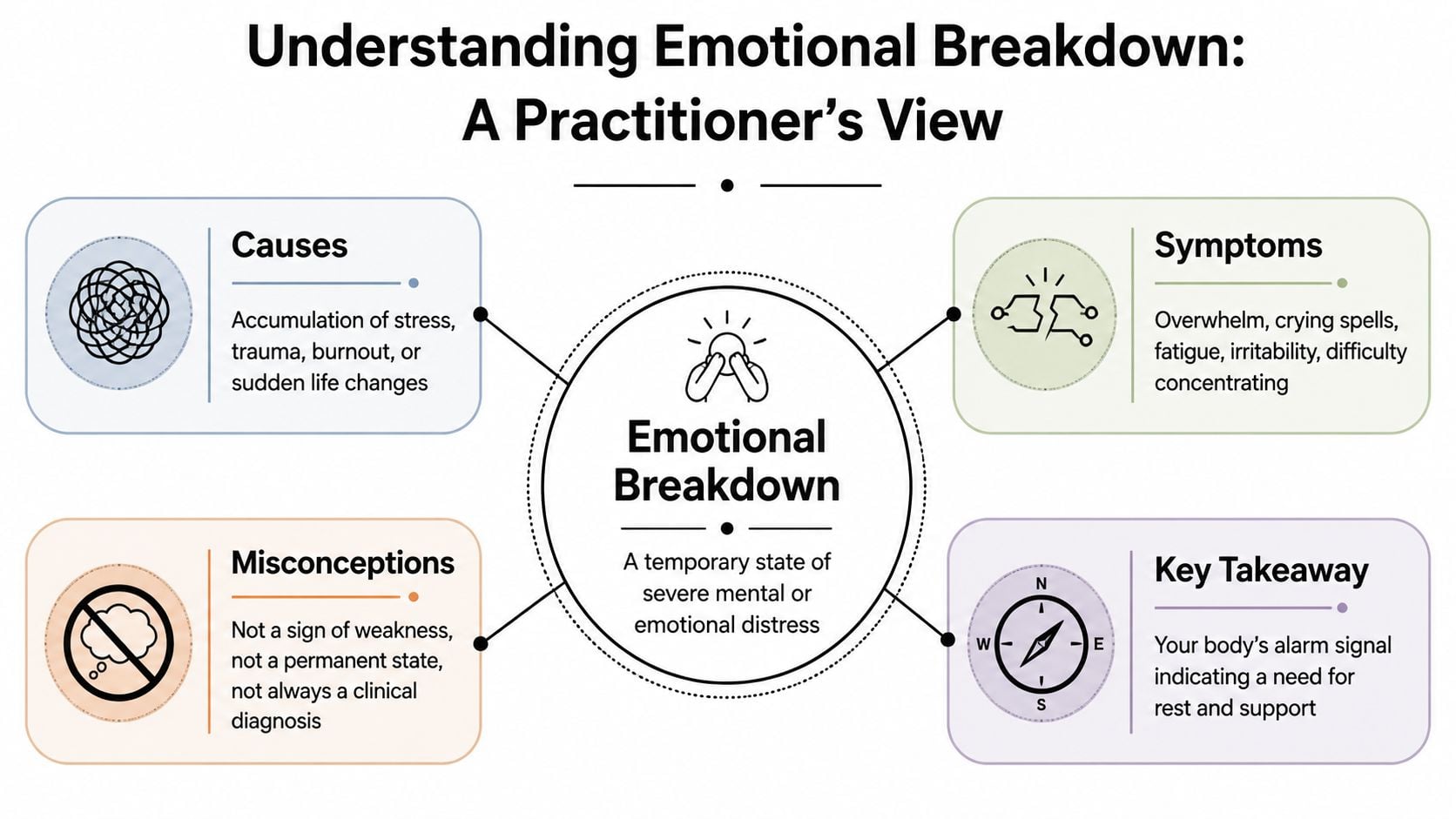
From a practitioner’s standpoint, an emotional breakdown is a temporary state of severe emotional distress that overwhelms your normal coping capacity. It is not a formal diagnosis by itself. It’s a description of what happens when your internal load exceeds your ability to regulate, think clearly, and keep functioning in your usual way.
That’s why people get confused. They look for one neat label. What they’re experiencing is a traffic jam of stress, emotion, body activation, and reduced mental bandwidth.
Think of it like a circuit breaker
Your nervous system is built to handle challenge. It’s not built to run at high strain without enough recovery, support, or processing.
When I explain this to clients, I use a circuit breaker analogy. A circuit breaker trips when the load is too high. It’s not a moral event. It’s protective. Your system does something similar. When stress keeps building, your higher-order thinking gets less available. Planning, perspective, language, and judgment all get harder to access. The more overloaded you become, the less helpful “just calm down” advice becomes.
That’s also why somatic tools matter. They don’t ask your most overwhelmed part to think its way out first. They give the body a path back toward steadiness.
It’s not just a bad day
A bad day is painful, frustrating, discouraging. But usually you can still track what’s happening, do basic tasks, and recover with sleep, space, or one good conversation.
A breakdown is different. The key difference is capacity. Your ability to function, decide, organize, or self-soothe gets impaired enough that daily life starts to buckle. You may feel emotionally flooded, physically depleted, unusually numb, or all three.
It’s also not always the same as a panic attack. A panic attack often involves an intense spike of fear and body symptoms. A breakdown can include panic, but it can also look like prolonged crying, shutdown, irritability, inability to work, private collapse, or going emotionally flat for days.
Clinical reality: people often wait too long to take a breakdown seriously because they expect it to look dramatic.
The silent breakdown most people miss
This is the version high-achievers, students, caregivers, and competent-looking adults often don’t recognize in themselves. They keep producing. They keep replying. They keep showing up. Inside, they are thinning out.
The idea of a silent collapse has gained attention because many people don’t explode outwardly. They withdraw, cry privately, swing between numbness and irritation, and suppress what they feel to stay productive. One cited summary notes a 28% rise in self-reported “silent breakdowns” among professionals and students ages 25 to 40 since 2023, with 62% saying they suppress emotions to maintain productivity in this School of Life discussion of breakdown and emotional suppression.
If that sounds like you, don’t dismiss it because you’re still functioning on paper. Outward performance can hide severe internal strain.
The Signs Your System Is Overloaded
An emotional breakdown rarely arrives as one clean symptom. It usually shows up as a cluster. Naming that cluster matters because it helps you stop treating ten separate problems as ten separate failures.
Adults ages 18 to 25 have the highest rate of any mental illness in the U.S. at 32.2%, according to NAMI’s mental health by the numbers. That doesn’t mean only young adults break down. It does tell you this kind of distress is common during periods of identity pressure, transition, and overload.

Emotional signs
These are the internal signals people often notice first, though they don’t always connect them to one pattern.
- Intense sadness or hopelessness: not just disappointment, but a heavy sense that you can’t hold yourself together
- Irritability: small demands feel invasive or unbearable
- Numbness: some people don’t feel “too much.” They feel almost nothing
- Emotional whiplash: crying, then anger, then flatness
- Fear of losing control: often paired with shame about needing help
A common mistake is assuming numbness means you’re doing better than someone who’s crying. It often means your system has shifted into another form of protection.
Physical signs
The body keeps score long before the mind makes sense of it.
- Exhaustion: the kind sleep doesn’t fully fix
- Sleep changes: trouble falling asleep, waking too early, or sleeping to escape
- Appetite changes: either loss of interest in food or using food for relief
- Muscle tension and aches: especially jaw, neck, shoulders, stomach
- Feeling physically slowed down or agitated: either can show up
If your body feels “off,” don’t automatically interpret that as proof you’re weak. Often it means your system has been burning fuel without enough recovery.
Behavioral signs
At this stage, other people may start noticing, or your life starts becoming harder to manage.
| Area | What overload can look like |
|---|---|
| Work or school | missed deadlines, staring at tasks, inability to start simple things |
| Relationships | withdrawing, snapping, going quiet, avoiding calls |
| Daily care | skipping meals, staying in bed, neglecting hygiene, forgetting basics |
| Coping | overworking, doom scrolling, isolating, using distractions to avoid feeling |
Sometimes the clearest sign of an emotional breakdown is not the feeling itself. It’s the sudden inability to do what you normally do.
If several of these signs are showing up at once, don’t argue with yourself about whether you “deserve” support. Take the pattern seriously.
Three Things to Do in the Next Ten Minutes
When your system is overloaded, insight is not the first job. Stabilization is. If your mind is spiraling, your next move should be simple enough to do while distressed.
Breakdowns often come after stacked stress, and one cited summary notes that sleep deprivation can impair prefrontal cortex activity, reducing emotional regulation capacity by 15% to 25% in this article on causes, signs, and recovery. That’s one reason body-based steps work better in the moment than long internal debates.

Step one, make the space smaller
Do less. Reduce input. Get out of the argument, the group chat, the store, the hallway, the meeting, or the car if you can do so safely.
If possible:
- Sit down somewhere with a wall behind you
- Put both feet on the floor
- Silence nonessential notifications
- Delay decisions that do not need to happen right now
Your distressed brain will tell you everything is urgent. Most of it isn’t.
Step two, orient to your senses
Grounding works because it gives the brain and body a present-moment task. You are not trying to feel amazing. You are trying to become less hijacked.
Try this slowly:
- Name five things you can see
- Notice four things you can physically feel
- Identify three things you can hear
- Name two things you can smell
- Notice one thing you can taste, or one breath moving in and out
If that feels too elaborate, use the simpler version. Press your feet into the floor and describe the pressure in your heels and toes for thirty seconds.
Practical rule: if a tool requires a lot of concentration, it’s probably too advanced for the first ten minutes of a breakdown.
If you want a simple reset you can save and reuse, this emotion regulation checklist gives you a clearer sequence than trying to improvise while flooded.
Step three, change your breathing without forcing it
Don’t aim for perfect deep breathing. Forced deep breaths can make some people more distressed.
Use one of these instead:
- Long exhale breathing: inhale gently, exhale a little longer than the inhale
- Box breathing: inhale, hold, exhale, hold, using the same count if that feels comfortable
- Physiological sigh: take one inhale, then a small second inhale on top, then let out a long exhale
Do that for a few rounds. Not because breathing solves everything, but because it signals to your body that the emergency level can come down.
If you can, add one concrete act of care right after. Drink water. Wash your face. Hold a warm mug. Put on socks. These tiny physical actions sound unimpressive. In a breakdown, they are often the bridge back to choice.
How to Help Someone Having a Breakdown
If someone you care about is having an emotional breakdown, your calm matters more than your advice. Most helpers make the same mistake. They rush to fix, explain, persuade, or organize. It comes from love. It often creates more pressure.
Mental health crises drive 6 million emergency room visits annually in the U.S., according to this summary of mental health statistics and crisis burden. Family and friends can sometimes help de-escalate distress before it reaches that point, but only if they stop trying to manage the person and start helping create safety.
Supporting someone through a breakdown
| Do This (Create Safety) | Avoid This (Create Pressure) |
|---|---|
| Stay physically and emotionally steady. Lower your voice, slow your pace, sit nearby if welcome. | Don’t match their intensity. Fast talking, panic, or visible frustration adds fuel. |
| Use short, simple language. “I’m here.” “You don’t have to explain it all right now.” | Don’t interrogate. “What happened?” repeated five ways can overwhelm them further. |
| Offer one practical choice. Water, a blanket, a quieter room, a ride, help making one call. | Don’t flood them with options. Distress shrinks decision-making capacity. |
| Validate the experience. “This looks like a lot.” “You’re not alone in this.” | Don’t minimize. “It’s not that bad” usually increases shame. |
| Watch for safety concerns. If there’s risk of self-harm, medical danger, or inability to stay safe, seek urgent help. | Don’t assume it will pass on its own if safety is in question. |
What actually helps
The most useful role is often co-regulation. Your job is not to make them understand everything in the moment. Your job is to help their nervous system borrow some of your steadiness.
A few phrases tend to help:
- “You don’t have to solve this right now.”
- “Let’s just handle the next five minutes.”
- “Do you want me to stay, or give you a little space nearby?”
- “Can I help reduce the noise and decisions around you?”
That last question is better than “What do you need?” because people in breakdown often don’t know.
What usually backfires
Trying to reason with someone who is flooded is usually ineffective. So is turning the moment into a lecture about habits, boundaries, medication, work, school, or responsibility.
If this is a pattern in your family or relationship, learning what emotional availability actually looks like matters. Many people think they’re being supportive when they’re actually becoming controlling, performative, or anxiously overinvolved.
Calm presence is not passive. It is active help delivered without pressure.
When the immediate crisis settles, the work becomes about not landing back here — and that work is hard to do alone. Online platforms like Talkspace can match you with a licensed therapist usually within 24 hours, work in all 50 states, accept most major insurance, and let you message your therapist between sessions when something comes up that you don’t want to forget. They’re where I’d point a student or coaching client today — the path from “I think I need help” to “I’m in a session” is short enough to actually walk.
Rebuilding After the Storm Your Path Forward
Once the worst of the wave passes, many wonder: “How long until I feel normal again?” The more honest answer is that recovery has a pattern, but not a shortcut.
One cited summary reports that recovery often takes 4 to 12 weeks for isolated events, and may take longer when the breakdown is tied to underlying conditions. The same summary says 45% of families report worsened dynamics when they lack a shared framework for recovery in this discussion of emotional breakdowns and recovery patterns.

Treat the breakdown like data
This is the reframe often missed. They treat the breakdown as the problem. Often, the breakdown is the signal that exposes the problem.
Ask better questions after the acute phase:
- What had been building before this?
- What was I forcing myself not to feel?
- What part of my life had become performative, unsustainable, or disconnected from reality?
- Where was I functioning without true recovery?
- What support did I need earlier that I kept postponing?
These questions are not for self-attack. They’re for pattern recognition.
Build a recovery environment
People often sabotage recovery by trying to “bounce back” too fast. They want one good day to mean full repair. That usually creates a second crash.
A better approach is to rebuild conditions:
- Reduce unnecessary load: postpone what can wait
- Protect sleep and basic routines: meals, hydration, getting outside, showering
- Limit high-conflict conversations: not forever, but during the fragile phase
- Create fewer decisions: simplify your day on purpose
- Get support that matches the problem: counseling, therapy, coaching, medical care, family coordination
If you need help sorting thoughts, beliefs, and behavior after the acute stage, these cognitive behavioral therapy techniques are useful because they help you separate facts, fears, and patterns instead of treating all internal noise as truth.
Know when professional help is needed
If you are in crisis right now — if the breakdown has tipped into thoughts of harming yourself — reach out immediately. In the US, you can call or text 988 to reach the Suicide & Crisis Lifeline, free and confidential, 24/7. There is no version of this that you have to carry alone.
Sometimes a breakdown is primarily situational. Sometimes it’s attached to depression, anxiety, trauma, burnout, grief, or another mental health condition that needs direct care.
Seek professional support sooner if:
- you can’t return to basic functioning
- the distress keeps escalating
- you’re using harmful coping methods to get through the day
- you’re having thoughts of self-harm or suicide
- family conflict is making recovery harder instead of safer
You do not need to wait until things are catastrophic to qualify for help. Early support is often the difference between a painful interruption and a prolonged collapse.
Recovery isn’t about becoming the person who can tolerate anything. It’s about becoming the person who listens sooner and reorganizes life more honestly.
An emotional breakdown can become a turning point if you treat it as information. Not a verdict. Information. It tells you where the system overloaded. It tells you what your body could no longer keep contained. If you work with that truth instead of against it, the breakdown can mark the start of a different kind of stability. One built on reality, not performance.
A note on affiliates: This article includes affiliate links to platforms I’ve vetted and would recommend to my own clients and students. If you start with a recommended service through a link here, I may earn a small commission — at no extra cost to you. I only mention what I’d actually point you to in person. The recommendation comes first; the relationship is disclosed second.
If this resonates, the full framework lives in Love, Success, Freedom and Boundaries.
A practical playbook for raising emotionally resilient kids — and breaking the patterns you didn’t choose to inherit.
Get the ebook →