



I can usually tell when someone has been living inside a victim pattern before they say the word “victim.” Their shoulders are up, their breath is shallow, and every story ends in the same place: “So what was I supposed to do?” If that’s where you are right now, you’re not weak, dramatic, or broken. You’re tired.
You may have been mistreated. You may have been ignored, controlled, blamed, betrayed, or put in impossible situations for a long time. That pain is real. I want to start there because a lot of advice on how to stop being a victim skips straight to “take responsibility,” and when someone is hurting, that lands like accusation.
But there’s a difference between being hurt and building your identity around helplessness.
That difference matters because one of those honors reality, and the other hands your future to the people or events that wounded you. When I work with clients, I’m rarely trying to talk them out of their pain. I’m helping them see the pattern wrapped around the pain. Once you can see the pattern, you can interrupt it.
The Feeling Is Real, But the Story Is a Choice
A woman once sat across from me and said, “Every time I trust someone, they disappoint me. So I’ve learned not to expect much.” She wasn’t lying. She had real reasons to feel that way. People had let her down repeatedly.
But the sentence that trapped her wasn’t “I’ve been hurt.” It was “This is how it always goes.”
That’s the pivot.
If you want to know how to stop being a victim, start by separating the feeling from the identity. Feeling powerless in a painful moment is human. Deciding that powerlessness is your role in life is a story. Stories feel true when they’ve been rehearsed for years, especially if they were written during trauma, chaos, or childhood.
What the victim story sounds like
It usually doesn’t sound dramatic. It sounds familiar.
- “People always take advantage of me.”
- “No matter what I do, nothing changes.”
- “I’m the one who gets blamed.”
- “Other people have choices. I just deal with what happens.”
That story can make sense emotionally and still damage your life. It changes the way you read relationships, conflict, work, and even your own body. You stop looking for options and start scanning for proof that you’re stuck.
You don’t heal by arguing with your pain. You heal by refusing to let pain become your job description.
The reframe that actually helps
I tell clients this often. You’re not dealing with a permanent truth. You’re dealing with a trained pattern. That should bring relief, not shame.
A pattern can be studied. A pattern can be interrupted. A pattern can be replaced.
That doesn’t mean pretending everything is fair. It means asking a harder and more useful question: “What am I repeating that keeps me in the same position?” When you ask that, your attention shifts from the problem out there to the pattern in here. That’s where agency starts.
Your Story Is a Map Not the Territory
Individuals often don’t notice they’re living inside a script. They think they’re “being realistic.” But your story about what happened is not the same as reality itself. It’s a map. It highlights some things, ignores others, and predicts where you think the road goes next.
That matters because maps can be outdated.
Dr. Martin Seligman’s research on learned helplessness showed that after exposure to uncontrollable negative events, people often stop acting even when circumstances change. Cognitive behavioral interventions that help people reframe events as more controllable can reverse helplessness in up to 80% of individuals, according to this summary of Seligman’s findings. The point is simple and important. What feels fixed may be learned.
Here’s a visual way to think about it.
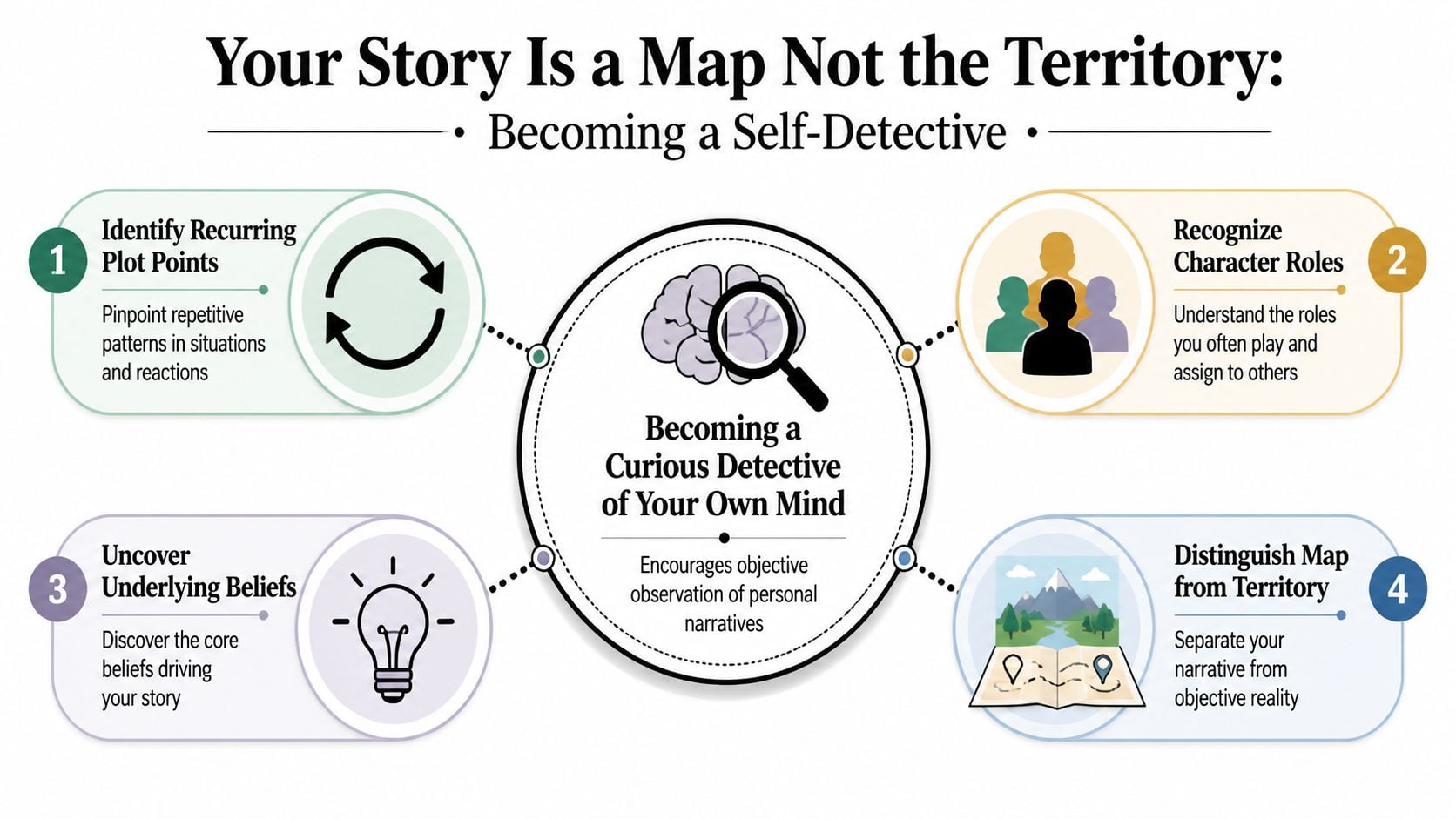
Learn to catch the plot, not just the pain
When you feel wronged, your mind gets fast. It fills in motives, predicts endings, and assigns roles. Someone becomes the villain. You become the one cornered, dismissed, or overlooked. The event may be real, but your interpretation often arrives preloaded.
I like narrative work. If you want a deeper version of this process, these narrative therapy techniques can help you separate yourself from the problem and examine the story with more distance.
Try looking for these repeating elements:
- The trigger: What kinds of situations activate your “here we go again” response?
- The cast: Who do you keep casting as controlling, selfish, abandoning, or impossible?
- The role: Are you the ignored one, the rescuer, the scapegoat, the one who never gets chosen?
- The ending: What bad outcome do you assume before the conversation even starts?
The hidden payoff matters
People get uneasy when I use the word “payoff,” because it sounds like I’m saying your suffering is fake. I’m not. I’m saying patterns stay alive because they offer something, even when they cost you dearly.
Sometimes the payoff is protection. If you assume people will disappoint you, you don’t have to risk hope. If you frame every conflict as proof that others are unfair, you don’t have to examine your own passivity. If you stay in the role of the injured one, you may avoid the discomfort of assertiveness, grief, or change.
Reflection exercise
Write down one situation you still feel charged about.
Then answer these four prompts:
- What happened?
- What story did I immediately tell about it?
- What do I get to avoid by keeping that story?
- What is this story costing me in peace, clarity, or action?
That last question is where the fog starts to lift.
A short reality check
Use this table when you’re not sure whether you’re naming reality or rehearsing a victim script.
| Pattern question | Victim story response | Agent response |
|---|---|---|
| What happened? | “This always happens to me.” | “This happened. It affected me.” |
| What does it mean? | “I have no good options.” | “I may not like my options, but I need to find them.” |
| Who has the power? | “They do.” | “They have some power. I still have choices.” |
| What happens next? | “Probably more of the same.” | “I need to test a different move.” |
You don’t need a perfect story. You need a more accurate one.
Your Body Keeps the Score and How to Settle It
A lot of people know the right mindset and still can’t access it when it counts. They can recite boundaries, journal prompts, and affirmations. Then one text message comes in, one look from a parent, one sharp tone from a partner, and the whole system collapses.
Sponsored

That’s not a character flaw. It’s a body problem as much as a thinking problem.
A Journal of Family Psychology finding summarized here reported that a parent’s victim orientation predicts 28% higher odds of adolescent learned helplessness. The same summary notes that this transmission is amplified when families lack somatic awareness and unconsciously mirror one another’s stress responses. In plain language, families teach victim patterns through the nervous system, not just through words.

Why thinking positive usually fails in the moment
When your body goes into freeze, collapse, appeasement, or panic, your reasoning narrows. You don’t evaluate. You react. A victim pattern often lives there first. The mind comes in afterward and writes the explanation.
I see this with adults who grew up around volatility. The moment someone gets irritated, their body already knows its old assignment. Stay small. Apologize fast. Don’t make it worse. Later they say, “I don’t know why I gave in again.” Their body knew. Their conscious mind arrived late.
If anxiety is part of that loop, natural approaches to reducing anxiety can support the mental work by helping your system come down enough to choose.
Three somatic resets that restore agency
None of these are dramatic. That’s why they work.
Orient the room
Look slowly around your space and name five neutral things you see. A lamp. A window. A blue folder. A chair leg. A shadow on the floor.
This tells your nervous system you’re in the present, not back in the original danger. Do it before hard conversations, after a triggering text, or when you feel your chest tighten.
Drop your shoulders and lengthen the exhale
Your body often tells the truth before your thoughts do. If your shoulders are lifted and your jaw is hard, your system is preparing for threat.
Try this for one minute:
- Inhale gently through the nose
- Exhale longer than the inhale
- Unclench your jaw
- Let your shoulders fall without forcing them
You’re not trying to become calm in a spiritual sense. You’re making it easier to think.
When your body believes you’re trapped, your mind will produce trapped thoughts.
Press into the ground
Put both feet flat on the floor and press down. Notice the pressure in your heels, the chair under you, the support beneath your body.
Then, should discretion be required, say, “I’m here. I can choose my next move.”
That sentence matters. Not because it’s magical, but because it links physical support with a behavioral choice. It shifts you from collapse toward action.
What to watch for in families
If you’re a parent, your body is teaching as much as your words. Kids notice the sigh, the shut-down face, the frantic tone, the “nothing ever works” posture. They learn helplessness by exposure.
A useful family question is: “What does our house do with stress?” Not what do we say about stress. What do we do with it physically?
If the answer is tense up, blame, withdraw, or wait for rescue, that’s the pattern to change.
Rewriting the Script with Boundaries and Assertive Action
Insight is not enough. Calm is not enough either. At some point, how to stop being a victim becomes behavioral. You need a different move.
That usually means boundaries, direct requests, and cleaner ownership.
The most useful framework I know for this shift is the Oz Principle accountability model. A summary of the model explains that it has been adopted by 80% of Fortune 500 companies and has reduced victim-cycle behaviors by 55% in organizational settings by moving people from blame to proactive problem-solving through four steps: See It, Own It, Solve It, Do It. You can read that overview in this explanation of the Oz accountability model.

See It and Own It
Many skip straight to solving and miss the two steps that break the victim loop.
See It means naming the pattern without sugarcoating it. “I keep hinting instead of asking.” “I agree, then resent it.” “I wait for people to notice my needs and call them selfish when they don’t.”
Own It does not mean blaming yourself for what others did. It means owning your part in what happens next. That sounds like: “I didn’t cause this person’s behavior, but I am responsible for my response.”
Practical rule
Ownership is not self-attack. It’s the moment you stop asking, “Whose fault is this?” and start asking, “What is my move now?”
Solve It with smaller, clearer actions
Victim thinking likes vague outrage. Agency likes specific behavior.
Instead of “I need people to respect me,” solve the actual problem:
- With your boss: “I need to say I can’t take on that deadline without moving another priority.”
- With a friend: “I need to stop answering emotionally loaded messages the second they arrive.”
- With family: “I need to leave the conversation when yelling starts.”
Boundaries then become practical.
The gracious no
Use this when you want to decline without overexplaining.
“I can’t do that.”
“I’m not available for that.”
“That doesn’t work for me.”
“I can help with this part, but not that part.”
The key is what comes after. Nothing dramatic. No courtroom argument. No ten-minute defense. The more you justify, the more you invite negotiation.
The I-statement request
Use this when you need a change, not just distance.
A clean formula is:
- Name the behavior
- Name the impact
- Make the request
Examples:
- “When plans change at the last minute, I feel thrown off. I need more notice.”
- “When you joke about that in front of other people, I shut down. Please stop doing that.”
- “When you text me repeatedly while I’m working, I lose focus. Send one message and I’ll reply when I can.”
Do It before you feel fully ready
At this stage, many individuals give up. They want confidence first. Confidence usually follows action, not the other way around.
Try a short rehearsal process before a hard conversation:
- Write the sentence once. Not five versions. One.
- Say it out loud. Your body needs to hear you use direct language.
- Stand while you practice. Agency is easier to access when your posture supports it.
- Expect discomfort. Feeling shaky doesn’t mean the boundary is wrong.
Here’s the trade-off nobody likes, but everybody needs. If you stop being a victim, some people will call you difficult. They were benefiting from your confusion. That doesn’t mean your new behavior is cruel. It often means it’s working.
A simple comparison to keep in mind
| In the victim loop | In an agentic response |
|---|---|
| Waits to be understood | States the need clearly |
| Hints, then resents | Asks directly |
| Overexplains boundaries | Holds the line briefly |
| Focuses on fairness | Focuses on the next choice |
| Replays the offense | Practices a new behavior |
You don’t reclaim power by winning every interaction. You reclaim it by changing your participation.
Stories from My Office Three Paths from Victim to Agent
A young professional came in convinced her boss was the entire problem. He interrupted her, changed priorities, and acted like everything was urgent. All of that was true. Her victim story was, “I have no room here. He decides everything.”
When we slowed it down, the pattern got clearer. Every time he became intense, her body went into appeasement. She said yes too quickly, then vented later. Her first shift wasn’t a speech. It was somatic. Feet on the floor. Long exhale. Then one sentence in meetings: “If this moves up, what should move back?” That question changed the dynamic because it replaced silent resentment with visible ownership. He didn’t become easy overnight, but she stopped disappearing.
The parent who heard his own script in his son
A father told me his teenager gave up too easily. “If one thing goes wrong, he says there’s no point.” As we talked, the father started laughing in the painful way people do when they recognize themselves. He said some version of “nothing ever works” almost daily.
That family didn’t need another lecture about positive thinking. They needed pattern awareness. He began tracking what happened in his body when stress hit. Tight chest. Heavy sigh. Slumped posture. Then he practiced one change in front of his son. Instead of “Here we go, this always turns into a mess,” he used, “This is frustrating. Let’s figure out the next step.” The son didn’t transform in a week. But the house started teaching a different script.
Some of the most important change happens when one person in a family refuses to pass the pattern on.
The woman who was always “the one people dump on”
Another client felt chronically used by friends. She was the one people called in crisis, but when she needed support, they were hard to find. Her victim story was convincing: “I attract selfish people.”
Part of that was true. But part of the pattern was behavioral. She answered every call, never said no, and gave care she hadn’t been asked to give. Then she expected loyalty in return. That’s not generosity. That’s unspoken contracting.
Her shift was simple and hard. She stopped picking up every emotional emergency. She let some messages wait. She said, “I don’t have the capacity for this tonight.” A few friendships got thinner. The healthy ones got more honest. She stopped measuring love by how needed she was.
These are the kinds of changes that matter. Not dramatic reinventions. Better questions. Calmer bodies. Clearer words. Different moves.
Knowing When You Need More Than a Map
Sometimes an article like this is enough to help you spot the pattern and make a meaningful change. Sometimes it isn’t. That’s not failure. It just means the pattern is deeper than self-observation alone can reach.
If your victim pattern is tied to significant trauma, chronic emotional abuse, family enmeshment, or relationships that still feel unsafe, you may need more than insight. You may need structure, support, and someone who can help you notice the moves you can’t see from inside the system.
Clinical psychology data indicates that for people struggling with a persistent victim mentality rooted in trauma or family dynamics, therapy leads to a 75% improvement rate in symptoms and overall well-being, according to this summary of victim mentality and treatment. That matters because getting help is not surrender. It’s one of the clearest acts of agency available to you.
Signs self-help may not be enough
You should consider more support if:
- You understand the pattern but can’t interrupt it. Insight keeps arriving after the damage is done.
- Your body overwhelms your intentions. You freeze, fawn, panic, or collapse in ways that feel automatic.
- The pattern is hurting work, parenting, or close relationships. The cost is spreading.
- Your history contains trauma that still feels live in your nervous system.
- You keep choosing people who confirm your old story.
If that’s you, guided support can help. Personal growth counseling is one place to start if you want help turning self-awareness into action.
A map is useful. A guide is sometimes what gets you through the terrain.
You do not need to become cold, invulnerable, or endlessly self-reliant. You only need to stop organizing your life around the assumption that you are powerless. That shift changes relationships. It changes your posture. It changes what your children learn by watching you. It changes the kind of future you can imagine.
I write about the hidden scripts that run our relationships, especially the ones families and high-functioning adults miss because they look normal. Next week I’m breaking down the rescuer role and why it’s often the other side of the victim coin. If you want that in your inbox, join David Pexa.
If this resonates, the full framework lives in Love, Success, Freedom and Boundaries.
A practical playbook for raising emotionally resilient kids — and breaking the patterns you didn’t choose to inherit.
Get the ebook →
