



Summary: What Does It Mean To Be Emotionally Available? — understanding the signal beneath the surface and what you can actually do about it.
Being emotionally unavailable isn’t a character flaw — it’s usually a protection strategy that made sense at some point. Understanding why someone shut down is the first step toward reconnection.
You’re talking to someone you care about. Maybe it’s a partner, a friend, or even a colleague after a hard week. They finally say something real: “I’ve been feeling overwhelmed lately.”
And the response lands with a thud.
“Have you tried time blocking?”
“You’re overthinking it.”
“That’s just stress. You’ll be fine.”
Then the subject changes.
Nothing openly cruel happened. But something important didn’t happen either. The moment asked for presence, and instead it got advice, analysis, or escape.
A lot of people searching what does it mean to be emotionally available are trying to name that exact gap. They’re not looking for a buzzword. They’re trying to understand why some interactions feel warm, safe, and real, while others feel strangely empty even when the other person says all the “right” things.
That confusion gets even sharper if you’re a high-achiever. You may be good at communication, dependable under pressure, and skilled at helping others solve problems. Yet your relationships can still feel thin. Or exhausting. Or full of effort but missing closeness.
Emotional availability is often the missing piece.
It’s not about being dramatic. It’s not about sharing every feeling with everyone. And it’s definitely not about becoming the unpaid emotional support system for every person in your life.
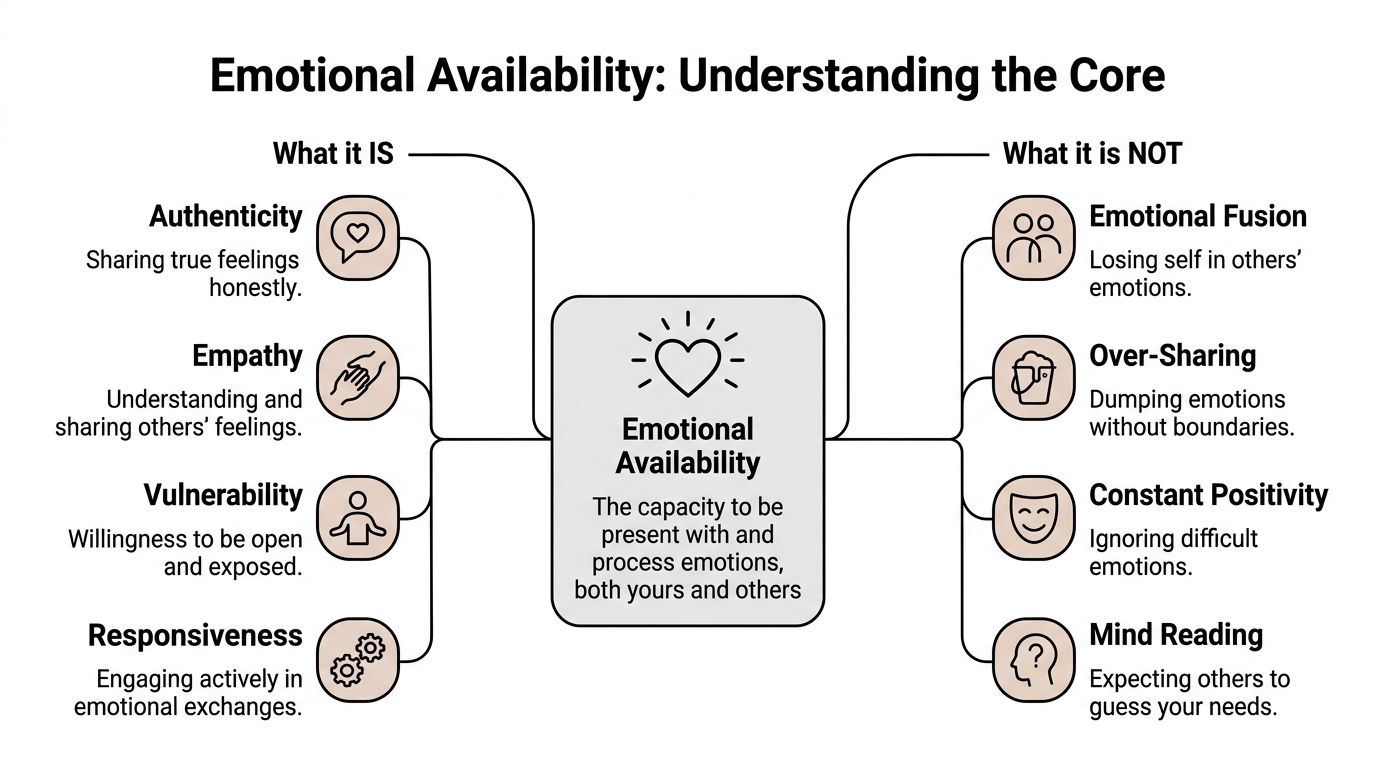
It’s about having the capacity to stay present with emotions, yours and someone else’s, without shutting down, performing, fixing, or disappearing. That capacity shapes intimacy, trust, repair, and the sense that a relationship has real depth.
The Frustrating Search for Real Connection
You can see emotional unavailability in ordinary moments.
A woman tells her boyfriend she felt hurt when he canceled plans at the last minute. He immediately explains why he was busy. His explanation may even be valid. But he never meets her feeling. She leaves the conversation thinking, “He heard my words, but he didn’t get me.”
At work, an employee tells a manager, “I’m stretched thin and starting to feel burned out.” The manager responds with a polished productivity lecture. Helpful on paper. Disconnecting in practice.
When a conversation feels off
Many people don’t describe these moments by saying, “This person lacks emotional availability.” They say things like:
- “I can’t reach them.” They seem physically present but emotionally elsewhere.
- “I always leave feeling more alone.” The conversation happened, but connection didn’t.
- “I end up editing myself.” It feels easier to stay surface-level than risk being unmet.
That “off” feeling matters. It usually means one person offered emotional reality, and the other person didn’t have the capacity, skill, or willingness to stay with it.
Some relationships have plenty of contact but very little connection.
Growth-oriented people often miss this because they’re used to rewarding action. If a person texts back, shows up, handles logistics, and says they care, that can look like relationship health. But emotional connection asks for more than reliability. It asks for responsiveness.
Why this is hard to name
Part of the frustration is that emotional availability sounds abstract. It can seem like one of those terms people throw around when they’re disappointed.
But the experience behind it is concrete. You feel safer being honest with some people than others. Some people can sit with sadness, fear, anger, or uncertainty. Others rush to fix, joke, defend, or withdraw.
The difference changes everything.
What Emotional Availability Really Means and What It Is Not
Emotional availability is the capacity within a relationship to share a healthy emotional connection. It’s a scientifically validated construct that began in the 1970s, and a major milestone came in 1998 when Biringen and colleagues developed the Emotional Availability Scales. That framework assesses relational qualities such as sensitivity, nonintrusiveness, and responsiveness, and research support includes over 450 peer-reviewed articles discussed in this overview of emotional availability research.
In plain language, emotional availability means you can stay in contact with feelings without getting lost, guarded, controlling, or checked out.
The simplest way to understand it
Think of emotional availability like emotional bandwidth.
If you have enough bandwidth, you can notice what you feel, name it, stay grounded, and respond to another person without collapsing into their emotions or fleeing from them.
If you don’t have enough bandwidth, several things tend to happen:
- You intellectualize. You explain the feeling instead of feeling it.
- You fix. You rush to solutions so discomfort ends quickly.
- You disappear. You go quiet, distant, or vague.
- You overperform care. You become useful instead of emotionally honest.
That last one trips people up the most.
Emotional availability is not emotional labor
Many high-achievers confuse emotional availability with being endlessly supportive. They become the listener, the organizer, the calm one, the person who remembers everyone’s needs.
That can look mature. Sometimes it is. But sometimes it’s avoidance wearing a responsible outfit.
Being emotionally available does not mean:
| Common misconception | What is happening |
|---|---|
| Always being there for everyone | You may be abandoning your own limits |
| Taking care of other people’s emotions | You may be managing discomfort, not connecting |
| Never upsetting anyone | You may be people-pleasing instead of being honest |
| Sharing everything immediately | You may be skipping boundaries |
A useful analogy is this: be a safe harbor, not a rescue boat.
A safe harbor offers steadiness, room, and protection. A rescue boat frantically overfunctions, chases, and takes responsibility for keeping everyone afloat. One creates connection. The other often creates burnout.
Practical rule: If your version of “being emotionally available” regularly leaves you depleted, resentful, or disconnected from your own needs, it may be emotional labor rather than genuine presence.
What emotional availability looks like in real life
It often sounds ordinary.
“I feel disappointed, and I want to talk about it.”
“I can see this matters to you. I’m here.”
“I need a little time to settle, but I don’t want to avoid this.”
“I can’t fix this for you, but I can stay with you.”
That’s availability. Honest. Boundaried. Responsive.
If you struggle to tell the difference between raw sensations and named emotions, this guide on emotions vs feelings can help build the emotional vocabulary that availability depends on.
Recognizing the Signs of Emotional Unavailability
Emotional unavailability rarely announces itself. It shows up in patterns.
One person seems warm until the conversation gets real. Another says they want closeness, but becomes evasive when vulnerability appears. Someone else is attentive when things are easy, then goes cold during conflict.

What it looks like in dating
A common scenario goes like this. You say, “I’d like to know where this is going.” The other person replies with charm, chemistry, and vague reassurance, but no real answer. You get closeness on their terms and confusion on yours.
Other signs include:
- They talk about feelings in theory. They can discuss therapy, healing, or self-awareness, but avoid naming what they feel right now.
- They go hot and cold. Intense interest gives way to distance when intimacy deepens.
- They want access without responsibility. They seek emotional or physical closeness while resisting commitment, clarity, or repair.
- They deflect with humor or distraction. The moment gets serious, and they change the tone.
This helps explain why dating feels so draining for many people. A 2022 Match.com survey found over 70% of singles feel burned out from dating, and the same analysis cited that 35% of men demonstrate high emotional intelligence, leaving many people struggling to find reliable emotional connection, as summarized in this discussion of modern dating and emotional availability.
If you want a deeper breakdown of the pattern itself, this article on what it means to be emotionally unavailable is a useful companion.
What it looks like outside romance
Emotional unavailability also shows up in families, friendships, and workplaces.
A friend only wants upbeat conversation. If you share grief, they become visibly uncomfortable and start offering silver linings.
A colleague asks how you are, then cuts you off the second your answer becomes real.
A parent says “you can tell me anything,” but gets defensive when you do.
Emotional unavailability is often less about not caring and more about not being able to stay present.
A quick contrast
An emotionally available person might not always say the perfect thing. But they tend to do a few grounding things well:
- They acknowledge emotion before solving.
- They stay more consistent under stress.
- They can hear your experience without making it all about them.
Unavailability isn’t just silence. Sometimes it hides inside competence, charisma, or constant helpfulness.
The Hidden Roots of Unavailability Trauma and Attachment
Many people assume emotional unavailability is a personality flaw. It often isn’t. It’s a protective pattern.
If closeness once felt unpredictable, overwhelming, or unsafe, your nervous system may have learned that emotional contact is dangerous. Then, even if part of you wants intimacy, another part reacts as if intimacy is a threat.

The window of tolerance
A helpful concept here is the window of tolerance.
This is the zone where you can feel emotion without becoming so overwhelmed that you shut down or so activated that you become reactive. When you’re inside that window, you can listen, reflect, speak with candor, and stay connected.
When you’re outside it, connection gets harder.
- Hyperactivated states can look like defensiveness, panic, control, or anger.
- Hypoactivated states can look like numbness, blankness, dissociation, or withdrawal.
In both cases, the body is trying to protect you.
Why closeness can trigger shutdown
For some people, emotional exposure lights up old danger signals. Being known can feel risky. Depending on your history, your body may read conflict as abandonment, need as weakness, or intimacy as loss of control.
That’s why someone can sincerely want closeness and still pull away the moment it appears.
According to this trauma-informed explanation of emotional availability, emotional unavailability is often physiological, not just psychological. Trauma can disrupt the nervous system’s window of tolerance, and evidence cited there notes that interventions such as EMDR and body-based techniques can reduce relational PTSD symptoms by 40% to 60% after 12 sessions by helping people stay present with emotions.
That matters because it reframes the problem. You’re not only dealing with beliefs. You may be dealing with a body that has learned to protect first and connect later.
If your system experiences closeness as danger, insight alone won’t always change the pattern.
Attachment patterns make this more visible
Attachment language can be useful here if you treat it gently.
Some people learned to minimize needs because no one responded well to them. Others became highly alert to signs of distance or rejection. In adult relationships, those patterns can show up as avoidance, clinging, mixed signals, or fear around repair.
The key point isn’t the label. It’s the function.
Ask: What is this behavior protecting me from?
That question creates more change than “What’s wrong with me?”
Compassion without excuse
Understanding the roots of unavailability doesn’t mean tolerating harmful behavior. A pattern can be understandable and still be painful. You can have empathy for someone’s history and still require honesty, effort, and boundaries.
But when you understand unavailability as protection, shame often loosens. That’s important. Shame tends to make people hide. Safety helps people build capacity.
A Practical Self-Assessment for Your Own Availability
Self-awareness matters more than self-labeling.
You don’t need to decide whether you are “an emotionally available person” once and for all. It’s more accurate to ask where you have access to that capacity, and where you lose it.
Questions worth sitting with
Try these slowly. Journal them if that helps.
- When someone I care about is upset, what’s my first impulse? To listen, fix, explain, withdraw, reassure too fast, or make it lighter?
- How easy is it for me to say a direct feeling sentence? Not “I think things are weird,” but “I feel hurt,” “I feel scared,” or “I feel disappointed.”
- What happens in conflict? Do I stay present, get sharp, go numb, become overly accommodating, or disappear?
- Can I receive care? Or do I only feel comfortable being the helper?
- Do I confuse support with overfunctioning? After “being there” for someone, do I feel connected, or drained?
The burnout clue
One overlooked sign is exhaustion.
A key distinction in this topic is that true availability includes boundaries and reciprocity, while excessive caretaking can become a form of avoidance. People, especially high-achievers, often focus on others’ needs so intensely that they lose contact with their own. That pattern can look caring from the outside while producing burnout on the inside, as described in this discussion about emotional availability and emotional labor.
Use this simple check:
| If it’s emotional availability | If it’s emotional labor |
|---|---|
| You feel present | You feel responsible |
| You can be honest | You manage the other person’s reaction |
| There is reciprocity | The flow is mostly one-way |
| Boundaries remain intact | Boundaries blur |
Try replacing “Was I supportive?” with “Was I honest, present, and boundaried?” That question reveals a lot.
What to notice this week
Don’t aim for a perfect answer. Watch your patterns in real time.
Notice the moment just before you explain, rescue, appease, or shut down. That moment is often where your growth lives.
How to Build Your Capacity for Emotional Connection
Emotional availability grows through practice, not pressure.
You don’t become more available by forcing vulnerable conversations when your whole body wants to run. You build capacity by helping your system stay present for a little more truth, a little more honesty, and a little more discomfort at a time.

Start with your body
Before a hard conversation, pause and notice what’s happening physically.
Is your jaw tight? Chest closed? Stomach buzzing? Are you speeding up internally?
That’s useful information. It tells you whether you’re resourced enough to stay present.
A few grounded practices can help:
- Use 4-7-8 breathing. Inhale for 4, hold for 7, exhale for 8. This can slow the rush to react.
- Try a somatic check-in. Ask, “What sensation am I feeling right now?” Stay with the body for a few breaths before speaking.
- Use the 5-4-3-2-1 grounding method. Name things you can see, feel, hear, smell, and taste to bring yourself back to the present.
Build emotional honesty in small reps
You don’t need a dramatic disclosure. Start smaller.
Instead of “I’m fine,” try “I’m more disappointed than I expected.”
Instead of “It’s okay,” try “Part of me is okay, and part of me is hurt.”
Instead of silent resentment, try “I need a little more clarity from you.”
Short, clear statements build tolerance.
Create a simple practice loop
This works well for busy professionals:
- Morning or evening journal: Write one sentence that begins with “I feel…”
- During tension: Pause before replying and check your body state
- After conversations: Ask, “Did I stay present, perform, or protect?”
If you want a structured tool for this skill, David Pexa offers an emotion regulation checklist that can support more consistent reflection.
Growth in emotional availability often looks less like “saying more” and more like staying when it would be easier to leave yourself.
Choose paced progress
If deep emotional work feels overwhelming, that doesn’t mean you’re failing. It may mean you need smaller steps, steadier people, or better support.
Therapy, coaching, journaling, mindfulness apps, and body-based practices can all help when they increase your ability to remain present rather than push you into overwhelm.
The goal isn’t perfect openness. It’s greater capacity for real connection, with honesty, limits, and self-respect intact.
Frequently Asked Questions
What does emotional availability actually look like?
Being emotionally available means you can be present with someone else’s feelings without needing to fix, dismiss, or redirect them. It’s the ability to hold space without an agenda.
How do I become more emotionally available?
The biggest barrier is usually your own discomfort with certain emotions. If sadness makes you anxious, you’ll unconsciously avoid it in others too. Start by expanding your tolerance for your own emotional range.
Why is emotional availability important in relationships?
Because people don’t just need you to be physically present — they need to feel felt. Emotional availability is what turns a relationship from functional to meaningful.
Keep Reading
- What does it mean to be emotionally unavailable?
- Emotionally Healthy Spirituality: Thrive with Integrated Faith & Well-being
- Is Love an Emotion? A Guide to Its True Nature
If you process emotions through writing — journaling, drafting hard conversations, putting words to what you’re feeling — the tool I use to draft most of my words is Wispr Flow. It transcribes your voice into clean, edited text in real time, so the friction between thinking it and writing it basically disappears.
Conclusion
Understanding is the first step, but it’s what you do with that understanding that changes things. The ideas in this article aren’t meant to sit in your head — they’re meant to shift how you see your situation and give you something concrete to act on. Start with the one thing that felt most relevant, apply it this week, and notice what changes.
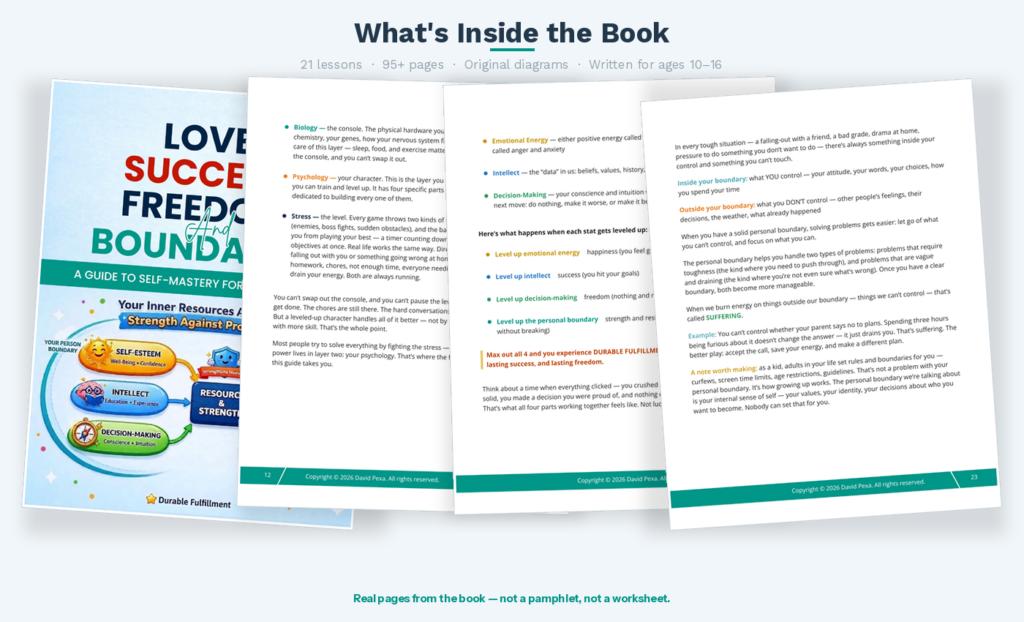
If this resonated, go deeper. My book Love, Success, Freedom and Boundaries gives you twelve frameworks for seeing the patterns that shape your life — and changing the ones that aren’t working.
A note on affiliates: This article includes affiliate links to platforms I’ve vetted and would recommend to my own clients and students. If you start with a recommended service through a link here, I may earn a small commission — at no extra cost to you. I only mention what I’d actually point you to in person. The recommendation comes first; the relationship is disclosed second.
If this resonates, the full framework lives in Love, Success, Freedom and Boundaries.
A practical playbook for raising emotionally resilient kids — and breaking the patterns you didn’t choose to inherit.
