


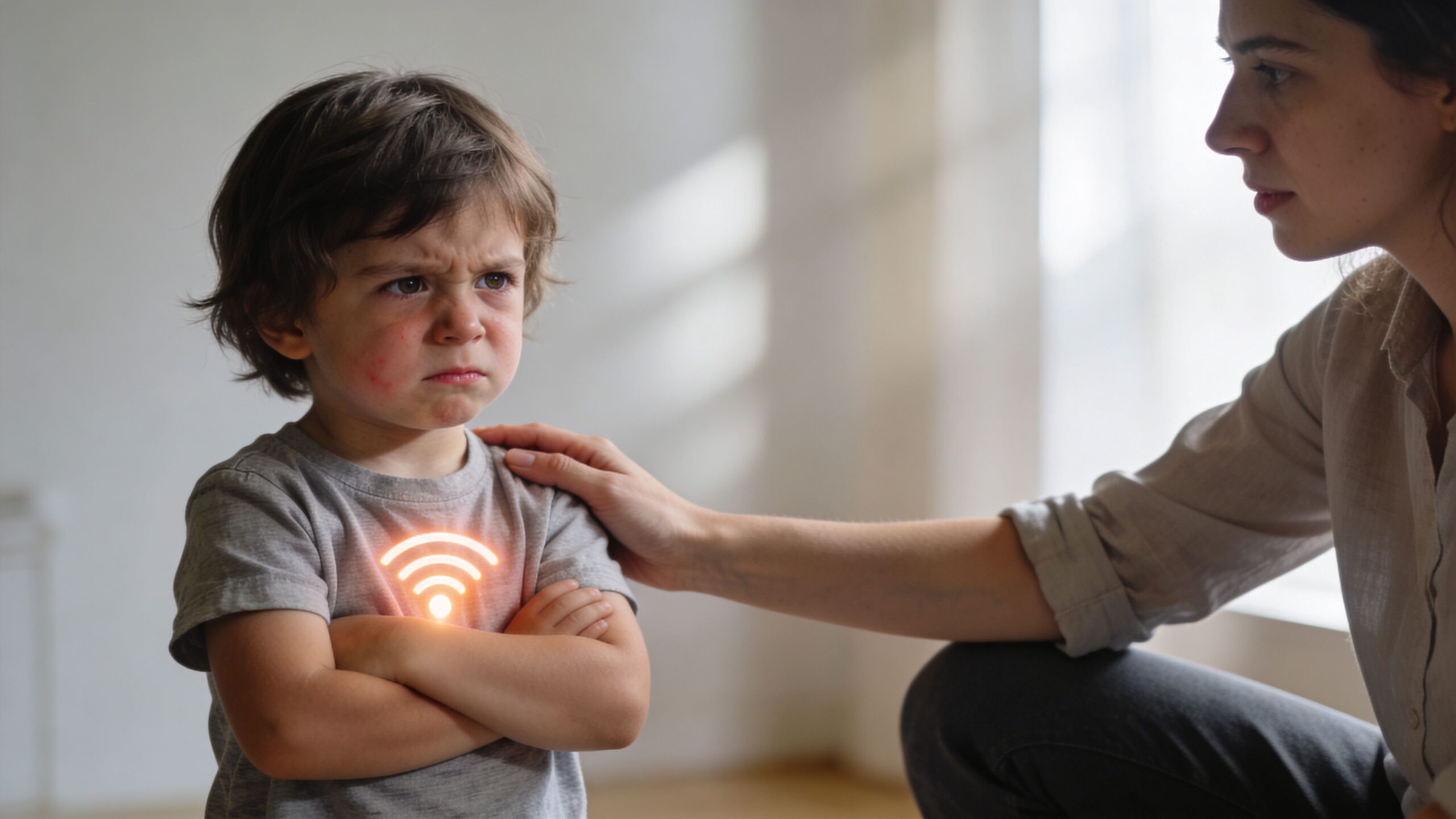
You know the moment. Your child goes from fine to furious in what feels like ten seconds, and suddenly the whole house is organized around the outburst. In that moment, most parents don’t need more judgment. They need a way to understand what’s happening.
Child anger scares people because it feels disruptive, disrespectful, and sometimes impossible to reason with. But if you only treat it as a behavior problem, you miss the message inside it. That’s where families get stuck.
I want to offer you a different frame. Anger is often not the main problem. It’s the loudest signal. When you learn to decode that signal, you stop playing emotional whack-a-mole and start addressing the core issue underneath.
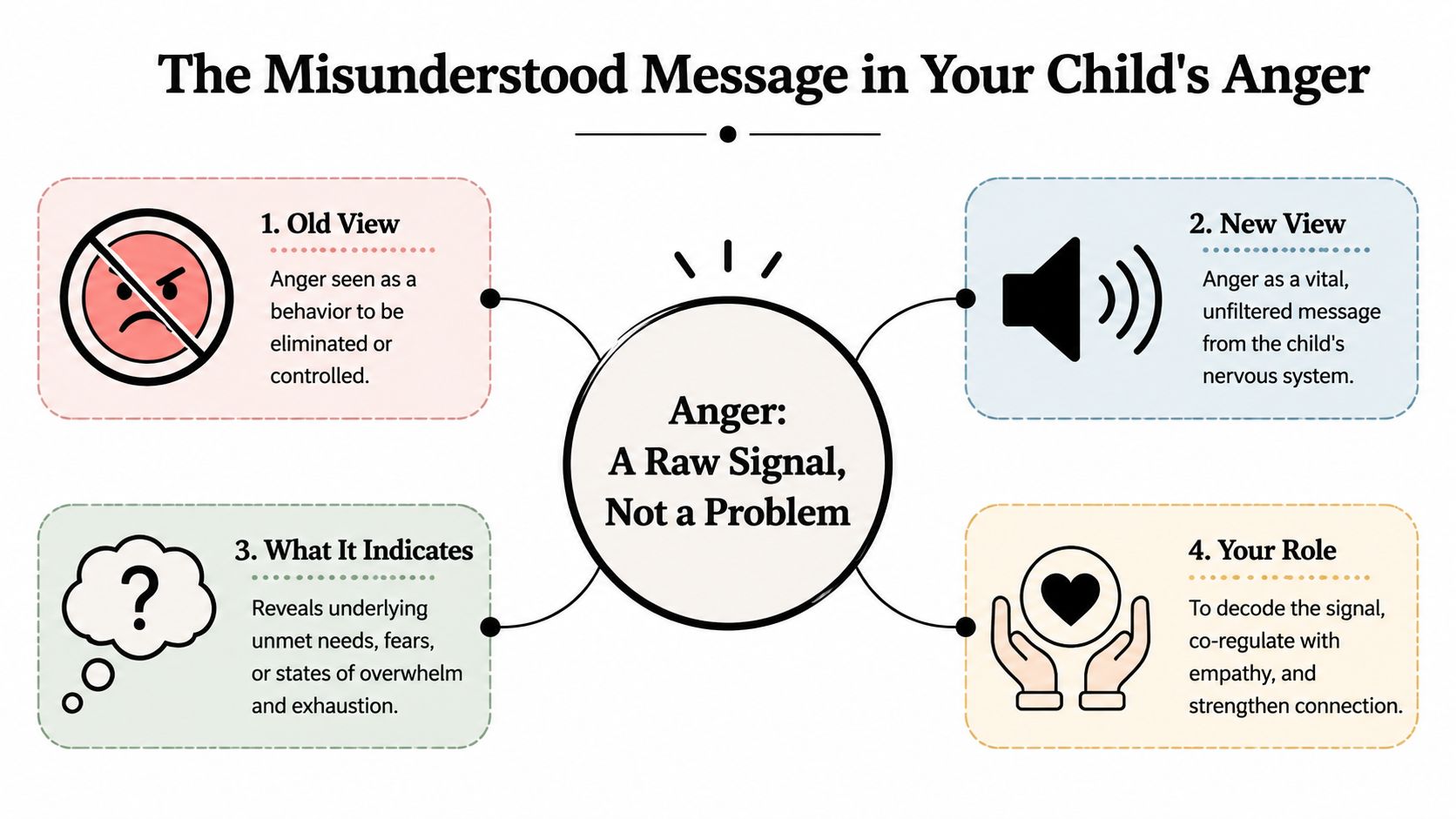
The Misunderstood Message in Your Child’s Anger
Most parents were taught some version of this: anger is bad, calm is good, and your job is to shut the anger down quickly. That approach looks efficient, but it usually backfires.
A child’s anger is often a nervous system signal before it’s a discipline issue. Think smoke alarm, not character flaw. The alarm may be too loud, badly timed, or triggered by burnt toast instead of a house fire, but it’s still telling you something.
Why reason fails in the hot moment
When a child is flooded, the thinking part of the brain is not in charge in the way you want it to be. The body is leading. The emotional system is leading. Survival responses are leading.
That’s why lectures during an outburst usually fail. That’s why “Use your words” often lands badly when the child is already over the edge. It’s not that language never matters. It’s that timing matters.
Practical rule: If your child looks wildly unreasonable, assume their system is overwhelmed before you assume they’re choosing chaos.
This shift matters because it changes your role. You stop acting like a courtroom judge and start acting like a decoder. You ask different questions.
Not “How do I stop this right now?”
More like:
- What is this signal reacting to
- What demand just became too much
- What feeling came first
- What does my child not yet know how to say clearly
Anger is often the outer shell
Children reach for anger because anger is powerful. It covers softer states that feel harder to tolerate. Fear feels vulnerable. Shame feels exposing. Disappointment feels helpless. Anger feels active.
That doesn’t mean you excuse hurtful behavior. It means you understand why the behavior appears in the first place. A child who slams a door may be saying, “I feel trapped.” A child who screams over a small limit may be saying, “I was barely holding it together before you asked.”
When parents make this shift, the energy in the home changes. You don’t become permissive. You become more accurate. And accuracy helps.
What’s Developmentally Normal and What Is Not
Parents ask me some version of the same question all the time. “Is this normal, or is something off?” That’s the right question.
Not all child anger means the same thing. Some of it is built into development. Some of it signals a pattern that needs more support. The difference is less about whether your child ever gets angry, and more about intensity, persistence, recovery, and impact.
A longitudinal study found that 65.1% of children followed low to average anger trajectories, while 6.7% showed high, stable anger patterns that predicted significant psychological problems by age 8 in this developmental study on anger trajectories. The point isn’t to alarm yourself. The point is to notice whether you’re looking at a passing phase or a durable pattern.
What tends to be typical
Toddlers often go physical. Their bodies are ahead of their language. Preschoolers melt down around frustration, transitions, hunger, fatigue, and limits. School-age kids may argue, sulk, blame, or explode when they feel embarrassed or cornered. Teens often shift from tantrums to sharper words, withdrawal, contempt, or door-slamming.
That range can still be normal.
What makes parents anxious is not anger itself. It’s unpredictability. It’s the sense that every small request could become a fight.
Child anger developmental norms vs red flags
| Age Group | Typical Expression (The “Signal”) | Potential Red Flag (The “Static”) |
|---|---|---|
| Toddlers | Tantrums, yelling, dropping to the floor, hitting when overloaded | Frequent extreme aggression, long recovery times, anger that seems constant rather than situational |
| Preschoolers | Explosive reactions to limits, transitions, losing, sharing, or sensory overload | Anger that dominates most days, harms others regularly, or blocks participation in normal routines |
| School-age children | Arguing, blaming, storming off, crying that flips into rage | Repeated destruction, intense shame after every episode, school or peer problems driven by anger |
| Teens | Irritability, snapping, sarcasm, withdrawal, verbal escalation | Threats, violence, severe property damage, major relationship or school breakdown tied to anger |
A useful way to assess this is to stop asking, “Did my child overreact?” and ask:
- Is it getting more frequent
- Is the recovery getting harder
- Is it spreading into school, friendships, and family life
- Is the child anger becoming their main way of handling stress
If you’re seeing that kind of pattern, it helps to look more closely at broader child behavior problems and what they may be signaling.
Normal anger still needs guidance. Concerning anger needs guidance plus investigation.
What matters more than age
I pay close attention to whether the child can return to baseline. A strong reaction followed by repair is very different from a child who stays hostile, brittle, or on edge long after the event is over.
I also look at whether the anger fits the context. Young children are allowed to be immature. That’s not the same as being stuck. The concern rises when the anger becomes persistent, costly, and less connected to what’s happening.
Decoding the Outburst What They’re Really Saying
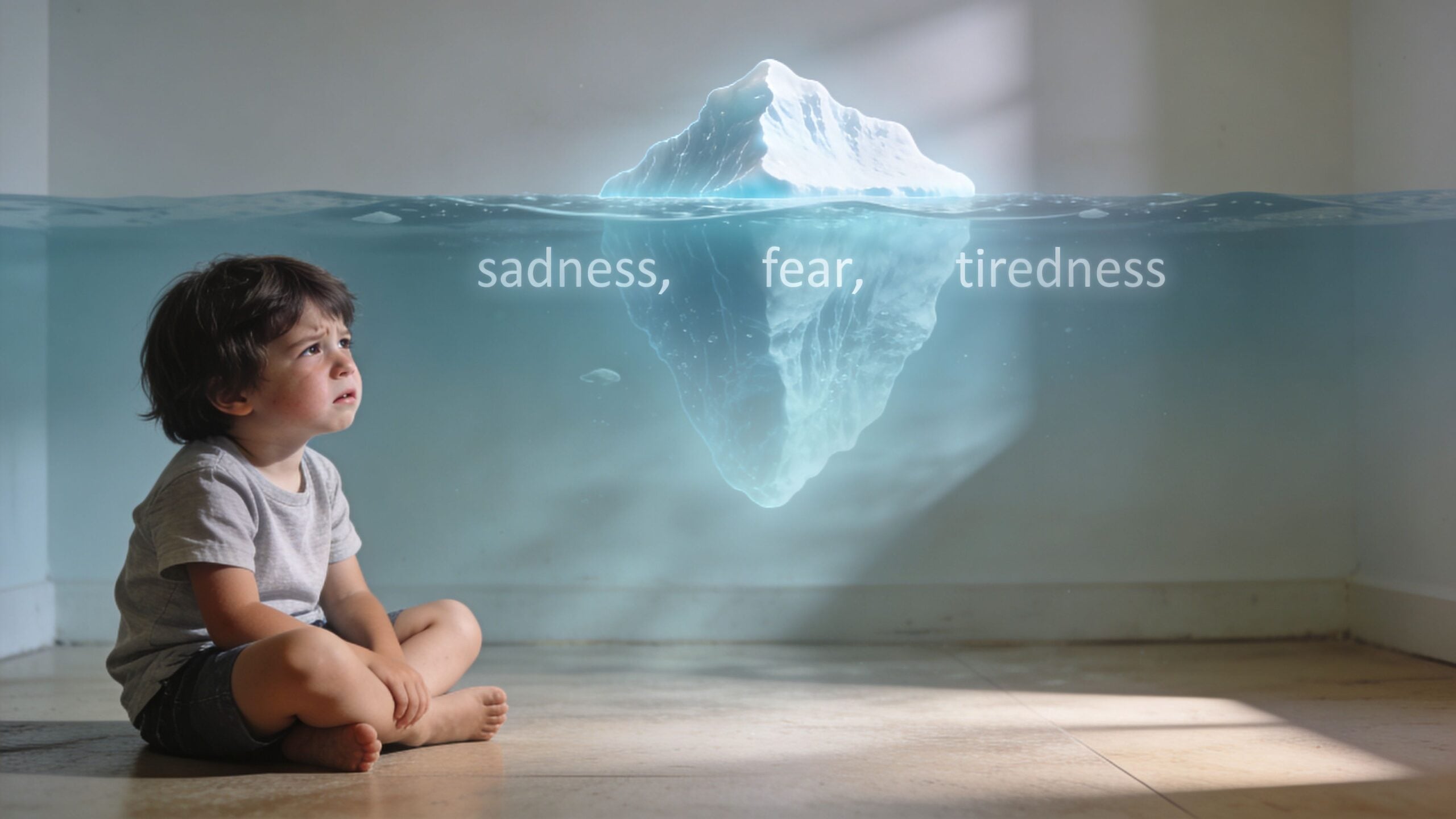
The visible outburst is the tip of the iceberg. The hidden drivers sit below the waterline.
Parents often focus on the shout, the slam, the thrown shoe, the harsh words. I understand why. That’s the part that hits the room. But if you only respond to the visible part, you’ll keep missing the engine underneath.
The common messages under the anger
In practice, child anger often translates into a handful of hidden messages.
Sponsored

- Fear. “I think I’m in trouble, exposed, or unsafe.”
- Overwhelm. “There is too much coming at me and I can’t process it.”
- Shame. “I already feel small, and now I need to push that feeling away.”
- Injustice. “This feels unfair, and I don’t have another way to protest.”
- Disconnection. “I don’t feel understood, and anger gets your attention fast.”
- Exhaustion. “I was functioning on fumes before this happened.”
A child rarely says those lines directly. They say them through behavior.
A better question to ask
When the anger spikes, ask yourself, What is this anger protecting?
That question changes everything.
The child who screams over homework may not be “lazy.” They may be protecting themselves from the feeling of being stupid. The child who lashes out at a sibling may be protecting a fragile sense of control after a chaotic day. The child who explodes over a small change in plans may be protecting themselves from anxiety they can’t organize.
Anger is often the bodyguard for a more vulnerable feeling.
There’s another layer here. For some children, especially those who’ve lived with chronic stress, anger becomes part of threat detection itself. Research on maltreated children found that their brains showed a response to angry faces that was 2 to 3 times larger than their peers, described in this report on hypersensitivity to anger cues. What looks disproportionate from the outside may feel adaptive from the inside.
What decoding sounds like in real life
Instead of saying, “This is ridiculous,” try translating the likely message.
- “You got angry fast when your brother touched your stuff. I’m wondering if you already felt crowded.”
- “You’re yelling about the homework, but I think something in it feels too hard or too exposing.”
- “You’re acting like you don’t care, but this might be one of those moments where not caring feels safer than trying.”
You won’t always guess right. That’s fine. A decent hypothesis is better than a moral lecture.
Children calm faster when they feel understood accurately. Not indulged. Understood.
Your First Move When the Storm Hits
When the storm hits, your job is not to win. It’s to stabilize the system.
Most parents try one of two things. They either overpower the child with commands, or they over-explain in a desperate effort to reason the child back to calm. Neither works well when the nervous system is already flooded.

Anchor yourself first
Before you say a word, check your own body. Drop your shoulders. Unclench your jaw. Slow your breathing. Lower your volume.
If your body says danger, your child’s body will answer it. Adults often underestimate how much regulation is physical before it’s verbal.
Say the unspoken
Put simple language around the feeling without approving the behavior.
Try lines like:
- “You are really angry right now.”
- “This hit you hard.”
- “You did not want that limit.”
- “Something about this feels too much.”
That kind of language helps a child feel seen. It also reduces the need to keep escalating just to prove they’re upset.
Hold the boundary
Validation is not surrender. You can understand the feeling and still stop the behavior.
- If there’s hitting say, “I won’t let you hit.”
- If there’s throwing move objects and say, “I’m moving this. It’s not for throwing.”
- If there’s verbal abuse keep it short. “I’m here. I’m not staying in a conversation where we hurt each other.”
Calm is not weakness. Calm is containment.
After the child is safe, look at repeatable triggers. One major modern example is screen use. A study in JAMA Pediatrics found that a 1-SD increase in tablet use at age 3.5 predicted a 22% rise in anger by age 4.5, and increased anger then predicted another 22% increase in tablet use by age 5.5, forming a loop described in this tablet use and anger study. If your child melts down around device transitions, don’t treat that as random. Treat it as a pattern you can interrupt.
A practical place to start is an emotion regulation checklist for high-intensity moments. Use it when your own brain goes blank.
Rewiring the Pattern After the Calm
The teaching moment is usually not during the explosion. It’s after.
Parents often wait until everyone is calm, then swing into one of two extremes. They either punish and move on, or they pretend it never happened because they’re relieved the house is quiet again. Both miss the most valuable window.
Repair builds more than punishment does
After a rupture, children need help making sense of what happened. That’s how they build self-awareness. That’s how they learn that relationships can stretch and repair instead of just break.
Parental modeling is a powerful lever. As Dr. Roseann Hodge notes, a child’s frustration tolerance is often tied to a dysregulated nervous system shaped by parental inconsistency and reactions. She also points to poll data showing 1 in 7 parents see their child as angrier than peers, discussed in her article on childhood anger and family patterns.
If we want children to learn repair, we have to model it. Not perfectly. Consistently.
What to say later
You don’t need a TED Talk. You need a calm post-game review.
Try a structure like this:
- Start with observation. “When I said it was time to stop, you went from frustrated to furious.”
- Name the likely trigger. “I think the change hit you fast.”
- Invite reflection. “What was happening in your body right before you lost it?”
- Collaborate. “Next time, what would help you earlier? A warning, a break, fewer words, space?”
That conversation teaches pattern recognition. It gives the child a map.
The goal after an outburst is not to make your child feel worse. It’s to help them become more aware, more honest, and more capable next time.
What actually rewires the cycle
Punishment can stop behavior in the short term. It rarely builds the missing skill. Skill-building takes repetition.
A few things help:
- Name body cues. Tight chest, hot face, clenched fists, buzzing legs.
- Track triggers. Transitions, sibling contact, hunger, school pressure, noise, embarrassment.
- Practice alternatives when calm. Taking space, asking for help, squeezing a pillow, using a scripted phrase.
- Own your part. “I got sharp with you. That didn’t help.”
Children borrow regulation from adults before they build enough of their own. If you want to strengthen resilience over time, the same family habits that support confidence in kids also support anger recovery. Competence and regulation are close cousins.
When to Get Another Set of Eyes
Sometimes anger needs more than home-based adjustments. Getting help is not overreacting. It’s good pattern recognition.
If your child’s anger involves violence, serious property destruction, threats of self-harm, or major disruption at school or in close relationships, take that seriously. If the outbursts feel extreme, frequent, and hard to predict, trust that signal too.
A national survey found that nearly two-thirds of U.S. adolescents have experienced a severe anger attack, and one in 12 meets criteria for Intermittent Explosive Disorder. The same report found that only 6.5% of affected adolescents receive any professional treatment, according to Harvard Medical School’s summary of the NCS-A findings. That treatment gap matters.
You do not need to wait for a formal diagnosis to consult someone. In fact, the best time to get another set of eyes is often before the family has organized itself around the anger. Early support can help you sort out whether you’re dealing with developmental friction, stress overload, family patterning, trauma effects, or a condition that needs targeted care.
A simple rule helps here:
- Seek support when safety is at risk
- Seek support when anger is damaging daily life
- Seek support when you’ve become afraid of your child’s reactions
- Seek support when nothing you try changes the pattern
Competent parents ask for help. They don’t wait to be drowning.
I write about the patterns most parents never see until they’re already stuck inside them. If you want the next piece in your inbox, including practical breakdowns on sibling conflict, shutdown behavior, and what kids are really communicating when they say “I don’t care,” join David Pexa’s newsletter and resources here.
For the therapy option specifically, the access friction has dropped a lot in the last few years. Online platforms like Talkspace can match you with a licensed therapist usually within 24 hours, work in all 50 states, accept most major insurance, and let you message your therapist between sessions when something comes up that you don’t want to forget. I mention them by name because they’re the platform I’d point a student or coaching client to today — the path from “I think I need help” to “I’m in a session” is short enough to actually walk.
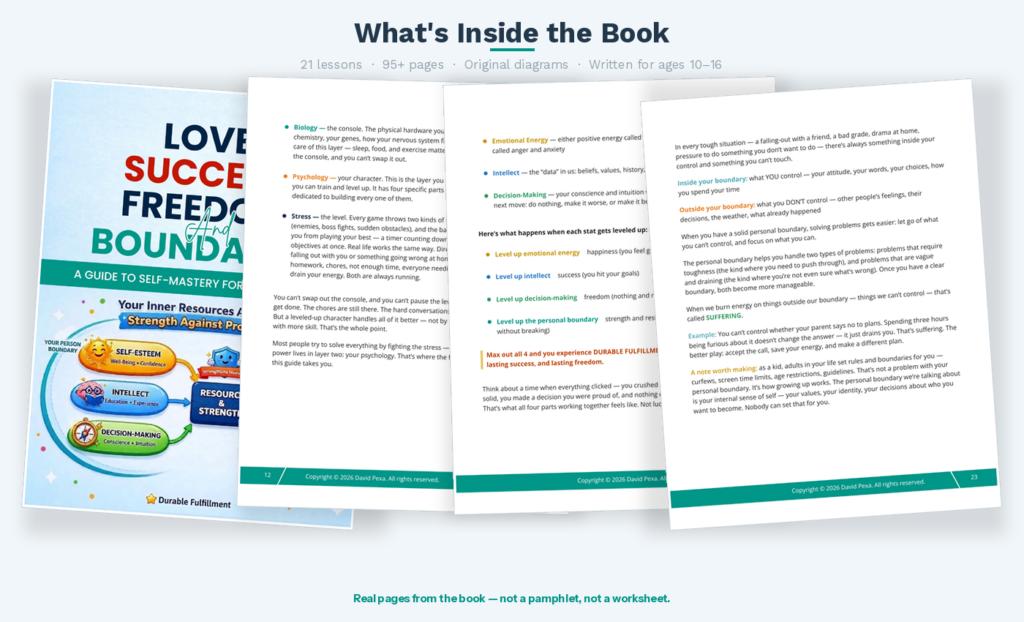
For parents who want the deeper framework — the one that makes work like this stick instead of feeling like you’re firefighting forever — my book Love, Success, Freedom and Boundaries is the structured version of what I teach my own students. Written for tweens and teens, but most parents tell me they pick up more from it than the kid does.
A note on affiliates: This article includes affiliate links to platforms I’ve vetted and would recommend to my own clients and students. If you start with a recommended service through a link here, I may earn a small commission — at no extra cost to you. I only mention what I’d actually point you to in person. The recommendation comes first; the relationship is disclosed second.
If this resonates, the full framework lives in Love, Success, Freedom and Boundaries.
A practical playbook for raising emotionally resilient kids — and breaking the patterns you didn’t choose to inherit.
Get the ebook →