


Summary: A practical guide to build confidence in kids: expert guide. What actually works, what doesn’t, and where to start.
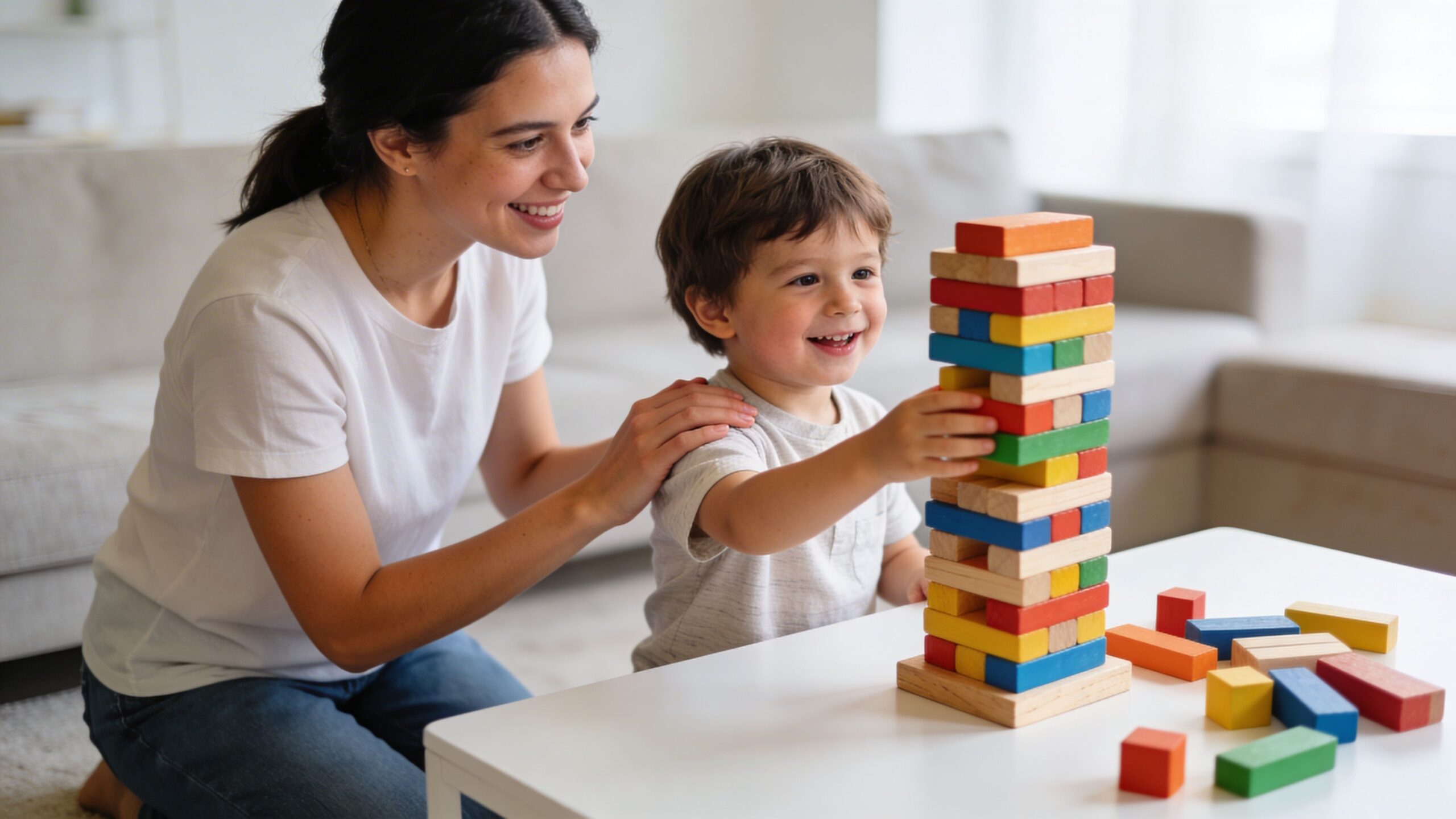
Building confidence in kids isn’t about praise or trophies. The children I’ve worked with who developed real confidence all had one thing in common: adults who let them struggle and stayed close while they did.
Most parents think confidence is something a child either has or doesn’t. The data says otherwise, and it’s far more urgent than that.
A landmark statistic from self-esteem expert Jack Canfield found that 80 percent of children entering first grade score high on self-esteem inventories, dropping to 20 percent by fifth grade and 5 percent by high school graduation (Adventures to Awesome summary). That means confidence doesn’t usually disappear all at once. It gets worn down, year by year, in ordinary moments.
As an educator and parent, I don’t see confidence as “feeling good all the time.” I see it as something more practical. A confident child can try, wobble, recover, and try again. They can hear “not yet” without turning it into “I’m bad at this.” They can make a mistake without making it their identity.
If you want to know how to build confidence in kids, start with this truth: confidence grows from repeated experiences of safety, effort, and competence. It doesn’t grow from constant praise, pressure, or rescue. It grows when a child feels secure with you and capable in the world.
Why Building Confidence in Kids Matters Now More Than Ever

A child’s confidence works like an internal translator. It helps them decide what a hard moment means.
The reason this matters is simple. Childhood now asks kids to perform, compare, and recover more often than many adults realize. A child with steady confidence is more likely to stick with a tough worksheet, try again after striking out, speak up with a friend, or walk into a new room without assuming they will fail. A child with fragile confidence often reads the very same moments as proof that something is wrong with them.
You can hear that difference in everyday language:
“I need help.”
“I’m still learning.”
“This is taking me a while.”
Compare that with:
“I can’t do it.”
“I’m bad at this.”
“Everybody else is better.”
Those sentences may sound small. They shape behavior in a big way.
Confidence changes the story kids tell themselves
Two children can miss the same math problem or get left out of the same game. One child sees a temporary problem. The other turns it into a personal verdict.
That inner story affects school, friendships, sports, and home life because kids act from the meaning they make. If struggle means “I’m learning,” they stay engaged longer. If struggle means “I’m the kind of kid who fails,” they protect themselves by quitting, avoiding, clowning around, or melting down.
Parents often miss this part because the surface behavior gets all the attention. The refusal, tears, anger, or shrug are easier to see than the belief underneath. Confidence work helps you address the root, not just the symptom.
Practical rule: Build confidence before the hard season hits. Kids use it the way hikers use good footing. You notice it most when the path gets steep.
Home is where confidence gets practiced
Children absorb your tone long before they can explain your message. They notice what happens on your face when they spill, forget, lose, or fail. They listen for whether mistakes sound repairable or shameful in your home.
As noted earlier, the pattern many children experience includes far more correction than encouragement. Busy families can slip into that rhythm without meaning to. Shoes on. Hurry up. Stop that. Fix this. Be careful. Try harder. By bedtime, a child may have heard plenty about what went wrong and very little about what they handled well.
That does not mean parents should praise everything. It means children need coaching that is specific enough to help them build a solid sense of capability. If you want a helpful distinction, this guide on self-esteem vs self-confidence explains the difference between feeling worthy and trusting your ability. Kids need both, and both are shaped at home.
Confidence grows through repeated coaching moments
Parents have more influence here than schools, teams, or personality labels suggest. Confidence grows in ordinary repetitions, the same way reading grows through many nights with books, not one great lesson.
Three patterns matter most:
- Name effort and strategy clearly: “You kept trying different ways to zip your coat.”
- Correct behavior without turning it into identity: “Throwing the block was unsafe. Let’s try that again with calmer hands.”
- Stay close while your child does hard things: “I’m right here. You do the next step.”
Those responses give a child something sturdy to stand on. They learn, “I can be frustrated without falling apart,” “I can make a mistake and repair it,” and “The adults in my life believe I can grow.”
If your child has been quitting quickly, avoiding challenges, or crumbling over small mistakes, treat that as useful information. You do not need more generic praise. You need a clearer coaching plan, and the rest of this article will help you build one by age and by situation.
The Two Pillars of Unshakeable Self-Esteem
If I had to simplify confidence-building into two pillars, I’d name them growth mindset and secure attachment.
One teaches a child, “I can get better.”
The other teaches, “I am safe, valued, and not alone while I learn.”
When those two work together, confidence becomes much more stable.
Growth mindset teaches kids what effort means
Research published in the Proceedings of the National Academy of Sciences found that students taught a growth mindset show increased motivation and higher academic performance. The method includes praising specific effort, reframing mistakes as learning opportunities, and helping children identify the strategies that worked (Tutor Doctor summary).
That sounds academic, but in a kitchen, car ride, or homework moment, it’s simple.
Instead of:
- “You’re so smart.”
Try:
- “You kept testing different ways to solve that.”
- “You didn’t give up when the first answer didn’t work.”
- “What helped you figure it out?”
This is the difference between labeling a child and coaching a child.
If you want a clean way to think about this, the distinction between self-esteem and self-confidence helps. Self-esteem is the deeper sense of worth. Self-confidence is trust in one’s ability to handle a task. Kids need both, but they often build confidence first through action.
A child who hears “You’re amazing” all day may still crumble when work gets hard. A child who learns “I can use effort and strategy” has something usable.

Secure attachment gives kids a safe base
A child won’t explore boldly if they think love disappears when performance drops.
Secure attachment doesn’t mean being permissive. It means your child knows your relationship is solid, even when they mess up. They experience correction without shame and support without over-rescue.
Here’s the simplest way I explain it to parents:
| Situation | What insecure confidence sounds like | What secure confidence sounds like |
|---|---|---|
| Child makes a mistake | “I’m bad.” | “I got it wrong.” |
| Child faces challenge | “Don’t make me.” | “Stay close while I try.” |
| Child gets feedback | “You’re mad at me.” | “You’re helping me improve.” |
A securely attached child can tolerate frustration better because they don’t experience every correction as rejection.
The two pillars work together
Growth mindset without attachment can feel cold. It turns into constant coaching.
Attachment without growth mindset can feel soothing in the moment, but it may leave a child under-challenged.
The sweet spot sounds like this:
- Warmth first: “I know this feels hard.”
- Belief next: “You can learn this.”
- Action last: “Let’s figure out the next step.”
That sequence matters. Children borrow our calm before they can use their own.
Age-Specific Confidence Building Routines and Activities
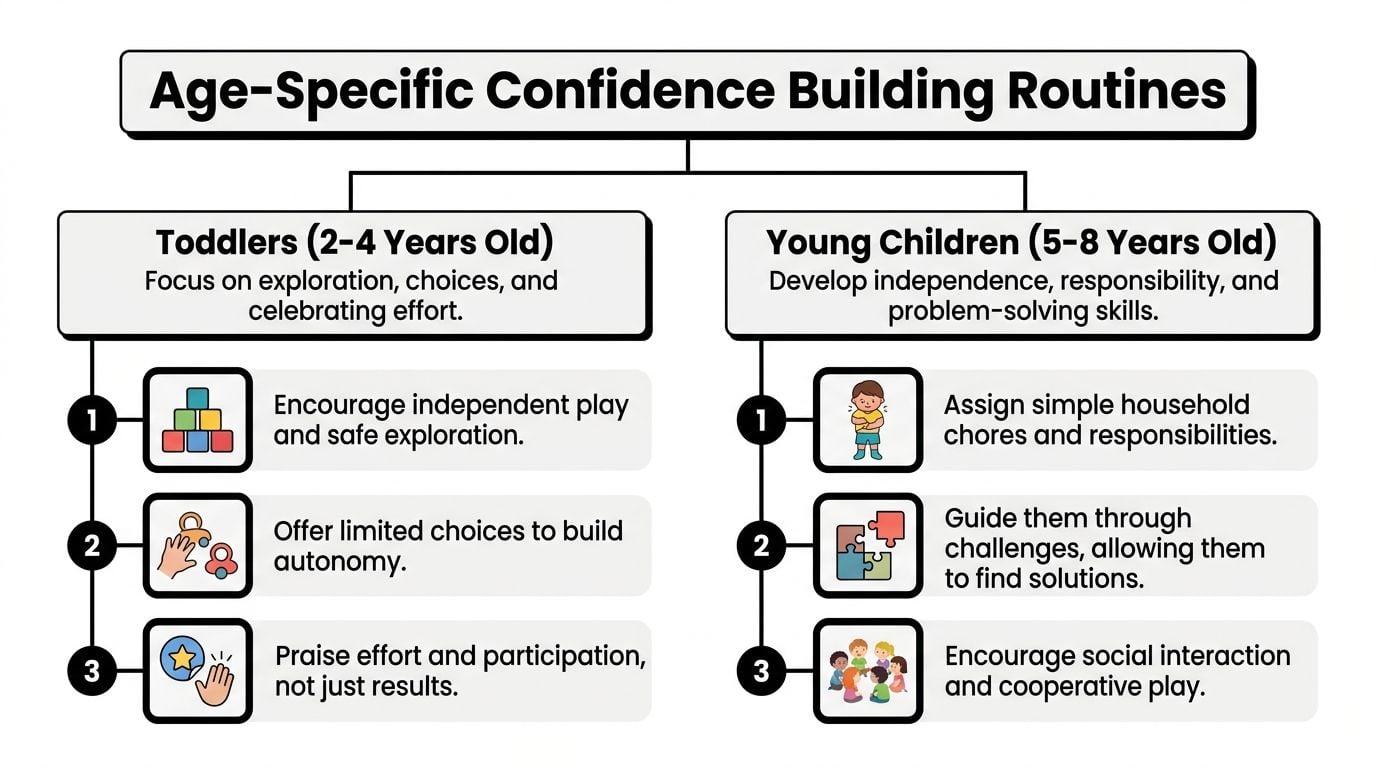
Many parents get stuck because they use the same confidence strategy at every age. A toddler, a 7-year-old, and a pre-teen need different kinds of wins.
One principle helps across all three stages. Scaffolding. That means breaking a hard task into manageable steps and adjusting support to the child’s current ability. Research summarized by Zero to Three explains that realistic expectations matter because when expectations exceed capability, self-esteem erodes, while repeated age-appropriate successes build confidence (Zero to Three).
If you’ve ever wondered why one child beams after helping and another collapses halfway through, this is often the reason. The task was either too easy to feel meaningful or too hard to feel possible.
For a quick mindset companion to this section, this guide on growth vs fixed mindset pairs well with the routines below.
Toddlers ages 2 to 4
At this age, confidence comes from autonomy with safety nearby.
Toddlers don’t need speeches. They need simple chances to do things “by myself” without being rushed or corrected every few seconds.
Try these tonight:
- Offer two clear choices: “Blue cup or green cup?” Limited choice builds agency without overwhelming them.
- Create tiny helper jobs: carry napkins, put socks in a basket, wipe a low table.
- Pause before stepping in: give them a few extra seconds to attempt the zipper, block stack, or spoon scoop.
What to say:
“You’re working hard on that.”
“You almost got it. Try one more time.”
“I’m right here if you want help.”
What to avoid:
- Taking over too fast: It teaches, “Adults do hard things for me.”
- Praising only success: Toddlers need credit for participation and persistence.
Young children ages 5 to 8
This age group starts comparing themselves to peers. They also care about getting things “right.”
Confidence-building here works best through responsibility, play, and problem-solving.
A strong weekly routine looks like this:
| Routine | Why it helps | Simple example |
|---|---|---|
| One household job | Builds competence | feed the pet, match socks, set forks on table |
| One challenge task | Builds frustration tolerance | simple recipe step, puzzle, bike practice |
| One social skill practice | Builds peer confidence | greeting a classmate, inviting someone to play |
Use coaching questions instead of quick fixes:
- When they’re stuck on homework: “What part do you understand already?”
- When they fight with a friend: “What happened first?”
- When they want to quit: “Do you need a break, help, or one small step?”
This age also responds well to role-play. If your child struggles to join a group, practice at home.
Try:
- “Can I play too?”
- “What are the rules?”
- “Want to build with me?”
Kids build confidence faster when they rehearse success before the actual moment.
Pre-teens ages 9 to 12
Pre-teens need something different. They want dignity. They want more say. They also become much more aware of embarrassment.
At this age, confidence grows when adults stop over-directing and start collaborating.
Three routines work well:
-
Responsibility with ownership
Give them a real job they can manage from start to finish. Packing sports gear, managing a reading log, prepping part of lunch, or planning what they need for an activity. -
Reflection after setbacks
Don’t jump straight to encouragement. Ask:- “What felt hardest?”
- “What did you try?”
- “What would you do differently next time?”
-
Skill building in public-facing areas
Let them order their own food, ask a store question, email a teacher with help, or introduce themselves to an adult.
What to say:
- “You can handle this with support.”
- “I won’t do it for you, but I’ll help you break it down.”
- “You don’t have to feel ready to begin.”
Pre-teens often look resistant when they feel unsure. Don’t read eye-rolls as confidence. Sometimes they’re just protecting themselves from feeling exposed.
Your Coaching Scriptbook for Everyday Parenting Moments
Words matter most when your child feels small, embarrassed, or flooded.
In those moments, parents often swing toward one of two habits. We either minimize the feeling or rush into a lecture. Both can shut confidence down. What helps is a short script that does three jobs in order: name the feeling, protect the child’s dignity, and guide the next move.

If you’ve been working on your own mindset too, this piece on overcoming limiting beliefs can help you notice the messages you may be passing down without meaning to.
When your child gets a bad grade
Not that:
“You’re fine. Just study harder next time.”
Try this:
“That feels disappointing. Let’s look at what happened without beating you up. Was it the studying, the time pressure, or not understanding the material yet?”
Why it works: the child learns that setbacks can be examined, not feared.
When your child says “I’m bad at this”
Not that:
“No you’re not. Don’t say that.”
Try this:
“You feel discouraged right now. Being bad at the first part of learning doesn’t mean you can’t get better. Show me which part makes you want to quit.”
Why it works: you’re not arguing with emotion. You’re helping them move through it.
When they’re scared to join a new activity
Not that:
“You’ll love it. Stop worrying.”
Try this:
“It makes sense to feel nervous before trying something new. Let’s decide what the brave version looks like for today. Maybe it’s watching first, then joining for a short time.”
That phrase, “the brave version for today,” helps children think in steps instead of all-or-nothing.
Small script to remember: Connect, then coach.
When your child melts down after a mistake
Not that:
“It’s not a big deal.”
Try this:
“It feels like a big deal to you right now. I’m staying with you. When your body is calmer, we’ll figure out what went wrong.”
This protects dignity. It also prevents “teaching” while the child is too upset to learn.
When siblings compare themselves
Not that:
“Your sister can do it. Why can’t you?”
Try this:
“You two are learning different things at different speeds. I’m paying attention to your progress, not your brother’s or sister’s.”
Comparison can turn a normal learning gap into a character wound.
When they want you to do the hard part
Not that:
“Fine, I’ll just do it.”
Try this:
“I won’t take the whole job away from you. I will help with the first step.”
That one line is powerful. It says, “I believe you’re capable, and I’m not abandoning you.”

Common Confidence Killers and How to Avoid Them
Some of the biggest confidence problems come from loving habits that miss the mark.
Parents usually don’t damage confidence by being cruel. They do it by overhelping, overpraising, overcorrecting, or expecting a child to handle stress in a way that doesn’t match that child’s brain and stage.
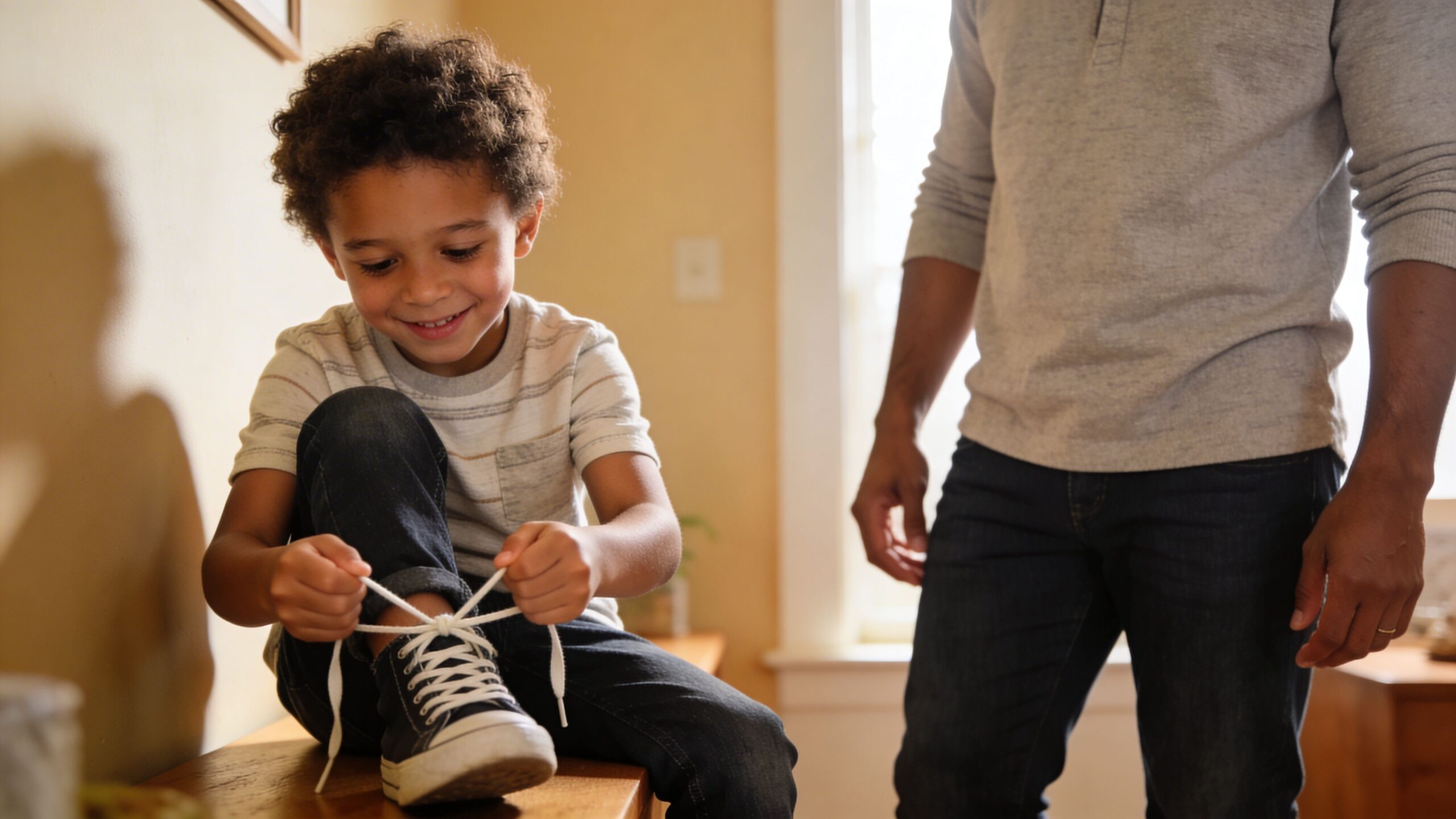
Four habits that undermine confidence
-
Rescuing too early
When a child struggles and you instantly fix it, they learn that distress means someone else takes over. Help with the next step, not the whole task. -
Using empty praise
“Good job” isn’t harmful, but by itself it doesn’t teach much. Specific feedback is more useful. Name the effort, strategy, or recovery. -
Comparing siblings or classmates
Comparison rarely motivates insecure children. It usually confirms their fear that they’re behind. -
Correcting more than connecting
Some homes become correction-heavy without realizing it. Kids start to brace for feedback before they even begin.

Neurodiverse kids often need a different approach
This matters enough to say plainly. Standard advice can fall flat for children with ADHD, autism, and other neurodivergent profiles.
The verified summary for Child Mind Institute notes that neurodiverse children have 2 to 3 times higher rates of low self-esteem, and that over-emphasizing independence can backfire. It also reports that co-regulation via parent modeling has been shown to reduce anxiety by 30 percent, making gradual skill-building more possible (Child Mind Institute summary).
That means “Just let them struggle” is not always wise advice.
For these children, confidence often grows through:
- Co-regulation first: sit nearby, slow your voice, reduce the sense of threat.
- Visible supports: checklists, visual steps, laid-out materials.
- Shorter challenge windows: brief efforts with a clear stopping point.
- Recovery built in: sensory breaks, movement, quieter spaces.
Some children can’t access confidence until they first feel regulated.
A child who melts down over small failures isn’t “choosing drama.” They may be hitting a wall in executive function, sensory load, or emotional regulation. Support isn’t the opposite of confidence-building. Used wisely, it’s how confidence becomes possible.

Screens and comparison culture can wear kids down
You don’t need a complicated media theory to see the pattern. Some kids feel worse about themselves after too much time watching everyone else perform, pose, compete, and compare.
What helps most at home is structure, not panic.
Try this short reset:
| Problem pattern | Better family response |
|---|---|
| Endless passive scrolling | Set clear no-screen windows |
| Child fixates on what others have | Keep a simple wins journal |
| Boredom equals instant device use | Build in unstructured play time |
A “wins journal” can be as simple as one notebook line a day: “Something I tried,” “something I handled,” or “something I improved.”
That shifts attention back to lived competence.
Making Confidence a Lifelong Family Habit
Confidence doesn’t come from one pep talk, one sports season, or one great teacher. It grows in family culture.
Positive self-esteem gives children a stronger base for resilience. Kids with it are more likely to feel respected, keep pride even after mistakes, feel some control over life, act independently, and resist peer pressure. That foundation is built through repeated successes and affirming feedback (Understood).
The easiest way to make this stick is to stop treating confidence as a rescue project. Make it a weekly rhythm.
A simple weekly confidence check-in
Once a week, ask yourself:
- Where did my child show effort this week
- Where did I step in too fast
- What skill are we building right now
- Did I praise process, not just outcome
- Did my child get at least one real chance to do something hard successfully
You don’t need a spreadsheet. A note on your phone works.
Start a family wins jar
Put out a jar, bowl, or box.
Add slips of paper for moments like:
- “Kept trying after getting frustrated”
- “Asked for help instead of quitting”
- “Tried something new”
- “Recovered after a mistake”
Read a few at the end of the week. Keep the focus on courage, persistence, problem-solving, and honesty. Not perfection.
The long game matters most
If you remember only one thing, remember this: confident kids are not kids who never doubt themselves. They’re kids who know doubt doesn’t get the final say.
That kind of confidence is teachable.
It’s built when you stay calm, expect growth, allow struggle, and notice progress in small honest ways. Done consistently, those ordinary moments become the training ground for a child who can handle disappointment, trust their own effort, and keep going.
Confidence isn’t built by telling a child they’re great. It’s built by helping them understand what’s happening inside them—and giving them frameworks to work with it. Love, Success, Freedom and Boundaries is a guide to doing exactly that: helping young people build the psychological tools they need so they stop guessing and start building.
Enter your email and get the first chapter sent to your inbox.
If this resonated, go deeper. My book Love, Success, Freedom and Boundaries gives you twelve frameworks for seeing the patterns that shape your life — and changing the ones that aren’t working.
Frequently Asked Questions
What builds real confidence in children?
Real confidence comes from competence, not compliments. Children build confidence by attempting hard things, failing safely, and learning they can handle difficulty. Praise without substance actually undermines it.
Can you build confidence in a shy child?
Shyness and low confidence are different things. A shy child may be deeply confident but slow to warm up socially. The goal isn’t to make them outgoing — it’s to help them trust their own way of engaging with the world.
What destroys a child’s confidence?
Constant correction, comparison to other children, and rescuing them from every struggle. Each one sends the same message: you’re not enough as you are, and you can’t handle things on your own.
Keep Reading
- How to Be a Good Parent: It’s Not What You Think
- Behavioral Strengths of a Child: What Your Child’s Worst Behavior Is Really Telling You
- Manipulative Child Behavior Symptoms: What You’re Really Seeing
If you find yourself wanting to put words to what’s happening with your kid — drafting a hard conversation, journaling what you noticed, writing the script you wish you had — the tool I use to draft most of my words is Wispr Flow. It transcribes your voice into clean, edited text in real time, so the friction between thinking it and writing it basically disappears.
If this resonated, go deeper. My book Love, Success, Freedom and Boundaries gives you twelve frameworks for seeing the patterns that shape your life — and changing the ones that aren’t working.
Frequently Asked Questions
What builds real confidence in children?
Real confidence comes from competence, not compliments. Children build confidence by attempting hard things, failing safely, and learning they can handle difficulty. Praise without substance actually undermines it.
Can you build confidence in a shy child?
Shyness and low confidence are different things. A shy child may be deeply confident but slow to warm up socially. The goal isn’t to make them outgoing — it’s to help them trust their own way of engaging with the world.
What destroys a child’s confidence?
Constant correction, comparison to other children, and rescuing them from every struggle. Each one sends the same message: you’re not enough as you are, and you can’t handle things on your own.
Keep Reading
- How to Be a Good Parent: It’s Not What You Think
- Behavioral Strengths of a Child: What Your Child’s Worst Behavior Is Really Telling You
- Manipulative Child Behavior Symptoms: What You’re Really Seeing
If you find yourself wanting to put words to what’s happening with your kid — drafting a hard conversation, journaling what you noticed, writing the script you wish you had — the tool I use to draft most of my words is Wispr Flow. It transcribes your voice into clean, edited text in real time, so the friction between thinking it and writing it basically disappears.
If this resonated, go deeper. My book Love, Success, Freedom and Boundaries gives you twelve frameworks for seeing the patterns that shape your life — and changing the ones that aren’t working.
Frequently Asked Questions
What builds real confidence in children?
Real confidence comes from competence, not compliments. Children build confidence by attempting hard things, failing safely, and learning they can handle difficulty. Praise without substance actually undermines it.
Can you build confidence in a shy child?
Shyness and low confidence are different things. A shy child may be deeply confident but slow to warm up socially. The goal isn’t to make them outgoing — it’s to help them trust their own way of engaging with the world.
What destroys a child’s confidence?
Constant correction, comparison to other children, and rescuing them from every struggle. Each one sends the same message: you’re not enough as you are, and you can’t handle things on your own.
Keep Reading
- How to Be a Good Parent: It’s Not What You Think
- Behavioral Strengths of a Child: What Your Child’s Worst Behavior Is Really Telling You
- Manipulative Child Behavior Symptoms: What You’re Really Seeing
If you find yourself wanting to put words to what’s happening with your kid — drafting a hard conversation, journaling what you noticed, writing the script you wish you had — the tool I use to draft most of my words is Wispr Flow. It transcribes your voice into clean, edited text in real time, so the friction between thinking it and writing it basically disappears.
If this resonated, go deeper. My book Love, Success, Freedom and Boundaries gives you twelve frameworks for seeing the patterns that shape your life — and changing the ones that aren’t working.
Frequently Asked Questions
What builds real confidence in children?
Real confidence comes from competence, not compliments. Children build confidence by attempting hard things, failing safely, and learning they can handle difficulty. Praise without substance actually undermines it.
Can you build confidence in a shy child?
Shyness and low confidence are different things. A shy child may be deeply confident but slow to warm up socially. The goal isn’t to make them outgoing — it’s to help them trust their own way of engaging with the world.
What destroys a child’s confidence?
Constant correction, comparison to other children, and rescuing them from every struggle. Each one sends the same message: you’re not enough as you are, and you can’t handle things on your own.
Keep Reading
- How to Be a Good Parent: It’s Not What You Think
- Behavioral Strengths of a Child: What Your Child’s Worst Behavior Is Really Telling You
- Manipulative Child Behavior Symptoms: What You’re Really Seeing
If you find yourself wanting to put words to what’s happening with your kid — drafting a hard conversation, journaling what you noticed, writing the script you wish you had — the tool I use to draft most of my words is Wispr Flow. It transcribes your voice into clean, edited text in real time, so the friction between thinking it and writing it basically disappears.
If this resonated, go deeper. My book Love, Success, Freedom and Boundaries gives you twelve frameworks for seeing the patterns that shape your life — and changing the ones that aren’t working.
Frequently Asked Questions
What builds real confidence in children?
Real confidence comes from competence, not compliments. Children build confidence by attempting hard things, failing safely, and learning they can handle difficulty. Praise without substance actually undermines it.
Can you build confidence in a shy child?
Shyness and low confidence are different things. A shy child may be deeply confident but slow to warm up socially. The goal isn’t to make them outgoing — it’s to help them trust their own way of engaging with the world.
What destroys a child’s confidence?
Constant correction, comparison to other children, and rescuing them from every struggle. Each one sends the same message: you’re not enough as you are, and you can’t handle things on your own.
Keep Reading
- How to Be a Good Parent: It’s Not What You Think
- Behavioral Strengths of a Child: What Your Child’s Worst Behavior Is Really Telling You
- Manipulative Child Behavior Symptoms: What You’re Really Seeing
If you find yourself wanting to put words to what’s happening with your kid — drafting a hard conversation, journaling what you noticed, writing the script you wish you had — the tool I use to draft most of my words is Wispr Flow. It transcribes your voice into clean, edited text in real time, so the friction between thinking it and writing it basically disappears.
If this resonated, go deeper. My book Love, Success, Freedom and Boundaries gives you twelve frameworks for seeing the patterns that shape your life — and changing the ones that aren’t working.
Frequently Asked Questions
What builds real confidence in children?
Real confidence comes from competence, not compliments. Children build confidence by attempting hard things, failing safely, and learning they can handle difficulty. Praise without substance actually undermines it.
Can you build confidence in a shy child?
Shyness and low confidence are different things. A shy child may be deeply confident but slow to warm up socially. The goal isn’t to make them outgoing — it’s to help them trust their own way of engaging with the world.
What destroys a child’s confidence?
Constant correction, comparison to other children, and rescuing them from every struggle. Each one sends the same message: you’re not enough as you are, and you can’t handle things on your own.
Keep Reading
- How to Be a Good Parent: It’s Not What You Think
- Behavioral Strengths of a Child: What Your Child’s Worst Behavior Is Really Telling You
- Manipulative Child Behavior Symptoms: What You’re Really Seeing
If you find yourself wanting to put words to what’s happening with your kid — drafting a hard conversation, journaling what you noticed, writing the script you wish you had — the tool I use to draft most of my words is Wispr Flow. It transcribes your voice into clean, edited text in real time, so the friction between thinking it and writing it basically disappears.
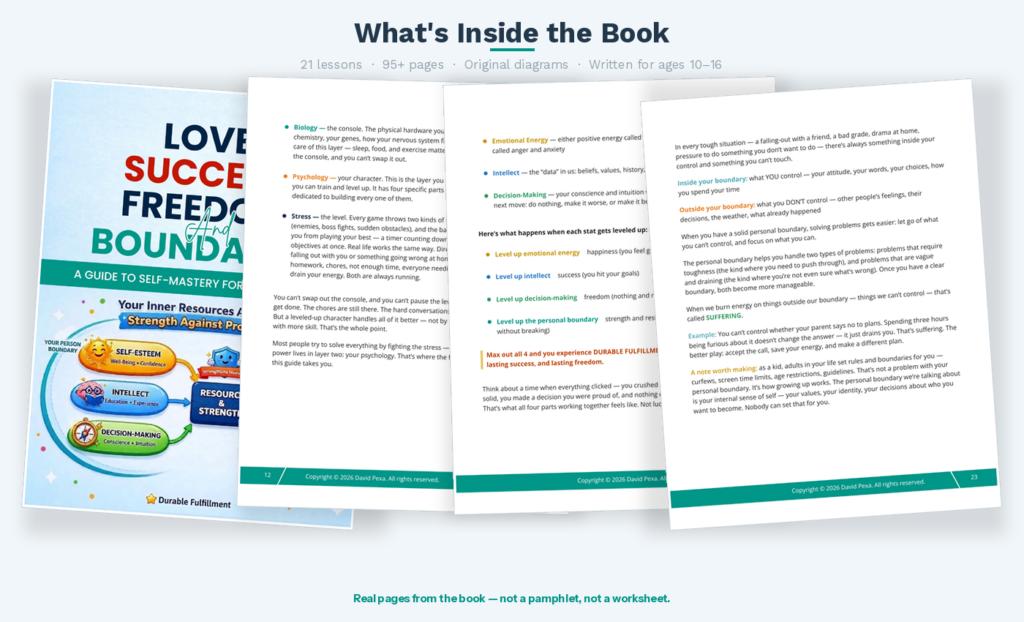
If this resonated, go deeper. My book Love, Success, Freedom and Boundaries gives you twelve frameworks for seeing the patterns that shape your life — and changing the ones that aren’t working.
Frequently Asked Questions
What builds real confidence in children?
Real confidence comes from competence, not compliments. Children build confidence by attempting hard things, failing safely, and learning they can handle difficulty. Praise without substance actually undermines it.
Can you build confidence in a shy child?
Shyness and low confidence are different things. A shy child may be deeply confident but slow to warm up socially. The goal isn’t to make them outgoing — it’s to help them trust their own way of engaging with the world.
What destroys a child’s confidence?
Constant correction, comparison to other children, and rescuing them from every struggle. Each one sends the same message: you’re not enough as you are, and you can’t handle things on your own.
Keep Reading
- How to Be a Good Parent: It’s Not What You Think
- Behavioral Strengths of a Child: What Your Child’s Worst Behavior Is Really Telling You
- Manipulative Child Behavior Symptoms: What You’re Really Seeing
If you find yourself wanting to put words to what’s happening with your kid — drafting a hard conversation, journaling what you noticed, writing the script you wish you had — the tool I use to draft most of my words is Wispr Flow. It transcribes your voice into clean, edited text in real time, so the friction between thinking it and writing it basically disappears.
If this resonated, go deeper. My book Love, Success, Freedom and Boundaries gives you twelve frameworks for seeing the patterns that shape your life — and changing the ones that aren’t working.
Frequently Asked Questions
What builds real confidence in children?
Real confidence comes from competence, not compliments. Children build confidence by attempting hard things, failing safely, and learning they can handle difficulty. Praise without substance actually undermines it.
Can you build confidence in a shy child?
Shyness and low confidence are different things. A shy child may be deeply confident but slow to warm up socially. The goal isn’t to make them outgoing — it’s to help them trust their own way of engaging with the world.
What destroys a child’s confidence?
Constant correction, comparison to other children, and rescuing them from every struggle. Each one sends the same message: you’re not enough as you are, and you can’t handle things on your own.
Keep Reading
- How to Be a Good Parent: It’s Not What You Think
- Behavioral Strengths of a Child: What Your Child’s Worst Behavior Is Really Telling You
- Manipulative Child Behavior Symptoms: What You’re Really Seeing
If you find yourself wanting to put words to what’s happening with your kid — drafting a hard conversation, journaling what you noticed, writing the script you wish you had — the tool I use to draft most of my words is Wispr Flow. It transcribes your voice into clean, edited text in real time, so the friction between thinking it and writing it basically disappears.
If this resonated, go deeper. My book Love, Success, Freedom and Boundaries gives you twelve frameworks for seeing the patterns that shape your life — and changing the ones that aren’t working.
Frequently Asked Questions
What builds real confidence in children?
Real confidence comes from competence, not compliments. Children build confidence by attempting hard things, failing safely, and learning they can handle difficulty. Praise without substance actually undermines it.
Can you build confidence in a shy child?
Shyness and low confidence are different things. A shy child may be deeply confident but slow to warm up socially. The goal isn’t to make them outgoing — it’s to help them trust their own way of engaging with the world.
What destroys a child’s confidence?
Constant correction, comparison to other children, and rescuing them from every struggle. Each one sends the same message: you’re not enough as you are, and you can’t handle things on your own.
Keep Reading
- How to Be a Good Parent: It’s Not What You Think
- Behavioral Strengths of a Child: What Your Child’s Worst Behavior Is Really Telling You
- Manipulative Child Behavior Symptoms: What You’re Really Seeing
If you find yourself wanting to put words to what’s happening with your kid — drafting a hard conversation, journaling what you noticed, writing the script you wish you had — the tool I use to draft most of my words is Wispr Flow. It transcribes your voice into clean, edited text in real time, so the friction between thinking it and writing it basically disappears.
If this resonated, go deeper. My book Love, Success, Freedom and Boundaries gives you twelve frameworks for seeing the patterns that shape your life — and changing the ones that aren’t working.
Frequently Asked Questions
What builds real confidence in children?
Real confidence comes from competence, not compliments. Children build confidence by attempting hard things, failing safely, and learning they can handle difficulty. Praise without substance actually undermines it.
Can you build confidence in a shy child?
Shyness and low confidence are different things. A shy child may be deeply confident but slow to warm up socially. The goal isn’t to make them outgoing — it’s to help them trust their own way of engaging with the world.
What destroys a child’s confidence?
Constant correction, comparison to other children, and rescuing them from every struggle. Each one sends the same message: you’re not enough as you are, and you can’t handle things on your own.
Keep Reading
- How to Be a Good Parent: It’s Not What You Think
- Behavioral Strengths of a Child: What Your Child’s Worst Behavior Is Really Telling You
- Manipulative Child Behavior Symptoms: What You’re Really Seeing
If you find yourself wanting to put words to what’s happening with your kid — drafting a hard conversation, journaling what you noticed, writing the script you wish you had — the tool I use to draft most of my words is Wispr Flow. It transcribes your voice into clean, edited text in real time, so the friction between thinking it and writing it basically disappears.
If this resonated, go deeper. My book Love, Success, Freedom and Boundaries gives you twelve frameworks for seeing the patterns that shape your life — and changing the ones that aren’t working.
Frequently Asked Questions
What builds real confidence in children?
Real confidence comes from competence, not compliments. Children build confidence by attempting hard things, failing safely, and learning they can handle difficulty. Praise without substance actually undermines it.
Can you build confidence in a shy child?
Shyness and low confidence are different things. A shy child may be deeply confident but slow to warm up socially. The goal isn’t to make them outgoing — it’s to help them trust their own way of engaging with the world.
What destroys a child’s confidence?
Constant correction, comparison to other children, and rescuing them from every struggle. Each one sends the same message: you’re not enough as you are, and you can’t handle things on your own.
Keep Reading
- How to Be a Good Parent: It’s Not What You Think
- Behavioral Strengths of a Child: What Your Child’s Worst Behavior Is Really Telling You
- Manipulative Child Behavior Symptoms: What You’re Really Seeing
If you find yourself wanting to put words to what’s happening with your kid — drafting a hard conversation, journaling what you noticed, writing the script you wish you had — the tool I use to draft most of my words is Wispr Flow. It transcribes your voice into clean, edited text in real time, so the friction between thinking it and writing it basically disappears.
If this resonated, go deeper. My book Love, Success, Freedom and Boundaries gives you twelve frameworks for seeing the patterns that shape your life — and changing the ones that aren’t working.
Frequently Asked Questions
What builds real confidence in children?
Real confidence comes from competence, not compliments. Children build confidence by attempting hard things, failing safely, and learning they can handle difficulty. Praise without substance actually undermines it.
Can you build confidence in a shy child?
Shyness and low confidence are different things. A shy child may be deeply confident but slow to warm up socially. The goal isn’t to make them outgoing — it’s to help them trust their own way of engaging with the world.
What destroys a child’s confidence?
Constant correction, comparison to other children, and rescuing them from every struggle. Each one sends the same message: you’re not enough as you are, and you can’t handle things on your own.
Keep Reading
- How to Be a Good Parent: It’s Not What You Think
- Behavioral Strengths of a Child: What Your Child’s Worst Behavior Is Really Telling You
- Manipulative Child Behavior Symptoms: What You’re Really Seeing
If you find yourself wanting to put words to what’s happening with your kid — drafting a hard conversation, journaling what you noticed, writing the script you wish you had — the tool I use to draft most of my words is Wispr Flow. It transcribes your voice into clean, edited text in real time, so the friction between thinking it and writing it basically disappears.
If this resonated, go deeper. My book Love, Success, Freedom and Boundaries gives you twelve frameworks for seeing the patterns that shape your life — and changing the ones that aren’t working.
Frequently Asked Questions
What builds real confidence in children?
Real confidence comes from competence, not compliments. Children build confidence by attempting hard things, failing safely, and learning they can handle difficulty. Praise without substance actually undermines it.
Can you build confidence in a shy child?
Shyness and low confidence are different things. A shy child may be deeply confident but slow to warm up socially. The goal isn’t to make them outgoing — it’s to help them trust their own way of engaging with the world.
What destroys a child’s confidence?
Constant correction, comparison to other children, and rescuing them from every struggle. Each one sends the same message: you’re not enough as you are, and you can’t handle things on your own.
Keep Reading
- How to Be a Good Parent: It’s Not What You Think
- Behavioral Strengths of a Child: What Your Child’s Worst Behavior Is Really Telling You
- Manipulative Child Behavior Symptoms: What You’re Really Seeing
If you find yourself wanting to put words to what’s happening with your kid — drafting a hard conversation, journaling what you noticed, writing the script you wish you had — the tool I use to draft most of my words is Wispr Flow. It transcribes your voice into clean, edited text in real time, so the friction between thinking it and writing it basically disappears.
If this resonated, go deeper. My book Love, Success, Freedom and Boundaries gives you twelve frameworks for seeing the patterns that shape your life — and changing the ones that aren’t working.
Frequently Asked Questions
What builds real confidence in children?
Real confidence comes from competence, not compliments. Children build confidence by attempting hard things, failing safely, and learning they can handle difficulty. Praise without substance actually undermines it.
Can you build confidence in a shy child?
Shyness and low confidence are different things. A shy child may be deeply confident but slow to warm up socially. The goal isn’t to make them outgoing — it’s to help them trust their own way of engaging with the world.
What destroys a child’s confidence?
Constant correction, comparison to other children, and rescuing them from every struggle. Each one sends the same message: you’re not enough as you are, and you can’t handle things on your own.
Keep Reading
- How to Be a Good Parent: It’s Not What You Think
- Behavioral Strengths of a Child: What Your Child’s Worst Behavior Is Really Telling You
- Manipulative Child Behavior Symptoms: What You’re Really Seeing
If you find yourself wanting to put words to what’s happening with your kid — drafting a hard conversation, journaling what you noticed, writing the script you wish you had — the tool I use to draft most of my words is Wispr Flow. It transcribes your voice into clean, edited text in real time, so the friction between thinking it and writing it basically disappears.
If this resonated, go deeper. My book Love, Success, Freedom and Boundaries gives you twelve frameworks for seeing the patterns that shape your life — and changing the ones that aren’t working.
Frequently Asked Questions
What builds real confidence in children?
Real confidence comes from competence, not compliments. Children build confidence by attempting hard things, failing safely, and learning they can handle difficulty. Praise without substance actually undermines it.
Can you build confidence in a shy child?
Shyness and low confidence are different things. A shy child may be deeply confident but slow to warm up socially. The goal isn’t to make them outgoing — it’s to help them trust their own way of engaging with the world.
What destroys a child’s confidence?
Constant correction, comparison to other children, and rescuing them from every struggle. Each one sends the same message: you’re not enough as you are, and you can’t handle things on your own.
Keep Reading
- How to Be a Good Parent: It’s Not What You Think
- Behavioral Strengths of a Child: What Your Child’s Worst Behavior Is Really Telling You
- Manipulative Child Behavior Symptoms: What You’re Really Seeing
If you find yourself wanting to put words to what’s happening with your kid — drafting a hard conversation, journaling what you noticed, writing the script you wish you had — the tool I use to draft most of my words is Wispr Flow. It transcribes your voice into clean, edited text in real time, so the friction between thinking it and writing it basically disappears.
If this resonated, go deeper. My book Love, Success, Freedom and Boundaries gives you twelve frameworks for seeing the patterns that shape your life — and changing the ones that aren’t working.
Frequently Asked Questions
What builds real confidence in children?
Real confidence comes from competence, not compliments. Children build confidence by attempting hard things, failing safely, and learning they can handle difficulty. Praise without substance actually undermines it.
Can you build confidence in a shy child?
Shyness and low confidence are different things. A shy child may be deeply confident but slow to warm up socially. The goal isn’t to make them outgoing — it’s to help them trust their own way of engaging with the world.
What destroys a child’s confidence?
Constant correction, comparison to other children, and rescuing them from every struggle. Each one sends the same message: you’re not enough as you are, and you can’t handle things on your own.
Keep Reading
- How to Be a Good Parent: It’s Not What You Think
- Behavioral Strengths of a Child: What Your Child’s Worst Behavior Is Really Telling You
- Manipulative Child Behavior Symptoms: What You’re Really Seeing
If you find yourself wanting to put words to what’s happening with your kid — drafting a hard conversation, journaling what you noticed, writing the script you wish you had — the tool I use to draft most of my words is Wispr Flow. It transcribes your voice into clean, edited text in real time, so the friction between thinking it and writing it basically disappears.
If this resonated, go deeper. My book Love, Success, Freedom and Boundaries gives you twelve frameworks for seeing the patterns that shape your life — and changing the ones that aren’t working.
Frequently Asked Questions
What builds real confidence in children?
Real confidence comes from competence, not compliments. Children build confidence by attempting hard things, failing safely, and learning they can handle difficulty. Praise without substance actually undermines it.
Can you build confidence in a shy child?
Shyness and low confidence are different things. A shy child may be deeply confident but slow to warm up socially. The goal isn’t to make them outgoing — it’s to help them trust their own way of engaging with the world.
What destroys a child’s confidence?
Constant correction, comparison to other children, and rescuing them from every struggle. Each one sends the same message: you’re not enough as you are, and you can’t handle things on your own.
Keep Reading
- How to Be a Good Parent: It’s Not What You Think
- Behavioral Strengths of a Child: What Your Child’s Worst Behavior Is Really Telling You
- Manipulative Child Behavior Symptoms: What You’re Really Seeing
If you find yourself wanting to put words to what’s happening with your kid — drafting a hard conversation, journaling what you noticed, writing the script you wish you had — the tool I use to draft most of my words is Wispr Flow. It transcribes your voice into clean, edited text in real time, so the friction between thinking it and writing it basically disappears.
If this resonated, go deeper. My book Love, Success, Freedom and Boundaries gives you twelve frameworks for seeing the patterns that shape your life — and changing the ones that aren’t working.
Frequently Asked Questions
What builds real confidence in children?
Real confidence comes from competence, not compliments. Children build confidence by attempting hard things, failing safely, and learning they can handle difficulty. Praise without substance actually undermines it.
Can you build confidence in a shy child?
Shyness and low confidence are different things. A shy child may be deeply confident but slow to warm up socially. The goal isn’t to make them outgoing — it’s to help them trust their own way of engaging with the world.
What destroys a child’s confidence?
Constant correction, comparison to other children, and rescuing them from every struggle. Each one sends the same message: you’re not enough as you are, and you can’t handle things on your own.
Keep Reading
- How to Be a Good Parent: It’s Not What You Think
- Behavioral Strengths of a Child: What Your Child’s Worst Behavior Is Really Telling You
- Manipulative Child Behavior Symptoms: What You’re Really Seeing
If you find yourself wanting to put words to what’s happening with your kid — drafting a hard conversation, journaling what you noticed, writing the script you wish you had — the tool I use to draft most of my words is Wispr Flow. It transcribes your voice into clean, edited text in real time, so the friction between thinking it and writing it basically disappears.
If this resonated, go deeper. My book Love, Success, Freedom and Boundaries gives you twelve frameworks for seeing the patterns that shape your life — and changing the ones that aren’t working.
Frequently Asked Questions
What builds real confidence in children?
Real confidence comes from competence, not compliments. Children build confidence by attempting hard things, failing safely, and learning they can handle difficulty. Praise without substance actually undermines it.
Can you build confidence in a shy child?
Shyness and low confidence are different things. A shy child may be deeply confident but slow to warm up socially. The goal isn’t to make them outgoing — it’s to help them trust their own way of engaging with the world.
What destroys a child’s confidence?
Constant correction, comparison to other children, and rescuing them from every struggle. Each one sends the same message: you’re not enough as you are, and you can’t handle things on your own.
Keep Reading
- How to Be a Good Parent: It’s Not What You Think
- Behavioral Strengths of a Child: What Your Child’s Worst Behavior Is Really Telling You
- Manipulative Child Behavior Symptoms: What You’re Really Seeing
If you find yourself wanting to put words to what’s happening with your kid — drafting a hard conversation, journaling what you noticed, writing the script you wish you had — the tool I use to draft most of my words is Wispr Flow. It transcribes your voice into clean, edited text in real time, so the friction between thinking it and writing it basically disappears.
If this resonated, go deeper. My book Love, Success, Freedom and Boundaries gives you twelve frameworks for seeing the patterns that shape your life — and changing the ones that aren’t working.
Frequently Asked Questions
What builds real confidence in children?
Real confidence comes from competence, not compliments. Children build confidence by attempting hard things, failing safely, and learning they can handle difficulty. Praise without substance actually undermines it.
Can you build confidence in a shy child?
Shyness and low confidence are different things. A shy child may be deeply confident but slow to warm up socially. The goal isn’t to make them outgoing — it’s to help them trust their own way of engaging with the world.
What destroys a child’s confidence?
Constant correction, comparison to other children, and rescuing them from every struggle. Each one sends the same message: you’re not enough as you are, and you can’t handle things on your own.
Keep Reading
- How to Be a Good Parent: It’s Not What You Think
- Behavioral Strengths of a Child: What Your Child’s Worst Behavior Is Really Telling You
- Manipulative Child Behavior Symptoms: What You’re Really Seeing
If you find yourself wanting to put words to what’s happening with your kid — drafting a hard conversation, journaling what you noticed, writing the script you wish you had — the tool I use to draft most of my words is Wispr Flow. It transcribes your voice into clean, edited text in real time, so the friction between thinking it and writing it basically disappears.
If this resonated, go deeper. My book Love, Success, Freedom and Boundaries gives you twelve frameworks for seeing the patterns that shape your life — and changing the ones that aren’t working.
Frequently Asked Questions
What builds real confidence in children?
Real confidence comes from competence, not compliments. Children build confidence by attempting hard things, failing safely, and learning they can handle difficulty. Praise without substance actually undermines it.
Can you build confidence in a shy child?
Shyness and low confidence are different things. A shy child may be deeply confident but slow to warm up socially. The goal isn’t to make them outgoing — it’s to help them trust their own way of engaging with the world.
What destroys a child’s confidence?
Constant correction, comparison to other children, and rescuing them from every struggle. Each one sends the same message: you’re not enough as you are, and you can’t handle things on your own.
Keep Reading
- How to Be a Good Parent: It’s Not What You Think
- Behavioral Strengths of a Child: What Your Child’s Worst Behavior Is Really Telling You
- Manipulative Child Behavior Symptoms: What You’re Really Seeing
If you find yourself wanting to put words to what’s happening with your kid — drafting a hard conversation, journaling what you noticed, writing the script you wish you had — the tool I use to draft most of my words is Wispr Flow. It transcribes your voice into clean, edited text in real time, so the friction between thinking it and writing it basically disappears.
If this resonated, go deeper. My book Love, Success, Freedom and Boundaries gives you twelve frameworks for seeing the patterns that shape your life — and changing the ones that aren’t working.
Frequently Asked Questions
What builds real confidence in children?
Real confidence comes from competence, not compliments. Children build confidence by attempting hard things, failing safely, and learning they can handle difficulty. Praise without substance actually undermines it.
Can you build confidence in a shy child?
Shyness and low confidence are different things. A shy child may be deeply confident but slow to warm up socially. The goal isn’t to make them outgoing — it’s to help them trust their own way of engaging with the world.
What destroys a child’s confidence?
Constant correction, comparison to other children, and rescuing them from every struggle. Each one sends the same message: you’re not enough as you are, and you can’t handle things on your own.
Keep Reading
- How to Be a Good Parent: It’s Not What You Think
- Behavioral Strengths of a Child: What Your Child’s Worst Behavior Is Really Telling You
- Manipulative Child Behavior Symptoms: What You’re Really Seeing
If you find yourself wanting to put words to what’s happening with your kid — drafting a hard conversation, journaling what you noticed, writing the script you wish you had — the tool I use to draft most of my words is Wispr Flow. It transcribes your voice into clean, edited text in real time, so the friction between thinking it and writing it basically disappears.
If this resonated, go deeper. My book Love, Success, Freedom and Boundaries gives you twelve frameworks for seeing the patterns that shape your life — and changing the ones that aren’t working.
Frequently Asked Questions
What builds real confidence in children?
Real confidence comes from competence, not compliments. Children build confidence by attempting hard things, failing safely, and learning they can handle difficulty. Praise without substance actually undermines it.
Can you build confidence in a shy child?
Shyness and low confidence are different things. A shy child may be deeply confident but slow to warm up socially. The goal isn’t to make them outgoing — it’s to help them trust their own way of engaging with the world.
What destroys a child’s confidence?
Constant correction, comparison to other children, and rescuing them from every struggle. Each one sends the same message: you’re not enough as you are, and you can’t handle things on your own.
Keep Reading
- How to Be a Good Parent: It’s Not What You Think
- Behavioral Strengths of a Child: What Your Child’s Worst Behavior Is Really Telling You
- Manipulative Child Behavior Symptoms: What You’re Really Seeing
If you find yourself wanting to put words to what’s happening with your kid — drafting a hard conversation, journaling what you noticed, writing the script you wish you had — the tool I use to draft most of my words is Wispr Flow. It transcribes your voice into clean, edited text in real time, so the friction between thinking it and writing it basically disappears.
If this resonated, go deeper. My book Love, Success, Freedom and Boundaries gives you twelve frameworks for seeing the patterns that shape your life — and changing the ones that aren’t working.
Frequently Asked Questions
What builds real confidence in children?
Real confidence comes from competence, not compliments. Children build confidence by attempting hard things, failing safely, and learning they can handle difficulty. Praise without substance actually undermines it.
Can you build confidence in a shy child?
Shyness and low confidence are different things. A shy child may be deeply confident but slow to warm up socially. The goal isn’t to make them outgoing — it’s to help them trust their own way of engaging with the world.
What destroys a child’s confidence?
Constant correction, comparison to other children, and rescuing them from every struggle. Each one sends the same message: you’re not enough as you are, and you can’t handle things on your own.
Keep Reading
- How to Be a Good Parent: It’s Not What You Think
- Behavioral Strengths of a Child: What Your Child’s Worst Behavior Is Really Telling You
- Manipulative Child Behavior Symptoms: What You’re Really Seeing
If you find yourself wanting to put words to what’s happening with your kid — drafting a hard conversation, journaling what you noticed, writing the script you wish you had — the tool I use to draft most of my words is Wispr Flow. It transcribes your voice into clean, edited text in real time, so the friction between thinking it and writing it basically disappears.
If this resonated, go deeper. My book Love, Success, Freedom and Boundaries gives you twelve frameworks for seeing the patterns that shape your life — and changing the ones that aren’t working.
Frequently Asked Questions
What builds real confidence in children?
Real confidence comes from competence, not compliments. Children build confidence by attempting hard things, failing safely, and learning they can handle difficulty. Praise without substance actually undermines it.
Can you build confidence in a shy child?
Shyness and low confidence are different things. A shy child may be deeply confident but slow to warm up socially. The goal isn’t to make them outgoing — it’s to help them trust their own way of engaging with the world.
What destroys a child’s confidence?
Constant correction, comparison to other children, and rescuing them from every struggle. Each one sends the same message: you’re not enough as you are, and you can’t handle things on your own.
Keep Reading
- How to Be a Good Parent: It’s Not What You Think
- Behavioral Strengths of a Child: What Your Child’s Worst Behavior Is Really Telling You
- Manipulative Child Behavior Symptoms: What You’re Really Seeing
If you find yourself wanting to put words to what’s happening with your kid — drafting a hard conversation, journaling what you noticed, writing the script you wish you had — the tool I use to draft most of my words is Wispr Flow. It transcribes your voice into clean, edited text in real time, so the friction between thinking it and writing it basically disappears.
If this resonated, go deeper. My book Love, Success, Freedom and Boundaries gives you twelve frameworks for seeing the patterns that shape your life — and changing the ones that aren’t working.
Frequently Asked Questions
What builds real confidence in children?
Real confidence comes from competence, not compliments. Children build confidence by attempting hard things, failing safely, and learning they can handle difficulty. Praise without substance actually undermines it.
Can you build confidence in a shy child?
Shyness and low confidence are different things. A shy child may be deeply confident but slow to warm up socially. The goal isn’t to make them outgoing — it’s to help them trust their own way of engaging with the world.
What destroys a child’s confidence?
Constant correction, comparison to other children, and rescuing them from every struggle. Each one sends the same message: you’re not enough as you are, and you can’t handle things on your own.
Keep Reading
- How to Be a Good Parent: It’s Not What You Think
- Behavioral Strengths of a Child: What Your Child’s Worst Behavior Is Really Telling You
- Manipulative Child Behavior Symptoms: What You’re Really Seeing
If you find yourself wanting to put words to what’s happening with your kid — drafting a hard conversation, journaling what you noticed, writing the script you wish you had — the tool I use to draft most of my words is Wispr Flow. It transcribes your voice into clean, edited text in real time, so the friction between thinking it and writing it basically disappears.
If this resonated, go deeper. My book Love, Success, Freedom and Boundaries gives you twelve frameworks for seeing the patterns that shape your life — and changing the ones that aren’t working.
Frequently Asked Questions
What builds real confidence in children?
Real confidence comes from competence, not compliments. Children build confidence by attempting hard things, failing safely, and learning they can handle difficulty. Praise without substance actually undermines it.
Can you build confidence in a shy child?
Shyness and low confidence are different things. A shy child may be deeply confident but slow to warm up socially. The goal isn’t to make them outgoing — it’s to help them trust their own way of engaging with the world.
What destroys a child’s confidence?
Constant correction, comparison to other children, and rescuing them from every struggle. Each one sends the same message: you’re not enough as you are, and you can’t handle things on your own.
Keep Reading
- How to Be a Good Parent: It’s Not What You Think
- Behavioral Strengths of a Child: What Your Child’s Worst Behavior Is Really Telling You
- Manipulative Child Behavior Symptoms: What You’re Really Seeing
If you find yourself wanting to put words to what’s happening with your kid — drafting a hard conversation, journaling what you noticed, writing the script you wish you had — the tool I use to draft most of my words is Wispr Flow. It transcribes your voice into clean, edited text in real time, so the friction between thinking it and writing it basically disappears.
If this resonated, go deeper. My book Love, Success, Freedom and Boundaries gives you twelve frameworks for seeing the patterns that shape your life — and changing the ones that aren’t working.
Frequently Asked Questions
What builds real confidence in children?
Real confidence comes from competence, not compliments. Children build confidence by attempting hard things, failing safely, and learning they can handle difficulty. Praise without substance actually undermines it.
Can you build confidence in a shy child?
Shyness and low confidence are different things. A shy child may be deeply confident but slow to warm up socially. The goal isn’t to make them outgoing — it’s to help them trust their own way of engaging with the world.
What destroys a child’s confidence?
Constant correction, comparison to other children, and rescuing them from every struggle. Each one sends the same message: you’re not enough as you are, and you can’t handle things on your own.
Keep Reading
- How to Be a Good Parent: It’s Not What You Think
- Behavioral Strengths of a Child: What Your Child’s Worst Behavior Is Really Telling You
- Manipulative Child Behavior Symptoms: What You’re Really Seeing
If you find yourself wanting to put words to what’s happening with your kid — drafting a hard conversation, journaling what you noticed, writing the script you wish you had — the tool I use to draft most of my words is Wispr Flow. It transcribes your voice into clean, edited text in real time, so the friction between thinking it and writing it basically disappears.
If this resonated, go deeper. My book Love, Success, Freedom and Boundaries gives you twelve frameworks for seeing the patterns that shape your life — and changing the ones that aren’t working.
Frequently Asked Questions
What builds real confidence in children?
Real confidence comes from competence, not compliments. Children build confidence by attempting hard things, failing safely, and learning they can handle difficulty. Praise without substance actually undermines it.
Can you build confidence in a shy child?
Shyness and low confidence are different things. A shy child may be deeply confident but slow to warm up socially. The goal isn’t to make them outgoing — it’s to help them trust their own way of engaging with the world.
What destroys a child’s confidence?
Constant correction, comparison to other children, and rescuing them from every struggle. Each one sends the same message: you’re not enough as you are, and you can’t handle things on your own.
Keep Reading
- How to Be a Good Parent: It’s Not What You Think
- Behavioral Strengths of a Child: What Your Child’s Worst Behavior Is Really Telling You
- Manipulative Child Behavior Symptoms: What You’re Really Seeing
If you find yourself wanting to put words to what’s happening with your kid — drafting a hard conversation, journaling what you noticed, writing the script you wish you had — the tool I use to draft most of my words is Wispr Flow. It transcribes your voice into clean, edited text in real time, so the friction between thinking it and writing it basically disappears.
If this resonated, go deeper. My book Love, Success, Freedom and Boundaries gives you twelve frameworks for seeing the patterns that shape your life — and changing the ones that aren’t working.
Frequently Asked Questions
What builds real confidence in children?
Real confidence comes from competence, not compliments. Children build confidence by attempting hard things, failing safely, and learning they can handle difficulty. Praise without substance actually undermines it.
Can you build confidence in a shy child?
Shyness and low confidence are different things. A shy child may be deeply confident but slow to warm up socially. The goal isn’t to make them outgoing — it’s to help them trust their own way of engaging with the world.
What destroys a child’s confidence?
Constant correction, comparison to other children, and rescuing them from every struggle. Each one sends the same message: you’re not enough as you are, and you can’t handle things on your own.
Keep Reading
- How to Be a Good Parent: It’s Not What You Think
- Behavioral Strengths of a Child: What Your Child’s Worst Behavior Is Really Telling You
- Manipulative Child Behavior Symptoms: What You’re Really Seeing
If you find yourself wanting to put words to what’s happening with your kid — drafting a hard conversation, journaling what you noticed, writing the script you wish you had — the tool I use to draft most of my words is Wispr Flow. It transcribes your voice into clean, edited text in real time, so the friction between thinking it and writing it basically disappears.
If this resonated, go deeper. My book Love, Success, Freedom and Boundaries gives you twelve frameworks for seeing the patterns that shape your life — and changing the ones that aren’t working.
Frequently Asked Questions
What builds real confidence in children?
Real confidence comes from competence, not compliments. Children build confidence by attempting hard things, failing safely, and learning they can handle difficulty. Praise without substance actually undermines it.
Can you build confidence in a shy child?
Shyness and low confidence are different things. A shy child may be deeply confident but slow to warm up socially. The goal isn’t to make them outgoing — it’s to help them trust their own way of engaging with the world.
What destroys a child’s confidence?
Constant correction, comparison to other children, and rescuing them from every struggle. Each one sends the same message: you’re not enough as you are, and you can’t handle things on your own.
Keep Reading
- How to Be a Good Parent: It’s Not What You Think
- Behavioral Strengths of a Child: What Your Child’s Worst Behavior Is Really Telling You
- Manipulative Child Behavior Symptoms: What You’re Really Seeing
If you find yourself wanting to put words to what’s happening with your kid — drafting a hard conversation, journaling what you noticed, writing the script you wish you had — the tool I use to draft most of my words is Wispr Flow. It transcribes your voice into clean, edited text in real time, so the friction between thinking it and writing it basically disappears.
If this resonated, go deeper. My book Love, Success, Freedom and Boundaries gives you twelve frameworks for seeing the patterns that shape your life — and changing the ones that aren’t working.
Frequently Asked Questions
What builds real confidence in children?
Real confidence comes from competence, not compliments. Children build confidence by attempting hard things, failing safely, and learning they can handle difficulty. Praise without substance actually undermines it.
Can you build confidence in a shy child?
Shyness and low confidence are different things. A shy child may be deeply confident but slow to warm up socially. The goal isn’t to make them outgoing — it’s to help them trust their own way of engaging with the world.
What destroys a child’s confidence?
Constant correction, comparison to other children, and rescuing them from every struggle. Each one sends the same message: you’re not enough as you are, and you can’t handle things on your own.
Keep Reading
- How to Be a Good Parent: It’s Not What You Think
- Behavioral Strengths of a Child: What Your Child’s Worst Behavior Is Really Telling You
- Manipulative Child Behavior Symptoms: What You’re Really Seeing
If you find yourself wanting to put words to what’s happening with your kid — drafting a hard conversation, journaling what you noticed, writing the script you wish you had — the tool I use to draft most of my words is Wispr Flow. It transcribes your voice into clean, edited text in real time, so the friction between thinking it and writing it basically disappears.
If this resonated, go deeper. My book Love, Success, Freedom and Boundaries gives you twelve frameworks for seeing the patterns that shape your life — and changing the ones that aren’t working.
Frequently Asked Questions
What builds real confidence in children?
Real confidence comes from competence, not compliments. Children build confidence by attempting hard things, failing safely, and learning they can handle difficulty. Praise without substance actually undermines it.
Can you build confidence in a shy child?
Shyness and low confidence are different things. A shy child may be deeply confident but slow to warm up socially. The goal isn’t to make them outgoing — it’s to help them trust their own way of engaging with the world.
What destroys a child’s confidence?
Constant correction, comparison to other children, and rescuing them from every struggle. Each one sends the same message: you’re not enough as you are, and you can’t handle things on your own.
Keep Reading
- How to Be a Good Parent: It’s Not What You Think
- Behavioral Strengths of a Child: What Your Child’s Worst Behavior Is Really Telling You
- Manipulative Child Behavior Symptoms: What You’re Really Seeing
If you find yourself wanting to put words to what’s happening with your kid — drafting a hard conversation, journaling what you noticed, writing the script you wish you had — the tool I use to draft most of my words is Wispr Flow. It transcribes your voice into clean, edited text in real time, so the friction between thinking it and writing it basically disappears.
If this resonated, go deeper. My book Love, Success, Freedom and Boundaries gives you twelve frameworks for seeing the patterns that shape your life — and changing the ones that aren’t working.
Frequently Asked Questions
What builds real confidence in children?
Real confidence comes from competence, not compliments. Children build confidence by attempting hard things, failing safely, and learning they can handle difficulty. Praise without substance actually undermines it.
Can you build confidence in a shy child?
Shyness and low confidence are different things. A shy child may be deeply confident but slow to warm up socially. The goal isn’t to make them outgoing — it’s to help them trust their own way of engaging with the world.
What destroys a child’s confidence?
Constant correction, comparison to other children, and rescuing them from every struggle. Each one sends the same message: you’re not enough as you are, and you can’t handle things on your own.
Keep Reading
- How to Be a Good Parent: It’s Not What You Think
- Behavioral Strengths of a Child: What Your Child’s Worst Behavior Is Really Telling You
- Manipulative Child Behavior Symptoms: What You’re Really Seeing
If you find yourself wanting to put words to what’s happening with your kid — drafting a hard conversation, journaling what you noticed, writing the script you wish you had — the tool I use to draft most of my words is Wispr Flow. It transcribes your voice into clean, edited text in real time, so the friction between thinking it and writing it basically disappears.
If this resonated, go deeper. My book Love, Success, Freedom and Boundaries gives you twelve frameworks for seeing the patterns that shape your life — and changing the ones that aren’t working.
Frequently Asked Questions
What builds real confidence in children?
Real confidence comes from competence, not compliments. Children build confidence by attempting hard things, failing safely, and learning they can handle difficulty. Praise without substance actually undermines it.
Can you build confidence in a shy child?
Shyness and low confidence are different things. A shy child may be deeply confident but slow to warm up socially. The goal isn’t to make them outgoing — it’s to help them trust their own way of engaging with the world.
What destroys a child’s confidence?
Constant correction, comparison to other children, and rescuing them from every struggle. Each one sends the same message: you’re not enough as you are, and you can’t handle things on your own.
Keep Reading
- How to Be a Good Parent: It’s Not What You Think
- Behavioral Strengths of a Child: What Your Child’s Worst Behavior Is Really Telling You
- Manipulative Child Behavior Symptoms: What You’re Really Seeing
If you find yourself wanting to put words to what’s happening with your kid — drafting a hard conversation, journaling what you noticed, writing the script you wish you had — the tool I use to draft most of my words is Wispr Flow. It transcribes your voice into clean, edited text in real time, so the friction between thinking it and writing it basically disappears.
If this resonated, go deeper. My book Love, Success, Freedom and Boundaries gives you twelve frameworks for seeing the patterns that shape your life — and changing the ones that aren’t working.
Frequently Asked Questions
What builds real confidence in children?
Real confidence comes from competence, not compliments. Children build confidence by attempting hard things, failing safely, and learning they can handle difficulty. Praise without substance actually undermines it.
Can you build confidence in a shy child?
Shyness and low confidence are different things. A shy child may be deeply confident but slow to warm up socially. The goal isn’t to make them outgoing — it’s to help them trust their own way of engaging with the world.
What destroys a child’s confidence?
Constant correction, comparison to other children, and rescuing them from every struggle. Each one sends the same message: you’re not enough as you are, and you can’t handle things on your own.
Keep Reading
- How to Be a Good Parent: It’s Not What You Think
- Behavioral Strengths of a Child: What Your Child’s Worst Behavior Is Really Telling You
- Manipulative Child Behavior Symptoms: What You’re Really Seeing
If you find yourself wanting to put words to what’s happening with your kid — drafting a hard conversation, journaling what you noticed, writing the script you wish you had — the tool I use to draft most of my words is Wispr Flow. It transcribes your voice into clean, edited text in real time, so the friction between thinking it and writing it basically disappears.
If this resonated, go deeper. My book Love, Success, Freedom and Boundaries gives you twelve frameworks for seeing the patterns that shape your life — and changing the ones that aren’t working.
Frequently Asked Questions
What builds real confidence in children?
Real confidence comes from competence, not compliments. Children build confidence by attempting hard things, failing safely, and learning they can handle difficulty. Praise without substance actually undermines it.
Can you build confidence in a shy child?
Shyness and low confidence are different things. A shy child may be deeply confident but slow to warm up socially. The goal isn’t to make them outgoing — it’s to help them trust their own way of engaging with the world.
What destroys a child’s confidence?
Constant correction, comparison to other children, and rescuing them from every struggle. Each one sends the same message: you’re not enough as you are, and you can’t handle things on your own.
Keep Reading
- How to Be a Good Parent: It’s Not What You Think
- Behavioral Strengths of a Child: What Your Child’s Worst Behavior Is Really Telling You
- Manipulative Child Behavior Symptoms: What You’re Really Seeing
If you find yourself wanting to put words to what’s happening with your kid — drafting a hard conversation, journaling what you noticed, writing the script you wish you had — the tool I use to draft most of my words is Wispr Flow. It transcribes your voice into clean, edited text in real time, so the friction between thinking it and writing it basically disappears.
If this resonated, go deeper. My book Love, Success, Freedom and Boundaries gives you twelve frameworks for seeing the patterns that shape your life — and changing the ones that aren’t working.
Frequently Asked Questions
What builds real confidence in children?
Real confidence comes from competence, not compliments. Children build confidence by attempting hard things, failing safely, and learning they can handle difficulty. Praise without substance actually undermines it.
Can you build confidence in a shy child?
Shyness and low confidence are different things. A shy child may be deeply confident but slow to warm up socially. The goal isn’t to make them outgoing — it’s to help them trust their own way of engaging with the world.
What destroys a child’s confidence?
Constant correction, comparison to other children, and rescuing them from every struggle. Each one sends the same message: you’re not enough as you are, and you can’t handle things on your own.
Keep Reading
- How to Be a Good Parent: It’s Not What You Think
- Behavioral Strengths of a Child: What Your Child’s Worst Behavior Is Really Telling You
- Manipulative Child Behavior Symptoms: What You’re Really Seeing
If you find yourself wanting to put words to what’s happening with your kid — drafting a hard conversation, journaling what you noticed, writing the script you wish you had — the tool I use to draft most of my words is Wispr Flow. It transcribes your voice into clean, edited text in real time, so the friction between thinking it and writing it basically disappears.
If this resonated, go deeper. My book Love, Success, Freedom and Boundaries gives you twelve frameworks for seeing the patterns that shape your life — and changing the ones that aren’t working.
Frequently Asked Questions
What builds real confidence in children?
Real confidence comes from competence, not compliments. Children build confidence by attempting hard things, failing safely, and learning they can handle difficulty. Praise without substance actually undermines it.
Can you build confidence in a shy child?
Shyness and low confidence are different things. A shy child may be deeply confident but slow to warm up socially. The goal isn’t to make them outgoing — it’s to help them trust their own way of engaging with the world.
What destroys a child’s confidence?
Constant correction, comparison to other children, and rescuing them from every struggle. Each one sends the same message: you’re not enough as you are, and you can’t handle things on your own.
Keep Reading
- How to Be a Good Parent: It’s Not What You Think
- Behavioral Strengths of a Child: What Your Child’s Worst Behavior Is Really Telling You
- Manipulative Child Behavior Symptoms: What You’re Really Seeing
If you find yourself wanting to put words to what’s happening with your kid — drafting a hard conversation, journaling what you noticed, writing the script you wish you had — the tool I use to draft most of my words is Wispr Flow. It transcribes your voice into clean, edited text in real time, so the friction between thinking it and writing it basically disappears.
If this resonated, go deeper. My book Love, Success, Freedom and Boundaries gives you twelve frameworks for seeing the patterns that shape your life — and changing the ones that aren’t working.
Frequently Asked Questions
What builds real confidence in children?
Real confidence comes from competence, not compliments. Children build confidence by attempting hard things, failing safely, and learning they can handle difficulty. Praise without substance actually undermines it.
Can you build confidence in a shy child?
Shyness and low confidence are different things. A shy child may be deeply confident but slow to warm up socially. The goal isn’t to make them outgoing — it’s to help them trust their own way of engaging with the world.
What destroys a child’s confidence?
Constant correction, comparison to other children, and rescuing them from every struggle. Each one sends the same message: you’re not enough as you are, and you can’t handle things on your own.
Keep Reading
- How to Be a Good Parent: It’s Not What You Think
- Behavioral Strengths of a Child: What Your Child’s Worst Behavior Is Really Telling You
- Manipulative Child Behavior Symptoms: What You’re Really Seeing
If you find yourself wanting to put words to what’s happening with your kid — drafting a hard conversation, journaling what you noticed, writing the script you wish you had — the tool I use to draft most of my words is Wispr Flow. It transcribes your voice into clean, edited text in real time, so the friction between thinking it and writing it basically disappears.
If this resonated, go deeper. My book Love, Success, Freedom and Boundaries gives you twelve frameworks for seeing the patterns that shape your life — and changing the ones that aren’t working.
Frequently Asked Questions
What builds real confidence in children?
Real confidence comes from competence, not compliments. Children build confidence by attempting hard things, failing safely, and learning they can handle difficulty. Praise without substance actually undermines it.
Can you build confidence in a shy child?
Shyness and low confidence are different things. A shy child may be deeply confident but slow to warm up socially. The goal isn’t to make them outgoing — it’s to help them trust their own way of engaging with the world.
What destroys a child’s confidence?
Constant correction, comparison to other children, and rescuing them from every struggle. Each one sends the same message: you’re not enough as you are, and you can’t handle things on your own.
Keep Reading
- How to Be a Good Parent: It’s Not What You Think
- Behavioral Strengths of a Child: What Your Child’s Worst Behavior Is Really Telling You
- Manipulative Child Behavior Symptoms: What You’re Really Seeing
If you find yourself wanting to put words to what’s happening with your kid — drafting a hard conversation, journaling what you noticed, writing the script you wish you had — the tool I use to draft most of my words is Wispr Flow. It transcribes your voice into clean, edited text in real time, so the friction between thinking it and writing it basically disappears.
If this resonated, go deeper. My book Love, Success, Freedom and Boundaries gives you twelve frameworks for seeing the patterns that shape your life — and changing the ones that aren’t working.
Frequently Asked Questions
What builds real confidence in children?
Real confidence comes from competence, not compliments. Children build confidence by attempting hard things, failing safely, and learning they can handle difficulty. Praise without substance actually undermines it.
Can you build confidence in a shy child?
Shyness and low confidence are different things. A shy child may be deeply confident but slow to warm up socially. The goal isn’t to make them outgoing — it’s to help them trust their own way of engaging with the world.
What destroys a child’s confidence?
Constant correction, comparison to other children, and rescuing them from every struggle. Each one sends the same message: you’re not enough as you are, and you can’t handle things on your own.
Keep Reading
- How to Be a Good Parent: It’s Not What You Think
- Behavioral Strengths of a Child: What Your Child’s Worst Behavior Is Really Telling You
- Manipulative Child Behavior Symptoms: What You’re Really Seeing
If you find yourself wanting to put words to what’s happening with your kid — drafting a hard conversation, journaling what you noticed, writing the script you wish you had — the tool I use to draft most of my words is Wispr Flow. It transcribes your voice into clean, edited text in real time, so the friction between thinking it and writing it basically disappears.
If this resonated, go deeper. My book Love, Success, Freedom and Boundaries gives you twelve frameworks for seeing the patterns that shape your life — and changing the ones that aren’t working.
Frequently Asked Questions
What builds real confidence in children?
Real confidence comes from competence, not compliments. Children build confidence by attempting hard things, failing safely, and learning they can handle difficulty. Praise without substance actually undermines it.
Can you build confidence in a shy child?
Shyness and low confidence are different things. A shy child may be deeply confident but slow to warm up socially. The goal isn’t to make them outgoing — it’s to help them trust their own way of engaging with the world.
What destroys a child’s confidence?
Constant correction, comparison to other children, and rescuing them from every struggle. Each one sends the same message: you’re not enough as you are, and you can’t handle things on your own.
Keep Reading
- How to Be a Good Parent: It’s Not What You Think
- Behavioral Strengths of a Child: What Your Child’s Worst Behavior Is Really Telling You
- Manipulative Child Behavior Symptoms: What You’re Really Seeing
If you find yourself wanting to put words to what’s happening with your kid — drafting a hard conversation, journaling what you noticed, writing the script you wish you had — the tool I use to draft most of my words is Wispr Flow. It transcribes your voice into clean, edited text in real time, so the friction between thinking it and writing it basically disappears.
If this resonated, go deeper. My book Love, Success, Freedom and Boundaries gives you twelve frameworks for seeing the patterns that shape your life — and changing the ones that aren’t working.
Frequently Asked Questions
What builds real confidence in children?
Real confidence comes from competence, not compliments. Children build confidence by attempting hard things, failing safely, and learning they can handle difficulty. Praise without substance actually undermines it.
Can you build confidence in a shy child?
Shyness and low confidence are different things. A shy child may be deeply confident but slow to warm up socially. The goal isn’t to make them outgoing — it’s to help them trust their own way of engaging with the world.
What destroys a child’s confidence?
Constant correction, comparison to other children, and rescuing them from every struggle. Each one sends the same message: you’re not enough as you are, and you can’t handle things on your own.
Keep Reading
- How to Be a Good Parent: It’s Not What You Think
- Behavioral Strengths of a Child: What Your Child’s Worst Behavior Is Really Telling You
- Manipulative Child Behavior Symptoms: What You’re Really Seeing
If you find yourself wanting to put words to what’s happening with your kid — drafting a hard conversation, journaling what you noticed, writing the script you wish you had — the tool I use to draft most of my words is Wispr Flow. It transcribes your voice into clean, edited text in real time, so the friction between thinking it and writing it basically disappears.
If this resonated, go deeper. My book Love, Success, Freedom and Boundaries gives you twelve frameworks for seeing the patterns that shape your life — and changing the ones that aren’t working.
Frequently Asked Questions
What builds real confidence in children?
Real confidence comes from competence, not compliments. Children build confidence by attempting hard things, failing safely, and learning they can handle difficulty. Praise without substance actually undermines it.
Can you build confidence in a shy child?
Shyness and low confidence are different things. A shy child may be deeply confident but slow to warm up socially. The goal isn’t to make them outgoing — it’s to help them trust their own way of engaging with the world.
What destroys a child’s confidence?
Constant correction, comparison to other children, and rescuing them from every struggle. Each one sends the same message: you’re not enough as you are, and you can’t handle things on your own.
Keep Reading
- How to Be a Good Parent: It’s Not What You Think
- Behavioral Strengths of a Child: What Your Child’s Worst Behavior Is Really Telling You
- Manipulative Child Behavior Symptoms: What You’re Really Seeing
If you find yourself wanting to put words to what’s happening with your kid — drafting a hard conversation, journaling what you noticed, writing the script you wish you had — the tool I use to draft most of my words is Wispr Flow. It transcribes your voice into clean, edited text in real time, so the friction between thinking it and writing it basically disappears.
If this resonated, go deeper. My book Love, Success, Freedom and Boundaries gives you twelve frameworks for seeing the patterns that shape your life — and changing the ones that aren’t working.
Frequently Asked Questions
What builds real confidence in children?
Real confidence comes from competence, not compliments. Children build confidence by attempting hard things, failing safely, and learning they can handle difficulty. Praise without substance actually undermines it.
Can you build confidence in a shy child?
Shyness and low confidence are different things. A shy child may be deeply confident but slow to warm up socially. The goal isn’t to make them outgoing — it’s to help them trust their own way of engaging with the world.
What destroys a child’s confidence?
Constant correction, comparison to other children, and rescuing them from every struggle. Each one sends the same message: you’re not enough as you are, and you can’t handle things on your own.
Keep Reading
- How to Be a Good Parent: It’s Not What You Think
- Behavioral Strengths of a Child: What Your Child’s Worst Behavior Is Really Telling You
- Manipulative Child Behavior Symptoms: What You’re Really Seeing
If you find yourself wanting to put words to what’s happening with your kid — drafting a hard conversation, journaling what you noticed, writing the script you wish you had — the tool I use to draft most of my words is Wispr Flow. It transcribes your voice into clean, edited text in real time, so the friction between thinking it and writing it basically disappears.
If this resonated, go deeper. My book Love, Success, Freedom and Boundaries gives you twelve frameworks for seeing the patterns that shape your life — and changing the ones that aren’t working.
Frequently Asked Questions
What builds real confidence in children?
Real confidence comes from competence, not compliments. Children build confidence by attempting hard things, failing safely, and learning they can handle difficulty. Praise without substance actually undermines it.
Can you build confidence in a shy child?
Shyness and low confidence are different things. A shy child may be deeply confident but slow to warm up socially. The goal isn’t to make them outgoing — it’s to help them trust their own way of engaging with the world.
What destroys a child’s confidence?
Constant correction, comparison to other children, and rescuing them from every struggle. Each one sends the same message: you’re not enough as you are, and you can’t handle things on your own.
Keep Reading
- How to Be a Good Parent: It’s Not What You Think
- Behavioral Strengths of a Child: What Your Child’s Worst Behavior Is Really Telling You
- Manipulative Child Behavior Symptoms: What You’re Really Seeing
If you find yourself wanting to put words to what’s happening with your kid — drafting a hard conversation, journaling what you noticed, writing the script you wish you had — the tool I use to draft most of my words is Wispr Flow. It transcribes your voice into clean, edited text in real time, so the friction between thinking it and writing it basically disappears.
If this resonated, go deeper. My book Love, Success, Freedom and Boundaries gives you twelve frameworks for seeing the patterns that shape your life — and changing the ones that aren’t working.
Frequently Asked Questions
What builds real confidence in children?
Real confidence comes from competence, not compliments. Children build confidence by attempting hard things, failing safely, and learning they can handle difficulty. Praise without substance actually undermines it.
Can you build confidence in a shy child?
Shyness and low confidence are different things. A shy child may be deeply confident but slow to warm up socially. The goal isn’t to make them outgoing — it’s to help them trust their own way of engaging with the world.
What destroys a child’s confidence?
Constant correction, comparison to other children, and rescuing them from every struggle. Each one sends the same message: you’re not enough as you are, and you can’t handle things on your own.
Keep Reading
- How to Be a Good Parent: It’s Not What You Think
- Behavioral Strengths of a Child: What Your Child’s Worst Behavior Is Really Telling You
- Manipulative Child Behavior Symptoms: What You’re Really Seeing
If you find yourself wanting to put words to what’s happening with your kid — drafting a hard conversation, journaling what you noticed, writing the script you wish you had — the tool I use to draft most of my words is Wispr Flow. It transcribes your voice into clean, edited text in real time, so the friction between thinking it and writing it basically disappears.
If this resonated, go deeper. My book Love, Success, Freedom and Boundaries gives you twelve frameworks for seeing the patterns that shape your life — and changing the ones that aren’t working.
Frequently Asked Questions
What builds real confidence in children?
Real confidence comes from competence, not compliments. Children build confidence by attempting hard things, failing safely, and learning they can handle difficulty. Praise without substance actually undermines it.
Can you build confidence in a shy child?
Shyness and low confidence are different things. A shy child may be deeply confident but slow to warm up socially. The goal isn’t to make them outgoing — it’s to help them trust their own way of engaging with the world.
What destroys a child’s confidence?
Constant correction, comparison to other children, and rescuing them from every struggle. Each one sends the same message: you’re not enough as you are, and you can’t handle things on your own.
Keep Reading
- How to Be a Good Parent: It’s Not What You Think
- Behavioral Strengths of a Child: What Your Child’s Worst Behavior Is Really Telling You
- Manipulative Child Behavior Symptoms: What You’re Really Seeing
If you find yourself wanting to put words to what’s happening with your kid — drafting a hard conversation, journaling what you noticed, writing the script you wish you had — the tool I use to draft most of my words is Wispr Flow. It transcribes your voice into clean, edited text in real time, so the friction between thinking it and writing it basically disappears.
If this resonated, go deeper. My book Love, Success, Freedom and Boundaries gives you twelve frameworks for seeing the patterns that shape your life — and changing the ones that aren’t working.
Frequently Asked Questions
What builds real confidence in children?
Real confidence comes from competence, not compliments. Children build confidence by attempting hard things, failing safely, and learning they can handle difficulty. Praise without substance actually undermines it.
Can you build confidence in a shy child?
Shyness and low confidence are different things. A shy child may be deeply confident but slow to warm up socially. The goal isn’t to make them outgoing — it’s to help them trust their own way of engaging with the world.
What destroys a child’s confidence?
Constant correction, comparison to other children, and rescuing them from every struggle. Each one sends the same message: you’re not enough as you are, and you can’t handle things on your own.
Keep Reading
- How to Be a Good Parent: It’s Not What You Think
- Behavioral Strengths of a Child: What Your Child’s Worst Behavior Is Really Telling You
- Manipulative Child Behavior Symptoms: What You’re Really Seeing
If you find yourself wanting to put words to what’s happening with your kid — drafting a hard conversation, journaling what you noticed, writing the script you wish you had — the tool I use to draft most of my words is Wispr Flow. It transcribes your voice into clean, edited text in real time, so the friction between thinking it and writing it basically disappears.
If this resonated, go deeper. My book Love, Success, Freedom and Boundaries gives you twelve frameworks for seeing the patterns that shape your life — and changing the ones that aren’t working.
Frequently Asked Questions
What builds real confidence in children?
Real confidence comes from competence, not compliments. Children build confidence by attempting hard things, failing safely, and learning they can handle difficulty. Praise without substance actually undermines it.
Can you build confidence in a shy child?
Shyness and low confidence are different things. A shy child may be deeply confident but slow to warm up socially. The goal isn’t to make them outgoing — it’s to help them trust their own way of engaging with the world.
What destroys a child’s confidence?
Constant correction, comparison to other children, and rescuing them from every struggle. Each one sends the same message: you’re not enough as you are, and you can’t handle things on your own.
Keep Reading
- How to Be a Good Parent: It’s Not What You Think
- Behavioral Strengths of a Child: What Your Child’s Worst Behavior Is Really Telling You
- Manipulative Child Behavior Symptoms: What You’re Really Seeing
If you find yourself wanting to put words to what’s happening with your kid — drafting a hard conversation, journaling what you noticed, writing the script you wish you had — the tool I use to draft most of my words is Wispr Flow. It transcribes your voice into clean, edited text in real time, so the friction between thinking it and writing it basically disappears.
If this resonated, go deeper. My book Love, Success, Freedom and Boundaries gives you twelve frameworks for seeing the patterns that shape your life — and changing the ones that aren’t working.
Frequently Asked Questions
What builds real confidence in children?
Real confidence comes from competence, not compliments. Children build confidence by attempting hard things, failing safely, and learning they can handle difficulty. Praise without substance actually undermines it.
Can you build confidence in a shy child?
Shyness and low confidence are different things. A shy child may be deeply confident but slow to warm up socially. The goal isn’t to make them outgoing — it’s to help them trust their own way of engaging with the world.
What destroys a child’s confidence?
Constant correction, comparison to other children, and rescuing them from every struggle. Each one sends the same message: you’re not enough as you are, and you can’t handle things on your own.
Keep Reading
- How to Be a Good Parent: It’s Not What You Think
- Behavioral Strengths of a Child: What Your Child’s Worst Behavior Is Really Telling You
- Manipulative Child Behavior Symptoms: What You’re Really Seeing
If you find yourself wanting to put words to what’s happening with your kid — drafting a hard conversation, journaling what you noticed, writing the script you wish you had — the tool I use to draft most of my words is Wispr Flow. It transcribes your voice into clean, edited text in real time, so the friction between thinking it and writing it basically disappears.
If this resonated, go deeper. My book Love, Success, Freedom and Boundaries gives you twelve frameworks for seeing the patterns that shape your life — and changing the ones that aren’t working.
Frequently Asked Questions
What builds real confidence in children?
Real confidence comes from competence, not compliments. Children build confidence by attempting hard things, failing safely, and learning they can handle difficulty. Praise without substance actually undermines it.
Can you build confidence in a shy child?
Shyness and low confidence are different things. A shy child may be deeply confident but slow to warm up socially. The goal isn’t to make them outgoing — it’s to help them trust their own way of engaging with the world.
What destroys a child’s confidence?
Constant correction, comparison to other children, and rescuing them from every struggle. Each one sends the same message: you’re not enough as you are, and you can’t handle things on your own.
Keep Reading
- How to Be a Good Parent: It’s Not What You Think
- Behavioral Strengths of a Child: What Your Child’s Worst Behavior Is Really Telling You
- Manipulative Child Behavior Symptoms: What You’re Really Seeing
If you find yourself wanting to put words to what’s happening with your kid — drafting a hard conversation, journaling what you noticed, writing the script you wish you had — the tool I use to draft most of my words is Wispr Flow. It transcribes your voice into clean, edited text in real time, so the friction between thinking it and writing it basically disappears.
If this resonated, go deeper. My book Love, Success, Freedom and Boundaries gives you twelve frameworks for seeing the patterns that shape your life — and changing the ones that aren’t working.
Frequently Asked Questions
What builds real confidence in children?
Real confidence comes from competence, not compliments. Children build confidence by attempting hard things, failing safely, and learning they can handle difficulty. Praise without substance actually undermines it.
Can you build confidence in a shy child?
Shyness and low confidence are different things. A shy child may be deeply confident but slow to warm up socially. The goal isn’t to make them outgoing — it’s to help them trust their own way of engaging with the world.
What destroys a child’s confidence?
Constant correction, comparison to other children, and rescuing them from every struggle. Each one sends the same message: you’re not enough as you are, and you can’t handle things on your own.
Keep Reading
- How to Be a Good Parent: It’s Not What You Think
- Behavioral Strengths of a Child: What Your Child’s Worst Behavior Is Really Telling You
- Manipulative Child Behavior Symptoms: What You’re Really Seeing
If you find yourself wanting to put words to what’s happening with your kid — drafting a hard conversation, journaling what you noticed, writing the script you wish you had — the tool I use to draft most of my words is Wispr Flow. It transcribes your voice into clean, edited text in real time, so the friction between thinking it and writing it basically disappears.
If this resonated, go deeper. My book Love, Success, Freedom and Boundaries gives you twelve frameworks for seeing the patterns that shape your life — and changing the ones that aren’t working.
Frequently Asked Questions
What builds real confidence in children?
Real confidence comes from competence, not compliments. Children build confidence by attempting hard things, failing safely, and learning they can handle difficulty. Praise without substance actually undermines it.
Can you build confidence in a shy child?
Shyness and low confidence are different things. A shy child may be deeply confident but slow to warm up socially. The goal isn’t to make them outgoing — it’s to help them trust their own way of engaging with the world.
What destroys a child’s confidence?
Constant correction, comparison to other children, and rescuing them from every struggle. Each one sends the same message: you’re not enough as you are, and you can’t handle things on your own.
Keep Reading
- How to Be a Good Parent: It’s Not What You Think
- Behavioral Strengths of a Child: What Your Child’s Worst Behavior Is Really Telling You
- Manipulative Child Behavior Symptoms: What You’re Really Seeing
If you find yourself wanting to put words to what’s happening with your kid — drafting a hard conversation, journaling what you noticed, writing the script you wish you had — the tool I use to draft most of my words is Wispr Flow. It transcribes your voice into clean, edited text in real time, so the friction between thinking it and writing it basically disappears.
If this resonated, go deeper. My book Love, Success, Freedom and Boundaries gives you twelve frameworks for seeing the patterns that shape your life — and changing the ones that aren’t working.
Frequently Asked Questions
What builds real confidence in children?
Real confidence comes from competence, not compliments. Children build confidence by attempting hard things, failing safely, and learning they can handle difficulty. Praise without substance actually undermines it.
Can you build confidence in a shy child?
Shyness and low confidence are different things. A shy child may be deeply confident but slow to warm up socially. The goal isn’t to make them outgoing — it’s to help them trust their own way of engaging with the world.
What destroys a child’s confidence?
Constant correction, comparison to other children, and rescuing them from every struggle. Each one sends the same message: you’re not enough as you are, and you can’t handle things on your own.
Keep Reading
- How to Be a Good Parent: It’s Not What You Think
- Behavioral Strengths of a Child: What Your Child’s Worst Behavior Is Really Telling You
- Manipulative Child Behavior Symptoms: What You’re Really Seeing
If you find yourself wanting to put words to what’s happening with your kid — drafting a hard conversation, journaling what you noticed, writing the script you wish you had — the tool I use to draft most of my words is Wispr Flow. It transcribes your voice into clean, edited text in real time, so the friction between thinking it and writing it basically disappears.
If this resonated, go deeper. My book Love, Success, Freedom and Boundaries gives you twelve frameworks for seeing the patterns that shape your life — and changing the ones that aren’t working.
Frequently Asked Questions
What builds real confidence in children?
Real confidence comes from competence, not compliments. Children build confidence by attempting hard things, failing safely, and learning they can handle difficulty. Praise without substance actually undermines it.
Can you build confidence in a shy child?
Shyness and low confidence are different things. A shy child may be deeply confident but slow to warm up socially. The goal isn’t to make them outgoing — it’s to help them trust their own way of engaging with the world.
What destroys a child’s confidence?
Constant correction, comparison to other children, and rescuing them from every struggle. Each one sends the same message: you’re not enough as you are, and you can’t handle things on your own.
Keep Reading
- How to Be a Good Parent: It’s Not What You Think
- Behavioral Strengths of a Child: What Your Child’s Worst Behavior Is Really Telling You
- Manipulative Child Behavior Symptoms: What You’re Really Seeing
If you find yourself wanting to put words to what’s happening with your kid — drafting a hard conversation, journaling what you noticed, writing the script you wish you had — the tool I use to draft most of my words is Wispr Flow. It transcribes your voice into clean, edited text in real time, so the friction between thinking it and writing it basically disappears.
If this resonated, go deeper. My book Love, Success, Freedom and Boundaries gives you twelve frameworks for seeing the patterns that shape your life — and changing the ones that aren’t working.
Frequently Asked Questions
What builds real confidence in children?
Real confidence comes from competence, not compliments. Children build confidence by attempting hard things, failing safely, and learning they can handle difficulty. Praise without substance actually undermines it.
Can you build confidence in a shy child?
Shyness and low confidence are different things. A shy child may be deeply confident but slow to warm up socially. The goal isn’t to make them outgoing — it’s to help them trust their own way of engaging with the world.
What destroys a child’s confidence?
Constant correction, comparison to other children, and rescuing them from every struggle. Each one sends the same message: you’re not enough as you are, and you can’t handle things on your own.
Keep Reading
- How to Be a Good Parent: It’s Not What You Think
- Behavioral Strengths of a Child: What Your Child’s Worst Behavior Is Really Telling You
- Manipulative Child Behavior Symptoms: What You’re Really Seeing
If you find yourself wanting to put words to what’s happening with your kid — drafting a hard conversation, journaling what you noticed, writing the script you wish you had — the tool I use to draft most of my words is Wispr Flow. It transcribes your voice into clean, edited text in real time, so the friction between thinking it and writing it basically disappears.
If this resonated, go deeper. My book Love, Success, Freedom and Boundaries gives you twelve frameworks for seeing the patterns that shape your life — and changing the ones that aren’t working.
Frequently Asked Questions
What builds real confidence in children?
Real confidence comes from competence, not compliments. Children build confidence by attempting hard things, failing safely, and learning they can handle difficulty. Praise without substance actually undermines it.
Can you build confidence in a shy child?
Shyness and low confidence are different things. A shy child may be deeply confident but slow to warm up socially. The goal isn’t to make them outgoing — it’s to help them trust their own way of engaging with the world.
What destroys a child’s confidence?
Constant correction, comparison to other children, and rescuing them from every struggle. Each one sends the same message: you’re not enough as you are, and you can’t handle things on your own.
Keep Reading
- How to Be a Good Parent: It’s Not What You Think
- Behavioral Strengths of a Child: What Your Child’s Worst Behavior Is Really Telling You
- Manipulative Child Behavior Symptoms: What You’re Really Seeing
If you find yourself wanting to put words to what’s happening with your kid — drafting a hard conversation, journaling what you noticed, writing the script you wish you had — the tool I use to draft most of my words is Wispr Flow. It transcribes your voice into clean, edited text in real time, so the friction between thinking it and writing it basically disappears.
If this resonated, go deeper. My book Love, Success, Freedom and Boundaries gives you twelve frameworks for seeing the patterns that shape your life — and changing the ones that aren’t working.
Frequently Asked Questions
What builds real confidence in children?
Real confidence comes from competence, not compliments. Children build confidence by attempting hard things, failing safely, and learning they can handle difficulty. Praise without substance actually undermines it.
Can you build confidence in a shy child?
Shyness and low confidence are different things. A shy child may be deeply confident but slow to warm up socially. The goal isn’t to make them outgoing — it’s to help them trust their own way of engaging with the world.
What destroys a child’s confidence?
Constant correction, comparison to other children, and rescuing them from every struggle. Each one sends the same message: you’re not enough as you are, and you can’t handle things on your own.
Keep Reading
- How to Be a Good Parent: It’s Not What You Think
- Behavioral Strengths of a Child: What Your Child’s Worst Behavior Is Really Telling You
- Manipulative Child Behavior Symptoms: What You’re Really Seeing
If you find yourself wanting to put words to what’s happening with your kid — drafting a hard conversation, journaling what you noticed, writing the script you wish you had — the tool I use to draft most of my words is Wispr Flow. It transcribes your voice into clean, edited text in real time, so the friction between thinking it and writing it basically disappears.
If this resonated, go deeper. My book Love, Success, Freedom and Boundaries gives you twelve frameworks for seeing the patterns that shape your life — and changing the ones that aren’t working.
Frequently Asked Questions
What builds real confidence in children?
Real confidence comes from competence, not compliments. Children build confidence by attempting hard things, failing safely, and learning they can handle difficulty. Praise without substance actually undermines it.
Can you build confidence in a shy child?
Shyness and low confidence are different things. A shy child may be deeply confident but slow to warm up socially. The goal isn’t to make them outgoing — it’s to help them trust their own way of engaging with the world.
What destroys a child’s confidence?
Constant correction, comparison to other children, and rescuing them from every struggle. Each one sends the same message: you’re not enough as you are, and you can’t handle things on your own.
Keep Reading
- How to Be a Good Parent: It’s Not What You Think
- Behavioral Strengths of a Child: What Your Child’s Worst Behavior Is Really Telling You
- Manipulative Child Behavior Symptoms: What You’re Really Seeing
If you find yourself wanting to put words to what’s happening with your kid — drafting a hard conversation, journaling what you noticed, writing the script you wish you had — the tool I use to draft most of my words is Wispr Flow. It transcribes your voice into clean, edited text in real time, so the friction between thinking it and writing it basically disappears.
If this resonated, go deeper. My book Love, Success, Freedom and Boundaries gives you twelve frameworks for seeing the patterns that shape your life — and changing the ones that aren’t working.
Frequently Asked Questions
What builds real confidence in children?
Real confidence comes from competence, not compliments. Children build confidence by attempting hard things, failing safely, and learning they can handle difficulty. Praise without substance actually undermines it.
Can you build confidence in a shy child?
Shyness and low confidence are different things. A shy child may be deeply confident but slow to warm up socially. The goal isn’t to make them outgoing — it’s to help them trust their own way of engaging with the world.
What destroys a child’s confidence?
Constant correction, comparison to other children, and rescuing them from every struggle. Each one sends the same message: you’re not enough as you are, and you can’t handle things on your own.
Keep Reading
- How to Be a Good Parent: It’s Not What You Think
- Behavioral Strengths of a Child: What Your Child’s Worst Behavior Is Really Telling You
- Manipulative Child Behavior Symptoms: What You’re Really Seeing
If you find yourself wanting to put words to what’s happening with your kid — drafting a hard conversation, journaling what you noticed, writing the script you wish you had — the tool I use to draft most of my words is Wispr Flow. It transcribes your voice into clean, edited text in real time, so the friction between thinking it and writing it basically disappears.
If this resonated, go deeper. My book Love, Success, Freedom and Boundaries gives you twelve frameworks for seeing the patterns that shape your life — and changing the ones that aren’t working.
Frequently Asked Questions
What builds real confidence in children?
Real confidence comes from competence, not compliments. Children build confidence by attempting hard things, failing safely, and learning they can handle difficulty. Praise without substance actually undermines it.
Can you build confidence in a shy child?
Shyness and low confidence are different things. A shy child may be deeply confident but slow to warm up socially. The goal isn’t to make them outgoing — it’s to help them trust their own way of engaging with the world.
What destroys a child’s confidence?
Constant correction, comparison to other children, and rescuing them from every struggle. Each one sends the same message: you’re not enough as you are, and you can’t handle things on your own.
Keep Reading
- How to Be a Good Parent: It’s Not What You Think
- Behavioral Strengths of a Child: What Your Child’s Worst Behavior Is Really Telling You
- Manipulative Child Behavior Symptoms: What You’re Really Seeing
If you find yourself wanting to put words to what’s happening with your kid — drafting a hard conversation, journaling what you noticed, writing the script you wish you had — the tool I use to draft most of my words is Wispr Flow. It transcribes your voice into clean, edited text in real time, so the friction between thinking it and writing it basically disappears.
If this resonated, go deeper. My book Love, Success, Freedom and Boundaries gives you twelve frameworks for seeing the patterns that shape your life — and changing the ones that aren’t working.
Frequently Asked Questions
What builds real confidence in children?
Real confidence comes from competence, not compliments. Children build confidence by attempting hard things, failing safely, and learning they can handle difficulty. Praise without substance actually undermines it.
Can you build confidence in a shy child?
Shyness and low confidence are different things. A shy child may be deeply confident but slow to warm up socially. The goal isn’t to make them outgoing — it’s to help them trust their own way of engaging with the world.
What destroys a child’s confidence?
Constant correction, comparison to other children, and rescuing them from every struggle. Each one sends the same message: you’re not enough as you are, and you can’t handle things on your own.
Keep Reading
- How to Be a Good Parent: It’s Not What You Think
- Behavioral Strengths of a Child: What Your Child’s Worst Behavior Is Really Telling You
- Manipulative Child Behavior Symptoms: What You’re Really Seeing
If you find yourself wanting to put words to what’s happening with your kid — drafting a hard conversation, journaling what you noticed, writing the script you wish you had — the tool I use to draft most of my words is Wispr Flow. It transcribes your voice into clean, edited text in real time, so the friction between thinking it and writing it basically disappears.
If this resonated, go deeper. My book Love, Success, Freedom and Boundaries gives you twelve frameworks for seeing the patterns that shape your life — and changing the ones that aren’t working.
Frequently Asked Questions
What builds real confidence in children?
Real confidence comes from competence, not compliments. Children build confidence by attempting hard things, failing safely, and learning they can handle difficulty. Praise without substance actually undermines it.
Can you build confidence in a shy child?
Shyness and low confidence are different things. A shy child may be deeply confident but slow to warm up socially. The goal isn’t to make them outgoing — it’s to help them trust their own way of engaging with the world.
What destroys a child’s confidence?
Constant correction, comparison to other children, and rescuing them from every struggle. Each one sends the same message: you’re not enough as you are, and you can’t handle things on your own.
Keep Reading
- How to Be a Good Parent: It’s Not What You Think
- Behavioral Strengths of a Child: What Your Child’s Worst Behavior Is Really Telling You
- Manipulative Child Behavior Symptoms: What You’re Really Seeing
If you find yourself wanting to put words to what’s happening with your kid — drafting a hard conversation, journaling what you noticed, writing the script you wish you had — the tool I use to draft most of my words is Wispr Flow. It transcribes your voice into clean, edited text in real time, so the friction between thinking it and writing it basically disappears.
If this resonated, go deeper. My book Love, Success, Freedom and Boundaries gives you twelve frameworks for seeing the patterns that shape your life — and changing the ones that aren’t working.
Frequently Asked Questions
What builds real confidence in children?
Real confidence comes from competence, not compliments. Children build confidence by attempting hard things, failing safely, and learning they can handle difficulty. Praise without substance actually undermines it.
Can you build confidence in a shy child?
Shyness and low confidence are different things. A shy child may be deeply confident but slow to warm up socially. The goal isn’t to make them outgoing — it’s to help them trust their own way of engaging with the world.
What destroys a child’s confidence?
Constant correction, comparison to other children, and rescuing them from every struggle. Each one sends the same message: you’re not enough as you are, and you can’t handle things on your own.
Keep Reading
- How to Be a Good Parent: It’s Not What You Think
- Behavioral Strengths of a Child: What Your Child’s Worst Behavior Is Really Telling You
- Manipulative Child Behavior Symptoms: What You’re Really Seeing
If you find yourself wanting to put words to what’s happening with your kid — drafting a hard conversation, journaling what you noticed, writing the script you wish you had — the tool I use to draft most of my words is Wispr Flow. It transcribes your voice into clean, edited text in real time, so the friction between thinking it and writing it basically disappears.
If this resonated, go deeper. My book Love, Success, Freedom and Boundaries gives you twelve frameworks for seeing the patterns that shape your life — and changing the ones that aren’t working.
Frequently Asked Questions
What builds real confidence in children?
Real confidence comes from competence, not compliments. Children build confidence by attempting hard things, failing safely, and learning they can handle difficulty. Praise without substance actually undermines it.
Can you build confidence in a shy child?
Shyness and low confidence are different things. A shy child may be deeply confident but slow to warm up socially. The goal isn’t to make them outgoing — it’s to help them trust their own way of engaging with the world.
What destroys a child’s confidence?
Constant correction, comparison to other children, and rescuing them from every struggle. Each one sends the same message: you’re not enough as you are, and you can’t handle things on your own.
Keep Reading
- How to Be a Good Parent: It’s Not What You Think
- Behavioral Strengths of a Child: What Your Child’s Worst Behavior Is Really Telling You
- Manipulative Child Behavior Symptoms: What You’re Really Seeing
If you find yourself wanting to put words to what’s happening with your kid — drafting a hard conversation, journaling what you noticed, writing the script you wish you had — the tool I use to draft most of my words is Wispr Flow. It transcribes your voice into clean, edited text in real time, so the friction between thinking it and writing it basically disappears.
If this resonated, go deeper. My book Love, Success, Freedom and Boundaries gives you twelve frameworks for seeing the patterns that shape your life — and changing the ones that aren’t working.
Frequently Asked Questions
What builds real confidence in children?
Real confidence comes from competence, not compliments. Children build confidence by attempting hard things, failing safely, and learning they can handle difficulty. Praise without substance actually undermines it.
Can you build confidence in a shy child?
Shyness and low confidence are different things. A shy child may be deeply confident but slow to warm up socially. The goal isn’t to make them outgoing — it’s to help them trust their own way of engaging with the world.
What destroys a child’s confidence?
Constant correction, comparison to other children, and rescuing them from every struggle. Each one sends the same message: you’re not enough as you are, and you can’t handle things on your own.
Keep Reading
- How to Be a Good Parent: It’s Not What You Think
- Behavioral Strengths of a Child: What Your Child’s Worst Behavior Is Really Telling You
- Manipulative Child Behavior Symptoms: What You’re Really Seeing
If you find yourself wanting to put words to what’s happening with your kid — drafting a hard conversation, journaling what you noticed, writing the script you wish you had — the tool I use to draft most of my words is Wispr Flow. It transcribes your voice into clean, edited text in real time, so the friction between thinking it and writing it basically disappears.
If this resonated, go deeper. My book Love, Success, Freedom and Boundaries gives you twelve frameworks for seeing the patterns that shape your life — and changing the ones that aren’t working.
Frequently Asked Questions
What builds real confidence in children?
Real confidence comes from competence, not compliments. Children build confidence by attempting hard things, failing safely, and learning they can handle difficulty. Praise without substance actually undermines it.
Can you build confidence in a shy child?
Shyness and low confidence are different things. A shy child may be deeply confident but slow to warm up socially. The goal isn’t to make them outgoing — it’s to help them trust their own way of engaging with the world.
What destroys a child’s confidence?
Constant correction, comparison to other children, and rescuing them from every struggle. Each one sends the same message: you’re not enough as you are, and you can’t handle things on your own.
Keep Reading
- How to Be a Good Parent: It’s Not What You Think
- Behavioral Strengths of a Child: What Your Child’s Worst Behavior Is Really Telling You
- Manipulative Child Behavior Symptoms: What You’re Really Seeing
If you find yourself wanting to put words to what’s happening with your kid — drafting a hard conversation, journaling what you noticed, writing the script you wish you had — the tool I use to draft most of my words is Wispr Flow. It transcribes your voice into clean, edited text in real time, so the friction between thinking it and writing it basically disappears.
If this resonated, go deeper. My book Love, Success, Freedom and Boundaries gives you twelve frameworks for seeing the patterns that shape your life — and changing the ones that aren’t working.
Frequently Asked Questions
What builds real confidence in children?
Real confidence comes from competence, not compliments. Children build confidence by attempting hard things, failing safely, and learning they can handle difficulty. Praise without substance actually undermines it.
Can you build confidence in a shy child?
Shyness and low confidence are different things. A shy child may be deeply confident but slow to warm up socially. The goal isn’t to make them outgoing — it’s to help them trust their own way of engaging with the world.
What destroys a child’s confidence?
Constant correction, comparison to other children, and rescuing them from every struggle. Each one sends the same message: you’re not enough as you are, and you can’t handle things on your own.
Keep Reading
- How to Be a Good Parent: It’s Not What You Think
- Behavioral Strengths of a Child: What Your Child’s Worst Behavior Is Really Telling You
- Manipulative Child Behavior Symptoms: What You’re Really Seeing
If you find yourself wanting to put words to what’s happening with your kid — drafting a hard conversation, journaling what you noticed, writing the script you wish you had — the tool I use to draft most of my words is Wispr Flow. It transcribes your voice into clean, edited text in real time, so the friction between thinking it and writing it basically disappears.
If this resonated, go deeper. My book Love, Success, Freedom and Boundaries gives you twelve frameworks for seeing the patterns that shape your life — and changing the ones that aren’t working.
Frequently Asked Questions
What builds real confidence in children?
Real confidence comes from competence, not compliments. Children build confidence by attempting hard things, failing safely, and learning they can handle difficulty. Praise without substance actually undermines it.
Can you build confidence in a shy child?
Shyness and low confidence are different things. A shy child may be deeply confident but slow to warm up socially. The goal isn’t to make them outgoing — it’s to help them trust their own way of engaging with the world.
What destroys a child’s confidence?
Constant correction, comparison to other children, and rescuing them from every struggle. Each one sends the same message: you’re not enough as you are, and you can’t handle things on your own.
Keep Reading
- How to Be a Good Parent: It’s Not What You Think
- Behavioral Strengths of a Child: What Your Child’s Worst Behavior Is Really Telling You
- Manipulative Child Behavior Symptoms: What You’re Really Seeing
If you find yourself wanting to put words to what’s happening with your kid — drafting a hard conversation, journaling what you noticed, writing the script you wish you had — the tool I use to draft most of my words is Wispr Flow. It transcribes your voice into clean, edited text in real time, so the friction between thinking it and writing it basically disappears.
If this resonated, go deeper. My book Love, Success, Freedom and Boundaries gives you twelve frameworks for seeing the patterns that shape your life — and changing the ones that aren’t working.
Frequently Asked Questions
What builds real confidence in children?
Real confidence comes from competence, not compliments. Children build confidence by attempting hard things, failing safely, and learning they can handle difficulty. Praise without substance actually undermines it.
Can you build confidence in a shy child?
Shyness and low confidence are different things. A shy child may be deeply confident but slow to warm up socially. The goal isn’t to make them outgoing — it’s to help them trust their own way of engaging with the world.
What destroys a child’s confidence?
Constant correction, comparison to other children, and rescuing them from every struggle. Each one sends the same message: you’re not enough as you are, and you can’t handle things on your own.
Keep Reading
- How to Be a Good Parent: It’s Not What You Think
- Behavioral Strengths of a Child: What Your Child’s Worst Behavior Is Really Telling You
- Manipulative Child Behavior Symptoms: What You’re Really Seeing
If you find yourself wanting to put words to what’s happening with your kid — drafting a hard conversation, journaling what you noticed, writing the script you wish you had — the tool I use to draft most of my words is Wispr Flow. It transcribes your voice into clean, edited text in real time, so the friction between thinking it and writing it basically disappears.
If this resonated, go deeper. My book Love, Success, Freedom and Boundaries gives you twelve frameworks for seeing the patterns that shape your life — and changing the ones that aren’t working.
Frequently Asked Questions
What builds real confidence in children?
Real confidence comes from competence, not compliments. Children build confidence by attempting hard things, failing safely, and learning they can handle difficulty. Praise without substance actually undermines it.
Can you build confidence in a shy child?
Shyness and low confidence are different things. A shy child may be deeply confident but slow to warm up socially. The goal isn’t to make them outgoing — it’s to help them trust their own way of engaging with the world.
What destroys a child’s confidence?
Constant correction, comparison to other children, and rescuing them from every struggle. Each one sends the same message: you’re not enough as you are, and you can’t handle things on your own.
Keep Reading
- How to Be a Good Parent: It’s Not What You Think
- Behavioral Strengths of a Child: What Your Child’s Worst Behavior Is Really Telling You
- Manipulative Child Behavior Symptoms: What You’re Really Seeing
If you find yourself wanting to put words to what’s happening with your kid — drafting a hard conversation, journaling what you noticed, writing the script you wish you had — the tool I use to draft most of my words is Wispr Flow. It transcribes your voice into clean, edited text in real time, so the friction between thinking it and writing it basically disappears.
If this resonated, go deeper. My book Love, Success, Freedom and Boundaries gives you twelve frameworks for seeing the patterns that shape your life — and changing the ones that aren’t working.
Frequently Asked Questions
What builds real confidence in children?
Real confidence comes from competence, not compliments. Children build confidence by attempting hard things, failing safely, and learning they can handle difficulty. Praise without substance actually undermines it.
Can you build confidence in a shy child?
Shyness and low confidence are different things. A shy child may be deeply confident but slow to warm up socially. The goal isn’t to make them outgoing — it’s to help them trust their own way of engaging with the world.
What destroys a child’s confidence?
Constant correction, comparison to other children, and rescuing them from every struggle. Each one sends the same message: you’re not enough as you are, and you can’t handle things on your own.
Keep Reading
- How to Be a Good Parent: It’s Not What You Think
- Behavioral Strengths of a Child: What Your Child’s Worst Behavior Is Really Telling You
- Manipulative Child Behavior Symptoms: What You’re Really Seeing
If you find yourself wanting to put words to what’s happening with your kid — drafting a hard conversation, journaling what you noticed, writing the script you wish you had — the tool I use to draft most of my words is Wispr Flow. It transcribes your voice into clean, edited text in real time, so the friction between thinking it and writing it basically disappears.
If this resonated, go deeper. My book Love, Success, Freedom and Boundaries gives you twelve frameworks for seeing the patterns that shape your life — and changing the ones that aren’t working.
Frequently Asked Questions
What builds real confidence in children?
Real confidence comes from competence, not compliments. Children build confidence by attempting hard things, failing safely, and learning they can handle difficulty. Praise without substance actually undermines it.
Can you build confidence in a shy child?
Shyness and low confidence are different things. A shy child may be deeply confident but slow to warm up socially. The goal isn’t to make them outgoing — it’s to help them trust their own way of engaging with the world.
What destroys a child’s confidence?
Constant correction, comparison to other children, and rescuing them from every struggle. Each one sends the same message: you’re not enough as you are, and you can’t handle things on your own.
Keep Reading
- How to Be a Good Parent: It’s Not What You Think
- Behavioral Strengths of a Child: What Your Child’s Worst Behavior Is Really Telling You
- Manipulative Child Behavior Symptoms: What You’re Really Seeing
If you find yourself wanting to put words to what’s happening with your kid — drafting a hard conversation, journaling what you noticed, writing the script you wish you had — the tool I use to draft most of my words is Wispr Flow. It transcribes your voice into clean, edited text in real time, so the friction between thinking it and writing it basically disappears.
If this resonated, go deeper. My book Love, Success, Freedom and Boundaries gives you twelve frameworks for seeing the patterns that shape your life — and changing the ones that aren’t working.
Frequently Asked Questions
What builds real confidence in children?
Real confidence comes from competence, not compliments. Children build confidence by attempting hard things, failing safely, and learning they can handle difficulty. Praise without substance actually undermines it.
Can you build confidence in a shy child?
Shyness and low confidence are different things. A shy child may be deeply confident but slow to warm up socially. The goal isn’t to make them outgoing — it’s to help them trust their own way of engaging with the world.
What destroys a child’s confidence?
Constant correction, comparison to other children, and rescuing them from every struggle. Each one sends the same message: you’re not enough as you are, and you can’t handle things on your own.
Keep Reading
- How to Be a Good Parent: It’s Not What You Think
- Behavioral Strengths of a Child: What Your Child’s Worst Behavior Is Really Telling You
- Manipulative Child Behavior Symptoms: What You’re Really Seeing
If you find yourself wanting to put words to what’s happening with your kid — drafting a hard conversation, journaling what you noticed, writing the script you wish you had — the tool I use to draft most of my words is Wispr Flow. It transcribes your voice into clean, edited text in real time, so the friction between thinking it and writing it basically disappears.
If this resonated, go deeper. My book Love, Success, Freedom and Boundaries gives you twelve frameworks for seeing the patterns that shape your life — and changing the ones that aren’t working.
Frequently Asked Questions
What builds real confidence in children?
Real confidence comes from competence, not compliments. Children build confidence by attempting hard things, failing safely, and learning they can handle difficulty. Praise without substance actually undermines it.
Can you build confidence in a shy child?
Shyness and low confidence are different things. A shy child may be deeply confident but slow to warm up socially. The goal isn’t to make them outgoing — it’s to help them trust their own way of engaging with the world.
What destroys a child’s confidence?
Constant correction, comparison to other children, and rescuing them from every struggle. Each one sends the same message: you’re not enough as you are, and you can’t handle things on your own.
Keep Reading
- How to Be a Good Parent: It’s Not What You Think
- Behavioral Strengths of a Child: What Your Child’s Worst Behavior Is Really Telling You
- Manipulative Child Behavior Symptoms: What You’re Really Seeing
If you find yourself wanting to put words to what’s happening with your kid — drafting a hard conversation, journaling what you noticed, writing the script you wish you had — the tool I use to draft most of my words is Wispr Flow. It transcribes your voice into clean, edited text in real time, so the friction between thinking it and writing it basically disappears.
If this resonated, go deeper. My book Love, Success, Freedom and Boundaries gives you twelve frameworks for seeing the patterns that shape your life — and changing the ones that aren’t working.
Frequently Asked Questions
What builds real confidence in children?
Real confidence comes from competence, not compliments. Children build confidence by attempting hard things, failing safely, and learning they can handle difficulty. Praise without substance actually undermines it.
Can you build confidence in a shy child?
Shyness and low confidence are different things. A shy child may be deeply confident but slow to warm up socially. The goal isn’t to make them outgoing — it’s to help them trust their own way of engaging with the world.
What destroys a child’s confidence?
Constant correction, comparison to other children, and rescuing them from every struggle. Each one sends the same message: you’re not enough as you are, and you can’t handle things on your own.
Keep Reading
- How to Be a Good Parent: It’s Not What You Think
- Behavioral Strengths of a Child: What Your Child’s Worst Behavior Is Really Telling You
- Manipulative Child Behavior Symptoms: What You’re Really Seeing
If you find yourself wanting to put words to what’s happening with your kid — drafting a hard conversation, journaling what you noticed, writing the script you wish you had — the tool I use to draft most of my words is Wispr Flow. It transcribes your voice into clean, edited text in real time, so the friction between thinking it and writing it basically disappears.
If this resonated, go deeper. My book Love, Success, Freedom and Boundaries gives you twelve frameworks for seeing the patterns that shape your life — and changing the ones that aren’t working.
Frequently Asked Questions
What builds real confidence in children?
Real confidence comes from competence, not compliments. Children build confidence by attempting hard things, failing safely, and learning they can handle difficulty. Praise without substance actually undermines it.
Can you build confidence in a shy child?
Shyness and low confidence are different things. A shy child may be deeply confident but slow to warm up socially. The goal isn’t to make them outgoing — it’s to help them trust their own way of engaging with the world.
What destroys a child’s confidence?
Constant correction, comparison to other children, and rescuing them from every struggle. Each one sends the same message: you’re not enough as you are, and you can’t handle things on your own.
Keep Reading
- How to Be a Good Parent: It’s Not What You Think
- Behavioral Strengths of a Child: What Your Child’s Worst Behavior Is Really Telling You
- Manipulative Child Behavior Symptoms: What You’re Really Seeing
If you find yourself wanting to put words to what’s happening with your kid — drafting a hard conversation, journaling what you noticed, writing the script you wish you had — the tool I use to draft most of my words is Wispr Flow. It transcribes your voice into clean, edited text in real time, so the friction between thinking it and writing it basically disappears.
If this resonated, go deeper. My book Love, Success, Freedom and Boundaries gives you twelve frameworks for seeing the patterns that shape your life — and changing the ones that aren’t working.
Frequently Asked Questions
What builds real confidence in children?
Real confidence comes from competence, not compliments. Children build confidence by attempting hard things, failing safely, and learning they can handle difficulty. Praise without substance actually undermines it.
Can you build confidence in a shy child?
Shyness and low confidence are different things. A shy child may be deeply confident but slow to warm up socially. The goal isn’t to make them outgoing — it’s to help them trust their own way of engaging with the world.
What destroys a child’s confidence?
Constant correction, comparison to other children, and rescuing them from every struggle. Each one sends the same message: you’re not enough as you are, and you can’t handle things on your own.
Keep Reading
- How to Be a Good Parent: It’s Not What You Think
- Behavioral Strengths of a Child: What Your Child’s Worst Behavior Is Really Telling You
- Manipulative Child Behavior Symptoms: What You’re Really Seeing
If you find yourself wanting to put words to what’s happening with your kid — drafting a hard conversation, journaling what you noticed, writing the script you wish you had — the tool I use to draft most of my words is Wispr Flow. It transcribes your voice into clean, edited text in real time, so the friction between thinking it and writing it basically disappears.
If this resonated, go deeper. My book Love, Success, Freedom and Boundaries gives you twelve frameworks for seeing the patterns that shape your life — and changing the ones that aren’t working.
Frequently Asked Questions
What builds real confidence in children?
Real confidence comes from competence, not compliments. Children build confidence by attempting hard things, failing safely, and learning they can handle difficulty. Praise without substance actually undermines it.
Can you build confidence in a shy child?
Shyness and low confidence are different things. A shy child may be deeply confident but slow to warm up socially. The goal isn’t to make them outgoing — it’s to help them trust their own way of engaging with the world.
What destroys a child’s confidence?
Constant correction, comparison to other children, and rescuing them from every struggle. Each one sends the same message: you’re not enough as you are, and you can’t handle things on your own.
Keep Reading
- How to Be a Good Parent: It’s Not What You Think
- Behavioral Strengths of a Child: What Your Child’s Worst Behavior Is Really Telling You
- Manipulative Child Behavior Symptoms: What You’re Really Seeing
If you find yourself wanting to put words to what’s happening with your kid — drafting a hard conversation, journaling what you noticed, writing the script you wish you had — the tool I use to draft most of my words is Wispr Flow. It transcribes your voice into clean, edited text in real time, so the friction between thinking it and writing it basically disappears.
If this resonated, go deeper. My book Love, Success, Freedom and Boundaries gives you twelve frameworks for seeing the patterns that shape your life — and changing the ones that aren’t working.
Frequently Asked Questions
What builds real confidence in children?
Real confidence comes from competence, not compliments. Children build confidence by attempting hard things, failing safely, and learning they can handle difficulty. Praise without substance actually undermines it.
Can you build confidence in a shy child?
Shyness and low confidence are different things. A shy child may be deeply confident but slow to warm up socially. The goal isn’t to make them outgoing — it’s to help them trust their own way of engaging with the world.
What destroys a child’s confidence?
Constant correction, comparison to other children, and rescuing them from every struggle. Each one sends the same message: you’re not enough as you are, and you can’t handle things on your own.
Keep Reading
- How to Be a Good Parent: It’s Not What You Think
- Behavioral Strengths of a Child: What Your Child’s Worst Behavior Is Really Telling You
- Manipulative Child Behavior Symptoms: What You’re Really Seeing
If you find yourself wanting to put words to what’s happening with your kid — drafting a hard conversation, journaling what you noticed, writing the script you wish you had — the tool I use to draft most of my words is Wispr Flow. It transcribes your voice into clean, edited text in real time, so the friction between thinking it and writing it basically disappears.
If this resonated, go deeper. My book Love, Success, Freedom and Boundaries gives you twelve frameworks for seeing the patterns that shape your life — and changing the ones that aren’t working.
Frequently Asked Questions
What builds real confidence in children?
Real confidence comes from competence, not compliments. Children build confidence by attempting hard things, failing safely, and learning they can handle difficulty. Praise without substance actually undermines it.
Can you build confidence in a shy child?
Shyness and low confidence are different things. A shy child may be deeply confident but slow to warm up socially. The goal isn’t to make them outgoing — it’s to help them trust their own way of engaging with the world.
What destroys a child’s confidence?
Constant correction, comparison to other children, and rescuing them from every struggle. Each one sends the same message: you’re not enough as you are, and you can’t handle things on your own.
Keep Reading
- How to Be a Good Parent: It’s Not What You Think
- Behavioral Strengths of a Child: What Your Child’s Worst Behavior Is Really Telling You
- Manipulative Child Behavior Symptoms: What You’re Really Seeing
If you find yourself wanting to put words to what’s happening with your kid — drafting a hard conversation, journaling what you noticed, writing the script you wish you had — the tool I use to draft most of my words is Wispr Flow. It transcribes your voice into clean, edited text in real time, so the friction between thinking it and writing it basically disappears.
If this resonated, go deeper. My book Love, Success, Freedom and Boundaries gives you twelve frameworks for seeing the patterns that shape your life — and changing the ones that aren’t working.
Frequently Asked Questions
What builds real confidence in children?
Real confidence comes from competence, not compliments. Children build confidence by attempting hard things, failing safely, and learning they can handle difficulty. Praise without substance actually undermines it.
Can you build confidence in a shy child?
Shyness and low confidence are different things. A shy child may be deeply confident but slow to warm up socially. The goal isn’t to make them outgoing — it’s to help them trust their own way of engaging with the world.
What destroys a child’s confidence?
Constant correction, comparison to other children, and rescuing them from every struggle. Each one sends the same message: you’re not enough as you are, and you can’t handle things on your own.
Keep Reading
- How to Be a Good Parent: It’s Not What You Think
- Behavioral Strengths of a Child: What Your Child’s Worst Behavior Is Really Telling You
- Manipulative Child Behavior Symptoms: What You’re Really Seeing
If you find yourself wanting to put words to what’s happening with your kid — drafting a hard conversation, journaling what you noticed, writing the script you wish you had — the tool I use to draft most of my words is Wispr Flow. It transcribes your voice into clean, edited text in real time, so the friction between thinking it and writing it basically disappears.
If this resonated, go deeper. My book Love, Success, Freedom and Boundaries gives you twelve frameworks for seeing the patterns that shape your life — and changing the ones that aren’t working.
Frequently Asked Questions
What builds real confidence in children?
Real confidence comes from competence, not compliments. Children build confidence by attempting hard things, failing safely, and learning they can handle difficulty. Praise without substance actually undermines it.
Can you build confidence in a shy child?
Shyness and low confidence are different things. A shy child may be deeply confident but slow to warm up socially. The goal isn’t to make them outgoing — it’s to help them trust their own way of engaging with the world.
What destroys a child’s confidence?
Constant correction, comparison to other children, and rescuing them from every struggle. Each one sends the same message: you’re not enough as you are, and you can’t handle things on your own.
Keep Reading
- How to Be a Good Parent: It’s Not What You Think
- Behavioral Strengths of a Child: What Your Child’s Worst Behavior Is Really Telling You
- Manipulative Child Behavior Symptoms: What You’re Really Seeing
If you find yourself wanting to put words to what’s happening with your kid — drafting a hard conversation, journaling what you noticed, writing the script you wish you had — the tool I use to draft most of my words is Wispr Flow. It transcribes your voice into clean, edited text in real time, so the friction between thinking it and writing it basically disappears.
If this resonated, go deeper. My book Love, Success, Freedom and Boundaries gives you twelve frameworks for seeing the patterns that shape your life — and changing the ones that aren’t working.
Frequently Asked Questions
What builds real confidence in children?
Real confidence comes from competence, not compliments. Children build confidence by attempting hard things, failing safely, and learning they can handle difficulty. Praise without substance actually undermines it.
Can you build confidence in a shy child?
Shyness and low confidence are different things. A shy child may be deeply confident but slow to warm up socially. The goal isn’t to make them outgoing — it’s to help them trust their own way of engaging with the world.
What destroys a child’s confidence?
Constant correction, comparison to other children, and rescuing them from every struggle. Each one sends the same message: you’re not enough as you are, and you can’t handle things on your own.
Keep Reading
- How to Be a Good Parent: It’s Not What You Think
- Behavioral Strengths of a Child: What Your Child’s Worst Behavior Is Really Telling You
- Manipulative Child Behavior Symptoms: What You’re Really Seeing
If you find yourself wanting to put words to what’s happening with your kid — drafting a hard conversation, journaling what you noticed, writing the script you wish you had — the tool I use to draft most of my words is Wispr Flow. It transcribes your voice into clean, edited text in real time, so the friction between thinking it and writing it basically disappears.
If this resonated, go deeper. My book Love, Success, Freedom and Boundaries gives you twelve frameworks for seeing the patterns that shape your life — and changing the ones that aren’t working.
Frequently Asked Questions
What builds real confidence in children?
Real confidence comes from competence, not compliments. Children build confidence by attempting hard things, failing safely, and learning they can handle difficulty. Praise without substance actually undermines it.
Can you build confidence in a shy child?
Shyness and low confidence are different things. A shy child may be deeply confident but slow to warm up socially. The goal isn’t to make them outgoing — it’s to help them trust their own way of engaging with the world.
What destroys a child’s confidence?
Constant correction, comparison to other children, and rescuing them from every struggle. Each one sends the same message: you’re not enough as you are, and you can’t handle things on your own.
Keep Reading
- How to Be a Good Parent: It’s Not What You Think
- Behavioral Strengths of a Child: What Your Child’s Worst Behavior Is Really Telling You
- Manipulative Child Behavior Symptoms: What You’re Really Seeing
If you find yourself wanting to put words to what’s happening with your kid — drafting a hard conversation, journaling what you noticed, writing the script you wish you had — the tool I use to draft most of my words is Wispr Flow. It transcribes your voice into clean, edited text in real time, so the friction between thinking it and writing it basically disappears.
If this resonated, go deeper. My book Love, Success, Freedom and Boundaries gives you twelve frameworks for seeing the patterns that shape your life — and changing the ones that aren’t working.
Frequently Asked Questions
What builds real confidence in children?
Real confidence comes from competence, not compliments. Children build confidence by attempting hard things, failing safely, and learning they can handle difficulty. Praise without substance actually undermines it.
Can you build confidence in a shy child?
Shyness and low confidence are different things. A shy child may be deeply confident but slow to warm up socially. The goal isn’t to make them outgoing — it’s to help them trust their own way of engaging with the world.
What destroys a child’s confidence?
Constant correction, comparison to other children, and rescuing them from every struggle. Each one sends the same message: you’re not enough as you are, and you can’t handle things on your own.
Keep Reading
- How to Be a Good Parent: It’s Not What You Think
- Behavioral Strengths of a Child: What Your Child’s Worst Behavior Is Really Telling You
- Manipulative Child Behavior Symptoms: What You’re Really Seeing
If you find yourself wanting to put words to what’s happening with your kid — drafting a hard conversation, journaling what you noticed, writing the script you wish you had — the tool I use to draft most of my words is Wispr Flow. It transcribes your voice into clean, edited text in real time, so the friction between thinking it and writing it basically disappears.
If this resonated, go deeper. My book Love, Success, Freedom and Boundaries gives you twelve frameworks for seeing the patterns that shape your life — and changing the ones that aren’t working.
Frequently Asked Questions
What builds real confidence in children?
Real confidence comes from competence, not compliments. Children build confidence by attempting hard things, failing safely, and learning they can handle difficulty. Praise without substance actually undermines it.
Can you build confidence in a shy child?
Shyness and low confidence are different things. A shy child may be deeply confident but slow to warm up socially. The goal isn’t to make them outgoing — it’s to help them trust their own way of engaging with the world.
What destroys a child’s confidence?
Constant correction, comparison to other children, and rescuing them from every struggle. Each one sends the same message: you’re not enough as you are, and you can’t handle things on your own.
Keep Reading
- How to Be a Good Parent: It’s Not What You Think
- Behavioral Strengths of a Child: What Your Child’s Worst Behavior Is Really Telling You
- Manipulative Child Behavior Symptoms: What You’re Really Seeing
If you find yourself wanting to put words to what’s happening with your kid — drafting a hard conversation, journaling what you noticed, writing the script you wish you had — the tool I use to draft most of my words is Wispr Flow. It transcribes your voice into clean, edited text in real time, so the friction between thinking it and writing it basically disappears.
If this resonated, go deeper. My book Love, Success, Freedom and Boundaries gives you twelve frameworks for seeing the patterns that shape your life — and changing the ones that aren’t working.
Frequently Asked Questions
What builds real confidence in children?
Real confidence comes from competence, not compliments. Children build confidence by attempting hard things, failing safely, and learning they can handle difficulty. Praise without substance actually undermines it.
Can you build confidence in a shy child?
Shyness and low confidence are different things. A shy child may be deeply confident but slow to warm up socially. The goal isn’t to make them outgoing — it’s to help them trust their own way of engaging with the world.
What destroys a child’s confidence?
Constant correction, comparison to other children, and rescuing them from every struggle. Each one sends the same message: you’re not enough as you are, and you can’t handle things on your own.
Keep Reading
- How to Be a Good Parent: It’s Not What You Think
- Behavioral Strengths of a Child: What Your Child’s Worst Behavior Is Really Telling You
- Manipulative Child Behavior Symptoms: What You’re Really Seeing
If you find yourself wanting to put words to what’s happening with your kid — drafting a hard conversation, journaling what you noticed, writing the script you wish you had — the tool I use to draft most of my words is Wispr Flow. It transcribes your voice into clean, edited text in real time, so the friction between thinking it and writing it basically disappears.
If this resonated, go deeper. My book Love, Success, Freedom and Boundaries gives you twelve frameworks for seeing the patterns that shape your life — and changing the ones that aren’t working.
Frequently Asked Questions
What builds real confidence in children?
Real confidence comes from competence, not compliments. Children build confidence by attempting hard things, failing safely, and learning they can handle difficulty. Praise without substance actually undermines it.
Can you build confidence in a shy child?
Shyness and low confidence are different things. A shy child may be deeply confident but slow to warm up socially. The goal isn’t to make them outgoing — it’s to help them trust their own way of engaging with the world.
What destroys a child’s confidence?
Constant correction, comparison to other children, and rescuing them from every struggle. Each one sends the same message: you’re not enough as you are, and you can’t handle things on your own.
Keep Reading
- How to Be a Good Parent: It’s Not What You Think
- Behavioral Strengths of a Child: What Your Child’s Worst Behavior Is Really Telling You
- Manipulative Child Behavior Symptoms: What You’re Really Seeing
If you find yourself wanting to put words to what’s happening with your kid — drafting a hard conversation, journaling what you noticed, writing the script you wish you had — the tool I use to draft most of my words is Wispr Flow. It transcribes your voice into clean, edited text in real time, so the friction between thinking it and writing it basically disappears.
If this resonated, go deeper. My book Love, Success, Freedom and Boundaries gives you twelve frameworks for seeing the patterns that shape your life — and changing the ones that aren’t working.
Frequently Asked Questions
What builds real confidence in children?
Real confidence comes from competence, not compliments. Children build confidence by attempting hard things, failing safely, and learning they can handle difficulty. Praise without substance actually undermines it.
Can you build confidence in a shy child?
Shyness and low confidence are different things. A shy child may be deeply confident but slow to warm up socially. The goal isn’t to make them outgoing — it’s to help them trust their own way of engaging with the world.
What destroys a child’s confidence?
Constant correction, comparison to other children, and rescuing them from every struggle. Each one sends the same message: you’re not enough as you are, and you can’t handle things on your own.
Keep Reading
- How to Be a Good Parent: It’s Not What You Think
- Behavioral Strengths of a Child: What Your Child’s Worst Behavior Is Really Telling You
- Manipulative Child Behavior Symptoms: What You’re Really Seeing
If you find yourself wanting to put words to what’s happening with your kid — drafting a hard conversation, journaling what you noticed, writing the script you wish you had — the tool I use to draft most of my words is Wispr Flow. It transcribes your voice into clean, edited text in real time, so the friction between thinking it and writing it basically disappears.
If this resonated, go deeper. My book Love, Success, Freedom and Boundaries gives you twelve frameworks for seeing the patterns that shape your life — and changing the ones that aren’t working.
Frequently Asked Questions
What builds real confidence in children?
Real confidence comes from competence, not compliments. Children build confidence by attempting hard things, failing safely, and learning they can handle difficulty. Praise without substance actually undermines it.
Can you build confidence in a shy child?
Shyness and low confidence are different things. A shy child may be deeply confident but slow to warm up socially. The goal isn’t to make them outgoing — it’s to help them trust their own way of engaging with the world.
What destroys a child’s confidence?
Constant correction, comparison to other children, and rescuing them from every struggle. Each one sends the same message: you’re not enough as you are, and you can’t handle things on your own.
Keep Reading
- How to Be a Good Parent: It’s Not What You Think
- Behavioral Strengths of a Child: What Your Child’s Worst Behavior Is Really Telling You
- Manipulative Child Behavior Symptoms: What You’re Really Seeing
If you find yourself wanting to put words to what’s happening with your kid — drafting a hard conversation, journaling what you noticed, writing the script you wish you had — the tool I use to draft most of my words is Wispr Flow. It transcribes your voice into clean, edited text in real time, so the friction between thinking it and writing it basically disappears.
If this resonated, go deeper. My book Love, Success, Freedom and Boundaries gives you twelve frameworks for seeing the patterns that shape your life — and changing the ones that aren’t working.
Frequently Asked Questions
What builds real confidence in children?
Real confidence comes from competence, not compliments. Children build confidence by attempting hard things, failing safely, and learning they can handle difficulty. Praise without substance actually undermines it.
Can you build confidence in a shy child?
Shyness and low confidence are different things. A shy child may be deeply confident but slow to warm up socially. The goal isn’t to make them outgoing — it’s to help them trust their own way of engaging with the world.
What destroys a child’s confidence?
Constant correction, comparison to other children, and rescuing them from every struggle. Each one sends the same message: you’re not enough as you are, and you can’t handle things on your own.
Keep Reading
- How to Be a Good Parent: It’s Not What You Think
- Behavioral Strengths of a Child: What Your Child’s Worst Behavior Is Really Telling You
- Manipulative Child Behavior Symptoms: What You’re Really Seeing
If you find yourself wanting to put words to what’s happening with your kid — drafting a hard conversation, journaling what you noticed, writing the script you wish you had — the tool I use to draft most of my words is Wispr Flow. It transcribes your voice into clean, edited text in real time, so the friction between thinking it and writing it basically disappears.
If this resonated, go deeper. My book Love, Success, Freedom and Boundaries gives you twelve frameworks for seeing the patterns that shape your life — and changing the ones that aren’t working.
Frequently Asked Questions
What builds real confidence in children?
Real confidence comes from competence, not compliments. Children build confidence by attempting hard things, failing safely, and learning they can handle difficulty. Praise without substance actually undermines it.
Can you build confidence in a shy child?
Shyness and low confidence are different things. A shy child may be deeply confident but slow to warm up socially. The goal isn’t to make them outgoing — it’s to help them trust their own way of engaging with the world.
What destroys a child’s confidence?
Constant correction, comparison to other children, and rescuing them from every struggle. Each one sends the same message: you’re not enough as you are, and you can’t handle things on your own.
Keep Reading
- How to Be a Good Parent: It’s Not What You Think
- Behavioral Strengths of a Child: What Your Child’s Worst Behavior Is Really Telling You
- Manipulative Child Behavior Symptoms: What You’re Really Seeing
If you find yourself wanting to put words to what’s happening with your kid — drafting a hard conversation, journaling what you noticed, writing the script you wish you had — the tool I use to draft most of my words is Wispr Flow. It transcribes your voice into clean, edited text in real time, so the friction between thinking it and writing it basically disappears.
If this resonated, go deeper. My book Love, Success, Freedom and Boundaries gives you twelve frameworks for seeing the patterns that shape your life — and changing the ones that aren’t working.
Frequently Asked Questions
What builds real confidence in children?
Real confidence comes from competence, not compliments. Children build confidence by attempting hard things, failing safely, and learning they can handle difficulty. Praise without substance actually undermines it.
Can you build confidence in a shy child?
Shyness and low confidence are different things. A shy child may be deeply confident but slow to warm up socially. The goal isn’t to make them outgoing — it’s to help them trust their own way of engaging with the world.
What destroys a child’s confidence?
Constant correction, comparison to other children, and rescuing them from every struggle. Each one sends the same message: you’re not enough as you are, and you can’t handle things on your own.
Keep Reading
- How to Be a Good Parent: It’s Not What You Think
- Behavioral Strengths of a Child: What Your Child’s Worst Behavior Is Really Telling You
- Manipulative Child Behavior Symptoms: What You’re Really Seeing
If you find yourself wanting to put words to what’s happening with your kid — drafting a hard conversation, journaling what you noticed, writing the script you wish you had — the tool I use to draft most of my words is Wispr Flow. It transcribes your voice into clean, edited text in real time, so the friction between thinking it and writing it basically disappears.
If this resonated, go deeper. My book Love, Success, Freedom and Boundaries gives you twelve frameworks for seeing the patterns that shape your life — and changing the ones that aren’t working.
Frequently Asked Questions
What builds real confidence in children?
Real confidence comes from competence, not compliments. Children build confidence by attempting hard things, failing safely, and learning they can handle difficulty. Praise without substance actually undermines it.
Can you build confidence in a shy child?
Shyness and low confidence are different things. A shy child may be deeply confident but slow to warm up socially. The goal isn’t to make them outgoing — it’s to help them trust their own way of engaging with the world.
What destroys a child’s confidence?
Constant correction, comparison to other children, and rescuing them from every struggle. Each one sends the same message: you’re not enough as you are, and you can’t handle things on your own.
Keep Reading
- How to Be a Good Parent: It’s Not What You Think
- Behavioral Strengths of a Child: What Your Child’s Worst Behavior Is Really Telling You
- Manipulative Child Behavior Symptoms: What You’re Really Seeing
If you find yourself wanting to put words to what’s happening with your kid — drafting a hard conversation, journaling what you noticed, writing the script you wish you had — the tool I use to draft most of my words is Wispr Flow. It transcribes your voice into clean, edited text in real time, so the friction between thinking it and writing it basically disappears.
If this resonated, go deeper. My book Love, Success, Freedom and Boundaries gives you twelve frameworks for seeing the patterns that shape your life — and changing the ones that aren’t working.
Frequently Asked Questions
What builds real confidence in children?
Real confidence comes from competence, not compliments. Children build confidence by attempting hard things, failing safely, and learning they can handle difficulty. Praise without substance actually undermines it.
Can you build confidence in a shy child?
Shyness and low confidence are different things. A shy child may be deeply confident but slow to warm up socially. The goal isn’t to make them outgoing — it’s to help them trust their own way of engaging with the world.
What destroys a child’s confidence?
Constant correction, comparison to other children, and rescuing them from every struggle. Each one sends the same message: you’re not enough as you are, and you can’t handle things on your own.
Keep Reading
- How to Be a Good Parent: It’s Not What You Think
- Behavioral Strengths of a Child: What Your Child’s Worst Behavior Is Really Telling You
- Manipulative Child Behavior Symptoms: What You’re Really Seeing
If you find yourself wanting to put words to what’s happening with your kid — drafting a hard conversation, journaling what you noticed, writing the script you wish you had — the tool I use to draft most of my words is Wispr Flow. It transcribes your voice into clean, edited text in real time, so the friction between thinking it and writing it basically disappears.
If this resonated, go deeper. My book Love, Success, Freedom and Boundaries gives you twelve frameworks for seeing the patterns that shape your life — and changing the ones that aren’t working.
Frequently Asked Questions
What builds real confidence in children?
Real confidence comes from competence, not compliments. Children build confidence by attempting hard things, failing safely, and learning they can handle difficulty. Praise without substance actually undermines it.
Can you build confidence in a shy child?
Shyness and low confidence are different things. A shy child may be deeply confident but slow to warm up socially. The goal isn’t to make them outgoing — it’s to help them trust their own way of engaging with the world.
What destroys a child’s confidence?
Constant correction, comparison to other children, and rescuing them from every struggle. Each one sends the same message: you’re not enough as you are, and you can’t handle things on your own.
Keep Reading
- How to Be a Good Parent: It’s Not What You Think
- Behavioral Strengths of a Child: What Your Child’s Worst Behavior Is Really Telling You
- Manipulative Child Behavior Symptoms: What You’re Really Seeing
If you find yourself wanting to put words to what’s happening with your kid — drafting a hard conversation, journaling what you noticed, writing the script you wish you had — the tool I use to draft most of my words is Wispr Flow. It transcribes your voice into clean, edited text in real time, so the friction between thinking it and writing it basically disappears.
If this resonated, go deeper. My book Love, Success, Freedom and Boundaries gives you twelve frameworks for seeing the patterns that shape your life — and changing the ones that aren’t working.
Frequently Asked Questions
What builds real confidence in children?
Real confidence comes from competence, not compliments. Children build confidence by attempting hard things, failing safely, and learning they can handle difficulty. Praise without substance actually undermines it.
Can you build confidence in a shy child?
Shyness and low confidence are different things. A shy child may be deeply confident but slow to warm up socially. The goal isn’t to make them outgoing — it’s to help them trust their own way of engaging with the world.
What destroys a child’s confidence?
Constant correction, comparison to other children, and rescuing them from every struggle. Each one sends the same message: you’re not enough as you are, and you can’t handle things on your own.
Keep Reading
- How to Be a Good Parent: It’s Not What You Think
- Behavioral Strengths of a Child: What Your Child’s Worst Behavior Is Really Telling You
- Manipulative Child Behavior Symptoms: What You’re Really Seeing
If you find yourself wanting to put words to what’s happening with your kid — drafting a hard conversation, journaling what you noticed, writing the script you wish you had — the tool I use to draft most of my words is Wispr Flow. It transcribes your voice into clean, edited text in real time, so the friction between thinking it and writing it basically disappears.
If this resonated, go deeper. My book Love, Success, Freedom and Boundaries gives you twelve frameworks for seeing the patterns that shape your life — and changing the ones that aren’t working.
Frequently Asked Questions
What builds real confidence in children?
Real confidence comes from competence, not compliments. Children build confidence by attempting hard things, failing safely, and learning they can handle difficulty. Praise without substance actually undermines it.
Can you build confidence in a shy child?
Shyness and low confidence are different things. A shy child may be deeply confident but slow to warm up socially. The goal isn’t to make them outgoing — it’s to help them trust their own way of engaging with the world.
What destroys a child’s confidence?
Constant correction, comparison to other children, and rescuing them from every struggle. Each one sends the same message: you’re not enough as you are, and you can’t handle things on your own.
Keep Reading
- How to Be a Good Parent: It’s Not What You Think
- Behavioral Strengths of a Child: What Your Child’s Worst Behavior Is Really Telling You
- Manipulative Child Behavior Symptoms: What You’re Really Seeing
If you find yourself wanting to put words to what’s happening with your kid — drafting a hard conversation, journaling what you noticed, writing the script you wish you had — the tool I use to draft most of my words is Wispr Flow. It transcribes your voice into clean, edited text in real time, so the friction between thinking it and writing it basically disappears.
If this resonated, go deeper. My book Love, Success, Freedom and Boundaries gives you twelve frameworks for seeing the patterns that shape your life — and changing the ones that aren’t working.
Frequently Asked Questions
What builds real confidence in children?
Real confidence comes from competence, not compliments. Children build confidence by attempting hard things, failing safely, and learning they can handle difficulty. Praise without substance actually undermines it.
Can you build confidence in a shy child?
Shyness and low confidence are different things. A shy child may be deeply confident but slow to warm up socially. The goal isn’t to make them outgoing — it’s to help them trust their own way of engaging with the world.
What destroys a child’s confidence?
Constant correction, comparison to other children, and rescuing them from every struggle. Each one sends the same message: you’re not enough as you are, and you can’t handle things on your own.
Keep Reading
- How to Be a Good Parent: It’s Not What You Think
- Behavioral Strengths of a Child: What Your Child’s Worst Behavior Is Really Telling You
- Manipulative Child Behavior Symptoms: What You’re Really Seeing
If you find yourself wanting to put words to what’s happening with your kid — drafting a hard conversation, journaling what you noticed, writing the script you wish you had — the tool I use to draft most of my words is Wispr Flow. It transcribes your voice into clean, edited text in real time, so the friction between thinking it and writing it basically disappears.
If this resonated, go deeper. My book Love, Success, Freedom and Boundaries gives you twelve frameworks for seeing the patterns that shape your life — and changing the ones that aren’t working.
Frequently Asked Questions
What builds real confidence in children?
Real confidence comes from competence, not compliments. Children build confidence by attempting hard things, failing safely, and learning they can handle difficulty. Praise without substance actually undermines it.
Can you build confidence in a shy child?
Shyness and low confidence are different things. A shy child may be deeply confident but slow to warm up socially. The goal isn’t to make them outgoing — it’s to help them trust their own way of engaging with the world.
What destroys a child’s confidence?
Constant correction, comparison to other children, and rescuing them from every struggle. Each one sends the same message: you’re not enough as you are, and you can’t handle things on your own.
Keep Reading
- How to Be a Good Parent: It’s Not What You Think
- Behavioral Strengths of a Child: What Your Child’s Worst Behavior Is Really Telling You
- Manipulative Child Behavior Symptoms: What You’re Really Seeing
If you find yourself wanting to put words to what’s happening with your kid — drafting a hard conversation, journaling what you noticed, writing the script you wish you had — the tool I use to draft most of my words is Wispr Flow. It transcribes your voice into clean, edited text in real time, so the friction between thinking it and writing it basically disappears.
If this resonated, go deeper. My book Love, Success, Freedom and Boundaries gives you twelve frameworks for seeing the patterns that shape your life — and changing the ones that aren’t working.
Frequently Asked Questions
What builds real confidence in children?
Real confidence comes from competence, not compliments. Children build confidence by attempting hard things, failing safely, and learning they can handle difficulty. Praise without substance actually undermines it.
Can you build confidence in a shy child?
Shyness and low confidence are different things. A shy child may be deeply confident but slow to warm up socially. The goal isn’t to make them outgoing — it’s to help them trust their own way of engaging with the world.
What destroys a child’s confidence?
Constant correction, comparison to other children, and rescuing them from every struggle. Each one sends the same message: you’re not enough as you are, and you can’t handle things on your own.
Keep Reading
- How to Be a Good Parent: It’s Not What You Think
- Behavioral Strengths of a Child: What Your Child’s Worst Behavior Is Really Telling You
- Manipulative Child Behavior Symptoms: What You’re Really Seeing
If you find yourself wanting to put words to what’s happening with your kid — drafting a hard conversation, journaling what you noticed, writing the script you wish you had — the tool I use to draft most of my words is Wispr Flow. It transcribes your voice into clean, edited text in real time, so the friction between thinking it and writing it basically disappears.
If this resonated, go deeper. My book Love, Success, Freedom and Boundaries gives you twelve frameworks for seeing the patterns that shape your life — and changing the ones that aren’t working.
Frequently Asked Questions
What builds real confidence in children?
Real confidence comes from competence, not compliments. Children build confidence by attempting hard things, failing safely, and learning they can handle difficulty. Praise without substance actually undermines it.
Can you build confidence in a shy child?
Shyness and low confidence are different things. A shy child may be deeply confident but slow to warm up socially. The goal isn’t to make them outgoing — it’s to help them trust their own way of engaging with the world.
What destroys a child’s confidence?
Constant correction, comparison to other children, and rescuing them from every struggle. Each one sends the same message: you’re not enough as you are, and you can’t handle things on your own.
Keep Reading
- How to Be a Good Parent: It’s Not What You Think
- Behavioral Strengths of a Child: What Your Child’s Worst Behavior Is Really Telling You
- Manipulative Child Behavior Symptoms: What You’re Really Seeing
If you find yourself wanting to put words to what’s happening with your kid — drafting a hard conversation, journaling what you noticed, writing the script you wish you had — the tool I use to draft most of my words is Wispr Flow. It transcribes your voice into clean, edited text in real time, so the friction between thinking it and writing it basically disappears.
If this resonated, go deeper. My book Love, Success, Freedom and Boundaries gives you twelve frameworks for seeing the patterns that shape your life — and changing the ones that aren’t working.
Frequently Asked Questions
What builds real confidence in children?
Real confidence comes from competence, not compliments. Children build confidence by attempting hard things, failing safely, and learning they can handle difficulty. Praise without substance actually undermines it.
Can you build confidence in a shy child?
Shyness and low confidence are different things. A shy child may be deeply confident but slow to warm up socially. The goal isn’t to make them outgoing — it’s to help them trust their own way of engaging with the world.
What destroys a child’s confidence?
Constant correction, comparison to other children, and rescuing them from every struggle. Each one sends the same message: you’re not enough as you are, and you can’t handle things on your own.
Keep Reading
- How to Be a Good Parent: It’s Not What You Think
- Behavioral Strengths of a Child: What Your Child’s Worst Behavior Is Really Telling You
- Manipulative Child Behavior Symptoms: What You’re Really Seeing
If you find yourself wanting to put words to what’s happening with your kid — drafting a hard conversation, journaling what you noticed, writing the script you wish you had — the tool I use to draft most of my words is Wispr Flow. It transcribes your voice into clean, edited text in real time, so the friction between thinking it and writing it basically disappears.
If this resonated, go deeper. My book Love, Success, Freedom and Boundaries gives you twelve frameworks for seeing the patterns that shape your life — and changing the ones that aren’t working.
Frequently Asked Questions
What builds real confidence in children?
Real confidence comes from competence, not compliments. Children build confidence by attempting hard things, failing safely, and learning they can handle difficulty. Praise without substance actually undermines it.
Can you build confidence in a shy child?
Shyness and low confidence are different things. A shy child may be deeply confident but slow to warm up socially. The goal isn’t to make them outgoing — it’s to help them trust their own way of engaging with the world.
What destroys a child’s confidence?
Constant correction, comparison to other children, and rescuing them from every struggle. Each one sends the same message: you’re not enough as you are, and you can’t handle things on your own.
Keep Reading
- How to Be a Good Parent: It’s Not What You Think
- Behavioral Strengths of a Child: What Your Child’s Worst Behavior Is Really Telling You
- Manipulative Child Behavior Symptoms: What You’re Really Seeing
If you find yourself wanting to put words to what’s happening with your kid — drafting a hard conversation, journaling what you noticed, writing the script you wish you had — the tool I use to draft most of my words is Wispr Flow. It transcribes your voice into clean, edited text in real time, so the friction between thinking it and writing it basically disappears.
If this resonated, go deeper. My book Love, Success, Freedom and Boundaries gives you twelve frameworks for seeing the patterns that shape your life — and changing the ones that aren’t working.
Frequently Asked Questions
What builds real confidence in children?
Real confidence comes from competence, not compliments. Children build confidence by attempting hard things, failing safely, and learning they can handle difficulty. Praise without substance actually undermines it.
Can you build confidence in a shy child?
Shyness and low confidence are different things. A shy child may be deeply confident but slow to warm up socially. The goal isn’t to make them outgoing — it’s to help them trust their own way of engaging with the world.
What destroys a child’s confidence?
Constant correction, comparison to other children, and rescuing them from every struggle. Each one sends the same message: you’re not enough as you are, and you can’t handle things on your own.
Keep Reading
- How to Be a Good Parent: It’s Not What You Think
- Behavioral Strengths of a Child: What Your Child’s Worst Behavior Is Really Telling You
- Manipulative Child Behavior Symptoms: What You’re Really Seeing
If you find yourself wanting to put words to what’s happening with your kid — drafting a hard conversation, journaling what you noticed, writing the script you wish you had — the tool I use to draft most of my words is Wispr Flow. It transcribes your voice into clean, edited text in real time, so the friction between thinking it and writing it basically disappears.
If this resonated, go deeper. My book Love, Success, Freedom and Boundaries gives you twelve frameworks for seeing the patterns that shape your life — and changing the ones that aren’t working.
Frequently Asked Questions
What builds real confidence in children?
Real confidence comes from competence, not compliments. Children build confidence by attempting hard things, failing safely, and learning they can handle difficulty. Praise without substance actually undermines it.
Can you build confidence in a shy child?
Shyness and low confidence are different things. A shy child may be deeply confident but slow to warm up socially. The goal isn’t to make them outgoing — it’s to help them trust their own way of engaging with the world.
What destroys a child’s confidence?
Constant correction, comparison to other children, and rescuing them from every struggle. Each one sends the same message: you’re not enough as you are, and you can’t handle things on your own.
Keep Reading
- How to Be a Good Parent: It’s Not What You Think
- Behavioral Strengths of a Child: What Your Child’s Worst Behavior Is Really Telling You
- Manipulative Child Behavior Symptoms: What You’re Really Seeing
If you find yourself wanting to put words to what’s happening with your kid — drafting a hard conversation, journaling what you noticed, writing the script you wish you had — the tool I use to draft most of my words is Wispr Flow. It transcribes your voice into clean, edited text in real time, so the friction between thinking it and writing it basically disappears.
If this resonated, go deeper. My book Love, Success, Freedom and Boundaries gives you twelve frameworks for seeing the patterns that shape your life — and changing the ones that aren’t working.
Frequently Asked Questions
What builds real confidence in children?
Real confidence comes from competence, not compliments. Children build confidence by attempting hard things, failing safely, and learning they can handle difficulty. Praise without substance actually undermines it.
Can you build confidence in a shy child?
Shyness and low confidence are different things. A shy child may be deeply confident but slow to warm up socially. The goal isn’t to make them outgoing — it’s to help them trust their own way of engaging with the world.
What destroys a child’s confidence?
Constant correction, comparison to other children, and rescuing them from every struggle. Each one sends the same message: you’re not enough as you are, and you can’t handle things on your own.
Keep Reading
- How to Be a Good Parent: It’s Not What You Think
- Behavioral Strengths of a Child: What Your Child’s Worst Behavior Is Really Telling You
- Manipulative Child Behavior Symptoms: What You’re Really Seeing
If you find yourself wanting to put words to what’s happening with your kid — drafting a hard conversation, journaling what you noticed, writing the script you wish you had — the tool I use to draft most of my words is Wispr Flow. It transcribes your voice into clean, edited text in real time, so the friction between thinking it and writing it basically disappears.
If this resonated, go deeper. My book Love, Success, Freedom and Boundaries gives you twelve frameworks for seeing the patterns that shape your life — and changing the ones that aren’t working.
Frequently Asked Questions
What builds real confidence in children?
Real confidence comes from competence, not compliments. Children build confidence by attempting hard things, failing safely, and learning they can handle difficulty. Praise without substance actually undermines it.
Can you build confidence in a shy child?
Shyness and low confidence are different things. A shy child may be deeply confident but slow to warm up socially. The goal isn’t to make them outgoing — it’s to help them trust their own way of engaging with the world.
What destroys a child’s confidence?
Constant correction, comparison to other children, and rescuing them from every struggle. Each one sends the same message: you’re not enough as you are, and you can’t handle things on your own.
Keep Reading
- How to Be a Good Parent: It’s Not What You Think
- Behavioral Strengths of a Child: What Your Child’s Worst Behavior Is Really Telling You
- Manipulative Child Behavior Symptoms: What You’re Really Seeing
If you find yourself wanting to put words to what’s happening with your kid — drafting a hard conversation, journaling what you noticed, writing the script you wish you had — the tool I use to draft most of my words is Wispr Flow. It transcribes your voice into clean, edited text in real time, so the friction between thinking it and writing it basically disappears.
If this resonated, go deeper. My book Love, Success, Freedom and Boundaries gives you twelve frameworks for seeing the patterns that shape your life — and changing the ones that aren’t working.
Frequently Asked Questions
What builds real confidence in children?
Real confidence comes from competence, not compliments. Children build confidence by attempting hard things, failing safely, and learning they can handle difficulty. Praise without substance actually undermines it.
Can you build confidence in a shy child?
Shyness and low confidence are different things. A shy child may be deeply confident but slow to warm up socially. The goal isn’t to make them outgoing — it’s to help them trust their own way of engaging with the world.
What destroys a child’s confidence?
Constant correction, comparison to other children, and rescuing them from every struggle. Each one sends the same message: you’re not enough as you are, and you can’t handle things on your own.
Keep Reading
- How to Be a Good Parent: It’s Not What You Think
- Behavioral Strengths of a Child: What Your Child’s Worst Behavior Is Really Telling You
- Manipulative Child Behavior Symptoms: What You’re Really Seeing
If you find yourself wanting to put words to what’s happening with your kid — drafting a hard conversation, journaling what you noticed, writing the script you wish you had — the tool I use to draft most of my words is Wispr Flow. It transcribes your voice into clean, edited text in real time, so the friction between thinking it and writing it basically disappears.
If this resonated, go deeper. My book Love, Success, Freedom and Boundaries gives you twelve frameworks for seeing the patterns that shape your life — and changing the ones that aren’t working.
Frequently Asked Questions
What builds real confidence in children?
Real confidence comes from competence, not compliments. Children build confidence by attempting hard things, failing safely, and learning they can handle difficulty. Praise without substance actually undermines it.
Can you build confidence in a shy child?
Shyness and low confidence are different things. A shy child may be deeply confident but slow to warm up socially. The goal isn’t to make them outgoing — it’s to help them trust their own way of engaging with the world.
What destroys a child’s confidence?
Constant correction, comparison to other children, and rescuing them from every struggle. Each one sends the same message: you’re not enough as you are, and you can’t handle things on your own.
Keep Reading
- How to Be a Good Parent: It’s Not What You Think
- Behavioral Strengths of a Child: What Your Child’s Worst Behavior Is Really Telling You
- Manipulative Child Behavior Symptoms: What You’re Really Seeing
If you find yourself wanting to put words to what’s happening with your kid — drafting a hard conversation, journaling what you noticed, writing the script you wish you had — the tool I use to draft most of my words is Wispr Flow. It transcribes your voice into clean, edited text in real time, so the friction between thinking it and writing it basically disappears.
If this resonated, go deeper. My book Love, Success, Freedom and Boundaries gives you twelve frameworks for seeing the patterns that shape your life — and changing the ones that aren’t working.
Frequently Asked Questions
What builds real confidence in children?
Real confidence comes from competence, not compliments. Children build confidence by attempting hard things, failing safely, and learning they can handle difficulty. Praise without substance actually undermines it.
Can you build confidence in a shy child?
Shyness and low confidence are different things. A shy child may be deeply confident but slow to warm up socially. The goal isn’t to make them outgoing — it’s to help them trust their own way of engaging with the world.
What destroys a child’s confidence?
Constant correction, comparison to other children, and rescuing them from every struggle. Each one sends the same message: you’re not enough as you are, and you can’t handle things on your own.
Keep Reading
- How to Be a Good Parent: It’s Not What You Think
- Behavioral Strengths of a Child: What Your Child’s Worst Behavior Is Really Telling You
- Manipulative Child Behavior Symptoms: What You’re Really Seeing
If you find yourself wanting to put words to what’s happening with your kid — drafting a hard conversation, journaling what you noticed, writing the script you wish you had — the tool I use to draft most of my words is Wispr Flow. It transcribes your voice into clean, edited text in real time, so the friction between thinking it and writing it basically disappears.
If this resonated, go deeper. My book Love, Success, Freedom and Boundaries gives you twelve frameworks for seeing the patterns that shape your life — and changing the ones that aren’t working.
Frequently Asked Questions
What builds real confidence in children?
Real confidence comes from competence, not compliments. Children build confidence by attempting hard things, failing safely, and learning they can handle difficulty. Praise without substance actually undermines it.
Can you build confidence in a shy child?
Shyness and low confidence are different things. A shy child may be deeply confident but slow to warm up socially. The goal isn’t to make them outgoing — it’s to help them trust their own way of engaging with the world.
What destroys a child’s confidence?
Constant correction, comparison to other children, and rescuing them from every struggle. Each one sends the same message: you’re not enough as you are, and you can’t handle things on your own.
Keep Reading
- How to Be a Good Parent: It’s Not What You Think
- Behavioral Strengths of a Child: What Your Child’s Worst Behavior Is Really Telling You
- Manipulative Child Behavior Symptoms: What You’re Really Seeing
If you find yourself wanting to put words to what’s happening with your kid — drafting a hard conversation, journaling what you noticed, writing the script you wish you had — the tool I use to draft most of my words is Wispr Flow. It transcribes your voice into clean, edited text in real time, so the friction between thinking it and writing it basically disappears.
If this resonated, go deeper. My book Love, Success, Freedom and Boundaries gives you twelve frameworks for seeing the patterns that shape your life — and changing the ones that aren’t working.
Frequently Asked Questions
What builds real confidence in children?
Real confidence comes from competence, not compliments. Children build confidence by attempting hard things, failing safely, and learning they can handle difficulty. Praise without substance actually undermines it.
Can you build confidence in a shy child?
Shyness and low confidence are different things. A shy child may be deeply confident but slow to warm up socially. The goal isn’t to make them outgoing — it’s to help them trust their own way of engaging with the world.
What destroys a child’s confidence?
Constant correction, comparison to other children, and rescuing them from every struggle. Each one sends the same message: you’re not enough as you are, and you can’t handle things on your own.
Keep Reading
- How to Be a Good Parent: It’s Not What You Think
- Behavioral Strengths of a Child: What Your Child’s Worst Behavior Is Really Telling You
- Manipulative Child Behavior Symptoms: What You’re Really Seeing
If you find yourself wanting to put words to what’s happening with your kid — drafting a hard conversation, journaling what you noticed, writing the script you wish you had — the tool I use to draft most of my words is Wispr Flow. It transcribes your voice into clean, edited text in real time, so the friction between thinking it and writing it basically disappears.
If this resonated, go deeper. My book Love, Success, Freedom and Boundaries gives you twelve frameworks for seeing the patterns that shape your life — and changing the ones that aren’t working.
Frequently Asked Questions
What builds real confidence in children?
Real confidence comes from competence, not compliments. Children build confidence by attempting hard things, failing safely, and learning they can handle difficulty. Praise without substance actually undermines it.
Can you build confidence in a shy child?
Shyness and low confidence are different things. A shy child may be deeply confident but slow to warm up socially. The goal isn’t to make them outgoing — it’s to help them trust their own way of engaging with the world.
What destroys a child’s confidence?
Constant correction, comparison to other children, and rescuing them from every struggle. Each one sends the same message: you’re not enough as you are, and you can’t handle things on your own.
Keep Reading
- How to Be a Good Parent: It’s Not What You Think
- Behavioral Strengths of a Child: What Your Child’s Worst Behavior Is Really Telling You
- Manipulative Child Behavior Symptoms: What You’re Really Seeing
If you find yourself wanting to put words to what’s happening with your kid — drafting a hard conversation, journaling what you noticed, writing the script you wish you had — the tool I use to draft most of my words is Wispr Flow. It transcribes your voice into clean, edited text in real time, so the friction between thinking it and writing it basically disappears.
If this resonated, go deeper. My book Love, Success, Freedom and Boundaries gives you twelve frameworks for seeing the patterns that shape your life — and changing the ones that aren’t working.
Frequently Asked Questions
What builds real confidence in children?
Real confidence comes from competence, not compliments. Children build confidence by attempting hard things, failing safely, and learning they can handle difficulty. Praise without substance actually undermines it.
Can you build confidence in a shy child?
Shyness and low confidence are different things. A shy child may be deeply confident but slow to warm up socially. The goal isn’t to make them outgoing — it’s to help them trust their own way of engaging with the world.
What destroys a child’s confidence?
Constant correction, comparison to other children, and rescuing them from every struggle. Each one sends the same message: you’re not enough as you are, and you can’t handle things on your own.
Keep Reading
- How to Be a Good Parent: It’s Not What You Think
- Behavioral Strengths of a Child: What Your Child’s Worst Behavior Is Really Telling You
- Manipulative Child Behavior Symptoms: What You’re Really Seeing
If you find yourself wanting to put words to what’s happening with your kid — drafting a hard conversation, journaling what you noticed, writing the script you wish you had — the tool I use to draft most of my words is Wispr Flow. It transcribes your voice into clean, edited text in real time, so the friction between thinking it and writing it basically disappears.
If this resonated, go deeper. My book Love, Success, Freedom and Boundaries gives you twelve frameworks for seeing the patterns that shape your life — and changing the ones that aren’t working.
Frequently Asked Questions
What builds real confidence in children?
Real confidence comes from competence, not compliments. Children build confidence by attempting hard things, failing safely, and learning they can handle difficulty. Praise without substance actually undermines it.
Can you build confidence in a shy child?
Shyness and low confidence are different things. A shy child may be deeply confident but slow to warm up socially. The goal isn’t to make them outgoing — it’s to help them trust their own way of engaging with the world.
What destroys a child’s confidence?
Constant correction, comparison to other children, and rescuing them from every struggle. Each one sends the same message: you’re not enough as you are, and you can’t handle things on your own.
Keep Reading
- How to Be a Good Parent: It’s Not What You Think
- Behavioral Strengths of a Child: What Your Child’s Worst Behavior Is Really Telling You
- Manipulative Child Behavior Symptoms: What You’re Really Seeing
If you find yourself wanting to put words to what’s happening with your kid — drafting a hard conversation, journaling what you noticed, writing the script you wish you had — the tool I use to draft most of my words is Wispr Flow. It transcribes your voice into clean, edited text in real time, so the friction between thinking it and writing it basically disappears.
If this resonated, go deeper. My book Love, Success, Freedom and Boundaries gives you twelve frameworks for seeing the patterns that shape your life — and changing the ones that aren’t working.
Frequently Asked Questions
What builds real confidence in children?
Real confidence comes from competence, not compliments. Children build confidence by attempting hard things, failing safely, and learning they can handle difficulty. Praise without substance actually undermines it.
Can you build confidence in a shy child?
Shyness and low confidence are different things. A shy child may be deeply confident but slow to warm up socially. The goal isn’t to make them outgoing — it’s to help them trust their own way of engaging with the world.
What destroys a child’s confidence?
Constant correction, comparison to other children, and rescuing them from every struggle. Each one sends the same message: you’re not enough as you are, and you can’t handle things on your own.
Keep Reading
- How to Be a Good Parent: It’s Not What You Think
- Behavioral Strengths of a Child: What Your Child’s Worst Behavior Is Really Telling You
- Manipulative Child Behavior Symptoms: What You’re Really Seeing
If you find yourself wanting to put words to what’s happening with your kid — drafting a hard conversation, journaling what you noticed, writing the script you wish you had — the tool I use to draft most of my words is Wispr Flow. It transcribes your voice into clean, edited text in real time, so the friction between thinking it and writing it basically disappears.
If this resonated, go deeper. My book Love, Success, Freedom and Boundaries gives you twelve frameworks for seeing the patterns that shape your life — and changing the ones that aren’t working.
Frequently Asked Questions
What builds real confidence in children?
Real confidence comes from competence, not compliments. Children build confidence by attempting hard things, failing safely, and learning they can handle difficulty. Praise without substance actually undermines it.
Can you build confidence in a shy child?
Shyness and low confidence are different things. A shy child may be deeply confident but slow to warm up socially. The goal isn’t to make them outgoing — it’s to help them trust their own way of engaging with the world.
What destroys a child’s confidence?
Constant correction, comparison to other children, and rescuing them from every struggle. Each one sends the same message: you’re not enough as you are, and you can’t handle things on your own.
Keep Reading
- How to Be a Good Parent: It’s Not What You Think
- Behavioral Strengths of a Child: What Your Child’s Worst Behavior Is Really Telling You
- Manipulative Child Behavior Symptoms: What You’re Really Seeing
If you find yourself wanting to put words to what’s happening with your kid — drafting a hard conversation, journaling what you noticed, writing the script you wish you had — the tool I use to draft most of my words is Wispr Flow. It transcribes your voice into clean, edited text in real time, so the friction between thinking it and writing it basically disappears.
If this resonated, go deeper. My book Love, Success, Freedom and Boundaries gives you twelve frameworks for seeing the patterns that shape your life — and changing the ones that aren’t working.
Frequently Asked Questions
What builds real confidence in children?
Real confidence comes from competence, not compliments. Children build confidence by attempting hard things, failing safely, and learning they can handle difficulty. Praise without substance actually undermines it.
Can you build confidence in a shy child?
Shyness and low confidence are different things. A shy child may be deeply confident but slow to warm up socially. The goal isn’t to make them outgoing — it’s to help them trust their own way of engaging with the world.
What destroys a child’s confidence?
Constant correction, comparison to other children, and rescuing them from every struggle. Each one sends the same message: you’re not enough as you are, and you can’t handle things on your own.
Keep Reading
- How to Be a Good Parent: It’s Not What You Think
- Behavioral Strengths of a Child: What Your Child’s Worst Behavior Is Really Telling You
- Manipulative Child Behavior Symptoms: What You’re Really Seeing
If you find yourself wanting to put words to what’s happening with your kid — drafting a hard conversation, journaling what you noticed, writing the script you wish you had — the tool I use to draft most of my words is Wispr Flow. It transcribes your voice into clean, edited text in real time, so the friction between thinking it and writing it basically disappears.
If this resonated, go deeper. My book Love, Success, Freedom and Boundaries gives you twelve frameworks for seeing the patterns that shape your life — and changing the ones that aren’t working.
Frequently Asked Questions
What builds real confidence in children?
Real confidence comes from competence, not compliments. Children build confidence by attempting hard things, failing safely, and learning they can handle difficulty. Praise without substance actually undermines it.
Can you build confidence in a shy child?
Shyness and low confidence are different things. A shy child may be deeply confident but slow to warm up socially. The goal isn’t to make them outgoing — it’s to help them trust their own way of engaging with the world.
What destroys a child’s confidence?
Constant correction, comparison to other children, and rescuing them from every struggle. Each one sends the same message: you’re not enough as you are, and you can’t handle things on your own.
Keep Reading
- How to Be a Good Parent: It’s Not What You Think
- Behavioral Strengths of a Child: What Your Child’s Worst Behavior Is Really Telling You
- Manipulative Child Behavior Symptoms: What You’re Really Seeing
If you find yourself wanting to put words to what’s happening with your kid — drafting a hard conversation, journaling what you noticed, writing the script you wish you had — the tool I use to draft most of my words is Wispr Flow. It transcribes your voice into clean, edited text in real time, so the friction between thinking it and writing it basically disappears.
If this resonated, go deeper. My book Love, Success, Freedom and Boundaries gives you twelve frameworks for seeing the patterns that shape your life — and changing the ones that aren’t working.
Frequently Asked Questions
What builds real confidence in children?
Real confidence comes from competence, not compliments. Children build confidence by attempting hard things, failing safely, and learning they can handle difficulty. Praise without substance actually undermines it.
Can you build confidence in a shy child?
Shyness and low confidence are different things. A shy child may be deeply confident but slow to warm up socially. The goal isn’t to make them outgoing — it’s to help them trust their own way of engaging with the world.
What destroys a child’s confidence?
Constant correction, comparison to other children, and rescuing them from every struggle. Each one sends the same message: you’re not enough as you are, and you can’t handle things on your own.
Keep Reading
- How to Be a Good Parent: It’s Not What You Think
- Behavioral Strengths of a Child: What Your Child’s Worst Behavior Is Really Telling You
- Manipulative Child Behavior Symptoms: What You’re Really Seeing
If you find yourself wanting to put words to what’s happening with your kid — drafting a hard conversation, journaling what you noticed, writing the script you wish you had — the tool I use to draft most of my words is Wispr Flow. It transcribes your voice into clean, edited text in real time, so the friction between thinking it and writing it basically disappears.
If this resonated, go deeper. My book Love, Success, Freedom and Boundaries gives you twelve frameworks for seeing the patterns that shape your life — and changing the ones that aren’t working.
Frequently Asked Questions
What builds real confidence in children?
Real confidence comes from competence, not compliments. Children build confidence by attempting hard things, failing safely, and learning they can handle difficulty. Praise without substance actually undermines it.
Can you build confidence in a shy child?
Shyness and low confidence are different things. A shy child may be deeply confident but slow to warm up socially. The goal isn’t to make them outgoing — it’s to help them trust their own way of engaging with the world.
What destroys a child’s confidence?
Constant correction, comparison to other children, and rescuing them from every struggle. Each one sends the same message: you’re not enough as you are, and you can’t handle things on your own.
Keep Reading
- How to Be a Good Parent: It’s Not What You Think
- Behavioral Strengths of a Child: What Your Child’s Worst Behavior Is Really Telling You
- Manipulative Child Behavior Symptoms: What You’re Really Seeing
If you find yourself wanting to put words to what’s happening with your kid — drafting a hard conversation, journaling what you noticed, writing the script you wish you had — the tool I use to draft most of my words is Wispr Flow. It transcribes your voice into clean, edited text in real time, so the friction between thinking it and writing it basically disappears.
If this resonated, go deeper. My book Love, Success, Freedom and Boundaries gives you twelve frameworks for seeing the patterns that shape your life — and changing the ones that aren’t working.
Frequently Asked Questions
What builds real confidence in children?
Real confidence comes from competence, not compliments. Children build confidence by attempting hard things, failing safely, and learning they can handle difficulty. Praise without substance actually undermines it.
Can you build confidence in a shy child?
Shyness and low confidence are different things. A shy child may be deeply confident but slow to warm up socially. The goal isn’t to make them outgoing — it’s to help them trust their own way of engaging with the world.
What destroys a child’s confidence?
Constant correction, comparison to other children, and rescuing them from every struggle. Each one sends the same message: you’re not enough as you are, and you can’t handle things on your own.
Keep Reading
- How to Be a Good Parent: It’s Not What You Think
- Behavioral Strengths of a Child: What Your Child’s Worst Behavior Is Really Telling You
- Manipulative Child Behavior Symptoms: What You’re Really Seeing
If you find yourself wanting to put words to what’s happening with your kid — drafting a hard conversation, journaling what you noticed, writing the script you wish you had — the tool I use to draft most of my words is Wispr Flow. It transcribes your voice into clean, edited text in real time, so the friction between thinking it and writing it basically disappears.
If this resonated, go deeper. My book Love, Success, Freedom and Boundaries gives you twelve frameworks for seeing the patterns that shape your life — and changing the ones that aren’t working.
Frequently Asked Questions
What builds real confidence in children?
Real confidence comes from competence, not compliments. Children build confidence by attempting hard things, failing safely, and learning they can handle difficulty. Praise without substance actually undermines it.
Can you build confidence in a shy child?
Shyness and low confidence are different things. A shy child may be deeply confident but slow to warm up socially. The goal isn’t to make them outgoing — it’s to help them trust their own way of engaging with the world.
What destroys a child’s confidence?
Constant correction, comparison to other children, and rescuing them from every struggle. Each one sends the same message: you’re not enough as you are, and you can’t handle things on your own.
Keep Reading
- How to Be a Good Parent: It’s Not What You Think
- Behavioral Strengths of a Child: What Your Child’s Worst Behavior Is Really Telling You
- Manipulative Child Behavior Symptoms: What You’re Really Seeing
If you find yourself wanting to put words to what’s happening with your kid — drafting a hard conversation, journaling what you noticed, writing the script you wish you had — the tool I use to draft most of my words is Wispr Flow. It transcribes your voice into clean, edited text in real time, so the friction between thinking it and writing it basically disappears.
If this resonated, go deeper. My book Love, Success, Freedom and Boundaries gives you twelve frameworks for seeing the patterns that shape your life — and changing the ones that aren’t working.
Frequently Asked Questions
What builds real confidence in children?
Real confidence comes from competence, not compliments. Children build confidence by attempting hard things, failing safely, and learning they can handle difficulty. Praise without substance actually undermines it.
Can you build confidence in a shy child?
Shyness and low confidence are different things. A shy child may be deeply confident but slow to warm up socially. The goal isn’t to make them outgoing — it’s to help them trust their own way of engaging with the world.
What destroys a child’s confidence?
Constant correction, comparison to other children, and rescuing them from every struggle. Each one sends the same message: you’re not enough as you are, and you can’t handle things on your own.
Keep Reading
- How to Be a Good Parent: It’s Not What You Think
- Behavioral Strengths of a Child: What Your Child’s Worst Behavior Is Really Telling You
- Manipulative Child Behavior Symptoms: What You’re Really Seeing
If you find yourself wanting to put words to what’s happening with your kid — drafting a hard conversation, journaling what you noticed, writing the script you wish you had — the tool I use to draft most of my words is Wispr Flow. It transcribes your voice into clean, edited text in real time, so the friction between thinking it and writing it basically disappears.
If this resonated, go deeper. My book Love, Success, Freedom and Boundaries gives you twelve frameworks for seeing the patterns that shape your life — and changing the ones that aren’t working.
Frequently Asked Questions
What builds real confidence in children?
Real confidence comes from competence, not compliments. Children build confidence by attempting hard things, failing safely, and learning they can handle difficulty. Praise without substance actually undermines it.
Can you build confidence in a shy child?
Shyness and low confidence are different things. A shy child may be deeply confident but slow to warm up socially. The goal isn’t to make them outgoing — it’s to help them trust their own way of engaging with the world.
What destroys a child’s confidence?
Constant correction, comparison to other children, and rescuing them from every struggle. Each one sends the same message: you’re not enough as you are, and you can’t handle things on your own.
Keep Reading
- How to Be a Good Parent: It’s Not What You Think
- Behavioral Strengths of a Child: What Your Child’s Worst Behavior Is Really Telling You
- Manipulative Child Behavior Symptoms: What You’re Really Seeing
If you find yourself wanting to put words to what’s happening with your kid — drafting a hard conversation, journaling what you noticed, writing the script you wish you had — the tool I use to draft most of my words is Wispr Flow. It transcribes your voice into clean, edited text in real time, so the friction between thinking it and writing it basically disappears.
If this resonated, go deeper. My book Love, Success, Freedom and Boundaries gives you twelve frameworks for seeing the patterns that shape your life — and changing the ones that aren’t working.
Frequently Asked Questions
What builds real confidence in children?
Real confidence comes from competence, not compliments. Children build confidence by attempting hard things, failing safely, and learning they can handle difficulty. Praise without substance actually undermines it.
Can you build confidence in a shy child?
Shyness and low confidence are different things. A shy child may be deeply confident but slow to warm up socially. The goal isn’t to make them outgoing — it’s to help them trust their own way of engaging with the world.
What destroys a child’s confidence?
Constant correction, comparison to other children, and rescuing them from every struggle. Each one sends the same message: you’re not enough as you are, and you can’t handle things on your own.
Keep Reading
- How to Be a Good Parent: It’s Not What You Think
- Behavioral Strengths of a Child: What Your Child’s Worst Behavior Is Really Telling You
- Manipulative Child Behavior Symptoms: What You’re Really Seeing
If you find yourself wanting to put words to what’s happening with your kid — drafting a hard conversation, journaling what you noticed, writing the script you wish you had — the tool I use to draft most of my words is Wispr Flow. It transcribes your voice into clean, edited text in real time, so the friction between thinking it and writing it basically disappears.
If this resonated, go deeper. My book Love, Success, Freedom and Boundaries gives you twelve frameworks for seeing the patterns that shape your life — and changing the ones that aren’t working.
Frequently Asked Questions
What builds real confidence in children?
Real confidence comes from competence, not compliments. Children build confidence by attempting hard things, failing safely, and learning they can handle difficulty. Praise without substance actually undermines it.
Can you build confidence in a shy child?
Shyness and low confidence are different things. A shy child may be deeply confident but slow to warm up socially. The goal isn’t to make them outgoing — it’s to help them trust their own way of engaging with the world.
What destroys a child’s confidence?
Constant correction, comparison to other children, and rescuing them from every struggle. Each one sends the same message: you’re not enough as you are, and you can’t handle things on your own.
Keep Reading
- How to Be a Good Parent: It’s Not What You Think
- Behavioral Strengths of a Child: What Your Child’s Worst Behavior Is Really Telling You
- Manipulative Child Behavior Symptoms: What You’re Really Seeing
If you find yourself wanting to put words to what’s happening with your kid — drafting a hard conversation, journaling what you noticed, writing the script you wish you had — the tool I use to draft most of my words is Wispr Flow. It transcribes your voice into clean, edited text in real time, so the friction between thinking it and writing it basically disappears.
If this resonated, go deeper. My book Love, Success, Freedom and Boundaries gives you twelve frameworks for seeing the patterns that shape your life — and changing the ones that aren’t working.
Frequently Asked Questions
What builds real confidence in children?
Real confidence comes from competence, not compliments. Children build confidence by attempting hard things, failing safely, and learning they can handle difficulty. Praise without substance actually undermines it.
Can you build confidence in a shy child?
Shyness and low confidence are different things. A shy child may be deeply confident but slow to warm up socially. The goal isn’t to make them outgoing — it’s to help them trust their own way of engaging with the world.
What destroys a child’s confidence?
Constant correction, comparison to other children, and rescuing them from every struggle. Each one sends the same message: you’re not enough as you are, and you can’t handle things on your own.
Keep Reading
- How to Be a Good Parent: It’s Not What You Think
- Behavioral Strengths of a Child: What Your Child’s Worst Behavior Is Really Telling You
- Manipulative Child Behavior Symptoms: What You’re Really Seeing
If you find yourself wanting to put words to what’s happening with your kid — drafting a hard conversation, journaling what you noticed, writing the script you wish you had — the tool I use to draft most of my words is Wispr Flow. It transcribes your voice into clean, edited text in real time, so the friction between thinking it and writing it basically disappears.
If this resonated, go deeper. My book Love, Success, Freedom and Boundaries gives you twelve frameworks for seeing the patterns that shape your life — and changing the ones that aren’t working.
Frequently Asked Questions
What builds real confidence in children?
Real confidence comes from competence, not compliments. Children build confidence by attempting hard things, failing safely, and learning they can handle difficulty. Praise without substance actually undermines it.
Can you build confidence in a shy child?
Shyness and low confidence are different things. A shy child may be deeply confident but slow to warm up socially. The goal isn’t to make them outgoing — it’s to help them trust their own way of engaging with the world.
What destroys a child’s confidence?
Constant correction, comparison to other children, and rescuing them from every struggle. Each one sends the same message: you’re not enough as you are, and you can’t handle things on your own.
Keep Reading
- How to Be a Good Parent: It’s Not What You Think
- Behavioral Strengths of a Child: What Your Child’s Worst Behavior Is Really Telling You
- Manipulative Child Behavior Symptoms: What You’re Really Seeing
If you find yourself wanting to put words to what’s happening with your kid — drafting a hard conversation, journaling what you noticed, writing the script you wish you had — the tool I use to draft most of my words is Wispr Flow. It transcribes your voice into clean, edited text in real time, so the friction between thinking it and writing it basically disappears.
If this resonated, go deeper. My book Love, Success, Freedom and Boundaries gives you twelve frameworks for seeing the patterns that shape your life — and changing the ones that aren’t working.
Frequently Asked Questions
What builds real confidence in children?
Real confidence comes from competence, not compliments. Children build confidence by attempting hard things, failing safely, and learning they can handle difficulty. Praise without substance actually undermines it.
Can you build confidence in a shy child?
Shyness and low confidence are different things. A shy child may be deeply confident but slow to warm up socially. The goal isn’t to make them outgoing — it’s to help them trust their own way of engaging with the world.
What destroys a child’s confidence?
Constant correction, comparison to other children, and rescuing them from every struggle. Each one sends the same message: you’re not enough as you are, and you can’t handle things on your own.
Keep Reading
- How to Be a Good Parent: It’s Not What You Think
- Behavioral Strengths of a Child: What Your Child’s Worst Behavior Is Really Telling You
- Manipulative Child Behavior Symptoms: What You’re Really Seeing
If you find yourself wanting to put words to what’s happening with your kid — drafting a hard conversation, journaling what you noticed, writing the script you wish you had — the tool I use to draft most of my words is Wispr Flow. It transcribes your voice into clean, edited text in real time, so the friction between thinking it and writing it basically disappears.
If this resonated, go deeper. My book Love, Success, Freedom and Boundaries gives you twelve frameworks for seeing the patterns that shape your life — and changing the ones that aren’t working.
Frequently Asked Questions
What builds real confidence in children?
Real confidence comes from competence, not compliments. Children build confidence by attempting hard things, failing safely, and learning they can handle difficulty. Praise without substance actually undermines it.
Can you build confidence in a shy child?
Shyness and low confidence are different things. A shy child may be deeply confident but slow to warm up socially. The goal isn’t to make them outgoing — it’s to help them trust their own way of engaging with the world.
What destroys a child’s confidence?
Constant correction, comparison to other children, and rescuing them from every struggle. Each one sends the same message: you’re not enough as you are, and you can’t handle things on your own.
Keep Reading
- How to Be a Good Parent: It’s Not What You Think
- Behavioral Strengths of a Child: What Your Child’s Worst Behavior Is Really Telling You
- Manipulative Child Behavior Symptoms: What You’re Really Seeing
If you find yourself wanting to put words to what’s happening with your kid — drafting a hard conversation, journaling what you noticed, writing the script you wish you had — the tool I use to draft most of my words is Wispr Flow. It transcribes your voice into clean, edited text in real time, so the friction between thinking it and writing it basically disappears.
If this resonated, go deeper. My book Love, Success, Freedom and Boundaries gives you twelve frameworks for seeing the patterns that shape your life — and changing the ones that aren’t working.
Frequently Asked Questions
What builds real confidence in children?
Real confidence comes from competence, not compliments. Children build confidence by attempting hard things, failing safely, and learning they can handle difficulty. Praise without substance actually undermines it.
Can you build confidence in a shy child?
Shyness and low confidence are different things. A shy child may be deeply confident but slow to warm up socially. The goal isn’t to make them outgoing — it’s to help them trust their own way of engaging with the world.
What destroys a child’s confidence?
Constant correction, comparison to other children, and rescuing them from every struggle. Each one sends the same message: you’re not enough as you are, and you can’t handle things on your own.
Keep Reading
- How to Be a Good Parent: It’s Not What You Think
- Behavioral Strengths of a Child: What Your Child’s Worst Behavior Is Really Telling You
- Manipulative Child Behavior Symptoms: What You’re Really Seeing
If you find yourself wanting to put words to what’s happening with your kid — drafting a hard conversation, journaling what you noticed, writing the script you wish you had — the tool I use to draft most of my words is Wispr Flow. It transcribes your voice into clean, edited text in real time, so the friction between thinking it and writing it basically disappears.
If this resonated, go deeper. My book Love, Success, Freedom and Boundaries gives you twelve frameworks for seeing the patterns that shape your life — and changing the ones that aren’t working.
Frequently Asked Questions
What builds real confidence in children?
Real confidence comes from competence, not compliments. Children build confidence by attempting hard things, failing safely, and learning they can handle difficulty. Praise without substance actually undermines it.
Can you build confidence in a shy child?
Shyness and low confidence are different things. A shy child may be deeply confident but slow to warm up socially. The goal isn’t to make them outgoing — it’s to help them trust their own way of engaging with the world.
What destroys a child’s confidence?
Constant correction, comparison to other children, and rescuing them from every struggle. Each one sends the same message: you’re not enough as you are, and you can’t handle things on your own.
Keep Reading
- How to Be a Good Parent: It’s Not What You Think
- Behavioral Strengths of a Child: What Your Child’s Worst Behavior Is Really Telling You
- Manipulative Child Behavior Symptoms: What You’re Really Seeing
If you find yourself wanting to put words to what’s happening with your kid — drafting a hard conversation, journaling what you noticed, writing the script you wish you had — the tool I use to draft most of my words is Wispr Flow. It transcribes your voice into clean, edited text in real time, so the friction between thinking it and writing it basically disappears.
If this resonated, go deeper. My book Love, Success, Freedom and Boundaries gives you twelve frameworks for seeing the patterns that shape your life — and changing the ones that aren’t working.
Frequently Asked Questions
What builds real confidence in children?
Real confidence comes from competence, not compliments. Children build confidence by attempting hard things, failing safely, and learning they can handle difficulty. Praise without substance actually undermines it.
Can you build confidence in a shy child?
Shyness and low confidence are different things. A shy child may be deeply confident but slow to warm up socially. The goal isn’t to make them outgoing — it’s to help them trust their own way of engaging with the world.
What destroys a child’s confidence?
Constant correction, comparison to other children, and rescuing them from every struggle. Each one sends the same message: you’re not enough as you are, and you can’t handle things on your own.
Keep Reading
- How to Be a Good Parent: It’s Not What You Think
- Behavioral Strengths of a Child: What Your Child’s Worst Behavior Is Really Telling You
- Manipulative Child Behavior Symptoms: What You’re Really Seeing
If you find yourself wanting to put words to what’s happening with your kid — drafting a hard conversation, journaling what you noticed, writing the script you wish you had — the tool I use to draft most of my words is Wispr Flow. It transcribes your voice into clean, edited text in real time, so the friction between thinking it and writing it basically disappears.
If this resonated, go deeper. My book Love, Success, Freedom and Boundaries gives you twelve frameworks for seeing the patterns that shape your life — and changing the ones that aren’t working.
Frequently Asked Questions
What builds real confidence in children?
Real confidence comes from competence, not compliments. Children build confidence by attempting hard things, failing safely, and learning they can handle difficulty. Praise without substance actually undermines it.
Can you build confidence in a shy child?
Shyness and low confidence are different things. A shy child may be deeply confident but slow to warm up socially. The goal isn’t to make them outgoing — it’s to help them trust their own way of engaging with the world.
What destroys a child’s confidence?
Constant correction, comparison to other children, and rescuing them from every struggle. Each one sends the same message: you’re not enough as you are, and you can’t handle things on your own.
Keep Reading
- How to Be a Good Parent: It’s Not What You Think
- Behavioral Strengths of a Child: What Your Child’s Worst Behavior Is Really Telling You
- Manipulative Child Behavior Symptoms: What You’re Really Seeing
If you find yourself wanting to put words to what’s happening with your kid — drafting a hard conversation, journaling what you noticed, writing the script you wish you had — the tool I use to draft most of my words is Wispr Flow. It transcribes your voice into clean, edited text in real time, so the friction between thinking it and writing it basically disappears.
If this resonated, go deeper. My book Love, Success, Freedom and Boundaries gives you twelve frameworks for seeing the patterns that shape your life — and changing the ones that aren’t working.
Frequently Asked Questions
What builds real confidence in children?
Real confidence comes from competence, not compliments. Children build confidence by attempting hard things, failing safely, and learning they can handle difficulty. Praise without substance actually undermines it.
Can you build confidence in a shy child?
Shyness and low confidence are different things. A shy child may be deeply confident but slow to warm up socially. The goal isn’t to make them outgoing — it’s to help them trust their own way of engaging with the world.
What destroys a child’s confidence?
Constant correction, comparison to other children, and rescuing them from every struggle. Each one sends the same message: you’re not enough as you are, and you can’t handle things on your own.
Keep Reading
- How to Be a Good Parent: It’s Not What You Think
- Behavioral Strengths of a Child: What Your Child’s Worst Behavior Is Really Telling You
- Manipulative Child Behavior Symptoms: What You’re Really Seeing
If you find yourself wanting to put words to what’s happening with your kid — drafting a hard conversation, journaling what you noticed, writing the script you wish you had — the tool I use to draft most of my words is Wispr Flow. It transcribes your voice into clean, edited text in real time, so the friction between thinking it and writing it basically disappears.
If this resonated, go deeper. My book Love, Success, Freedom and Boundaries gives you twelve frameworks for seeing the patterns that shape your life — and changing the ones that aren’t working.
Frequently Asked Questions
What builds real confidence in children?
Real confidence comes from competence, not compliments. Children build confidence by attempting hard things, failing safely, and learning they can handle difficulty. Praise without substance actually undermines it.
Can you build confidence in a shy child?
Shyness and low confidence are different things. A shy child may be deeply confident but slow to warm up socially. The goal isn’t to make them outgoing — it’s to help them trust their own way of engaging with the world.
What destroys a child’s confidence?
Constant correction, comparison to other children, and rescuing them from every struggle. Each one sends the same message: you’re not enough as you are, and you can’t handle things on your own.
Keep Reading
- How to Be a Good Parent: It’s Not What You Think
- Behavioral Strengths of a Child: What Your Child’s Worst Behavior Is Really Telling You
- Manipulative Child Behavior Symptoms: What You’re Really Seeing
If you find yourself wanting to put words to what’s happening with your kid — drafting a hard conversation, journaling what you noticed, writing the script you wish you had — the tool I use to draft most of my words is Wispr Flow. It transcribes your voice into clean, edited text in real time, so the friction between thinking it and writing it basically disappears.
If this resonated, go deeper. My book Love, Success, Freedom and Boundaries gives you twelve frameworks for seeing the patterns that shape your life — and changing the ones that aren’t working.
Frequently Asked Questions
What builds real confidence in children?
Real confidence comes from competence, not compliments. Children build confidence by attempting hard things, failing safely, and learning they can handle difficulty. Praise without substance actually undermines it.
Can you build confidence in a shy child?
Shyness and low confidence are different things. A shy child may be deeply confident but slow to warm up socially. The goal isn’t to make them outgoing — it’s to help them trust their own way of engaging with the world.
What destroys a child’s confidence?
Constant correction, comparison to other children, and rescuing them from every struggle. Each one sends the same message: you’re not enough as you are, and you can’t handle things on your own.
Keep Reading
- How to Be a Good Parent: It’s Not What You Think
- Behavioral Strengths of a Child: What Your Child’s Worst Behavior Is Really Telling You
- Manipulative Child Behavior Symptoms: What You’re Really Seeing
If you find yourself wanting to put words to what’s happening with your kid — drafting a hard conversation, journaling what you noticed, writing the script you wish you had — the tool I use to draft most of my words is Wispr Flow. It transcribes your voice into clean, edited text in real time, so the friction between thinking it and writing it basically disappears.
If this resonated, go deeper. My book Love, Success, Freedom and Boundaries gives you twelve frameworks for seeing the patterns that shape your life — and changing the ones that aren’t working.
Frequently Asked Questions
What builds real confidence in children?
Real confidence comes from competence, not compliments. Children build confidence by attempting hard things, failing safely, and learning they can handle difficulty. Praise without substance actually undermines it.
Can you build confidence in a shy child?
Shyness and low confidence are different things. A shy child may be deeply confident but slow to warm up socially. The goal isn’t to make them outgoing — it’s to help them trust their own way of engaging with the world.
What destroys a child’s confidence?
Constant correction, comparison to other children, and rescuing them from every struggle. Each one sends the same message: you’re not enough as you are, and you can’t handle things on your own.
Keep Reading
- How to Be a Good Parent: It’s Not What You Think
- Behavioral Strengths of a Child: What Your Child’s Worst Behavior Is Really Telling You
- Manipulative Child Behavior Symptoms: What You’re Really Seeing
If you find yourself wanting to put words to what’s happening with your kid — drafting a hard conversation, journaling what you noticed, writing the script you wish you had — the tool I use to draft most of my words is Wispr Flow. It transcribes your voice into clean, edited text in real time, so the friction between thinking it and writing it basically disappears.
If this resonated, go deeper. My book Love, Success, Freedom and Boundaries gives you twelve frameworks for seeing the patterns that shape your life — and changing the ones that aren’t working.
Frequently Asked Questions
What builds real confidence in children?
Real confidence comes from competence, not compliments. Children build confidence by attempting hard things, failing safely, and learning they can handle difficulty. Praise without substance actually undermines it.
Can you build confidence in a shy child?
Shyness and low confidence are different things. A shy child may be deeply confident but slow to warm up socially. The goal isn’t to make them outgoing — it’s to help them trust their own way of engaging with the world.
What destroys a child’s confidence?
Constant correction, comparison to other children, and rescuing them from every struggle. Each one sends the same message: you’re not enough as you are, and you can’t handle things on your own.
Keep Reading
- How to Be a Good Parent: It’s Not What You Think
- Behavioral Strengths of a Child: What Your Child’s Worst Behavior Is Really Telling You
- Manipulative Child Behavior Symptoms: What You’re Really Seeing
If you find yourself wanting to put words to what’s happening with your kid — drafting a hard conversation, journaling what you noticed, writing the script you wish you had — the tool I use to draft most of my words is Wispr Flow. It transcribes your voice into clean, edited text in real time, so the friction between thinking it and writing it basically disappears.
If this resonated, go deeper. My book Love, Success, Freedom and Boundaries gives you twelve frameworks for seeing the patterns that shape your life — and changing the ones that aren’t working.
Frequently Asked Questions
What builds real confidence in children?
Real confidence comes from competence, not compliments. Children build confidence by attempting hard things, failing safely, and learning they can handle difficulty. Praise without substance actually undermines it.
Can you build confidence in a shy child?
Shyness and low confidence are different things. A shy child may be deeply confident but slow to warm up socially. The goal isn’t to make them outgoing — it’s to help them trust their own way of engaging with the world.
What destroys a child’s confidence?
Constant correction, comparison to other children, and rescuing them from every struggle. Each one sends the same message: you’re not enough as you are, and you can’t handle things on your own.
Keep Reading
- How to Be a Good Parent: It’s Not What You Think
- Behavioral Strengths of a Child: What Your Child’s Worst Behavior Is Really Telling You
- Manipulative Child Behavior Symptoms: What You’re Really Seeing
If you find yourself wanting to put words to what’s happening with your kid — drafting a hard conversation, journaling what you noticed, writing the script you wish you had — the tool I use to draft most of my words is Wispr Flow. It transcribes your voice into clean, edited text in real time, so the friction between thinking it and writing it basically disappears.
If this resonated, go deeper. My book Love, Success, Freedom and Boundaries gives you twelve frameworks for seeing the patterns that shape your life — and changing the ones that aren’t working.
Frequently Asked Questions
What builds real confidence in children?
Real confidence comes from competence, not compliments. Children build confidence by attempting hard things, failing safely, and learning they can handle difficulty. Praise without substance actually undermines it.
Can you build confidence in a shy child?
Shyness and low confidence are different things. A shy child may be deeply confident but slow to warm up socially. The goal isn’t to make them outgoing — it’s to help them trust their own way of engaging with the world.
What destroys a child’s confidence?
Constant correction, comparison to other children, and rescuing them from every struggle. Each one sends the same message: you’re not enough as you are, and you can’t handle things on your own.
Keep Reading
- How to Be a Good Parent: It’s Not What You Think
- Behavioral Strengths of a Child: What Your Child’s Worst Behavior Is Really Telling You
- Manipulative Child Behavior Symptoms: What You’re Really Seeing
If you find yourself wanting to put words to what’s happening with your kid — drafting a hard conversation, journaling what you noticed, writing the script you wish you had — the tool I use to draft most of my words is Wispr Flow. It transcribes your voice into clean, edited text in real time, so the friction between thinking it and writing it basically disappears.
If this resonated, go deeper. My book Love, Success, Freedom and Boundaries gives you twelve frameworks for seeing the patterns that shape your life — and changing the ones that aren’t working.
Frequently Asked Questions
What builds real confidence in children?
Real confidence comes from competence, not compliments. Children build confidence by attempting hard things, failing safely, and learning they can handle difficulty. Praise without substance actually undermines it.
Can you build confidence in a shy child?
Shyness and low confidence are different things. A shy child may be deeply confident but slow to warm up socially. The goal isn’t to make them outgoing — it’s to help them trust their own way of engaging with the world.
What destroys a child’s confidence?
Constant correction, comparison to other children, and rescuing them from every struggle. Each one sends the same message: you’re not enough as you are, and you can’t handle things on your own.
Keep Reading
- How to Be a Good Parent: It’s Not What You Think
- Behavioral Strengths of a Child: What Your Child’s Worst Behavior Is Really Telling You
- Manipulative Child Behavior Symptoms: What You’re Really Seeing
If you find yourself wanting to put words to what’s happening with your kid — drafting a hard conversation, journaling what you noticed, writing the script you wish you had — the tool I use to draft most of my words is Wispr Flow. It transcribes your voice into clean, edited text in real time, so the friction between thinking it and writing it basically disappears.
If this resonated, go deeper. My book Love, Success, Freedom and Boundaries gives you twelve frameworks for seeing the patterns that shape your life — and changing the ones that aren’t working.
Frequently Asked Questions
What builds real confidence in children?
Real confidence comes from competence, not compliments. Children build confidence by attempting hard things, failing safely, and learning they can handle difficulty. Praise without substance actually undermines it.
Can you build confidence in a shy child?
Shyness and low confidence are different things. A shy child may be deeply confident but slow to warm up socially. The goal isn’t to make them outgoing — it’s to help them trust their own way of engaging with the world.
What destroys a child’s confidence?
Constant correction, comparison to other children, and rescuing them from every struggle. Each one sends the same message: you’re not enough as you are, and you can’t handle things on your own.
Keep Reading
- How to Be a Good Parent: It’s Not What You Think
- Behavioral Strengths of a Child: What Your Child’s Worst Behavior Is Really Telling You
- Manipulative Child Behavior Symptoms: What You’re Really Seeing
If you find yourself wanting to put words to what’s happening with your kid — drafting a hard conversation, journaling what you noticed, writing the script you wish you had — the tool I use to draft most of my words is Wispr Flow. It transcribes your voice into clean, edited text in real time, so the friction between thinking it and writing it basically disappears.
If this resonated, go deeper. My book Love, Success, Freedom and Boundaries gives you twelve frameworks for seeing the patterns that shape your life — and changing the ones that aren’t working.
Frequently Asked Questions
What builds real confidence in children?
Real confidence comes from competence, not compliments. Children build confidence by attempting hard things, failing safely, and learning they can handle difficulty. Praise without substance actually undermines it.
Can you build confidence in a shy child?
Shyness and low confidence are different things. A shy child may be deeply confident but slow to warm up socially. The goal isn’t to make them outgoing — it’s to help them trust their own way of engaging with the world.
What destroys a child’s confidence?
Constant correction, comparison to other children, and rescuing them from every struggle. Each one sends the same message: you’re not enough as you are, and you can’t handle things on your own.
Keep Reading
- How to Be a Good Parent: It’s Not What You Think
- Behavioral Strengths of a Child: What Your Child’s Worst Behavior Is Really Telling You
- Manipulative Child Behavior Symptoms: What You’re Really Seeing
If you find yourself wanting to put words to what’s happening with your kid — drafting a hard conversation, journaling what you noticed, writing the script you wish you had — the tool I use to draft most of my words is Wispr Flow. It transcribes your voice into clean, edited text in real time, so the friction between thinking it and writing it basically disappears.
If this resonated, go deeper. My book Love, Success, Freedom and Boundaries gives you twelve frameworks for seeing the patterns that shape your life — and changing the ones that aren’t working.
Frequently Asked Questions
What builds real confidence in children?
Real confidence comes from competence, not compliments. Children build confidence by attempting hard things, failing safely, and learning they can handle difficulty. Praise without substance actually undermines it.
Can you build confidence in a shy child?
Shyness and low confidence are different things. A shy child may be deeply confident but slow to warm up socially. The goal isn’t to make them outgoing — it’s to help them trust their own way of engaging with the world.
What destroys a child’s confidence?
Constant correction, comparison to other children, and rescuing them from every struggle. Each one sends the same message: you’re not enough as you are, and you can’t handle things on your own.
Keep Reading
- How to Be a Good Parent: It’s Not What You Think
- Behavioral Strengths of a Child: What Your Child’s Worst Behavior Is Really Telling You
- Manipulative Child Behavior Symptoms: What You’re Really Seeing
If you find yourself wanting to put words to what’s happening with your kid — drafting a hard conversation, journaling what you noticed, writing the script you wish you had — the tool I use to draft most of my words is Wispr Flow. It transcribes your voice into clean, edited text in real time, so the friction between thinking it and writing it basically disappears.
If this resonated, go deeper. My book Love, Success, Freedom and Boundaries gives you twelve frameworks for seeing the patterns that shape your life — and changing the ones that aren’t working.
Frequently Asked Questions
What builds real confidence in children?
Real confidence comes from competence, not compliments. Children build confidence by attempting hard things, failing safely, and learning they can handle difficulty. Praise without substance actually undermines it.
Can you build confidence in a shy child?
Shyness and low confidence are different things. A shy child may be deeply confident but slow to warm up socially. The goal isn’t to make them outgoing — it’s to help them trust their own way of engaging with the world.
What destroys a child’s confidence?
Constant correction, comparison to other children, and rescuing them from every struggle. Each one sends the same message: you’re not enough as you are, and you can’t handle things on your own.
Keep Reading
- How to Be a Good Parent: It’s Not What You Think
- Behavioral Strengths of a Child: What Your Child’s Worst Behavior Is Really Telling You
- Manipulative Child Behavior Symptoms: What You’re Really Seeing
If you find yourself wanting to put words to what’s happening with your kid — drafting a hard conversation, journaling what you noticed, writing the script you wish you had — the tool I use to draft most of my words is Wispr Flow. It transcribes your voice into clean, edited text in real time, so the friction between thinking it and writing it basically disappears.
If this resonated, go deeper. My book Love, Success, Freedom and Boundaries gives you twelve frameworks for seeing the patterns that shape your life — and changing the ones that aren’t working.
Frequently Asked Questions
What builds real confidence in children?
Real confidence comes from competence, not compliments. Children build confidence by attempting hard things, failing safely, and learning they can handle difficulty. Praise without substance actually undermines it.
Can you build confidence in a shy child?
Shyness and low confidence are different things. A shy child may be deeply confident but slow to warm up socially. The goal isn’t to make them outgoing — it’s to help them trust their own way of engaging with the world.
What destroys a child’s confidence?
Constant correction, comparison to other children, and rescuing them from every struggle. Each one sends the same message: you’re not enough as you are, and you can’t handle things on your own.
Keep Reading
- How to Be a Good Parent: It’s Not What You Think
- Behavioral Strengths of a Child: What Your Child’s Worst Behavior Is Really Telling You
- Manipulative Child Behavior Symptoms: What You’re Really Seeing
If you find yourself wanting to put words to what’s happening with your kid — drafting a hard conversation, journaling what you noticed, writing the script you wish you had — the tool I use to draft most of my words is Wispr Flow. It transcribes your voice into clean, edited text in real time, so the friction between thinking it and writing it basically disappears.
If this resonated, go deeper. My book Love, Success, Freedom and Boundaries gives you twelve frameworks for seeing the patterns that shape your life — and changing the ones that aren’t working.
Frequently Asked Questions
What builds real confidence in children?
Real confidence comes from competence, not compliments. Children build confidence by attempting hard things, failing safely, and learning they can handle difficulty. Praise without substance actually undermines it.
Can you build confidence in a shy child?
Shyness and low confidence are different things. A shy child may be deeply confident but slow to warm up socially. The goal isn’t to make them outgoing — it’s to help them trust their own way of engaging with the world.
What destroys a child’s confidence?
Constant correction, comparison to other children, and rescuing them from every struggle. Each one sends the same message: you’re not enough as you are, and you can’t handle things on your own.
Keep Reading
- How to Be a Good Parent: It’s Not What You Think
- Behavioral Strengths of a Child: What Your Child’s Worst Behavior Is Really Telling You
- Manipulative Child Behavior Symptoms: What You’re Really Seeing
If you find yourself wanting to put words to what’s happening with your kid — drafting a hard conversation, journaling what you noticed, writing the script you wish you had — the tool I use to draft most of my words is Wispr Flow. It transcribes your voice into clean, edited text in real time, so the friction between thinking it and writing it basically disappears.
If this resonated, go deeper. My book Love, Success, Freedom and Boundaries gives you twelve frameworks for seeing the patterns that shape your life — and changing the ones that aren’t working.
Frequently Asked Questions
What builds real confidence in children?
Real confidence comes from competence, not compliments. Children build confidence by attempting hard things, failing safely, and learning they can handle difficulty. Praise without substance actually undermines it.
Can you build confidence in a shy child?
Shyness and low confidence are different things. A shy child may be deeply confident but slow to warm up socially. The goal isn’t to make them outgoing — it’s to help them trust their own way of engaging with the world.
What destroys a child’s confidence?
Constant correction, comparison to other children, and rescuing them from every struggle. Each one sends the same message: you’re not enough as you are, and you can’t handle things on your own.
Keep Reading
- How to Be a Good Parent: It’s Not What You Think
- Behavioral Strengths of a Child: What Your Child’s Worst Behavior Is Really Telling You
- Manipulative Child Behavior Symptoms: What You’re Really Seeing
If you find yourself wanting to put words to what’s happening with your kid — drafting a hard conversation, journaling what you noticed, writing the script you wish you had — the tool I use to draft most of my words is Wispr Flow. It transcribes your voice into clean, edited text in real time, so the friction between thinking it and writing it basically disappears.
If this resonated, go deeper. My book Love, Success, Freedom and Boundaries gives you twelve frameworks for seeing the patterns that shape your life — and changing the ones that aren’t working.
Frequently Asked Questions
What builds real confidence in children?
Real confidence comes from competence, not compliments. Children build confidence by attempting hard things, failing safely, and learning they can handle difficulty. Praise without substance actually undermines it.
Can you build confidence in a shy child?
Shyness and low confidence are different things. A shy child may be deeply confident but slow to warm up socially. The goal isn’t to make them outgoing — it’s to help them trust their own way of engaging with the world.
What destroys a child’s confidence?
Constant correction, comparison to other children, and rescuing them from every struggle. Each one sends the same message: you’re not enough as you are, and you can’t handle things on your own.
Keep Reading
- How to Be a Good Parent: It’s Not What You Think
- Behavioral Strengths of a Child: What Your Child’s Worst Behavior Is Really Telling You
- Manipulative Child Behavior Symptoms: What You’re Really Seeing
If you find yourself wanting to put words to what’s happening with your kid — drafting a hard conversation, journaling what you noticed, writing the script you wish you had — the tool I use to draft most of my words is Wispr Flow. It transcribes your voice into clean, edited text in real time, so the friction between thinking it and writing it basically disappears.
If this resonated, go deeper. My book Love, Success, Freedom and Boundaries gives you twelve frameworks for seeing the patterns that shape your life — and changing the ones that aren’t working.
Frequently Asked Questions
What builds real confidence in children?
Real confidence comes from competence, not compliments. Children build confidence by attempting hard things, failing safely, and learning they can handle difficulty. Praise without substance actually undermines it.
Can you build confidence in a shy child?
Shyness and low confidence are different things. A shy child may be deeply confident but slow to warm up socially. The goal isn’t to make them outgoing — it’s to help them trust their own way of engaging with the world.
What destroys a child’s confidence?
Constant correction, comparison to other children, and rescuing them from every struggle. Each one sends the same message: you’re not enough as you are, and you can’t handle things on your own.
Keep Reading
- How to Be a Good Parent: It’s Not What You Think
- Behavioral Strengths of a Child: What Your Child’s Worst Behavior Is Really Telling You
- Manipulative Child Behavior Symptoms: What You’re Really Seeing
If you find yourself wanting to put words to what’s happening with your kid — drafting a hard conversation, journaling what you noticed, writing the script you wish you had — the tool I use to draft most of my words is Wispr Flow. It transcribes your voice into clean, edited text in real time, so the friction between thinking it and writing it basically disappears.
If this resonated, go deeper. My book Love, Success, Freedom and Boundaries gives you twelve frameworks for seeing the patterns that shape your life — and changing the ones that aren’t working.
Frequently Asked Questions
What builds real confidence in children?
Real confidence comes from competence, not compliments. Children build confidence by attempting hard things, failing safely, and learning they can handle difficulty. Praise without substance actually undermines it.
Can you build confidence in a shy child?
Shyness and low confidence are different things. A shy child may be deeply confident but slow to warm up socially. The goal isn’t to make them outgoing — it’s to help them trust their own way of engaging with the world.
What destroys a child’s confidence?
Constant correction, comparison to other children, and rescuing them from every struggle. Each one sends the same message: you’re not enough as you are, and you can’t handle things on your own.
Keep Reading
- How to Be a Good Parent: It’s Not What You Think
- Behavioral Strengths of a Child: What Your Child’s Worst Behavior Is Really Telling You
- Manipulative Child Behavior Symptoms: What You’re Really Seeing
If you find yourself wanting to put words to what’s happening with your kid — drafting a hard conversation, journaling what you noticed, writing the script you wish you had — the tool I use to draft most of my words is Wispr Flow. It transcribes your voice into clean, edited text in real time, so the friction between thinking it and writing it basically disappears.
If this resonated, go deeper. My book Love, Success, Freedom and Boundaries gives you twelve frameworks for seeing the patterns that shape your life — and changing the ones that aren’t working.
Frequently Asked Questions
What builds real confidence in children?
Real confidence comes from competence, not compliments. Children build confidence by attempting hard things, failing safely, and learning they can handle difficulty. Praise without substance actually undermines it.
Can you build confidence in a shy child?
Shyness and low confidence are different things. A shy child may be deeply confident but slow to warm up socially. The goal isn’t to make them outgoing — it’s to help them trust their own way of engaging with the world.
What destroys a child’s confidence?
Constant correction, comparison to other children, and rescuing them from every struggle. Each one sends the same message: you’re not enough as you are, and you can’t handle things on your own.
Keep Reading
- How to Be a Good Parent: It’s Not What You Think
- Behavioral Strengths of a Child: What Your Child’s Worst Behavior Is Really Telling You
- Manipulative Child Behavior Symptoms: What You’re Really Seeing
If you find yourself wanting to put words to what’s happening with your kid — drafting a hard conversation, journaling what you noticed, writing the script you wish you had — the tool I use to draft most of my words is Wispr Flow. It transcribes your voice into clean, edited text in real time, so the friction between thinking it and writing it basically disappears.
If this resonated, go deeper. My book Love, Success, Freedom and Boundaries gives you twelve frameworks for seeing the patterns that shape your life — and changing the ones that aren’t working.
Frequently Asked Questions
What builds real confidence in children?
Real confidence comes from competence, not compliments. Children build confidence by attempting hard things, failing safely, and learning they can handle difficulty. Praise without substance actually undermines it.
Can you build confidence in a shy child?
Shyness and low confidence are different things. A shy child may be deeply confident but slow to warm up socially. The goal isn’t to make them outgoing — it’s to help them trust their own way of engaging with the world.
What destroys a child’s confidence?
Constant correction, comparison to other children, and rescuing them from every struggle. Each one sends the same message: you’re not enough as you are, and you can’t handle things on your own.
Keep Reading
- How to Be a Good Parent: It’s Not What You Think
- Behavioral Strengths of a Child: What Your Child’s Worst Behavior Is Really Telling You
- Manipulative Child Behavior Symptoms: What You’re Really Seeing
If you find yourself wanting to put words to what’s happening with your kid — drafting a hard conversation, journaling what you noticed, writing the script you wish you had — the tool I use to draft most of my words is Wispr Flow. It transcribes your voice into clean, edited text in real time, so the friction between thinking it and writing it basically disappears.
If this resonated, go deeper. My book Love, Success, Freedom and Boundaries gives you twelve frameworks for seeing the patterns that shape your life — and changing the ones that aren’t working.
Frequently Asked Questions
What builds real confidence in children?
Real confidence comes from competence, not compliments. Children build confidence by attempting hard things, failing safely, and learning they can handle difficulty. Praise without substance actually undermines it.
Can you build confidence in a shy child?
Shyness and low confidence are different things. A shy child may be deeply confident but slow to warm up socially. The goal isn’t to make them outgoing — it’s to help them trust their own way of engaging with the world.
What destroys a child’s confidence?
Constant correction, comparison to other children, and rescuing them from every struggle. Each one sends the same message: you’re not enough as you are, and you can’t handle things on your own.
Keep Reading
- How to Be a Good Parent: It’s Not What You Think
- Behavioral Strengths of a Child: What Your Child’s Worst Behavior Is Really Telling You
- Manipulative Child Behavior Symptoms: What You’re Really Seeing
If you find yourself wanting to put words to what’s happening with your kid — drafting a hard conversation, journaling what you noticed, writing the script you wish you had — the tool I use to draft most of my words is Wispr Flow. It transcribes your voice into clean, edited text in real time, so the friction between thinking it and writing it basically disappears.
If this resonated, go deeper. My book Love, Success, Freedom and Boundaries gives you twelve frameworks for seeing the patterns that shape your life — and changing the ones that aren’t working.
Frequently Asked Questions
What builds real confidence in children?
Real confidence comes from competence, not compliments. Children build confidence by attempting hard things, failing safely, and learning they can handle difficulty. Praise without substance actually undermines it.
Can you build confidence in a shy child?
Shyness and low confidence are different things. A shy child may be deeply confident but slow to warm up socially. The goal isn’t to make them outgoing — it’s to help them trust their own way of engaging with the world.
What destroys a child’s confidence?
Constant correction, comparison to other children, and rescuing them from every struggle. Each one sends the same message: you’re not enough as you are, and you can’t handle things on your own.
Keep Reading
- How to Be a Good Parent: It’s Not What You Think
- Behavioral Strengths of a Child: What Your Child’s Worst Behavior Is Really Telling You
- Manipulative Child Behavior Symptoms: What You’re Really Seeing
If you find yourself wanting to put words to what’s happening with your kid — drafting a hard conversation, journaling what you noticed, writing the script you wish you had — the tool I use to draft most of my words is Wispr Flow. It transcribes your voice into clean, edited text in real time, so the friction between thinking it and writing it basically disappears.
If this resonated, go deeper. My book Love, Success, Freedom and Boundaries gives you twelve frameworks for seeing the patterns that shape your life — and changing the ones that aren’t working.
Frequently Asked Questions
What builds real confidence in children?
Real confidence comes from competence, not compliments. Children build confidence by attempting hard things, failing safely, and learning they can handle difficulty. Praise without substance actually undermines it.
Can you build confidence in a shy child?
Shyness and low confidence are different things. A shy child may be deeply confident but slow to warm up socially. The goal isn’t to make them outgoing — it’s to help them trust their own way of engaging with the world.
What destroys a child’s confidence?
Constant correction, comparison to other children, and rescuing them from every struggle. Each one sends the same message: you’re not enough as you are, and you can’t handle things on your own.
Keep Reading
- How to Be a Good Parent: It’s Not What You Think
- Behavioral Strengths of a Child: What Your Child’s Worst Behavior Is Really Telling You
- Manipulative Child Behavior Symptoms: What You’re Really Seeing
If you find yourself wanting to put words to what’s happening with your kid — drafting a hard conversation, journaling what you noticed, writing the script you wish you had — the tool I use to draft most of my words is Wispr Flow. It transcribes your voice into clean, edited text in real time, so the friction between thinking it and writing it basically disappears.
If this resonated, go deeper. My book Love, Success, Freedom and Boundaries gives you twelve frameworks for seeing the patterns that shape your life — and changing the ones that aren’t working.
Frequently Asked Questions
What builds real confidence in children?
Real confidence comes from competence, not compliments. Children build confidence by attempting hard things, failing safely, and learning they can handle difficulty. Praise without substance actually undermines it.
Can you build confidence in a shy child?
Shyness and low confidence are different things. A shy child may be deeply confident but slow to warm up socially. The goal isn’t to make them outgoing — it’s to help them trust their own way of engaging with the world.
What destroys a child’s confidence?
Constant correction, comparison to other children, and rescuing them from every struggle. Each one sends the same message: you’re not enough as you are, and you can’t handle things on your own.
Keep Reading
- How to Be a Good Parent: It’s Not What You Think
- Behavioral Strengths of a Child: What Your Child’s Worst Behavior Is Really Telling You
- Manipulative Child Behavior Symptoms: What You’re Really Seeing
If you find yourself wanting to put words to what’s happening with your kid — drafting a hard conversation, journaling what you noticed, writing the script you wish you had — the tool I use to draft most of my words is Wispr Flow. It transcribes your voice into clean, edited text in real time, so the friction between thinking it and writing it basically disappears.
If this resonated, go deeper. My book Love, Success, Freedom and Boundaries gives you twelve frameworks for seeing the patterns that shape your life — and changing the ones that aren’t working.
Frequently Asked Questions
What builds real confidence in children?
Real confidence comes from competence, not compliments. Children build confidence by attempting hard things, failing safely, and learning they can handle difficulty. Praise without substance actually undermines it.
Can you build confidence in a shy child?
Shyness and low confidence are different things. A shy child may be deeply confident but slow to warm up socially. The goal isn’t to make them outgoing — it’s to help them trust their own way of engaging with the world.
What destroys a child’s confidence?
Constant correction, comparison to other children, and rescuing them from every struggle. Each one sends the same message: you’re not enough as you are, and you can’t handle things on your own.
Keep Reading
- How to Be a Good Parent: It’s Not What You Think
- Behavioral Strengths of a Child: What Your Child’s Worst Behavior Is Really Telling You
- Manipulative Child Behavior Symptoms: What You’re Really Seeing
If you find yourself wanting to put words to what’s happening with your kid — drafting a hard conversation, journaling what you noticed, writing the script you wish you had — the tool I use to draft most of my words is Wispr Flow. It transcribes your voice into clean, edited text in real time, so the friction between thinking it and writing it basically disappears.
If this resonated, go deeper. My book Love, Success, Freedom and Boundaries gives you twelve frameworks for seeing the patterns that shape your life — and changing the ones that aren’t working.
Frequently Asked Questions
What builds real confidence in children?
Real confidence comes from competence, not compliments. Children build confidence by attempting hard things, failing safely, and learning they can handle difficulty. Praise without substance actually undermines it.
Can you build confidence in a shy child?
Shyness and low confidence are different things. A shy child may be deeply confident but slow to warm up socially. The goal isn’t to make them outgoing — it’s to help them trust their own way of engaging with the world.
What destroys a child’s confidence?
Constant correction, comparison to other children, and rescuing them from every struggle. Each one sends the same message: you’re not enough as you are, and you can’t handle things on your own.
Keep Reading
- How to Be a Good Parent: It’s Not What You Think
- Behavioral Strengths of a Child: What Your Child’s Worst Behavior Is Really Telling You
- Manipulative Child Behavior Symptoms: What You’re Really Seeing
If you find yourself wanting to put words to what’s happening with your kid — drafting a hard conversation, journaling what you noticed, writing the script you wish you had — the tool I use to draft most of my words is Wispr Flow. It transcribes your voice into clean, edited text in real time, so the friction between thinking it and writing it basically disappears.
If this resonated, go deeper. My book Love, Success, Freedom and Boundaries gives you twelve frameworks for seeing the patterns that shape your life — and changing the ones that aren’t working.
Frequently Asked Questions
What builds real confidence in children?
Real confidence comes from competence, not compliments. Children build confidence by attempting hard things, failing safely, and learning they can handle difficulty. Praise without substance actually undermines it.
Can you build confidence in a shy child?
Shyness and low confidence are different things. A shy child may be deeply confident but slow to warm up socially. The goal isn’t to make them outgoing — it’s to help them trust their own way of engaging with the world.
What destroys a child’s confidence?
Constant correction, comparison to other children, and rescuing them from every struggle. Each one sends the same message: you’re not enough as you are, and you can’t handle things on your own.
Keep Reading
- How to Be a Good Parent: It’s Not What You Think
- Behavioral Strengths of a Child: What Your Child’s Worst Behavior Is Really Telling You
- Manipulative Child Behavior Symptoms: What You’re Really Seeing
If you find yourself wanting to put words to what’s happening with your kid — drafting a hard conversation, journaling what you noticed, writing the script you wish you had — the tool I use to draft most of my words is Wispr Flow. It transcribes your voice into clean, edited text in real time, so the friction between thinking it and writing it basically disappears.
If this resonated, go deeper. My book Love, Success, Freedom and Boundaries gives you twelve frameworks for seeing the patterns that shape your life — and changing the ones that aren’t working.
Frequently Asked Questions
What builds real confidence in children?
Real confidence comes from competence, not compliments. Children build confidence by attempting hard things, failing safely, and learning they can handle difficulty. Praise without substance actually undermines it.
Can you build confidence in a shy child?
Shyness and low confidence are different things. A shy child may be deeply confident but slow to warm up socially. The goal isn’t to make them outgoing — it’s to help them trust their own way of engaging with the world.
What destroys a child’s confidence?
Constant correction, comparison to other children, and rescuing them from every struggle. Each one sends the same message: you’re not enough as you are, and you can’t handle things on your own.
Keep Reading
- How to Be a Good Parent: It’s Not What You Think
- Behavioral Strengths of a Child: What Your Child’s Worst Behavior Is Really Telling You
- Manipulative Child Behavior Symptoms: What You’re Really Seeing
If you find yourself wanting to put words to what’s happening with your kid — drafting a hard conversation, journaling what you noticed, writing the script you wish you had — the tool I use to draft most of my words is Wispr Flow. It transcribes your voice into clean, edited text in real time, so the friction between thinking it and writing it basically disappears.
If this resonated, go deeper. My book Love, Success, Freedom and Boundaries gives you twelve frameworks for seeing the patterns that shape your life — and changing the ones that aren’t working.
Frequently Asked Questions
What builds real confidence in children?
Real confidence comes from competence, not compliments. Children build confidence by attempting hard things, failing safely, and learning they can handle difficulty. Praise without substance actually undermines it.
Can you build confidence in a shy child?
Shyness and low confidence are different things. A shy child may be deeply confident but slow to warm up socially. The goal isn’t to make them outgoing — it’s to help them trust their own way of engaging with the world.
What destroys a child’s confidence?
Constant correction, comparison to other children, and rescuing them from every struggle. Each one sends the same message: you’re not enough as you are, and you can’t handle things on your own.
Keep Reading
- How to Be a Good Parent: It’s Not What You Think
- Behavioral Strengths of a Child: What Your Child’s Worst Behavior Is Really Telling You
- Manipulative Child Behavior Symptoms: What You’re Really Seeing
If you find yourself wanting to put words to what’s happening with your kid — drafting a hard conversation, journaling what you noticed, writing the script you wish you had — the tool I use to draft most of my words is Wispr Flow. It transcribes your voice into clean, edited text in real time, so the friction between thinking it and writing it basically disappears.
If this resonated, go deeper. My book Love, Success, Freedom and Boundaries gives you twelve frameworks for seeing the patterns that shape your life — and changing the ones that aren’t working.
Frequently Asked Questions
What builds real confidence in children?
Real confidence comes from competence, not compliments. Children build confidence by attempting hard things, failing safely, and learning they can handle difficulty. Praise without substance actually undermines it.
Can you build confidence in a shy child?
Shyness and low confidence are different things. A shy child may be deeply confident but slow to warm up socially. The goal isn’t to make them outgoing — it’s to help them trust their own way of engaging with the world.
What destroys a child’s confidence?
Constant correction, comparison to other children, and rescuing them from every struggle. Each one sends the same message: you’re not enough as you are, and you can’t handle things on your own.
Keep Reading
- How to Be a Good Parent: It’s Not What You Think
- Behavioral Strengths of a Child: What Your Child’s Worst Behavior Is Really Telling You
- Manipulative Child Behavior Symptoms: What You’re Really Seeing
If you find yourself wanting to put words to what’s happening with your kid — drafting a hard conversation, journaling what you noticed, writing the script you wish you had — the tool I use to draft most of my words is Wispr Flow. It transcribes your voice into clean, edited text in real time, so the friction between thinking it and writing it basically disappears.
If this resonated, go deeper. My book Love, Success, Freedom and Boundaries gives you twelve frameworks for seeing the patterns that shape your life — and changing the ones that aren’t working.
Frequently Asked Questions
What builds real confidence in children?
Real confidence comes from competence, not compliments. Children build confidence by attempting hard things, failing safely, and learning they can handle difficulty. Praise without substance actually undermines it.
Can you build confidence in a shy child?
Shyness and low confidence are different things. A shy child may be deeply confident but slow to warm up socially. The goal isn’t to make them outgoing — it’s to help them trust their own way of engaging with the world.
What destroys a child’s confidence?
Constant correction, comparison to other children, and rescuing them from every struggle. Each one sends the same message: you’re not enough as you are, and you can’t handle things on your own.
Keep Reading
- How to Be a Good Parent: It’s Not What You Think
- Behavioral Strengths of a Child: What Your Child’s Worst Behavior Is Really Telling You
- Manipulative Child Behavior Symptoms: What You’re Really Seeing
If you find yourself wanting to put words to what’s happening with your kid — drafting a hard conversation, journaling what you noticed, writing the script you wish you had — the tool I use to draft most of my words is Wispr Flow. It transcribes your voice into clean, edited text in real time, so the friction between thinking it and writing it basically disappears.
If this resonated, go deeper. My book Love, Success, Freedom and Boundaries gives you twelve frameworks for seeing the patterns that shape your life — and changing the ones that aren’t working.
Frequently Asked Questions
What builds real confidence in children?
Real confidence comes from competence, not compliments. Children build confidence by attempting hard things, failing safely, and learning they can handle difficulty. Praise without substance actually undermines it.
Can you build confidence in a shy child?
Shyness and low confidence are different things. A shy child may be deeply confident but slow to warm up socially. The goal isn’t to make them outgoing — it’s to help them trust their own way of engaging with the world.
What destroys a child’s confidence?
Constant correction, comparison to other children, and rescuing them from every struggle. Each one sends the same message: you’re not enough as you are, and you can’t handle things on your own.
Keep Reading
- How to Be a Good Parent: It’s Not What You Think
- Behavioral Strengths of a Child: What Your Child’s Worst Behavior Is Really Telling You
- Manipulative Child Behavior Symptoms: What You’re Really Seeing
If you find yourself wanting to put words to what’s happening with your kid — drafting a hard conversation, journaling what you noticed, writing the script you wish you had — the tool I use to draft most of my words is Wispr Flow. It transcribes your voice into clean, edited text in real time, so the friction between thinking it and writing it basically disappears.
If this resonated, go deeper. My book Love, Success, Freedom and Boundaries gives you twelve frameworks for seeing the patterns that shape your life — and changing the ones that aren’t working.
Frequently Asked Questions
What builds real confidence in children?
Real confidence comes from competence, not compliments. Children build confidence by attempting hard things, failing safely, and learning they can handle difficulty. Praise without substance actually undermines it.
Can you build confidence in a shy child?
Shyness and low confidence are different things. A shy child may be deeply confident but slow to warm up socially. The goal isn’t to make them outgoing — it’s to help them trust their own way of engaging with the world.
What destroys a child’s confidence?
Constant correction, comparison to other children, and rescuing them from every struggle. Each one sends the same message: you’re not enough as you are, and you can’t handle things on your own.
Keep Reading
- How to Be a Good Parent: It’s Not What You Think
- Behavioral Strengths of a Child: What Your Child’s Worst Behavior Is Really Telling You
- Manipulative Child Behavior Symptoms: What You’re Really Seeing
If you find yourself wanting to put words to what’s happening with your kid — drafting a hard conversation, journaling what you noticed, writing the script you wish you had — the tool I use to draft most of my words is Wispr Flow. It transcribes your voice into clean, edited text in real time, so the friction between thinking it and writing it basically disappears.
If this resonated, go deeper. My book Love, Success, Freedom and Boundaries gives you twelve frameworks for seeing the patterns that shape your life — and changing the ones that aren’t working.
Frequently Asked Questions
What builds real confidence in children?
Real confidence comes from competence, not compliments. Children build confidence by attempting hard things, failing safely, and learning they can handle difficulty. Praise without substance actually undermines it.
Can you build confidence in a shy child?
Shyness and low confidence are different things. A shy child may be deeply confident but slow to warm up socially. The goal isn’t to make them outgoing — it’s to help them trust their own way of engaging with the world.
What destroys a child’s confidence?
Constant correction, comparison to other children, and rescuing them from every struggle. Each one sends the same message: you’re not enough as you are, and you can’t handle things on your own.
Keep Reading
- How to Be a Good Parent: It’s Not What You Think
- Behavioral Strengths of a Child: What Your Child’s Worst Behavior Is Really Telling You
- Manipulative Child Behavior Symptoms: What You’re Really Seeing
If you find yourself wanting to put words to what’s happening with your kid — drafting a hard conversation, journaling what you noticed, writing the script you wish you had — the tool I use to draft most of my words is Wispr Flow. It transcribes your voice into clean, edited text in real time, so the friction between thinking it and writing it basically disappears.
If this resonated, go deeper. My book Love, Success, Freedom and Boundaries gives you twelve frameworks for seeing the patterns that shape your life — and changing the ones that aren’t working.
Frequently Asked Questions
What builds real confidence in children?
Real confidence comes from competence, not compliments. Children build confidence by attempting hard things, failing safely, and learning they can handle difficulty. Praise without substance actually undermines it.
Can you build confidence in a shy child?
Shyness and low confidence are different things. A shy child may be deeply confident but slow to warm up socially. The goal isn’t to make them outgoing — it’s to help them trust their own way of engaging with the world.
What destroys a child’s confidence?
Constant correction, comparison to other children, and rescuing them from every struggle. Each one sends the same message: you’re not enough as you are, and you can’t handle things on your own.
Keep Reading
- How to Be a Good Parent: It’s Not What You Think
- Behavioral Strengths of a Child: What Your Child’s Worst Behavior Is Really Telling You
- Manipulative Child Behavior Symptoms: What You’re Really Seeing
If you find yourself wanting to put words to what’s happening with your kid — drafting a hard conversation, journaling what you noticed, writing the script you wish you had — the tool I use to draft most of my words is Wispr Flow. It transcribes your voice into clean, edited text in real time, so the friction between thinking it and writing it basically disappears.
If this resonated, go deeper. My book Love, Success, Freedom and Boundaries gives you twelve frameworks for seeing the patterns that shape your life — and changing the ones that aren’t working.
Frequently Asked Questions
What builds real confidence in children?
Real confidence comes from competence, not compliments. Children build confidence by attempting hard things, failing safely, and learning they can handle difficulty. Praise without substance actually undermines it.
Can you build confidence in a shy child?
Shyness and low confidence are different things. A shy child may be deeply confident but slow to warm up socially. The goal isn’t to make them outgoing — it’s to help them trust their own way of engaging with the world.
What destroys a child’s confidence?
Constant correction, comparison to other children, and rescuing them from every struggle. Each one sends the same message: you’re not enough as you are, and you can’t handle things on your own.
Keep Reading
- How to Be a Good Parent: It’s Not What You Think
- Behavioral Strengths of a Child: What Your Child’s Worst Behavior Is Really Telling You
- Manipulative Child Behavior Symptoms: What You’re Really Seeing
If you find yourself wanting to put words to what’s happening with your kid — drafting a hard conversation, journaling what you noticed, writing the script you wish you had — the tool I use to draft most of my words is Wispr Flow. It transcribes your voice into clean, edited text in real time, so the friction between thinking it and writing it basically disappears.
If this resonated, go deeper. My book Love, Success, Freedom and Boundaries gives you twelve frameworks for seeing the patterns that shape your life — and changing the ones that aren’t working.
Frequently Asked Questions
What builds real confidence in children?
Real confidence comes from competence, not compliments. Children build confidence by attempting hard things, failing safely, and learning they can handle difficulty. Praise without substance actually undermines it.
Can you build confidence in a shy child?
Shyness and low confidence are different things. A shy child may be deeply confident but slow to warm up socially. The goal isn’t to make them outgoing — it’s to help them trust their own way of engaging with the world.
What destroys a child’s confidence?
Constant correction, comparison to other children, and rescuing them from every struggle. Each one sends the same message: you’re not enough as you are, and you can’t handle things on your own.
Keep Reading
- How to Be a Good Parent: It’s Not What You Think
- Behavioral Strengths of a Child: What Your Child’s Worst Behavior Is Really Telling You
- Manipulative Child Behavior Symptoms: What You’re Really Seeing
If you find yourself wanting to put words to what’s happening with your kid — drafting a hard conversation, journaling what you noticed, writing the script you wish you had — the tool I use to draft most of my words is Wispr Flow. It transcribes your voice into clean, edited text in real time, so the friction between thinking it and writing it basically disappears.
If this resonated, go deeper. My book Love, Success, Freedom and Boundaries gives you twelve frameworks for seeing the patterns that shape your life — and changing the ones that aren’t working.
Frequently Asked Questions
What builds real confidence in children?
Real confidence comes from competence, not compliments. Children build confidence by attempting hard things, failing safely, and learning they can handle difficulty. Praise without substance actually undermines it.
Can you build confidence in a shy child?
Shyness and low confidence are different things. A shy child may be deeply confident but slow to warm up socially. The goal isn’t to make them outgoing — it’s to help them trust their own way of engaging with the world.
What destroys a child’s confidence?
Constant correction, comparison to other children, and rescuing them from every struggle. Each one sends the same message: you’re not enough as you are, and you can’t handle things on your own.
Keep Reading
- How to Be a Good Parent: It’s Not What You Think
- Behavioral Strengths of a Child: What Your Child’s Worst Behavior Is Really Telling You
- Manipulative Child Behavior Symptoms: What You’re Really Seeing
If you find yourself wanting to put words to what’s happening with your kid — drafting a hard conversation, journaling what you noticed, writing the script you wish you had — the tool I use to draft most of my words is Wispr Flow. It transcribes your voice into clean, edited text in real time, so the friction between thinking it and writing it basically disappears.
If this resonated, go deeper. My book Love, Success, Freedom and Boundaries gives you twelve frameworks for seeing the patterns that shape your life — and changing the ones that aren’t working.
Frequently Asked Questions
What builds real confidence in children?
Real confidence comes from competence, not compliments. Children build confidence by attempting hard things, failing safely, and learning they can handle difficulty. Praise without substance actually undermines it.
Can you build confidence in a shy child?
Shyness and low confidence are different things. A shy child may be deeply confident but slow to warm up socially. The goal isn’t to make them outgoing — it’s to help them trust their own way of engaging with the world.
What destroys a child’s confidence?
Constant correction, comparison to other children, and rescuing them from every struggle. Each one sends the same message: you’re not enough as you are, and you can’t handle things on your own.
Keep Reading
- How to Be a Good Parent: It’s Not What You Think
- Behavioral Strengths of a Child: What Your Child’s Worst Behavior Is Really Telling You
- Manipulative Child Behavior Symptoms: What You’re Really Seeing
If you find yourself wanting to put words to what’s happening with your kid — drafting a hard conversation, journaling what you noticed, writing the script you wish you had — the tool I use to draft most of my words is Wispr Flow. It transcribes your voice into clean, edited text in real time, so the friction between thinking it and writing it basically disappears.
If this resonated, go deeper. My book Love, Success, Freedom and Boundaries gives you twelve frameworks for seeing the patterns that shape your life — and changing the ones that aren’t working.
Frequently Asked Questions
What builds real confidence in children?
Real confidence comes from competence, not compliments. Children build confidence by attempting hard things, failing safely, and learning they can handle difficulty. Praise without substance actually undermines it.
Can you build confidence in a shy child?
Shyness and low confidence are different things. A shy child may be deeply confident but slow to warm up socially. The goal isn’t to make them outgoing — it’s to help them trust their own way of engaging with the world.
What destroys a child’s confidence?
Constant correction, comparison to other children, and rescuing them from every struggle. Each one sends the same message: you’re not enough as you are, and you can’t handle things on your own.
Keep Reading
- How to Be a Good Parent: It’s Not What You Think
- Behavioral Strengths of a Child: What Your Child’s Worst Behavior Is Really Telling You
- Manipulative Child Behavior Symptoms: What You’re Really Seeing
If you find yourself wanting to put words to what’s happening with your kid — drafting a hard conversation, journaling what you noticed, writing the script you wish you had — the tool I use to draft most of my words is Wispr Flow. It transcribes your voice into clean, edited text in real time, so the friction between thinking it and writing it basically disappears.
If this resonated, go deeper. My book Love, Success, Freedom and Boundaries gives you twelve frameworks for seeing the patterns that shape your life — and changing the ones that aren’t working.
Frequently Asked Questions
What builds real confidence in children?
Real confidence comes from competence, not compliments. Children build confidence by attempting hard things, failing safely, and learning they can handle difficulty. Praise without substance actually undermines it.
Can you build confidence in a shy child?
Shyness and low confidence are different things. A shy child may be deeply confident but slow to warm up socially. The goal isn’t to make them outgoing — it’s to help them trust their own way of engaging with the world.
What destroys a child’s confidence?
Constant correction, comparison to other children, and rescuing them from every struggle. Each one sends the same message: you’re not enough as you are, and you can’t handle things on your own.
Keep Reading
- How to Be a Good Parent: It’s Not What You Think
- Behavioral Strengths of a Child: What Your Child’s Worst Behavior Is Really Telling You
- Manipulative Child Behavior Symptoms: What You’re Really Seeing
If you find yourself wanting to put words to what’s happening with your kid — drafting a hard conversation, journaling what you noticed, writing the script you wish you had — the tool I use to draft most of my words is Wispr Flow. It transcribes your voice into clean, edited text in real time, so the friction between thinking it and writing it basically disappears.
If this resonated, go deeper. My book Love, Success, Freedom and Boundaries gives you twelve frameworks for seeing the patterns that shape your life — and changing the ones that aren’t working.
Frequently Asked Questions
What builds real confidence in children?
Real confidence comes from competence, not compliments. Children build confidence by attempting hard things, failing safely, and learning they can handle difficulty. Praise without substance actually undermines it.
Can you build confidence in a shy child?
Shyness and low confidence are different things. A shy child may be deeply confident but slow to warm up socially. The goal isn’t to make them outgoing — it’s to help them trust their own way of engaging with the world.
What destroys a child’s confidence?
Constant correction, comparison to other children, and rescuing them from every struggle. Each one sends the same message: you’re not enough as you are, and you can’t handle things on your own.
Keep Reading
- How to Be a Good Parent: It’s Not What You Think
- Behavioral Strengths of a Child: What Your Child’s Worst Behavior Is Really Telling You
- Manipulative Child Behavior Symptoms: What You’re Really Seeing
If you find yourself wanting to put words to what’s happening with your kid — drafting a hard conversation, journaling what you noticed, writing the script you wish you had — the tool I use to draft most of my words is Wispr Flow. It transcribes your voice into clean, edited text in real time, so the friction between thinking it and writing it basically disappears.
If this resonated, go deeper. My book Love, Success, Freedom and Boundaries gives you twelve frameworks for seeing the patterns that shape your life — and changing the ones that aren’t working.
Frequently Asked Questions
What builds real confidence in children?
Real confidence comes from competence, not compliments. Children build confidence by attempting hard things, failing safely, and learning they can handle difficulty. Praise without substance actually undermines it.
Can you build confidence in a shy child?
Shyness and low confidence are different things. A shy child may be deeply confident but slow to warm up socially. The goal isn’t to make them outgoing — it’s to help them trust their own way of engaging with the world.
What destroys a child’s confidence?
Constant correction, comparison to other children, and rescuing them from every struggle. Each one sends the same message: you’re not enough as you are, and you can’t handle things on your own.
Keep Reading
- How to Be a Good Parent: It’s Not What You Think
- Behavioral Strengths of a Child: What Your Child’s Worst Behavior Is Really Telling You
- Manipulative Child Behavior Symptoms: What You’re Really Seeing
If you find yourself wanting to put words to what’s happening with your kid — drafting a hard conversation, journaling what you noticed, writing the script you wish you had — the tool I use to draft most of my words is Wispr Flow. It transcribes your voice into clean, edited text in real time, so the friction between thinking it and writing it basically disappears.
If this resonated, go deeper. My book Love, Success, Freedom and Boundaries gives you twelve frameworks for seeing the patterns that shape your life — and changing the ones that aren’t working.
Frequently Asked Questions
What builds real confidence in children?
Real confidence comes from competence, not compliments. Children build confidence by attempting hard things, failing safely, and learning they can handle difficulty. Praise without substance actually undermines it.
Can you build confidence in a shy child?
Shyness and low confidence are different things. A shy child may be deeply confident but slow to warm up socially. The goal isn’t to make them outgoing — it’s to help them trust their own way of engaging with the world.
What destroys a child’s confidence?
Constant correction, comparison to other children, and rescuing them from every struggle. Each one sends the same message: you’re not enough as you are, and you can’t handle things on your own.
Keep Reading
- How to Be a Good Parent: It’s Not What You Think
- Behavioral Strengths of a Child: What Your Child’s Worst Behavior Is Really Telling You
- Manipulative Child Behavior Symptoms: What You’re Really Seeing
If you find yourself wanting to put words to what’s happening with your kid — drafting a hard conversation, journaling what you noticed, writing the script you wish you had — the tool I use to draft most of my words is Wispr Flow. It transcribes your voice into clean, edited text in real time, so the friction between thinking it and writing it basically disappears.
If this resonated, go deeper. My book Love, Success, Freedom and Boundaries gives you twelve frameworks for seeing the patterns that shape your life — and changing the ones that aren’t working.
Frequently Asked Questions
What builds real confidence in children?
Real confidence comes from competence, not compliments. Children build confidence by attempting hard things, failing safely, and learning they can handle difficulty. Praise without substance actually undermines it.
Can you build confidence in a shy child?
Shyness and low confidence are different things. A shy child may be deeply confident but slow to warm up socially. The goal isn’t to make them outgoing — it’s to help them trust their own way of engaging with the world.
What destroys a child’s confidence?
Constant correction, comparison to other children, and rescuing them from every struggle. Each one sends the same message: you’re not enough as you are, and you can’t handle things on your own.
Keep Reading
- How to Be a Good Parent: It’s Not What You Think
- Behavioral Strengths of a Child: What Your Child’s Worst Behavior Is Really Telling You
- Manipulative Child Behavior Symptoms: What You’re Really Seeing
If you find yourself wanting to put words to what’s happening with your kid — drafting a hard conversation, journaling what you noticed, writing the script you wish you had — the tool I use to draft most of my words is Wispr Flow. It transcribes your voice into clean, edited text in real time, so the friction between thinking it and writing it basically disappears.
If this resonated, go deeper. My book Love, Success, Freedom and Boundaries gives you twelve frameworks for seeing the patterns that shape your life — and changing the ones that aren’t working.
Frequently Asked Questions
What builds real confidence in children?
Real confidence comes from competence, not compliments. Children build confidence by attempting hard things, failing safely, and learning they can handle difficulty. Praise without substance actually undermines it.
Can you build confidence in a shy child?
Shyness and low confidence are different things. A shy child may be deeply confident but slow to warm up socially. The goal isn’t to make them outgoing — it’s to help them trust their own way of engaging with the world.
What destroys a child’s confidence?
Constant correction, comparison to other children, and rescuing them from every struggle. Each one sends the same message: you’re not enough as you are, and you can’t handle things on your own.
Keep Reading
- How to Be a Good Parent: It’s Not What You Think
- Behavioral Strengths of a Child: What Your Child’s Worst Behavior Is Really Telling You
- Manipulative Child Behavior Symptoms: What You’re Really Seeing
If you find yourself wanting to put words to what’s happening with your kid — drafting a hard conversation, journaling what you noticed, writing the script you wish you had — the tool I use to draft most of my words is Wispr Flow. It transcribes your voice into clean, edited text in real time, so the friction between thinking it and writing it basically disappears.
If this resonated, go deeper. My book Love, Success, Freedom and Boundaries gives you twelve frameworks for seeing the patterns that shape your life — and changing the ones that aren’t working.
Frequently Asked Questions
What builds real confidence in children?
Real confidence comes from competence, not compliments. Children build confidence by attempting hard things, failing safely, and learning they can handle difficulty. Praise without substance actually undermines it.
Can you build confidence in a shy child?
Shyness and low confidence are different things. A shy child may be deeply confident but slow to warm up socially. The goal isn’t to make them outgoing — it’s to help them trust their own way of engaging with the world.
What destroys a child’s confidence?
Constant correction, comparison to other children, and rescuing them from every struggle. Each one sends the same message: you’re not enough as you are, and you can’t handle things on your own.
Keep Reading
- How to Be a Good Parent: It’s Not What You Think
- Behavioral Strengths of a Child: What Your Child’s Worst Behavior Is Really Telling You
- Manipulative Child Behavior Symptoms: What You’re Really Seeing
If you find yourself wanting to put words to what’s happening with your kid — drafting a hard conversation, journaling what you noticed, writing the script you wish you had — the tool I use to draft most of my words is Wispr Flow. It transcribes your voice into clean, edited text in real time, so the friction between thinking it and writing it basically disappears.
If this resonated, go deeper. My book Love, Success, Freedom and Boundaries gives you twelve frameworks for seeing the patterns that shape your life — and changing the ones that aren’t working.
Frequently Asked Questions
What builds real confidence in children?
Real confidence comes from competence, not compliments. Children build confidence by attempting hard things, failing safely, and learning they can handle difficulty. Praise without substance actually undermines it.
Can you build confidence in a shy child?
Shyness and low confidence are different things. A shy child may be deeply confident but slow to warm up socially. The goal isn’t to make them outgoing — it’s to help them trust their own way of engaging with the world.
What destroys a child’s confidence?
Constant correction, comparison to other children, and rescuing them from every struggle. Each one sends the same message: you’re not enough as you are, and you can’t handle things on your own.
Keep Reading
- How to Be a Good Parent: It’s Not What You Think
- Behavioral Strengths of a Child: What Your Child’s Worst Behavior Is Really Telling You
- Manipulative Child Behavior Symptoms: What You’re Really Seeing
If you find yourself wanting to put words to what’s happening with your kid — drafting a hard conversation, journaling what you noticed, writing the script you wish you had — the tool I use to draft most of my words is Wispr Flow. It transcribes your voice into clean, edited text in real time, so the friction between thinking it and writing it basically disappears.
If this resonated, go deeper. My book Love, Success, Freedom and Boundaries gives you twelve frameworks for seeing the patterns that shape your life — and changing the ones that aren’t working.
Frequently Asked Questions
What builds real confidence in children?
Real confidence comes from competence, not compliments. Children build confidence by attempting hard things, failing safely, and learning they can handle difficulty. Praise without substance actually undermines it.
Can you build confidence in a shy child?
Shyness and low confidence are different things. A shy child may be deeply confident but slow to warm up socially. The goal isn’t to make them outgoing — it’s to help them trust their own way of engaging with the world.
What destroys a child’s confidence?
Constant correction, comparison to other children, and rescuing them from every struggle. Each one sends the same message: you’re not enough as you are, and you can’t handle things on your own.
Keep Reading
- How to Be a Good Parent: It’s Not What You Think
- Behavioral Strengths of a Child: What Your Child’s Worst Behavior Is Really Telling You
- Manipulative Child Behavior Symptoms: What You’re Really Seeing
If you find yourself wanting to put words to what’s happening with your kid — drafting a hard conversation, journaling what you noticed, writing the script you wish you had — the tool I use to draft most of my words is Wispr Flow. It transcribes your voice into clean, edited text in real time, so the friction between thinking it and writing it basically disappears.
If this resonated, go deeper. My book Love, Success, Freedom and Boundaries gives you twelve frameworks for seeing the patterns that shape your life — and changing the ones that aren’t working.
Frequently Asked Questions
What builds real confidence in children?
Real confidence comes from competence, not compliments. Children build confidence by attempting hard things, failing safely, and learning they can handle difficulty. Praise without substance actually undermines it.
Can you build confidence in a shy child?
Shyness and low confidence are different things. A shy child may be deeply confident but slow to warm up socially. The goal isn’t to make them outgoing — it’s to help them trust their own way of engaging with the world.
What destroys a child’s confidence?
Constant correction, comparison to other children, and rescuing them from every struggle. Each one sends the same message: you’re not enough as you are, and you can’t handle things on your own.
Keep Reading
- How to Be a Good Parent: It’s Not What You Think
- Behavioral Strengths of a Child: What Your Child’s Worst Behavior Is Really Telling You
- Manipulative Child Behavior Symptoms: What You’re Really Seeing
If you find yourself wanting to put words to what’s happening with your kid — drafting a hard conversation, journaling what you noticed, writing the script you wish you had — the tool I use to draft most of my words is Wispr Flow. It transcribes your voice into clean, edited text in real time, so the friction between thinking it and writing it basically disappears.
If this resonated, go deeper. My book Love, Success, Freedom and Boundaries gives you twelve frameworks for seeing the patterns that shape your life — and changing the ones that aren’t working.
Frequently Asked Questions
What builds real confidence in children?
Real confidence comes from competence, not compliments. Children build confidence by attempting hard things, failing safely, and learning they can handle difficulty. Praise without substance actually undermines it.
Can you build confidence in a shy child?
Shyness and low confidence are different things. A shy child may be deeply confident but slow to warm up socially. The goal isn’t to make them outgoing — it’s to help them trust their own way of engaging with the world.
What destroys a child’s confidence?
Constant correction, comparison to other children, and rescuing them from every struggle. Each one sends the same message: you’re not enough as you are, and you can’t handle things on your own.
Keep Reading
- How to Be a Good Parent: It’s Not What You Think
- Behavioral Strengths of a Child: What Your Child’s Worst Behavior Is Really Telling You
- Manipulative Child Behavior Symptoms: What You’re Really Seeing
If you find yourself wanting to put words to what’s happening with your kid — drafting a hard conversation, journaling what you noticed, writing the script you wish you had — the tool I use to draft most of my words is Wispr Flow. It transcribes your voice into clean, edited text in real time, so the friction between thinking it and writing it basically disappears.
If this resonated, go deeper. My book Love, Success, Freedom and Boundaries gives you twelve frameworks for seeing the patterns that shape your life — and changing the ones that aren’t working.
Frequently Asked Questions
What builds real confidence in children?
Real confidence comes from competence, not compliments. Children build confidence by attempting hard things, failing safely, and learning they can handle difficulty. Praise without substance actually undermines it.
Can you build confidence in a shy child?
Shyness and low confidence are different things. A shy child may be deeply confident but slow to warm up socially. The goal isn’t to make them outgoing — it’s to help them trust their own way of engaging with the world.
What destroys a child’s confidence?
Constant correction, comparison to other children, and rescuing them from every struggle. Each one sends the same message: you’re not enough as you are, and you can’t handle things on your own.
Keep Reading
- How to Be a Good Parent: It’s Not What You Think
- Behavioral Strengths of a Child: What Your Child’s Worst Behavior Is Really Telling You
- Manipulative Child Behavior Symptoms: What You’re Really Seeing
If you find yourself wanting to put words to what’s happening with your kid — drafting a hard conversation, journaling what you noticed, writing the script you wish you had — the tool I use to draft most of my words is Wispr Flow. It transcribes your voice into clean, edited text in real time, so the friction between thinking it and writing it basically disappears.
If this resonated, go deeper. My book Love, Success, Freedom and Boundaries gives you twelve frameworks for seeing the patterns that shape your life — and changing the ones that aren’t working.
Frequently Asked Questions
What builds real confidence in children?
Real confidence comes from competence, not compliments. Children build confidence by attempting hard things, failing safely, and learning they can handle difficulty. Praise without substance actually undermines it.
Can you build confidence in a shy child?
Shyness and low confidence are different things. A shy child may be deeply confident but slow to warm up socially. The goal isn’t to make them outgoing — it’s to help them trust their own way of engaging with the world.
What destroys a child’s confidence?
Constant correction, comparison to other children, and rescuing them from every struggle. Each one sends the same message: you’re not enough as you are, and you can’t handle things on your own.
Keep Reading
- How to Be a Good Parent: It’s Not What You Think
- Behavioral Strengths of a Child: What Your Child’s Worst Behavior Is Really Telling You
- Manipulative Child Behavior Symptoms: What You’re Really Seeing
If you find yourself wanting to put words to what’s happening with your kid — drafting a hard conversation, journaling what you noticed, writing the script you wish you had — the tool I use to draft most of my words is Wispr Flow. It transcribes your voice into clean, edited text in real time, so the friction between thinking it and writing it basically disappears.
If this resonated, go deeper. My book Love, Success, Freedom and Boundaries gives you twelve frameworks for seeing the patterns that shape your life — and changing the ones that aren’t working.
Frequently Asked Questions
What builds real confidence in children?
Real confidence comes from competence, not compliments. Children build confidence by attempting hard things, failing safely, and learning they can handle difficulty. Praise without substance actually undermines it.
Can you build confidence in a shy child?
Shyness and low confidence are different things. A shy child may be deeply confident but slow to warm up socially. The goal isn’t to make them outgoing — it’s to help them trust their own way of engaging with the world.
What destroys a child’s confidence?
Constant correction, comparison to other children, and rescuing them from every struggle. Each one sends the same message: you’re not enough as you are, and you can’t handle things on your own.
Keep Reading
- How to Be a Good Parent: It’s Not What You Think
- Behavioral Strengths of a Child: What Your Child’s Worst Behavior Is Really Telling You
- Manipulative Child Behavior Symptoms: What You’re Really Seeing
If you find yourself wanting to put words to what’s happening with your kid — drafting a hard conversation, journaling what you noticed, writing the script you wish you had — the tool I use to draft most of my words is Wispr Flow. It transcribes your voice into clean, edited text in real time, so the friction between thinking it and writing it basically disappears.
If this resonated, go deeper. My book Love, Success, Freedom and Boundaries gives you twelve frameworks for seeing the patterns that shape your life — and changing the ones that aren’t working.
Frequently Asked Questions
What builds real confidence in children?
Real confidence comes from competence, not compliments. Children build confidence by attempting hard things, failing safely, and learning they can handle difficulty. Praise without substance actually undermines it.
Can you build confidence in a shy child?
Shyness and low confidence are different things. A shy child may be deeply confident but slow to warm up socially. The goal isn’t to make them outgoing — it’s to help them trust their own way of engaging with the world.
What destroys a child’s confidence?
Constant correction, comparison to other children, and rescuing them from every struggle. Each one sends the same message: you’re not enough as you are, and you can’t handle things on your own.
Keep Reading
- How to Be a Good Parent: It’s Not What You Think
- Behavioral Strengths of a Child: What Your Child’s Worst Behavior Is Really Telling You
- Manipulative Child Behavior Symptoms: What You’re Really Seeing
If you find yourself wanting to put words to what’s happening with your kid — drafting a hard conversation, journaling what you noticed, writing the script you wish you had — the tool I use to draft most of my words is Wispr Flow. It transcribes your voice into clean, edited text in real time, so the friction between thinking it and writing it basically disappears.
If this resonated, go deeper. My book Love, Success, Freedom and Boundaries gives you twelve frameworks for seeing the patterns that shape your life — and changing the ones that aren’t working.
Frequently Asked Questions
What builds real confidence in children?
Real confidence comes from competence, not compliments. Children build confidence by attempting hard things, failing safely, and learning they can handle difficulty. Praise without substance actually undermines it.
Can you build confidence in a shy child?
Shyness and low confidence are different things. A shy child may be deeply confident but slow to warm up socially. The goal isn’t to make them outgoing — it’s to help them trust their own way of engaging with the world.
What destroys a child’s confidence?
Constant correction, comparison to other children, and rescuing them from every struggle. Each one sends the same message: you’re not enough as you are, and you can’t handle things on your own.
Keep Reading
- How to Be a Good Parent: It’s Not What You Think
- Behavioral Strengths of a Child: What Your Child’s Worst Behavior Is Really Telling You
- Manipulative Child Behavior Symptoms: What You’re Really Seeing
If you find yourself wanting to put words to what’s happening with your kid — drafting a hard conversation, journaling what you noticed, writing the script you wish you had — the tool I use to draft most of my words is Wispr Flow. It transcribes your voice into clean, edited text in real time, so the friction between thinking it and writing it basically disappears.
If this resonated, go deeper. My book Love, Success, Freedom and Boundaries gives you twelve frameworks for seeing the patterns that shape your life — and changing the ones that aren’t working.
Frequently Asked Questions
What builds real confidence in children?
Real confidence comes from competence, not compliments. Children build confidence by attempting hard things, failing safely, and learning they can handle difficulty. Praise without substance actually undermines it.
Can you build confidence in a shy child?
Shyness and low confidence are different things. A shy child may be deeply confident but slow to warm up socially. The goal isn’t to make them outgoing — it’s to help them trust their own way of engaging with the world.
What destroys a child’s confidence?
Constant correction, comparison to other children, and rescuing them from every struggle. Each one sends the same message: you’re not enough as you are, and you can’t handle things on your own.
Keep Reading
- How to Be a Good Parent: It’s Not What You Think
- Behavioral Strengths of a Child: What Your Child’s Worst Behavior Is Really Telling You
- Manipulative Child Behavior Symptoms: What You’re Really Seeing
If you find yourself wanting to put words to what’s happening with your kid — drafting a hard conversation, journaling what you noticed, writing the script you wish you had — the tool I use to draft most of my words is Wispr Flow. It transcribes your voice into clean, edited text in real time, so the friction between thinking it and writing it basically disappears.
If this resonated, go deeper. My book Love, Success, Freedom and Boundaries gives you twelve frameworks for seeing the patterns that shape your life — and changing the ones that aren’t working.
Frequently Asked Questions
What builds real confidence in children?
Real confidence comes from competence, not compliments. Children build confidence by attempting hard things, failing safely, and learning they can handle difficulty. Praise without substance actually undermines it.
Can you build confidence in a shy child?
Shyness and low confidence are different things. A shy child may be deeply confident but slow to warm up socially. The goal isn’t to make them outgoing — it’s to help them trust their own way of engaging with the world.
What destroys a child’s confidence?
Constant correction, comparison to other children, and rescuing them from every struggle. Each one sends the same message: you’re not enough as you are, and you can’t handle things on your own.
Keep Reading
- How to Be a Good Parent: It’s Not What You Think
- Behavioral Strengths of a Child: What Your Child’s Worst Behavior Is Really Telling You
- Manipulative Child Behavior Symptoms: What You’re Really Seeing
If you find yourself wanting to put words to what’s happening with your kid — drafting a hard conversation, journaling what you noticed, writing the script you wish you had — the tool I use to draft most of my words is Wispr Flow. It transcribes your voice into clean, edited text in real time, so the friction between thinking it and writing it basically disappears.
If this resonated, go deeper. My book Love, Success, Freedom and Boundaries gives you twelve frameworks for seeing the patterns that shape your life — and changing the ones that aren’t working.
Frequently Asked Questions
What builds real confidence in children?
Real confidence comes from competence, not compliments. Children build confidence by attempting hard things, failing safely, and learning they can handle difficulty. Praise without substance actually undermines it.
Can you build confidence in a shy child?
Shyness and low confidence are different things. A shy child may be deeply confident but slow to warm up socially. The goal isn’t to make them outgoing — it’s to help them trust their own way of engaging with the world.
What destroys a child’s confidence?
Constant correction, comparison to other children, and rescuing them from every struggle. Each one sends the same message: you’re not enough as you are, and you can’t handle things on your own.
Keep Reading
- How to Be a Good Parent: It’s Not What You Think
- Behavioral Strengths of a Child: What Your Child’s Worst Behavior Is Really Telling You
- Manipulative Child Behavior Symptoms: What You’re Really Seeing
If you find yourself wanting to put words to what’s happening with your kid — drafting a hard conversation, journaling what you noticed, writing the script you wish you had — the tool I use to draft most of my words is Wispr Flow. It transcribes your voice into clean, edited text in real time, so the friction between thinking it and writing it basically disappears.
If this resonated, go deeper. My book Love, Success, Freedom and Boundaries gives you twelve frameworks for seeing the patterns that shape your life — and changing the ones that aren’t working.
Frequently Asked Questions
What builds real confidence in children?
Real confidence comes from competence, not compliments. Children build confidence by attempting hard things, failing safely, and learning they can handle difficulty. Praise without substance actually undermines it.
Can you build confidence in a shy child?
Shyness and low confidence are different things. A shy child may be deeply confident but slow to warm up socially. The goal isn’t to make them outgoing — it’s to help them trust their own way of engaging with the world.
What destroys a child’s confidence?
Constant correction, comparison to other children, and rescuing them from every struggle. Each one sends the same message: you’re not enough as you are, and you can’t handle things on your own.
Keep Reading
- How to Be a Good Parent: It’s Not What You Think
- Behavioral Strengths of a Child: What Your Child’s Worst Behavior Is Really Telling You
- Manipulative Child Behavior Symptoms: What You’re Really Seeing
If you find yourself wanting to put words to what’s happening with your kid — drafting a hard conversation, journaling what you noticed, writing the script you wish you had — the tool I use to draft most of my words is Wispr Flow. It transcribes your voice into clean, edited text in real time, so the friction between thinking it and writing it basically disappears.
If this resonated, go deeper. My book Love, Success, Freedom and Boundaries gives you twelve frameworks for seeing the patterns that shape your life — and changing the ones that aren’t working.
Frequently Asked Questions
What builds real confidence in children?
Real confidence comes from competence, not compliments. Children build confidence by attempting hard things, failing safely, and learning they can handle difficulty. Praise without substance actually undermines it.
Can you build confidence in a shy child?
Shyness and low confidence are different things. A shy child may be deeply confident but slow to warm up socially. The goal isn’t to make them outgoing — it’s to help them trust their own way of engaging with the world.
What destroys a child’s confidence?
Constant correction, comparison to other children, and rescuing them from every struggle. Each one sends the same message: you’re not enough as you are, and you can’t handle things on your own.
Keep Reading
- How to Be a Good Parent: It’s Not What You Think
- Behavioral Strengths of a Child: What Your Child’s Worst Behavior Is Really Telling You
- Manipulative Child Behavior Symptoms: What You’re Really Seeing
If you find yourself wanting to put words to what’s happening with your kid — drafting a hard conversation, journaling what you noticed, writing the script you wish you had — the tool I use to draft most of my words is Wispr Flow. It transcribes your voice into clean, edited text in real time, so the friction between thinking it and writing it basically disappears.
If this resonated, go deeper. My book Love, Success, Freedom and Boundaries gives you twelve frameworks for seeing the patterns that shape your life — and changing the ones that aren’t working.
Frequently Asked Questions
What builds real confidence in children?
Real confidence comes from competence, not compliments. Children build confidence by attempting hard things, failing safely, and learning they can handle difficulty. Praise without substance actually undermines it.
Can you build confidence in a shy child?
Shyness and low confidence are different things. A shy child may be deeply confident but slow to warm up socially. The goal isn’t to make them outgoing — it’s to help them trust their own way of engaging with the world.
What destroys a child’s confidence?
Constant correction, comparison to other children, and rescuing them from every struggle. Each one sends the same message: you’re not enough as you are, and you can’t handle things on your own.
Keep Reading
- How to Be a Good Parent: It’s Not What You Think
- Behavioral Strengths of a Child: What Your Child’s Worst Behavior Is Really Telling You
- Manipulative Child Behavior Symptoms: What You’re Really Seeing
If you find yourself wanting to put words to what’s happening with your kid — drafting a hard conversation, journaling what you noticed, writing the script you wish you had — the tool I use to draft most of my words is Wispr Flow. It transcribes your voice into clean, edited text in real time, so the friction between thinking it and writing it basically disappears.
If this resonated, go deeper. My book Love, Success, Freedom and Boundaries gives you twelve frameworks for seeing the patterns that shape your life — and changing the ones that aren’t working.
Frequently Asked Questions
What builds real confidence in children?
Real confidence comes from competence, not compliments. Children build confidence by attempting hard things, failing safely, and learning they can handle difficulty. Praise without substance actually undermines it.
Can you build confidence in a shy child?
Shyness and low confidence are different things. A shy child may be deeply confident but slow to warm up socially. The goal isn’t to make them outgoing — it’s to help them trust their own way of engaging with the world.
What destroys a child’s confidence?
Constant correction, comparison to other children, and rescuing them from every struggle. Each one sends the same message: you’re not enough as you are, and you can’t handle things on your own.
Keep Reading
- How to Be a Good Parent: It’s Not What You Think
- Behavioral Strengths of a Child: What Your Child’s Worst Behavior Is Really Telling You
- Manipulative Child Behavior Symptoms: What You’re Really Seeing
If you find yourself wanting to put words to what’s happening with your kid — drafting a hard conversation, journaling what you noticed, writing the script you wish you had — the tool I use to draft most of my words is Wispr Flow. It transcribes your voice into clean, edited text in real time, so the friction between thinking it and writing it basically disappears.
If this resonated, go deeper. My book Love, Success, Freedom and Boundaries gives you twelve frameworks for seeing the patterns that shape your life — and changing the ones that aren’t working.
Frequently Asked Questions
What builds real confidence in children?
Real confidence comes from competence, not compliments. Children build confidence by attempting hard things, failing safely, and learning they can handle difficulty. Praise without substance actually undermines it.
Can you build confidence in a shy child?
Shyness and low confidence are different things. A shy child may be deeply confident but slow to warm up socially. The goal isn’t to make them outgoing — it’s to help them trust their own way of engaging with the world.
What destroys a child’s confidence?
Constant correction, comparison to other children, and rescuing them from every struggle. Each one sends the same message: you’re not enough as you are, and you can’t handle things on your own.
Keep Reading
- How to Be a Good Parent: It’s Not What You Think
- Behavioral Strengths of a Child: What Your Child’s Worst Behavior Is Really Telling You
- Manipulative Child Behavior Symptoms: What You’re Really Seeing
If you find yourself wanting to put words to what’s happening with your kid — drafting a hard conversation, journaling what you noticed, writing the script you wish you had — the tool I use to draft most of my words is Wispr Flow. It transcribes your voice into clean, edited text in real time, so the friction between thinking it and writing it basically disappears.
If this resonated, go deeper. My book Love, Success, Freedom and Boundaries gives you twelve frameworks for seeing the patterns that shape your life — and changing the ones that aren’t working.
Frequently Asked Questions
What builds real confidence in children?
Real confidence comes from competence, not compliments. Children build confidence by attempting hard things, failing safely, and learning they can handle difficulty. Praise without substance actually undermines it.
Can you build confidence in a shy child?
Shyness and low confidence are different things. A shy child may be deeply confident but slow to warm up socially. The goal isn’t to make them outgoing — it’s to help them trust their own way of engaging with the world.
What destroys a child’s confidence?
Constant correction, comparison to other children, and rescuing them from every struggle. Each one sends the same message: you’re not enough as you are, and you can’t handle things on your own.
Keep Reading
- How to Be a Good Parent: It’s Not What You Think
- Behavioral Strengths of a Child: What Your Child’s Worst Behavior Is Really Telling You
- Manipulative Child Behavior Symptoms: What You’re Really Seeing
If you find yourself wanting to put words to what’s happening with your kid — drafting a hard conversation, journaling what you noticed, writing the script you wish you had — the tool I use to draft most of my words is Wispr Flow. It transcribes your voice into clean, edited text in real time, so the friction between thinking it and writing it basically disappears.
If this resonated, go deeper. My book Love, Success, Freedom and Boundaries gives you twelve frameworks for seeing the patterns that shape your life — and changing the ones that aren’t working.
Frequently Asked Questions
What builds real confidence in children?
Real confidence comes from competence, not compliments. Children build confidence by attempting hard things, failing safely, and learning they can handle difficulty. Praise without substance actually undermines it.
Can you build confidence in a shy child?
Shyness and low confidence are different things. A shy child may be deeply confident but slow to warm up socially. The goal isn’t to make them outgoing — it’s to help them trust their own way of engaging with the world.
What destroys a child’s confidence?
Constant correction, comparison to other children, and rescuing them from every struggle. Each one sends the same message: you’re not enough as you are, and you can’t handle things on your own.
Keep Reading
- How to Be a Good Parent: It’s Not What You Think
- Behavioral Strengths of a Child: What Your Child’s Worst Behavior Is Really Telling You
- Manipulative Child Behavior Symptoms: What You’re Really Seeing
If you find yourself wanting to put words to what’s happening with your kid — drafting a hard conversation, journaling what you noticed, writing the script you wish you had — the tool I use to draft most of my words is Wispr Flow. It transcribes your voice into clean, edited text in real time, so the friction between thinking it and writing it basically disappears.
If this resonated, go deeper. My book Love, Success, Freedom and Boundaries gives you twelve frameworks for seeing the patterns that shape your life — and changing the ones that aren’t working.
Frequently Asked Questions
What builds real confidence in children?
Real confidence comes from competence, not compliments. Children build confidence by attempting hard things, failing safely, and learning they can handle difficulty. Praise without substance actually undermines it.
Can you build confidence in a shy child?
Shyness and low confidence are different things. A shy child may be deeply confident but slow to warm up socially. The goal isn’t to make them outgoing — it’s to help them trust their own way of engaging with the world.
What destroys a child’s confidence?
Constant correction, comparison to other children, and rescuing them from every struggle. Each one sends the same message: you’re not enough as you are, and you can’t handle things on your own.
Keep Reading
- How to Be a Good Parent: It’s Not What You Think
- Behavioral Strengths of a Child: What Your Child’s Worst Behavior Is Really Telling You
- Manipulative Child Behavior Symptoms: What You’re Really Seeing
If you find yourself wanting to put words to what’s happening with your kid — drafting a hard conversation, journaling what you noticed, writing the script you wish you had — the tool I use to draft most of my words is Wispr Flow. It transcribes your voice into clean, edited text in real time, so the friction between thinking it and writing it basically disappears.
If this resonated, go deeper. My book Love, Success, Freedom and Boundaries gives you twelve frameworks for seeing the patterns that shape your life — and changing the ones that aren’t working.
Frequently Asked Questions
What builds real confidence in children?
Real confidence comes from competence, not compliments. Children build confidence by attempting hard things, failing safely, and learning they can handle difficulty. Praise without substance actually undermines it.
Can you build confidence in a shy child?
Shyness and low confidence are different things. A shy child may be deeply confident but slow to warm up socially. The goal isn’t to make them outgoing — it’s to help them trust their own way of engaging with the world.
What destroys a child’s confidence?
Constant correction, comparison to other children, and rescuing them from every struggle. Each one sends the same message: you’re not enough as you are, and you can’t handle things on your own.
Keep Reading
- How to Be a Good Parent: It’s Not What You Think
- Behavioral Strengths of a Child: What Your Child’s Worst Behavior Is Really Telling You
- Manipulative Child Behavior Symptoms: What You’re Really Seeing
If you find yourself wanting to put words to what’s happening with your kid — drafting a hard conversation, journaling what you noticed, writing the script you wish you had — the tool I use to draft most of my words is Wispr Flow. It transcribes your voice into clean, edited text in real time, so the friction between thinking it and writing it basically disappears.
If this resonated, go deeper. My book Love, Success, Freedom and Boundaries gives you twelve frameworks for seeing the patterns that shape your life — and changing the ones that aren’t working.
Frequently Asked Questions
What builds real confidence in children?
Real confidence comes from competence, not compliments. Children build confidence by attempting hard things, failing safely, and learning they can handle difficulty. Praise without substance actually undermines it.
Can you build confidence in a shy child?
Shyness and low confidence are different things. A shy child may be deeply confident but slow to warm up socially. The goal isn’t to make them outgoing — it’s to help them trust their own way of engaging with the world.
What destroys a child’s confidence?
Constant correction, comparison to other children, and rescuing them from every struggle. Each one sends the same message: you’re not enough as you are, and you can’t handle things on your own.
Keep Reading
- How to Be a Good Parent: It’s Not What You Think
- Behavioral Strengths of a Child: What Your Child’s Worst Behavior Is Really Telling You
- Manipulative Child Behavior Symptoms: What You’re Really Seeing
If you find yourself wanting to put words to what’s happening with your kid — drafting a hard conversation, journaling what you noticed, writing the script you wish you had — the tool I use to draft most of my words is Wispr Flow. It transcribes your voice into clean, edited text in real time, so the friction between thinking it and writing it basically disappears.
If this resonated, go deeper. My book Love, Success, Freedom and Boundaries gives you twelve frameworks for seeing the patterns that shape your life — and changing the ones that aren’t working.
Frequently Asked Questions
What builds real confidence in children?
Real confidence comes from competence, not compliments. Children build confidence by attempting hard things, failing safely, and learning they can handle difficulty. Praise without substance actually undermines it.
Can you build confidence in a shy child?
Shyness and low confidence are different things. A shy child may be deeply confident but slow to warm up socially. The goal isn’t to make them outgoing — it’s to help them trust their own way of engaging with the world.
What destroys a child’s confidence?
Constant correction, comparison to other children, and rescuing them from every struggle. Each one sends the same message: you’re not enough as you are, and you can’t handle things on your own.
Keep Reading
- How to Be a Good Parent: It’s Not What You Think
- Behavioral Strengths of a Child: What Your Child’s Worst Behavior Is Really Telling You
- Manipulative Child Behavior Symptoms: What You’re Really Seeing
If you find yourself wanting to put words to what’s happening with your kid — drafting a hard conversation, journaling what you noticed, writing the script you wish you had — the tool I use to draft most of my words is Wispr Flow. It transcribes your voice into clean, edited text in real time, so the friction between thinking it and writing it basically disappears.
If this resonated, go deeper. My book Love, Success, Freedom and Boundaries gives you twelve frameworks for seeing the patterns that shape your life — and changing the ones that aren’t working.
Frequently Asked Questions
What builds real confidence in children?
Real confidence comes from competence, not compliments. Children build confidence by attempting hard things, failing safely, and learning they can handle difficulty. Praise without substance actually undermines it.
Can you build confidence in a shy child?
Shyness and low confidence are different things. A shy child may be deeply confident but slow to warm up socially. The goal isn’t to make them outgoing — it’s to help them trust their own way of engaging with the world.
What destroys a child’s confidence?
Constant correction, comparison to other children, and rescuing them from every struggle. Each one sends the same message: you’re not enough as you are, and you can’t handle things on your own.
Keep Reading
- How to Be a Good Parent: It’s Not What You Think
- Behavioral Strengths of a Child: What Your Child’s Worst Behavior Is Really Telling You
- Manipulative Child Behavior Symptoms: What You’re Really Seeing
If you find yourself wanting to put words to what’s happening with your kid — drafting a hard conversation, journaling what you noticed, writing the script you wish you had — the tool I use to draft most of my words is Wispr Flow. It transcribes your voice into clean, edited text in real time, so the friction between thinking it and writing it basically disappears.
If this resonated, go deeper. My book Love, Success, Freedom and Boundaries gives you twelve frameworks for seeing the patterns that shape your life — and changing the ones that aren’t working.
Frequently Asked Questions
What builds real confidence in children?
Real confidence comes from competence, not compliments. Children build confidence by attempting hard things, failing safely, and learning they can handle difficulty. Praise without substance actually undermines it.
Can you build confidence in a shy child?
Shyness and low confidence are different things. A shy child may be deeply confident but slow to warm up socially. The goal isn’t to make them outgoing — it’s to help them trust their own way of engaging with the world.
What destroys a child’s confidence?
Constant correction, comparison to other children, and rescuing them from every struggle. Each one sends the same message: you’re not enough as you are, and you can’t handle things on your own.
Keep Reading
- How to Be a Good Parent: It’s Not What You Think
- Behavioral Strengths of a Child: What Your Child’s Worst Behavior Is Really Telling You
- Manipulative Child Behavior Symptoms: What You’re Really Seeing
If you find yourself wanting to put words to what’s happening with your kid — drafting a hard conversation, journaling what you noticed, writing the script you wish you had — the tool I use to draft most of my words is Wispr Flow. It transcribes your voice into clean, edited text in real time, so the friction between thinking it and writing it basically disappears.
If this resonated, go deeper. My book Love, Success, Freedom and Boundaries gives you twelve frameworks for seeing the patterns that shape your life — and changing the ones that aren’t working.
Frequently Asked Questions
What builds real confidence in children?
Real confidence comes from competence, not compliments. Children build confidence by attempting hard things, failing safely, and learning they can handle difficulty. Praise without substance actually undermines it.
Can you build confidence in a shy child?
Shyness and low confidence are different things. A shy child may be deeply confident but slow to warm up socially. The goal isn’t to make them outgoing — it’s to help them trust their own way of engaging with the world.
What destroys a child’s confidence?
Constant correction, comparison to other children, and rescuing them from every struggle. Each one sends the same message: you’re not enough as you are, and you can’t handle things on your own.
Keep Reading
- How to Be a Good Parent: It’s Not What You Think
- Behavioral Strengths of a Child: What Your Child’s Worst Behavior Is Really Telling You
- Manipulative Child Behavior Symptoms: What You’re Really Seeing
If you find yourself wanting to put words to what’s happening with your kid — drafting a hard conversation, journaling what you noticed, writing the script you wish you had — the tool I use to draft most of my words is Wispr Flow. It transcribes your voice into clean, edited text in real time, so the friction between thinking it and writing it basically disappears.
If this resonated, go deeper. My book Love, Success, Freedom and Boundaries gives you twelve frameworks for seeing the patterns that shape your life — and changing the ones that aren’t working.
Frequently Asked Questions
What builds real confidence in children?
Real confidence comes from competence, not compliments. Children build confidence by attempting hard things, failing safely, and learning they can handle difficulty. Praise without substance actually undermines it.
Can you build confidence in a shy child?
Shyness and low confidence are different things. A shy child may be deeply confident but slow to warm up socially. The goal isn’t to make them outgoing — it’s to help them trust their own way of engaging with the world.
What destroys a child’s confidence?
Constant correction, comparison to other children, and rescuing them from every struggle. Each one sends the same message: you’re not enough as you are, and you can’t handle things on your own.
Keep Reading
- How to Be a Good Parent: It’s Not What You Think
- Behavioral Strengths of a Child: What Your Child’s Worst Behavior Is Really Telling You
- Manipulative Child Behavior Symptoms: What You’re Really Seeing
If you find yourself wanting to put words to what’s happening with your kid — drafting a hard conversation, journaling what you noticed, writing the script you wish you had — the tool I use to draft most of my words is Wispr Flow. It transcribes your voice into clean, edited text in real time, so the friction between thinking it and writing it basically disappears.
If this resonated, go deeper. My book Love, Success, Freedom and Boundaries gives you twelve frameworks for seeing the patterns that shape your life — and changing the ones that aren’t working.
Frequently Asked Questions
What builds real confidence in children?
Real confidence comes from competence, not compliments. Children build confidence by attempting hard things, failing safely, and learning they can handle difficulty. Praise without substance actually undermines it.
Can you build confidence in a shy child?
Shyness and low confidence are different things. A shy child may be deeply confident but slow to warm up socially. The goal isn’t to make them outgoing — it’s to help them trust their own way of engaging with the world.
What destroys a child’s confidence?
Constant correction, comparison to other children, and rescuing them from every struggle. Each one sends the same message: you’re not enough as you are, and you can’t handle things on your own.
Keep Reading
- How to Be a Good Parent: It’s Not What You Think
- Behavioral Strengths of a Child: What Your Child’s Worst Behavior Is Really Telling You
- Manipulative Child Behavior Symptoms: What You’re Really Seeing
If you find yourself wanting to put words to what’s happening with your kid — drafting a hard conversation, journaling what you noticed, writing the script you wish you had — the tool I use to draft most of my words is Wispr Flow. It transcribes your voice into clean, edited text in real time, so the friction between thinking it and writing it basically disappears.
If this resonated, go deeper. My book Love, Success, Freedom and Boundaries gives you twelve frameworks for seeing the patterns that shape your life — and changing the ones that aren’t working.
Frequently Asked Questions
What builds real confidence in children?
Real confidence comes from competence, not compliments. Children build confidence by attempting hard things, failing safely, and learning they can handle difficulty. Praise without substance actually undermines it.
Can you build confidence in a shy child?
Shyness and low confidence are different things. A shy child may be deeply confident but slow to warm up socially. The goal isn’t to make them outgoing — it’s to help them trust their own way of engaging with the world.
What destroys a child’s confidence?
Constant correction, comparison to other children, and rescuing them from every struggle. Each one sends the same message: you’re not enough as you are, and you can’t handle things on your own.
Keep Reading
- How to Be a Good Parent: It’s Not What You Think
- Behavioral Strengths of a Child: What Your Child’s Worst Behavior Is Really Telling You
- Manipulative Child Behavior Symptoms: What You’re Really Seeing
If you find yourself wanting to put words to what’s happening with your kid — drafting a hard conversation, journaling what you noticed, writing the script you wish you had — the tool I use to draft most of my words is Wispr Flow. It transcribes your voice into clean, edited text in real time, so the friction between thinking it and writing it basically disappears.
If this resonated, go deeper. My book Love, Success, Freedom and Boundaries gives you twelve frameworks for seeing the patterns that shape your life — and changing the ones that aren’t working.
Frequently Asked Questions
What builds real confidence in children?
Real confidence comes from competence, not compliments. Children build confidence by attempting hard things, failing safely, and learning they can handle difficulty. Praise without substance actually undermines it.
Can you build confidence in a shy child?
Shyness and low confidence are different things. A shy child may be deeply confident but slow to warm up socially. The goal isn’t to make them outgoing — it’s to help them trust their own way of engaging with the world.
What destroys a child’s confidence?
Constant correction, comparison to other children, and rescuing them from every struggle. Each one sends the same message: you’re not enough as you are, and you can’t handle things on your own.
Keep Reading
- How to Be a Good Parent: It’s Not What You Think
- Behavioral Strengths of a Child: What Your Child’s Worst Behavior Is Really Telling You
- Manipulative Child Behavior Symptoms: What You’re Really Seeing
If you find yourself wanting to put words to what’s happening with your kid — drafting a hard conversation, journaling what you noticed, writing the script you wish you had — the tool I use to draft most of my words is Wispr Flow. It transcribes your voice into clean, edited text in real time, so the friction between thinking it and writing it basically disappears.
If this resonated, go deeper. My book Love, Success, Freedom and Boundaries gives you twelve frameworks for seeing the patterns that shape your life — and changing the ones that aren’t working.
Frequently Asked Questions
What builds real confidence in children?
Real confidence comes from competence, not compliments. Children build confidence by attempting hard things, failing safely, and learning they can handle difficulty. Praise without substance actually undermines it.
Can you build confidence in a shy child?
Shyness and low confidence are different things. A shy child may be deeply confident but slow to warm up socially. The goal isn’t to make them outgoing — it’s to help them trust their own way of engaging with the world.
What destroys a child’s confidence?
Constant correction, comparison to other children, and rescuing them from every struggle. Each one sends the same message: you’re not enough as you are, and you can’t handle things on your own.
Keep Reading
- How to Be a Good Parent: It’s Not What You Think
- Behavioral Strengths of a Child: What Your Child’s Worst Behavior Is Really Telling You
- Manipulative Child Behavior Symptoms: What You’re Really Seeing
If you find yourself wanting to put words to what’s happening with your kid — drafting a hard conversation, journaling what you noticed, writing the script you wish you had — the tool I use to draft most of my words is Wispr Flow. It transcribes your voice into clean, edited text in real time, so the friction between thinking it and writing it basically disappears.
If this resonated, go deeper. My book Love, Success, Freedom and Boundaries gives you twelve frameworks for seeing the patterns that shape your life — and changing the ones that aren’t working.
Frequently Asked Questions
What builds real confidence in children?
Real confidence comes from competence, not compliments. Children build confidence by attempting hard things, failing safely, and learning they can handle difficulty. Praise without substance actually undermines it.
Can you build confidence in a shy child?
Shyness and low confidence are different things. A shy child may be deeply confident but slow to warm up socially. The goal isn’t to make them outgoing — it’s to help them trust their own way of engaging with the world.
What destroys a child’s confidence?
Constant correction, comparison to other children, and rescuing them from every struggle. Each one sends the same message: you’re not enough as you are, and you can’t handle things on your own.
Keep Reading
- How to Be a Good Parent: It’s Not What You Think
- Behavioral Strengths of a Child: What Your Child’s Worst Behavior Is Really Telling You
- Manipulative Child Behavior Symptoms: What You’re Really Seeing
If you find yourself wanting to put words to what’s happening with your kid — drafting a hard conversation, journaling what you noticed, writing the script you wish you had — the tool I use to draft most of my words is Wispr Flow. It transcribes your voice into clean, edited text in real time, so the friction between thinking it and writing it basically disappears.
If this resonated, go deeper. My book Love, Success, Freedom and Boundaries gives you twelve frameworks for seeing the patterns that shape your life — and changing the ones that aren’t working.
Frequently Asked Questions
What builds real confidence in children?
Real confidence comes from competence, not compliments. Children build confidence by attempting hard things, failing safely, and learning they can handle difficulty. Praise without substance actually undermines it.
Can you build confidence in a shy child?
Shyness and low confidence are different things. A shy child may be deeply confident but slow to warm up socially. The goal isn’t to make them outgoing — it’s to help them trust their own way of engaging with the world.
What destroys a child’s confidence?
Constant correction, comparison to other children, and rescuing them from every struggle. Each one sends the same message: you’re not enough as you are, and you can’t handle things on your own.
Keep Reading
- How to Be a Good Parent: It’s Not What You Think
- Behavioral Strengths of a Child: What Your Child’s Worst Behavior Is Really Telling You
- Manipulative Child Behavior Symptoms: What You’re Really Seeing
If you find yourself wanting to put words to what’s happening with your kid — drafting a hard conversation, journaling what you noticed, writing the script you wish you had — the tool I use to draft most of my words is Wispr Flow. It transcribes your voice into clean, edited text in real time, so the friction between thinking it and writing it basically disappears.
If this resonated, go deeper. My book Love, Success, Freedom and Boundaries gives you twelve frameworks for seeing the patterns that shape your life — and changing the ones that aren’t working.
Frequently Asked Questions
What builds real confidence in children?
Real confidence comes from competence, not compliments. Children build confidence by attempting hard things, failing safely, and learning they can handle difficulty. Praise without substance actually undermines it.
Can you build confidence in a shy child?
Shyness and low confidence are different things. A shy child may be deeply confident but slow to warm up socially. The goal isn’t to make them outgoing — it’s to help them trust their own way of engaging with the world.
What destroys a child’s confidence?
Constant correction, comparison to other children, and rescuing them from every struggle. Each one sends the same message: you’re not enough as you are, and you can’t handle things on your own.
Keep Reading
- How to Be a Good Parent: It’s Not What You Think
- Behavioral Strengths of a Child: What Your Child’s Worst Behavior Is Really Telling You
- Manipulative Child Behavior Symptoms: What You’re Really Seeing
If you find yourself wanting to put words to what’s happening with your kid — drafting a hard conversation, journaling what you noticed, writing the script you wish you had — the tool I use to draft most of my words is Wispr Flow. It transcribes your voice into clean, edited text in real time, so the friction between thinking it and writing it basically disappears.
If this resonated, go deeper. My book Love, Success, Freedom and Boundaries gives you twelve frameworks for seeing the patterns that shape your life — and changing the ones that aren’t working.
Frequently Asked Questions
What builds real confidence in children?
Real confidence comes from competence, not compliments. Children build confidence by attempting hard things, failing safely, and learning they can handle difficulty. Praise without substance actually undermines it.
Can you build confidence in a shy child?
Shyness and low confidence are different things. A shy child may be deeply confident but slow to warm up socially. The goal isn’t to make them outgoing — it’s to help them trust their own way of engaging with the world.
What destroys a child’s confidence?
Constant correction, comparison to other children, and rescuing them from every struggle. Each one sends the same message: you’re not enough as you are, and you can’t handle things on your own.
Keep Reading
- How to Be a Good Parent: It’s Not What You Think
- Behavioral Strengths of a Child: What Your Child’s Worst Behavior Is Really Telling You
- Manipulative Child Behavior Symptoms: What You’re Really Seeing
If you find yourself wanting to put words to what’s happening with your kid — drafting a hard conversation, journaling what you noticed, writing the script you wish you had — the tool I use to draft most of my words is Wispr Flow. It transcribes your voice into clean, edited text in real time, so the friction between thinking it and writing it basically disappears.
If this resonated, go deeper. My book Love, Success, Freedom and Boundaries gives you twelve frameworks for seeing the patterns that shape your life — and changing the ones that aren’t working.
Frequently Asked Questions
What builds real confidence in children?
Real confidence comes from competence, not compliments. Children build confidence by attempting hard things, failing safely, and learning they can handle difficulty. Praise without substance actually undermines it.
Can you build confidence in a shy child?
Shyness and low confidence are different things. A shy child may be deeply confident but slow to warm up socially. The goal isn’t to make them outgoing — it’s to help them trust their own way of engaging with the world.
What destroys a child’s confidence?
Constant correction, comparison to other children, and rescuing them from every struggle. Each one sends the same message: you’re not enough as you are, and you can’t handle things on your own.
Keep Reading
- How to Be a Good Parent: It’s Not What You Think
- Behavioral Strengths of a Child: What Your Child’s Worst Behavior Is Really Telling You
- Manipulative Child Behavior Symptoms: What You’re Really Seeing
If you find yourself wanting to put words to what’s happening with your kid — drafting a hard conversation, journaling what you noticed, writing the script you wish you had — the tool I use to draft most of my words is Wispr Flow. It transcribes your voice into clean, edited text in real time, so the friction between thinking it and writing it basically disappears.
If this resonated, go deeper. My book Love, Success, Freedom and Boundaries gives you twelve frameworks for seeing the patterns that shape your life — and changing the ones that aren’t working.
Frequently Asked Questions
What builds real confidence in children?
Real confidence comes from competence, not compliments. Children build confidence by attempting hard things, failing safely, and learning they can handle difficulty. Praise without substance actually undermines it.
Can you build confidence in a shy child?
Shyness and low confidence are different things. A shy child may be deeply confident but slow to warm up socially. The goal isn’t to make them outgoing — it’s to help them trust their own way of engaging with the world.
What destroys a child’s confidence?
Constant correction, comparison to other children, and rescuing them from every struggle. Each one sends the same message: you’re not enough as you are, and you can’t handle things on your own.
Keep Reading
- How to Be a Good Parent: It’s Not What You Think
- Behavioral Strengths of a Child: What Your Child’s Worst Behavior Is Really Telling You
- Manipulative Child Behavior Symptoms: What You’re Really Seeing
If you find yourself wanting to put words to what’s happening with your kid — drafting a hard conversation, journaling what you noticed, writing the script you wish you had — the tool I use to draft most of my words is Wispr Flow. It transcribes your voice into clean, edited text in real time, so the friction between thinking it and writing it basically disappears.
If this resonated, go deeper. My book Love, Success, Freedom and Boundaries gives you twelve frameworks for seeing the patterns that shape your life — and changing the ones that aren’t working.
Frequently Asked Questions
What builds real confidence in children?
Real confidence comes from competence, not compliments. Children build confidence by attempting hard things, failing safely, and learning they can handle difficulty. Praise without substance actually undermines it.
Can you build confidence in a shy child?
Shyness and low confidence are different things. A shy child may be deeply confident but slow to warm up socially. The goal isn’t to make them outgoing — it’s to help them trust their own way of engaging with the world.
What destroys a child’s confidence?
Constant correction, comparison to other children, and rescuing them from every struggle. Each one sends the same message: you’re not enough as you are, and you can’t handle things on your own.
Keep Reading
- How to Be a Good Parent: It’s Not What You Think
- Behavioral Strengths of a Child: What Your Child’s Worst Behavior Is Really Telling You
- Manipulative Child Behavior Symptoms: What You’re Really Seeing
If you find yourself wanting to put words to what’s happening with your kid — drafting a hard conversation, journaling what you noticed, writing the script you wish you had — the tool I use to draft most of my words is Wispr Flow. It transcribes your voice into clean, edited text in real time, so the friction between thinking it and writing it basically disappears.
If this resonated, go deeper. My book Love, Success, Freedom and Boundaries gives you twelve frameworks for seeing the patterns that shape your life — and changing the ones that aren’t working.
Frequently Asked Questions
What builds real confidence in children?
Real confidence comes from competence, not compliments. Children build confidence by attempting hard things, failing safely, and learning they can handle difficulty. Praise without substance actually undermines it.
Can you build confidence in a shy child?
Shyness and low confidence are different things. A shy child may be deeply confident but slow to warm up socially. The goal isn’t to make them outgoing — it’s to help them trust their own way of engaging with the world.
What destroys a child’s confidence?
Constant correction, comparison to other children, and rescuing them from every struggle. Each one sends the same message: you’re not enough as you are, and you can’t handle things on your own.
Keep Reading
- How to Be a Good Parent: It’s Not What You Think
- Behavioral Strengths of a Child: What Your Child’s Worst Behavior Is Really Telling You
- Manipulative Child Behavior Symptoms: What You’re Really Seeing
If you find yourself wanting to put words to what’s happening with your kid — drafting a hard conversation, journaling what you noticed, writing the script you wish you had — the tool I use to draft most of my words is Wispr Flow. It transcribes your voice into clean, edited text in real time, so the friction between thinking it and writing it basically disappears.
If this resonated, go deeper. My book Love, Success, Freedom and Boundaries gives you twelve frameworks for seeing the patterns that shape your life — and changing the ones that aren’t working.
Frequently Asked Questions
What builds real confidence in children?
Real confidence comes from competence, not compliments. Children build confidence by attempting hard things, failing safely, and learning they can handle difficulty. Praise without substance actually undermines it.
Can you build confidence in a shy child?
Shyness and low confidence are different things. A shy child may be deeply confident but slow to warm up socially. The goal isn’t to make them outgoing — it’s to help them trust their own way of engaging with the world.
What destroys a child’s confidence?
Constant correction, comparison to other children, and rescuing them from every struggle. Each one sends the same message: you’re not enough as you are, and you can’t handle things on your own.
Keep Reading
- How to Be a Good Parent: It’s Not What You Think
- Behavioral Strengths of a Child: What Your Child’s Worst Behavior Is Really Telling You
- Manipulative Child Behavior Symptoms: What You’re Really Seeing
If you find yourself wanting to put words to what’s happening with your kid — drafting a hard conversation, journaling what you noticed, writing the script you wish you had — the tool I use to draft most of my words is Wispr Flow. It transcribes your voice into clean, edited text in real time, so the friction between thinking it and writing it basically disappears.
If this resonated, go deeper. My book Love, Success, Freedom and Boundaries gives you twelve frameworks for seeing the patterns that shape your life — and changing the ones that aren’t working.
Frequently Asked Questions
What builds real confidence in children?
Real confidence comes from competence, not compliments. Children build confidence by attempting hard things, failing safely, and learning they can handle difficulty. Praise without substance actually undermines it.
Can you build confidence in a shy child?
Shyness and low confidence are different things. A shy child may be deeply confident but slow to warm up socially. The goal isn’t to make them outgoing — it’s to help them trust their own way of engaging with the world.
What destroys a child’s confidence?
Constant correction, comparison to other children, and rescuing them from every struggle. Each one sends the same message: you’re not enough as you are, and you can’t handle things on your own.
Keep Reading
- How to Be a Good Parent: It’s Not What You Think
- Behavioral Strengths of a Child: What Your Child’s Worst Behavior Is Really Telling You
- Manipulative Child Behavior Symptoms: What You’re Really Seeing
If you find yourself wanting to put words to what’s happening with your kid — drafting a hard conversation, journaling what you noticed, writing the script you wish you had — the tool I use to draft most of my words is Wispr Flow. It transcribes your voice into clean, edited text in real time, so the friction between thinking it and writing it basically disappears.
If this resonated, go deeper. My book Love, Success, Freedom and Boundaries gives you twelve frameworks for seeing the patterns that shape your life — and changing the ones that aren’t working.
Frequently Asked Questions
What builds real confidence in children?
Real confidence comes from competence, not compliments. Children build confidence by attempting hard things, failing safely, and learning they can handle difficulty. Praise without substance actually undermines it.
Can you build confidence in a shy child?
Shyness and low confidence are different things. A shy child may be deeply confident but slow to warm up socially. The goal isn’t to make them outgoing — it’s to help them trust their own way of engaging with the world.
What destroys a child’s confidence?
Constant correction, comparison to other children, and rescuing them from every struggle. Each one sends the same message: you’re not enough as you are, and you can’t handle things on your own.
Keep Reading
- How to Be a Good Parent: It’s Not What You Think
- Behavioral Strengths of a Child: What Your Child’s Worst Behavior Is Really Telling You
- Manipulative Child Behavior Symptoms: What You’re Really Seeing
If you find yourself wanting to put words to what’s happening with your kid — drafting a hard conversation, journaling what you noticed, writing the script you wish you had — the tool I use to draft most of my words is Wispr Flow. It transcribes your voice into clean, edited text in real time, so the friction between thinking it and writing it basically disappears.
If this resonated, go deeper. My book Love, Success, Freedom and Boundaries gives you twelve frameworks for seeing the patterns that shape your life — and changing the ones that aren’t working.
Frequently Asked Questions
What builds real confidence in children?
Real confidence comes from competence, not compliments. Children build confidence by attempting hard things, failing safely, and learning they can handle difficulty. Praise without substance actually undermines it.
Can you build confidence in a shy child?
Shyness and low confidence are different things. A shy child may be deeply confident but slow to warm up socially. The goal isn’t to make them outgoing — it’s to help them trust their own way of engaging with the world.
What destroys a child’s confidence?
Constant correction, comparison to other children, and rescuing them from every struggle. Each one sends the same message: you’re not enough as you are, and you can’t handle things on your own.
Keep Reading
- How to Be a Good Parent: It’s Not What You Think
- Behavioral Strengths of a Child: What Your Child’s Worst Behavior Is Really Telling You
- Manipulative Child Behavior Symptoms: What You’re Really Seeing
If you find yourself wanting to put words to what’s happening with your kid — drafting a hard conversation, journaling what you noticed, writing the script you wish you had — the tool I use to draft most of my words is Wispr Flow. It transcribes your voice into clean, edited text in real time, so the friction between thinking it and writing it basically disappears.
If this resonated, go deeper. My book Love, Success, Freedom and Boundaries gives you twelve frameworks for seeing the patterns that shape your life — and changing the ones that aren’t working.
Frequently Asked Questions
What builds real confidence in children?
Real confidence comes from competence, not compliments. Children build confidence by attempting hard things, failing safely, and learning they can handle difficulty. Praise without substance actually undermines it.
Can you build confidence in a shy child?
Shyness and low confidence are different things. A shy child may be deeply confident but slow to warm up socially. The goal isn’t to make them outgoing — it’s to help them trust their own way of engaging with the world.
What destroys a child’s confidence?
Constant correction, comparison to other children, and rescuing them from every struggle. Each one sends the same message: you’re not enough as you are, and you can’t handle things on your own.
Keep Reading
- How to Be a Good Parent: It’s Not What You Think
- Behavioral Strengths of a Child: What Your Child’s Worst Behavior Is Really Telling You
- Manipulative Child Behavior Symptoms: What You’re Really Seeing
If you find yourself wanting to put words to what’s happening with your kid — drafting a hard conversation, journaling what you noticed, writing the script you wish you had — the tool I use to draft most of my words is Wispr Flow. It transcribes your voice into clean, edited text in real time, so the friction between thinking it and writing it basically disappears.
If this resonated, go deeper. My book Love, Success, Freedom and Boundaries gives you twelve frameworks for seeing the patterns that shape your life — and changing the ones that aren’t working.
Frequently Asked Questions
What builds real confidence in children?
Real confidence comes from competence, not compliments. Children build confidence by attempting hard things, failing safely, and learning they can handle difficulty. Praise without substance actually undermines it.
Can you build confidence in a shy child?
Shyness and low confidence are different things. A shy child may be deeply confident but slow to warm up socially. The goal isn’t to make them outgoing — it’s to help them trust their own way of engaging with the world.
What destroys a child’s confidence?
Constant correction, comparison to other children, and rescuing them from every struggle. Each one sends the same message: you’re not enough as you are, and you can’t handle things on your own.
Keep Reading
- How to Be a Good Parent: It’s Not What You Think
- Behavioral Strengths of a Child: What Your Child’s Worst Behavior Is Really Telling You
- Manipulative Child Behavior Symptoms: What You’re Really Seeing
If you find yourself wanting to put words to what’s happening with your kid — drafting a hard conversation, journaling what you noticed, writing the script you wish you had — the tool I use to draft most of my words is Wispr Flow. It transcribes your voice into clean, edited text in real time, so the friction between thinking it and writing it basically disappears.
If this resonated, go deeper. My book Love, Success, Freedom and Boundaries gives you twelve frameworks for seeing the patterns that shape your life — and changing the ones that aren’t working.
Frequently Asked Questions
What builds real confidence in children?
Real confidence comes from competence, not compliments. Children build confidence by attempting hard things, failing safely, and learning they can handle difficulty. Praise without substance actually undermines it.
Can you build confidence in a shy child?
Shyness and low confidence are different things. A shy child may be deeply confident but slow to warm up socially. The goal isn’t to make them outgoing — it’s to help them trust their own way of engaging with the world.
What destroys a child’s confidence?
Constant correction, comparison to other children, and rescuing them from every struggle. Each one sends the same message: you’re not enough as you are, and you can’t handle things on your own.
Keep Reading
- How to Be a Good Parent: It’s Not What You Think
- Behavioral Strengths of a Child: What Your Child’s Worst Behavior Is Really Telling You
- Manipulative Child Behavior Symptoms: What You’re Really Seeing
If you find yourself wanting to put words to what’s happening with your kid — drafting a hard conversation, journaling what you noticed, writing the script you wish you had — the tool I use to draft most of my words is Wispr Flow. It transcribes your voice into clean, edited text in real time, so the friction between thinking it and writing it basically disappears.
If this resonated, go deeper. My book Love, Success, Freedom and Boundaries gives you twelve frameworks for seeing the patterns that shape your life — and changing the ones that aren’t working.
Frequently Asked Questions
What builds real confidence in children?
Real confidence comes from competence, not compliments. Children build confidence by attempting hard things, failing safely, and learning they can handle difficulty. Praise without substance actually undermines it.
Can you build confidence in a shy child?
Shyness and low confidence are different things. A shy child may be deeply confident but slow to warm up socially. The goal isn’t to make them outgoing — it’s to help them trust their own way of engaging with the world.
What destroys a child’s confidence?
Constant correction, comparison to other children, and rescuing them from every struggle. Each one sends the same message: you’re not enough as you are, and you can’t handle things on your own.
Keep Reading
- How to Be a Good Parent: It’s Not What You Think
- Behavioral Strengths of a Child: What Your Child’s Worst Behavior Is Really Telling You
- Manipulative Child Behavior Symptoms: What You’re Really Seeing
If you find yourself wanting to put words to what’s happening with your kid — drafting a hard conversation, journaling what you noticed, writing the script you wish you had — the tool I use to draft most of my words is Wispr Flow. It transcribes your voice into clean, edited text in real time, so the friction between thinking it and writing it basically disappears.
If this resonated, go deeper. My book Love, Success, Freedom and Boundaries gives you twelve frameworks for seeing the patterns that shape your life — and changing the ones that aren’t working.
Frequently Asked Questions
What builds real confidence in children?
Real confidence comes from competence, not compliments. Children build confidence by attempting hard things, failing safely, and learning they can handle difficulty. Praise without substance actually undermines it.
Can you build confidence in a shy child?
Shyness and low confidence are different things. A shy child may be deeply confident but slow to warm up socially. The goal isn’t to make them outgoing — it’s to help them trust their own way of engaging with the world.
What destroys a child’s confidence?
Constant correction, comparison to other children, and rescuing them from every struggle. Each one sends the same message: you’re not enough as you are, and you can’t handle things on your own.
Keep Reading
- How to Be a Good Parent: It’s Not What You Think
- Behavioral Strengths of a Child: What Your Child’s Worst Behavior Is Really Telling You
- Manipulative Child Behavior Symptoms: What You’re Really Seeing
If you find yourself wanting to put words to what’s happening with your kid — drafting a hard conversation, journaling what you noticed, writing the script you wish you had — the tool I use to draft most of my words is Wispr Flow. It transcribes your voice into clean, edited text in real time, so the friction between thinking it and writing it basically disappears.
If this resonated, go deeper. My book Love, Success, Freedom and Boundaries gives you twelve frameworks for seeing the patterns that shape your life — and changing the ones that aren’t working.
Frequently Asked Questions
What builds real confidence in children?
Real confidence comes from competence, not compliments. Children build confidence by attempting hard things, failing safely, and learning they can handle difficulty. Praise without substance actually undermines it.
Can you build confidence in a shy child?
Shyness and low confidence are different things. A shy child may be deeply confident but slow to warm up socially. The goal isn’t to make them outgoing — it’s to help them trust their own way of engaging with the world.
What destroys a child’s confidence?
Constant correction, comparison to other children, and rescuing them from every struggle. Each one sends the same message: you’re not enough as you are, and you can’t handle things on your own.
Keep Reading
- How to Be a Good Parent: It’s Not What You Think
- Behavioral Strengths of a Child: What Your Child’s Worst Behavior Is Really Telling You
- Manipulative Child Behavior Symptoms: What You’re Really Seeing
If you find yourself wanting to put words to what’s happening with your kid — drafting a hard conversation, journaling what you noticed, writing the script you wish you had — the tool I use to draft most of my words is Wispr Flow. It transcribes your voice into clean, edited text in real time, so the friction between thinking it and writing it basically disappears.
If this resonated, go deeper. My book Love, Success, Freedom and Boundaries gives you twelve frameworks for seeing the patterns that shape your life — and changing the ones that aren’t working.
Frequently Asked Questions
What builds real confidence in children?
Real confidence comes from competence, not compliments. Children build confidence by attempting hard things, failing safely, and learning they can handle difficulty. Praise without substance actually undermines it.
Can you build confidence in a shy child?
Shyness and low confidence are different things. A shy child may be deeply confident but slow to warm up socially. The goal isn’t to make them outgoing — it’s to help them trust their own way of engaging with the world.
What destroys a child’s confidence?
Constant correction, comparison to other children, and rescuing them from every struggle. Each one sends the same message: you’re not enough as you are, and you can’t handle things on your own.
Keep Reading
- How to Be a Good Parent: It’s Not What You Think
- Behavioral Strengths of a Child: What Your Child’s Worst Behavior Is Really Telling You
- Manipulative Child Behavior Symptoms: What You’re Really Seeing
If you find yourself wanting to put words to what’s happening with your kid — drafting a hard conversation, journaling what you noticed, writing the script you wish you had — the tool I use to draft most of my words is Wispr Flow. It transcribes your voice into clean, edited text in real time, so the friction between thinking it and writing it basically disappears.
If this resonated, go deeper. My book Love, Success, Freedom and Boundaries gives you twelve frameworks for seeing the patterns that shape your life — and changing the ones that aren’t working.
Frequently Asked Questions
What builds real confidence in children?
Real confidence comes from competence, not compliments. Children build confidence by attempting hard things, failing safely, and learning they can handle difficulty. Praise without substance actually undermines it.
Can you build confidence in a shy child?
Shyness and low confidence are different things. A shy child may be deeply confident but slow to warm up socially. The goal isn’t to make them outgoing — it’s to help them trust their own way of engaging with the world.
What destroys a child’s confidence?
Constant correction, comparison to other children, and rescuing them from every struggle. Each one sends the same message: you’re not enough as you are, and you can’t handle things on your own.
Keep Reading
- How to Be a Good Parent: It’s Not What You Think
- Behavioral Strengths of a Child: What Your Child’s Worst Behavior Is Really Telling You
- Manipulative Child Behavior Symptoms: What You’re Really Seeing
If you find yourself wanting to put words to what’s happening with your kid — drafting a hard conversation, journaling what you noticed, writing the script you wish you had — the tool I use to draft most of my words is Wispr Flow. It transcribes your voice into clean, edited text in real time, so the friction between thinking it and writing it basically disappears.
If this resonated, go deeper. My book Love, Success, Freedom and Boundaries gives you twelve frameworks for seeing the patterns that shape your life — and changing the ones that aren’t working.
Frequently Asked Questions
What builds real confidence in children?
Real confidence comes from competence, not compliments. Children build confidence by attempting hard things, failing safely, and learning they can handle difficulty. Praise without substance actually undermines it.
Can you build confidence in a shy child?
Shyness and low confidence are different things. A shy child may be deeply confident but slow to warm up socially. The goal isn’t to make them outgoing — it’s to help them trust their own way of engaging with the world.
What destroys a child’s confidence?
Constant correction, comparison to other children, and rescuing them from every struggle. Each one sends the same message: you’re not enough as you are, and you can’t handle things on your own.
Keep Reading
- How to Be a Good Parent: It’s Not What You Think
- Behavioral Strengths of a Child: What Your Child’s Worst Behavior Is Really Telling You
- Manipulative Child Behavior Symptoms: What You’re Really Seeing
If you find yourself wanting to put words to what’s happening with your kid — drafting a hard conversation, journaling what you noticed, writing the script you wish you had — the tool I use to draft most of my words is Wispr Flow. It transcribes your voice into clean, edited text in real time, so the friction between thinking it and writing it basically disappears.
If this resonated, go deeper. My book Love, Success, Freedom and Boundaries gives you twelve frameworks for seeing the patterns that shape your life — and changing the ones that aren’t working.
Frequently Asked Questions
What builds real confidence in children?
Real confidence comes from competence, not compliments. Children build confidence by attempting hard things, failing safely, and learning they can handle difficulty. Praise without substance actually undermines it.
Can you build confidence in a shy child?
Shyness and low confidence are different things. A shy child may be deeply confident but slow to warm up socially. The goal isn’t to make them outgoing — it’s to help them trust their own way of engaging with the world.
What destroys a child’s confidence?
Constant correction, comparison to other children, and rescuing them from every struggle. Each one sends the same message: you’re not enough as you are, and you can’t handle things on your own.
Keep Reading
- How to Be a Good Parent: It’s Not What You Think
- Behavioral Strengths of a Child: What Your Child’s Worst Behavior Is Really Telling You
- Manipulative Child Behavior Symptoms: What You’re Really Seeing
If you find yourself wanting to put words to what’s happening with your kid — drafting a hard conversation, journaling what you noticed, writing the script you wish you had — the tool I use to draft most of my words is Wispr Flow. It transcribes your voice into clean, edited text in real time, so the friction between thinking it and writing it basically disappears.
If this resonated, go deeper. My book Love, Success, Freedom and Boundaries gives you twelve frameworks for seeing the patterns that shape your life — and changing the ones that aren’t working.
Frequently Asked Questions
What builds real confidence in children?
Real confidence comes from competence, not compliments. Children build confidence by attempting hard things, failing safely, and learning they can handle difficulty. Praise without substance actually undermines it.
Can you build confidence in a shy child?
Shyness and low confidence are different things. A shy child may be deeply confident but slow to warm up socially. The goal isn’t to make them outgoing — it’s to help them trust their own way of engaging with the world.
What destroys a child’s confidence?
Constant correction, comparison to other children, and rescuing them from every struggle. Each one sends the same message: you’re not enough as you are, and you can’t handle things on your own.
Keep Reading
- How to Be a Good Parent: It’s Not What You Think
- Behavioral Strengths of a Child: What Your Child’s Worst Behavior Is Really Telling You
- Manipulative Child Behavior Symptoms: What You’re Really Seeing
If you find yourself wanting to put words to what’s happening with your kid — drafting a hard conversation, journaling what you noticed, writing the script you wish you had — the tool I use to draft most of my words is Wispr Flow. It transcribes your voice into clean, edited text in real time, so the friction between thinking it and writing it basically disappears.
If this resonated, go deeper. My book Love, Success, Freedom and Boundaries gives you twelve frameworks for seeing the patterns that shape your life — and changing the ones that aren’t working.
Frequently Asked Questions
What builds real confidence in children?
Real confidence comes from competence, not compliments. Children build confidence by attempting hard things, failing safely, and learning they can handle difficulty. Praise without substance actually undermines it.
Can you build confidence in a shy child?
Shyness and low confidence are different things. A shy child may be deeply confident but slow to warm up socially. The goal isn’t to make them outgoing — it’s to help them trust their own way of engaging with the world.
What destroys a child’s confidence?
Constant correction, comparison to other children, and rescuing them from every struggle. Each one sends the same message: you’re not enough as you are, and you can’t handle things on your own.
Keep Reading
- How to Be a Good Parent: It’s Not What You Think
- Behavioral Strengths of a Child: What Your Child’s Worst Behavior Is Really Telling You
- Manipulative Child Behavior Symptoms: What You’re Really Seeing
If you find yourself wanting to put words to what’s happening with your kid — drafting a hard conversation, journaling what you noticed, writing the script you wish you had — the tool I use to draft most of my words is Wispr Flow. It transcribes your voice into clean, edited text in real time, so the friction between thinking it and writing it basically disappears.
If this resonated, go deeper. My book Love, Success, Freedom and Boundaries gives you twelve frameworks for seeing the patterns that shape your life — and changing the ones that aren’t working.
Frequently Asked Questions
What builds real confidence in children?
Real confidence comes from competence, not compliments. Children build confidence by attempting hard things, failing safely, and learning they can handle difficulty. Praise without substance actually undermines it.
Can you build confidence in a shy child?
Shyness and low confidence are different things. A shy child may be deeply confident but slow to warm up socially. The goal isn’t to make them outgoing — it’s to help them trust their own way of engaging with the world.
What destroys a child’s confidence?
Constant correction, comparison to other children, and rescuing them from every struggle. Each one sends the same message: you’re not enough as you are, and you can’t handle things on your own.
Keep Reading
- How to Be a Good Parent: It’s Not What You Think
- Behavioral Strengths of a Child: What Your Child’s Worst Behavior Is Really Telling You
- Manipulative Child Behavior Symptoms: What You’re Really Seeing
If you find yourself wanting to put words to what’s happening with your kid — drafting a hard conversation, journaling what you noticed, writing the script you wish you had — the tool I use to draft most of my words is Wispr Flow. It transcribes your voice into clean, edited text in real time, so the friction between thinking it and writing it basically disappears.
If this resonated, go deeper. My book Love, Success, Freedom and Boundaries gives you twelve frameworks for seeing the patterns that shape your life — and changing the ones that aren’t working.
Frequently Asked Questions
What builds real confidence in children?
Real confidence comes from competence, not compliments. Children build confidence by attempting hard things, failing safely, and learning they can handle difficulty. Praise without substance actually undermines it.
Can you build confidence in a shy child?
Shyness and low confidence are different things. A shy child may be deeply confident but slow to warm up socially. The goal isn’t to make them outgoing — it’s to help them trust their own way of engaging with the world.
What destroys a child’s confidence?
Constant correction, comparison to other children, and rescuing them from every struggle. Each one sends the same message: you’re not enough as you are, and you can’t handle things on your own.
Keep Reading
- How to Be a Good Parent: It’s Not What You Think
- Behavioral Strengths of a Child: What Your Child’s Worst Behavior Is Really Telling You
- Manipulative Child Behavior Symptoms: What You’re Really Seeing
If you find yourself wanting to put words to what’s happening with your kid — drafting a hard conversation, journaling what you noticed, writing the script you wish you had — the tool I use to draft most of my words is Wispr Flow. It transcribes your voice into clean, edited text in real time, so the friction between thinking it and writing it basically disappears.
If this resonated, go deeper. My book Love, Success, Freedom and Boundaries gives you twelve frameworks for seeing the patterns that shape your life — and changing the ones that aren’t working.
Frequently Asked Questions
What builds real confidence in children?
Real confidence comes from competence, not compliments. Children build confidence by attempting hard things, failing safely, and learning they can handle difficulty. Praise without substance actually undermines it.
Can you build confidence in a shy child?
Shyness and low confidence are different things. A shy child may be deeply confident but slow to warm up socially. The goal isn’t to make them outgoing — it’s to help them trust their own way of engaging with the world.
What destroys a child’s confidence?
Constant correction, comparison to other children, and rescuing them from every struggle. Each one sends the same message: you’re not enough as you are, and you can’t handle things on your own.
Keep Reading
- How to Be a Good Parent: It’s Not What You Think
- Behavioral Strengths of a Child: What Your Child’s Worst Behavior Is Really Telling You
- Manipulative Child Behavior Symptoms: What You’re Really Seeing
If you find yourself wanting to put words to what’s happening with your kid — drafting a hard conversation, journaling what you noticed, writing the script you wish you had — the tool I use to draft most of my words is Wispr Flow. It transcribes your voice into clean, edited text in real time, so the friction between thinking it and writing it basically disappears.
If this resonated, go deeper. My book Love, Success, Freedom and Boundaries gives you twelve frameworks for seeing the patterns that shape your life — and changing the ones that aren’t working.
Frequently Asked Questions
What builds real confidence in children?
Real confidence comes from competence, not compliments. Children build confidence by attempting hard things, failing safely, and learning they can handle difficulty. Praise without substance actually undermines it.
Can you build confidence in a shy child?
Shyness and low confidence are different things. A shy child may be deeply confident but slow to warm up socially. The goal isn’t to make them outgoing — it’s to help them trust their own way of engaging with the world.
What destroys a child’s confidence?
Constant correction, comparison to other children, and rescuing them from every struggle. Each one sends the same message: you’re not enough as you are, and you can’t handle things on your own.
Keep Reading
- How to Be a Good Parent: It’s Not What You Think
- Behavioral Strengths of a Child: What Your Child’s Worst Behavior Is Really Telling You
- Manipulative Child Behavior Symptoms: What You’re Really Seeing
If you find yourself wanting to put words to what’s happening with your kid — drafting a hard conversation, journaling what you noticed, writing the script you wish you had — the tool I use to draft most of my words is Wispr Flow. It transcribes your voice into clean, edited text in real time, so the friction between thinking it and writing it basically disappears.
If this resonated, go deeper. My book Love, Success, Freedom and Boundaries gives you twelve frameworks for seeing the patterns that shape your life — and changing the ones that aren’t working.
Frequently Asked Questions
What builds real confidence in children?
Real confidence comes from competence, not compliments. Children build confidence by attempting hard things, failing safely, and learning they can handle difficulty. Praise without substance actually undermines it.
Can you build confidence in a shy child?
Shyness and low confidence are different things. A shy child may be deeply confident but slow to warm up socially. The goal isn’t to make them outgoing — it’s to help them trust their own way of engaging with the world.
What destroys a child’s confidence?
Constant correction, comparison to other children, and rescuing them from every struggle. Each one sends the same message: you’re not enough as you are, and you can’t handle things on your own.
Keep Reading
- How to Be a Good Parent: It’s Not What You Think
- Behavioral Strengths of a Child: What Your Child’s Worst Behavior Is Really Telling You
- Manipulative Child Behavior Symptoms: What You’re Really Seeing
If you find yourself wanting to put words to what’s happening with your kid — drafting a hard conversation, journaling what you noticed, writing the script you wish you had — the tool I use to draft most of my words is Wispr Flow. It transcribes your voice into clean, edited text in real time, so the friction between thinking it and writing it basically disappears.
If this resonated, go deeper. My book Love, Success, Freedom and Boundaries gives you twelve frameworks for seeing the patterns that shape your life — and changing the ones that aren’t working.
Frequently Asked Questions
What builds real confidence in children?
Real confidence comes from competence, not compliments. Children build confidence by attempting hard things, failing safely, and learning they can handle difficulty. Praise without substance actually undermines it.
Can you build confidence in a shy child?
Shyness and low confidence are different things. A shy child may be deeply confident but slow to warm up socially. The goal isn’t to make them outgoing — it’s to help them trust their own way of engaging with the world.
What destroys a child’s confidence?
Constant correction, comparison to other children, and rescuing them from every struggle. Each one sends the same message: you’re not enough as you are, and you can’t handle things on your own.
Keep Reading
- How to Be a Good Parent: It’s Not What You Think
- Behavioral Strengths of a Child: What Your Child’s Worst Behavior Is Really Telling You
- Manipulative Child Behavior Symptoms: What You’re Really Seeing
If you find yourself wanting to put words to what’s happening with your kid — drafting a hard conversation, journaling what you noticed, writing the script you wish you had — the tool I use to draft most of my words is Wispr Flow. It transcribes your voice into clean, edited text in real time, so the friction between thinking it and writing it basically disappears.
If this resonated, go deeper. My book Love, Success, Freedom and Boundaries gives you twelve frameworks for seeing the patterns that shape your life — and changing the ones that aren’t working.
Frequently Asked Questions
What builds real confidence in children?
Real confidence comes from competence, not compliments. Children build confidence by attempting hard things, failing safely, and learning they can handle difficulty. Praise without substance actually undermines it.
Can you build confidence in a shy child?
Shyness and low confidence are different things. A shy child may be deeply confident but slow to warm up socially. The goal isn’t to make them outgoing — it’s to help them trust their own way of engaging with the world.
What destroys a child’s confidence?
Constant correction, comparison to other children, and rescuing them from every struggle. Each one sends the same message: you’re not enough as you are, and you can’t handle things on your own.
Keep Reading
- How to Be a Good Parent: It’s Not What You Think
- Behavioral Strengths of a Child: What Your Child’s Worst Behavior Is Really Telling You
- Manipulative Child Behavior Symptoms: What You’re Really Seeing
If you find yourself wanting to put words to what’s happening with your kid — drafting a hard conversation, journaling what you noticed, writing the script you wish you had — the tool I use to draft most of my words is Wispr Flow. It transcribes your voice into clean, edited text in real time, so the friction between thinking it and writing it basically disappears.
If this resonated, go deeper. My book Love, Success, Freedom and Boundaries gives you twelve frameworks for seeing the patterns that shape your life — and changing the ones that aren’t working.
Frequently Asked Questions
What builds real confidence in children?
Real confidence comes from competence, not compliments. Children build confidence by attempting hard things, failing safely, and learning they can handle difficulty. Praise without substance actually undermines it.
Can you build confidence in a shy child?
Shyness and low confidence are different things. A shy child may be deeply confident but slow to warm up socially. The goal isn’t to make them outgoing — it’s to help them trust their own way of engaging with the world.
What destroys a child’s confidence?
Constant correction, comparison to other children, and rescuing them from every struggle. Each one sends the same message: you’re not enough as you are, and you can’t handle things on your own.
Keep Reading
- How to Be a Good Parent: It’s Not What You Think
- Behavioral Strengths of a Child: What Your Child’s Worst Behavior Is Really Telling You
- Manipulative Child Behavior Symptoms: What You’re Really Seeing
If you find yourself wanting to put words to what’s happening with your kid — drafting a hard conversation, journaling what you noticed, writing the script you wish you had — the tool I use to draft most of my words is Wispr Flow. It transcribes your voice into clean, edited text in real time, so the friction between thinking it and writing it basically disappears.
If this resonated, go deeper. My book Love, Success, Freedom and Boundaries gives you twelve frameworks for seeing the patterns that shape your life — and changing the ones that aren’t working.
Frequently Asked Questions
What builds real confidence in children?
Real confidence comes from competence, not compliments. Children build confidence by attempting hard things, failing safely, and learning they can handle difficulty. Praise without substance actually undermines it.
Can you build confidence in a shy child?
Shyness and low confidence are different things. A shy child may be deeply confident but slow to warm up socially. The goal isn’t to make them outgoing — it’s to help them trust their own way of engaging with the world.
What destroys a child’s confidence?
Constant correction, comparison to other children, and rescuing them from every struggle. Each one sends the same message: you’re not enough as you are, and you can’t handle things on your own.
Keep Reading
- How to Be a Good Parent: It’s Not What You Think
- Behavioral Strengths of a Child: What Your Child’s Worst Behavior Is Really Telling You
- Manipulative Child Behavior Symptoms: What You’re Really Seeing
If you find yourself wanting to put words to what’s happening with your kid — drafting a hard conversation, journaling what you noticed, writing the script you wish you had — the tool I use to draft most of my words is Wispr Flow. It transcribes your voice into clean, edited text in real time, so the friction between thinking it and writing it basically disappears.
If this resonated, go deeper. My book Love, Success, Freedom and Boundaries gives you twelve frameworks for seeing the patterns that shape your life — and changing the ones that aren’t working.
Frequently Asked Questions
What builds real confidence in children?
Real confidence comes from competence, not compliments. Children build confidence by attempting hard things, failing safely, and learning they can handle difficulty. Praise without substance actually undermines it.
Can you build confidence in a shy child?
Shyness and low confidence are different things. A shy child may be deeply confident but slow to warm up socially. The goal isn’t to make them outgoing — it’s to help them trust their own way of engaging with the world.
What destroys a child’s confidence?
Constant correction, comparison to other children, and rescuing them from every struggle. Each one sends the same message: you’re not enough as you are, and you can’t handle things on your own.
Keep Reading
- How to Be a Good Parent: It’s Not What You Think
- Behavioral Strengths of a Child: What Your Child’s Worst Behavior Is Really Telling You
- Manipulative Child Behavior Symptoms: What You’re Really Seeing
If you find yourself wanting to put words to what’s happening with your kid — drafting a hard conversation, journaling what you noticed, writing the script you wish you had — the tool I use to draft most of my words is Wispr Flow. It transcribes your voice into clean, edited text in real time, so the friction between thinking it and writing it basically disappears.
If this resonated, go deeper. My book Love, Success, Freedom and Boundaries gives you twelve frameworks for seeing the patterns that shape your life — and changing the ones that aren’t working.
Frequently Asked Questions
What builds real confidence in children?
Real confidence comes from competence, not compliments. Children build confidence by attempting hard things, failing safely, and learning they can handle difficulty. Praise without substance actually undermines it.
Can you build confidence in a shy child?
Shyness and low confidence are different things. A shy child may be deeply confident but slow to warm up socially. The goal isn’t to make them outgoing — it’s to help them trust their own way of engaging with the world.
What destroys a child’s confidence?
Constant correction, comparison to other children, and rescuing them from every struggle. Each one sends the same message: you’re not enough as you are, and you can’t handle things on your own.
Keep Reading
- How to Be a Good Parent: It’s Not What You Think
- Behavioral Strengths of a Child: What Your Child’s Worst Behavior Is Really Telling You
- Manipulative Child Behavior Symptoms: What You’re Really Seeing
If you find yourself wanting to put words to what’s happening with your kid — drafting a hard conversation, journaling what you noticed, writing the script you wish you had — the tool I use to draft most of my words is Wispr Flow. It transcribes your voice into clean, edited text in real time, so the friction between thinking it and writing it basically disappears.
If this resonated, go deeper. My book Love, Success, Freedom and Boundaries gives you twelve frameworks for seeing the patterns that shape your life — and changing the ones that aren’t working.
Frequently Asked Questions
What builds real confidence in children?
Real confidence comes from competence, not compliments. Children build confidence by attempting hard things, failing safely, and learning they can handle difficulty. Praise without substance actually undermines it.
Can you build confidence in a shy child?
Shyness and low confidence are different things. A shy child may be deeply confident but slow to warm up socially. The goal isn’t to make them outgoing — it’s to help them trust their own way of engaging with the world.
What destroys a child’s confidence?
Constant correction, comparison to other children, and rescuing them from every struggle. Each one sends the same message: you’re not enough as you are, and you can’t handle things on your own.
Keep Reading
- How to Be a Good Parent: It’s Not What You Think
- Behavioral Strengths of a Child: What Your Child’s Worst Behavior Is Really Telling You
- Manipulative Child Behavior Symptoms: What You’re Really Seeing
If you find yourself wanting to put words to what’s happening with your kid — drafting a hard conversation, journaling what you noticed, writing the script you wish you had — the tool I use to draft most of my words is Wispr Flow. It transcribes your voice into clean, edited text in real time, so the friction between thinking it and writing it basically disappears.
If this resonated, go deeper. My book Love, Success, Freedom and Boundaries gives you twelve frameworks for seeing the patterns that shape your life — and changing the ones that aren’t working.
Frequently Asked Questions
What builds real confidence in children?
Real confidence comes from competence, not compliments. Children build confidence by attempting hard things, failing safely, and learning they can handle difficulty. Praise without substance actually undermines it.
Can you build confidence in a shy child?
Shyness and low confidence are different things. A shy child may be deeply confident but slow to warm up socially. The goal isn’t to make them outgoing — it’s to help them trust their own way of engaging with the world.
What destroys a child’s confidence?
Constant correction, comparison to other children, and rescuing them from every struggle. Each one sends the same message: you’re not enough as you are, and you can’t handle things on your own.
Keep Reading
- How to Be a Good Parent: It’s Not What You Think
- Behavioral Strengths of a Child: What Your Child’s Worst Behavior Is Really Telling You
- Manipulative Child Behavior Symptoms: What You’re Really Seeing
If you find yourself wanting to put words to what’s happening with your kid — drafting a hard conversation, journaling what you noticed, writing the script you wish you had — the tool I use to draft most of my words is Wispr Flow. It transcribes your voice into clean, edited text in real time, so the friction between thinking it and writing it basically disappears.
If this resonated, go deeper. My book Love, Success, Freedom and Boundaries gives you twelve frameworks for seeing the patterns that shape your life — and changing the ones that aren’t working.
Frequently Asked Questions
What builds real confidence in children?
Real confidence comes from competence, not compliments. Children build confidence by attempting hard things, failing safely, and learning they can handle difficulty. Praise without substance actually undermines it.
Can you build confidence in a shy child?
Shyness and low confidence are different things. A shy child may be deeply confident but slow to warm up socially. The goal isn’t to make them outgoing — it’s to help them trust their own way of engaging with the world.
What destroys a child’s confidence?
Constant correction, comparison to other children, and rescuing them from every struggle. Each one sends the same message: you’re not enough as you are, and you can’t handle things on your own.
Keep Reading
- How to Be a Good Parent: It’s Not What You Think
- Behavioral Strengths of a Child: What Your Child’s Worst Behavior Is Really Telling You
- Manipulative Child Behavior Symptoms: What You’re Really Seeing
If you find yourself wanting to put words to what’s happening with your kid — drafting a hard conversation, journaling what you noticed, writing the script you wish you had — the tool I use to draft most of my words is Wispr Flow. It transcribes your voice into clean, edited text in real time, so the friction between thinking it and writing it basically disappears.
If this resonated, go deeper. My book Love, Success, Freedom and Boundaries gives you twelve frameworks for seeing the patterns that shape your life — and changing the ones that aren’t working.
Frequently Asked Questions
What builds real confidence in children?
Real confidence comes from competence, not compliments. Children build confidence by attempting hard things, failing safely, and learning they can handle difficulty. Praise without substance actually undermines it.
Can you build confidence in a shy child?
Shyness and low confidence are different things. A shy child may be deeply confident but slow to warm up socially. The goal isn’t to make them outgoing — it’s to help them trust their own way of engaging with the world.
What destroys a child’s confidence?
Constant correction, comparison to other children, and rescuing them from every struggle. Each one sends the same message: you’re not enough as you are, and you can’t handle things on your own.
Keep Reading
- How to Be a Good Parent: It’s Not What You Think
- Behavioral Strengths of a Child: What Your Child’s Worst Behavior Is Really Telling You
- Manipulative Child Behavior Symptoms: What You’re Really Seeing
If you find yourself wanting to put words to what’s happening with your kid — drafting a hard conversation, journaling what you noticed, writing the script you wish you had — the tool I use to draft most of my words is Wispr Flow. It transcribes your voice into clean, edited text in real time, so the friction between thinking it and writing it basically disappears.
If this resonated, go deeper. My book Love, Success, Freedom and Boundaries gives you twelve frameworks for seeing the patterns that shape your life — and changing the ones that aren’t working.
Frequently Asked Questions
What builds real confidence in children?
Real confidence comes from competence, not compliments. Children build confidence by attempting hard things, failing safely, and learning they can handle difficulty. Praise without substance actually undermines it.
Can you build confidence in a shy child?
Shyness and low confidence are different things. A shy child may be deeply confident but slow to warm up socially. The goal isn’t to make them outgoing — it’s to help them trust their own way of engaging with the world.
What destroys a child’s confidence?
Constant correction, comparison to other children, and rescuing them from every struggle. Each one sends the same message: you’re not enough as you are, and you can’t handle things on your own.
Keep Reading
- How to Be a Good Parent: It’s Not What You Think
- Behavioral Strengths of a Child: What Your Child’s Worst Behavior Is Really Telling You
- Manipulative Child Behavior Symptoms: What You’re Really Seeing
If you find yourself wanting to put words to what’s happening with your kid — drafting a hard conversation, journaling what you noticed, writing the script you wish you had — the tool I use to draft most of my words is Wispr Flow. It transcribes your voice into clean, edited text in real time, so the friction between thinking it and writing it basically disappears.
If this resonated, go deeper. My book Love, Success, Freedom and Boundaries gives you twelve frameworks for seeing the patterns that shape your life — and changing the ones that aren’t working.
Frequently Asked Questions
What builds real confidence in children?
Real confidence comes from competence, not compliments. Children build confidence by attempting hard things, failing safely, and learning they can handle difficulty. Praise without substance actually undermines it.
Can you build confidence in a shy child?
Shyness and low confidence are different things. A shy child may be deeply confident but slow to warm up socially. The goal isn’t to make them outgoing — it’s to help them trust their own way of engaging with the world.
What destroys a child’s confidence?
Constant correction, comparison to other children, and rescuing them from every struggle. Each one sends the same message: you’re not enough as you are, and you can’t handle things on your own.
Keep Reading
- How to Be a Good Parent: It’s Not What You Think
- Behavioral Strengths of a Child: What Your Child’s Worst Behavior Is Really Telling You
- Manipulative Child Behavior Symptoms: What You’re Really Seeing
If you find yourself wanting to put words to what’s happening with your kid — drafting a hard conversation, journaling what you noticed, writing the script you wish you had — the tool I use to draft most of my words is Wispr Flow. It transcribes your voice into clean, edited text in real time, so the friction between thinking it and writing it basically disappears.
If this resonated, go deeper. My book Love, Success, Freedom and Boundaries gives you twelve frameworks for seeing the patterns that shape your life — and changing the ones that aren’t working.
Frequently Asked Questions
What builds real confidence in children?
Real confidence comes from competence, not compliments. Children build confidence by attempting hard things, failing safely, and learning they can handle difficulty. Praise without substance actually undermines it.
Can you build confidence in a shy child?
Shyness and low confidence are different things. A shy child may be deeply confident but slow to warm up socially. The goal isn’t to make them outgoing — it’s to help them trust their own way of engaging with the world.
What destroys a child’s confidence?
Constant correction, comparison to other children, and rescuing them from every struggle. Each one sends the same message: you’re not enough as you are, and you can’t handle things on your own.
Keep Reading
- How to Be a Good Parent: It’s Not What You Think
- Behavioral Strengths of a Child: What Your Child’s Worst Behavior Is Really Telling You
- Manipulative Child Behavior Symptoms: What You’re Really Seeing
If you find yourself wanting to put words to what’s happening with your kid — drafting a hard conversation, journaling what you noticed, writing the script you wish you had — the tool I use to draft most of my words is Wispr Flow. It transcribes your voice into clean, edited text in real time, so the friction between thinking it and writing it basically disappears.
If this resonated, go deeper. My book Love, Success, Freedom and Boundaries gives you twelve frameworks for seeing the patterns that shape your life — and changing the ones that aren’t working.
Frequently Asked Questions
What builds real confidence in children?
Real confidence comes from competence, not compliments. Children build confidence by attempting hard things, failing safely, and learning they can handle difficulty. Praise without substance actually undermines it.
Can you build confidence in a shy child?
Shyness and low confidence are different things. A shy child may be deeply confident but slow to warm up socially. The goal isn’t to make them outgoing — it’s to help them trust their own way of engaging with the world.
What destroys a child’s confidence?
Constant correction, comparison to other children, and rescuing them from every struggle. Each one sends the same message: you’re not enough as you are, and you can’t handle things on your own.
Keep Reading
- How to Be a Good Parent: It’s Not What You Think
- Behavioral Strengths of a Child: What Your Child’s Worst Behavior Is Really Telling You
- Manipulative Child Behavior Symptoms: What You’re Really Seeing
If you find yourself wanting to put words to what’s happening with your kid — drafting a hard conversation, journaling what you noticed, writing the script you wish you had — the tool I use to draft most of my words is Wispr Flow. It transcribes your voice into clean, edited text in real time, so the friction between thinking it and writing it basically disappears.
If this resonated, go deeper. My book Love, Success, Freedom and Boundaries gives you twelve frameworks for seeing the patterns that shape your life — and changing the ones that aren’t working.
Frequently Asked Questions
What builds real confidence in children?
Real confidence comes from competence, not compliments. Children build confidence by attempting hard things, failing safely, and learning they can handle difficulty. Praise without substance actually undermines it.
Can you build confidence in a shy child?
Shyness and low confidence are different things. A shy child may be deeply confident but slow to warm up socially. The goal isn’t to make them outgoing — it’s to help them trust their own way of engaging with the world.
What destroys a child’s confidence?
Constant correction, comparison to other children, and rescuing them from every struggle. Each one sends the same message: you’re not enough as you are, and you can’t handle things on your own.
Keep Reading
- How to Be a Good Parent: It’s Not What You Think
- Behavioral Strengths of a Child: What Your Child’s Worst Behavior Is Really Telling You
- Manipulative Child Behavior Symptoms: What You’re Really Seeing
If you find yourself wanting to put words to what’s happening with your kid — drafting a hard conversation, journaling what you noticed, writing the script you wish you had — the tool I use to draft most of my words is Wispr Flow. It transcribes your voice into clean, edited text in real time, so the friction between thinking it and writing it basically disappears.
If this resonated, go deeper. My book Love, Success, Freedom and Boundaries gives you twelve frameworks for seeing the patterns that shape your life — and changing the ones that aren’t working.
Frequently Asked Questions
What builds real confidence in children?
Real confidence comes from competence, not compliments. Children build confidence by attempting hard things, failing safely, and learning they can handle difficulty. Praise without substance actually undermines it.
Can you build confidence in a shy child?
Shyness and low confidence are different things. A shy child may be deeply confident but slow to warm up socially. The goal isn’t to make them outgoing — it’s to help them trust their own way of engaging with the world.
What destroys a child’s confidence?
Constant correction, comparison to other children, and rescuing them from every struggle. Each one sends the same message: you’re not enough as you are, and you can’t handle things on your own.
Keep Reading
- How to Be a Good Parent: It’s Not What You Think
- Behavioral Strengths of a Child: What Your Child’s Worst Behavior Is Really Telling You
- Manipulative Child Behavior Symptoms: What You’re Really Seeing
If you find yourself wanting to put words to what’s happening with your kid — drafting a hard conversation, journaling what you noticed, writing the script you wish you had — the tool I use to draft most of my words is Wispr Flow. It transcribes your voice into clean, edited text in real time, so the friction between thinking it and writing it basically disappears.
If this resonated, go deeper. My book Love, Success, Freedom and Boundaries gives you twelve frameworks for seeing the patterns that shape your life — and changing the ones that aren’t working.
Frequently Asked Questions
What builds real confidence in children?
Real confidence comes from competence, not compliments. Children build confidence by attempting hard things, failing safely, and learning they can handle difficulty. Praise without substance actually undermines it.
Can you build confidence in a shy child?
Shyness and low confidence are different things. A shy child may be deeply confident but slow to warm up socially. The goal isn’t to make them outgoing — it’s to help them trust their own way of engaging with the world.
What destroys a child’s confidence?
Constant correction, comparison to other children, and rescuing them from every struggle. Each one sends the same message: you’re not enough as you are, and you can’t handle things on your own.
Keep Reading
- How to Be a Good Parent: It’s Not What You Think
- Behavioral Strengths of a Child: What Your Child’s Worst Behavior Is Really Telling You
- Manipulative Child Behavior Symptoms: What You’re Really Seeing
If you find yourself wanting to put words to what’s happening with your kid — drafting a hard conversation, journaling what you noticed, writing the script you wish you had — the tool I use to draft most of my words is Wispr Flow. It transcribes your voice into clean, edited text in real time, so the friction between thinking it and writing it basically disappears.
If this resonated, go deeper. My book Love, Success, Freedom and Boundaries gives you twelve frameworks for seeing the patterns that shape your life — and changing the ones that aren’t working.
Frequently Asked Questions
What builds real confidence in children?
Real confidence comes from competence, not compliments. Children build confidence by attempting hard things, failing safely, and learning they can handle difficulty. Praise without substance actually undermines it.
Can you build confidence in a shy child?
Shyness and low confidence are different things. A shy child may be deeply confident but slow to warm up socially. The goal isn’t to make them outgoing — it’s to help them trust their own way of engaging with the world.
What destroys a child’s confidence?
Constant correction, comparison to other children, and rescuing them from every struggle. Each one sends the same message: you’re not enough as you are, and you can’t handle things on your own.
Keep Reading
- How to Be a Good Parent: It’s Not What You Think
- Behavioral Strengths of a Child: What Your Child’s Worst Behavior Is Really Telling You
- Manipulative Child Behavior Symptoms: What You’re Really Seeing
If you find yourself wanting to put words to what’s happening with your kid — drafting a hard conversation, journaling what you noticed, writing the script you wish you had — the tool I use to draft most of my words is Wispr Flow. It transcribes your voice into clean, edited text in real time, so the friction between thinking it and writing it basically disappears.
If this resonated, go deeper. My book Love, Success, Freedom and Boundaries gives you twelve frameworks for seeing the patterns that shape your life — and changing the ones that aren’t working.
Frequently Asked Questions
What builds real confidence in children?
Real confidence comes from competence, not compliments. Children build confidence by attempting hard things, failing safely, and learning they can handle difficulty. Praise without substance actually undermines it.
Can you build confidence in a shy child?
Shyness and low confidence are different things. A shy child may be deeply confident but slow to warm up socially. The goal isn’t to make them outgoing — it’s to help them trust their own way of engaging with the world.
What destroys a child’s confidence?
Constant correction, comparison to other children, and rescuing them from every struggle. Each one sends the same message: you’re not enough as you are, and you can’t handle things on your own.
Keep Reading
- How to Be a Good Parent: It’s Not What You Think
- Behavioral Strengths of a Child: What Your Child’s Worst Behavior Is Really Telling You
- Manipulative Child Behavior Symptoms: What You’re Really Seeing
If you find yourself wanting to put words to what’s happening with your kid — drafting a hard conversation, journaling what you noticed, writing the script you wish you had — the tool I use to draft most of my words is Wispr Flow. It transcribes your voice into clean, edited text in real time, so the friction between thinking it and writing it basically disappears.
If this resonated, go deeper. My book Love, Success, Freedom and Boundaries gives you twelve frameworks for seeing the patterns that shape your life — and changing the ones that aren’t working.
Frequently Asked Questions
What builds real confidence in children?
Real confidence comes from competence, not compliments. Children build confidence by attempting hard things, failing safely, and learning they can handle difficulty. Praise without substance actually undermines it.
Can you build confidence in a shy child?
Shyness and low confidence are different things. A shy child may be deeply confident but slow to warm up socially. The goal isn’t to make them outgoing — it’s to help them trust their own way of engaging with the world.
What destroys a child’s confidence?
Constant correction, comparison to other children, and rescuing them from every struggle. Each one sends the same message: you’re not enough as you are, and you can’t handle things on your own.
Keep Reading
- How to Be a Good Parent: It’s Not What You Think
- Behavioral Strengths of a Child: What Your Child’s Worst Behavior Is Really Telling You
- Manipulative Child Behavior Symptoms: What You’re Really Seeing
If you find yourself wanting to put words to what’s happening with your kid — drafting a hard conversation, journaling what you noticed, writing the script you wish you had — the tool I use to draft most of my words is Wispr Flow. It transcribes your voice into clean, edited text in real time, so the friction between thinking it and writing it basically disappears.
If this resonated, go deeper. My book Love, Success, Freedom and Boundaries gives you twelve frameworks for seeing the patterns that shape your life — and changing the ones that aren’t working.
Frequently Asked Questions
What builds real confidence in children?
Real confidence comes from competence, not compliments. Children build confidence by attempting hard things, failing safely, and learning they can handle difficulty. Praise without substance actually undermines it.
Can you build confidence in a shy child?
Shyness and low confidence are different things. A shy child may be deeply confident but slow to warm up socially. The goal isn’t to make them outgoing — it’s to help them trust their own way of engaging with the world.
What destroys a child’s confidence?
Constant correction, comparison to other children, and rescuing them from every struggle. Each one sends the same message: you’re not enough as you are, and you can’t handle things on your own.
Keep Reading
- How to Be a Good Parent: It’s Not What You Think
- Behavioral Strengths of a Child: What Your Child’s Worst Behavior Is Really Telling You
- Manipulative Child Behavior Symptoms: What You’re Really Seeing
If you find yourself wanting to put words to what’s happening with your kid — drafting a hard conversation, journaling what you noticed, writing the script you wish you had — the tool I use to draft most of my words is Wispr Flow. It transcribes your voice into clean, edited text in real time, so the friction between thinking it and writing it basically disappears.
If this resonated, go deeper. My book Love, Success, Freedom and Boundaries gives you twelve frameworks for seeing the patterns that shape your life — and changing the ones that aren’t working.
Frequently Asked Questions
What builds real confidence in children?
Real confidence comes from competence, not compliments. Children build confidence by attempting hard things, failing safely, and learning they can handle difficulty. Praise without substance actually undermines it.
Can you build confidence in a shy child?
Shyness and low confidence are different things. A shy child may be deeply confident but slow to warm up socially. The goal isn’t to make them outgoing — it’s to help them trust their own way of engaging with the world.
What destroys a child’s confidence?
Constant correction, comparison to other children, and rescuing them from every struggle. Each one sends the same message: you’re not enough as you are, and you can’t handle things on your own.
Keep Reading
- How to Be a Good Parent: It’s Not What You Think
- Behavioral Strengths of a Child: What Your Child’s Worst Behavior Is Really Telling You
- Manipulative Child Behavior Symptoms: What You’re Really Seeing
If you find yourself wanting to put words to what’s happening with your kid — drafting a hard conversation, journaling what you noticed, writing the script you wish you had — the tool I use to draft most of my words is Wispr Flow. It transcribes your voice into clean, edited text in real time, so the friction between thinking it and writing it basically disappears.
If this resonated, go deeper. My book Love, Success, Freedom and Boundaries gives you twelve frameworks for seeing the patterns that shape your life — and changing the ones that aren’t working.
Frequently Asked Questions
What builds real confidence in children?
Real confidence comes from competence, not compliments. Children build confidence by attempting hard things, failing safely, and learning they can handle difficulty. Praise without substance actually undermines it.
Can you build confidence in a shy child?
Shyness and low confidence are different things. A shy child may be deeply confident but slow to warm up socially. The goal isn’t to make them outgoing — it’s to help them trust their own way of engaging with the world.
What destroys a child’s confidence?
Constant correction, comparison to other children, and rescuing them from every struggle. Each one sends the same message: you’re not enough as you are, and you can’t handle things on your own.
Keep Reading
- How to Be a Good Parent: It’s Not What You Think
- Behavioral Strengths of a Child: What Your Child’s Worst Behavior Is Really Telling You
- Manipulative Child Behavior Symptoms: What You’re Really Seeing
If you find yourself wanting to put words to what’s happening with your kid — drafting a hard conversation, journaling what you noticed, writing the script you wish you had — the tool I use to draft most of my words is Wispr Flow. It transcribes your voice into clean, edited text in real time, so the friction between thinking it and writing it basically disappears.
If this resonated, go deeper. My book Love, Success, Freedom and Boundaries gives you twelve frameworks for seeing the patterns that shape your life — and changing the ones that aren’t working.
Frequently Asked Questions
What builds real confidence in children?
Real confidence comes from competence, not compliments. Children build confidence by attempting hard things, failing safely, and learning they can handle difficulty. Praise without substance actually undermines it.
Can you build confidence in a shy child?
Shyness and low confidence are different things. A shy child may be deeply confident but slow to warm up socially. The goal isn’t to make them outgoing — it’s to help them trust their own way of engaging with the world.
What destroys a child’s confidence?
Constant correction, comparison to other children, and rescuing them from every struggle. Each one sends the same message: you’re not enough as you are, and you can’t handle things on your own.
Keep Reading
- How to Be a Good Parent: It’s Not What You Think
- Behavioral Strengths of a Child: What Your Child’s Worst Behavior Is Really Telling You
- Manipulative Child Behavior Symptoms: What You’re Really Seeing
If you find yourself wanting to put words to what’s happening with your kid — drafting a hard conversation, journaling what you noticed, writing the script you wish you had — the tool I use to draft most of my words is Wispr Flow. It transcribes your voice into clean, edited text in real time, so the friction between thinking it and writing it basically disappears.
If this resonated, go deeper. My book Love, Success, Freedom and Boundaries gives you twelve frameworks for seeing the patterns that shape your life — and changing the ones that aren’t working.
Frequently Asked Questions
What builds real confidence in children?
Real confidence comes from competence, not compliments. Children build confidence by attempting hard things, failing safely, and learning they can handle difficulty. Praise without substance actually undermines it.
Can you build confidence in a shy child?
Shyness and low confidence are different things. A shy child may be deeply confident but slow to warm up socially. The goal isn’t to make them outgoing — it’s to help them trust their own way of engaging with the world.
What destroys a child’s confidence?
Constant correction, comparison to other children, and rescuing them from every struggle. Each one sends the same message: you’re not enough as you are, and you can’t handle things on your own.
Keep Reading
- How to Be a Good Parent: It’s Not What You Think
- Behavioral Strengths of a Child: What Your Child’s Worst Behavior Is Really Telling You
- Manipulative Child Behavior Symptoms: What You’re Really Seeing
If you find yourself wanting to put words to what’s happening with your kid — drafting a hard conversation, journaling what you noticed, writing the script you wish you had — the tool I use to draft most of my words is Wispr Flow. It transcribes your voice into clean, edited text in real time, so the friction between thinking it and writing it basically disappears.
If this resonated, go deeper. My book Love, Success, Freedom and Boundaries gives you twelve frameworks for seeing the patterns that shape your life — and changing the ones that aren’t working.
Frequently Asked Questions
What builds real confidence in children?
Real confidence comes from competence, not compliments. Children build confidence by attempting hard things, failing safely, and learning they can handle difficulty. Praise without substance actually undermines it.
Can you build confidence in a shy child?
Shyness and low confidence are different things. A shy child may be deeply confident but slow to warm up socially. The goal isn’t to make them outgoing — it’s to help them trust their own way of engaging with the world.
What destroys a child’s confidence?
Constant correction, comparison to other children, and rescuing them from every struggle. Each one sends the same message: you’re not enough as you are, and you can’t handle things on your own.
Keep Reading
- How to Be a Good Parent: It’s Not What You Think
- Behavioral Strengths of a Child: What Your Child’s Worst Behavior Is Really Telling You
- Manipulative Child Behavior Symptoms: What You’re Really Seeing
If you find yourself wanting to put words to what’s happening with your kid — drafting a hard conversation, journaling what you noticed, writing the script you wish you had — the tool I use to draft most of my words is Wispr Flow. It transcribes your voice into clean, edited text in real time, so the friction between thinking it and writing it basically disappears.
If this resonated, go deeper. My book Love, Success, Freedom and Boundaries gives you twelve frameworks for seeing the patterns that shape your life — and changing the ones that aren’t working.
Frequently Asked Questions
What builds real confidence in children?
Real confidence comes from competence, not compliments. Children build confidence by attempting hard things, failing safely, and learning they can handle difficulty. Praise without substance actually undermines it.
Can you build confidence in a shy child?
Shyness and low confidence are different things. A shy child may be deeply confident but slow to warm up socially. The goal isn’t to make them outgoing — it’s to help them trust their own way of engaging with the world.
What destroys a child’s confidence?
Constant correction, comparison to other children, and rescuing them from every struggle. Each one sends the same message: you’re not enough as you are, and you can’t handle things on your own.
Keep Reading
- How to Be a Good Parent: It’s Not What You Think
- Behavioral Strengths of a Child: What Your Child’s Worst Behavior Is Really Telling You
- Manipulative Child Behavior Symptoms: What You’re Really Seeing
If you find yourself wanting to put words to what’s happening with your kid — drafting a hard conversation, journaling what you noticed, writing the script you wish you had — the tool I use to draft most of my words is Wispr Flow. It transcribes your voice into clean, edited text in real time, so the friction between thinking it and writing it basically disappears.
If this resonated, go deeper. My book Love, Success, Freedom and Boundaries gives you twelve frameworks for seeing the patterns that shape your life — and changing the ones that aren’t working.
Frequently Asked Questions
What builds real confidence in children?
Real confidence comes from competence, not compliments. Children build confidence by attempting hard things, failing safely, and learning they can handle difficulty. Praise without substance actually undermines it.
Can you build confidence in a shy child?
Shyness and low confidence are different things. A shy child may be deeply confident but slow to warm up socially. The goal isn’t to make them outgoing — it’s to help them trust their own way of engaging with the world.
What destroys a child’s confidence?
Constant correction, comparison to other children, and rescuing them from every struggle. Each one sends the same message: you’re not enough as you are, and you can’t handle things on your own.
Keep Reading
- How to Be a Good Parent: It’s Not What You Think
- Behavioral Strengths of a Child: What Your Child’s Worst Behavior Is Really Telling You
- Manipulative Child Behavior Symptoms: What You’re Really Seeing
If you find yourself wanting to put words to what’s happening with your kid — drafting a hard conversation, journaling what you noticed, writing the script you wish you had — the tool I use to draft most of my words is Wispr Flow. It transcribes your voice into clean, edited text in real time, so the friction between thinking it and writing it basically disappears.
If this resonated, go deeper. My book Love, Success, Freedom and Boundaries gives you twelve frameworks for seeing the patterns that shape your life — and changing the ones that aren’t working.
Frequently Asked Questions
What builds real confidence in children?
Real confidence comes from competence, not compliments. Children build confidence by attempting hard things, failing safely, and learning they can handle difficulty. Praise without substance actually undermines it.
Can you build confidence in a shy child?
Shyness and low confidence are different things. A shy child may be deeply confident but slow to warm up socially. The goal isn’t to make them outgoing — it’s to help them trust their own way of engaging with the world.
What destroys a child’s confidence?
Constant correction, comparison to other children, and rescuing them from every struggle. Each one sends the same message: you’re not enough as you are, and you can’t handle things on your own.
Keep Reading
- How to Be a Good Parent: It’s Not What You Think
- Behavioral Strengths of a Child: What Your Child’s Worst Behavior Is Really Telling You
- Manipulative Child Behavior Symptoms: What You’re Really Seeing
If you find yourself wanting to put words to what’s happening with your kid — drafting a hard conversation, journaling what you noticed, writing the script you wish you had — the tool I use to draft most of my words is Wispr Flow. It transcribes your voice into clean, edited text in real time, so the friction between thinking it and writing it basically disappears.
If this resonated, go deeper. My book Love, Success, Freedom and Boundaries gives you twelve frameworks for seeing the patterns that shape your life — and changing the ones that aren’t working.
Frequently Asked Questions
What builds real confidence in children?
Real confidence comes from competence, not compliments. Children build confidence by attempting hard things, failing safely, and learning they can handle difficulty. Praise without substance actually undermines it.
Can you build confidence in a shy child?
Shyness and low confidence are different things. A shy child may be deeply confident but slow to warm up socially. The goal isn’t to make them outgoing — it’s to help them trust their own way of engaging with the world.
What destroys a child’s confidence?
Constant correction, comparison to other children, and rescuing them from every struggle. Each one sends the same message: you’re not enough as you are, and you can’t handle things on your own.
Keep Reading
- How to Be a Good Parent: It’s Not What You Think
- Behavioral Strengths of a Child: What Your Child’s Worst Behavior Is Really Telling You
- Manipulative Child Behavior Symptoms: What You’re Really Seeing
If you find yourself wanting to put words to what’s happening with your kid — drafting a hard conversation, journaling what you noticed, writing the script you wish you had — the tool I use to draft most of my words is Wispr Flow. It transcribes your voice into clean, edited text in real time, so the friction between thinking it and writing it basically disappears.
If this resonated, go deeper. My book Love, Success, Freedom and Boundaries gives you twelve frameworks for seeing the patterns that shape your life — and changing the ones that aren’t working.
Frequently Asked Questions
What builds real confidence in children?
Real confidence comes from competence, not compliments. Children build confidence by attempting hard things, failing safely, and learning they can handle difficulty. Praise without substance actually undermines it.
Can you build confidence in a shy child?
Shyness and low confidence are different things. A shy child may be deeply confident but slow to warm up socially. The goal isn’t to make them outgoing — it’s to help them trust their own way of engaging with the world.
What destroys a child’s confidence?
Constant correction, comparison to other children, and rescuing them from every struggle. Each one sends the same message: you’re not enough as you are, and you can’t handle things on your own.
Keep Reading
- How to Be a Good Parent: It’s Not What You Think
- Behavioral Strengths of a Child: What Your Child’s Worst Behavior Is Really Telling You
- Manipulative Child Behavior Symptoms: What You’re Really Seeing
If you find yourself wanting to put words to what’s happening with your kid — drafting a hard conversation, journaling what you noticed, writing the script you wish you had — the tool I use to draft most of my words is Wispr Flow. It transcribes your voice into clean, edited text in real time, so the friction between thinking it and writing it basically disappears.
If this resonated, go deeper. My book Love, Success, Freedom and Boundaries gives you twelve frameworks for seeing the patterns that shape your life — and changing the ones that aren’t working.
Frequently Asked Questions
What builds real confidence in children?
Real confidence comes from competence, not compliments. Children build confidence by attempting hard things, failing safely, and learning they can handle difficulty. Praise without substance actually undermines it.
Can you build confidence in a shy child?
Shyness and low confidence are different things. A shy child may be deeply confident but slow to warm up socially. The goal isn’t to make them outgoing — it’s to help them trust their own way of engaging with the world.
What destroys a child’s confidence?
Constant correction, comparison to other children, and rescuing them from every struggle. Each one sends the same message: you’re not enough as you are, and you can’t handle things on your own.
Keep Reading
- How to Be a Good Parent: It’s Not What You Think
- Behavioral Strengths of a Child: What Your Child’s Worst Behavior Is Really Telling You
- Manipulative Child Behavior Symptoms: What You’re Really Seeing
If you find yourself wanting to put words to what’s happening with your kid — drafting a hard conversation, journaling what you noticed, writing the script you wish you had — the tool I use to draft most of my words is Wispr Flow. It transcribes your voice into clean, edited text in real time, so the friction between thinking it and writing it basically disappears.
If this resonated, go deeper. My book Love, Success, Freedom and Boundaries gives you twelve frameworks for seeing the patterns that shape your life — and changing the ones that aren’t working.
Frequently Asked Questions
What builds real confidence in children?
Real confidence comes from competence, not compliments. Children build confidence by attempting hard things, failing safely, and learning they can handle difficulty. Praise without substance actually undermines it.
Can you build confidence in a shy child?
Shyness and low confidence are different things. A shy child may be deeply confident but slow to warm up socially. The goal isn’t to make them outgoing — it’s to help them trust their own way of engaging with the world.
What destroys a child’s confidence?
Constant correction, comparison to other children, and rescuing them from every struggle. Each one sends the same message: you’re not enough as you are, and you can’t handle things on your own.
Keep Reading
- How to Be a Good Parent: It’s Not What You Think
- Behavioral Strengths of a Child: What Your Child’s Worst Behavior Is Really Telling You
- Manipulative Child Behavior Symptoms: What You’re Really Seeing
If you find yourself wanting to put words to what’s happening with your kid — drafting a hard conversation, journaling what you noticed, writing the script you wish you had — the tool I use to draft most of my words is Wispr Flow. It transcribes your voice into clean, edited text in real time, so the friction between thinking it and writing it basically disappears.
If this resonated, go deeper. My book Love, Success, Freedom and Boundaries gives you twelve frameworks for seeing the patterns that shape your life — and changing the ones that aren’t working.
Frequently Asked Questions
What builds real confidence in children?
Real confidence comes from competence, not compliments. Children build confidence by attempting hard things, failing safely, and learning they can handle difficulty. Praise without substance actually undermines it.
Can you build confidence in a shy child?
Shyness and low confidence are different things. A shy child may be deeply confident but slow to warm up socially. The goal isn’t to make them outgoing — it’s to help them trust their own way of engaging with the world.
What destroys a child’s confidence?
Constant correction, comparison to other children, and rescuing them from every struggle. Each one sends the same message: you’re not enough as you are, and you can’t handle things on your own.
Keep Reading
- How to Be a Good Parent: It’s Not What You Think
- Behavioral Strengths of a Child: What Your Child’s Worst Behavior Is Really Telling You
- Manipulative Child Behavior Symptoms: What You’re Really Seeing
If you find yourself wanting to put words to what’s happening with your kid — drafting a hard conversation, journaling what you noticed, writing the script you wish you had — the tool I use to draft most of my words is Wispr Flow. It transcribes your voice into clean, edited text in real time, so the friction between thinking it and writing it basically disappears.
If this resonated, go deeper. My book Love, Success, Freedom and Boundaries gives you twelve frameworks for seeing the patterns that shape your life — and changing the ones that aren’t working.
Frequently Asked Questions
What builds real confidence in children?
Real confidence comes from competence, not compliments. Children build confidence by attempting hard things, failing safely, and learning they can handle difficulty. Praise without substance actually undermines it.
Can you build confidence in a shy child?
Shyness and low confidence are different things. A shy child may be deeply confident but slow to warm up socially. The goal isn’t to make them outgoing — it’s to help them trust their own way of engaging with the world.
What destroys a child’s confidence?
Constant correction, comparison to other children, and rescuing them from every struggle. Each one sends the same message: you’re not enough as you are, and you can’t handle things on your own.
Keep Reading
- How to Be a Good Parent: It’s Not What You Think
- Behavioral Strengths of a Child: What Your Child’s Worst Behavior Is Really Telling You
- Manipulative Child Behavior Symptoms: What You’re Really Seeing
If you find yourself wanting to put words to what’s happening with your kid — drafting a hard conversation, journaling what you noticed, writing the script you wish you had — the tool I use to draft most of my words is Wispr Flow. It transcribes your voice into clean, edited text in real time, so the friction between thinking it and writing it basically disappears.
If this resonated, go deeper. My book Love, Success, Freedom and Boundaries gives you twelve frameworks for seeing the patterns that shape your life — and changing the ones that aren’t working.
Frequently Asked Questions
What builds real confidence in children?
Real confidence comes from competence, not compliments. Children build confidence by attempting hard things, failing safely, and learning they can handle difficulty. Praise without substance actually undermines it.
Can you build confidence in a shy child?
Shyness and low confidence are different things. A shy child may be deeply confident but slow to warm up socially. The goal isn’t to make them outgoing — it’s to help them trust their own way of engaging with the world.
What destroys a child’s confidence?
Constant correction, comparison to other children, and rescuing them from every struggle. Each one sends the same message: you’re not enough as you are, and you can’t handle things on your own.
Keep Reading
- How to Be a Good Parent: It’s Not What You Think
- Behavioral Strengths of a Child: What Your Child’s Worst Behavior Is Really Telling You
- Manipulative Child Behavior Symptoms: What You’re Really Seeing
If you find yourself wanting to put words to what’s happening with your kid — drafting a hard conversation, journaling what you noticed, writing the script you wish you had — the tool I use to draft most of my words is Wispr Flow. It transcribes your voice into clean, edited text in real time, so the friction between thinking it and writing it basically disappears.
If this resonated, go deeper. My book Love, Success, Freedom and Boundaries gives you twelve frameworks for seeing the patterns that shape your life — and changing the ones that aren’t working.
Frequently Asked Questions
What builds real confidence in children?
Real confidence comes from competence, not compliments. Children build confidence by attempting hard things, failing safely, and learning they can handle difficulty. Praise without substance actually undermines it.
Can you build confidence in a shy child?
Shyness and low confidence are different things. A shy child may be deeply confident but slow to warm up socially. The goal isn’t to make them outgoing — it’s to help them trust their own way of engaging with the world.
What destroys a child’s confidence?
Constant correction, comparison to other children, and rescuing them from every struggle. Each one sends the same message: you’re not enough as you are, and you can’t handle things on your own.
Keep Reading
- How to Be a Good Parent: It’s Not What You Think
- Behavioral Strengths of a Child: What Your Child’s Worst Behavior Is Really Telling You
- Manipulative Child Behavior Symptoms: What You’re Really Seeing
If you find yourself wanting to put words to what’s happening with your kid — drafting a hard conversation, journaling what you noticed, writing the script you wish you had — the tool I use to draft most of my words is Wispr Flow. It transcribes your voice into clean, edited text in real time, so the friction between thinking it and writing it basically disappears.
If this resonated, go deeper. My book Love, Success, Freedom and Boundaries gives you twelve frameworks for seeing the patterns that shape your life — and changing the ones that aren’t working.
Frequently Asked Questions
What builds real confidence in children?
Real confidence comes from competence, not compliments. Children build confidence by attempting hard things, failing safely, and learning they can handle difficulty. Praise without substance actually undermines it.
Can you build confidence in a shy child?
Shyness and low confidence are different things. A shy child may be deeply confident but slow to warm up socially. The goal isn’t to make them outgoing — it’s to help them trust their own way of engaging with the world.
What destroys a child’s confidence?
Constant correction, comparison to other children, and rescuing them from every struggle. Each one sends the same message: you’re not enough as you are, and you can’t handle things on your own.
Keep Reading
- How to Be a Good Parent: It’s Not What You Think
- Behavioral Strengths of a Child: What Your Child’s Worst Behavior Is Really Telling You
- Manipulative Child Behavior Symptoms: What You’re Really Seeing
If you find yourself wanting to put words to what’s happening with your kid — drafting a hard conversation, journaling what you noticed, writing the script you wish you had — the tool I use to draft most of my words is Wispr Flow. It transcribes your voice into clean, edited text in real time, so the friction between thinking it and writing it basically disappears.
If this resonated, go deeper. My book Love, Success, Freedom and Boundaries gives you twelve frameworks for seeing the patterns that shape your life — and changing the ones that aren’t working.
Frequently Asked Questions
What builds real confidence in children?
Real confidence comes from competence, not compliments. Children build confidence by attempting hard things, failing safely, and learning they can handle difficulty. Praise without substance actually undermines it.
Can you build confidence in a shy child?
Shyness and low confidence are different things. A shy child may be deeply confident but slow to warm up socially. The goal isn’t to make them outgoing — it’s to help them trust their own way of engaging with the world.
What destroys a child’s confidence?
Constant correction, comparison to other children, and rescuing them from every struggle. Each one sends the same message: you’re not enough as you are, and you can’t handle things on your own.
Keep Reading
- How to Be a Good Parent: It’s Not What You Think
- Behavioral Strengths of a Child: What Your Child’s Worst Behavior Is Really Telling You
- Manipulative Child Behavior Symptoms: What You’re Really Seeing
If you find yourself wanting to put words to what’s happening with your kid — drafting a hard conversation, journaling what you noticed, writing the script you wish you had — the tool I use to draft most of my words is Wispr Flow. It transcribes your voice into clean, edited text in real time, so the friction between thinking it and writing it basically disappears.
If this resonated, go deeper. My book Love, Success, Freedom and Boundaries gives you twelve frameworks for seeing the patterns that shape your life — and changing the ones that aren’t working.
Frequently Asked Questions
What builds real confidence in children?
Real confidence comes from competence, not compliments. Children build confidence by attempting hard things, failing safely, and learning they can handle difficulty. Praise without substance actually undermines it.
Can you build confidence in a shy child?
Shyness and low confidence are different things. A shy child may be deeply confident but slow to warm up socially. The goal isn’t to make them outgoing — it’s to help them trust their own way of engaging with the world.
What destroys a child’s confidence?
Constant correction, comparison to other children, and rescuing them from every struggle. Each one sends the same message: you’re not enough as you are, and you can’t handle things on your own.
Keep Reading
- How to Be a Good Parent: It’s Not What You Think
- Behavioral Strengths of a Child: What Your Child’s Worst Behavior Is Really Telling You
- Manipulative Child Behavior Symptoms: What You’re Really Seeing
If you find yourself wanting to put words to what’s happening with your kid — drafting a hard conversation, journaling what you noticed, writing the script you wish you had — the tool I use to draft most of my words is Wispr Flow. It transcribes your voice into clean, edited text in real time, so the friction between thinking it and writing it basically disappears.
If this resonated, go deeper. My book Love, Success, Freedom and Boundaries gives you twelve frameworks for seeing the patterns that shape your life — and changing the ones that aren’t working.
Frequently Asked Questions
What builds real confidence in children?
Real confidence comes from competence, not compliments. Children build confidence by attempting hard things, failing safely, and learning they can handle difficulty. Praise without substance actually undermines it.
Can you build confidence in a shy child?
Shyness and low confidence are different things. A shy child may be deeply confident but slow to warm up socially. The goal isn’t to make them outgoing — it’s to help them trust their own way of engaging with the world.
What destroys a child’s confidence?
Constant correction, comparison to other children, and rescuing them from every struggle. Each one sends the same message: you’re not enough as you are, and you can’t handle things on your own.
Keep Reading
- How to Be a Good Parent: It’s Not What You Think
- Behavioral Strengths of a Child: What Your Child’s Worst Behavior Is Really Telling You
- Manipulative Child Behavior Symptoms: What You’re Really Seeing
If you find yourself wanting to put words to what’s happening with your kid — drafting a hard conversation, journaling what you noticed, writing the script you wish you had — the tool I use to draft most of my words is Wispr Flow. It transcribes your voice into clean, edited text in real time, so the friction between thinking it and writing it basically disappears.
If this resonated, go deeper. My book Love, Success, Freedom and Boundaries gives you twelve frameworks for seeing the patterns that shape your life — and changing the ones that aren’t working.
Frequently Asked Questions
What builds real confidence in children?
Real confidence comes from competence, not compliments. Children build confidence by attempting hard things, failing safely, and learning they can handle difficulty. Praise without substance actually undermines it.
Can you build confidence in a shy child?
Shyness and low confidence are different things. A shy child may be deeply confident but slow to warm up socially. The goal isn’t to make them outgoing — it’s to help them trust their own way of engaging with the world.
What destroys a child’s confidence?
Constant correction, comparison to other children, and rescuing them from every struggle. Each one sends the same message: you’re not enough as you are, and you can’t handle things on your own.
Keep Reading
- How to Be a Good Parent: It’s Not What You Think
- Behavioral Strengths of a Child: What Your Child’s Worst Behavior Is Really Telling You
- Manipulative Child Behavior Symptoms: What You’re Really Seeing
If you find yourself wanting to put words to what’s happening with your kid — drafting a hard conversation, journaling what you noticed, writing the script you wish you had — the tool I use to draft most of my words is Wispr Flow. It transcribes your voice into clean, edited text in real time, so the friction between thinking it and writing it basically disappears.
If this resonated, go deeper. My book Love, Success, Freedom and Boundaries gives you twelve frameworks for seeing the patterns that shape your life — and changing the ones that aren’t working.
Frequently Asked Questions
What builds real confidence in children?
Real confidence comes from competence, not compliments. Children build confidence by attempting hard things, failing safely, and learning they can handle difficulty. Praise without substance actually undermines it.
Can you build confidence in a shy child?
Shyness and low confidence are different things. A shy child may be deeply confident but slow to warm up socially. The goal isn’t to make them outgoing — it’s to help them trust their own way of engaging with the world.
What destroys a child’s confidence?
Constant correction, comparison to other children, and rescuing them from every struggle. Each one sends the same message: you’re not enough as you are, and you can’t handle things on your own.
Keep Reading
- How to Be a Good Parent: It’s Not What You Think
- Behavioral Strengths of a Child: What Your Child’s Worst Behavior Is Really Telling You
- Manipulative Child Behavior Symptoms: What You’re Really Seeing
If you find yourself wanting to put words to what’s happening with your kid — drafting a hard conversation, journaling what you noticed, writing the script you wish you had — the tool I use to draft most of my words is Wispr Flow. It transcribes your voice into clean, edited text in real time, so the friction between thinking it and writing it basically disappears.
If this resonated, go deeper. My book Love, Success, Freedom and Boundaries gives you twelve frameworks for seeing the patterns that shape your life — and changing the ones that aren’t working.
Frequently Asked Questions
What builds real confidence in children?
Real confidence comes from competence, not compliments. Children build confidence by attempting hard things, failing safely, and learning they can handle difficulty. Praise without substance actually undermines it.
Can you build confidence in a shy child?
Shyness and low confidence are different things. A shy child may be deeply confident but slow to warm up socially. The goal isn’t to make them outgoing — it’s to help them trust their own way of engaging with the world.
What destroys a child’s confidence?
Constant correction, comparison to other children, and rescuing them from every struggle. Each one sends the same message: you’re not enough as you are, and you can’t handle things on your own.
Keep Reading
- How to Be a Good Parent: It’s Not What You Think
- Behavioral Strengths of a Child: What Your Child’s Worst Behavior Is Really Telling You
- Manipulative Child Behavior Symptoms: What You’re Really Seeing
If you find yourself wanting to put words to what’s happening with your kid — drafting a hard conversation, journaling what you noticed, writing the script you wish you had — the tool I use to draft most of my words is Wispr Flow. It transcribes your voice into clean, edited text in real time, so the friction between thinking it and writing it basically disappears.
If this resonated, go deeper. My book Love, Success, Freedom and Boundaries gives you twelve frameworks for seeing the patterns that shape your life — and changing the ones that aren’t working.
Frequently Asked Questions
What builds real confidence in children?
Real confidence comes from competence, not compliments. Children build confidence by attempting hard things, failing safely, and learning they can handle difficulty. Praise without substance actually undermines it.
Can you build confidence in a shy child?
Shyness and low confidence are different things. A shy child may be deeply confident but slow to warm up socially. The goal isn’t to make them outgoing — it’s to help them trust their own way of engaging with the world.
What destroys a child’s confidence?
Constant correction, comparison to other children, and rescuing them from every struggle. Each one sends the same message: you’re not enough as you are, and you can’t handle things on your own.
Keep Reading
- How to Be a Good Parent: It’s Not What You Think
- Behavioral Strengths of a Child: What Your Child’s Worst Behavior Is Really Telling You
- Manipulative Child Behavior Symptoms: What You’re Really Seeing
If you find yourself wanting to put words to what’s happening with your kid — drafting a hard conversation, journaling what you noticed, writing the script you wish you had — the tool I use to draft most of my words is Wispr Flow. It transcribes your voice into clean, edited text in real time, so the friction between thinking it and writing it basically disappears.
If this resonated, go deeper. My book Love, Success, Freedom and Boundaries gives you twelve frameworks for seeing the patterns that shape your life — and changing the ones that aren’t working.
Frequently Asked Questions
What builds real confidence in children?
Real confidence comes from competence, not compliments. Children build confidence by attempting hard things, failing safely, and learning they can handle difficulty. Praise without substance actually undermines it.
Can you build confidence in a shy child?
Shyness and low confidence are different things. A shy child may be deeply confident but slow to warm up socially. The goal isn’t to make them outgoing — it’s to help them trust their own way of engaging with the world.
What destroys a child’s confidence?
Constant correction, comparison to other children, and rescuing them from every struggle. Each one sends the same message: you’re not enough as you are, and you can’t handle things on your own.
Keep Reading
- How to Be a Good Parent: It’s Not What You Think
- Behavioral Strengths of a Child: What Your Child’s Worst Behavior Is Really Telling You
- Manipulative Child Behavior Symptoms: What You’re Really Seeing
If you find yourself wanting to put words to what’s happening with your kid — drafting a hard conversation, journaling what you noticed, writing the script you wish you had — the tool I use to draft most of my words is Wispr Flow. It transcribes your voice into clean, edited text in real time, so the friction between thinking it and writing it basically disappears.
If this resonated, go deeper. My book Love, Success, Freedom and Boundaries gives you twelve frameworks for seeing the patterns that shape your life — and changing the ones that aren’t working.
Frequently Asked Questions
What builds real confidence in children?
Real confidence comes from competence, not compliments. Children build confidence by attempting hard things, failing safely, and learning they can handle difficulty. Praise without substance actually undermines it.
Can you build confidence in a shy child?
Shyness and low confidence are different things. A shy child may be deeply confident but slow to warm up socially. The goal isn’t to make them outgoing — it’s to help them trust their own way of engaging with the world.
What destroys a child’s confidence?
Constant correction, comparison to other children, and rescuing them from every struggle. Each one sends the same message: you’re not enough as you are, and you can’t handle things on your own.
Keep Reading
- How to Be a Good Parent: It’s Not What You Think
- Behavioral Strengths of a Child: What Your Child’s Worst Behavior Is Really Telling You
- Manipulative Child Behavior Symptoms: What You’re Really Seeing
If you find yourself wanting to put words to what’s happening with your kid — drafting a hard conversation, journaling what you noticed, writing the script you wish you had — the tool I use to draft most of my words is Wispr Flow. It transcribes your voice into clean, edited text in real time, so the friction between thinking it and writing it basically disappears.
If this resonated, go deeper. My book Love, Success, Freedom and Boundaries gives you twelve frameworks for seeing the patterns that shape your life — and changing the ones that aren’t working.
Frequently Asked Questions
What builds real confidence in children?
Real confidence comes from competence, not compliments. Children build confidence by attempting hard things, failing safely, and learning they can handle difficulty. Praise without substance actually undermines it.
Can you build confidence in a shy child?
Shyness and low confidence are different things. A shy child may be deeply confident but slow to warm up socially. The goal isn’t to make them outgoing — it’s to help them trust their own way of engaging with the world.
What destroys a child’s confidence?
Constant correction, comparison to other children, and rescuing them from every struggle. Each one sends the same message: you’re not enough as you are, and you can’t handle things on your own.
Keep Reading
- How to Be a Good Parent: It’s Not What You Think
- Behavioral Strengths of a Child: What Your Child’s Worst Behavior Is Really Telling You
- Manipulative Child Behavior Symptoms: What You’re Really Seeing
If you find yourself wanting to put words to what’s happening with your kid — drafting a hard conversation, journaling what you noticed, writing the script you wish you had — the tool I use to draft most of my words is Wispr Flow. It transcribes your voice into clean, edited text in real time, so the friction between thinking it and writing it basically disappears.
If this resonated, go deeper. My book Love, Success, Freedom and Boundaries gives you twelve frameworks for seeing the patterns that shape your life — and changing the ones that aren’t working.
Frequently Asked Questions
What builds real confidence in children?
Real confidence comes from competence, not compliments. Children build confidence by attempting hard things, failing safely, and learning they can handle difficulty. Praise without substance actually undermines it.
Can you build confidence in a shy child?
Shyness and low confidence are different things. A shy child may be deeply confident but slow to warm up socially. The goal isn’t to make them outgoing — it’s to help them trust their own way of engaging with the world.
What destroys a child’s confidence?
Constant correction, comparison to other children, and rescuing them from every struggle. Each one sends the same message: you’re not enough as you are, and you can’t handle things on your own.
Keep Reading
- How to Be a Good Parent: It’s Not What You Think
- Behavioral Strengths of a Child: What Your Child’s Worst Behavior Is Really Telling You
- Manipulative Child Behavior Symptoms: What You’re Really Seeing
If you find yourself wanting to put words to what’s happening with your kid — drafting a hard conversation, journaling what you noticed, writing the script you wish you had — the tool I use to draft most of my words is Wispr Flow. It transcribes your voice into clean, edited text in real time, so the friction between thinking it and writing it basically disappears.
If this resonated, go deeper. My book Love, Success, Freedom and Boundaries gives you twelve frameworks for seeing the patterns that shape your life — and changing the ones that aren’t working.
Frequently Asked Questions
What builds real confidence in children?
Real confidence comes from competence, not compliments. Children build confidence by attempting hard things, failing safely, and learning they can handle difficulty. Praise without substance actually undermines it.
Can you build confidence in a shy child?
Shyness and low confidence are different things. A shy child may be deeply confident but slow to warm up socially. The goal isn’t to make them outgoing — it’s to help them trust their own way of engaging with the world.
What destroys a child’s confidence?
Constant correction, comparison to other children, and rescuing them from every struggle. Each one sends the same message: you’re not enough as you are, and you can’t handle things on your own.
Keep Reading
- How to Be a Good Parent: It’s Not What You Think
- Behavioral Strengths of a Child: What Your Child’s Worst Behavior Is Really Telling You
- Manipulative Child Behavior Symptoms: What You’re Really Seeing
If you find yourself wanting to put words to what’s happening with your kid — drafting a hard conversation, journaling what you noticed, writing the script you wish you had — the tool I use to draft most of my words is Wispr Flow. It transcribes your voice into clean, edited text in real time, so the friction between thinking it and writing it basically disappears.
If this resonated, go deeper. My book Love, Success, Freedom and Boundaries gives you twelve frameworks for seeing the patterns that shape your life — and changing the ones that aren’t working.
Frequently Asked Questions
What builds real confidence in children?
Real confidence comes from competence, not compliments. Children build confidence by attempting hard things, failing safely, and learning they can handle difficulty. Praise without substance actually undermines it.
Can you build confidence in a shy child?
Shyness and low confidence are different things. A shy child may be deeply confident but slow to warm up socially. The goal isn’t to make them outgoing — it’s to help them trust their own way of engaging with the world.
What destroys a child’s confidence?
Constant correction, comparison to other children, and rescuing them from every struggle. Each one sends the same message: you’re not enough as you are, and you can’t handle things on your own.
Keep Reading
- How to Be a Good Parent: It’s Not What You Think
- Behavioral Strengths of a Child: What Your Child’s Worst Behavior Is Really Telling You
- Manipulative Child Behavior Symptoms: What You’re Really Seeing
If you find yourself wanting to put words to what’s happening with your kid — drafting a hard conversation, journaling what you noticed, writing the script you wish you had — the tool I use to draft most of my words is Wispr Flow. It transcribes your voice into clean, edited text in real time, so the friction between thinking it and writing it basically disappears.
If this resonated, go deeper. My book Love, Success, Freedom and Boundaries gives you twelve frameworks for seeing the patterns that shape your life — and changing the ones that aren’t working.
Frequently Asked Questions
What builds real confidence in children?
Real confidence comes from competence, not compliments. Children build confidence by attempting hard things, failing safely, and learning they can handle difficulty. Praise without substance actually undermines it.
Can you build confidence in a shy child?
Shyness and low confidence are different things. A shy child may be deeply confident but slow to warm up socially. The goal isn’t to make them outgoing — it’s to help them trust their own way of engaging with the world.
What destroys a child’s confidence?
Constant correction, comparison to other children, and rescuing them from every struggle. Each one sends the same message: you’re not enough as you are, and you can’t handle things on your own.
Keep Reading
- How to Be a Good Parent: It’s Not What You Think
- Behavioral Strengths of a Child: What Your Child’s Worst Behavior Is Really Telling You
- Manipulative Child Behavior Symptoms: What You’re Really Seeing
If you find yourself wanting to put words to what’s happening with your kid — drafting a hard conversation, journaling what you noticed, writing the script you wish you had — the tool I use to draft most of my words is Wispr Flow. It transcribes your voice into clean, edited text in real time, so the friction between thinking it and writing it basically disappears.
If this resonated, go deeper. My book Love, Success, Freedom and Boundaries gives you twelve frameworks for seeing the patterns that shape your life — and changing the ones that aren’t working.
Frequently Asked Questions
What builds real confidence in children?
Real confidence comes from competence, not compliments. Children build confidence by attempting hard things, failing safely, and learning they can handle difficulty. Praise without substance actually undermines it.
Can you build confidence in a shy child?
Shyness and low confidence are different things. A shy child may be deeply confident but slow to warm up socially. The goal isn’t to make them outgoing — it’s to help them trust their own way of engaging with the world.
What destroys a child’s confidence?
Constant correction, comparison to other children, and rescuing them from every struggle. Each one sends the same message: you’re not enough as you are, and you can’t handle things on your own.
Keep Reading
- How to Be a Good Parent: It’s Not What You Think
- Behavioral Strengths of a Child: What Your Child’s Worst Behavior Is Really Telling You
- Manipulative Child Behavior Symptoms: What You’re Really Seeing
If you find yourself wanting to put words to what’s happening with your kid — drafting a hard conversation, journaling what you noticed, writing the script you wish you had — the tool I use to draft most of my words is Wispr Flow. It transcribes your voice into clean, edited text in real time, so the friction between thinking it and writing it basically disappears.
If this resonated, go deeper. My book Love, Success, Freedom and Boundaries gives you twelve frameworks for seeing the patterns that shape your life — and changing the ones that aren’t working.
Frequently Asked Questions
What builds real confidence in children?
Real confidence comes from competence, not compliments. Children build confidence by attempting hard things, failing safely, and learning they can handle difficulty. Praise without substance actually undermines it.
Can you build confidence in a shy child?
Shyness and low confidence are different things. A shy child may be deeply confident but slow to warm up socially. The goal isn’t to make them outgoing — it’s to help them trust their own way of engaging with the world.
What destroys a child’s confidence?
Constant correction, comparison to other children, and rescuing them from every struggle. Each one sends the same message: you’re not enough as you are, and you can’t handle things on your own.
Keep Reading
- How to Be a Good Parent: It’s Not What You Think
- Behavioral Strengths of a Child: What Your Child’s Worst Behavior Is Really Telling You
- Manipulative Child Behavior Symptoms: What You’re Really Seeing
If you find yourself wanting to put words to what’s happening with your kid — drafting a hard conversation, journaling what you noticed, writing the script you wish you had — the tool I use to draft most of my words is Wispr Flow. It transcribes your voice into clean, edited text in real time, so the friction between thinking it and writing it basically disappears.
If this resonated, go deeper. My book Love, Success, Freedom and Boundaries gives you twelve frameworks for seeing the patterns that shape your life — and changing the ones that aren’t working.
Frequently Asked Questions
What builds real confidence in children?
Real confidence comes from competence, not compliments. Children build confidence by attempting hard things, failing safely, and learning they can handle difficulty. Praise without substance actually undermines it.
Can you build confidence in a shy child?
Shyness and low confidence are different things. A shy child may be deeply confident but slow to warm up socially. The goal isn’t to make them outgoing — it’s to help them trust their own way of engaging with the world.
What destroys a child’s confidence?
Constant correction, comparison to other children, and rescuing them from every struggle. Each one sends the same message: you’re not enough as you are, and you can’t handle things on your own.
Keep Reading
- How to Be a Good Parent: It’s Not What You Think
- Behavioral Strengths of a Child: What Your Child’s Worst Behavior Is Really Telling You
- Manipulative Child Behavior Symptoms: What You’re Really Seeing
If you find yourself wanting to put words to what’s happening with your kid — drafting a hard conversation, journaling what you noticed, writing the script you wish you had — the tool I use to draft most of my words is Wispr Flow. It transcribes your voice into clean, edited text in real time, so the friction between thinking it and writing it basically disappears.
If this resonated, go deeper. My book Love, Success, Freedom and Boundaries gives you twelve frameworks for seeing the patterns that shape your life — and changing the ones that aren’t working.
Frequently Asked Questions
What builds real confidence in children?
Real confidence comes from competence, not compliments. Children build confidence by attempting hard things, failing safely, and learning they can handle difficulty. Praise without substance actually undermines it.
Can you build confidence in a shy child?
Shyness and low confidence are different things. A shy child may be deeply confident but slow to warm up socially. The goal isn’t to make them outgoing — it’s to help them trust their own way of engaging with the world.
What destroys a child’s confidence?
Constant correction, comparison to other children, and rescuing them from every struggle. Each one sends the same message: you’re not enough as you are, and you can’t handle things on your own.
Keep Reading
- How to Be a Good Parent: It’s Not What You Think
- Behavioral Strengths of a Child: What Your Child’s Worst Behavior Is Really Telling You
- Manipulative Child Behavior Symptoms: What You’re Really Seeing
If you find yourself wanting to put words to what’s happening with your kid — drafting a hard conversation, journaling what you noticed, writing the script you wish you had — the tool I use to draft most of my words is Wispr Flow. It transcribes your voice into clean, edited text in real time, so the friction between thinking it and writing it basically disappears.
If this resonated, go deeper. My book Love, Success, Freedom and Boundaries gives you twelve frameworks for seeing the patterns that shape your life — and changing the ones that aren’t working.
Frequently Asked Questions
What builds real confidence in children?
Real confidence comes from competence, not compliments. Children build confidence by attempting hard things, failing safely, and learning they can handle difficulty. Praise without substance actually undermines it.
Can you build confidence in a shy child?
Shyness and low confidence are different things. A shy child may be deeply confident but slow to warm up socially. The goal isn’t to make them outgoing — it’s to help them trust their own way of engaging with the world.
What destroys a child’s confidence?
Constant correction, comparison to other children, and rescuing them from every struggle. Each one sends the same message: you’re not enough as you are, and you can’t handle things on your own.
Keep Reading
- How to Be a Good Parent: It’s Not What You Think
- Behavioral Strengths of a Child: What Your Child’s Worst Behavior Is Really Telling You
- Manipulative Child Behavior Symptoms: What You’re Really Seeing
If you find yourself wanting to put words to what’s happening with your kid — drafting a hard conversation, journaling what you noticed, writing the script you wish you had — the tool I use to draft most of my words is Wispr Flow. It transcribes your voice into clean, edited text in real time, so the friction between thinking it and writing it basically disappears.
If this resonated, go deeper. My book Love, Success, Freedom and Boundaries gives you twelve frameworks for seeing the patterns that shape your life — and changing the ones that aren’t working.
Frequently Asked Questions
What builds real confidence in children?
Real confidence comes from competence, not compliments. Children build confidence by attempting hard things, failing safely, and learning they can handle difficulty. Praise without substance actually undermines it.
Can you build confidence in a shy child?
Shyness and low confidence are different things. A shy child may be deeply confident but slow to warm up socially. The goal isn’t to make them outgoing — it’s to help them trust their own way of engaging with the world.
What destroys a child’s confidence?
Constant correction, comparison to other children, and rescuing them from every struggle. Each one sends the same message: you’re not enough as you are, and you can’t handle things on your own.
Keep Reading
- How to Be a Good Parent: It’s Not What You Think
- Behavioral Strengths of a Child: What Your Child’s Worst Behavior Is Really Telling You
- Manipulative Child Behavior Symptoms: What You’re Really Seeing
If you find yourself wanting to put words to what’s happening with your kid — drafting a hard conversation, journaling what you noticed, writing the script you wish you had — the tool I use to draft most of my words is Wispr Flow. It transcribes your voice into clean, edited text in real time, so the friction between thinking it and writing it basically disappears.
If this resonated, go deeper. My book Love, Success, Freedom and Boundaries gives you twelve frameworks for seeing the patterns that shape your life — and changing the ones that aren’t working.
Frequently Asked Questions
What builds real confidence in children?
Real confidence comes from competence, not compliments. Children build confidence by attempting hard things, failing safely, and learning they can handle difficulty. Praise without substance actually undermines it.
Can you build confidence in a shy child?
Shyness and low confidence are different things. A shy child may be deeply confident but slow to warm up socially. The goal isn’t to make them outgoing — it’s to help them trust their own way of engaging with the world.
What destroys a child’s confidence?
Constant correction, comparison to other children, and rescuing them from every struggle. Each one sends the same message: you’re not enough as you are, and you can’t handle things on your own.
Keep Reading
- How to Be a Good Parent: It’s Not What You Think
- Behavioral Strengths of a Child: What Your Child’s Worst Behavior Is Really Telling You
- Manipulative Child Behavior Symptoms: What You’re Really Seeing
If you find yourself wanting to put words to what’s happening with your kid — drafting a hard conversation, journaling what you noticed, writing the script you wish you had — the tool I use to draft most of my words is Wispr Flow. It transcribes your voice into clean, edited text in real time, so the friction between thinking it and writing it basically disappears.
If this resonated, go deeper. My book Love, Success, Freedom and Boundaries gives you twelve frameworks for seeing the patterns that shape your life — and changing the ones that aren’t working.
Frequently Asked Questions
What builds real confidence in children?
Real confidence comes from competence, not compliments. Children build confidence by attempting hard things, failing safely, and learning they can handle difficulty. Praise without substance actually undermines it.
Can you build confidence in a shy child?
Shyness and low confidence are different things. A shy child may be deeply confident but slow to warm up socially. The goal isn’t to make them outgoing — it’s to help them trust their own way of engaging with the world.
What destroys a child’s confidence?
Constant correction, comparison to other children, and rescuing them from every struggle. Each one sends the same message: you’re not enough as you are, and you can’t handle things on your own.
Keep Reading
- How to Be a Good Parent: It’s Not What You Think
- Behavioral Strengths of a Child: What Your Child’s Worst Behavior Is Really Telling You
- Manipulative Child Behavior Symptoms: What You’re Really Seeing
If you find yourself wanting to put words to what’s happening with your kid — drafting a hard conversation, journaling what you noticed, writing the script you wish you had — the tool I use to draft most of my words is Wispr Flow. It transcribes your voice into clean, edited text in real time, so the friction between thinking it and writing it basically disappears.
If this resonated, go deeper. My book Love, Success, Freedom and Boundaries gives you twelve frameworks for seeing the patterns that shape your life — and changing the ones that aren’t working.
Frequently Asked Questions
What builds real confidence in children?
Real confidence comes from competence, not compliments. Children build confidence by attempting hard things, failing safely, and learning they can handle difficulty. Praise without substance actually undermines it.
Can you build confidence in a shy child?
Shyness and low confidence are different things. A shy child may be deeply confident but slow to warm up socially. The goal isn’t to make them outgoing — it’s to help them trust their own way of engaging with the world.
What destroys a child’s confidence?
Constant correction, comparison to other children, and rescuing them from every struggle. Each one sends the same message: you’re not enough as you are, and you can’t handle things on your own.
Keep Reading
- How to Be a Good Parent: It’s Not What You Think
- Behavioral Strengths of a Child: What Your Child’s Worst Behavior Is Really Telling You
- Manipulative Child Behavior Symptoms: What You’re Really Seeing
If you find yourself wanting to put words to what’s happening with your kid — drafting a hard conversation, journaling what you noticed, writing the script you wish you had — the tool I use to draft most of my words is Wispr Flow. It transcribes your voice into clean, edited text in real time, so the friction between thinking it and writing it basically disappears.
If this resonated, go deeper. My book Love, Success, Freedom and Boundaries gives you twelve frameworks for seeing the patterns that shape your life — and changing the ones that aren’t working.
Frequently Asked Questions
What builds real confidence in children?
Real confidence comes from competence, not compliments. Children build confidence by attempting hard things, failing safely, and learning they can handle difficulty. Praise without substance actually undermines it.
Can you build confidence in a shy child?
Shyness and low confidence are different things. A shy child may be deeply confident but slow to warm up socially. The goal isn’t to make them outgoing — it’s to help them trust their own way of engaging with the world.
What destroys a child’s confidence?
Constant correction, comparison to other children, and rescuing them from every struggle. Each one sends the same message: you’re not enough as you are, and you can’t handle things on your own.
Keep Reading
- How to Be a Good Parent: It’s Not What You Think
- Behavioral Strengths of a Child: What Your Child’s Worst Behavior Is Really Telling You
- Manipulative Child Behavior Symptoms: What You’re Really Seeing
If you find yourself wanting to put words to what’s happening with your kid — drafting a hard conversation, journaling what you noticed, writing the script you wish you had — the tool I use to draft most of my words is Wispr Flow. It transcribes your voice into clean, edited text in real time, so the friction between thinking it and writing it basically disappears.
If this resonated, go deeper. My book Love, Success, Freedom and Boundaries gives you twelve frameworks for seeing the patterns that shape your life — and changing the ones that aren’t working.
Frequently Asked Questions
What builds real confidence in children?
Real confidence comes from competence, not compliments. Children build confidence by attempting hard things, failing safely, and learning they can handle difficulty. Praise without substance actually undermines it.
Can you build confidence in a shy child?
Shyness and low confidence are different things. A shy child may be deeply confident but slow to warm up socially. The goal isn’t to make them outgoing — it’s to help them trust their own way of engaging with the world.
What destroys a child’s confidence?
Constant correction, comparison to other children, and rescuing them from every struggle. Each one sends the same message: you’re not enough as you are, and you can’t handle things on your own.
Keep Reading
- How to Be a Good Parent: It’s Not What You Think
- Behavioral Strengths of a Child: What Your Child’s Worst Behavior Is Really Telling You
- Manipulative Child Behavior Symptoms: What You’re Really Seeing
If you find yourself wanting to put words to what’s happening with your kid — drafting a hard conversation, journaling what you noticed, writing the script you wish you had — the tool I use to draft most of my words is Wispr Flow. It transcribes your voice into clean, edited text in real time, so the friction between thinking it and writing it basically disappears.
If this resonated, go deeper. My book Love, Success, Freedom and Boundaries gives you twelve frameworks for seeing the patterns that shape your life — and changing the ones that aren’t working.
Frequently Asked Questions
What builds real confidence in children?
Real confidence comes from competence, not compliments. Children build confidence by attempting hard things, failing safely, and learning they can handle difficulty. Praise without substance actually undermines it.
Can you build confidence in a shy child?
Shyness and low confidence are different things. A shy child may be deeply confident but slow to warm up socially. The goal isn’t to make them outgoing — it’s to help them trust their own way of engaging with the world.
What destroys a child’s confidence?
Constant correction, comparison to other children, and rescuing them from every struggle. Each one sends the same message: you’re not enough as you are, and you can’t handle things on your own.
Keep Reading
- How to Be a Good Parent: It’s Not What You Think
- Behavioral Strengths of a Child: What Your Child’s Worst Behavior Is Really Telling You
- Manipulative Child Behavior Symptoms: What You’re Really Seeing
If you find yourself wanting to put words to what’s happening with your kid — drafting a hard conversation, journaling what you noticed, writing the script you wish you had — the tool I use to draft most of my words is Wispr Flow. It transcribes your voice into clean, edited text in real time, so the friction between thinking it and writing it basically disappears.
If this resonated, go deeper. My book Love, Success, Freedom and Boundaries gives you twelve frameworks for seeing the patterns that shape your life — and changing the ones that aren’t working.
Frequently Asked Questions
What builds real confidence in children?
Real confidence comes from competence, not compliments. Children build confidence by attempting hard things, failing safely, and learning they can handle difficulty. Praise without substance actually undermines it.
Can you build confidence in a shy child?
Shyness and low confidence are different things. A shy child may be deeply confident but slow to warm up socially. The goal isn’t to make them outgoing — it’s to help them trust their own way of engaging with the world.
What destroys a child’s confidence?
Constant correction, comparison to other children, and rescuing them from every struggle. Each one sends the same message: you’re not enough as you are, and you can’t handle things on your own.
Keep Reading
- How to Be a Good Parent: It’s Not What You Think
- Behavioral Strengths of a Child: What Your Child’s Worst Behavior Is Really Telling You
- Manipulative Child Behavior Symptoms: What You’re Really Seeing
If you find yourself wanting to put words to what’s happening with your kid — drafting a hard conversation, journaling what you noticed, writing the script you wish you had — the tool I use to draft most of my words is Wispr Flow. It transcribes your voice into clean, edited text in real time, so the friction between thinking it and writing it basically disappears.
If this resonated, go deeper. My book Love, Success, Freedom and Boundaries gives you twelve frameworks for seeing the patterns that shape your life — and changing the ones that aren’t working.
Frequently Asked Questions
What builds real confidence in children?
Real confidence comes from competence, not compliments. Children build confidence by attempting hard things, failing safely, and learning they can handle difficulty. Praise without substance actually undermines it.
Can you build confidence in a shy child?
Shyness and low confidence are different things. A shy child may be deeply confident but slow to warm up socially. The goal isn’t to make them outgoing — it’s to help them trust their own way of engaging with the world.
What destroys a child’s confidence?
Constant correction, comparison to other children, and rescuing them from every struggle. Each one sends the same message: you’re not enough as you are, and you can’t handle things on your own.
Keep Reading
- How to Be a Good Parent: It’s Not What You Think
- Behavioral Strengths of a Child: What Your Child’s Worst Behavior Is Really Telling You
- Manipulative Child Behavior Symptoms: What You’re Really Seeing
If you find yourself wanting to put words to what’s happening with your kid — drafting a hard conversation, journaling what you noticed, writing the script you wish you had — the tool I use to draft most of my words is Wispr Flow. It transcribes your voice into clean, edited text in real time, so the friction between thinking it and writing it basically disappears.
If this resonated, go deeper. My book Love, Success, Freedom and Boundaries gives you twelve frameworks for seeing the patterns that shape your life — and changing the ones that aren’t working.
Frequently Asked Questions
What builds real confidence in children?
Real confidence comes from competence, not compliments. Children build confidence by attempting hard things, failing safely, and learning they can handle difficulty. Praise without substance actually undermines it.
Can you build confidence in a shy child?
Shyness and low confidence are different things. A shy child may be deeply confident but slow to warm up socially. The goal isn’t to make them outgoing — it’s to help them trust their own way of engaging with the world.
What destroys a child’s confidence?
Constant correction, comparison to other children, and rescuing them from every struggle. Each one sends the same message: you’re not enough as you are, and you can’t handle things on your own.
Keep Reading
- How to Be a Good Parent: It’s Not What You Think
- Behavioral Strengths of a Child: What Your Child’s Worst Behavior Is Really Telling You
- Manipulative Child Behavior Symptoms: What You’re Really Seeing
If you find yourself wanting to put words to what’s happening with your kid — drafting a hard conversation, journaling what you noticed, writing the script you wish you had — the tool I use to draft most of my words is Wispr Flow. It transcribes your voice into clean, edited text in real time, so the friction between thinking it and writing it basically disappears.
If this resonated, go deeper. My book Love, Success, Freedom and Boundaries gives you twelve frameworks for seeing the patterns that shape your life — and changing the ones that aren’t working.
Frequently Asked Questions
What builds real confidence in children?
Real confidence comes from competence, not compliments. Children build confidence by attempting hard things, failing safely, and learning they can handle difficulty. Praise without substance actually undermines it.
Can you build confidence in a shy child?
Shyness and low confidence are different things. A shy child may be deeply confident but slow to warm up socially. The goal isn’t to make them outgoing — it’s to help them trust their own way of engaging with the world.
What destroys a child’s confidence?
Constant correction, comparison to other children, and rescuing them from every struggle. Each one sends the same message: you’re not enough as you are, and you can’t handle things on your own.
Keep Reading
- How to Be a Good Parent: It’s Not What You Think
- Behavioral Strengths of a Child: What Your Child’s Worst Behavior Is Really Telling You
- Manipulative Child Behavior Symptoms: What You’re Really Seeing
If you find yourself wanting to put words to what’s happening with your kid — drafting a hard conversation, journaling what you noticed, writing the script you wish you had — the tool I use to draft most of my words is Wispr Flow. It transcribes your voice into clean, edited text in real time, so the friction between thinking it and writing it basically disappears.
If this resonated, go deeper. My book Love, Success, Freedom and Boundaries gives you twelve frameworks for seeing the patterns that shape your life — and changing the ones that aren’t working.
Frequently Asked Questions
What builds real confidence in children?
Real confidence comes from competence, not compliments. Children build confidence by attempting hard things, failing safely, and learning they can handle difficulty. Praise without substance actually undermines it.
Can you build confidence in a shy child?
Shyness and low confidence are different things. A shy child may be deeply confident but slow to warm up socially. The goal isn’t to make them outgoing — it’s to help them trust their own way of engaging with the world.
What destroys a child’s confidence?
Constant correction, comparison to other children, and rescuing them from every struggle. Each one sends the same message: you’re not enough as you are, and you can’t handle things on your own.
Keep Reading
- How to Be a Good Parent: It’s Not What You Think
- Behavioral Strengths of a Child: What Your Child’s Worst Behavior Is Really Telling You
- Manipulative Child Behavior Symptoms: What You’re Really Seeing
If you find yourself wanting to put words to what’s happening with your kid — drafting a hard conversation, journaling what you noticed, writing the script you wish you had — the tool I use to draft most of my words is Wispr Flow. It transcribes your voice into clean, edited text in real time, so the friction between thinking it and writing it basically disappears.
If this resonated, go deeper. My book Love, Success, Freedom and Boundaries gives you twelve frameworks for seeing the patterns that shape your life — and changing the ones that aren’t working.
Frequently Asked Questions
What builds real confidence in children?
Real confidence comes from competence, not compliments. Children build confidence by attempting hard things, failing safely, and learning they can handle difficulty. Praise without substance actually undermines it.
Can you build confidence in a shy child?
Shyness and low confidence are different things. A shy child may be deeply confident but slow to warm up socially. The goal isn’t to make them outgoing — it’s to help them trust their own way of engaging with the world.
What destroys a child’s confidence?
Constant correction, comparison to other children, and rescuing them from every struggle. Each one sends the same message: you’re not enough as you are, and you can’t handle things on your own.
Keep Reading
- How to Be a Good Parent: It’s Not What You Think
- Behavioral Strengths of a Child: What Your Child’s Worst Behavior Is Really Telling You
- Manipulative Child Behavior Symptoms: What You’re Really Seeing
If you find yourself wanting to put words to what’s happening with your kid — drafting a hard conversation, journaling what you noticed, writing the script you wish you had — the tool I use to draft most of my words is Wispr Flow. It transcribes your voice into clean, edited text in real time, so the friction between thinking it and writing it basically disappears.
If this resonated, go deeper. My book Love, Success, Freedom and Boundaries gives you twelve frameworks for seeing the patterns that shape your life — and changing the ones that aren’t working.
Frequently Asked Questions
What builds real confidence in children?
Real confidence comes from competence, not compliments. Children build confidence by attempting hard things, failing safely, and learning they can handle difficulty. Praise without substance actually undermines it.
Can you build confidence in a shy child?
Shyness and low confidence are different things. A shy child may be deeply confident but slow to warm up socially. The goal isn’t to make them outgoing — it’s to help them trust their own way of engaging with the world.
What destroys a child’s confidence?
Constant correction, comparison to other children, and rescuing them from every struggle. Each one sends the same message: you’re not enough as you are, and you can’t handle things on your own.
Keep Reading
- How to Be a Good Parent: It’s Not What You Think
- Behavioral Strengths of a Child: What Your Child’s Worst Behavior Is Really Telling You
- Manipulative Child Behavior Symptoms: What You’re Really Seeing
If you find yourself wanting to put words to what’s happening with your kid — drafting a hard conversation, journaling what you noticed, writing the script you wish you had — the tool I use to draft most of my words is Wispr Flow. It transcribes your voice into clean, edited text in real time, so the friction between thinking it and writing it basically disappears.
If this resonated, go deeper. My book Love, Success, Freedom and Boundaries gives you twelve frameworks for seeing the patterns that shape your life — and changing the ones that aren’t working.
Frequently Asked Questions
What builds real confidence in children?
Real confidence comes from competence, not compliments. Children build confidence by attempting hard things, failing safely, and learning they can handle difficulty. Praise without substance actually undermines it.
Can you build confidence in a shy child?
Shyness and low confidence are different things. A shy child may be deeply confident but slow to warm up socially. The goal isn’t to make them outgoing — it’s to help them trust their own way of engaging with the world.
What destroys a child’s confidence?
Constant correction, comparison to other children, and rescuing them from every struggle. Each one sends the same message: you’re not enough as you are, and you can’t handle things on your own.
Keep Reading
- How to Be a Good Parent: It’s Not What You Think
- Behavioral Strengths of a Child: What Your Child’s Worst Behavior Is Really Telling You
- Manipulative Child Behavior Symptoms: What You’re Really Seeing
If you find yourself wanting to put words to what’s happening with your kid — drafting a hard conversation, journaling what you noticed, writing the script you wish you had — the tool I use to draft most of my words is Wispr Flow. It transcribes your voice into clean, edited text in real time, so the friction between thinking it and writing it basically disappears.
If this resonated, go deeper. My book Love, Success, Freedom and Boundaries gives you twelve frameworks for seeing the patterns that shape your life — and changing the ones that aren’t working.
Frequently Asked Questions
What builds real confidence in children?
Real confidence comes from competence, not compliments. Children build confidence by attempting hard things, failing safely, and learning they can handle difficulty. Praise without substance actually undermines it.
Can you build confidence in a shy child?
Shyness and low confidence are different things. A shy child may be deeply confident but slow to warm up socially. The goal isn’t to make them outgoing — it’s to help them trust their own way of engaging with the world.
What destroys a child’s confidence?
Constant correction, comparison to other children, and rescuing them from every struggle. Each one sends the same message: you’re not enough as you are, and you can’t handle things on your own.
Keep Reading
- How to Be a Good Parent: It’s Not What You Think
- Behavioral Strengths of a Child: What Your Child’s Worst Behavior Is Really Telling You
- Manipulative Child Behavior Symptoms: What You’re Really Seeing
If you find yourself wanting to put words to what’s happening with your kid — drafting a hard conversation, journaling what you noticed, writing the script you wish you had — the tool I use to draft most of my words is Wispr Flow. It transcribes your voice into clean, edited text in real time, so the friction between thinking it and writing it basically disappears.
If this resonated, go deeper. My book Love, Success, Freedom and Boundaries gives you twelve frameworks for seeing the patterns that shape your life — and changing the ones that aren’t working.
Frequently Asked Questions
What builds real confidence in children?
Real confidence comes from competence, not compliments. Children build confidence by attempting hard things, failing safely, and learning they can handle difficulty. Praise without substance actually undermines it.
Can you build confidence in a shy child?
Shyness and low confidence are different things. A shy child may be deeply confident but slow to warm up socially. The goal isn’t to make them outgoing — it’s to help them trust their own way of engaging with the world.
What destroys a child’s confidence?
Constant correction, comparison to other children, and rescuing them from every struggle. Each one sends the same message: you’re not enough as you are, and you can’t handle things on your own.
Keep Reading
- How to Be a Good Parent: It’s Not What You Think
- Behavioral Strengths of a Child: What Your Child’s Worst Behavior Is Really Telling You
- Manipulative Child Behavior Symptoms: What You’re Really Seeing
If you find yourself wanting to put words to what’s happening with your kid — drafting a hard conversation, journaling what you noticed, writing the script you wish you had — the tool I use to draft most of my words is Wispr Flow. It transcribes your voice into clean, edited text in real time, so the friction between thinking it and writing it basically disappears.
If this resonated, go deeper. My book Love, Success, Freedom and Boundaries gives you twelve frameworks for seeing the patterns that shape your life — and changing the ones that aren’t working.
Frequently Asked Questions
What builds real confidence in children?
Real confidence comes from competence, not compliments. Children build confidence by attempting hard things, failing safely, and learning they can handle difficulty. Praise without substance actually undermines it.
Can you build confidence in a shy child?
Shyness and low confidence are different things. A shy child may be deeply confident but slow to warm up socially. The goal isn’t to make them outgoing — it’s to help them trust their own way of engaging with the world.
What destroys a child’s confidence?
Constant correction, comparison to other children, and rescuing them from every struggle. Each one sends the same message: you’re not enough as you are, and you can’t handle things on your own.
Keep Reading
- How to Be a Good Parent: It’s Not What You Think
- Behavioral Strengths of a Child: What Your Child’s Worst Behavior Is Really Telling You
- Manipulative Child Behavior Symptoms: What You’re Really Seeing
If you find yourself wanting to put words to what’s happening with your kid — drafting a hard conversation, journaling what you noticed, writing the script you wish you had — the tool I use to draft most of my words is Wispr Flow. It transcribes your voice into clean, edited text in real time, so the friction between thinking it and writing it basically disappears.
If this resonated, go deeper. My book Love, Success, Freedom and Boundaries gives you twelve frameworks for seeing the patterns that shape your life — and changing the ones that aren’t working.
Frequently Asked Questions
What builds real confidence in children?
Real confidence comes from competence, not compliments. Children build confidence by attempting hard things, failing safely, and learning they can handle difficulty. Praise without substance actually undermines it.
Can you build confidence in a shy child?
Shyness and low confidence are different things. A shy child may be deeply confident but slow to warm up socially. The goal isn’t to make them outgoing — it’s to help them trust their own way of engaging with the world.
What destroys a child’s confidence?
Constant correction, comparison to other children, and rescuing them from every struggle. Each one sends the same message: you’re not enough as you are, and you can’t handle things on your own.
Keep Reading
- How to Be a Good Parent: It’s Not What You Think
- Behavioral Strengths of a Child: What Your Child’s Worst Behavior Is Really Telling You
- Manipulative Child Behavior Symptoms: What You’re Really Seeing
If you find yourself wanting to put words to what’s happening with your kid — drafting a hard conversation, journaling what you noticed, writing the script you wish you had — the tool I use to draft most of my words is Wispr Flow. It transcribes your voice into clean, edited text in real time, so the friction between thinking it and writing it basically disappears.
If this resonated, go deeper. My book Love, Success, Freedom and Boundaries gives you twelve frameworks for seeing the patterns that shape your life — and changing the ones that aren’t working.
Frequently Asked Questions
What builds real confidence in children?
Real confidence comes from competence, not compliments. Children build confidence by attempting hard things, failing safely, and learning they can handle difficulty. Praise without substance actually undermines it.
Can you build confidence in a shy child?
Shyness and low confidence are different things. A shy child may be deeply confident but slow to warm up socially. The goal isn’t to make them outgoing — it’s to help them trust their own way of engaging with the world.
What destroys a child’s confidence?
Constant correction, comparison to other children, and rescuing them from every struggle. Each one sends the same message: you’re not enough as you are, and you can’t handle things on your own.
Keep Reading
- How to Be a Good Parent: It’s Not What You Think
- Behavioral Strengths of a Child: What Your Child’s Worst Behavior Is Really Telling You
- Manipulative Child Behavior Symptoms: What You’re Really Seeing
If you find yourself wanting to put words to what’s happening with your kid — drafting a hard conversation, journaling what you noticed, writing the script you wish you had — the tool I use to draft most of my words is Wispr Flow. It transcribes your voice into clean, edited text in real time, so the friction between thinking it and writing it basically disappears.
If this resonated, go deeper. My book Love, Success, Freedom and Boundaries gives you twelve frameworks for seeing the patterns that shape your life — and changing the ones that aren’t working.
Frequently Asked Questions
What builds real confidence in children?
Real confidence comes from competence, not compliments. Children build confidence by attempting hard things, failing safely, and learning they can handle difficulty. Praise without substance actually undermines it.
Can you build confidence in a shy child?
Shyness and low confidence are different things. A shy child may be deeply confident but slow to warm up socially. The goal isn’t to make them outgoing — it’s to help them trust their own way of engaging with the world.
What destroys a child’s confidence?
Constant correction, comparison to other children, and rescuing them from every struggle. Each one sends the same message: you’re not enough as you are, and you can’t handle things on your own.
Keep Reading
- How to Be a Good Parent: It’s Not What You Think
- Behavioral Strengths of a Child: What Your Child’s Worst Behavior Is Really Telling You
- Manipulative Child Behavior Symptoms: What You’re Really Seeing
If you find yourself wanting to put words to what’s happening with your kid — drafting a hard conversation, journaling what you noticed, writing the script you wish you had — the tool I use to draft most of my words is Wispr Flow. It transcribes your voice into clean, edited text in real time, so the friction between thinking it and writing it basically disappears.
If this resonated, go deeper. My book Love, Success, Freedom and Boundaries gives you twelve frameworks for seeing the patterns that shape your life — and changing the ones that aren’t working.
Frequently Asked Questions
What builds real confidence in children?
Real confidence comes from competence, not compliments. Children build confidence by attempting hard things, failing safely, and learning they can handle difficulty. Praise without substance actually undermines it.
Can you build confidence in a shy child?
Shyness and low confidence are different things. A shy child may be deeply confident but slow to warm up socially. The goal isn’t to make them outgoing — it’s to help them trust their own way of engaging with the world.
What destroys a child’s confidence?
Constant correction, comparison to other children, and rescuing them from every struggle. Each one sends the same message: you’re not enough as you are, and you can’t handle things on your own.
Keep Reading
- How to Be a Good Parent: It’s Not What You Think
- Behavioral Strengths of a Child: What Your Child’s Worst Behavior Is Really Telling You
- Manipulative Child Behavior Symptoms: What You’re Really Seeing
If you find yourself wanting to put words to what’s happening with your kid — drafting a hard conversation, journaling what you noticed, writing the script you wish you had — the tool I use to draft most of my words is Wispr Flow. It transcribes your voice into clean, edited text in real time, so the friction between thinking it and writing it basically disappears.
If this resonated, go deeper. My book Love, Success, Freedom and Boundaries gives you twelve frameworks for seeing the patterns that shape your life — and changing the ones that aren’t working.
Frequently Asked Questions
What builds real confidence in children?
Real confidence comes from competence, not compliments. Children build confidence by attempting hard things, failing safely, and learning they can handle difficulty. Praise without substance actually undermines it.
Can you build confidence in a shy child?
Shyness and low confidence are different things. A shy child may be deeply confident but slow to warm up socially. The goal isn’t to make them outgoing — it’s to help them trust their own way of engaging with the world.
What destroys a child’s confidence?
Constant correction, comparison to other children, and rescuing them from every struggle. Each one sends the same message: you’re not enough as you are, and you can’t handle things on your own.
Keep Reading
- How to Be a Good Parent: It’s Not What You Think
- Behavioral Strengths of a Child: What Your Child’s Worst Behavior Is Really Telling You
- Manipulative Child Behavior Symptoms: What You’re Really Seeing
If you find yourself wanting to put words to what’s happening with your kid — drafting a hard conversation, journaling what you noticed, writing the script you wish you had — the tool I use to draft most of my words is Wispr Flow. It transcribes your voice into clean, edited text in real time, so the friction between thinking it and writing it basically disappears.
If this resonated, go deeper. My book Love, Success, Freedom and Boundaries gives you twelve frameworks for seeing the patterns that shape your life — and changing the ones that aren’t working.
Frequently Asked Questions
What builds real confidence in children?
Real confidence comes from competence, not compliments. Children build confidence by attempting hard things, failing safely, and learning they can handle difficulty. Praise without substance actually undermines it.
Can you build confidence in a shy child?
Shyness and low confidence are different things. A shy child may be deeply confident but slow to warm up socially. The goal isn’t to make them outgoing — it’s to help them trust their own way of engaging with the world.
What destroys a child’s confidence?
Constant correction, comparison to other children, and rescuing them from every struggle. Each one sends the same message: you’re not enough as you are, and you can’t handle things on your own.
Keep Reading
- How to Be a Good Parent: It’s Not What You Think
- Behavioral Strengths of a Child: What Your Child’s Worst Behavior Is Really Telling You
- Manipulative Child Behavior Symptoms: What You’re Really Seeing
If you find yourself wanting to put words to what’s happening with your kid — drafting a hard conversation, journaling what you noticed, writing the script you wish you had — the tool I use to draft most of my words is Wispr Flow. It transcribes your voice into clean, edited text in real time, so the friction between thinking it and writing it basically disappears.
If this resonated, go deeper. My book Love, Success, Freedom and Boundaries gives you twelve frameworks for seeing the patterns that shape your life — and changing the ones that aren’t working.
Frequently Asked Questions
What builds real confidence in children?
Real confidence comes from competence, not compliments. Children build confidence by attempting hard things, failing safely, and learning they can handle difficulty. Praise without substance actually undermines it.
Can you build confidence in a shy child?
Shyness and low confidence are different things. A shy child may be deeply confident but slow to warm up socially. The goal isn’t to make them outgoing — it’s to help them trust their own way of engaging with the world.
What destroys a child’s confidence?
Constant correction, comparison to other children, and rescuing them from every struggle. Each one sends the same message: you’re not enough as you are, and you can’t handle things on your own.
Keep Reading
- How to Be a Good Parent: It’s Not What You Think
- Behavioral Strengths of a Child: What Your Child’s Worst Behavior Is Really Telling You
- Manipulative Child Behavior Symptoms: What You’re Really Seeing
If you find yourself wanting to put words to what’s happening with your kid — drafting a hard conversation, journaling what you noticed, writing the script you wish you had — the tool I use to draft most of my words is Wispr Flow. It transcribes your voice into clean, edited text in real time, so the friction between thinking it and writing it basically disappears.
If this resonated, go deeper. My book Love, Success, Freedom and Boundaries gives you twelve frameworks for seeing the patterns that shape your life — and changing the ones that aren’t working.
Frequently Asked Questions
What builds real confidence in children?
Real confidence comes from competence, not compliments. Children build confidence by attempting hard things, failing safely, and learning they can handle difficulty. Praise without substance actually undermines it.
Can you build confidence in a shy child?
Shyness and low confidence are different things. A shy child may be deeply confident but slow to warm up socially. The goal isn’t to make them outgoing — it’s to help them trust their own way of engaging with the world.
What destroys a child’s confidence?
Constant correction, comparison to other children, and rescuing them from every struggle. Each one sends the same message: you’re not enough as you are, and you can’t handle things on your own.
Keep Reading
- How to Be a Good Parent: It’s Not What You Think
- Behavioral Strengths of a Child: What Your Child’s Worst Behavior Is Really Telling You
- Manipulative Child Behavior Symptoms: What You’re Really Seeing
If you find yourself wanting to put words to what’s happening with your kid — drafting a hard conversation, journaling what you noticed, writing the script you wish you had — the tool I use to draft most of my words is Wispr Flow. It transcribes your voice into clean, edited text in real time, so the friction between thinking it and writing it basically disappears.
If this resonated, go deeper. My book Love, Success, Freedom and Boundaries gives you twelve frameworks for seeing the patterns that shape your life — and changing the ones that aren’t working.
Frequently Asked Questions
What builds real confidence in children?
Real confidence comes from competence, not compliments. Children build confidence by attempting hard things, failing safely, and learning they can handle difficulty. Praise without substance actually undermines it.
Can you build confidence in a shy child?
Shyness and low confidence are different things. A shy child may be deeply confident but slow to warm up socially. The goal isn’t to make them outgoing — it’s to help them trust their own way of engaging with the world.
What destroys a child’s confidence?
Constant correction, comparison to other children, and rescuing them from every struggle. Each one sends the same message: you’re not enough as you are, and you can’t handle things on your own.
Keep Reading
- How to Be a Good Parent: It’s Not What You Think
- Behavioral Strengths of a Child: What Your Child’s Worst Behavior Is Really Telling You
- Manipulative Child Behavior Symptoms: What You’re Really Seeing
If you find yourself wanting to put words to what’s happening with your kid — drafting a hard conversation, journaling what you noticed, writing the script you wish you had — the tool I use to draft most of my words is Wispr Flow. It transcribes your voice into clean, edited text in real time, so the friction between thinking it and writing it basically disappears.
If this resonated, go deeper. My book Love, Success, Freedom and Boundaries gives you twelve frameworks for seeing the patterns that shape your life — and changing the ones that aren’t working.
Frequently Asked Questions
What builds real confidence in children?
Real confidence comes from competence, not compliments. Children build confidence by attempting hard things, failing safely, and learning they can handle difficulty. Praise without substance actually undermines it.
Can you build confidence in a shy child?
Shyness and low confidence are different things. A shy child may be deeply confident but slow to warm up socially. The goal isn’t to make them outgoing — it’s to help them trust their own way of engaging with the world.
What destroys a child’s confidence?
Constant correction, comparison to other children, and rescuing them from every struggle. Each one sends the same message: you’re not enough as you are, and you can’t handle things on your own.
Keep Reading
- How to Be a Good Parent: It’s Not What You Think
- Behavioral Strengths of a Child: What Your Child’s Worst Behavior Is Really Telling You
- Manipulative Child Behavior Symptoms: What You’re Really Seeing
If you find yourself wanting to put words to what’s happening with your kid — drafting a hard conversation, journaling what you noticed, writing the script you wish you had — the tool I use to draft most of my words is Wispr Flow. It transcribes your voice into clean, edited text in real time, so the friction between thinking it and writing it basically disappears.
If this resonated, go deeper. My book Love, Success, Freedom and Boundaries gives you twelve frameworks for seeing the patterns that shape your life — and changing the ones that aren’t working.
Frequently Asked Questions
What builds real confidence in children?
Real confidence comes from competence, not compliments. Children build confidence by attempting hard things, failing safely, and learning they can handle difficulty. Praise without substance actually undermines it.
Can you build confidence in a shy child?
Shyness and low confidence are different things. A shy child may be deeply confident but slow to warm up socially. The goal isn’t to make them outgoing — it’s to help them trust their own way of engaging with the world.
What destroys a child’s confidence?
Constant correction, comparison to other children, and rescuing them from every struggle. Each one sends the same message: you’re not enough as you are, and you can’t handle things on your own.
Keep Reading
- How to Be a Good Parent: It’s Not What You Think
- Behavioral Strengths of a Child: What Your Child’s Worst Behavior Is Really Telling You
- Manipulative Child Behavior Symptoms: What You’re Really Seeing
If you find yourself wanting to put words to what’s happening with your kid — drafting a hard conversation, journaling what you noticed, writing the script you wish you had — the tool I use to draft most of my words is Wispr Flow. It transcribes your voice into clean, edited text in real time, so the friction between thinking it and writing it basically disappears.
If this resonated, go deeper. My book Love, Success, Freedom and Boundaries gives you twelve frameworks for seeing the patterns that shape your life — and changing the ones that aren’t working.
Frequently Asked Questions
What builds real confidence in children?
Real confidence comes from competence, not compliments. Children build confidence by attempting hard things, failing safely, and learning they can handle difficulty. Praise without substance actually undermines it.
Can you build confidence in a shy child?
Shyness and low confidence are different things. A shy child may be deeply confident but slow to warm up socially. The goal isn’t to make them outgoing — it’s to help them trust their own way of engaging with the world.
What destroys a child’s confidence?
Constant correction, comparison to other children, and rescuing them from every struggle. Each one sends the same message: you’re not enough as you are, and you can’t handle things on your own.
Keep Reading
- How to Be a Good Parent: It’s Not What You Think
- Behavioral Strengths of a Child: What Your Child’s Worst Behavior Is Really Telling You
- Manipulative Child Behavior Symptoms: What You’re Really Seeing
If you find yourself wanting to put words to what’s happening with your kid — drafting a hard conversation, journaling what you noticed, writing the script you wish you had — the tool I use to draft most of my words is Wispr Flow. It transcribes your voice into clean, edited text in real time, so the friction between thinking it and writing it basically disappears.
If this resonated, go deeper. My book Love, Success, Freedom and Boundaries gives you twelve frameworks for seeing the patterns that shape your life — and changing the ones that aren’t working.
Frequently Asked Questions
What builds real confidence in children?
Real confidence comes from competence, not compliments. Children build confidence by attempting hard things, failing safely, and learning they can handle difficulty. Praise without substance actually undermines it.
Can you build confidence in a shy child?
Shyness and low confidence are different things. A shy child may be deeply confident but slow to warm up socially. The goal isn’t to make them outgoing — it’s to help them trust their own way of engaging with the world.
What destroys a child’s confidence?
Constant correction, comparison to other children, and rescuing them from every struggle. Each one sends the same message: you’re not enough as you are, and you can’t handle things on your own.
Keep Reading
- How to Be a Good Parent: It’s Not What You Think
- Behavioral Strengths of a Child: What Your Child’s Worst Behavior Is Really Telling You
- Manipulative Child Behavior Symptoms: What You’re Really Seeing
If you find yourself wanting to put words to what’s happening with your kid — drafting a hard conversation, journaling what you noticed, writing the script you wish you had — the tool I use to draft most of my words is Wispr Flow. It transcribes your voice into clean, edited text in real time, so the friction between thinking it and writing it basically disappears.
If this resonated, go deeper. My book Love, Success, Freedom and Boundaries gives you twelve frameworks for seeing the patterns that shape your life — and changing the ones that aren’t working.
Frequently Asked Questions
What builds real confidence in children?
Real confidence comes from competence, not compliments. Children build confidence by attempting hard things, failing safely, and learning they can handle difficulty. Praise without substance actually undermines it.
Can you build confidence in a shy child?
Shyness and low confidence are different things. A shy child may be deeply confident but slow to warm up socially. The goal isn’t to make them outgoing — it’s to help them trust their own way of engaging with the world.
What destroys a child’s confidence?
Constant correction, comparison to other children, and rescuing them from every struggle. Each one sends the same message: you’re not enough as you are, and you can’t handle things on your own.
Keep Reading
- How to Be a Good Parent: It’s Not What You Think
- Behavioral Strengths of a Child: What Your Child’s Worst Behavior Is Really Telling You
- Manipulative Child Behavior Symptoms: What You’re Really Seeing
If you find yourself wanting to put words to what’s happening with your kid — drafting a hard conversation, journaling what you noticed, writing the script you wish you had — the tool I use to draft most of my words is Wispr Flow. It transcribes your voice into clean, edited text in real time, so the friction between thinking it and writing it basically disappears.
If this resonated, go deeper. My book Love, Success, Freedom and Boundaries gives you twelve frameworks for seeing the patterns that shape your life — and changing the ones that aren’t working.
Frequently Asked Questions
What builds real confidence in children?
Real confidence comes from competence, not compliments. Children build confidence by attempting hard things, failing safely, and learning they can handle difficulty. Praise without substance actually undermines it.
Can you build confidence in a shy child?
Shyness and low confidence are different things. A shy child may be deeply confident but slow to warm up socially. The goal isn’t to make them outgoing — it’s to help them trust their own way of engaging with the world.
What destroys a child’s confidence?
Constant correction, comparison to other children, and rescuing them from every struggle. Each one sends the same message: you’re not enough as you are, and you can’t handle things on your own.
Keep Reading
- How to Be a Good Parent: It’s Not What You Think
- Behavioral Strengths of a Child: What Your Child’s Worst Behavior Is Really Telling You
- Manipulative Child Behavior Symptoms: What You’re Really Seeing
If you find yourself wanting to put words to what’s happening with your kid — drafting a hard conversation, journaling what you noticed, writing the script you wish you had — the tool I use to draft most of my words is Wispr Flow. It transcribes your voice into clean, edited text in real time, so the friction between thinking it and writing it basically disappears.
If this resonated, go deeper. My book Love, Success, Freedom and Boundaries gives you twelve frameworks for seeing the patterns that shape your life — and changing the ones that aren’t working.
Frequently Asked Questions
What builds real confidence in children?
Real confidence comes from competence, not compliments. Children build confidence by attempting hard things, failing safely, and learning they can handle difficulty. Praise without substance actually undermines it.
Can you build confidence in a shy child?
Shyness and low confidence are different things. A shy child may be deeply confident but slow to warm up socially. The goal isn’t to make them outgoing — it’s to help them trust their own way of engaging with the world.
What destroys a child’s confidence?
Constant correction, comparison to other children, and rescuing them from every struggle. Each one sends the same message: you’re not enough as you are, and you can’t handle things on your own.
Keep Reading
- How to Be a Good Parent: It’s Not What You Think
- Behavioral Strengths of a Child: What Your Child’s Worst Behavior Is Really Telling You
- Manipulative Child Behavior Symptoms: What You’re Really Seeing
If you find yourself wanting to put words to what’s happening with your kid — drafting a hard conversation, journaling what you noticed, writing the script you wish you had — the tool I use to draft most of my words is Wispr Flow. It transcribes your voice into clean, edited text in real time, so the friction between thinking it and writing it basically disappears.
If this resonated, go deeper. My book Love, Success, Freedom and Boundaries gives you twelve frameworks for seeing the patterns that shape your life — and changing the ones that aren’t working.
Frequently Asked Questions
What builds real confidence in children?
Real confidence comes from competence, not compliments. Children build confidence by attempting hard things, failing safely, and learning they can handle difficulty. Praise without substance actually undermines it.
Can you build confidence in a shy child?
Shyness and low confidence are different things. A shy child may be deeply confident but slow to warm up socially. The goal isn’t to make them outgoing — it’s to help them trust their own way of engaging with the world.
What destroys a child’s confidence?
Constant correction, comparison to other children, and rescuing them from every struggle. Each one sends the same message: you’re not enough as you are, and you can’t handle things on your own.
Keep Reading
- How to Be a Good Parent: It’s Not What You Think
- Behavioral Strengths of a Child: What Your Child’s Worst Behavior Is Really Telling You
- Manipulative Child Behavior Symptoms: What You’re Really Seeing
If you find yourself wanting to put words to what’s happening with your kid — drafting a hard conversation, journaling what you noticed, writing the script you wish you had — the tool I use to draft most of my words is Wispr Flow. It transcribes your voice into clean, edited text in real time, so the friction between thinking it and writing it basically disappears.
If this resonated, go deeper. My book Love, Success, Freedom and Boundaries gives you twelve frameworks for seeing the patterns that shape your life — and changing the ones that aren’t working.
Frequently Asked Questions
What builds real confidence in children?
Real confidence comes from competence, not compliments. Children build confidence by attempting hard things, failing safely, and learning they can handle difficulty. Praise without substance actually undermines it.
Can you build confidence in a shy child?
Shyness and low confidence are different things. A shy child may be deeply confident but slow to warm up socially. The goal isn’t to make them outgoing — it’s to help them trust their own way of engaging with the world.
What destroys a child’s confidence?
Constant correction, comparison to other children, and rescuing them from every struggle. Each one sends the same message: you’re not enough as you are, and you can’t handle things on your own.
Keep Reading
- How to Be a Good Parent: It’s Not What You Think
- Behavioral Strengths of a Child: What Your Child’s Worst Behavior Is Really Telling You
- Manipulative Child Behavior Symptoms: What You’re Really Seeing
If you find yourself wanting to put words to what’s happening with your kid — drafting a hard conversation, journaling what you noticed, writing the script you wish you had — the tool I use to draft most of my words is Wispr Flow. It transcribes your voice into clean, edited text in real time, so the friction between thinking it and writing it basically disappears.
If this resonated, go deeper. My book Love, Success, Freedom and Boundaries gives you twelve frameworks for seeing the patterns that shape your life — and changing the ones that aren’t working.
Frequently Asked Questions
What builds real confidence in children?
Real confidence comes from competence, not compliments. Children build confidence by attempting hard things, failing safely, and learning they can handle difficulty. Praise without substance actually undermines it.
Can you build confidence in a shy child?
Shyness and low confidence are different things. A shy child may be deeply confident but slow to warm up socially. The goal isn’t to make them outgoing — it’s to help them trust their own way of engaging with the world.
What destroys a child’s confidence?
Constant correction, comparison to other children, and rescuing them from every struggle. Each one sends the same message: you’re not enough as you are, and you can’t handle things on your own.
Keep Reading
- How to Be a Good Parent: It’s Not What You Think
- Behavioral Strengths of a Child: What Your Child’s Worst Behavior Is Really Telling You
- Manipulative Child Behavior Symptoms: What You’re Really Seeing
If you find yourself wanting to put words to what’s happening with your kid — drafting a hard conversation, journaling what you noticed, writing the script you wish you had — the tool I use to draft most of my words is Wispr Flow. It transcribes your voice into clean, edited text in real time, so the friction between thinking it and writing it basically disappears.
If this resonated, go deeper. My book Love, Success, Freedom and Boundaries gives you twelve frameworks for seeing the patterns that shape your life — and changing the ones that aren’t working.
Frequently Asked Questions
What builds real confidence in children?
Real confidence comes from competence, not compliments. Children build confidence by attempting hard things, failing safely, and learning they can handle difficulty. Praise without substance actually undermines it.
Can you build confidence in a shy child?
Shyness and low confidence are different things. A shy child may be deeply confident but slow to warm up socially. The goal isn’t to make them outgoing — it’s to help them trust their own way of engaging with the world.
What destroys a child’s confidence?
Constant correction, comparison to other children, and rescuing them from every struggle. Each one sends the same message: you’re not enough as you are, and you can’t handle things on your own.
Keep Reading
- How to Be a Good Parent: It’s Not What You Think
- Behavioral Strengths of a Child: What Your Child’s Worst Behavior Is Really Telling You
- Manipulative Child Behavior Symptoms: What You’re Really Seeing
If you find yourself wanting to put words to what’s happening with your kid — drafting a hard conversation, journaling what you noticed, writing the script you wish you had — the tool I use to draft most of my words is Wispr Flow. It transcribes your voice into clean, edited text in real time, so the friction between thinking it and writing it basically disappears.
If this resonated, go deeper. My book Love, Success, Freedom and Boundaries gives you twelve frameworks for seeing the patterns that shape your life — and changing the ones that aren’t working.
Frequently Asked Questions
What builds real confidence in children?
Real confidence comes from competence, not compliments. Children build confidence by attempting hard things, failing safely, and learning they can handle difficulty. Praise without substance actually undermines it.
Can you build confidence in a shy child?
Shyness and low confidence are different things. A shy child may be deeply confident but slow to warm up socially. The goal isn’t to make them outgoing — it’s to help them trust their own way of engaging with the world.
What destroys a child’s confidence?
Constant correction, comparison to other children, and rescuing them from every struggle. Each one sends the same message: you’re not enough as you are, and you can’t handle things on your own.
Keep Reading
- How to Be a Good Parent: It’s Not What You Think
- Behavioral Strengths of a Child: What Your Child’s Worst Behavior Is Really Telling You
- Manipulative Child Behavior Symptoms: What You’re Really Seeing
If you find yourself wanting to put words to what’s happening with your kid — drafting a hard conversation, journaling what you noticed, writing the script you wish you had — the tool I use to draft most of my words is Wispr Flow. It transcribes your voice into clean, edited text in real time, so the friction between thinking it and writing it basically disappears.
If this resonated, go deeper. My book Love, Success, Freedom and Boundaries gives you twelve frameworks for seeing the patterns that shape your life — and changing the ones that aren’t working.
Frequently Asked Questions
What builds real confidence in children?
Real confidence comes from competence, not compliments. Children build confidence by attempting hard things, failing safely, and learning they can handle difficulty. Praise without substance actually undermines it.
Can you build confidence in a shy child?
Shyness and low confidence are different things. A shy child may be deeply confident but slow to warm up socially. The goal isn’t to make them outgoing — it’s to help them trust their own way of engaging with the world.
What destroys a child’s confidence?
Constant correction, comparison to other children, and rescuing them from every struggle. Each one sends the same message: you’re not enough as you are, and you can’t handle things on your own.
Keep Reading
- How to Be a Good Parent: It’s Not What You Think
- Behavioral Strengths of a Child: What Your Child’s Worst Behavior Is Really Telling You
- Manipulative Child Behavior Symptoms: What You’re Really Seeing
If you find yourself wanting to put words to what’s happening with your kid — drafting a hard conversation, journaling what you noticed, writing the script you wish you had — the tool I use to draft most of my words is Wispr Flow. It transcribes your voice into clean, edited text in real time, so the friction between thinking it and writing it basically disappears.
If this resonated, go deeper. My book Love, Success, Freedom and Boundaries gives you twelve frameworks for seeing the patterns that shape your life — and changing the ones that aren’t working.
Frequently Asked Questions
What builds real confidence in children?
Real confidence comes from competence, not compliments. Children build confidence by attempting hard things, failing safely, and learning they can handle difficulty. Praise without substance actually undermines it.
Can you build confidence in a shy child?
Shyness and low confidence are different things. A shy child may be deeply confident but slow to warm up socially. The goal isn’t to make them outgoing — it’s to help them trust their own way of engaging with the world.
What destroys a child’s confidence?
Constant correction, comparison to other children, and rescuing them from every struggle. Each one sends the same message: you’re not enough as you are, and you can’t handle things on your own.
Keep Reading
- How to Be a Good Parent: It’s Not What You Think
- Behavioral Strengths of a Child: What Your Child’s Worst Behavior Is Really Telling You
- Manipulative Child Behavior Symptoms: What You’re Really Seeing
If you find yourself wanting to put words to what’s happening with your kid — drafting a hard conversation, journaling what you noticed, writing the script you wish you had — the tool I use to draft most of my words is Wispr Flow. It transcribes your voice into clean, edited text in real time, so the friction between thinking it and writing it basically disappears.
If this resonated, go deeper. My book Love, Success, Freedom and Boundaries gives you twelve frameworks for seeing the patterns that shape your life — and changing the ones that aren’t working.
Frequently Asked Questions
What builds real confidence in children?
Real confidence comes from competence, not compliments. Children build confidence by attempting hard things, failing safely, and learning they can handle difficulty. Praise without substance actually undermines it.
Can you build confidence in a shy child?
Shyness and low confidence are different things. A shy child may be deeply confident but slow to warm up socially. The goal isn’t to make them outgoing — it’s to help them trust their own way of engaging with the world.
What destroys a child’s confidence?
Constant correction, comparison to other children, and rescuing them from every struggle. Each one sends the same message: you’re not enough as you are, and you can’t handle things on your own.
Keep Reading
- How to Be a Good Parent: It’s Not What You Think
- Behavioral Strengths of a Child: What Your Child’s Worst Behavior Is Really Telling You
- Manipulative Child Behavior Symptoms: What You’re Really Seeing
If you find yourself wanting to put words to what’s happening with your kid — drafting a hard conversation, journaling what you noticed, writing the script you wish you had — the tool I use to draft most of my words is Wispr Flow. It transcribes your voice into clean, edited text in real time, so the friction between thinking it and writing it basically disappears.
If this resonated, go deeper. My book Love, Success, Freedom and Boundaries gives you twelve frameworks for seeing the patterns that shape your life — and changing the ones that aren’t working.
Frequently Asked Questions
What builds real confidence in children?
Real confidence comes from competence, not compliments. Children build confidence by attempting hard things, failing safely, and learning they can handle difficulty. Praise without substance actually undermines it.
Can you build confidence in a shy child?
Shyness and low confidence are different things. A shy child may be deeply confident but slow to warm up socially. The goal isn’t to make them outgoing — it’s to help them trust their own way of engaging with the world.
What destroys a child’s confidence?
Constant correction, comparison to other children, and rescuing them from every struggle. Each one sends the same message: you’re not enough as you are, and you can’t handle things on your own.
Keep Reading
- How to Be a Good Parent: It’s Not What You Think
- Behavioral Strengths of a Child: What Your Child’s Worst Behavior Is Really Telling You
- Manipulative Child Behavior Symptoms: What You’re Really Seeing
If you find yourself wanting to put words to what’s happening with your kid — drafting a hard conversation, journaling what you noticed, writing the script you wish you had — the tool I use to draft most of my words is Wispr Flow. It transcribes your voice into clean, edited text in real time, so the friction between thinking it and writing it basically disappears.
If this resonated, go deeper. My book Love, Success, Freedom and Boundaries gives you twelve frameworks for seeing the patterns that shape your life — and changing the ones that aren’t working.
Frequently Asked Questions
What builds real confidence in children?
Real confidence comes from competence, not compliments. Children build confidence by attempting hard things, failing safely, and learning they can handle difficulty. Praise without substance actually undermines it.
Can you build confidence in a shy child?
Shyness and low confidence are different things. A shy child may be deeply confident but slow to warm up socially. The goal isn’t to make them outgoing — it’s to help them trust their own way of engaging with the world.
What destroys a child’s confidence?
Constant correction, comparison to other children, and rescuing them from every struggle. Each one sends the same message: you’re not enough as you are, and you can’t handle things on your own.
Keep Reading
- How to Be a Good Parent: It’s Not What You Think
- Behavioral Strengths of a Child: What Your Child’s Worst Behavior Is Really Telling You
- Manipulative Child Behavior Symptoms: What You’re Really Seeing
If you find yourself wanting to put words to what’s happening with your kid — drafting a hard conversation, journaling what you noticed, writing the script you wish you had — the tool I use to draft most of my words is Wispr Flow. It transcribes your voice into clean, edited text in real time, so the friction between thinking it and writing it basically disappears.
If this resonated, go deeper. My book Love, Success, Freedom and Boundaries gives you twelve frameworks for seeing the patterns that shape your life — and changing the ones that aren’t working.
Frequently Asked Questions
What builds real confidence in children?
Real confidence comes from competence, not compliments. Children build confidence by attempting hard things, failing safely, and learning they can handle difficulty. Praise without substance actually undermines it.
Can you build confidence in a shy child?
Shyness and low confidence are different things. A shy child may be deeply confident but slow to warm up socially. The goal isn’t to make them outgoing — it’s to help them trust their own way of engaging with the world.
What destroys a child’s confidence?
Constant correction, comparison to other children, and rescuing them from every struggle. Each one sends the same message: you’re not enough as you are, and you can’t handle things on your own.
Keep Reading
- How to Be a Good Parent: It’s Not What You Think
- Behavioral Strengths of a Child: What Your Child’s Worst Behavior Is Really Telling You
- Manipulative Child Behavior Symptoms: What You’re Really Seeing
If you find yourself wanting to put words to what’s happening with your kid — drafting a hard conversation, journaling what you noticed, writing the script you wish you had — the tool I use to draft most of my words is Wispr Flow. It transcribes your voice into clean, edited text in real time, so the friction between thinking it and writing it basically disappears.
If this resonated, go deeper. My book Love, Success, Freedom and Boundaries gives you twelve frameworks for seeing the patterns that shape your life — and changing the ones that aren’t working.
Frequently Asked Questions
What builds real confidence in children?
Real confidence comes from competence, not compliments. Children build confidence by attempting hard things, failing safely, and learning they can handle difficulty. Praise without substance actually undermines it.
Can you build confidence in a shy child?
Shyness and low confidence are different things. A shy child may be deeply confident but slow to warm up socially. The goal isn’t to make them outgoing — it’s to help them trust their own way of engaging with the world.
What destroys a child’s confidence?
Constant correction, comparison to other children, and rescuing them from every struggle. Each one sends the same message: you’re not enough as you are, and you can’t handle things on your own.
Keep Reading
- How to Be a Good Parent: It’s Not What You Think
- Behavioral Strengths of a Child: What Your Child’s Worst Behavior Is Really Telling You
- Manipulative Child Behavior Symptoms: What You’re Really Seeing
If you find yourself wanting to put words to what’s happening with your kid — drafting a hard conversation, journaling what you noticed, writing the script you wish you had — the tool I use to draft most of my words is Wispr Flow. It transcribes your voice into clean, edited text in real time, so the friction between thinking it and writing it basically disappears.
If this resonated, go deeper. My book Love, Success, Freedom and Boundaries gives you twelve frameworks for seeing the patterns that shape your life — and changing the ones that aren’t working.
Frequently Asked Questions
What builds real confidence in children?
Real confidence comes from competence, not compliments. Children build confidence by attempting hard things, failing safely, and learning they can handle difficulty. Praise without substance actually undermines it.
Can you build confidence in a shy child?
Shyness and low confidence are different things. A shy child may be deeply confident but slow to warm up socially. The goal isn’t to make them outgoing — it’s to help them trust their own way of engaging with the world.
What destroys a child’s confidence?
Constant correction, comparison to other children, and rescuing them from every struggle. Each one sends the same message: you’re not enough as you are, and you can’t handle things on your own.
Keep Reading
- How to Be a Good Parent: It’s Not What You Think
- Behavioral Strengths of a Child: What Your Child’s Worst Behavior Is Really Telling You
- Manipulative Child Behavior Symptoms: What You’re Really Seeing
If you find yourself wanting to put words to what’s happening with your kid — drafting a hard conversation, journaling what you noticed, writing the script you wish you had — the tool I use to draft most of my words is Wispr Flow. It transcribes your voice into clean, edited text in real time, so the friction between thinking it and writing it basically disappears.
If this resonated, go deeper. My book Love, Success, Freedom and Boundaries gives you twelve frameworks for seeing the patterns that shape your life — and changing the ones that aren’t working.
Frequently Asked Questions
What builds real confidence in children?
Real confidence comes from competence, not compliments. Children build confidence by attempting hard things, failing safely, and learning they can handle difficulty. Praise without substance actually undermines it.
Can you build confidence in a shy child?
Shyness and low confidence are different things. A shy child may be deeply confident but slow to warm up socially. The goal isn’t to make them outgoing — it’s to help them trust their own way of engaging with the world.
What destroys a child’s confidence?
Constant correction, comparison to other children, and rescuing them from every struggle. Each one sends the same message: you’re not enough as you are, and you can’t handle things on your own.
Keep Reading
- How to Be a Good Parent: It’s Not What You Think
- Behavioral Strengths of a Child: What Your Child’s Worst Behavior Is Really Telling You
- Manipulative Child Behavior Symptoms: What You’re Really Seeing
If you find yourself wanting to put words to what’s happening with your kid — drafting a hard conversation, journaling what you noticed, writing the script you wish you had — the tool I use to draft most of my words is Wispr Flow. It transcribes your voice into clean, edited text in real time, so the friction between thinking it and writing it basically disappears.
If this resonated, go deeper. My book Love, Success, Freedom and Boundaries gives you twelve frameworks for seeing the patterns that shape your life — and changing the ones that aren’t working.
Frequently Asked Questions
What builds real confidence in children?
Real confidence comes from competence, not compliments. Children build confidence by attempting hard things, failing safely, and learning they can handle difficulty. Praise without substance actually undermines it.
Can you build confidence in a shy child?
Shyness and low confidence are different things. A shy child may be deeply confident but slow to warm up socially. The goal isn’t to make them outgoing — it’s to help them trust their own way of engaging with the world.
What destroys a child’s confidence?
Constant correction, comparison to other children, and rescuing them from every struggle. Each one sends the same message: you’re not enough as you are, and you can’t handle things on your own.
Keep Reading
- How to Be a Good Parent: It’s Not What You Think
- Behavioral Strengths of a Child: What Your Child’s Worst Behavior Is Really Telling You
- Manipulative Child Behavior Symptoms: What You’re Really Seeing
If you find yourself wanting to put words to what’s happening with your kid — drafting a hard conversation, journaling what you noticed, writing the script you wish you had — the tool I use to draft most of my words is Wispr Flow. It transcribes your voice into clean, edited text in real time, so the friction between thinking it and writing it basically disappears.
If this resonated, go deeper. My book Love, Success, Freedom and Boundaries gives you twelve frameworks for seeing the patterns that shape your life — and changing the ones that aren’t working.
Frequently Asked Questions
What builds real confidence in children?
Real confidence comes from competence, not compliments. Children build confidence by attempting hard things, failing safely, and learning they can handle difficulty. Praise without substance actually undermines it.
Can you build confidence in a shy child?
Shyness and low confidence are different things. A shy child may be deeply confident but slow to warm up socially. The goal isn’t to make them outgoing — it’s to help them trust their own way of engaging with the world.
What destroys a child’s confidence?
Constant correction, comparison to other children, and rescuing them from every struggle. Each one sends the same message: you’re not enough as you are, and you can’t handle things on your own.
Keep Reading
- How to Be a Good Parent: It’s Not What You Think
- Behavioral Strengths of a Child: What Your Child’s Worst Behavior Is Really Telling You
- Manipulative Child Behavior Symptoms: What You’re Really Seeing
If you find yourself wanting to put words to what’s happening with your kid — drafting a hard conversation, journaling what you noticed, writing the script you wish you had — the tool I use to draft most of my words is Wispr Flow. It transcribes your voice into clean, edited text in real time, so the friction between thinking it and writing it basically disappears.
If this resonated, go deeper. My book Love, Success, Freedom and Boundaries gives you twelve frameworks for seeing the patterns that shape your life — and changing the ones that aren’t working.
Frequently Asked Questions
What builds real confidence in children?
Real confidence comes from competence, not compliments. Children build confidence by attempting hard things, failing safely, and learning they can handle difficulty. Praise without substance actually undermines it.
Can you build confidence in a shy child?
Shyness and low confidence are different things. A shy child may be deeply confident but slow to warm up socially. The goal isn’t to make them outgoing — it’s to help them trust their own way of engaging with the world.
What destroys a child’s confidence?
Constant correction, comparison to other children, and rescuing them from every struggle. Each one sends the same message: you’re not enough as you are, and you can’t handle things on your own.
Keep Reading
- How to Be a Good Parent: It’s Not What You Think
- Behavioral Strengths of a Child: What Your Child’s Worst Behavior Is Really Telling You
- Manipulative Child Behavior Symptoms: What You’re Really Seeing
If you find yourself wanting to put words to what’s happening with your kid — drafting a hard conversation, journaling what you noticed, writing the script you wish you had — the tool I use to draft most of my words is Wispr Flow. It transcribes your voice into clean, edited text in real time, so the friction between thinking it and writing it basically disappears.
If this resonated, go deeper. My book Love, Success, Freedom and Boundaries gives you twelve frameworks for seeing the patterns that shape your life — and changing the ones that aren’t working.
Frequently Asked Questions
What builds real confidence in children?
Real confidence comes from competence, not compliments. Children build confidence by attempting hard things, failing safely, and learning they can handle difficulty. Praise without substance actually undermines it.
Can you build confidence in a shy child?
Shyness and low confidence are different things. A shy child may be deeply confident but slow to warm up socially. The goal isn’t to make them outgoing — it’s to help them trust their own way of engaging with the world.
What destroys a child’s confidence?
Constant correction, comparison to other children, and rescuing them from every struggle. Each one sends the same message: you’re not enough as you are, and you can’t handle things on your own.
Keep Reading
- How to Be a Good Parent: It’s Not What You Think
- Behavioral Strengths of a Child: What Your Child’s Worst Behavior Is Really Telling You
- Manipulative Child Behavior Symptoms: What You’re Really Seeing
If you find yourself wanting to put words to what’s happening with your kid — drafting a hard conversation, journaling what you noticed, writing the script you wish you had — the tool I use to draft most of my words is Wispr Flow. It transcribes your voice into clean, edited text in real time, so the friction between thinking it and writing it basically disappears.
If this resonated, go deeper. My book Love, Success, Freedom and Boundaries gives you twelve frameworks for seeing the patterns that shape your life — and changing the ones that aren’t working.
Frequently Asked Questions
What builds real confidence in children?
Real confidence comes from competence, not compliments. Children build confidence by attempting hard things, failing safely, and learning they can handle difficulty. Praise without substance actually undermines it.
Can you build confidence in a shy child?
Shyness and low confidence are different things. A shy child may be deeply confident but slow to warm up socially. The goal isn’t to make them outgoing — it’s to help them trust their own way of engaging with the world.
What destroys a child’s confidence?
Constant correction, comparison to other children, and rescuing them from every struggle. Each one sends the same message: you’re not enough as you are, and you can’t handle things on your own.
Keep Reading
- How to Be a Good Parent: It’s Not What You Think
- Behavioral Strengths of a Child: What Your Child’s Worst Behavior Is Really Telling You
- Manipulative Child Behavior Symptoms: What You’re Really Seeing
If you find yourself wanting to put words to what’s happening with your kid — drafting a hard conversation, journaling what you noticed, writing the script you wish you had — the tool I use to draft most of my words is Wispr Flow. It transcribes your voice into clean, edited text in real time, so the friction between thinking it and writing it basically disappears.
If this resonated, go deeper. My book Love, Success, Freedom and Boundaries gives you twelve frameworks for seeing the patterns that shape your life — and changing the ones that aren’t working.
Frequently Asked Questions
What builds real confidence in children?
Real confidence comes from competence, not compliments. Children build confidence by attempting hard things, failing safely, and learning they can handle difficulty. Praise without substance actually undermines it.
Can you build confidence in a shy child?
Shyness and low confidence are different things. A shy child may be deeply confident but slow to warm up socially. The goal isn’t to make them outgoing — it’s to help them trust their own way of engaging with the world.
What destroys a child’s confidence?
Constant correction, comparison to other children, and rescuing them from every struggle. Each one sends the same message: you’re not enough as you are, and you can’t handle things on your own.
Keep Reading
- How to Be a Good Parent: It’s Not What You Think
- Behavioral Strengths of a Child: What Your Child’s Worst Behavior Is Really Telling You
- Manipulative Child Behavior Symptoms: What You’re Really Seeing
If you find yourself wanting to put words to what’s happening with your kid — drafting a hard conversation, journaling what you noticed, writing the script you wish you had — the tool I use to draft most of my words is Wispr Flow. It transcribes your voice into clean, edited text in real time, so the friction between thinking it and writing it basically disappears.
If this resonated, go deeper. My book Love, Success, Freedom and Boundaries gives you twelve frameworks for seeing the patterns that shape your life — and changing the ones that aren’t working.
Frequently Asked Questions
What builds real confidence in children?
Real confidence comes from competence, not compliments. Children build confidence by attempting hard things, failing safely, and learning they can handle difficulty. Praise without substance actually undermines it.
Can you build confidence in a shy child?
Shyness and low confidence are different things. A shy child may be deeply confident but slow to warm up socially. The goal isn’t to make them outgoing — it’s to help them trust their own way of engaging with the world.
What destroys a child’s confidence?
Constant correction, comparison to other children, and rescuing them from every struggle. Each one sends the same message: you’re not enough as you are, and you can’t handle things on your own.
Keep Reading
- How to Be a Good Parent: It’s Not What You Think
- Behavioral Strengths of a Child: What Your Child’s Worst Behavior Is Really Telling You
- Manipulative Child Behavior Symptoms: What You’re Really Seeing
If you find yourself wanting to put words to what’s happening with your kid — drafting a hard conversation, journaling what you noticed, writing the script you wish you had — the tool I use to draft most of my words is Wispr Flow. It transcribes your voice into clean, edited text in real time, so the friction between thinking it and writing it basically disappears.
If this resonated, go deeper. My book Love, Success, Freedom and Boundaries gives you twelve frameworks for seeing the patterns that shape your life — and changing the ones that aren’t working.
Frequently Asked Questions
What builds real confidence in children?
Real confidence comes from competence, not compliments. Children build confidence by attempting hard things, failing safely, and learning they can handle difficulty. Praise without substance actually undermines it.
Can you build confidence in a shy child?
Shyness and low confidence are different things. A shy child may be deeply confident but slow to warm up socially. The goal isn’t to make them outgoing — it’s to help them trust their own way of engaging with the world.
What destroys a child’s confidence?
Constant correction, comparison to other children, and rescuing them from every struggle. Each one sends the same message: you’re not enough as you are, and you can’t handle things on your own.
Keep Reading
- How to Be a Good Parent: It’s Not What You Think
- Behavioral Strengths of a Child: What Your Child’s Worst Behavior Is Really Telling You
- Manipulative Child Behavior Symptoms: What You’re Really Seeing
If you find yourself wanting to put words to what’s happening with your kid — drafting a hard conversation, journaling what you noticed, writing the script you wish you had — the tool I use to draft most of my words is Wispr Flow. It transcribes your voice into clean, edited text in real time, so the friction between thinking it and writing it basically disappears.
If this resonated, go deeper. My book Love, Success, Freedom and Boundaries gives you twelve frameworks for seeing the patterns that shape your life — and changing the ones that aren’t working.
Frequently Asked Questions
What builds real confidence in children?
Real confidence comes from competence, not compliments. Children build confidence by attempting hard things, failing safely, and learning they can handle difficulty. Praise without substance actually undermines it.
Can you build confidence in a shy child?
Shyness and low confidence are different things. A shy child may be deeply confident but slow to warm up socially. The goal isn’t to make them outgoing — it’s to help them trust their own way of engaging with the world.
What destroys a child’s confidence?
Constant correction, comparison to other children, and rescuing them from every struggle. Each one sends the same message: you’re not enough as you are, and you can’t handle things on your own.
Keep Reading
- How to Be a Good Parent: It’s Not What You Think
- Behavioral Strengths of a Child: What Your Child’s Worst Behavior Is Really Telling You
- Manipulative Child Behavior Symptoms: What You’re Really Seeing
If you find yourself wanting to put words to what’s happening with your kid — drafting a hard conversation, journaling what you noticed, writing the script you wish you had — the tool I use to draft most of my words is Wispr Flow. It transcribes your voice into clean, edited text in real time, so the friction between thinking it and writing it basically disappears.
If this resonated, go deeper. My book Love, Success, Freedom and Boundaries gives you twelve frameworks for seeing the patterns that shape your life — and changing the ones that aren’t working.
Frequently Asked Questions
What builds real confidence in children?
Real confidence comes from competence, not compliments. Children build confidence by attempting hard things, failing safely, and learning they can handle difficulty. Praise without substance actually undermines it.
Can you build confidence in a shy child?
Shyness and low confidence are different things. A shy child may be deeply confident but slow to warm up socially. The goal isn’t to make them outgoing — it’s to help them trust their own way of engaging with the world.
What destroys a child’s confidence?
Constant correction, comparison to other children, and rescuing them from every struggle. Each one sends the same message: you’re not enough as you are, and you can’t handle things on your own.
Keep Reading
- How to Be a Good Parent: It’s Not What You Think
- Behavioral Strengths of a Child: What Your Child’s Worst Behavior Is Really Telling You
- Manipulative Child Behavior Symptoms: What You’re Really Seeing
If you find yourself wanting to put words to what’s happening with your kid — drafting a hard conversation, journaling what you noticed, writing the script you wish you had — the tool I use to draft most of my words is Wispr Flow. It transcribes your voice into clean, edited text in real time, so the friction between thinking it and writing it basically disappears.
If this resonated, go deeper. My book Love, Success, Freedom and Boundaries gives you twelve frameworks for seeing the patterns that shape your life — and changing the ones that aren’t working.
Frequently Asked Questions
What builds real confidence in children?
Real confidence comes from competence, not compliments. Children build confidence by attempting hard things, failing safely, and learning they can handle difficulty. Praise without substance actually undermines it.
Can you build confidence in a shy child?
Shyness and low confidence are different things. A shy child may be deeply confident but slow to warm up socially. The goal isn’t to make them outgoing — it’s to help them trust their own way of engaging with the world.
What destroys a child’s confidence?
Constant correction, comparison to other children, and rescuing them from every struggle. Each one sends the same message: you’re not enough as you are, and you can’t handle things on your own.
Keep Reading
- How to Be a Good Parent: It’s Not What You Think
- Behavioral Strengths of a Child: What Your Child’s Worst Behavior Is Really Telling You
- Manipulative Child Behavior Symptoms: What You’re Really Seeing
If you find yourself wanting to put words to what’s happening with your kid — drafting a hard conversation, journaling what you noticed, writing the script you wish you had — the tool I use to draft most of my words is Wispr Flow. It transcribes your voice into clean, edited text in real time, so the friction between thinking it and writing it basically disappears.
If this resonated, go deeper. My book Love, Success, Freedom and Boundaries gives you twelve frameworks for seeing the patterns that shape your life — and changing the ones that aren’t working.
Frequently Asked Questions
What builds real confidence in children?
Real confidence comes from competence, not compliments. Children build confidence by attempting hard things, failing safely, and learning they can handle difficulty. Praise without substance actually undermines it.
Can you build confidence in a shy child?
Shyness and low confidence are different things. A shy child may be deeply confident but slow to warm up socially. The goal isn’t to make them outgoing — it’s to help them trust their own way of engaging with the world.
What destroys a child’s confidence?
Constant correction, comparison to other children, and rescuing them from every struggle. Each one sends the same message: you’re not enough as you are, and you can’t handle things on your own.
Keep Reading
- How to Be a Good Parent: It’s Not What You Think
- Behavioral Strengths of a Child: What Your Child’s Worst Behavior Is Really Telling You
- Manipulative Child Behavior Symptoms: What You’re Really Seeing
If you find yourself wanting to put words to what’s happening with your kid — drafting a hard conversation, journaling what you noticed, writing the script you wish you had — the tool I use to draft most of my words is Wispr Flow. It transcribes your voice into clean, edited text in real time, so the friction between thinking it and writing it basically disappears.
If this resonated, go deeper. My book Love, Success, Freedom and Boundaries gives you twelve frameworks for seeing the patterns that shape your life — and changing the ones that aren’t working.
Frequently Asked Questions
What builds real confidence in children?
Real confidence comes from competence, not compliments. Children build confidence by attempting hard things, failing safely, and learning they can handle difficulty. Praise without substance actually undermines it.
Can you build confidence in a shy child?
Shyness and low confidence are different things. A shy child may be deeply confident but slow to warm up socially. The goal isn’t to make them outgoing — it’s to help them trust their own way of engaging with the world.
What destroys a child’s confidence?
Constant correction, comparison to other children, and rescuing them from every struggle. Each one sends the same message: you’re not enough as you are, and you can’t handle things on your own.
Keep Reading
- How to Be a Good Parent: It’s Not What You Think
- Behavioral Strengths of a Child: What Your Child’s Worst Behavior Is Really Telling You
- Manipulative Child Behavior Symptoms: What You’re Really Seeing
If you find yourself wanting to put words to what’s happening with your kid — drafting a hard conversation, journaling what you noticed, writing the script you wish you had — the tool I use to draft most of my words is Wispr Flow. It transcribes your voice into clean, edited text in real time, so the friction between thinking it and writing it basically disappears.
If this resonated, go deeper. My book Love, Success, Freedom and Boundaries gives you twelve frameworks for seeing the patterns that shape your life — and changing the ones that aren’t working.
Frequently Asked Questions
What builds real confidence in children?
Real confidence comes from competence, not compliments. Children build confidence by attempting hard things, failing safely, and learning they can handle difficulty. Praise without substance actually undermines it.
Can you build confidence in a shy child?
Shyness and low confidence are different things. A shy child may be deeply confident but slow to warm up socially. The goal isn’t to make them outgoing — it’s to help them trust their own way of engaging with the world.
What destroys a child’s confidence?
Constant correction, comparison to other children, and rescuing them from every struggle. Each one sends the same message: you’re not enough as you are, and you can’t handle things on your own.
Keep Reading
- How to Be a Good Parent: It’s Not What You Think
- Behavioral Strengths of a Child: What Your Child’s Worst Behavior Is Really Telling You
- Manipulative Child Behavior Symptoms: What You’re Really Seeing
If you find yourself wanting to put words to what’s happening with your kid — drafting a hard conversation, journaling what you noticed, writing the script you wish you had — the tool I use to draft most of my words is Wispr Flow. It transcribes your voice into clean, edited text in real time, so the friction between thinking it and writing it basically disappears.
If this resonated, go deeper. My book Love, Success, Freedom and Boundaries gives you twelve frameworks for seeing the patterns that shape your life — and changing the ones that aren’t working.
Frequently Asked Questions
What builds real confidence in children?
Real confidence comes from competence, not compliments. Children build confidence by attempting hard things, failing safely, and learning they can handle difficulty. Praise without substance actually undermines it.
Can you build confidence in a shy child?
Shyness and low confidence are different things. A shy child may be deeply confident but slow to warm up socially. The goal isn’t to make them outgoing — it’s to help them trust their own way of engaging with the world.
What destroys a child’s confidence?
Constant correction, comparison to other children, and rescuing them from every struggle. Each one sends the same message: you’re not enough as you are, and you can’t handle things on your own.
Keep Reading
- How to Be a Good Parent: It’s Not What You Think
- Behavioral Strengths of a Child: What Your Child’s Worst Behavior Is Really Telling You
- Manipulative Child Behavior Symptoms: What You’re Really Seeing
If you find yourself wanting to put words to what’s happening with your kid — drafting a hard conversation, journaling what you noticed, writing the script you wish you had — the tool I use to draft most of my words is Wispr Flow. It transcribes your voice into clean, edited text in real time, so the friction between thinking it and writing it basically disappears.
If this resonated, go deeper. My book Love, Success, Freedom and Boundaries gives you twelve frameworks for seeing the patterns that shape your life — and changing the ones that aren’t working.
Frequently Asked Questions
What builds real confidence in children?
Real confidence comes from competence, not compliments. Children build confidence by attempting hard things, failing safely, and learning they can handle difficulty. Praise without substance actually undermines it.
Can you build confidence in a shy child?
Shyness and low confidence are different things. A shy child may be deeply confident but slow to warm up socially. The goal isn’t to make them outgoing — it’s to help them trust their own way of engaging with the world.
What destroys a child’s confidence?
Constant correction, comparison to other children, and rescuing them from every struggle. Each one sends the same message: you’re not enough as you are, and you can’t handle things on your own.
Keep Reading
- How to Be a Good Parent: It’s Not What You Think
- Behavioral Strengths of a Child: What Your Child’s Worst Behavior Is Really Telling You
- Manipulative Child Behavior Symptoms: What You’re Really Seeing
If you find yourself wanting to put words to what’s happening with your kid — drafting a hard conversation, journaling what you noticed, writing the script you wish you had — the tool I use to draft most of my words is Wispr Flow. It transcribes your voice into clean, edited text in real time, so the friction between thinking it and writing it basically disappears.
If this resonated, go deeper. My book Love, Success, Freedom and Boundaries gives you twelve frameworks for seeing the patterns that shape your life — and changing the ones that aren’t working.
Frequently Asked Questions
What builds real confidence in children?
Real confidence comes from competence, not compliments. Children build confidence by attempting hard things, failing safely, and learning they can handle difficulty. Praise without substance actually undermines it.
Can you build confidence in a shy child?
Shyness and low confidence are different things. A shy child may be deeply confident but slow to warm up socially. The goal isn’t to make them outgoing — it’s to help them trust their own way of engaging with the world.
What destroys a child’s confidence?
Constant correction, comparison to other children, and rescuing them from every struggle. Each one sends the same message: you’re not enough as you are, and you can’t handle things on your own.
Keep Reading
- How to Be a Good Parent: It’s Not What You Think
- Behavioral Strengths of a Child: What Your Child’s Worst Behavior Is Really Telling You
- Manipulative Child Behavior Symptoms: What You’re Really Seeing
If you find yourself wanting to put words to what’s happening with your kid — drafting a hard conversation, journaling what you noticed, writing the script you wish you had — the tool I use to draft most of my words is Wispr Flow. It transcribes your voice into clean, edited text in real time, so the friction between thinking it and writing it basically disappears.
If this resonated, go deeper. My book Love, Success, Freedom and Boundaries gives you twelve frameworks for seeing the patterns that shape your life — and changing the ones that aren’t working.
Frequently Asked Questions
What builds real confidence in children?
Real confidence comes from competence, not compliments. Children build confidence by attempting hard things, failing safely, and learning they can handle difficulty. Praise without substance actually undermines it.
Can you build confidence in a shy child?
Shyness and low confidence are different things. A shy child may be deeply confident but slow to warm up socially. The goal isn’t to make them outgoing — it’s to help them trust their own way of engaging with the world.
What destroys a child’s confidence?
Constant correction, comparison to other children, and rescuing them from every struggle. Each one sends the same message: you’re not enough as you are, and you can’t handle things on your own.
Keep Reading
- How to Be a Good Parent: It’s Not What You Think
- Behavioral Strengths of a Child: What Your Child’s Worst Behavior Is Really Telling You
- Manipulative Child Behavior Symptoms: What You’re Really Seeing
If you find yourself wanting to put words to what’s happening with your kid — drafting a hard conversation, journaling what you noticed, writing the script you wish you had — the tool I use to draft most of my words is Wispr Flow. It transcribes your voice into clean, edited text in real time, so the friction between thinking it and writing it basically disappears.
If this resonated, go deeper. My book Love, Success, Freedom and Boundaries gives you twelve frameworks for seeing the patterns that shape your life — and changing the ones that aren’t working.
Frequently Asked Questions
What builds real confidence in children?
Real confidence comes from competence, not compliments. Children build confidence by attempting hard things, failing safely, and learning they can handle difficulty. Praise without substance actually undermines it.
Can you build confidence in a shy child?
Shyness and low confidence are different things. A shy child may be deeply confident but slow to warm up socially. The goal isn’t to make them outgoing — it’s to help them trust their own way of engaging with the world.
What destroys a child’s confidence?
Constant correction, comparison to other children, and rescuing them from every struggle. Each one sends the same message: you’re not enough as you are, and you can’t handle things on your own.
Keep Reading
- How to Be a Good Parent: It’s Not What You Think
- Behavioral Strengths of a Child: What Your Child’s Worst Behavior Is Really Telling You
- Manipulative Child Behavior Symptoms: What You’re Really Seeing
If you find yourself wanting to put words to what’s happening with your kid — drafting a hard conversation, journaling what you noticed, writing the script you wish you had — the tool I use to draft most of my words is Wispr Flow. It transcribes your voice into clean, edited text in real time, so the friction between thinking it and writing it basically disappears.
If this resonated, go deeper. My book Love, Success, Freedom and Boundaries gives you twelve frameworks for seeing the patterns that shape your life — and changing the ones that aren’t working.
Frequently Asked Questions
What builds real confidence in children?
Real confidence comes from competence, not compliments. Children build confidence by attempting hard things, failing safely, and learning they can handle difficulty. Praise without substance actually undermines it.
Can you build confidence in a shy child?
Shyness and low confidence are different things. A shy child may be deeply confident but slow to warm up socially. The goal isn’t to make them outgoing — it’s to help them trust their own way of engaging with the world.
What destroys a child’s confidence?
Constant correction, comparison to other children, and rescuing them from every struggle. Each one sends the same message: you’re not enough as you are, and you can’t handle things on your own.
Keep Reading
- How to Be a Good Parent: It’s Not What You Think
- Behavioral Strengths of a Child: What Your Child’s Worst Behavior Is Really Telling You
- Manipulative Child Behavior Symptoms: What You’re Really Seeing
If you find yourself wanting to put words to what’s happening with your kid — drafting a hard conversation, journaling what you noticed, writing the script you wish you had — the tool I use to draft most of my words is Wispr Flow. It transcribes your voice into clean, edited text in real time, so the friction between thinking it and writing it basically disappears.
If this resonated, go deeper. My book Love, Success, Freedom and Boundaries gives you twelve frameworks for seeing the patterns that shape your life — and changing the ones that aren’t working.
Frequently Asked Questions
What builds real confidence in children?
Real confidence comes from competence, not compliments. Children build confidence by attempting hard things, failing safely, and learning they can handle difficulty. Praise without substance actually undermines it.
Can you build confidence in a shy child?
Shyness and low confidence are different things. A shy child may be deeply confident but slow to warm up socially. The goal isn’t to make them outgoing — it’s to help them trust their own way of engaging with the world.
What destroys a child’s confidence?
Constant correction, comparison to other children, and rescuing them from every struggle. Each one sends the same message: you’re not enough as you are, and you can’t handle things on your own.
Keep Reading
- How to Be a Good Parent: It’s Not What You Think
- Behavioral Strengths of a Child: What Your Child’s Worst Behavior Is Really Telling You
- Manipulative Child Behavior Symptoms: What You’re Really Seeing
If you find yourself wanting to put words to what’s happening with your kid — drafting a hard conversation, journaling what you noticed, writing the script you wish you had — the tool I use to draft most of my words is Wispr Flow. It transcribes your voice into clean, edited text in real time, so the friction between thinking it and writing it basically disappears.
If this resonated, go deeper. My book Love, Success, Freedom and Boundaries gives you twelve frameworks for seeing the patterns that shape your life — and changing the ones that aren’t working.
Frequently Asked Questions
What builds real confidence in children?
Real confidence comes from competence, not compliments. Children build confidence by attempting hard things, failing safely, and learning they can handle difficulty. Praise without substance actually undermines it.
Can you build confidence in a shy child?
Shyness and low confidence are different things. A shy child may be deeply confident but slow to warm up socially. The goal isn’t to make them outgoing — it’s to help them trust their own way of engaging with the world.
What destroys a child’s confidence?
Constant correction, comparison to other children, and rescuing them from every struggle. Each one sends the same message: you’re not enough as you are, and you can’t handle things on your own.
Keep Reading
- How to Be a Good Parent: It’s Not What You Think
- Behavioral Strengths of a Child: What Your Child’s Worst Behavior Is Really Telling You
- Manipulative Child Behavior Symptoms: What You’re Really Seeing
If you find yourself wanting to put words to what’s happening with your kid — drafting a hard conversation, journaling what you noticed, writing the script you wish you had — the tool I use to draft most of my words is Wispr Flow. It transcribes your voice into clean, edited text in real time, so the friction between thinking it and writing it basically disappears.
If this resonated, go deeper. My book Love, Success, Freedom and Boundaries gives you twelve frameworks for seeing the patterns that shape your life — and changing the ones that aren’t working.
Frequently Asked Questions
What builds real confidence in children?
Real confidence comes from competence, not compliments. Children build confidence by attempting hard things, failing safely, and learning they can handle difficulty. Praise without substance actually undermines it.
Can you build confidence in a shy child?
Shyness and low confidence are different things. A shy child may be deeply confident but slow to warm up socially. The goal isn’t to make them outgoing — it’s to help them trust their own way of engaging with the world.
What destroys a child’s confidence?
Constant correction, comparison to other children, and rescuing them from every struggle. Each one sends the same message: you’re not enough as you are, and you can’t handle things on your own.
Keep Reading
- How to Be a Good Parent: It’s Not What You Think
- Behavioral Strengths of a Child: What Your Child’s Worst Behavior Is Really Telling You
- Manipulative Child Behavior Symptoms: What You’re Really Seeing
If you find yourself wanting to put words to what’s happening with your kid — drafting a hard conversation, journaling what you noticed, writing the script you wish you had — the tool I use to draft most of my words is Wispr Flow. It transcribes your voice into clean, edited text in real time, so the friction between thinking it and writing it basically disappears.
If this resonated, go deeper. My book Love, Success, Freedom and Boundaries gives you twelve frameworks for seeing the patterns that shape your life — and changing the ones that aren’t working.
Frequently Asked Questions
What builds real confidence in children?
Real confidence comes from competence, not compliments. Children build confidence by attempting hard things, failing safely, and learning they can handle difficulty. Praise without substance actually undermines it.
Can you build confidence in a shy child?
Shyness and low confidence are different things. A shy child may be deeply confident but slow to warm up socially. The goal isn’t to make them outgoing — it’s to help them trust their own way of engaging with the world.
What destroys a child’s confidence?
Constant correction, comparison to other children, and rescuing them from every struggle. Each one sends the same message: you’re not enough as you are, and you can’t handle things on your own.
Keep Reading
- How to Be a Good Parent: It’s Not What You Think
- Behavioral Strengths of a Child: What Your Child’s Worst Behavior Is Really Telling You
- Manipulative Child Behavior Symptoms: What You’re Really Seeing
If you find yourself wanting to put words to what’s happening with your kid — drafting a hard conversation, journaling what you noticed, writing the script you wish you had — the tool I use to draft most of my words is Wispr Flow. It transcribes your voice into clean, edited text in real time, so the friction between thinking it and writing it basically disappears.
If this resonated, go deeper. My book Love, Success, Freedom and Boundaries gives you twelve frameworks for seeing the patterns that shape your life — and changing the ones that aren’t working.
Frequently Asked Questions
What builds real confidence in children?
Real confidence comes from competence, not compliments. Children build confidence by attempting hard things, failing safely, and learning they can handle difficulty. Praise without substance actually undermines it.
Can you build confidence in a shy child?
Shyness and low confidence are different things. A shy child may be deeply confident but slow to warm up socially. The goal isn’t to make them outgoing — it’s to help them trust their own way of engaging with the world.
What destroys a child’s confidence?
Constant correction, comparison to other children, and rescuing them from every struggle. Each one sends the same message: you’re not enough as you are, and you can’t handle things on your own.
Keep Reading
- How to Be a Good Parent: It’s Not What You Think
- Behavioral Strengths of a Child: What Your Child’s Worst Behavior Is Really Telling You
- Manipulative Child Behavior Symptoms: What You’re Really Seeing
If you find yourself wanting to put words to what’s happening with your kid — drafting a hard conversation, journaling what you noticed, writing the script you wish you had — the tool I use to draft most of my words is Wispr Flow. It transcribes your voice into clean, edited text in real time, so the friction between thinking it and writing it basically disappears.
If this resonated, go deeper. My book Love, Success, Freedom and Boundaries gives you twelve frameworks for seeing the patterns that shape your life — and changing the ones that aren’t working.
Frequently Asked Questions
What builds real confidence in children?
Real confidence comes from competence, not compliments. Children build confidence by attempting hard things, failing safely, and learning they can handle difficulty. Praise without substance actually undermines it.
Can you build confidence in a shy child?
Shyness and low confidence are different things. A shy child may be deeply confident but slow to warm up socially. The goal isn’t to make them outgoing — it’s to help them trust their own way of engaging with the world.
What destroys a child’s confidence?
Constant correction, comparison to other children, and rescuing them from every struggle. Each one sends the same message: you’re not enough as you are, and you can’t handle things on your own.
Keep Reading
- How to Be a Good Parent: It’s Not What You Think
- Behavioral Strengths of a Child: What Your Child’s Worst Behavior Is Really Telling You
- Manipulative Child Behavior Symptoms: What You’re Really Seeing
If you find yourself wanting to put words to what’s happening with your kid — drafting a hard conversation, journaling what you noticed, writing the script you wish you had — the tool I use to draft most of my words is Wispr Flow. It transcribes your voice into clean, edited text in real time, so the friction between thinking it and writing it basically disappears.
If this resonated, go deeper. My book Love, Success, Freedom and Boundaries gives you twelve frameworks for seeing the patterns that shape your life — and changing the ones that aren’t working.
Frequently Asked Questions
What builds real confidence in children?
Real confidence comes from competence, not compliments. Children build confidence by attempting hard things, failing safely, and learning they can handle difficulty. Praise without substance actually undermines it.
Can you build confidence in a shy child?
Shyness and low confidence are different things. A shy child may be deeply confident but slow to warm up socially. The goal isn’t to make them outgoing — it’s to help them trust their own way of engaging with the world.
What destroys a child’s confidence?
Constant correction, comparison to other children, and rescuing them from every struggle. Each one sends the same message: you’re not enough as you are, and you can’t handle things on your own.
Keep Reading
- How to Be a Good Parent: It’s Not What You Think
- Behavioral Strengths of a Child: What Your Child’s Worst Behavior Is Really Telling You
- Manipulative Child Behavior Symptoms: What You’re Really Seeing
If you find yourself wanting to put words to what’s happening with your kid — drafting a hard conversation, journaling what you noticed, writing the script you wish you had — the tool I use to draft most of my words is Wispr Flow. It transcribes your voice into clean, edited text in real time, so the friction between thinking it and writing it basically disappears.
If this resonated, go deeper. My book Love, Success, Freedom and Boundaries gives you twelve frameworks for seeing the patterns that shape your life — and changing the ones that aren’t working.
Frequently Asked Questions
What builds real confidence in children?
Real confidence comes from competence, not compliments. Children build confidence by attempting hard things, failing safely, and learning they can handle difficulty. Praise without substance actually undermines it.
Can you build confidence in a shy child?
Shyness and low confidence are different things. A shy child may be deeply confident but slow to warm up socially. The goal isn’t to make them outgoing — it’s to help them trust their own way of engaging with the world.
What destroys a child’s confidence?
Constant correction, comparison to other children, and rescuing them from every struggle. Each one sends the same message: you’re not enough as you are, and you can’t handle things on your own.
Keep Reading
- How to Be a Good Parent: It’s Not What You Think
- Behavioral Strengths of a Child: What Your Child’s Worst Behavior Is Really Telling You
- Manipulative Child Behavior Symptoms: What You’re Really Seeing
If you find yourself wanting to put words to what’s happening with your kid — drafting a hard conversation, journaling what you noticed, writing the script you wish you had — the tool I use to draft most of my words is Wispr Flow. It transcribes your voice into clean, edited text in real time, so the friction between thinking it and writing it basically disappears.
If this resonated, go deeper. My book Love, Success, Freedom and Boundaries gives you twelve frameworks for seeing the patterns that shape your life — and changing the ones that aren’t working.
Frequently Asked Questions
What builds real confidence in children?
Real confidence comes from competence, not compliments. Children build confidence by attempting hard things, failing safely, and learning they can handle difficulty. Praise without substance actually undermines it.
Can you build confidence in a shy child?
Shyness and low confidence are different things. A shy child may be deeply confident but slow to warm up socially. The goal isn’t to make them outgoing — it’s to help them trust their own way of engaging with the world.
What destroys a child’s confidence?
Constant correction, comparison to other children, and rescuing them from every struggle. Each one sends the same message: you’re not enough as you are, and you can’t handle things on your own.
Keep Reading
- How to Be a Good Parent: It’s Not What You Think
- Behavioral Strengths of a Child: What Your Child’s Worst Behavior Is Really Telling You
- Manipulative Child Behavior Symptoms: What You’re Really Seeing
If you find yourself wanting to put words to what’s happening with your kid — drafting a hard conversation, journaling what you noticed, writing the script you wish you had — the tool I use to draft most of my words is Wispr Flow. It transcribes your voice into clean, edited text in real time, so the friction between thinking it and writing it basically disappears.
If this resonated, go deeper. My book Love, Success, Freedom and Boundaries gives you twelve frameworks for seeing the patterns that shape your life — and changing the ones that aren’t working.
Frequently Asked Questions
What builds real confidence in children?
Real confidence comes from competence, not compliments. Children build confidence by attempting hard things, failing safely, and learning they can handle difficulty. Praise without substance actually undermines it.
Can you build confidence in a shy child?
Shyness and low confidence are different things. A shy child may be deeply confident but slow to warm up socially. The goal isn’t to make them outgoing — it’s to help them trust their own way of engaging with the world.
What destroys a child’s confidence?
Constant correction, comparison to other children, and rescuing them from every struggle. Each one sends the same message: you’re not enough as you are, and you can’t handle things on your own.
Keep Reading
- How to Be a Good Parent: It’s Not What You Think
- Behavioral Strengths of a Child: What Your Child’s Worst Behavior Is Really Telling You
- Manipulative Child Behavior Symptoms: What You’re Really Seeing
If you find yourself wanting to put words to what’s happening with your kid — drafting a hard conversation, journaling what you noticed, writing the script you wish you had — the tool I use to draft most of my words is Wispr Flow. It transcribes your voice into clean, edited text in real time, so the friction between thinking it and writing it basically disappears.
If this resonated, go deeper. My book Love, Success, Freedom and Boundaries gives you twelve frameworks for seeing the patterns that shape your life — and changing the ones that aren’t working.
Frequently Asked Questions
What builds real confidence in children?
Real confidence comes from competence, not compliments. Children build confidence by attempting hard things, failing safely, and learning they can handle difficulty. Praise without substance actually undermines it.
Can you build confidence in a shy child?
Shyness and low confidence are different things. A shy child may be deeply confident but slow to warm up socially. The goal isn’t to make them outgoing — it’s to help them trust their own way of engaging with the world.
What destroys a child’s confidence?
Constant correction, comparison to other children, and rescuing them from every struggle. Each one sends the same message: you’re not enough as you are, and you can’t handle things on your own.
Keep Reading
- How to Be a Good Parent: It’s Not What You Think
- Behavioral Strengths of a Child: What Your Child’s Worst Behavior Is Really Telling You
- Manipulative Child Behavior Symptoms: What You’re Really Seeing
If you find yourself wanting to put words to what’s happening with your kid — drafting a hard conversation, journaling what you noticed, writing the script you wish you had — the tool I use to draft most of my words is Wispr Flow. It transcribes your voice into clean, edited text in real time, so the friction between thinking it and writing it basically disappears.
If this resonated, go deeper. My book Love, Success, Freedom and Boundaries gives you twelve frameworks for seeing the patterns that shape your life — and changing the ones that aren’t working.
Frequently Asked Questions
What builds real confidence in children?
Real confidence comes from competence, not compliments. Children build confidence by attempting hard things, failing safely, and learning they can handle difficulty. Praise without substance actually undermines it.
Can you build confidence in a shy child?
Shyness and low confidence are different things. A shy child may be deeply confident but slow to warm up socially. The goal isn’t to make them outgoing — it’s to help them trust their own way of engaging with the world.
What destroys a child’s confidence?
Constant correction, comparison to other children, and rescuing them from every struggle. Each one sends the same message: you’re not enough as you are, and you can’t handle things on your own.
Keep Reading
- How to Be a Good Parent: It’s Not What You Think
- Behavioral Strengths of a Child: What Your Child’s Worst Behavior Is Really Telling You
- Manipulative Child Behavior Symptoms: What You’re Really Seeing
If you find yourself wanting to put words to what’s happening with your kid — drafting a hard conversation, journaling what you noticed, writing the script you wish you had — the tool I use to draft most of my words is Wispr Flow. It transcribes your voice into clean, edited text in real time, so the friction between thinking it and writing it basically disappears.
If this resonated, go deeper. My book Love, Success, Freedom and Boundaries gives you twelve frameworks for seeing the patterns that shape your life — and changing the ones that aren’t working.
Frequently Asked Questions
What builds real confidence in children?
Real confidence comes from competence, not compliments. Children build confidence by attempting hard things, failing safely, and learning they can handle difficulty. Praise without substance actually undermines it.
Can you build confidence in a shy child?
Shyness and low confidence are different things. A shy child may be deeply confident but slow to warm up socially. The goal isn’t to make them outgoing — it’s to help them trust their own way of engaging with the world.
What destroys a child’s confidence?
Constant correction, comparison to other children, and rescuing them from every struggle. Each one sends the same message: you’re not enough as you are, and you can’t handle things on your own.
Keep Reading
- How to Be a Good Parent: It’s Not What You Think
- Behavioral Strengths of a Child: What Your Child’s Worst Behavior Is Really Telling You
- Manipulative Child Behavior Symptoms: What You’re Really Seeing
If you find yourself wanting to put words to what’s happening with your kid — drafting a hard conversation, journaling what you noticed, writing the script you wish you had — the tool I use to draft most of my words is Wispr Flow. It transcribes your voice into clean, edited text in real time, so the friction between thinking it and writing it basically disappears.
If this resonated, go deeper. My book Love, Success, Freedom and Boundaries gives you twelve frameworks for seeing the patterns that shape your life — and changing the ones that aren’t working.
Frequently Asked Questions
What builds real confidence in children?
Real confidence comes from competence, not compliments. Children build confidence by attempting hard things, failing safely, and learning they can handle difficulty. Praise without substance actually undermines it.
Can you build confidence in a shy child?
Shyness and low confidence are different things. A shy child may be deeply confident but slow to warm up socially. The goal isn’t to make them outgoing — it’s to help them trust their own way of engaging with the world.
What destroys a child’s confidence?
Constant correction, comparison to other children, and rescuing them from every struggle. Each one sends the same message: you’re not enough as you are, and you can’t handle things on your own.
Keep Reading
- How to Be a Good Parent: It’s Not What You Think
- Behavioral Strengths of a Child: What Your Child’s Worst Behavior Is Really Telling You
- Manipulative Child Behavior Symptoms: What You’re Really Seeing
If you find yourself wanting to put words to what’s happening with your kid — drafting a hard conversation, journaling what you noticed, writing the script you wish you had — the tool I use to draft most of my words is Wispr Flow. It transcribes your voice into clean, edited text in real time, so the friction between thinking it and writing it basically disappears.
If this resonated, go deeper. My book Love, Success, Freedom and Boundaries gives you twelve frameworks for seeing the patterns that shape your life — and changing the ones that aren’t working.
Frequently Asked Questions
What builds real confidence in children?
Real confidence comes from competence, not compliments. Children build confidence by attempting hard things, failing safely, and learning they can handle difficulty. Praise without substance actually undermines it.
Can you build confidence in a shy child?
Shyness and low confidence are different things. A shy child may be deeply confident but slow to warm up socially. The goal isn’t to make them outgoing — it’s to help them trust their own way of engaging with the world.
What destroys a child’s confidence?
Constant correction, comparison to other children, and rescuing them from every struggle. Each one sends the same message: you’re not enough as you are, and you can’t handle things on your own.
Keep Reading
- How to Be a Good Parent: It’s Not What You Think
- Behavioral Strengths of a Child: What Your Child’s Worst Behavior Is Really Telling You
- Manipulative Child Behavior Symptoms: What You’re Really Seeing
If you find yourself wanting to put words to what’s happening with your kid — drafting a hard conversation, journaling what you noticed, writing the script you wish you had — the tool I use to draft most of my words is Wispr Flow. It transcribes your voice into clean, edited text in real time, so the friction between thinking it and writing it basically disappears.
If this resonated, go deeper. My book Love, Success, Freedom and Boundaries gives you twelve frameworks for seeing the patterns that shape your life — and changing the ones that aren’t working.
Frequently Asked Questions
What builds real confidence in children?
Real confidence comes from competence, not compliments. Children build confidence by attempting hard things, failing safely, and learning they can handle difficulty. Praise without substance actually undermines it.
Can you build confidence in a shy child?
Shyness and low confidence are different things. A shy child may be deeply confident but slow to warm up socially. The goal isn’t to make them outgoing — it’s to help them trust their own way of engaging with the world.
What destroys a child’s confidence?
Constant correction, comparison to other children, and rescuing them from every struggle. Each one sends the same message: you’re not enough as you are, and you can’t handle things on your own.
Keep Reading
- How to Be a Good Parent: It’s Not What You Think
- Behavioral Strengths of a Child: What Your Child’s Worst Behavior Is Really Telling You
- Manipulative Child Behavior Symptoms: What You’re Really Seeing
If you find yourself wanting to put words to what’s happening with your kid — drafting a hard conversation, journaling what you noticed, writing the script you wish you had — the tool I use to draft most of my words is Wispr Flow. It transcribes your voice into clean, edited text in real time, so the friction between thinking it and writing it basically disappears.
If this resonated, go deeper. My book Love, Success, Freedom and Boundaries gives you twelve frameworks for seeing the patterns that shape your life — and changing the ones that aren’t working.
Frequently Asked Questions
What builds real confidence in children?
Real confidence comes from competence, not compliments. Children build confidence by attempting hard things, failing safely, and learning they can handle difficulty. Praise without substance actually undermines it.
Can you build confidence in a shy child?
Shyness and low confidence are different things. A shy child may be deeply confident but slow to warm up socially. The goal isn’t to make them outgoing — it’s to help them trust their own way of engaging with the world.
What destroys a child’s confidence?
Constant correction, comparison to other children, and rescuing them from every struggle. Each one sends the same message: you’re not enough as you are, and you can’t handle things on your own.
Keep Reading
- How to Be a Good Parent: It’s Not What You Think
- Behavioral Strengths of a Child: What Your Child’s Worst Behavior Is Really Telling You
- Manipulative Child Behavior Symptoms: What You’re Really Seeing
If you find yourself wanting to put words to what’s happening with your kid — drafting a hard conversation, journaling what you noticed, writing the script you wish you had — the tool I use to draft most of my words is Wispr Flow. It transcribes your voice into clean, edited text in real time, so the friction between thinking it and writing it basically disappears.
If this resonated, go deeper. My book Love, Success, Freedom and Boundaries gives you twelve frameworks for seeing the patterns that shape your life — and changing the ones that aren’t working.
Frequently Asked Questions
What builds real confidence in children?
Real confidence comes from competence, not compliments. Children build confidence by attempting hard things, failing safely, and learning they can handle difficulty. Praise without substance actually undermines it.
Can you build confidence in a shy child?
Shyness and low confidence are different things. A shy child may be deeply confident but slow to warm up socially. The goal isn’t to make them outgoing — it’s to help them trust their own way of engaging with the world.
What destroys a child’s confidence?
Constant correction, comparison to other children, and rescuing them from every struggle. Each one sends the same message: you’re not enough as you are, and you can’t handle things on your own.
Keep Reading
- How to Be a Good Parent: It’s Not What You Think
- Behavioral Strengths of a Child: What Your Child’s Worst Behavior Is Really Telling You
- Manipulative Child Behavior Symptoms: What You’re Really Seeing
If you find yourself wanting to put words to what’s happening with your kid — drafting a hard conversation, journaling what you noticed, writing the script you wish you had — the tool I use to draft most of my words is Wispr Flow. It transcribes your voice into clean, edited text in real time, so the friction between thinking it and writing it basically disappears.
If this resonated, go deeper. My book Love, Success, Freedom and Boundaries gives you twelve frameworks for seeing the patterns that shape your life — and changing the ones that aren’t working.
Frequently Asked Questions
What builds real confidence in children?
Real confidence comes from competence, not compliments. Children build confidence by attempting hard things, failing safely, and learning they can handle difficulty. Praise without substance actually undermines it.
Can you build confidence in a shy child?
Shyness and low confidence are different things. A shy child may be deeply confident but slow to warm up socially. The goal isn’t to make them outgoing — it’s to help them trust their own way of engaging with the world.
What destroys a child’s confidence?
Constant correction, comparison to other children, and rescuing them from every struggle. Each one sends the same message: you’re not enough as you are, and you can’t handle things on your own.
Keep Reading
- How to Be a Good Parent: It’s Not What You Think
- Behavioral Strengths of a Child: What Your Child’s Worst Behavior Is Really Telling You
- Manipulative Child Behavior Symptoms: What You’re Really Seeing
If you find yourself wanting to put words to what’s happening with your kid — drafting a hard conversation, journaling what you noticed, writing the script you wish you had — the tool I use to draft most of my words is Wispr Flow. It transcribes your voice into clean, edited text in real time, so the friction between thinking it and writing it basically disappears.
If this resonated, go deeper. My book Love, Success, Freedom and Boundaries gives you twelve frameworks for seeing the patterns that shape your life — and changing the ones that aren’t working.
Frequently Asked Questions
What builds real confidence in children?
Real confidence comes from competence, not compliments. Children build confidence by attempting hard things, failing safely, and learning they can handle difficulty. Praise without substance actually undermines it.
Can you build confidence in a shy child?
Shyness and low confidence are different things. A shy child may be deeply confident but slow to warm up socially. The goal isn’t to make them outgoing — it’s to help them trust their own way of engaging with the world.
What destroys a child’s confidence?
Constant correction, comparison to other children, and rescuing them from every struggle. Each one sends the same message: you’re not enough as you are, and you can’t handle things on your own.
Keep Reading
- How to Be a Good Parent: It’s Not What You Think
- Behavioral Strengths of a Child: What Your Child’s Worst Behavior Is Really Telling You
- Manipulative Child Behavior Symptoms: What You’re Really Seeing
If you find yourself wanting to put words to what’s happening with your kid — drafting a hard conversation, journaling what you noticed, writing the script you wish you had — the tool I use to draft most of my words is Wispr Flow. It transcribes your voice into clean, edited text in real time, so the friction between thinking it and writing it basically disappears.
If this resonated, go deeper. My book Love, Success, Freedom and Boundaries gives you twelve frameworks for seeing the patterns that shape your life — and changing the ones that aren’t working.
Frequently Asked Questions
What builds real confidence in children?
Real confidence comes from competence, not compliments. Children build confidence by attempting hard things, failing safely, and learning they can handle difficulty. Praise without substance actually undermines it.
Can you build confidence in a shy child?
Shyness and low confidence are different things. A shy child may be deeply confident but slow to warm up socially. The goal isn’t to make them outgoing — it’s to help them trust their own way of engaging with the world.
What destroys a child’s confidence?
Constant correction, comparison to other children, and rescuing them from every struggle. Each one sends the same message: you’re not enough as you are, and you can’t handle things on your own.
Keep Reading
- How to Be a Good Parent: It’s Not What You Think
- Behavioral Strengths of a Child: What Your Child’s Worst Behavior Is Really Telling You
- Manipulative Child Behavior Symptoms: What You’re Really Seeing
If you find yourself wanting to put words to what’s happening with your kid — drafting a hard conversation, journaling what you noticed, writing the script you wish you had — the tool I use to draft most of my words is Wispr Flow. It transcribes your voice into clean, edited text in real time, so the friction between thinking it and writing it basically disappears.
If this resonated, go deeper. My book Love, Success, Freedom and Boundaries gives you twelve frameworks for seeing the patterns that shape your life — and changing the ones that aren’t working.
Frequently Asked Questions
What builds real confidence in children?
Real confidence comes from competence, not compliments. Children build confidence by attempting hard things, failing safely, and learning they can handle difficulty. Praise without substance actually undermines it.
Can you build confidence in a shy child?
Shyness and low confidence are different things. A shy child may be deeply confident but slow to warm up socially. The goal isn’t to make them outgoing — it’s to help them trust their own way of engaging with the world.
What destroys a child’s confidence?
Constant correction, comparison to other children, and rescuing them from every struggle. Each one sends the same message: you’re not enough as you are, and you can’t handle things on your own.
Keep Reading
- How to Be a Good Parent: It’s Not What You Think
- Behavioral Strengths of a Child: What Your Child’s Worst Behavior Is Really Telling You
- Manipulative Child Behavior Symptoms: What You’re Really Seeing
If you find yourself wanting to put words to what’s happening with your kid — drafting a hard conversation, journaling what you noticed, writing the script you wish you had — the tool I use to draft most of my words is Wispr Flow. It transcribes your voice into clean, edited text in real time, so the friction between thinking it and writing it basically disappears.
If this resonated, go deeper. My book Love, Success, Freedom and Boundaries gives you twelve frameworks for seeing the patterns that shape your life — and changing the ones that aren’t working.
Frequently Asked Questions
What builds real confidence in children?
Real confidence comes from competence, not compliments. Children build confidence by attempting hard things, failing safely, and learning they can handle difficulty. Praise without substance actually undermines it.
Can you build confidence in a shy child?
Shyness and low confidence are different things. A shy child may be deeply confident but slow to warm up socially. The goal isn’t to make them outgoing — it’s to help them trust their own way of engaging with the world.
What destroys a child’s confidence?
Constant correction, comparison to other children, and rescuing them from every struggle. Each one sends the same message: you’re not enough as you are, and you can’t handle things on your own.
Keep Reading
- How to Be a Good Parent: It’s Not What You Think
- Behavioral Strengths of a Child: What Your Child’s Worst Behavior Is Really Telling You
- Manipulative Child Behavior Symptoms: What You’re Really Seeing
If you find yourself wanting to put words to what’s happening with your kid — drafting a hard conversation, journaling what you noticed, writing the script you wish you had — the tool I use to draft most of my words is Wispr Flow. It transcribes your voice into clean, edited text in real time, so the friction between thinking it and writing it basically disappears.
If this resonated, go deeper. My book Love, Success, Freedom and Boundaries gives you twelve frameworks for seeing the patterns that shape your life — and changing the ones that aren’t working.
Frequently Asked Questions
What builds real confidence in children?
Real confidence comes from competence, not compliments. Children build confidence by attempting hard things, failing safely, and learning they can handle difficulty. Praise without substance actually undermines it.
Can you build confidence in a shy child?
Shyness and low confidence are different things. A shy child may be deeply confident but slow to warm up socially. The goal isn’t to make them outgoing — it’s to help them trust their own way of engaging with the world.
What destroys a child’s confidence?
Constant correction, comparison to other children, and rescuing them from every struggle. Each one sends the same message: you’re not enough as you are, and you can’t handle things on your own.
Keep Reading
- How to Be a Good Parent: It’s Not What You Think
- Behavioral Strengths of a Child: What Your Child’s Worst Behavior Is Really Telling You
- Manipulative Child Behavior Symptoms: What You’re Really Seeing
If you find yourself wanting to put words to what’s happening with your kid — drafting a hard conversation, journaling what you noticed, writing the script you wish you had — the tool I use to draft most of my words is Wispr Flow. It transcribes your voice into clean, edited text in real time, so the friction between thinking it and writing it basically disappears.
If this resonated, go deeper. My book Love, Success, Freedom and Boundaries gives you twelve frameworks for seeing the patterns that shape your life — and changing the ones that aren’t working.
Frequently Asked Questions
What builds real confidence in children?
Real confidence comes from competence, not compliments. Children build confidence by attempting hard things, failing safely, and learning they can handle difficulty. Praise without substance actually undermines it.
Can you build confidence in a shy child?
Shyness and low confidence are different things. A shy child may be deeply confident but slow to warm up socially. The goal isn’t to make them outgoing — it’s to help them trust their own way of engaging with the world.
What destroys a child’s confidence?
Constant correction, comparison to other children, and rescuing them from every struggle. Each one sends the same message: you’re not enough as you are, and you can’t handle things on your own.
Keep Reading
- How to Be a Good Parent: It’s Not What You Think
- Behavioral Strengths of a Child: What Your Child’s Worst Behavior Is Really Telling You
- Manipulative Child Behavior Symptoms: What You’re Really Seeing
If you find yourself wanting to put words to what’s happening with your kid — drafting a hard conversation, journaling what you noticed, writing the script you wish you had — the tool I use to draft most of my words is Wispr Flow. It transcribes your voice into clean, edited text in real time, so the friction between thinking it and writing it basically disappears.
If this resonated, go deeper. My book Love, Success, Freedom and Boundaries gives you twelve frameworks for seeing the patterns that shape your life — and changing the ones that aren’t working.
Frequently Asked Questions
What builds real confidence in children?
Real confidence comes from competence, not compliments. Children build confidence by attempting hard things, failing safely, and learning they can handle difficulty. Praise without substance actually undermines it.
Can you build confidence in a shy child?
Shyness and low confidence are different things. A shy child may be deeply confident but slow to warm up socially. The goal isn’t to make them outgoing — it’s to help them trust their own way of engaging with the world.
What destroys a child’s confidence?
Constant correction, comparison to other children, and rescuing them from every struggle. Each one sends the same message: you’re not enough as you are, and you can’t handle things on your own.
Keep Reading
- How to Be a Good Parent: It’s Not What You Think
- Behavioral Strengths of a Child: What Your Child’s Worst Behavior Is Really Telling You
- Manipulative Child Behavior Symptoms: What You’re Really Seeing
If you find yourself wanting to put words to what’s happening with your kid — drafting a hard conversation, journaling what you noticed, writing the script you wish you had — the tool I use to draft most of my words is Wispr Flow. It transcribes your voice into clean, edited text in real time, so the friction between thinking it and writing it basically disappears.
If this resonated, go deeper. My book Love, Success, Freedom and Boundaries gives you twelve frameworks for seeing the patterns that shape your life — and changing the ones that aren’t working.
Frequently Asked Questions
What builds real confidence in children?
Real confidence comes from competence, not compliments. Children build confidence by attempting hard things, failing safely, and learning they can handle difficulty. Praise without substance actually undermines it.
Can you build confidence in a shy child?
Shyness and low confidence are different things. A shy child may be deeply confident but slow to warm up socially. The goal isn’t to make them outgoing — it’s to help them trust their own way of engaging with the world.
What destroys a child’s confidence?
Constant correction, comparison to other children, and rescuing them from every struggle. Each one sends the same message: you’re not enough as you are, and you can’t handle things on your own.
Keep Reading
- How to Be a Good Parent: It’s Not What You Think
- Behavioral Strengths of a Child: What Your Child’s Worst Behavior Is Really Telling You
- Manipulative Child Behavior Symptoms: What You’re Really Seeing
If you find yourself wanting to put words to what’s happening with your kid — drafting a hard conversation, journaling what you noticed, writing the script you wish you had — the tool I use to draft most of my words is Wispr Flow. It transcribes your voice into clean, edited text in real time, so the friction between thinking it and writing it basically disappears.
If this resonated, go deeper. My book Love, Success, Freedom and Boundaries gives you twelve frameworks for seeing the patterns that shape your life — and changing the ones that aren’t working.
Frequently Asked Questions
What builds real confidence in children?
Real confidence comes from competence, not compliments. Children build confidence by attempting hard things, failing safely, and learning they can handle difficulty. Praise without substance actually undermines it.
Can you build confidence in a shy child?
Shyness and low confidence are different things. A shy child may be deeply confident but slow to warm up socially. The goal isn’t to make them outgoing — it’s to help them trust their own way of engaging with the world.
What destroys a child’s confidence?
Constant correction, comparison to other children, and rescuing them from every struggle. Each one sends the same message: you’re not enough as you are, and you can’t handle things on your own.
Keep Reading
- How to Be a Good Parent: It’s Not What You Think
- Behavioral Strengths of a Child: What Your Child’s Worst Behavior Is Really Telling You
- Manipulative Child Behavior Symptoms: What You’re Really Seeing
If you find yourself wanting to put words to what’s happening with your kid — drafting a hard conversation, journaling what you noticed, writing the script you wish you had — the tool I use to draft most of my words is Wispr Flow. It transcribes your voice into clean, edited text in real time, so the friction between thinking it and writing it basically disappears.
If this resonated, go deeper. My book Love, Success, Freedom and Boundaries gives you twelve frameworks for seeing the patterns that shape your life — and changing the ones that aren’t working.
Frequently Asked Questions
What builds real confidence in children?
Real confidence comes from competence, not compliments. Children build confidence by attempting hard things, failing safely, and learning they can handle difficulty. Praise without substance actually undermines it.
Can you build confidence in a shy child?
Shyness and low confidence are different things. A shy child may be deeply confident but slow to warm up socially. The goal isn’t to make them outgoing — it’s to help them trust their own way of engaging with the world.
What destroys a child’s confidence?
Constant correction, comparison to other children, and rescuing them from every struggle. Each one sends the same message: you’re not enough as you are, and you can’t handle things on your own.
Keep Reading
- How to Be a Good Parent: It’s Not What You Think
- Behavioral Strengths of a Child: What Your Child’s Worst Behavior Is Really Telling You
- Manipulative Child Behavior Symptoms: What You’re Really Seeing
If you find yourself wanting to put words to what’s happening with your kid — drafting a hard conversation, journaling what you noticed, writing the script you wish you had — the tool I use to draft most of my words is Wispr Flow. It transcribes your voice into clean, edited text in real time, so the friction between thinking it and writing it basically disappears.
If this resonated, go deeper. My book Love, Success, Freedom and Boundaries gives you twelve frameworks for seeing the patterns that shape your life — and changing the ones that aren’t working.
Frequently Asked Questions
What builds real confidence in children?
Real confidence comes from competence, not compliments. Children build confidence by attempting hard things, failing safely, and learning they can handle difficulty. Praise without substance actually undermines it.
Can you build confidence in a shy child?
Shyness and low confidence are different things. A shy child may be deeply confident but slow to warm up socially. The goal isn’t to make them outgoing — it’s to help them trust their own way of engaging with the world.
What destroys a child’s confidence?
Constant correction, comparison to other children, and rescuing them from every struggle. Each one sends the same message: you’re not enough as you are, and you can’t handle things on your own.
Keep Reading
- How to Be a Good Parent: It’s Not What You Think
- Behavioral Strengths of a Child: What Your Child’s Worst Behavior Is Really Telling You
- Manipulative Child Behavior Symptoms: What You’re Really Seeing
If you find yourself wanting to put words to what’s happening with your kid — drafting a hard conversation, journaling what you noticed, writing the script you wish you had — the tool I use to draft most of my words is Wispr Flow. It transcribes your voice into clean, edited text in real time, so the friction between thinking it and writing it basically disappears.
If this resonated, go deeper. My book Love, Success, Freedom and Boundaries gives you twelve frameworks for seeing the patterns that shape your life — and changing the ones that aren’t working.
Frequently Asked Questions
What builds real confidence in children?
Real confidence comes from competence, not compliments. Children build confidence by attempting hard things, failing safely, and learning they can handle difficulty. Praise without substance actually undermines it.
Can you build confidence in a shy child?
Shyness and low confidence are different things. A shy child may be deeply confident but slow to warm up socially. The goal isn’t to make them outgoing — it’s to help them trust their own way of engaging with the world.
What destroys a child’s confidence?
Constant correction, comparison to other children, and rescuing them from every struggle. Each one sends the same message: you’re not enough as you are, and you can’t handle things on your own.
Keep Reading
- How to Be a Good Parent: It’s Not What You Think
- Behavioral Strengths of a Child: What Your Child’s Worst Behavior Is Really Telling You
- Manipulative Child Behavior Symptoms: What You’re Really Seeing
If you find yourself wanting to put words to what’s happening with your kid — drafting a hard conversation, journaling what you noticed, writing the script you wish you had — the tool I use to draft most of my words is Wispr Flow. It transcribes your voice into clean, edited text in real time, so the friction between thinking it and writing it basically disappears.
If this resonated, go deeper. My book Love, Success, Freedom and Boundaries gives you twelve frameworks for seeing the patterns that shape your life — and changing the ones that aren’t working.
Frequently Asked Questions
What builds real confidence in children?
Real confidence comes from competence, not compliments. Children build confidence by attempting hard things, failing safely, and learning they can handle difficulty. Praise without substance actually undermines it.
Can you build confidence in a shy child?
Shyness and low confidence are different things. A shy child may be deeply confident but slow to warm up socially. The goal isn’t to make them outgoing — it’s to help them trust their own way of engaging with the world.
What destroys a child’s confidence?
Constant correction, comparison to other children, and rescuing them from every struggle. Each one sends the same message: you’re not enough as you are, and you can’t handle things on your own.
Keep Reading
- How to Be a Good Parent: It’s Not What You Think
- Behavioral Strengths of a Child: What Your Child’s Worst Behavior Is Really Telling You
- Manipulative Child Behavior Symptoms: What You’re Really Seeing
If you find yourself wanting to put words to what’s happening with your kid — drafting a hard conversation, journaling what you noticed, writing the script you wish you had — the tool I use to draft most of my words is Wispr Flow. It transcribes your voice into clean, edited text in real time, so the friction between thinking it and writing it basically disappears.
If this resonated, go deeper. My book Love, Success, Freedom and Boundaries gives you twelve frameworks for seeing the patterns that shape your life — and changing the ones that aren’t working.
Frequently Asked Questions
What builds real confidence in children?
Real confidence comes from competence, not compliments. Children build confidence by attempting hard things, failing safely, and learning they can handle difficulty. Praise without substance actually undermines it.
Can you build confidence in a shy child?
Shyness and low confidence are different things. A shy child may be deeply confident but slow to warm up socially. The goal isn’t to make them outgoing — it’s to help them trust their own way of engaging with the world.
What destroys a child’s confidence?
Constant correction, comparison to other children, and rescuing them from every struggle. Each one sends the same message: you’re not enough as you are, and you can’t handle things on your own.
Keep Reading
- How to Be a Good Parent: It’s Not What You Think
- Behavioral Strengths of a Child: What Your Child’s Worst Behavior Is Really Telling You
- Manipulative Child Behavior Symptoms: What You’re Really Seeing
If you find yourself wanting to put words to what’s happening with your kid — drafting a hard conversation, journaling what you noticed, writing the script you wish you had — the tool I use to draft most of my words is Wispr Flow. It transcribes your voice into clean, edited text in real time, so the friction between thinking it and writing it basically disappears.
If this resonated, go deeper. My book Love, Success, Freedom and Boundaries gives you twelve frameworks for seeing the patterns that shape your life — and changing the ones that aren’t working.
Frequently Asked Questions
What builds real confidence in children?
Real confidence comes from competence, not compliments. Children build confidence by attempting hard things, failing safely, and learning they can handle difficulty. Praise without substance actually undermines it.
Can you build confidence in a shy child?
Shyness and low confidence are different things. A shy child may be deeply confident but slow to warm up socially. The goal isn’t to make them outgoing — it’s to help them trust their own way of engaging with the world.
What destroys a child’s confidence?
Constant correction, comparison to other children, and rescuing them from every struggle. Each one sends the same message: you’re not enough as you are, and you can’t handle things on your own.
Keep Reading
- How to Be a Good Parent: It’s Not What You Think
- Behavioral Strengths of a Child: What Your Child’s Worst Behavior Is Really Telling You
- Manipulative Child Behavior Symptoms: What You’re Really Seeing
If you find yourself wanting to put words to what’s happening with your kid — drafting a hard conversation, journaling what you noticed, writing the script you wish you had — the tool I use to draft most of my words is Wispr Flow. It transcribes your voice into clean, edited text in real time, so the friction between thinking it and writing it basically disappears.
If this resonated, go deeper. My book Love, Success, Freedom and Boundaries gives you twelve frameworks for seeing the patterns that shape your life — and changing the ones that aren’t working.
Frequently Asked Questions
What builds real confidence in children?
Real confidence comes from competence, not compliments. Children build confidence by attempting hard things, failing safely, and learning they can handle difficulty. Praise without substance actually undermines it.
Can you build confidence in a shy child?
Shyness and low confidence are different things. A shy child may be deeply confident but slow to warm up socially. The goal isn’t to make them outgoing — it’s to help them trust their own way of engaging with the world.
What destroys a child’s confidence?
Constant correction, comparison to other children, and rescuing them from every struggle. Each one sends the same message: you’re not enough as you are, and you can’t handle things on your own.
Keep Reading
- How to Be a Good Parent: It’s Not What You Think
- Behavioral Strengths of a Child: What Your Child’s Worst Behavior Is Really Telling You
- Manipulative Child Behavior Symptoms: What You’re Really Seeing
If you find yourself wanting to put words to what’s happening with your kid — drafting a hard conversation, journaling what you noticed, writing the script you wish you had — the tool I use to draft most of my words is Wispr Flow. It transcribes your voice into clean, edited text in real time, so the friction between thinking it and writing it basically disappears.
If this resonated, go deeper. My book Love, Success, Freedom and Boundaries gives you twelve frameworks for seeing the patterns that shape your life — and changing the ones that aren’t working.
Frequently Asked Questions
What builds real confidence in children?
Real confidence comes from competence, not compliments. Children build confidence by attempting hard things, failing safely, and learning they can handle difficulty. Praise without substance actually undermines it.
Can you build confidence in a shy child?
Shyness and low confidence are different things. A shy child may be deeply confident but slow to warm up socially. The goal isn’t to make them outgoing — it’s to help them trust their own way of engaging with the world.
What destroys a child’s confidence?
Constant correction, comparison to other children, and rescuing them from every struggle. Each one sends the same message: you’re not enough as you are, and you can’t handle things on your own.
Keep Reading
- How to Be a Good Parent: It’s Not What You Think
- Behavioral Strengths of a Child: What Your Child’s Worst Behavior Is Really Telling You
- Manipulative Child Behavior Symptoms: What You’re Really Seeing
If you find yourself wanting to put words to what’s happening with your kid — drafting a hard conversation, journaling what you noticed, writing the script you wish you had — the tool I use to draft most of my words is Wispr Flow. It transcribes your voice into clean, edited text in real time, so the friction between thinking it and writing it basically disappears.
If this resonated, go deeper. My book Love, Success, Freedom and Boundaries gives you twelve frameworks for seeing the patterns that shape your life — and changing the ones that aren’t working.
Frequently Asked Questions
What builds real confidence in children?
Real confidence comes from competence, not compliments. Children build confidence by attempting hard things, failing safely, and learning they can handle difficulty. Praise without substance actually undermines it.
Can you build confidence in a shy child?
Shyness and low confidence are different things. A shy child may be deeply confident but slow to warm up socially. The goal isn’t to make them outgoing — it’s to help them trust their own way of engaging with the world.
What destroys a child’s confidence?
Constant correction, comparison to other children, and rescuing them from every struggle. Each one sends the same message: you’re not enough as you are, and you can’t handle things on your own.
Keep Reading
- How to Be a Good Parent: It’s Not What You Think
- Behavioral Strengths of a Child: What Your Child’s Worst Behavior Is Really Telling You
- Manipulative Child Behavior Symptoms: What You’re Really Seeing
If you find yourself wanting to put words to what’s happening with your kid — drafting a hard conversation, journaling what you noticed, writing the script you wish you had — the tool I use to draft most of my words is Wispr Flow. It transcribes your voice into clean, edited text in real time, so the friction between thinking it and writing it basically disappears.
If this resonated, go deeper. My book Love, Success, Freedom and Boundaries gives you twelve frameworks for seeing the patterns that shape your life — and changing the ones that aren’t working.
Frequently Asked Questions
What builds real confidence in children?
Real confidence comes from competence, not compliments. Children build confidence by attempting hard things, failing safely, and learning they can handle difficulty. Praise without substance actually undermines it.
Can you build confidence in a shy child?
Shyness and low confidence are different things. A shy child may be deeply confident but slow to warm up socially. The goal isn’t to make them outgoing — it’s to help them trust their own way of engaging with the world.
What destroys a child’s confidence?
Constant correction, comparison to other children, and rescuing them from every struggle. Each one sends the same message: you’re not enough as you are, and you can’t handle things on your own.
Keep Reading
- How to Be a Good Parent: It’s Not What You Think
- Behavioral Strengths of a Child: What Your Child’s Worst Behavior Is Really Telling You
- Manipulative Child Behavior Symptoms: What You’re Really Seeing
If you find yourself wanting to put words to what’s happening with your kid — drafting a hard conversation, journaling what you noticed, writing the script you wish you had — the tool I use to draft most of my words is Wispr Flow. It transcribes your voice into clean, edited text in real time, so the friction between thinking it and writing it basically disappears.
If this resonated, go deeper. My book Love, Success, Freedom and Boundaries gives you twelve frameworks for seeing the patterns that shape your life — and changing the ones that aren’t working.
Frequently Asked Questions
What builds real confidence in children?
Real confidence comes from competence, not compliments. Children build confidence by attempting hard things, failing safely, and learning they can handle difficulty. Praise without substance actually undermines it.
Can you build confidence in a shy child?
Shyness and low confidence are different things. A shy child may be deeply confident but slow to warm up socially. The goal isn’t to make them outgoing — it’s to help them trust their own way of engaging with the world.
What destroys a child’s confidence?
Constant correction, comparison to other children, and rescuing them from every struggle. Each one sends the same message: you’re not enough as you are, and you can’t handle things on your own.
Keep Reading
- How to Be a Good Parent: It’s Not What You Think
- Behavioral Strengths of a Child: What Your Child’s Worst Behavior Is Really Telling You
- Manipulative Child Behavior Symptoms: What You’re Really Seeing
If you find yourself wanting to put words to what’s happening with your kid — drafting a hard conversation, journaling what you noticed, writing the script you wish you had — the tool I use to draft most of my words is Wispr Flow. It transcribes your voice into clean, edited text in real time, so the friction between thinking it and writing it basically disappears.
If this resonated, go deeper. My book Love, Success, Freedom and Boundaries gives you twelve frameworks for seeing the patterns that shape your life — and changing the ones that aren’t working.
Frequently Asked Questions
What builds real confidence in children?
Real confidence comes from competence, not compliments. Children build confidence by attempting hard things, failing safely, and learning they can handle difficulty. Praise without substance actually undermines it.
Can you build confidence in a shy child?
Shyness and low confidence are different things. A shy child may be deeply confident but slow to warm up socially. The goal isn’t to make them outgoing — it’s to help them trust their own way of engaging with the world.
What destroys a child’s confidence?
Constant correction, comparison to other children, and rescuing them from every struggle. Each one sends the same message: you’re not enough as you are, and you can’t handle things on your own.
Keep Reading
- How to Be a Good Parent: It’s Not What You Think
- Behavioral Strengths of a Child: What Your Child’s Worst Behavior Is Really Telling You
- Manipulative Child Behavior Symptoms: What You’re Really Seeing
If you find yourself wanting to put words to what’s happening with your kid — drafting a hard conversation, journaling what you noticed, writing the script you wish you had — the tool I use to draft most of my words is Wispr Flow. It transcribes your voice into clean, edited text in real time, so the friction between thinking it and writing it basically disappears.
If this resonated, go deeper. My book Love, Success, Freedom and Boundaries gives you twelve frameworks for seeing the patterns that shape your life — and changing the ones that aren’t working.
Frequently Asked Questions
What builds real confidence in children?
Real confidence comes from competence, not compliments. Children build confidence by attempting hard things, failing safely, and learning they can handle difficulty. Praise without substance actually undermines it.
Can you build confidence in a shy child?
Shyness and low confidence are different things. A shy child may be deeply confident but slow to warm up socially. The goal isn’t to make them outgoing — it’s to help them trust their own way of engaging with the world.
What destroys a child’s confidence?
Constant correction, comparison to other children, and rescuing them from every struggle. Each one sends the same message: you’re not enough as you are, and you can’t handle things on your own.
Keep Reading
- How to Be a Good Parent: It’s Not What You Think
- Behavioral Strengths of a Child: What Your Child’s Worst Behavior Is Really Telling You
- Manipulative Child Behavior Symptoms: What You’re Really Seeing
If you find yourself wanting to put words to what’s happening with your kid — drafting a hard conversation, journaling what you noticed, writing the script you wish you had — the tool I use to draft most of my words is Wispr Flow. It transcribes your voice into clean, edited text in real time, so the friction between thinking it and writing it basically disappears.
If this resonated, go deeper. My book Love, Success, Freedom and Boundaries gives you twelve frameworks for seeing the patterns that shape your life — and changing the ones that aren’t working.
Frequently Asked Questions
What builds real confidence in children?
Real confidence comes from competence, not compliments. Children build confidence by attempting hard things, failing safely, and learning they can handle difficulty. Praise without substance actually undermines it.
Can you build confidence in a shy child?
Shyness and low confidence are different things. A shy child may be deeply confident but slow to warm up socially. The goal isn’t to make them outgoing — it’s to help them trust their own way of engaging with the world.
What destroys a child’s confidence?
Constant correction, comparison to other children, and rescuing them from every struggle. Each one sends the same message: you’re not enough as you are, and you can’t handle things on your own.
Keep Reading
- How to Be a Good Parent: It’s Not What You Think
- Behavioral Strengths of a Child: What Your Child’s Worst Behavior Is Really Telling You
- Manipulative Child Behavior Symptoms: What You’re Really Seeing
If you find yourself wanting to put words to what’s happening with your kid — drafting a hard conversation, journaling what you noticed, writing the script you wish you had — the tool I use to draft most of my words is Wispr Flow. It transcribes your voice into clean, edited text in real time, so the friction between thinking it and writing it basically disappears.
If this resonated, go deeper. My book Love, Success, Freedom and Boundaries gives you twelve frameworks for seeing the patterns that shape your life — and changing the ones that aren’t working.
Frequently Asked Questions
What builds real confidence in children?
Real confidence comes from competence, not compliments. Children build confidence by attempting hard things, failing safely, and learning they can handle difficulty. Praise without substance actually undermines it.
Can you build confidence in a shy child?
Shyness and low confidence are different things. A shy child may be deeply confident but slow to warm up socially. The goal isn’t to make them outgoing — it’s to help them trust their own way of engaging with the world.
What destroys a child’s confidence?
Constant correction, comparison to other children, and rescuing them from every struggle. Each one sends the same message: you’re not enough as you are, and you can’t handle things on your own.
Keep Reading
- How to Be a Good Parent: It’s Not What You Think
- Behavioral Strengths of a Child: What Your Child’s Worst Behavior Is Really Telling You
- Manipulative Child Behavior Symptoms: What You’re Really Seeing
If you find yourself wanting to put words to what’s happening with your kid — drafting a hard conversation, journaling what you noticed, writing the script you wish you had — the tool I use to draft most of my words is Wispr Flow. It transcribes your voice into clean, edited text in real time, so the friction between thinking it and writing it basically disappears.
If this resonated, go deeper. My book Love, Success, Freedom and Boundaries gives you twelve frameworks for seeing the patterns that shape your life — and changing the ones that aren’t working.
Frequently Asked Questions
What builds real confidence in children?
Real confidence comes from competence, not compliments. Children build confidence by attempting hard things, failing safely, and learning they can handle difficulty. Praise without substance actually undermines it.
Can you build confidence in a shy child?
Shyness and low confidence are different things. A shy child may be deeply confident but slow to warm up socially. The goal isn’t to make them outgoing — it’s to help them trust their own way of engaging with the world.
What destroys a child’s confidence?
Constant correction, comparison to other children, and rescuing them from every struggle. Each one sends the same message: you’re not enough as you are, and you can’t handle things on your own.
Keep Reading
- How to Be a Good Parent: It’s Not What You Think
- Behavioral Strengths of a Child: What Your Child’s Worst Behavior Is Really Telling You
- Manipulative Child Behavior Symptoms: What You’re Really Seeing
If you find yourself wanting to put words to what’s happening with your kid — drafting a hard conversation, journaling what you noticed, writing the script you wish you had — the tool I use to draft most of my words is Wispr Flow. It transcribes your voice into clean, edited text in real time, so the friction between thinking it and writing it basically disappears.
If this resonated, go deeper. My book Love, Success, Freedom and Boundaries gives you twelve frameworks for seeing the patterns that shape your life — and changing the ones that aren’t working.
Frequently Asked Questions
What builds real confidence in children?
Real confidence comes from competence, not compliments. Children build confidence by attempting hard things, failing safely, and learning they can handle difficulty. Praise without substance actually undermines it.
Can you build confidence in a shy child?
Shyness and low confidence are different things. A shy child may be deeply confident but slow to warm up socially. The goal isn’t to make them outgoing — it’s to help them trust their own way of engaging with the world.
What destroys a child’s confidence?
Constant correction, comparison to other children, and rescuing them from every struggle. Each one sends the same message: you’re not enough as you are, and you can’t handle things on your own.
Keep Reading
- How to Be a Good Parent: It’s Not What You Think
- Behavioral Strengths of a Child: What Your Child’s Worst Behavior Is Really Telling You
- Manipulative Child Behavior Symptoms: What You’re Really Seeing
If you find yourself wanting to put words to what’s happening with your kid — drafting a hard conversation, journaling what you noticed, writing the script you wish you had — the tool I use to draft most of my words is Wispr Flow. It transcribes your voice into clean, edited text in real time, so the friction between thinking it and writing it basically disappears.
If this resonated, go deeper. My book Love, Success, Freedom and Boundaries gives you twelve frameworks for seeing the patterns that shape your life — and changing the ones that aren’t working.
Frequently Asked Questions
What builds real confidence in children?
Real confidence comes from competence, not compliments. Children build confidence by attempting hard things, failing safely, and learning they can handle difficulty. Praise without substance actually undermines it.
Can you build confidence in a shy child?
Shyness and low confidence are different things. A shy child may be deeply confident but slow to warm up socially. The goal isn’t to make them outgoing — it’s to help them trust their own way of engaging with the world.
What destroys a child’s confidence?
Constant correction, comparison to other children, and rescuing them from every struggle. Each one sends the same message: you’re not enough as you are, and you can’t handle things on your own.
Keep Reading
- How to Be a Good Parent: It’s Not What You Think
- Behavioral Strengths of a Child: What Your Child’s Worst Behavior Is Really Telling You
- Manipulative Child Behavior Symptoms: What You’re Really Seeing
If you find yourself wanting to put words to what’s happening with your kid — drafting a hard conversation, journaling what you noticed, writing the script you wish you had — the tool I use to draft most of my words is Wispr Flow. It transcribes your voice into clean, edited text in real time, so the friction between thinking it and writing it basically disappears.
If this resonated, go deeper. My book Love, Success, Freedom and Boundaries gives you twelve frameworks for seeing the patterns that shape your life — and changing the ones that aren’t working.
Frequently Asked Questions
What builds real confidence in children?
Real confidence comes from competence, not compliments. Children build confidence by attempting hard things, failing safely, and learning they can handle difficulty. Praise without substance actually undermines it.
Can you build confidence in a shy child?
Shyness and low confidence are different things. A shy child may be deeply confident but slow to warm up socially. The goal isn’t to make them outgoing — it’s to help them trust their own way of engaging with the world.
What destroys a child’s confidence?
Constant correction, comparison to other children, and rescuing them from every struggle. Each one sends the same message: you’re not enough as you are, and you can’t handle things on your own.
Keep Reading
- How to Be a Good Parent: It’s Not What You Think
- Behavioral Strengths of a Child: What Your Child’s Worst Behavior Is Really Telling You
- Manipulative Child Behavior Symptoms: What You’re Really Seeing
If you find yourself wanting to put words to what’s happening with your kid — drafting a hard conversation, journaling what you noticed, writing the script you wish you had — the tool I use to draft most of my words is Wispr Flow. It transcribes your voice into clean, edited text in real time, so the friction between thinking it and writing it basically disappears.
If this resonated, go deeper. My book Love, Success, Freedom and Boundaries gives you twelve frameworks for seeing the patterns that shape your life — and changing the ones that aren’t working.
Frequently Asked Questions
What builds real confidence in children?
Real confidence comes from competence, not compliments. Children build confidence by attempting hard things, failing safely, and learning they can handle difficulty. Praise without substance actually undermines it.
Can you build confidence in a shy child?
Shyness and low confidence are different things. A shy child may be deeply confident but slow to warm up socially. The goal isn’t to make them outgoing — it’s to help them trust their own way of engaging with the world.
What destroys a child’s confidence?
Constant correction, comparison to other children, and rescuing them from every struggle. Each one sends the same message: you’re not enough as you are, and you can’t handle things on your own.
Keep Reading
- How to Be a Good Parent: It’s Not What You Think
- Behavioral Strengths of a Child: What Your Child’s Worst Behavior Is Really Telling You
- Manipulative Child Behavior Symptoms: What You’re Really Seeing
If you find yourself wanting to put words to what’s happening with your kid — drafting a hard conversation, journaling what you noticed, writing the script you wish you had — the tool I use to draft most of my words is Wispr Flow. It transcribes your voice into clean, edited text in real time, so the friction between thinking it and writing it basically disappears.
If this resonated, go deeper. My book Love, Success, Freedom and Boundaries gives you twelve frameworks for seeing the patterns that shape your life — and changing the ones that aren’t working.
Frequently Asked Questions
What builds real confidence in children?
Real confidence comes from competence, not compliments. Children build confidence by attempting hard things, failing safely, and learning they can handle difficulty. Praise without substance actually undermines it.
Can you build confidence in a shy child?
Shyness and low confidence are different things. A shy child may be deeply confident but slow to warm up socially. The goal isn’t to make them outgoing — it’s to help them trust their own way of engaging with the world.
What destroys a child’s confidence?
Constant correction, comparison to other children, and rescuing them from every struggle. Each one sends the same message: you’re not enough as you are, and you can’t handle things on your own.
Keep Reading
- How to Be a Good Parent: It’s Not What You Think
- Behavioral Strengths of a Child: What Your Child’s Worst Behavior Is Really Telling You
- Manipulative Child Behavior Symptoms: What You’re Really Seeing
If you find yourself wanting to put words to what’s happening with your kid — drafting a hard conversation, journaling what you noticed, writing the script you wish you had — the tool I use to draft most of my words is Wispr Flow. It transcribes your voice into clean, edited text in real time, so the friction between thinking it and writing it basically disappears.
If this resonated, go deeper. My book Love, Success, Freedom and Boundaries gives you twelve frameworks for seeing the patterns that shape your life — and changing the ones that aren’t working.
Frequently Asked Questions
What builds real confidence in children?
Real confidence comes from competence, not compliments. Children build confidence by attempting hard things, failing safely, and learning they can handle difficulty. Praise without substance actually undermines it.
Can you build confidence in a shy child?
Shyness and low confidence are different things. A shy child may be deeply confident but slow to warm up socially. The goal isn’t to make them outgoing — it’s to help them trust their own way of engaging with the world.
What destroys a child’s confidence?
Constant correction, comparison to other children, and rescuing them from every struggle. Each one sends the same message: you’re not enough as you are, and you can’t handle things on your own.
Keep Reading
- How to Be a Good Parent: It’s Not What You Think
- Behavioral Strengths of a Child: What Your Child’s Worst Behavior Is Really Telling You
- Manipulative Child Behavior Symptoms: What You’re Really Seeing
If you find yourself wanting to put words to what’s happening with your kid — drafting a hard conversation, journaling what you noticed, writing the script you wish you had — the tool I use to draft most of my words is Wispr Flow. It transcribes your voice into clean, edited text in real time, so the friction between thinking it and writing it basically disappears.
If this resonated, go deeper. My book Love, Success, Freedom and Boundaries gives you twelve frameworks for seeing the patterns that shape your life — and changing the ones that aren’t working.
Frequently Asked Questions
What builds real confidence in children?
Real confidence comes from competence, not compliments. Children build confidence by attempting hard things, failing safely, and learning they can handle difficulty. Praise without substance actually undermines it.
Can you build confidence in a shy child?
Shyness and low confidence are different things. A shy child may be deeply confident but slow to warm up socially. The goal isn’t to make them outgoing — it’s to help them trust their own way of engaging with the world.
What destroys a child’s confidence?
Constant correction, comparison to other children, and rescuing them from every struggle. Each one sends the same message: you’re not enough as you are, and you can’t handle things on your own.
Keep Reading
- How to Be a Good Parent: It’s Not What You Think
- Behavioral Strengths of a Child: What Your Child’s Worst Behavior Is Really Telling You
- Manipulative Child Behavior Symptoms: What You’re Really Seeing
If you find yourself wanting to put words to what’s happening with your kid — drafting a hard conversation, journaling what you noticed, writing the script you wish you had — the tool I use to draft most of my words is Wispr Flow. It transcribes your voice into clean, edited text in real time, so the friction between thinking it and writing it basically disappears.
If this resonated, go deeper. My book Love, Success, Freedom and Boundaries gives you twelve frameworks for seeing the patterns that shape your life — and changing the ones that aren’t working.
Frequently Asked Questions
What builds real confidence in children?
Real confidence comes from competence, not compliments. Children build confidence by attempting hard things, failing safely, and learning they can handle difficulty. Praise without substance actually undermines it.
Can you build confidence in a shy child?
Shyness and low confidence are different things. A shy child may be deeply confident but slow to warm up socially. The goal isn’t to make them outgoing — it’s to help them trust their own way of engaging with the world.
What destroys a child’s confidence?
Constant correction, comparison to other children, and rescuing them from every struggle. Each one sends the same message: you’re not enough as you are, and you can’t handle things on your own.
Keep Reading
- How to Be a Good Parent: It’s Not What You Think
- Behavioral Strengths of a Child: What Your Child’s Worst Behavior Is Really Telling You
- Manipulative Child Behavior Symptoms: What You’re Really Seeing
If you find yourself wanting to put words to what’s happening with your kid — drafting a hard conversation, journaling what you noticed, writing the script you wish you had — the tool I use to draft most of my words is Wispr Flow. It transcribes your voice into clean, edited text in real time, so the friction between thinking it and writing it basically disappears.
If this resonated, go deeper. My book Love, Success, Freedom and Boundaries gives you twelve frameworks for seeing the patterns that shape your life — and changing the ones that aren’t working.
Frequently Asked Questions
What builds real confidence in children?
Real confidence comes from competence, not compliments. Children build confidence by attempting hard things, failing safely, and learning they can handle difficulty. Praise without substance actually undermines it.
Can you build confidence in a shy child?
Shyness and low confidence are different things. A shy child may be deeply confident but slow to warm up socially. The goal isn’t to make them outgoing — it’s to help them trust their own way of engaging with the world.
What destroys a child’s confidence?
Constant correction, comparison to other children, and rescuing them from every struggle. Each one sends the same message: you’re not enough as you are, and you can’t handle things on your own.
Keep Reading
- How to Be a Good Parent: It’s Not What You Think
- Behavioral Strengths of a Child: What Your Child’s Worst Behavior Is Really Telling You
- Manipulative Child Behavior Symptoms: What You’re Really Seeing
If you find yourself wanting to put words to what’s happening with your kid — drafting a hard conversation, journaling what you noticed, writing the script you wish you had — the tool I use to draft most of my words is Wispr Flow. It transcribes your voice into clean, edited text in real time, so the friction between thinking it and writing it basically disappears.
If this resonated, go deeper. My book Love, Success, Freedom and Boundaries gives you twelve frameworks for seeing the patterns that shape your life — and changing the ones that aren’t working.
Frequently Asked Questions
What builds real confidence in children?
Real confidence comes from competence, not compliments. Children build confidence by attempting hard things, failing safely, and learning they can handle difficulty. Praise without substance actually undermines it.
Can you build confidence in a shy child?
Shyness and low confidence are different things. A shy child may be deeply confident but slow to warm up socially. The goal isn’t to make them outgoing — it’s to help them trust their own way of engaging with the world.
What destroys a child’s confidence?
Constant correction, comparison to other children, and rescuing them from every struggle. Each one sends the same message: you’re not enough as you are, and you can’t handle things on your own.
Keep Reading
- How to Be a Good Parent: It’s Not What You Think
- Behavioral Strengths of a Child: What Your Child’s Worst Behavior Is Really Telling You
- Manipulative Child Behavior Symptoms: What You’re Really Seeing
If you find yourself wanting to put words to what’s happening with your kid — drafting a hard conversation, journaling what you noticed, writing the script you wish you had — the tool I use to draft most of my words is Wispr Flow. It transcribes your voice into clean, edited text in real time, so the friction between thinking it and writing it basically disappears.
If this resonated, go deeper. My book Love, Success, Freedom and Boundaries gives you twelve frameworks for seeing the patterns that shape your life — and changing the ones that aren’t working.
Frequently Asked Questions
What builds real confidence in children?
Real confidence comes from competence, not compliments. Children build confidence by attempting hard things, failing safely, and learning they can handle difficulty. Praise without substance actually undermines it.
Can you build confidence in a shy child?
Shyness and low confidence are different things. A shy child may be deeply confident but slow to warm up socially. The goal isn’t to make them outgoing — it’s to help them trust their own way of engaging with the world.
What destroys a child’s confidence?
Constant correction, comparison to other children, and rescuing them from every struggle. Each one sends the same message: you’re not enough as you are, and you can’t handle things on your own.
Keep Reading
- How to Be a Good Parent: It’s Not What You Think
- Behavioral Strengths of a Child: What Your Child’s Worst Behavior Is Really Telling You
- Manipulative Child Behavior Symptoms: What You’re Really Seeing
If you find yourself wanting to put words to what’s happening with your kid — drafting a hard conversation, journaling what you noticed, writing the script you wish you had — the tool I use to draft most of my words is Wispr Flow. It transcribes your voice into clean, edited text in real time, so the friction between thinking it and writing it basically disappears.
If this resonated, go deeper. My book Love, Success, Freedom and Boundaries gives you twelve frameworks for seeing the patterns that shape your life — and changing the ones that aren’t working.
Frequently Asked Questions
What builds real confidence in children?
Real confidence comes from competence, not compliments. Children build confidence by attempting hard things, failing safely, and learning they can handle difficulty. Praise without substance actually undermines it.
Can you build confidence in a shy child?
Shyness and low confidence are different things. A shy child may be deeply confident but slow to warm up socially. The goal isn’t to make them outgoing — it’s to help them trust their own way of engaging with the world.
What destroys a child’s confidence?
Constant correction, comparison to other children, and rescuing them from every struggle. Each one sends the same message: you’re not enough as you are, and you can’t handle things on your own.
Keep Reading
- How to Be a Good Parent: It’s Not What You Think
- Behavioral Strengths of a Child: What Your Child’s Worst Behavior Is Really Telling You
- Manipulative Child Behavior Symptoms: What You’re Really Seeing
If you find yourself wanting to put words to what’s happening with your kid — drafting a hard conversation, journaling what you noticed, writing the script you wish you had — the tool I use to draft most of my words is Wispr Flow. It transcribes your voice into clean, edited text in real time, so the friction between thinking it and writing it basically disappears.
If this resonated, go deeper. My book Love, Success, Freedom and Boundaries gives you twelve frameworks for seeing the patterns that shape your life — and changing the ones that aren’t working.
Frequently Asked Questions
What builds real confidence in children?
Real confidence comes from competence, not compliments. Children build confidence by attempting hard things, failing safely, and learning they can handle difficulty. Praise without substance actually undermines it.
Can you build confidence in a shy child?
Shyness and low confidence are different things. A shy child may be deeply confident but slow to warm up socially. The goal isn’t to make them outgoing — it’s to help them trust their own way of engaging with the world.
What destroys a child’s confidence?
Constant correction, comparison to other children, and rescuing them from every struggle. Each one sends the same message: you’re not enough as you are, and you can’t handle things on your own.
Keep Reading
- How to Be a Good Parent: It’s Not What You Think
- Behavioral Strengths of a Child: What Your Child’s Worst Behavior Is Really Telling You
- Manipulative Child Behavior Symptoms: What You’re Really Seeing
If you find yourself wanting to put words to what’s happening with your kid — drafting a hard conversation, journaling what you noticed, writing the script you wish you had — the tool I use to draft most of my words is Wispr Flow. It transcribes your voice into clean, edited text in real time, so the friction between thinking it and writing it basically disappears.
If this resonated, go deeper. My book Love, Success, Freedom and Boundaries gives you twelve frameworks for seeing the patterns that shape your life — and changing the ones that aren’t working.
Frequently Asked Questions
What builds real confidence in children?
Real confidence comes from competence, not compliments. Children build confidence by attempting hard things, failing safely, and learning they can handle difficulty. Praise without substance actually undermines it.
Can you build confidence in a shy child?
Shyness and low confidence are different things. A shy child may be deeply confident but slow to warm up socially. The goal isn’t to make them outgoing — it’s to help them trust their own way of engaging with the world.
What destroys a child’s confidence?
Constant correction, comparison to other children, and rescuing them from every struggle. Each one sends the same message: you’re not enough as you are, and you can’t handle things on your own.
Keep Reading
- How to Be a Good Parent: It’s Not What You Think
- Behavioral Strengths of a Child: What Your Child’s Worst Behavior Is Really Telling You
- Manipulative Child Behavior Symptoms: What You’re Really Seeing
If you find yourself wanting to put words to what’s happening with your kid — drafting a hard conversation, journaling what you noticed, writing the script you wish you had — the tool I use to draft most of my words is Wispr Flow. It transcribes your voice into clean, edited text in real time, so the friction between thinking it and writing it basically disappears.
If this resonated, go deeper. My book Love, Success, Freedom and Boundaries gives you twelve frameworks for seeing the patterns that shape your life — and changing the ones that aren’t working.
Frequently Asked Questions
What builds real confidence in children?
Real confidence comes from competence, not compliments. Children build confidence by attempting hard things, failing safely, and learning they can handle difficulty. Praise without substance actually undermines it.
Can you build confidence in a shy child?
Shyness and low confidence are different things. A shy child may be deeply confident but slow to warm up socially. The goal isn’t to make them outgoing — it’s to help them trust their own way of engaging with the world.
What destroys a child’s confidence?
Constant correction, comparison to other children, and rescuing them from every struggle. Each one sends the same message: you’re not enough as you are, and you can’t handle things on your own.
Keep Reading
- How to Be a Good Parent: It’s Not What You Think
- Behavioral Strengths of a Child: What Your Child’s Worst Behavior Is Really Telling You
- Manipulative Child Behavior Symptoms: What You’re Really Seeing
If you find yourself wanting to put words to what’s happening with your kid — drafting a hard conversation, journaling what you noticed, writing the script you wish you had — the tool I use to draft most of my words is Wispr Flow. It transcribes your voice into clean, edited text in real time, so the friction between thinking it and writing it basically disappears.
If this resonated, go deeper. My book Love, Success, Freedom and Boundaries gives you twelve frameworks for seeing the patterns that shape your life — and changing the ones that aren’t working.
Frequently Asked Questions
What builds real confidence in children?
Real confidence comes from competence, not compliments. Children build confidence by attempting hard things, failing safely, and learning they can handle difficulty. Praise without substance actually undermines it.
Can you build confidence in a shy child?
Shyness and low confidence are different things. A shy child may be deeply confident but slow to warm up socially. The goal isn’t to make them outgoing — it’s to help them trust their own way of engaging with the world.
What destroys a child’s confidence?
Constant correction, comparison to other children, and rescuing them from every struggle. Each one sends the same message: you’re not enough as you are, and you can’t handle things on your own.
Keep Reading
- How to Be a Good Parent: It’s Not What You Think
- Behavioral Strengths of a Child: What Your Child’s Worst Behavior Is Really Telling You
- Manipulative Child Behavior Symptoms: What You’re Really Seeing
If you find yourself wanting to put words to what’s happening with your kid — drafting a hard conversation, journaling what you noticed, writing the script you wish you had — the tool I use to draft most of my words is Wispr Flow. It transcribes your voice into clean, edited text in real time, so the friction between thinking it and writing it basically disappears.
If this resonated, go deeper. My book Love, Success, Freedom and Boundaries gives you twelve frameworks for seeing the patterns that shape your life — and changing the ones that aren’t working.
Frequently Asked Questions
What builds real confidence in children?
Real confidence comes from competence, not compliments. Children build confidence by attempting hard things, failing safely, and learning they can handle difficulty. Praise without substance actually undermines it.
Can you build confidence in a shy child?
Shyness and low confidence are different things. A shy child may be deeply confident but slow to warm up socially. The goal isn’t to make them outgoing — it’s to help them trust their own way of engaging with the world.
What destroys a child’s confidence?
Constant correction, comparison to other children, and rescuing them from every struggle. Each one sends the same message: you’re not enough as you are, and you can’t handle things on your own.
Keep Reading
- How to Be a Good Parent: It’s Not What You Think
- Behavioral Strengths of a Child: What Your Child’s Worst Behavior Is Really Telling You
- Manipulative Child Behavior Symptoms: What You’re Really Seeing
If you find yourself wanting to put words to what’s happening with your kid — drafting a hard conversation, journaling what you noticed, writing the script you wish you had — the tool I use to draft most of my words is Wispr Flow. It transcribes your voice into clean, edited text in real time, so the friction between thinking it and writing it basically disappears.
If this resonated, go deeper. My book Love, Success, Freedom and Boundaries gives you twelve frameworks for seeing the patterns that shape your life — and changing the ones that aren’t working.
Frequently Asked Questions
What builds real confidence in children?
Real confidence comes from competence, not compliments. Children build confidence by attempting hard things, failing safely, and learning they can handle difficulty. Praise without substance actually undermines it.
Can you build confidence in a shy child?
Shyness and low confidence are different things. A shy child may be deeply confident but slow to warm up socially. The goal isn’t to make them outgoing — it’s to help them trust their own way of engaging with the world.
What destroys a child’s confidence?
Constant correction, comparison to other children, and rescuing them from every struggle. Each one sends the same message: you’re not enough as you are, and you can’t handle things on your own.
Keep Reading
- How to Be a Good Parent: It’s Not What You Think
- Behavioral Strengths of a Child: What Your Child’s Worst Behavior Is Really Telling You
- Manipulative Child Behavior Symptoms: What You’re Really Seeing
If you find yourself wanting to put words to what’s happening with your kid — drafting a hard conversation, journaling what you noticed, writing the script you wish you had — the tool I use to draft most of my words is Wispr Flow. It transcribes your voice into clean, edited text in real time, so the friction between thinking it and writing it basically disappears.
If this resonated, go deeper. My book Love, Success, Freedom and Boundaries gives you twelve frameworks for seeing the patterns that shape your life — and changing the ones that aren’t working.
Frequently Asked Questions
What builds real confidence in children?
Real confidence comes from competence, not compliments. Children build confidence by attempting hard things, failing safely, and learning they can handle difficulty. Praise without substance actually undermines it.
Can you build confidence in a shy child?
Shyness and low confidence are different things. A shy child may be deeply confident but slow to warm up socially. The goal isn’t to make them outgoing — it’s to help them trust their own way of engaging with the world.
What destroys a child’s confidence?
Constant correction, comparison to other children, and rescuing them from every struggle. Each one sends the same message: you’re not enough as you are, and you can’t handle things on your own.
Keep Reading
- How to Be a Good Parent: It’s Not What You Think
- Behavioral Strengths of a Child: What Your Child’s Worst Behavior Is Really Telling You
- Manipulative Child Behavior Symptoms: What You’re Really Seeing
If you find yourself wanting to put words to what’s happening with your kid — drafting a hard conversation, journaling what you noticed, writing the script you wish you had — the tool I use to draft most of my words is Wispr Flow. It transcribes your voice into clean, edited text in real time, so the friction between thinking it and writing it basically disappears.
If this resonated, go deeper. My book Love, Success, Freedom and Boundaries gives you twelve frameworks for seeing the patterns that shape your life — and changing the ones that aren’t working.
Frequently Asked Questions
What builds real confidence in children?
Real confidence comes from competence, not compliments. Children build confidence by attempting hard things, failing safely, and learning they can handle difficulty. Praise without substance actually undermines it.
Can you build confidence in a shy child?
Shyness and low confidence are different things. A shy child may be deeply confident but slow to warm up socially. The goal isn’t to make them outgoing — it’s to help them trust their own way of engaging with the world.
What destroys a child’s confidence?
Constant correction, comparison to other children, and rescuing them from every struggle. Each one sends the same message: you’re not enough as you are, and you can’t handle things on your own.
Keep Reading
- How to Be a Good Parent: It’s Not What You Think
- Behavioral Strengths of a Child: What Your Child’s Worst Behavior Is Really Telling You
- Manipulative Child Behavior Symptoms: What You’re Really Seeing
If you find yourself wanting to put words to what’s happening with your kid — drafting a hard conversation, journaling what you noticed, writing the script you wish you had — the tool I use to draft most of my words is Wispr Flow. It transcribes your voice into clean, edited text in real time, so the friction between thinking it and writing it basically disappears.
If this resonated, go deeper. My book Love, Success, Freedom and Boundaries gives you twelve frameworks for seeing the patterns that shape your life — and changing the ones that aren’t working.
Frequently Asked Questions
What builds real confidence in children?
Real confidence comes from competence, not compliments. Children build confidence by attempting hard things, failing safely, and learning they can handle difficulty. Praise without substance actually undermines it.
Can you build confidence in a shy child?
Shyness and low confidence are different things. A shy child may be deeply confident but slow to warm up socially. The goal isn’t to make them outgoing — it’s to help them trust their own way of engaging with the world.
What destroys a child’s confidence?
Constant correction, comparison to other children, and rescuing them from every struggle. Each one sends the same message: you’re not enough as you are, and you can’t handle things on your own.
Keep Reading
- How to Be a Good Parent: It’s Not What You Think
- Behavioral Strengths of a Child: What Your Child’s Worst Behavior Is Really Telling You
- Manipulative Child Behavior Symptoms: What You’re Really Seeing
If you find yourself wanting to put words to what’s happening with your kid — drafting a hard conversation, journaling what you noticed, writing the script you wish you had — the tool I use to draft most of my words is Wispr Flow. It transcribes your voice into clean, edited text in real time, so the friction between thinking it and writing it basically disappears.
If this resonated, go deeper. My book Love, Success, Freedom and Boundaries gives you twelve frameworks for seeing the patterns that shape your life — and changing the ones that aren’t working.
Frequently Asked Questions
What builds real confidence in children?
Real confidence comes from competence, not compliments. Children build confidence by attempting hard things, failing safely, and learning they can handle difficulty. Praise without substance actually undermines it.
Can you build confidence in a shy child?
Shyness and low confidence are different things. A shy child may be deeply confident but slow to warm up socially. The goal isn’t to make them outgoing — it’s to help them trust their own way of engaging with the world.
What destroys a child’s confidence?
Constant correction, comparison to other children, and rescuing them from every struggle. Each one sends the same message: you’re not enough as you are, and you can’t handle things on your own.
Keep Reading
- How to Be a Good Parent: It’s Not What You Think
- Behavioral Strengths of a Child: What Your Child’s Worst Behavior Is Really Telling You
- Manipulative Child Behavior Symptoms: What You’re Really Seeing
If you find yourself wanting to put words to what’s happening with your kid — drafting a hard conversation, journaling what you noticed, writing the script you wish you had — the tool I use to draft most of my words is Wispr Flow. It transcribes your voice into clean, edited text in real time, so the friction between thinking it and writing it basically disappears.
If this resonated, go deeper. My book Love, Success, Freedom and Boundaries gives you twelve frameworks for seeing the patterns that shape your life — and changing the ones that aren’t working.
Frequently Asked Questions
What builds real confidence in children?
Real confidence comes from competence, not compliments. Children build confidence by attempting hard things, failing safely, and learning they can handle difficulty. Praise without substance actually undermines it.
Can you build confidence in a shy child?
Shyness and low confidence are different things. A shy child may be deeply confident but slow to warm up socially. The goal isn’t to make them outgoing — it’s to help them trust their own way of engaging with the world.
What destroys a child’s confidence?
Constant correction, comparison to other children, and rescuing them from every struggle. Each one sends the same message: you’re not enough as you are, and you can’t handle things on your own.
Keep Reading
- How to Be a Good Parent: It’s Not What You Think
- Behavioral Strengths of a Child: What Your Child’s Worst Behavior Is Really Telling You
- Manipulative Child Behavior Symptoms: What You’re Really Seeing
If you find yourself wanting to put words to what’s happening with your kid — drafting a hard conversation, journaling what you noticed, writing the script you wish you had — the tool I use to draft most of my words is Wispr Flow. It transcribes your voice into clean, edited text in real time, so the friction between thinking it and writing it basically disappears.
If this resonated, go deeper. My book Love, Success, Freedom and Boundaries gives you twelve frameworks for seeing the patterns that shape your life — and changing the ones that aren’t working.
Frequently Asked Questions
What builds real confidence in children?
Real confidence comes from competence, not compliments. Children build confidence by attempting hard things, failing safely, and learning they can handle difficulty. Praise without substance actually undermines it.
Can you build confidence in a shy child?
Shyness and low confidence are different things. A shy child may be deeply confident but slow to warm up socially. The goal isn’t to make them outgoing — it’s to help them trust their own way of engaging with the world.
What destroys a child’s confidence?
Constant correction, comparison to other children, and rescuing them from every struggle. Each one sends the same message: you’re not enough as you are, and you can’t handle things on your own.
Keep Reading
- How to Be a Good Parent: It’s Not What You Think
- Behavioral Strengths of a Child: What Your Child’s Worst Behavior Is Really Telling You
- Manipulative Child Behavior Symptoms: What You’re Really Seeing
If you find yourself wanting to put words to what’s happening with your kid — drafting a hard conversation, journaling what you noticed, writing the script you wish you had — the tool I use to draft most of my words is Wispr Flow. It transcribes your voice into clean, edited text in real time, so the friction between thinking it and writing it basically disappears.
If this resonated, go deeper. My book Love, Success, Freedom and Boundaries gives you twelve frameworks for seeing the patterns that shape your life — and changing the ones that aren’t working.
Frequently Asked Questions
What builds real confidence in children?
Real confidence comes from competence, not compliments. Children build confidence by attempting hard things, failing safely, and learning they can handle difficulty. Praise without substance actually undermines it.
Can you build confidence in a shy child?
Shyness and low confidence are different things. A shy child may be deeply confident but slow to warm up socially. The goal isn’t to make them outgoing — it’s to help them trust their own way of engaging with the world.
What destroys a child’s confidence?
Constant correction, comparison to other children, and rescuing them from every struggle. Each one sends the same message: you’re not enough as you are, and you can’t handle things on your own.
Keep Reading
- How to Be a Good Parent: It’s Not What You Think
- Behavioral Strengths of a Child: What Your Child’s Worst Behavior Is Really Telling You
- Manipulative Child Behavior Symptoms: What You’re Really Seeing
If you find yourself wanting to put words to what’s happening with your kid — drafting a hard conversation, journaling what you noticed, writing the script you wish you had — the tool I use to draft most of my words is Wispr Flow. It transcribes your voice into clean, edited text in real time, so the friction between thinking it and writing it basically disappears.
If this resonated, go deeper. My book Love, Success, Freedom and Boundaries gives you twelve frameworks for seeing the patterns that shape your life — and changing the ones that aren’t working.
Frequently Asked Questions
What builds real confidence in children?
Real confidence comes from competence, not compliments. Children build confidence by attempting hard things, failing safely, and learning they can handle difficulty. Praise without substance actually undermines it.
Can you build confidence in a shy child?
Shyness and low confidence are different things. A shy child may be deeply confident but slow to warm up socially. The goal isn’t to make them outgoing — it’s to help them trust their own way of engaging with the world.
What destroys a child’s confidence?
Constant correction, comparison to other children, and rescuing them from every struggle. Each one sends the same message: you’re not enough as you are, and you can’t handle things on your own.
Keep Reading
- How to Be a Good Parent: It’s Not What You Think
- Behavioral Strengths of a Child: What Your Child’s Worst Behavior Is Really Telling You
- Manipulative Child Behavior Symptoms: What You’re Really Seeing
If you find yourself wanting to put words to what’s happening with your kid — drafting a hard conversation, journaling what you noticed, writing the script you wish you had — the tool I use to draft most of my words is Wispr Flow. It transcribes your voice into clean, edited text in real time, so the friction between thinking it and writing it basically disappears.
If this resonated, go deeper. My book Love, Success, Freedom and Boundaries gives you twelve frameworks for seeing the patterns that shape your life — and changing the ones that aren’t working.
Frequently Asked Questions
What builds real confidence in children?
Real confidence comes from competence, not compliments. Children build confidence by attempting hard things, failing safely, and learning they can handle difficulty. Praise without substance actually undermines it.
Can you build confidence in a shy child?
Shyness and low confidence are different things. A shy child may be deeply confident but slow to warm up socially. The goal isn’t to make them outgoing — it’s to help them trust their own way of engaging with the world.
What destroys a child’s confidence?
Constant correction, comparison to other children, and rescuing them from every struggle. Each one sends the same message: you’re not enough as you are, and you can’t handle things on your own.
Keep Reading
- How to Be a Good Parent: It’s Not What You Think
- Behavioral Strengths of a Child: What Your Child’s Worst Behavior Is Really Telling You
- Manipulative Child Behavior Symptoms: What You’re Really Seeing
If you find yourself wanting to put words to what’s happening with your kid — drafting a hard conversation, journaling what you noticed, writing the script you wish you had — the tool I use to draft most of my words is Wispr Flow. It transcribes your voice into clean, edited text in real time, so the friction between thinking it and writing it basically disappears.
If this resonated, go deeper. My book Love, Success, Freedom and Boundaries gives you twelve frameworks for seeing the patterns that shape your life — and changing the ones that aren’t working.
Frequently Asked Questions
What builds real confidence in children?
Real confidence comes from competence, not compliments. Children build confidence by attempting hard things, failing safely, and learning they can handle difficulty. Praise without substance actually undermines it.
Can you build confidence in a shy child?
Shyness and low confidence are different things. A shy child may be deeply confident but slow to warm up socially. The goal isn’t to make them outgoing — it’s to help them trust their own way of engaging with the world.
What destroys a child’s confidence?
Constant correction, comparison to other children, and rescuing them from every struggle. Each one sends the same message: you’re not enough as you are, and you can’t handle things on your own.
Keep Reading
- How to Be a Good Parent: It’s Not What You Think
- Behavioral Strengths of a Child: What Your Child’s Worst Behavior Is Really Telling You
- Manipulative Child Behavior Symptoms: What You’re Really Seeing
If you find yourself wanting to put words to what’s happening with your kid — drafting a hard conversation, journaling what you noticed, writing the script you wish you had — the tool I use to draft most of my words is Wispr Flow. It transcribes your voice into clean, edited text in real time, so the friction between thinking it and writing it basically disappears.
If this resonated, go deeper. My book Love, Success, Freedom and Boundaries gives you twelve frameworks for seeing the patterns that shape your life — and changing the ones that aren’t working.
Frequently Asked Questions
What builds real confidence in children?
Real confidence comes from competence, not compliments. Children build confidence by attempting hard things, failing safely, and learning they can handle difficulty. Praise without substance actually undermines it.
Can you build confidence in a shy child?
Shyness and low confidence are different things. A shy child may be deeply confident but slow to warm up socially. The goal isn’t to make them outgoing — it’s to help them trust their own way of engaging with the world.
What destroys a child’s confidence?
Constant correction, comparison to other children, and rescuing them from every struggle. Each one sends the same message: you’re not enough as you are, and you can’t handle things on your own.
Keep Reading
- How to Be a Good Parent: It’s Not What You Think
- Behavioral Strengths of a Child: What Your Child’s Worst Behavior Is Really Telling You
- Manipulative Child Behavior Symptoms: What You’re Really Seeing
If you find yourself wanting to put words to what’s happening with your kid — drafting a hard conversation, journaling what you noticed, writing the script you wish you had — the tool I use to draft most of my words is Wispr Flow. It transcribes your voice into clean, edited text in real time, so the friction between thinking it and writing it basically disappears.
If this resonated, go deeper. My book Love, Success, Freedom and Boundaries gives you twelve frameworks for seeing the patterns that shape your life — and changing the ones that aren’t working.
Frequently Asked Questions
What builds real confidence in children?
Real confidence comes from competence, not compliments. Children build confidence by attempting hard things, failing safely, and learning they can handle difficulty. Praise without substance actually undermines it.
Can you build confidence in a shy child?
Shyness and low confidence are different things. A shy child may be deeply confident but slow to warm up socially. The goal isn’t to make them outgoing — it’s to help them trust their own way of engaging with the world.
What destroys a child’s confidence?
Constant correction, comparison to other children, and rescuing them from every struggle. Each one sends the same message: you’re not enough as you are, and you can’t handle things on your own.
Keep Reading
- How to Be a Good Parent: It’s Not What You Think
- Behavioral Strengths of a Child: What Your Child’s Worst Behavior Is Really Telling You
- Manipulative Child Behavior Symptoms: What You’re Really Seeing
If you find yourself wanting to put words to what’s happening with your kid — drafting a hard conversation, journaling what you noticed, writing the script you wish you had — the tool I use to draft most of my words is Wispr Flow. It transcribes your voice into clean, edited text in real time, so the friction between thinking it and writing it basically disappears.
If this resonated, go deeper. My book Love, Success, Freedom and Boundaries gives you twelve frameworks for seeing the patterns that shape your life — and changing the ones that aren’t working.
Frequently Asked Questions
What builds real confidence in children?
Real confidence comes from competence, not compliments. Children build confidence by attempting hard things, failing safely, and learning they can handle difficulty. Praise without substance actually undermines it.
Can you build confidence in a shy child?
Shyness and low confidence are different things. A shy child may be deeply confident but slow to warm up socially. The goal isn’t to make them outgoing — it’s to help them trust their own way of engaging with the world.
What destroys a child’s confidence?
Constant correction, comparison to other children, and rescuing them from every struggle. Each one sends the same message: you’re not enough as you are, and you can’t handle things on your own.
Keep Reading
- How to Be a Good Parent: It’s Not What You Think
- Behavioral Strengths of a Child: What Your Child’s Worst Behavior Is Really Telling You
- Manipulative Child Behavior Symptoms: What You’re Really Seeing
If you find yourself wanting to put words to what’s happening with your kid — drafting a hard conversation, journaling what you noticed, writing the script you wish you had — the tool I use to draft most of my words is Wispr Flow. It transcribes your voice into clean, edited text in real time, so the friction between thinking it and writing it basically disappears.
If this resonated, go deeper. My book Love, Success, Freedom and Boundaries gives you twelve frameworks for seeing the patterns that shape your life — and changing the ones that aren’t working.
Frequently Asked Questions
What builds real confidence in children?
Real confidence comes from competence, not compliments. Children build confidence by attempting hard things, failing safely, and learning they can handle difficulty. Praise without substance actually undermines it.
Can you build confidence in a shy child?
Shyness and low confidence are different things. A shy child may be deeply confident but slow to warm up socially. The goal isn’t to make them outgoing — it’s to help them trust their own way of engaging with the world.
What destroys a child’s confidence?
Constant correction, comparison to other children, and rescuing them from every struggle. Each one sends the same message: you’re not enough as you are, and you can’t handle things on your own.
Keep Reading
- How to Be a Good Parent: It’s Not What You Think
- Behavioral Strengths of a Child: What Your Child’s Worst Behavior Is Really Telling You
- Manipulative Child Behavior Symptoms: What You’re Really Seeing
If you find yourself wanting to put words to what’s happening with your kid — drafting a hard conversation, journaling what you noticed, writing the script you wish you had — the tool I use to draft most of my words is Wispr Flow. It transcribes your voice into clean, edited text in real time, so the friction between thinking it and writing it basically disappears.
If this resonated, go deeper. My book Love, Success, Freedom and Boundaries gives you twelve frameworks for seeing the patterns that shape your life — and changing the ones that aren’t working.
Frequently Asked Questions
What builds real confidence in children?
Real confidence comes from competence, not compliments. Children build confidence by attempting hard things, failing safely, and learning they can handle difficulty. Praise without substance actually undermines it.
Can you build confidence in a shy child?
Shyness and low confidence are different things. A shy child may be deeply confident but slow to warm up socially. The goal isn’t to make them outgoing — it’s to help them trust their own way of engaging with the world.
What destroys a child’s confidence?
Constant correction, comparison to other children, and rescuing them from every struggle. Each one sends the same message: you’re not enough as you are, and you can’t handle things on your own.
Keep Reading
- How to Be a Good Parent: It’s Not What You Think
- Behavioral Strengths of a Child: What Your Child’s Worst Behavior Is Really Telling You
- Manipulative Child Behavior Symptoms: What You’re Really Seeing
If you find yourself wanting to put words to what’s happening with your kid — drafting a hard conversation, journaling what you noticed, writing the script you wish you had — the tool I use to draft most of my words is Wispr Flow. It transcribes your voice into clean, edited text in real time, so the friction between thinking it and writing it basically disappears.
If this resonated, go deeper. My book Love, Success, Freedom and Boundaries gives you twelve frameworks for seeing the patterns that shape your life — and changing the ones that aren’t working.
Frequently Asked Questions
What builds real confidence in children?
Real confidence comes from competence, not compliments. Children build confidence by attempting hard things, failing safely, and learning they can handle difficulty. Praise without substance actually undermines it.
Can you build confidence in a shy child?
Shyness and low confidence are different things. A shy child may be deeply confident but slow to warm up socially. The goal isn’t to make them outgoing — it’s to help them trust their own way of engaging with the world.
What destroys a child’s confidence?
Constant correction, comparison to other children, and rescuing them from every struggle. Each one sends the same message: you’re not enough as you are, and you can’t handle things on your own.
Keep Reading
- How to Be a Good Parent: It’s Not What You Think
- Behavioral Strengths of a Child: What Your Child’s Worst Behavior Is Really Telling You
- Manipulative Child Behavior Symptoms: What You’re Really Seeing
If you find yourself wanting to put words to what’s happening with your kid — drafting a hard conversation, journaling what you noticed, writing the script you wish you had — the tool I use to draft most of my words is Wispr Flow. It transcribes your voice into clean, edited text in real time, so the friction between thinking it and writing it basically disappears.
If this resonated, go deeper. My book Love, Success, Freedom and Boundaries gives you twelve frameworks for seeing the patterns that shape your life — and changing the ones that aren’t working.
Frequently Asked Questions
What builds real confidence in children?
Real confidence comes from competence, not compliments. Children build confidence by attempting hard things, failing safely, and learning they can handle difficulty. Praise without substance actually undermines it.
Can you build confidence in a shy child?
Shyness and low confidence are different things. A shy child may be deeply confident but slow to warm up socially. The goal isn’t to make them outgoing — it’s to help them trust their own way of engaging with the world.
What destroys a child’s confidence?
Constant correction, comparison to other children, and rescuing them from every struggle. Each one sends the same message: you’re not enough as you are, and you can’t handle things on your own.
Keep Reading
- How to Be a Good Parent: It’s Not What You Think
- Behavioral Strengths of a Child: What Your Child’s Worst Behavior Is Really Telling You
- Manipulative Child Behavior Symptoms: What You’re Really Seeing
If you find yourself wanting to put words to what’s happening with your kid — drafting a hard conversation, journaling what you noticed, writing the script you wish you had — the tool I use to draft most of my words is Wispr Flow. It transcribes your voice into clean, edited text in real time, so the friction between thinking it and writing it basically disappears.
If this resonated, go deeper. My book Love, Success, Freedom and Boundaries gives you twelve frameworks for seeing the patterns that shape your life — and changing the ones that aren’t working.
Frequently Asked Questions
What builds real confidence in children?
Real confidence comes from competence, not compliments. Children build confidence by attempting hard things, failing safely, and learning they can handle difficulty. Praise without substance actually undermines it.
Can you build confidence in a shy child?
Shyness and low confidence are different things. A shy child may be deeply confident but slow to warm up socially. The goal isn’t to make them outgoing — it’s to help them trust their own way of engaging with the world.
What destroys a child’s confidence?
Constant correction, comparison to other children, and rescuing them from every struggle. Each one sends the same message: you’re not enough as you are, and you can’t handle things on your own.
Keep Reading
- How to Be a Good Parent: It’s Not What You Think
- Behavioral Strengths of a Child: What Your Child’s Worst Behavior Is Really Telling You
- Manipulative Child Behavior Symptoms: What You’re Really Seeing
If you find yourself wanting to put words to what’s happening with your kid — drafting a hard conversation, journaling what you noticed, writing the script you wish you had — the tool I use to draft most of my words is Wispr Flow. It transcribes your voice into clean, edited text in real time, so the friction between thinking it and writing it basically disappears.
If this resonated, go deeper. My book Love, Success, Freedom and Boundaries gives you twelve frameworks for seeing the patterns that shape your life — and changing the ones that aren’t working.
Frequently Asked Questions
What builds real confidence in children?
Real confidence comes from competence, not compliments. Children build confidence by attempting hard things, failing safely, and learning they can handle difficulty. Praise without substance actually undermines it.
Can you build confidence in a shy child?
Shyness and low confidence are different things. A shy child may be deeply confident but slow to warm up socially. The goal isn’t to make them outgoing — it’s to help them trust their own way of engaging with the world.
What destroys a child’s confidence?
Constant correction, comparison to other children, and rescuing them from every struggle. Each one sends the same message: you’re not enough as you are, and you can’t handle things on your own.
Keep Reading
- How to Be a Good Parent: It’s Not What You Think
- Behavioral Strengths of a Child: What Your Child’s Worst Behavior Is Really Telling You
- Manipulative Child Behavior Symptoms: What You’re Really Seeing
If you find yourself wanting to put words to what’s happening with your kid — drafting a hard conversation, journaling what you noticed, writing the script you wish you had — the tool I use to draft most of my words is Wispr Flow. It transcribes your voice into clean, edited text in real time, so the friction between thinking it and writing it basically disappears.
If this resonated, go deeper. My book Love, Success, Freedom and Boundaries gives you twelve frameworks for seeing the patterns that shape your life — and changing the ones that aren’t working.
Frequently Asked Questions
What builds real confidence in children?
Real confidence comes from competence, not compliments. Children build confidence by attempting hard things, failing safely, and learning they can handle difficulty. Praise without substance actually undermines it.
Can you build confidence in a shy child?
Shyness and low confidence are different things. A shy child may be deeply confident but slow to warm up socially. The goal isn’t to make them outgoing — it’s to help them trust their own way of engaging with the world.
What destroys a child’s confidence?
Constant correction, comparison to other children, and rescuing them from every struggle. Each one sends the same message: you’re not enough as you are, and you can’t handle things on your own.
Keep Reading
- How to Be a Good Parent: It’s Not What You Think
- Behavioral Strengths of a Child: What Your Child’s Worst Behavior Is Really Telling You
- Manipulative Child Behavior Symptoms: What You’re Really Seeing
If you find yourself wanting to put words to what’s happening with your kid — drafting a hard conversation, journaling what you noticed, writing the script you wish you had — the tool I use to draft most of my words is Wispr Flow. It transcribes your voice into clean, edited text in real time, so the friction between thinking it and writing it basically disappears.
If this resonated, go deeper. My book Love, Success, Freedom and Boundaries gives you twelve frameworks for seeing the patterns that shape your life — and changing the ones that aren’t working.
Frequently Asked Questions
What builds real confidence in children?
Real confidence comes from competence, not compliments. Children build confidence by attempting hard things, failing safely, and learning they can handle difficulty. Praise without substance actually undermines it.
Can you build confidence in a shy child?
Shyness and low confidence are different things. A shy child may be deeply confident but slow to warm up socially. The goal isn’t to make them outgoing — it’s to help them trust their own way of engaging with the world.
What destroys a child’s confidence?
Constant correction, comparison to other children, and rescuing them from every struggle. Each one sends the same message: you’re not enough as you are, and you can’t handle things on your own.
Keep Reading
- How to Be a Good Parent: It’s Not What You Think
- Behavioral Strengths of a Child: What Your Child’s Worst Behavior Is Really Telling You
- Manipulative Child Behavior Symptoms: What You’re Really Seeing
If you find yourself wanting to put words to what’s happening with your kid — drafting a hard conversation, journaling what you noticed, writing the script you wish you had — the tool I use to draft most of my words is Wispr Flow. It transcribes your voice into clean, edited text in real time, so the friction between thinking it and writing it basically disappears.
If this resonated, go deeper. My book Love, Success, Freedom and Boundaries gives you twelve frameworks for seeing the patterns that shape your life — and changing the ones that aren’t working.
Frequently Asked Questions
What builds real confidence in children?
Real confidence comes from competence, not compliments. Children build confidence by attempting hard things, failing safely, and learning they can handle difficulty. Praise without substance actually undermines it.
Can you build confidence in a shy child?
Shyness and low confidence are different things. A shy child may be deeply confident but slow to warm up socially. The goal isn’t to make them outgoing — it’s to help them trust their own way of engaging with the world.
What destroys a child’s confidence?
Constant correction, comparison to other children, and rescuing them from every struggle. Each one sends the same message: you’re not enough as you are, and you can’t handle things on your own.
Keep Reading
- How to Be a Good Parent: It’s Not What You Think
- Behavioral Strengths of a Child: What Your Child’s Worst Behavior Is Really Telling You
- Manipulative Child Behavior Symptoms: What You’re Really Seeing
If you find yourself wanting to put words to what’s happening with your kid — drafting a hard conversation, journaling what you noticed, writing the script you wish you had — the tool I use to draft most of my words is Wispr Flow. It transcribes your voice into clean, edited text in real time, so the friction between thinking it and writing it basically disappears.
If this resonated, go deeper. My book Love, Success, Freedom and Boundaries gives you twelve frameworks for seeing the patterns that shape your life — and changing the ones that aren’t working.
Frequently Asked Questions
What builds real confidence in children?
Real confidence comes from competence, not compliments. Children build confidence by attempting hard things, failing safely, and learning they can handle difficulty. Praise without substance actually undermines it.
Can you build confidence in a shy child?
Shyness and low confidence are different things. A shy child may be deeply confident but slow to warm up socially. The goal isn’t to make them outgoing — it’s to help them trust their own way of engaging with the world.
What destroys a child’s confidence?
Constant correction, comparison to other children, and rescuing them from every struggle. Each one sends the same message: you’re not enough as you are, and you can’t handle things on your own.
Keep Reading
- How to Be a Good Parent: It’s Not What You Think
- Behavioral Strengths of a Child: What Your Child’s Worst Behavior Is Really Telling You
- Manipulative Child Behavior Symptoms: What You’re Really Seeing
If you find yourself wanting to put words to what’s happening with your kid — drafting a hard conversation, journaling what you noticed, writing the script you wish you had — the tool I use to draft most of my words is Wispr Flow. It transcribes your voice into clean, edited text in real time, so the friction between thinking it and writing it basically disappears.
If this resonated, go deeper. My book Love, Success, Freedom and Boundaries gives you twelve frameworks for seeing the patterns that shape your life — and changing the ones that aren’t working.
Frequently Asked Questions
What builds real confidence in children?
Real confidence comes from competence, not compliments. Children build confidence by attempting hard things, failing safely, and learning they can handle difficulty. Praise without substance actually undermines it.
Can you build confidence in a shy child?
Shyness and low confidence are different things. A shy child may be deeply confident but slow to warm up socially. The goal isn’t to make them outgoing — it’s to help them trust their own way of engaging with the world.
What destroys a child’s confidence?
Constant correction, comparison to other children, and rescuing them from every struggle. Each one sends the same message: you’re not enough as you are, and you can’t handle things on your own.
Keep Reading
- How to Be a Good Parent: It’s Not What You Think
- Behavioral Strengths of a Child: What Your Child’s Worst Behavior Is Really Telling You
- Manipulative Child Behavior Symptoms: What You’re Really Seeing
If you find yourself wanting to put words to what’s happening with your kid — drafting a hard conversation, journaling what you noticed, writing the script you wish you had — the tool I use to draft most of my words is Wispr Flow. It transcribes your voice into clean, edited text in real time, so the friction between thinking it and writing it basically disappears.
If this resonated, go deeper. My book Love, Success, Freedom and Boundaries gives you twelve frameworks for seeing the patterns that shape your life — and changing the ones that aren’t working.
Frequently Asked Questions
What builds real confidence in children?
Real confidence comes from competence, not compliments. Children build confidence by attempting hard things, failing safely, and learning they can handle difficulty. Praise without substance actually undermines it.
Can you build confidence in a shy child?
Shyness and low confidence are different things. A shy child may be deeply confident but slow to warm up socially. The goal isn’t to make them outgoing — it’s to help them trust their own way of engaging with the world.
What destroys a child’s confidence?
Constant correction, comparison to other children, and rescuing them from every struggle. Each one sends the same message: you’re not enough as you are, and you can’t handle things on your own.
Keep Reading
- How to Be a Good Parent: It’s Not What You Think
- Behavioral Strengths of a Child: What Your Child’s Worst Behavior Is Really Telling You
- Manipulative Child Behavior Symptoms: What You’re Really Seeing
If you find yourself wanting to put words to what’s happening with your kid — drafting a hard conversation, journaling what you noticed, writing the script you wish you had — the tool I use to draft most of my words is Wispr Flow. It transcribes your voice into clean, edited text in real time, so the friction between thinking it and writing it basically disappears.
If this resonated, go deeper. My book Love, Success, Freedom and Boundaries gives you twelve frameworks for seeing the patterns that shape your life — and changing the ones that aren’t working.
Frequently Asked Questions
What builds real confidence in children?
Real confidence comes from competence, not compliments. Children build confidence by attempting hard things, failing safely, and learning they can handle difficulty. Praise without substance actually undermines it.
Can you build confidence in a shy child?
Shyness and low confidence are different things. A shy child may be deeply confident but slow to warm up socially. The goal isn’t to make them outgoing — it’s to help them trust their own way of engaging with the world.
What destroys a child’s confidence?
Constant correction, comparison to other children, and rescuing them from every struggle. Each one sends the same message: you’re not enough as you are, and you can’t handle things on your own.
Keep Reading
- How to Be a Good Parent: It’s Not What You Think
- Behavioral Strengths of a Child: What Your Child’s Worst Behavior Is Really Telling You
- Manipulative Child Behavior Symptoms: What You’re Really Seeing
If you find yourself wanting to put words to what’s happening with your kid — drafting a hard conversation, journaling what you noticed, writing the script you wish you had — the tool I use to draft most of my words is Wispr Flow. It transcribes your voice into clean, edited text in real time, so the friction between thinking it and writing it basically disappears.
If this resonated, go deeper. My book Love, Success, Freedom and Boundaries gives you twelve frameworks for seeing the patterns that shape your life — and changing the ones that aren’t working.
Frequently Asked Questions
What builds real confidence in children?
Real confidence comes from competence, not compliments. Children build confidence by attempting hard things, failing safely, and learning they can handle difficulty. Praise without substance actually undermines it.
Can you build confidence in a shy child?
Shyness and low confidence are different things. A shy child may be deeply confident but slow to warm up socially. The goal isn’t to make them outgoing — it’s to help them trust their own way of engaging with the world.
What destroys a child’s confidence?
Constant correction, comparison to other children, and rescuing them from every struggle. Each one sends the same message: you’re not enough as you are, and you can’t handle things on your own.
Keep Reading
- How to Be a Good Parent: It’s Not What You Think
- Behavioral Strengths of a Child: What Your Child’s Worst Behavior Is Really Telling You
- Manipulative Child Behavior Symptoms: What You’re Really Seeing
If you find yourself wanting to put words to what’s happening with your kid — drafting a hard conversation, journaling what you noticed, writing the script you wish you had — the tool I use to draft most of my words is Wispr Flow. It transcribes your voice into clean, edited text in real time, so the friction between thinking it and writing it basically disappears.
If this resonated, go deeper. My book Love, Success, Freedom and Boundaries gives you twelve frameworks for seeing the patterns that shape your life — and changing the ones that aren’t working.
Frequently Asked Questions
What builds real confidence in children?
Real confidence comes from competence, not compliments. Children build confidence by attempting hard things, failing safely, and learning they can handle difficulty. Praise without substance actually undermines it.
Can you build confidence in a shy child?
Shyness and low confidence are different things. A shy child may be deeply confident but slow to warm up socially. The goal isn’t to make them outgoing — it’s to help them trust their own way of engaging with the world.
What destroys a child’s confidence?
Constant correction, comparison to other children, and rescuing them from every struggle. Each one sends the same message: you’re not enough as you are, and you can’t handle things on your own.
Keep Reading
- How to Be a Good Parent: It’s Not What You Think
- Behavioral Strengths of a Child: What Your Child’s Worst Behavior Is Really Telling You
- Manipulative Child Behavior Symptoms: What You’re Really Seeing
If you find yourself wanting to put words to what’s happening with your kid — drafting a hard conversation, journaling what you noticed, writing the script you wish you had — the tool I use to draft most of my words is Wispr Flow. It transcribes your voice into clean, edited text in real time, so the friction between thinking it and writing it basically disappears.
If this resonated, go deeper. My book Love, Success, Freedom and Boundaries gives you twelve frameworks for seeing the patterns that shape your life — and changing the ones that aren’t working.
Frequently Asked Questions
What builds real confidence in children?
Real confidence comes from competence, not compliments. Children build confidence by attempting hard things, failing safely, and learning they can handle difficulty. Praise without substance actually undermines it.
Can you build confidence in a shy child?
Shyness and low confidence are different things. A shy child may be deeply confident but slow to warm up socially. The goal isn’t to make them outgoing — it’s to help them trust their own way of engaging with the world.
What destroys a child’s confidence?
Constant correction, comparison to other children, and rescuing them from every struggle. Each one sends the same message: you’re not enough as you are, and you can’t handle things on your own.
Keep Reading
- How to Be a Good Parent: It’s Not What You Think
- Behavioral Strengths of a Child: What Your Child’s Worst Behavior Is Really Telling You
- Manipulative Child Behavior Symptoms: What You’re Really Seeing
If you find yourself wanting to put words to what’s happening with your kid — drafting a hard conversation, journaling what you noticed, writing the script you wish you had — the tool I use to draft most of my words is Wispr Flow. It transcribes your voice into clean, edited text in real time, so the friction between thinking it and writing it basically disappears.
If this resonated, go deeper. My book Love, Success, Freedom and Boundaries gives you twelve frameworks for seeing the patterns that shape your life — and changing the ones that aren’t working.
Frequently Asked Questions
What builds real confidence in children?
Real confidence comes from competence, not compliments. Children build confidence by attempting hard things, failing safely, and learning they can handle difficulty. Praise without substance actually undermines it.
Can you build confidence in a shy child?
Shyness and low confidence are different things. A shy child may be deeply confident but slow to warm up socially. The goal isn’t to make them outgoing — it’s to help them trust their own way of engaging with the world.
What destroys a child’s confidence?
Constant correction, comparison to other children, and rescuing them from every struggle. Each one sends the same message: you’re not enough as you are, and you can’t handle things on your own.
Keep Reading
- How to Be a Good Parent: It’s Not What You Think
- Behavioral Strengths of a Child: What Your Child’s Worst Behavior Is Really Telling You
- Manipulative Child Behavior Symptoms: What You’re Really Seeing
If you find yourself wanting to put words to what’s happening with your kid — drafting a hard conversation, journaling what you noticed, writing the script you wish you had — the tool I use to draft most of my words is Wispr Flow. It transcribes your voice into clean, edited text in real time, so the friction between thinking it and writing it basically disappears.
If this resonated, go deeper. My book Love, Success, Freedom and Boundaries gives you twelve frameworks for seeing the patterns that shape your life — and changing the ones that aren’t working.
Frequently Asked Questions
What builds real confidence in children?
Real confidence comes from competence, not compliments. Children build confidence by attempting hard things, failing safely, and learning they can handle difficulty. Praise without substance actually undermines it.
Can you build confidence in a shy child?
Shyness and low confidence are different things. A shy child may be deeply confident but slow to warm up socially. The goal isn’t to make them outgoing — it’s to help them trust their own way of engaging with the world.
What destroys a child’s confidence?
Constant correction, comparison to other children, and rescuing them from every struggle. Each one sends the same message: you’re not enough as you are, and you can’t handle things on your own.
Keep Reading
- How to Be a Good Parent: It’s Not What You Think
- Behavioral Strengths of a Child: What Your Child’s Worst Behavior Is Really Telling You
- Manipulative Child Behavior Symptoms: What You’re Really Seeing
If you find yourself wanting to put words to what’s happening with your kid — drafting a hard conversation, journaling what you noticed, writing the script you wish you had — the tool I use to draft most of my words is Wispr Flow. It transcribes your voice into clean, edited text in real time, so the friction between thinking it and writing it basically disappears.
If this resonated, go deeper. My book Love, Success, Freedom and Boundaries gives you twelve frameworks for seeing the patterns that shape your life — and changing the ones that aren’t working.
Frequently Asked Questions
What builds real confidence in children?
Real confidence comes from competence, not compliments. Children build confidence by attempting hard things, failing safely, and learning they can handle difficulty. Praise without substance actually undermines it.
Can you build confidence in a shy child?
Shyness and low confidence are different things. A shy child may be deeply confident but slow to warm up socially. The goal isn’t to make them outgoing — it’s to help them trust their own way of engaging with the world.
What destroys a child’s confidence?
Constant correction, comparison to other children, and rescuing them from every struggle. Each one sends the same message: you’re not enough as you are, and you can’t handle things on your own.
Keep Reading
- How to Be a Good Parent: It’s Not What You Think
- Behavioral Strengths of a Child: What Your Child’s Worst Behavior Is Really Telling You
- Manipulative Child Behavior Symptoms: What You’re Really Seeing
If you find yourself wanting to put words to what’s happening with your kid — drafting a hard conversation, journaling what you noticed, writing the script you wish you had — the tool I use to draft most of my words is Wispr Flow. It transcribes your voice into clean, edited text in real time, so the friction between thinking it and writing it basically disappears.
If this resonated, go deeper. My book Love, Success, Freedom and Boundaries gives you twelve frameworks for seeing the patterns that shape your life — and changing the ones that aren’t working.
Frequently Asked Questions
What builds real confidence in children?
Real confidence comes from competence, not compliments. Children build confidence by attempting hard things, failing safely, and learning they can handle difficulty. Praise without substance actually undermines it.
Can you build confidence in a shy child?
Shyness and low confidence are different things. A shy child may be deeply confident but slow to warm up socially. The goal isn’t to make them outgoing — it’s to help them trust their own way of engaging with the world.
What destroys a child’s confidence?
Constant correction, comparison to other children, and rescuing them from every struggle. Each one sends the same message: you’re not enough as you are, and you can’t handle things on your own.
Keep Reading
- How to Be a Good Parent: It’s Not What You Think
- Behavioral Strengths of a Child: What Your Child’s Worst Behavior Is Really Telling You
- Manipulative Child Behavior Symptoms: What You’re Really Seeing
If you find yourself wanting to put words to what’s happening with your kid — drafting a hard conversation, journaling what you noticed, writing the script you wish you had — the tool I use to draft most of my words is Wispr Flow. It transcribes your voice into clean, edited text in real time, so the friction between thinking it and writing it basically disappears.
If this resonated, go deeper. My book Love, Success, Freedom and Boundaries gives you twelve frameworks for seeing the patterns that shape your life — and changing the ones that aren’t working.
Frequently Asked Questions
What builds real confidence in children?
Real confidence comes from competence, not compliments. Children build confidence by attempting hard things, failing safely, and learning they can handle difficulty. Praise without substance actually undermines it.
Can you build confidence in a shy child?
Shyness and low confidence are different things. A shy child may be deeply confident but slow to warm up socially. The goal isn’t to make them outgoing — it’s to help them trust their own way of engaging with the world.
What destroys a child’s confidence?
Constant correction, comparison to other children, and rescuing them from every struggle. Each one sends the same message: you’re not enough as you are, and you can’t handle things on your own.
Keep Reading
- How to Be a Good Parent: It’s Not What You Think
- Behavioral Strengths of a Child: What Your Child’s Worst Behavior Is Really Telling You
- Manipulative Child Behavior Symptoms: What You’re Really Seeing
If you find yourself wanting to put words to what’s happening with your kid — drafting a hard conversation, journaling what you noticed, writing the script you wish you had — the tool I use to draft most of my words is Wispr Flow. It transcribes your voice into clean, edited text in real time, so the friction between thinking it and writing it basically disappears.
If this resonated, go deeper. My book Love, Success, Freedom and Boundaries gives you twelve frameworks for seeing the patterns that shape your life — and changing the ones that aren’t working.
Frequently Asked Questions
What builds real confidence in children?
Real confidence comes from competence, not compliments. Children build confidence by attempting hard things, failing safely, and learning they can handle difficulty. Praise without substance actually undermines it.
Can you build confidence in a shy child?
Shyness and low confidence are different things. A shy child may be deeply confident but slow to warm up socially. The goal isn’t to make them outgoing — it’s to help them trust their own way of engaging with the world.
What destroys a child’s confidence?
Constant correction, comparison to other children, and rescuing them from every struggle. Each one sends the same message: you’re not enough as you are, and you can’t handle things on your own.
Keep Reading
- How to Be a Good Parent: It’s Not What You Think
- Behavioral Strengths of a Child: What Your Child’s Worst Behavior Is Really Telling You
- Manipulative Child Behavior Symptoms: What You’re Really Seeing
If you find yourself wanting to put words to what’s happening with your kid — drafting a hard conversation, journaling what you noticed, writing the script you wish you had — the tool I use to draft most of my words is Wispr Flow. It transcribes your voice into clean, edited text in real time, so the friction between thinking it and writing it basically disappears.
If this resonated, go deeper. My book Love, Success, Freedom and Boundaries gives you twelve frameworks for seeing the patterns that shape your life — and changing the ones that aren’t working.
Frequently Asked Questions
What builds real confidence in children?
Real confidence comes from competence, not compliments. Children build confidence by attempting hard things, failing safely, and learning they can handle difficulty. Praise without substance actually undermines it.
Can you build confidence in a shy child?
Shyness and low confidence are different things. A shy child may be deeply confident but slow to warm up socially. The goal isn’t to make them outgoing — it’s to help them trust their own way of engaging with the world.
What destroys a child’s confidence?
Constant correction, comparison to other children, and rescuing them from every struggle. Each one sends the same message: you’re not enough as you are, and you can’t handle things on your own.
Keep Reading
- How to Be a Good Parent: It’s Not What You Think
- Behavioral Strengths of a Child: What Your Child’s Worst Behavior Is Really Telling You
- Manipulative Child Behavior Symptoms: What You’re Really Seeing
If you find yourself wanting to put words to what’s happening with your kid — drafting a hard conversation, journaling what you noticed, writing the script you wish you had — the tool I use to draft most of my words is Wispr Flow. It transcribes your voice into clean, edited text in real time, so the friction between thinking it and writing it basically disappears.
If this resonated, go deeper. My book Love, Success, Freedom and Boundaries gives you twelve frameworks for seeing the patterns that shape your life — and changing the ones that aren’t working.
Frequently Asked Questions
What builds real confidence in children?
Real confidence comes from competence, not compliments. Children build confidence by attempting hard things, failing safely, and learning they can handle difficulty. Praise without substance actually undermines it.
Can you build confidence in a shy child?
Shyness and low confidence are different things. A shy child may be deeply confident but slow to warm up socially. The goal isn’t to make them outgoing — it’s to help them trust their own way of engaging with the world.
What destroys a child’s confidence?
Constant correction, comparison to other children, and rescuing them from every struggle. Each one sends the same message: you’re not enough as you are, and you can’t handle things on your own.
Keep Reading
- How to Be a Good Parent: It’s Not What You Think
- Behavioral Strengths of a Child: What Your Child’s Worst Behavior Is Really Telling You
- Manipulative Child Behavior Symptoms: What You’re Really Seeing
If you find yourself wanting to put words to what’s happening with your kid — drafting a hard conversation, journaling what you noticed, writing the script you wish you had — the tool I use to draft most of my words is Wispr Flow. It transcribes your voice into clean, edited text in real time, so the friction between thinking it and writing it basically disappears.
If this resonated, go deeper. My book Love, Success, Freedom and Boundaries gives you twelve frameworks for seeing the patterns that shape your life — and changing the ones that aren’t working.
Frequently Asked Questions
What builds real confidence in children?
Real confidence comes from competence, not compliments. Children build confidence by attempting hard things, failing safely, and learning they can handle difficulty. Praise without substance actually undermines it.
Can you build confidence in a shy child?
Shyness and low confidence are different things. A shy child may be deeply confident but slow to warm up socially. The goal isn’t to make them outgoing — it’s to help them trust their own way of engaging with the world.
What destroys a child’s confidence?
Constant correction, comparison to other children, and rescuing them from every struggle. Each one sends the same message: you’re not enough as you are, and you can’t handle things on your own.
Keep Reading
- How to Be a Good Parent: It’s Not What You Think
- Behavioral Strengths of a Child: What Your Child’s Worst Behavior Is Really Telling You
- Manipulative Child Behavior Symptoms: What You’re Really Seeing
If you find yourself wanting to put words to what’s happening with your kid — drafting a hard conversation, journaling what you noticed, writing the script you wish you had — the tool I use to draft most of my words is Wispr Flow. It transcribes your voice into clean, edited text in real time, so the friction between thinking it and writing it basically disappears.
If this resonated, go deeper. My book Love, Success, Freedom and Boundaries gives you twelve frameworks for seeing the patterns that shape your life — and changing the ones that aren’t working.
Frequently Asked Questions
What builds real confidence in children?
Real confidence comes from competence, not compliments. Children build confidence by attempting hard things, failing safely, and learning they can handle difficulty. Praise without substance actually undermines it.
Can you build confidence in a shy child?
Shyness and low confidence are different things. A shy child may be deeply confident but slow to warm up socially. The goal isn’t to make them outgoing — it’s to help them trust their own way of engaging with the world.
What destroys a child’s confidence?
Constant correction, comparison to other children, and rescuing them from every struggle. Each one sends the same message: you’re not enough as you are, and you can’t handle things on your own.
Keep Reading
- How to Be a Good Parent: It’s Not What You Think
- Behavioral Strengths of a Child: What Your Child’s Worst Behavior Is Really Telling You
- Manipulative Child Behavior Symptoms: What You’re Really Seeing
If you find yourself wanting to put words to what’s happening with your kid — drafting a hard conversation, journaling what you noticed, writing the script you wish you had — the tool I use to draft most of my words is Wispr Flow. It transcribes your voice into clean, edited text in real time, so the friction between thinking it and writing it basically disappears.
If this resonated, go deeper. My book Love, Success, Freedom and Boundaries gives you twelve frameworks for seeing the patterns that shape your life — and changing the ones that aren’t working.
Frequently Asked Questions
What builds real confidence in children?
Real confidence comes from competence, not compliments. Children build confidence by attempting hard things, failing safely, and learning they can handle difficulty. Praise without substance actually undermines it.
Can you build confidence in a shy child?
Shyness and low confidence are different things. A shy child may be deeply confident but slow to warm up socially. The goal isn’t to make them outgoing — it’s to help them trust their own way of engaging with the world.
What destroys a child’s confidence?
Constant correction, comparison to other children, and rescuing them from every struggle. Each one sends the same message: you’re not enough as you are, and you can’t handle things on your own.
Keep Reading
- How to Be a Good Parent: It’s Not What You Think
- Behavioral Strengths of a Child: What Your Child’s Worst Behavior Is Really Telling You
- Manipulative Child Behavior Symptoms: What You’re Really Seeing
If you find yourself wanting to put words to what’s happening with your kid — drafting a hard conversation, journaling what you noticed, writing the script you wish you had — the tool I use to draft most of my words is Wispr Flow. It transcribes your voice into clean, edited text in real time, so the friction between thinking it and writing it basically disappears.
If this resonated, go deeper. My book Love, Success, Freedom and Boundaries gives you twelve frameworks for seeing the patterns that shape your life — and changing the ones that aren’t working.
Frequently Asked Questions
What builds real confidence in children?
Real confidence comes from competence, not compliments. Children build confidence by attempting hard things, failing safely, and learning they can handle difficulty. Praise without substance actually undermines it.
Can you build confidence in a shy child?
Shyness and low confidence are different things. A shy child may be deeply confident but slow to warm up socially. The goal isn’t to make them outgoing — it’s to help them trust their own way of engaging with the world.
What destroys a child’s confidence?
Constant correction, comparison to other children, and rescuing them from every struggle. Each one sends the same message: you’re not enough as you are, and you can’t handle things on your own.
Keep Reading
- How to Be a Good Parent: It’s Not What You Think
- Behavioral Strengths of a Child: What Your Child’s Worst Behavior Is Really Telling You
- Manipulative Child Behavior Symptoms: What You’re Really Seeing
If you find yourself wanting to put words to what’s happening with your kid — drafting a hard conversation, journaling what you noticed, writing the script you wish you had — the tool I use to draft most of my words is Wispr Flow. It transcribes your voice into clean, edited text in real time, so the friction between thinking it and writing it basically disappears.
If this resonated, go deeper. My book Love, Success, Freedom and Boundaries gives you twelve frameworks for seeing the patterns that shape your life — and changing the ones that aren’t working.
Frequently Asked Questions
What builds real confidence in children?
Real confidence comes from competence, not compliments. Children build confidence by attempting hard things, failing safely, and learning they can handle difficulty. Praise without substance actually undermines it.
Can you build confidence in a shy child?
Shyness and low confidence are different things. A shy child may be deeply confident but slow to warm up socially. The goal isn’t to make them outgoing — it’s to help them trust their own way of engaging with the world.
What destroys a child’s confidence?
Constant correction, comparison to other children, and rescuing them from every struggle. Each one sends the same message: you’re not enough as you are, and you can’t handle things on your own.
Keep Reading
- How to Be a Good Parent: It’s Not What You Think
- Behavioral Strengths of a Child: What Your Child’s Worst Behavior Is Really Telling You
- Manipulative Child Behavior Symptoms: What You’re Really Seeing
If you find yourself wanting to put words to what’s happening with your kid — drafting a hard conversation, journaling what you noticed, writing the script you wish you had — the tool I use to draft most of my words is Wispr Flow. It transcribes your voice into clean, edited text in real time, so the friction between thinking it and writing it basically disappears.
If this resonated, go deeper. My book Love, Success, Freedom and Boundaries gives you twelve frameworks for seeing the patterns that shape your life — and changing the ones that aren’t working.
Frequently Asked Questions
What builds real confidence in children?
Real confidence comes from competence, not compliments. Children build confidence by attempting hard things, failing safely, and learning they can handle difficulty. Praise without substance actually undermines it.
Can you build confidence in a shy child?
Shyness and low confidence are different things. A shy child may be deeply confident but slow to warm up socially. The goal isn’t to make them outgoing — it’s to help them trust their own way of engaging with the world.
What destroys a child’s confidence?
Constant correction, comparison to other children, and rescuing them from every struggle. Each one sends the same message: you’re not enough as you are, and you can’t handle things on your own.
Keep Reading
- How to Be a Good Parent: It’s Not What You Think
- Behavioral Strengths of a Child: What Your Child’s Worst Behavior Is Really Telling You
- Manipulative Child Behavior Symptoms: What You’re Really Seeing
If you find yourself wanting to put words to what’s happening with your kid — drafting a hard conversation, journaling what you noticed, writing the script you wish you had — the tool I use to draft most of my words is Wispr Flow. It transcribes your voice into clean, edited text in real time, so the friction between thinking it and writing it basically disappears.
If this resonated, go deeper. My book Love, Success, Freedom and Boundaries gives you twelve frameworks for seeing the patterns that shape your life — and changing the ones that aren’t working.
Frequently Asked Questions
What builds real confidence in children?
Real confidence comes from competence, not compliments. Children build confidence by attempting hard things, failing safely, and learning they can handle difficulty. Praise without substance actually undermines it.
Can you build confidence in a shy child?
Shyness and low confidence are different things. A shy child may be deeply confident but slow to warm up socially. The goal isn’t to make them outgoing — it’s to help them trust their own way of engaging with the world.
What destroys a child’s confidence?
Constant correction, comparison to other children, and rescuing them from every struggle. Each one sends the same message: you’re not enough as you are, and you can’t handle things on your own.
Keep Reading
- How to Be a Good Parent: It’s Not What You Think
- Behavioral Strengths of a Child: What Your Child’s Worst Behavior Is Really Telling You
- Manipulative Child Behavior Symptoms: What You’re Really Seeing
If you find yourself wanting to put words to what’s happening with your kid — drafting a hard conversation, journaling what you noticed, writing the script you wish you had — the tool I use to draft most of my words is Wispr Flow. It transcribes your voice into clean, edited text in real time, so the friction between thinking it and writing it basically disappears.
If this resonated, go deeper. My book Love, Success, Freedom and Boundaries gives you twelve frameworks for seeing the patterns that shape your life — and changing the ones that aren’t working.
Frequently Asked Questions
What builds real confidence in children?
Real confidence comes from competence, not compliments. Children build confidence by attempting hard things, failing safely, and learning they can handle difficulty. Praise without substance actually undermines it.
Can you build confidence in a shy child?
Shyness and low confidence are different things. A shy child may be deeply confident but slow to warm up socially. The goal isn’t to make them outgoing — it’s to help them trust their own way of engaging with the world.
What destroys a child’s confidence?
Constant correction, comparison to other children, and rescuing them from every struggle. Each one sends the same message: you’re not enough as you are, and you can’t handle things on your own.
Keep Reading
- How to Be a Good Parent: It’s Not What You Think
- Behavioral Strengths of a Child: What Your Child’s Worst Behavior Is Really Telling You
- Manipulative Child Behavior Symptoms: What You’re Really Seeing
If you find yourself wanting to put words to what’s happening with your kid — drafting a hard conversation, journaling what you noticed, writing the script you wish you had — the tool I use to draft most of my words is Wispr Flow. It transcribes your voice into clean, edited text in real time, so the friction between thinking it and writing it basically disappears.
If this resonated, go deeper. My book Love, Success, Freedom and Boundaries gives you twelve frameworks for seeing the patterns that shape your life — and changing the ones that aren’t working.
Frequently Asked Questions
What builds real confidence in children?
Real confidence comes from competence, not compliments. Children build confidence by attempting hard things, failing safely, and learning they can handle difficulty. Praise without substance actually undermines it.
Can you build confidence in a shy child?
Shyness and low confidence are different things. A shy child may be deeply confident but slow to warm up socially. The goal isn’t to make them outgoing — it’s to help them trust their own way of engaging with the world.
What destroys a child’s confidence?
Constant correction, comparison to other children, and rescuing them from every struggle. Each one sends the same message: you’re not enough as you are, and you can’t handle things on your own.
Keep Reading
- How to Be a Good Parent: It’s Not What You Think
- Behavioral Strengths of a Child: What Your Child’s Worst Behavior Is Really Telling You
- Manipulative Child Behavior Symptoms: What You’re Really Seeing
If you find yourself wanting to put words to what’s happening with your kid — drafting a hard conversation, journaling what you noticed, writing the script you wish you had — the tool I use to draft most of my words is Wispr Flow. It transcribes your voice into clean, edited text in real time, so the friction between thinking it and writing it basically disappears.
If this resonated, go deeper. My book Love, Success, Freedom and Boundaries gives you twelve frameworks for seeing the patterns that shape your life — and changing the ones that aren’t working.
Frequently Asked Questions
What builds real confidence in children?
Real confidence comes from competence, not compliments. Children build confidence by attempting hard things, failing safely, and learning they can handle difficulty. Praise without substance actually undermines it.
Can you build confidence in a shy child?
Shyness and low confidence are different things. A shy child may be deeply confident but slow to warm up socially. The goal isn’t to make them outgoing — it’s to help them trust their own way of engaging with the world.
What destroys a child’s confidence?
Constant correction, comparison to other children, and rescuing them from every struggle. Each one sends the same message: you’re not enough as you are, and you can’t handle things on your own.
Keep Reading
- How to Be a Good Parent: It’s Not What You Think
- Behavioral Strengths of a Child: What Your Child’s Worst Behavior Is Really Telling You
- Manipulative Child Behavior Symptoms: What You’re Really Seeing
If you find yourself wanting to put words to what’s happening with your kid — drafting a hard conversation, journaling what you noticed, writing the script you wish you had — the tool I use to draft most of my words is Wispr Flow. It transcribes your voice into clean, edited text in real time, so the friction between thinking it and writing it basically disappears.
If this resonated, go deeper. My book Love, Success, Freedom and Boundaries gives you twelve frameworks for seeing the patterns that shape your life — and changing the ones that aren’t working.
Frequently Asked Questions
What builds real confidence in children?
Real confidence comes from competence, not compliments. Children build confidence by attempting hard things, failing safely, and learning they can handle difficulty. Praise without substance actually undermines it.
Can you build confidence in a shy child?
Shyness and low confidence are different things. A shy child may be deeply confident but slow to warm up socially. The goal isn’t to make them outgoing — it’s to help them trust their own way of engaging with the world.
What destroys a child’s confidence?
Constant correction, comparison to other children, and rescuing them from every struggle. Each one sends the same message: you’re not enough as you are, and you can’t handle things on your own.
Keep Reading
- How to Be a Good Parent: It’s Not What You Think
- Behavioral Strengths of a Child: What Your Child’s Worst Behavior Is Really Telling You
- Manipulative Child Behavior Symptoms: What You’re Really Seeing
If you find yourself wanting to put words to what’s happening with your kid — drafting a hard conversation, journaling what you noticed, writing the script you wish you had — the tool I use to draft most of my words is Wispr Flow. It transcribes your voice into clean, edited text in real time, so the friction between thinking it and writing it basically disappears.
If this resonated, go deeper. My book Love, Success, Freedom and Boundaries gives you twelve frameworks for seeing the patterns that shape your life — and changing the ones that aren’t working.
Frequently Asked Questions
What builds real confidence in children?
Real confidence comes from competence, not compliments. Children build confidence by attempting hard things, failing safely, and learning they can handle difficulty. Praise without substance actually undermines it.
Can you build confidence in a shy child?
Shyness and low confidence are different things. A shy child may be deeply confident but slow to warm up socially. The goal isn’t to make them outgoing — it’s to help them trust their own way of engaging with the world.
What destroys a child’s confidence?
Constant correction, comparison to other children, and rescuing them from every struggle. Each one sends the same message: you’re not enough as you are, and you can’t handle things on your own.
Keep Reading
- How to Be a Good Parent: It’s Not What You Think
- Behavioral Strengths of a Child: What Your Child’s Worst Behavior Is Really Telling You
- Manipulative Child Behavior Symptoms: What You’re Really Seeing
If you find yourself wanting to put words to what’s happening with your kid — drafting a hard conversation, journaling what you noticed, writing the script you wish you had — the tool I use to draft most of my words is Wispr Flow. It transcribes your voice into clean, edited text in real time, so the friction between thinking it and writing it basically disappears.
If this resonated, go deeper. My book Love, Success, Freedom and Boundaries gives you twelve frameworks for seeing the patterns that shape your life — and changing the ones that aren’t working.
Frequently Asked Questions
What builds real confidence in children?
Real confidence comes from competence, not compliments. Children build confidence by attempting hard things, failing safely, and learning they can handle difficulty. Praise without substance actually undermines it.
Can you build confidence in a shy child?
Shyness and low confidence are different things. A shy child may be deeply confident but slow to warm up socially. The goal isn’t to make them outgoing — it’s to help them trust their own way of engaging with the world.
What destroys a child’s confidence?
Constant correction, comparison to other children, and rescuing them from every struggle. Each one sends the same message: you’re not enough as you are, and you can’t handle things on your own.
Keep Reading
- How to Be a Good Parent: It’s Not What You Think
- Behavioral Strengths of a Child: What Your Child’s Worst Behavior Is Really Telling You
- Manipulative Child Behavior Symptoms: What You’re Really Seeing
If you find yourself wanting to put words to what’s happening with your kid — drafting a hard conversation, journaling what you noticed, writing the script you wish you had — the tool I use to draft most of my words is Wispr Flow. It transcribes your voice into clean, edited text in real time, so the friction between thinking it and writing it basically disappears.
If this resonated, go deeper. My book Love, Success, Freedom and Boundaries gives you twelve frameworks for seeing the patterns that shape your life — and changing the ones that aren’t working.
Frequently Asked Questions
What builds real confidence in children?
Real confidence comes from competence, not compliments. Children build confidence by attempting hard things, failing safely, and learning they can handle difficulty. Praise without substance actually undermines it.
Can you build confidence in a shy child?
Shyness and low confidence are different things. A shy child may be deeply confident but slow to warm up socially. The goal isn’t to make them outgoing — it’s to help them trust their own way of engaging with the world.
What destroys a child’s confidence?
Constant correction, comparison to other children, and rescuing them from every struggle. Each one sends the same message: you’re not enough as you are, and you can’t handle things on your own.
Keep Reading
- How to Be a Good Parent: It’s Not What You Think
- Behavioral Strengths of a Child: What Your Child’s Worst Behavior Is Really Telling You
- Manipulative Child Behavior Symptoms: What You’re Really Seeing
If you find yourself wanting to put words to what’s happening with your kid — drafting a hard conversation, journaling what you noticed, writing the script you wish you had — the tool I use to draft most of my words is Wispr Flow. It transcribes your voice into clean, edited text in real time, so the friction between thinking it and writing it basically disappears.
If this resonated, go deeper. My book Love, Success, Freedom and Boundaries gives you twelve frameworks for seeing the patterns that shape your life — and changing the ones that aren’t working.
Frequently Asked Questions
What builds real confidence in children?
Real confidence comes from competence, not compliments. Children build confidence by attempting hard things, failing safely, and learning they can handle difficulty. Praise without substance actually undermines it.
Can you build confidence in a shy child?
Shyness and low confidence are different things. A shy child may be deeply confident but slow to warm up socially. The goal isn’t to make them outgoing — it’s to help them trust their own way of engaging with the world.
What destroys a child’s confidence?
Constant correction, comparison to other children, and rescuing them from every struggle. Each one sends the same message: you’re not enough as you are, and you can’t handle things on your own.
Keep Reading
- How to Be a Good Parent: It’s Not What You Think
- Behavioral Strengths of a Child: What Your Child’s Worst Behavior Is Really Telling You
- Manipulative Child Behavior Symptoms: What You’re Really Seeing
If you find yourself wanting to put words to what’s happening with your kid — drafting a hard conversation, journaling what you noticed, writing the script you wish you had — the tool I use to draft most of my words is Wispr Flow. It transcribes your voice into clean, edited text in real time, so the friction between thinking it and writing it basically disappears.
If this resonated, go deeper. My book Love, Success, Freedom and Boundaries gives you twelve frameworks for seeing the patterns that shape your life — and changing the ones that aren’t working.
Frequently Asked Questions
What builds real confidence in children?
Real confidence comes from competence, not compliments. Children build confidence by attempting hard things, failing safely, and learning they can handle difficulty. Praise without substance actually undermines it.
Can you build confidence in a shy child?
Shyness and low confidence are different things. A shy child may be deeply confident but slow to warm up socially. The goal isn’t to make them outgoing — it’s to help them trust their own way of engaging with the world.
What destroys a child’s confidence?
Constant correction, comparison to other children, and rescuing them from every struggle. Each one sends the same message: you’re not enough as you are, and you can’t handle things on your own.
Keep Reading
- How to Be a Good Parent: It’s Not What You Think
- Behavioral Strengths of a Child: What Your Child’s Worst Behavior Is Really Telling You
- Manipulative Child Behavior Symptoms: What You’re Really Seeing
If you find yourself wanting to put words to what’s happening with your kid — drafting a hard conversation, journaling what you noticed, writing the script you wish you had — the tool I use to draft most of my words is Wispr Flow. It transcribes your voice into clean, edited text in real time, so the friction between thinking it and writing it basically disappears.
If this resonated, go deeper. My book Love, Success, Freedom and Boundaries gives you twelve frameworks for seeing the patterns that shape your life — and changing the ones that aren’t working.
Frequently Asked Questions
What builds real confidence in children?
Real confidence comes from competence, not compliments. Children build confidence by attempting hard things, failing safely, and learning they can handle difficulty. Praise without substance actually undermines it.
Can you build confidence in a shy child?
Shyness and low confidence are different things. A shy child may be deeply confident but slow to warm up socially. The goal isn’t to make them outgoing — it’s to help them trust their own way of engaging with the world.
What destroys a child’s confidence?
Constant correction, comparison to other children, and rescuing them from every struggle. Each one sends the same message: you’re not enough as you are, and you can’t handle things on your own.
Keep Reading
- How to Be a Good Parent: It’s Not What You Think
- Behavioral Strengths of a Child: What Your Child’s Worst Behavior Is Really Telling You
- Manipulative Child Behavior Symptoms: What You’re Really Seeing
If you find yourself wanting to put words to what’s happening with your kid — drafting a hard conversation, journaling what you noticed, writing the script you wish you had — the tool I use to draft most of my words is Wispr Flow. It transcribes your voice into clean, edited text in real time, so the friction between thinking it and writing it basically disappears.
If this resonated, go deeper. My book Love, Success, Freedom and Boundaries gives you twelve frameworks for seeing the patterns that shape your life — and changing the ones that aren’t working.
Frequently Asked Questions
What builds real confidence in children?
Real confidence comes from competence, not compliments. Children build confidence by attempting hard things, failing safely, and learning they can handle difficulty. Praise without substance actually undermines it.
Can you build confidence in a shy child?
Shyness and low confidence are different things. A shy child may be deeply confident but slow to warm up socially. The goal isn’t to make them outgoing — it’s to help them trust their own way of engaging with the world.
What destroys a child’s confidence?
Constant correction, comparison to other children, and rescuing them from every struggle. Each one sends the same message: you’re not enough as you are, and you can’t handle things on your own.
Keep Reading
- How to Be a Good Parent: It’s Not What You Think
- Behavioral Strengths of a Child: What Your Child’s Worst Behavior Is Really Telling You
- Manipulative Child Behavior Symptoms: What You’re Really Seeing
If you find yourself wanting to put words to what’s happening with your kid — drafting a hard conversation, journaling what you noticed, writing the script you wish you had — the tool I use to draft most of my words is Wispr Flow. It transcribes your voice into clean, edited text in real time, so the friction between thinking it and writing it basically disappears.
If this resonated, go deeper. My book Love, Success, Freedom and Boundaries gives you twelve frameworks for seeing the patterns that shape your life — and changing the ones that aren’t working.
Frequently Asked Questions
What builds real confidence in children?
Real confidence comes from competence, not compliments. Children build confidence by attempting hard things, failing safely, and learning they can handle difficulty. Praise without substance actually undermines it.
Can you build confidence in a shy child?
Shyness and low confidence are different things. A shy child may be deeply confident but slow to warm up socially. The goal isn’t to make them outgoing — it’s to help them trust their own way of engaging with the world.
What destroys a child’s confidence?
Constant correction, comparison to other children, and rescuing them from every struggle. Each one sends the same message: you’re not enough as you are, and you can’t handle things on your own.
Keep Reading
- How to Be a Good Parent: It’s Not What You Think
- Behavioral Strengths of a Child: What Your Child’s Worst Behavior Is Really Telling You
- Manipulative Child Behavior Symptoms: What You’re Really Seeing
If you find yourself wanting to put words to what’s happening with your kid — drafting a hard conversation, journaling what you noticed, writing the script you wish you had — the tool I use to draft most of my words is Wispr Flow. It transcribes your voice into clean, edited text in real time, so the friction between thinking it and writing it basically disappears.
If this resonated, go deeper. My book Love, Success, Freedom and Boundaries gives you twelve frameworks for seeing the patterns that shape your life — and changing the ones that aren’t working.
Frequently Asked Questions
What builds real confidence in children?
Real confidence comes from competence, not compliments. Children build confidence by attempting hard things, failing safely, and learning they can handle difficulty. Praise without substance actually undermines it.
Can you build confidence in a shy child?
Shyness and low confidence are different things. A shy child may be deeply confident but slow to warm up socially. The goal isn’t to make them outgoing — it’s to help them trust their own way of engaging with the world.
What destroys a child’s confidence?
Constant correction, comparison to other children, and rescuing them from every struggle. Each one sends the same message: you’re not enough as you are, and you can’t handle things on your own.
Keep Reading
- How to Be a Good Parent: It’s Not What You Think
- Behavioral Strengths of a Child: What Your Child’s Worst Behavior Is Really Telling You
- Manipulative Child Behavior Symptoms: What You’re Really Seeing
If you find yourself wanting to put words to what’s happening with your kid — drafting a hard conversation, journaling what you noticed, writing the script you wish you had — the tool I use to draft most of my words is Wispr Flow. It transcribes your voice into clean, edited text in real time, so the friction between thinking it and writing it basically disappears.
If this resonated, go deeper. My book Love, Success, Freedom and Boundaries gives you twelve frameworks for seeing the patterns that shape your life — and changing the ones that aren’t working.
Frequently Asked Questions
What builds real confidence in children?
Real confidence comes from competence, not compliments. Children build confidence by attempting hard things, failing safely, and learning they can handle difficulty. Praise without substance actually undermines it.
Can you build confidence in a shy child?
Shyness and low confidence are different things. A shy child may be deeply confident but slow to warm up socially. The goal isn’t to make them outgoing — it’s to help them trust their own way of engaging with the world.
What destroys a child’s confidence?
Constant correction, comparison to other children, and rescuing them from every struggle. Each one sends the same message: you’re not enough as you are, and you can’t handle things on your own.
Keep Reading
- How to Be a Good Parent: It’s Not What You Think
- Behavioral Strengths of a Child: What Your Child’s Worst Behavior Is Really Telling You
- Manipulative Child Behavior Symptoms: What You’re Really Seeing
If you find yourself wanting to put words to what’s happening with your kid — drafting a hard conversation, journaling what you noticed, writing the script you wish you had — the tool I use to draft most of my words is Wispr Flow. It transcribes your voice into clean, edited text in real time, so the friction between thinking it and writing it basically disappears.
If this resonated, go deeper. My book Love, Success, Freedom and Boundaries gives you twelve frameworks for seeing the patterns that shape your life — and changing the ones that aren’t working.
Frequently Asked Questions
What builds real confidence in children?
Real confidence comes from competence, not compliments. Children build confidence by attempting hard things, failing safely, and learning they can handle difficulty. Praise without substance actually undermines it.
Can you build confidence in a shy child?
Shyness and low confidence are different things. A shy child may be deeply confident but slow to warm up socially. The goal isn’t to make them outgoing — it’s to help them trust their own way of engaging with the world.
What destroys a child’s confidence?
Constant correction, comparison to other children, and rescuing them from every struggle. Each one sends the same message: you’re not enough as you are, and you can’t handle things on your own.
Keep Reading
- How to Be a Good Parent: It’s Not What You Think
- Behavioral Strengths of a Child: What Your Child’s Worst Behavior Is Really Telling You
- Manipulative Child Behavior Symptoms: What You’re Really Seeing
If you find yourself wanting to put words to what’s happening with your kid — drafting a hard conversation, journaling what you noticed, writing the script you wish you had — the tool I use to draft most of my words is Wispr Flow. It transcribes your voice into clean, edited text in real time, so the friction between thinking it and writing it basically disappears.
If this resonated, go deeper. My book Love, Success, Freedom and Boundaries gives you twelve frameworks for seeing the patterns that shape your life — and changing the ones that aren’t working.
Frequently Asked Questions
What builds real confidence in children?
Real confidence comes from competence, not compliments. Children build confidence by attempting hard things, failing safely, and learning they can handle difficulty. Praise without substance actually undermines it.
Can you build confidence in a shy child?
Shyness and low confidence are different things. A shy child may be deeply confident but slow to warm up socially. The goal isn’t to make them outgoing — it’s to help them trust their own way of engaging with the world.
What destroys a child’s confidence?
Constant correction, comparison to other children, and rescuing them from every struggle. Each one sends the same message: you’re not enough as you are, and you can’t handle things on your own.
Keep Reading
- How to Be a Good Parent: It’s Not What You Think
- Behavioral Strengths of a Child: What Your Child’s Worst Behavior Is Really Telling You
- Manipulative Child Behavior Symptoms: What You’re Really Seeing
If you find yourself wanting to put words to what’s happening with your kid — drafting a hard conversation, journaling what you noticed, writing the script you wish you had — the tool I use to draft most of my words is Wispr Flow. It transcribes your voice into clean, edited text in real time, so the friction between thinking it and writing it basically disappears.
If this resonated, go deeper. My book Love, Success, Freedom and Boundaries gives you twelve frameworks for seeing the patterns that shape your life — and changing the ones that aren’t working.
Frequently Asked Questions
What builds real confidence in children?
Real confidence comes from competence, not compliments. Children build confidence by attempting hard things, failing safely, and learning they can handle difficulty. Praise without substance actually undermines it.
Can you build confidence in a shy child?
Shyness and low confidence are different things. A shy child may be deeply confident but slow to warm up socially. The goal isn’t to make them outgoing — it’s to help them trust their own way of engaging with the world.
What destroys a child’s confidence?
Constant correction, comparison to other children, and rescuing them from every struggle. Each one sends the same message: you’re not enough as you are, and you can’t handle things on your own.
Keep Reading
- How to Be a Good Parent: It’s Not What You Think
- Behavioral Strengths of a Child: What Your Child’s Worst Behavior Is Really Telling You
- Manipulative Child Behavior Symptoms: What You’re Really Seeing
If you find yourself wanting to put words to what’s happening with your kid — drafting a hard conversation, journaling what you noticed, writing the script you wish you had — the tool I use to draft most of my words is Wispr Flow. It transcribes your voice into clean, edited text in real time, so the friction between thinking it and writing it basically disappears.
If this resonated, go deeper. My book Love, Success, Freedom and Boundaries gives you twelve frameworks for seeing the patterns that shape your life — and changing the ones that aren’t working.
Frequently Asked Questions
What builds real confidence in children?
Real confidence comes from competence, not compliments. Children build confidence by attempting hard things, failing safely, and learning they can handle difficulty. Praise without substance actually undermines it.
Can you build confidence in a shy child?
Shyness and low confidence are different things. A shy child may be deeply confident but slow to warm up socially. The goal isn’t to make them outgoing — it’s to help them trust their own way of engaging with the world.
What destroys a child’s confidence?
Constant correction, comparison to other children, and rescuing them from every struggle. Each one sends the same message: you’re not enough as you are, and you can’t handle things on your own.
Keep Reading
- How to Be a Good Parent: It’s Not What You Think
- Behavioral Strengths of a Child: What Your Child’s Worst Behavior Is Really Telling You
- Manipulative Child Behavior Symptoms: What You’re Really Seeing
If you find yourself wanting to put words to what’s happening with your kid — drafting a hard conversation, journaling what you noticed, writing the script you wish you had — the tool I use to draft most of my words is Wispr Flow. It transcribes your voice into clean, edited text in real time, so the friction between thinking it and writing it basically disappears.
If this resonated, go deeper. My book Love, Success, Freedom and Boundaries gives you twelve frameworks for seeing the patterns that shape your life — and changing the ones that aren’t working.
Frequently Asked Questions
What builds real confidence in children?
Real confidence comes from competence, not compliments. Children build confidence by attempting hard things, failing safely, and learning they can handle difficulty. Praise without substance actually undermines it.
Can you build confidence in a shy child?
Shyness and low confidence are different things. A shy child may be deeply confident but slow to warm up socially. The goal isn’t to make them outgoing — it’s to help them trust their own way of engaging with the world.
What destroys a child’s confidence?
Constant correction, comparison to other children, and rescuing them from every struggle. Each one sends the same message: you’re not enough as you are, and you can’t handle things on your own.
Keep Reading
- How to Be a Good Parent: It’s Not What You Think
- Behavioral Strengths of a Child: What Your Child’s Worst Behavior Is Really Telling You
- Manipulative Child Behavior Symptoms: What You’re Really Seeing
If you find yourself wanting to put words to what’s happening with your kid — drafting a hard conversation, journaling what you noticed, writing the script you wish you had — the tool I use to draft most of my words is Wispr Flow. It transcribes your voice into clean, edited text in real time, so the friction between thinking it and writing it basically disappears.
If this resonated, go deeper. My book Love, Success, Freedom and Boundaries gives you twelve frameworks for seeing the patterns that shape your life — and changing the ones that aren’t working.
Frequently Asked Questions
What builds real confidence in children?
Real confidence comes from competence, not compliments. Children build confidence by attempting hard things, failing safely, and learning they can handle difficulty. Praise without substance actually undermines it.
Can you build confidence in a shy child?
Shyness and low confidence are different things. A shy child may be deeply confident but slow to warm up socially. The goal isn’t to make them outgoing — it’s to help them trust their own way of engaging with the world.
What destroys a child’s confidence?
Constant correction, comparison to other children, and rescuing them from every struggle. Each one sends the same message: you’re not enough as you are, and you can’t handle things on your own.
Keep Reading
- How to Be a Good Parent: It’s Not What You Think
- Behavioral Strengths of a Child: What Your Child’s Worst Behavior Is Really Telling You
- Manipulative Child Behavior Symptoms: What You’re Really Seeing
If you find yourself wanting to put words to what’s happening with your kid — drafting a hard conversation, journaling what you noticed, writing the script you wish you had — the tool I use to draft most of my words is Wispr Flow. It transcribes your voice into clean, edited text in real time, so the friction between thinking it and writing it basically disappears.
If this resonated, go deeper. My book Love, Success, Freedom and Boundaries gives you twelve frameworks for seeing the patterns that shape your life — and changing the ones that aren’t working.
Frequently Asked Questions
What builds real confidence in children?
Real confidence comes from competence, not compliments. Children build confidence by attempting hard things, failing safely, and learning they can handle difficulty. Praise without substance actually undermines it.
Can you build confidence in a shy child?
Shyness and low confidence are different things. A shy child may be deeply confident but slow to warm up socially. The goal isn’t to make them outgoing — it’s to help them trust their own way of engaging with the world.
What destroys a child’s confidence?
Constant correction, comparison to other children, and rescuing them from every struggle. Each one sends the same message: you’re not enough as you are, and you can’t handle things on your own.
Keep Reading
- How to Be a Good Parent: It’s Not What You Think
- Behavioral Strengths of a Child: What Your Child’s Worst Behavior Is Really Telling You
- Manipulative Child Behavior Symptoms: What You’re Really Seeing
If you find yourself wanting to put words to what’s happening with your kid — drafting a hard conversation, journaling what you noticed, writing the script you wish you had — the tool I use to draft most of my words is Wispr Flow. It transcribes your voice into clean, edited text in real time, so the friction between thinking it and writing it basically disappears.
If this resonated, go deeper. My book Love, Success, Freedom and Boundaries gives you twelve frameworks for seeing the patterns that shape your life — and changing the ones that aren’t working.
Frequently Asked Questions
What builds real confidence in children?
Real confidence comes from competence, not compliments. Children build confidence by attempting hard things, failing safely, and learning they can handle difficulty. Praise without substance actually undermines it.
Can you build confidence in a shy child?
Shyness and low confidence are different things. A shy child may be deeply confident but slow to warm up socially. The goal isn’t to make them outgoing — it’s to help them trust their own way of engaging with the world.
What destroys a child’s confidence?
Constant correction, comparison to other children, and rescuing them from every struggle. Each one sends the same message: you’re not enough as you are, and you can’t handle things on your own.
Keep Reading
- How to Be a Good Parent: It’s Not What You Think
- Behavioral Strengths of a Child: What Your Child’s Worst Behavior Is Really Telling You
- Manipulative Child Behavior Symptoms: What You’re Really Seeing
If you find yourself wanting to put words to what’s happening with your kid — drafting a hard conversation, journaling what you noticed, writing the script you wish you had — the tool I use to draft most of my words is Wispr Flow. It transcribes your voice into clean, edited text in real time, so the friction between thinking it and writing it basically disappears.
If this resonated, go deeper. My book Love, Success, Freedom and Boundaries gives you twelve frameworks for seeing the patterns that shape your life — and changing the ones that aren’t working.
Frequently Asked Questions
What builds real confidence in children?
Real confidence comes from competence, not compliments. Children build confidence by attempting hard things, failing safely, and learning they can handle difficulty. Praise without substance actually undermines it.
Can you build confidence in a shy child?
Shyness and low confidence are different things. A shy child may be deeply confident but slow to warm up socially. The goal isn’t to make them outgoing — it’s to help them trust their own way of engaging with the world.
What destroys a child’s confidence?
Constant correction, comparison to other children, and rescuing them from every struggle. Each one sends the same message: you’re not enough as you are, and you can’t handle things on your own.
Keep Reading
- How to Be a Good Parent: It’s Not What You Think
- Behavioral Strengths of a Child: What Your Child’s Worst Behavior Is Really Telling You
- Manipulative Child Behavior Symptoms: What You’re Really Seeing
If you find yourself wanting to put words to what’s happening with your kid — drafting a hard conversation, journaling what you noticed, writing the script you wish you had — the tool I use to draft most of my words is Wispr Flow. It transcribes your voice into clean, edited text in real time, so the friction between thinking it and writing it basically disappears.
If this resonated, go deeper. My book Love, Success, Freedom and Boundaries gives you twelve frameworks for seeing the patterns that shape your life — and changing the ones that aren’t working.
Frequently Asked Questions
What builds real confidence in children?
Real confidence comes from competence, not compliments. Children build confidence by attempting hard things, failing safely, and learning they can handle difficulty. Praise without substance actually undermines it.
Can you build confidence in a shy child?
Shyness and low confidence are different things. A shy child may be deeply confident but slow to warm up socially. The goal isn’t to make them outgoing — it’s to help them trust their own way of engaging with the world.
What destroys a child’s confidence?
Constant correction, comparison to other children, and rescuing them from every struggle. Each one sends the same message: you’re not enough as you are, and you can’t handle things on your own.
Keep Reading
- How to Be a Good Parent: It’s Not What You Think
- Behavioral Strengths of a Child: What Your Child’s Worst Behavior Is Really Telling You
- Manipulative Child Behavior Symptoms: What You’re Really Seeing
If you find yourself wanting to put words to what’s happening with your kid — drafting a hard conversation, journaling what you noticed, writing the script you wish you had — the tool I use to draft most of my words is Wispr Flow. It transcribes your voice into clean, edited text in real time, so the friction between thinking it and writing it basically disappears.
If this resonated, go deeper. My book Love, Success, Freedom and Boundaries gives you twelve frameworks for seeing the patterns that shape your life — and changing the ones that aren’t working.
Frequently Asked Questions
What builds real confidence in children?
Real confidence comes from competence, not compliments. Children build confidence by attempting hard things, failing safely, and learning they can handle difficulty. Praise without substance actually undermines it.
Can you build confidence in a shy child?
Shyness and low confidence are different things. A shy child may be deeply confident but slow to warm up socially. The goal isn’t to make them outgoing — it’s to help them trust their own way of engaging with the world.
What destroys a child’s confidence?
Constant correction, comparison to other children, and rescuing them from every struggle. Each one sends the same message: you’re not enough as you are, and you can’t handle things on your own.
Keep Reading
- How to Be a Good Parent: It’s Not What You Think
- Behavioral Strengths of a Child: What Your Child’s Worst Behavior Is Really Telling You
- Manipulative Child Behavior Symptoms: What You’re Really Seeing
If you find yourself wanting to put words to what’s happening with your kid — drafting a hard conversation, journaling what you noticed, writing the script you wish you had — the tool I use to draft most of my words is Wispr Flow. It transcribes your voice into clean, edited text in real time, so the friction between thinking it and writing it basically disappears.
If this resonated, go deeper. My book Love, Success, Freedom and Boundaries gives you twelve frameworks for seeing the patterns that shape your life — and changing the ones that aren’t working.
Frequently Asked Questions
What builds real confidence in children?
Real confidence comes from competence, not compliments. Children build confidence by attempting hard things, failing safely, and learning they can handle difficulty. Praise without substance actually undermines it.
Can you build confidence in a shy child?
Shyness and low confidence are different things. A shy child may be deeply confident but slow to warm up socially. The goal isn’t to make them outgoing — it’s to help them trust their own way of engaging with the world.
What destroys a child’s confidence?
Constant correction, comparison to other children, and rescuing them from every struggle. Each one sends the same message: you’re not enough as you are, and you can’t handle things on your own.
Keep Reading
- How to Be a Good Parent: It’s Not What You Think
- Behavioral Strengths of a Child: What Your Child’s Worst Behavior Is Really Telling You
- Manipulative Child Behavior Symptoms: What You’re Really Seeing
If you find yourself wanting to put words to what’s happening with your kid — drafting a hard conversation, journaling what you noticed, writing the script you wish you had — the tool I use to draft most of my words is Wispr Flow. It transcribes your voice into clean, edited text in real time, so the friction between thinking it and writing it basically disappears.
If this resonated, go deeper. My book Love, Success, Freedom and Boundaries gives you twelve frameworks for seeing the patterns that shape your life — and changing the ones that aren’t working.
Frequently Asked Questions
What builds real confidence in children?
Real confidence comes from competence, not compliments. Children build confidence by attempting hard things, failing safely, and learning they can handle difficulty. Praise without substance actually undermines it.
Can you build confidence in a shy child?
Shyness and low confidence are different things. A shy child may be deeply confident but slow to warm up socially. The goal isn’t to make them outgoing — it’s to help them trust their own way of engaging with the world.
What destroys a child’s confidence?
Constant correction, comparison to other children, and rescuing them from every struggle. Each one sends the same message: you’re not enough as you are, and you can’t handle things on your own.
Keep Reading
- How to Be a Good Parent: It’s Not What You Think
- Behavioral Strengths of a Child: What Your Child’s Worst Behavior Is Really Telling You
- Manipulative Child Behavior Symptoms: What You’re Really Seeing
If you find yourself wanting to put words to what’s happening with your kid — drafting a hard conversation, journaling what you noticed, writing the script you wish you had — the tool I use to draft most of my words is Wispr Flow. It transcribes your voice into clean, edited text in real time, so the friction between thinking it and writing it basically disappears.
If this resonated, go deeper. My book Love, Success, Freedom and Boundaries gives you twelve frameworks for seeing the patterns that shape your life — and changing the ones that aren’t working.
Frequently Asked Questions
What builds real confidence in children?
Real confidence comes from competence, not compliments. Children build confidence by attempting hard things, failing safely, and learning they can handle difficulty. Praise without substance actually undermines it.
Can you build confidence in a shy child?
Shyness and low confidence are different things. A shy child may be deeply confident but slow to warm up socially. The goal isn’t to make them outgoing — it’s to help them trust their own way of engaging with the world.
What destroys a child’s confidence?
Constant correction, comparison to other children, and rescuing them from every struggle. Each one sends the same message: you’re not enough as you are, and you can’t handle things on your own.
Keep Reading
- How to Be a Good Parent: It’s Not What You Think
- Behavioral Strengths of a Child: What Your Child’s Worst Behavior Is Really Telling You
- Manipulative Child Behavior Symptoms: What You’re Really Seeing
If you find yourself wanting to put words to what’s happening with your kid — drafting a hard conversation, journaling what you noticed, writing the script you wish you had — the tool I use to draft most of my words is Wispr Flow. It transcribes your voice into clean, edited text in real time, so the friction between thinking it and writing it basically disappears.
If this resonated, go deeper. My book Love, Success, Freedom and Boundaries gives you twelve frameworks for seeing the patterns that shape your life — and changing the ones that aren’t working.
Frequently Asked Questions
What builds real confidence in children?
Real confidence comes from competence, not compliments. Children build confidence by attempting hard things, failing safely, and learning they can handle difficulty. Praise without substance actually undermines it.
Can you build confidence in a shy child?
Shyness and low confidence are different things. A shy child may be deeply confident but slow to warm up socially. The goal isn’t to make them outgoing — it’s to help them trust their own way of engaging with the world.
What destroys a child’s confidence?
Constant correction, comparison to other children, and rescuing them from every struggle. Each one sends the same message: you’re not enough as you are, and you can’t handle things on your own.
Keep Reading
- How to Be a Good Parent: It’s Not What You Think
- Behavioral Strengths of a Child: What Your Child’s Worst Behavior Is Really Telling You
- Manipulative Child Behavior Symptoms: What You’re Really Seeing
If you find yourself wanting to put words to what’s happening with your kid — drafting a hard conversation, journaling what you noticed, writing the script you wish you had — the tool I use to draft most of my words is Wispr Flow. It transcribes your voice into clean, edited text in real time, so the friction between thinking it and writing it basically disappears.
If this resonated, go deeper. My book Love, Success, Freedom and Boundaries gives you twelve frameworks for seeing the patterns that shape your life — and changing the ones that aren’t working.
Frequently Asked Questions
What builds real confidence in children?
Real confidence comes from competence, not compliments. Children build confidence by attempting hard things, failing safely, and learning they can handle difficulty. Praise without substance actually undermines it.
Can you build confidence in a shy child?
Shyness and low confidence are different things. A shy child may be deeply confident but slow to warm up socially. The goal isn’t to make them outgoing — it’s to help them trust their own way of engaging with the world.
What destroys a child’s confidence?
Constant correction, comparison to other children, and rescuing them from every struggle. Each one sends the same message: you’re not enough as you are, and you can’t handle things on your own.
Keep Reading
- How to Be a Good Parent: It’s Not What You Think
- Behavioral Strengths of a Child: What Your Child’s Worst Behavior Is Really Telling You
- Manipulative Child Behavior Symptoms: What You’re Really Seeing
If you find yourself wanting to put words to what’s happening with your kid — drafting a hard conversation, journaling what you noticed, writing the script you wish you had — the tool I use to draft most of my words is Wispr Flow. It transcribes your voice into clean, edited text in real time, so the friction between thinking it and writing it basically disappears.
If this resonated, go deeper. My book Love, Success, Freedom and Boundaries gives you twelve frameworks for seeing the patterns that shape your life — and changing the ones that aren’t working.
Frequently Asked Questions
What builds real confidence in children?
Real confidence comes from competence, not compliments. Children build confidence by attempting hard things, failing safely, and learning they can handle difficulty. Praise without substance actually undermines it.
Can you build confidence in a shy child?
Shyness and low confidence are different things. A shy child may be deeply confident but slow to warm up socially. The goal isn’t to make them outgoing — it’s to help them trust their own way of engaging with the world.
What destroys a child’s confidence?
Constant correction, comparison to other children, and rescuing them from every struggle. Each one sends the same message: you’re not enough as you are, and you can’t handle things on your own.
Keep Reading
- How to Be a Good Parent: It’s Not What You Think
- Behavioral Strengths of a Child: What Your Child’s Worst Behavior Is Really Telling You
- Manipulative Child Behavior Symptoms: What You’re Really Seeing
If you find yourself wanting to put words to what’s happening with your kid — drafting a hard conversation, journaling what you noticed, writing the script you wish you had — the tool I use to draft most of my words is Wispr Flow. It transcribes your voice into clean, edited text in real time, so the friction between thinking it and writing it basically disappears.
If this resonated, go deeper. My book Love, Success, Freedom and Boundaries gives you twelve frameworks for seeing the patterns that shape your life — and changing the ones that aren’t working.
Frequently Asked Questions
What builds real confidence in children?
Real confidence comes from competence, not compliments. Children build confidence by attempting hard things, failing safely, and learning they can handle difficulty. Praise without substance actually undermines it.
Can you build confidence in a shy child?
Shyness and low confidence are different things. A shy child may be deeply confident but slow to warm up socially. The goal isn’t to make them outgoing — it’s to help them trust their own way of engaging with the world.
What destroys a child’s confidence?
Constant correction, comparison to other children, and rescuing them from every struggle. Each one sends the same message: you’re not enough as you are, and you can’t handle things on your own.
Keep Reading
- How to Be a Good Parent: It’s Not What You Think
- Behavioral Strengths of a Child: What Your Child’s Worst Behavior Is Really Telling You
- Manipulative Child Behavior Symptoms: What You’re Really Seeing
If you find yourself wanting to put words to what’s happening with your kid — drafting a hard conversation, journaling what you noticed, writing the script you wish you had — the tool I use to draft most of my words is Wispr Flow. It transcribes your voice into clean, edited text in real time, so the friction between thinking it and writing it basically disappears.
If this resonated, go deeper. My book Love, Success, Freedom and Boundaries gives you twelve frameworks for seeing the patterns that shape your life — and changing the ones that aren’t working.
Frequently Asked Questions
What builds real confidence in children?
Real confidence comes from competence, not compliments. Children build confidence by attempting hard things, failing safely, and learning they can handle difficulty. Praise without substance actually undermines it.
Can you build confidence in a shy child?
Shyness and low confidence are different things. A shy child may be deeply confident but slow to warm up socially. The goal isn’t to make them outgoing — it’s to help them trust their own way of engaging with the world.
What destroys a child’s confidence?
Constant correction, comparison to other children, and rescuing them from every struggle. Each one sends the same message: you’re not enough as you are, and you can’t handle things on your own.
Keep Reading
- How to Be a Good Parent: It’s Not What You Think
- Behavioral Strengths of a Child: What Your Child’s Worst Behavior Is Really Telling You
- Manipulative Child Behavior Symptoms: What You’re Really Seeing
If you find yourself wanting to put words to what’s happening with your kid — drafting a hard conversation, journaling what you noticed, writing the script you wish you had — the tool I use to draft most of my words is Wispr Flow. It transcribes your voice into clean, edited text in real time, so the friction between thinking it and writing it basically disappears.
If this resonated, go deeper. My book Love, Success, Freedom and Boundaries gives you twelve frameworks for seeing the patterns that shape your life — and changing the ones that aren’t working.
Frequently Asked Questions
What builds real confidence in children?
Real confidence comes from competence, not compliments. Children build confidence by attempting hard things, failing safely, and learning they can handle difficulty. Praise without substance actually undermines it.
Can you build confidence in a shy child?
Shyness and low confidence are different things. A shy child may be deeply confident but slow to warm up socially. The goal isn’t to make them outgoing — it’s to help them trust their own way of engaging with the world.
What destroys a child’s confidence?
Constant correction, comparison to other children, and rescuing them from every struggle. Each one sends the same message: you’re not enough as you are, and you can’t handle things on your own.
Keep Reading
- How to Be a Good Parent: It’s Not What You Think
- Behavioral Strengths of a Child: What Your Child’s Worst Behavior Is Really Telling You
- Manipulative Child Behavior Symptoms: What You’re Really Seeing
If you find yourself wanting to put words to what’s happening with your kid — drafting a hard conversation, journaling what you noticed, writing the script you wish you had — the tool I use to draft most of my words is Wispr Flow. It transcribes your voice into clean, edited text in real time, so the friction between thinking it and writing it basically disappears.
If this resonated, go deeper. My book Love, Success, Freedom and Boundaries gives you twelve frameworks for seeing the patterns that shape your life — and changing the ones that aren’t working.
Frequently Asked Questions
What builds real confidence in children?
Real confidence comes from competence, not compliments. Children build confidence by attempting hard things, failing safely, and learning they can handle difficulty. Praise without substance actually undermines it.
Can you build confidence in a shy child?
Shyness and low confidence are different things. A shy child may be deeply confident but slow to warm up socially. The goal isn’t to make them outgoing — it’s to help them trust their own way of engaging with the world.
What destroys a child’s confidence?
Constant correction, comparison to other children, and rescuing them from every struggle. Each one sends the same message: you’re not enough as you are, and you can’t handle things on your own.
Keep Reading
- How to Be a Good Parent: It’s Not What You Think
- Behavioral Strengths of a Child: What Your Child’s Worst Behavior Is Really Telling You
- Manipulative Child Behavior Symptoms: What You’re Really Seeing
If you find yourself wanting to put words to what’s happening with your kid — drafting a hard conversation, journaling what you noticed, writing the script you wish you had — the tool I use to draft most of my words is Wispr Flow. It transcribes your voice into clean, edited text in real time, so the friction between thinking it and writing it basically disappears.
If this resonated, go deeper. My book Love, Success, Freedom and Boundaries gives you twelve frameworks for seeing the patterns that shape your life — and changing the ones that aren’t working.
Frequently Asked Questions
What builds real confidence in children?
Real confidence comes from competence, not compliments. Children build confidence by attempting hard things, failing safely, and learning they can handle difficulty. Praise without substance actually undermines it.
Can you build confidence in a shy child?
Shyness and low confidence are different things. A shy child may be deeply confident but slow to warm up socially. The goal isn’t to make them outgoing — it’s to help them trust their own way of engaging with the world.
What destroys a child’s confidence?
Constant correction, comparison to other children, and rescuing them from every struggle. Each one sends the same message: you’re not enough as you are, and you can’t handle things on your own.
Keep Reading
- How to Be a Good Parent: It’s Not What You Think
- Behavioral Strengths of a Child: What Your Child’s Worst Behavior Is Really Telling You
- Manipulative Child Behavior Symptoms: What You’re Really Seeing
If you find yourself wanting to put words to what’s happening with your kid — drafting a hard conversation, journaling what you noticed, writing the script you wish you had — the tool I use to draft most of my words is Wispr Flow. It transcribes your voice into clean, edited text in real time, so the friction between thinking it and writing it basically disappears.
If this resonated, go deeper. My book Love, Success, Freedom and Boundaries gives you twelve frameworks for seeing the patterns that shape your life — and changing the ones that aren’t working.
Frequently Asked Questions
What builds real confidence in children?
Real confidence comes from competence, not compliments. Children build confidence by attempting hard things, failing safely, and learning they can handle difficulty. Praise without substance actually undermines it.
Can you build confidence in a shy child?
Shyness and low confidence are different things. A shy child may be deeply confident but slow to warm up socially. The goal isn’t to make them outgoing — it’s to help them trust their own way of engaging with the world.
What destroys a child’s confidence?
Constant correction, comparison to other children, and rescuing them from every struggle. Each one sends the same message: you’re not enough as you are, and you can’t handle things on your own.
Keep Reading
- How to Be a Good Parent: It’s Not What You Think
- Behavioral Strengths of a Child: What Your Child’s Worst Behavior Is Really Telling You
- Manipulative Child Behavior Symptoms: What You’re Really Seeing
If you find yourself wanting to put words to what’s happening with your kid — drafting a hard conversation, journaling what you noticed, writing the script you wish you had — the tool I use to draft most of my words is Wispr Flow. It transcribes your voice into clean, edited text in real time, so the friction between thinking it and writing it basically disappears.
If this resonated, go deeper. My book Love, Success, Freedom and Boundaries gives you twelve frameworks for seeing the patterns that shape your life — and changing the ones that aren’t working.
Frequently Asked Questions
What builds real confidence in children?
Real confidence comes from competence, not compliments. Children build confidence by attempting hard things, failing safely, and learning they can handle difficulty. Praise without substance actually undermines it.
Can you build confidence in a shy child?
Shyness and low confidence are different things. A shy child may be deeply confident but slow to warm up socially. The goal isn’t to make them outgoing — it’s to help them trust their own way of engaging with the world.
What destroys a child’s confidence?
Constant correction, comparison to other children, and rescuing them from every struggle. Each one sends the same message: you’re not enough as you are, and you can’t handle things on your own.
Keep Reading
- How to Be a Good Parent: It’s Not What You Think
- Behavioral Strengths of a Child: What Your Child’s Worst Behavior Is Really Telling You
- Manipulative Child Behavior Symptoms: What You’re Really Seeing
If you find yourself wanting to put words to what’s happening with your kid — drafting a hard conversation, journaling what you noticed, writing the script you wish you had — the tool I use to draft most of my words is Wispr Flow. It transcribes your voice into clean, edited text in real time, so the friction between thinking it and writing it basically disappears.
If this resonated, go deeper. My book Love, Success, Freedom and Boundaries gives you twelve frameworks for seeing the patterns that shape your life — and changing the ones that aren’t working.
Frequently Asked Questions
What builds real confidence in children?
Real confidence comes from competence, not compliments. Children build confidence by attempting hard things, failing safely, and learning they can handle difficulty. Praise without substance actually undermines it.
Can you build confidence in a shy child?
Shyness and low confidence are different things. A shy child may be deeply confident but slow to warm up socially. The goal isn’t to make them outgoing — it’s to help them trust their own way of engaging with the world.
What destroys a child’s confidence?
Constant correction, comparison to other children, and rescuing them from every struggle. Each one sends the same message: you’re not enough as you are, and you can’t handle things on your own.
Keep Reading
- How to Be a Good Parent: It’s Not What You Think
- Behavioral Strengths of a Child: What Your Child’s Worst Behavior Is Really Telling You
- Manipulative Child Behavior Symptoms: What You’re Really Seeing
If you find yourself wanting to put words to what’s happening with your kid — drafting a hard conversation, journaling what you noticed, writing the script you wish you had — the tool I use to draft most of my words is Wispr Flow. It transcribes your voice into clean, edited text in real time, so the friction between thinking it and writing it basically disappears.
If this resonated, go deeper. My book Love, Success, Freedom and Boundaries gives you twelve frameworks for seeing the patterns that shape your life — and changing the ones that aren’t working.
Frequently Asked Questions
What builds real confidence in children?
Real confidence comes from competence, not compliments. Children build confidence by attempting hard things, failing safely, and learning they can handle difficulty. Praise without substance actually undermines it.
Can you build confidence in a shy child?
Shyness and low confidence are different things. A shy child may be deeply confident but slow to warm up socially. The goal isn’t to make them outgoing — it’s to help them trust their own way of engaging with the world.
What destroys a child’s confidence?
Constant correction, comparison to other children, and rescuing them from every struggle. Each one sends the same message: you’re not enough as you are, and you can’t handle things on your own.
Keep Reading
- How to Be a Good Parent: It’s Not What You Think
- Behavioral Strengths of a Child: What Your Child’s Worst Behavior Is Really Telling You
- Manipulative Child Behavior Symptoms: What You’re Really Seeing
If you find yourself wanting to put words to what’s happening with your kid — drafting a hard conversation, journaling what you noticed, writing the script you wish you had — the tool I use to draft most of my words is Wispr Flow. It transcribes your voice into clean, edited text in real time, so the friction between thinking it and writing it basically disappears.
If this resonated, go deeper. My book Love, Success, Freedom and Boundaries gives you twelve frameworks for seeing the patterns that shape your life — and changing the ones that aren’t working.
Frequently Asked Questions
What builds real confidence in children?
Real confidence comes from competence, not compliments. Children build confidence by attempting hard things, failing safely, and learning they can handle difficulty. Praise without substance actually undermines it.
Can you build confidence in a shy child?
Shyness and low confidence are different things. A shy child may be deeply confident but slow to warm up socially. The goal isn’t to make them outgoing — it’s to help them trust their own way of engaging with the world.
What destroys a child’s confidence?
Constant correction, comparison to other children, and rescuing them from every struggle. Each one sends the same message: you’re not enough as you are, and you can’t handle things on your own.
Keep Reading
- How to Be a Good Parent: It’s Not What You Think
- Behavioral Strengths of a Child: What Your Child’s Worst Behavior Is Really Telling You
- Manipulative Child Behavior Symptoms: What You’re Really Seeing
If you find yourself wanting to put words to what’s happening with your kid — drafting a hard conversation, journaling what you noticed, writing the script you wish you had — the tool I use to draft most of my words is Wispr Flow. It transcribes your voice into clean, edited text in real time, so the friction between thinking it and writing it basically disappears.
If this resonated, go deeper. My book Love, Success, Freedom and Boundaries gives you twelve frameworks for seeing the patterns that shape your life — and changing the ones that aren’t working.
Frequently Asked Questions
What builds real confidence in children?
Real confidence comes from competence, not compliments. Children build confidence by attempting hard things, failing safely, and learning they can handle difficulty. Praise without substance actually undermines it.
Can you build confidence in a shy child?
Shyness and low confidence are different things. A shy child may be deeply confident but slow to warm up socially. The goal isn’t to make them outgoing — it’s to help them trust their own way of engaging with the world.
What destroys a child’s confidence?
Constant correction, comparison to other children, and rescuing them from every struggle. Each one sends the same message: you’re not enough as you are, and you can’t handle things on your own.
Keep Reading
- How to Be a Good Parent: It’s Not What You Think
- Behavioral Strengths of a Child: What Your Child’s Worst Behavior Is Really Telling You
- Manipulative Child Behavior Symptoms: What You’re Really Seeing
If you find yourself wanting to put words to what’s happening with your kid — drafting a hard conversation, journaling what you noticed, writing the script you wish you had — the tool I use to draft most of my words is Wispr Flow. It transcribes your voice into clean, edited text in real time, so the friction between thinking it and writing it basically disappears.
If this resonated, go deeper. My book Love, Success, Freedom and Boundaries gives you twelve frameworks for seeing the patterns that shape your life — and changing the ones that aren’t working.
Frequently Asked Questions
What builds real confidence in children?
Real confidence comes from competence, not compliments. Children build confidence by attempting hard things, failing safely, and learning they can handle difficulty. Praise without substance actually undermines it.
Can you build confidence in a shy child?
Shyness and low confidence are different things. A shy child may be deeply confident but slow to warm up socially. The goal isn’t to make them outgoing — it’s to help them trust their own way of engaging with the world.
What destroys a child’s confidence?
Constant correction, comparison to other children, and rescuing them from every struggle. Each one sends the same message: you’re not enough as you are, and you can’t handle things on your own.
Keep Reading
- How to Be a Good Parent: It’s Not What You Think
- Behavioral Strengths of a Child: What Your Child’s Worst Behavior Is Really Telling You
- Manipulative Child Behavior Symptoms: What You’re Really Seeing
If you find yourself wanting to put words to what’s happening with your kid — drafting a hard conversation, journaling what you noticed, writing the script you wish you had — the tool I use to draft most of my words is Wispr Flow. It transcribes your voice into clean, edited text in real time, so the friction between thinking it and writing it basically disappears.
If this resonated, go deeper. My book Love, Success, Freedom and Boundaries gives you twelve frameworks for seeing the patterns that shape your life — and changing the ones that aren’t working.
Frequently Asked Questions
What builds real confidence in children?
Real confidence comes from competence, not compliments. Children build confidence by attempting hard things, failing safely, and learning they can handle difficulty. Praise without substance actually undermines it.
Can you build confidence in a shy child?
Shyness and low confidence are different things. A shy child may be deeply confident but slow to warm up socially. The goal isn’t to make them outgoing — it’s to help them trust their own way of engaging with the world.
What destroys a child’s confidence?
Constant correction, comparison to other children, and rescuing them from every struggle. Each one sends the same message: you’re not enough as you are, and you can’t handle things on your own.
Keep Reading
- How to Be a Good Parent: It’s Not What You Think
- Behavioral Strengths of a Child: What Your Child’s Worst Behavior Is Really Telling You
- Manipulative Child Behavior Symptoms: What You’re Really Seeing
If you find yourself wanting to put words to what’s happening with your kid — drafting a hard conversation, journaling what you noticed, writing the script you wish you had — the tool I use to draft most of my words is Wispr Flow. It transcribes your voice into clean, edited text in real time, so the friction between thinking it and writing it basically disappears.
If this resonated, go deeper. My book Love, Success, Freedom and Boundaries gives you twelve frameworks for seeing the patterns that shape your life — and changing the ones that aren’t working.
Frequently Asked Questions
What builds real confidence in children?
Real confidence comes from competence, not compliments. Children build confidence by attempting hard things, failing safely, and learning they can handle difficulty. Praise without substance actually undermines it.
Can you build confidence in a shy child?
Shyness and low confidence are different things. A shy child may be deeply confident but slow to warm up socially. The goal isn’t to make them outgoing — it’s to help them trust their own way of engaging with the world.
What destroys a child’s confidence?
Constant correction, comparison to other children, and rescuing them from every struggle. Each one sends the same message: you’re not enough as you are, and you can’t handle things on your own.
Keep Reading
- How to Be a Good Parent: It’s Not What You Think
- Behavioral Strengths of a Child: What Your Child’s Worst Behavior Is Really Telling You
- Manipulative Child Behavior Symptoms: What You’re Really Seeing
If you find yourself wanting to put words to what’s happening with your kid — drafting a hard conversation, journaling what you noticed, writing the script you wish you had — the tool I use to draft most of my words is Wispr Flow. It transcribes your voice into clean, edited text in real time, so the friction between thinking it and writing it basically disappears.
If this resonated, go deeper. My book Love, Success, Freedom and Boundaries gives you twelve frameworks for seeing the patterns that shape your life — and changing the ones that aren’t working.
Frequently Asked Questions
What builds real confidence in children?
Real confidence comes from competence, not compliments. Children build confidence by attempting hard things, failing safely, and learning they can handle difficulty. Praise without substance actually undermines it.
Can you build confidence in a shy child?
Shyness and low confidence are different things. A shy child may be deeply confident but slow to warm up socially. The goal isn’t to make them outgoing — it’s to help them trust their own way of engaging with the world.
What destroys a child’s confidence?
Constant correction, comparison to other children, and rescuing them from every struggle. Each one sends the same message: you’re not enough as you are, and you can’t handle things on your own.
Keep Reading
- How to Be a Good Parent: It’s Not What You Think
- Behavioral Strengths of a Child: What Your Child’s Worst Behavior Is Really Telling You
- Manipulative Child Behavior Symptoms: What You’re Really Seeing
If you find yourself wanting to put words to what’s happening with your kid — drafting a hard conversation, journaling what you noticed, writing the script you wish you had — the tool I use to draft most of my words is Wispr Flow. It transcribes your voice into clean, edited text in real time, so the friction between thinking it and writing it basically disappears.
If this resonated, go deeper. My book Love, Success, Freedom and Boundaries gives you twelve frameworks for seeing the patterns that shape your life — and changing the ones that aren’t working.
Frequently Asked Questions
What builds real confidence in children?
Real confidence comes from competence, not compliments. Children build confidence by attempting hard things, failing safely, and learning they can handle difficulty. Praise without substance actually undermines it.
Can you build confidence in a shy child?
Shyness and low confidence are different things. A shy child may be deeply confident but slow to warm up socially. The goal isn’t to make them outgoing — it’s to help them trust their own way of engaging with the world.
What destroys a child’s confidence?
Constant correction, comparison to other children, and rescuing them from every struggle. Each one sends the same message: you’re not enough as you are, and you can’t handle things on your own.
Keep Reading
- How to Be a Good Parent: It’s Not What You Think
- Behavioral Strengths of a Child: What Your Child’s Worst Behavior Is Really Telling You
- Manipulative Child Behavior Symptoms: What You’re Really Seeing
If you find yourself wanting to put words to what’s happening with your kid — drafting a hard conversation, journaling what you noticed, writing the script you wish you had — the tool I use to draft most of my words is Wispr Flow. It transcribes your voice into clean, edited text in real time, so the friction between thinking it and writing it basically disappears.
If this resonated, go deeper. My book Love, Success, Freedom and Boundaries gives you twelve frameworks for seeing the patterns that shape your life — and changing the ones that aren’t working.
Frequently Asked Questions
What builds real confidence in children?
Real confidence comes from competence, not compliments. Children build confidence by attempting hard things, failing safely, and learning they can handle difficulty. Praise without substance actually undermines it.
Can you build confidence in a shy child?
Shyness and low confidence are different things. A shy child may be deeply confident but slow to warm up socially. The goal isn’t to make them outgoing — it’s to help them trust their own way of engaging with the world.
What destroys a child’s confidence?
Constant correction, comparison to other children, and rescuing them from every struggle. Each one sends the same message: you’re not enough as you are, and you can’t handle things on your own.
Keep Reading
- How to Be a Good Parent: It’s Not What You Think
- Behavioral Strengths of a Child: What Your Child’s Worst Behavior Is Really Telling You
- Manipulative Child Behavior Symptoms: What You’re Really Seeing
If you find yourself wanting to put words to what’s happening with your kid — drafting a hard conversation, journaling what you noticed, writing the script you wish you had — the tool I use to draft most of my words is Wispr Flow. It transcribes your voice into clean, edited text in real time, so the friction between thinking it and writing it basically disappears.
If this resonated, go deeper. My book Love, Success, Freedom and Boundaries gives you twelve frameworks for seeing the patterns that shape your life — and changing the ones that aren’t working.
Frequently Asked Questions
What builds real confidence in children?
Real confidence comes from competence, not compliments. Children build confidence by attempting hard things, failing safely, and learning they can handle difficulty. Praise without substance actually undermines it.
Can you build confidence in a shy child?
Shyness and low confidence are different things. A shy child may be deeply confident but slow to warm up socially. The goal isn’t to make them outgoing — it’s to help them trust their own way of engaging with the world.
What destroys a child’s confidence?
Constant correction, comparison to other children, and rescuing them from every struggle. Each one sends the same message: you’re not enough as you are, and you can’t handle things on your own.
Keep Reading
- How to Be a Good Parent: It’s Not What You Think
- Behavioral Strengths of a Child: What Your Child’s Worst Behavior Is Really Telling You
- Manipulative Child Behavior Symptoms: What You’re Really Seeing
If you find yourself wanting to put words to what’s happening with your kid — drafting a hard conversation, journaling what you noticed, writing the script you wish you had — the tool I use to draft most of my words is Wispr Flow. It transcribes your voice into clean, edited text in real time, so the friction between thinking it and writing it basically disappears.
If this resonated, go deeper. My book Love, Success, Freedom and Boundaries gives you twelve frameworks for seeing the patterns that shape your life — and changing the ones that aren’t working.
Frequently Asked Questions
What builds real confidence in children?
Real confidence comes from competence, not compliments. Children build confidence by attempting hard things, failing safely, and learning they can handle difficulty. Praise without substance actually undermines it.
Can you build confidence in a shy child?
Shyness and low confidence are different things. A shy child may be deeply confident but slow to warm up socially. The goal isn’t to make them outgoing — it’s to help them trust their own way of engaging with the world.
What destroys a child’s confidence?
Constant correction, comparison to other children, and rescuing them from every struggle. Each one sends the same message: you’re not enough as you are, and you can’t handle things on your own.
Keep Reading
- How to Be a Good Parent: It’s Not What You Think
- Behavioral Strengths of a Child: What Your Child’s Worst Behavior Is Really Telling You
- Manipulative Child Behavior Symptoms: What You’re Really Seeing
If you find yourself wanting to put words to what’s happening with your kid — drafting a hard conversation, journaling what you noticed, writing the script you wish you had — the tool I use to draft most of my words is Wispr Flow. It transcribes your voice into clean, edited text in real time, so the friction between thinking it and writing it basically disappears.
If this resonated, go deeper. My book Love, Success, Freedom and Boundaries gives you twelve frameworks for seeing the patterns that shape your life — and changing the ones that aren’t working.
Frequently Asked Questions
What builds real confidence in children?
Real confidence comes from competence, not compliments. Children build confidence by attempting hard things, failing safely, and learning they can handle difficulty. Praise without substance actually undermines it.
Can you build confidence in a shy child?
Shyness and low confidence are different things. A shy child may be deeply confident but slow to warm up socially. The goal isn’t to make them outgoing — it’s to help them trust their own way of engaging with the world.
What destroys a child’s confidence?
Constant correction, comparison to other children, and rescuing them from every struggle. Each one sends the same message: you’re not enough as you are, and you can’t handle things on your own.
Keep Reading
- How to Be a Good Parent: It’s Not What You Think
- Behavioral Strengths of a Child: What Your Child’s Worst Behavior Is Really Telling You
- Manipulative Child Behavior Symptoms: What You’re Really Seeing
If you find yourself wanting to put words to what’s happening with your kid — drafting a hard conversation, journaling what you noticed, writing the script you wish you had — the tool I use to draft most of my words is Wispr Flow. It transcribes your voice into clean, edited text in real time, so the friction between thinking it and writing it basically disappears.
If this resonated, go deeper. My book Love, Success, Freedom and Boundaries gives you twelve frameworks for seeing the patterns that shape your life — and changing the ones that aren’t working.
Frequently Asked Questions
What builds real confidence in children?
Real confidence comes from competence, not compliments. Children build confidence by attempting hard things, failing safely, and learning they can handle difficulty. Praise without substance actually undermines it.
Can you build confidence in a shy child?
Shyness and low confidence are different things. A shy child may be deeply confident but slow to warm up socially. The goal isn’t to make them outgoing — it’s to help them trust their own way of engaging with the world.
What destroys a child’s confidence?
Constant correction, comparison to other children, and rescuing them from every struggle. Each one sends the same message: you’re not enough as you are, and you can’t handle things on your own.
Keep Reading
- How to Be a Good Parent: It’s Not What You Think
- Behavioral Strengths of a Child: What Your Child’s Worst Behavior Is Really Telling You
- Manipulative Child Behavior Symptoms: What You’re Really Seeing
If you find yourself wanting to put words to what’s happening with your kid — drafting a hard conversation, journaling what you noticed, writing the script you wish you had — the tool I use to draft most of my words is Wispr Flow. It transcribes your voice into clean, edited text in real time, so the friction between thinking it and writing it basically disappears.
If this resonated, go deeper. My book Love, Success, Freedom and Boundaries gives you twelve frameworks for seeing the patterns that shape your life — and changing the ones that aren’t working.
Frequently Asked Questions
What builds real confidence in children?
Real confidence comes from competence, not compliments. Children build confidence by attempting hard things, failing safely, and learning they can handle difficulty. Praise without substance actually undermines it.
Can you build confidence in a shy child?
Shyness and low confidence are different things. A shy child may be deeply confident but slow to warm up socially. The goal isn’t to make them outgoing — it’s to help them trust their own way of engaging with the world.
What destroys a child’s confidence?
Constant correction, comparison to other children, and rescuing them from every struggle. Each one sends the same message: you’re not enough as you are, and you can’t handle things on your own.
Keep Reading
- How to Be a Good Parent: It’s Not What You Think
- Behavioral Strengths of a Child: What Your Child’s Worst Behavior Is Really Telling You
- Manipulative Child Behavior Symptoms: What You’re Really Seeing
If you find yourself wanting to put words to what’s happening with your kid — drafting a hard conversation, journaling what you noticed, writing the script you wish you had — the tool I use to draft most of my words is Wispr Flow. It transcribes your voice into clean, edited text in real time, so the friction between thinking it and writing it basically disappears.
If this resonated, go deeper. My book Love, Success, Freedom and Boundaries gives you twelve frameworks for seeing the patterns that shape your life — and changing the ones that aren’t working.
Frequently Asked Questions
What builds real confidence in children?
Real confidence comes from competence, not compliments. Children build confidence by attempting hard things, failing safely, and learning they can handle difficulty. Praise without substance actually undermines it.
Can you build confidence in a shy child?
Shyness and low confidence are different things. A shy child may be deeply confident but slow to warm up socially. The goal isn’t to make them outgoing — it’s to help them trust their own way of engaging with the world.
What destroys a child’s confidence?
Constant correction, comparison to other children, and rescuing them from every struggle. Each one sends the same message: you’re not enough as you are, and you can’t handle things on your own.
Keep Reading
- How to Be a Good Parent: It’s Not What You Think
- Behavioral Strengths of a Child: What Your Child’s Worst Behavior Is Really Telling You
- Manipulative Child Behavior Symptoms: What You’re Really Seeing
If you find yourself wanting to put words to what’s happening with your kid — drafting a hard conversation, journaling what you noticed, writing the script you wish you had — the tool I use to draft most of my words is Wispr Flow. It transcribes your voice into clean, edited text in real time, so the friction between thinking it and writing it basically disappears.
If this resonated, go deeper. My book Love, Success, Freedom and Boundaries gives you twelve frameworks for seeing the patterns that shape your life — and changing the ones that aren’t working.
Frequently Asked Questions
What builds real confidence in children?
Real confidence comes from competence, not compliments. Children build confidence by attempting hard things, failing safely, and learning they can handle difficulty. Praise without substance actually undermines it.
Can you build confidence in a shy child?
Shyness and low confidence are different things. A shy child may be deeply confident but slow to warm up socially. The goal isn’t to make them outgoing — it’s to help them trust their own way of engaging with the world.
What destroys a child’s confidence?
Constant correction, comparison to other children, and rescuing them from every struggle. Each one sends the same message: you’re not enough as you are, and you can’t handle things on your own.
Keep Reading
- How to Be a Good Parent: It’s Not What You Think
- Behavioral Strengths of a Child: What Your Child’s Worst Behavior Is Really Telling You
- Manipulative Child Behavior Symptoms: What You’re Really Seeing
If you find yourself wanting to put words to what’s happening with your kid — drafting a hard conversation, journaling what you noticed, writing the script you wish you had — the tool I use to draft most of my words is Wispr Flow. It transcribes your voice into clean, edited text in real time, so the friction between thinking it and writing it basically disappears.
If this resonated, go deeper. My book Love, Success, Freedom and Boundaries gives you twelve frameworks for seeing the patterns that shape your life — and changing the ones that aren’t working.
Frequently Asked Questions
What builds real confidence in children?
Real confidence comes from competence, not compliments. Children build confidence by attempting hard things, failing safely, and learning they can handle difficulty. Praise without substance actually undermines it.
Can you build confidence in a shy child?
Shyness and low confidence are different things. A shy child may be deeply confident but slow to warm up socially. The goal isn’t to make them outgoing — it’s to help them trust their own way of engaging with the world.
What destroys a child’s confidence?
Constant correction, comparison to other children, and rescuing them from every struggle. Each one sends the same message: you’re not enough as you are, and you can’t handle things on your own.
Keep Reading
- How to Be a Good Parent: It’s Not What You Think
- Behavioral Strengths of a Child: What Your Child’s Worst Behavior Is Really Telling You
- Manipulative Child Behavior Symptoms: What You’re Really Seeing
If you find yourself wanting to put words to what’s happening with your kid — drafting a hard conversation, journaling what you noticed, writing the script you wish you had — the tool I use to draft most of my words is Wispr Flow. It transcribes your voice into clean, edited text in real time, so the friction between thinking it and writing it basically disappears.
If this resonated, go deeper. My book Love, Success, Freedom and Boundaries gives you twelve frameworks for seeing the patterns that shape your life — and changing the ones that aren’t working.
Frequently Asked Questions
What builds real confidence in children?
Real confidence comes from competence, not compliments. Children build confidence by attempting hard things, failing safely, and learning they can handle difficulty. Praise without substance actually undermines it.
Can you build confidence in a shy child?
Shyness and low confidence are different things. A shy child may be deeply confident but slow to warm up socially. The goal isn’t to make them outgoing — it’s to help them trust their own way of engaging with the world.
What destroys a child’s confidence?
Constant correction, comparison to other children, and rescuing them from every struggle. Each one sends the same message: you’re not enough as you are, and you can’t handle things on your own.
Keep Reading
- How to Be a Good Parent: It’s Not What You Think
- Behavioral Strengths of a Child: What Your Child’s Worst Behavior Is Really Telling You
- Manipulative Child Behavior Symptoms: What You’re Really Seeing
If you find yourself wanting to put words to what’s happening with your kid — drafting a hard conversation, journaling what you noticed, writing the script you wish you had — the tool I use to draft most of my words is Wispr Flow. It transcribes your voice into clean, edited text in real time, so the friction between thinking it and writing it basically disappears.
If this resonated, go deeper. My book Love, Success, Freedom and Boundaries gives you twelve frameworks for seeing the patterns that shape your life — and changing the ones that aren’t working.
Frequently Asked Questions
What builds real confidence in children?
Real confidence comes from competence, not compliments. Children build confidence by attempting hard things, failing safely, and learning they can handle difficulty. Praise without substance actually undermines it.
Can you build confidence in a shy child?
Shyness and low confidence are different things. A shy child may be deeply confident but slow to warm up socially. The goal isn’t to make them outgoing — it’s to help them trust their own way of engaging with the world.
What destroys a child’s confidence?
Constant correction, comparison to other children, and rescuing them from every struggle. Each one sends the same message: you’re not enough as you are, and you can’t handle things on your own.
Keep Reading
- How to Be a Good Parent: It’s Not What You Think
- Behavioral Strengths of a Child: What Your Child’s Worst Behavior Is Really Telling You
- Manipulative Child Behavior Symptoms: What You’re Really Seeing
If you find yourself wanting to put words to what’s happening with your kid — drafting a hard conversation, journaling what you noticed, writing the script you wish you had — the tool I use to draft most of my words is Wispr Flow. It transcribes your voice into clean, edited text in real time, so the friction between thinking it and writing it basically disappears.
If this resonated, go deeper. My book Love, Success, Freedom and Boundaries gives you twelve frameworks for seeing the patterns that shape your life — and changing the ones that aren’t working.
Frequently Asked Questions
What builds real confidence in children?
Real confidence comes from competence, not compliments. Children build confidence by attempting hard things, failing safely, and learning they can handle difficulty. Praise without substance actually undermines it.
Can you build confidence in a shy child?
Shyness and low confidence are different things. A shy child may be deeply confident but slow to warm up socially. The goal isn’t to make them outgoing — it’s to help them trust their own way of engaging with the world.
What destroys a child’s confidence?
Constant correction, comparison to other children, and rescuing them from every struggle. Each one sends the same message: you’re not enough as you are, and you can’t handle things on your own.
Keep Reading
- How to Be a Good Parent: It’s Not What You Think
- Behavioral Strengths of a Child: What Your Child’s Worst Behavior Is Really Telling You
- Manipulative Child Behavior Symptoms: What You’re Really Seeing
If you find yourself wanting to put words to what’s happening with your kid — drafting a hard conversation, journaling what you noticed, writing the script you wish you had — the tool I use to draft most of my words is Wispr Flow. It transcribes your voice into clean, edited text in real time, so the friction between thinking it and writing it basically disappears.
If this resonated, go deeper. My book Love, Success, Freedom and Boundaries gives you twelve frameworks for seeing the patterns that shape your life — and changing the ones that aren’t working.
Frequently Asked Questions
What builds real confidence in children?
Real confidence comes from competence, not compliments. Children build confidence by attempting hard things, failing safely, and learning they can handle difficulty. Praise without substance actually undermines it.
Can you build confidence in a shy child?
Shyness and low confidence are different things. A shy child may be deeply confident but slow to warm up socially. The goal isn’t to make them outgoing — it’s to help them trust their own way of engaging with the world.
What destroys a child’s confidence?
Constant correction, comparison to other children, and rescuing them from every struggle. Each one sends the same message: you’re not enough as you are, and you can’t handle things on your own.
Keep Reading
- How to Be a Good Parent: It’s Not What You Think
- Behavioral Strengths of a Child: What Your Child’s Worst Behavior Is Really Telling You
- Manipulative Child Behavior Symptoms: What You’re Really Seeing
If you find yourself wanting to put words to what’s happening with your kid — drafting a hard conversation, journaling what you noticed, writing the script you wish you had — the tool I use to draft most of my words is Wispr Flow. It transcribes your voice into clean, edited text in real time, so the friction between thinking it and writing it basically disappears.
If this resonated, go deeper. My book Love, Success, Freedom and Boundaries gives you twelve frameworks for seeing the patterns that shape your life — and changing the ones that aren’t working.
Frequently Asked Questions
What builds real confidence in children?
Real confidence comes from competence, not compliments. Children build confidence by attempting hard things, failing safely, and learning they can handle difficulty. Praise without substance actually undermines it.
Can you build confidence in a shy child?
Shyness and low confidence are different things. A shy child may be deeply confident but slow to warm up socially. The goal isn’t to make them outgoing — it’s to help them trust their own way of engaging with the world.
What destroys a child’s confidence?
Constant correction, comparison to other children, and rescuing them from every struggle. Each one sends the same message: you’re not enough as you are, and you can’t handle things on your own.
Keep Reading
- How to Be a Good Parent: It’s Not What You Think
- Behavioral Strengths of a Child: What Your Child’s Worst Behavior Is Really Telling You
- Manipulative Child Behavior Symptoms: What You’re Really Seeing
If you find yourself wanting to put words to what’s happening with your kid — drafting a hard conversation, journaling what you noticed, writing the script you wish you had — the tool I use to draft most of my words is Wispr Flow. It transcribes your voice into clean, edited text in real time, so the friction between thinking it and writing it basically disappears.
If this resonated, go deeper. My book Love, Success, Freedom and Boundaries gives you twelve frameworks for seeing the patterns that shape your life — and changing the ones that aren’t working.
Frequently Asked Questions
What builds real confidence in children?
Real confidence comes from competence, not compliments. Children build confidence by attempting hard things, failing safely, and learning they can handle difficulty. Praise without substance actually undermines it.
Can you build confidence in a shy child?
Shyness and low confidence are different things. A shy child may be deeply confident but slow to warm up socially. The goal isn’t to make them outgoing — it’s to help them trust their own way of engaging with the world.
What destroys a child’s confidence?
Constant correction, comparison to other children, and rescuing them from every struggle. Each one sends the same message: you’re not enough as you are, and you can’t handle things on your own.
Keep Reading
- How to Be a Good Parent: It’s Not What You Think
- Behavioral Strengths of a Child: What Your Child’s Worst Behavior Is Really Telling You
- Manipulative Child Behavior Symptoms: What You’re Really Seeing
If you find yourself wanting to put words to what’s happening with your kid — drafting a hard conversation, journaling what you noticed, writing the script you wish you had — the tool I use to draft most of my words is Wispr Flow. It transcribes your voice into clean, edited text in real time, so the friction between thinking it and writing it basically disappears.
If this resonated, go deeper. My book Love, Success, Freedom and Boundaries gives you twelve frameworks for seeing the patterns that shape your life — and changing the ones that aren’t working.
Frequently Asked Questions
What builds real confidence in children?
Real confidence comes from competence, not compliments. Children build confidence by attempting hard things, failing safely, and learning they can handle difficulty. Praise without substance actually undermines it.
Can you build confidence in a shy child?
Shyness and low confidence are different things. A shy child may be deeply confident but slow to warm up socially. The goal isn’t to make them outgoing — it’s to help them trust their own way of engaging with the world.
What destroys a child’s confidence?
Constant correction, comparison to other children, and rescuing them from every struggle. Each one sends the same message: you’re not enough as you are, and you can’t handle things on your own.
Keep Reading
- How to Be a Good Parent: It’s Not What You Think
- Behavioral Strengths of a Child: What Your Child’s Worst Behavior Is Really Telling You
- Manipulative Child Behavior Symptoms: What You’re Really Seeing
If you find yourself wanting to put words to what’s happening with your kid — drafting a hard conversation, journaling what you noticed, writing the script you wish you had — the tool I use to draft most of my words is Wispr Flow. It transcribes your voice into clean, edited text in real time, so the friction between thinking it and writing it basically disappears.
If this resonated, go deeper. My book Love, Success, Freedom and Boundaries gives you twelve frameworks for seeing the patterns that shape your life — and changing the ones that aren’t working.
Frequently Asked Questions
What builds real confidence in children?
Real confidence comes from competence, not compliments. Children build confidence by attempting hard things, failing safely, and learning they can handle difficulty. Praise without substance actually undermines it.
Can you build confidence in a shy child?
Shyness and low confidence are different things. A shy child may be deeply confident but slow to warm up socially. The goal isn’t to make them outgoing — it’s to help them trust their own way of engaging with the world.
What destroys a child’s confidence?
Constant correction, comparison to other children, and rescuing them from every struggle. Each one sends the same message: you’re not enough as you are, and you can’t handle things on your own.
Keep Reading
- How to Be a Good Parent: It’s Not What You Think
- Behavioral Strengths of a Child: What Your Child’s Worst Behavior Is Really Telling You
- Manipulative Child Behavior Symptoms: What You’re Really Seeing
If you find yourself wanting to put words to what’s happening with your kid — drafting a hard conversation, journaling what you noticed, writing the script you wish you had — the tool I use to draft most of my words is Wispr Flow. It transcribes your voice into clean, edited text in real time, so the friction between thinking it and writing it basically disappears.
If this resonated, go deeper. My book Love, Success, Freedom and Boundaries gives you twelve frameworks for seeing the patterns that shape your life — and changing the ones that aren’t working.
Frequently Asked Questions
What builds real confidence in children?
Real confidence comes from competence, not compliments. Children build confidence by attempting hard things, failing safely, and learning they can handle difficulty. Praise without substance actually undermines it.
Can you build confidence in a shy child?
Shyness and low confidence are different things. A shy child may be deeply confident but slow to warm up socially. The goal isn’t to make them outgoing — it’s to help them trust their own way of engaging with the world.
What destroys a child’s confidence?
Constant correction, comparison to other children, and rescuing them from every struggle. Each one sends the same message: you’re not enough as you are, and you can’t handle things on your own.
Keep Reading
- How to Be a Good Parent: It’s Not What You Think
- Behavioral Strengths of a Child: What Your Child’s Worst Behavior Is Really Telling You
- Manipulative Child Behavior Symptoms: What You’re Really Seeing
If you find yourself wanting to put words to what’s happening with your kid — drafting a hard conversation, journaling what you noticed, writing the script you wish you had — the tool I use to draft most of my words is Wispr Flow. It transcribes your voice into clean, edited text in real time, so the friction between thinking it and writing it basically disappears.
If this resonated, go deeper. My book Love, Success, Freedom and Boundaries gives you twelve frameworks for seeing the patterns that shape your life — and changing the ones that aren’t working.
Frequently Asked Questions
What builds real confidence in children?
Real confidence comes from competence, not compliments. Children build confidence by attempting hard things, failing safely, and learning they can handle difficulty. Praise without substance actually undermines it.
Can you build confidence in a shy child?
Shyness and low confidence are different things. A shy child may be deeply confident but slow to warm up socially. The goal isn’t to make them outgoing — it’s to help them trust their own way of engaging with the world.
What destroys a child’s confidence?
Constant correction, comparison to other children, and rescuing them from every struggle. Each one sends the same message: you’re not enough as you are, and you can’t handle things on your own.
Keep Reading
- How to Be a Good Parent: It’s Not What You Think
- Behavioral Strengths of a Child: What Your Child’s Worst Behavior Is Really Telling You
- Manipulative Child Behavior Symptoms: What You’re Really Seeing
If you find yourself wanting to put words to what’s happening with your kid — drafting a hard conversation, journaling what you noticed, writing the script you wish you had — the tool I use to draft most of my words is Wispr Flow. It transcribes your voice into clean, edited text in real time, so the friction between thinking it and writing it basically disappears.
If this resonated, go deeper. My book Love, Success, Freedom and Boundaries gives you twelve frameworks for seeing the patterns that shape your life — and changing the ones that aren’t working.
Frequently Asked Questions
What builds real confidence in children?
Real confidence comes from competence, not compliments. Children build confidence by attempting hard things, failing safely, and learning they can handle difficulty. Praise without substance actually undermines it.
Can you build confidence in a shy child?
Shyness and low confidence are different things. A shy child may be deeply confident but slow to warm up socially. The goal isn’t to make them outgoing — it’s to help them trust their own way of engaging with the world.
What destroys a child’s confidence?
Constant correction, comparison to other children, and rescuing them from every struggle. Each one sends the same message: you’re not enough as you are, and you can’t handle things on your own.
Keep Reading
- How to Be a Good Parent: It’s Not What You Think
- Behavioral Strengths of a Child: What Your Child’s Worst Behavior Is Really Telling You
- Manipulative Child Behavior Symptoms: What You’re Really Seeing
If you find yourself wanting to put words to what’s happening with your kid — drafting a hard conversation, journaling what you noticed, writing the script you wish you had — the tool I use to draft most of my words is Wispr Flow. It transcribes your voice into clean, edited text in real time, so the friction between thinking it and writing it basically disappears.
If this resonated, go deeper. My book Love, Success, Freedom and Boundaries gives you twelve frameworks for seeing the patterns that shape your life — and changing the ones that aren’t working.
Frequently Asked Questions
What builds real confidence in children?
Real confidence comes from competence, not compliments. Children build confidence by attempting hard things, failing safely, and learning they can handle difficulty. Praise without substance actually undermines it.
Can you build confidence in a shy child?
Shyness and low confidence are different things. A shy child may be deeply confident but slow to warm up socially. The goal isn’t to make them outgoing — it’s to help them trust their own way of engaging with the world.
What destroys a child’s confidence?
Constant correction, comparison to other children, and rescuing them from every struggle. Each one sends the same message: you’re not enough as you are, and you can’t handle things on your own.
Keep Reading
- How to Be a Good Parent: It’s Not What You Think
- Behavioral Strengths of a Child: What Your Child’s Worst Behavior Is Really Telling You
- Manipulative Child Behavior Symptoms: What You’re Really Seeing
If you find yourself wanting to put words to what’s happening with your kid — drafting a hard conversation, journaling what you noticed, writing the script you wish you had — the tool I use to draft most of my words is Wispr Flow. It transcribes your voice into clean, edited text in real time, so the friction between thinking it and writing it basically disappears.
If this resonated, go deeper. My book Love, Success, Freedom and Boundaries gives you twelve frameworks for seeing the patterns that shape your life — and changing the ones that aren’t working.
Frequently Asked Questions
What builds real confidence in children?
Real confidence comes from competence, not compliments. Children build confidence by attempting hard things, failing safely, and learning they can handle difficulty. Praise without substance actually undermines it.
Can you build confidence in a shy child?
Shyness and low confidence are different things. A shy child may be deeply confident but slow to warm up socially. The goal isn’t to make them outgoing — it’s to help them trust their own way of engaging with the world.
What destroys a child’s confidence?
Constant correction, comparison to other children, and rescuing them from every struggle. Each one sends the same message: you’re not enough as you are, and you can’t handle things on your own.
Keep Reading
- How to Be a Good Parent: It’s Not What You Think
- Behavioral Strengths of a Child: What Your Child’s Worst Behavior Is Really Telling You
- Manipulative Child Behavior Symptoms: What You’re Really Seeing
If you find yourself wanting to put words to what’s happening with your kid — drafting a hard conversation, journaling what you noticed, writing the script you wish you had — the tool I use to draft most of my words is Wispr Flow. It transcribes your voice into clean, edited text in real time, so the friction between thinking it and writing it basically disappears.
If this resonated, go deeper. My book Love, Success, Freedom and Boundaries gives you twelve frameworks for seeing the patterns that shape your life — and changing the ones that aren’t working.
Frequently Asked Questions
What builds real confidence in children?
Real confidence comes from competence, not compliments. Children build confidence by attempting hard things, failing safely, and learning they can handle difficulty. Praise without substance actually undermines it.
Can you build confidence in a shy child?
Shyness and low confidence are different things. A shy child may be deeply confident but slow to warm up socially. The goal isn’t to make them outgoing — it’s to help them trust their own way of engaging with the world.
What destroys a child’s confidence?
Constant correction, comparison to other children, and rescuing them from every struggle. Each one sends the same message: you’re not enough as you are, and you can’t handle things on your own.
Keep Reading
- How to Be a Good Parent: It’s Not What You Think
- Behavioral Strengths of a Child: What Your Child’s Worst Behavior Is Really Telling You
- Manipulative Child Behavior Symptoms: What You’re Really Seeing
If you find yourself wanting to put words to what’s happening with your kid — drafting a hard conversation, journaling what you noticed, writing the script you wish you had — the tool I use to draft most of my words is Wispr Flow. It transcribes your voice into clean, edited text in real time, so the friction between thinking it and writing it basically disappears.
If this resonated, go deeper. My book Love, Success, Freedom and Boundaries gives you twelve frameworks for seeing the patterns that shape your life — and changing the ones that aren’t working.
Frequently Asked Questions
What builds real confidence in children?
Real confidence comes from competence, not compliments. Children build confidence by attempting hard things, failing safely, and learning they can handle difficulty. Praise without substance actually undermines it.
Can you build confidence in a shy child?
Shyness and low confidence are different things. A shy child may be deeply confident but slow to warm up socially. The goal isn’t to make them outgoing — it’s to help them trust their own way of engaging with the world.
What destroys a child’s confidence?
Constant correction, comparison to other children, and rescuing them from every struggle. Each one sends the same message: you’re not enough as you are, and you can’t handle things on your own.
Keep Reading
- How to Be a Good Parent: It’s Not What You Think
- Behavioral Strengths of a Child: What Your Child’s Worst Behavior Is Really Telling You
- Manipulative Child Behavior Symptoms: What You’re Really Seeing
If you find yourself wanting to put words to what’s happening with your kid — drafting a hard conversation, journaling what you noticed, writing the script you wish you had — the tool I use to draft most of my words is Wispr Flow. It transcribes your voice into clean, edited text in real time, so the friction between thinking it and writing it basically disappears.
If this resonated, go deeper. My book Love, Success, Freedom and Boundaries gives you twelve frameworks for seeing the patterns that shape your life — and changing the ones that aren’t working.
Frequently Asked Questions
What builds real confidence in children?
Real confidence comes from competence, not compliments. Children build confidence by attempting hard things, failing safely, and learning they can handle difficulty. Praise without substance actually undermines it.
Can you build confidence in a shy child?
Shyness and low confidence are different things. A shy child may be deeply confident but slow to warm up socially. The goal isn’t to make them outgoing — it’s to help them trust their own way of engaging with the world.
What destroys a child’s confidence?
Constant correction, comparison to other children, and rescuing them from every struggle. Each one sends the same message: you’re not enough as you are, and you can’t handle things on your own.
Keep Reading
- How to Be a Good Parent: It’s Not What You Think
- Behavioral Strengths of a Child: What Your Child’s Worst Behavior Is Really Telling You
- Manipulative Child Behavior Symptoms: What You’re Really Seeing
If you find yourself wanting to put words to what’s happening with your kid — drafting a hard conversation, journaling what you noticed, writing the script you wish you had — the tool I use to draft most of my words is Wispr Flow. It transcribes your voice into clean, edited text in real time, so the friction between thinking it and writing it basically disappears.
If this resonated, go deeper. My book Love, Success, Freedom and Boundaries gives you twelve frameworks for seeing the patterns that shape your life — and changing the ones that aren’t working.
Frequently Asked Questions
What builds real confidence in children?
Real confidence comes from competence, not compliments. Children build confidence by attempting hard things, failing safely, and learning they can handle difficulty. Praise without substance actually undermines it.
Can you build confidence in a shy child?
Shyness and low confidence are different things. A shy child may be deeply confident but slow to warm up socially. The goal isn’t to make them outgoing — it’s to help them trust their own way of engaging with the world.
What destroys a child’s confidence?
Constant correction, comparison to other children, and rescuing them from every struggle. Each one sends the same message: you’re not enough as you are, and you can’t handle things on your own.
Keep Reading
- How to Be a Good Parent: It’s Not What You Think
- Behavioral Strengths of a Child: What Your Child’s Worst Behavior Is Really Telling You
- Manipulative Child Behavior Symptoms: What You’re Really Seeing
If you find yourself wanting to put words to what’s happening with your kid — drafting a hard conversation, journaling what you noticed, writing the script you wish you had — the tool I use to draft most of my words is Wispr Flow. It transcribes your voice into clean, edited text in real time, so the friction between thinking it and writing it basically disappears.
If this resonated, go deeper. My book Love, Success, Freedom and Boundaries gives you twelve frameworks for seeing the patterns that shape your life — and changing the ones that aren’t working.
Frequently Asked Questions
What builds real confidence in children?
Real confidence comes from competence, not compliments. Children build confidence by attempting hard things, failing safely, and learning they can handle difficulty. Praise without substance actually undermines it.
Can you build confidence in a shy child?
Shyness and low confidence are different things. A shy child may be deeply confident but slow to warm up socially. The goal isn’t to make them outgoing — it’s to help them trust their own way of engaging with the world.
What destroys a child’s confidence?
Constant correction, comparison to other children, and rescuing them from every struggle. Each one sends the same message: you’re not enough as you are, and you can’t handle things on your own.
Keep Reading
- How to Be a Good Parent: It’s Not What You Think
- Behavioral Strengths of a Child: What Your Child’s Worst Behavior Is Really Telling You
- Manipulative Child Behavior Symptoms: What You’re Really Seeing
If you find yourself wanting to put words to what’s happening with your kid — drafting a hard conversation, journaling what you noticed, writing the script you wish you had — the tool I use to draft most of my words is Wispr Flow. It transcribes your voice into clean, edited text in real time, so the friction between thinking it and writing it basically disappears.
If this resonated, go deeper. My book Love, Success, Freedom and Boundaries gives you twelve frameworks for seeing the patterns that shape your life — and changing the ones that aren’t working.
Frequently Asked Questions
What builds real confidence in children?
Real confidence comes from competence, not compliments. Children build confidence by attempting hard things, failing safely, and learning they can handle difficulty. Praise without substance actually undermines it.
Can you build confidence in a shy child?
Shyness and low confidence are different things. A shy child may be deeply confident but slow to warm up socially. The goal isn’t to make them outgoing — it’s to help them trust their own way of engaging with the world.
What destroys a child’s confidence?
Constant correction, comparison to other children, and rescuing them from every struggle. Each one sends the same message: you’re not enough as you are, and you can’t handle things on your own.
Keep Reading
- How to Be a Good Parent: It’s Not What You Think
- Behavioral Strengths of a Child: What Your Child’s Worst Behavior Is Really Telling You
- Manipulative Child Behavior Symptoms: What You’re Really Seeing
If you find yourself wanting to put words to what’s happening with your kid — drafting a hard conversation, journaling what you noticed, writing the script you wish you had — the tool I use to draft most of my words is Wispr Flow. It transcribes your voice into clean, edited text in real time, so the friction between thinking it and writing it basically disappears.
If this resonated, go deeper. My book Love, Success, Freedom and Boundaries gives you twelve frameworks for seeing the patterns that shape your life — and changing the ones that aren’t working.
Frequently Asked Questions
What builds real confidence in children?
Real confidence comes from competence, not compliments. Children build confidence by attempting hard things, failing safely, and learning they can handle difficulty. Praise without substance actually undermines it.
Can you build confidence in a shy child?
Shyness and low confidence are different things. A shy child may be deeply confident but slow to warm up socially. The goal isn’t to make them outgoing — it’s to help them trust their own way of engaging with the world.
What destroys a child’s confidence?
Constant correction, comparison to other children, and rescuing them from every struggle. Each one sends the same message: you’re not enough as you are, and you can’t handle things on your own.
Keep Reading
- How to Be a Good Parent: It’s Not What You Think
- Behavioral Strengths of a Child: What Your Child’s Worst Behavior Is Really Telling You
- Manipulative Child Behavior Symptoms: What You’re Really Seeing
If you find yourself wanting to put words to what’s happening with your kid — drafting a hard conversation, journaling what you noticed, writing the script you wish you had — the tool I use to draft most of my words is Wispr Flow. It transcribes your voice into clean, edited text in real time, so the friction between thinking it and writing it basically disappears.
If this resonated, go deeper. My book Love, Success, Freedom and Boundaries gives you twelve frameworks for seeing the patterns that shape your life — and changing the ones that aren’t working.
Frequently Asked Questions
What builds real confidence in children?
Real confidence comes from competence, not compliments. Children build confidence by attempting hard things, failing safely, and learning they can handle difficulty. Praise without substance actually undermines it.
Can you build confidence in a shy child?
Shyness and low confidence are different things. A shy child may be deeply confident but slow to warm up socially. The goal isn’t to make them outgoing — it’s to help them trust their own way of engaging with the world.
What destroys a child’s confidence?
Constant correction, comparison to other children, and rescuing them from every struggle. Each one sends the same message: you’re not enough as you are, and you can’t handle things on your own.
Keep Reading
- How to Be a Good Parent: It’s Not What You Think
- Behavioral Strengths of a Child: What Your Child’s Worst Behavior Is Really Telling You
- Manipulative Child Behavior Symptoms: What You’re Really Seeing
If you find yourself wanting to put words to what’s happening with your kid — drafting a hard conversation, journaling what you noticed, writing the script you wish you had — the tool I use to draft most of my words is Wispr Flow. It transcribes your voice into clean, edited text in real time, so the friction between thinking it and writing it basically disappears.
If this resonated, go deeper. My book Love, Success, Freedom and Boundaries gives you twelve frameworks for seeing the patterns that shape your life — and changing the ones that aren’t working.
Frequently Asked Questions
What builds real confidence in children?
Real confidence comes from competence, not compliments. Children build confidence by attempting hard things, failing safely, and learning they can handle difficulty. Praise without substance actually undermines it.
Can you build confidence in a shy child?
Shyness and low confidence are different things. A shy child may be deeply confident but slow to warm up socially. The goal isn’t to make them outgoing — it’s to help them trust their own way of engaging with the world.
What destroys a child’s confidence?
Constant correction, comparison to other children, and rescuing them from every struggle. Each one sends the same message: you’re not enough as you are, and you can’t handle things on your own.
Keep Reading
- How to Be a Good Parent: It’s Not What You Think
- Behavioral Strengths of a Child: What Your Child’s Worst Behavior Is Really Telling You
- Manipulative Child Behavior Symptoms: What You’re Really Seeing
If you find yourself wanting to put words to what’s happening with your kid — drafting a hard conversation, journaling what you noticed, writing the script you wish you had — the tool I use to draft most of my words is Wispr Flow. It transcribes your voice into clean, edited text in real time, so the friction between thinking it and writing it basically disappears.
If this resonated, go deeper. My book Love, Success, Freedom and Boundaries gives you twelve frameworks for seeing the patterns that shape your life — and changing the ones that aren’t working.
Frequently Asked Questions
What builds real confidence in children?
Real confidence comes from competence, not compliments. Children build confidence by attempting hard things, failing safely, and learning they can handle difficulty. Praise without substance actually undermines it.
Can you build confidence in a shy child?
Shyness and low confidence are different things. A shy child may be deeply confident but slow to warm up socially. The goal isn’t to make them outgoing — it’s to help them trust their own way of engaging with the world.
What destroys a child’s confidence?
Constant correction, comparison to other children, and rescuing them from every struggle. Each one sends the same message: you’re not enough as you are, and you can’t handle things on your own.
Keep Reading
- How to Be a Good Parent: It’s Not What You Think
- Behavioral Strengths of a Child: What Your Child’s Worst Behavior Is Really Telling You
- Manipulative Child Behavior Symptoms: What You’re Really Seeing
If you find yourself wanting to put words to what’s happening with your kid — drafting a hard conversation, journaling what you noticed, writing the script you wish you had — the tool I use to draft most of my words is Wispr Flow. It transcribes your voice into clean, edited text in real time, so the friction between thinking it and writing it basically disappears.
If this resonated, go deeper. My book Love, Success, Freedom and Boundaries gives you twelve frameworks for seeing the patterns that shape your life — and changing the ones that aren’t working.
Frequently Asked Questions
What builds real confidence in children?
Real confidence comes from competence, not compliments. Children build confidence by attempting hard things, failing safely, and learning they can handle difficulty. Praise without substance actually undermines it.
Can you build confidence in a shy child?
Shyness and low confidence are different things. A shy child may be deeply confident but slow to warm up socially. The goal isn’t to make them outgoing — it’s to help them trust their own way of engaging with the world.
What destroys a child’s confidence?
Constant correction, comparison to other children, and rescuing them from every struggle. Each one sends the same message: you’re not enough as you are, and you can’t handle things on your own.
Keep Reading
- How to Be a Good Parent: It’s Not What You Think
- Behavioral Strengths of a Child: What Your Child’s Worst Behavior Is Really Telling You
- Manipulative Child Behavior Symptoms: What You’re Really Seeing
If you find yourself wanting to put words to what’s happening with your kid — drafting a hard conversation, journaling what you noticed, writing the script you wish you had — the tool I use to draft most of my words is Wispr Flow. It transcribes your voice into clean, edited text in real time, so the friction between thinking it and writing it basically disappears.
If this resonated, go deeper. My book Love, Success, Freedom and Boundaries gives you twelve frameworks for seeing the patterns that shape your life — and changing the ones that aren’t working.
Frequently Asked Questions
What builds real confidence in children?
Real confidence comes from competence, not compliments. Children build confidence by attempting hard things, failing safely, and learning they can handle difficulty. Praise without substance actually undermines it.
Can you build confidence in a shy child?
Shyness and low confidence are different things. A shy child may be deeply confident but slow to warm up socially. The goal isn’t to make them outgoing — it’s to help them trust their own way of engaging with the world.
What destroys a child’s confidence?
Constant correction, comparison to other children, and rescuing them from every struggle. Each one sends the same message: you’re not enough as you are, and you can’t handle things on your own.
Keep Reading
- How to Be a Good Parent: It’s Not What You Think
- Behavioral Strengths of a Child: What Your Child’s Worst Behavior Is Really Telling You
- Manipulative Child Behavior Symptoms: What You’re Really Seeing
If you find yourself wanting to put words to what’s happening with your kid — drafting a hard conversation, journaling what you noticed, writing the script you wish you had — the tool I use to draft most of my words is Wispr Flow. It transcribes your voice into clean, edited text in real time, so the friction between thinking it and writing it basically disappears.
If this resonated, go deeper. My book Love, Success, Freedom and Boundaries gives you twelve frameworks for seeing the patterns that shape your life — and changing the ones that aren’t working.
Frequently Asked Questions
What builds real confidence in children?
Real confidence comes from competence, not compliments. Children build confidence by attempting hard things, failing safely, and learning they can handle difficulty. Praise without substance actually undermines it.
Can you build confidence in a shy child?
Shyness and low confidence are different things. A shy child may be deeply confident but slow to warm up socially. The goal isn’t to make them outgoing — it’s to help them trust their own way of engaging with the world.
What destroys a child’s confidence?
Constant correction, comparison to other children, and rescuing them from every struggle. Each one sends the same message: you’re not enough as you are, and you can’t handle things on your own.
Keep Reading
- How to Be a Good Parent: It’s Not What You Think
- Behavioral Strengths of a Child: What Your Child’s Worst Behavior Is Really Telling You
- Manipulative Child Behavior Symptoms: What You’re Really Seeing
If you find yourself wanting to put words to what’s happening with your kid — drafting a hard conversation, journaling what you noticed, writing the script you wish you had — the tool I use to draft most of my words is Wispr Flow. It transcribes your voice into clean, edited text in real time, so the friction between thinking it and writing it basically disappears.
If this resonated, go deeper. My book Love, Success, Freedom and Boundaries gives you twelve frameworks for seeing the patterns that shape your life — and changing the ones that aren’t working.
Frequently Asked Questions
What builds real confidence in children?
Real confidence comes from competence, not compliments. Children build confidence by attempting hard things, failing safely, and learning they can handle difficulty. Praise without substance actually undermines it.
Can you build confidence in a shy child?
Shyness and low confidence are different things. A shy child may be deeply confident but slow to warm up socially. The goal isn’t to make them outgoing — it’s to help them trust their own way of engaging with the world.
What destroys a child’s confidence?
Constant correction, comparison to other children, and rescuing them from every struggle. Each one sends the same message: you’re not enough as you are, and you can’t handle things on your own.
Keep Reading
- How to Be a Good Parent: It’s Not What You Think
- Behavioral Strengths of a Child: What Your Child’s Worst Behavior Is Really Telling You
- Manipulative Child Behavior Symptoms: What You’re Really Seeing
If you find yourself wanting to put words to what’s happening with your kid — drafting a hard conversation, journaling what you noticed, writing the script you wish you had — the tool I use to draft most of my words is Wispr Flow. It transcribes your voice into clean, edited text in real time, so the friction between thinking it and writing it basically disappears.
If this resonated, go deeper. My book Love, Success, Freedom and Boundaries gives you twelve frameworks for seeing the patterns that shape your life — and changing the ones that aren’t working.
Frequently Asked Questions
What builds real confidence in children?
Real confidence comes from competence, not compliments. Children build confidence by attempting hard things, failing safely, and learning they can handle difficulty. Praise without substance actually undermines it.
Can you build confidence in a shy child?
Shyness and low confidence are different things. A shy child may be deeply confident but slow to warm up socially. The goal isn’t to make them outgoing — it’s to help them trust their own way of engaging with the world.
What destroys a child’s confidence?
Constant correction, comparison to other children, and rescuing them from every struggle. Each one sends the same message: you’re not enough as you are, and you can’t handle things on your own.
Keep Reading
- How to Be a Good Parent: It’s Not What You Think
- Behavioral Strengths of a Child: What Your Child’s Worst Behavior Is Really Telling You
- Manipulative Child Behavior Symptoms: What You’re Really Seeing
If you find yourself wanting to put words to what’s happening with your kid — drafting a hard conversation, journaling what you noticed, writing the script you wish you had — the tool I use to draft most of my words is Wispr Flow. It transcribes your voice into clean, edited text in real time, so the friction between thinking it and writing it basically disappears.
If this resonated, go deeper. My book Love, Success, Freedom and Boundaries gives you twelve frameworks for seeing the patterns that shape your life — and changing the ones that aren’t working.
Frequently Asked Questions
What builds real confidence in children?
Real confidence comes from competence, not compliments. Children build confidence by attempting hard things, failing safely, and learning they can handle difficulty. Praise without substance actually undermines it.
Can you build confidence in a shy child?
Shyness and low confidence are different things. A shy child may be deeply confident but slow to warm up socially. The goal isn’t to make them outgoing — it’s to help them trust their own way of engaging with the world.
What destroys a child’s confidence?
Constant correction, comparison to other children, and rescuing them from every struggle. Each one sends the same message: you’re not enough as you are, and you can’t handle things on your own.
Keep Reading
- How to Be a Good Parent: It’s Not What You Think
- Behavioral Strengths of a Child: What Your Child’s Worst Behavior Is Really Telling You
- Manipulative Child Behavior Symptoms: What You’re Really Seeing
If you find yourself wanting to put words to what’s happening with your kid — drafting a hard conversation, journaling what you noticed, writing the script you wish you had — the tool I use to draft most of my words is Wispr Flow. It transcribes your voice into clean, edited text in real time, so the friction between thinking it and writing it basically disappears.
If this resonated, go deeper. My book Love, Success, Freedom and Boundaries gives you twelve frameworks for seeing the patterns that shape your life — and changing the ones that aren’t working.
Frequently Asked Questions
What builds real confidence in children?
Real confidence comes from competence, not compliments. Children build confidence by attempting hard things, failing safely, and learning they can handle difficulty. Praise without substance actually undermines it.
Can you build confidence in a shy child?
Shyness and low confidence are different things. A shy child may be deeply confident but slow to warm up socially. The goal isn’t to make them outgoing — it’s to help them trust their own way of engaging with the world.
What destroys a child’s confidence?
Constant correction, comparison to other children, and rescuing them from every struggle. Each one sends the same message: you’re not enough as you are, and you can’t handle things on your own.
Keep Reading
- How to Be a Good Parent: It’s Not What You Think
- Behavioral Strengths of a Child: What Your Child’s Worst Behavior Is Really Telling You
- Manipulative Child Behavior Symptoms: What You’re Really Seeing
If you find yourself wanting to put words to what’s happening with your kid — drafting a hard conversation, journaling what you noticed, writing the script you wish you had — the tool I use to draft most of my words is Wispr Flow. It transcribes your voice into clean, edited text in real time, so the friction between thinking it and writing it basically disappears.
If this resonated, go deeper. My book Love, Success, Freedom and Boundaries gives you twelve frameworks for seeing the patterns that shape your life — and changing the ones that aren’t working.
Frequently Asked Questions
What builds real confidence in children?
Real confidence comes from competence, not compliments. Children build confidence by attempting hard things, failing safely, and learning they can handle difficulty. Praise without substance actually undermines it.
Can you build confidence in a shy child?
Shyness and low confidence are different things. A shy child may be deeply confident but slow to warm up socially. The goal isn’t to make them outgoing — it’s to help them trust their own way of engaging with the world.
What destroys a child’s confidence?
Constant correction, comparison to other children, and rescuing them from every struggle. Each one sends the same message: you’re not enough as you are, and you can’t handle things on your own.
Keep Reading
- How to Be a Good Parent: It’s Not What You Think
- Behavioral Strengths of a Child: What Your Child’s Worst Behavior Is Really Telling You
- Manipulative Child Behavior Symptoms: What You’re Really Seeing
If you find yourself wanting to put words to what’s happening with your kid — drafting a hard conversation, journaling what you noticed, writing the script you wish you had — the tool I use to draft most of my words is Wispr Flow. It transcribes your voice into clean, edited text in real time, so the friction between thinking it and writing it basically disappears.
If this resonated, go deeper. My book Love, Success, Freedom and Boundaries gives you twelve frameworks for seeing the patterns that shape your life — and changing the ones that aren’t working.
Frequently Asked Questions
What builds real confidence in children?
Real confidence comes from competence, not compliments. Children build confidence by attempting hard things, failing safely, and learning they can handle difficulty. Praise without substance actually undermines it.
Can you build confidence in a shy child?
Shyness and low confidence are different things. A shy child may be deeply confident but slow to warm up socially. The goal isn’t to make them outgoing — it’s to help them trust their own way of engaging with the world.
What destroys a child’s confidence?
Constant correction, comparison to other children, and rescuing them from every struggle. Each one sends the same message: you’re not enough as you are, and you can’t handle things on your own.
Keep Reading
- How to Be a Good Parent: It’s Not What You Think
- Behavioral Strengths of a Child: What Your Child’s Worst Behavior Is Really Telling You
- Manipulative Child Behavior Symptoms: What You’re Really Seeing
If you find yourself wanting to put words to what’s happening with your kid — drafting a hard conversation, journaling what you noticed, writing the script you wish you had — the tool I use to draft most of my words is Wispr Flow. It transcribes your voice into clean, edited text in real time, so the friction between thinking it and writing it basically disappears.
If this resonated, go deeper. My book Love, Success, Freedom and Boundaries gives you twelve frameworks for seeing the patterns that shape your life — and changing the ones that aren’t working.
Frequently Asked Questions
What builds real confidence in children?
Real confidence comes from competence, not compliments. Children build confidence by attempting hard things, failing safely, and learning they can handle difficulty. Praise without substance actually undermines it.
Can you build confidence in a shy child?
Shyness and low confidence are different things. A shy child may be deeply confident but slow to warm up socially. The goal isn’t to make them outgoing — it’s to help them trust their own way of engaging with the world.
What destroys a child’s confidence?
Constant correction, comparison to other children, and rescuing them from every struggle. Each one sends the same message: you’re not enough as you are, and you can’t handle things on your own.
Keep Reading
- How to Be a Good Parent: It’s Not What You Think
- Behavioral Strengths of a Child: What Your Child’s Worst Behavior Is Really Telling You
- Manipulative Child Behavior Symptoms: What You’re Really Seeing
If you find yourself wanting to put words to what’s happening with your kid — drafting a hard conversation, journaling what you noticed, writing the script you wish you had — the tool I use to draft most of my words is Wispr Flow. It transcribes your voice into clean, edited text in real time, so the friction between thinking it and writing it basically disappears.
If this resonated, go deeper. My book Love, Success, Freedom and Boundaries gives you twelve frameworks for seeing the patterns that shape your life — and changing the ones that aren’t working.
Frequently Asked Questions
What builds real confidence in children?
Real confidence comes from competence, not compliments. Children build confidence by attempting hard things, failing safely, and learning they can handle difficulty. Praise without substance actually undermines it.
Can you build confidence in a shy child?
Shyness and low confidence are different things. A shy child may be deeply confident but slow to warm up socially. The goal isn’t to make them outgoing — it’s to help them trust their own way of engaging with the world.
What destroys a child’s confidence?
Constant correction, comparison to other children, and rescuing them from every struggle. Each one sends the same message: you’re not enough as you are, and you can’t handle things on your own.
Keep Reading
- How to Be a Good Parent: It’s Not What You Think
- Behavioral Strengths of a Child: What Your Child’s Worst Behavior Is Really Telling You
- Manipulative Child Behavior Symptoms: What You’re Really Seeing
If you find yourself wanting to put words to what’s happening with your kid — drafting a hard conversation, journaling what you noticed, writing the script you wish you had — the tool I use to draft most of my words is Wispr Flow. It transcribes your voice into clean, edited text in real time, so the friction between thinking it and writing it basically disappears.
If this resonated, go deeper. My book Love, Success, Freedom and Boundaries gives you twelve frameworks for seeing the patterns that shape your life — and changing the ones that aren’t working.
Frequently Asked Questions
What builds real confidence in children?
Real confidence comes from competence, not compliments. Children build confidence by attempting hard things, failing safely, and learning they can handle difficulty. Praise without substance actually undermines it.
Can you build confidence in a shy child?
Shyness and low confidence are different things. A shy child may be deeply confident but slow to warm up socially. The goal isn’t to make them outgoing — it’s to help them trust their own way of engaging with the world.
What destroys a child’s confidence?
Constant correction, comparison to other children, and rescuing them from every struggle. Each one sends the same message: you’re not enough as you are, and you can’t handle things on your own.
Keep Reading
- How to Be a Good Parent: It’s Not What You Think
- Behavioral Strengths of a Child: What Your Child’s Worst Behavior Is Really Telling You
- Manipulative Child Behavior Symptoms: What You’re Really Seeing
If you find yourself wanting to put words to what’s happening with your kid — drafting a hard conversation, journaling what you noticed, writing the script you wish you had — the tool I use to draft most of my words is Wispr Flow. It transcribes your voice into clean, edited text in real time, so the friction between thinking it and writing it basically disappears.
If this resonated, go deeper. My book Love, Success, Freedom and Boundaries gives you twelve frameworks for seeing the patterns that shape your life — and changing the ones that aren’t working.
Frequently Asked Questions
What builds real confidence in children?
Real confidence comes from competence, not compliments. Children build confidence by attempting hard things, failing safely, and learning they can handle difficulty. Praise without substance actually undermines it.
Can you build confidence in a shy child?
Shyness and low confidence are different things. A shy child may be deeply confident but slow to warm up socially. The goal isn’t to make them outgoing — it’s to help them trust their own way of engaging with the world.
What destroys a child’s confidence?
Constant correction, comparison to other children, and rescuing them from every struggle. Each one sends the same message: you’re not enough as you are, and you can’t handle things on your own.
Keep Reading
- How to Be a Good Parent: It’s Not What You Think
- Behavioral Strengths of a Child: What Your Child’s Worst Behavior Is Really Telling You
- Manipulative Child Behavior Symptoms: What You’re Really Seeing
If you find yourself wanting to put words to what’s happening with your kid — drafting a hard conversation, journaling what you noticed, writing the script you wish you had — the tool I use to draft most of my words is Wispr Flow. It transcribes your voice into clean, edited text in real time, so the friction between thinking it and writing it basically disappears.
If this resonated, go deeper. My book Love, Success, Freedom and Boundaries gives you twelve frameworks for seeing the patterns that shape your life — and changing the ones that aren’t working.
Frequently Asked Questions
What builds real confidence in children?
Real confidence comes from competence, not compliments. Children build confidence by attempting hard things, failing safely, and learning they can handle difficulty. Praise without substance actually undermines it.
Can you build confidence in a shy child?
Shyness and low confidence are different things. A shy child may be deeply confident but slow to warm up socially. The goal isn’t to make them outgoing — it’s to help them trust their own way of engaging with the world.
What destroys a child’s confidence?
Constant correction, comparison to other children, and rescuing them from every struggle. Each one sends the same message: you’re not enough as you are, and you can’t handle things on your own.
Keep Reading
- How to Be a Good Parent: It’s Not What You Think
- Behavioral Strengths of a Child: What Your Child’s Worst Behavior Is Really Telling You
- Manipulative Child Behavior Symptoms: What You’re Really Seeing
If you find yourself wanting to put words to what’s happening with your kid — drafting a hard conversation, journaling what you noticed, writing the script you wish you had — the tool I use to draft most of my words is Wispr Flow. It transcribes your voice into clean, edited text in real time, so the friction between thinking it and writing it basically disappears.
If this resonated, go deeper. My book Love, Success, Freedom and Boundaries gives you twelve frameworks for seeing the patterns that shape your life — and changing the ones that aren’t working.
Frequently Asked Questions
What builds real confidence in children?
Real confidence comes from competence, not compliments. Children build confidence by attempting hard things, failing safely, and learning they can handle difficulty. Praise without substance actually undermines it.
Can you build confidence in a shy child?
Shyness and low confidence are different things. A shy child may be deeply confident but slow to warm up socially. The goal isn’t to make them outgoing — it’s to help them trust their own way of engaging with the world.
What destroys a child’s confidence?
Constant correction, comparison to other children, and rescuing them from every struggle. Each one sends the same message: you’re not enough as you are, and you can’t handle things on your own.
Keep Reading
- How to Be a Good Parent: It’s Not What You Think
- Behavioral Strengths of a Child: What Your Child’s Worst Behavior Is Really Telling You
- Manipulative Child Behavior Symptoms: What You’re Really Seeing
If you find yourself wanting to put words to what’s happening with your kid — drafting a hard conversation, journaling what you noticed, writing the script you wish you had — the tool I use to draft most of my words is Wispr Flow. It transcribes your voice into clean, edited text in real time, so the friction between thinking it and writing it basically disappears.
If this resonated, go deeper. My book Love, Success, Freedom and Boundaries gives you twelve frameworks for seeing the patterns that shape your life — and changing the ones that aren’t working.
Frequently Asked Questions
What builds real confidence in children?
Real confidence comes from competence, not compliments. Children build confidence by attempting hard things, failing safely, and learning they can handle difficulty. Praise without substance actually undermines it.
Can you build confidence in a shy child?
Shyness and low confidence are different things. A shy child may be deeply confident but slow to warm up socially. The goal isn’t to make them outgoing — it’s to help them trust their own way of engaging with the world.
What destroys a child’s confidence?
Constant correction, comparison to other children, and rescuing them from every struggle. Each one sends the same message: you’re not enough as you are, and you can’t handle things on your own.
Keep Reading
- How to Be a Good Parent: It’s Not What You Think
- Behavioral Strengths of a Child: What Your Child’s Worst Behavior Is Really Telling You
- Manipulative Child Behavior Symptoms: What You’re Really Seeing
If you find yourself wanting to put words to what’s happening with your kid — drafting a hard conversation, journaling what you noticed, writing the script you wish you had — the tool I use to draft most of my words is Wispr Flow. It transcribes your voice into clean, edited text in real time, so the friction between thinking it and writing it basically disappears.
If this resonated, go deeper. My book Love, Success, Freedom and Boundaries gives you twelve frameworks for seeing the patterns that shape your life — and changing the ones that aren’t working.
Frequently Asked Questions
What builds real confidence in children?
Real confidence comes from competence, not compliments. Children build confidence by attempting hard things, failing safely, and learning they can handle difficulty. Praise without substance actually undermines it.
Can you build confidence in a shy child?
Shyness and low confidence are different things. A shy child may be deeply confident but slow to warm up socially. The goal isn’t to make them outgoing — it’s to help them trust their own way of engaging with the world.
What destroys a child’s confidence?
Constant correction, comparison to other children, and rescuing them from every struggle. Each one sends the same message: you’re not enough as you are, and you can’t handle things on your own.
Keep Reading
- How to Be a Good Parent: It’s Not What You Think
- Behavioral Strengths of a Child: What Your Child’s Worst Behavior Is Really Telling You
- Manipulative Child Behavior Symptoms: What You’re Really Seeing
If you find yourself wanting to put words to what’s happening with your kid — drafting a hard conversation, journaling what you noticed, writing the script you wish you had — the tool I use to draft most of my words is Wispr Flow. It transcribes your voice into clean, edited text in real time, so the friction between thinking it and writing it basically disappears.
If this resonated, go deeper. My book Love, Success, Freedom and Boundaries gives you twelve frameworks for seeing the patterns that shape your life — and changing the ones that aren’t working.
Frequently Asked Questions
What builds real confidence in children?
Real confidence comes from competence, not compliments. Children build confidence by attempting hard things, failing safely, and learning they can handle difficulty. Praise without substance actually undermines it.
Can you build confidence in a shy child?
Shyness and low confidence are different things. A shy child may be deeply confident but slow to warm up socially. The goal isn’t to make them outgoing — it’s to help them trust their own way of engaging with the world.
What destroys a child’s confidence?
Constant correction, comparison to other children, and rescuing them from every struggle. Each one sends the same message: you’re not enough as you are, and you can’t handle things on your own.
Keep Reading
- How to Be a Good Parent: It’s Not What You Think
- Behavioral Strengths of a Child: What Your Child’s Worst Behavior Is Really Telling You
- Manipulative Child Behavior Symptoms: What You’re Really Seeing
If you find yourself wanting to put words to what’s happening with your kid — drafting a hard conversation, journaling what you noticed, writing the script you wish you had — the tool I use to draft most of my words is Wispr Flow. It transcribes your voice into clean, edited text in real time, so the friction between thinking it and writing it basically disappears.
If this resonated, go deeper. My book Love, Success, Freedom and Boundaries gives you twelve frameworks for seeing the patterns that shape your life — and changing the ones that aren’t working.
Frequently Asked Questions
What builds real confidence in children?
Real confidence comes from competence, not compliments. Children build confidence by attempting hard things, failing safely, and learning they can handle difficulty. Praise without substance actually undermines it.
Can you build confidence in a shy child?
Shyness and low confidence are different things. A shy child may be deeply confident but slow to warm up socially. The goal isn’t to make them outgoing — it’s to help them trust their own way of engaging with the world.
What destroys a child’s confidence?
Constant correction, comparison to other children, and rescuing them from every struggle. Each one sends the same message: you’re not enough as you are, and you can’t handle things on your own.
Keep Reading
- How to Be a Good Parent: It’s Not What You Think
- Behavioral Strengths of a Child: What Your Child’s Worst Behavior Is Really Telling You
- Manipulative Child Behavior Symptoms: What You’re Really Seeing
If you find yourself wanting to put words to what’s happening with your kid — drafting a hard conversation, journaling what you noticed, writing the script you wish you had — the tool I use to draft most of my words is Wispr Flow. It transcribes your voice into clean, edited text in real time, so the friction between thinking it and writing it basically disappears.
If this resonated, go deeper. My book Love, Success, Freedom and Boundaries gives you twelve frameworks for seeing the patterns that shape your life — and changing the ones that aren’t working.
Frequently Asked Questions
What builds real confidence in children?
Real confidence comes from competence, not compliments. Children build confidence by attempting hard things, failing safely, and learning they can handle difficulty. Praise without substance actually undermines it.
Can you build confidence in a shy child?
Shyness and low confidence are different things. A shy child may be deeply confident but slow to warm up socially. The goal isn’t to make them outgoing — it’s to help them trust their own way of engaging with the world.
What destroys a child’s confidence?
Constant correction, comparison to other children, and rescuing them from every struggle. Each one sends the same message: you’re not enough as you are, and you can’t handle things on your own.
Keep Reading
- How to Be a Good Parent: It’s Not What You Think
- Behavioral Strengths of a Child: What Your Child’s Worst Behavior Is Really Telling You
- Manipulative Child Behavior Symptoms: What You’re Really Seeing
If you find yourself wanting to put words to what’s happening with your kid — drafting a hard conversation, journaling what you noticed, writing the script you wish you had — the tool I use to draft most of my words is Wispr Flow. It transcribes your voice into clean, edited text in real time, so the friction between thinking it and writing it basically disappears.
If this resonated, go deeper. My book Love, Success, Freedom and Boundaries gives you twelve frameworks for seeing the patterns that shape your life — and changing the ones that aren’t working.
Frequently Asked Questions
What builds real confidence in children?
Real confidence comes from competence, not compliments. Children build confidence by attempting hard things, failing safely, and learning they can handle difficulty. Praise without substance actually undermines it.
Can you build confidence in a shy child?
Shyness and low confidence are different things. A shy child may be deeply confident but slow to warm up socially. The goal isn’t to make them outgoing — it’s to help them trust their own way of engaging with the world.
What destroys a child’s confidence?
Constant correction, comparison to other children, and rescuing them from every struggle. Each one sends the same message: you’re not enough as you are, and you can’t handle things on your own.
Keep Reading
- How to Be a Good Parent: It’s Not What You Think
- Behavioral Strengths of a Child: What Your Child’s Worst Behavior Is Really Telling You
- Manipulative Child Behavior Symptoms: What You’re Really Seeing
If you find yourself wanting to put words to what’s happening with your kid — drafting a hard conversation, journaling what you noticed, writing the script you wish you had — the tool I use to draft most of my words is Wispr Flow. It transcribes your voice into clean, edited text in real time, so the friction between thinking it and writing it basically disappears.
If this resonated, go deeper. My book Love, Success, Freedom and Boundaries gives you twelve frameworks for seeing the patterns that shape your life — and changing the ones that aren’t working.
Frequently Asked Questions
What builds real confidence in children?
Real confidence comes from competence, not compliments. Children build confidence by attempting hard things, failing safely, and learning they can handle difficulty. Praise without substance actually undermines it.
Can you build confidence in a shy child?
Shyness and low confidence are different things. A shy child may be deeply confident but slow to warm up socially. The goal isn’t to make them outgoing — it’s to help them trust their own way of engaging with the world.
What destroys a child’s confidence?
Constant correction, comparison to other children, and rescuing them from every struggle. Each one sends the same message: you’re not enough as you are, and you can’t handle things on your own.
Keep Reading
- How to Be a Good Parent: It’s Not What You Think
- Behavioral Strengths of a Child: What Your Child’s Worst Behavior Is Really Telling You
- Manipulative Child Behavior Symptoms: What You’re Really Seeing
If you find yourself wanting to put words to what’s happening with your kid — drafting a hard conversation, journaling what you noticed, writing the script you wish you had — the tool I use to draft most of my words is Wispr Flow. It transcribes your voice into clean, edited text in real time, so the friction between thinking it and writing it basically disappears.
If this resonated, go deeper. My book Love, Success, Freedom and Boundaries gives you twelve frameworks for seeing the patterns that shape your life — and changing the ones that aren’t working.
Frequently Asked Questions
What builds real confidence in children?
Real confidence comes from competence, not compliments. Children build confidence by attempting hard things, failing safely, and learning they can handle difficulty. Praise without substance actually undermines it.
Can you build confidence in a shy child?
Shyness and low confidence are different things. A shy child may be deeply confident but slow to warm up socially. The goal isn’t to make them outgoing — it’s to help them trust their own way of engaging with the world.
What destroys a child’s confidence?
Constant correction, comparison to other children, and rescuing them from every struggle. Each one sends the same message: you’re not enough as you are, and you can’t handle things on your own.
Keep Reading
- How to Be a Good Parent: It’s Not What You Think
- Behavioral Strengths of a Child: What Your Child’s Worst Behavior Is Really Telling You
- Manipulative Child Behavior Symptoms: What You’re Really Seeing
If you find yourself wanting to put words to what’s happening with your kid — drafting a hard conversation, journaling what you noticed, writing the script you wish you had — the tool I use to draft most of my words is Wispr Flow. It transcribes your voice into clean, edited text in real time, so the friction between thinking it and writing it basically disappears.
If this resonated, go deeper. My book Love, Success, Freedom and Boundaries gives you twelve frameworks for seeing the patterns that shape your life — and changing the ones that aren’t working.
Frequently Asked Questions
What builds real confidence in children?
Real confidence comes from competence, not compliments. Children build confidence by attempting hard things, failing safely, and learning they can handle difficulty. Praise without substance actually undermines it.
Can you build confidence in a shy child?
Shyness and low confidence are different things. A shy child may be deeply confident but slow to warm up socially. The goal isn’t to make them outgoing — it’s to help them trust their own way of engaging with the world.
What destroys a child’s confidence?
Constant correction, comparison to other children, and rescuing them from every struggle. Each one sends the same message: you’re not enough as you are, and you can’t handle things on your own.
Keep Reading
- How to Be a Good Parent: It’s Not What You Think
- Behavioral Strengths of a Child: What Your Child’s Worst Behavior Is Really Telling You
- Manipulative Child Behavior Symptoms: What You’re Really Seeing
If you find yourself wanting to put words to what’s happening with your kid — drafting a hard conversation, journaling what you noticed, writing the script you wish you had — the tool I use to draft most of my words is Wispr Flow. It transcribes your voice into clean, edited text in real time, so the friction between thinking it and writing it basically disappears.
If this resonated, go deeper. My book Love, Success, Freedom and Boundaries gives you twelve frameworks for seeing the patterns that shape your life — and changing the ones that aren’t working.
Frequently Asked Questions
What builds real confidence in children?
Real confidence comes from competence, not compliments. Children build confidence by attempting hard things, failing safely, and learning they can handle difficulty. Praise without substance actually undermines it.
Can you build confidence in a shy child?
Shyness and low confidence are different things. A shy child may be deeply confident but slow to warm up socially. The goal isn’t to make them outgoing — it’s to help them trust their own way of engaging with the world.
What destroys a child’s confidence?
Constant correction, comparison to other children, and rescuing them from every struggle. Each one sends the same message: you’re not enough as you are, and you can’t handle things on your own.
Keep Reading
- How to Be a Good Parent: It’s Not What You Think
- Behavioral Strengths of a Child: What Your Child’s Worst Behavior Is Really Telling You
- Manipulative Child Behavior Symptoms: What You’re Really Seeing
If you find yourself wanting to put words to what’s happening with your kid — drafting a hard conversation, journaling what you noticed, writing the script you wish you had — the tool I use to draft most of my words is Wispr Flow. It transcribes your voice into clean, edited text in real time, so the friction between thinking it and writing it basically disappears.
If this resonated, go deeper. My book Love, Success, Freedom and Boundaries gives you twelve frameworks for seeing the patterns that shape your life — and changing the ones that aren’t working.
Frequently Asked Questions
What builds real confidence in children?
Real confidence comes from competence, not compliments. Children build confidence by attempting hard things, failing safely, and learning they can handle difficulty. Praise without substance actually undermines it.
Can you build confidence in a shy child?
Shyness and low confidence are different things. A shy child may be deeply confident but slow to warm up socially. The goal isn’t to make them outgoing — it’s to help them trust their own way of engaging with the world.
What destroys a child’s confidence?
Constant correction, comparison to other children, and rescuing them from every struggle. Each one sends the same message: you’re not enough as you are, and you can’t handle things on your own.
Keep Reading
- How to Be a Good Parent: It’s Not What You Think
- Behavioral Strengths of a Child: What Your Child’s Worst Behavior Is Really Telling You
- Manipulative Child Behavior Symptoms: What You’re Really Seeing
If you find yourself wanting to put words to what’s happening with your kid — drafting a hard conversation, journaling what you noticed, writing the script you wish you had — the tool I use to draft most of my words is Wispr Flow. It transcribes your voice into clean, edited text in real time, so the friction between thinking it and writing it basically disappears.
If this resonated, go deeper. My book Love, Success, Freedom and Boundaries gives you twelve frameworks for seeing the patterns that shape your life — and changing the ones that aren’t working.
Frequently Asked Questions
What builds real confidence in children?
Real confidence comes from competence, not compliments. Children build confidence by attempting hard things, failing safely, and learning they can handle difficulty. Praise without substance actually undermines it.
Can you build confidence in a shy child?
Shyness and low confidence are different things. A shy child may be deeply confident but slow to warm up socially. The goal isn’t to make them outgoing — it’s to help them trust their own way of engaging with the world.
What destroys a child’s confidence?
Constant correction, comparison to other children, and rescuing them from every struggle. Each one sends the same message: you’re not enough as you are, and you can’t handle things on your own.
Keep Reading
- How to Be a Good Parent: It’s Not What You Think
- Behavioral Strengths of a Child: What Your Child’s Worst Behavior Is Really Telling You
- Manipulative Child Behavior Symptoms: What You’re Really Seeing
If you find yourself wanting to put words to what’s happening with your kid — drafting a hard conversation, journaling what you noticed, writing the script you wish you had — the tool I use to draft most of my words is Wispr Flow. It transcribes your voice into clean, edited text in real time, so the friction between thinking it and writing it basically disappears.
If this resonated, go deeper. My book Love, Success, Freedom and Boundaries gives you twelve frameworks for seeing the patterns that shape your life — and changing the ones that aren’t working.
Frequently Asked Questions
What builds real confidence in children?
Real confidence comes from competence, not compliments. Children build confidence by attempting hard things, failing safely, and learning they can handle difficulty. Praise without substance actually undermines it.
Can you build confidence in a shy child?
Shyness and low confidence are different things. A shy child may be deeply confident but slow to warm up socially. The goal isn’t to make them outgoing — it’s to help them trust their own way of engaging with the world.
What destroys a child’s confidence?
Constant correction, comparison to other children, and rescuing them from every struggle. Each one sends the same message: you’re not enough as you are, and you can’t handle things on your own.
Keep Reading
- How to Be a Good Parent: It’s Not What You Think
- Behavioral Strengths of a Child: What Your Child’s Worst Behavior Is Really Telling You
- Manipulative Child Behavior Symptoms: What You’re Really Seeing
If you find yourself wanting to put words to what’s happening with your kid — drafting a hard conversation, journaling what you noticed, writing the script you wish you had — the tool I use to draft most of my words is Wispr Flow. It transcribes your voice into clean, edited text in real time, so the friction between thinking it and writing it basically disappears.
If this resonated, go deeper. My book Love, Success, Freedom and Boundaries gives you twelve frameworks for seeing the patterns that shape your life — and changing the ones that aren’t working.
Frequently Asked Questions
What builds real confidence in children?
Real confidence comes from competence, not compliments. Children build confidence by attempting hard things, failing safely, and learning they can handle difficulty. Praise without substance actually undermines it.
Can you build confidence in a shy child?
Shyness and low confidence are different things. A shy child may be deeply confident but slow to warm up socially. The goal isn’t to make them outgoing — it’s to help them trust their own way of engaging with the world.
What destroys a child’s confidence?
Constant correction, comparison to other children, and rescuing them from every struggle. Each one sends the same message: you’re not enough as you are, and you can’t handle things on your own.
Keep Reading
- How to Be a Good Parent: It’s Not What You Think
- Behavioral Strengths of a Child: What Your Child’s Worst Behavior Is Really Telling You
- Manipulative Child Behavior Symptoms: What You’re Really Seeing
If you find yourself wanting to put words to what’s happening with your kid — drafting a hard conversation, journaling what you noticed, writing the script you wish you had — the tool I use to draft most of my words is Wispr Flow. It transcribes your voice into clean, edited text in real time, so the friction between thinking it and writing it basically disappears.
If this resonated, go deeper. My book Love, Success, Freedom and Boundaries gives you twelve frameworks for seeing the patterns that shape your life — and changing the ones that aren’t working.
Frequently Asked Questions
What builds real confidence in children?
Real confidence comes from competence, not compliments. Children build confidence by attempting hard things, failing safely, and learning they can handle difficulty. Praise without substance actually undermines it.
Can you build confidence in a shy child?
Shyness and low confidence are different things. A shy child may be deeply confident but slow to warm up socially. The goal isn’t to make them outgoing — it’s to help them trust their own way of engaging with the world.
What destroys a child’s confidence?
Constant correction, comparison to other children, and rescuing them from every struggle. Each one sends the same message: you’re not enough as you are, and you can’t handle things on your own.
Keep Reading
- How to Be a Good Parent: It’s Not What You Think
- Behavioral Strengths of a Child: What Your Child’s Worst Behavior Is Really Telling You
- Manipulative Child Behavior Symptoms: What You’re Really Seeing
If you find yourself wanting to put words to what’s happening with your kid — drafting a hard conversation, journaling what you noticed, writing the script you wish you had — the tool I use to draft most of my words is Wispr Flow. It transcribes your voice into clean, edited text in real time, so the friction between thinking it and writing it basically disappears.
If this resonated, go deeper. My book Love, Success, Freedom and Boundaries gives you twelve frameworks for seeing the patterns that shape your life — and changing the ones that aren’t working.
Frequently Asked Questions
What builds real confidence in children?
Real confidence comes from competence, not compliments. Children build confidence by attempting hard things, failing safely, and learning they can handle difficulty. Praise without substance actually undermines it.
Can you build confidence in a shy child?
Shyness and low confidence are different things. A shy child may be deeply confident but slow to warm up socially. The goal isn’t to make them outgoing — it’s to help them trust their own way of engaging with the world.
What destroys a child’s confidence?
Constant correction, comparison to other children, and rescuing them from every struggle. Each one sends the same message: you’re not enough as you are, and you can’t handle things on your own.
Keep Reading
- How to Be a Good Parent: It’s Not What You Think
- Behavioral Strengths of a Child: What Your Child’s Worst Behavior Is Really Telling You
- Manipulative Child Behavior Symptoms: What You’re Really Seeing
If you find yourself wanting to put words to what’s happening with your kid — drafting a hard conversation, journaling what you noticed, writing the script you wish you had — the tool I use to draft most of my words is Wispr Flow. It transcribes your voice into clean, edited text in real time, so the friction between thinking it and writing it basically disappears.
If this resonated, go deeper. My book Love, Success, Freedom and Boundaries gives you twelve frameworks for seeing the patterns that shape your life — and changing the ones that aren’t working.
Frequently Asked Questions
What builds real confidence in children?
Real confidence comes from competence, not compliments. Children build confidence by attempting hard things, failing safely, and learning they can handle difficulty. Praise without substance actually undermines it.
Can you build confidence in a shy child?
Shyness and low confidence are different things. A shy child may be deeply confident but slow to warm up socially. The goal isn’t to make them outgoing — it’s to help them trust their own way of engaging with the world.
What destroys a child’s confidence?
Constant correction, comparison to other children, and rescuing them from every struggle. Each one sends the same message: you’re not enough as you are, and you can’t handle things on your own.
Keep Reading
- How to Be a Good Parent: It’s Not What You Think
- Behavioral Strengths of a Child: What Your Child’s Worst Behavior Is Really Telling You
- Manipulative Child Behavior Symptoms: What You’re Really Seeing
If you find yourself wanting to put words to what’s happening with your kid — drafting a hard conversation, journaling what you noticed, writing the script you wish you had — the tool I use to draft most of my words is Wispr Flow. It transcribes your voice into clean, edited text in real time, so the friction between thinking it and writing it basically disappears.
If this resonated, go deeper. My book Love, Success, Freedom and Boundaries gives you twelve frameworks for seeing the patterns that shape your life — and changing the ones that aren’t working.
Frequently Asked Questions
What builds real confidence in children?
Real confidence comes from competence, not compliments. Children build confidence by attempting hard things, failing safely, and learning they can handle difficulty. Praise without substance actually undermines it.
Can you build confidence in a shy child?
Shyness and low confidence are different things. A shy child may be deeply confident but slow to warm up socially. The goal isn’t to make them outgoing — it’s to help them trust their own way of engaging with the world.
What destroys a child’s confidence?
Constant correction, comparison to other children, and rescuing them from every struggle. Each one sends the same message: you’re not enough as you are, and you can’t handle things on your own.
Keep Reading
- How to Be a Good Parent: It’s Not What You Think
- Behavioral Strengths of a Child: What Your Child’s Worst Behavior Is Really Telling You
- Manipulative Child Behavior Symptoms: What You’re Really Seeing
If you find yourself wanting to put words to what’s happening with your kid — drafting a hard conversation, journaling what you noticed, writing the script you wish you had — the tool I use to draft most of my words is Wispr Flow. It transcribes your voice into clean, edited text in real time, so the friction between thinking it and writing it basically disappears.
If this resonated, go deeper. My book Love, Success, Freedom and Boundaries gives you twelve frameworks for seeing the patterns that shape your life — and changing the ones that aren’t working.
Frequently Asked Questions
What builds real confidence in children?
Real confidence comes from competence, not compliments. Children build confidence by attempting hard things, failing safely, and learning they can handle difficulty. Praise without substance actually undermines it.
Can you build confidence in a shy child?
Shyness and low confidence are different things. A shy child may be deeply confident but slow to warm up socially. The goal isn’t to make them outgoing — it’s to help them trust their own way of engaging with the world.
What destroys a child’s confidence?
Constant correction, comparison to other children, and rescuing them from every struggle. Each one sends the same message: you’re not enough as you are, and you can’t handle things on your own.
Keep Reading
- How to Be a Good Parent: It’s Not What You Think
- Behavioral Strengths of a Child: What Your Child’s Worst Behavior Is Really Telling You
- Manipulative Child Behavior Symptoms: What You’re Really Seeing
If you find yourself wanting to put words to what’s happening with your kid — drafting a hard conversation, journaling what you noticed, writing the script you wish you had — the tool I use to draft most of my words is Wispr Flow. It transcribes your voice into clean, edited text in real time, so the friction between thinking it and writing it basically disappears.
If this resonated, go deeper. My book Love, Success, Freedom and Boundaries gives you twelve frameworks for seeing the patterns that shape your life — and changing the ones that aren’t working.
Frequently Asked Questions
What builds real confidence in children?
Real confidence comes from competence, not compliments. Children build confidence by attempting hard things, failing safely, and learning they can handle difficulty. Praise without substance actually undermines it.
Can you build confidence in a shy child?
Shyness and low confidence are different things. A shy child may be deeply confident but slow to warm up socially. The goal isn’t to make them outgoing — it’s to help them trust their own way of engaging with the world.
What destroys a child’s confidence?
Constant correction, comparison to other children, and rescuing them from every struggle. Each one sends the same message: you’re not enough as you are, and you can’t handle things on your own.
Keep Reading
- How to Be a Good Parent: It’s Not What You Think
- Behavioral Strengths of a Child: What Your Child’s Worst Behavior Is Really Telling You
- Manipulative Child Behavior Symptoms: What You’re Really Seeing
If you find yourself wanting to put words to what’s happening with your kid — drafting a hard conversation, journaling what you noticed, writing the script you wish you had — the tool I use to draft most of my words is Wispr Flow. It transcribes your voice into clean, edited text in real time, so the friction between thinking it and writing it basically disappears.
If this resonated, go deeper. My book Love, Success, Freedom and Boundaries gives you twelve frameworks for seeing the patterns that shape your life — and changing the ones that aren’t working.
Frequently Asked Questions
What builds real confidence in children?
Real confidence comes from competence, not compliments. Children build confidence by attempting hard things, failing safely, and learning they can handle difficulty. Praise without substance actually undermines it.
Can you build confidence in a shy child?
Shyness and low confidence are different things. A shy child may be deeply confident but slow to warm up socially. The goal isn’t to make them outgoing — it’s to help them trust their own way of engaging with the world.
What destroys a child’s confidence?
Constant correction, comparison to other children, and rescuing them from every struggle. Each one sends the same message: you’re not enough as you are, and you can’t handle things on your own.
Keep Reading
- How to Be a Good Parent: It’s Not What You Think
- Behavioral Strengths of a Child: What Your Child’s Worst Behavior Is Really Telling You
- Manipulative Child Behavior Symptoms: What You’re Really Seeing
If you find yourself wanting to put words to what’s happening with your kid — drafting a hard conversation, journaling what you noticed, writing the script you wish you had — the tool I use to draft most of my words is Wispr Flow. It transcribes your voice into clean, edited text in real time, so the friction between thinking it and writing it basically disappears.
If this resonated, go deeper. My book Love, Success, Freedom and Boundaries gives you twelve frameworks for seeing the patterns that shape your life — and changing the ones that aren’t working.
Frequently Asked Questions
What builds real confidence in children?
Real confidence comes from competence, not compliments. Children build confidence by attempting hard things, failing safely, and learning they can handle difficulty. Praise without substance actually undermines it.
Can you build confidence in a shy child?
Shyness and low confidence are different things. A shy child may be deeply confident but slow to warm up socially. The goal isn’t to make them outgoing — it’s to help them trust their own way of engaging with the world.
What destroys a child’s confidence?
Constant correction, comparison to other children, and rescuing them from every struggle. Each one sends the same message: you’re not enough as you are, and you can’t handle things on your own.
Keep Reading
- How to Be a Good Parent: It’s Not What You Think
- Behavioral Strengths of a Child: What Your Child’s Worst Behavior Is Really Telling You
- Manipulative Child Behavior Symptoms: What You’re Really Seeing
If you find yourself wanting to put words to what’s happening with your kid — drafting a hard conversation, journaling what you noticed, writing the script you wish you had — the tool I use to draft most of my words is Wispr Flow. It transcribes your voice into clean, edited text in real time, so the friction between thinking it and writing it basically disappears.
If this resonated, go deeper. My book Love, Success, Freedom and Boundaries gives you twelve frameworks for seeing the patterns that shape your life — and changing the ones that aren’t working.
Frequently Asked Questions
What builds real confidence in children?
Real confidence comes from competence, not compliments. Children build confidence by attempting hard things, failing safely, and learning they can handle difficulty. Praise without substance actually undermines it.
Can you build confidence in a shy child?
Shyness and low confidence are different things. A shy child may be deeply confident but slow to warm up socially. The goal isn’t to make them outgoing — it’s to help them trust their own way of engaging with the world.
What destroys a child’s confidence?
Constant correction, comparison to other children, and rescuing them from every struggle. Each one sends the same message: you’re not enough as you are, and you can’t handle things on your own.
Keep Reading
- How to Be a Good Parent: It’s Not What You Think
- Behavioral Strengths of a Child: What Your Child’s Worst Behavior Is Really Telling You
- Manipulative Child Behavior Symptoms: What You’re Really Seeing
If you find yourself wanting to put words to what’s happening with your kid — drafting a hard conversation, journaling what you noticed, writing the script you wish you had — the tool I use to draft most of my words is Wispr Flow. It transcribes your voice into clean, edited text in real time, so the friction between thinking it and writing it basically disappears.
If this resonated, go deeper. My book Love, Success, Freedom and Boundaries gives you twelve frameworks for seeing the patterns that shape your life — and changing the ones that aren’t working.
Frequently Asked Questions
What builds real confidence in children?
Real confidence comes from competence, not compliments. Children build confidence by attempting hard things, failing safely, and learning they can handle difficulty. Praise without substance actually undermines it.
Can you build confidence in a shy child?
Shyness and low confidence are different things. A shy child may be deeply confident but slow to warm up socially. The goal isn’t to make them outgoing — it’s to help them trust their own way of engaging with the world.
What destroys a child’s confidence?
Constant correction, comparison to other children, and rescuing them from every struggle. Each one sends the same message: you’re not enough as you are, and you can’t handle things on your own.
Keep Reading
- How to Be a Good Parent: It’s Not What You Think
- Behavioral Strengths of a Child: What Your Child’s Worst Behavior Is Really Telling You
- Manipulative Child Behavior Symptoms: What You’re Really Seeing
If you find yourself wanting to put words to what’s happening with your kid — drafting a hard conversation, journaling what you noticed, writing the script you wish you had — the tool I use to draft most of my words is Wispr Flow. It transcribes your voice into clean, edited text in real time, so the friction between thinking it and writing it basically disappears.
If this resonated, go deeper. My book Love, Success, Freedom and Boundaries gives you twelve frameworks for seeing the patterns that shape your life — and changing the ones that aren’t working.
Frequently Asked Questions
What builds real confidence in children?
Real confidence comes from competence, not compliments. Children build confidence by attempting hard things, failing safely, and learning they can handle difficulty. Praise without substance actually undermines it.
Can you build confidence in a shy child?
Shyness and low confidence are different things. A shy child may be deeply confident but slow to warm up socially. The goal isn’t to make them outgoing — it’s to help them trust their own way of engaging with the world.
What destroys a child’s confidence?
Constant correction, comparison to other children, and rescuing them from every struggle. Each one sends the same message: you’re not enough as you are, and you can’t handle things on your own.
Keep Reading
- How to Be a Good Parent: It’s Not What You Think
- Behavioral Strengths of a Child: What Your Child’s Worst Behavior Is Really Telling You
- Manipulative Child Behavior Symptoms: What You’re Really Seeing
If you find yourself wanting to put words to what’s happening with your kid — drafting a hard conversation, journaling what you noticed, writing the script you wish you had — the tool I use to draft most of my words is Wispr Flow. It transcribes your voice into clean, edited text in real time, so the friction between thinking it and writing it basically disappears.
If this resonated, go deeper. My book Love, Success, Freedom and Boundaries gives you twelve frameworks for seeing the patterns that shape your life — and changing the ones that aren’t working.
Frequently Asked Questions
What builds real confidence in children?
Real confidence comes from competence, not compliments. Children build confidence by attempting hard things, failing safely, and learning they can handle difficulty. Praise without substance actually undermines it.
Can you build confidence in a shy child?
Shyness and low confidence are different things. A shy child may be deeply confident but slow to warm up socially. The goal isn’t to make them outgoing — it’s to help them trust their own way of engaging with the world.
What destroys a child’s confidence?
Constant correction, comparison to other children, and rescuing them from every struggle. Each one sends the same message: you’re not enough as you are, and you can’t handle things on your own.
Keep Reading
- How to Be a Good Parent: It’s Not What You Think
- Behavioral Strengths of a Child: What Your Child’s Worst Behavior Is Really Telling You
- Manipulative Child Behavior Symptoms: What You’re Really Seeing
If you find yourself wanting to put words to what’s happening with your kid — drafting a hard conversation, journaling what you noticed, writing the script you wish you had — the tool I use to draft most of my words is Wispr Flow. It transcribes your voice into clean, edited text in real time, so the friction between thinking it and writing it basically disappears.
If this resonated, go deeper. My book Love, Success, Freedom and Boundaries gives you twelve frameworks for seeing the patterns that shape your life — and changing the ones that aren’t working.
Frequently Asked Questions
What builds real confidence in children?
Real confidence comes from competence, not compliments. Children build confidence by attempting hard things, failing safely, and learning they can handle difficulty. Praise without substance actually undermines it.
Can you build confidence in a shy child?
Shyness and low confidence are different things. A shy child may be deeply confident but slow to warm up socially. The goal isn’t to make them outgoing — it’s to help them trust their own way of engaging with the world.
What destroys a child’s confidence?
Constant correction, comparison to other children, and rescuing them from every struggle. Each one sends the same message: you’re not enough as you are, and you can’t handle things on your own.
Keep Reading
- How to Be a Good Parent: It’s Not What You Think
- Behavioral Strengths of a Child: What Your Child’s Worst Behavior Is Really Telling You
- Manipulative Child Behavior Symptoms: What You’re Really Seeing
If you find yourself wanting to put words to what’s happening with your kid — drafting a hard conversation, journaling what you noticed, writing the script you wish you had — the tool I use to draft most of my words is Wispr Flow. It transcribes your voice into clean, edited text in real time, so the friction between thinking it and writing it basically disappears.
If this resonated, go deeper. My book Love, Success, Freedom and Boundaries gives you twelve frameworks for seeing the patterns that shape your life — and changing the ones that aren’t working.
Frequently Asked Questions
What builds real confidence in children?
Real confidence comes from competence, not compliments. Children build confidence by attempting hard things, failing safely, and learning they can handle difficulty. Praise without substance actually undermines it.
Can you build confidence in a shy child?
Shyness and low confidence are different things. A shy child may be deeply confident but slow to warm up socially. The goal isn’t to make them outgoing — it’s to help them trust their own way of engaging with the world.
What destroys a child’s confidence?
Constant correction, comparison to other children, and rescuing them from every struggle. Each one sends the same message: you’re not enough as you are, and you can’t handle things on your own.
Keep Reading
- How to Be a Good Parent: It’s Not What You Think
- Behavioral Strengths of a Child: What Your Child’s Worst Behavior Is Really Telling You
- Manipulative Child Behavior Symptoms: What You’re Really Seeing
If you find yourself wanting to put words to what’s happening with your kid — drafting a hard conversation, journaling what you noticed, writing the script you wish you had — the tool I use to draft most of my words is Wispr Flow. It transcribes your voice into clean, edited text in real time, so the friction between thinking it and writing it basically disappears.
If this resonated, go deeper. My book Love, Success, Freedom and Boundaries gives you twelve frameworks for seeing the patterns that shape your life — and changing the ones that aren’t working.
Frequently Asked Questions
What builds real confidence in children?
Real confidence comes from competence, not compliments. Children build confidence by attempting hard things, failing safely, and learning they can handle difficulty. Praise without substance actually undermines it.
Can you build confidence in a shy child?
Shyness and low confidence are different things. A shy child may be deeply confident but slow to warm up socially. The goal isn’t to make them outgoing — it’s to help them trust their own way of engaging with the world.
What destroys a child’s confidence?
Constant correction, comparison to other children, and rescuing them from every struggle. Each one sends the same message: you’re not enough as you are, and you can’t handle things on your own.
Keep Reading
- How to Be a Good Parent: It’s Not What You Think
- Behavioral Strengths of a Child: What Your Child’s Worst Behavior Is Really Telling You
- Manipulative Child Behavior Symptoms: What You’re Really Seeing
If you find yourself wanting to put words to what’s happening with your kid — drafting a hard conversation, journaling what you noticed, writing the script you wish you had — the tool I use to draft most of my words is Wispr Flow. It transcribes your voice into clean, edited text in real time, so the friction between thinking it and writing it basically disappears.
If this resonated, go deeper. My book Love, Success, Freedom and Boundaries gives you twelve frameworks for seeing the patterns that shape your life — and changing the ones that aren’t working.
Frequently Asked Questions
What builds real confidence in children?
Real confidence comes from competence, not compliments. Children build confidence by attempting hard things, failing safely, and learning they can handle difficulty. Praise without substance actually undermines it.
Can you build confidence in a shy child?
Shyness and low confidence are different things. A shy child may be deeply confident but slow to warm up socially. The goal isn’t to make them outgoing — it’s to help them trust their own way of engaging with the world.
What destroys a child’s confidence?
Constant correction, comparison to other children, and rescuing them from every struggle. Each one sends the same message: you’re not enough as you are, and you can’t handle things on your own.
Keep Reading
- How to Be a Good Parent: It’s Not What You Think
- Behavioral Strengths of a Child: What Your Child’s Worst Behavior Is Really Telling You
- Manipulative Child Behavior Symptoms: What You’re Really Seeing
If you find yourself wanting to put words to what’s happening with your kid — drafting a hard conversation, journaling what you noticed, writing the script you wish you had — the tool I use to draft most of my words is Wispr Flow. It transcribes your voice into clean, edited text in real time, so the friction between thinking it and writing it basically disappears.
If this resonated, go deeper. My book Love, Success, Freedom and Boundaries gives you twelve frameworks for seeing the patterns that shape your life — and changing the ones that aren’t working.
Frequently Asked Questions
What builds real confidence in children?
Real confidence comes from competence, not compliments. Children build confidence by attempting hard things, failing safely, and learning they can handle difficulty. Praise without substance actually undermines it.
Can you build confidence in a shy child?
Shyness and low confidence are different things. A shy child may be deeply confident but slow to warm up socially. The goal isn’t to make them outgoing — it’s to help them trust their own way of engaging with the world.
What destroys a child’s confidence?
Constant correction, comparison to other children, and rescuing them from every struggle. Each one sends the same message: you’re not enough as you are, and you can’t handle things on your own.
Keep Reading
- How to Be a Good Parent: It’s Not What You Think
- Behavioral Strengths of a Child: What Your Child’s Worst Behavior Is Really Telling You
- Manipulative Child Behavior Symptoms: What You’re Really Seeing
If you find yourself wanting to put words to what’s happening with your kid — drafting a hard conversation, journaling what you noticed, writing the script you wish you had — the tool I use to draft most of my words is Wispr Flow. It transcribes your voice into clean, edited text in real time, so the friction between thinking it and writing it basically disappears.
If this resonated, go deeper. My book Love, Success, Freedom and Boundaries gives you twelve frameworks for seeing the patterns that shape your life — and changing the ones that aren’t working.
Frequently Asked Questions
What builds real confidence in children?
Real confidence comes from competence, not compliments. Children build confidence by attempting hard things, failing safely, and learning they can handle difficulty. Praise without substance actually undermines it.
Can you build confidence in a shy child?
Shyness and low confidence are different things. A shy child may be deeply confident but slow to warm up socially. The goal isn’t to make them outgoing — it’s to help them trust their own way of engaging with the world.
What destroys a child’s confidence?
Constant correction, comparison to other children, and rescuing them from every struggle. Each one sends the same message: you’re not enough as you are, and you can’t handle things on your own.
Keep Reading
- How to Be a Good Parent: It’s Not What You Think
- Behavioral Strengths of a Child: What Your Child’s Worst Behavior Is Really Telling You
- Manipulative Child Behavior Symptoms: What You’re Really Seeing
If you find yourself wanting to put words to what’s happening with your kid — drafting a hard conversation, journaling what you noticed, writing the script you wish you had — the tool I use to draft most of my words is Wispr Flow. It transcribes your voice into clean, edited text in real time, so the friction between thinking it and writing it basically disappears.
If this resonated, go deeper. My book Love, Success, Freedom and Boundaries gives you twelve frameworks for seeing the patterns that shape your life — and changing the ones that aren’t working.
Frequently Asked Questions
What builds real confidence in children?
Real confidence comes from competence, not compliments. Children build confidence by attempting hard things, failing safely, and learning they can handle difficulty. Praise without substance actually undermines it.
Can you build confidence in a shy child?
Shyness and low confidence are different things. A shy child may be deeply confident but slow to warm up socially. The goal isn’t to make them outgoing — it’s to help them trust their own way of engaging with the world.
What destroys a child’s confidence?
Constant correction, comparison to other children, and rescuing them from every struggle. Each one sends the same message: you’re not enough as you are, and you can’t handle things on your own.
Keep Reading
- How to Be a Good Parent: It’s Not What You Think
- Behavioral Strengths of a Child: What Your Child’s Worst Behavior Is Really Telling You
- Manipulative Child Behavior Symptoms: What You’re Really Seeing
If you find yourself wanting to put words to what’s happening with your kid — drafting a hard conversation, journaling what you noticed, writing the script you wish you had — the tool I use to draft most of my words is Wispr Flow. It transcribes your voice into clean, edited text in real time, so the friction between thinking it and writing it basically disappears.
If this resonated, go deeper. My book Love, Success, Freedom and Boundaries gives you twelve frameworks for seeing the patterns that shape your life — and changing the ones that aren’t working.
Frequently Asked Questions
What builds real confidence in children?
Real confidence comes from competence, not compliments. Children build confidence by attempting hard things, failing safely, and learning they can handle difficulty. Praise without substance actually undermines it.
Can you build confidence in a shy child?
Shyness and low confidence are different things. A shy child may be deeply confident but slow to warm up socially. The goal isn’t to make them outgoing — it’s to help them trust their own way of engaging with the world.
What destroys a child’s confidence?
Constant correction, comparison to other children, and rescuing them from every struggle. Each one sends the same message: you’re not enough as you are, and you can’t handle things on your own.
Keep Reading
- How to Be a Good Parent: It’s Not What You Think
- Behavioral Strengths of a Child: What Your Child’s Worst Behavior Is Really Telling You
- Manipulative Child Behavior Symptoms: What You’re Really Seeing
If you find yourself wanting to put words to what’s happening with your kid — drafting a hard conversation, journaling what you noticed, writing the script you wish you had — the tool I use to draft most of my words is Wispr Flow. It transcribes your voice into clean, edited text in real time, so the friction between thinking it and writing it basically disappears.
If this resonated, go deeper. My book Love, Success, Freedom and Boundaries gives you twelve frameworks for seeing the patterns that shape your life — and changing the ones that aren’t working.
Frequently Asked Questions
What builds real confidence in children?
Real confidence comes from competence, not compliments. Children build confidence by attempting hard things, failing safely, and learning they can handle difficulty. Praise without substance actually undermines it.
Can you build confidence in a shy child?
Shyness and low confidence are different things. A shy child may be deeply confident but slow to warm up socially. The goal isn’t to make them outgoing — it’s to help them trust their own way of engaging with the world.
What destroys a child’s confidence?
Constant correction, comparison to other children, and rescuing them from every struggle. Each one sends the same message: you’re not enough as you are, and you can’t handle things on your own.
Keep Reading
- How to Be a Good Parent: It’s Not What You Think
- Behavioral Strengths of a Child: What Your Child’s Worst Behavior Is Really Telling You
- Manipulative Child Behavior Symptoms: What You’re Really Seeing
If you find yourself wanting to put words to what’s happening with your kid — drafting a hard conversation, journaling what you noticed, writing the script you wish you had — the tool I use to draft most of my words is Wispr Flow. It transcribes your voice into clean, edited text in real time, so the friction between thinking it and writing it basically disappears.
If this resonated, go deeper. My book Love, Success, Freedom and Boundaries gives you twelve frameworks for seeing the patterns that shape your life — and changing the ones that aren’t working.
Frequently Asked Questions
What builds real confidence in children?
Real confidence comes from competence, not compliments. Children build confidence by attempting hard things, failing safely, and learning they can handle difficulty. Praise without substance actually undermines it.
Can you build confidence in a shy child?
Shyness and low confidence are different things. A shy child may be deeply confident but slow to warm up socially. The goal isn’t to make them outgoing — it’s to help them trust their own way of engaging with the world.
What destroys a child’s confidence?
Constant correction, comparison to other children, and rescuing them from every struggle. Each one sends the same message: you’re not enough as you are, and you can’t handle things on your own.
Keep Reading
- How to Be a Good Parent: It’s Not What You Think
- Behavioral Strengths of a Child: What Your Child’s Worst Behavior Is Really Telling You
- Manipulative Child Behavior Symptoms: What You’re Really Seeing
If you find yourself wanting to put words to what’s happening with your kid — drafting a hard conversation, journaling what you noticed, writing the script you wish you had — the tool I use to draft most of my words is Wispr Flow. It transcribes your voice into clean, edited text in real time, so the friction between thinking it and writing it basically disappears.
If this resonated, go deeper. My book Love, Success, Freedom and Boundaries gives you twelve frameworks for seeing the patterns that shape your life — and changing the ones that aren’t working.
Frequently Asked Questions
What builds real confidence in children?
Real confidence comes from competence, not compliments. Children build confidence by attempting hard things, failing safely, and learning they can handle difficulty. Praise without substance actually undermines it.
Can you build confidence in a shy child?
Shyness and low confidence are different things. A shy child may be deeply confident but slow to warm up socially. The goal isn’t to make them outgoing — it’s to help them trust their own way of engaging with the world.
What destroys a child’s confidence?
Constant correction, comparison to other children, and rescuing them from every struggle. Each one sends the same message: you’re not enough as you are, and you can’t handle things on your own.
Keep Reading
- How to Be a Good Parent: It’s Not What You Think
- Behavioral Strengths of a Child: What Your Child’s Worst Behavior Is Really Telling You
- Manipulative Child Behavior Symptoms: What You’re Really Seeing
If you find yourself wanting to put words to what’s happening with your kid — drafting a hard conversation, journaling what you noticed, writing the script you wish you had — the tool I use to draft most of my words is Wispr Flow. It transcribes your voice into clean, edited text in real time, so the friction between thinking it and writing it basically disappears.
If this resonated, go deeper. My book Love, Success, Freedom and Boundaries gives you twelve frameworks for seeing the patterns that shape your life — and changing the ones that aren’t working.
Frequently Asked Questions
What builds real confidence in children?
Real confidence comes from competence, not compliments. Children build confidence by attempting hard things, failing safely, and learning they can handle difficulty. Praise without substance actually undermines it.
Can you build confidence in a shy child?
Shyness and low confidence are different things. A shy child may be deeply confident but slow to warm up socially. The goal isn’t to make them outgoing — it’s to help them trust their own way of engaging with the world.
What destroys a child’s confidence?
Constant correction, comparison to other children, and rescuing them from every struggle. Each one sends the same message: you’re not enough as you are, and you can’t handle things on your own.
Keep Reading
- How to Be a Good Parent: It’s Not What You Think
- Behavioral Strengths of a Child: What Your Child’s Worst Behavior Is Really Telling You
- Manipulative Child Behavior Symptoms: What You’re Really Seeing
If you find yourself wanting to put words to what’s happening with your kid — drafting a hard conversation, journaling what you noticed, writing the script you wish you had — the tool I use to draft most of my words is Wispr Flow. It transcribes your voice into clean, edited text in real time, so the friction between thinking it and writing it basically disappears.
If this resonated, go deeper. My book Love, Success, Freedom and Boundaries gives you twelve frameworks for seeing the patterns that shape your life — and changing the ones that aren’t working.
Frequently Asked Questions
What builds real confidence in children?
Real confidence comes from competence, not compliments. Children build confidence by attempting hard things, failing safely, and learning they can handle difficulty. Praise without substance actually undermines it.
Can you build confidence in a shy child?
Shyness and low confidence are different things. A shy child may be deeply confident but slow to warm up socially. The goal isn’t to make them outgoing — it’s to help them trust their own way of engaging with the world.
What destroys a child’s confidence?
Constant correction, comparison to other children, and rescuing them from every struggle. Each one sends the same message: you’re not enough as you are, and you can’t handle things on your own.
Keep Reading
- How to Be a Good Parent: It’s Not What You Think
- Behavioral Strengths of a Child: What Your Child’s Worst Behavior Is Really Telling You
- Manipulative Child Behavior Symptoms: What You’re Really Seeing
If you find yourself wanting to put words to what’s happening with your kid — drafting a hard conversation, journaling what you noticed, writing the script you wish you had — the tool I use to draft most of my words is Wispr Flow. It transcribes your voice into clean, edited text in real time, so the friction between thinking it and writing it basically disappears.
If this resonated, go deeper. My book Love, Success, Freedom and Boundaries gives you twelve frameworks for seeing the patterns that shape your life — and changing the ones that aren’t working.
Frequently Asked Questions
What builds real confidence in children?
Real confidence comes from competence, not compliments. Children build confidence by attempting hard things, failing safely, and learning they can handle difficulty. Praise without substance actually undermines it.
Can you build confidence in a shy child?
Shyness and low confidence are different things. A shy child may be deeply confident but slow to warm up socially. The goal isn’t to make them outgoing — it’s to help them trust their own way of engaging with the world.
What destroys a child’s confidence?
Constant correction, comparison to other children, and rescuing them from every struggle. Each one sends the same message: you’re not enough as you are, and you can’t handle things on your own.
Keep Reading
- How to Be a Good Parent: It’s Not What You Think
- Behavioral Strengths of a Child: What Your Child’s Worst Behavior Is Really Telling You
- Manipulative Child Behavior Symptoms: What You’re Really Seeing
If you find yourself wanting to put words to what’s happening with your kid — drafting a hard conversation, journaling what you noticed, writing the script you wish you had — the tool I use to draft most of my words is Wispr Flow. It transcribes your voice into clean, edited text in real time, so the friction between thinking it and writing it basically disappears.
If this resonated, go deeper. My book Love, Success, Freedom and Boundaries gives you twelve frameworks for seeing the patterns that shape your life — and changing the ones that aren’t working.
Frequently Asked Questions
What builds real confidence in children?
Real confidence comes from competence, not compliments. Children build confidence by attempting hard things, failing safely, and learning they can handle difficulty. Praise without substance actually undermines it.
Can you build confidence in a shy child?
Shyness and low confidence are different things. A shy child may be deeply confident but slow to warm up socially. The goal isn’t to make them outgoing — it’s to help them trust their own way of engaging with the world.
What destroys a child’s confidence?
Constant correction, comparison to other children, and rescuing them from every struggle. Each one sends the same message: you’re not enough as you are, and you can’t handle things on your own.
Keep Reading
- How to Be a Good Parent: It’s Not What You Think
- Behavioral Strengths of a Child: What Your Child’s Worst Behavior Is Really Telling You
- Manipulative Child Behavior Symptoms: What You’re Really Seeing
If you find yourself wanting to put words to what’s happening with your kid — drafting a hard conversation, journaling what you noticed, writing the script you wish you had — the tool I use to draft most of my words is Wispr Flow. It transcribes your voice into clean, edited text in real time, so the friction between thinking it and writing it basically disappears.
If this resonated, go deeper. My book Love, Success, Freedom and Boundaries gives you twelve frameworks for seeing the patterns that shape your life — and changing the ones that aren’t working.
Frequently Asked Questions
What builds real confidence in children?
Real confidence comes from competence, not compliments. Children build confidence by attempting hard things, failing safely, and learning they can handle difficulty. Praise without substance actually undermines it.
Can you build confidence in a shy child?
Shyness and low confidence are different things. A shy child may be deeply confident but slow to warm up socially. The goal isn’t to make them outgoing — it’s to help them trust their own way of engaging with the world.
What destroys a child’s confidence?
Constant correction, comparison to other children, and rescuing them from every struggle. Each one sends the same message: you’re not enough as you are, and you can’t handle things on your own.
Keep Reading
- How to Be a Good Parent: It’s Not What You Think
- Behavioral Strengths of a Child: What Your Child’s Worst Behavior Is Really Telling You
- Manipulative Child Behavior Symptoms: What You’re Really Seeing
If you find yourself wanting to put words to what’s happening with your kid — drafting a hard conversation, journaling what you noticed, writing the script you wish you had — the tool I use to draft most of my words is Wispr Flow. It transcribes your voice into clean, edited text in real time, so the friction between thinking it and writing it basically disappears.
If this resonated, go deeper. My book Love, Success, Freedom and Boundaries gives you twelve frameworks for seeing the patterns that shape your life — and changing the ones that aren’t working.
Frequently Asked Questions
What builds real confidence in children?
Real confidence comes from competence, not compliments. Children build confidence by attempting hard things, failing safely, and learning they can handle difficulty. Praise without substance actually undermines it.
Can you build confidence in a shy child?
Shyness and low confidence are different things. A shy child may be deeply confident but slow to warm up socially. The goal isn’t to make them outgoing — it’s to help them trust their own way of engaging with the world.
What destroys a child’s confidence?
Constant correction, comparison to other children, and rescuing them from every struggle. Each one sends the same message: you’re not enough as you are, and you can’t handle things on your own.
Keep Reading
- How to Be a Good Parent: It’s Not What You Think
- Behavioral Strengths of a Child: What Your Child’s Worst Behavior Is Really Telling You
- Manipulative Child Behavior Symptoms: What You’re Really Seeing
If you find yourself wanting to put words to what’s happening with your kid — drafting a hard conversation, journaling what you noticed, writing the script you wish you had — the tool I use to draft most of my words is Wispr Flow. It transcribes your voice into clean, edited text in real time, so the friction between thinking it and writing it basically disappears.
If this resonated, go deeper. My book Love, Success, Freedom and Boundaries gives you twelve frameworks for seeing the patterns that shape your life — and changing the ones that aren’t working.
Frequently Asked Questions
What builds real confidence in children?
Real confidence comes from competence, not compliments. Children build confidence by attempting hard things, failing safely, and learning they can handle difficulty. Praise without substance actually undermines it.
Can you build confidence in a shy child?
Shyness and low confidence are different things. A shy child may be deeply confident but slow to warm up socially. The goal isn’t to make them outgoing — it’s to help them trust their own way of engaging with the world.
What destroys a child’s confidence?
Constant correction, comparison to other children, and rescuing them from every struggle. Each one sends the same message: you’re not enough as you are, and you can’t handle things on your own.
Keep Reading
- How to Be a Good Parent: It’s Not What You Think
- Behavioral Strengths of a Child: What Your Child’s Worst Behavior Is Really Telling You
- Manipulative Child Behavior Symptoms: What You’re Really Seeing
If you find yourself wanting to put words to what’s happening with your kid — drafting a hard conversation, journaling what you noticed, writing the script you wish you had — the tool I use to draft most of my words is Wispr Flow. It transcribes your voice into clean, edited text in real time, so the friction between thinking it and writing it basically disappears.
If this resonated, go deeper. My book Love, Success, Freedom and Boundaries gives you twelve frameworks for seeing the patterns that shape your life — and changing the ones that aren’t working.
Frequently Asked Questions
What builds real confidence in children?
Real confidence comes from competence, not compliments. Children build confidence by attempting hard things, failing safely, and learning they can handle difficulty. Praise without substance actually undermines it.
Can you build confidence in a shy child?
Shyness and low confidence are different things. A shy child may be deeply confident but slow to warm up socially. The goal isn’t to make them outgoing — it’s to help them trust their own way of engaging with the world.
What destroys a child’s confidence?
Constant correction, comparison to other children, and rescuing them from every struggle. Each one sends the same message: you’re not enough as you are, and you can’t handle things on your own.
Keep Reading
- How to Be a Good Parent: It’s Not What You Think
- Behavioral Strengths of a Child: What Your Child’s Worst Behavior Is Really Telling You
- Manipulative Child Behavior Symptoms: What You’re Really Seeing
If you find yourself wanting to put words to what’s happening with your kid — drafting a hard conversation, journaling what you noticed, writing the script you wish you had — the tool I use to draft most of my words is Wispr Flow. It transcribes your voice into clean, edited text in real time, so the friction between thinking it and writing it basically disappears.
If this resonated, go deeper. My book Love, Success, Freedom and Boundaries gives you twelve frameworks for seeing the patterns that shape your life — and changing the ones that aren’t working.
Frequently Asked Questions
What builds real confidence in children?
Real confidence comes from competence, not compliments. Children build confidence by attempting hard things, failing safely, and learning they can handle difficulty. Praise without substance actually undermines it.
Can you build confidence in a shy child?
Shyness and low confidence are different things. A shy child may be deeply confident but slow to warm up socially. The goal isn’t to make them outgoing — it’s to help them trust their own way of engaging with the world.
What destroys a child’s confidence?
Constant correction, comparison to other children, and rescuing them from every struggle. Each one sends the same message: you’re not enough as you are, and you can’t handle things on your own.
Keep Reading
- How to Be a Good Parent: It’s Not What You Think
- Behavioral Strengths of a Child: What Your Child’s Worst Behavior Is Really Telling You
- Manipulative Child Behavior Symptoms: What You’re Really Seeing
If you find yourself wanting to put words to what’s happening with your kid — drafting a hard conversation, journaling what you noticed, writing the script you wish you had — the tool I use to draft most of my words is Wispr Flow. It transcribes your voice into clean, edited text in real time, so the friction between thinking it and writing it basically disappears.
If this resonated, go deeper. My book Love, Success, Freedom and Boundaries gives you twelve frameworks for seeing the patterns that shape your life — and changing the ones that aren’t working.
Frequently Asked Questions
What builds real confidence in children?
Real confidence comes from competence, not compliments. Children build confidence by attempting hard things, failing safely, and learning they can handle difficulty. Praise without substance actually undermines it.
Can you build confidence in a shy child?
Shyness and low confidence are different things. A shy child may be deeply confident but slow to warm up socially. The goal isn’t to make them outgoing — it’s to help them trust their own way of engaging with the world.
What destroys a child’s confidence?
Constant correction, comparison to other children, and rescuing them from every struggle. Each one sends the same message: you’re not enough as you are, and you can’t handle things on your own.
Keep Reading
- How to Be a Good Parent: It’s Not What You Think
- Behavioral Strengths of a Child: What Your Child’s Worst Behavior Is Really Telling You
- Manipulative Child Behavior Symptoms: What You’re Really Seeing
If you find yourself wanting to put words to what’s happening with your kid — drafting a hard conversation, journaling what you noticed, writing the script you wish you had — the tool I use to draft most of my words is Wispr Flow. It transcribes your voice into clean, edited text in real time, so the friction between thinking it and writing it basically disappears.
If this resonated, go deeper. My book Love, Success, Freedom and Boundaries gives you twelve frameworks for seeing the patterns that shape your life — and changing the ones that aren’t working.
Frequently Asked Questions
What builds real confidence in children?
Real confidence comes from competence, not compliments. Children build confidence by attempting hard things, failing safely, and learning they can handle difficulty. Praise without substance actually undermines it.
Can you build confidence in a shy child?
Shyness and low confidence are different things. A shy child may be deeply confident but slow to warm up socially. The goal isn’t to make them outgoing — it’s to help them trust their own way of engaging with the world.
What destroys a child’s confidence?
Constant correction, comparison to other children, and rescuing them from every struggle. Each one sends the same message: you’re not enough as you are, and you can’t handle things on your own.
Keep Reading
- How to Be a Good Parent: It’s Not What You Think
- Behavioral Strengths of a Child: What Your Child’s Worst Behavior Is Really Telling You
- Manipulative Child Behavior Symptoms: What You’re Really Seeing
If you find yourself wanting to put words to what’s happening with your kid — drafting a hard conversation, journaling what you noticed, writing the script you wish you had — the tool I use to draft most of my words is Wispr Flow. It transcribes your voice into clean, edited text in real time, so the friction between thinking it and writing it basically disappears.
If this resonated, go deeper. My book Love, Success, Freedom and Boundaries gives you twelve frameworks for seeing the patterns that shape your life — and changing the ones that aren’t working.
Frequently Asked Questions
What builds real confidence in children?
Real confidence comes from competence, not compliments. Children build confidence by attempting hard things, failing safely, and learning they can handle difficulty. Praise without substance actually undermines it.
Can you build confidence in a shy child?
Shyness and low confidence are different things. A shy child may be deeply confident but slow to warm up socially. The goal isn’t to make them outgoing — it’s to help them trust their own way of engaging with the world.
What destroys a child’s confidence?
Constant correction, comparison to other children, and rescuing them from every struggle. Each one sends the same message: you’re not enough as you are, and you can’t handle things on your own.
Keep Reading
- How to Be a Good Parent: It’s Not What You Think
- Behavioral Strengths of a Child: What Your Child’s Worst Behavior Is Really Telling You
- Manipulative Child Behavior Symptoms: What You’re Really Seeing
If you find yourself wanting to put words to what’s happening with your kid — drafting a hard conversation, journaling what you noticed, writing the script you wish you had — the tool I use to draft most of my words is Wispr Flow. It transcribes your voice into clean, edited text in real time, so the friction between thinking it and writing it basically disappears.
If this resonated, go deeper. My book Love, Success, Freedom and Boundaries gives you twelve frameworks for seeing the patterns that shape your life — and changing the ones that aren’t working.
Frequently Asked Questions
What builds real confidence in children?
Real confidence comes from competence, not compliments. Children build confidence by attempting hard things, failing safely, and learning they can handle difficulty. Praise without substance actually undermines it.
Can you build confidence in a shy child?
Shyness and low confidence are different things. A shy child may be deeply confident but slow to warm up socially. The goal isn’t to make them outgoing — it’s to help them trust their own way of engaging with the world.
What destroys a child’s confidence?
Constant correction, comparison to other children, and rescuing them from every struggle. Each one sends the same message: you’re not enough as you are, and you can’t handle things on your own.
Keep Reading
- How to Be a Good Parent: It’s Not What You Think
- Behavioral Strengths of a Child: What Your Child’s Worst Behavior Is Really Telling You
- Manipulative Child Behavior Symptoms: What You’re Really Seeing
If you find yourself wanting to put words to what’s happening with your kid — drafting a hard conversation, journaling what you noticed, writing the script you wish you had — the tool I use to draft most of my words is Wispr Flow. It transcribes your voice into clean, edited text in real time, so the friction between thinking it and writing it basically disappears.
If this resonated, go deeper. My book Love, Success, Freedom and Boundaries gives you twelve frameworks for seeing the patterns that shape your life — and changing the ones that aren’t working.
Frequently Asked Questions
What builds real confidence in children?
Real confidence comes from competence, not compliments. Children build confidence by attempting hard things, failing safely, and learning they can handle difficulty. Praise without substance actually undermines it.
Can you build confidence in a shy child?
Shyness and low confidence are different things. A shy child may be deeply confident but slow to warm up socially. The goal isn’t to make them outgoing — it’s to help them trust their own way of engaging with the world.
What destroys a child’s confidence?
Constant correction, comparison to other children, and rescuing them from every struggle. Each one sends the same message: you’re not enough as you are, and you can’t handle things on your own.
Keep Reading
- How to Be a Good Parent: It’s Not What You Think
- Behavioral Strengths of a Child: What Your Child’s Worst Behavior Is Really Telling You
- Manipulative Child Behavior Symptoms: What You’re Really Seeing
If you find yourself wanting to put words to what’s happening with your kid — drafting a hard conversation, journaling what you noticed, writing the script you wish you had — the tool I use to draft most of my words is Wispr Flow. It transcribes your voice into clean, edited text in real time, so the friction between thinking it and writing it basically disappears.
If this resonated, go deeper. My book Love, Success, Freedom and Boundaries gives you twelve frameworks for seeing the patterns that shape your life — and changing the ones that aren’t working.
Frequently Asked Questions
What builds real confidence in children?
Real confidence comes from competence, not compliments. Children build confidence by attempting hard things, failing safely, and learning they can handle difficulty. Praise without substance actually undermines it.
Can you build confidence in a shy child?
Shyness and low confidence are different things. A shy child may be deeply confident but slow to warm up socially. The goal isn’t to make them outgoing — it’s to help them trust their own way of engaging with the world.
What destroys a child’s confidence?
Constant correction, comparison to other children, and rescuing them from every struggle. Each one sends the same message: you’re not enough as you are, and you can’t handle things on your own.
Keep Reading
- How to Be a Good Parent: It’s Not What You Think
- Behavioral Strengths of a Child: What Your Child’s Worst Behavior Is Really Telling You
- Manipulative Child Behavior Symptoms: What You’re Really Seeing
If you find yourself wanting to put words to what’s happening with your kid — drafting a hard conversation, journaling what you noticed, writing the script you wish you had — the tool I use to draft most of my words is Wispr Flow. It transcribes your voice into clean, edited text in real time, so the friction between thinking it and writing it basically disappears.
If this resonated, go deeper. My book Love, Success, Freedom and Boundaries gives you twelve frameworks for seeing the patterns that shape your life — and changing the ones that aren’t working.
Frequently Asked Questions
What builds real confidence in children?
Real confidence comes from competence, not compliments. Children build confidence by attempting hard things, failing safely, and learning they can handle difficulty. Praise without substance actually undermines it.
Can you build confidence in a shy child?
Shyness and low confidence are different things. A shy child may be deeply confident but slow to warm up socially. The goal isn’t to make them outgoing — it’s to help them trust their own way of engaging with the world.
What destroys a child’s confidence?
Constant correction, comparison to other children, and rescuing them from every struggle. Each one sends the same message: you’re not enough as you are, and you can’t handle things on your own.
Keep Reading
- How to Be a Good Parent: It’s Not What You Think
- Behavioral Strengths of a Child: What Your Child’s Worst Behavior Is Really Telling You
- Manipulative Child Behavior Symptoms: What You’re Really Seeing
If you find yourself wanting to put words to what’s happening with your kid — drafting a hard conversation, journaling what you noticed, writing the script you wish you had — the tool I use to draft most of my words is Wispr Flow. It transcribes your voice into clean, edited text in real time, so the friction between thinking it and writing it basically disappears.
If this resonated, go deeper. My book Love, Success, Freedom and Boundaries gives you twelve frameworks for seeing the patterns that shape your life — and changing the ones that aren’t working.
Frequently Asked Questions
What builds real confidence in children?
Real confidence comes from competence, not compliments. Children build confidence by attempting hard things, failing safely, and learning they can handle difficulty. Praise without substance actually undermines it.
Can you build confidence in a shy child?
Shyness and low confidence are different things. A shy child may be deeply confident but slow to warm up socially. The goal isn’t to make them outgoing — it’s to help them trust their own way of engaging with the world.
What destroys a child’s confidence?
Constant correction, comparison to other children, and rescuing them from every struggle. Each one sends the same message: you’re not enough as you are, and you can’t handle things on your own.
Keep Reading
- How to Be a Good Parent: It’s Not What You Think
- Behavioral Strengths of a Child: What Your Child’s Worst Behavior Is Really Telling You
- Manipulative Child Behavior Symptoms: What You’re Really Seeing
If you find yourself wanting to put words to what’s happening with your kid — drafting a hard conversation, journaling what you noticed, writing the script you wish you had — the tool I use to draft most of my words is Wispr Flow. It transcribes your voice into clean, edited text in real time, so the friction between thinking it and writing it basically disappears.
If this resonated, go deeper. My book Love, Success, Freedom and Boundaries gives you twelve frameworks for seeing the patterns that shape your life — and changing the ones that aren’t working.
Frequently Asked Questions
What builds real confidence in children?
Real confidence comes from competence, not compliments. Children build confidence by attempting hard things, failing safely, and learning they can handle difficulty. Praise without substance actually undermines it.
Can you build confidence in a shy child?
Shyness and low confidence are different things. A shy child may be deeply confident but slow to warm up socially. The goal isn’t to make them outgoing — it’s to help them trust their own way of engaging with the world.
What destroys a child’s confidence?
Constant correction, comparison to other children, and rescuing them from every struggle. Each one sends the same message: you’re not enough as you are, and you can’t handle things on your own.
Keep Reading
- How to Be a Good Parent: It’s Not What You Think
- Behavioral Strengths of a Child: What Your Child’s Worst Behavior Is Really Telling You
- Manipulative Child Behavior Symptoms: What You’re Really Seeing
If you find yourself wanting to put words to what’s happening with your kid — drafting a hard conversation, journaling what you noticed, writing the script you wish you had — the tool I use to draft most of my words is Wispr Flow. It transcribes your voice into clean, edited text in real time, so the friction between thinking it and writing it basically disappears.
If this resonated, go deeper. My book Love, Success, Freedom and Boundaries gives you twelve frameworks for seeing the patterns that shape your life — and changing the ones that aren’t working.
Frequently Asked Questions
What builds real confidence in children?
Real confidence comes from competence, not compliments. Children build confidence by attempting hard things, failing safely, and learning they can handle difficulty. Praise without substance actually undermines it.
Can you build confidence in a shy child?
Shyness and low confidence are different things. A shy child may be deeply confident but slow to warm up socially. The goal isn’t to make them outgoing — it’s to help them trust their own way of engaging with the world.
What destroys a child’s confidence?
Constant correction, comparison to other children, and rescuing them from every struggle. Each one sends the same message: you’re not enough as you are, and you can’t handle things on your own.
Keep Reading
- How to Be a Good Parent: It’s Not What You Think
- Behavioral Strengths of a Child: What Your Child’s Worst Behavior Is Really Telling You
- Manipulative Child Behavior Symptoms: What You’re Really Seeing
If you find yourself wanting to put words to what’s happening with your kid — drafting a hard conversation, journaling what you noticed, writing the script you wish you had — the tool I use to draft most of my words is Wispr Flow. It transcribes your voice into clean, edited text in real time, so the friction between thinking it and writing it basically disappears.
If this resonated, go deeper. My book Love, Success, Freedom and Boundaries gives you twelve frameworks for seeing the patterns that shape your life — and changing the ones that aren’t working.
Frequently Asked Questions
What builds real confidence in children?
Real confidence comes from competence, not compliments. Children build confidence by attempting hard things, failing safely, and learning they can handle difficulty. Praise without substance actually undermines it.
Can you build confidence in a shy child?
Shyness and low confidence are different things. A shy child may be deeply confident but slow to warm up socially. The goal isn’t to make them outgoing — it’s to help them trust their own way of engaging with the world.
What destroys a child’s confidence?
Constant correction, comparison to other children, and rescuing them from every struggle. Each one sends the same message: you’re not enough as you are, and you can’t handle things on your own.
Keep Reading
- How to Be a Good Parent: It’s Not What You Think
- Behavioral Strengths of a Child: What Your Child’s Worst Behavior Is Really Telling You
- Manipulative Child Behavior Symptoms: What You’re Really Seeing
If you find yourself wanting to put words to what’s happening with your kid — drafting a hard conversation, journaling what you noticed, writing the script you wish you had — the tool I use to draft most of my words is Wispr Flow. It transcribes your voice into clean, edited text in real time, so the friction between thinking it and writing it basically disappears.
If this resonated, go deeper. My book Love, Success, Freedom and Boundaries gives you twelve frameworks for seeing the patterns that shape your life — and changing the ones that aren’t working.
Frequently Asked Questions
What builds real confidence in children?
Real confidence comes from competence, not compliments. Children build confidence by attempting hard things, failing safely, and learning they can handle difficulty. Praise without substance actually undermines it.
Can you build confidence in a shy child?
Shyness and low confidence are different things. A shy child may be deeply confident but slow to warm up socially. The goal isn’t to make them outgoing — it’s to help them trust their own way of engaging with the world.
What destroys a child’s confidence?
Constant correction, comparison to other children, and rescuing them from every struggle. Each one sends the same message: you’re not enough as you are, and you can’t handle things on your own.
Keep Reading
- How to Be a Good Parent: It’s Not What You Think
- Behavioral Strengths of a Child: What Your Child’s Worst Behavior Is Really Telling You
- Manipulative Child Behavior Symptoms: What You’re Really Seeing
If you find yourself wanting to put words to what’s happening with your kid — drafting a hard conversation, journaling what you noticed, writing the script you wish you had — the tool I use to draft most of my words is Wispr Flow. It transcribes your voice into clean, edited text in real time, so the friction between thinking it and writing it basically disappears.
If this resonated, go deeper. My book Love, Success, Freedom and Boundaries gives you twelve frameworks for seeing the patterns that shape your life — and changing the ones that aren’t working.
Frequently Asked Questions
What builds real confidence in children?
Real confidence comes from competence, not compliments. Children build confidence by attempting hard things, failing safely, and learning they can handle difficulty. Praise without substance actually undermines it.
Can you build confidence in a shy child?
Shyness and low confidence are different things. A shy child may be deeply confident but slow to warm up socially. The goal isn’t to make them outgoing — it’s to help them trust their own way of engaging with the world.
What destroys a child’s confidence?
Constant correction, comparison to other children, and rescuing them from every struggle. Each one sends the same message: you’re not enough as you are, and you can’t handle things on your own.
Keep Reading
- How to Be a Good Parent: It’s Not What You Think
- Behavioral Strengths of a Child: What Your Child’s Worst Behavior Is Really Telling You
- Manipulative Child Behavior Symptoms: What You’re Really Seeing
If you find yourself wanting to put words to what’s happening with your kid — drafting a hard conversation, journaling what you noticed, writing the script you wish you had — the tool I use to draft most of my words is Wispr Flow. It transcribes your voice into clean, edited text in real time, so the friction between thinking it and writing it basically disappears.
If this resonated, go deeper. My book Love, Success, Freedom and Boundaries gives you twelve frameworks for seeing the patterns that shape your life — and changing the ones that aren’t working.
Frequently Asked Questions
What builds real confidence in children?
Real confidence comes from competence, not compliments. Children build confidence by attempting hard things, failing safely, and learning they can handle difficulty. Praise without substance actually undermines it.
Can you build confidence in a shy child?
Shyness and low confidence are different things. A shy child may be deeply confident but slow to warm up socially. The goal isn’t to make them outgoing — it’s to help them trust their own way of engaging with the world.
What destroys a child’s confidence?
Constant correction, comparison to other children, and rescuing them from every struggle. Each one sends the same message: you’re not enough as you are, and you can’t handle things on your own.
Keep Reading
- How to Be a Good Parent: It’s Not What You Think
- Behavioral Strengths of a Child: What Your Child’s Worst Behavior Is Really Telling You
- Manipulative Child Behavior Symptoms: What You’re Really Seeing
If you find yourself wanting to put words to what’s happening with your kid — drafting a hard conversation, journaling what you noticed, writing the script you wish you had — the tool I use to draft most of my words is Wispr Flow. It transcribes your voice into clean, edited text in real time, so the friction between thinking it and writing it basically disappears.
If this resonated, go deeper. My book Love, Success, Freedom and Boundaries gives you twelve frameworks for seeing the patterns that shape your life — and changing the ones that aren’t working.
Frequently Asked Questions
What builds real confidence in children?
Real confidence comes from competence, not compliments. Children build confidence by attempting hard things, failing safely, and learning they can handle difficulty. Praise without substance actually undermines it.
Can you build confidence in a shy child?
Shyness and low confidence are different things. A shy child may be deeply confident but slow to warm up socially. The goal isn’t to make them outgoing — it’s to help them trust their own way of engaging with the world.
What destroys a child’s confidence?
Constant correction, comparison to other children, and rescuing them from every struggle. Each one sends the same message: you’re not enough as you are, and you can’t handle things on your own.
Keep Reading
- How to Be a Good Parent: It’s Not What You Think
- Behavioral Strengths of a Child: What Your Child’s Worst Behavior Is Really Telling You
- Manipulative Child Behavior Symptoms: What You’re Really Seeing
If you find yourself wanting to put words to what’s happening with your kid — drafting a hard conversation, journaling what you noticed, writing the script you wish you had — the tool I use to draft most of my words is Wispr Flow. It transcribes your voice into clean, edited text in real time, so the friction between thinking it and writing it basically disappears.
If this resonated, go deeper. My book Love, Success, Freedom and Boundaries gives you twelve frameworks for seeing the patterns that shape your life — and changing the ones that aren’t working.
Frequently Asked Questions
What builds real confidence in children?
Real confidence comes from competence, not compliments. Children build confidence by attempting hard things, failing safely, and learning they can handle difficulty. Praise without substance actually undermines it.
Can you build confidence in a shy child?
Shyness and low confidence are different things. A shy child may be deeply confident but slow to warm up socially. The goal isn’t to make them outgoing — it’s to help them trust their own way of engaging with the world.
What destroys a child’s confidence?
Constant correction, comparison to other children, and rescuing them from every struggle. Each one sends the same message: you’re not enough as you are, and you can’t handle things on your own.
Keep Reading
- How to Be a Good Parent: It’s Not What You Think
- Behavioral Strengths of a Child: What Your Child’s Worst Behavior Is Really Telling You
- Manipulative Child Behavior Symptoms: What You’re Really Seeing
If you find yourself wanting to put words to what’s happening with your kid — drafting a hard conversation, journaling what you noticed, writing the script you wish you had — the tool I use to draft most of my words is Wispr Flow. It transcribes your voice into clean, edited text in real time, so the friction between thinking it and writing it basically disappears.
If this resonated, go deeper. My book Love, Success, Freedom and Boundaries gives you twelve frameworks for seeing the patterns that shape your life — and changing the ones that aren’t working.
Frequently Asked Questions
What builds real confidence in children?
Real confidence comes from competence, not compliments. Children build confidence by attempting hard things, failing safely, and learning they can handle difficulty. Praise without substance actually undermines it.
Can you build confidence in a shy child?
Shyness and low confidence are different things. A shy child may be deeply confident but slow to warm up socially. The goal isn’t to make them outgoing — it’s to help them trust their own way of engaging with the world.
What destroys a child’s confidence?
Constant correction, comparison to other children, and rescuing them from every struggle. Each one sends the same message: you’re not enough as you are, and you can’t handle things on your own.
Keep Reading
- How to Be a Good Parent: It’s Not What You Think
- Behavioral Strengths of a Child: What Your Child’s Worst Behavior Is Really Telling You
- Manipulative Child Behavior Symptoms: What You’re Really Seeing
If you find yourself wanting to put words to what’s happening with your kid — drafting a hard conversation, journaling what you noticed, writing the script you wish you had — the tool I use to draft most of my words is Wispr Flow. It transcribes your voice into clean, edited text in real time, so the friction between thinking it and writing it basically disappears.
If this resonated, go deeper. My book Love, Success, Freedom and Boundaries gives you twelve frameworks for seeing the patterns that shape your life — and changing the ones that aren’t working.
Frequently Asked Questions
What builds real confidence in children?
Real confidence comes from competence, not compliments. Children build confidence by attempting hard things, failing safely, and learning they can handle difficulty. Praise without substance actually undermines it.
Can you build confidence in a shy child?
Shyness and low confidence are different things. A shy child may be deeply confident but slow to warm up socially. The goal isn’t to make them outgoing — it’s to help them trust their own way of engaging with the world.
What destroys a child’s confidence?
Constant correction, comparison to other children, and rescuing them from every struggle. Each one sends the same message: you’re not enough as you are, and you can’t handle things on your own.
Keep Reading
- How to Be a Good Parent: It’s Not What You Think
- Behavioral Strengths of a Child: What Your Child’s Worst Behavior Is Really Telling You
- Manipulative Child Behavior Symptoms: What You’re Really Seeing
If you find yourself wanting to put words to what’s happening with your kid — drafting a hard conversation, journaling what you noticed, writing the script you wish you had — the tool I use to draft most of my words is Wispr Flow. It transcribes your voice into clean, edited text in real time, so the friction between thinking it and writing it basically disappears.
If this resonated, go deeper. My book Love, Success, Freedom and Boundaries gives you twelve frameworks for seeing the patterns that shape your life — and changing the ones that aren’t working.
Frequently Asked Questions
What builds real confidence in children?
Real confidence comes from competence, not compliments. Children build confidence by attempting hard things, failing safely, and learning they can handle difficulty. Praise without substance actually undermines it.
Can you build confidence in a shy child?
Shyness and low confidence are different things. A shy child may be deeply confident but slow to warm up socially. The goal isn’t to make them outgoing — it’s to help them trust their own way of engaging with the world.
What destroys a child’s confidence?
Constant correction, comparison to other children, and rescuing them from every struggle. Each one sends the same message: you’re not enough as you are, and you can’t handle things on your own.
Keep Reading
- How to Be a Good Parent: It’s Not What You Think
- Behavioral Strengths of a Child: What Your Child’s Worst Behavior Is Really Telling You
- Manipulative Child Behavior Symptoms: What You’re Really Seeing
If you find yourself wanting to put words to what’s happening with your kid — drafting a hard conversation, journaling what you noticed, writing the script you wish you had — the tool I use to draft most of my words is Wispr Flow. It transcribes your voice into clean, edited text in real time, so the friction between thinking it and writing it basically disappears.
If this resonated, go deeper. My book Love, Success, Freedom and Boundaries gives you twelve frameworks for seeing the patterns that shape your life — and changing the ones that aren’t working.
Frequently Asked Questions
What builds real confidence in children?
Real confidence comes from competence, not compliments. Children build confidence by attempting hard things, failing safely, and learning they can handle difficulty. Praise without substance actually undermines it.
Can you build confidence in a shy child?
Shyness and low confidence are different things. A shy child may be deeply confident but slow to warm up socially. The goal isn’t to make them outgoing — it’s to help them trust their own way of engaging with the world.
What destroys a child’s confidence?
Constant correction, comparison to other children, and rescuing them from every struggle. Each one sends the same message: you’re not enough as you are, and you can’t handle things on your own.
Keep Reading
- How to Be a Good Parent: It’s Not What You Think
- Behavioral Strengths of a Child: What Your Child’s Worst Behavior Is Really Telling You
- Manipulative Child Behavior Symptoms: What You’re Really Seeing
If you find yourself wanting to put words to what’s happening with your kid — drafting a hard conversation, journaling what you noticed, writing the script you wish you had — the tool I use to draft most of my words is Wispr Flow. It transcribes your voice into clean, edited text in real time, so the friction between thinking it and writing it basically disappears.
If this resonated, go deeper. My book Love, Success, Freedom and Boundaries gives you twelve frameworks for seeing the patterns that shape your life — and changing the ones that aren’t working.
Frequently Asked Questions
What builds real confidence in children?
Real confidence comes from competence, not compliments. Children build confidence by attempting hard things, failing safely, and learning they can handle difficulty. Praise without substance actually undermines it.
Can you build confidence in a shy child?
Shyness and low confidence are different things. A shy child may be deeply confident but slow to warm up socially. The goal isn’t to make them outgoing — it’s to help them trust their own way of engaging with the world.
What destroys a child’s confidence?
Constant correction, comparison to other children, and rescuing them from every struggle. Each one sends the same message: you’re not enough as you are, and you can’t handle things on your own.
Keep Reading
- How to Be a Good Parent: It’s Not What You Think
- Behavioral Strengths of a Child: What Your Child’s Worst Behavior Is Really Telling You
- Manipulative Child Behavior Symptoms: What You’re Really Seeing
If you find yourself wanting to put words to what’s happening with your kid — drafting a hard conversation, journaling what you noticed, writing the script you wish you had — the tool I use to draft most of my words is Wispr Flow. It transcribes your voice into clean, edited text in real time, so the friction between thinking it and writing it basically disappears.
If this resonated, go deeper. My book Love, Success, Freedom and Boundaries gives you twelve frameworks for seeing the patterns that shape your life — and changing the ones that aren’t working.
Frequently Asked Questions
What builds real confidence in children?
Real confidence comes from competence, not compliments. Children build confidence by attempting hard things, failing safely, and learning they can handle difficulty. Praise without substance actually undermines it.
Can you build confidence in a shy child?
Shyness and low confidence are different things. A shy child may be deeply confident but slow to warm up socially. The goal isn’t to make them outgoing — it’s to help them trust their own way of engaging with the world.
What destroys a child’s confidence?
Constant correction, comparison to other children, and rescuing them from every struggle. Each one sends the same message: you’re not enough as you are, and you can’t handle things on your own.
Keep Reading
- How to Be a Good Parent: It’s Not What You Think
- Behavioral Strengths of a Child: What Your Child’s Worst Behavior Is Really Telling You
- Manipulative Child Behavior Symptoms: What You’re Really Seeing
If you find yourself wanting to put words to what’s happening with your kid — drafting a hard conversation, journaling what you noticed, writing the script you wish you had — the tool I use to draft most of my words is Wispr Flow. It transcribes your voice into clean, edited text in real time, so the friction between thinking it and writing it basically disappears.
If this resonated, go deeper. My book Love, Success, Freedom and Boundaries gives you twelve frameworks for seeing the patterns that shape your life — and changing the ones that aren’t working.
Frequently Asked Questions
What builds real confidence in children?
Real confidence comes from competence, not compliments. Children build confidence by attempting hard things, failing safely, and learning they can handle difficulty. Praise without substance actually undermines it.
Can you build confidence in a shy child?
Shyness and low confidence are different things. A shy child may be deeply confident but slow to warm up socially. The goal isn’t to make them outgoing — it’s to help them trust their own way of engaging with the world.
What destroys a child’s confidence?
Constant correction, comparison to other children, and rescuing them from every struggle. Each one sends the same message: you’re not enough as you are, and you can’t handle things on your own.
Keep Reading
- How to Be a Good Parent: It’s Not What You Think
- Behavioral Strengths of a Child: What Your Child’s Worst Behavior Is Really Telling You
- Manipulative Child Behavior Symptoms: What You’re Really Seeing
If you find yourself wanting to put words to what’s happening with your kid — drafting a hard conversation, journaling what you noticed, writing the script you wish you had — the tool I use to draft most of my words is Wispr Flow. It transcribes your voice into clean, edited text in real time, so the friction between thinking it and writing it basically disappears.
If this resonated, go deeper. My book Love, Success, Freedom and Boundaries gives you twelve frameworks for seeing the patterns that shape your life — and changing the ones that aren’t working.
Frequently Asked Questions
What builds real confidence in children?
Real confidence comes from competence, not compliments. Children build confidence by attempting hard things, failing safely, and learning they can handle difficulty. Praise without substance actually undermines it.
Can you build confidence in a shy child?
Shyness and low confidence are different things. A shy child may be deeply confident but slow to warm up socially. The goal isn’t to make them outgoing — it’s to help them trust their own way of engaging with the world.
What destroys a child’s confidence?
Constant correction, comparison to other children, and rescuing them from every struggle. Each one sends the same message: you’re not enough as you are, and you can’t handle things on your own.
Keep Reading
- How to Be a Good Parent: It’s Not What You Think
- Behavioral Strengths of a Child: What Your Child’s Worst Behavior Is Really Telling You
- Manipulative Child Behavior Symptoms: What You’re Really Seeing
If you find yourself wanting to put words to what’s happening with your kid — drafting a hard conversation, journaling what you noticed, writing the script you wish you had — the tool I use to draft most of my words is Wispr Flow. It transcribes your voice into clean, edited text in real time, so the friction between thinking it and writing it basically disappears.
If this resonated, go deeper. My book Love, Success, Freedom and Boundaries gives you twelve frameworks for seeing the patterns that shape your life — and changing the ones that aren’t working.
Frequently Asked Questions
What builds real confidence in children?
Real confidence comes from competence, not compliments. Children build confidence by attempting hard things, failing safely, and learning they can handle difficulty. Praise without substance actually undermines it.
Can you build confidence in a shy child?
Shyness and low confidence are different things. A shy child may be deeply confident but slow to warm up socially. The goal isn’t to make them outgoing — it’s to help them trust their own way of engaging with the world.
What destroys a child’s confidence?
Constant correction, comparison to other children, and rescuing them from every struggle. Each one sends the same message: you’re not enough as you are, and you can’t handle things on your own.
Keep Reading
- How to Be a Good Parent: It’s Not What You Think
- Behavioral Strengths of a Child: What Your Child’s Worst Behavior Is Really Telling You
- Manipulative Child Behavior Symptoms: What You’re Really Seeing
If you find yourself wanting to put words to what’s happening with your kid — drafting a hard conversation, journaling what you noticed, writing the script you wish you had — the tool I use to draft most of my words is Wispr Flow. It transcribes your voice into clean, edited text in real time, so the friction between thinking it and writing it basically disappears.
If this resonated, go deeper. My book Love, Success, Freedom and Boundaries gives you twelve frameworks for seeing the patterns that shape your life — and changing the ones that aren’t working.
Frequently Asked Questions
What builds real confidence in children?
Real confidence comes from competence, not compliments. Children build confidence by attempting hard things, failing safely, and learning they can handle difficulty. Praise without substance actually undermines it.
Can you build confidence in a shy child?
Shyness and low confidence are different things. A shy child may be deeply confident but slow to warm up socially. The goal isn’t to make them outgoing — it’s to help them trust their own way of engaging with the world.
What destroys a child’s confidence?
Constant correction, comparison to other children, and rescuing them from every struggle. Each one sends the same message: you’re not enough as you are, and you can’t handle things on your own.
Keep Reading
- How to Be a Good Parent: It’s Not What You Think
- Behavioral Strengths of a Child: What Your Child’s Worst Behavior Is Really Telling You
- Manipulative Child Behavior Symptoms: What You’re Really Seeing
If you find yourself wanting to put words to what’s happening with your kid — drafting a hard conversation, journaling what you noticed, writing the script you wish you had — the tool I use to draft most of my words is Wispr Flow. It transcribes your voice into clean, edited text in real time, so the friction between thinking it and writing it basically disappears.
If this resonated, go deeper. My book Love, Success, Freedom and Boundaries gives you twelve frameworks for seeing the patterns that shape your life — and changing the ones that aren’t working.
Frequently Asked Questions
What builds real confidence in children?
Real confidence comes from competence, not compliments. Children build confidence by attempting hard things, failing safely, and learning they can handle difficulty. Praise without substance actually undermines it.
Can you build confidence in a shy child?
Shyness and low confidence are different things. A shy child may be deeply confident but slow to warm up socially. The goal isn’t to make them outgoing — it’s to help them trust their own way of engaging with the world.
What destroys a child’s confidence?
Constant correction, comparison to other children, and rescuing them from every struggle. Each one sends the same message: you’re not enough as you are, and you can’t handle things on your own.
Keep Reading
- How to Be a Good Parent: It’s Not What You Think
- Behavioral Strengths of a Child: What Your Child’s Worst Behavior Is Really Telling You
- Manipulative Child Behavior Symptoms: What You’re Really Seeing
If you find yourself wanting to put words to what’s happening with your kid — drafting a hard conversation, journaling what you noticed, writing the script you wish you had — the tool I use to draft most of my words is Wispr Flow. It transcribes your voice into clean, edited text in real time, so the friction between thinking it and writing it basically disappears.
If this resonated, go deeper. My book Love, Success, Freedom and Boundaries gives you twelve frameworks for seeing the patterns that shape your life — and changing the ones that aren’t working.
Frequently Asked Questions
What builds real confidence in children?
Real confidence comes from competence, not compliments. Children build confidence by attempting hard things, failing safely, and learning they can handle difficulty. Praise without substance actually undermines it.
Can you build confidence in a shy child?
Shyness and low confidence are different things. A shy child may be deeply confident but slow to warm up socially. The goal isn’t to make them outgoing — it’s to help them trust their own way of engaging with the world.
What destroys a child’s confidence?
Constant correction, comparison to other children, and rescuing them from every struggle. Each one sends the same message: you’re not enough as you are, and you can’t handle things on your own.
Keep Reading
- How to Be a Good Parent: It’s Not What You Think
- Behavioral Strengths of a Child: What Your Child’s Worst Behavior Is Really Telling You
- Manipulative Child Behavior Symptoms: What You’re Really Seeing
If you find yourself wanting to put words to what’s happening with your kid — drafting a hard conversation, journaling what you noticed, writing the script you wish you had — the tool I use to draft most of my words is Wispr Flow. It transcribes your voice into clean, edited text in real time, so the friction between thinking it and writing it basically disappears.
If this resonated, go deeper. My book Love, Success, Freedom and Boundaries gives you twelve frameworks for seeing the patterns that shape your life — and changing the ones that aren’t working.
Frequently Asked Questions
What builds real confidence in children?
Real confidence comes from competence, not compliments. Children build confidence by attempting hard things, failing safely, and learning they can handle difficulty. Praise without substance actually undermines it.
Can you build confidence in a shy child?
Shyness and low confidence are different things. A shy child may be deeply confident but slow to warm up socially. The goal isn’t to make them outgoing — it’s to help them trust their own way of engaging with the world.
What destroys a child’s confidence?
Constant correction, comparison to other children, and rescuing them from every struggle. Each one sends the same message: you’re not enough as you are, and you can’t handle things on your own.
Keep Reading
- How to Be a Good Parent: It’s Not What You Think
- Behavioral Strengths of a Child: What Your Child’s Worst Behavior Is Really Telling You
- Manipulative Child Behavior Symptoms: What You’re Really Seeing
If you find yourself wanting to put words to what’s happening with your kid — drafting a hard conversation, journaling what you noticed, writing the script you wish you had — the tool I use to draft most of my words is Wispr Flow. It transcribes your voice into clean, edited text in real time, so the friction between thinking it and writing it basically disappears.
If this resonated, go deeper. My book Love, Success, Freedom and Boundaries gives you twelve frameworks for seeing the patterns that shape your life — and changing the ones that aren’t working.
Frequently Asked Questions
What builds real confidence in children?
Real confidence comes from competence, not compliments. Children build confidence by attempting hard things, failing safely, and learning they can handle difficulty. Praise without substance actually undermines it.
Can you build confidence in a shy child?
Shyness and low confidence are different things. A shy child may be deeply confident but slow to warm up socially. The goal isn’t to make them outgoing — it’s to help them trust their own way of engaging with the world.
What destroys a child’s confidence?
Constant correction, comparison to other children, and rescuing them from every struggle. Each one sends the same message: you’re not enough as you are, and you can’t handle things on your own.
Keep Reading
- How to Be a Good Parent: It’s Not What You Think
- Behavioral Strengths of a Child: What Your Child’s Worst Behavior Is Really Telling You
- Manipulative Child Behavior Symptoms: What You’re Really Seeing
If you find yourself wanting to put words to what’s happening with your kid — drafting a hard conversation, journaling what you noticed, writing the script you wish you had — the tool I use to draft most of my words is Wispr Flow. It transcribes your voice into clean, edited text in real time, so the friction between thinking it and writing it basically disappears.
If this resonated, go deeper. My book Love, Success, Freedom and Boundaries gives you twelve frameworks for seeing the patterns that shape your life — and changing the ones that aren’t working.
Frequently Asked Questions
What builds real confidence in children?
Real confidence comes from competence, not compliments. Children build confidence by attempting hard things, failing safely, and learning they can handle difficulty. Praise without substance actually undermines it.
Can you build confidence in a shy child?
Shyness and low confidence are different things. A shy child may be deeply confident but slow to warm up socially. The goal isn’t to make them outgoing — it’s to help them trust their own way of engaging with the world.
What destroys a child’s confidence?
Constant correction, comparison to other children, and rescuing them from every struggle. Each one sends the same message: you’re not enough as you are, and you can’t handle things on your own.
Keep Reading
- How to Be a Good Parent: It’s Not What You Think
- Behavioral Strengths of a Child: What Your Child’s Worst Behavior Is Really Telling You
- Manipulative Child Behavior Symptoms: What You’re Really Seeing
If you find yourself wanting to put words to what’s happening with your kid — drafting a hard conversation, journaling what you noticed, writing the script you wish you had — the tool I use to draft most of my words is Wispr Flow. It transcribes your voice into clean, edited text in real time, so the friction between thinking it and writing it basically disappears.
If this resonated, go deeper. My book Love, Success, Freedom and Boundaries gives you twelve frameworks for seeing the patterns that shape your life — and changing the ones that aren’t working.
Frequently Asked Questions
What builds real confidence in children?
Real confidence comes from competence, not compliments. Children build confidence by attempting hard things, failing safely, and learning they can handle difficulty. Praise without substance actually undermines it.
Can you build confidence in a shy child?
Shyness and low confidence are different things. A shy child may be deeply confident but slow to warm up socially. The goal isn’t to make them outgoing — it’s to help them trust their own way of engaging with the world.
What destroys a child’s confidence?
Constant correction, comparison to other children, and rescuing them from every struggle. Each one sends the same message: you’re not enough as you are, and you can’t handle things on your own.
Keep Reading
- How to Be a Good Parent: It’s Not What You Think
- Behavioral Strengths of a Child: What Your Child’s Worst Behavior Is Really Telling You
- Manipulative Child Behavior Symptoms: What You’re Really Seeing
If you find yourself wanting to put words to what’s happening with your kid — drafting a hard conversation, journaling what you noticed, writing the script you wish you had — the tool I use to draft most of my words is Wispr Flow. It transcribes your voice into clean, edited text in real time, so the friction between thinking it and writing it basically disappears.
If this resonated, go deeper. My book Love, Success, Freedom and Boundaries gives you twelve frameworks for seeing the patterns that shape your life — and changing the ones that aren’t working.
Frequently Asked Questions
What builds real confidence in children?
Real confidence comes from competence, not compliments. Children build confidence by attempting hard things, failing safely, and learning they can handle difficulty. Praise without substance actually undermines it.
Can you build confidence in a shy child?
Shyness and low confidence are different things. A shy child may be deeply confident but slow to warm up socially. The goal isn’t to make them outgoing — it’s to help them trust their own way of engaging with the world.
What destroys a child’s confidence?
Constant correction, comparison to other children, and rescuing them from every struggle. Each one sends the same message: you’re not enough as you are, and you can’t handle things on your own.
Keep Reading
- How to Be a Good Parent: It’s Not What You Think
- Behavioral Strengths of a Child: What Your Child’s Worst Behavior Is Really Telling You
- Manipulative Child Behavior Symptoms: What You’re Really Seeing
If you find yourself wanting to put words to what’s happening with your kid — drafting a hard conversation, journaling what you noticed, writing the script you wish you had — the tool I use to draft most of my words is Wispr Flow. It transcribes your voice into clean, edited text in real time, so the friction between thinking it and writing it basically disappears.
If this resonated, go deeper. My book Love, Success, Freedom and Boundaries gives you twelve frameworks for seeing the patterns that shape your life — and changing the ones that aren’t working.
Frequently Asked Questions
What builds real confidence in children?
Real confidence comes from competence, not compliments. Children build confidence by attempting hard things, failing safely, and learning they can handle difficulty. Praise without substance actually undermines it.
Can you build confidence in a shy child?
Shyness and low confidence are different things. A shy child may be deeply confident but slow to warm up socially. The goal isn’t to make them outgoing — it’s to help them trust their own way of engaging with the world.
What destroys a child’s confidence?
Constant correction, comparison to other children, and rescuing them from every struggle. Each one sends the same message: you’re not enough as you are, and you can’t handle things on your own.
Keep Reading
- How to Be a Good Parent: It’s Not What You Think
- Behavioral Strengths of a Child: What Your Child’s Worst Behavior Is Really Telling You
- Manipulative Child Behavior Symptoms: What You’re Really Seeing
If you find yourself wanting to put words to what’s happening with your kid — drafting a hard conversation, journaling what you noticed, writing the script you wish you had — the tool I use to draft most of my words is Wispr Flow. It transcribes your voice into clean, edited text in real time, so the friction between thinking it and writing it basically disappears.
If this resonated, go deeper. My book Love, Success, Freedom and Boundaries gives you twelve frameworks for seeing the patterns that shape your life — and changing the ones that aren’t working.
Frequently Asked Questions
What builds real confidence in children?
Real confidence comes from competence, not compliments. Children build confidence by attempting hard things, failing safely, and learning they can handle difficulty. Praise without substance actually undermines it.
Can you build confidence in a shy child?
Shyness and low confidence are different things. A shy child may be deeply confident but slow to warm up socially. The goal isn’t to make them outgoing — it’s to help them trust their own way of engaging with the world.
What destroys a child’s confidence?
Constant correction, comparison to other children, and rescuing them from every struggle. Each one sends the same message: you’re not enough as you are, and you can’t handle things on your own.
Keep Reading
- How to Be a Good Parent: It’s Not What You Think
- Behavioral Strengths of a Child: What Your Child’s Worst Behavior Is Really Telling You
- Manipulative Child Behavior Symptoms: What You’re Really Seeing
If you find yourself wanting to put words to what’s happening with your kid — drafting a hard conversation, journaling what you noticed, writing the script you wish you had — the tool I use to draft most of my words is Wispr Flow. It transcribes your voice into clean, edited text in real time, so the friction between thinking it and writing it basically disappears.
If this resonated, go deeper. My book Love, Success, Freedom and Boundaries gives you twelve frameworks for seeing the patterns that shape your life — and changing the ones that aren’t working.
Frequently Asked Questions
What builds real confidence in children?
Real confidence comes from competence, not compliments. Children build confidence by attempting hard things, failing safely, and learning they can handle difficulty. Praise without substance actually undermines it.
Can you build confidence in a shy child?
Shyness and low confidence are different things. A shy child may be deeply confident but slow to warm up socially. The goal isn’t to make them outgoing — it’s to help them trust their own way of engaging with the world.
What destroys a child’s confidence?
Constant correction, comparison to other children, and rescuing them from every struggle. Each one sends the same message: you’re not enough as you are, and you can’t handle things on your own.
Keep Reading
- How to Be a Good Parent: It’s Not What You Think
- Behavioral Strengths of a Child: What Your Child’s Worst Behavior Is Really Telling You
- Manipulative Child Behavior Symptoms: What You’re Really Seeing
If you find yourself wanting to put words to what’s happening with your kid — drafting a hard conversation, journaling what you noticed, writing the script you wish you had — the tool I use to draft most of my words is Wispr Flow. It transcribes your voice into clean, edited text in real time, so the friction between thinking it and writing it basically disappears.
If this resonated, go deeper. My book Love, Success, Freedom and Boundaries gives you twelve frameworks for seeing the patterns that shape your life — and changing the ones that aren’t working.
Frequently Asked Questions
What builds real confidence in children?
Real confidence comes from competence, not compliments. Children build confidence by attempting hard things, failing safely, and learning they can handle difficulty. Praise without substance actually undermines it.
Can you build confidence in a shy child?
Shyness and low confidence are different things. A shy child may be deeply confident but slow to warm up socially. The goal isn’t to make them outgoing — it’s to help them trust their own way of engaging with the world.
What destroys a child’s confidence?
Constant correction, comparison to other children, and rescuing them from every struggle. Each one sends the same message: you’re not enough as you are, and you can’t handle things on your own.
Keep Reading
- How to Be a Good Parent: It’s Not What You Think
- Behavioral Strengths of a Child: What Your Child’s Worst Behavior Is Really Telling You
- Manipulative Child Behavior Symptoms: What You’re Really Seeing
If you find yourself wanting to put words to what’s happening with your kid — drafting a hard conversation, journaling what you noticed, writing the script you wish you had — the tool I use to draft most of my words is Wispr Flow. It transcribes your voice into clean, edited text in real time, so the friction between thinking it and writing it basically disappears.
If this resonated, go deeper. My book Love, Success, Freedom and Boundaries gives you twelve frameworks for seeing the patterns that shape your life — and changing the ones that aren’t working.
Frequently Asked Questions
What builds real confidence in children?
Real confidence comes from competence, not compliments. Children build confidence by attempting hard things, failing safely, and learning they can handle difficulty. Praise without substance actually undermines it.
Can you build confidence in a shy child?
Shyness and low confidence are different things. A shy child may be deeply confident but slow to warm up socially. The goal isn’t to make them outgoing — it’s to help them trust their own way of engaging with the world.
What destroys a child’s confidence?
Constant correction, comparison to other children, and rescuing them from every struggle. Each one sends the same message: you’re not enough as you are, and you can’t handle things on your own.
Keep Reading
- How to Be a Good Parent: It’s Not What You Think
- Behavioral Strengths of a Child: What Your Child’s Worst Behavior Is Really Telling You
- Manipulative Child Behavior Symptoms: What You’re Really Seeing
If you find yourself wanting to put words to what’s happening with your kid — drafting a hard conversation, journaling what you noticed, writing the script you wish you had — the tool I use to draft most of my words is Wispr Flow. It transcribes your voice into clean, edited text in real time, so the friction between thinking it and writing it basically disappears.
If this resonated, go deeper. My book Love, Success, Freedom and Boundaries gives you twelve frameworks for seeing the patterns that shape your life — and changing the ones that aren’t working.
Frequently Asked Questions
What builds real confidence in children?
Real confidence comes from competence, not compliments. Children build confidence by attempting hard things, failing safely, and learning they can handle difficulty. Praise without substance actually undermines it.
Can you build confidence in a shy child?
Shyness and low confidence are different things. A shy child may be deeply confident but slow to warm up socially. The goal isn’t to make them outgoing — it’s to help them trust their own way of engaging with the world.
What destroys a child’s confidence?
Constant correction, comparison to other children, and rescuing them from every struggle. Each one sends the same message: you’re not enough as you are, and you can’t handle things on your own.
Keep Reading
- How to Be a Good Parent: It’s Not What You Think
- Behavioral Strengths of a Child: What Your Child’s Worst Behavior Is Really Telling You
- Manipulative Child Behavior Symptoms: What You’re Really Seeing
If you find yourself wanting to put words to what’s happening with your kid — drafting a hard conversation, journaling what you noticed, writing the script you wish you had — the tool I use to draft most of my words is Wispr Flow. It transcribes your voice into clean, edited text in real time, so the friction between thinking it and writing it basically disappears.
If this resonated, go deeper. My book Love, Success, Freedom and Boundaries gives you twelve frameworks for seeing the patterns that shape your life — and changing the ones that aren’t working.
Frequently Asked Questions
What builds real confidence in children?
Real confidence comes from competence, not compliments. Children build confidence by attempting hard things, failing safely, and learning they can handle difficulty. Praise without substance actually undermines it.
Can you build confidence in a shy child?
Shyness and low confidence are different things. A shy child may be deeply confident but slow to warm up socially. The goal isn’t to make them outgoing — it’s to help them trust their own way of engaging with the world.
What destroys a child’s confidence?
Constant correction, comparison to other children, and rescuing them from every struggle. Each one sends the same message: you’re not enough as you are, and you can’t handle things on your own.
Keep Reading
- How to Be a Good Parent: It’s Not What You Think
- Behavioral Strengths of a Child: What Your Child’s Worst Behavior Is Really Telling You
- Manipulative Child Behavior Symptoms: What You’re Really Seeing
If you find yourself wanting to put words to what’s happening with your kid — drafting a hard conversation, journaling what you noticed, writing the script you wish you had — the tool I use to draft most of my words is Wispr Flow. It transcribes your voice into clean, edited text in real time, so the friction between thinking it and writing it basically disappears.
If this resonated, go deeper. My book Love, Success, Freedom and Boundaries gives you twelve frameworks for seeing the patterns that shape your life — and changing the ones that aren’t working.
Frequently Asked Questions
What builds real confidence in children?
Real confidence comes from competence, not compliments. Children build confidence by attempting hard things, failing safely, and learning they can handle difficulty. Praise without substance actually undermines it.
Can you build confidence in a shy child?
Shyness and low confidence are different things. A shy child may be deeply confident but slow to warm up socially. The goal isn’t to make them outgoing — it’s to help them trust their own way of engaging with the world.
What destroys a child’s confidence?
Constant correction, comparison to other children, and rescuing them from every struggle. Each one sends the same message: you’re not enough as you are, and you can’t handle things on your own.
Keep Reading
- How to Be a Good Parent: It’s Not What You Think
- Behavioral Strengths of a Child: What Your Child’s Worst Behavior Is Really Telling You
- Manipulative Child Behavior Symptoms: What You’re Really Seeing
If you find yourself wanting to put words to what’s happening with your kid — drafting a hard conversation, journaling what you noticed, writing the script you wish you had — the tool I use to draft most of my words is Wispr Flow. It transcribes your voice into clean, edited text in real time, so the friction between thinking it and writing it basically disappears.
If this resonated, go deeper. My book Love, Success, Freedom and Boundaries gives you twelve frameworks for seeing the patterns that shape your life — and changing the ones that aren’t working.
Frequently Asked Questions
What builds real confidence in children?
Real confidence comes from competence, not compliments. Children build confidence by attempting hard things, failing safely, and learning they can handle difficulty. Praise without substance actually undermines it.
Can you build confidence in a shy child?
Shyness and low confidence are different things. A shy child may be deeply confident but slow to warm up socially. The goal isn’t to make them outgoing — it’s to help them trust their own way of engaging with the world.
What destroys a child’s confidence?
Constant correction, comparison to other children, and rescuing them from every struggle. Each one sends the same message: you’re not enough as you are, and you can’t handle things on your own.
Keep Reading
- How to Be a Good Parent: It’s Not What You Think
- Behavioral Strengths of a Child: What Your Child’s Worst Behavior Is Really Telling You
- Manipulative Child Behavior Symptoms: What You’re Really Seeing
If you find yourself wanting to put words to what’s happening with your kid — drafting a hard conversation, journaling what you noticed, writing the script you wish you had — the tool I use to draft most of my words is Wispr Flow. It transcribes your voice into clean, edited text in real time, so the friction between thinking it and writing it basically disappears.
If this resonated, go deeper. My book Love, Success, Freedom and Boundaries gives you twelve frameworks for seeing the patterns that shape your life — and changing the ones that aren’t working.
Frequently Asked Questions
What builds real confidence in children?
Real confidence comes from competence, not compliments. Children build confidence by attempting hard things, failing safely, and learning they can handle difficulty. Praise without substance actually undermines it.
Can you build confidence in a shy child?
Shyness and low confidence are different things. A shy child may be deeply confident but slow to warm up socially. The goal isn’t to make them outgoing — it’s to help them trust their own way of engaging with the world.
What destroys a child’s confidence?
Constant correction, comparison to other children, and rescuing them from every struggle. Each one sends the same message: you’re not enough as you are, and you can’t handle things on your own.
Keep Reading
- How to Be a Good Parent: It’s Not What You Think
- Behavioral Strengths of a Child: What Your Child’s Worst Behavior Is Really Telling You
- Manipulative Child Behavior Symptoms: What You’re Really Seeing
If you find yourself wanting to put words to what’s happening with your kid — drafting a hard conversation, journaling what you noticed, writing the script you wish you had — the tool I use to draft most of my words is Wispr Flow. It transcribes your voice into clean, edited text in real time, so the friction between thinking it and writing it basically disappears.
If this resonated, go deeper. My book Love, Success, Freedom and Boundaries gives you twelve frameworks for seeing the patterns that shape your life — and changing the ones that aren’t working.
Frequently Asked Questions
What builds real confidence in children?
Real confidence comes from competence, not compliments. Children build confidence by attempting hard things, failing safely, and learning they can handle difficulty. Praise without substance actually undermines it.
Can you build confidence in a shy child?
Shyness and low confidence are different things. A shy child may be deeply confident but slow to warm up socially. The goal isn’t to make them outgoing — it’s to help them trust their own way of engaging with the world.
What destroys a child’s confidence?
Constant correction, comparison to other children, and rescuing them from every struggle. Each one sends the same message: you’re not enough as you are, and you can’t handle things on your own.
Keep Reading
- How to Be a Good Parent: It’s Not What You Think
- Behavioral Strengths of a Child: What Your Child’s Worst Behavior Is Really Telling You
- Manipulative Child Behavior Symptoms: What You’re Really Seeing
If you find yourself wanting to put words to what’s happening with your kid — drafting a hard conversation, journaling what you noticed, writing the script you wish you had — the tool I use to draft most of my words is Wispr Flow. It transcribes your voice into clean, edited text in real time, so the friction between thinking it and writing it basically disappears.
If this resonated, go deeper. My book Love, Success, Freedom and Boundaries gives you twelve frameworks for seeing the patterns that shape your life — and changing the ones that aren’t working.
Frequently Asked Questions
What builds real confidence in children?
Real confidence comes from competence, not compliments. Children build confidence by attempting hard things, failing safely, and learning they can handle difficulty. Praise without substance actually undermines it.
Can you build confidence in a shy child?
Shyness and low confidence are different things. A shy child may be deeply confident but slow to warm up socially. The goal isn’t to make them outgoing — it’s to help them trust their own way of engaging with the world.
What destroys a child’s confidence?
Constant correction, comparison to other children, and rescuing them from every struggle. Each one sends the same message: you’re not enough as you are, and you can’t handle things on your own.
Keep Reading
- How to Be a Good Parent: It’s Not What You Think
- Behavioral Strengths of a Child: What Your Child’s Worst Behavior Is Really Telling You
- Manipulative Child Behavior Symptoms: What You’re Really Seeing
If you find yourself wanting to put words to what’s happening with your kid — drafting a hard conversation, journaling what you noticed, writing the script you wish you had — the tool I use to draft most of my words is Wispr Flow. It transcribes your voice into clean, edited text in real time, so the friction between thinking it and writing it basically disappears.
If this resonated, go deeper. My book Love, Success, Freedom and Boundaries gives you twelve frameworks for seeing the patterns that shape your life — and changing the ones that aren’t working.
Frequently Asked Questions
What builds real confidence in children?
Real confidence comes from competence, not compliments. Children build confidence by attempting hard things, failing safely, and learning they can handle difficulty. Praise without substance actually undermines it.
Can you build confidence in a shy child?
Shyness and low confidence are different things. A shy child may be deeply confident but slow to warm up socially. The goal isn’t to make them outgoing — it’s to help them trust their own way of engaging with the world.
What destroys a child’s confidence?
Constant correction, comparison to other children, and rescuing them from every struggle. Each one sends the same message: you’re not enough as you are, and you can’t handle things on your own.
Keep Reading
- How to Be a Good Parent: It’s Not What You Think
- Behavioral Strengths of a Child: What Your Child’s Worst Behavior Is Really Telling You
- Manipulative Child Behavior Symptoms: What You’re Really Seeing
If you find yourself wanting to put words to what’s happening with your kid — drafting a hard conversation, journaling what you noticed, writing the script you wish you had — the tool I use to draft most of my words is Wispr Flow. It transcribes your voice into clean, edited text in real time, so the friction between thinking it and writing it basically disappears.
If this resonated, go deeper. My book Love, Success, Freedom and Boundaries gives you twelve frameworks for seeing the patterns that shape your life — and changing the ones that aren’t working.
Frequently Asked Questions
What builds real confidence in children?
Real confidence comes from competence, not compliments. Children build confidence by attempting hard things, failing safely, and learning they can handle difficulty. Praise without substance actually undermines it.
Can you build confidence in a shy child?
Shyness and low confidence are different things. A shy child may be deeply confident but slow to warm up socially. The goal isn’t to make them outgoing — it’s to help them trust their own way of engaging with the world.
What destroys a child’s confidence?
Constant correction, comparison to other children, and rescuing them from every struggle. Each one sends the same message: you’re not enough as you are, and you can’t handle things on your own.
Keep Reading
- How to Be a Good Parent: It’s Not What You Think
- Behavioral Strengths of a Child: What Your Child’s Worst Behavior Is Really Telling You
- Manipulative Child Behavior Symptoms: What You’re Really Seeing
If you find yourself wanting to put words to what’s happening with your kid — drafting a hard conversation, journaling what you noticed, writing the script you wish you had — the tool I use to draft most of my words is Wispr Flow. It transcribes your voice into clean, edited text in real time, so the friction between thinking it and writing it basically disappears.
If this resonated, go deeper. My book Love, Success, Freedom and Boundaries gives you twelve frameworks for seeing the patterns that shape your life — and changing the ones that aren’t working.
Frequently Asked Questions
What builds real confidence in children?
Real confidence comes from competence, not compliments. Children build confidence by attempting hard things, failing safely, and learning they can handle difficulty. Praise without substance actually undermines it.
Can you build confidence in a shy child?
Shyness and low confidence are different things. A shy child may be deeply confident but slow to warm up socially. The goal isn’t to make them outgoing — it’s to help them trust their own way of engaging with the world.
What destroys a child’s confidence?
Constant correction, comparison to other children, and rescuing them from every struggle. Each one sends the same message: you’re not enough as you are, and you can’t handle things on your own.
Keep Reading
- How to Be a Good Parent: It’s Not What You Think
- Behavioral Strengths of a Child: What Your Child’s Worst Behavior Is Really Telling You
- Manipulative Child Behavior Symptoms: What You’re Really Seeing
If you find yourself wanting to put words to what’s happening with your kid — drafting a hard conversation, journaling what you noticed, writing the script you wish you had — the tool I use to draft most of my words is Wispr Flow. It transcribes your voice into clean, edited text in real time, so the friction between thinking it and writing it basically disappears.
If this resonated, go deeper. My book Love, Success, Freedom and Boundaries gives you twelve frameworks for seeing the patterns that shape your life — and changing the ones that aren’t working.
Frequently Asked Questions
What builds real confidence in children?
Real confidence comes from competence, not compliments. Children build confidence by attempting hard things, failing safely, and learning they can handle difficulty. Praise without substance actually undermines it.
Can you build confidence in a shy child?
Shyness and low confidence are different things. A shy child may be deeply confident but slow to warm up socially. The goal isn’t to make them outgoing — it’s to help them trust their own way of engaging with the world.
What destroys a child’s confidence?
Constant correction, comparison to other children, and rescuing them from every struggle. Each one sends the same message: you’re not enough as you are, and you can’t handle things on your own.
Keep Reading
- How to Be a Good Parent: It’s Not What You Think
- Behavioral Strengths of a Child: What Your Child’s Worst Behavior Is Really Telling You
- Manipulative Child Behavior Symptoms: What You’re Really Seeing
If you find yourself wanting to put words to what’s happening with your kid — drafting a hard conversation, journaling what you noticed, writing the script you wish you had — the tool I use to draft most of my words is Wispr Flow. It transcribes your voice into clean, edited text in real time, so the friction between thinking it and writing it basically disappears.
If this resonated, go deeper. My book Love, Success, Freedom and Boundaries gives you twelve frameworks for seeing the patterns that shape your life — and changing the ones that aren’t working.
Frequently Asked Questions
What builds real confidence in children?
Real confidence comes from competence, not compliments. Children build confidence by attempting hard things, failing safely, and learning they can handle difficulty. Praise without substance actually undermines it.
Can you build confidence in a shy child?
Shyness and low confidence are different things. A shy child may be deeply confident but slow to warm up socially. The goal isn’t to make them outgoing — it’s to help them trust their own way of engaging with the world.
What destroys a child’s confidence?
Constant correction, comparison to other children, and rescuing them from every struggle. Each one sends the same message: you’re not enough as you are, and you can’t handle things on your own.
Keep Reading
- How to Be a Good Parent: It’s Not What You Think
- Behavioral Strengths of a Child: What Your Child’s Worst Behavior Is Really Telling You
- Manipulative Child Behavior Symptoms: What You’re Really Seeing
If you find yourself wanting to put words to what’s happening with your kid — drafting a hard conversation, journaling what you noticed, writing the script you wish you had — the tool I use to draft most of my words is Wispr Flow. It transcribes your voice into clean, edited text in real time, so the friction between thinking it and writing it basically disappears.
If this resonated, go deeper. My book Love, Success, Freedom and Boundaries gives you twelve frameworks for seeing the patterns that shape your life — and changing the ones that aren’t working.
Frequently Asked Questions
What builds real confidence in children?
Real confidence comes from competence, not compliments. Children build confidence by attempting hard things, failing safely, and learning they can handle difficulty. Praise without substance actually undermines it.
Can you build confidence in a shy child?
Shyness and low confidence are different things. A shy child may be deeply confident but slow to warm up socially. The goal isn’t to make them outgoing — it’s to help them trust their own way of engaging with the world.
What destroys a child’s confidence?
Constant correction, comparison to other children, and rescuing them from every struggle. Each one sends the same message: you’re not enough as you are, and you can’t handle things on your own.
Keep Reading
- How to Be a Good Parent: It’s Not What You Think
- Behavioral Strengths of a Child: What Your Child’s Worst Behavior Is Really Telling You
- Manipulative Child Behavior Symptoms: What You’re Really Seeing
If you find yourself wanting to put words to what’s happening with your kid — drafting a hard conversation, journaling what you noticed, writing the script you wish you had — the tool I use to draft most of my words is Wispr Flow. It transcribes your voice into clean, edited text in real time, so the friction between thinking it and writing it basically disappears.
If this resonated, go deeper. My book Love, Success, Freedom and Boundaries gives you twelve frameworks for seeing the patterns that shape your life — and changing the ones that aren’t working.
Frequently Asked Questions
What builds real confidence in children?
Real confidence comes from competence, not compliments. Children build confidence by attempting hard things, failing safely, and learning they can handle difficulty. Praise without substance actually undermines it.
Can you build confidence in a shy child?
Shyness and low confidence are different things. A shy child may be deeply confident but slow to warm up socially. The goal isn’t to make them outgoing — it’s to help them trust their own way of engaging with the world.
What destroys a child’s confidence?
Constant correction, comparison to other children, and rescuing them from every struggle. Each one sends the same message: you’re not enough as you are, and you can’t handle things on your own.
Keep Reading
- How to Be a Good Parent: It’s Not What You Think
- Behavioral Strengths of a Child: What Your Child’s Worst Behavior Is Really Telling You
- Manipulative Child Behavior Symptoms: What You’re Really Seeing
If you find yourself wanting to put words to what’s happening with your kid — drafting a hard conversation, journaling what you noticed, writing the script you wish you had — the tool I use to draft most of my words is Wispr Flow. It transcribes your voice into clean, edited text in real time, so the friction between thinking it and writing it basically disappears.
If this resonated, go deeper. My book Love, Success, Freedom and Boundaries gives you twelve frameworks for seeing the patterns that shape your life — and changing the ones that aren’t working.
Frequently Asked Questions
What builds real confidence in children?
Real confidence comes from competence, not compliments. Children build confidence by attempting hard things, failing safely, and learning they can handle difficulty. Praise without substance actually undermines it.
Can you build confidence in a shy child?
Shyness and low confidence are different things. A shy child may be deeply confident but slow to warm up socially. The goal isn’t to make them outgoing — it’s to help them trust their own way of engaging with the world.
What destroys a child’s confidence?
Constant correction, comparison to other children, and rescuing them from every struggle. Each one sends the same message: you’re not enough as you are, and you can’t handle things on your own.
Keep Reading
- How to Be a Good Parent: It’s Not What You Think
- Behavioral Strengths of a Child: What Your Child’s Worst Behavior Is Really Telling You
- Manipulative Child Behavior Symptoms: What You’re Really Seeing
If you find yourself wanting to put words to what’s happening with your kid — drafting a hard conversation, journaling what you noticed, writing the script you wish you had — the tool I use to draft most of my words is Wispr Flow. It transcribes your voice into clean, edited text in real time, so the friction between thinking it and writing it basically disappears.
If this resonated, go deeper. My book Love, Success, Freedom and Boundaries gives you twelve frameworks for seeing the patterns that shape your life — and changing the ones that aren’t working.
Frequently Asked Questions
What builds real confidence in children?
Real confidence comes from competence, not compliments. Children build confidence by attempting hard things, failing safely, and learning they can handle difficulty. Praise without substance actually undermines it.
Can you build confidence in a shy child?
Shyness and low confidence are different things. A shy child may be deeply confident but slow to warm up socially. The goal isn’t to make them outgoing — it’s to help them trust their own way of engaging with the world.
What destroys a child’s confidence?
Constant correction, comparison to other children, and rescuing them from every struggle. Each one sends the same message: you’re not enough as you are, and you can’t handle things on your own.
Keep Reading
- How to Be a Good Parent: It’s Not What You Think
- Behavioral Strengths of a Child: What Your Child’s Worst Behavior Is Really Telling You
- Manipulative Child Behavior Symptoms: What You’re Really Seeing
If you find yourself wanting to put words to what’s happening with your kid — drafting a hard conversation, journaling what you noticed, writing the script you wish you had — the tool I use to draft most of my words is Wispr Flow. It transcribes your voice into clean, edited text in real time, so the friction between thinking it and writing it basically disappears.
If this resonated, go deeper. My book Love, Success, Freedom and Boundaries gives you twelve frameworks for seeing the patterns that shape your life — and changing the ones that aren’t working.
Frequently Asked Questions
What builds real confidence in children?
Real confidence comes from competence, not compliments. Children build confidence by attempting hard things, failing safely, and learning they can handle difficulty. Praise without substance actually undermines it.
Can you build confidence in a shy child?
Shyness and low confidence are different things. A shy child may be deeply confident but slow to warm up socially. The goal isn’t to make them outgoing — it’s to help them trust their own way of engaging with the world.
What destroys a child’s confidence?
Constant correction, comparison to other children, and rescuing them from every struggle. Each one sends the same message: you’re not enough as you are, and you can’t handle things on your own.
Keep Reading
- How to Be a Good Parent: It’s Not What You Think
- Behavioral Strengths of a Child: What Your Child’s Worst Behavior Is Really Telling You
- Manipulative Child Behavior Symptoms: What You’re Really Seeing
If you find yourself wanting to put words to what’s happening with your kid — drafting a hard conversation, journaling what you noticed, writing the script you wish you had — the tool I use to draft most of my words is Wispr Flow. It transcribes your voice into clean, edited text in real time, so the friction between thinking it and writing it basically disappears.
If this resonated, go deeper. My book Love, Success, Freedom and Boundaries gives you twelve frameworks for seeing the patterns that shape your life — and changing the ones that aren’t working.
Frequently Asked Questions
What builds real confidence in children?
Real confidence comes from competence, not compliments. Children build confidence by attempting hard things, failing safely, and learning they can handle difficulty. Praise without substance actually undermines it.
Can you build confidence in a shy child?
Shyness and low confidence are different things. A shy child may be deeply confident but slow to warm up socially. The goal isn’t to make them outgoing — it’s to help them trust their own way of engaging with the world.
What destroys a child’s confidence?
Constant correction, comparison to other children, and rescuing them from every struggle. Each one sends the same message: you’re not enough as you are, and you can’t handle things on your own.
Keep Reading
- How to Be a Good Parent: It’s Not What You Think
- Behavioral Strengths of a Child: What Your Child’s Worst Behavior Is Really Telling You
- Manipulative Child Behavior Symptoms: What You’re Really Seeing
If you find yourself wanting to put words to what’s happening with your kid — drafting a hard conversation, journaling what you noticed, writing the script you wish you had — the tool I use to draft most of my words is Wispr Flow. It transcribes your voice into clean, edited text in real time, so the friction between thinking it and writing it basically disappears.
If this resonated, go deeper. My book Love, Success, Freedom and Boundaries gives you twelve frameworks for seeing the patterns that shape your life — and changing the ones that aren’t working.
Frequently Asked Questions
What builds real confidence in children?
Real confidence comes from competence, not compliments. Children build confidence by attempting hard things, failing safely, and learning they can handle difficulty. Praise without substance actually undermines it.
Can you build confidence in a shy child?
Shyness and low confidence are different things. A shy child may be deeply confident but slow to warm up socially. The goal isn’t to make them outgoing — it’s to help them trust their own way of engaging with the world.
What destroys a child’s confidence?
Constant correction, comparison to other children, and rescuing them from every struggle. Each one sends the same message: you’re not enough as you are, and you can’t handle things on your own.
Keep Reading
- How to Be a Good Parent: It’s Not What You Think
- Behavioral Strengths of a Child: What Your Child’s Worst Behavior Is Really Telling You
- Manipulative Child Behavior Symptoms: What You’re Really Seeing
If you find yourself wanting to put words to what’s happening with your kid — drafting a hard conversation, journaling what you noticed, writing the script you wish you had — the tool I use to draft most of my words is Wispr Flow. It transcribes your voice into clean, edited text in real time, so the friction between thinking it and writing it basically disappears.
If this resonated, go deeper. My book Love, Success, Freedom and Boundaries gives you twelve frameworks for seeing the patterns that shape your life — and changing the ones that aren’t working.
Frequently Asked Questions
What builds real confidence in children?
Real confidence comes from competence, not compliments. Children build confidence by attempting hard things, failing safely, and learning they can handle difficulty. Praise without substance actually undermines it.
Can you build confidence in a shy child?
Shyness and low confidence are different things. A shy child may be deeply confident but slow to warm up socially. The goal isn’t to make them outgoing — it’s to help them trust their own way of engaging with the world.
What destroys a child’s confidence?
Constant correction, comparison to other children, and rescuing them from every struggle. Each one sends the same message: you’re not enough as you are, and you can’t handle things on your own.
Keep Reading
- How to Be a Good Parent: It’s Not What You Think
- Behavioral Strengths of a Child: What Your Child’s Worst Behavior Is Really Telling You
- Manipulative Child Behavior Symptoms: What You’re Really Seeing
If you find yourself wanting to put words to what’s happening with your kid — drafting a hard conversation, journaling what you noticed, writing the script you wish you had — the tool I use to draft most of my words is Wispr Flow. It transcribes your voice into clean, edited text in real time, so the friction between thinking it and writing it basically disappears.
If this resonated, go deeper. My book Love, Success, Freedom and Boundaries gives you twelve frameworks for seeing the patterns that shape your life — and changing the ones that aren’t working.
Frequently Asked Questions
What builds real confidence in children?
Real confidence comes from competence, not compliments. Children build confidence by attempting hard things, failing safely, and learning they can handle difficulty. Praise without substance actually undermines it.
Can you build confidence in a shy child?
Shyness and low confidence are different things. A shy child may be deeply confident but slow to warm up socially. The goal isn’t to make them outgoing — it’s to help them trust their own way of engaging with the world.
What destroys a child’s confidence?
Constant correction, comparison to other children, and rescuing them from every struggle. Each one sends the same message: you’re not enough as you are, and you can’t handle things on your own.
Keep Reading
- How to Be a Good Parent: It’s Not What You Think
- Behavioral Strengths of a Child: What Your Child’s Worst Behavior Is Really Telling You
- Manipulative Child Behavior Symptoms: What You’re Really Seeing
If you find yourself wanting to put words to what’s happening with your kid — drafting a hard conversation, journaling what you noticed, writing the script you wish you had — the tool I use to draft most of my words is Wispr Flow. It transcribes your voice into clean, edited text in real time, so the friction between thinking it and writing it basically disappears.
If this resonated, go deeper. My book Love, Success, Freedom and Boundaries gives you twelve frameworks for seeing the patterns that shape your life — and changing the ones that aren’t working.
Frequently Asked Questions
What builds real confidence in children?
Real confidence comes from competence, not compliments. Children build confidence by attempting hard things, failing safely, and learning they can handle difficulty. Praise without substance actually undermines it.
Can you build confidence in a shy child?
Shyness and low confidence are different things. A shy child may be deeply confident but slow to warm up socially. The goal isn’t to make them outgoing — it’s to help them trust their own way of engaging with the world.
What destroys a child’s confidence?
Constant correction, comparison to other children, and rescuing them from every struggle. Each one sends the same message: you’re not enough as you are, and you can’t handle things on your own.
Keep Reading
- How to Be a Good Parent: It’s Not What You Think
- Behavioral Strengths of a Child: What Your Child’s Worst Behavior Is Really Telling You
- Manipulative Child Behavior Symptoms: What You’re Really Seeing
If you find yourself wanting to put words to what’s happening with your kid — drafting a hard conversation, journaling what you noticed, writing the script you wish you had — the tool I use to draft most of my words is Wispr Flow. It transcribes your voice into clean, edited text in real time, so the friction between thinking it and writing it basically disappears.
If this resonated, go deeper. My book Love, Success, Freedom and Boundaries gives you twelve frameworks for seeing the patterns that shape your life — and changing the ones that aren’t working.
Frequently Asked Questions
What builds real confidence in children?
Real confidence comes from competence, not compliments. Children build confidence by attempting hard things, failing safely, and learning they can handle difficulty. Praise without substance actually undermines it.
Can you build confidence in a shy child?
Shyness and low confidence are different things. A shy child may be deeply confident but slow to warm up socially. The goal isn’t to make them outgoing — it’s to help them trust their own way of engaging with the world.
What destroys a child’s confidence?
Constant correction, comparison to other children, and rescuing them from every struggle. Each one sends the same message: you’re not enough as you are, and you can’t handle things on your own.
Keep Reading
- How to Be a Good Parent: It’s Not What You Think
- Behavioral Strengths of a Child: What Your Child’s Worst Behavior Is Really Telling You
- Manipulative Child Behavior Symptoms: What You’re Really Seeing
If you find yourself wanting to put words to what’s happening with your kid — drafting a hard conversation, journaling what you noticed, writing the script you wish you had — the tool I use to draft most of my words is Wispr Flow. It transcribes your voice into clean, edited text in real time, so the friction between thinking it and writing it basically disappears.
If this resonated, go deeper. My book Love, Success, Freedom and Boundaries gives you twelve frameworks for seeing the patterns that shape your life — and changing the ones that aren’t working.
Frequently Asked Questions
What builds real confidence in children?
Real confidence comes from competence, not compliments. Children build confidence by attempting hard things, failing safely, and learning they can handle difficulty. Praise without substance actually undermines it.
Can you build confidence in a shy child?
Shyness and low confidence are different things. A shy child may be deeply confident but slow to warm up socially. The goal isn’t to make them outgoing — it’s to help them trust their own way of engaging with the world.
What destroys a child’s confidence?
Constant correction, comparison to other children, and rescuing them from every struggle. Each one sends the same message: you’re not enough as you are, and you can’t handle things on your own.
Keep Reading
- How to Be a Good Parent: It’s Not What You Think
- Behavioral Strengths of a Child: What Your Child’s Worst Behavior Is Really Telling You
- Manipulative Child Behavior Symptoms: What You’re Really Seeing
If you find yourself wanting to put words to what’s happening with your kid — drafting a hard conversation, journaling what you noticed, writing the script you wish you had — the tool I use to draft most of my words is Wispr Flow. It transcribes your voice into clean, edited text in real time, so the friction between thinking it and writing it basically disappears.
If this resonated, go deeper. My book Love, Success, Freedom and Boundaries gives you twelve frameworks for seeing the patterns that shape your life — and changing the ones that aren’t working.
Frequently Asked Questions
What builds real confidence in children?
Real confidence comes from competence, not compliments. Children build confidence by attempting hard things, failing safely, and learning they can handle difficulty. Praise without substance actually undermines it.
Can you build confidence in a shy child?
Shyness and low confidence are different things. A shy child may be deeply confident but slow to warm up socially. The goal isn’t to make them outgoing — it’s to help them trust their own way of engaging with the world.
What destroys a child’s confidence?
Constant correction, comparison to other children, and rescuing them from every struggle. Each one sends the same message: you’re not enough as you are, and you can’t handle things on your own.
Keep Reading
- How to Be a Good Parent: It’s Not What You Think
- Behavioral Strengths of a Child: What Your Child’s Worst Behavior Is Really Telling You
- Manipulative Child Behavior Symptoms: What You’re Really Seeing
If you find yourself wanting to put words to what’s happening with your kid — drafting a hard conversation, journaling what you noticed, writing the script you wish you had — the tool I use to draft most of my words is Wispr Flow. It transcribes your voice into clean, edited text in real time, so the friction between thinking it and writing it basically disappears.
If this resonated, go deeper. My book Love, Success, Freedom and Boundaries gives you twelve frameworks for seeing the patterns that shape your life — and changing the ones that aren’t working.
Frequently Asked Questions
What builds real confidence in children?
Real confidence comes from competence, not compliments. Children build confidence by attempting hard things, failing safely, and learning they can handle difficulty. Praise without substance actually undermines it.
Can you build confidence in a shy child?
Shyness and low confidence are different things. A shy child may be deeply confident but slow to warm up socially. The goal isn’t to make them outgoing — it’s to help them trust their own way of engaging with the world.
What destroys a child’s confidence?
Constant correction, comparison to other children, and rescuing them from every struggle. Each one sends the same message: you’re not enough as you are, and you can’t handle things on your own.
Keep Reading
- How to Be a Good Parent: It’s Not What You Think
- Behavioral Strengths of a Child: What Your Child’s Worst Behavior Is Really Telling You
- Manipulative Child Behavior Symptoms: What You’re Really Seeing
If you find yourself wanting to put words to what’s happening with your kid — drafting a hard conversation, journaling what you noticed, writing the script you wish you had — the tool I use to draft most of my words is Wispr Flow. It transcribes your voice into clean, edited text in real time, so the friction between thinking it and writing it basically disappears.
If this resonated, go deeper. My book Love, Success, Freedom and Boundaries gives you twelve frameworks for seeing the patterns that shape your life — and changing the ones that aren’t working.
Frequently Asked Questions
What builds real confidence in children?
Real confidence comes from competence, not compliments. Children build confidence by attempting hard things, failing safely, and learning they can handle difficulty. Praise without substance actually undermines it.
Can you build confidence in a shy child?
Shyness and low confidence are different things. A shy child may be deeply confident but slow to warm up socially. The goal isn’t to make them outgoing — it’s to help them trust their own way of engaging with the world.
What destroys a child’s confidence?
Constant correction, comparison to other children, and rescuing them from every struggle. Each one sends the same message: you’re not enough as you are, and you can’t handle things on your own.
Keep Reading
- How to Be a Good Parent: It’s Not What You Think
- Behavioral Strengths of a Child: What Your Child’s Worst Behavior Is Really Telling You
- Manipulative Child Behavior Symptoms: What You’re Really Seeing
If you find yourself wanting to put words to what’s happening with your kid — drafting a hard conversation, journaling what you noticed, writing the script you wish you had — the tool I use to draft most of my words is Wispr Flow. It transcribes your voice into clean, edited text in real time, so the friction between thinking it and writing it basically disappears.
If this resonated, go deeper. My book Love, Success, Freedom and Boundaries gives you twelve frameworks for seeing the patterns that shape your life — and changing the ones that aren’t working.
Frequently Asked Questions
What builds real confidence in children?
Real confidence comes from competence, not compliments. Children build confidence by attempting hard things, failing safely, and learning they can handle difficulty. Praise without substance actually undermines it.
Can you build confidence in a shy child?
Shyness and low confidence are different things. A shy child may be deeply confident but slow to warm up socially. The goal isn’t to make them outgoing — it’s to help them trust their own way of engaging with the world.
What destroys a child’s confidence?
Constant correction, comparison to other children, and rescuing them from every struggle. Each one sends the same message: you’re not enough as you are, and you can’t handle things on your own.
Keep Reading
- How to Be a Good Parent: It’s Not What You Think
- Behavioral Strengths of a Child: What Your Child’s Worst Behavior Is Really Telling You
- Manipulative Child Behavior Symptoms: What You’re Really Seeing
If you find yourself wanting to put words to what’s happening with your kid — drafting a hard conversation, journaling what you noticed, writing the script you wish you had — the tool I use to draft most of my words is Wispr Flow. It transcribes your voice into clean, edited text in real time, so the friction between thinking it and writing it basically disappears.
If this resonated, go deeper. My book Love, Success, Freedom and Boundaries gives you twelve frameworks for seeing the patterns that shape your life — and changing the ones that aren’t working.
Frequently Asked Questions
What builds real confidence in children?
Real confidence comes from competence, not compliments. Children build confidence by attempting hard things, failing safely, and learning they can handle difficulty. Praise without substance actually undermines it.
Can you build confidence in a shy child?
Shyness and low confidence are different things. A shy child may be deeply confident but slow to warm up socially. The goal isn’t to make them outgoing — it’s to help them trust their own way of engaging with the world.
What destroys a child’s confidence?
Constant correction, comparison to other children, and rescuing them from every struggle. Each one sends the same message: you’re not enough as you are, and you can’t handle things on your own.
Keep Reading
- How to Be a Good Parent: It’s Not What You Think
- Behavioral Strengths of a Child: What Your Child’s Worst Behavior Is Really Telling You
- Manipulative Child Behavior Symptoms: What You’re Really Seeing
If you find yourself wanting to put words to what’s happening with your kid — drafting a hard conversation, journaling what you noticed, writing the script you wish you had — the tool I use to draft most of my words is Wispr Flow. It transcribes your voice into clean, edited text in real time, so the friction between thinking it and writing it basically disappears.
If this resonated, go deeper. My book Love, Success, Freedom and Boundaries gives you twelve frameworks for seeing the patterns that shape your life — and changing the ones that aren’t working.
Frequently Asked Questions
What builds real confidence in children?
Real confidence comes from competence, not compliments. Children build confidence by attempting hard things, failing safely, and learning they can handle difficulty. Praise without substance actually undermines it.
Can you build confidence in a shy child?
Shyness and low confidence are different things. A shy child may be deeply confident but slow to warm up socially. The goal isn’t to make them outgoing — it’s to help them trust their own way of engaging with the world.
What destroys a child’s confidence?
Constant correction, comparison to other children, and rescuing them from every struggle. Each one sends the same message: you’re not enough as you are, and you can’t handle things on your own.
Keep Reading
- How to Be a Good Parent: It’s Not What You Think
- Behavioral Strengths of a Child: What Your Child’s Worst Behavior Is Really Telling You
- Manipulative Child Behavior Symptoms: What You’re Really Seeing
If you find yourself wanting to put words to what’s happening with your kid — drafting a hard conversation, journaling what you noticed, writing the script you wish you had — the tool I use to draft most of my words is Wispr Flow. It transcribes your voice into clean, edited text in real time, so the friction between thinking it and writing it basically disappears.
If this resonated, go deeper. My book Love, Success, Freedom and Boundaries gives you twelve frameworks for seeing the patterns that shape your life — and changing the ones that aren’t working.
Frequently Asked Questions
What builds real confidence in children?
Real confidence comes from competence, not compliments. Children build confidence by attempting hard things, failing safely, and learning they can handle difficulty. Praise without substance actually undermines it.
Can you build confidence in a shy child?
Shyness and low confidence are different things. A shy child may be deeply confident but slow to warm up socially. The goal isn’t to make them outgoing — it’s to help them trust their own way of engaging with the world.
What destroys a child’s confidence?
Constant correction, comparison to other children, and rescuing them from every struggle. Each one sends the same message: you’re not enough as you are, and you can’t handle things on your own.
Keep Reading
- How to Be a Good Parent: It’s Not What You Think
- Behavioral Strengths of a Child: What Your Child’s Worst Behavior Is Really Telling You
- Manipulative Child Behavior Symptoms: What You’re Really Seeing
If you find yourself wanting to put words to what’s happening with your kid — drafting a hard conversation, journaling what you noticed, writing the script you wish you had — the tool I use to draft most of my words is Wispr Flow. It transcribes your voice into clean, edited text in real time, so the friction between thinking it and writing it basically disappears.
If this resonated, go deeper. My book Love, Success, Freedom and Boundaries gives you twelve frameworks for seeing the patterns that shape your life — and changing the ones that aren’t working.
Frequently Asked Questions
What builds real confidence in children?
Real confidence comes from competence, not compliments. Children build confidence by attempting hard things, failing safely, and learning they can handle difficulty. Praise without substance actually undermines it.
Can you build confidence in a shy child?
Shyness and low confidence are different things. A shy child may be deeply confident but slow to warm up socially. The goal isn’t to make them outgoing — it’s to help them trust their own way of engaging with the world.
What destroys a child’s confidence?
Constant correction, comparison to other children, and rescuing them from every struggle. Each one sends the same message: you’re not enough as you are, and you can’t handle things on your own.
Keep Reading
- How to Be a Good Parent: It’s Not What You Think
- Behavioral Strengths of a Child: What Your Child’s Worst Behavior Is Really Telling You
- Manipulative Child Behavior Symptoms: What You’re Really Seeing
If you find yourself wanting to put words to what’s happening with your kid — drafting a hard conversation, journaling what you noticed, writing the script you wish you had — the tool I use to draft most of my words is Wispr Flow. It transcribes your voice into clean, edited text in real time, so the friction between thinking it and writing it basically disappears.
If this resonated, go deeper. My book Love, Success, Freedom and Boundaries gives you twelve frameworks for seeing the patterns that shape your life — and changing the ones that aren’t working.
Frequently Asked Questions
What builds real confidence in children?
Real confidence comes from competence, not compliments. Children build confidence by attempting hard things, failing safely, and learning they can handle difficulty. Praise without substance actually undermines it.
Can you build confidence in a shy child?
Shyness and low confidence are different things. A shy child may be deeply confident but slow to warm up socially. The goal isn’t to make them outgoing — it’s to help them trust their own way of engaging with the world.
What destroys a child’s confidence?
Constant correction, comparison to other children, and rescuing them from every struggle. Each one sends the same message: you’re not enough as you are, and you can’t handle things on your own.
Keep Reading
- How to Be a Good Parent: It’s Not What You Think
- Behavioral Strengths of a Child: What Your Child’s Worst Behavior Is Really Telling You
- Manipulative Child Behavior Symptoms: What You’re Really Seeing
If you find yourself wanting to put words to what’s happening with your kid — drafting a hard conversation, journaling what you noticed, writing the script you wish you had — the tool I use to draft most of my words is Wispr Flow. It transcribes your voice into clean, edited text in real time, so the friction between thinking it and writing it basically disappears.
If this resonated, go deeper. My book Love, Success, Freedom and Boundaries gives you twelve frameworks for seeing the patterns that shape your life — and changing the ones that aren’t working.
Frequently Asked Questions
What builds real confidence in children?
Real confidence comes from competence, not compliments. Children build confidence by attempting hard things, failing safely, and learning they can handle difficulty. Praise without substance actually undermines it.
Can you build confidence in a shy child?
Shyness and low confidence are different things. A shy child may be deeply confident but slow to warm up socially. The goal isn’t to make them outgoing — it’s to help them trust their own way of engaging with the world.
What destroys a child’s confidence?
Constant correction, comparison to other children, and rescuing them from every struggle. Each one sends the same message: you’re not enough as you are, and you can’t handle things on your own.
Keep Reading
- How to Be a Good Parent: It’s Not What You Think
- Behavioral Strengths of a Child: What Your Child’s Worst Behavior Is Really Telling You
- Manipulative Child Behavior Symptoms: What You’re Really Seeing
If you find yourself wanting to put words to what’s happening with your kid — drafting a hard conversation, journaling what you noticed, writing the script you wish you had — the tool I use to draft most of my words is Wispr Flow. It transcribes your voice into clean, edited text in real time, so the friction between thinking it and writing it basically disappears.
If this resonated, go deeper. My book Love, Success, Freedom and Boundaries gives you twelve frameworks for seeing the patterns that shape your life — and changing the ones that aren’t working.
Frequently Asked Questions
What builds real confidence in children?
Real confidence comes from competence, not compliments. Children build confidence by attempting hard things, failing safely, and learning they can handle difficulty. Praise without substance actually undermines it.
Can you build confidence in a shy child?
Shyness and low confidence are different things. A shy child may be deeply confident but slow to warm up socially. The goal isn’t to make them outgoing — it’s to help them trust their own way of engaging with the world.
What destroys a child’s confidence?
Constant correction, comparison to other children, and rescuing them from every struggle. Each one sends the same message: you’re not enough as you are, and you can’t handle things on your own.
Keep Reading
- How to Be a Good Parent: It’s Not What You Think
- Behavioral Strengths of a Child: What Your Child’s Worst Behavior Is Really Telling You
- Manipulative Child Behavior Symptoms: What You’re Really Seeing
If you find yourself wanting to put words to what’s happening with your kid — drafting a hard conversation, journaling what you noticed, writing the script you wish you had — the tool I use to draft most of my words is Wispr Flow. It transcribes your voice into clean, edited text in real time, so the friction between thinking it and writing it basically disappears.
If this resonated, go deeper. My book Love, Success, Freedom and Boundaries gives you twelve frameworks for seeing the patterns that shape your life — and changing the ones that aren’t working.
Frequently Asked Questions
What builds real confidence in children?
Real confidence comes from competence, not compliments. Children build confidence by attempting hard things, failing safely, and learning they can handle difficulty. Praise without substance actually undermines it.
Can you build confidence in a shy child?
Shyness and low confidence are different things. A shy child may be deeply confident but slow to warm up socially. The goal isn’t to make them outgoing — it’s to help them trust their own way of engaging with the world.
What destroys a child’s confidence?
Constant correction, comparison to other children, and rescuing them from every struggle. Each one sends the same message: you’re not enough as you are, and you can’t handle things on your own.
Keep Reading
- How to Be a Good Parent: It’s Not What You Think
- Behavioral Strengths of a Child: What Your Child’s Worst Behavior Is Really Telling You
- Manipulative Child Behavior Symptoms: What You’re Really Seeing
If you find yourself wanting to put words to what’s happening with your kid — drafting a hard conversation, journaling what you noticed, writing the script you wish you had — the tool I use to draft most of my words is Wispr Flow. It transcribes your voice into clean, edited text in real time, so the friction between thinking it and writing it basically disappears.
If this resonated, go deeper. My book Love, Success, Freedom and Boundaries gives you twelve frameworks for seeing the patterns that shape your life — and changing the ones that aren’t working.
Frequently Asked Questions
What builds real confidence in children?
Real confidence comes from competence, not compliments. Children build confidence by attempting hard things, failing safely, and learning they can handle difficulty. Praise without substance actually undermines it.
Can you build confidence in a shy child?
Shyness and low confidence are different things. A shy child may be deeply confident but slow to warm up socially. The goal isn’t to make them outgoing — it’s to help them trust their own way of engaging with the world.
What destroys a child’s confidence?
Constant correction, comparison to other children, and rescuing them from every struggle. Each one sends the same message: you’re not enough as you are, and you can’t handle things on your own.
Keep Reading
- How to Be a Good Parent: It’s Not What You Think
- Behavioral Strengths of a Child: What Your Child’s Worst Behavior Is Really Telling You
- Manipulative Child Behavior Symptoms: What You’re Really Seeing
If you find yourself wanting to put words to what’s happening with your kid — drafting a hard conversation, journaling what you noticed, writing the script you wish you had — the tool I use to draft most of my words is Wispr Flow. It transcribes your voice into clean, edited text in real time, so the friction between thinking it and writing it basically disappears.
If this resonated, go deeper. My book Love, Success, Freedom and Boundaries gives you twelve frameworks for seeing the patterns that shape your life — and changing the ones that aren’t working.
Frequently Asked Questions
What builds real confidence in children?
Real confidence comes from competence, not compliments. Children build confidence by attempting hard things, failing safely, and learning they can handle difficulty. Praise without substance actually undermines it.
Can you build confidence in a shy child?
Shyness and low confidence are different things. A shy child may be deeply confident but slow to warm up socially. The goal isn’t to make them outgoing — it’s to help them trust their own way of engaging with the world.
What destroys a child’s confidence?
Constant correction, comparison to other children, and rescuing them from every struggle. Each one sends the same message: you’re not enough as you are, and you can’t handle things on your own.
Keep Reading
- How to Be a Good Parent: It’s Not What You Think
- Behavioral Strengths of a Child: What Your Child’s Worst Behavior Is Really Telling You
- Manipulative Child Behavior Symptoms: What You’re Really Seeing
If you find yourself wanting to put words to what’s happening with your kid — drafting a hard conversation, journaling what you noticed, writing the script you wish you had — the tool I use to draft most of my words is Wispr Flow. It transcribes your voice into clean, edited text in real time, so the friction between thinking it and writing it basically disappears.
If this resonated, go deeper. My book Love, Success, Freedom and Boundaries gives you twelve frameworks for seeing the patterns that shape your life — and changing the ones that aren’t working.
Frequently Asked Questions
What builds real confidence in children?
Real confidence comes from competence, not compliments. Children build confidence by attempting hard things, failing safely, and learning they can handle difficulty. Praise without substance actually undermines it.
Can you build confidence in a shy child?
Shyness and low confidence are different things. A shy child may be deeply confident but slow to warm up socially. The goal isn’t to make them outgoing — it’s to help them trust their own way of engaging with the world.
What destroys a child’s confidence?
Constant correction, comparison to other children, and rescuing them from every struggle. Each one sends the same message: you’re not enough as you are, and you can’t handle things on your own.
Keep Reading
- How to Be a Good Parent: It’s Not What You Think
- Behavioral Strengths of a Child: What Your Child’s Worst Behavior Is Really Telling You
- Manipulative Child Behavior Symptoms: What You’re Really Seeing
If you find yourself wanting to put words to what’s happening with your kid — drafting a hard conversation, journaling what you noticed, writing the script you wish you had — the tool I use to draft most of my words is Wispr Flow. It transcribes your voice into clean, edited text in real time, so the friction between thinking it and writing it basically disappears.
If this resonated, go deeper. My book Love, Success, Freedom and Boundaries gives you twelve frameworks for seeing the patterns that shape your life — and changing the ones that aren’t working.
Frequently Asked Questions
What builds real confidence in children?
Real confidence comes from competence, not compliments. Children build confidence by attempting hard things, failing safely, and learning they can handle difficulty. Praise without substance actually undermines it.
Can you build confidence in a shy child?
Shyness and low confidence are different things. A shy child may be deeply confident but slow to warm up socially. The goal isn’t to make them outgoing — it’s to help them trust their own way of engaging with the world.
What destroys a child’s confidence?
Constant correction, comparison to other children, and rescuing them from every struggle. Each one sends the same message: you’re not enough as you are, and you can’t handle things on your own.
Keep Reading
- How to Be a Good Parent: It’s Not What You Think
- Behavioral Strengths of a Child: What Your Child’s Worst Behavior Is Really Telling You
- Manipulative Child Behavior Symptoms: What You’re Really Seeing
If you find yourself wanting to put words to what’s happening with your kid — drafting a hard conversation, journaling what you noticed, writing the script you wish you had — the tool I use to draft most of my words is Wispr Flow. It transcribes your voice into clean, edited text in real time, so the friction between thinking it and writing it basically disappears.
If this resonated, go deeper. My book Love, Success, Freedom and Boundaries gives you twelve frameworks for seeing the patterns that shape your life — and changing the ones that aren’t working.
Frequently Asked Questions
What builds real confidence in children?
Real confidence comes from competence, not compliments. Children build confidence by attempting hard things, failing safely, and learning they can handle difficulty. Praise without substance actually undermines it.
Can you build confidence in a shy child?
Shyness and low confidence are different things. A shy child may be deeply confident but slow to warm up socially. The goal isn’t to make them outgoing — it’s to help them trust their own way of engaging with the world.
What destroys a child’s confidence?
Constant correction, comparison to other children, and rescuing them from every struggle. Each one sends the same message: you’re not enough as you are, and you can’t handle things on your own.
Keep Reading
- How to Be a Good Parent: It’s Not What You Think
- Behavioral Strengths of a Child: What Your Child’s Worst Behavior Is Really Telling You
- Manipulative Child Behavior Symptoms: What You’re Really Seeing
If you find yourself wanting to put words to what’s happening with your kid — drafting a hard conversation, journaling what you noticed, writing the script you wish you had — the tool I use to draft most of my words is Wispr Flow. It transcribes your voice into clean, edited text in real time, so the friction between thinking it and writing it basically disappears.
If this resonated, go deeper. My book Love, Success, Freedom and Boundaries gives you twelve frameworks for seeing the patterns that shape your life — and changing the ones that aren’t working.
Frequently Asked Questions
What builds real confidence in children?
Real confidence comes from competence, not compliments. Children build confidence by attempting hard things, failing safely, and learning they can handle difficulty. Praise without substance actually undermines it.
Can you build confidence in a shy child?
Shyness and low confidence are different things. A shy child may be deeply confident but slow to warm up socially. The goal isn’t to make them outgoing — it’s to help them trust their own way of engaging with the world.
What destroys a child’s confidence?
Constant correction, comparison to other children, and rescuing them from every struggle. Each one sends the same message: you’re not enough as you are, and you can’t handle things on your own.
Keep Reading
- How to Be a Good Parent: It’s Not What You Think
- Behavioral Strengths of a Child: What Your Child’s Worst Behavior Is Really Telling You
- Manipulative Child Behavior Symptoms: What You’re Really Seeing
If you find yourself wanting to put words to what’s happening with your kid — drafting a hard conversation, journaling what you noticed, writing the script you wish you had — the tool I use to draft most of my words is Wispr Flow. It transcribes your voice into clean, edited text in real time, so the friction between thinking it and writing it basically disappears.
If this resonated, go deeper. My book Love, Success, Freedom and Boundaries gives you twelve frameworks for seeing the patterns that shape your life — and changing the ones that aren’t working.
Frequently Asked Questions
What builds real confidence in children?
Real confidence comes from competence, not compliments. Children build confidence by attempting hard things, failing safely, and learning they can handle difficulty. Praise without substance actually undermines it.
Can you build confidence in a shy child?
Shyness and low confidence are different things. A shy child may be deeply confident but slow to warm up socially. The goal isn’t to make them outgoing — it’s to help them trust their own way of engaging with the world.
What destroys a child’s confidence?
Constant correction, comparison to other children, and rescuing them from every struggle. Each one sends the same message: you’re not enough as you are, and you can’t handle things on your own.
Keep Reading
- How to Be a Good Parent: It’s Not What You Think
- Behavioral Strengths of a Child: What Your Child’s Worst Behavior Is Really Telling You
- Manipulative Child Behavior Symptoms: What You’re Really Seeing
If you find yourself wanting to put words to what’s happening with your kid — drafting a hard conversation, journaling what you noticed, writing the script you wish you had — the tool I use to draft most of my words is Wispr Flow. It transcribes your voice into clean, edited text in real time, so the friction between thinking it and writing it basically disappears.
If this resonated, go deeper. My book Love, Success, Freedom and Boundaries gives you twelve frameworks for seeing the patterns that shape your life — and changing the ones that aren’t working.
Frequently Asked Questions
What builds real confidence in children?
Real confidence comes from competence, not compliments. Children build confidence by attempting hard things, failing safely, and learning they can handle difficulty. Praise without substance actually undermines it.
Can you build confidence in a shy child?
Shyness and low confidence are different things. A shy child may be deeply confident but slow to warm up socially. The goal isn’t to make them outgoing — it’s to help them trust their own way of engaging with the world.
What destroys a child’s confidence?
Constant correction, comparison to other children, and rescuing them from every struggle. Each one sends the same message: you’re not enough as you are, and you can’t handle things on your own.
Keep Reading
- How to Be a Good Parent: It’s Not What You Think
- Behavioral Strengths of a Child: What Your Child’s Worst Behavior Is Really Telling You
- Manipulative Child Behavior Symptoms: What You’re Really Seeing
If you find yourself wanting to put words to what’s happening with your kid — drafting a hard conversation, journaling what you noticed, writing the script you wish you had — the tool I use to draft most of my words is Wispr Flow. It transcribes your voice into clean, edited text in real time, so the friction between thinking it and writing it basically disappears.
If this resonated, go deeper. My book Love, Success, Freedom and Boundaries gives you twelve frameworks for seeing the patterns that shape your life — and changing the ones that aren’t working.
Frequently Asked Questions
What builds real confidence in children?
Real confidence comes from competence, not compliments. Children build confidence by attempting hard things, failing safely, and learning they can handle difficulty. Praise without substance actually undermines it.
Can you build confidence in a shy child?
Shyness and low confidence are different things. A shy child may be deeply confident but slow to warm up socially. The goal isn’t to make them outgoing — it’s to help them trust their own way of engaging with the world.
What destroys a child’s confidence?
Constant correction, comparison to other children, and rescuing them from every struggle. Each one sends the same message: you’re not enough as you are, and you can’t handle things on your own.
Keep Reading
- How to Be a Good Parent: It’s Not What You Think
- Behavioral Strengths of a Child: What Your Child’s Worst Behavior Is Really Telling You
- Manipulative Child Behavior Symptoms: What You’re Really Seeing
If you find yourself wanting to put words to what’s happening with your kid — drafting a hard conversation, journaling what you noticed, writing the script you wish you had — the tool I use to draft most of my words is Wispr Flow. It transcribes your voice into clean, edited text in real time, so the friction between thinking it and writing it basically disappears.
If this resonated, go deeper. My book Love, Success, Freedom and Boundaries gives you twelve frameworks for seeing the patterns that shape your life — and changing the ones that aren’t working.
Frequently Asked Questions
What builds real confidence in children?
Real confidence comes from competence, not compliments. Children build confidence by attempting hard things, failing safely, and learning they can handle difficulty. Praise without substance actually undermines it.
Can you build confidence in a shy child?
Shyness and low confidence are different things. A shy child may be deeply confident but slow to warm up socially. The goal isn’t to make them outgoing — it’s to help them trust their own way of engaging with the world.
What destroys a child’s confidence?
Constant correction, comparison to other children, and rescuing them from every struggle. Each one sends the same message: you’re not enough as you are, and you can’t handle things on your own.
Keep Reading
- How to Be a Good Parent: It’s Not What You Think
- Behavioral Strengths of a Child: What Your Child’s Worst Behavior Is Really Telling You
- Manipulative Child Behavior Symptoms: What You’re Really Seeing
If you find yourself wanting to put words to what’s happening with your kid — drafting a hard conversation, journaling what you noticed, writing the script you wish you had — the tool I use to draft most of my words is Wispr Flow. It transcribes your voice into clean, edited text in real time, so the friction between thinking it and writing it basically disappears.
If this resonated, go deeper. My book Love, Success, Freedom and Boundaries gives you twelve frameworks for seeing the patterns that shape your life — and changing the ones that aren’t working.
Frequently Asked Questions
What builds real confidence in children?
Real confidence comes from competence, not compliments. Children build confidence by attempting hard things, failing safely, and learning they can handle difficulty. Praise without substance actually undermines it.
Can you build confidence in a shy child?
Shyness and low confidence are different things. A shy child may be deeply confident but slow to warm up socially. The goal isn’t to make them outgoing — it’s to help them trust their own way of engaging with the world.
What destroys a child’s confidence?
Constant correction, comparison to other children, and rescuing them from every struggle. Each one sends the same message: you’re not enough as you are, and you can’t handle things on your own.
Keep Reading
- How to Be a Good Parent: It’s Not What You Think
- Behavioral Strengths of a Child: What Your Child’s Worst Behavior Is Really Telling You
- Manipulative Child Behavior Symptoms: What You’re Really Seeing
If you find yourself wanting to put words to what’s happening with your kid — drafting a hard conversation, journaling what you noticed, writing the script you wish you had — the tool I use to draft most of my words is Wispr Flow. It transcribes your voice into clean, edited text in real time, so the friction between thinking it and writing it basically disappears.
If this resonated, go deeper. My book Love, Success, Freedom and Boundaries gives you twelve frameworks for seeing the patterns that shape your life — and changing the ones that aren’t working.
Frequently Asked Questions
What builds real confidence in children?
Real confidence comes from competence, not compliments. Children build confidence by attempting hard things, failing safely, and learning they can handle difficulty. Praise without substance actually undermines it.
Can you build confidence in a shy child?
Shyness and low confidence are different things. A shy child may be deeply confident but slow to warm up socially. The goal isn’t to make them outgoing — it’s to help them trust their own way of engaging with the world.
What destroys a child’s confidence?
Constant correction, comparison to other children, and rescuing them from every struggle. Each one sends the same message: you’re not enough as you are, and you can’t handle things on your own.
Keep Reading
- How to Be a Good Parent: It’s Not What You Think
- Behavioral Strengths of a Child: What Your Child’s Worst Behavior Is Really Telling You
- Manipulative Child Behavior Symptoms: What You’re Really Seeing
If you find yourself wanting to put words to what’s happening with your kid — drafting a hard conversation, journaling what you noticed, writing the script you wish you had — the tool I use to draft most of my words is Wispr Flow. It transcribes your voice into clean, edited text in real time, so the friction between thinking it and writing it basically disappears.
If this resonated, go deeper. My book Love, Success, Freedom and Boundaries gives you twelve frameworks for seeing the patterns that shape your life — and changing the ones that aren’t working.
Frequently Asked Questions
What builds real confidence in children?
Real confidence comes from competence, not compliments. Children build confidence by attempting hard things, failing safely, and learning they can handle difficulty. Praise without substance actually undermines it.
Can you build confidence in a shy child?
Shyness and low confidence are different things. A shy child may be deeply confident but slow to warm up socially. The goal isn’t to make them outgoing — it’s to help them trust their own way of engaging with the world.
What destroys a child’s confidence?
Constant correction, comparison to other children, and rescuing them from every struggle. Each one sends the same message: you’re not enough as you are, and you can’t handle things on your own.
Keep Reading
- How to Be a Good Parent: It’s Not What You Think
- Behavioral Strengths of a Child: What Your Child’s Worst Behavior Is Really Telling You
- Manipulative Child Behavior Symptoms: What You’re Really Seeing
If you find yourself wanting to put words to what’s happening with your kid — drafting a hard conversation, journaling what you noticed, writing the script you wish you had — the tool I use to draft most of my words is Wispr Flow. It transcribes your voice into clean, edited text in real time, so the friction between thinking it and writing it basically disappears.
If this resonated, go deeper. My book Love, Success, Freedom and Boundaries gives you twelve frameworks for seeing the patterns that shape your life — and changing the ones that aren’t working.
Frequently Asked Questions
What builds real confidence in children?
Real confidence comes from competence, not compliments. Children build confidence by attempting hard things, failing safely, and learning they can handle difficulty. Praise without substance actually undermines it.
Can you build confidence in a shy child?
Shyness and low confidence are different things. A shy child may be deeply confident but slow to warm up socially. The goal isn’t to make them outgoing — it’s to help them trust their own way of engaging with the world.
What destroys a child’s confidence?
Constant correction, comparison to other children, and rescuing them from every struggle. Each one sends the same message: you’re not enough as you are, and you can’t handle things on your own.
Keep Reading
- How to Be a Good Parent: It’s Not What You Think
- Behavioral Strengths of a Child: What Your Child’s Worst Behavior Is Really Telling You
- Manipulative Child Behavior Symptoms: What You’re Really Seeing
If you find yourself wanting to put words to what’s happening with your kid — drafting a hard conversation, journaling what you noticed, writing the script you wish you had — the tool I use to draft most of my words is Wispr Flow. It transcribes your voice into clean, edited text in real time, so the friction between thinking it and writing it basically disappears.
If this resonated, go deeper. My book Love, Success, Freedom and Boundaries gives you twelve frameworks for seeing the patterns that shape your life — and changing the ones that aren’t working.
Frequently Asked Questions
What builds real confidence in children?
Real confidence comes from competence, not compliments. Children build confidence by attempting hard things, failing safely, and learning they can handle difficulty. Praise without substance actually undermines it.
Can you build confidence in a shy child?
Shyness and low confidence are different things. A shy child may be deeply confident but slow to warm up socially. The goal isn’t to make them outgoing — it’s to help them trust their own way of engaging with the world.
What destroys a child’s confidence?
Constant correction, comparison to other children, and rescuing them from every struggle. Each one sends the same message: you’re not enough as you are, and you can’t handle things on your own.
Keep Reading
- How to Be a Good Parent: It’s Not What You Think
- Behavioral Strengths of a Child: What Your Child’s Worst Behavior Is Really Telling You
- Manipulative Child Behavior Symptoms: What You’re Really Seeing
If you find yourself wanting to put words to what’s happening with your kid — drafting a hard conversation, journaling what you noticed, writing the script you wish you had — the tool I use to draft most of my words is Wispr Flow. It transcribes your voice into clean, edited text in real time, so the friction between thinking it and writing it basically disappears.
If this resonated, go deeper. My book Love, Success, Freedom and Boundaries gives you twelve frameworks for seeing the patterns that shape your life — and changing the ones that aren’t working.
Frequently Asked Questions
What builds real confidence in children?
Real confidence comes from competence, not compliments. Children build confidence by attempting hard things, failing safely, and learning they can handle difficulty. Praise without substance actually undermines it.
Can you build confidence in a shy child?
Shyness and low confidence are different things. A shy child may be deeply confident but slow to warm up socially. The goal isn’t to make them outgoing — it’s to help them trust their own way of engaging with the world.
What destroys a child’s confidence?
Constant correction, comparison to other children, and rescuing them from every struggle. Each one sends the same message: you’re not enough as you are, and you can’t handle things on your own.
Keep Reading
- How to Be a Good Parent: It’s Not What You Think
- Behavioral Strengths of a Child: What Your Child’s Worst Behavior Is Really Telling You
- Manipulative Child Behavior Symptoms: What You’re Really Seeing
If you find yourself wanting to put words to what’s happening with your kid — drafting a hard conversation, journaling what you noticed, writing the script you wish you had — the tool I use to draft most of my words is Wispr Flow. It transcribes your voice into clean, edited text in real time, so the friction between thinking it and writing it basically disappears.
If this resonated, go deeper. My book Love, Success, Freedom and Boundaries gives you twelve frameworks for seeing the patterns that shape your life — and changing the ones that aren’t working.
Frequently Asked Questions
What builds real confidence in children?
Real confidence comes from competence, not compliments. Children build confidence by attempting hard things, failing safely, and learning they can handle difficulty. Praise without substance actually undermines it.
Can you build confidence in a shy child?
Shyness and low confidence are different things. A shy child may be deeply confident but slow to warm up socially. The goal isn’t to make them outgoing — it’s to help them trust their own way of engaging with the world.
What destroys a child’s confidence?
Constant correction, comparison to other children, and rescuing them from every struggle. Each one sends the same message: you’re not enough as you are, and you can’t handle things on your own.
Keep Reading
- How to Be a Good Parent: It’s Not What You Think
- Behavioral Strengths of a Child: What Your Child’s Worst Behavior Is Really Telling You
- Manipulative Child Behavior Symptoms: What You’re Really Seeing
If you find yourself wanting to put words to what’s happening with your kid — drafting a hard conversation, journaling what you noticed, writing the script you wish you had — the tool I use to draft most of my words is Wispr Flow. It transcribes your voice into clean, edited text in real time, so the friction between thinking it and writing it basically disappears.
If this resonated, go deeper. My book Love, Success, Freedom and Boundaries gives you twelve frameworks for seeing the patterns that shape your life — and changing the ones that aren’t working.
Frequently Asked Questions
What builds real confidence in children?
Real confidence comes from competence, not compliments. Children build confidence by attempting hard things, failing safely, and learning they can handle difficulty. Praise without substance actually undermines it.
Can you build confidence in a shy child?
Shyness and low confidence are different things. A shy child may be deeply confident but slow to warm up socially. The goal isn’t to make them outgoing — it’s to help them trust their own way of engaging with the world.
What destroys a child’s confidence?
Constant correction, comparison to other children, and rescuing them from every struggle. Each one sends the same message: you’re not enough as you are, and you can’t handle things on your own.
Keep Reading
- How to Be a Good Parent: It’s Not What You Think
- Behavioral Strengths of a Child: What Your Child’s Worst Behavior Is Really Telling You
- Manipulative Child Behavior Symptoms: What You’re Really Seeing
If you find yourself wanting to put words to what’s happening with your kid — drafting a hard conversation, journaling what you noticed, writing the script you wish you had — the tool I use to draft most of my words is Wispr Flow. It transcribes your voice into clean, edited text in real time, so the friction between thinking it and writing it basically disappears.
If this resonated, go deeper. My book Love, Success, Freedom and Boundaries gives you twelve frameworks for seeing the patterns that shape your life — and changing the ones that aren’t working.
Frequently Asked Questions
What builds real confidence in children?
Real confidence comes from competence, not compliments. Children build confidence by attempting hard things, failing safely, and learning they can handle difficulty. Praise without substance actually undermines it.
Can you build confidence in a shy child?
Shyness and low confidence are different things. A shy child may be deeply confident but slow to warm up socially. The goal isn’t to make them outgoing — it’s to help them trust their own way of engaging with the world.
What destroys a child’s confidence?
Constant correction, comparison to other children, and rescuing them from every struggle. Each one sends the same message: you’re not enough as you are, and you can’t handle things on your own.
Keep Reading
- How to Be a Good Parent: It’s Not What You Think
- Behavioral Strengths of a Child: What Your Child’s Worst Behavior Is Really Telling You
- Manipulative Child Behavior Symptoms: What You’re Really Seeing
If you find yourself wanting to put words to what’s happening with your kid — drafting a hard conversation, journaling what you noticed, writing the script you wish you had — the tool I use to draft most of my words is Wispr Flow. It transcribes your voice into clean, edited text in real time, so the friction between thinking it and writing it basically disappears.
If this resonated, go deeper. My book Love, Success, Freedom and Boundaries gives you twelve frameworks for seeing the patterns that shape your life — and changing the ones that aren’t working.
Frequently Asked Questions
What builds real confidence in children?
Real confidence comes from competence, not compliments. Children build confidence by attempting hard things, failing safely, and learning they can handle difficulty. Praise without substance actually undermines it.
Can you build confidence in a shy child?
Shyness and low confidence are different things. A shy child may be deeply confident but slow to warm up socially. The goal isn’t to make them outgoing — it’s to help them trust their own way of engaging with the world.
What destroys a child’s confidence?
Constant correction, comparison to other children, and rescuing them from every struggle. Each one sends the same message: you’re not enough as you are, and you can’t handle things on your own.
Keep Reading
- How to Be a Good Parent: It’s Not What You Think
- Behavioral Strengths of a Child: What Your Child’s Worst Behavior Is Really Telling You
- Manipulative Child Behavior Symptoms: What You’re Really Seeing
If you find yourself wanting to put words to what’s happening with your kid — drafting a hard conversation, journaling what you noticed, writing the script you wish you had — the tool I use to draft most of my words is Wispr Flow. It transcribes your voice into clean, edited text in real time, so the friction between thinking it and writing it basically disappears.
If this resonated, go deeper. My book Love, Success, Freedom and Boundaries gives you twelve frameworks for seeing the patterns that shape your life — and changing the ones that aren’t working.
Frequently Asked Questions
What builds real confidence in children?
Real confidence comes from competence, not compliments. Children build confidence by attempting hard things, failing safely, and learning they can handle difficulty. Praise without substance actually undermines it.
Can you build confidence in a shy child?
Shyness and low confidence are different things. A shy child may be deeply confident but slow to warm up socially. The goal isn’t to make them outgoing — it’s to help them trust their own way of engaging with the world.
What destroys a child’s confidence?
Constant correction, comparison to other children, and rescuing them from every struggle. Each one sends the same message: you’re not enough as you are, and you can’t handle things on your own.
Keep Reading
- How to Be a Good Parent: It’s Not What You Think
- Behavioral Strengths of a Child: What Your Child’s Worst Behavior Is Really Telling You
- Manipulative Child Behavior Symptoms: What You’re Really Seeing
If you find yourself wanting to put words to what’s happening with your kid — drafting a hard conversation, journaling what you noticed, writing the script you wish you had — the tool I use to draft most of my words is Wispr Flow. It transcribes your voice into clean, edited text in real time, so the friction between thinking it and writing it basically disappears.
If this resonated, go deeper. My book Love, Success, Freedom and Boundaries gives you twelve frameworks for seeing the patterns that shape your life — and changing the ones that aren’t working.
Frequently Asked Questions
What builds real confidence in children?
Real confidence comes from competence, not compliments. Children build confidence by attempting hard things, failing safely, and learning they can handle difficulty. Praise without substance actually undermines it.
Can you build confidence in a shy child?
Shyness and low confidence are different things. A shy child may be deeply confident but slow to warm up socially. The goal isn’t to make them outgoing — it’s to help them trust their own way of engaging with the world.
What destroys a child’s confidence?
Constant correction, comparison to other children, and rescuing them from every struggle. Each one sends the same message: you’re not enough as you are, and you can’t handle things on your own.
Keep Reading
- How to Be a Good Parent: It’s Not What You Think
- Behavioral Strengths of a Child: What Your Child’s Worst Behavior Is Really Telling You
- Manipulative Child Behavior Symptoms: What You’re Really Seeing
If you find yourself wanting to put words to what’s happening with your kid — drafting a hard conversation, journaling what you noticed, writing the script you wish you had — the tool I use to draft most of my words is Wispr Flow. It transcribes your voice into clean, edited text in real time, so the friction between thinking it and writing it basically disappears.
If this resonated, go deeper. My book Love, Success, Freedom and Boundaries gives you twelve frameworks for seeing the patterns that shape your life — and changing the ones that aren’t working.
Frequently Asked Questions
What builds real confidence in children?
Real confidence comes from competence, not compliments. Children build confidence by attempting hard things, failing safely, and learning they can handle difficulty. Praise without substance actually undermines it.
Can you build confidence in a shy child?
Shyness and low confidence are different things. A shy child may be deeply confident but slow to warm up socially. The goal isn’t to make them outgoing — it’s to help them trust their own way of engaging with the world.
What destroys a child’s confidence?
Constant correction, comparison to other children, and rescuing them from every struggle. Each one sends the same message: you’re not enough as you are, and you can’t handle things on your own.
Keep Reading
- How to Be a Good Parent: It’s Not What You Think
- Behavioral Strengths of a Child: What Your Child’s Worst Behavior Is Really Telling You
- Manipulative Child Behavior Symptoms: What You’re Really Seeing
If you find yourself wanting to put words to what’s happening with your kid — drafting a hard conversation, journaling what you noticed, writing the script you wish you had — the tool I use to draft most of my words is Wispr Flow. It transcribes your voice into clean, edited text in real time, so the friction between thinking it and writing it basically disappears.
If this resonated, go deeper. My book Love, Success, Freedom and Boundaries gives you twelve frameworks for seeing the patterns that shape your life — and changing the ones that aren’t working.
Frequently Asked Questions
What builds real confidence in children?
Real confidence comes from competence, not compliments. Children build confidence by attempting hard things, failing safely, and learning they can handle difficulty. Praise without substance actually undermines it.
Can you build confidence in a shy child?
Shyness and low confidence are different things. A shy child may be deeply confident but slow to warm up socially. The goal isn’t to make them outgoing — it’s to help them trust their own way of engaging with the world.
What destroys a child’s confidence?
Constant correction, comparison to other children, and rescuing them from every struggle. Each one sends the same message: you’re not enough as you are, and you can’t handle things on your own.
Keep Reading
- How to Be a Good Parent: It’s Not What You Think
- Behavioral Strengths of a Child: What Your Child’s Worst Behavior Is Really Telling You
- Manipulative Child Behavior Symptoms: What You’re Really Seeing
If you find yourself wanting to put words to what’s happening with your kid — drafting a hard conversation, journaling what you noticed, writing the script you wish you had — the tool I use to draft most of my words is Wispr Flow. It transcribes your voice into clean, edited text in real time, so the friction between thinking it and writing it basically disappears.
If this resonated, go deeper. My book Love, Success, Freedom and Boundaries gives you twelve frameworks for seeing the patterns that shape your life — and changing the ones that aren’t working.
Frequently Asked Questions
What builds real confidence in children?
Real confidence comes from competence, not compliments. Children build confidence by attempting hard things, failing safely, and learning they can handle difficulty. Praise without substance actually undermines it.
Can you build confidence in a shy child?
Shyness and low confidence are different things. A shy child may be deeply confident but slow to warm up socially. The goal isn’t to make them outgoing — it’s to help them trust their own way of engaging with the world.
What destroys a child’s confidence?
Constant correction, comparison to other children, and rescuing them from every struggle. Each one sends the same message: you’re not enough as you are, and you can’t handle things on your own.
Keep Reading
- How to Be a Good Parent: It’s Not What You Think
- Behavioral Strengths of a Child: What Your Child’s Worst Behavior Is Really Telling You
- Manipulative Child Behavior Symptoms: What You’re Really Seeing
If you find yourself wanting to put words to what’s happening with your kid — drafting a hard conversation, journaling what you noticed, writing the script you wish you had — the tool I use to draft most of my words is Wispr Flow. It transcribes your voice into clean, edited text in real time, so the friction between thinking it and writing it basically disappears.
If this resonated, go deeper. My book Love, Success, Freedom and Boundaries gives you twelve frameworks for seeing the patterns that shape your life — and changing the ones that aren’t working.
Frequently Asked Questions
What builds real confidence in children?
Real confidence comes from competence, not compliments. Children build confidence by attempting hard things, failing safely, and learning they can handle difficulty. Praise without substance actually undermines it.
Can you build confidence in a shy child?
Shyness and low confidence are different things. A shy child may be deeply confident but slow to warm up socially. The goal isn’t to make them outgoing — it’s to help them trust their own way of engaging with the world.
What destroys a child’s confidence?
Constant correction, comparison to other children, and rescuing them from every struggle. Each one sends the same message: you’re not enough as you are, and you can’t handle things on your own.
Keep Reading
- How to Be a Good Parent: It’s Not What You Think
- Behavioral Strengths of a Child: What Your Child’s Worst Behavior Is Really Telling You
- Manipulative Child Behavior Symptoms: What You’re Really Seeing
If you find yourself wanting to put words to what’s happening with your kid — drafting a hard conversation, journaling what you noticed, writing the script you wish you had — the tool I use to draft most of my words is Wispr Flow. It transcribes your voice into clean, edited text in real time, so the friction between thinking it and writing it basically disappears.
If this resonated, go deeper. My book Love, Success, Freedom and Boundaries gives you twelve frameworks for seeing the patterns that shape your life — and changing the ones that aren’t working.
Frequently Asked Questions
What builds real confidence in children?
Real confidence comes from competence, not compliments. Children build confidence by attempting hard things, failing safely, and learning they can handle difficulty. Praise without substance actually undermines it.
Can you build confidence in a shy child?
Shyness and low confidence are different things. A shy child may be deeply confident but slow to warm up socially. The goal isn’t to make them outgoing — it’s to help them trust their own way of engaging with the world.
What destroys a child’s confidence?
Constant correction, comparison to other children, and rescuing them from every struggle. Each one sends the same message: you’re not enough as you are, and you can’t handle things on your own.
Keep Reading
- How to Be a Good Parent: It’s Not What You Think
- Behavioral Strengths of a Child: What Your Child’s Worst Behavior Is Really Telling You
- Manipulative Child Behavior Symptoms: What You’re Really Seeing
If you find yourself wanting to put words to what’s happening with your kid — drafting a hard conversation, journaling what you noticed, writing the script you wish you had — the tool I use to draft most of my words is Wispr Flow. It transcribes your voice into clean, edited text in real time, so the friction between thinking it and writing it basically disappears.
If this resonated, go deeper. My book Love, Success, Freedom and Boundaries gives you twelve frameworks for seeing the patterns that shape your life — and changing the ones that aren’t working.
Frequently Asked Questions
What builds real confidence in children?
Real confidence comes from competence, not compliments. Children build confidence by attempting hard things, failing safely, and learning they can handle difficulty. Praise without substance actually undermines it.
Can you build confidence in a shy child?
Shyness and low confidence are different things. A shy child may be deeply confident but slow to warm up socially. The goal isn’t to make them outgoing — it’s to help them trust their own way of engaging with the world.
What destroys a child’s confidence?
Constant correction, comparison to other children, and rescuing them from every struggle. Each one sends the same message: you’re not enough as you are, and you can’t handle things on your own.
Keep Reading
- How to Be a Good Parent: It’s Not What You Think
- Behavioral Strengths of a Child: What Your Child’s Worst Behavior Is Really Telling You
- Manipulative Child Behavior Symptoms: What You’re Really Seeing
If you find yourself wanting to put words to what’s happening with your kid — drafting a hard conversation, journaling what you noticed, writing the script you wish you had — the tool I use to draft most of my words is Wispr Flow. It transcribes your voice into clean, edited text in real time, so the friction between thinking it and writing it basically disappears.
If this resonated, go deeper. My book Love, Success, Freedom and Boundaries gives you twelve frameworks for seeing the patterns that shape your life — and changing the ones that aren’t working.
Frequently Asked Questions
What builds real confidence in children?
Real confidence comes from competence, not compliments. Children build confidence by attempting hard things, failing safely, and learning they can handle difficulty. Praise without substance actually undermines it.
Can you build confidence in a shy child?
Shyness and low confidence are different things. A shy child may be deeply confident but slow to warm up socially. The goal isn’t to make them outgoing — it’s to help them trust their own way of engaging with the world.
What destroys a child’s confidence?
Constant correction, comparison to other children, and rescuing them from every struggle. Each one sends the same message: you’re not enough as you are, and you can’t handle things on your own.
Keep Reading
- How to Be a Good Parent: It’s Not What You Think
- Behavioral Strengths of a Child: What Your Child’s Worst Behavior Is Really Telling You
- Manipulative Child Behavior Symptoms: What You’re Really Seeing
If you find yourself wanting to put words to what’s happening with your kid — drafting a hard conversation, journaling what you noticed, writing the script you wish you had — the tool I use to draft most of my words is Wispr Flow. It transcribes your voice into clean, edited text in real time, so the friction between thinking it and writing it basically disappears.
If this resonated, go deeper. My book Love, Success, Freedom and Boundaries gives you twelve frameworks for seeing the patterns that shape your life — and changing the ones that aren’t working.
Frequently Asked Questions
What builds real confidence in children?
Real confidence comes from competence, not compliments. Children build confidence by attempting hard things, failing safely, and learning they can handle difficulty. Praise without substance actually undermines it.
Can you build confidence in a shy child?
Shyness and low confidence are different things. A shy child may be deeply confident but slow to warm up socially. The goal isn’t to make them outgoing — it’s to help them trust their own way of engaging with the world.
What destroys a child’s confidence?
Constant correction, comparison to other children, and rescuing them from every struggle. Each one sends the same message: you’re not enough as you are, and you can’t handle things on your own.
Keep Reading
- How to Be a Good Parent: It’s Not What You Think
- Behavioral Strengths of a Child: What Your Child’s Worst Behavior Is Really Telling You
- Manipulative Child Behavior Symptoms: What You’re Really Seeing
If you find yourself wanting to put words to what’s happening with your kid — drafting a hard conversation, journaling what you noticed, writing the script you wish you had — the tool I use to draft most of my words is Wispr Flow. It transcribes your voice into clean, edited text in real time, so the friction between thinking it and writing it basically disappears.
If this resonated, go deeper. My book Love, Success, Freedom and Boundaries gives you twelve frameworks for seeing the patterns that shape your life — and changing the ones that aren’t working.
Frequently Asked Questions
What builds real confidence in children?
Real confidence comes from competence, not compliments. Children build confidence by attempting hard things, failing safely, and learning they can handle difficulty. Praise without substance actually undermines it.
Can you build confidence in a shy child?
Shyness and low confidence are different things. A shy child may be deeply confident but slow to warm up socially. The goal isn’t to make them outgoing — it’s to help them trust their own way of engaging with the world.
What destroys a child’s confidence?
Constant correction, comparison to other children, and rescuing them from every struggle. Each one sends the same message: you’re not enough as you are, and you can’t handle things on your own.
Keep Reading
- How to Be a Good Parent: It’s Not What You Think
- Behavioral Strengths of a Child: What Your Child’s Worst Behavior Is Really Telling You
- Manipulative Child Behavior Symptoms: What You’re Really Seeing
If you find yourself wanting to put words to what’s happening with your kid — drafting a hard conversation, journaling what you noticed, writing the script you wish you had — the tool I use to draft most of my words is Wispr Flow. It transcribes your voice into clean, edited text in real time, so the friction between thinking it and writing it basically disappears.
If this resonated, go deeper. My book Love, Success, Freedom and Boundaries gives you twelve frameworks for seeing the patterns that shape your life — and changing the ones that aren’t working.
Frequently Asked Questions
What builds real confidence in children?
Real confidence comes from competence, not compliments. Children build confidence by attempting hard things, failing safely, and learning they can handle difficulty. Praise without substance actually undermines it.
Can you build confidence in a shy child?
Shyness and low confidence are different things. A shy child may be deeply confident but slow to warm up socially. The goal isn’t to make them outgoing — it’s to help them trust their own way of engaging with the world.
What destroys a child’s confidence?
Constant correction, comparison to other children, and rescuing them from every struggle. Each one sends the same message: you’re not enough as you are, and you can’t handle things on your own.
Keep Reading
- How to Be a Good Parent: It’s Not What You Think
- Behavioral Strengths of a Child: What Your Child’s Worst Behavior Is Really Telling You
- Manipulative Child Behavior Symptoms: What You’re Really Seeing
If you find yourself wanting to put words to what’s happening with your kid — drafting a hard conversation, journaling what you noticed, writing the script you wish you had — the tool I use to draft most of my words is Wispr Flow. It transcribes your voice into clean, edited text in real time, so the friction between thinking it and writing it basically disappears.
If this resonated, go deeper. My book Love, Success, Freedom and Boundaries gives you twelve frameworks for seeing the patterns that shape your life — and changing the ones that aren’t working.
Frequently Asked Questions
What builds real confidence in children?
Real confidence comes from competence, not compliments. Children build confidence by attempting hard things, failing safely, and learning they can handle difficulty. Praise without substance actually undermines it.
Can you build confidence in a shy child?
Shyness and low confidence are different things. A shy child may be deeply confident but slow to warm up socially. The goal isn’t to make them outgoing — it’s to help them trust their own way of engaging with the world.
What destroys a child’s confidence?
Constant correction, comparison to other children, and rescuing them from every struggle. Each one sends the same message: you’re not enough as you are, and you can’t handle things on your own.
Keep Reading
- How to Be a Good Parent: It’s Not What You Think
- Behavioral Strengths of a Child: What Your Child’s Worst Behavior Is Really Telling You
- Manipulative Child Behavior Symptoms: What You’re Really Seeing
If you find yourself wanting to put words to what’s happening with your kid — drafting a hard conversation, journaling what you noticed, writing the script you wish you had — the tool I use to draft most of my words is Wispr Flow. It transcribes your voice into clean, edited text in real time, so the friction between thinking it and writing it basically disappears.
If this resonated, go deeper. My book Love, Success, Freedom and Boundaries gives you twelve frameworks for seeing the patterns that shape your life — and changing the ones that aren’t working.
Frequently Asked Questions
What builds real confidence in children?
Real confidence comes from competence, not compliments. Children build confidence by attempting hard things, failing safely, and learning they can handle difficulty. Praise without substance actually undermines it.
Can you build confidence in a shy child?
Shyness and low confidence are different things. A shy child may be deeply confident but slow to warm up socially. The goal isn’t to make them outgoing — it’s to help them trust their own way of engaging with the world.
What destroys a child’s confidence?
Constant correction, comparison to other children, and rescuing them from every struggle. Each one sends the same message: you’re not enough as you are, and you can’t handle things on your own.
Keep Reading
- How to Be a Good Parent: It’s Not What You Think
- Behavioral Strengths of a Child: What Your Child’s Worst Behavior Is Really Telling You
- Manipulative Child Behavior Symptoms: What You’re Really Seeing
If you find yourself wanting to put words to what’s happening with your kid — drafting a hard conversation, journaling what you noticed, writing the script you wish you had — the tool I use to draft most of my words is Wispr Flow. It transcribes your voice into clean, edited text in real time, so the friction between thinking it and writing it basically disappears.
If this resonated, go deeper. My book Love, Success, Freedom and Boundaries gives you twelve frameworks for seeing the patterns that shape your life — and changing the ones that aren’t working.
Frequently Asked Questions
What builds real confidence in children?
Real confidence comes from competence, not compliments. Children build confidence by attempting hard things, failing safely, and learning they can handle difficulty. Praise without substance actually undermines it.
Can you build confidence in a shy child?
Shyness and low confidence are different things. A shy child may be deeply confident but slow to warm up socially. The goal isn’t to make them outgoing — it’s to help them trust their own way of engaging with the world.
What destroys a child’s confidence?
Constant correction, comparison to other children, and rescuing them from every struggle. Each one sends the same message: you’re not enough as you are, and you can’t handle things on your own.
Keep Reading
- How to Be a Good Parent: It’s Not What You Think
- Behavioral Strengths of a Child: What Your Child’s Worst Behavior Is Really Telling You
- Manipulative Child Behavior Symptoms: What You’re Really Seeing
If you find yourself wanting to put words to what’s happening with your kid — drafting a hard conversation, journaling what you noticed, writing the script you wish you had — the tool I use to draft most of my words is Wispr Flow. It transcribes your voice into clean, edited text in real time, so the friction between thinking it and writing it basically disappears.
If this resonated, go deeper. My book Love, Success, Freedom and Boundaries gives you twelve frameworks for seeing the patterns that shape your life — and changing the ones that aren’t working.
Frequently Asked Questions
What builds real confidence in children?
Real confidence comes from competence, not compliments. Children build confidence by attempting hard things, failing safely, and learning they can handle difficulty. Praise without substance actually undermines it.
Can you build confidence in a shy child?
Shyness and low confidence are different things. A shy child may be deeply confident but slow to warm up socially. The goal isn’t to make them outgoing — it’s to help them trust their own way of engaging with the world.
What destroys a child’s confidence?
Constant correction, comparison to other children, and rescuing them from every struggle. Each one sends the same message: you’re not enough as you are, and you can’t handle things on your own.
Keep Reading
- How to Be a Good Parent: It’s Not What You Think
- Behavioral Strengths of a Child: What Your Child’s Worst Behavior Is Really Telling You
- Manipulative Child Behavior Symptoms: What You’re Really Seeing
If you find yourself wanting to put words to what’s happening with your kid — drafting a hard conversation, journaling what you noticed, writing the script you wish you had — the tool I use to draft most of my words is Wispr Flow. It transcribes your voice into clean, edited text in real time, so the friction between thinking it and writing it basically disappears.
If this resonated, go deeper. My book Love, Success, Freedom and Boundaries gives you twelve frameworks for seeing the patterns that shape your life — and changing the ones that aren’t working.
Frequently Asked Questions
What builds real confidence in children?
Real confidence comes from competence, not compliments. Children build confidence by attempting hard things, failing safely, and learning they can handle difficulty. Praise without substance actually undermines it.
Can you build confidence in a shy child?
Shyness and low confidence are different things. A shy child may be deeply confident but slow to warm up socially. The goal isn’t to make them outgoing — it’s to help them trust their own way of engaging with the world.
What destroys a child’s confidence?
Constant correction, comparison to other children, and rescuing them from every struggle. Each one sends the same message: you’re not enough as you are, and you can’t handle things on your own.
Keep Reading
- How to Be a Good Parent: It’s Not What You Think
- Behavioral Strengths of a Child: What Your Child’s Worst Behavior Is Really Telling You
- Manipulative Child Behavior Symptoms: What You’re Really Seeing
If you find yourself wanting to put words to what’s happening with your kid — drafting a hard conversation, journaling what you noticed, writing the script you wish you had — the tool I use to draft most of my words is Wispr Flow. It transcribes your voice into clean, edited text in real time, so the friction between thinking it and writing it basically disappears.
If this resonated, go deeper. My book Love, Success, Freedom and Boundaries gives you twelve frameworks for seeing the patterns that shape your life — and changing the ones that aren’t working.
Frequently Asked Questions
What builds real confidence in children?
Real confidence comes from competence, not compliments. Children build confidence by attempting hard things, failing safely, and learning they can handle difficulty. Praise without substance actually undermines it.
Can you build confidence in a shy child?
Shyness and low confidence are different things. A shy child may be deeply confident but slow to warm up socially. The goal isn’t to make them outgoing — it’s to help them trust their own way of engaging with the world.
What destroys a child’s confidence?
Constant correction, comparison to other children, and rescuing them from every struggle. Each one sends the same message: you’re not enough as you are, and you can’t handle things on your own.
Keep Reading
- How to Be a Good Parent: It’s Not What You Think
- Behavioral Strengths of a Child: What Your Child’s Worst Behavior Is Really Telling You
- Manipulative Child Behavior Symptoms: What You’re Really Seeing
If you find yourself wanting to put words to what’s happening with your kid — drafting a hard conversation, journaling what you noticed, writing the script you wish you had — the tool I use to draft most of my words is Wispr Flow. It transcribes your voice into clean, edited text in real time, so the friction between thinking it and writing it basically disappears.
Conclusion
Understanding is the first step, but it’s what you do with that understanding that changes things. The ideas in this article aren’t meant to sit in your head — they’re meant to shift how you see your situation and give you something concrete to act on. Start with the one thing that felt most relevant, apply it this week, and notice what changes.
A note on affiliates: This article includes affiliate links to platforms I’ve vetted and would recommend to my own clients and students. If you start with a recommended service through a link here, I may earn a small commission — at no extra cost to you. I only mention what I’d actually point you to in person. The recommendation comes first; the relationship is disclosed second.
If this resonates, the full framework lives in Love, Success, Freedom and Boundaries.
A practical playbook for raising emotionally resilient kids — and breaking the patterns you didn’t choose to inherit.
