


Summary: Manipulative Child Behavior Symptoms: What You’re Really Seeing. A framework for understanding what’s really going on — and what to do about it.
Sponsored

What looks like manipulation is almost always something else entirely.
If you’re searching “manipulative child behavior symptoms,” you’re probably watching your child do something that makes your stomach drop. The crocodile tears. The guilt trips. The way they seem to know exactly which buttons to push — and push them with precision.
And you’re thinking: Is my child manipulating me?
I understand why it feels that way. But before we go any further, I want to offer you a different lens — one that might change everything about how you respond to what you’re seeing.
Because here’s what most articles on this topic get wrong: they give you a checklist of “manipulative behaviors” and then tell you how to shut them down. As if your child is a tiny con artist who needs to be outsmarted.
That approach misses the point so completely it actually makes things worse.
Why the “Manipulation” Label Is Dangerous
When we label a child’s behavior as manipulative, we make a fundamental error: we attribute adult-level strategy to a developing brain.
Think about what manipulation actually requires. It requires the ability to model another person’s mind, predict their emotional reactions, construct a false display calibrated to trigger a specific response, and maintain that deception over time. That’s executive-level cognitive functioning. Most adults struggle with it.
Your child isn’t running a con. They’re running an experiment — and the experiment is: What do I have to do to get my needs met?
That distinction matters enormously. A con artist knows what they’re doing is deceptive. A child using tears, guilt, or emotional pressure has usually learned — through trial and error — that these are the strategies that work. Not because they’re manipulative. Because they’re adaptive.
The child who learned that crying gets connection isn’t manipulating you. They’re using the only tool that reliably opens the door.
What You’re Actually Seeing
Let’s go through the behaviors most parents identify as manipulative child behavior symptoms — and what’s actually happening underneath each one.
The tears that seem fake.
You know the ones — they start the instant your child doesn’t get what they want, and they stop the instant they do. It looks calculated. But here’s what’s happening in the child’s body: the frustration of not getting what they want triggers a genuine emotional response. The tears are real — even if the trigger seems trivial to you. What the child hasn’t developed yet is the ability to regulate that response or express the need underneath it in words. So the emotion comes out raw and unfiltered. It looks performative because it resolves quickly when the need is met. But that’s not evidence of manipulation. That’s evidence that the need was real.
Playing one parent against the other.
“Mom said I could” when Mom said no such thing. This one feels especially manipulative because it involves deception. But look at it from the child’s perspective: they want something. One path is blocked. They try another path. That’s not manipulation — that’s problem-solving with immature moral reasoning. The child isn’t thinking “I’m going to deceive Dad to undermine Mom’s authority.” They’re thinking “I want this thing and maybe Dad will say yes.” The fix isn’t to punish the strategy. It’s to close the gap — make sure both parents are aligned and the child knows it.
Guilt trips and emotional pressure.
“You don’t love me.” “You love my sister more.” “You’re the worst parent ever.” These cut deep precisely because they target our deepest fears. But a child who uses guilt as leverage has usually learned that guilt produces results in their family system. They’re not manipulating your emotions — they’re responding to an environment where emotional intensity is the currency that buys attention. The question isn’t “How do I stop them from guilt-tripping me?” It’s “What am I inadvertently teaching them about how needs get met in this house?”
The sudden helplessness.
A child who can tie their shoes perfectly well but “can’t” do it when you’re rushing out the door. A child who “forgets” how to do homework they’ve done a hundred times. This looks like manipulation because the incompetence is so selective. But selective helplessness is almost always a bid for closeness. The child isn’t trying to trick you into doing things for them. They’re trying to create a moment where you slow down, come close, and help. It’s a connection strategy disguised as incompetence.
Why This Happens — And What It Means
Here’s the pattern: every behavior we label as manipulative in children comes back to the same root. The child has a legitimate need — for connection, for agency, for significance, for safety — and they’ve learned an indirect strategy for meeting it.
They learned the indirect strategy because the direct one didn’t work. Or wasn’t available. Or was never taught.
Think about your own life for a moment. Have you ever said “I’m fine” when you weren’t? Ever been passive-aggressive because you didn’t know how to ask for what you needed directly? Ever sulked instead of speaking up?
We all use indirect strategies when the direct path feels too risky. Children do the same thing — they just do it more clumsily, more obviously, and with higher emotional volume.
The real question isn’t whether your child is manipulative. It’s: What need are they trying to meet, and why don’t they have a better strategy for meeting it?
What to Do Instead of Calling It Manipulation
Step 1: Decode the need behind the behavior.
Every “manipulative” behavior is a clue. Fake tears point to a need for emotional responsiveness. Playing parents against each other points to a need for agency. Guilt trips point to a need for reassurance. Selective helplessness points to a need for connection. Start asking: “What is this behavior trying to get?” — and you’ll find a legitimate need every time.
Step 2: Teach the direct route.
Once you’ve identified the need, teach your child how to meet it directly. “Instead of crying when you want something, try telling me: ‘This is really important to me.’ I promise I’ll listen.” “Instead of asking Dad after I said no, come back to me and tell me why you think I should reconsider.” “Instead of saying I don’t love you, try saying: ‘I need some time with just you.'”
You’re not rewarding the behavior. You’re replacing a clumsy strategy with a sophisticated one. That’s not permissive parenting. That’s skill-building.
Step 3: Make the direct route work.
This is where most parents stumble. We teach kids to “use their words” — and then when they do, we dismiss what they say. If you teach your child to express needs directly, those direct expressions have to actually produce results. Not every time. Not for every request. But often enough that the child learns: honesty works better than performance.
If the direct route consistently fails, the child will go right back to the indirect one. And you won’t be able to blame them for it.
Step 4: Examine what the family system rewards.
This is the hardest step — but it’s the one that creates lasting change. Look honestly at your family’s patterns. Does the loudest person get the most attention? Does guilt produce compliance? Does helplessness trigger caregiving?
If the answer to any of these is yes, then the “manipulative” behavior isn’t a child problem. It’s a system problem. The child is simply adapting to the rules of the game. Change the game, and you change the behavior.
What Changes When You Drop the Label
When you stop seeing your child as manipulative and start seeing them as strategic — a developing human doing their best to get their needs met with limited skills — the relief is immediate. For you and for them.
You stop feeling like you’re in a battle of wits with a seven-year-old. Your child stops feeling like who they are is a problem. The energy that went into the power struggle starts flowing into actual problem-solving.
And something remarkable happens: as your child learns better strategies for meeting their needs, the “manipulative” behavior fades — not because you punished it away, but because it became unnecessary. Better tools replaced it.
That’s not a parenting hack. That’s human development working the way it’s supposed to — when someone finally clears the path.
For the therapy option specifically, the access friction has dropped a lot in the last few years. Online platforms like Talkspace can match you with a licensed therapist usually within 24 hours, work in all 50 states, accept most major insurance, and let you message your therapist between sessions when something comes up that you don’t want to forget. I mention them by name because they’re the platform I’d point a student or coaching client to today — the path from “I think I need help” to “I’m in a session” is short enough to actually walk.
What causes manipulative behavior in children?
Children learn to use indirect strategies when direct communication doesn’t work. If a child has learned that asking directly gets ignored but crying gets results, they’ll cry. The behavior is logical from their perspective.
How should I respond to manipulative behavior?
Instead of punishing the strategy, address the underlying need. Ask yourself: what is my child trying to get? Then create a direct path to it. When direct communication works, indirect tactics become unnecessary.
Keep Reading
- Two Different Kids: When Your Child Is Fine at School and Falling Apart at Home
- Behavioral Strengths of a Child: What Your Child’s Worst Behavior Is Really Telling You
- Your Child’s Anger Isn’t the Problem. Here’s What Is.
Conclusion
Understanding is the first step, but it’s what you do with that understanding that changes things. The ideas in this article aren’t meant to sit in your head — they’re meant to shift how you see your situation and give you something concrete to act on. Start with the one thing that felt most relevant, apply it this week, and notice what changes.
A note on affiliates: This article includes affiliate links to platforms I’ve vetted and would recommend to my own clients and students. If you start with a recommended service through a link here, I may earn a small commission — at no extra cost to you. I only mention what I’d actually point you to in person. The recommendation comes first; the relationship is disclosed second.
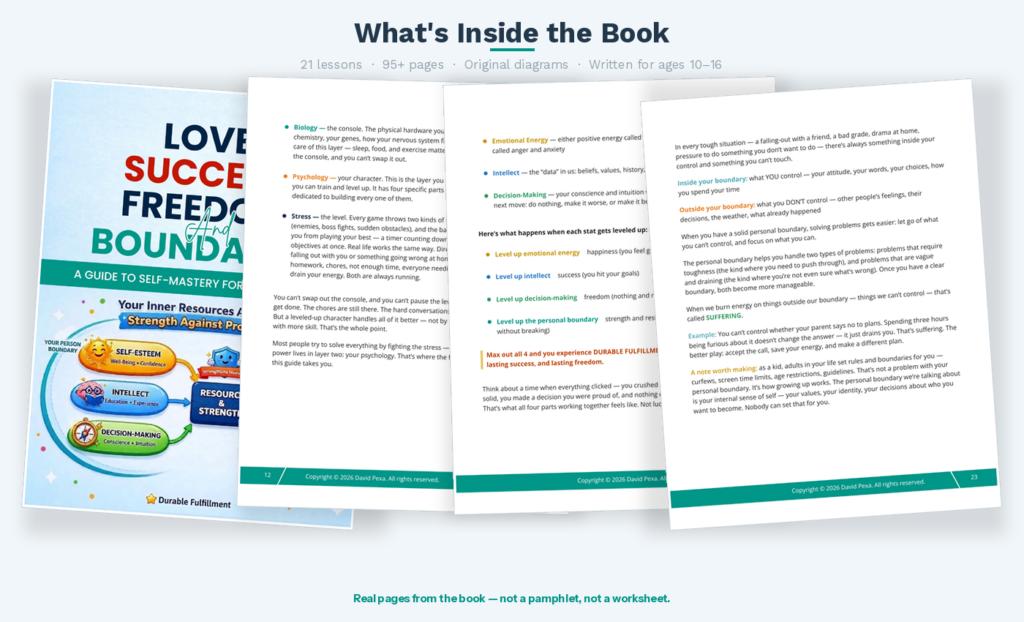
If this resonates, the full framework lives in Love, Success, Freedom and Boundaries.
A practical playbook for raising emotionally resilient kids — and breaking the patterns you didn’t choose to inherit.
