


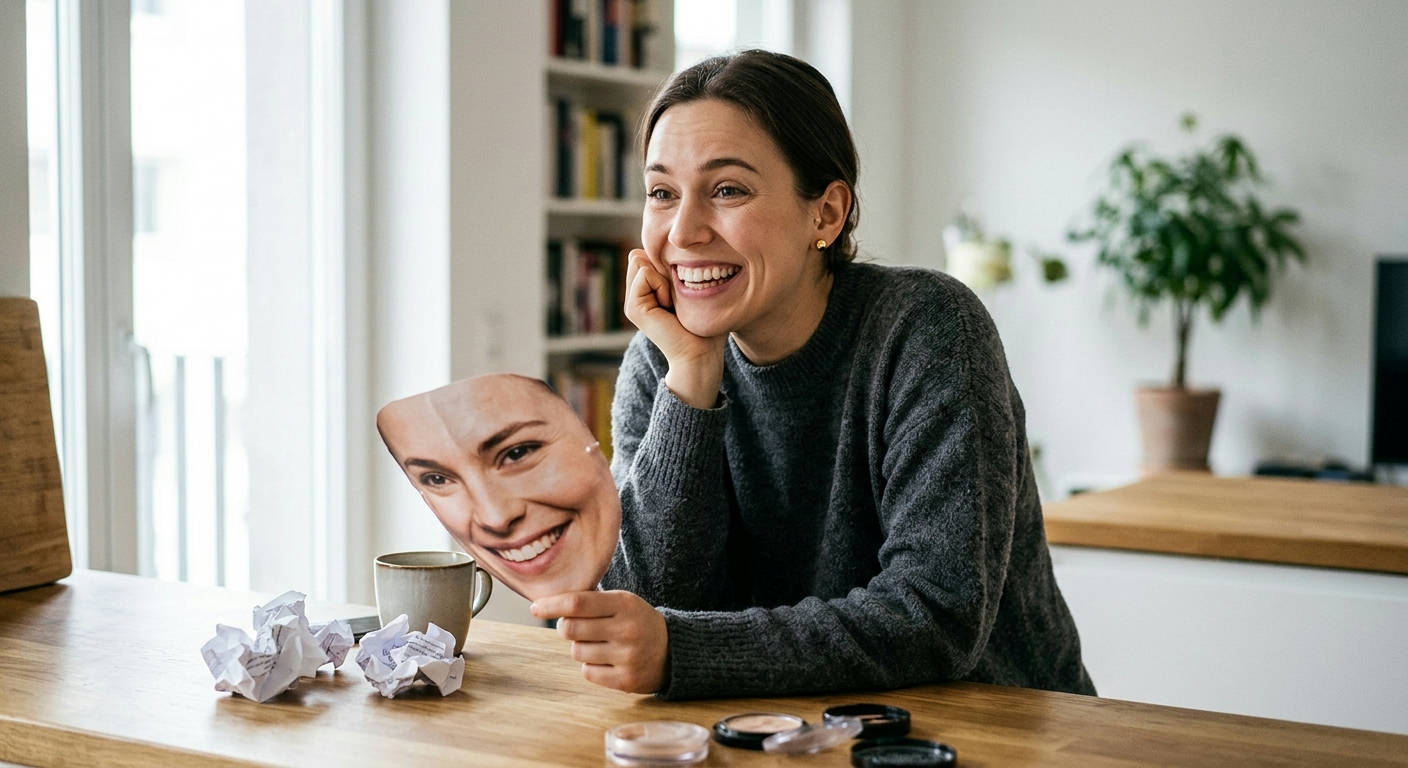
It’s exhausting, isn’t it? That constant performance, the carefully managed smile, the perfectly pitched tone of voice. If you feel like you’re always faking emotions, you’re not just tired—you’re carrying a weight that grinds you down day after day. You’ve become a master actor in the theater of your own life, but you’ve forgotten what it feels like to just be. This isn’t about being a “fake person”; it’s about a survival mechanism that has long outlived its usefulness and is now actively costing you your connection to yourself and the world.
The Psychological Roots of Emotional Fakery
Why do we learn to put on a mask? It’s rarely a conscious choice. This behavior is forged in the fires of our past experiences, social expectations, and deep-seated fears. Understanding where it comes from is the first step toward dismantling it.
Childhood Conditioning and “Feeling Rules”
From a young age, we’re handed a script. We’re taught which emotions are acceptable and which ones need to be hidden away. Boys are told, “Don’t cry.” Girls are told, “Be nice.” These aren’t just suggestions; they are powerful social directives.
Sociologists call these “feeling rules”—the unspoken social agreements about what we’re supposed to feel in certain situations, and how we’re supposed to express it. A funeral requires sadness. A birthday party requires joy. When your internal state doesn’t match the external expectation, you learn to perform the “correct” emotion to fit in and avoid disapproval.
Trauma and Emotional Survival
For some, faking emotions isn’t about fitting in; it’s about survival. If you grew up in a volatile or unpredictable environment, showing your true feelings—like fear, sadness, or anger—could have been dangerous. You learned that a neutral or pleasant expression was a form of camouflage.
This creates a powerful, automatic response. Your nervous system learns that authenticity equals threat. So, you disconnect from your feelings and project whatever is necessary to keep the peace and stay safe. It’s a brilliant coping mechanism for a child in a tough spot, but it becomes a prison in adulthood.
The Performance Pressure of 2026
We live in a world that curates perfection. Social media feeds are highlight reels of promotions, perfect vacations, and flawless relationships. There’s an immense, unspoken pressure to project an image of constant happiness and success.
This digital stage encourages a culture of emotional performance. Admitting you’re struggling, lonely, or just plain bored feels like a failure. So you post the smiling photo, you “like” the happy news, and you contribute to the collective illusion, all while feeling a growing chasm between your public persona and your private reality.
Are You Always Faking Emotions? The Telltale Signs
It’s one thing to put on a brave face occasionally. It’s another thing entirely when the mask becomes your face. If you’re not sure where you stand, these signs might feel uncomfortably familiar.
The Feeling of Emptiness and Disconnection
You’re present at events, but you feel like a ghost watching from the corner of the room. You laugh at the joke, but you don’t feel the humor. You offer a hug, but you don’t feel the connection.
This profound sense of detachment is a hallmark of someone who is chronically faking their emotions. You’re so busy managing the performance that you can’t actually participate in your own life. You observe, you react, but you don’t feel.
Chronic Exhaustion and Burnout
Have you ever wondered why you’re so tired all the time, even when you’ve had enough sleep? Maintaining a constant emotional facade is incredibly draining. It requires a huge amount of cognitive and emotional energy.
You are essentially running two operating systems at once: the real, underlying emotional state and the carefully constructed one you show the world. It’s no wonder you’re burned out.
This isn’t just mental fatigue. This kind of chronic stress can manifest physically, leading to headaches, digestive issues, and a weakened immune system. You might feel emotionally constipated, unable to process or release anything that’s bottled up inside.
Your Relationships Feel Superficial
How can someone truly know you if you never show them who you are? When you’re always faking emotions, your relationships are built on a fragile foundation.
People may like the version of you that you present, but you’re left with a nagging feeling that they wouldn’t like the real you. This prevents true intimacy and leaves you feeling profoundly lonely, even when you’re surrounded by people. You can’t build a deep connection on a shallow performance.
The High Cost of Emotional Disingenuity
This isn’t a harmless habit. The long-term consequences of emotional suppression and performance are severe, impacting everything from your sense of self to your physical health.
The Erosion of Your Identity
Who are you when you’re not performing? If you spend years—or decades—faking your emotions, that question becomes terrifyingly difficult to answer. The line between the mask and your true self blurs.
You might find yourself making life choices—career paths, relationships, hobbies—based on the persona you’ve created, not on what you genuinely want or need. You lose touch with your inner compass, leaving you feeling lost and directionless.
Physical Health Consequences

Your body keeps the score. Suppressing emotions, especially powerful ones like anger and sadness, creates chronic stress. This isn’t just a mental state; it’s a physiological one.
Research consistently shows a link between emotional suppression and negative health outcomes. The American Psychological Association highlights how long-term stress can disrupt almost all of your body’s processes, increasing the risk for everything from heart disease to digestive problems. The energy it takes to hold it all in has to come from somewhere.
### The Inevitable Crack in the Facade of Always Faking Emotions
You can’t keep a lid on a boiling pot forever. Eventually, the pressure builds, and the suppressed emotions leak out sideways.
This can look like a sudden, disproportionate outburst of anger over something minor. It might be a breakdown in the grocery store aisle. It could also manifest as a deep dive into depression or a spike in anxiety. These moments are not you “going crazy”; they are the desperate attempts of your authentic self to be heard.
Why Is It So Hard to Stop?
If it’s so damaging, why not just stop faking it? This question misunderstands the nature of the problem. This behavior is a deeply ingrained defense mechanism, and letting it go can feel incredibly risky.
The Primal Fear of Rejection
At its core, the fear of showing your true emotions is the fear of not being loved or accepted for who you are. “If they see my anger, my sadness, my fear… they will leave me.”
This fear is often rooted in early experiences where emotional honesty was met with punishment, ridicule, or abandonment. Your brain learned a simple but powerful equation: Authenticity = Rejection. Unlearning that takes courage. It requires you to be willing to how to take risks for personal growth in your most vulnerable relationships.
The Loss of a Perceived “Superpower”
Being an emotional chameleon can feel advantageous. It allows you to navigate tense work meetings, placate difficult family members, and appear poised and in control at all times. It’s a tool that has likely helped you avoid conflict and achieve certain goals.
Giving up this tool can feel like giving up your armor. You’re stepping onto the battlefield of life unprotected, and that’s a terrifying prospect. The thought of being raw, messy, and vulnerable feels like a strategic disadvantage.
The Behavior is Automatic
After years of practice, faking emotions is no longer a conscious decision. It’s a reflex. You don’t decide to smile when you’re sad; it just happens. You don’t choose to say “I’m fine”; the words just come out.
Breaking this habit is like trying to write with your non-dominant hand. It feels awkward, unnatural, and requires immense concentration. It’s a process of overriding years of neurological programming.
A Practical Guide to Reclaiming Your Authentic Feelings
Breaking free from the habit of always faking emotions is a journey, not an overnight fix. It’s about taking small, consistent steps toward emotional honesty and self-acceptance.
Start with Micro-Doses of Honesty
You don’t have to bare your soul to a stranger. Start small, in low-stakes situations. When a coworker asks how you are, instead of the automatic “Great!”, try a more honest, but still appropriate, “You know, a bit of a slow start today.”
Think of it as building a muscle. You start with small weights. Tell a trusted friend, “I’m actually feeling pretty anxious about that presentation,” instead of pretending you’re confident. Each small act of honesty strengthens your capacity for authenticity.
The Power of Emotional Labeling
You can’t express what you can’t identify. Many people who fake emotions are also disconnected from what they’re truly feeling. The practice of “affect labeling” can be a game-changer.
It’s simple: just put a name to the feeling. Take a moment to check in with yourself and ask, “What is this sensation in my chest? Is it disappointment? Is it frustration? Is it loneliness?” As neuroscientist Matthew Lieberman’s research at UCLA has shown, simply naming an emotion can help reduce its intensity and give you a sense of control. This is a crucial step toward achieving real how to improve mental clarity.
Find a Safe Harbor
You need at least one person or space where you can practice taking off the mask without fear of judgment. This could be a therapist, a supportive partner, or a very close friend.
This is your training ground. In this safe space, you can experiment with expressing your real feelings and learn that the world doesn’t end. You can cry, rage, or admit your deepest fears and be met with acceptance. This positive reinforcement is essential for rewriting the old script that says your true feelings are unacceptable.
“Vulnerability is not winning or losing; it’s having the courage to show up and be seen when we have no control over the outcome. Vulnerability is not weakness; it’s our greatest measure of courage.” – Brené Brown
Embrace the Mess
Real emotions aren’t neat and tidy. They are messy, contradictory, and inconvenient. The goal isn’t to achieve some perfect state of emotional zen. The goal is to allow yourself to be a complete human being.
Accept that you will feel jealous sometimes. You will feel petty. You will feel overwhelming grief and ecstatic joy. Allowing the full spectrum of human emotion to exist within you without judgment is the ultimate act of self-acceptance. It’s the key to ending the exhausting performance of always faking emotions. The work is hard, but the freedom on the other side is everything.
