


It usually hits in ordinary moments. You’re staring at your phone, avoiding a text, or sitting on the edge of the bed thinking, “i hate my life so much,” and part of you feels dramatic for even saying it while another part knows you mean it.
I understand that moment. I’ve sat with enough people in it to know this thought rarely shows up out of nowhere. It usually arrives after too much pressure, too little relief, and a long stretch of pretending you’re fine.
First I Want You to Hear This
If that sentence is running through your mind, I want to say something plainly.
I understand. I’m not going to argue with your pain, shame you for it, or slap a motivational quote over it. When someone says “I hate my life,” they’re usually not asking for a lecture. They’re trying to describe a level of overload that words barely hold.
You may feel trapped, embarrassed, angry, numb, exhausted, or all of it at once. You may not even know whether you hate your whole life or just the way it feels to live it right now. That confusion is common. It doesn’t make your pain less real.
You are not the only person having this thought
A lot of people assume this feeling means they’re broken in some unique way. That’s false. In the United States, 40% of high school students experienced persistent feelings of sadness or hopelessness in 2023, and 32.2% of young adults ages 18 to 25 faced a mental illness in 2024, according to NAMI’s mental health by the numbers.
That doesn’t mean your suffering is small. It means your suffering is human.
You are not failing at life because your nervous system and mind are waving a red flag.
Sometimes this shows up as crying all the time. Sometimes it shows up as irritability, doom-scrolling, snapping at people you love, sleeping too much, not sleeping at all, or feeling detached from your own life. If that sounds familiar, you may also relate to why emotions can suddenly feel too big to manage.
Don’t reduce this to weakness
People say “I hate my life” when something in them has been carrying too much for too long. The mistake we often make is turning a distress signal into a character judgment. You don’t need more self-attack. You need a steadier way to read what’s happening.
Here’s my direct opinion. You should stop treating this thought like proof that your life is hopeless. Treat it like evidence that something needs attention now.
A few things can be true at once:
- You’re overwhelmed and not thinking clearly.
- You still have good instincts underneath the overwhelm.
- You need relief first, not a grand life plan by tonight.
- You deserve support before things get worse.
If you only take one sentence from this section, take this one. The thought “i hate my life so much” is serious, but it is not a final verdict.
The Critical First 15 Minutes
When your mind is flooded, do not start with life analysis. Start with your body.
Your body is faster than your logic. If your chest is tight, your breathing is shallow, your stomach is clenched, and your thoughts are racing, you won’t think your way out cleanly. You need to lower the alarm first.

Start with 4 7 8 breathing
Let me show you the simplest first move. Newport Institute explains that somatic grounding techniques like 4-7-8 breathing, inhale 4 seconds, hold 7 seconds, exhale 8 seconds, are designed to interrupt the body’s hypervigilance and can be a powerful first step in regulating overwhelming emotions linked to trauma, anxiety, or depression.
Do it like this:
- Sit down if you can. Put both feet on the floor.
- Inhale for 4 through your nose.
- Hold for 7.
- Exhale for 8 slowly through your mouth.
- Repeat for a few rounds without trying to do it perfectly.
Don’t chase calm. Just give your body a slower rhythm to follow.
Use the room to anchor yourself
If breathing alone feels hard, use a simple grounding scan. Look around and name:
- 5 things you can see
- 4 things you can feel
- 3 things you can hear
- 2 things you can smell
- 1 thing you can taste
This is not cheesy. It pulls your attention out of the mental spiral and back into the present environment. Your brain needs something concrete when it’s trying to run catastrophe loops.
Practical rule: If your thoughts are spinning, your next move should involve breath, touch, temperature, or movement. Not more overthinking.
Do a blunt safety check
Ask yourself this directly.
Are you thinking about hurting yourself right now, or do you feel like you might act on it?
If the answer is yes, stop reading and contact immediate support now. In the U.S., the 988 Suicide & Crisis Lifeline is available by call or text. If you’re in immediate danger, call emergency services now or go to the nearest emergency room. If you can, move toward another person, not deeper into isolation.
If you’re not in immediate danger but you feel shaky, do these three things in order:
| Right now | Why it helps |
|---|---|
| Put water in your hand or drink some | Gives your body a concrete task |
| Move to a different room or outside | Breaks the frozen state |
| Text one safe person | Interrupts isolation fast |
Use a text this simple:
I’m having a rough moment and I don’t want to be alone with my thoughts. Can you stay with me by text or call for a bit?
For the next fifteen minutes only
Do not decide your future in the worst ten minutes of your week.
Your only job in this window is to get a little safer, a little steadier, and a little less alone. That’s enough. Once your body comes down even slightly, your options come back into view.
What if I Hate My Life Is a Signal Not a Fact
This thought is often treated like a verdict. I think that’s a mistake.
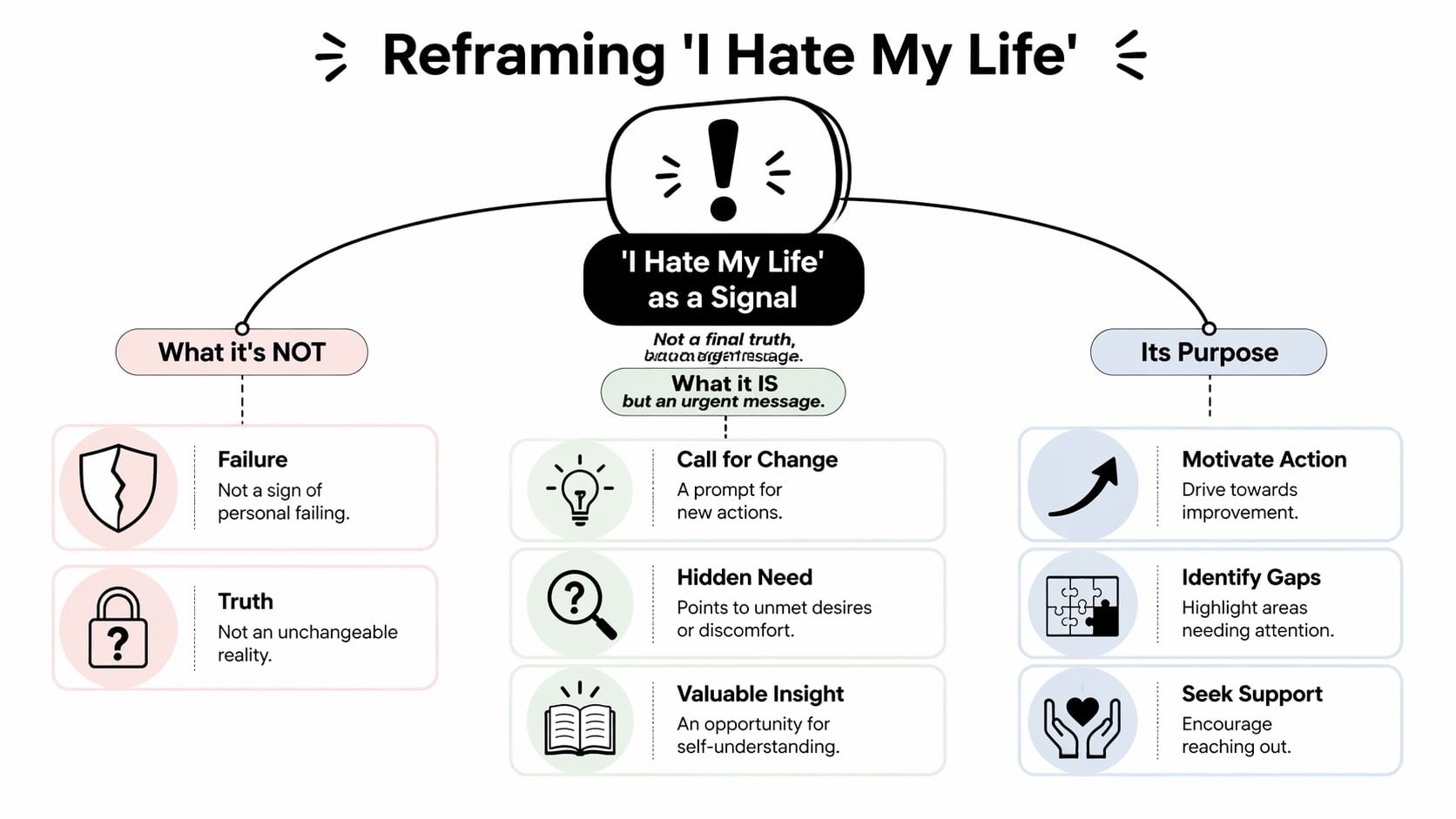
“I hate my life” feels like a conclusion, but very often it’s a signal. A loud one. An urgent one. But still a signal. If your smoke alarm goes off, you don’t stand in the kitchen debating whether the alarm is being too negative. You check what’s burning.
That’s the shift I want for you.
Your body often knows before your mind admits it
Many resources frame this feeling only as illness. Sometimes that’s part of it. But Mental Wellness Counselling describes a somatic perspective that sees it as an “alarm for agency.” In plain English, the feeling often signals that you’re living in a way your system can’t keep absorbing. Misaligned values, relentless pressure, and unrelenting standards can show up as physical and emotional distress.
I agree with that frame because it gives you somewhere to go.
Sponsored

If your body keeps tightening before work, going numb around certain people, or crashing after you force yourself through another week you don’t believe in, that matters. It doesn’t mean every feeling is a perfect message. It does mean your distress may be pointing toward a mismatch you’ve been minimizing.
Ask better questions
Bad question: Why is my life so terrible?
Better questions:
- What part of my life feels impossible right now
- Where do I feel trapped
- What am I tolerating that my body is rejecting
- What standard am I obeying that is crushing me
- What gets worse every time I ignore it
That’s where useful change starts.
If you want a more structured way to challenge the thought without pretending it’s nonsense, some of the tools in these cognitive behavioral therapy techniques can help you separate the feeling from the conclusion.
“I hate my life” is often shorthand for “something important is wrong and I don’t know how to change it yet.”
Common signals hiding under the sentence
Not every person means the same thing when they say it. Here’s a cleaner way to read the message:
| What you say | What may be underneath |
|---|---|
| I hate my life | I feel trapped and powerless |
| I’m done | I’m depleted and can’t keep performing |
| Nothing matters | I’m disconnected from meaning or people |
| I can’t do this anymore | My current load exceeds my capacity |
This reframe matters because facts feel fixed. Signals invite response.
If you treat the thought like truth, you collapse. If you treat it like information, you investigate. That small mental move can return a piece of agency you thought you’d lost.
From Signal to Action Your First Small Moves
Once you stop treating the feeling as a final judgment, the next step is not “reinvent your life.” The next step is much smaller.
You need movement, not drama. Tiny actions rebuild trust in yourself faster than giant promises. When people are overwhelmed, they usually make one of two mistakes. They either do nothing because everything feels too big, or they design a perfect recovery plan they can’t sustain for two days.
Do neither.

Pick one move that is almost too small
A good first move is boring on purpose. It should be concrete, doable, and hard to argue with.
Examples:
- Body move. Stand outside for five minutes without your phone.
- Connection move. Send one honest text to one safe person.
- Environment move. Clear one small surface, like your desk or nightstand.
- Nourishment move. Eat something simple and drink water.
- Relief move. Take a shower and change clothes.
- Boundary move. Delay one non-urgent obligation that is draining you.
If you’re in a bad state, don’t ask, “What will fix my life?” Ask, “What would make the next hour less hostile?”
Use a simple daily template
Write this on paper or in Notes:
Today, I will
one small action: __________________
I expect it to help by
making me feel: __________________
After I do it, I’ll rate
better, same, or worse
That’s it. No journal essay. No deep performance. Just data.
Keep a behavioral log, not a shame log
People track their distress by replaying it in their head. That’s useless. Put it somewhere visible instead.
Try a simple log with four columns:
| Situation | What I felt in my body | What I did next | Better, same, or worse |
|---|---|---|---|
| After a work call | tight chest, headache | scrolled for an hour | worse |
| After a walk | less pressure in shoulders | made lunch | better |
| After talking to that person | stomach drop, numb | withdrew | worse |
Patterns matter. You’re looking for clues, not trying to prove you’re broken.
Small actions look weak to an overwhelmed mind. They are not weak. They are how agency returns.
Interrupt one repeating pattern
You probably already know one pattern that makes everything worse. Maybe it’s isolating, doom-scrolling at midnight, skipping meals, saying yes when you mean no, or checking messages from someone who destabilizes you.
Pick one interruption:
- If nights are hardest, charge your phone outside the bedroom.
- If work dread spikes your stress, take a two-minute pause before opening email.
- If loneliness distorts everything, schedule time in the same room as another human, even just being there.
- If one relationship keeps wrecking you, stop having serious conversations by text.
These aren’t glamorous. Good. Glamour is not the goal. Stability is.
When and How to Ask for Backup
Asking for help is not a sign that you’ve failed to handle life. It’s a sign that you’ve stopped trying to white-knuckle your way through suffering alone.
A lot of people wait too long because they think their pain has to become extreme before it counts. That’s backward. Support works best when you ask before you’re completely underwater.

What kind of backup fits what kind of need
You do not need one perfect person to meet every need. Different support helps in different ways.
| Type of support | Best for |
|---|---|
| Trusted friend or family member | Immediate company, practical help, not being alone |
| Therapist or counselor | Ongoing patterns, depression, anxiety, trauma, deeper change |
| Coach | Structure, accountability, behavior change, follow-through |
| Crisis support | Moments when safety is in question |
Authoritative sources confirm that about 1 in 4 U.S. adults suffer a diagnosable mental disorder in a given year, and that the SAMHSA National Helpline provides free, confidential, 24/7 treatment referral and information services for people facing mental health issues, as noted by Mind’s mental health facts and statistics page.
If you need help finding support, personal growth counseling options can also give you a sense of what kind of guidance may fit your situation.
For the therapy option specifically, the access friction has dropped a lot in the last few years. Online platforms like Talkspace can match you with a licensed therapist usually within 24 hours, work in all 50 states, accept most major insurance, and let you message your therapist between sessions when something comes up that you don’t want to forget. I mention them by name because they’re the platform I’d point a student or coaching client to today — the path from “I think I need help” to “I’m in a session” is short enough to actually walk.
Use words you can copy and paste
You do not need to craft the perfect vulnerable message. Use one of these.
To a friend:
I’m struggling more than I’ve been letting on. I don’t need you to fix it, but I do need some support. Could you check in with me today?
To a family member:
I’ve been feeling overwhelmed and low, and I think I need more support than I’ve been asking for. Can we talk sometime today?
To a therapist or counseling office:
Hi, I’m reaching out because I’ve been dealing with intense distress and I want support. I’m looking for help with emotional regulation, patterns, and getting steadier day to day. Do you have availability for an appointment?
To someone safe when you feel ashamed:
I’m having a hard time and my brain is telling me to isolate. I’m sending this because isolating will make it worse.
If speaking feels impossible, send the text anyway. Let the other person help carry the conversation.
Make the ask smaller if needed
Some people won’t ask for help because “Can you support me?” feels too big. Then make the request narrower.
Ask for one of these instead:
- A call tonight
- A ride to an appointment
- Help finding a therapist
- Someone to sit with you
- A check-in tomorrow morning
- Help making a plan for the weekend
Specific asks are easier for people to respond to. They also reduce the chance that you’ll feel disappointed by vague support.
If you are having thoughts of hurting yourself or you don’t trust yourself to stay safe, skip the subtle outreach and contact immediate crisis support now.
Your Life Isn’t Over It’s Asking for a Change
Let me pull this together.
When “i hate my life so much” hits, don’t start by judging yourself. Start by grounding your body. Get your feet on the floor. Breathe. Use the room. Get near another person if you need to. Safety first.
Then stop treating the thought like a courtroom sentence. Read it as a signal. Something in your life, load, relationships, standards, or inner pressure system is out of alignment. Your pain may be messy, but it is not meaningless.
After that, go small. One tiny action. One pattern interrupt. One honest note in your log. One text. One boundary. One shower. One walk. One less hour spent feeding the spiral.
And when it’s too heavy to carry alone, ask for backup sooner. Not because you’re weak. Because you’re wise enough to stop confusing isolation with strength.
I understand how convincing this thought can feel in the moment. I also know this. Many lives begin changing at the exact point someone finally admits, “I can’t keep doing it like this.”
That admission is painful. It is also useful.
Your life isn’t over. It’s asking for a change. Listen to that request with seriousness, not contempt.
I write about the patterns often overlooked when people are overwhelmed, emotionally flooded, or stuck in roles that are crushing them. If you want the next essay in your inbox from David Pexa, join there. I’ll send practical pieces on hidden family dynamics, emotional regulation, and how to tell whether your distress is coming from burnout, grief, trauma, or a life that no longer fits.
A note on affiliates: This article includes affiliate links to platforms I’ve vetted and would recommend to my own clients and students. If you start with a recommended service through a link here, I may earn a small commission — at no extra cost to you. I only mention what I’d actually point you to in person. The recommendation comes first; the relationship is disclosed second.
If this resonates, the full framework lives in Love, Success, Freedom and Boundaries.
A practical playbook for raising emotionally resilient kids — and breaking the patterns you didn’t choose to inherit.
Get the ebook →