



Summary: Why Am I So Emotional: Find Your Balance — understanding the signal beneath the surface and what you can actually do about it.
You open your laptop, read a short email, and your eyes fill with tears.
Or someone cuts you off in traffic and your reaction feels wildly bigger than the moment. Or your partner asks a normal question and you snap, then immediately wonder, Why am I so emotional? What is wrong with me?
Usually, nothing is wrong with you.
What’s happening is that your internal system is sending signals. Your body, brain, history, habits, and expectations all feed into how strongly you feel something. If you treat those signals like a character flaw, you miss the message. If you treat them like data, you can work with them.
That is the user manual people often miss. Emotions are not random. They are not always convenient, but they are usually informative.
Your Emotions Are Data Not a Defect
A lot of emotional suffering comes from the second reaction, not the first one.
The first reaction is the feeling itself. Sadness. Anger. Panic. Shame. Hurt. The second reaction is your judgment about having that feeling at all. I shouldn’t still be upset. This is too much. Normal people don’t react like this.
That second layer often hurts more.
Research on unrealistic emotional expectations captures this well. When your emotional expectations are unrealistic, you end up feeling bad about feeling bad, which is what really makes us feel inadequate. That is the emotional expectations paradox.
The first useful question
Instead of asking, “What’s wrong with me?”, ask:
- What is this feeling reacting to
- What changed in my body or environment
- What story am I telling myself about this feeling
- Am I upset, or am I also upset that I’m upset
That shift matters. It moves you from self-attack to observation.
Think of your emotions like warning lights on a dashboard. A warning light is not a moral failure. It is a signal that something needs attention. Sometimes the issue is immediate. Sometimes it points to a deeper pattern. But the light itself is useful.
Why mixed feelings confuse people
Many people think emotional clarity means feeling one clean emotion at a time. Real life rarely works that way. You can feel relieved and guilty. Excited and scared. Grateful and resentful.
If that sounds familiar, this guide to understanding mixed emotions can help you put better language around what feels tangled.
Key idea: Emotional intensity often becomes more painful when you fight it, rush it, or label it as weakness.
A better goal is not emotional perfection. It is emotional translation.
When you can say, “I’m not falling apart, I’m overloaded,” or “I’m not irrational, I’m touched a vulnerable spot,” your next decision gets better. You stop treating every feeling as a verdict on your identity.
The Hidden Blueprint in Your Biology and Hormones
Hormones do not create emotions from scratch. They change the volume on feelings that are already in your system.
Some days that shift happens before you have a clear thought about it. You wake up more irritable, more tearful, or less able to brush things off. That can feel confusing, especially if your life looks normal on paper. The better question is not, “Why am I being dramatic?” It is, “What changed in my internal settings?”

Hormones change the volume, not your worth
Your emotional operating system responds to chemistry as well as circumstance. Shifts related to the menstrual cycle, puberty, pregnancy, postpartum recovery, and perimenopause can alter mood, patience, and stress tolerance. The same is true for sleep disruption, thyroid problems, blood sugar swings, and other physical changes that affect how your brain and body communicate.
The Office on Women’s Health explains that hormone changes can affect brain chemicals linked to mood during menstruation, pregnancy, the postpartum period, and menopause.
That helps explain why a hard day can feel harder than usual. Your coping skills may be the same. The conditions those skills are working under have changed.
What this can look like in real life
Biology often shows up in ordinary moments, not dramatic ones.
You may notice:
- More irritability than usual after poor sleep during a hormonal shift
- Tears arriving faster over problems you would usually handle
- Less patience with noise, interruptions, or too many choices
- A heavier emotional tone that colors the whole day
People often misread these shifts. They assume every intense feeling must trace back to a major event or a character flaw. Sometimes your body is sending stronger signals, and then your mind starts building a story around them.
That second layer matters. Feeling bad is one thing. Feeling ashamed that you feel bad usually makes the experience sharper and harder to regulate.
Mental health conditions can change the baseline
Sometimes emotional intensity is not only about a temporary hormone shift. Ongoing mental health conditions can affect how strongly you react, how long feelings last, and how quickly you return to baseline.
The National Institute of Mental Health describes mood disorders such as depression and bipolar disorder, and anxiety disorders, as conditions that can significantly affect mood, energy, thinking, and daily functioning. Those changes can make emotions feel more persistent, heavier, or more difficult to interrupt.
A simple way to sort this out is to compare patterns over time:
| Situation | What it may feel like |
|---|---|
| Baseline stress | You feel stretched, but rest and support usually help |
| Hormonal disruption | The same situation hits harder than it did last week |
| Mood or anxiety condition in the background | Feelings linger, intensify, or interfere with daily life more consistently |
Patterns are more useful than isolated moments. One rough day may reflect biology. Weeks of emotional heaviness, panic, hopelessness, or instability deserve a closer look.
Some people process more by default
Temperament also shapes emotional intensity. Some nervous systems pick up more information and hold onto it longer.
Psychology Today describes sensory processing sensitivity as a trait linked to deeper processing of subtleties, stronger emotional reactivity, and greater awareness of environmental stimuli. If you relate to that pattern, you may notice tone of voice, facial expressions, clutter, background noise, or social tension faster than other people do.
That does not automatically mean poor regulation. It may mean your system runs a more sensitive scanner.
A useful comparison is screen brightness. On a brighter setting, you can see more detail, but glare also hits harder. A sensitive nervous system works in a similar way. You may pick up richness, nuance, and warning signs that others miss. You may also reach overload sooner in harsh, crowded, or chaotic settings.
Practical takeaway: If your emotions spike in noisy, bright, crowded, or tense environments, audit sensory load before blaming your character.
That shift in interpretation helps you build a better emotional rulebook. Instead of asking why you are “too much,” you can ask what inputs your system handles well, what inputs flood it, and what support helps you recover.

How Daily Stressors Rewire Your Emotional Responses
You do not need a major crisis to feel emotionally overwhelmed. Modern life can do the job in smaller, repeated doses.
A tight deadline. Constant notifications. Money stress. Family pressure. Too little sleep. Too much caffeine. Not enough recovery time. Layer enough of that together and your system starts acting like every problem is urgent.
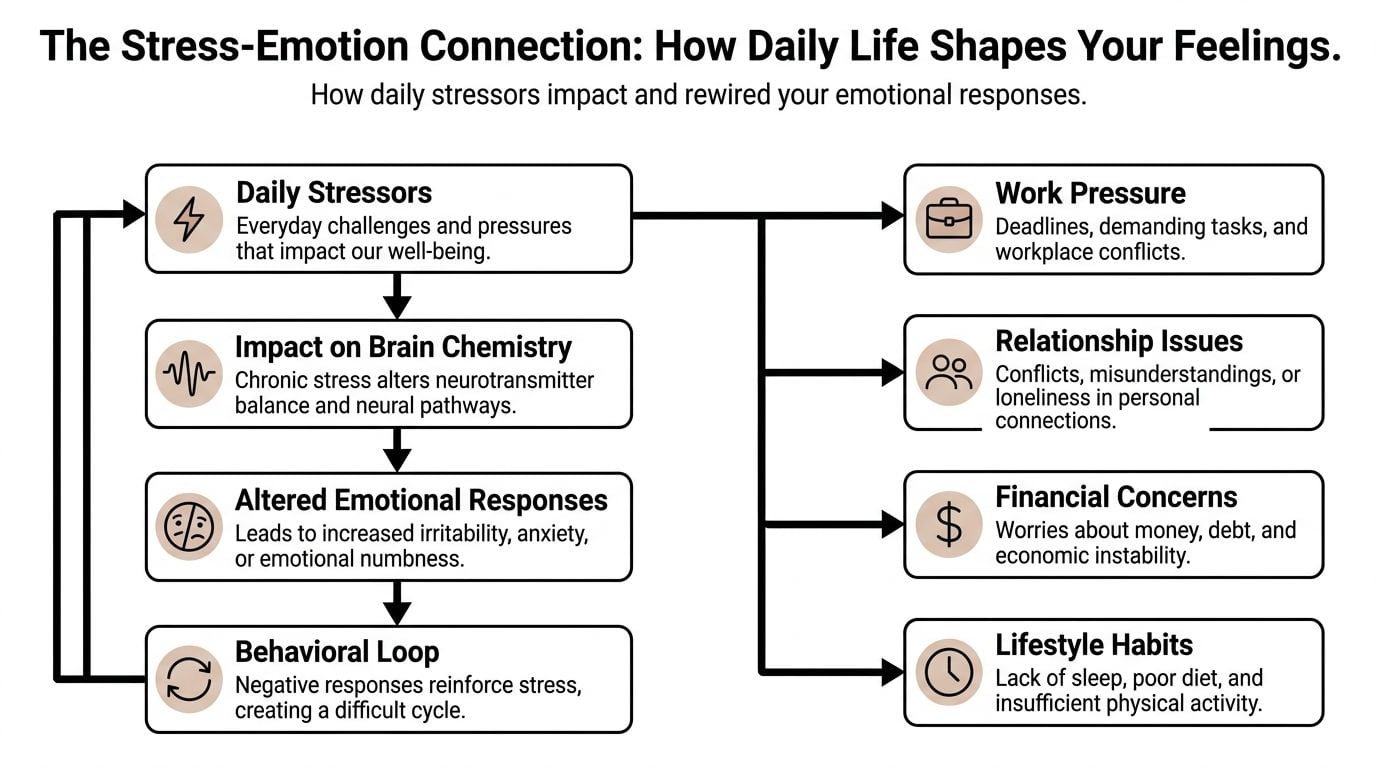
Stress changes how you feel and how you interpret
According to the Mental Health Foundation, 51% of adults who felt stressed reported feeling depressed, and 61% reported feeling anxious. That helps explain why unmanaged stress makes ordinary life feel emotionally loaded.
Stress does not just add pressure. It changes perception.
A neutral comment can sound critical. A small setback can feel catastrophic. A simple task can trigger tears because your system is already running hot.
The modern version of fight, flight, or freeze
Your body’s stress response was built to protect you. The problem is that your body does not always distinguish well between a real emergency and a digital, social, or work-based one.
A tense inbox can keep your body alert.
A financial worry can stay in your muscles all day.
A phone that never stops buzzing can keep you from returning to baseline.
That is why people often say, “Nothing huge happened, but I feel like I’m unraveling.” The load is cumulative.
The overlooked lifestyle amplifiers
Emotional intensity often rises when these pieces stack:
- Sleep debt: Your patience shrinks, and your brain becomes more negative in how it sorts information.
- Blood sugar swings: Going too long without food can make you shaky, reactive, or tearful.
- Too much caffeine: Useful in small doses for some people, but rough on an already activated system.
- Alcohol: It can lower inhibition and worsen emotional volatility later.
- No transition time: Moving from task to task with no pause keeps your system in performance mode.
Here is a simple check-in table you can use:
| Daily factor | Question to ask |
|---|---|
| Sleep | Did I get enough rest to recover, not just survive |
| Food | Have I eaten in a way that keeps my energy steady |
| Workload | Am I carrying more than I can realistically process today |
| Inputs | Have I been online so much that my nervous system never settled |
Quick reset: Before analyzing your whole life, ask whether your emotional system is underfed, overtired, overstimulated, or overcommitted.
That question is boring. It is also powerful.
If you want to know why am i so emotional lately, start with the everyday conditions your system has been living in. Many people search for a dramatic explanation when the truer answer is chronic overload.
The Overthinking Loop and Your Brain’s Default Mode
Some emotions hit hard and pass. Others get trapped in mental replay.
You re-read the conversation. Rehearse what you should have said. Predict what will happen next. Try to solve the feeling with more thinking, then end up deeper in it.
That is the overthinking loop.
Your brain has a resting mode
A helpful analogy is the brain’s screensaver mode. When you are not focused on a task, your mind often shifts into self-referential thinking. For some people, that mode becomes a workshop for reflection. For others, it becomes a courtroom.
That is why “just stop thinking about it” rarely works.

Why the same thought keeps returning
Overthinking creates a false sense of productivity. It feels like work, but often it is repetition without resolution.
You may be doing one of these:
- Replaying a moment to avoid future pain
- Mind-reading what other people think of you
- Building a case for why your reaction is justified
- Trying to think your way out of uncertainty
The brain treats this loop like unfinished business. So it keeps reopening the tab.
The shift that helps
You do not need to argue with every thought. You need to notice what category it belongs to.
A short sorting method:
| Thought type | Better response |
|---|---|
| Problem to solve | Write the next action |
| Feeling to process | Name it and allow it |
| Story about yourself | Test whether it is true |
| Loop with no endpoint | Redirect attention back to the present |
If you want structured ways to challenge these loops, these cognitive behavioral therapy techniques can help you separate thought from fact.
Key takeaway: Overthinking is not proof that you care strongly. Often it is a sign that your brain is stuck in protection mode.
When you understand that, emotional intensity becomes less mysterious. You are not only feeling the original event. You are also feeling the mental replay of it.
Practical Tools for Immediate Emotional First Aid
When your emotions surge, you do not need a lecture. You need a short, reliable response.
Think of these as emotional first aid. They are not a full cure. They are how you stop the bleeding long enough to think clearly again.
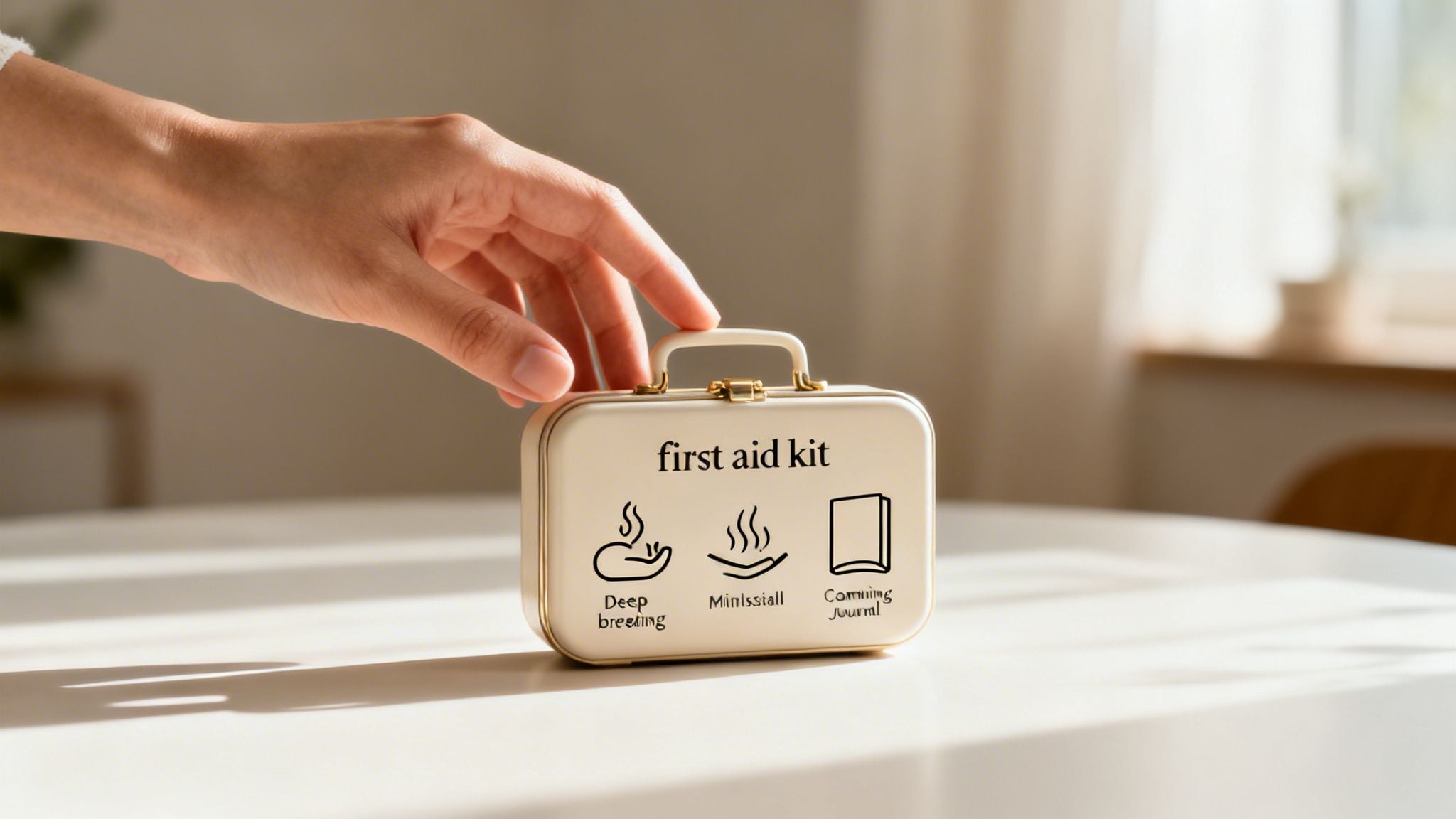
Box breathing
Use this when your body feels revved up.
- Inhale through your nose for a count of four.
- Hold for four.
- Exhale for four.
- Hold again for four.
- Repeat for a few rounds.
Why it helps: it gives your attention one simple job and can reduce the sense that everything is escalating at once.
The 5 4 3 2 1 grounding method
Use this when your mind is spiraling.
Notice:
- 5 things you can see
- 4 things you can feel
- 3 things you can hear
- 2 things you can smell
- 1 thing you can taste
Why it helps: it pulls you out of imagined danger and back into the present environment.
Name it to tame it
This one is simple and underrated.
Try a sentence like:
- “I feel embarrassed.”
- “I feel rejected.”
- “I feel overwhelmed and cornered.”
- “I feel angry, but underneath that I also feel hurt.”
Specific language lowers confusion. Vague distress tends to grow. Specific words tend to organize experience.
A tool like an emotions chart can help if you go blank. One option is David Pexa’s emotion regulation checklist, which is designed to help people identify what they are feeling and choose a next step.
A two-minute discharge
If your body is flooded, add movement.
Try one of these:
- Walk outside briefly
- Press your feet into the floor
- Shake out your hands and shoulders
- Splash cold water on your face
- Exhale longer than you inhale
These actions are basic on purpose. In a heightened state, simple works better than clever.
The sentence that interrupts shame
Say this to yourself if needed:
“This feeling is real. It is not the whole story. I can respond without obeying it.”
That sentence does three jobs. It validates the feeling, avoids over-identifying with it, and creates choice.
Building Long-Term Emotional Resilience and Clarity
You get snappy over something small, then spend the next hour criticizing yourself for being “too much.” That second layer often does more damage than the first feeling. The emotion passes. The shame can linger.

Long-term resilience starts there. Your goal is not to become less human. It is to understand your emotional operating system well enough that your reactions make more sense, recover faster, and stop turning into a fight with yourself.

Audit your emotional rulebook
Many adults are following rules they never chose. They learned them early, repeated them for years, and now treat them like facts.
Common examples look like this:
- I should be over this by now
- If I feel bad, I must be doing something wrong
- Strong people stay calm all the time
- Emotions are inefficient
- Needing space means I’m weak
These rules do not calm emotions. They add a second hit. First you feel hurt, afraid, or overwhelmed. Then you judge yourself for having that reaction at all.
Write down the rules you absorbed from family, school, work culture, religion, or past relationships. Then test them like a coach reviewing an outdated playbook. Does this rule help you respond well, or does it train you to suppress useful information?
Try this table:
| Old rule | Replacement rule |
|---|---|
| I should not feel this way | This feeling contains information, and I can examine it without punishing myself |
| I need to calm down fast | I need to understand what my system is reacting to |
| Being emotional is unprofessional | Clear, regulated communication works better than suppression |
Build a stress budget
Emotional capacity works a lot like a phone battery. If too many apps are running in the background, even a small task can drain what is left.
A stress budget means planning your days around actual capacity instead of ideal capacity. That shift sounds simple, but it changes a lot. You stop treating every hard moment like a personal failure and start asking a better question: what was my system already carrying before this happened?
Use a quick audit:
- Which commitments are necessary
- Which ones are draining but optional
- Which environments wear me down
- Which routines restore me reliably
- What times of day give me the most patience and focus
Then make concrete adjustments. Put difficult conversations earlier if that is when your mind is clearest. Reduce notification noise. Stop stacking emotionally heavy tasks with no recovery time between them. Protect transitions, because many people get overloaded in the handoff from one demand to the next.
Reframe the story, not the facts
Cognitive reframing means correcting the interpretation your brain adds under stress. It is less about positive thinking and more about accurate thinking.
For example:
- “I’m too emotional” becomes “My system is activated, and I need to find out why.”
- “I ruined everything” becomes “I had a strong reaction, and I can repair what matters.”
- “This always happens” becomes “This pattern shows up under certain conditions.”
That last shift matters. A pattern can be studied and changed. An identity label can make you feel stuck.
Design for sensitivity instead of fighting it
As noted earlier, some people process stimulation and emotion more intensely. If that sounds familiar, resilience may depend less on forcing yourself to tolerate everything and more on setting up conditions your nervous system handles well.
That can include:
- Reducing noise load with quieter spaces or headphones
- Creating visual calm by lowering clutter
- Spacing social demands instead of overbooking
- Protecting recovery time after busy or high-stimulation events
Good design is not avoidance. It is wise configuration. If your emotional operating system picks up more signals, your job is to manage input well enough that useful data does not turn into overload.
Build reflective habits before the next hard week
Clarity grows from repetition. You do not need a complicated practice. You need one you will keep.
A simple routine might include a short daily journal, a consistent wind-down ritual, a weekly review of triggers, or a few minutes of mindfulness. The point is to notice patterns while you are calm, because insight is easier to access there than in the middle of a surge.
Try these three prompts once a week:
- What emotion showed up most often this week?
- What conditions made it louder?
- What response helped me recover?
Over time, you start collecting your own user manual. You learn what sets you off, what steadies you, which beliefs add shame, and which habits create room to respond well.
Emotional resilience is the ability to read your signals with less fear and more skill. That is what creates clarity.
When to Seek Professional Guidance and Support
Self-management tools are helpful. Sometimes they are not enough.
Getting support does not mean you failed at handling your emotions. It means you are using the right level of help for the level of difficulty.
Signs it may be time
Consider professional support if:
- Your emotions regularly disrupt work or relationships
- You feel persistently hopeless, panicked, or numb
- You cannot recover your footing even with rest and self-care
- You are using alcohol, drugs, compulsive behaviors, or isolation to cope
- People close to you are expressing concern
- Your reactions feel frightening, uncontrollable, or quite unlike you
If your emotional intensity includes thoughts of harming yourself or you feel unsafe, seek urgent support from local emergency services or a crisis resource in your area right away.

Which kind of support fits what
A lot of people delay help because they do not know who to contact.
Here is a practical breakdown:
| Support type | Usually best for |
|---|---|
| Therapist | Patterns, trauma, anxiety, depression, relationship issues, emotion regulation |
| Psychiatrist | Medication evaluation and management, especially when symptoms are severe or persistent |
| Coach | Goals, habits, self-awareness, accountability, and implementation when clinical care is not the main need |
These roles can overlap, but they are not identical.
Tools and resources people often use
Some people prefer structured support at home. Common options include:
- Talkspace for online therapy access
- BetterHelp for online counseling formats
- Headspace for guided meditation
- Waking Up for mindfulness and reflective practice
Books on emotional intelligence, journaling frameworks, and CBT-based workbooks can also help, especially if you like learning through structured exercises.
The key is matching the tool to the problem. If you need treatment, productivity hacks will frustrate you. If you need emotional vocabulary and daily habits, therapy might be only one part of the solution.
Frequently Asked Questions About Emotional Intensity
Is being highly emotional a weakness or a strength
Neither by itself. It is a capacity.
Unmanaged intensity can create problems. Understood intensity can improve empathy, pattern recognition, honesty, creativity, and decision-making. The goal is not to become less human. The goal is to become more skillful with what you feel.
How much does diet affect mood
Often more than people expect, but not in a magical way.
Long gaps without eating, dehydration, too much caffeine, or heavy alcohol use can make your system less stable. Food is not the whole answer, but steady nourishment helps many people feel less reactive.
How do I explain my emotional needs without sounding unstable
Use concrete language.
Instead of “I’m a mess lately,” try:
- “I’ve been overloaded and I need a little more time to respond well.”
- “When things get loud and fast, I process better if I pause first.”
- “I’m not asking you to fix this. I’m asking for patience while I sort out what I’m feeling.”
That sounds grounded because it is grounded.
Why am i so emotional for no reason
Usually there is a reason. It may just not be obvious yet.
The reason might be biological, stress-related, cognitive, sensory, relational, or tied to your expectations about emotions themselves. Lack of clarity is not the same thing as lack of cause.
Can I get better at this
Yes.
Not by eliminating emotion, but by improving awareness, language, regulation, recovery, and support. Emotional clarity is a trainable skill.
Keep Reading
- Emotional Intelligence Chart: A Guide to Mapping Your EQ
- Emotional Disconnect: Signs, Causes, & Repair
- Unlock Emotional Value: Master Its Power for a Better Life
If you process emotions through writing — journaling, drafting hard conversations, putting words to what you’re feeling — the tool I use to draft most of my words is Wispr Flow. It transcribes your voice into clean, edited text in real time, so the friction between thinking it and writing it basically disappears.
What I Actually Take
If you want a supplement that does what most of these strategies need a boost from, I take BrainSupreme FEEL GOOD. A natural mood support stack I take on the days my emotions feel bigger than my coping skills. Use code PEXA at checkout for 15% off.
Conclusion
Understanding is the first step, but it’s what you do with that understanding that changes things. The ideas in this article aren’t meant to sit in your head — they’re meant to shift how you see your situation and give you something concrete to act on. Start with the one thing that felt most relevant, apply it this week, and notice what changes.
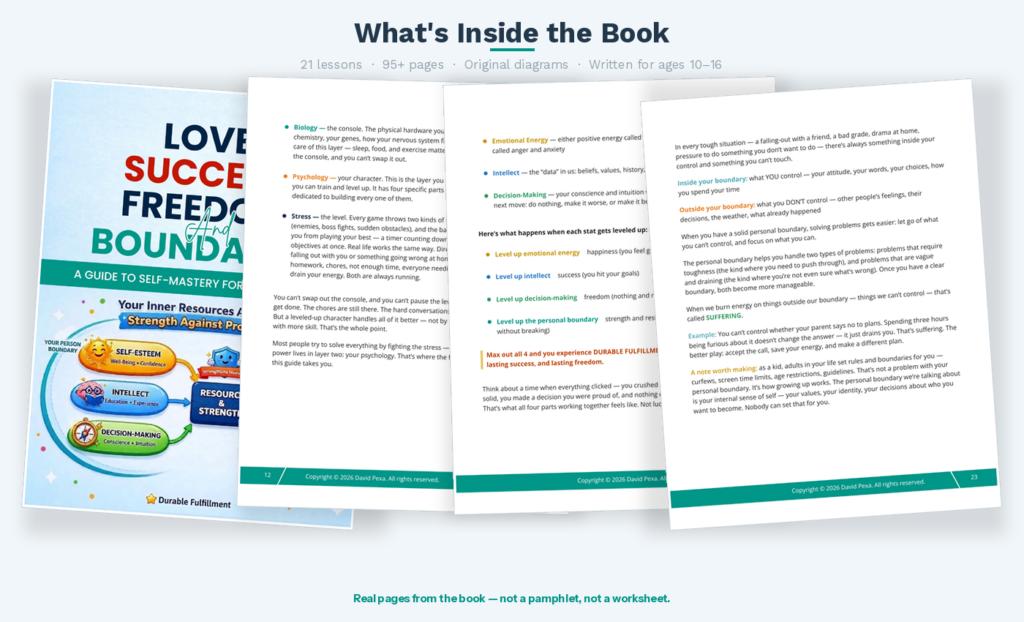
If this resonated, go deeper. My book Love, Success, Freedom and Boundaries gives you twelve frameworks for seeing the patterns that shape your life — and changing the ones that aren’t working.
A note on affiliates: This article includes affiliate links to platforms I’ve vetted and would recommend to my own clients and students. If you start with a recommended service through a link here, I may earn a small commission — at no extra cost to you. I only mention what I’d actually point you to in person. The recommendation comes first; the relationship is disclosed second.
If this resonates, the full framework lives in Love, Success, Freedom and Boundaries.
A practical playbook for raising emotionally resilient kids — and breaking the patterns you didn’t choose to inherit.
