



Summary: When you think “I hate my life,” that thought isn’t a conclusion — it’s a signal. It means your system is overloaded, not that your life is broken. This article breaks down what that signal is actually telling you, the pattern most people miss, and what to do next — without the toxic positivity or empty advice you’ve already tried.
I’ve sat across from people — teenagers, parents, professionals — who all arrived at the same sentence: “I hate my life.”
Most of them didn’t say it out loud at first. They typed it into a search bar at 2 a.m., or they thought it in the shower, or it just landed in their chest one Tuesday afternoon when nothing particularly bad had happened.
Here’s what I’ve learned after years in counseling: that sentence almost never means what it sounds like. It sounds like a verdict. It’s actually a distress signal — and there’s a massive difference between those two things.
If it’s a verdict, you’re stuck. If it’s a signal, you can work with it.
This article is for people who are ready to work with it.
What “I Hate My Life” Is Actually Telling You
Your brain does something specific when it’s overwhelmed: it generalizes. One area of pain — a relationship, a job, a season of loneliness — and your brain paints the entire wall with it.
“I hate my life” is what comes out when the real problem is too tangled to name. It’s a compression artifact. The actual message underneath might be:
- “I don’t recognize myself anymore.”
- “Nothing I’m doing seems to matter.”
- “I’m exhausted from pretending this is fine.”
- “I’ve been carrying something alone for too long.”
Those are specific. Specific is workable. “I hate my life” is a flare gun — it gets your attention, but it doesn’t tell you where the fire is. The first step is translating the global statement into something you can actually act on.
Try this: finish the sentence “The thing I actually can’t stand right now is ___.” Most people find that the answer is narrower than they expected. That’s not minimizing — that’s clarifying. And clarity is where movement starts.
Why This Feeling Gets Louder Over Time
Here’s the pattern I see in my practice, over and over:
Something happens — a loss, a disappointment, a slow accumulation of stress. You cope. You push through. You tell yourself it’s fine, or that other people have it worse, or that you should be grateful. The pressure doesn’t go away. It just goes underground.
And then your nervous system starts doing the talking for you. Irritability. Numbness. That flat feeling where nothing sounds good. The thought “I hate my life” arrives not because things suddenly got worse, but because your system ran out of room to absorb more.
This is important: the feeling getting louder doesn’t mean you’re getting weaker. It means the strategy you’ve been using — pushing through, staying busy, ignoring the signal — has hit its limit. That’s not failure. That’s feedback.
The people who stay stuck are the ones who argue with the feeling instead of listening to it. The people who move are the ones who get curious about what it’s pointing to.
The Pattern Most People Miss
Most advice for “I hate my life” focuses on behavior: exercise more, journal, practice gratitude, change your routine. And some of that works — on the surface, for a while.
But there’s a deeper layer that almost nobody talks about.
When I work with people — especially young people and the families around them — I often find that the problem isn’t the situation. It’s the operating system they’re running. The set of beliefs, assumptions, and unconscious patterns they absorbed before they had the ability to question them.
Think of it this way: if you install software on a corrupted operating system, the software won’t run well. You can change jobs, relationships, cities — but if the underlying pattern is “nothing I do will work” or “I don’t deserve good things,” you’ll recreate the same results in a new zip code.
The shift isn’t try harder. The shift is see clearly.
When you can see the pattern — where it came from, how it runs, what it costs you — you stop being at its mercy. That’s not therapy jargon. That’s the difference between someone who hates their life and someone who sees exactly what to change.
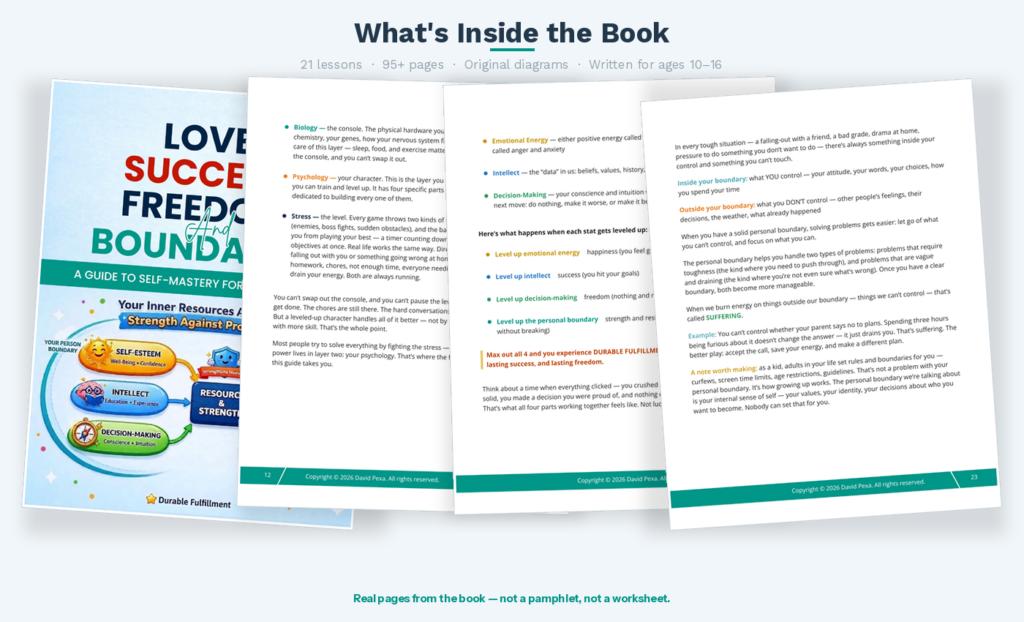
This is the framework I built my book around. Love, Success, Freedom and Boundaries walks through twelve lessons that help you identify these patterns and replace them — not with positive thinking, but with an actual decision-making framework you can use when things get hard.
What Actually Helps (And What Doesn’t)
Let me be direct about what works and what’s noise.
What helps:
1. Name the specific pressure, not the global feeling. “I hate my life” keeps you stuck. “I hate that I have no energy left for the people I care about” gives you something to work with. Get specific.
2. Change your physiology first, not your thoughts. When your nervous system is flooded, self-talk doesn’t land. Move your body. Cold water on your face. Walk outside. Get your system out of emergency mode before you try to think your way through it.
3. Edit one environment that keeps pressing on you. You might not be able to change your whole life. But you can probably change one thing that drains you every day — a conversation you keep having, a commitment that’s outlived its purpose, a habit that’s costing more than it gives.
4. Tell one person the truth. Not a performance of being fine. Not a vent session. Just: “I’m not doing well, and I wanted someone to know.” Isolation is fuel for the “I hate my life” thought. Connection disrupts it — not because someone fixes you, but because being seen changes the internal math.
Sponsored

5. Question the pattern, not just the situation. Ask yourself: Have I felt this way before? What was happening then? If the answer is yes, you’re not looking at a bad season. You’re looking at a pattern — and patterns can be changed once you see them. This is what I work on with people in coaching.
What doesn’t help:
Toxic positivity. “Just be grateful” is the emotional equivalent of telling someone with a broken leg to walk it off. Gratitude has its place, but not as a silencer for legitimate pain.
Comparison. “Other people have it worse” has never made anyone feel better. It just adds guilt to the pile.
Total life reinvention. The urge to blow everything up — quit the job, leave the relationship, move across the country — usually comes from the same overwhelmed place. Big decisions made from a flooded nervous system tend to trade one set of problems for another. Start smaller than you think you need to.
What This Looks Like in Families
I work with a lot of young people and their families, and here’s something most parents don’t realize: when a kid says “I hate my life” — or shows it through anger, withdrawal, or behavior that looks manipulative — they’re running the same signal-not-verdict pattern. They just don’t have the language for it yet.
And here’s the part that’s harder to hear: the pattern often started in the family system. Not because the parents did something wrong, but because parenting is essentially passing down an operating system. If the parent’s operating system includes “push through and don’t complain,” the kid learns that their distress signal is invalid. So they turn it inward.
The good news: when one person in the family starts seeing the pattern clearly, it shifts the whole system. I’ve watched a parent recognize their own “I hate my life” moment, change how they respond to stress, and watched their child’s behavior change within weeks — without ever directly addressing the child’s behavior at all.
That’s the leverage point. Not fixing the person who’s struggling. Fixing the pattern they’re caught in.
For the therapy option specifically, the access friction has dropped a lot in the last few years. Online platforms like Talkspace can match you with a licensed therapist usually within 24 hours, work in all 50 states, accept most major insurance, and let you message your therapist between sessions when something comes up that you don’t want to forget. I mention them by name because they’re the platform I’d point a student or coaching client to today — the path from “I think I need help” to “I’m in a session” is short enough to actually walk.
When It’s More Than a Bad Season
I want to be clear about something: “I hate my life” can be a signal of overload, and it can also be a symptom of clinical depression, anxiety, trauma, or a mental health condition that needs professional support.
Here’s how to tell the difference:
- If you’ve felt this way consistently for more than two weeks with no relief, talk to a professional.
- If you’ve lost interest in things that used to matter to you, that’s a flag.
- If you’re having thoughts of harming yourself, call 988 (Suicide and Crisis Lifeline) or text “HELLO” to 741741 (Crisis Text Line). You don’t have to be “bad enough” to reach out.
- If you can’t identify what’s wrong — the feeling is everywhere and nowhere — a therapist can help you decode what your system is telling you.
Asking for help isn’t a sign that the signal beat you. It’s the smartest response to a signal you can’t decode alone.
Your Next Move
If you read this far, you’re not someone who’s given up. You’re someone who’s looking for a better framework — a way to see your situation clearly enough to actually do something about it.
That’s exactly what I built Love, Success, Freedom and Boundaries to do. It’s twelve lessons that help you identify the patterns running under the surface — the ones that keep recreating the same problems no matter what you change on the outside. Not theory. Not lectures. Real frameworks, written at a level anyone can use.
And if you want help applying this to your specific situation — your family, your relationships, the patterns you keep running into — I work with people one-on-one. Limited availability, because this work only works when it’s real.
Frequently Asked Questions
Is it normal to think “I hate my life”?
Yes. It’s one of the most common distress signals people experience, especially during periods of sustained stress, major transitions, or when they feel disconnected from their sense of purpose. The thought itself isn’t the problem — staying stuck in it without examining what’s underneath is.
What’s the difference between hating your life and being depressed?
They can overlap, but they’re not identical. “I hate my life” is often a response to specific circumstances or accumulated stress — and it can shift when those circumstances change. Depression is a clinical condition where the feeling persists regardless of what’s happening, often accompanied by changes in sleep, appetite, energy, and the ability to feel pleasure. If you’re unsure, a conversation with a mental health professional can help you sort it out.
Can a teenager really mean it when they say they hate their life?
Absolutely. Young people don’t have less capacity for pain — they have less context for it. When a teenager says “I hate my life,” they’re telling you their system is overloaded and they don’t have the framework to process it yet. Taking it seriously doesn’t mean panicking. It means listening without trying to fix, and helping them translate the global feeling into something specific.
What should I do right now if I’m feeling this way?
Three things, in order: (1) Change your physiology — move, splash cold water on your face, step outside. Get out of freeze mode. (2) Finish this sentence: “The specific thing I can’t stand right now is ___.” (3) Tell one person the truth about how you’re feeling. Not a performance, just honesty. Those three things won’t fix everything, but they’ll move you from stuck to started.
Does this feeling ever fully go away?
The acute version — the crushing weight of it — yes, that shifts. But the signal itself might come back during difficult seasons, and that’s not failure. It means your system is doing its job: telling you something needs attention. The difference is that once you understand it as a signal, you stop being afraid of it and start using it.
Conclusion
“I hate my life” is one of the heaviest sentences a person can carry. But it’s not a life sentence. It’s your system telling you that something needs to change — and the fact that you’re here, reading this, means you’re already moving toward it.
You don’t need to reinvent yourself. You need to see clearly what’s been running underneath — the patterns, the assumptions, the operating system you didn’t choose — and decide what stays and what goes.
That’s not easy work. But it’s the only kind that actually changes anything.
— David Pexa, M.A.
A note on affiliates: This article includes affiliate links to platforms I’ve vetted and would recommend to my own clients and students. If you start with a recommended service through a link here, I may earn a small commission — at no extra cost to you. I only mention what I’d actually point you to in person. The recommendation comes first; the relationship is disclosed second.
If this resonates, the full framework lives in Love, Success, Freedom and Boundaries.
A practical playbook for raising emotionally resilient kids — and breaking the patterns you didn’t choose to inherit.
Get the ebook →