



The moment usually sounds small from the outside. An eye roll. “Whatever.” A muttered “You’re so annoying.” But if you’re the parent in front of it, it lands like a slap, because it doesn’t just feel rude. It feels like your child is rejecting you.
If you’re searching for how to deal with a disrespectful child, you probably don’t need another lecture about “being consistent.” You need a way to respond that works when your nervous system is already lit up and your child is pushing every button they know how to push.
I want to give you that. Not a soft excuse for bad behavior, and not a punishment-heavy script that turns your home into a courtroom. The useful middle is this: disrespect matters, boundaries matter, and the behavior is often telling you something important about what your child can’t yet do well.
That Stinging Moment and What It’s Really About

When a child speaks to you with contempt, your body reacts before your parenting philosophy does. Your chest tightens. Your jaw locks. You feel anger, then hurt, then fear.
That fear matters more than most parents realize.
For some parents, the fear is, “If I don’t shut this down now, I’m raising a selfish adult.” For others, it’s, “I’m losing my child.” Sometimes it goes even deeper. A disrespectful tone from your child can wake up old memories of being dismissed, mocked, or powerless in your own family.
Why it feels so personal
Disrespect rarely lands as just behavior. It lands as meaning.
You don’t hear only “No.” You hear, “You don’t matter.”
You don’t hear only “Leave me alone.” You hear, “Your love isn’t wanted.”
You don’t hear only sarcasm. You hear a challenge to your role, your effort, and your bond.
That’s why otherwise thoughtful parents can react fast and hard. Not because they’re weak. Because they’re human.
Practical rule: If your reaction feels bigger than the moment, part of what you’re fighting may be history, not just your child.
You’re also not dealing with this in isolation. A 2023 Ipsos survey reported by Education Week found that the majority of parents believe children today don’t treat others with respect. The same survey found that nearly 90 percent of parents recognized they have the most influence on their child’s character, while 69 percent also depend on teachers to reinforce those values.
That tells me two things. First, your concern is real. Second, many parents know they matter most, but still feel outmatched in the moment.
The hidden trap in the stinging moment
When you feel insulted, your instinct is usually one of three moves:
- Clamp down hard with threats, lectures, or punishment
- Take it personally and argue the content of what they said
- Back away completely because you’re exhausted and don’t want another fight
All three are understandable. None gets to the root.
If you only treat disrespect as a power problem, you’ll chase control. If you treat it as a relationship problem, you’ll start looking for what your child is showing you badly.
That doesn’t make the behavior acceptable. It makes it workable.
Why Your Child’s Disrespect Is a Signal Not a Flaw

A lot of parents get stuck because they assume disrespect proves something fixed about the child. “He’s becoming entitled.” “She has no empathy.” “He knows exactly what he’s doing.”
Sometimes a child does know they’re being rude. But that still doesn’t mean the behavior is best understood as a character flaw.
I treat disrespect more like a signal. Not a good signal. Not a harmless one. But a signal all the same. It usually points to one of three things: an unmet need, an overloaded system, or an undeveloped skill.
What might be underneath the attitude
A child who snaps at you may be struggling with:
- Autonomy pressure. They want more say, but don’t know how to ask for it respectfully.
- Connection hunger. They feel misunderstood, lonely, or sidelined, and protest with edge instead of honesty.
- Overwhelm. Stress, fatigue, school pressure, and social drama often come out sideways.
- Weak regulation skills. They feel a surge and express it before thought catches up.
That’s why punishment alone often misses the mark. It addresses the surface offense but not the machinery underneath it.
Misbehavior is often clumsy communication. If you only answer the clumsy part, you miss the communication.
Your child is reacting to a social world, not just your rules
Children don’t learn tone and respect in a vacuum. They absorb it from siblings, peers, school culture, screens, and stress.
Longwood University’s research on disrespect experienced by children found that 60 percent of disrespectful acts toward children come from peers and 28 percent from siblings. The same reference notes that a 2021-22 study showed a 48 percent increase in disrespect toward school staff compared with typical years before the pandemic.
That matters because it shifts the frame. Your child may not just be producing disrespect. They may be swimming in it.
If you’ve got a child who comes home sharp, explosive, or dismissive, it’s worth asking what kind of tone they’ve been marinating in all day. Peer conflict changes kids. So does chronic stress. So does anger they can’t organize. If that’s a regular pattern in your home, work through the wider emotional pattern, not just the rude moments. I break that down more in this guide on child anger patterns and what they often mean.
The check engine light idea
Here’s the simplest reframe I know. Disrespect is often a check engine light.
You don’t ignore a check engine light. But you also don’t scream at the dashboard.
That’s the mistake many of us make. We try to punish the signal into disappearing. What helps more is curiosity plus boundary. You ask, “What is this behavior telling me?” while also making it clear, “You still don’t get to speak to me that way.”
That combination is what changes the atmosphere. Your child stops being the enemy. The problem becomes the problem.
The First 60 Seconds How to Respond Without Escalating
When disrespect hits, your first job isn’t delivering a perfect line. It’s keeping the moment from turning into a nervous system pileup.
Most parents try to correct too early. They go for logic when the child is flooded and they’re half flooded too. That’s why the same lecture keeps failing.
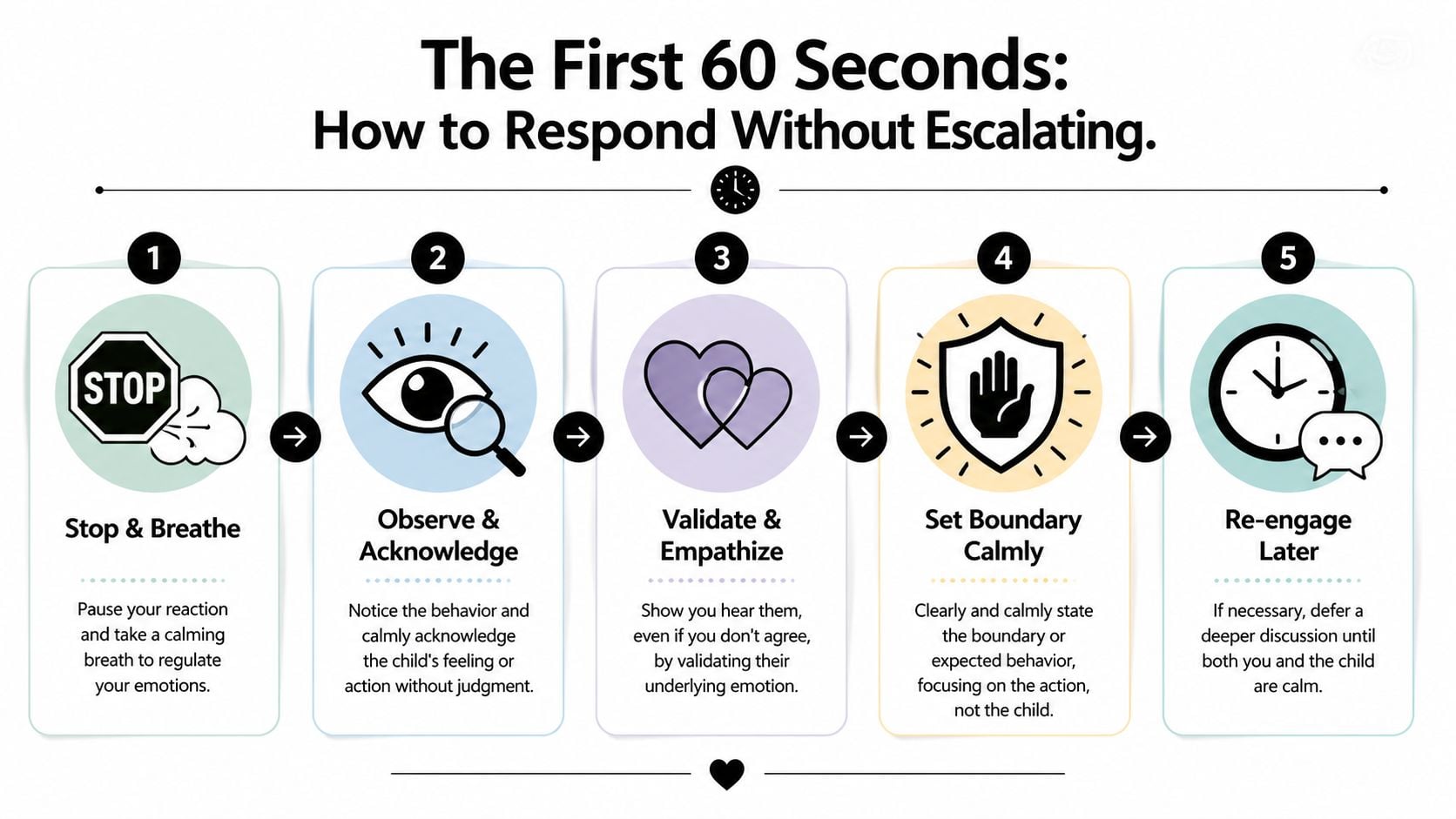
A somatic, five-step response model described by Hand in Hand Parenting has been reported to reduce daily disrespect incidents by 70-80% within 2-4 weeks with consistent use. The sequence is simple: somatic connection, acknowledging emotion, holding a warm limit, co-creating alternatives, and later reflection.
Step one is your body, not your words
Before you say anything, pause.
Drop your shoulders. Unclench your teeth. Exhale longer than you inhale. Plant your feet. If your child is safe, take one beat before you engage.
Sponsored

This is not avoidance. It’s leadership.
If you bring a charged body into a charged moment, your child will feel the charge before they process the words. If you bring steadiness, you lower the odds of a power spiral. If you need support doing that in real time, this emotion regulation checklist can help you build the habit before the next blowup.
A calm response in five moves
-
Pause and connect somatically
Regulate yourself first. Calm eyes, softer face, steady voice. You’re signaling safety while you prepare to set a boundary. -
Acknowledge the feeling without approving the delivery
Try, “You’re really upset right now,” or “I can see you’re furious about that.”
This lowers defensiveness because the child feels seen, not cornered. -
Hold the limit warmly
Keep it short. “I won’t let you talk to me like that.”
Or, “You can be mad. You can’t be cruel.” -
Don’t force the lesson mid-storm
If the child is still hot, stop trying to teach. Move to containment. Reduce words. Stay close if helpful, give space if that works better. -
Return later for repair and skill-building
When both of you are calm, revisit the moment. That’s when learning can happen.
“You don’t need to win the moment. You need to keep it teachable.”
What this sounds like out loud
Instead of: “Don’t you dare talk to me that way after all I do for you.”
Try: “You’re angry. I’m listening. I’m not available for being spoken to like that.”
Instead of: “That attitude is exactly why you’re losing everything.”
Try: “We’ll deal with the problem. First, bring the tone down.”
Instead of: “Say sorry right now.”
Try: “We’ll come back to this when your body is calmer.”
The tone matters as much as the text. Businesslike beats sarcastic. Clear beats wordy. Warm beats icy.
What usually makes things worse
The most common escalation patterns are familiar:
- Stacking consequences in anger. You keep adding punishments because your child isn’t instantly remorseful.
- Over-talking. The child is flooded, but you’re delivering a speech.
- Matching disrespect with disrespect. You call them rude, spoiled, or impossible.
- Demanding emotional control they don’t yet have. Then punishing them for not having it.
A shorter response often works better than a smarter one. Calm authority travels farther than emotional force.
Building Boundaries That Teach Not Just Punish
The hard moment passes. Then comes the part many parents either skip or mishandle. They either let it go because everyone’s exhausted, or they come back with a punishment that has little to do with what happened.
A useful consequence should do more than hurt. It should teach, repair, and increase responsibility.
Accountability works better than a revenge mindset
If your child lashed out verbally, the main skill gap usually isn’t “needs to suffer more.” It’s “needs practice expressing frustration without contempt.”
That’s why I prefer accountability loops over random punishments. The loop looks like this: name the impact, hear the child’s side, decide what repair makes sense, and follow through.
For older kids and teens, collaboration matters. Data summarized by Newport Institute notes that involving preteens and teens in designing their own consequences can boost buy-in by 65% compared with unilateral parental decisions, and this approach has been associated with a 75% increase in cooperation after three cycles.
The principle is straightforward. Children cooperate more when they have some ownership in the repair.
What a teaching consequence looks like
Consequences land better when they are tied to the behavior.
| Situation | Teaching focus | Better consequence |
|---|---|---|
| Child insults you during conflict | Respectful expression | Practice a redo of the conversation using different words |
| Child slams a door and storms off | Regulation and repair | Return after calming, then repair the interaction and discuss what to do next time |
| Child humiliates a sibling | Empathy and impact | Repair with sibling through apology, action, and changed behavior |
| Teen uses a cutting tone repeatedly | Accountability and autonomy | Jointly design a consequence plus a plan for handling frustration differently |
Notice what’s missing. Huge, unrelated punishments.
Taking a phone for a week because your child rolled their eyes may feel satisfying in the moment. It often teaches only this: power wins. It doesn’t teach respectful communication.
A simple debrief you can use later
When everyone’s calm, keep the repair conversation tight:
-
Start with impact
“When you called me that, it shut the conversation down.” -
Ask for their view
“What was happening for you right before that?” -
Name the underlying issue
“So you felt cornered and unheard.” -
Build a better option
“Next time, what can you say instead that still gets your point across?” -
Agree on repair
“What needs to happen now to make this right?”
A better boundary sounds like this: “I’m not punishing you for having big feelings. I’m holding you responsible for what you did with them.”
That sentence changes the emotional climate. It tells your child that feelings are allowed, disrespect isn’t, and responsibility is learnable.
Trade-offs parents should know
This approach takes more energy up front. It asks more of you than barking out consequences. It can feel slower.
But it builds something punishment alone rarely builds. Internal control.
The goal isn’t a child who behaves only under threat. The goal is a child who can feel anger, disappointment, or shame without immediately firing it at someone else.
What to Say and How to Adapt for Their Age
Parents often understand the reframe but freeze on the words. They know they shouldn’t explode, but they also don’t want to sound weak.
You don’t need magical language. You need language that is calm, clear, and age-matched.
Copy and use these lines
If your child says, “You’re so unfair.”
Try: “You don’t like this limit. I get that. You still need to speak respectfully.”
If they roll their eyes in public.
Try: “We’ll talk later. Fix the tone now.”
If they slam a door.
Try: “Take space if you need it. Slamming isn’t okay. We’ll reset and talk when you’re ready.”
If your teen says, “Leave me alone.”
Try: “I’ll give you space for now. I’m coming back to this, because space doesn’t cancel respect.”
The strongest script is usually the shortest one you can say without heat.
Age changes the method
The core job stays the same. Regulate, set the boundary, teach the missing skill. But the delivery should match development.
| Age Group | Focus | Example Consequence |
|---|---|---|
| Young child | Safety, simple language, physical redirection | Pause play, help them reset, then practice a respectful phrase |
| Middle childhood | Fairness, cause and effect, repair | Redo the interaction, apologize, and complete a related repair task |
| Teen | Autonomy, collaboration, accountability | Jointly design a consequence and a plan for handling the next conflict |
Young children need less talking and more co-regulation. Middle childhood responds well to simple logic and do-overs. Teens need room for dignity. If you humiliate a teenager, they usually defend themselves harder.
That’s also where modern context matters. The source summarized in All Pro Dad’s discussion of disrespectful child behavior cites a 2025 Pediatrics meta-analysis reporting that teens with more than 7 hours of daily screen time had 3x higher defiance rates, and it links 65% of teen disrespect to screen-induced dopamine dysregulation. Because that year is future-dated, treat it as a cited projection rather than settled current fact. Even so, the practical takeaway is useful: if your teenager’s disrespect spikes after gaming, scrolling, or late-night device use, don’t ignore the environment.
Confidence helps too. Some disrespectful behavior is a cover for insecurity. Kids often posture when they feel small. If you’re trying to strengthen the foundation underneath the attitude, this guide on how to build confidence in kids can help you target the need beneath the performance.
Turning Conflict into Connection and When to Get Help
A disrespectful child doesn’t need a parent who wins every exchange. They need a parent who can hold the line without losing the relationship.
That’s the shift. You stop acting like a referee in an endless contest and start acting like a coach for emotional skills. You still correct. You still set limits. But you’re no longer trying to crush the behavior by force. You’re teaching your child what to do instead.
Some situations need more than home strategies. Get professional help if disrespect comes with violence, threats, self-harm, cruelty that feels persistent and escalating, major school collapse, severe social fallout, or behavior that leaves your home feeling chronically unsafe. Also get support if you notice your own reactions are becoming explosive, shut down, or frightening to you. Parents need regulation help too.
You do not have to choose between kindness and authority. The healthiest families use both.
I write about the patterns most parents never see until they’re already in a fight. If you want the next one in your inbox, join David Pexa for practical pieces on sibling hostility, shutdown after school, and the hidden reasons kids get meanest with the people they trust most.
For the therapy option specifically, the access friction has dropped a lot in the last few years. Online platforms like Talkspace can match you with a licensed therapist usually within 24 hours, work in all 50 states, accept most major insurance, and let you message your therapist between sessions when something comes up that you don’t want to forget. I mention them by name because they’re the platform I’d point a student or coaching client to today — the path from “I think I need help” to “I’m in a session” is short enough to actually walk.
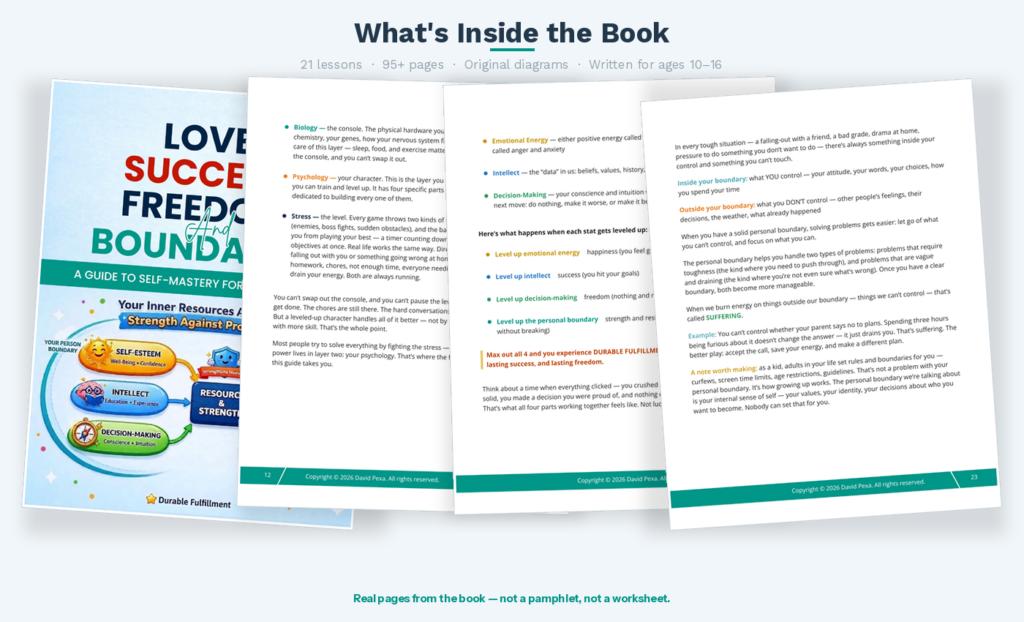
For parents who want the deeper framework — the one that makes work like this stick instead of feeling like you’re firefighting forever — my book Love, Success, Freedom and Boundaries is the structured version of what I teach my own students. Written for tweens and teens, but most parents tell me they pick up more from it than the kid does.
A note on affiliates: This article includes affiliate links to platforms I’ve vetted and would recommend to my own clients and students. If you start with a recommended service through a link here, I may earn a small commission — at no extra cost to you. I only mention what I’d actually point you to in person. The recommendation comes first; the relationship is disclosed second.
If this resonates, the full framework lives in Love, Success, Freedom and Boundaries.
A practical playbook for raising emotionally resilient kids — and breaking the patterns you didn’t choose to inherit.
Get the ebook →