



Most parents don’t ask this question in a calm moment. They ask it after the slam of a bedroom door, after the yelling, after the look on their child’s face that lingers long after the room goes quiet. I’ve sat with a lot of parents in that exact hour, when the house is finally still and their mind won’t let them rest.
The Question That Keeps You Up at Night
If you’re asking am i a bad parent, you’re probably not asking it as a philosophical question. You’re asking it because something happened.
Maybe you snapped. Maybe your child pulled away from you. Maybe you saw fear, shutdown, or contempt in their eyes and thought, I did that. Then the mind starts building a case. You remember every missed cue, every threat you wish you hadn’t made, every moment you were too tired to be patient.
That spiral feels honest, but it usually isn’t accurate. It’s shame doing what shame does. It takes a moment and turns it into an identity.
I want to say something plainly. The fact that you’re losing sleep over your impact on your child tells me something important. You care. You’re watching yourself. You’re afraid of causing damage. That fear can become unhelpful, but it does not come from indifference.
What this question is usually hiding
Under “am I a bad parent?” I usually hear a few deeper fears:
- Fear of lasting harm: You’re not worried about one argument. You’re worried you’ve shaped your child in a painful way.
- Fear of becoming your own parent: Many people don’t panic because of one rough moment. They panic because it felt familiar.
- Fear that love isn’t enough: You love your child fiercely, but your home still feels tense, reactive, or distant.
Those fears deserve respect. They also need better handling than self-condemnation.
The most useful parents I know are not the ones who never rupture. They’re the ones who notice the rupture and come back to repair it.
A lot of mothers and fathers are carrying more doubt than they admit. A 2023 Pew Research Center survey on gender and parenting found that 66% of mothers and 58% of fathers say parenting is much harder than they expected. That matters because struggle is common. It’s not proof that you’re failing.
A better question than am i a bad parent
The question that helps is this:
What is my child experiencing from me, and what can I change?
That question does two things. It shifts you out of verdict mode and into observation mode. It also turns guilt into responsibility, which is far more useful.
A bad identity is fixed. A harmful pattern is changeable.
That’s where hope lives.
Are You Causing Harm or Feeling Guilt
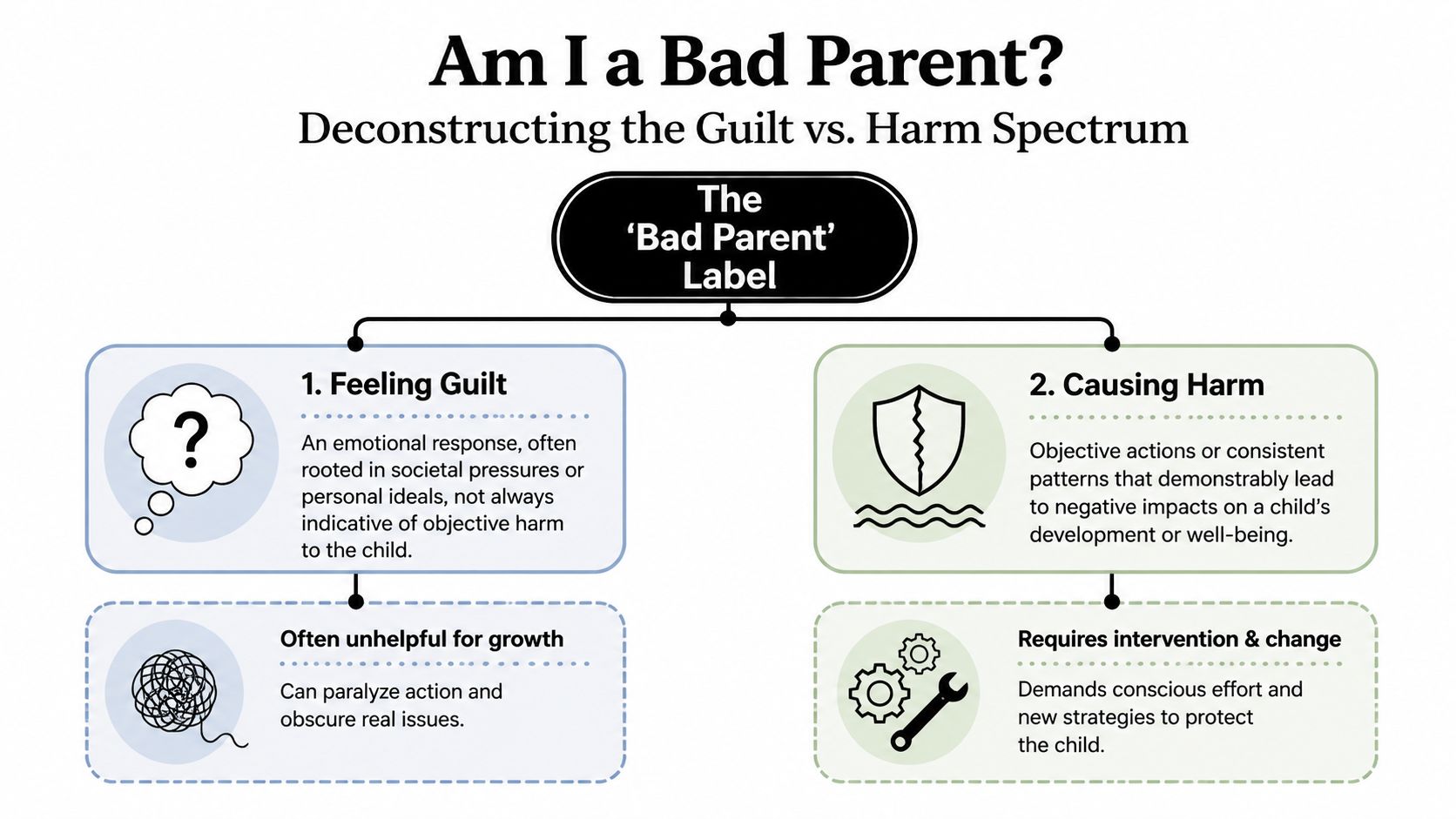
The phrase bad parent bundles together two very different things. That’s why it keeps people stuck.
One is guilt. The other is harm.
Guilt is a smoke alarm
Guilt is an internal signal. Sometimes it’s useful. Sometimes it’s oversensitive.
It can go off because you were short with your child. It can also go off because you’re exhausted, comparing yourself to impossible standards, or carrying old wounds that make every parenting mistake feel catastrophic. In my work, a lot of parents confuse the alarm with the fire.
That confusion gets expensive. You spend all your energy asking whether you’re a good person instead of asking whether your child feels safe, seen, and able to recover with you after hard moments.
Here’s why that matters. When guilt runs the show, people often swing between two extremes:
| Pattern | What it looks like | What it usually does |
|---|---|---|
| Collapse | “I ruin everything.” | Creates shame and paralysis |
| Defensiveness | “I’m doing my best, so this shouldn’t count.” | Blocks reflection |
| Repair | “That landed badly. I need to understand why.” | Creates movement |
Harm is about impact
Harm is not a feeling. It’s a pattern of behavior that repeatedly disrupts a child’s sense of safety, worth, or stability.
That’s a very different standard.
A parent can feel crushing guilt and still not be causing ongoing harm. A parent can also feel justified and still be creating a home that a child experiences as threatening or conditional. That’s why guilt is not a reliable judge.
Practical rule: Don’t ask, “How bad do I feel?” Ask, “What happens in my child when I respond this way?”
That’s the shift from identity to impact.
It also gives you room to be imperfect. Parents do not need flawless performance to raise secure kids. They need enough responsiveness, enough repair, and enough steadiness that the child’s nervous system learns, “Hard moments happen, but connection returns.”
If emotional distance is part of the pattern, this deeper look at what emotionally unavailable parenting can feel like may help you name what’s been hard to describe.
The good enough standard
Most parents are not failing because they’re imperfect. They’re suffering because they think imperfection itself is the failure.
That’s not how healthy development works.
The “good enough” idea matters because it frees you from performance and returns you to relationship. It says your child does not need a polished version of you. Your child needs a real parent who can notice disconnection and move back toward connection.
When you separate guilt from harm, you stop treating every mistake like proof and start treating patterns like data. That’s where change gets traction.
Three Signs Your Behavior Is Causing Harm
Harm usually doesn’t announce itself with a dramatic label. It shows up in the child’s body, behavior, and expectations.
Look less at whether you mean well and more at what your child has learned to do around you.
Research from the American SPCC on the effects of harsh parenting shows that children exposed to hostile or harsh parenting, including frequent criticism or emotional rejection, face higher cumulative risk for internalizing symptoms like anxiety and withdrawal, and externalizing symptoms like aggression. If you’re trying to tell the difference between ordinary conflict and deeper strain, this piece on emotional disconnect in families can help sharpen the picture.
Your child learns that feelings are dangerous
Some children stop crying in front of a parent because they feel secure. Others stop because experience taught them that tears get mocked, dismissed, punished, or escalated.
That pattern sounds like:
- Minimizing: “You’re fine.”
- Shaming: “Stop being dramatic.”
- Threatening: “If you keep crying, I’ll give you something to cry about.”
When that becomes the climate, the child doesn’t learn regulation. The child learns concealment.
Sponsored

A child who has to hide distress often shows one of two moves. They get louder and more explosive because that’s the only way their state gets noticed. Or they become flat, compliant, and hard to read because their system has learned that emotional exposure is unsafe.
Love feels conditional
Children don’t need constant praise. They do need to know that belonging is not up for auction.
Conditional love often sounds polished on the surface. It may come wrapped in achievement, manners, obedience, or family image. The message underneath is, “You are easiest to love when you perform correctly.”
Watch for these signs:
- Affection disappears after disappointment
- Warmth rises and falls with grades, behavior, or success
- Your child seems preoccupied with keeping you pleased
That creates an anxious kind of parenting bond. The child becomes vigilant. Instead of asking, “What do I feel?” they ask, “What version of me keeps the relationship safe?”
Children can handle limits. What unsettles them is when connection itself feels unstable.
The home feels tense and unpredictable
A child can live with rules. What strains the nervous system is unpredictability.
If your reactions depend on your stress level, your child may spend a lot of time scanning the room. They watch your face, your footsteps, your tone, the way you shut the cabinet. They become excellent readers of atmosphere because atmosphere has become survival information.
That might mean:
- You erupt over small things after bottling stress
- Rules change depending on your mood
- The child braces before bringing you bad news
You don’t need constant chaos for this to matter. Repeated tension is enough to teach the body that home is not fully safe.
The key point is simple. Harm is not measured by whether you had good intentions. It’s measured by what your child has to do, emotionally and physically, to live around your pattern.
How to Repair the Connection When You Get It Wrong
Repair matters more than most parents realize. Not because mistakes don’t count, but because repair teaches the child what to do with pain inside a relationship.
That’s why I don’t start with scripts. I start with your body.

Longitudinal findings discussed in Psychology Today on “good enough” parenting report that parents who consistently repair ruptures and validate emotions can reduce a child’s cortisol spikes by 20% to 40% during conflict. That’s not small. It means repair is not sentimental. It’s regulatory.
Regulate yourself before you try to reconnect
If your body is still in fight mode, your apology will often come out as a justification, lecture, or demand for quick forgiveness.
Use a short body-first reset:
- Unclench your jaw: Most parents don’t notice they’re still physically braced.
- Lengthen your exhale: Breathe out longer than you breathe in for a few rounds.
- Drop your shoulders and hands: Your child reads your posture before they process your words.
- Feel your feet on the floor: That sounds basic because it is basic. It brings you back into the room.
I often tell parents this: don’t go back into the conversation until your voice can get quiet without becoming cold.
Make a real apology
A useful apology is short, specific, and owned.
Not this: “I’m sorry, but you were being impossible.”
Not this either: “I guess I’m just a terrible mother.” That makes the child manage your feelings.
Try language like this instead:
“I yelled. That was too much, and it probably felt scary. You didn’t deserve that part. I’m sorry.”
Or:
“I was frustrated, but the way I spoke to you was not okay. I’m working on handling that differently.”
A real apology includes three ingredients:
| Part | Example | Why it works |
|---|---|---|
| Ownership | “I snapped.” | Removes blame-shifting |
| Impact | “That probably felt harsh.” | Shows empathy |
| Correction | “Next time I’m going to pause before I answer.” | Builds trust |
If your child has stopped talking to you after repeated ruptures, this article on why a child may stop talking to a parent can help you understand what silence may be protecting.
Interrupt the pattern earlier
Repair after the fact is powerful. Catching the pattern earlier is even better.
Use a simple ABC note for a week:
-
Antecedent
What happened right before you lost your footing? Noise, disrespect, rushing, sibling conflict, bedtime resistance? -
Behavior
What did you do? Yell, threaten, withdraw, over-explain, criticize? -
Consequence
What happened next in your child and in you? Shutdown, escalation, guilt, avoidance?
That gives you something concrete to work with. Most parents discover they don’t have an anger problem in general. They have a pattern that shows up in a narrow set of conditions.
Once you know the pattern, create a preloaded interruption. For example:
- If mornings trigger you, reduce verbal instructions and use a written checklist.
- If defiance hooks you, delay the power struggle and come back when your body settles.
- If disrespect sends you straight into rage, decide in advance on one calm sentence you’ll use every time.
“I’m too activated to handle this well right now. I’m going to settle down and come back.”
That sentence has saved a lot of relationships.
The goal isn’t to become endlessly calm. The goal is to become interruptible. That’s what changes family systems.
For the therapy option specifically, the access friction has dropped a lot in the last few years. Online platforms like Talkspace can match you with a licensed therapist usually within 24 hours, work in all 50 states, accept most major insurance, and let you message your therapist between sessions when something comes up that you don’t want to forget. I mention them by name because they’re the platform I’d point a student or coaching client to today — the path from “I think I need help” to “I’m in a session” is short enough to actually walk.
When Self-Help Is Not Enough
Some patterns improve with insight and repetition. Some need outside help because the stakes are too high, the reactions are too fast, or the family has been stuck too long.
Knowing the difference is part of competent parenting.
Meta-analyses summarized in Healthline’s review of bad parenting patterns found that authoritarian and overprotective parenting styles can raise the odds of adult anxiety disorders in children by over 60%. That matters because unresolved parental anxiety doesn’t stay contained inside the parent. It shapes the climate the child grows up inside.
Signs you should bring in a professional
Consider getting support if any of these are true:
- You keep doing what you promised yourself you’d never do: Especially if the behavior feels automatic, explosive, or numb.
- Your child seems persistently afraid, shut down, or unreachable: Not just upset with you, but altered by the family atmosphere.
- Your own history gets triggered hard in parenting moments: If your child’s behavior consistently pulls you into panic, rage, or collapse, self-awareness alone may not be enough.
- Communication has broken down completely: You talk, your child leaves. Your child talks, you defend. Nothing repairs.
- There is any form of abuse: Physical intimidation, threats, degradation, severe emotional cruelty, or neglect needs immediate intervention.
What getting help actually means
It does not mean you’ve been exposed as a fraud.
It means you’ve recognized that the family system needs more support than one overwhelmed person can provide from inside the pattern. That’s wise. Parents wait too long because they think needing help is the same as failing. It isn’t.
Sometimes the most protective move a parent can make is to stop saying, “I should be able to fix this myself.”
If you’re reading this and already know the house doesn’t feel safe enough, trust that knowledge. Don’t argue with it.
You Are a Parent with a Pattern Not a Bad Parent
I don’t find the label bad parent very useful. It freezes people. It turns living, changeable behavior into identity.
Pattern is the better word.
Patterns can be observed. Patterns can be interrupted. Patterns can be repaired. That shift matters because it gives you somewhere to stand. Instead of asking whether you are good or bad at heart, you start asking better questions. What does my child feel from me? What happens in my body before I react? What repair needs to happen next?
That is how families change.
A projected 2025 Australian family study described in this referenced summary found that 55% of “high-effort” parents overlooked how their own unresolved issues were mirrored in their children’s behavior. I believe that. A lot of struggling kids are carrying family patterns, not issuing verdicts on their parents’ worth.
Hold onto this frame
- Your guilt is not the full story
- Your impact matters more than your self-judgment
- Your body state shapes your parenting more than your intentions do
- Repair counts
- Getting help is a responsible move, not a humiliating one
If you came here asking am i a bad parent, I hope you leave with a more useful answer.
You may be a loving parent stuck in a reactive pattern. You may be an exhausted parent whose nervous system keeps outrunning your values. You may be a parent who needs to repair more directly and more often than you realized.
That is serious. It is also workable.
A note on affiliates: This article includes affiliate links to platforms I’ve vetted and would recommend to my own clients and students. If you start with a recommended service through a link here, I may earn a small commission — at no extra cost to you. I only mention what I’d actually point you to in person. The recommendation comes first; the relationship is disclosed second.
If this resonates, the full framework lives in Love, Success, Freedom and Boundaries.
A practical playbook for raising emotionally resilient kids — and breaking the patterns you didn’t choose to inherit.
Get the ebook →