



It’s often late when this search starts. Your child is finally asleep, the house is quiet, and you’re replaying the same moments from the day, the yelling, the shutdown, the look on their face after it all happened, wondering if you missed something important.
Most parents I talk to aren’t looking for a “fix” as much as they’re looking for a way to understand what’s happening before things get worse. That instinct matters.
That Feeling in Your Gut Is Trying to Tell You Something
When you start looking for a child behavioral therapist, it usually doesn’t feel calm or organized. It feels urgent. You’re trying to make sense of a pattern that keeps repeating, and some part of you knows this is bigger than “they need to listen better.”
That gut feeling is worth respecting.

A lot of parents turn that instinct against themselves. They assume that if they were calmer, stricter, more consistent, more intuitive, less reactive, this wouldn’t be happening. I don’t buy that. A parent who’s paying attention enough to ask deeper questions is not failing. A parent who’s listening closely enough to notice that something feels off is doing one of the most important jobs in the family.
The wider picture matters too. Nearly 1 in 5 children in the U.S. ages 3 to 17, or 21%, have been diagnosed with a mental, emotional, or behavioral health condition, and approximately half do not receive the treatment they need, according to the CDC’s children’s mental health data. So if you’re sitting there thinking, “Why does this feel so hard, and why do I feel so alone in it,” you’re not alone at all.
Your fear is usually about more than behavior
Parents rarely come in worried only about yelling, defiance, school refusal, aggression, or meltdowns. Underneath that, they’re scared of what the pattern means.
- You may be asking about the future: Is this getting worse?
- You may be asking about your child’s inner world: Are they suffering more than they can say?
- You may be asking about yourself: Have I done something to cause this?
Those are real questions. But they don’t get answered by panic, and they don’t get answered by shame.
Practical rule: If your concern keeps coming back, it deserves attention. Repeating worry is often your mind’s way of saying, “This pattern needs understanding, not dismissal.”
Searching for help is a strong move
One of the hardest mental shifts for parents is this. Reaching out for help isn’t an admission that your family is broken. It’s an act of leadership.
Sometimes the first useful reframe is this. You’re not starting therapy because your child is “bad.” You’re starting because behavior is information, and you want to understand what it’s telling you.
If you’ve been quietly carrying the thought, “Maybe I’m the problem,” I’d start with this piece on why fearing you’re a bad parent usually means you care deeply. Self-blame makes it harder to see your child clearly. Clarity helps.
A Behavior Detective Not a Judge
A good child behavioral therapist is not there to decide who’s right, who’s wrong, or who needs to be controlled. They work more like a behavior detective.
That word matters because detectives look for function. They ask what happened before, what happened after, what the child gained, what they avoided, and what the behavior might be doing for them. Judges look for fault. Therapy that helps starts with curiosity, not blame.
Behavior is communication, even when it’s messy
Children communicate through words when they can. They communicate through behavior when words aren’t enough, aren’t available fast enough, or don’t feel safe enough.
A child who throws a shoe when it’s time for school may be saying very different things depending on the situation:
- “I’m overwhelmed.”
- “I don’t know how to handle this transition.”
- “School feels threatening.”
- “This is the only way I know to stop what’s happening.”
The outside behavior may look the same. The inner function may be completely different.
That’s why generic advice often falls apart. “Just be consistent” sounds useful until you realize consistency applied to the wrong understanding can make a child feel even more trapped. A therapist’s job is to help the family decode the pattern before trying to change it.
The question isn’t only, “How do we stop this?” The better question is, “What is this behavior accomplishing, protecting, or expressing?”
What a therapist is actually looking for
In practice, a child behavioral therapist is often tracking a few core things:
| What they study | Why it matters |
|---|---|
| Triggers | What reliably sets the behavior in motion |
| Function | What need the behavior serves |
| Skills gap | What the child can’t yet do under stress |
| Family response | How adult reactions accidentally reduce or reinforce the pattern |
Parents often find relief, not because the behavior disappears overnight, but because the family finally has a map.
If your child’s anger is the issue that keeps taking over family life, this breakdown on how to understand child anger without reducing it to disobedience may help you see the pattern more accurately.
What works and what usually backfires
Here’s the trade-off I see all the time. Short-term control can look effective while making the deeper issue worse.
What often backfires:
- Escalating consequences too quickly: The child may comply from fear, but the stress underneath stays untouched.
- Arguing with the behavior: Logic rarely works in a nervous system that’s already overloaded.
- Treating every incident as isolated: Patterns repeat for a reason.
What tends to work better:
- Clear observation before interpretation
- Simple, predictable responses
- Teaching replacement skills
- Involving the family, not just the child
The point isn’t to excuse harmful behavior. The point is to understand it well enough to change it in a lasting way.
Three Lenses for Seeing Your Child Clearly
Most families get stuck when they use only one lens. They look at behavior as a discipline problem, or only as a diagnosis issue, or only as an emotional problem inside the child. A stronger approach uses multiple lenses at once.
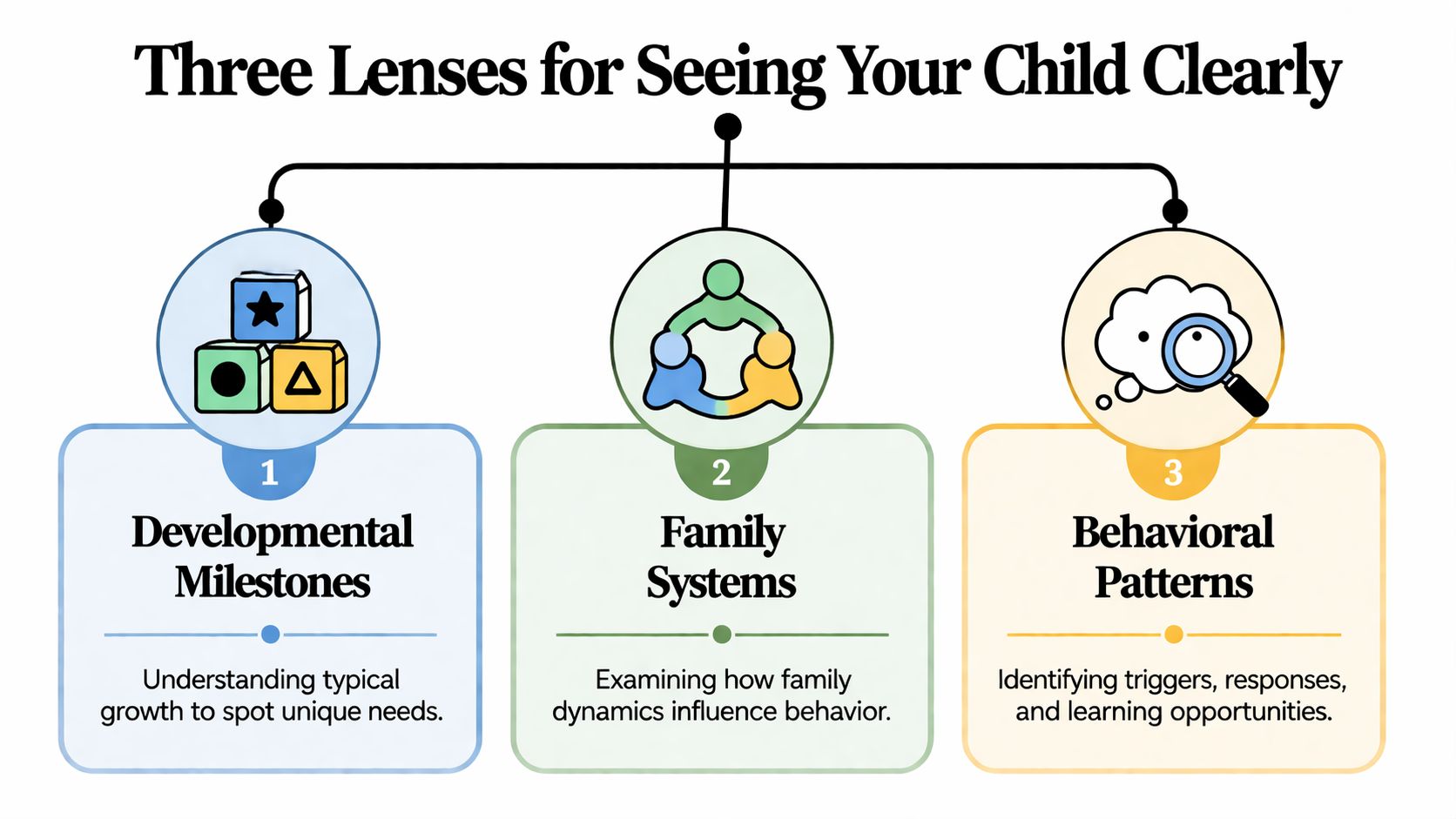
The behavioral lens
This lens looks at what we can observe. What happens before the behavior, what the behavior looks like, and what follows it. It’s concrete, useful, and often very grounding for parents who feel lost in emotion.
In Applied Behavior Analysis, or ABA, clinicians use structured observation and skill-building. A landmark 1987 study found that 90% of autistic patients showed behavioral improvements after ABA, and by 2005, 48% of young children with autism who started ABA early succeeded in mainstream classrooms, as summarized by Cross River Therapy’s review of ABA success rates.
That doesn’t mean every child needs ABA, or that every provider uses it well. It means the behavioral lens gives us a disciplined way to track what’s changing and why.
The strength of this lens is precision. The limitation is that if it’s used alone, it can become too narrow. We can end up measuring behavior without understanding the child’s internal state.
The somatic lens
This is the piece many families have never been taught to notice. Somatic awareness means paying attention to the body’s signals.
Some children don’t first experience distress as a thought. They experience it as a clenched stomach, tight shoulders, buzzing energy, a need to run, a frozen stare, or a sudden drop in language. If we ignore the body, we miss the earliest part of the pattern.
A child might not say, “I’m dysregulated.” They may pace, hide under the table, get loud, or become impossible to redirect.
This lens asks questions like:
- What happens in the child’s body before the outburst?
- What sensory load are they carrying?
- What bodily cues tell us they’re nearing the edge?
A child’s behavior often starts in the nervous system before it ever shows up as a decision.
When parents begin to distinguish emotions from physical stress states, they usually gain more control. That’s part of why I often point people toward understanding the difference between emotions and feelings. It changes how you respond in the moment.
The family systems lens
The third lens steps back. It asks what role the behavior is playing in the whole family.
Sometimes a child becomes the visible carrier of tension that the entire system is feeling. One parent pursues, the other withdraws. Siblings adapt. Everyone starts organizing around the child’s hardest moments. The family can end up unintentionally rehearsing the same dance every day.
This doesn’t mean the child’s struggle is “caused” by the family in some simplistic way. It means behavior lives in relationship.
Here’s a plain comparison:
| Lens | Main question | Strength | Risk if used alone |
|---|---|---|---|
| Behavioral | What pattern can we observe and shape? | Clear, measurable, practical | Can miss inner experience |
| Somatic | What is the body signaling? | Catches stress early | Can stay too internal without structure |
| Family systems | What is happening around the child? | Reveals relationship patterns | Can become too abstract without action |
A strong child behavioral therapist doesn’t have to use those exact labels. But they should be able to see your child from more than one angle.
Mapping the Territory Before You Start the Journey
Parents often worry that therapy will be vague. A stranger will ask broad questions, your child will shrug, and nothing useful will happen. Good therapy is usually much more structured than that.
The first phase is about mapping. Before anyone tries to change a pattern, they need to understand the territory.

What the intake is really for
A therapist will usually ask about development, school, sleep, stress, family history, routines, friendships, major changes, and what the hard moments look like. That can feel like a lot, but there’s a reason for it. A behavior makes more sense when you know the context around it.
In evidence-based ABA practice, clinicians may use assessment tools such as VB-MAPP and AFLS, and Registered Behavior Technicians collect real-time data on frequency, duration, and latency to inform treatment planning, as described in Cultivate BHE’s explanation of data in ABA therapy.
That kind of tracking sounds clinical, but it’s often reassuring. It moves the family from “everything feels chaotic” to “we can identify a pattern.”
A simple example of ABC tracking
One of the most useful tools is ABC data. That stands for Antecedent, Behavior, Consequence.
Here’s what that might look like in real life:
- Antecedent: Parent tells child to stop playing and start homework.
- Behavior: Child screams, throws pencil, runs to bedroom.
- Consequence: Homework is delayed, parent follows, discussion turns into a long argument.
Now we can ask better questions. Is the child avoiding a hard task? Struggling with transition? Lacking a skill for frustration? Getting overwhelmed by the way the demand is delivered? Usually it’s not just one thing.
A short vignette
A family might come in saying, “He explodes over nothing.” After a few weeks of tracking, the pattern often looks less random.
Maybe the outbursts happen most after school, before food, during rapid transitions, and when the parent uses several directions at once. That doesn’t excuse the explosion. It gives us an advantage. We can change the setup, teach a replacement skill, and help the adults respond in a way that doesn’t feed the cycle.
What therapists know: If you skip the mapping stage, you often choose interventions that match the parent’s frustration instead of the child’s actual need.
What happens after the map is clearer
Once the therapist sees the pattern, goals become specific. Not “behave better.” More like:
- Use one regulation strategy before escalation
- Tolerate a transition with support
- Ask for help instead of refusing
- Reduce one recurring conflict point at home
That’s when therapy starts to feel less mysterious. It becomes collaborative, practical, and testable.
Finding a Guide Who Speaks Your Family’s Language
If you are reading therapist profiles late at night and feeling your stomach tighten, that reaction makes sense. Parents usually start this search because something at home feels too hard, too loud, or too fragile. The goal here is not to find someone who will stop a behavior in isolation. The goal is to find someone who can understand what that behavior is doing inside your child and inside your family, then help everyone respond with more skill.
A strong child behavioral therapist brings training, yes. Fit matters just as much. I have seen families lose months with a clinician who had solid credentials but treated every conflict like a discipline problem. I have also seen progress start quickly when a therapist could speak to the child’s nervous system, the parents’ stress, and the family pattern all at once.

Where to start looking
Families usually begin with the channels already around them.
- Pediatrician referrals: Helpful if you want someone established, local, and used to coordinating with medical providers.
- School support staff: Counselors, psychologists, and social workers often know which clinicians handle attention issues, anxiety, school refusal, or aggression well.
- Insurance directories: Clumsy to use, but still practical if cost and coverage will shape your options.
- Private coaching or counseling options: These can help when you want a behavior-focused and family-systems-oriented approach outside a medical setting. David Pexa is one example of a practitioner working from behavioral science, family dynamics, somatic awareness, and practical routines.
Setting matters too. Some children do better in an office where things feel contained and predictable. Others show the clearest patterns at home, around siblings, transitions, bedtime, homework, or meals. In those cases, home-based services can offer a better read on what is occurring. The Brien Center’s children and adolescent services overview describes home-based therapy and therapeutic mentoring as supports that can reduce out-of-home placement by helping families in the environments where problems occur.
Questions worth asking before you commit
Listen for how the therapist thinks, not only whether they sound confident.
-
How do you understand challenging behavior?
Look for answers that include function, stress, developmental skills, relationship patterns, and context. If everything gets framed as defiance, I would be careful. -
How do you involve parents or caregivers?
Children live in a family system. If the adults are treated as bystanders, change often stays shallow. -
How do you track progress?
Strong answers include clear goals, observation, pattern tracking, and regular review, not vague reassurance. -
What do you do when a strategy is not working?
Good clinicians adjust. They do not force the same tool harder when the child is telling you it is the wrong fit. -
Can you work across home, school, and family routines?
A skill that only appears in one office chair is not yet a usable skill.
Green flags and red flags
You can often tell a lot in the first call.
Green flags
- They ask careful questions before giving advice
- They explain their approach in plain language
- They treat your knowledge of your child as valuable
- They care about regulation, attachment, and daily patterns, not only compliance
- They can explain what they will do with the child, with you, and sometimes with the whole family
Red flags
- They promise fast results without assessment
- They shame the child or the parent
- They explain every problem with one theory
- They ignore sleep, sensory load, trauma, family stress, or body-based signs of overload
- They make you feel managed instead of understood
One simple test helps. After the conversation, ask yourself whether you feel more oriented. A good therapist should help you make sense of your child, your own reactions, and the cycle between you. That kind of clarity is often the first sign that treatment will help.
If you find yourself wanting to put words to what’s happening with your kid — drafting a hard conversation, journaling what you noticed, writing the script you wish you had — the tool I use to draft most of my words is Wispr Flow. It transcribes your voice into clean, edited text in real time, so the friction between thinking it and writing it basically disappears.
The Real Goal Is Not a “Perfect” Child
Parents often begin this process wanting relief. That makes sense. You want fewer blowups, less tension, less walking on eggshells. But if therapy only produces a more compliant child on the surface, it hasn’t gone deep enough.
The goal is a child who understands themselves better, has more usable skills, and lives in a family that can respond with more clarity than chaos.
What lasting progress actually looks like
Sometimes progress is quiet. A child pauses before exploding. A parent notices the body cue earlier. A sibling no longer gets pulled into every storm. The family recovers faster after a hard moment.
That’s real change.
It’s also why I think the field needs a wider lens. Current resources on child behavior therapy often overlook somatic awareness, or body-based practices, especially for stress-related symptoms in underserved families, as noted by Children’s Hospital Los Angeles in its developmental-behavioral pediatrics context. If we only work at the level of visible behavior, we miss the strain living underneath it.
Connection gives you something perfection never can
Perfection is brittle. Connection is durable.
A child who feels understood is easier to guide. A parent who understands the pattern is less likely to personalize every hard moment. A family that can name what’s happening has more options than a family trapped in reaction.
That’s the bigger promise here. Not a polished child. Not a family that never struggles. A family that can make sense of what’s happening, respond on purpose, and build trust while they do it.
I write about the patterns most parents never see until they’re already exhausted by them. If you want the next one in your inbox, join David Pexa for practical pieces on hidden family dynamics, body-based regulation signals in kids, and how to respond to behavior without feeding the cycle.
A note on affiliates: This article includes affiliate links to platforms I’ve vetted and would recommend to my own clients and students. If you start with a recommended service through a link here, I may earn a small commission — at no extra cost to you. I only mention what I’d actually point you to in person. The recommendation comes first; the relationship is disclosed second.
If this resonates, the full framework lives in Love, Success, Freedom and Boundaries.
A practical playbook for raising emotionally resilient kids — and breaking the patterns you didn’t choose to inherit.
Get the ebook →