


Teenage rebellion gets treated like a disease to cure. But in my experience, it’s usually a sign that something is working — the teenager is trying to become a separate person, and the family system hasn’t made room for it yet.
Your teenager isn’t rebelling against you. They’re rebelling toward something.
If you’re searching “teenage rebellion,” you’re probably in the thick of it. The eye-rolling. The closed door. The conversations that used to happen easily and now feel like hostage negotiations.
And you’re wondering: Where did my kid go?
Here’s what I want you to know before we go any further: your teenager hasn’t disappeared. They’re actually doing something important — they just don’t have the words to tell you what it is, and it looks terrifying from the outside.
Most of the advice you’ll find on teenage rebellion treats it like a disease to cure. “Set firmer boundaries.” “Don’t tolerate disrespect.” “Show them who’s in charge.”
But that advice misses the point entirely. And if you’ve tried it, you already know it makes things worse.
So let’s talk about what’s really going on — and the three mistakes that keep well-meaning parents stuck in a war they didn’t sign up for.
What Teenage Rebellion Actually Is
Rebellion isn’t the opposite of respect. It’s the beginning of identity.
Think about it this way: for the first decade of their life, your child built their understanding of the world almost entirely through your eyes. Your values were their values. Your rules were the architecture of their reality.
Then something shifts. They start seeing the world through their own eyes — and what they see doesn’t always match what you taught them. That gap between your worldview and theirs? That’s not a problem. That’s the whole point of adolescence.
It’s like a rocket separating from its booster. The booster did its job. It got the rocket off the ground. But at a certain altitude, the rocket has to separate and fly on its own — and that separation looks violent from below. Explosive, even.
But without it, the rocket never reaches orbit.
Your teenager’s rebellion is that separation. It feels personal. It isn’t. It’s developmental. And how you respond to it will shape whether they land in a good place — or spin out.
The Three Mistakes That Turn Rebellion Into a War
Mistake #1: Treating every act of rebellion as disrespect.
This is the big one. When your teenager pushes back — refuses to follow a rule, challenges your decision, says something that cuts — the instinct is to hear it as disrespect. And sometimes it is. But more often, it’s something else entirely.
It’s a clumsy attempt at autonomy.
Think about the last time your teenager argued with you. Strip away the tone for a moment and listen to the content. Were they saying, “I don’t respect you”? Or were they saying, “I need to feel like my opinion matters”?
When we hear every pushback as disrespect, we respond with control. And control triggers more rebellion. Not because your teenager is defiant by nature — but because the one thing an emerging identity cannot tolerate is being made invisible.
What to do instead: Separate the tone from the message. Address the tone calmly — “I want to hear what you’re saying, but I need you to say it differently” — while still engaging with the content. This teaches them that their voice matters AND that how they use it matters. That’s not weakness. That’s modeling exactly the kind of communication you want them to develop.
Mistake #2: Tightening control when you should be transferring it.
When a teenager starts testing limits, our instinct is to clamp down. More rules. Stricter consequences. Shorter leash.
And here’s why it backfires: adolescence is biologically designed to push against external control. Their brain is literally rewiring for independence. When we respond to that drive by adding more external control, we create a pressure cooker.
The parents who navigate this well do something counterintuitive. They start transferring control rather than hoarding it. Not all at once — not recklessly. But strategically, in areas where the stakes are low enough to let their teenager practice making decisions.
“You can decide your own bedtime on weekends — but you’re still responsible for being functional the next day.”
“You choose how you spend your allowance — but when it’s gone, it’s gone.”
Sponsored

Each transfer of control does two things: it reduces the pressure to rebel (because they have real autonomy in some areas) and it builds decision-making capacity they’ll need in two years when they’re on their own.
What to do instead: Make a list of all the decisions you currently make for your teenager. Divide them into three categories: decisions you need to keep (safety, health, legal), decisions you could share (curfew, study schedule), and decisions you could transfer entirely (clothing, room organization, social plans). Start transferring the easy ones. Watch what happens.
Mistake #3: Taking it personally instead of staying curious.
This is the mistake that turns a developmental stage into a damaged relationship. When your teenager’s rebellion triggers something deep in you — the fear that you’ve failed, the pain of being shut out, the anger of being spoken to in a way you’d never have dared speak to your own parents — it stops being about them and starts being about you.
And that’s the moment we lose them.
Because here’s what’s happening on their side: they’re trying to figure out who they are. They’re trying on identities like clothes in a fitting room — some ridiculous, some alarming, most temporary. And they’re watching to see how you react.
When we react with fear, anger, or control, we send a message we don’t intend: Who you’re becoming is not okay with me.
When we stay curious — even when it’s hard, especially when it’s hard — we send a different message: I see you changing, and I’m not going anywhere.
What to do instead: Next time your teenager does something that triggers you, pause before you react. Ask yourself: “Am I responding to what they’re actually doing — or to what I’m afraid it means?” Then get curious. Ask them a question instead of delivering a verdict. “Help me understand why this matters to you.” You won’t always like the answer. But you’ll have a conversation instead of a confrontation.
The Real Question Behind Teenage Rebellion
Here’s what most articles on teenage rebellion won’t tell you: your teenager’s behavior is asking a question, and it’s the most important question of their adolescence.
Can I become my own person and still belong here?
Every act of rebellion is a version of that question. When they push a boundary, they’re testing whether the relationship can survive their individuality. When they reject your values, they’re testing whether your love is conditional on agreement.
If the answer they get — through your reactions, your responses, your ability to stay present — is yes, you can be different from me and still be loved here, something remarkable happens. The rebellion softens. Not because they gave in, but because they don’t need to fight for something that’s already been given.
The parents who come out the other side of adolescence with a strong relationship aren’t the ones who won the battle. They’re the ones who refused to let it become one.
Three Things You Can Do This Week
1. Have one conversation where you only ask questions.
No advice. No corrections. No “when I was your age.” Just questions. “What’s that about?” “How did that feel?” “What are you thinking?” You’ll learn more in ten minutes of genuine curiosity than in a month of lectures.
2. Transfer one decision.
Pick something small — what they eat for lunch, how they organize their weekend, which extracurricular to drop. Hand it over completely. Then watch them wrestle with it. That wrestling is exactly the muscle they need to build.
3. Repair one moment.
Think about a recent interaction where you reacted instead of responded. Go back to them and say, “I’ve been thinking about what happened. I think I missed what you were actually trying to tell me. Can we try again?” That one act of repair teaches them more about relationships than any rule ever could.
For the therapy option specifically, the access friction has dropped a lot in the last few years. Online platforms like Talkspace can match you with a licensed therapist usually within 24 hours, work in all 50 states, accept most major insurance, and let you message your therapist between sessions when something comes up that you don’t want to forget. I mention them by name because they’re the platform I’d point a student or coaching client to today — the path from “I think I need help” to “I’m in a session” is short enough to actually walk.
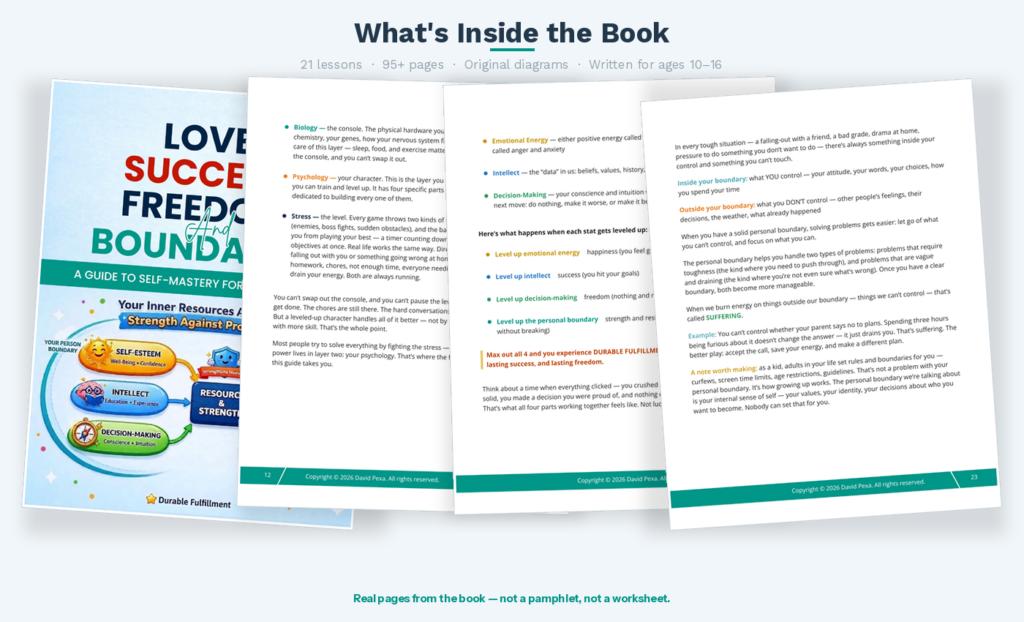
For parents who want the deeper framework — the one that makes work like this stick instead of feeling like you’re firefighting forever — my book Love, Success, Freedom and Boundaries is the structured version of what I teach my own students. Written for tweens and teens, but most parents tell me they pick up more from it than the kid does.
Going Deeper
If this article changed something in the way you see your teenager — if you read it and thought, “That’s exactly what’s happening in my house” — then you’re ready for the next step.
Love, Success, Freedom and Boundaries is a book I wrote for young people and the parents raising them. It gives teenagers a framework for understanding themselves — the same kind of framework that would have changed everything for most of us when we were their age. And it gives parents the language to have the conversations that matter most.
A note on affiliates: This article includes affiliate links to platforms I’ve vetted and would recommend to my own clients and students. If you start with a recommended service through a link here, I may earn a small commission — at no extra cost to you. I only mention what I’d actually point you to in person. The recommendation comes first; the relationship is disclosed second.
If this resonates, the full framework lives in Love, Success, Freedom and Boundaries.
A practical playbook for raising emotionally resilient kids — and breaking the patterns you didn’t choose to inherit.
