


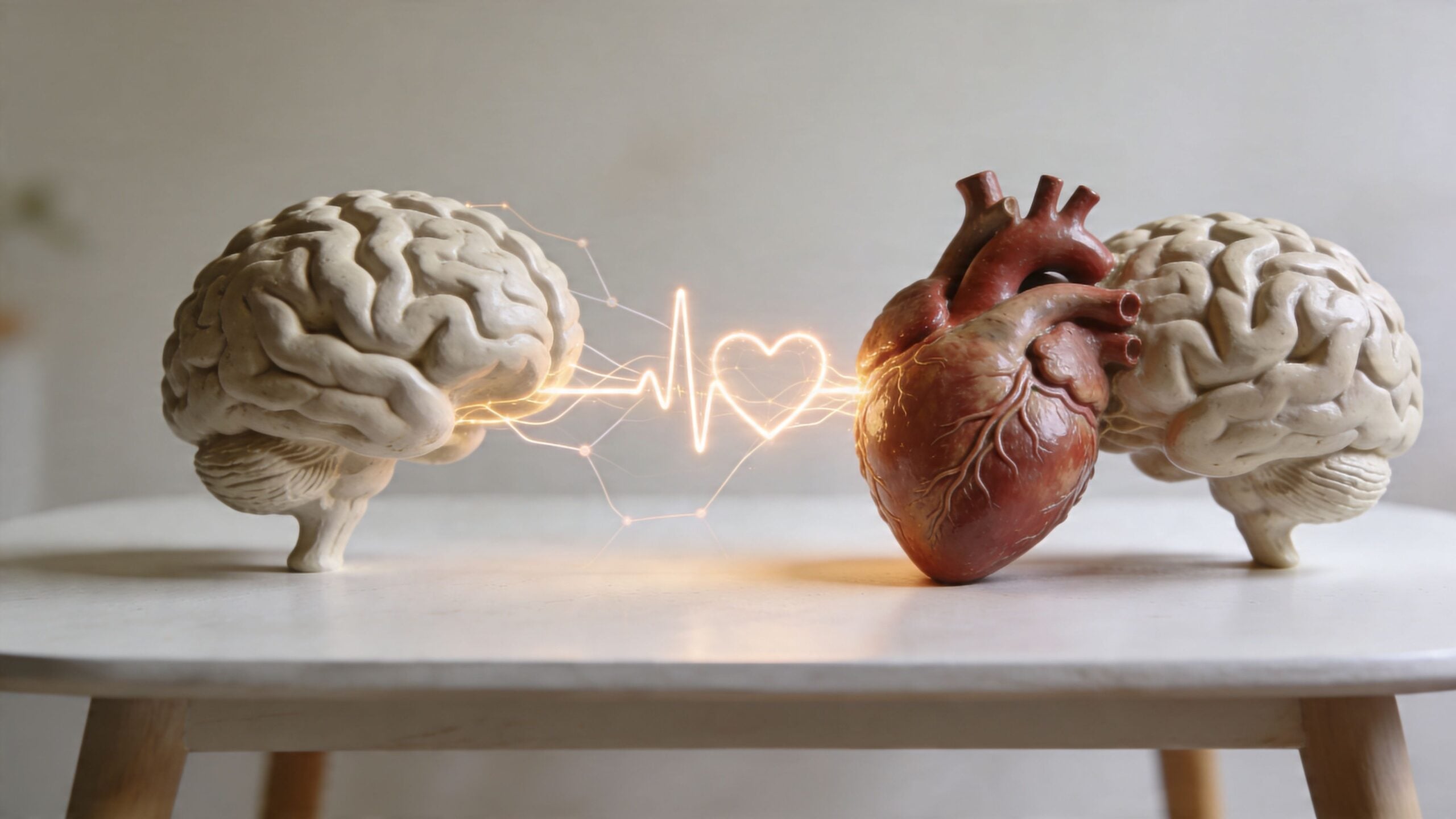
Summary: Is Love an Emotion? A Guide to Its True Nature — understanding the signal beneath the surface and what you can actually do about it.
This question stopped me in my tracks the first time a client asked it. Is love an emotion? Or is it something else entirely? The answer reframes how you approach every relationship in your life.
Most advice about love starts with the wrong assumption. It treats love like a feeling you either have or don't have. If the feeling is strong, the relationship is healthy. If the feeling fades, something must be wrong.
That sounds simple. It also creates a lot of confusion.
People panic when excitement drops. They mistake anxiety for chemistry. They assume steady affection is boring because it doesn't feel explosive. They chase intensity when what they want is closeness, trust, and durability. So when people ask, is love an emotion, they're usually asking a deeper question: What exactly am I supposed to trust, my feelings, my biology, or my choices?
A better answer is that love doesn't fit neatly into one box. Some researchers describe it as a biological drive. Some psychologists describe it as a core emotional experience. In real life, it is often experienced as both, plus something else: a pattern of actions that either strengthens or weakens connection over time.
That distinction matters for personal growth. If love is only a passing emotion, then you're at the mercy of mood. If love is also a motivation and a practice, then you can build it with intention. You can learn to recognize the difference between infatuation and attachment. You can stop treating every fluctuation in feeling as a crisis. You can become more skillful in how you show up with a partner, a friend, or a family member.
Practical rule: Don't judge love only by intensity. Judge it by what it moves you to do consistently.
The science helps here, not because relationships should feel clinical, but because clear language reduces self-deception. Once you understand why love can feel thrilling, disorienting, calming, and demanding all at once, you stop asking only whether it's "real." You start asking whether you're helping it mature.
The Question That Shapes Our Relationships
The question sounds philosophical, but it shows up in very practical moments. You feel less excitement than you did at the start of a relationship. Your partner annoys you. You still care, but the fireworks aren't constant. That's when the question returns: is love an emotion, or is it something steadier than that?
A lot of bad advice says you should always "follow the feeling." The problem is that feelings change quickly. Attraction rises and falls. Stress affects tenderness. Conflict can temporarily block warmth without erasing care. If you treat every emotional dip as a verdict on the relationship, you'll misread normal human fluctuation as failure.
Many readers get stuck on one confusion. They assume that if love includes emotion, then love must be only emotion. That leap creates trouble. Hunger includes feelings too, but we don't call hunger just a mood. Ambition includes emotion, but it's also a motivational force. Love may work in a similar way. It can involve strong feelings while also operating as a deeper orientation toward connection and bonding.
Where people usually get confused
Three mix-ups come up again and again:
- They confuse excitement with depth. Early intensity can feel convincing, but intensity alone doesn't tell you whether a bond is stable.
- They confuse calm with absence. Mature connection often feels less dramatic than infatuation.
- They confuse emotion with commitment. Feeling close today isn't the same as acting with care tomorrow.
A clearer frame helps. Instead of asking only, "What do I feel right now?" ask a second question: "What kind of bond is being built through repeated behavior?"
Love becomes easier to understand when you stop demanding one definition do all the work.
That shift matters beyond romance. It changes how you think about emotional regulation, trust, and long-term habits. If you want healthier relationships, you need a model of love that can survive an ordinary Tuesday, not just a euphoric weekend.
Love as a Primal Motivation The View from Neuroscience
Some scientists argue that love is closer to a drive than a standard emotion. That's a useful idea because it explains why love can feel so compelling, so energizing, and sometimes so irrational.
Biological anthropologist Helen Fisher studied 166 societies and found evidence of romantic love in 147 of them, which is about 88.6% of the societies examined, suggesting romantic love is near-universal across human cultures according to Harvard Medical School's discussion of love and the brain.
That finding matters because it pushes back on the idea that romantic love is just a modern cultural story. If it appears across so many societies, it's more reasonable to treat it as something deeply rooted in human biology.
Why love feels urgent
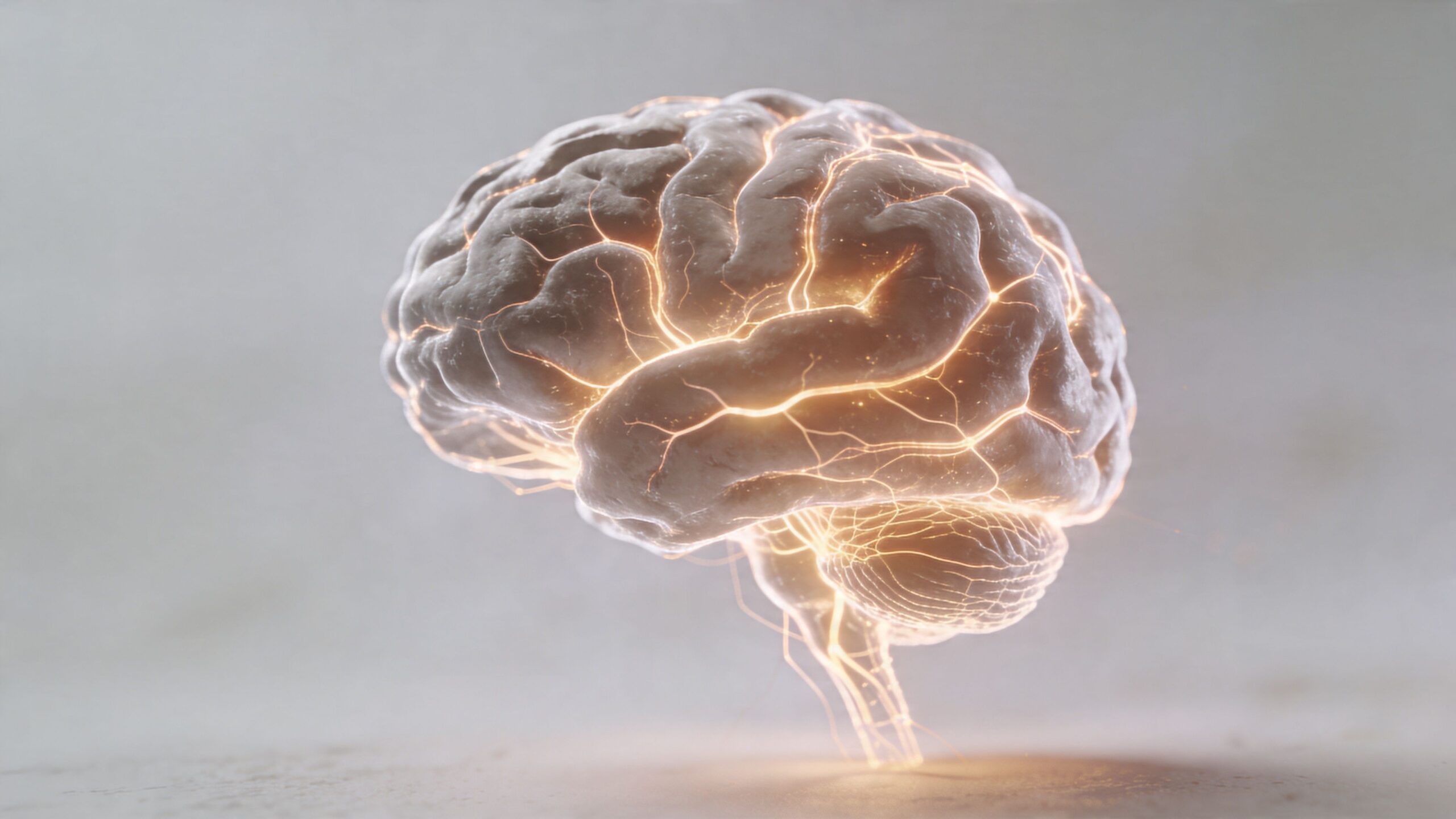
Neuroscience offers the next piece. When a person is in love, the brain's reward circuit becomes highly active. The same Harvard source explains that dopamine floods the system and that brain activity in love resembles the reward response associated with cocaine or alcohol euphoria. The article also notes a 2012 University of California, San Francisco study published in Science that scanned lovers' brains and found heightened activity in the nucleus accumbens.
This is one reason early romantic love can feel impossible to ignore. Your attention narrows. Motivation rises. The person can seem unusually significant.
A simple analogy helps. Think of early love as pressing the accelerator while easing off the brakes. The reward system pushes you toward the person, while some pathways linked to fear and social judgment become less active. The same Harvard discussion describes love as connecting the prefrontal cortex to the nucleus accumbens while suppressing amygdala responses tied to fear and negative emotion.
Why judgment changes in early love
This helps explain behavior people often find embarrassing later. You overlook flaws. You become unusually hopeful. Red flags don't always register with their normal force.
That doesn't mean people in love are foolish. It means the brain is temporarily prioritizing bonding over critique.
- Reward amplification: dopamine makes the connection feel valuable and motivating.
- Fear suppression: reduced negative judgment can make closeness easier.
- Bonding priority: attention shifts toward maintaining connection.
Early love isn't just something you "feel." It's something your brain organizes around.
For personal development, this is useful knowledge. If you know love can amplify reward and soften critique, you can stop worshipping those effects. You can enjoy them without assuming they are perfect guides. You can also use the same insight to build better habits. Reward helps repetition. Repetition helps bonding. Small positive interactions matter because the brain learns from what it experiences often.
So from a neuroscience lens, love isn't best understood as a fleeting passing feeling. It's a motivational state with serious biological force.
Love as a Core Feeling The View from Psychology
Psychology pushes back on a common oversimplification. If neuroscience asks what love drives us to do, psychology asks what love is like from the inside. That distinction matters in real relationships, because people do not only act on love. They interpret it, name it, and build habits around it.
A Psychology Today review of the history of emotion research on love summarizes an important finding: people consistently treat love as one of the most central emotions in human life. In plain language, love feels emotionally foundational, even if researchers debate whether it fits neatly into the category of a basic emotion.
That clears up a common confusion. A state can have motivational force and still feel intensely emotional. Hunger pushes behavior and also has a clear felt experience. Love works in a similar way. It can organize attention and action, while also showing up as tenderness, longing, comfort, joy, grief, relief, and care.
For coaching and personal growth, that is more than a theory point. If you only label love as a drive, you may excuse impulsive behavior. If you only label it as a feeling, you may expect it to sustain itself. A better frame is to treat love as an emotional system you can notice, shape, and strengthen.
Barbara Fredrickson offers a useful practical lens. She describes love as brief episodes of positive connection, often called micro-moments, marked by emotional attunement and physiological shifts linked to closeness. Love, in this view, works less like one giant permanent mood and more like a campfire that needs repeated small pieces of fuel.
Those moments often look ordinary, which is why people underestimate them.
- meeting each other's eyes and feeling understood
- laughing together after stress
- lowering your voice instead of escalating during conflict
- showing real interest when your partner talks
- responding to distress with warmth instead of defensiveness
If you want a clearer map of the difference between emotions and feelings, love sits at the intersection. It includes body-based reactions, emotional experience, personal meaning, memory, and the history of the relationship itself.
Psychologists have also tried to measure love instead of treating it as pure poetry. The same review describes early work by Zick Rubin that separated love from simple liking, and it summarizes later cross-cultural research identifying recurring dimensions such as caring, attachment, passion, and intimacy. That matters because it gives us a practical checklist. Lasting love is usually not one intense sensation. It is a pattern with recognizable parts.
| Psychological lens | What it helps you see |
|---|---|
| Love as a central emotion | Your experience of love is emotionally real, not "less valid" because scholars debate definitions |
| Micro-moments of connection | Small, repeated interactions build closeness over time |
| Measured dimensions of love | Caring, attachment, passion, and intimacy can be noticed, assessed, and strengthened |
This psychological view fills the gap many articles leave open. It does not stop at "love is an emotion" or "love is a drive." It turns the debate into a usable question: which part of love is present here, and which part needs practice?
That question changes how people grow. Instead of asking, "Do I still feel it?" you can ask, "Are we creating care, attachment, passion, and intimacy in repeatable ways?" That is a much better foundation for healthy love.
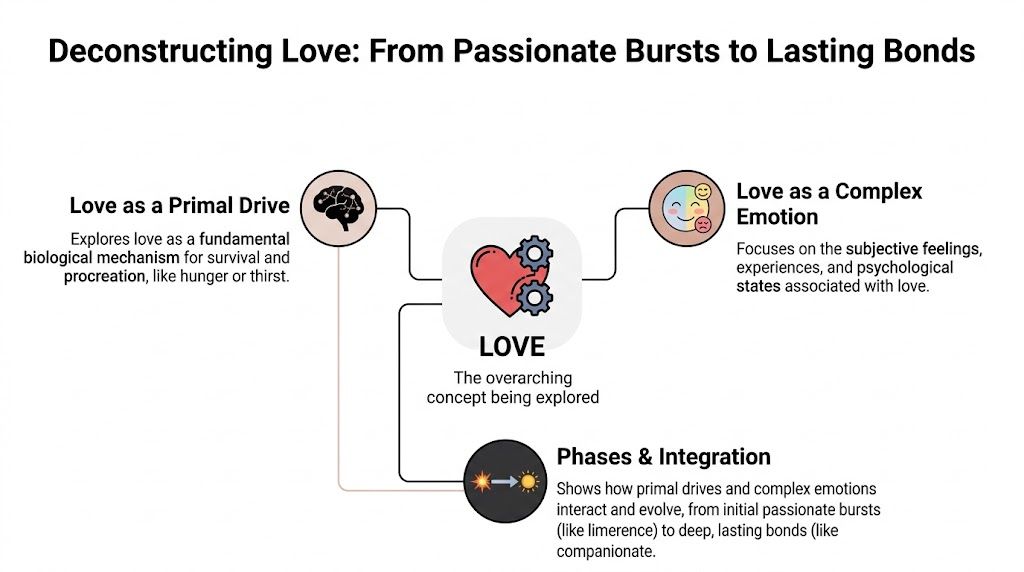
Deconstructing Love From Passionate Bursts to Lasting Bonds
The neuroscience view and the psychology view can sound like they're arguing. In practice, they're often describing different layers of the same experience.
The cleanest way to understand love is this: love isn't one thing. It can begin as a surge, continue as an emotion, deepen into attachment, and eventually become a pattern of deliberate care. If you try to use one definition for every phase, you'll misread what is changing.
One word, several experiences
Early romantic intensity often feels consuming. Mature love often feels steadier. Both may be called love, but they don't operate the same way.
A useful practical map looks like this:
- Passionate love: high urgency, strong attraction, lots of focus on the other person.
- Attachment love: comfort, safety, familiarity, emotional home base.
- Committed love: repeated choices that protect and sustain the bond.
Those categories overlap. A healthy long-term relationship often contains all three, just in different proportions over time.
A simple self-check
When people ask if their relationship is "still love," they're usually noticing that one element has changed while others remain. This short diagnostic can help.
| If this is strongest right now | You may be experiencing |
|---|---|
| Craving, excitement, preoccupation | A more passionate phase |
| Calm, trust, ease, reliability | A more attached phase |
| Follow-through, repair, loyalty | A more committed phase |
None of those automatically means the relationship is healthy or unhealthy. They just point to the layer that's most active.
A relationship doesn't fail because it stops feeling like the beginning. It fails when people don't understand what the middle is supposed to require.
Many people mourn the loss of intensity without noticing the growth of stability. They think love is gone when in fact the bond is changing form. Others do the opposite. They cling to comfort even though passion and curiosity have collapsed from neglect.
A more mature definition of love allows for movement. Some days love feels emotional. Some days it feels biological. Some days it feels like a decision to stay kind when you're tired. The richer model is more accurate and more useful.
Identifying Healthy Love vs Fleeting Infatuation
Individuals don't need a better theory first. They need better observation.
The practical question isn't only is love an emotion. It's also, "How can I tell whether what I'm feeling is stable love or temporary infatuation?" The answer shows up in behavior faster than in self-description.
Infatuation often feels loud. Healthy love is often easier to miss because it looks ordinary. It shows up in consistency, honesty, and a growing capacity to handle reality together.
Signs you're dealing with infatuation
Infatuation tends to distort attention. You focus on chemistry and possibility more than pattern and character.
Common clues include:
- Idealization: you keep explaining away concerns because the person feels special.
- Obsessive thinking: your mind loops around their messages, mood, or availability.
- Emotional volatility: a small delay or mixed signal throws your whole nervous system off.
- Performance mode: you work hard to maintain an image instead of relaxing into honesty.
These experiences don't mean a relationship is doomed. They do mean you shouldn't confuse intensity with evidence.
Signs you're dealing with healthier love
Healthier love is less cinematic and more dependable. It survives contact with real life.
Look for signs like these:
- Support under stress: care doesn't disappear the moment life gets inconvenient.
- Mutual vulnerability: both people can admit fear, need, and imperfection.
- Room for individuality: connection doesn't require losing your boundaries or routines.
- Joy without possession: you can celebrate the other person's growth without needing to control it.
If emotional openness is hard for you or your partner, learning what being emotionally available actually looks like can clarify a lot. Many people call a bond "love" when it's pursuit, avoidance, or dependency.
A quick comparison
| Pattern | Fleeting infatuation | Healthier love |
|---|---|---|
| View of partner | Idealized | Realistic and warm |
| Response to conflict | Panic or avoidance | Repair and curiosity |
| Sense of self | Unstable | Intact |
| Focus | How they make you feel right now | How you build life together |
If you can't be honest, disappointed, tired, and still caring, the bond may be more fantasy than love.
This is why stable love can feel less intoxicating and more nourishing. It asks for presence rather than obsession. It grows through repeated moments of truth.
A Practical Guide to Building and Deepening Love
Understanding love is helpful. Practicing it is what changes relationships.
A major gap in most discussions is that they explain the science but stop before the coaching. Yet the most useful question is practical: how do you turn insight into habits? One summary of this gap notes that dopamine-driven romantic love tends to fade in 12 to 24 months, and that people can consciously support a shift toward more mature attachment through journaling, micro-moments of connection, and mood tracking, as described in this discussion of love's development and practical application.

That doesn't mean every relationship should continue. It means a drop in intensity is not, by itself, evidence that love has ended. Often it's an invitation to build a more durable form of it.
Practice one, journal acts of dedication
Don't track only how strongly you feel. Track what you did.
Daily, write down one action that reinforced the relationship. Keep it concrete. Examples include listening without interrupting, checking in after a difficult meeting, apologizing clearly, or making space for your partner's priorities.
This trains your attention away from drama and toward pattern.
- Ask: What did I do today that made the bond safer, kinder, or more honest?
- Notice: Did I act with care even if I wasn't in a romantic mood?
- Review: After a few weeks, look for consistency rather than perfection.
Practice two, use micro-moments as rituals
Fredrickson's idea of micro-moments becomes powerful when you make it repeatable. Don't wait for spontaneous closeness. Create short connection rituals.
Try a few examples:
- Morning reset: make eye contact and share one intention for the day
- Midday touchpoint: send one sincere message that isn't logistical
- Evening repair: spend a few minutes asking, "Did anything feel off between us today?"
These are small on purpose. Tiny rituals are easier to sustain.
Coaching prompt: Build love the way you'd build any habit. Lower friction, repeat often, review honestly.
Practice three, track the shift from infatuation to attachment
A mood journal can help you separate chemistry from stability. This is especially useful if you tend to panic when feelings fluctuate.
Write brief notes about:
- your emotional intensity
- your sense of safety with the person
- your ability to be yourself
- how conflict was handled
Over time, you'll see a clearer picture. High intensity with low safety is one pattern. Moderate intensity with growing trust is another. That distinction matters.
If you need help staying steady enough to observe your reactions instead of acting on them, tools like an emotion regulation checklist can support that process.
Practice four, define love as a set of repeatable behaviors
Many adults need a mindset upgrade. Stop using "love" only as a noun. Use it as a verb category.
Your list might include:
- telling the truth kindly
- staying curious during conflict
- protecting time for connection
- expressing appreciation before resentment builds
- supporting growth without keeping score
Once you define love behaviorally, confusion drops. You stop asking only, "Do I feel in love today?" and start asking, "Did I practice love well today?"
That question leads to better relationships because it gives you agency.
If you process emotions through writing — journaling, drafting hard conversations, putting words to what you’re feeling — the tool I use to draft most of my words is Wispr Flow. It transcribes your voice into clean, edited text in real time, so the friction between thinking it and writing it basically disappears.
Conclusion Redefining Love as a Conscious Practice
The better question is not only, "Is love an emotion?" The better question is, "What do I do with love once I understand what it is?"
By now, the answer is wider than a simple yes or no. Love includes feeling, motivation, attachment, and behavior. That fuller definition matters because it changes how people judge their relationships. If love is treated as a passing feeling, every dip in intensity can feel like failure. If love is understood as a system, more like physical fitness than a lightning strike, then effort, recovery, and repetition start to make sense.
That shift gives people something many articles skip. Direction.
You do not need endless intensity to have real love. You need the ability to recognize what is happening inside you, respond with skill, and practice the behaviors that help trust grow. Passion may start the bond. Character helps sustain it. Repair strengthens it after strain. Over time, lasting love looks less like constant emotional fireworks and more like two people building safety, honesty, and mutual care on purpose.
That is why redefining love as a conscious practice is both scientifically grounded and personally useful. Neuroscience explains the pull. Psychology explains the feeling. Daily behavior determines whether the relationship becomes stable, nourishing, and real.
Building that kind of love takes practice and the right tools. If you want more practical, grounded guidance on emotions, mindset, and healthier habits, explore David Pexa for clear coaching tools and step-by-step resources that help you think better, relate better, and live with more intention.
Frequently Asked Questions
Is love an emotion or something else?
Love functions as both an emotion and a decision. The feeling of love is an emotional state, but lasting love is a pattern of choices — attention, commitment, repair. Reducing it to just a feeling misses what makes it powerful.
What’s the difference between love and attachment?
Attachment is about security — needing someone to feel safe. Love includes the capacity to see someone clearly and choose them anyway. Attachment can exist without love, and love can exist without anxious attachment.
Can you control who you love?
You can’t control the initial feeling, but you can control what you do with it. Love as an emotion happens to you. Love as a practice is something you build deliberately.
Keep Reading
- The Ultimate 10-Point Emotion Regulation Checklist
- Emotional Intelligence Chart: A Guide to Mapping Your EQ
- Emotional Disconnect: Signs, Causes, & Repair
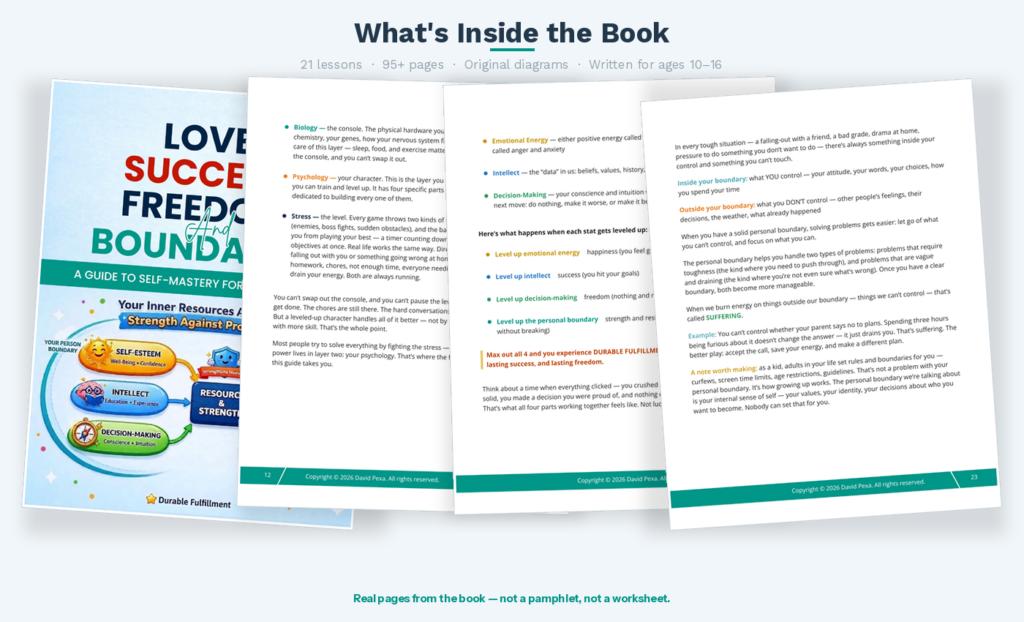
If this resonated, go deeper. My book Love, Success, Freedom and Boundaries gives you twelve frameworks for seeing the patterns that shape your life — and changing the ones that aren’t working.
A note on affiliates: This article includes affiliate links to platforms I’ve vetted and would recommend to my own clients and students. If you start with a recommended service through a link here, I may earn a small commission — at no extra cost to you. I only mention what I’d actually point you to in person. The recommendation comes first; the relationship is disclosed second.
If this resonates, the full framework lives in Love, Success, Freedom and Boundaries.
A practical playbook for raising emotionally resilient kids — and breaking the patterns you didn’t choose to inherit.
