



I’ve sat with people who typed “i hate my life” into a search bar at 2 a.m. because saying it out loud felt too risky. Usually they aren’t making a calm conclusion. They’re trying to name a pressure that has gotten bigger than their current way of coping.
You Are Not Broken You Are Overwhelmed
When you say “i hate my life,” I don’t hear a final verdict. I hear overload.
I hear a nervous system that’s been carrying too much for too long. I hear shame trying to turn pain into identity. And I hear the kind of global statement people make when the underlying problem feels too tangled to name.
That distinction matters. If the sentence is true in some absolute sense, you’re trapped. If it’s a signal, you can work with it.
A lot of people miss that moment because they start arguing with the sentence too early. “You don’t mean that.” “Be grateful.” “Other people have it worse.” None of that helps when your body already feels like it’s underwater. What helps first is recognizing that your system is not giving you a philosophical insight. It’s firing an alarm.
For many people, that alarm sits on top of something deeper and treatable. Among children and young people aged 8 to 25, about 1 in 5 have a probable mental health problem, and in the US 1 in 6 adolescents experienced a major depressive episode, with 3 million having serious suicidal thoughts, according to Mind’s mental health facts and statistics. That doesn’t reduce your pain. It does remove one dangerous lie, which is that you’re uniquely broken.
What this feeling usually means
Most of the time, “i hate my life” is covering one or more specific experiences:
- Loneliness that’s been building
- Exhaustion that you kept calling laziness
- Conflict at home that never really settles
- Pressure from school, work, or caregiving
- Loss of direction that makes every day feel heavy
- Unprocessed hurt that keeps leaking into the present
You are not weak for feeling overwhelmed. You are getting information.
I want to be direct here. If you’re searching this phrase, you probably don’t need inspiration first. You need relief, then clarity.
The reframe that opens a door
Try this sentence instead:
| Old sentence | Better working sentence |
|---|---|
| I hate my life | Something in my life feels unbearable right now |
| Everything is wrong | I can’t yet identify what hurts most |
| I’m the problem | My system is reacting to pain, stress, or both |
That may sound small. It isn’t.
The first version collapses your entire identity into despair. The second gives you a place to stand. When I work with young people and parents, this is often the first shift that lowers the temperature. Not because it solves anything on the spot, but because it turns a life sentence into a problem we can examine.
First Let's Get You on Solid Ground
If the feeling is intense right now, stop trying to solve your whole life.
Get your body back first.

When people are flooded, they often keep pushing themselves to think their way out. That usually makes things worse. A flooded brain grabs for absolutes. A steadier body gives you a better chance at steadier thinking.
Do these in order
Create distance from danger
Move away from anything you could use to hurt yourself. Go to a more public room in the house. Sit near a door. If being alone feels risky, get near another person.Name five things you can see
Then four things you can feel, three things you can hear, two things you can smell, one thing you can taste. This is the 5-4-3-2-1 method. It works because it interrupts the spiral and pulls attention back into the present.Use temperature
Hold ice. Splash cold water on your face. Put a cool can or chilled spoon against your wrist or cheek. Strong physical sensation can cut through mental looping.Lower the demand
Sit down. Put both feet on the floor. Unclench your jaw. Drop your shoulders. Exhale longer than you inhale for a few rounds.Say one orienting sentence out loud
Try: “I’m overwhelmed. I need to get through the next ten minutes, not the next ten years.”
What to say if you need immediate help
If you might act on suicidal thoughts, contact emergency support now. In the US, call or text 988, the Suicide & Crisis Lifeline. If you are in immediate danger, call emergency services.
You do not need the perfect words. Use plain language:
- “I’m not safe with myself right now.”
- “I’m having thoughts of hurting myself and I need help staying safe.”
- “Can you stay with me while I get support?”
Practical rule: If you’re asking yourself whether this is “serious enough,” take that as your cue to reach out.
If the intensity is lower but your body stays keyed up, lean on simple regulation before analysis. Walking, hydration, steady meals, and reducing overstimulation can matter more than one more hour of scrolling for answers. If anxiety is part of the picture, I’ve found readers often benefit from practical nervous-system support like these approaches to reducing anxiety naturally.
What not to do in the next hour
- Don’t isolate with your phone if the phone is making things darker.
- Don’t start a huge life review while dysregulated.
- Don’t shame yourself for being dramatic. Shame adds fuel.
- Don’t argue with your feelings. Regulate first. Evaluate later.
A calm body won’t fix a painful life situation by itself. But without that first step, panic often gets mistaken for truth.
Decoding the "I Hate My Life" Signal
Once the wave comes down a little, the sentence itself needs interrogation.
“I hate my life” sounds precise. It usually isn’t. It’s a catch-all phrase for pain that hasn’t been sorted yet. People say “my life” when the actual problem is more specific, more painful, and more changeable.

I want you to challenge the sentence, not because your feelings are fake, but because your first interpretation is often too broad to help you.
In the US, major depressive disorder affects 15.5% of the population and anxiety disorders affect 19.1%, and among adolescents 1 in 6 have endured a major depressive episode, according to NAMI’s mental health by the numbers. That matters because hopeless, all-or-nothing statements often sit on top of depression, anxiety, trauma, or some combination of them. In other words, the phrase may feel like a truth about your life when it is a symptom of a condition.
Translate the global statement into specifics
Take the sentence and break it apart.
| Global thought | More accurate translation |
|---|---|
| I hate my life | I feel trapped in a pattern I can’t name |
| Nothing matters | I’m disconnected from meaning right now |
| I can’t do this anymore | My load is beyond my current capacity |
| Everything is too much | Several stressors are stacking at once |
That translation work is not semantics. It’s clinical common sense. A vague problem keeps you helpless. A named problem gives you options.
Four questions that get under the hood
Write the answers, even if they’re messy.
What hurts most when I say it
Is it your job, your home, your loneliness, your body, your grief, your family tension, your sense of failure? Pick one. Not because it’s the only issue, but because your mind needs a starting point.
When does the sentence get loudest
Morning. Night. After social media. After talking to a parent. After being alone. After a conflict. Patterns tell you where the pressure lives.
What am I calling a life problem that may be a treatable mental health issue
Such an understanding often brings people relief. They’ve been treating depression like laziness, anxiety like weakness, trauma responses like overreactions. Once the frame changes, the self-hatred often loosens.
What am I needing that I haven’t admitted
Rest. Space. Structure. Help. Grief. A hard conversation. A boundary. Medication evaluation. Counseling. Less performance. More connection.
The sentence is loud because the unnamed problem underneath it is loud.
What works and what doesn't
What works
- naming the specific stressor
- tracking when the thought spikes
- getting assessed when depression or anxiety may be involved
- talking to someone who can tolerate the truth without panicking
What doesn’t
- debating whether you “should” feel this way
- forcing gratitude to cover distress
- making a permanent identity out of a temporary state
- treating a family or mental health problem like a motivation problem
When you decode the signal, the phrase starts losing its authority. It still hurts. But it no longer gets to pretend it’s the whole story.
Winning the Argument Against Your Inner Critic
After the global statement comes the prosecutor.
“You’re behind.”
“You ruin everything.”
“You’re too much for other people.”
“Nothing’s going to change.”
That voice feels intimate because it uses your own language. But that doesn’t make it accurate. One of the most useful tools I know for this is Voice Therapy, developed by Dr. Robert Firestone. In clinical applications, 70 to 85% of participants report a 50% or greater reduction in inner voice intensity after 12 weeks, as described in PsychAlive’s article on “i hate my life” and Voice Therapy. The heart of the method is simple. You identify the critic, trace where it learned to speak that way, and challenge it with reality.
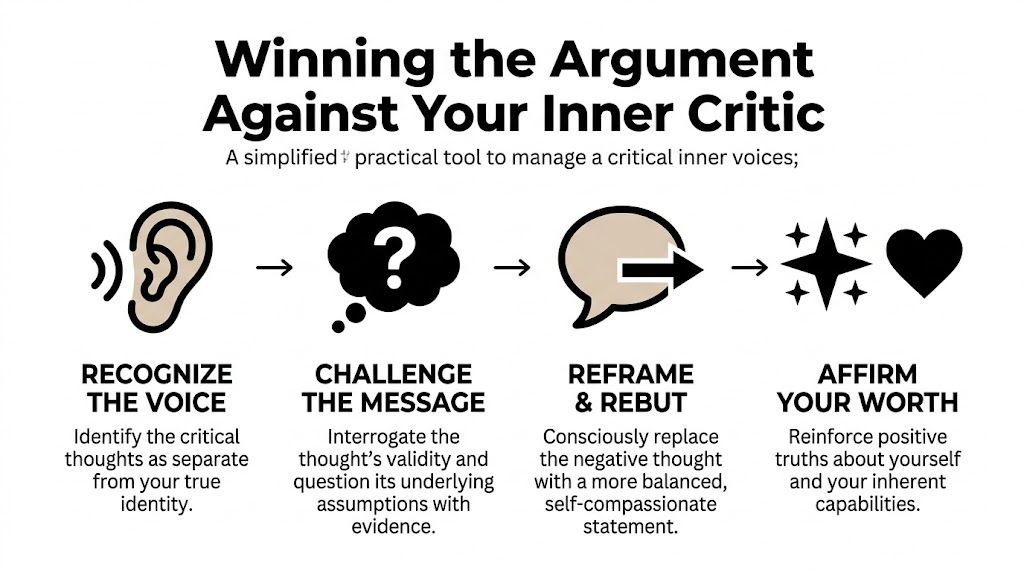
Step one is separation
Many lose the argument because they assume the voice is them.
It isn’t.
Write the thought in the second person, not the first. Not “I’m useless.” Write “You’re useless.” That small shift exposes the attack. It helps you hear the thought as something spoken at you, not as the deepest truth about you.
Build a rebuttal file
I don’t recommend cheesy affirmations when someone is in real pain. They bounce off. What works better is evidence.
Try this three-column practice:
| The critic says | Where it may have come from | Reality-based response |
|---|---|---|
| You fail at everything | old criticism, humiliation, comparison | I’m struggling in specific areas, not all areas |
| Nobody cares about you | loneliness, rejection, panic | I feel alone right now, but that is not proof that nobody cares |
| You’ll never get better | despair, past setbacks | I have had hard periods before, and help exists now |
This is very close to what people learn in good cognitive behavioral therapy techniques, but the voice-focused lens is especially useful when self-attack is relentless.
Use these prompts when the critic gets loud
- What exactly is the accusation
- What evidence does it claim to have
- What evidence contradicts it
- Whose voice does this resemble
- What would I say if this were aimed at someone I care about
Notice the order. You are not trying to be nice first. You are trying to be accurate.
A better response than “stop being negative” is this: “That thought is attacking me, and I’m going to answer it with facts.”
What this looks like in real life
A teenager says, “I hate my life. I’m a burden.”
The critic is making two moves at once. First, it turns pain into identity. Second, it predicts other people’s thoughts without evidence. The rebuttal is not “No you’re not, sweetie.” The rebuttal is stronger when it sounds like this:
- You’re overwhelmed and ashamed.
- That feeling is making you interpret your existence as a burden.
- The fact that you need support does not prove you are too much.
For adults, the content changes but the mechanism doesn’t. A parent under strain hears, “You’re failing your family.” A young professional hears, “You’ve wasted your potential.” The critic always tries to convert a difficult season into a total identity statement.
What usually backfires
- Arguing with every thought all day until you’re exhausted
- Calling the critic motivation because it sounds productive
- Using self-attack as discipline
- Waiting to feel confident before acting
Action helps. Tiny, grounded action. Wash your face. Send one honest text. Show up to one appointment. Eat something plain and steady. The critic hates measurable reality because reality keeps proving that you are more functional, worthy, and changeable than it says.
The Family Pattern Most People Miss
This is the part most articles skip.
Sometimes the person saying “i hate my life” is carrying their own pain. Sometimes they are also carrying the emotional weather of the home.
That is not blame. It’s systems thinking.

I see this often with families who care immensely and still get stuck. A child says something despairing. The parent panics and rushes into fixing. The child feels corrected instead of understood. The parent feels rejected and tries harder. Both people leave the exchange more alone than they started.
When a parent has unresolved stress, grief, shame, or chronic dissatisfaction, children often absorb more than adults realize. Not because anyone intends harm, but because nervous systems read each other. Tone, urgency, withdrawal, irritability, overcontrol, emotional absence. Kids notice all of it.
A 2025 UK study in the Journal of Family Psychology found that combined parent-child behavioral interventions reduced mutual “I hate my life” sentiments by 37% in 6 months, compared with 18% for individual counseling, as cited in Rosecrance’s discussion of how to respond to “I hate my life”. That tracks with what I’ve seen in practice. When the system changes, the individual often gets relief faster.
What families usually say
- “That’s not true.”
- “You have so much to be grateful for.”
- “Tell me what I need to fix.”
- “Why would you say that?”
None of those responses are evil. They’re anxious. They come from fear.
What helps more
Try language that lowers defensiveness and increases truth.
| Less helpful | More helpful |
|---|---|
| That’s ridiculous | Tell me what feels unbearable right now |
| You’re fine | I can see you’re not okay |
| We need to solve this | I want to understand before I try to help |
| Don’t talk like that | I’m glad you said it out loud instead of holding it alone |
If you’re the parent, your first job is not to correct the sentence. It’s to make the room safe enough for the truth underneath it.
The hidden feedback loop
Here’s the pattern.
A parent who feels secretly trapped often radiates tension. A child picks up the tension and becomes dysregulated. The child’s distress activates the parent’s unresolved fear. Then the home starts revolving around management instead of connection.
We tend to think the child is “the one with the problem.” Sometimes the child is also the one expressing what the family has not named.
If you’re the parent, ask yourself:
- What do I do when my child’s pain scares me
- Do I move into fixing, lecturing, minimizing, or withdrawing
- What in me gets activated by their hopelessness
- What support do I need so I stop asking my child to regulate my fear
If you’re the young person, a different question matters:
- What happens in my house when I tell the truth about how bad it feels
That answer tells us a lot. Many people don’t need more advice first. They need a different emotional environment.
Your Next Right Move Is Smaller Than You Think
People in despair often try to solve life in one swing. New plan. New city. New identity. New everything.
I understand the urge. It’s relief-seeking.
It’s also usually too big to hold.
The more reliable path is smaller and less dramatic. Pick one variable. Track it. Watch what happens. Then adjust from reality, not mood.
A self-tracking case study found a -0.65 correlation between poor sleep and negative sentiment, and a +2.3 average sentiment boost on days that included learning, according to this freeCodeCamp piece on analyzing life with data. That doesn’t mean sleep or learning is your whole answer. It means your life has patterns, and patterns can be measured.
Start with one week, not a reinvention
Track just a few daily items:
Sleep
Rough bedtime, wake time, and whether sleep felt broken or steady.Food and water
Not calories. Just whether you ate regularly and stayed hydrated.Movement
Walk, stretch, gym, sports, or none.Contact
Did you speak candidly with anyone, even briefly.Stress spikes
Note what happened right before the “i hate my life” thought got loud.One meaningful action
Reading, learning, building, cleaning, praying, journaling, practicing, making something.
A simple note app works. A paper page works. A spreadsheet works if you like data. The point is not perfection. The point is to stop treating every bad day like a mystery.
What to do with the pattern once you see it
If the thought spikes after poor sleep, start there.
If it spikes after conflict with a parent, name the relational trigger.
If it spikes on unstructured days, build light structure.
If it eases when you learn, create regular contact with growth.
That’s how agency comes back. Not as a feeling first, but as a practice.
When professional help moves from “maybe” to “yes”
Get professional support when any of these are true:
- The thought is recurring and getting darker
- You’re losing function at school, work, or home
- You feel stuck in numbness, panic, or hopelessness
- You’re using substances, self-harm, or dangerous behavior to cope
- Your family keeps having the same painful conversation with no change
- You don’t feel safe with your own thoughts
If you’re looking for a therapist or counselor, pay attention to fit. You want someone who can handle direct truth, help you identify patterns, and work with both thoughts and the body. If family tension is part of the pain, don’t assume individual work is the only route. Sometimes the fastest progress comes when the system is addressed alongside the person.
If change has felt impossible, lower the bar and make it measurable. One consistent bedtime. One appointment. One honest conversation. One week of tracking. One realistic plan. That’s the kind of structure that holds. If you need help with that piece, these ideas on how to set realistic goals are a good place to start.
You do not need to feel hopeful to begin. You need a next move that is small enough to do while still hurting.
I write about the patterns most parents never see, the hidden loops behind overwhelm, and the practical shifts that help young people and families regain clarity. If you want the next one in your inbox, join David Pexa.
