


Let’s name it. The thing you’ve been carrying that you haven’t said out loud, maybe not even to your spouse, definitely not to your friends.
Am I a bad parent?
It shows up at 11pm when the house is quiet and the argument from dinner is still sitting in your chest. It shows up when you see other families at the grocery store and their kids seem… fine. It shows up every time a well-meaning relative says “Have you tried just talking to him?” as if that thought hadn’t occurred to you in the last eighteen months.
Here’s what I want to tell you, and I want you to hear this clearly: the fact that you’re asking that question is the single strongest evidence that the answer is no.
Bad parents don’t ask. They don’t lie awake wondering. They don’t read articles like this one at midnight, looking for something — anything — that explains why the child they love has become someone they can’t reach.
You’re not a bad parent. You’re an uninformed one. And there’s a difference the size of the Grand Canyon between those two things.
But here’s what I need you to understand: uninformed isn’t harmless. Every week you keep guessing is another week of responding to the surface instead of the signal underneath. Your child’s nervous system is learning something from every interaction — and right now, what it’s learning is that the person they need most doesn’t speak their language. That gap doesn’t stay the same size. It widens. The ten-year-old who feels misunderstood becomes the fifteen-year-old who stops trying to be understood at all.
Why Asking ‘Am I a Bad Parent?’ Is the Wrong Question
You’re a high-performer. You might run a team, manage a department, close deals, solve complex problems every day. You’re used to being competent. You’re used to figuring things out.
And then you come home and a thirteen-year-old dismantles you with a single eye-roll.
The gap between your professional competence and your parental helplessness creates a specific kind of shame. It’s the shame of someone who should be able to handle this — who handles harder things at work every single day — and can’t figure out their own kid.
So you internalize it. The problem must be me. I must be doing something wrong. If I were a better parent, this wouldn’t be happening.
Here’s the pattern I see, over and over: the parents who are hardest on themselves are almost never the problem. They’re usually doing more right than they realize. The piece they’re missing isn’t effort or love or commitment. It’s information. Specifically, they’re missing the ability to read what their child’s behavior is actually communicating.
The Real Question You Should Be Asking
“Am I a bad parent?” is a closed question. It has a yes or no answer, and either answer traps you. Yes destroys your confidence. No feels like denial when your kid just told you they hate you.
The better question is: “What is my child trying to tell me that I haven’t learned how to hear yet?”
That question opens something up. It shifts you from self-judgment to curiosity. It reframes the problem from a character flaw (I’m a bad parent) to an information gap (I’m missing something specific). And information gaps can be closed.
Let me give you a concrete example. A parent comes to me and says: “My daughter screams at me every night about homework. I’ve tried being patient, I’ve tried being strict, I’ve tried backing off completely. Nothing works. I must be doing something wrong.”
When I observe the pattern, here’s what I see: the daughter isn’t screaming about homework. Homework is the trigger, but the message underneath is about autonomy. She’s at an age where she needs to feel competent and self-directed, and every time a parent asks “Did you finish your homework?” — even gently, even once — it registers as surveillance. The scream is her clumsy, developmentally appropriate way of saying: “I need you to trust that I can handle this, and your checking tells me you don’t.”
Sponsored

The parent wasn’t bad. The parent was reading the surface behavior (screaming = defiance) instead of the underlying communication (screaming = I need you to see me as capable). Once the parent understood the translation, the screaming stopped within two weeks. Not because the parent tried harder. Because the parent tried differently.
The Guilt Spiral and How It Distorts Your Vision
Guilt does something specific to your perception. It makes you the main character in your child’s story. When you’re trapped in “What did I do wrong?”, every piece of your child’s behavior becomes evidence in the case against you.
Your son is angry? Must be because of the divorce. Your daughter is withdrawn? Must be because you work too much. Your child has anxiety? Must be something you modeled.
Some of that might have threads of truth. But “bad parent” guilt takes those threads and weaves them into a straightjacket. It convinces you that you caused this, and therefore you should be able to fix it through sheer force of better parenting. More patience. More presence. More trying.
But your child isn’t a problem you caused. Your child is a developing human being navigating a world that is genuinely harder to navigate than the one you grew up in. Their struggles have sources — developmental, social, neurological, relational — and you are one influence among many. An important one. But not the only one, and probably not the one you’re afraid you are.
What I Actually See When Parents Come to Me
I’ll tell you what I notice. The parents who show up asking “Am I a bad parent?” are almost always the ones who have done the most work. They’ve read the books. They’ve tried the strategies. They’ve gone to the therapist and been told their child is “fine” when they know in their gut that something is off.
These parents aren’t failing. They’ve been trying to solve a communication problem with behavioral tools. It’s like trying to fix a translation error by speaking louder. The volume was never the issue. The language was.
These parents aren’t bad parents — they don’t need more advice. They need a framework for understanding what their child’s behavior means — not what it looks like, but what it’s actually communicating. When you have that framework, the guilt dissolves. Not because you stop caring, but because you stop playing the bad parent guessing game.
You’re not a bad parent. You’re not the problem. You’re missing a piece of information. And once you have it, everything you’ve been doing wrong starts to make sense — not as failure, but as the best guess of someone who didn’t yet have the translation.
What You Can Do This Week
You don’t need to fix everything tonight. But you can start seeing differently. Here are three things to try this week:
When your child does the thing that triggers you, pause and ask: what are they trying to tell me? Not “what’s wrong with them” — but what communication is this behavior carrying? Anger is often fear with a mask on. Withdrawal is often “I need you to come find me.” Defiance is often “I need you to see me as capable.” The behavior is the envelope. The message is inside.
Notice where the trigger lands in your body before you respond. The next time your child does the thing — the eye roll, the shutdown, the explosion — don’t focus on them first. Focus on you. Where did that land? Chest tight? Jaw clenched? Heat in your face? That’s your nervous system activating, and whatever comes out of your mouth in the next three seconds will be your stress response, not your parenting. Name the sensation silently — I’m clenching — and give yourself one breath before you speak. That one breath is the difference between reacting from fear and responding from clarity.
Notice your body before you respond. When your kid pushes your buttons, your chest tightens, your jaw sets, your voice changes. That’s your nervous system preparing for conflict. Before you say anything, take one breath and name what you’re feeling: I’m frustrated, not threatened. That ten-second pause changes everything that comes after it.
Replace “What did I do wrong?” with “What am I not seeing yet?” The first question is a trap — it leads to guilt, which leads to overcorrection, which makes the pattern worse. The second question is a door. It assumes you’re capable and caring (you are) and that there’s a piece of information you’re missing (there is). That reframe alone can break the guilt spiral.
If something in this article landed — if you recognized yourself in the 11pm guilt loop or the parent who’s been trying to solve a translation problem by speaking louder — the book goes deeper.
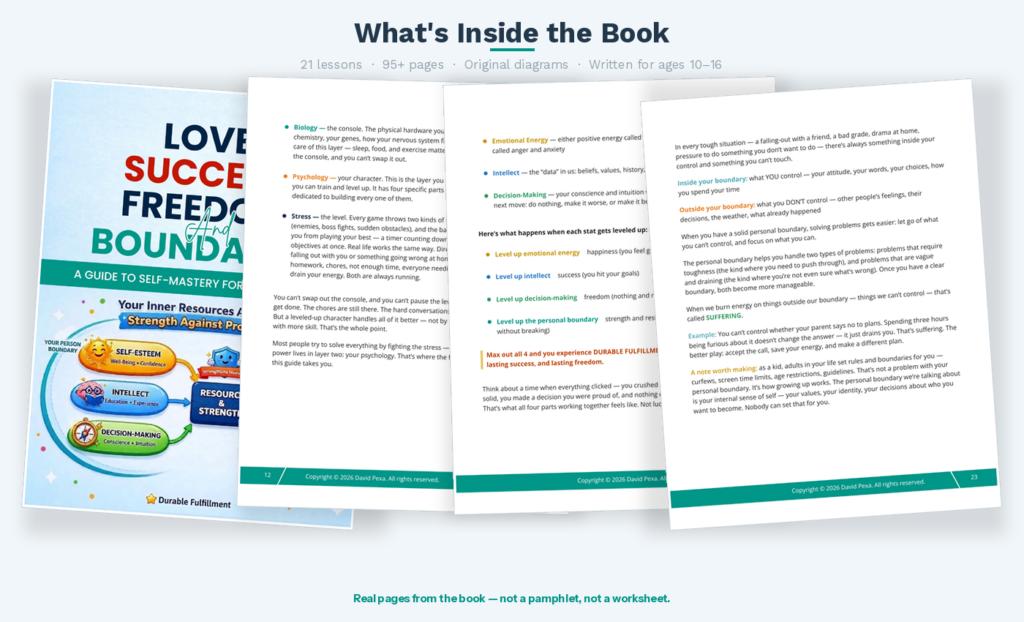
Love, Success, Freedom and Boundaries is the full framework for understanding what your child’s behavior is actually communicating. It’s what I use with every family I work with. Parents tell me it turns years of confusion into clarity in a single weekend.
Stop guessing what’s wrong — start seeing what’s real → Get Chapter 1 free — enter your email and it arrives in minutes.
Or if you’re ready for the full picture: Get the complete framework — $39
You’re not a bad parent. You’re a parent who hasn’t had the right framework yet. That changes now.
For the therapy option specifically, the access friction has dropped a lot in the last few years. Online platforms like Talkspace can match you with a licensed therapist usually within 24 hours, work in all 50 states, accept most major insurance, and let you message your therapist between sessions when something comes up that you don’t want to forget. I mention them by name because they’re the platform I’d point a student or coaching client to today — the path from “I think I need help” to “I’m in a session” is short enough to actually walk.
I write about the tools, habits, and mindset shifts that actually move the needle. Join the newsletter.
A note on affiliates: This article includes affiliate links to platforms I’ve vetted and would recommend to my own clients and students. If you start with a recommended service through a link here, I may earn a small commission — at no extra cost to you. I only mention what I’d actually point you to in person. The recommendation comes first; the relationship is disclosed second.
If this resonates, the full framework lives in Love, Success, Freedom and Boundaries.
A practical playbook for raising emotionally resilient kids — and breaking the patterns you didn’t choose to inherit.
