


Summary: A practical guide to create a personal growth plan that actually works. What actually works, what doesn’t, and where to start.
The first personal growth plan I made was a mess — too many goals, no priorities, no timeline. It took me years to learn that a good plan isn’t about doing more. It’s about doing fewer things with more intention.
A personal growth plan is more than just a to-do list for a better you. It’s a strategic blueprint that takes you from vague aspirations like “I want to be more productive” to a concrete, actionable framework built for real-world progress. It’s about defining what matters, setting clear targets, and building the daily systems to get you there.
Why Most Personal Growth Plans Fail Before They Start
Let’s be real for a moment. Most self-improvement kicks fizzle out within a few weeks. This isn’t because of a lack of willpower; it’s a failure of strategy. We often jump headfirst into big resolutions like “read more books” or “get in shape” without laying any groundwork. It’s like trying to build a house with a pile of wood but no blueprint—the enthusiasm is there, but the structure is completely missing.
A plan that actually works treats personal growth like a project, not a wish. It requires a thoughtful, structured approach that anticipates the inevitable roadblocks and builds momentum through small, consistent wins.
The 4 Pillars of a Successful Plan
To steer clear of those common pitfalls, your plan needs a solid foundation built on four core pillars. These stages are designed to turn abstract ambition into tangible reality, ensuring your efforts are focused, sustainable, and actually make an impact.
This is how these pieces fit together, with each step logically building on the last. It’s a cycle of introspection, execution, and refinement.
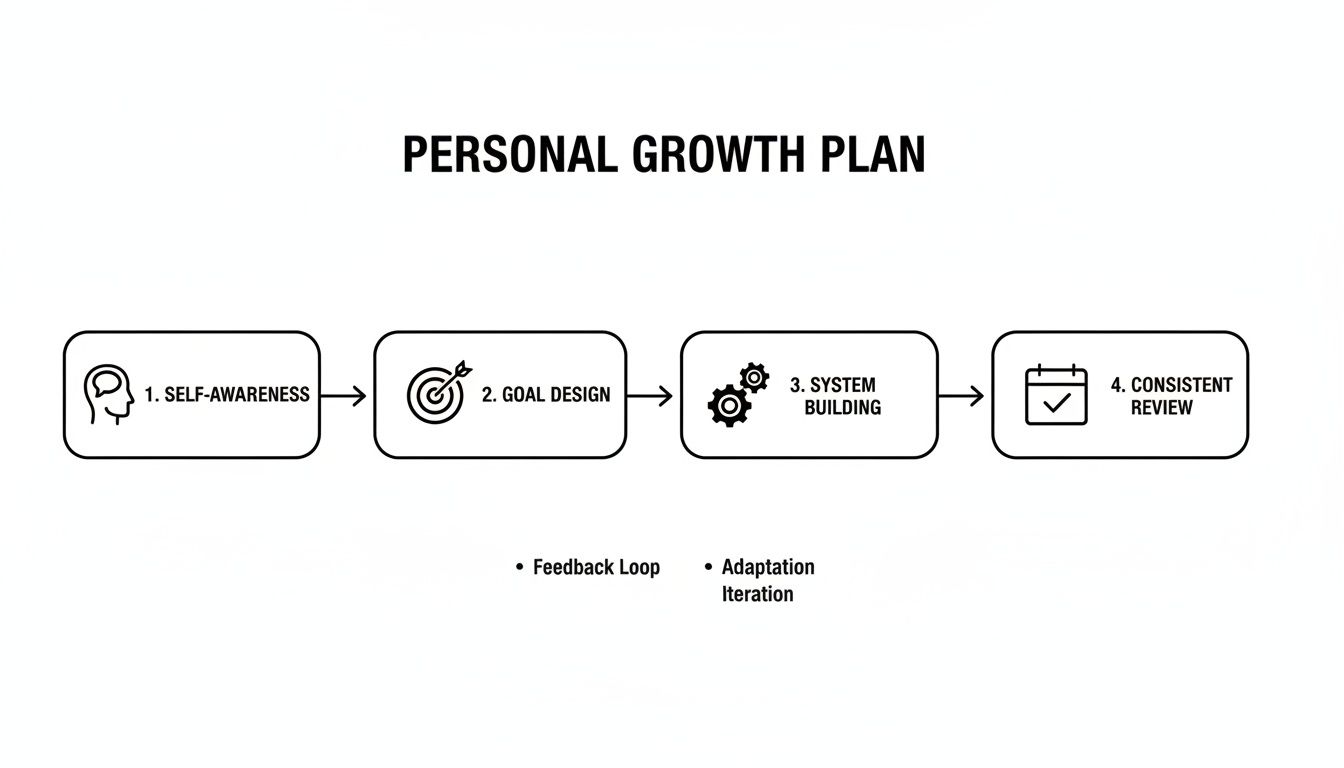
The graphic makes it clear: success isn’t just about setting a big goal. It’s about the entire system you build to support it.
The desire for self-improvement is nearly universal. In the US alone, 58% of adults have spent money on self-improvement products, yet so many of us struggle to see meaningful results. A staggering 40% of Americans set New Year’s resolutions centered on personal growth, but without a plan, those intentions often go nowhere. You can find more details in this research on personal development market trends. The real game-changer is having a plan with specific, trackable milestones.
Think of a personal growth plan as the business plan for your life. It deserves the same strategic thinking you’d give a critical project at work—clear objectives, defined actions, and regular performance reviews.
The 5 Core Phases of a Personal Growth Plan
To bring this all together, here’s a high-level look at the five core phases that turn a good idea into a great outcome. This table breaks down the entire process from start to finish.
| Phase | Objective | Key Action |
|---|---|---|
| 1. Self-Assessment | Gain clarity on your current state, values, and priorities. | Conduct a life audit, identify core values, and define what fulfillment means to you. |
| 2. Goal Design | Translate broad aspirations into specific, actionable targets. | Use frameworks like SMART and WOOP to set clear, measurable, and realistic goals. |
| 3. System Building | Create the daily habits and routines that drive progress. | Design morning/evening routines, practice habit stacking, and create a supportive environment. |
| 4. Execution | Implement the plan and manage your time effectively. | Use techniques like timeboxing and prioritization to stay focused on high-impact activities. |
| 5. Review & Adapt | Track progress, learn from setbacks, and adjust the plan. | Schedule weekly and monthly check-ins to review metrics and refine your approach. |
Each phase is crucial. Skipping a step is like leaving out a key ingredient—the final result just won’t be the same.
Shifting from Resolutions to Systems
Ultimately, the objective is to move beyond temporary bursts of motivation and create lasting change. A well-designed plan gets you there by focusing on the system, not just the goal.
Here’s the difference:
- Goals give you direction. They tell you where you want to end up (e.g., “Run a 5K race”).
- Systems drive your progress. They are the repeatable actions that actually get you there (e.g., “Run three times a week following a training schedule”).
By focusing on these foundational elements—deep self-awareness, smart goal design, supportive systems, and consistent reviews—you’re setting yourself up for success from day one. This guide will walk you through creating that exact blueprint, step by step.
Start With Your Personal Why, Not Just Your What
It’s tempting to jump right into setting goals, but that’s like planning a road trip without knowing your destination. You might end up somewhere interesting, but it probably won’t be where you truly wanted to go. Before you get lost in the “what” of your personal growth plan, you have to connect with your “why.”
This first step is all about honest introspection. It’s about digging deeper than surface-level desires—like getting that promotion or finally running a marathon—to understand the real motivations driving you. Without this clarity, you risk chasing goals that society tells you to want, only to find they leave you feeling empty.

Uncovering Your Core Values
Think of your core values as your internal compass—the fundamental beliefs that quietly guide every decision you make. When your goals and values are in sync, you feel a deep sense of purpose. But when they clash, you get friction, dissatisfaction, and eventually, burnout.
Take, for example, a mid-career marketing manager. On paper, she’s a huge success, but she feels a constant, nagging sense of unease. Her stated goal is to become a director, but the path there demands grueling hours and a cutthroat mindset that just drains her.
After some real self-reflection, she realizes her core values are actually creativity, collaboration, and community impact—not status or climbing the corporate ladder. Her goal was completely misaligned with her “why.” This insight gives her permission to pivot. Maybe she takes the lead on a passion project or moves to a role in the non-profit sector—something that energizes her because it resonates with who she truly is.
Journaling is one of the best ways to start uncovering your own values. Grab a notebook and try these prompts:
- Peak Experiences: When have you felt most alive and fulfilled? Describe where you were, who you were with, and what you were doing. What did that feel like?
- Your Frustrations: What makes you genuinely angry or frustrated? Often, the things that tick us off point directly to the values we hold most dear.
- Your Role Models: Who do you admire, and why? The specific qualities you look up to in others are often a mirror of the values you want to live by yourself.
A personal growth plan built on someone else’s definition of success is a blueprint for disappointment. Your ‘why’ is the anchor that keeps you steady when motivation wanes and obstacles appear.
Conduct a Personal SWOT Analysis
Once you have a better handle on your values, a simple SWOT analysis can help you map out your personal landscape. This isn’t just for boardroom strategy; it’s a practical way to audit your Strengths, Weaknesses, Opportunities, and Threats.
Be brutally honest with yourself. This is for your eyes only.
- Strengths (Internal): What do you do well? What skills come naturally to you, or which ones have you worked hard to develop? (e.g., great public speaker, ridiculously organized, an empathetic listener).
- Weaknesses (Internal): Where do you struggle? What skills are you lacking? What bad habits keep tripping you up? (e.g., procrastinating on tough tasks, fear of networking, avoiding your finances). Understanding these is key for growth and for overcoming limiting beliefs that might be holding you back.
- Opportunities (External): What trends or changes in the world could you use to your advantage? Who in your network could open a door for you? (e.g., growing demand for a skill you have, a mentor offering guidance).
- Threats (External): What external obstacles are standing in your way? What is creating stress or uncertainty in your life right now? (e.g., economic instability, a toxic job with zero work-life balance).
Craft Your Personal Vision Statement
Okay, with your values and your personal audit in hand, it’s time to craft a vision statement. This isn’t some stuffy corporate mission statement full of buzzwords. It should be a short, compelling paragraph that paints a picture of the person you want to become and the life you want to live.
Try to write it in the present tense, as if it’s already your reality.
A weak vision statement sounds like this: “I want to be healthier and more successful.”
A strong vision statement is much more vivid: “I am a vibrant and energetic person who prioritizes my well-being through daily movement and mindful nutrition. As a leader in my field, I am known for my creativity and integrity, using my skills to build a life of financial freedom and meaningful contribution.”
This foundational work—getting clear on your values, assessing where you stand, and defining your vision—is the most important part of this whole process. It ensures the goals you set next aren’t just random targets, but meaningful steps on a path that is authentically yours.
Turn Vague Wishes Into Actionable Goals
Now that you’ve connected with your personal “why,” it’s time to build the bridge from that vision to your daily reality. A vision without a plan is just a daydream, and this is where so many people get stuck. They have noble ideas like “I want to get healthier” or “I should be more confident,” but these are just fuzzy wishes, not actual goals.
To make real progress, you have to translate those sentiments into tangible outcomes. This isn’t about shrinking your ambitions—it’s about giving them a clear runway to take off. We’re moving beyond simple resolutions to design objectives that are motivating, resilient, and actually achievable.
From Vague to Vivid With SMART Goals
You’ve likely heard of SMART goals before, but it’s easy to treat the framework like a simple checkbox exercise instead of the powerful focusing tool it is. When you get it right, it forces you to bring incredible clarity to what you truly want to accomplish and how you’ll get there.
Let’s do a quick refresher on what it stands for:
- Specific: What, exactly, do you want to achieve? Be precise. Who’s involved? Where will this happen?
- Measurable: How will you track progress? What does the finish line look like in concrete terms?
- Achievable: Is this goal realistic right now? This is a crucial gut-check. For a deeper look, check out our guide on how to set realistic goals that stretch you without setting you up to fail.
- Relevant: Does this actually matter to you? Does it align with the core values you identified earlier?
- Time-bound: When will you achieve this? A deadline creates urgency and focus.
Applying this turns a weak wish into a powerful commitment. For instance, “I want to read more” becomes, “I will read 12 non-fiction books on leadership and communication by December 31st, finishing one book each month.” See the difference? One is a passive hope; the other is a clear plan.
Let’s look at a few more examples of this transformation.
Transforming Vague Goals into SMART Objectives
This table shows how to refine common personal growth wishes into specific, actionable goals using the SMART framework.
| Vague Wish | SMART Objective Example | Key Transformation |
|---|---|---|
| “I want to get healthier.” | “I will exercise for 30 minutes, 3 times per week (Mon, Wed, Fri) and eat 5 servings of vegetables daily for the next 90 days.” | Defines specific actions (exercise, nutrition), sets a clear frequency and duration, and establishes a timeline. |
| “I want to be more confident.” | “I will join a local public speaking club and deliver my first 5-minute speech within the next 6 weeks.” | Focuses on a specific skill (public speaking) that builds confidence, with a measurable outcome and a firm deadline. |
| “I should learn a new skill.” | “I will complete an online Python programming course by spending 5 hours per week on lessons and projects over the next 4 months.” | Identifies the specific skill, quantifies the weekly time commitment, and sets a clear completion date. |
Notice how each SMART objective is a mini-plan in itself. It’s clear, direct, and gives you something solid to work toward.
Prepare for Obstacles With the WOOP Method
A great goal is a fantastic start, but it’s not enough. The path to any meaningful change is littered with obstacles—a lack of motivation on a rainy Tuesday, an unexpected work project, or just plain old fatigue.
This is where a powerful psychological tool called WOOP comes in. Developed by psychologist Gabriele Oettingen, it helps you mentally prepare for those challenges, making your goals far more resilient. WOOP stands for Wish, Outcome, Obstacle, Plan, and it’s designed to ground your positive thinking in reality.
Here’s the breakdown:
- Wish: Start with your SMART goal. What is it you want to achieve? (e.g., “I will run a 10k race in 3 months.”)
- Outcome: Now, vividly imagine the best possible result. How will you feel when you achieve this? What’s the payoff? (e.g., “I’ll feel incredibly proud and full of energy crossing that finish line.”)
- Obstacle: Get real with yourself. What is the main internal obstacle that could stop you? (e.g., “After a long day at work, I often feel too drained and unmotivated to go for a run.”)
- Plan: Create a simple “if-then” plan to counter that specific obstacle. If [obstacle] happens, then I will [action]. (e.g., “If I feel too tired after work, then I will immediately change into my running clothes and just run for 10 minutes.”)
The “if-then” plan is a pre-loaded decision. It automates your response to a known trigger, saving you from having to rely on willpower in a moment of weakness.
By using WOOP, you stop just hoping for the best and start planning for the worst. This “mental contrasting”—pairing your exciting outcome with the very real obstacles—is what makes it so effective. You’re turning roadblocks into cues for action.
When you combine the clarity of SMART with the resilience of WOOP, you create a truly robust system for designing and achieving your goals.
Build Systems That Make Progress Automatic
Goals point you in the right direction, but it’s your systems that actually get you there. A perfectly written SMART goal is just a nice idea sitting in a notebook until you build a framework to act on it. The real secret to a killer personal growth plan is turning your big ambitions into small, repeatable actions that eventually become second nature.
This is where we get into the “how.” It’s all about designing your day and your surroundings so that making progress is the easiest choice you can make. You stop relying on willpower, which always runs out, and start building smart systems that do the heavy lifting for you.

Design Your Environment for Success
Believe it or not, your environment has a massive, silent influence on your behavior. Trying to eat healthier with a kitchen full of junk food is an uphill battle. If you want to read more, but your book is buried under a stack of mail, you’re probably not going to pick it up.
The trick is to make your desired actions obvious and easy, while making the things you want to avoid invisible and difficult. This is called environment design. It’s about being the architect of your physical and digital spaces to nudge you toward your goals.
- Learning a new language? Change your phone’s settings to that language or stick vocabulary flashcards on your bathroom mirror.
- Practicing guitar daily? Don’t hide it in its case. Leave it on a stand right in the middle of your living room.
- Drinking more water? Easy. Keep a full water bottle on your desk at all times.
These aren’t huge life changes. They’re small tweaks that remove friction and act as visual triggers, prompting the right behavior without you even having to think about it.
Master the Art of Habit Stacking
One of the slickest ways to introduce a new habit is to piggyback it onto something you already do automatically. This technique is known as habit stacking. You simply link a new action to an established routine. The formula is beautifully simple: “After I [Current Habit], I will [New Habit].”
Instead of trying to carve out a new slot in your already-packed day, you anchor your new habit to something that’s already a fixture.
Let’s say a marketing professional named Sarah wants to stay on top of her industry by reading one article a day. Her schedule is jammed, and finding a spare 15 minutes feels impossible.
Using habit stacking, she connects it to her unshakable morning coffee routine: “After I pour my first cup of coffee, I will open my news app and read one industry article.” The coffee is the trigger. Just like that, the new behavior has a permanent, non-negotiable home in her day. This is just one of many powerful techniques you can use to build healthy habits that stick.
Don’t look for more time in your day. Look for an existing routine and bolt your new habit onto it. This simple shift makes consistency feel almost effortless.
Prioritize Ruthlessly With the Eisenhower Matrix
Let’s be real: not all tasks are created equal. To make real progress, you have to focus your limited time and energy on what actually moves the needle. The Eisenhower Matrix is a time-tested tool for sorting your priorities based on two simple criteria: urgency and importance.
You sort tasks into four boxes:
- Urgent & Important (Do First): Crises, pressing problems, projects with a hard deadline.
- Not Urgent & Important (Schedule): This is where the magic happens. Think strategic planning, learning new skills, relationship-building, and exercise. This is the growth quadrant.
- Urgent & Not Important (Delegate): Most interruptions, some meetings, other people’s minor requests.
- Not Urgent & Not Important (Eliminate): Time-wasters, mindless scrolling, distractions.
Your personal growth activities will almost always land in Quadrant 2. They are profoundly important for your future but rarely feel urgent today. Without a system, they’re the first thing to get pushed aside by the daily “fires” in Quadrant 1.
The fix? Proactively schedule time for your Quadrant 2 goals. A strategy called timeboxing is perfect for this. You block out specific, non-negotiable appointments on your calendar for these tasks, just like you would for a client meeting. For Sarah, this might be a recurring 15-minute block at 8:00 AM labeled “Industry Reading.”
This proactive approach ensures your plan doesn’t get steamrolled by the daily grind. It’s no surprise the personal development sector is a massive industry, hitting USD 48.4 billion globally in 2024. Yet, so many individual efforts fizzle out from a simple lack of structure. By building these systems, you’re creating the very framework you need to stick with it for the long haul.
Keep an Eye on Your Progress and Be Ready to Pivot
So you’ve built your personal growth plan. That’s a huge first step, but it’s not a “set it and forget it” kind of deal. Think of it less like a stone tablet and more like a GPS map. It’s a living guide that needs to be updated as the terrain of your life changes. The real magic happens when you consistently check in, see how you’re doing, and have the guts to adjust your course when needed. Without that feedback loop, even the most brilliant plans have a way of quietly gathering dust.
This turns your plan from a simple to-do list into a powerful learning tool. You’re not just blindly checking off boxes; you’re actively figuring out what works for you. This is the critical difference between people who make real, lasting changes and those whose New Year’s resolutions fizzle out by February.
Finding the Right Tracking Tools for You
Honestly, the best tracking method is whichever one you’ll actually stick with. You don’t need a complicated, color-coded system if a simple notebook gets the job done. The goal here is to make it as easy as possible to log your efforts and see the results.
Here are a few options, from dead-simple to more tech-savvy:
- The Classic Journal: Never underestimate the power of a simple notebook and a pen. Taking a few minutes at the end of the day to jot down what you did, how it felt, and any roadblocks you hit is incredibly insightful. Sometimes, that qualitative data is more valuable than any number.
- A Simple Spreadsheet: For goals with clear numbers, a Google Sheet or Excel file is perfect. You can easily track things like workout duration, pages read, or minutes meditated. Plus, you can create simple charts to get a quick visual on how you’re trending over time.
- Dedicated Habit Apps: If you’re motivated by tech, tools like Streaks, Habitify, or even a customized dashboard in Notion can be game-changers. They send reminders, celebrate your streaks, and give you a clean visual of your progress, which can be a huge motivator.
It’s no surprise that the personal development market is expected to grow to USD 68.64 billion by 2032. People are actively seeking structured ways to improve, especially when it comes to mental well-being and professional skills. To make sure your plan is one that actually works, tie your efforts to real, measurable milestones. For a deeper dive into these trends, check out this comprehensive personal development report.
Set Up a Consistent Review Rhythm
Tracking your progress is pointless if you never actually look at the data. The secret to making this all stick is building a regular review habit. This is your dedicated time to step back from the daily grind, see the bigger picture, and make smart tweaks to your plan.
Your review sessions are your strategic huddles with yourself. They are non-negotiable appointments where you shift from doing the work to improving the work.
I’ve found that a multi-layered approach works best, with each review serving a slightly different purpose.
The Three Levels of Review
- The Daily Check-In (2 Minutes): This is just a quick, honest look back at your day, usually right before bed. Did I do what I set out to do? A simple “yes” or “no” in your journal or app is all you need. The point isn’t to judge yourself; it’s just to build awareness.
- The Weekly Reflection (15-20 Minutes): I like to do this on Sunday evening. Look back at the whole week. What were the wins? Celebrate them, even the small ones. Where did things go off track, and more importantly, why? Was it an obstacle you planned for with the WOOP method? Did your if-then plan actually work when you needed it?
- The 90-Day Review (1 Hour): This is your quarterly deep-dive. Block out an hour to review your progress against your big, overarching goals. Are you still heading in the right direction? Do these goals even matter to you anymore? This is your chance to make major adjustments, ditch goals that no longer serve you, and set a clear focus for the next 90 days. This cycle ensures your plan stays fresh, relevant, and truly aligned with who you’re becoming.
Got Questions About Your Personal Growth Plan? Let’s Get Them Answered.
It’s completely normal to have questions when you start building a personal growth plan. In fact, it’s a good sign—it means you’re taking it seriously. Knowing how to handle the common bumps in the road is just as critical as setting the goals themselves.
Think of this as your go-to guide for those “what if” moments. I’ve gathered the most common questions I hear and broken them down with practical, no-nonsense answers to keep you moving forward.
How Far Out Should I Plan?
One of the biggest mistakes I see is people trying to map out the next five years of their life in a single afternoon. It’s a recipe for overwhelm and creates a plan so rigid it’s bound to fail. A much more effective way to think about this is combining a long-term vision with shorter, more manageable sprints.
The sweet spot for most people is a one-year vision broken down into 90-day (quarterly) cycles.
Your one-year vision acts as your North Star—it gives you direction and purpose. The 90-day sprints are where the real work happens. This timeframe is long enough to see meaningful progress but short enough to stay flexible and adjust when life throws you a curveball. At the end of each quarter, you can do a proper review and set fresh priorities for the next 90 days.
What Are the Best Tools to Use?
Honestly, the best tool is the one you’ll actually use every day. Don’t get bogged down searching for some complex, all-in-one software. Simplicity almost always wins, especially when you’re just starting.
Here are a few options, from simple to more structured:
- Keep it Simple: A good old-fashioned notebook or a basic Google Docs file is often more than enough to outline your goals and track what you’re doing.
- Get Organized: If you like a bit more structure, apps like Notion, Todoist, or Trello are fantastic for organizing goals, tasks, and notes all in one place.
- Build Momentum: For cementing daily habits, a dedicated app like Streaks or Habitify can provide that visual feedback and motivation to keep your chain going.
The takeaway? Start with the simplest thing that works. You can always upgrade your toolkit later if you feel you need more features. Don’t let the hunt for the “perfect” app become a form of procrastination.
What if I Get Off Track?
First off, let’s be clear: falling behind is going to happen. It is not a failure—it’s just part of the process. Life is messy and unpredictable. The most important thing is how you react when you stumble. Don’t throw the whole plan out the window because of one bad week.
When you get off track, take a breath and get curious. Instead of beating yourself up, do a quick “post-mortem” to figure out why you fell off.
- Was the goal a little too ambitious to begin with?
- Did something unexpected come up that you couldn’t control?
- Was your “why” not strong enough to pull you through a tough patch?
Use that insight to adjust your plan. Maybe you need to break a goal into even tinier steps. Perhaps you need to extend your timeline or find a different strategy altogether. The point was always progress, not perfection.
A personal growth plan is a learning tool, not a stick to beat yourself with. Every misstep gives you valuable data on what works for you and what doesn’t.
How Many Goals Should I Tackle at Once?
Trying to reinvent your career, get a six-pack, learn Spanish, and start a side hustle all at the same time is a surefire path to burnout. When your focus is split in ten different directions, your energy gets so diluted that you make almost no real progress on anything.
When it comes to your plan, less is truly more.
A good rule of thumb is to focus on one to three major goals per 90-day cycle. This is a game-changer. It forces you to prioritize what’s truly important and allows you to pour your full energy into those few things, which dramatically boosts your odds of success.
You can still have smaller habits that support those big goals, of course. But your main focus should stay locked on a handful of high-impact objectives. Once you crush a goal or it becomes second nature, you can cycle in a new one during your next quarterly review. This approach builds incredible momentum and makes growth feel sustainable, not stressful.
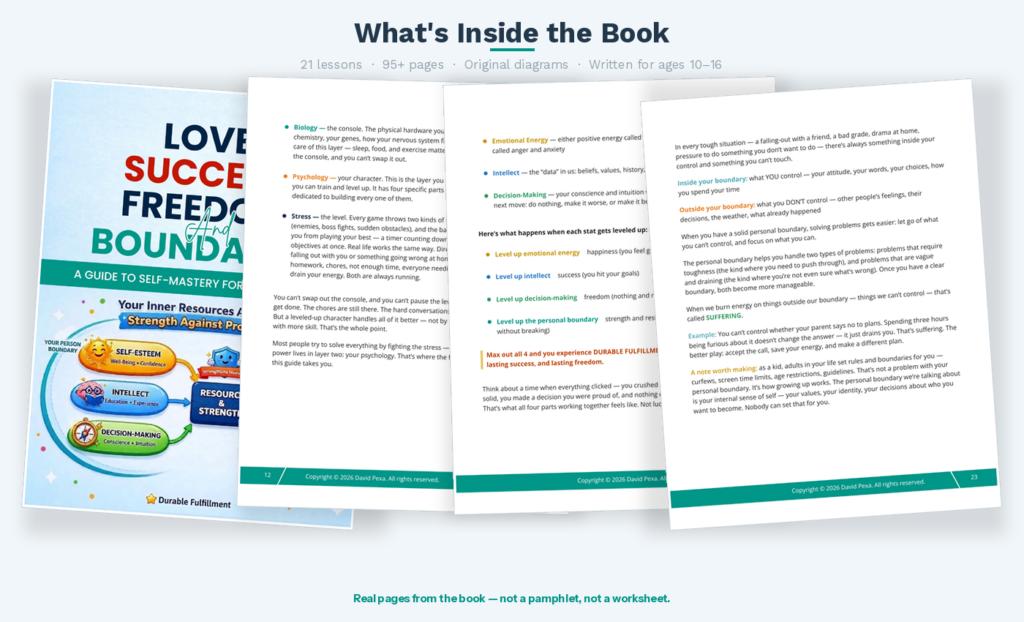
If this resonated, go deeper. My book Love, Success, Freedom and Boundaries gives you twelve frameworks for seeing the patterns that shape your life — and changing the ones that aren’t working.
Frequently Asked Questions
What should a personal growth plan include?
A real growth plan needs three things: a clear picture of where you are now (honest self-assessment), where you want to be (specific outcomes, not vague aspirations), and the daily actions that close the gap. Most plans fail because they skip the first step.
How detailed should a personal growth plan be?
Detailed enough to act on, simple enough to follow. If your plan has 47 goals and a color-coded spreadsheet, you’ve replaced doing with planning. Three to five focused areas with one actionable step each will outperform a comprehensive plan every time.
How often should I update my growth plan?
Review monthly, adjust quarterly. Your plan should be a living document that evolves as you do. If you’re following the same plan six months later without any changes, you’re either not growing or not paying attention.
Keep Reading
- How to Create a Personal Growth Plan That Actually Works
- How to Create a Personal Growth Plan for a Life You Love
- Your Ultimate Personal Growth Thesaurus: 10 Core Concepts for 2026
If you process emotions through writing — journaling, drafting hard conversations, putting words to what you’re feeling — the tool I use to draft most of my words is Wispr Flow. It transcribes your voice into clean, edited text in real time, so the friction between thinking it and writing it basically disappears.
Conclusion
Understanding is the first step, but it’s what you do with that understanding that changes things. The ideas in this article aren’t meant to sit in your head — they’re meant to shift how you see your situation and give you something concrete to act on. Start with the one thing that felt most relevant, apply it this week, and notice what changes.
A note on affiliates: This article includes affiliate links to platforms I’ve vetted and would recommend to my own clients and students. If you start with a recommended service through a link here, I may earn a small commission — at no extra cost to you. I only mention what I’d actually point you to in person. The recommendation comes first; the relationship is disclosed second.
If this resonates, the full framework lives in Love, Success, Freedom and Boundaries.
A practical playbook for raising emotionally resilient kids — and breaking the patterns you didn’t choose to inherit.
