



Summary: Master the Art of Conversation and Build Real Connections — a practical breakdown of what matters, what doesn’t, and what to do next.
Good conversation is a skill, not a personality trait. I learned this the hard way as an introvert who had to figure out how to connect with strangers in a new country.
In a world of endless emails and Slack pings, the simple art of conversation has become a rare and powerful skill. It’s the ability to connect with people, to go beyond just exchanging information and build real relationships. When you master it, every interaction—from a quick coffee chat to a major project kickoff—becomes an opportunity.
Why the Art of Conversation Is a Career Superpower
Let’s be honest: your ability to hold a great conversation is a massive predictor of your career success. It’s the glue that connects your technical skills to real-world results. Hard skills might get you the job, but it’s your conversational finesse that determines how high you’ll climb.
This isn’t some fuzzy “soft skill.” It’s a genuine strategic advantage that impacts everything you do at work.

Think about the most effective leaders you’ve worked with. They’re not just smart; they’re brilliant communicators. They know how to sell their vision, build consensus, and make people feel heard.
The Undeniable Professional Advantage
The numbers don’t lie. In today’s job market, communication is the single most sought-after skill. An incredible 57% of employers worldwide say it’s the top trait they look for in new hires, beating out technical know-how and every other skill. Other surveys back this up, with verbal communication at 55%, presentation skills at 47%, and active listening at 36% topping the list of what companies want. You can find more data on why communication is a top skill for employers.
What this really means is that your career path is shaped by thousands of small conversations. The way you articulate an idea in a meeting, handle a tough negotiation, or just build rapport with a new colleague—it all adds up.
A single great conversation can change the trajectory of a project, a team, or even an entire company. It’s the space where raw ideas become concrete strategies and where everyone gets aligned on a shared goal.
When you get good at this, you’re not just another employee. You become an influential, go-to person on your team.
Core Components of Powerful Conversations
So what’s the secret sauce that turns casual chat into a powerful tool? It’s not about being the wittiest person in the room or talking the most. It’s about a few key ingredients working together seamlessly.
- Active Listening: This isn’t just waiting for your turn to talk. It’s about truly understanding the meaning, emotion, and context behind what someone is saying. This is the foundation of everything.
- Emotional Intelligence (EQ): You have to be able to read the room. EQ is about managing your own emotions while also sensing and responding to the emotions of others.
- Strategic Questioning: The right questions can transform a one-sided lecture into a dynamic dialogue. Asking smart questions uncovers deeper insights and shows you’re genuinely engaged.
- Clarity and Conciseness: Can you get your point across without a bunch of jargon and fluff? Making complex ideas simple and accessible is a sign of a truly skilled communicator.
Nailing these core abilities takes you beyond surface-level small talk. You start having conversations that stick with people—conversations that are productive, memorable, and build your reputation as someone who is thoughtful and effective. This guide will give you the practical tools to build each one of these skills.
The Real Secret to Great Conversation: Master Active Listening
Ever notice how the best conversationalists don’t actually talk that much? It’s a bit of an open secret. Most of us treat conversation like a game of ping-pong, just waiting for our turn to smack our own point across the net. But the real magic isn’t in what you say—it’s in how well you listen.
This isn’t just about letting the other person talk. It’s about active listening: a conscious choice to really focus on the speaker, understand what they’re truly trying to say, and respond in a way that shows you get it. Making this one shift can completely change the quality of your connections, turning forgettable chats into memorable conversations.
It’s More Than Just Hearing the Words
First things first, let’s draw a line between passive hearing and active listening. Hearing is automatic; it’s the noise of the world filtering into your brain. Active listening is a deliberate act. It requires you to tell that little voice in your head—the one busy planning your next brilliant remark—to take a back seat for a minute.
You need to tune into the whole broadcast, not just the words.
- Tone of Voice: Is their voice tight with stress or light with excitement? A quiver can say more than a paragraph.
- Pacing: Are they rushing through their story because they’re thrilled, or are they speaking slowly to make sure you catch a critical detail?
- Body Language: Look for the unspoken clues. Are they leaning in, fully engaged? Or are their arms crossed, creating a physical barrier? Often, the most honest part of a story is told through their posture.
When you start picking up on these cues, you’re no longer just hearing words. You’re grasping the entire emotional landscape of the conversation. This is the foundation.
The Power of Playing It Back
One of the most effective tools in your listening toolkit is reflective listening. This is simply paraphrasing what you’ve heard to make sure you understood it correctly. Don’t be a parrot, just repeating their exact words. The goal is to capture the essence of their message in your own words.
Let’s say a coworker is venting: “I’m just buried. The marketing report is due Friday, but now the sales team is demanding new projections by tomorrow. I have no idea how I’m going to get this done.”
A reflexive, problem-solving response is tempting. Instead, try reflecting:
“Wow, it sounds like you’re completely underwater, caught between two impossible deadlines. The pressure must be intense.”
This does two incredible things. It validates their feelings (making them feel seen and heard) and gives them a chance to either agree or clarify. “Exactly!” or “Well, it’s more that…” either way, you’re building trust and sidestepping miscommunication.
You Don’t Have to Agree to Validate
While reflection confirms understanding, validation shows you accept their feelings as legitimate, even if you don’t share their perspective. It’s about empathy. You’re not saying they’re right; you’re saying their feelings are real.
Imagine a friend is really upset about something you think is minor. Your instinct might be to brush it off.
- Dismissive Response: “Oh, don’t worry about it. It’s not a big deal.”
- Validating Response: “I can totally see why that would be so frustrating. It makes complete sense that you’re upset.”
The first one is a conversational dead-end. The second one opens the door to connection and shows you respect their experience, which is the cornerstone of genuine rapport. Staying present is key to offering authentic validation; you can read more about how to improve your mental clarity in our guide on the topic.
Getting Out of Your Own Way
Of course, none of this is easy. Our brains are wired for distraction. We all struggle with common roadblocks that get in the way of true listening.
A few usual suspects:
- The Rehearsal: Mentally practicing your response while the other person is still talking.
- The Brain Wander: Thinking about your grocery list or a work deadline right in the middle of their sentence.
- The Mind Reader: Assuming you know where their story is going, so you just tune out.
To fight back, try a simple mindfulness trick. Pretend the speaker’s words are the only thing that exists in that moment. When you feel your attention drifting (and it will), just gently pull it back. This isn’t about being perfect. It’s a practice, and simply making the effort will make you a far more connected and respected person to talk to.
Moving Beyond Small Talk with Better Questions
If active listening sets the stage, your questions are the script. This is where you shift from simply hearing what someone says to guiding the conversation toward something more meaningful. Anyone can ask about the weather, but learning to ask better questions is what separates a forgettable chat from a memorable connection.
The secret isn’t to interrogate someone; it’s to spark their curiosity about their own thoughts. A well-crafted question can turn a simple update into a story about passion, a challenge, or a dream. It’s the difference between asking, “Busy week?” and something like, “What was the most interesting part of your week?” The first gets you a “Yep.” The second invites a real answer.
The Question Ladder Technique
One of the best ways I’ve found to deepen a conversation without making it feel like an interview is using what I call the Question Ladder. You wouldn’t start climbing a ladder from the top, right? You start at the bottom and work your way up. Conversations work the same way.
The technique is all about starting broad and then getting more specific as you build trust and comfort. It helps you gauge if the other person is open to sharing more, preventing them from feeling put on the spot.
Here’s how it works:
- Rung 1 (The Broad Opener): Start with something easy and open-ended. “What’s been on your mind lately?” or “What are you working on these days?” This lets them decide what to share.
- Rung 2 (The Specific Follow-up): Based on their answer, you zoom in. If they mention a big project, you could ask, “That sounds fascinating. What part of that are you most excited about?” This proves you’re paying attention.
- Rung 3 (The Personal Connection): Now, you can connect the “what” to the “why.” A great question here is, “What first got you interested in that kind of work?” This taps into their personal story and motivations.
Moving up the ladder rung by rung makes the progression feel completely natural.
The quality of your questions truly determines the quality of your conversation. Ask a generic question, get a generic answer. Ask a thoughtful one, and you’ll build a real connection.
This simple flow is what makes asking those deeper, follow-up questions possible. You have to earn the right to ask them by first proving you’re actually listening.
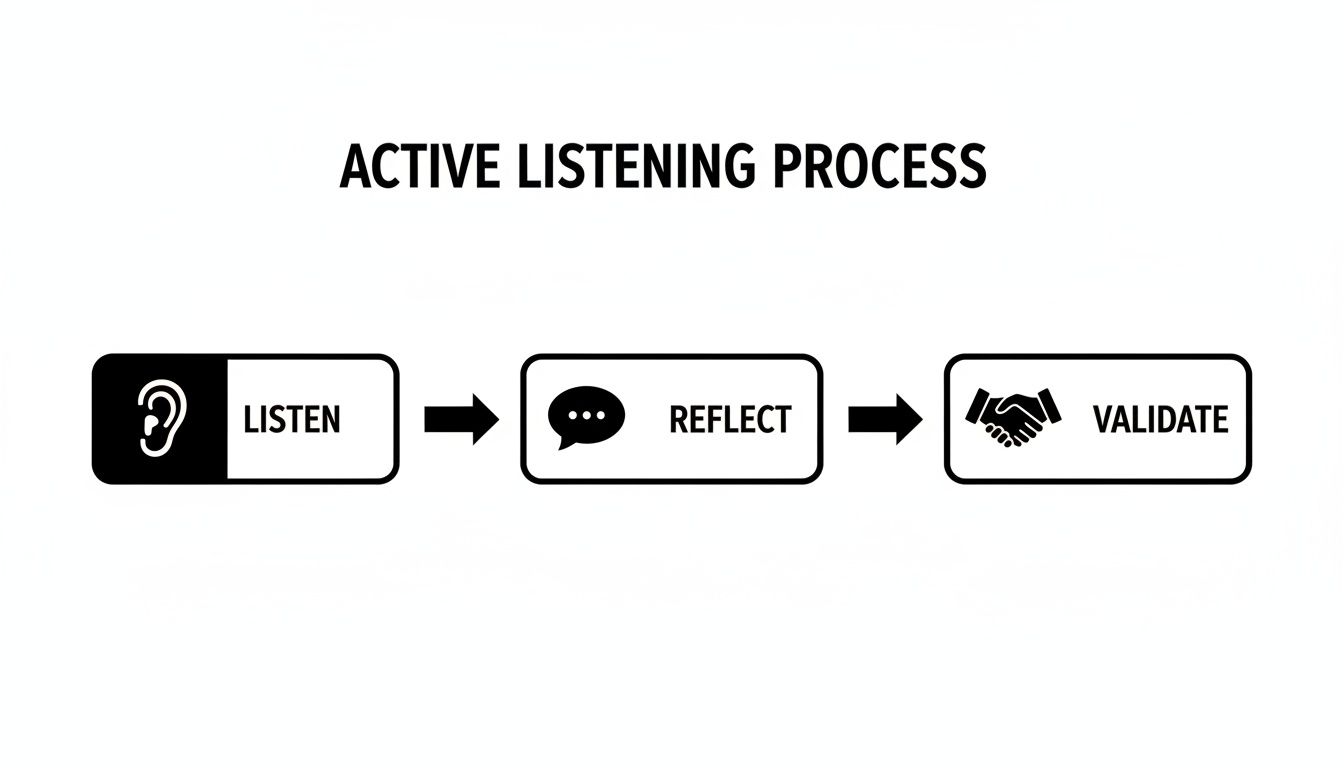
This process—Listen, Reflect, Validate—builds the foundation of trust you need before you can really start digging deeper with your questions.
Choosing the Right Tool for the Job
Not all questions are created equal. A great conversationalist has a full toolkit of question types, and the real skill lies in knowing which one to use and when.
Some questions are for gathering facts, others for exploring feelings. Using the wrong one can stop a great conversation in its tracks. For instance, asking a simple yes/no question when you want them to open up is a classic mistake that just kills the vibe. On the other hand, a well-timed hypothetical question can unlock a whole new level of dialogue.
To help you become more intentional, here’s a quick breakdown of the different types of questions and what they’re good for.
Types of Questions to Elevate Your Conversations
| Question Type | Purpose | Example |
|---|---|---|
| Open-Ended | Encourages detailed, narrative answers and invites storytelling. | “What was your experience like when you transitioned to your new role?” |
| Probing | Seeks clarification and dives deeper into a specific point. | “When you say it was ‘challenging,’ what was the biggest hurdle you faced?” |
| Hypothetical | Explores possibilities and reveals values or problem-solving approaches. | “If you had unlimited resources, what’s one project you would start tomorrow?” |
| Reflective | Encourages introspection and taps into feelings or opinions. | “How did that achievement make you feel personally?” |
Once you understand these different tools, you can stop defaulting to the same old questions. You can start choosing the right one for the moment, turning a simple exchange into a genuinely insightful conversation.
Reading the Room: How to Navigate Emotional Nuances and Build Real Rapport
A good conversation isn’t just about what you say. It’s about how you make the other person feel. True connection happens when you tune into the emotional frequency of the interaction, moving beyond a simple exchange of words to create genuine resonance. This is where the real art of conversation lives—in your ability to read the room, pick up on unspoken signals, and make someone feel truly heard and understood.

This awareness kicks in the second you start talking to someone. Before you even decide on your opening line, take a quick mental read of their energy. Are they leaning in, eyes bright with excitement? Or are they slumped over, looking like they’ve had a long day? Your goal isn’t to mimic their energy, but to complement it. Meeting them where they are creates an instant, unspoken sense of comfort.
Decoding the Unspoken Language
You’d be amazed how much is said before anyone speaks a word. Non-verbal cues often tell the real story, giving you a massive advantage in building rapport if you know what to look for.
Keep an eye out for these key signals:
- Body Posture: An open posture—uncrossed arms, leaning forward—is an invitation. It signals they’re engaged. On the flip side, crossed arms or a body angled away can be a sign of defensiveness or that you’re losing their interest.
- Facial Expressions: A smile is easy to spot, but the real clues are in the micro-expressions. A slightly furrowed brow might mean confusion, a tight-lipped frown could signal disagreement, and wide eyes often show genuine surprise.
- Eye Contact: Are they making natural, comfortable eye contact with you? That’s a great sign you have their attention. If their eyes keep darting to their phone or around the room, it’s a clear signal that their mind is elsewhere.
Once you spot these cues, you can adjust on the fly. If you see them disengaging, maybe it’s time to ask a question, switch topics, or simply pause and give them a chance to jump in.
Your Voice Is an Instrument
Think of your words as the lyrics and your voice as the music. The same sentence can land in completely different ways depending on your vocal tone. A flat, monotone delivery will make even the most exciting story fall flat, while a warm, dynamic tone pulls people in and conveys confidence.
Your tone doesn’t just deliver your message; it delivers your intention. It’s the difference between sounding like you’re giving a command and sounding like you’re offering an invitation to connect.
Try to be more intentional with your voice. Lowering your pitch can add a sense of authority, while speaking a bit faster can communicate excitement. A great way to get a feel for this is to record yourself talking to a friend. Hearing yourself from an outsider’s perspective can be incredibly revealing. Gaining more control over your vocal tone often starts with being more aware of your own emotional state, a connection you can learn more about through cognitive behavioral therapy techniques.
Handling Awkwardness with Grace
Look, even the smoothest talkers run into awkward moments. Disagreements happen. The goal isn’t to avoid these bumps in the road entirely, but to know how to navigate them with grace. Empathy is your best friend here.
When a conversation hits a weird patch, fight the instinct to just push through it or get defensive. Instead, pause and acknowledge the other person’s perspective.
Let’s walk through a scenario: You make a joke that you think is funny, but it clearly offends your colleague.
- Poor Response: “Relax, I was just joking. Don’t be so sensitive.” This is a classic mistake. It dismisses their feelings and just makes things worse.
- Graceful Response: “I can see that my comment didn’t land well, and I’m really sorry. That wasn’t my intention at all.” This approach validates their reaction, shows you’re taking responsibility, and immediately de-escalates the tension.
By responding with empathy—focusing on repairing the connection rather than winning the point—you can turn a cringeworthy moment into a chance to build even more trust. That’s a sign of someone who truly gets the art of conversation.
Common Conversational Pitfalls to Avoid
Even the most well-intentioned people can fall into conversational traps. These are the subtle habits that, without us even realizing it, can shut down a good dialogue or weaken a connection. Learning what not to do is just as important as learning what to do, because these missteps can really impact your relationships, both in and out of the office.
The fallout from bad communication isn’t just a feeling; it has real-world consequences. It might surprise you to learn that a whopping 68% of people have left a company for a competitor simply because of poor communication. And while email might be the most common way we talk at work (55.45%), face-to-face conversations are still a huge part of the equation at 38.27%. You can dig into more of these 2023 communication statistics if you’re curious.
The bottom line is, avoiding these common pitfalls helps you build bridges instead of walls.
The Unsolicited Advisor
This is one of the most common mistakes I see. Someone shares a problem, and our immediate instinct is to jump in and solve it. We mean well, of course, but it often sends the completely wrong message.
What it looks like: Your coworker sighs and says, “I’m just so buried in work this week.” You immediately jump in with, “You should really try time-blocking your calendar. Or have you heard of the Pomodoro Technique?”
What to do instead: Before you offer a single piece of advice, just validate their feelings. Something as simple as, “Wow, that sounds incredibly stressful,” shows you’re actually hearing them and not just their problem. Then, give them the reins by asking, “Is there anything I can do, or did you just need to get that off your chest?” Sometimes people just want someone to listen, not a consultant.
The impulse to fix is powerful, but the need to be heard is often stronger. Offer empathy before you offer a solution.
The Conversational One-Upper
We’ve all been on the receiving end of this one. You share something you’re proud of, and the other person immediately counters with a story that’s bigger, better, or more dramatic. It’s a surefire way to make someone feel small and completely unheard.
What it looks like: You say, “I finally ran a 5k last weekend!” They immediately fire back, “That’s cool. I ran a half-marathon last month. The training was brutal, but so worth it.”
What to do instead: Let them have their moment. Before you even think about sharing your own experience, ask a follow-up question that shows you’re genuinely interested in their story. Try something like, “That’s a huge accomplishment! What was the hardest part of the race for you?” Later on, if it feels right, you can share your own running stories. The key is to keep the initial focus on them.
This one simple shift turns a competitive dynamic into a collaborative one. Staying present in their moment is crucial, and you can explore more ways to do that in our guide on how to eliminate distractions.
The Monologue Dominator
A good conversation is a tennis match, not a bowling alley. It’s so easy, especially when you’re passionate about a topic, to grab the microphone and never let go. When you dominate the dialogue, you turn the other person into an audience member instead of a participant.
What it looks like: You’re explaining a concept and go on for several minutes without a single pause. You’re so into it that you don’t even notice the other person’s eyes starting to glaze over.
What to do instead: Give the “traffic light” rule a try. It’s a game-changer.
- Green Light (First 20 seconds): Get your main point across. Be concise.
- Yellow Light (Next 20 seconds): You can add a little more flavor or a quick example.
- Red Light (After 40 seconds): Stop. Seriously, just stop talking. Then, toss the ball back to them with a question like, “What are your thoughts on that?” or “How does that track with your experience?”
This little trick forces you to be mindful of how much airtime you’re taking up and actively invites the other person back into the conversation.
Frequently Asked Questions
Even with the best game plan, theory only gets you so far. When you’re out in the real world, things can get tricky. Here are a few common conversational hurdles and some practical ways to clear them.
How Can I Practice If I’m an Introvert?
Let’s clear something up: being an introvert can be a conversational superpower. You’re probably a naturally observant listener, and that’s the most important skill there is. The trick is to practice in a way that works with your energy, not against it.
Forget the idea that you need to command a room. Think quality over quantity.
- Start small. Really small. When you get your morning coffee, ask the barista one simple, open-ended question that goes beyond the order. Something like, “What’s the most interesting drink you’ve ever had to make?”
- Focus on one-on-one. This is your comfort zone, so use it. Prioritize individual chats where you can really tune in to the other person without the sensory overload of a big group.
- Set a micro-goal. Aim for just one five-minute, genuine conversation each day. The goal isn’t to become an extrovert; it’s to be a confident and effective communicator, just as you are.
What’s the Best Way to Gracefully Exit a Conversation?
Knowing how to end a conversation well is just as crucial as starting one. A good exit leaves the other person feeling respected, not ditched. The key is to be warm, appreciative, and clear.
First, wait for a natural lull. Cutting someone off mid-sentence always feels jarring. Once you have that pause, follow this simple, three-part approach.
- Acknowledge and Appreciate: Start with a quick wrap-up. “Well, I’m so glad I got to hear about your new project.”
- State Your Departure Clearly: Be polite but direct. “I have to run to my next meeting now, but it was really great catching up.”
- Create a Future Link (Optional): This is a great way to soften the exit. “I’d love to continue this later. Let’s connect on LinkedIn this week.”
This formula closes the current conversation cleanly while leaving the door open for another one down the road.
How Do I Handle Someone Who Dominates the Conversation?
We’ve all been there—stuck listening to someone who treats a conversation like a monologue. Reclaiming some of the space requires a bit of finesse, not a confrontation. You want to redirect the conversational spotlight, not wrestle it away.
Listen actively for a tiny opening, usually when they pause to take a breath.
Your moment to interject isn’t an interruption if it’s done with purpose. Use a bridging phrase that acknowledges their point before you pivot.
For instance, you could say, “That’s a really interesting point about marketing, and it reminds me of a challenge our team is facing…” You’re validating what they said before steering the conversation in a new direction.
If they keep going, try bringing someone else in. Politely jump in with something like, “That’s a strong perspective, John. Jane, I’m curious what your thoughts are on this?” This move skillfully redistributes the conversational energy and turns a monologue back into a dialogue.
How Can I Turn Boring Small Talk into Something Interesting?
The secret to escaping the black hole of small talk—the weather, the traffic—is what I call the “pivot and probe” technique. You don’t have to shut down the small talk; you just use it as a launchpad.
Acknowledge the generic topic, then pivot to a related but more personal question that invites a story or an opinion, not just a one-word answer.
Scenario: Someone says, “Crazy weather we’re having.”
- Pivot 1 (To Hobbies): “It is! All this rain makes me want to stay inside with a good book. Have you read anything interesting lately?”
- Pivot 2 (To Experiences): “Definitely! Did you manage to do anything fun over the weekend despite the weather?”
This simple shift gently guides the conversation from bland observations to personal experiences. It shows you’re genuinely curious about the other person, which is the foundation of any real connection.
If this resonated, go deeper. My book Love, Success, Freedom and Boundaries gives you twelve frameworks for seeing the patterns that shape your life — and changing the ones that aren’t working.
Keep Reading
- Emotional Intelligence Chart: A Guide to Mapping Your EQ
- Master Your Feelings: The Ultimate Emotions Chart Guide
Conclusion
Understanding is the first step, but it’s what you do with that understanding that changes things. The ideas in this article aren’t meant to sit in your head — they’re meant to shift how you see your situation and give you something concrete to act on. Start with the one thing that felt most relevant, apply it this week, and notice what changes.
If this resonates, the full framework lives in Love, Success, Freedom and Boundaries.
A practical playbook for raising emotionally resilient kids — and breaking the patterns you didn’t choose to inherit.
