



I’ve sat with people who whisper “i hate my life i hate my life” like they’re confessing something shameful. Usually they aren’t being dramatic. They’re trying to name a level of overwhelm that no one around them has understood.
When that sentence is looping in your head, you don’t need a lecture about gratitude. You need relief, orientation, and a way to get through the next few minutes without turning against yourself even more.
That phrase can mean a lot of things. It can mean you’re exhausted. It can mean you feel trapped. It can mean your mind has narrowed so much that your whole life looks like one solid block of pain. But it does not automatically mean your life is beyond repair. Very often, it means your system is overloaded and reading everything through that overload.
First Thing's First Your Pain Is Real
If you keep thinking i hate my life i hate my life, I want to be direct about something. This feeling is serious. It deserves attention. It is not weakness, and it is not a character flaw.
A lot of people reach this point and immediately shame themselves for having the thought. That usually makes the spiral worse. Pain plus self-attack becomes a closed room. The first move is to stop arguing with the fact that you’re hurting.
This is a signal, not a verdict
When people say “I hate my life,” they’re often trying to describe a total-body state. Their chest is tight, their thoughts are racing or going flat, ordinary tasks feel impossible, and the future looks sealed off. The sentence sounds like a conclusion, but in practice it often functions more like an alarm.
That matters, because alarms call for response, not debate.
More than 1 in 10 young adults ages 18 to 25 report having seriously contemplated suicide, according to Newport Institute’s review of this mental health pattern. That tells you two things at once. First, the despair behind this thought can run very deep. Second, you are not uniquely broken for having it.
Your pain is real, and it still may not be telling the truth about the whole of your life.
When to treat this as an emergency
If you’re in immediate danger, thinking about acting on suicidal thoughts, or you don’t trust yourself to stay safe, stop reading and contact emergency services in your area or go to the nearest emergency room now. If there’s a trusted person nearby, tell them plainly: “I am not safe alone right now.”
If you’re not in immediate danger but the thought keeps circling, treat that as a serious mental health signal. Don’t wait until you’ve collapsed to take yourself seriously.
A simple rule helps here:
- If the thought feels intense and active, get another human involved now.
- If the thought feels chronic and deadened, get support lined up quickly anyway.
- If you’re minimizing it because “other people have it worse,” ignore that instinct. Pain isn’t a competition.
Before You Change Your Life You Have to Survive the Next Five Minutes
Big life questions can wait. The next five minutes can’t.
When your system is flooded, your job is not to figure out your purpose, fix your job, repair your family, or reinvent yourself. Your job is to help your body receive one message. You are here, and this moment can be made safer.

Do this before you think
Start with a quick safety check.
- Move away from anything you could use to hurt yourself. Put distance between you and sharp objects, medication, ropes, cords, or anything else that worries you.
- Change rooms if you can. A doorway, kitchen chair, porch step, hallway floor. Physical relocation helps interrupt mental momentum.
- Tell one person what’s happening. Not the whole story. One sentence is enough.
If you need a simple structure, I like the sequence in this emotion regulation checklist because it keeps you focused on what your nervous system needs first.
Three grounding moves that work in real life
These aren’t magic. They are interruption tools. The point is to lower the intensity enough that you can choose your next step.
Cold temperature
Hold an ice cube, splash cold water on your face, or press a cold can against your neck. Strong temperature gives your body a clean sensory signal to orient around. It cuts through the blur.5 4 3 2 1 orientation
Name 5 things you see, 4 things you feel, 3 things you hear, 2 things you smell, and 1 thing you taste. Go slowly. The exercise is boring on purpose. Boredom is often a step up from panic.Heavy exhale breathing
Inhale naturally through your nose. Exhale longer than you inhale. Don’t force a huge breath. The long exhale is what matters. Think “let the air leave” more than “take a deep breath.”
Practical rule: If a technique makes you more agitated, stop and switch. Grounding is not a test of discipline.
What not to do right now
There are a few common mistakes people make in this window.
| What we often do | What helps more |
|---|---|
| Scroll and numb out | Reduce input and simplify the room |
| Analyze the whole life problem | Focus on the next ten minutes |
| Demand gratitude | Name one concrete discomfort honestly |
| Wait to “feel ready” | Take one physical action anyway |
You are not trying to become inspired. You are trying to become slightly more regulated.
How to Interrupt the Downward Spiral
Once the edge comes down a little, a different trap shows up. You may start waiting to feel better before doing anything useful. That sounds reasonable, but it keeps a lot of people stuck.
Action often has to come first.

Tiny actions beat dramatic promises
When someone feels disgusted with life, they usually try one of two bad strategies. They either do nothing, or they design a total reset. Neither works well in a distressed state.
Use micro-behavioral activation instead. That means doing something small enough that your system can’t argue with it.
Examples:
- Reset one surface. Clear the nightstand, not the whole room.
- Change your state with motion. Walk to the mailbox, around the block, or just to the end of the driveway.
- Make one thing usable. Shower. Change clothes. Open the blinds. Refill a water bottle.
- Create one completed loop. Send the email, put dishes in the sink, take out one bag of trash.
These actions matter because despair feeds on inertia. A completed action gives your brain new evidence: “I can still move something.”
For more structured versions of this, some of the tools in these cognitive behavioral therapy techniques can help you break tasks down without turning the process into another perfection project.
Notice the fight inside your body
There’s another layer many people miss. Chronic feelings like “I hate my life” can come from an internal conflict between aggression and passivity, as described in this Psychalive explanation of the pattern. In plain language, one part of you wants to push, act, protest, or leave. Another part collapses, doubts, freezes, or waits.
That clash often shows up physically before it becomes clear mentally.
Try this for one minute:
- Sit down and put both feet on the floor.
- Scan from jaw to throat to chest to stomach.
- Ask, “Where am I bracing?”
- Don’t interpret. Just notice.
A lot of people find tension in the jaw, fists, throat, diaphragm, or belly. That tension is useful information. It tells you your body is holding a fight you may not have words for yet.
Sometimes the thought isn’t “I hate my life.” Sometimes it’s “I don’t know how to move, and I hate that I feel trapped.”
A better question than why am I like this
Don’t ask “Why am I like this?” when you’re spiraling. That question often turns into self-prosecution.
Ask:
- What is my body doing right now?
- What is one action that reduces helplessness?
- What can wait until tomorrow?
That sequence restores agency faster than emotional over-processing. You’re not denying your feelings. You’re giving them a container.
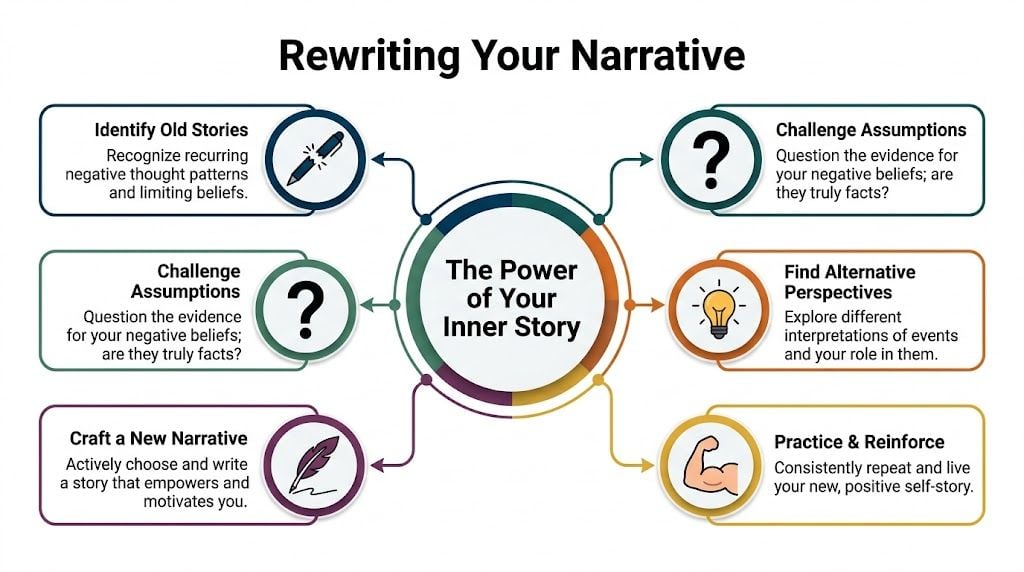
The Stories We Tell Ourselves and How to Write a New One
Once your body is less flooded, your mind becomes easier to examine. Many people often discover something surprising at this stage. The sentence “I hate my life” often rides on top of an older story.
Not a conscious story, necessarily. More like a script you absorbed and kept obeying.
The hidden script under the feeling
Research described in Mental Wellness Counselling’s discussion of this issue points to 11 common maladaptive patterns, often called schemas. Two that show up a lot in people who feel chronically defeated are Defectiveness and Failure.
Defectiveness says, “Something is wrong with me at the core.”
Failure says, “Other people can do life. I can’t.”
If you grew up with criticism, emotional neglect, bullying, chaos, or impossible standards, these scripts can become your default filter. Then every setback gets processed as proof. A hard week at work becomes “I’m useless.” A breakup becomes “No one could really want me.” One bad day becomes “See, my whole life is broken.”
Read the thought like a therapist would
When I listen closely, “I hate my life” usually contains several separate claims mashed together. Pull them apart.
| The raw thought | The likely hidden belief |
|---|---|
| I hate my life | My pain means everything is bad |
| Nothing works | One failure means global failure |
| I’m behind everyone | My worth depends on comparison |
| I ruin everything | Mistakes reveal my true self |
That shift matters. If the thought is a schema-driven conclusion, it can be challenged. It stops being sacred.
A practical way to work with this comes from narrative therapy techniques, which help you separate yourself from the story you’ve been handed.
How to write a new sentence without lying to yourself
Positive affirmations often fail here because they ask you to jump too far. If your mind is screaming “I hate my life,” saying “My life is amazing” usually won’t land.
Use a sentence your nervous system can accept.
Try replacing the global verdict with one of these:
- This is a brutal season, not the whole story.
- I’m overwhelmed, and overwhelmed people misread their lives.
- A part of me believes I’m defective. That part is loud right now.
- I don’t need to solve my identity tonight.
- My current script is harsh. It is not objective.
The goal isn’t to think pretty thoughts. The goal is to stop letting an old script narrate your whole reality.
That’s the key reframe. You may not hate your life in some final, absolute sense. You may be running a punishing mental map that keeps translating pain into identity.
You Don't Have to Do This Alone
A lot of capable people isolate when they’re hurting. They tell themselves they should handle it privately, cleanly, without burdening anyone. That usually prolongs the problem.
Reaching out is not dependency. It’s strategy.

Ask for the right kind of help
Different people serve different roles. Trouble starts when you ask one person to do all of them.
A friend
A friend is good for presence, company, and helping you come back into contact with ordinary life.
You can say:
- “I’m having a rough mental health day. Can you stay on the phone with me for a bit?”
- “I don’t need advice right now. I just need you to listen.”
- “Can we go for a short walk? I need help getting out of my head.”
A family member
Family can be useful, but only if they can regulate themselves enough not to turn your pain into their panic.
Try:
- “I’m struggling and I want support, not fixing.”
- “Please help me with practical things today, not big conversations.”
- “I need you to take this seriously, even if I can’t explain it neatly.”
A professional
A professional helps you see the pattern, not just discharge the emotion.
You can keep it simple:
- “I keep thinking I hate my life, and I need help understanding what’s driving that.”
- “I’m not sure if this is depression, burnout, trauma, or something else, but it’s affecting how I function.”
- “I need help with both what I’m feeling and what to do when it hits.”
If talking feels too hard
Then lower the bar.
Use text. Use one sentence. Ask for a practical task.
Here are low-friction options:
- Text “Can you check in on me today?”
- Ask someone to sit with you while you make an appointment
- Send “I’m not in danger right now, but I’m not doing well either”
- Request company for a grocery run, meal, or walk
Help doesn’t have to begin with a perfect explanation. It can begin with contact.
The strongest move is often the least glamorous one. You let another person know what reality is. That breaks the sealed environment where shame grows.
The Work of a Lifetime Starts Today
People often want one insight that will end this forever. Usually that isn’t how change works. What works is a repeatable sequence.
You steady the body. You interrupt the spiral with one action. You examine the script instead of obeying it. You bring in support before isolation hardens into identity.
That’s the practice.
Some days the work is very small. Drinking water. Standing outside. Telling the truth to one person. Catching the old line in your head before it becomes law. None of that looks dramatic from the outside. From the inside, it can be the beginning of a different life.
If i hate my life i hate my life has been your loop, don’t force yourself to solve the whole thing tonight. Start by refusing to let your worst moment define the whole map. A thought can be loud without being wise. A feeling can be intense without being final.
You’re not trying to become a different person in one leap. You’re learning to notice earlier, respond faster, and treat your own pain with more precision. That’s how agency returns. Not all at once. Consistently.
I write about the hidden patterns that drive our feelings, habits, and relationships at David Pexa. If you want the next framework in your inbox, including the subtle family dynamics and self-protective scripts that go unnoticed, join there.
