



Summary: A practical guide to create a personal growth plan that actually works. What actually works, what doesn’t, and where to start.
Most personal growth plans fail because they’re wish lists, not systems. I’ve made that mistake enough times to know: the plan only works if it accounts for the version of you that doesn’t feel like following it.
If you’ve ever felt a burning desire to improve your life but found yourself stuck, you’re not alone. The problem usually isn’t a lack of ambition. The real issue is the absence of a clear plan to channel that ambition into tangible results. A personal growth plan is that missing piece—it’s the blueprint that turns your aspirations into an actionable, step-by-step strategy.
Why Your Ambition Needs a Blueprint
Simply wanting to change isn’t enough. Without a structured approach, you’re essentially trying to navigate a new city without a map. You might wander for a while and even find some interesting things, but you’re unlikely to reach your intended destination efficiently. A growth plan is your personal roadmap, guiding your energy toward the goals that truly matter.
This isn’t just a niche idea; it’s a massive global movement. The self-improvement industry is on track to surge from USD 53.24 billion in 2025 to an incredible USD 90.86 billion by 2035. North America is at the forefront, accounting for over 35% of the market. With 58% of US adults having purchased self-improvement products, it’s clear that people are actively seeking structured ways to better themselves. You can dig into the full personal development market research to see just how significant this trend is.
At its core, a good plan rests on four key ideas. Before we dive into the “how-to,” let’s get a high-level view of these building blocks.
The Four Pillars of an Effective Personal Growth Plan
| Pillar | What It Is | Why It Matters |
|---|---|---|
| Self-Assessment | An honest evaluation of your current life—your strengths, weaknesses, and areas for improvement. | You can’t chart a course to your destination until you know your starting point. |
| Goal Setting | Defining clear, specific, and inspiring objectives that you want to achieve. | Vague desires lead to vague outcomes. Concrete goals provide direction and motivation. |
| System Design | Creating daily habits and routines that automatically move you toward your goals. | Motivation fades, but well-designed systems ensure you make progress even on days you don’t feel like it. |
| Review & Adjust | A regular process of tracking your progress, celebrating wins, and tweaking your plan as needed. | A plan isn’t set in stone. Regular reviews keep it relevant and effective, ensuring you stay on track. |
These four pillars work together to create a powerful feedback loop for continuous improvement, turning wishful thinking into a reliable engine for growth.
From Adrift to Action
I know the feeling of being stuck all too well. A few years ago, I felt completely adrift. I was working hard, but my career wasn’t advancing, my personal goals were gathering dust, and I felt like I was just spinning my wheels. My ambition was high, but I had zero direction.
It was only when I committed to creating my first real personal growth plan that things finally started to click.
The process forced me to be brutally honest about where I was and get crystal clear on where I wanted to go. By formalizing my goals and—more importantly—building daily systems to support them, I finally gained momentum. It wasn’t magic, but it was methodical. That simple shift from passive hoping to active planning changed everything.
A personal growth plan is not a rigid set of rules. It’s a living document that gives your ambition a job to do, directing your energy toward what truly matters.
This simple visual breaks down how a plan connects your drive to your results.
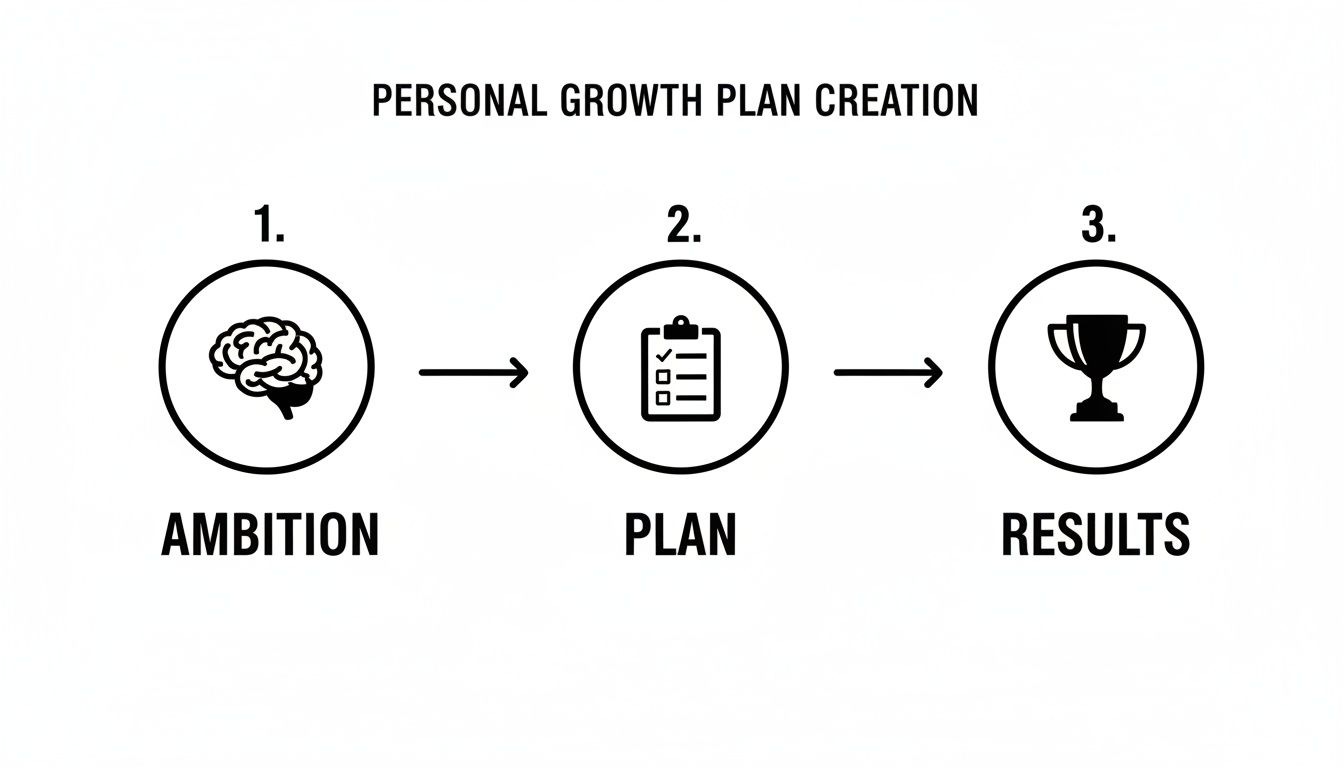
As you can see, the plan is the critical bridge between your initial idea (Ambition) and the measurable outcome you’re aiming for (Results). Without it, ambition remains an untapped resource.
What to Expect in This Guide
Throughout this article, we’ll build your personal growth blueprint piece by piece. You’ll get practical, no-fluff guidance on how to:
- Conduct a Radically Honest Life Audit: We’ll take stock of where you are right now across key areas of your life to find the best opportunities for growth.
- Set Goals That Actually Pull You Forward: Forget vague New Year’s resolutions. We’ll create compelling objectives that genuinely inspire you to take action.
- Build Systems for Automatic Progress: I’ll show you how to design routines and habits that make improvement your default setting, not a daily struggle.
- Track Progress and Stay Accountable: You’ll learn simple review systems to ensure you stay on track, celebrate your wins, and adjust your plan when life happens.
This isn’t about becoming a different person overnight. It’s about systematically becoming a better version of yourself, one intentional step at a time. Let’s get started.
Getting Radically Honest: The Life Audit
Before you can build anything meaningful, you have to survey the land. The same is true for personal growth. You can’t map out a path forward until you know exactly where you’re standing right now. That’s what a life audit is for.
This isn’t about judging yourself or dwelling on past mistakes. It’s about taking a clear-eyed, brutally honest look at your life as it is today. Trying to create a growth plan without this step is like trying to use Google Maps with the GPS turned off—you can see the destination, but you have no starting point.
See Your Life at a Glance
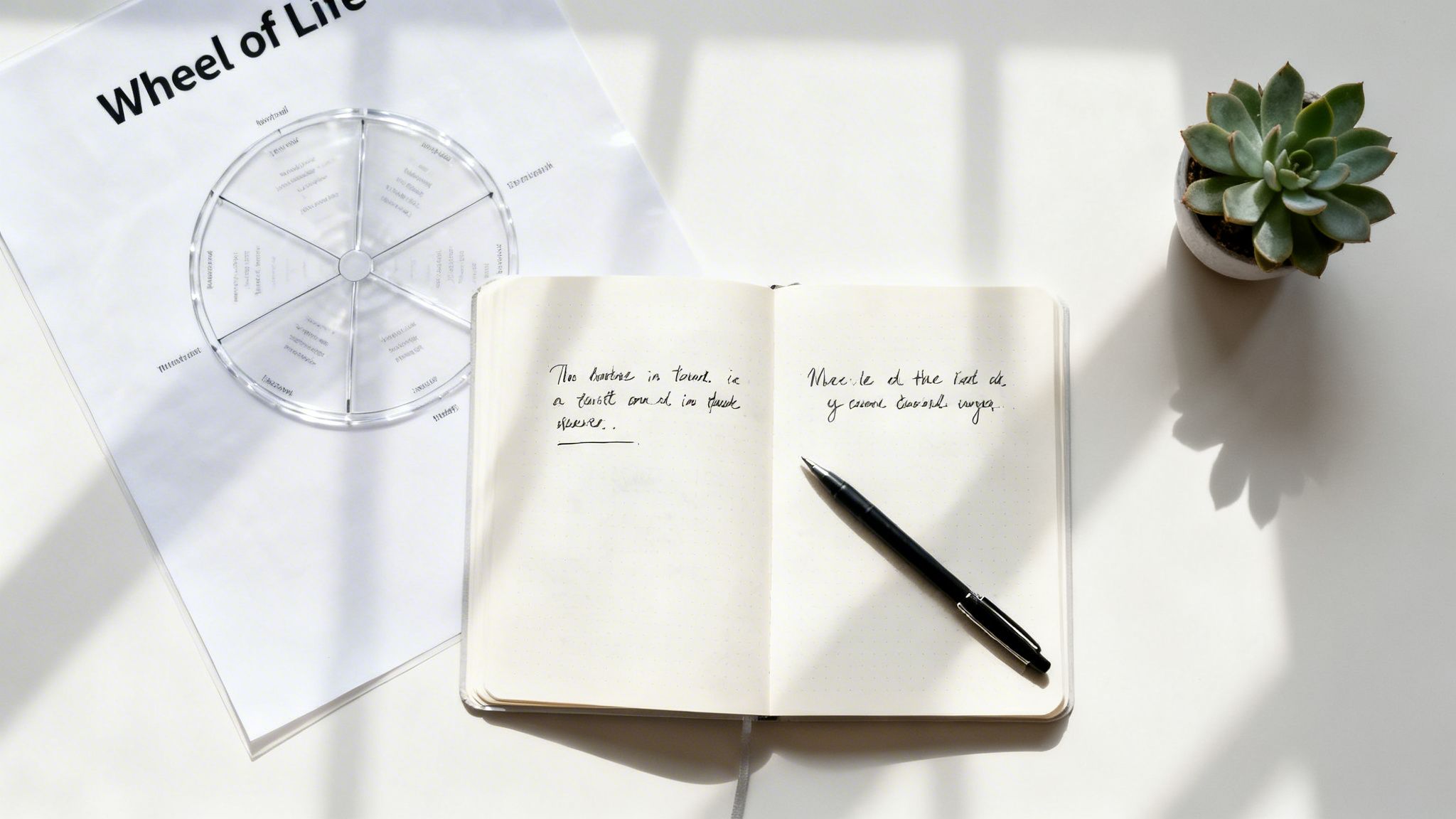
A great tool I always come back to for this is the Wheel of Life. It’s a simple exercise that gives you a powerful, instant snapshot of how balanced—or imbalanced—your life currently is.
Just draw a circle and split it into 8 to 10 slices, like a pizza. Each slice represents a core part of your life. While you can customize these, most people start with something like this:
- Career & Work: How fulfilled are you in your job?
- Finances: Do you feel a sense of control over your financial situation?
- Health & Fitness: How’s your physical energy and overall well-being?
- Relationships: Are your connections with family and friends genuinely supportive?
- Personal Growth: Are you actively learning and evolving?
- Fun & Recreation: Are you making real time for joy and hobbies?
- Environment: Do your home and work spaces energize you?
- Spiritual Well-being: Do you feel connected to something bigger than yourself?
Now, rate your satisfaction for each area on a scale from 1 (completely dissatisfied) to 10 (absolutely thriving). Mark a dot in each slice—a 1 is near the center, and a 10 is on the outer edge. Once you’re done, connect the dots.
Is your wheel round and smooth, or is it bumpy and lopsided? A jagged wheel immediately shows you which areas of your life are flourishing and which ones are being neglected.
Go Deeper by Asking Better Questions
The Wheel of Life gives you the “what,” but to understand the “why,” you need to dig deeper. Generic questions like “What are my weaknesses?” are useless. You need prompts that force you to get specific.
Find a quiet moment, grab a notebook, and let your thoughts flow freely as you answer these. No filters.
- What one activity this week gave me a genuine jolt of energy? This points directly to your passions and what truly motivates you.
- What task am I constantly putting off, and what feeling is really behind that procrastination? This is how you uncover your hidden fears, roadblocks, and points of friction.
- If I magically had two extra, uninterrupted hours every single day, what would I do with them? The answer reveals what you truly value but aren’t making time for.
- Who in my life consistently leaves me feeling drained? Who leaves me feeling inspired? This is a quick and dirty audit of your social and emotional energy.
- What tiny, recurring annoyance have I been putting up with for way too long? Fixing these small “papercuts” can free up an incredible amount of mental bandwidth.
A life audit isn’t a one-time event but a periodic check-in. It ensures your growth plan remains aligned with your evolving priorities and the realities of your life.
I’ll give you a personal example. During my last audit, I realized I dreaded writing project proposals. When I asked why, it wasn’t the writing itself. It was the feeling of ambiguity around the project’s scope that paralyzed me. So, I created a simple template to define the scope first. The friction vanished overnight.
By combining the bird’s-eye view of the Wheel of Life with the on-the-ground insights from these questions, you’ll have everything you need to build a plan that actually works for you. This honest inventory is the real first step to making a change that sticks.
Setting Goals That Pull You Forward
After taking a hard look at where you are, it’s time to decide where you’re going. This is where you turn those raw insights from your self-assessment into goals that actually get you excited to jump out of bed in the morning.
Most of us have heard of SMART goals—Specific, Measurable, Achievable, Relevant, and Time-bound. They’re a decent starting point, for sure. But I’ve found they often lack a certain spark. They can feel more like a homework assignment than a personal quest.
A far better method, and one I use with my own clients, is to blend the precision of SMART goals with the aspirational quality of OKRs (Objectives and Key Results). It’s the perfect mix of a big-picture vision and the concrete steps needed to make it real.
A goal should be a magnet, pulling you forward with enthusiasm, not a whip forcing you to comply through sheer willpower. This is the core of an effective personal growth plan.
Here’s how to think about it. Your Objective is the inspiring “what”—the ambitious vision that gets your heart pumping. Your Key Results are the measurable “hows”—the specific, trackable milestones that prove you’re actually getting closer to that vision.
So, a vague goal like “I want to start meditating” becomes a concrete action: “After I pour my morning coffee, I will meditate for five minutes.” Making coffee is the trigger. Meditating is the new routine. The decision is already made for you.
Here’s another example for someone whose goal is to be more organized.
- Vague Goal: “I’ll try to be less messy.”
- Habit Stack: “When I take off my work shoes, I will immediately sort the mail.”
This tiny, specific action, linked to the daily ritual of coming home, starts to build momentum. If you want to dive deeper into making positive changes stick, our guide on how to build healthy habits has even more strategies like this.
By linking a desired new behavior to an established routine, you eliminate the need for a decision. Progress becomes a natural side effect of your existing daily flow.
Design Your Morning and Evening Routines
Your morning and evening routines are the bookends of your day, and they hold incredible power. Getting them right sets the tone for everything in between. When you design them intentionally, you create protected time for your personal growth.
A great morning routine isn’t about cramming in as many tasks as possible before 7 AM. It’s about creating focus and setting a positive, proactive tone for the hours ahead.
Likewise, a solid evening routine is your chance to wind down, reflect, and prepare your brain and body for restorative sleep—which is essential for locking in what you’ve learned.
Here’s a look at how this shift from relying on willpower to building a system actually plays out.
From Willpower to Systems: Transforming Your Habits
This table shows the difference between common, frustrating habits that burn through your willpower and their system-driven alternatives that make success feel effortless.
| Ineffective Habit (Based on Willpower) | System-Driven Habit (Designed for Success) | Why It Works |
|---|---|---|
| “I’ll try to wake up early to work out.” | “I will lay out my workout clothes and shoes before I go to sleep.” | It removes friction and decision-making when you’re groggy and least motivated. |
| “I should journal more often.” | “After I brush my teeth at night, I will write one sentence in my journal.” | This anchors a small, achievable action to a non-negotiable daily habit. |
| “I need to stop scrolling on my phone in bed.” | “I will charge my phone in the kitchen overnight, not in the bedroom.” | It changes the environment, making the undesired behavior physically difficult. |
By building these small systems, you are architecting a life where progress isn’t something you have to fight for. It becomes the automatic outcome of how you live.
Making It Stick: How to Track Progress and Stay Accountable
Let’s be honest. A beautifully crafted plan is completely useless if it just sits in a folder on your desktop. We’ve all been there—that initial burst of motivation fades, and our grand ambitions become a forgotten wish list.
This is where the real work begins. Your personal growth plan isn’t a “set it and forget it” document; it’s a living, breathing roadmap. To keep it alive, you need a system for checking in, making adjustments, and holding yourself accountable. Without this feedback loop, you’re just driving blind.
Your Weekly Huddle with Yourself
The single most powerful habit for staying on track is the weekly review. Think of it as a non-negotiable appointment with yourself. It’s not about judgment or criticism. It’s a calm, strategic meeting to see what’s working, what isn’t, and what you’ll do about it next.
Block out 30 minutes in your calendar—maybe Friday afternoon to wrap up the week, or Sunday evening to prepare for Monday. During this time, get brutally honest with yourself by asking a few simple questions:
- What was my biggest win this week? Always start with progress. Acknowledging what went right builds momentum.
- What was the biggest obstacle that got in my way? Once you name the roadblocks, you can start planning a detour.
- Where did I fall short, and what was the trigger? This isn’t about guilt. It’s about understanding your patterns so you can design a better system for next week.
- What is the one thing I must accomplish next week to move forward? This cuts through the noise and gives you a clear, primary focus.
This simple ritual stops the weeks from blurring into one another and gives you real data to work with.
A weekly review turns your plan from a static map into a dynamic GPS. It recalibrates your route, alerts you to traffic jams, and confirms you’re still heading toward your destination.
The Monthly Strategy Session
While the weekly review is all about tactics, the monthly check-in is for strategy. This is where you zoom out to look at the bigger picture and see how you’re progressing against those larger Key Results you set.
Once a month, take a step back and ask some higher-level questions:
- How am I actually tracking against my quarterly Key Results? Look at the numbers. Are you on pace to hit your targets, or do you need to change your approach?
- Is this still the right Objective for me? Priorities can and do shift. It’s not failure to adjust a goal based on new information—it’s smart.
- What have I learned about myself or my process this month? This is where the real, deep growth happens.
This rhythm—weekly tactics, monthly strategy—is the engine that will drive your progress long-term.
Intelligent Change Life Designer Journal Guided Life Planner for Goal Setting & Self Reflection
$37.00

The Real Power of Accountability
Knowing what to do is half the battle; actually doing it is the other, much harder half. This is why accountability isn’t a sign of weakness—it’s a powerful strategic tool.
Simply sharing your intentions with someone else can dramatically increase your odds of following through. The personal development market is booming, with a 58% usage rate for structured growth methods, largely because people crave this kind of framework. In fact, research suggests that committing your goals to an accountability partner or an app can lead to 80% higher adherence. You can see more on how data-backed iteration transforms personal goals on Market Research Future.
Here are a few proven ways to build that support system:
- Accountability Buddy: Find a trusted friend and agree to a simple weekly check-in. Text each other your main goal for the week on Monday and report back on Friday. It’s simple but incredibly effective.
- Mastermind Groups: Form a small group of 3-5 motivated peers. Meet regularly (bi-weekly or monthly) to share your progress, brainstorm challenges, and hold each other to a higher standard.
- Coaching: For the highest level of structure, hire a professional coach. They provide expert guidance and a formal system for keeping you on track.
The method you choose depends on your personality, but the principle is the same. The act of saying your goals out loud to another person makes them real and creates a powerful social incentive to see them through.
And if you’re looking for a digital way to organize all this, our guide on the best Notion templates for productivity has some great options for structuring your review process.
Your Questions About Personal Growth Plans, Answered
It’s one thing to map out a personal growth plan, but it’s another thing entirely to live with it day in and day out. Life gets messy, and even the best-laid plans can hit a snag.
This is where the real work begins. Let’s tackle some of the most common questions and roadblocks that come up once the ink on your plan is dry.
What Should I Do When I Feel Overwhelmed by My Plan?
It happens to everyone. You’re fired up, you create this ambitious plan, and then a week later you’re staring at it, completely overwhelmed. That feeling usually stems from one of two things: your goals are too big for the immediate future, or you’re simply trying to do too much at once.
The answer is to shrink the scope. Seriously. Look at your plan and find the smallest possible action you can take that still moves you forward. Is your goal to overhaul your diet? Forget that for now. Just focus on adding one serving of vegetables to dinner tonight. Trying to write a book? Just write one good paragraph today.
This idea of breaking things down is a lifesaver, especially for anyone who struggles with executive function. A fantastic guide on creating a self-improvement plan with ADHD has some great strategies for making big goals feel less terrifying. Small, consistent wins are what build real momentum—not giant, intimidating ambitions that never get started.
How Often Should I Update My Personal Growth Plan?
Think of your plan as a living document, not something carved in stone. It has to evolve as you learn, grow, and your life changes. I’ve found a two-tiered review system works best for most people.
-
Weekly Check-In (The Tactical): Set aside 15-30 minutes every week. Look at your progress on your immediate actions. What’s working? What isn’t? This is your chance to adjust course and set one or two key priorities for the week ahead.
-
Monthly or Quarterly Review (The Strategic): Once a month or every three months, it’s time to zoom out. Are your big-picture objectives still the right ones? Do they still get you excited? This is where you make major adjustments, celebrate milestones, or even decide to shelve a goal that no longer serves you.
Life is going to throw you curveballs. A flexible plan will bend instead of breaking.
A review isn’t about judging yourself. It’s about gathering data to make better decisions. Think of it as a tool for learning, not a report card.
Is It Better to Use Digital Tools or a Paper Notebook?
Ah, the classic debate. The honest answer? The best tool is whichever one you’ll actually use. There’s no right or wrong here; it all boils down to your personality and what makes the process easiest for you.
To help you figure out your style, here’s a quick breakdown of the pros for each.
| Tool Type | Key Advantages | Best For People Who… |
|---|---|---|
| Paper Notebook | – Mindful & Distraction-Free: The act of writing helps you focus and remember things better. – Simple & Accessible: No apps to learn, no notifications to silence. – Infinitely Customizable: Use any layout you dream up, like with Bullet Journaling. |
…get easily distracted by their phone, love the feel of pen on paper, and want a simple, offline system. |
| Digital Tools | – Searchable & Organized: Find old entries in a snap and track data over time. – Accessible Anywhere: Your plan syncs across your phone, tablet, and computer. – Automated Reminders: Set notifications so you never forget a habit or review. |
…are tech-savvy, want to integrate their plan with a digital calendar, and benefit from automated prompts. |
Don’t be afraid to try both. I know plenty of people who use a hybrid system—maybe a digital tool like Notion for tracking big goals and a simple paper journal for daily thoughts and reflections.
How Do I Stay Motivated When I’m Not Seeing Results?
This is the toughest part. Progress isn’t a smooth, upward climb. It’s usually a series of frustrating plateaus punctuated by small, satisfying breakthroughs. When you feel stuck, you have to stop focusing on the outcomes and start celebrating the process.
You can’t always control when you hit your goal weight, but you can control whether you show up for your workouts this week. So, instead of being mad at the number on the scale, give yourself credit for sticking to your routine three times. This shift in focus is a cornerstone of purpose coaching and it works.
Another thing that helps immensely is to reconnect with your “why.” Seriously, go back to the very first part of your plan where you wrote down your core motivations. Read them. Aloud. Reminding yourself of the deep, emotional reason you started this journey is the best fuel to get you through a temporary slump.
If this resonated, go deeper. My book Love, Success, Freedom and Boundaries gives you twelve frameworks for seeing the patterns that shape your life — and changing the ones that aren’t working.
Frequently Asked Questions
Where do I start with personal growth?
Start with the area causing the most friction in your life right now. Not the most impressive goal — the most pressing pain point. Growth motivated by genuine discomfort sticks longer than growth motivated by ambition alone.
Is personal growth selfish?
The opposite. You can’t give from empty. Working on yourself increases your capacity to show up for others. The people around you benefit from every bit of growth you invest in.
How do I measure personal growth?
Look at your decisions, not your feelings. Are you making different choices than you would have a year ago? Are you handling situations that used to overwhelm you? Growth shows up in behavior before it shows up in emotion.
Keep Reading
- How to Create a Personal Growth Plan for a Life You Love
- How to Create a Personal Growth Plan That Actually Works
- Your Ultimate Personal Growth Thesaurus: 10 Core Concepts for 2026
If you process emotions through writing — journaling, drafting hard conversations, putting words to what you’re feeling — the tool I use to draft most of my words is Wispr Flow. It transcribes your voice into clean, edited text in real time, so the friction between thinking it and writing it basically disappears.
If this resonated, go deeper. My book Love, Success, Freedom and Boundaries gives you twelve frameworks for seeing the patterns that shape your life — and changing the ones that aren’t working.
Frequently Asked Questions
Where do I start with personal growth?
Start with the area causing the most friction in your life right now. Not the most impressive goal — the most pressing pain point. Growth motivated by genuine discomfort sticks longer than growth motivated by ambition alone.
Is personal growth selfish?
The opposite. You can’t give from empty. Working on yourself increases your capacity to show up for others. The people around you benefit from every bit of growth you invest in.
How do I measure personal growth?
Look at your decisions, not your feelings. Are you making different choices than you would have a year ago? Are you handling situations that used to overwhelm you? Growth shows up in behavior before it shows up in emotion.
Keep Reading
- How to Create a Personal Growth Plan for a Life You Love
- How to Create a Personal Growth Plan That Actually Works
- Your Ultimate Personal Growth Thesaurus: 10 Core Concepts for 2026
If you process emotions through writing — journaling, drafting hard conversations, putting words to what you’re feeling — the tool I use to draft most of my words is Wispr Flow. It transcribes your voice into clean, edited text in real time, so the friction between thinking it and writing it basically disappears.
If this resonated, go deeper. My book Love, Success, Freedom and Boundaries gives you twelve frameworks for seeing the patterns that shape your life — and changing the ones that aren’t working.
Frequently Asked Questions
Where do I start with personal growth?
Start with the area causing the most friction in your life right now. Not the most impressive goal — the most pressing pain point. Growth motivated by genuine discomfort sticks longer than growth motivated by ambition alone.
Is personal growth selfish?
The opposite. You can’t give from empty. Working on yourself increases your capacity to show up for others. The people around you benefit from every bit of growth you invest in.
How do I measure personal growth?
Look at your decisions, not your feelings. Are you making different choices than you would have a year ago? Are you handling situations that used to overwhelm you? Growth shows up in behavior before it shows up in emotion.
Keep Reading
- How to Create a Personal Growth Plan for a Life You Love
- How to Create a Personal Growth Plan That Actually Works
- Your Ultimate Personal Growth Thesaurus: 10 Core Concepts for 2026
If you process emotions through writing — journaling, drafting hard conversations, putting words to what you’re feeling — the tool I use to draft most of my words is Wispr Flow. It transcribes your voice into clean, edited text in real time, so the friction between thinking it and writing it basically disappears.
If this resonated, go deeper. My book Love, Success, Freedom and Boundaries gives you twelve frameworks for seeing the patterns that shape your life — and changing the ones that aren’t working.
Frequently Asked Questions
Where do I start with personal growth?
Start with the area causing the most friction in your life right now. Not the most impressive goal — the most pressing pain point. Growth motivated by genuine discomfort sticks longer than growth motivated by ambition alone.
Is personal growth selfish?
The opposite. You can’t give from empty. Working on yourself increases your capacity to show up for others. The people around you benefit from every bit of growth you invest in.
How do I measure personal growth?
Look at your decisions, not your feelings. Are you making different choices than you would have a year ago? Are you handling situations that used to overwhelm you? Growth shows up in behavior before it shows up in emotion.
Keep Reading
- How to Create a Personal Growth Plan for a Life You Love
- How to Create a Personal Growth Plan That Actually Works
- Your Ultimate Personal Growth Thesaurus: 10 Core Concepts for 2026
If you process emotions through writing — journaling, drafting hard conversations, putting words to what you’re feeling — the tool I use to draft most of my words is Wispr Flow. It transcribes your voice into clean, edited text in real time, so the friction between thinking it and writing it basically disappears.
If this resonated, go deeper. My book Love, Success, Freedom and Boundaries gives you twelve frameworks for seeing the patterns that shape your life — and changing the ones that aren’t working.
Frequently Asked Questions
Where do I start with personal growth?
Start with the area causing the most friction in your life right now. Not the most impressive goal — the most pressing pain point. Growth motivated by genuine discomfort sticks longer than growth motivated by ambition alone.
Is personal growth selfish?
The opposite. You can’t give from empty. Working on yourself increases your capacity to show up for others. The people around you benefit from every bit of growth you invest in.
How do I measure personal growth?
Look at your decisions, not your feelings. Are you making different choices than you would have a year ago? Are you handling situations that used to overwhelm you? Growth shows up in behavior before it shows up in emotion.
Keep Reading
- How to Create a Personal Growth Plan for a Life You Love
- How to Create a Personal Growth Plan That Actually Works
- Your Ultimate Personal Growth Thesaurus: 10 Core Concepts for 2026
If you process emotions through writing — journaling, drafting hard conversations, putting words to what you’re feeling — the tool I use to draft most of my words is Wispr Flow. It transcribes your voice into clean, edited text in real time, so the friction between thinking it and writing it basically disappears.
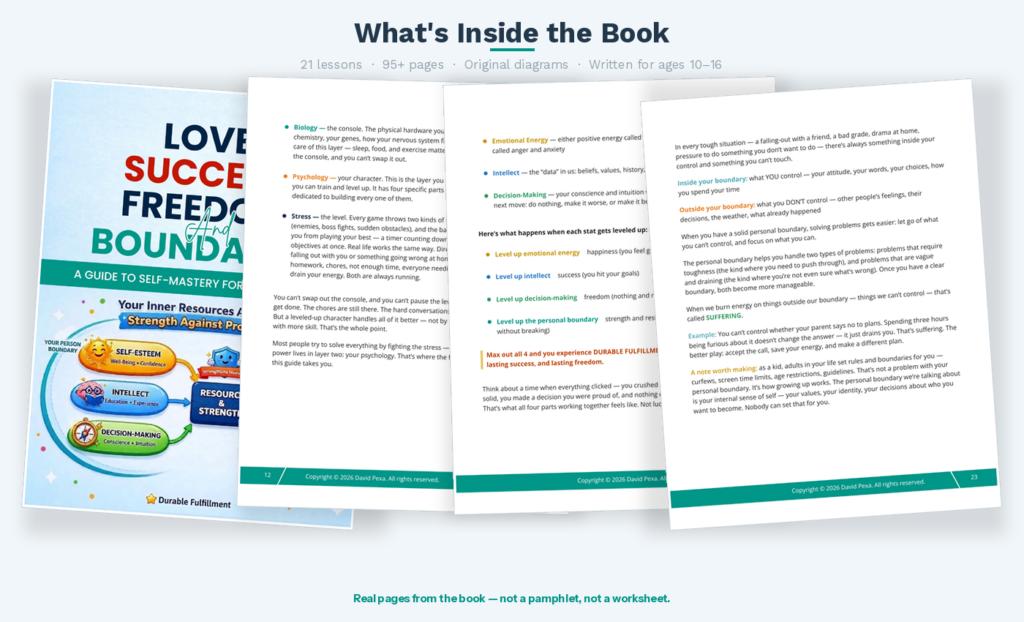
If this resonated, go deeper. My book Love, Success, Freedom and Boundaries gives you twelve frameworks for seeing the patterns that shape your life — and changing the ones that aren’t working.
Frequently Asked Questions
Where do I start with personal growth?
Start with the area causing the most friction in your life right now. Not the most impressive goal — the most pressing pain point. Growth motivated by genuine discomfort sticks longer than growth motivated by ambition alone.
Is personal growth selfish?
The opposite. You can’t give from empty. Working on yourself increases your capacity to show up for others. The people around you benefit from every bit of growth you invest in.
How do I measure personal growth?
Look at your decisions, not your feelings. Are you making different choices than you would have a year ago? Are you handling situations that used to overwhelm you? Growth shows up in behavior before it shows up in emotion.
Keep Reading
- How to Create a Personal Growth Plan for a Life You Love
- How to Create a Personal Growth Plan That Actually Works
- Your Ultimate Personal Growth Thesaurus: 10 Core Concepts for 2026
If you process emotions through writing — journaling, drafting hard conversations, putting words to what you’re feeling — the tool I use to draft most of my words is Wispr Flow. It transcribes your voice into clean, edited text in real time, so the friction between thinking it and writing it basically disappears.
If this resonated, go deeper. My book Love, Success, Freedom and Boundaries gives you twelve frameworks for seeing the patterns that shape your life — and changing the ones that aren’t working.
Frequently Asked Questions
Where do I start with personal growth?
Start with the area causing the most friction in your life right now. Not the most impressive goal — the most pressing pain point. Growth motivated by genuine discomfort sticks longer than growth motivated by ambition alone.
Is personal growth selfish?
The opposite. You can’t give from empty. Working on yourself increases your capacity to show up for others. The people around you benefit from every bit of growth you invest in.
How do I measure personal growth?
Look at your decisions, not your feelings. Are you making different choices than you would have a year ago? Are you handling situations that used to overwhelm you? Growth shows up in behavior before it shows up in emotion.
Keep Reading
- How to Create a Personal Growth Plan for a Life You Love
- How to Create a Personal Growth Plan That Actually Works
- Your Ultimate Personal Growth Thesaurus: 10 Core Concepts for 2026
If you process emotions through writing — journaling, drafting hard conversations, putting words to what you’re feeling — the tool I use to draft most of my words is Wispr Flow. It transcribes your voice into clean, edited text in real time, so the friction between thinking it and writing it basically disappears.
If this resonated, go deeper. My book Love, Success, Freedom and Boundaries gives you twelve frameworks for seeing the patterns that shape your life — and changing the ones that aren’t working.
Frequently Asked Questions
Where do I start with personal growth?
Start with the area causing the most friction in your life right now. Not the most impressive goal — the most pressing pain point. Growth motivated by genuine discomfort sticks longer than growth motivated by ambition alone.
Is personal growth selfish?
The opposite. You can’t give from empty. Working on yourself increases your capacity to show up for others. The people around you benefit from every bit of growth you invest in.
How do I measure personal growth?
Look at your decisions, not your feelings. Are you making different choices than you would have a year ago? Are you handling situations that used to overwhelm you? Growth shows up in behavior before it shows up in emotion.
Keep Reading
- How to Create a Personal Growth Plan for a Life You Love
- How to Create a Personal Growth Plan That Actually Works
- Your Ultimate Personal Growth Thesaurus: 10 Core Concepts for 2026
If you process emotions through writing — journaling, drafting hard conversations, putting words to what you’re feeling — the tool I use to draft most of my words is Wispr Flow. It transcribes your voice into clean, edited text in real time, so the friction between thinking it and writing it basically disappears.
If this resonated, go deeper. My book Love, Success, Freedom and Boundaries gives you twelve frameworks for seeing the patterns that shape your life — and changing the ones that aren’t working.
Frequently Asked Questions
Where do I start with personal growth?
Start with the area causing the most friction in your life right now. Not the most impressive goal — the most pressing pain point. Growth motivated by genuine discomfort sticks longer than growth motivated by ambition alone.
Is personal growth selfish?
The opposite. You can’t give from empty. Working on yourself increases your capacity to show up for others. The people around you benefit from every bit of growth you invest in.
How do I measure personal growth?
Look at your decisions, not your feelings. Are you making different choices than you would have a year ago? Are you handling situations that used to overwhelm you? Growth shows up in behavior before it shows up in emotion.
Keep Reading
- How to Create a Personal Growth Plan for a Life You Love
- How to Create a Personal Growth Plan That Actually Works
- Your Ultimate Personal Growth Thesaurus: 10 Core Concepts for 2026
If you process emotions through writing — journaling, drafting hard conversations, putting words to what you’re feeling — the tool I use to draft most of my words is Wispr Flow. It transcribes your voice into clean, edited text in real time, so the friction between thinking it and writing it basically disappears.
If this resonated, go deeper. My book Love, Success, Freedom and Boundaries gives you twelve frameworks for seeing the patterns that shape your life — and changing the ones that aren’t working.
Frequently Asked Questions
Where do I start with personal growth?
Start with the area causing the most friction in your life right now. Not the most impressive goal — the most pressing pain point. Growth motivated by genuine discomfort sticks longer than growth motivated by ambition alone.
Is personal growth selfish?
The opposite. You can’t give from empty. Working on yourself increases your capacity to show up for others. The people around you benefit from every bit of growth you invest in.
How do I measure personal growth?
Look at your decisions, not your feelings. Are you making different choices than you would have a year ago? Are you handling situations that used to overwhelm you? Growth shows up in behavior before it shows up in emotion.
Keep Reading
- How to Create a Personal Growth Plan for a Life You Love
- How to Create a Personal Growth Plan That Actually Works
- Your Ultimate Personal Growth Thesaurus: 10 Core Concepts for 2026
If you process emotions through writing — journaling, drafting hard conversations, putting words to what you’re feeling — the tool I use to draft most of my words is Wispr Flow. It transcribes your voice into clean, edited text in real time, so the friction between thinking it and writing it basically disappears.
If this resonated, go deeper. My book Love, Success, Freedom and Boundaries gives you twelve frameworks for seeing the patterns that shape your life — and changing the ones that aren’t working.
Frequently Asked Questions
Where do I start with personal growth?
Start with the area causing the most friction in your life right now. Not the most impressive goal — the most pressing pain point. Growth motivated by genuine discomfort sticks longer than growth motivated by ambition alone.
Is personal growth selfish?
The opposite. You can’t give from empty. Working on yourself increases your capacity to show up for others. The people around you benefit from every bit of growth you invest in.
How do I measure personal growth?
Look at your decisions, not your feelings. Are you making different choices than you would have a year ago? Are you handling situations that used to overwhelm you? Growth shows up in behavior before it shows up in emotion.
Keep Reading
- How to Create a Personal Growth Plan for a Life You Love
- How to Create a Personal Growth Plan That Actually Works
- Your Ultimate Personal Growth Thesaurus: 10 Core Concepts for 2026
If you process emotions through writing — journaling, drafting hard conversations, putting words to what you’re feeling — the tool I use to draft most of my words is Wispr Flow. It transcribes your voice into clean, edited text in real time, so the friction between thinking it and writing it basically disappears.
If this resonated, go deeper. My book Love, Success, Freedom and Boundaries gives you twelve frameworks for seeing the patterns that shape your life — and changing the ones that aren’t working.
Frequently Asked Questions
Where do I start with personal growth?
Start with the area causing the most friction in your life right now. Not the most impressive goal — the most pressing pain point. Growth motivated by genuine discomfort sticks longer than growth motivated by ambition alone.
Is personal growth selfish?
The opposite. You can’t give from empty. Working on yourself increases your capacity to show up for others. The people around you benefit from every bit of growth you invest in.
How do I measure personal growth?
Look at your decisions, not your feelings. Are you making different choices than you would have a year ago? Are you handling situations that used to overwhelm you? Growth shows up in behavior before it shows up in emotion.
Keep Reading
- How to Create a Personal Growth Plan for a Life You Love
- How to Create a Personal Growth Plan That Actually Works
- Your Ultimate Personal Growth Thesaurus: 10 Core Concepts for 2026
If you process emotions through writing — journaling, drafting hard conversations, putting words to what you’re feeling — the tool I use to draft most of my words is Wispr Flow. It transcribes your voice into clean, edited text in real time, so the friction between thinking it and writing it basically disappears.
If this resonated, go deeper. My book Love, Success, Freedom and Boundaries gives you twelve frameworks for seeing the patterns that shape your life — and changing the ones that aren’t working.
Frequently Asked Questions
Where do I start with personal growth?
Start with the area causing the most friction in your life right now. Not the most impressive goal — the most pressing pain point. Growth motivated by genuine discomfort sticks longer than growth motivated by ambition alone.
Is personal growth selfish?
The opposite. You can’t give from empty. Working on yourself increases your capacity to show up for others. The people around you benefit from every bit of growth you invest in.
How do I measure personal growth?
Look at your decisions, not your feelings. Are you making different choices than you would have a year ago? Are you handling situations that used to overwhelm you? Growth shows up in behavior before it shows up in emotion.
Keep Reading
- How to Create a Personal Growth Plan for a Life You Love
- How to Create a Personal Growth Plan That Actually Works
- Your Ultimate Personal Growth Thesaurus: 10 Core Concepts for 2026
If you process emotions through writing — journaling, drafting hard conversations, putting words to what you’re feeling — the tool I use to draft most of my words is Wispr Flow. It transcribes your voice into clean, edited text in real time, so the friction between thinking it and writing it basically disappears.
If this resonated, go deeper. My book Love, Success, Freedom and Boundaries gives you twelve frameworks for seeing the patterns that shape your life — and changing the ones that aren’t working.
Frequently Asked Questions
Where do I start with personal growth?
Start with the area causing the most friction in your life right now. Not the most impressive goal — the most pressing pain point. Growth motivated by genuine discomfort sticks longer than growth motivated by ambition alone.
Is personal growth selfish?
The opposite. You can’t give from empty. Working on yourself increases your capacity to show up for others. The people around you benefit from every bit of growth you invest in.
How do I measure personal growth?
Look at your decisions, not your feelings. Are you making different choices than you would have a year ago? Are you handling situations that used to overwhelm you? Growth shows up in behavior before it shows up in emotion.
Keep Reading
- How to Create a Personal Growth Plan for a Life You Love
- How to Create a Personal Growth Plan That Actually Works
- Your Ultimate Personal Growth Thesaurus: 10 Core Concepts for 2026
If you process emotions through writing — journaling, drafting hard conversations, putting words to what you’re feeling — the tool I use to draft most of my words is Wispr Flow. It transcribes your voice into clean, edited text in real time, so the friction between thinking it and writing it basically disappears.
If this resonated, go deeper. My book Love, Success, Freedom and Boundaries gives you twelve frameworks for seeing the patterns that shape your life — and changing the ones that aren’t working.
Frequently Asked Questions
Where do I start with personal growth?
Start with the area causing the most friction in your life right now. Not the most impressive goal — the most pressing pain point. Growth motivated by genuine discomfort sticks longer than growth motivated by ambition alone.
Is personal growth selfish?
The opposite. You can’t give from empty. Working on yourself increases your capacity to show up for others. The people around you benefit from every bit of growth you invest in.
How do I measure personal growth?
Look at your decisions, not your feelings. Are you making different choices than you would have a year ago? Are you handling situations that used to overwhelm you? Growth shows up in behavior before it shows up in emotion.
Keep Reading
- How to Create a Personal Growth Plan for a Life You Love
- How to Create a Personal Growth Plan That Actually Works
- Your Ultimate Personal Growth Thesaurus: 10 Core Concepts for 2026
If you process emotions through writing — journaling, drafting hard conversations, putting words to what you’re feeling — the tool I use to draft most of my words is Wispr Flow. It transcribes your voice into clean, edited text in real time, so the friction between thinking it and writing it basically disappears.
If this resonated, go deeper. My book Love, Success, Freedom and Boundaries gives you twelve frameworks for seeing the patterns that shape your life — and changing the ones that aren’t working.
Frequently Asked Questions
Where do I start with personal growth?
Start with the area causing the most friction in your life right now. Not the most impressive goal — the most pressing pain point. Growth motivated by genuine discomfort sticks longer than growth motivated by ambition alone.
Is personal growth selfish?
The opposite. You can’t give from empty. Working on yourself increases your capacity to show up for others. The people around you benefit from every bit of growth you invest in.
How do I measure personal growth?
Look at your decisions, not your feelings. Are you making different choices than you would have a year ago? Are you handling situations that used to overwhelm you? Growth shows up in behavior before it shows up in emotion.
Keep Reading
- How to Create a Personal Growth Plan for a Life You Love
- How to Create a Personal Growth Plan That Actually Works
- Your Ultimate Personal Growth Thesaurus: 10 Core Concepts for 2026
If you process emotions through writing — journaling, drafting hard conversations, putting words to what you’re feeling — the tool I use to draft most of my words is Wispr Flow. It transcribes your voice into clean, edited text in real time, so the friction between thinking it and writing it basically disappears.
If this resonated, go deeper. My book Love, Success, Freedom and Boundaries gives you twelve frameworks for seeing the patterns that shape your life — and changing the ones that aren’t working.
Frequently Asked Questions
Where do I start with personal growth?
Start with the area causing the most friction in your life right now. Not the most impressive goal — the most pressing pain point. Growth motivated by genuine discomfort sticks longer than growth motivated by ambition alone.
Is personal growth selfish?
The opposite. You can’t give from empty. Working on yourself increases your capacity to show up for others. The people around you benefit from every bit of growth you invest in.
How do I measure personal growth?
Look at your decisions, not your feelings. Are you making different choices than you would have a year ago? Are you handling situations that used to overwhelm you? Growth shows up in behavior before it shows up in emotion.
Keep Reading
- How to Create a Personal Growth Plan for a Life You Love
- How to Create a Personal Growth Plan That Actually Works
- Your Ultimate Personal Growth Thesaurus: 10 Core Concepts for 2026
If you process emotions through writing — journaling, drafting hard conversations, putting words to what you’re feeling — the tool I use to draft most of my words is Wispr Flow. It transcribes your voice into clean, edited text in real time, so the friction between thinking it and writing it basically disappears.
If this resonated, go deeper. My book Love, Success, Freedom and Boundaries gives you twelve frameworks for seeing the patterns that shape your life — and changing the ones that aren’t working.
Frequently Asked Questions
Where do I start with personal growth?
Start with the area causing the most friction in your life right now. Not the most impressive goal — the most pressing pain point. Growth motivated by genuine discomfort sticks longer than growth motivated by ambition alone.
Is personal growth selfish?
The opposite. You can’t give from empty. Working on yourself increases your capacity to show up for others. The people around you benefit from every bit of growth you invest in.
How do I measure personal growth?
Look at your decisions, not your feelings. Are you making different choices than you would have a year ago? Are you handling situations that used to overwhelm you? Growth shows up in behavior before it shows up in emotion.
Keep Reading
- How to Create a Personal Growth Plan for a Life You Love
- How to Create a Personal Growth Plan That Actually Works
- Your Ultimate Personal Growth Thesaurus: 10 Core Concepts for 2026
If you process emotions through writing — journaling, drafting hard conversations, putting words to what you’re feeling — the tool I use to draft most of my words is Wispr Flow. It transcribes your voice into clean, edited text in real time, so the friction between thinking it and writing it basically disappears.
If this resonated, go deeper. My book Love, Success, Freedom and Boundaries gives you twelve frameworks for seeing the patterns that shape your life — and changing the ones that aren’t working.
Frequently Asked Questions
Where do I start with personal growth?
Start with the area causing the most friction in your life right now. Not the most impressive goal — the most pressing pain point. Growth motivated by genuine discomfort sticks longer than growth motivated by ambition alone.
Is personal growth selfish?
The opposite. You can’t give from empty. Working on yourself increases your capacity to show up for others. The people around you benefit from every bit of growth you invest in.
How do I measure personal growth?
Look at your decisions, not your feelings. Are you making different choices than you would have a year ago? Are you handling situations that used to overwhelm you? Growth shows up in behavior before it shows up in emotion.
Keep Reading
- How to Create a Personal Growth Plan for a Life You Love
- How to Create a Personal Growth Plan That Actually Works
- Your Ultimate Personal Growth Thesaurus: 10 Core Concepts for 2026
If you process emotions through writing — journaling, drafting hard conversations, putting words to what you’re feeling — the tool I use to draft most of my words is Wispr Flow. It transcribes your voice into clean, edited text in real time, so the friction between thinking it and writing it basically disappears.
If this resonated, go deeper. My book Love, Success, Freedom and Boundaries gives you twelve frameworks for seeing the patterns that shape your life — and changing the ones that aren’t working.
Frequently Asked Questions
Where do I start with personal growth?
Start with the area causing the most friction in your life right now. Not the most impressive goal — the most pressing pain point. Growth motivated by genuine discomfort sticks longer than growth motivated by ambition alone.
Is personal growth selfish?
The opposite. You can’t give from empty. Working on yourself increases your capacity to show up for others. The people around you benefit from every bit of growth you invest in.
How do I measure personal growth?
Look at your decisions, not your feelings. Are you making different choices than you would have a year ago? Are you handling situations that used to overwhelm you? Growth shows up in behavior before it shows up in emotion.
Keep Reading
- How to Create a Personal Growth Plan for a Life You Love
- How to Create a Personal Growth Plan That Actually Works
- Your Ultimate Personal Growth Thesaurus: 10 Core Concepts for 2026
If you process emotions through writing — journaling, drafting hard conversations, putting words to what you’re feeling — the tool I use to draft most of my words is Wispr Flow. It transcribes your voice into clean, edited text in real time, so the friction between thinking it and writing it basically disappears.
If this resonated, go deeper. My book Love, Success, Freedom and Boundaries gives you twelve frameworks for seeing the patterns that shape your life — and changing the ones that aren’t working.
Frequently Asked Questions
Where do I start with personal growth?
Start with the area causing the most friction in your life right now. Not the most impressive goal — the most pressing pain point. Growth motivated by genuine discomfort sticks longer than growth motivated by ambition alone.
Is personal growth selfish?
The opposite. You can’t give from empty. Working on yourself increases your capacity to show up for others. The people around you benefit from every bit of growth you invest in.
How do I measure personal growth?
Look at your decisions, not your feelings. Are you making different choices than you would have a year ago? Are you handling situations that used to overwhelm you? Growth shows up in behavior before it shows up in emotion.
Keep Reading
- How to Create a Personal Growth Plan for a Life You Love
- How to Create a Personal Growth Plan That Actually Works
- Your Ultimate Personal Growth Thesaurus: 10 Core Concepts for 2026
If you process emotions through writing — journaling, drafting hard conversations, putting words to what you’re feeling — the tool I use to draft most of my words is Wispr Flow. It transcribes your voice into clean, edited text in real time, so the friction between thinking it and writing it basically disappears.
If this resonated, go deeper. My book Love, Success, Freedom and Boundaries gives you twelve frameworks for seeing the patterns that shape your life — and changing the ones that aren’t working.
Frequently Asked Questions
Where do I start with personal growth?
Start with the area causing the most friction in your life right now. Not the most impressive goal — the most pressing pain point. Growth motivated by genuine discomfort sticks longer than growth motivated by ambition alone.
Is personal growth selfish?
The opposite. You can’t give from empty. Working on yourself increases your capacity to show up for others. The people around you benefit from every bit of growth you invest in.
How do I measure personal growth?
Look at your decisions, not your feelings. Are you making different choices than you would have a year ago? Are you handling situations that used to overwhelm you? Growth shows up in behavior before it shows up in emotion.
Keep Reading
- How to Create a Personal Growth Plan for a Life You Love
- How to Create a Personal Growth Plan That Actually Works
- Your Ultimate Personal Growth Thesaurus: 10 Core Concepts for 2026
If you process emotions through writing — journaling, drafting hard conversations, putting words to what you’re feeling — the tool I use to draft most of my words is Wispr Flow. It transcribes your voice into clean, edited text in real time, so the friction between thinking it and writing it basically disappears.
If this resonated, go deeper. My book Love, Success, Freedom and Boundaries gives you twelve frameworks for seeing the patterns that shape your life — and changing the ones that aren’t working.
Frequently Asked Questions
Where do I start with personal growth?
Start with the area causing the most friction in your life right now. Not the most impressive goal — the most pressing pain point. Growth motivated by genuine discomfort sticks longer than growth motivated by ambition alone.
Is personal growth selfish?
The opposite. You can’t give from empty. Working on yourself increases your capacity to show up for others. The people around you benefit from every bit of growth you invest in.
How do I measure personal growth?
Look at your decisions, not your feelings. Are you making different choices than you would have a year ago? Are you handling situations that used to overwhelm you? Growth shows up in behavior before it shows up in emotion.
Keep Reading
- How to Create a Personal Growth Plan for a Life You Love
- How to Create a Personal Growth Plan That Actually Works
- Your Ultimate Personal Growth Thesaurus: 10 Core Concepts for 2026
If you process emotions through writing — journaling, drafting hard conversations, putting words to what you’re feeling — the tool I use to draft most of my words is Wispr Flow. It transcribes your voice into clean, edited text in real time, so the friction between thinking it and writing it basically disappears.
If this resonated, go deeper. My book Love, Success, Freedom and Boundaries gives you twelve frameworks for seeing the patterns that shape your life — and changing the ones that aren’t working.
Frequently Asked Questions
Where do I start with personal growth?
Start with the area causing the most friction in your life right now. Not the most impressive goal — the most pressing pain point. Growth motivated by genuine discomfort sticks longer than growth motivated by ambition alone.
Is personal growth selfish?
The opposite. You can’t give from empty. Working on yourself increases your capacity to show up for others. The people around you benefit from every bit of growth you invest in.
How do I measure personal growth?
Look at your decisions, not your feelings. Are you making different choices than you would have a year ago? Are you handling situations that used to overwhelm you? Growth shows up in behavior before it shows up in emotion.
Keep Reading
- How to Create a Personal Growth Plan for a Life You Love
- How to Create a Personal Growth Plan That Actually Works
- Your Ultimate Personal Growth Thesaurus: 10 Core Concepts for 2026
If you process emotions through writing — journaling, drafting hard conversations, putting words to what you’re feeling — the tool I use to draft most of my words is Wispr Flow. It transcribes your voice into clean, edited text in real time, so the friction between thinking it and writing it basically disappears.
If this resonated, go deeper. My book Love, Success, Freedom and Boundaries gives you twelve frameworks for seeing the patterns that shape your life — and changing the ones that aren’t working.
Frequently Asked Questions
Where do I start with personal growth?
Start with the area causing the most friction in your life right now. Not the most impressive goal — the most pressing pain point. Growth motivated by genuine discomfort sticks longer than growth motivated by ambition alone.
Is personal growth selfish?
The opposite. You can’t give from empty. Working on yourself increases your capacity to show up for others. The people around you benefit from every bit of growth you invest in.
How do I measure personal growth?
Look at your decisions, not your feelings. Are you making different choices than you would have a year ago? Are you handling situations that used to overwhelm you? Growth shows up in behavior before it shows up in emotion.
Keep Reading
- How to Create a Personal Growth Plan for a Life You Love
- How to Create a Personal Growth Plan That Actually Works
- Your Ultimate Personal Growth Thesaurus: 10 Core Concepts for 2026
If you process emotions through writing — journaling, drafting hard conversations, putting words to what you’re feeling — the tool I use to draft most of my words is Wispr Flow. It transcribes your voice into clean, edited text in real time, so the friction between thinking it and writing it basically disappears.
If this resonated, go deeper. My book Love, Success, Freedom and Boundaries gives you twelve frameworks for seeing the patterns that shape your life — and changing the ones that aren’t working.
Frequently Asked Questions
Where do I start with personal growth?
Start with the area causing the most friction in your life right now. Not the most impressive goal — the most pressing pain point. Growth motivated by genuine discomfort sticks longer than growth motivated by ambition alone.
Is personal growth selfish?
The opposite. You can’t give from empty. Working on yourself increases your capacity to show up for others. The people around you benefit from every bit of growth you invest in.
How do I measure personal growth?
Look at your decisions, not your feelings. Are you making different choices than you would have a year ago? Are you handling situations that used to overwhelm you? Growth shows up in behavior before it shows up in emotion.
Keep Reading
- How to Create a Personal Growth Plan for a Life You Love
- How to Create a Personal Growth Plan That Actually Works
- Your Ultimate Personal Growth Thesaurus: 10 Core Concepts for 2026
If you process emotions through writing — journaling, drafting hard conversations, putting words to what you’re feeling — the tool I use to draft most of my words is Wispr Flow. It transcribes your voice into clean, edited text in real time, so the friction between thinking it and writing it basically disappears.
If this resonated, go deeper. My book Love, Success, Freedom and Boundaries gives you twelve frameworks for seeing the patterns that shape your life — and changing the ones that aren’t working.
Frequently Asked Questions
Where do I start with personal growth?
Start with the area causing the most friction in your life right now. Not the most impressive goal — the most pressing pain point. Growth motivated by genuine discomfort sticks longer than growth motivated by ambition alone.
Is personal growth selfish?
The opposite. You can’t give from empty. Working on yourself increases your capacity to show up for others. The people around you benefit from every bit of growth you invest in.
How do I measure personal growth?
Look at your decisions, not your feelings. Are you making different choices than you would have a year ago? Are you handling situations that used to overwhelm you? Growth shows up in behavior before it shows up in emotion.
Keep Reading
- How to Create a Personal Growth Plan for a Life You Love
- How to Create a Personal Growth Plan That Actually Works
- Your Ultimate Personal Growth Thesaurus: 10 Core Concepts for 2026
If you process emotions through writing — journaling, drafting hard conversations, putting words to what you’re feeling — the tool I use to draft most of my words is Wispr Flow. It transcribes your voice into clean, edited text in real time, so the friction between thinking it and writing it basically disappears.
If this resonated, go deeper. My book Love, Success, Freedom and Boundaries gives you twelve frameworks for seeing the patterns that shape your life — and changing the ones that aren’t working.
Frequently Asked Questions
Where do I start with personal growth?
Start with the area causing the most friction in your life right now. Not the most impressive goal — the most pressing pain point. Growth motivated by genuine discomfort sticks longer than growth motivated by ambition alone.
Is personal growth selfish?
The opposite. You can’t give from empty. Working on yourself increases your capacity to show up for others. The people around you benefit from every bit of growth you invest in.
How do I measure personal growth?
Look at your decisions, not your feelings. Are you making different choices than you would have a year ago? Are you handling situations that used to overwhelm you? Growth shows up in behavior before it shows up in emotion.
Keep Reading
- How to Create a Personal Growth Plan for a Life You Love
- How to Create a Personal Growth Plan That Actually Works
- Your Ultimate Personal Growth Thesaurus: 10 Core Concepts for 2026
If you process emotions through writing — journaling, drafting hard conversations, putting words to what you’re feeling — the tool I use to draft most of my words is Wispr Flow. It transcribes your voice into clean, edited text in real time, so the friction between thinking it and writing it basically disappears.
If this resonated, go deeper. My book Love, Success, Freedom and Boundaries gives you twelve frameworks for seeing the patterns that shape your life — and changing the ones that aren’t working.
Frequently Asked Questions
Where do I start with personal growth?
Start with the area causing the most friction in your life right now. Not the most impressive goal — the most pressing pain point. Growth motivated by genuine discomfort sticks longer than growth motivated by ambition alone.
Is personal growth selfish?
The opposite. You can’t give from empty. Working on yourself increases your capacity to show up for others. The people around you benefit from every bit of growth you invest in.
How do I measure personal growth?
Look at your decisions, not your feelings. Are you making different choices than you would have a year ago? Are you handling situations that used to overwhelm you? Growth shows up in behavior before it shows up in emotion.
Keep Reading
- How to Create a Personal Growth Plan for a Life You Love
- How to Create a Personal Growth Plan That Actually Works
- Your Ultimate Personal Growth Thesaurus: 10 Core Concepts for 2026
If you process emotions through writing — journaling, drafting hard conversations, putting words to what you’re feeling — the tool I use to draft most of my words is Wispr Flow. It transcribes your voice into clean, edited text in real time, so the friction between thinking it and writing it basically disappears.
If this resonated, go deeper. My book Love, Success, Freedom and Boundaries gives you twelve frameworks for seeing the patterns that shape your life — and changing the ones that aren’t working.
Frequently Asked Questions
Where do I start with personal growth?
Start with the area causing the most friction in your life right now. Not the most impressive goal — the most pressing pain point. Growth motivated by genuine discomfort sticks longer than growth motivated by ambition alone.
Is personal growth selfish?
The opposite. You can’t give from empty. Working on yourself increases your capacity to show up for others. The people around you benefit from every bit of growth you invest in.
How do I measure personal growth?
Look at your decisions, not your feelings. Are you making different choices than you would have a year ago? Are you handling situations that used to overwhelm you? Growth shows up in behavior before it shows up in emotion.
Keep Reading
- How to Create a Personal Growth Plan for a Life You Love
- How to Create a Personal Growth Plan That Actually Works
- Your Ultimate Personal Growth Thesaurus: 10 Core Concepts for 2026
If you process emotions through writing — journaling, drafting hard conversations, putting words to what you’re feeling — the tool I use to draft most of my words is Wispr Flow. It transcribes your voice into clean, edited text in real time, so the friction between thinking it and writing it basically disappears.
If this resonated, go deeper. My book Love, Success, Freedom and Boundaries gives you twelve frameworks for seeing the patterns that shape your life — and changing the ones that aren’t working.
Frequently Asked Questions
Where do I start with personal growth?
Start with the area causing the most friction in your life right now. Not the most impressive goal — the most pressing pain point. Growth motivated by genuine discomfort sticks longer than growth motivated by ambition alone.
Is personal growth selfish?
The opposite. You can’t give from empty. Working on yourself increases your capacity to show up for others. The people around you benefit from every bit of growth you invest in.
How do I measure personal growth?
Look at your decisions, not your feelings. Are you making different choices than you would have a year ago? Are you handling situations that used to overwhelm you? Growth shows up in behavior before it shows up in emotion.
Keep Reading
- How to Create a Personal Growth Plan for a Life You Love
- How to Create a Personal Growth Plan That Actually Works
- Your Ultimate Personal Growth Thesaurus: 10 Core Concepts for 2026
If you process emotions through writing — journaling, drafting hard conversations, putting words to what you’re feeling — the tool I use to draft most of my words is Wispr Flow. It transcribes your voice into clean, edited text in real time, so the friction between thinking it and writing it basically disappears.
If this resonated, go deeper. My book Love, Success, Freedom and Boundaries gives you twelve frameworks for seeing the patterns that shape your life — and changing the ones that aren’t working.
Frequently Asked Questions
Where do I start with personal growth?
Start with the area causing the most friction in your life right now. Not the most impressive goal — the most pressing pain point. Growth motivated by genuine discomfort sticks longer than growth motivated by ambition alone.
Is personal growth selfish?
The opposite. You can’t give from empty. Working on yourself increases your capacity to show up for others. The people around you benefit from every bit of growth you invest in.
How do I measure personal growth?
Look at your decisions, not your feelings. Are you making different choices than you would have a year ago? Are you handling situations that used to overwhelm you? Growth shows up in behavior before it shows up in emotion.
Keep Reading
- How to Create a Personal Growth Plan for a Life You Love
- How to Create a Personal Growth Plan That Actually Works
- Your Ultimate Personal Growth Thesaurus: 10 Core Concepts for 2026
If you process emotions through writing — journaling, drafting hard conversations, putting words to what you’re feeling — the tool I use to draft most of my words is Wispr Flow. It transcribes your voice into clean, edited text in real time, so the friction between thinking it and writing it basically disappears.
If this resonated, go deeper. My book Love, Success, Freedom and Boundaries gives you twelve frameworks for seeing the patterns that shape your life — and changing the ones that aren’t working.
Frequently Asked Questions
Where do I start with personal growth?
Start with the area causing the most friction in your life right now. Not the most impressive goal — the most pressing pain point. Growth motivated by genuine discomfort sticks longer than growth motivated by ambition alone.
Is personal growth selfish?
The opposite. You can’t give from empty. Working on yourself increases your capacity to show up for others. The people around you benefit from every bit of growth you invest in.
How do I measure personal growth?
Look at your decisions, not your feelings. Are you making different choices than you would have a year ago? Are you handling situations that used to overwhelm you? Growth shows up in behavior before it shows up in emotion.
Keep Reading
- How to Create a Personal Growth Plan for a Life You Love
- How to Create a Personal Growth Plan That Actually Works
- Your Ultimate Personal Growth Thesaurus: 10 Core Concepts for 2026
If you process emotions through writing — journaling, drafting hard conversations, putting words to what you’re feeling — the tool I use to draft most of my words is Wispr Flow. It transcribes your voice into clean, edited text in real time, so the friction between thinking it and writing it basically disappears.
If this resonated, go deeper. My book Love, Success, Freedom and Boundaries gives you twelve frameworks for seeing the patterns that shape your life — and changing the ones that aren’t working.
Frequently Asked Questions
Where do I start with personal growth?
Start with the area causing the most friction in your life right now. Not the most impressive goal — the most pressing pain point. Growth motivated by genuine discomfort sticks longer than growth motivated by ambition alone.
Is personal growth selfish?
The opposite. You can’t give from empty. Working on yourself increases your capacity to show up for others. The people around you benefit from every bit of growth you invest in.
How do I measure personal growth?
Look at your decisions, not your feelings. Are you making different choices than you would have a year ago? Are you handling situations that used to overwhelm you? Growth shows up in behavior before it shows up in emotion.
Keep Reading
- How to Create a Personal Growth Plan for a Life You Love
- How to Create a Personal Growth Plan That Actually Works
- Your Ultimate Personal Growth Thesaurus: 10 Core Concepts for 2026
If you process emotions through writing — journaling, drafting hard conversations, putting words to what you’re feeling — the tool I use to draft most of my words is Wispr Flow. It transcribes your voice into clean, edited text in real time, so the friction between thinking it and writing it basically disappears.
If this resonated, go deeper. My book Love, Success, Freedom and Boundaries gives you twelve frameworks for seeing the patterns that shape your life — and changing the ones that aren’t working.
Frequently Asked Questions
Where do I start with personal growth?
Start with the area causing the most friction in your life right now. Not the most impressive goal — the most pressing pain point. Growth motivated by genuine discomfort sticks longer than growth motivated by ambition alone.
Is personal growth selfish?
The opposite. You can’t give from empty. Working on yourself increases your capacity to show up for others. The people around you benefit from every bit of growth you invest in.
How do I measure personal growth?
Look at your decisions, not your feelings. Are you making different choices than you would have a year ago? Are you handling situations that used to overwhelm you? Growth shows up in behavior before it shows up in emotion.
Keep Reading
- How to Create a Personal Growth Plan for a Life You Love
- How to Create a Personal Growth Plan That Actually Works
- Your Ultimate Personal Growth Thesaurus: 10 Core Concepts for 2026
If you process emotions through writing — journaling, drafting hard conversations, putting words to what you’re feeling — the tool I use to draft most of my words is Wispr Flow. It transcribes your voice into clean, edited text in real time, so the friction between thinking it and writing it basically disappears.
If this resonated, go deeper. My book Love, Success, Freedom and Boundaries gives you twelve frameworks for seeing the patterns that shape your life — and changing the ones that aren’t working.
Frequently Asked Questions
Where do I start with personal growth?
Start with the area causing the most friction in your life right now. Not the most impressive goal — the most pressing pain point. Growth motivated by genuine discomfort sticks longer than growth motivated by ambition alone.
Is personal growth selfish?
The opposite. You can’t give from empty. Working on yourself increases your capacity to show up for others. The people around you benefit from every bit of growth you invest in.
How do I measure personal growth?
Look at your decisions, not your feelings. Are you making different choices than you would have a year ago? Are you handling situations that used to overwhelm you? Growth shows up in behavior before it shows up in emotion.
Keep Reading
- How to Create a Personal Growth Plan for a Life You Love
- How to Create a Personal Growth Plan That Actually Works
- Your Ultimate Personal Growth Thesaurus: 10 Core Concepts for 2026
If you process emotions through writing — journaling, drafting hard conversations, putting words to what you’re feeling — the tool I use to draft most of my words is Wispr Flow. It transcribes your voice into clean, edited text in real time, so the friction between thinking it and writing it basically disappears.
If this resonated, go deeper. My book Love, Success, Freedom and Boundaries gives you twelve frameworks for seeing the patterns that shape your life — and changing the ones that aren’t working.
Frequently Asked Questions
Where do I start with personal growth?
Start with the area causing the most friction in your life right now. Not the most impressive goal — the most pressing pain point. Growth motivated by genuine discomfort sticks longer than growth motivated by ambition alone.
Is personal growth selfish?
The opposite. You can’t give from empty. Working on yourself increases your capacity to show up for others. The people around you benefit from every bit of growth you invest in.
How do I measure personal growth?
Look at your decisions, not your feelings. Are you making different choices than you would have a year ago? Are you handling situations that used to overwhelm you? Growth shows up in behavior before it shows up in emotion.
Keep Reading
- How to Create a Personal Growth Plan for a Life You Love
- How to Create a Personal Growth Plan That Actually Works
- Your Ultimate Personal Growth Thesaurus: 10 Core Concepts for 2026
If you process emotions through writing — journaling, drafting hard conversations, putting words to what you’re feeling — the tool I use to draft most of my words is Wispr Flow. It transcribes your voice into clean, edited text in real time, so the friction between thinking it and writing it basically disappears.
If this resonated, go deeper. My book Love, Success, Freedom and Boundaries gives you twelve frameworks for seeing the patterns that shape your life — and changing the ones that aren’t working.
Frequently Asked Questions
Where do I start with personal growth?
Start with the area causing the most friction in your life right now. Not the most impressive goal — the most pressing pain point. Growth motivated by genuine discomfort sticks longer than growth motivated by ambition alone.
Is personal growth selfish?
The opposite. You can’t give from empty. Working on yourself increases your capacity to show up for others. The people around you benefit from every bit of growth you invest in.
How do I measure personal growth?
Look at your decisions, not your feelings. Are you making different choices than you would have a year ago? Are you handling situations that used to overwhelm you? Growth shows up in behavior before it shows up in emotion.
Keep Reading
- How to Create a Personal Growth Plan for a Life You Love
- How to Create a Personal Growth Plan That Actually Works
- Your Ultimate Personal Growth Thesaurus: 10 Core Concepts for 2026
If you process emotions through writing — journaling, drafting hard conversations, putting words to what you’re feeling — the tool I use to draft most of my words is Wispr Flow. It transcribes your voice into clean, edited text in real time, so the friction between thinking it and writing it basically disappears.
If this resonated, go deeper. My book Love, Success, Freedom and Boundaries gives you twelve frameworks for seeing the patterns that shape your life — and changing the ones that aren’t working.
Frequently Asked Questions
Where do I start with personal growth?
Start with the area causing the most friction in your life right now. Not the most impressive goal — the most pressing pain point. Growth motivated by genuine discomfort sticks longer than growth motivated by ambition alone.
Is personal growth selfish?
The opposite. You can’t give from empty. Working on yourself increases your capacity to show up for others. The people around you benefit from every bit of growth you invest in.
How do I measure personal growth?
Look at your decisions, not your feelings. Are you making different choices than you would have a year ago? Are you handling situations that used to overwhelm you? Growth shows up in behavior before it shows up in emotion.
Keep Reading
- How to Create a Personal Growth Plan for a Life You Love
- How to Create a Personal Growth Plan That Actually Works
- Your Ultimate Personal Growth Thesaurus: 10 Core Concepts for 2026
If you process emotions through writing — journaling, drafting hard conversations, putting words to what you’re feeling — the tool I use to draft most of my words is Wispr Flow. It transcribes your voice into clean, edited text in real time, so the friction between thinking it and writing it basically disappears.
If this resonated, go deeper. My book Love, Success, Freedom and Boundaries gives you twelve frameworks for seeing the patterns that shape your life — and changing the ones that aren’t working.
Frequently Asked Questions
Where do I start with personal growth?
Start with the area causing the most friction in your life right now. Not the most impressive goal — the most pressing pain point. Growth motivated by genuine discomfort sticks longer than growth motivated by ambition alone.
Is personal growth selfish?
The opposite. You can’t give from empty. Working on yourself increases your capacity to show up for others. The people around you benefit from every bit of growth you invest in.
How do I measure personal growth?
Look at your decisions, not your feelings. Are you making different choices than you would have a year ago? Are you handling situations that used to overwhelm you? Growth shows up in behavior before it shows up in emotion.
Keep Reading
- How to Create a Personal Growth Plan for a Life You Love
- How to Create a Personal Growth Plan That Actually Works
- Your Ultimate Personal Growth Thesaurus: 10 Core Concepts for 2026
If you process emotions through writing — journaling, drafting hard conversations, putting words to what you’re feeling — the tool I use to draft most of my words is Wispr Flow. It transcribes your voice into clean, edited text in real time, so the friction between thinking it and writing it basically disappears.
If this resonated, go deeper. My book Love, Success, Freedom and Boundaries gives you twelve frameworks for seeing the patterns that shape your life — and changing the ones that aren’t working.
Frequently Asked Questions
Where do I start with personal growth?
Start with the area causing the most friction in your life right now. Not the most impressive goal — the most pressing pain point. Growth motivated by genuine discomfort sticks longer than growth motivated by ambition alone.
Is personal growth selfish?
The opposite. You can’t give from empty. Working on yourself increases your capacity to show up for others. The people around you benefit from every bit of growth you invest in.
How do I measure personal growth?
Look at your decisions, not your feelings. Are you making different choices than you would have a year ago? Are you handling situations that used to overwhelm you? Growth shows up in behavior before it shows up in emotion.
Keep Reading
- How to Create a Personal Growth Plan for a Life You Love
- How to Create a Personal Growth Plan That Actually Works
- Your Ultimate Personal Growth Thesaurus: 10 Core Concepts for 2026
If you process emotions through writing — journaling, drafting hard conversations, putting words to what you’re feeling — the tool I use to draft most of my words is Wispr Flow. It transcribes your voice into clean, edited text in real time, so the friction between thinking it and writing it basically disappears.
If this resonated, go deeper. My book Love, Success, Freedom and Boundaries gives you twelve frameworks for seeing the patterns that shape your life — and changing the ones that aren’t working.
Frequently Asked Questions
Where do I start with personal growth?
Start with the area causing the most friction in your life right now. Not the most impressive goal — the most pressing pain point. Growth motivated by genuine discomfort sticks longer than growth motivated by ambition alone.
Is personal growth selfish?
The opposite. You can’t give from empty. Working on yourself increases your capacity to show up for others. The people around you benefit from every bit of growth you invest in.
How do I measure personal growth?
Look at your decisions, not your feelings. Are you making different choices than you would have a year ago? Are you handling situations that used to overwhelm you? Growth shows up in behavior before it shows up in emotion.
Keep Reading
- How to Create a Personal Growth Plan for a Life You Love
- How to Create a Personal Growth Plan That Actually Works
- Your Ultimate Personal Growth Thesaurus: 10 Core Concepts for 2026
If you process emotions through writing — journaling, drafting hard conversations, putting words to what you’re feeling — the tool I use to draft most of my words is Wispr Flow. It transcribes your voice into clean, edited text in real time, so the friction between thinking it and writing it basically disappears.
If this resonated, go deeper. My book Love, Success, Freedom and Boundaries gives you twelve frameworks for seeing the patterns that shape your life — and changing the ones that aren’t working.
Frequently Asked Questions
Where do I start with personal growth?
Start with the area causing the most friction in your life right now. Not the most impressive goal — the most pressing pain point. Growth motivated by genuine discomfort sticks longer than growth motivated by ambition alone.
Is personal growth selfish?
The opposite. You can’t give from empty. Working on yourself increases your capacity to show up for others. The people around you benefit from every bit of growth you invest in.
How do I measure personal growth?
Look at your decisions, not your feelings. Are you making different choices than you would have a year ago? Are you handling situations that used to overwhelm you? Growth shows up in behavior before it shows up in emotion.
Keep Reading
- How to Create a Personal Growth Plan for a Life You Love
- How to Create a Personal Growth Plan That Actually Works
- Your Ultimate Personal Growth Thesaurus: 10 Core Concepts for 2026
If you process emotions through writing — journaling, drafting hard conversations, putting words to what you’re feeling — the tool I use to draft most of my words is Wispr Flow. It transcribes your voice into clean, edited text in real time, so the friction between thinking it and writing it basically disappears.
If this resonated, go deeper. My book Love, Success, Freedom and Boundaries gives you twelve frameworks for seeing the patterns that shape your life — and changing the ones that aren’t working.
Frequently Asked Questions
Where do I start with personal growth?
Start with the area causing the most friction in your life right now. Not the most impressive goal — the most pressing pain point. Growth motivated by genuine discomfort sticks longer than growth motivated by ambition alone.
Is personal growth selfish?
The opposite. You can’t give from empty. Working on yourself increases your capacity to show up for others. The people around you benefit from every bit of growth you invest in.
How do I measure personal growth?
Look at your decisions, not your feelings. Are you making different choices than you would have a year ago? Are you handling situations that used to overwhelm you? Growth shows up in behavior before it shows up in emotion.
Keep Reading
- How to Create a Personal Growth Plan for a Life You Love
- How to Create a Personal Growth Plan That Actually Works
- Your Ultimate Personal Growth Thesaurus: 10 Core Concepts for 2026
If you process emotions through writing — journaling, drafting hard conversations, putting words to what you’re feeling — the tool I use to draft most of my words is Wispr Flow. It transcribes your voice into clean, edited text in real time, so the friction between thinking it and writing it basically disappears.
If this resonated, go deeper. My book Love, Success, Freedom and Boundaries gives you twelve frameworks for seeing the patterns that shape your life — and changing the ones that aren’t working.
Frequently Asked Questions
Where do I start with personal growth?
Start with the area causing the most friction in your life right now. Not the most impressive goal — the most pressing pain point. Growth motivated by genuine discomfort sticks longer than growth motivated by ambition alone.
Is personal growth selfish?
The opposite. You can’t give from empty. Working on yourself increases your capacity to show up for others. The people around you benefit from every bit of growth you invest in.
How do I measure personal growth?
Look at your decisions, not your feelings. Are you making different choices than you would have a year ago? Are you handling situations that used to overwhelm you? Growth shows up in behavior before it shows up in emotion.
Keep Reading
- How to Create a Personal Growth Plan for a Life You Love
- How to Create a Personal Growth Plan That Actually Works
- Your Ultimate Personal Growth Thesaurus: 10 Core Concepts for 2026
If you process emotions through writing — journaling, drafting hard conversations, putting words to what you’re feeling — the tool I use to draft most of my words is Wispr Flow. It transcribes your voice into clean, edited text in real time, so the friction between thinking it and writing it basically disappears.
If this resonated, go deeper. My book Love, Success, Freedom and Boundaries gives you twelve frameworks for seeing the patterns that shape your life — and changing the ones that aren’t working.
Frequently Asked Questions
Where do I start with personal growth?
Start with the area causing the most friction in your life right now. Not the most impressive goal — the most pressing pain point. Growth motivated by genuine discomfort sticks longer than growth motivated by ambition alone.
Is personal growth selfish?
The opposite. You can’t give from empty. Working on yourself increases your capacity to show up for others. The people around you benefit from every bit of growth you invest in.
How do I measure personal growth?
Look at your decisions, not your feelings. Are you making different choices than you would have a year ago? Are you handling situations that used to overwhelm you? Growth shows up in behavior before it shows up in emotion.
Keep Reading
- How to Create a Personal Growth Plan for a Life You Love
- How to Create a Personal Growth Plan That Actually Works
- Your Ultimate Personal Growth Thesaurus: 10 Core Concepts for 2026
If you process emotions through writing — journaling, drafting hard conversations, putting words to what you’re feeling — the tool I use to draft most of my words is Wispr Flow. It transcribes your voice into clean, edited text in real time, so the friction between thinking it and writing it basically disappears.
If this resonated, go deeper. My book Love, Success, Freedom and Boundaries gives you twelve frameworks for seeing the patterns that shape your life — and changing the ones that aren’t working.
Frequently Asked Questions
Where do I start with personal growth?
Start with the area causing the most friction in your life right now. Not the most impressive goal — the most pressing pain point. Growth motivated by genuine discomfort sticks longer than growth motivated by ambition alone.
Is personal growth selfish?
The opposite. You can’t give from empty. Working on yourself increases your capacity to show up for others. The people around you benefit from every bit of growth you invest in.
How do I measure personal growth?
Look at your decisions, not your feelings. Are you making different choices than you would have a year ago? Are you handling situations that used to overwhelm you? Growth shows up in behavior before it shows up in emotion.
Keep Reading
- How to Create a Personal Growth Plan for a Life You Love
- How to Create a Personal Growth Plan That Actually Works
- Your Ultimate Personal Growth Thesaurus: 10 Core Concepts for 2026
If you process emotions through writing — journaling, drafting hard conversations, putting words to what you’re feeling — the tool I use to draft most of my words is Wispr Flow. It transcribes your voice into clean, edited text in real time, so the friction between thinking it and writing it basically disappears.
If this resonated, go deeper. My book Love, Success, Freedom and Boundaries gives you twelve frameworks for seeing the patterns that shape your life — and changing the ones that aren’t working.
Frequently Asked Questions
Where do I start with personal growth?
Start with the area causing the most friction in your life right now. Not the most impressive goal — the most pressing pain point. Growth motivated by genuine discomfort sticks longer than growth motivated by ambition alone.
Is personal growth selfish?
The opposite. You can’t give from empty. Working on yourself increases your capacity to show up for others. The people around you benefit from every bit of growth you invest in.
How do I measure personal growth?
Look at your decisions, not your feelings. Are you making different choices than you would have a year ago? Are you handling situations that used to overwhelm you? Growth shows up in behavior before it shows up in emotion.
Keep Reading
- How to Create a Personal Growth Plan for a Life You Love
- How to Create a Personal Growth Plan That Actually Works
- Your Ultimate Personal Growth Thesaurus: 10 Core Concepts for 2026
If you process emotions through writing — journaling, drafting hard conversations, putting words to what you’re feeling — the tool I use to draft most of my words is Wispr Flow. It transcribes your voice into clean, edited text in real time, so the friction between thinking it and writing it basically disappears.
If this resonated, go deeper. My book Love, Success, Freedom and Boundaries gives you twelve frameworks for seeing the patterns that shape your life — and changing the ones that aren’t working.
Frequently Asked Questions
Where do I start with personal growth?
Start with the area causing the most friction in your life right now. Not the most impressive goal — the most pressing pain point. Growth motivated by genuine discomfort sticks longer than growth motivated by ambition alone.
Is personal growth selfish?
The opposite. You can’t give from empty. Working on yourself increases your capacity to show up for others. The people around you benefit from every bit of growth you invest in.
How do I measure personal growth?
Look at your decisions, not your feelings. Are you making different choices than you would have a year ago? Are you handling situations that used to overwhelm you? Growth shows up in behavior before it shows up in emotion.
Keep Reading
- How to Create a Personal Growth Plan for a Life You Love
- How to Create a Personal Growth Plan That Actually Works
- Your Ultimate Personal Growth Thesaurus: 10 Core Concepts for 2026
If you process emotions through writing — journaling, drafting hard conversations, putting words to what you’re feeling — the tool I use to draft most of my words is Wispr Flow. It transcribes your voice into clean, edited text in real time, so the friction between thinking it and writing it basically disappears.
If this resonated, go deeper. My book Love, Success, Freedom and Boundaries gives you twelve frameworks for seeing the patterns that shape your life — and changing the ones that aren’t working.
Frequently Asked Questions
Where do I start with personal growth?
Start with the area causing the most friction in your life right now. Not the most impressive goal — the most pressing pain point. Growth motivated by genuine discomfort sticks longer than growth motivated by ambition alone.
Is personal growth selfish?
The opposite. You can’t give from empty. Working on yourself increases your capacity to show up for others. The people around you benefit from every bit of growth you invest in.
How do I measure personal growth?
Look at your decisions, not your feelings. Are you making different choices than you would have a year ago? Are you handling situations that used to overwhelm you? Growth shows up in behavior before it shows up in emotion.
Keep Reading
- How to Create a Personal Growth Plan for a Life You Love
- How to Create a Personal Growth Plan That Actually Works
- Your Ultimate Personal Growth Thesaurus: 10 Core Concepts for 2026
If you process emotions through writing — journaling, drafting hard conversations, putting words to what you’re feeling — the tool I use to draft most of my words is Wispr Flow. It transcribes your voice into clean, edited text in real time, so the friction between thinking it and writing it basically disappears.
If this resonated, go deeper. My book Love, Success, Freedom and Boundaries gives you twelve frameworks for seeing the patterns that shape your life — and changing the ones that aren’t working.
Frequently Asked Questions
Where do I start with personal growth?
Start with the area causing the most friction in your life right now. Not the most impressive goal — the most pressing pain point. Growth motivated by genuine discomfort sticks longer than growth motivated by ambition alone.
Is personal growth selfish?
The opposite. You can’t give from empty. Working on yourself increases your capacity to show up for others. The people around you benefit from every bit of growth you invest in.
How do I measure personal growth?
Look at your decisions, not your feelings. Are you making different choices than you would have a year ago? Are you handling situations that used to overwhelm you? Growth shows up in behavior before it shows up in emotion.
Keep Reading
- How to Create a Personal Growth Plan for a Life You Love
- How to Create a Personal Growth Plan That Actually Works
- Your Ultimate Personal Growth Thesaurus: 10 Core Concepts for 2026
If you process emotions through writing — journaling, drafting hard conversations, putting words to what you’re feeling — the tool I use to draft most of my words is Wispr Flow. It transcribes your voice into clean, edited text in real time, so the friction between thinking it and writing it basically disappears.
If this resonated, go deeper. My book Love, Success, Freedom and Boundaries gives you twelve frameworks for seeing the patterns that shape your life — and changing the ones that aren’t working.
Frequently Asked Questions
Where do I start with personal growth?
Start with the area causing the most friction in your life right now. Not the most impressive goal — the most pressing pain point. Growth motivated by genuine discomfort sticks longer than growth motivated by ambition alone.
Is personal growth selfish?
The opposite. You can’t give from empty. Working on yourself increases your capacity to show up for others. The people around you benefit from every bit of growth you invest in.
How do I measure personal growth?
Look at your decisions, not your feelings. Are you making different choices than you would have a year ago? Are you handling situations that used to overwhelm you? Growth shows up in behavior before it shows up in emotion.
Keep Reading
- How to Create a Personal Growth Plan for a Life You Love
- How to Create a Personal Growth Plan That Actually Works
- Your Ultimate Personal Growth Thesaurus: 10 Core Concepts for 2026
If you process emotions through writing — journaling, drafting hard conversations, putting words to what you’re feeling — the tool I use to draft most of my words is Wispr Flow. It transcribes your voice into clean, edited text in real time, so the friction between thinking it and writing it basically disappears.
If this resonated, go deeper. My book Love, Success, Freedom and Boundaries gives you twelve frameworks for seeing the patterns that shape your life — and changing the ones that aren’t working.
Frequently Asked Questions
Where do I start with personal growth?
Start with the area causing the most friction in your life right now. Not the most impressive goal — the most pressing pain point. Growth motivated by genuine discomfort sticks longer than growth motivated by ambition alone.
Is personal growth selfish?
The opposite. You can’t give from empty. Working on yourself increases your capacity to show up for others. The people around you benefit from every bit of growth you invest in.
How do I measure personal growth?
Look at your decisions, not your feelings. Are you making different choices than you would have a year ago? Are you handling situations that used to overwhelm you? Growth shows up in behavior before it shows up in emotion.
Keep Reading
- How to Create a Personal Growth Plan for a Life You Love
- How to Create a Personal Growth Plan That Actually Works
- Your Ultimate Personal Growth Thesaurus: 10 Core Concepts for 2026
If you process emotions through writing — journaling, drafting hard conversations, putting words to what you’re feeling — the tool I use to draft most of my words is Wispr Flow. It transcribes your voice into clean, edited text in real time, so the friction between thinking it and writing it basically disappears.
If this resonated, go deeper. My book Love, Success, Freedom and Boundaries gives you twelve frameworks for seeing the patterns that shape your life — and changing the ones that aren’t working.
Frequently Asked Questions
Where do I start with personal growth?
Start with the area causing the most friction in your life right now. Not the most impressive goal — the most pressing pain point. Growth motivated by genuine discomfort sticks longer than growth motivated by ambition alone.
Is personal growth selfish?
The opposite. You can’t give from empty. Working on yourself increases your capacity to show up for others. The people around you benefit from every bit of growth you invest in.
How do I measure personal growth?
Look at your decisions, not your feelings. Are you making different choices than you would have a year ago? Are you handling situations that used to overwhelm you? Growth shows up in behavior before it shows up in emotion.
Keep Reading
- How to Create a Personal Growth Plan for a Life You Love
- How to Create a Personal Growth Plan That Actually Works
- Your Ultimate Personal Growth Thesaurus: 10 Core Concepts for 2026
If you process emotions through writing — journaling, drafting hard conversations, putting words to what you’re feeling — the tool I use to draft most of my words is Wispr Flow. It transcribes your voice into clean, edited text in real time, so the friction between thinking it and writing it basically disappears.
If this resonated, go deeper. My book Love, Success, Freedom and Boundaries gives you twelve frameworks for seeing the patterns that shape your life — and changing the ones that aren’t working.
Frequently Asked Questions
Where do I start with personal growth?
Start with the area causing the most friction in your life right now. Not the most impressive goal — the most pressing pain point. Growth motivated by genuine discomfort sticks longer than growth motivated by ambition alone.
Is personal growth selfish?
The opposite. You can’t give from empty. Working on yourself increases your capacity to show up for others. The people around you benefit from every bit of growth you invest in.
How do I measure personal growth?
Look at your decisions, not your feelings. Are you making different choices than you would have a year ago? Are you handling situations that used to overwhelm you? Growth shows up in behavior before it shows up in emotion.
Keep Reading
- How to Create a Personal Growth Plan for a Life You Love
- How to Create a Personal Growth Plan That Actually Works
- Your Ultimate Personal Growth Thesaurus: 10 Core Concepts for 2026
If you process emotions through writing — journaling, drafting hard conversations, putting words to what you’re feeling — the tool I use to draft most of my words is Wispr Flow. It transcribes your voice into clean, edited text in real time, so the friction between thinking it and writing it basically disappears.
If this resonated, go deeper. My book Love, Success, Freedom and Boundaries gives you twelve frameworks for seeing the patterns that shape your life — and changing the ones that aren’t working.
Frequently Asked Questions
Where do I start with personal growth?
Start with the area causing the most friction in your life right now. Not the most impressive goal — the most pressing pain point. Growth motivated by genuine discomfort sticks longer than growth motivated by ambition alone.
Is personal growth selfish?
The opposite. You can’t give from empty. Working on yourself increases your capacity to show up for others. The people around you benefit from every bit of growth you invest in.
How do I measure personal growth?
Look at your decisions, not your feelings. Are you making different choices than you would have a year ago? Are you handling situations that used to overwhelm you? Growth shows up in behavior before it shows up in emotion.
Keep Reading
- How to Create a Personal Growth Plan for a Life You Love
- How to Create a Personal Growth Plan That Actually Works
- Your Ultimate Personal Growth Thesaurus: 10 Core Concepts for 2026
If you process emotions through writing — journaling, drafting hard conversations, putting words to what you’re feeling — the tool I use to draft most of my words is Wispr Flow. It transcribes your voice into clean, edited text in real time, so the friction between thinking it and writing it basically disappears.
If this resonated, go deeper. My book Love, Success, Freedom and Boundaries gives you twelve frameworks for seeing the patterns that shape your life — and changing the ones that aren’t working.
Frequently Asked Questions
Where do I start with personal growth?
Start with the area causing the most friction in your life right now. Not the most impressive goal — the most pressing pain point. Growth motivated by genuine discomfort sticks longer than growth motivated by ambition alone.
Is personal growth selfish?
The opposite. You can’t give from empty. Working on yourself increases your capacity to show up for others. The people around you benefit from every bit of growth you invest in.
How do I measure personal growth?
Look at your decisions, not your feelings. Are you making different choices than you would have a year ago? Are you handling situations that used to overwhelm you? Growth shows up in behavior before it shows up in emotion.
Keep Reading
- How to Create a Personal Growth Plan for a Life You Love
- How to Create a Personal Growth Plan That Actually Works
- Your Ultimate Personal Growth Thesaurus: 10 Core Concepts for 2026
If you process emotions through writing — journaling, drafting hard conversations, putting words to what you’re feeling — the tool I use to draft most of my words is Wispr Flow. It transcribes your voice into clean, edited text in real time, so the friction between thinking it and writing it basically disappears.
If this resonated, go deeper. My book Love, Success, Freedom and Boundaries gives you twelve frameworks for seeing the patterns that shape your life — and changing the ones that aren’t working.
Frequently Asked Questions
Where do I start with personal growth?
Start with the area causing the most friction in your life right now. Not the most impressive goal — the most pressing pain point. Growth motivated by genuine discomfort sticks longer than growth motivated by ambition alone.
Is personal growth selfish?
The opposite. You can’t give from empty. Working on yourself increases your capacity to show up for others. The people around you benefit from every bit of growth you invest in.
How do I measure personal growth?
Look at your decisions, not your feelings. Are you making different choices than you would have a year ago? Are you handling situations that used to overwhelm you? Growth shows up in behavior before it shows up in emotion.
Keep Reading
- How to Create a Personal Growth Plan for a Life You Love
- How to Create a Personal Growth Plan That Actually Works
- Your Ultimate Personal Growth Thesaurus: 10 Core Concepts for 2026
If you process emotions through writing — journaling, drafting hard conversations, putting words to what you’re feeling — the tool I use to draft most of my words is Wispr Flow. It transcribes your voice into clean, edited text in real time, so the friction between thinking it and writing it basically disappears.
If this resonated, go deeper. My book Love, Success, Freedom and Boundaries gives you twelve frameworks for seeing the patterns that shape your life — and changing the ones that aren’t working.
Frequently Asked Questions
Where do I start with personal growth?
Start with the area causing the most friction in your life right now. Not the most impressive goal — the most pressing pain point. Growth motivated by genuine discomfort sticks longer than growth motivated by ambition alone.
Is personal growth selfish?
The opposite. You can’t give from empty. Working on yourself increases your capacity to show up for others. The people around you benefit from every bit of growth you invest in.
How do I measure personal growth?
Look at your decisions, not your feelings. Are you making different choices than you would have a year ago? Are you handling situations that used to overwhelm you? Growth shows up in behavior before it shows up in emotion.
Keep Reading
- How to Create a Personal Growth Plan for a Life You Love
- How to Create a Personal Growth Plan That Actually Works
- Your Ultimate Personal Growth Thesaurus: 10 Core Concepts for 2026
If you process emotions through writing — journaling, drafting hard conversations, putting words to what you’re feeling — the tool I use to draft most of my words is Wispr Flow. It transcribes your voice into clean, edited text in real time, so the friction between thinking it and writing it basically disappears.
If this resonated, go deeper. My book Love, Success, Freedom and Boundaries gives you twelve frameworks for seeing the patterns that shape your life — and changing the ones that aren’t working.
Frequently Asked Questions
Where do I start with personal growth?
Start with the area causing the most friction in your life right now. Not the most impressive goal — the most pressing pain point. Growth motivated by genuine discomfort sticks longer than growth motivated by ambition alone.
Is personal growth selfish?
The opposite. You can’t give from empty. Working on yourself increases your capacity to show up for others. The people around you benefit from every bit of growth you invest in.
How do I measure personal growth?
Look at your decisions, not your feelings. Are you making different choices than you would have a year ago? Are you handling situations that used to overwhelm you? Growth shows up in behavior before it shows up in emotion.
Keep Reading
- How to Create a Personal Growth Plan for a Life You Love
- How to Create a Personal Growth Plan That Actually Works
- Your Ultimate Personal Growth Thesaurus: 10 Core Concepts for 2026
If you process emotions through writing — journaling, drafting hard conversations, putting words to what you’re feeling — the tool I use to draft most of my words is Wispr Flow. It transcribes your voice into clean, edited text in real time, so the friction between thinking it and writing it basically disappears.
If this resonated, go deeper. My book Love, Success, Freedom and Boundaries gives you twelve frameworks for seeing the patterns that shape your life — and changing the ones that aren’t working.
Frequently Asked Questions
Where do I start with personal growth?
Start with the area causing the most friction in your life right now. Not the most impressive goal — the most pressing pain point. Growth motivated by genuine discomfort sticks longer than growth motivated by ambition alone.
Is personal growth selfish?
The opposite. You can’t give from empty. Working on yourself increases your capacity to show up for others. The people around you benefit from every bit of growth you invest in.
How do I measure personal growth?
Look at your decisions, not your feelings. Are you making different choices than you would have a year ago? Are you handling situations that used to overwhelm you? Growth shows up in behavior before it shows up in emotion.
Keep Reading
- How to Create a Personal Growth Plan for a Life You Love
- How to Create a Personal Growth Plan That Actually Works
- Your Ultimate Personal Growth Thesaurus: 10 Core Concepts for 2026
If you process emotions through writing — journaling, drafting hard conversations, putting words to what you’re feeling — the tool I use to draft most of my words is Wispr Flow. It transcribes your voice into clean, edited text in real time, so the friction between thinking it and writing it basically disappears.
If this resonated, go deeper. My book Love, Success, Freedom and Boundaries gives you twelve frameworks for seeing the patterns that shape your life — and changing the ones that aren’t working.
Frequently Asked Questions
Where do I start with personal growth?
Start with the area causing the most friction in your life right now. Not the most impressive goal — the most pressing pain point. Growth motivated by genuine discomfort sticks longer than growth motivated by ambition alone.
Is personal growth selfish?
The opposite. You can’t give from empty. Working on yourself increases your capacity to show up for others. The people around you benefit from every bit of growth you invest in.
How do I measure personal growth?
Look at your decisions, not your feelings. Are you making different choices than you would have a year ago? Are you handling situations that used to overwhelm you? Growth shows up in behavior before it shows up in emotion.
Keep Reading
- How to Create a Personal Growth Plan for a Life You Love
- How to Create a Personal Growth Plan That Actually Works
- Your Ultimate Personal Growth Thesaurus: 10 Core Concepts for 2026
If you process emotions through writing — journaling, drafting hard conversations, putting words to what you’re feeling — the tool I use to draft most of my words is Wispr Flow. It transcribes your voice into clean, edited text in real time, so the friction between thinking it and writing it basically disappears.
If this resonated, go deeper. My book Love, Success, Freedom and Boundaries gives you twelve frameworks for seeing the patterns that shape your life — and changing the ones that aren’t working.
Frequently Asked Questions
Where do I start with personal growth?
Start with the area causing the most friction in your life right now. Not the most impressive goal — the most pressing pain point. Growth motivated by genuine discomfort sticks longer than growth motivated by ambition alone.
Is personal growth selfish?
The opposite. You can’t give from empty. Working on yourself increases your capacity to show up for others. The people around you benefit from every bit of growth you invest in.
How do I measure personal growth?
Look at your decisions, not your feelings. Are you making different choices than you would have a year ago? Are you handling situations that used to overwhelm you? Growth shows up in behavior before it shows up in emotion.
Keep Reading
- How to Create a Personal Growth Plan for a Life You Love
- How to Create a Personal Growth Plan That Actually Works
- Your Ultimate Personal Growth Thesaurus: 10 Core Concepts for 2026
If you process emotions through writing — journaling, drafting hard conversations, putting words to what you’re feeling — the tool I use to draft most of my words is Wispr Flow. It transcribes your voice into clean, edited text in real time, so the friction between thinking it and writing it basically disappears.
If this resonated, go deeper. My book Love, Success, Freedom and Boundaries gives you twelve frameworks for seeing the patterns that shape your life — and changing the ones that aren’t working.
Frequently Asked Questions
Where do I start with personal growth?
Start with the area causing the most friction in your life right now. Not the most impressive goal — the most pressing pain point. Growth motivated by genuine discomfort sticks longer than growth motivated by ambition alone.
Is personal growth selfish?
The opposite. You can’t give from empty. Working on yourself increases your capacity to show up for others. The people around you benefit from every bit of growth you invest in.
How do I measure personal growth?
Look at your decisions, not your feelings. Are you making different choices than you would have a year ago? Are you handling situations that used to overwhelm you? Growth shows up in behavior before it shows up in emotion.
Keep Reading
- How to Create a Personal Growth Plan for a Life You Love
- How to Create a Personal Growth Plan That Actually Works
- Your Ultimate Personal Growth Thesaurus: 10 Core Concepts for 2026
If you process emotions through writing — journaling, drafting hard conversations, putting words to what you’re feeling — the tool I use to draft most of my words is Wispr Flow. It transcribes your voice into clean, edited text in real time, so the friction between thinking it and writing it basically disappears.
If this resonated, go deeper. My book Love, Success, Freedom and Boundaries gives you twelve frameworks for seeing the patterns that shape your life — and changing the ones that aren’t working.
Frequently Asked Questions
Where do I start with personal growth?
Start with the area causing the most friction in your life right now. Not the most impressive goal — the most pressing pain point. Growth motivated by genuine discomfort sticks longer than growth motivated by ambition alone.
Is personal growth selfish?
The opposite. You can’t give from empty. Working on yourself increases your capacity to show up for others. The people around you benefit from every bit of growth you invest in.
How do I measure personal growth?
Look at your decisions, not your feelings. Are you making different choices than you would have a year ago? Are you handling situations that used to overwhelm you? Growth shows up in behavior before it shows up in emotion.
Keep Reading
- How to Create a Personal Growth Plan for a Life You Love
- How to Create a Personal Growth Plan That Actually Works
- Your Ultimate Personal Growth Thesaurus: 10 Core Concepts for 2026
If you process emotions through writing — journaling, drafting hard conversations, putting words to what you’re feeling — the tool I use to draft most of my words is Wispr Flow. It transcribes your voice into clean, edited text in real time, so the friction between thinking it and writing it basically disappears.
If this resonated, go deeper. My book Love, Success, Freedom and Boundaries gives you twelve frameworks for seeing the patterns that shape your life — and changing the ones that aren’t working.
Frequently Asked Questions
Where do I start with personal growth?
Start with the area causing the most friction in your life right now. Not the most impressive goal — the most pressing pain point. Growth motivated by genuine discomfort sticks longer than growth motivated by ambition alone.
Is personal growth selfish?
The opposite. You can’t give from empty. Working on yourself increases your capacity to show up for others. The people around you benefit from every bit of growth you invest in.
How do I measure personal growth?
Look at your decisions, not your feelings. Are you making different choices than you would have a year ago? Are you handling situations that used to overwhelm you? Growth shows up in behavior before it shows up in emotion.
Keep Reading
- How to Create a Personal Growth Plan for a Life You Love
- How to Create a Personal Growth Plan That Actually Works
- Your Ultimate Personal Growth Thesaurus: 10 Core Concepts for 2026
If you process emotions through writing — journaling, drafting hard conversations, putting words to what you’re feeling — the tool I use to draft most of my words is Wispr Flow. It transcribes your voice into clean, edited text in real time, so the friction between thinking it and writing it basically disappears.
If this resonated, go deeper. My book Love, Success, Freedom and Boundaries gives you twelve frameworks for seeing the patterns that shape your life — and changing the ones that aren’t working.
Frequently Asked Questions
Where do I start with personal growth?
Start with the area causing the most friction in your life right now. Not the most impressive goal — the most pressing pain point. Growth motivated by genuine discomfort sticks longer than growth motivated by ambition alone.
Is personal growth selfish?
The opposite. You can’t give from empty. Working on yourself increases your capacity to show up for others. The people around you benefit from every bit of growth you invest in.
How do I measure personal growth?
Look at your decisions, not your feelings. Are you making different choices than you would have a year ago? Are you handling situations that used to overwhelm you? Growth shows up in behavior before it shows up in emotion.
Keep Reading
- How to Create a Personal Growth Plan for a Life You Love
- How to Create a Personal Growth Plan That Actually Works
- Your Ultimate Personal Growth Thesaurus: 10 Core Concepts for 2026
If you process emotions through writing — journaling, drafting hard conversations, putting words to what you’re feeling — the tool I use to draft most of my words is Wispr Flow. It transcribes your voice into clean, edited text in real time, so the friction between thinking it and writing it basically disappears.
If this resonated, go deeper. My book Love, Success, Freedom and Boundaries gives you twelve frameworks for seeing the patterns that shape your life — and changing the ones that aren’t working.
Frequently Asked Questions
Where do I start with personal growth?
Start with the area causing the most friction in your life right now. Not the most impressive goal — the most pressing pain point. Growth motivated by genuine discomfort sticks longer than growth motivated by ambition alone.
Is personal growth selfish?
The opposite. You can’t give from empty. Working on yourself increases your capacity to show up for others. The people around you benefit from every bit of growth you invest in.
How do I measure personal growth?
Look at your decisions, not your feelings. Are you making different choices than you would have a year ago? Are you handling situations that used to overwhelm you? Growth shows up in behavior before it shows up in emotion.
Keep Reading
- How to Create a Personal Growth Plan for a Life You Love
- How to Create a Personal Growth Plan That Actually Works
- Your Ultimate Personal Growth Thesaurus: 10 Core Concepts for 2026
If you process emotions through writing — journaling, drafting hard conversations, putting words to what you’re feeling — the tool I use to draft most of my words is Wispr Flow. It transcribes your voice into clean, edited text in real time, so the friction between thinking it and writing it basically disappears.
If this resonated, go deeper. My book Love, Success, Freedom and Boundaries gives you twelve frameworks for seeing the patterns that shape your life — and changing the ones that aren’t working.
Frequently Asked Questions
Where do I start with personal growth?
Start with the area causing the most friction in your life right now. Not the most impressive goal — the most pressing pain point. Growth motivated by genuine discomfort sticks longer than growth motivated by ambition alone.
Is personal growth selfish?
The opposite. You can’t give from empty. Working on yourself increases your capacity to show up for others. The people around you benefit from every bit of growth you invest in.
How do I measure personal growth?
Look at your decisions, not your feelings. Are you making different choices than you would have a year ago? Are you handling situations that used to overwhelm you? Growth shows up in behavior before it shows up in emotion.
Keep Reading
- How to Create a Personal Growth Plan for a Life You Love
- How to Create a Personal Growth Plan That Actually Works
- Your Ultimate Personal Growth Thesaurus: 10 Core Concepts for 2026
If you process emotions through writing — journaling, drafting hard conversations, putting words to what you’re feeling — the tool I use to draft most of my words is Wispr Flow. It transcribes your voice into clean, edited text in real time, so the friction between thinking it and writing it basically disappears.
If this resonated, go deeper. My book Love, Success, Freedom and Boundaries gives you twelve frameworks for seeing the patterns that shape your life — and changing the ones that aren’t working.
Frequently Asked Questions
Where do I start with personal growth?
Start with the area causing the most friction in your life right now. Not the most impressive goal — the most pressing pain point. Growth motivated by genuine discomfort sticks longer than growth motivated by ambition alone.
Is personal growth selfish?
The opposite. You can’t give from empty. Working on yourself increases your capacity to show up for others. The people around you benefit from every bit of growth you invest in.
How do I measure personal growth?
Look at your decisions, not your feelings. Are you making different choices than you would have a year ago? Are you handling situations that used to overwhelm you? Growth shows up in behavior before it shows up in emotion.
Keep Reading
- How to Create a Personal Growth Plan for a Life You Love
- How to Create a Personal Growth Plan That Actually Works
- Your Ultimate Personal Growth Thesaurus: 10 Core Concepts for 2026
If you process emotions through writing — journaling, drafting hard conversations, putting words to what you’re feeling — the tool I use to draft most of my words is Wispr Flow. It transcribes your voice into clean, edited text in real time, so the friction between thinking it and writing it basically disappears.
If this resonated, go deeper. My book Love, Success, Freedom and Boundaries gives you twelve frameworks for seeing the patterns that shape your life — and changing the ones that aren’t working.
Frequently Asked Questions
Where do I start with personal growth?
Start with the area causing the most friction in your life right now. Not the most impressive goal — the most pressing pain point. Growth motivated by genuine discomfort sticks longer than growth motivated by ambition alone.
Is personal growth selfish?
The opposite. You can’t give from empty. Working on yourself increases your capacity to show up for others. The people around you benefit from every bit of growth you invest in.
How do I measure personal growth?
Look at your decisions, not your feelings. Are you making different choices than you would have a year ago? Are you handling situations that used to overwhelm you? Growth shows up in behavior before it shows up in emotion.
Keep Reading
- How to Create a Personal Growth Plan for a Life You Love
- How to Create a Personal Growth Plan That Actually Works
- Your Ultimate Personal Growth Thesaurus: 10 Core Concepts for 2026
If you process emotions through writing — journaling, drafting hard conversations, putting words to what you’re feeling — the tool I use to draft most of my words is Wispr Flow. It transcribes your voice into clean, edited text in real time, so the friction between thinking it and writing it basically disappears.
If this resonated, go deeper. My book Love, Success, Freedom and Boundaries gives you twelve frameworks for seeing the patterns that shape your life — and changing the ones that aren’t working.
Frequently Asked Questions
Where do I start with personal growth?
Start with the area causing the most friction in your life right now. Not the most impressive goal — the most pressing pain point. Growth motivated by genuine discomfort sticks longer than growth motivated by ambition alone.
Is personal growth selfish?
The opposite. You can’t give from empty. Working on yourself increases your capacity to show up for others. The people around you benefit from every bit of growth you invest in.
How do I measure personal growth?
Look at your decisions, not your feelings. Are you making different choices than you would have a year ago? Are you handling situations that used to overwhelm you? Growth shows up in behavior before it shows up in emotion.
Keep Reading
- How to Create a Personal Growth Plan for a Life You Love
- How to Create a Personal Growth Plan That Actually Works
- Your Ultimate Personal Growth Thesaurus: 10 Core Concepts for 2026
If you process emotions through writing — journaling, drafting hard conversations, putting words to what you’re feeling — the tool I use to draft most of my words is Wispr Flow. It transcribes your voice into clean, edited text in real time, so the friction between thinking it and writing it basically disappears.
If this resonated, go deeper. My book Love, Success, Freedom and Boundaries gives you twelve frameworks for seeing the patterns that shape your life — and changing the ones that aren’t working.
Frequently Asked Questions
Where do I start with personal growth?
Start with the area causing the most friction in your life right now. Not the most impressive goal — the most pressing pain point. Growth motivated by genuine discomfort sticks longer than growth motivated by ambition alone.
Is personal growth selfish?
The opposite. You can’t give from empty. Working on yourself increases your capacity to show up for others. The people around you benefit from every bit of growth you invest in.
How do I measure personal growth?
Look at your decisions, not your feelings. Are you making different choices than you would have a year ago? Are you handling situations that used to overwhelm you? Growth shows up in behavior before it shows up in emotion.
Keep Reading
- How to Create a Personal Growth Plan for a Life You Love
- How to Create a Personal Growth Plan That Actually Works
- Your Ultimate Personal Growth Thesaurus: 10 Core Concepts for 2026
If you process emotions through writing — journaling, drafting hard conversations, putting words to what you’re feeling — the tool I use to draft most of my words is Wispr Flow. It transcribes your voice into clean, edited text in real time, so the friction between thinking it and writing it basically disappears.
If this resonated, go deeper. My book Love, Success, Freedom and Boundaries gives you twelve frameworks for seeing the patterns that shape your life — and changing the ones that aren’t working.
Frequently Asked Questions
Where do I start with personal growth?
Start with the area causing the most friction in your life right now. Not the most impressive goal — the most pressing pain point. Growth motivated by genuine discomfort sticks longer than growth motivated by ambition alone.
Is personal growth selfish?
The opposite. You can’t give from empty. Working on yourself increases your capacity to show up for others. The people around you benefit from every bit of growth you invest in.
How do I measure personal growth?
Look at your decisions, not your feelings. Are you making different choices than you would have a year ago? Are you handling situations that used to overwhelm you? Growth shows up in behavior before it shows up in emotion.
Keep Reading
- How to Create a Personal Growth Plan for a Life You Love
- How to Create a Personal Growth Plan That Actually Works
- Your Ultimate Personal Growth Thesaurus: 10 Core Concepts for 2026
If you process emotions through writing — journaling, drafting hard conversations, putting words to what you’re feeling — the tool I use to draft most of my words is Wispr Flow. It transcribes your voice into clean, edited text in real time, so the friction between thinking it and writing it basically disappears.
If this resonated, go deeper. My book Love, Success, Freedom and Boundaries gives you twelve frameworks for seeing the patterns that shape your life — and changing the ones that aren’t working.
Frequently Asked Questions
Where do I start with personal growth?
Start with the area causing the most friction in your life right now. Not the most impressive goal — the most pressing pain point. Growth motivated by genuine discomfort sticks longer than growth motivated by ambition alone.
Is personal growth selfish?
The opposite. You can’t give from empty. Working on yourself increases your capacity to show up for others. The people around you benefit from every bit of growth you invest in.
How do I measure personal growth?
Look at your decisions, not your feelings. Are you making different choices than you would have a year ago? Are you handling situations that used to overwhelm you? Growth shows up in behavior before it shows up in emotion.
Keep Reading
- How to Create a Personal Growth Plan for a Life You Love
- How to Create a Personal Growth Plan That Actually Works
- Your Ultimate Personal Growth Thesaurus: 10 Core Concepts for 2026
If you process emotions through writing — journaling, drafting hard conversations, putting words to what you’re feeling — the tool I use to draft most of my words is Wispr Flow. It transcribes your voice into clean, edited text in real time, so the friction between thinking it and writing it basically disappears.
If this resonated, go deeper. My book Love, Success, Freedom and Boundaries gives you twelve frameworks for seeing the patterns that shape your life — and changing the ones that aren’t working.
Frequently Asked Questions
Where do I start with personal growth?
Start with the area causing the most friction in your life right now. Not the most impressive goal — the most pressing pain point. Growth motivated by genuine discomfort sticks longer than growth motivated by ambition alone.
Is personal growth selfish?
The opposite. You can’t give from empty. Working on yourself increases your capacity to show up for others. The people around you benefit from every bit of growth you invest in.
How do I measure personal growth?
Look at your decisions, not your feelings. Are you making different choices than you would have a year ago? Are you handling situations that used to overwhelm you? Growth shows up in behavior before it shows up in emotion.
Keep Reading
- How to Create a Personal Growth Plan for a Life You Love
- How to Create a Personal Growth Plan That Actually Works
- Your Ultimate Personal Growth Thesaurus: 10 Core Concepts for 2026
If you process emotions through writing — journaling, drafting hard conversations, putting words to what you’re feeling — the tool I use to draft most of my words is Wispr Flow. It transcribes your voice into clean, edited text in real time, so the friction between thinking it and writing it basically disappears.
If this resonated, go deeper. My book Love, Success, Freedom and Boundaries gives you twelve frameworks for seeing the patterns that shape your life — and changing the ones that aren’t working.
Frequently Asked Questions
Where do I start with personal growth?
Start with the area causing the most friction in your life right now. Not the most impressive goal — the most pressing pain point. Growth motivated by genuine discomfort sticks longer than growth motivated by ambition alone.
Is personal growth selfish?
The opposite. You can’t give from empty. Working on yourself increases your capacity to show up for others. The people around you benefit from every bit of growth you invest in.
How do I measure personal growth?
Look at your decisions, not your feelings. Are you making different choices than you would have a year ago? Are you handling situations that used to overwhelm you? Growth shows up in behavior before it shows up in emotion.
Keep Reading
- How to Create a Personal Growth Plan for a Life You Love
- How to Create a Personal Growth Plan That Actually Works
- Your Ultimate Personal Growth Thesaurus: 10 Core Concepts for 2026
If you process emotions through writing — journaling, drafting hard conversations, putting words to what you’re feeling — the tool I use to draft most of my words is Wispr Flow. It transcribes your voice into clean, edited text in real time, so the friction between thinking it and writing it basically disappears.
If this resonated, go deeper. My book Love, Success, Freedom and Boundaries gives you twelve frameworks for seeing the patterns that shape your life — and changing the ones that aren’t working.
Frequently Asked Questions
Where do I start with personal growth?
Start with the area causing the most friction in your life right now. Not the most impressive goal — the most pressing pain point. Growth motivated by genuine discomfort sticks longer than growth motivated by ambition alone.
Is personal growth selfish?
The opposite. You can’t give from empty. Working on yourself increases your capacity to show up for others. The people around you benefit from every bit of growth you invest in.
How do I measure personal growth?
Look at your decisions, not your feelings. Are you making different choices than you would have a year ago? Are you handling situations that used to overwhelm you? Growth shows up in behavior before it shows up in emotion.
Keep Reading
- How to Create a Personal Growth Plan for a Life You Love
- How to Create a Personal Growth Plan That Actually Works
- Your Ultimate Personal Growth Thesaurus: 10 Core Concepts for 2026
If you process emotions through writing — journaling, drafting hard conversations, putting words to what you’re feeling — the tool I use to draft most of my words is Wispr Flow. It transcribes your voice into clean, edited text in real time, so the friction between thinking it and writing it basically disappears.
If this resonated, go deeper. My book Love, Success, Freedom and Boundaries gives you twelve frameworks for seeing the patterns that shape your life — and changing the ones that aren’t working.
Frequently Asked Questions
Where do I start with personal growth?
Start with the area causing the most friction in your life right now. Not the most impressive goal — the most pressing pain point. Growth motivated by genuine discomfort sticks longer than growth motivated by ambition alone.
Is personal growth selfish?
The opposite. You can’t give from empty. Working on yourself increases your capacity to show up for others. The people around you benefit from every bit of growth you invest in.
How do I measure personal growth?
Look at your decisions, not your feelings. Are you making different choices than you would have a year ago? Are you handling situations that used to overwhelm you? Growth shows up in behavior before it shows up in emotion.
Keep Reading
- How to Create a Personal Growth Plan for a Life You Love
- How to Create a Personal Growth Plan That Actually Works
- Your Ultimate Personal Growth Thesaurus: 10 Core Concepts for 2026
If you process emotions through writing — journaling, drafting hard conversations, putting words to what you’re feeling — the tool I use to draft most of my words is Wispr Flow. It transcribes your voice into clean, edited text in real time, so the friction between thinking it and writing it basically disappears.
If this resonated, go deeper. My book Love, Success, Freedom and Boundaries gives you twelve frameworks for seeing the patterns that shape your life — and changing the ones that aren’t working.
Frequently Asked Questions
Where do I start with personal growth?
Start with the area causing the most friction in your life right now. Not the most impressive goal — the most pressing pain point. Growth motivated by genuine discomfort sticks longer than growth motivated by ambition alone.
Is personal growth selfish?
The opposite. You can’t give from empty. Working on yourself increases your capacity to show up for others. The people around you benefit from every bit of growth you invest in.
How do I measure personal growth?
Look at your decisions, not your feelings. Are you making different choices than you would have a year ago? Are you handling situations that used to overwhelm you? Growth shows up in behavior before it shows up in emotion.
Keep Reading
- How to Create a Personal Growth Plan for a Life You Love
- How to Create a Personal Growth Plan That Actually Works
- Your Ultimate Personal Growth Thesaurus: 10 Core Concepts for 2026
If you process emotions through writing — journaling, drafting hard conversations, putting words to what you’re feeling — the tool I use to draft most of my words is Wispr Flow. It transcribes your voice into clean, edited text in real time, so the friction between thinking it and writing it basically disappears.
If this resonated, go deeper. My book Love, Success, Freedom and Boundaries gives you twelve frameworks for seeing the patterns that shape your life — and changing the ones that aren’t working.
Frequently Asked Questions
Where do I start with personal growth?
Start with the area causing the most friction in your life right now. Not the most impressive goal — the most pressing pain point. Growth motivated by genuine discomfort sticks longer than growth motivated by ambition alone.
Is personal growth selfish?
The opposite. You can’t give from empty. Working on yourself increases your capacity to show up for others. The people around you benefit from every bit of growth you invest in.
How do I measure personal growth?
Look at your decisions, not your feelings. Are you making different choices than you would have a year ago? Are you handling situations that used to overwhelm you? Growth shows up in behavior before it shows up in emotion.
Keep Reading
- How to Create a Personal Growth Plan for a Life You Love
- How to Create a Personal Growth Plan That Actually Works
- Your Ultimate Personal Growth Thesaurus: 10 Core Concepts for 2026
If you process emotions through writing — journaling, drafting hard conversations, putting words to what you’re feeling — the tool I use to draft most of my words is Wispr Flow. It transcribes your voice into clean, edited text in real time, so the friction between thinking it and writing it basically disappears.
If this resonated, go deeper. My book Love, Success, Freedom and Boundaries gives you twelve frameworks for seeing the patterns that shape your life — and changing the ones that aren’t working.
Frequently Asked Questions
Where do I start with personal growth?
Start with the area causing the most friction in your life right now. Not the most impressive goal — the most pressing pain point. Growth motivated by genuine discomfort sticks longer than growth motivated by ambition alone.
Is personal growth selfish?
The opposite. You can’t give from empty. Working on yourself increases your capacity to show up for others. The people around you benefit from every bit of growth you invest in.
How do I measure personal growth?
Look at your decisions, not your feelings. Are you making different choices than you would have a year ago? Are you handling situations that used to overwhelm you? Growth shows up in behavior before it shows up in emotion.
Keep Reading
- How to Create a Personal Growth Plan for a Life You Love
- How to Create a Personal Growth Plan That Actually Works
- Your Ultimate Personal Growth Thesaurus: 10 Core Concepts for 2026
If you process emotions through writing — journaling, drafting hard conversations, putting words to what you’re feeling — the tool I use to draft most of my words is Wispr Flow. It transcribes your voice into clean, edited text in real time, so the friction between thinking it and writing it basically disappears.
If this resonated, go deeper. My book Love, Success, Freedom and Boundaries gives you twelve frameworks for seeing the patterns that shape your life — and changing the ones that aren’t working.
Frequently Asked Questions
Where do I start with personal growth?
Start with the area causing the most friction in your life right now. Not the most impressive goal — the most pressing pain point. Growth motivated by genuine discomfort sticks longer than growth motivated by ambition alone.
Is personal growth selfish?
The opposite. You can’t give from empty. Working on yourself increases your capacity to show up for others. The people around you benefit from every bit of growth you invest in.
How do I measure personal growth?
Look at your decisions, not your feelings. Are you making different choices than you would have a year ago? Are you handling situations that used to overwhelm you? Growth shows up in behavior before it shows up in emotion.
Keep Reading
- How to Create a Personal Growth Plan for a Life You Love
- How to Create a Personal Growth Plan That Actually Works
- Your Ultimate Personal Growth Thesaurus: 10 Core Concepts for 2026
If you process emotions through writing — journaling, drafting hard conversations, putting words to what you’re feeling — the tool I use to draft most of my words is Wispr Flow. It transcribes your voice into clean, edited text in real time, so the friction between thinking it and writing it basically disappears.
If this resonated, go deeper. My book Love, Success, Freedom and Boundaries gives you twelve frameworks for seeing the patterns that shape your life — and changing the ones that aren’t working.
Frequently Asked Questions
Where do I start with personal growth?
Start with the area causing the most friction in your life right now. Not the most impressive goal — the most pressing pain point. Growth motivated by genuine discomfort sticks longer than growth motivated by ambition alone.
Is personal growth selfish?
The opposite. You can’t give from empty. Working on yourself increases your capacity to show up for others. The people around you benefit from every bit of growth you invest in.
How do I measure personal growth?
Look at your decisions, not your feelings. Are you making different choices than you would have a year ago? Are you handling situations that used to overwhelm you? Growth shows up in behavior before it shows up in emotion.
Keep Reading
- How to Create a Personal Growth Plan for a Life You Love
- How to Create a Personal Growth Plan That Actually Works
- Your Ultimate Personal Growth Thesaurus: 10 Core Concepts for 2026
If you process emotions through writing — journaling, drafting hard conversations, putting words to what you’re feeling — the tool I use to draft most of my words is Wispr Flow. It transcribes your voice into clean, edited text in real time, so the friction between thinking it and writing it basically disappears.
If this resonated, go deeper. My book Love, Success, Freedom and Boundaries gives you twelve frameworks for seeing the patterns that shape your life — and changing the ones that aren’t working.
Frequently Asked Questions
Where do I start with personal growth?
Start with the area causing the most friction in your life right now. Not the most impressive goal — the most pressing pain point. Growth motivated by genuine discomfort sticks longer than growth motivated by ambition alone.
Is personal growth selfish?
The opposite. You can’t give from empty. Working on yourself increases your capacity to show up for others. The people around you benefit from every bit of growth you invest in.
How do I measure personal growth?
Look at your decisions, not your feelings. Are you making different choices than you would have a year ago? Are you handling situations that used to overwhelm you? Growth shows up in behavior before it shows up in emotion.
Keep Reading
- How to Create a Personal Growth Plan for a Life You Love
- How to Create a Personal Growth Plan That Actually Works
- Your Ultimate Personal Growth Thesaurus: 10 Core Concepts for 2026
If you process emotions through writing — journaling, drafting hard conversations, putting words to what you’re feeling — the tool I use to draft most of my words is Wispr Flow. It transcribes your voice into clean, edited text in real time, so the friction between thinking it and writing it basically disappears.
If this resonated, go deeper. My book Love, Success, Freedom and Boundaries gives you twelve frameworks for seeing the patterns that shape your life — and changing the ones that aren’t working.
Frequently Asked Questions
Where do I start with personal growth?
Start with the area causing the most friction in your life right now. Not the most impressive goal — the most pressing pain point. Growth motivated by genuine discomfort sticks longer than growth motivated by ambition alone.
Is personal growth selfish?
The opposite. You can’t give from empty. Working on yourself increases your capacity to show up for others. The people around you benefit from every bit of growth you invest in.
How do I measure personal growth?
Look at your decisions, not your feelings. Are you making different choices than you would have a year ago? Are you handling situations that used to overwhelm you? Growth shows up in behavior before it shows up in emotion.
Keep Reading
- How to Create a Personal Growth Plan for a Life You Love
- How to Create a Personal Growth Plan That Actually Works
- Your Ultimate Personal Growth Thesaurus: 10 Core Concepts for 2026
If you process emotions through writing — journaling, drafting hard conversations, putting words to what you’re feeling — the tool I use to draft most of my words is Wispr Flow. It transcribes your voice into clean, edited text in real time, so the friction between thinking it and writing it basically disappears.
If this resonated, go deeper. My book Love, Success, Freedom and Boundaries gives you twelve frameworks for seeing the patterns that shape your life — and changing the ones that aren’t working.
Frequently Asked Questions
Where do I start with personal growth?
Start with the area causing the most friction in your life right now. Not the most impressive goal — the most pressing pain point. Growth motivated by genuine discomfort sticks longer than growth motivated by ambition alone.
Is personal growth selfish?
The opposite. You can’t give from empty. Working on yourself increases your capacity to show up for others. The people around you benefit from every bit of growth you invest in.
How do I measure personal growth?
Look at your decisions, not your feelings. Are you making different choices than you would have a year ago? Are you handling situations that used to overwhelm you? Growth shows up in behavior before it shows up in emotion.
Keep Reading
- How to Create a Personal Growth Plan for a Life You Love
- How to Create a Personal Growth Plan That Actually Works
- Your Ultimate Personal Growth Thesaurus: 10 Core Concepts for 2026
If you process emotions through writing — journaling, drafting hard conversations, putting words to what you’re feeling — the tool I use to draft most of my words is Wispr Flow. It transcribes your voice into clean, edited text in real time, so the friction between thinking it and writing it basically disappears.
If this resonated, go deeper. My book Love, Success, Freedom and Boundaries gives you twelve frameworks for seeing the patterns that shape your life — and changing the ones that aren’t working.
Frequently Asked Questions
Where do I start with personal growth?
Start with the area causing the most friction in your life right now. Not the most impressive goal — the most pressing pain point. Growth motivated by genuine discomfort sticks longer than growth motivated by ambition alone.
Is personal growth selfish?
The opposite. You can’t give from empty. Working on yourself increases your capacity to show up for others. The people around you benefit from every bit of growth you invest in.
How do I measure personal growth?
Look at your decisions, not your feelings. Are you making different choices than you would have a year ago? Are you handling situations that used to overwhelm you? Growth shows up in behavior before it shows up in emotion.
Keep Reading
- How to Create a Personal Growth Plan for a Life You Love
- How to Create a Personal Growth Plan That Actually Works
- Your Ultimate Personal Growth Thesaurus: 10 Core Concepts for 2026
If you process emotions through writing — journaling, drafting hard conversations, putting words to what you’re feeling — the tool I use to draft most of my words is Wispr Flow. It transcribes your voice into clean, edited text in real time, so the friction between thinking it and writing it basically disappears.
If this resonated, go deeper. My book Love, Success, Freedom and Boundaries gives you twelve frameworks for seeing the patterns that shape your life — and changing the ones that aren’t working.
Frequently Asked Questions
Where do I start with personal growth?
Start with the area causing the most friction in your life right now. Not the most impressive goal — the most pressing pain point. Growth motivated by genuine discomfort sticks longer than growth motivated by ambition alone.
Is personal growth selfish?
The opposite. You can’t give from empty. Working on yourself increases your capacity to show up for others. The people around you benefit from every bit of growth you invest in.
How do I measure personal growth?
Look at your decisions, not your feelings. Are you making different choices than you would have a year ago? Are you handling situations that used to overwhelm you? Growth shows up in behavior before it shows up in emotion.
Keep Reading
- How to Create a Personal Growth Plan for a Life You Love
- How to Create a Personal Growth Plan That Actually Works
- Your Ultimate Personal Growth Thesaurus: 10 Core Concepts for 2026
If you process emotions through writing — journaling, drafting hard conversations, putting words to what you’re feeling — the tool I use to draft most of my words is Wispr Flow. It transcribes your voice into clean, edited text in real time, so the friction between thinking it and writing it basically disappears.
If this resonated, go deeper. My book Love, Success, Freedom and Boundaries gives you twelve frameworks for seeing the patterns that shape your life — and changing the ones that aren’t working.
Frequently Asked Questions
Where do I start with personal growth?
Start with the area causing the most friction in your life right now. Not the most impressive goal — the most pressing pain point. Growth motivated by genuine discomfort sticks longer than growth motivated by ambition alone.
Is personal growth selfish?
The opposite. You can’t give from empty. Working on yourself increases your capacity to show up for others. The people around you benefit from every bit of growth you invest in.
How do I measure personal growth?
Look at your decisions, not your feelings. Are you making different choices than you would have a year ago? Are you handling situations that used to overwhelm you? Growth shows up in behavior before it shows up in emotion.
Keep Reading
- How to Create a Personal Growth Plan for a Life You Love
- How to Create a Personal Growth Plan That Actually Works
- Your Ultimate Personal Growth Thesaurus: 10 Core Concepts for 2026
If you process emotions through writing — journaling, drafting hard conversations, putting words to what you’re feeling — the tool I use to draft most of my words is Wispr Flow. It transcribes your voice into clean, edited text in real time, so the friction between thinking it and writing it basically disappears.
If this resonated, go deeper. My book Love, Success, Freedom and Boundaries gives you twelve frameworks for seeing the patterns that shape your life — and changing the ones that aren’t working.
Frequently Asked Questions
Where do I start with personal growth?
Start with the area causing the most friction in your life right now. Not the most impressive goal — the most pressing pain point. Growth motivated by genuine discomfort sticks longer than growth motivated by ambition alone.
Is personal growth selfish?
The opposite. You can’t give from empty. Working on yourself increases your capacity to show up for others. The people around you benefit from every bit of growth you invest in.
How do I measure personal growth?
Look at your decisions, not your feelings. Are you making different choices than you would have a year ago? Are you handling situations that used to overwhelm you? Growth shows up in behavior before it shows up in emotion.
Keep Reading
- How to Create a Personal Growth Plan for a Life You Love
- How to Create a Personal Growth Plan That Actually Works
- Your Ultimate Personal Growth Thesaurus: 10 Core Concepts for 2026
If you process emotions through writing — journaling, drafting hard conversations, putting words to what you’re feeling — the tool I use to draft most of my words is Wispr Flow. It transcribes your voice into clean, edited text in real time, so the friction between thinking it and writing it basically disappears.
If this resonated, go deeper. My book Love, Success, Freedom and Boundaries gives you twelve frameworks for seeing the patterns that shape your life — and changing the ones that aren’t working.
Frequently Asked Questions
Where do I start with personal growth?
Start with the area causing the most friction in your life right now. Not the most impressive goal — the most pressing pain point. Growth motivated by genuine discomfort sticks longer than growth motivated by ambition alone.
Is personal growth selfish?
The opposite. You can’t give from empty. Working on yourself increases your capacity to show up for others. The people around you benefit from every bit of growth you invest in.
How do I measure personal growth?
Look at your decisions, not your feelings. Are you making different choices than you would have a year ago? Are you handling situations that used to overwhelm you? Growth shows up in behavior before it shows up in emotion.
Keep Reading
- How to Create a Personal Growth Plan for a Life You Love
- How to Create a Personal Growth Plan That Actually Works
- Your Ultimate Personal Growth Thesaurus: 10 Core Concepts for 2026
If you process emotions through writing — journaling, drafting hard conversations, putting words to what you’re feeling — the tool I use to draft most of my words is Wispr Flow. It transcribes your voice into clean, edited text in real time, so the friction between thinking it and writing it basically disappears.
If this resonated, go deeper. My book Love, Success, Freedom and Boundaries gives you twelve frameworks for seeing the patterns that shape your life — and changing the ones that aren’t working.
Frequently Asked Questions
Where do I start with personal growth?
Start with the area causing the most friction in your life right now. Not the most impressive goal — the most pressing pain point. Growth motivated by genuine discomfort sticks longer than growth motivated by ambition alone.
Is personal growth selfish?
The opposite. You can’t give from empty. Working on yourself increases your capacity to show up for others. The people around you benefit from every bit of growth you invest in.
How do I measure personal growth?
Look at your decisions, not your feelings. Are you making different choices than you would have a year ago? Are you handling situations that used to overwhelm you? Growth shows up in behavior before it shows up in emotion.
Keep Reading
- How to Create a Personal Growth Plan for a Life You Love
- How to Create a Personal Growth Plan That Actually Works
- Your Ultimate Personal Growth Thesaurus: 10 Core Concepts for 2026
If you process emotions through writing — journaling, drafting hard conversations, putting words to what you’re feeling — the tool I use to draft most of my words is Wispr Flow. It transcribes your voice into clean, edited text in real time, so the friction between thinking it and writing it basically disappears.
If this resonated, go deeper. My book Love, Success, Freedom and Boundaries gives you twelve frameworks for seeing the patterns that shape your life — and changing the ones that aren’t working.
Frequently Asked Questions
Where do I start with personal growth?
Start with the area causing the most friction in your life right now. Not the most impressive goal — the most pressing pain point. Growth motivated by genuine discomfort sticks longer than growth motivated by ambition alone.
Is personal growth selfish?
The opposite. You can’t give from empty. Working on yourself increases your capacity to show up for others. The people around you benefit from every bit of growth you invest in.
How do I measure personal growth?
Look at your decisions, not your feelings. Are you making different choices than you would have a year ago? Are you handling situations that used to overwhelm you? Growth shows up in behavior before it shows up in emotion.
Keep Reading
- How to Create a Personal Growth Plan for a Life You Love
- How to Create a Personal Growth Plan That Actually Works
- Your Ultimate Personal Growth Thesaurus: 10 Core Concepts for 2026
If you process emotions through writing — journaling, drafting hard conversations, putting words to what you’re feeling — the tool I use to draft most of my words is Wispr Flow. It transcribes your voice into clean, edited text in real time, so the friction between thinking it and writing it basically disappears.
If this resonated, go deeper. My book Love, Success, Freedom and Boundaries gives you twelve frameworks for seeing the patterns that shape your life — and changing the ones that aren’t working.
Frequently Asked Questions
Where do I start with personal growth?
Start with the area causing the most friction in your life right now. Not the most impressive goal — the most pressing pain point. Growth motivated by genuine discomfort sticks longer than growth motivated by ambition alone.
Is personal growth selfish?
The opposite. You can’t give from empty. Working on yourself increases your capacity to show up for others. The people around you benefit from every bit of growth you invest in.
How do I measure personal growth?
Look at your decisions, not your feelings. Are you making different choices than you would have a year ago? Are you handling situations that used to overwhelm you? Growth shows up in behavior before it shows up in emotion.
Keep Reading
- How to Create a Personal Growth Plan for a Life You Love
- How to Create a Personal Growth Plan That Actually Works
- Your Ultimate Personal Growth Thesaurus: 10 Core Concepts for 2026
If you process emotions through writing — journaling, drafting hard conversations, putting words to what you’re feeling — the tool I use to draft most of my words is Wispr Flow. It transcribes your voice into clean, edited text in real time, so the friction between thinking it and writing it basically disappears.
If this resonated, go deeper. My book Love, Success, Freedom and Boundaries gives you twelve frameworks for seeing the patterns that shape your life — and changing the ones that aren’t working.
Frequently Asked Questions
Where do I start with personal growth?
Start with the area causing the most friction in your life right now. Not the most impressive goal — the most pressing pain point. Growth motivated by genuine discomfort sticks longer than growth motivated by ambition alone.
Is personal growth selfish?
The opposite. You can’t give from empty. Working on yourself increases your capacity to show up for others. The people around you benefit from every bit of growth you invest in.
How do I measure personal growth?
Look at your decisions, not your feelings. Are you making different choices than you would have a year ago? Are you handling situations that used to overwhelm you? Growth shows up in behavior before it shows up in emotion.
Keep Reading
- How to Create a Personal Growth Plan for a Life You Love
- How to Create a Personal Growth Plan That Actually Works
- Your Ultimate Personal Growth Thesaurus: 10 Core Concepts for 2026
If you process emotions through writing — journaling, drafting hard conversations, putting words to what you’re feeling — the tool I use to draft most of my words is Wispr Flow. It transcribes your voice into clean, edited text in real time, so the friction between thinking it and writing it basically disappears.
If this resonated, go deeper. My book Love, Success, Freedom and Boundaries gives you twelve frameworks for seeing the patterns that shape your life — and changing the ones that aren’t working.
Frequently Asked Questions
Where do I start with personal growth?
Start with the area causing the most friction in your life right now. Not the most impressive goal — the most pressing pain point. Growth motivated by genuine discomfort sticks longer than growth motivated by ambition alone.
Is personal growth selfish?
The opposite. You can’t give from empty. Working on yourself increases your capacity to show up for others. The people around you benefit from every bit of growth you invest in.
How do I measure personal growth?
Look at your decisions, not your feelings. Are you making different choices than you would have a year ago? Are you handling situations that used to overwhelm you? Growth shows up in behavior before it shows up in emotion.
Keep Reading
- How to Create a Personal Growth Plan for a Life You Love
- How to Create a Personal Growth Plan That Actually Works
- Your Ultimate Personal Growth Thesaurus: 10 Core Concepts for 2026
If you process emotions through writing — journaling, drafting hard conversations, putting words to what you’re feeling — the tool I use to draft most of my words is Wispr Flow. It transcribes your voice into clean, edited text in real time, so the friction between thinking it and writing it basically disappears.
If this resonated, go deeper. My book Love, Success, Freedom and Boundaries gives you twelve frameworks for seeing the patterns that shape your life — and changing the ones that aren’t working.
Frequently Asked Questions
Where do I start with personal growth?
Start with the area causing the most friction in your life right now. Not the most impressive goal — the most pressing pain point. Growth motivated by genuine discomfort sticks longer than growth motivated by ambition alone.
Is personal growth selfish?
The opposite. You can’t give from empty. Working on yourself increases your capacity to show up for others. The people around you benefit from every bit of growth you invest in.
How do I measure personal growth?
Look at your decisions, not your feelings. Are you making different choices than you would have a year ago? Are you handling situations that used to overwhelm you? Growth shows up in behavior before it shows up in emotion.
Keep Reading
- How to Create a Personal Growth Plan for a Life You Love
- How to Create a Personal Growth Plan That Actually Works
- Your Ultimate Personal Growth Thesaurus: 10 Core Concepts for 2026
If you process emotions through writing — journaling, drafting hard conversations, putting words to what you’re feeling — the tool I use to draft most of my words is Wispr Flow. It transcribes your voice into clean, edited text in real time, so the friction between thinking it and writing it basically disappears.
If this resonated, go deeper. My book Love, Success, Freedom and Boundaries gives you twelve frameworks for seeing the patterns that shape your life — and changing the ones that aren’t working.
Frequently Asked Questions
Where do I start with personal growth?
Start with the area causing the most friction in your life right now. Not the most impressive goal — the most pressing pain point. Growth motivated by genuine discomfort sticks longer than growth motivated by ambition alone.
Is personal growth selfish?
The opposite. You can’t give from empty. Working on yourself increases your capacity to show up for others. The people around you benefit from every bit of growth you invest in.
How do I measure personal growth?
Look at your decisions, not your feelings. Are you making different choices than you would have a year ago? Are you handling situations that used to overwhelm you? Growth shows up in behavior before it shows up in emotion.
Keep Reading
- How to Create a Personal Growth Plan for a Life You Love
- How to Create a Personal Growth Plan That Actually Works
- Your Ultimate Personal Growth Thesaurus: 10 Core Concepts for 2026
If you process emotions through writing — journaling, drafting hard conversations, putting words to what you’re feeling — the tool I use to draft most of my words is Wispr Flow. It transcribes your voice into clean, edited text in real time, so the friction between thinking it and writing it basically disappears.
If this resonated, go deeper. My book Love, Success, Freedom and Boundaries gives you twelve frameworks for seeing the patterns that shape your life — and changing the ones that aren’t working.
Frequently Asked Questions
Where do I start with personal growth?
Start with the area causing the most friction in your life right now. Not the most impressive goal — the most pressing pain point. Growth motivated by genuine discomfort sticks longer than growth motivated by ambition alone.
Is personal growth selfish?
The opposite. You can’t give from empty. Working on yourself increases your capacity to show up for others. The people around you benefit from every bit of growth you invest in.
How do I measure personal growth?
Look at your decisions, not your feelings. Are you making different choices than you would have a year ago? Are you handling situations that used to overwhelm you? Growth shows up in behavior before it shows up in emotion.
Keep Reading
- How to Create a Personal Growth Plan for a Life You Love
- How to Create a Personal Growth Plan That Actually Works
- Your Ultimate Personal Growth Thesaurus: 10 Core Concepts for 2026
If you process emotions through writing — journaling, drafting hard conversations, putting words to what you’re feeling — the tool I use to draft most of my words is Wispr Flow. It transcribes your voice into clean, edited text in real time, so the friction between thinking it and writing it basically disappears.
If this resonated, go deeper. My book Love, Success, Freedom and Boundaries gives you twelve frameworks for seeing the patterns that shape your life — and changing the ones that aren’t working.
Frequently Asked Questions
Where do I start with personal growth?
Start with the area causing the most friction in your life right now. Not the most impressive goal — the most pressing pain point. Growth motivated by genuine discomfort sticks longer than growth motivated by ambition alone.
Is personal growth selfish?
The opposite. You can’t give from empty. Working on yourself increases your capacity to show up for others. The people around you benefit from every bit of growth you invest in.
How do I measure personal growth?
Look at your decisions, not your feelings. Are you making different choices than you would have a year ago? Are you handling situations that used to overwhelm you? Growth shows up in behavior before it shows up in emotion.
Keep Reading
- How to Create a Personal Growth Plan for a Life You Love
- How to Create a Personal Growth Plan That Actually Works
- Your Ultimate Personal Growth Thesaurus: 10 Core Concepts for 2026
If you process emotions through writing — journaling, drafting hard conversations, putting words to what you’re feeling — the tool I use to draft most of my words is Wispr Flow. It transcribes your voice into clean, edited text in real time, so the friction between thinking it and writing it basically disappears.
If this resonated, go deeper. My book Love, Success, Freedom and Boundaries gives you twelve frameworks for seeing the patterns that shape your life — and changing the ones that aren’t working.
Frequently Asked Questions
Where do I start with personal growth?
Start with the area causing the most friction in your life right now. Not the most impressive goal — the most pressing pain point. Growth motivated by genuine discomfort sticks longer than growth motivated by ambition alone.
Is personal growth selfish?
The opposite. You can’t give from empty. Working on yourself increases your capacity to show up for others. The people around you benefit from every bit of growth you invest in.
How do I measure personal growth?
Look at your decisions, not your feelings. Are you making different choices than you would have a year ago? Are you handling situations that used to overwhelm you? Growth shows up in behavior before it shows up in emotion.
Keep Reading
- How to Create a Personal Growth Plan for a Life You Love
- How to Create a Personal Growth Plan That Actually Works
- Your Ultimate Personal Growth Thesaurus: 10 Core Concepts for 2026
If you process emotions through writing — journaling, drafting hard conversations, putting words to what you’re feeling — the tool I use to draft most of my words is Wispr Flow. It transcribes your voice into clean, edited text in real time, so the friction between thinking it and writing it basically disappears.
If this resonated, go deeper. My book Love, Success, Freedom and Boundaries gives you twelve frameworks for seeing the patterns that shape your life — and changing the ones that aren’t working.
Frequently Asked Questions
Where do I start with personal growth?
Start with the area causing the most friction in your life right now. Not the most impressive goal — the most pressing pain point. Growth motivated by genuine discomfort sticks longer than growth motivated by ambition alone.
Is personal growth selfish?
The opposite. You can’t give from empty. Working on yourself increases your capacity to show up for others. The people around you benefit from every bit of growth you invest in.
How do I measure personal growth?
Look at your decisions, not your feelings. Are you making different choices than you would have a year ago? Are you handling situations that used to overwhelm you? Growth shows up in behavior before it shows up in emotion.
Keep Reading
- How to Create a Personal Growth Plan for a Life You Love
- How to Create a Personal Growth Plan That Actually Works
- Your Ultimate Personal Growth Thesaurus: 10 Core Concepts for 2026
If you process emotions through writing — journaling, drafting hard conversations, putting words to what you’re feeling — the tool I use to draft most of my words is Wispr Flow. It transcribes your voice into clean, edited text in real time, so the friction between thinking it and writing it basically disappears.
If this resonated, go deeper. My book Love, Success, Freedom and Boundaries gives you twelve frameworks for seeing the patterns that shape your life — and changing the ones that aren’t working.
Frequently Asked Questions
Where do I start with personal growth?
Start with the area causing the most friction in your life right now. Not the most impressive goal — the most pressing pain point. Growth motivated by genuine discomfort sticks longer than growth motivated by ambition alone.
Is personal growth selfish?
The opposite. You can’t give from empty. Working on yourself increases your capacity to show up for others. The people around you benefit from every bit of growth you invest in.
How do I measure personal growth?
Look at your decisions, not your feelings. Are you making different choices than you would have a year ago? Are you handling situations that used to overwhelm you? Growth shows up in behavior before it shows up in emotion.
Keep Reading
- How to Create a Personal Growth Plan for a Life You Love
- How to Create a Personal Growth Plan That Actually Works
- Your Ultimate Personal Growth Thesaurus: 10 Core Concepts for 2026
If you process emotions through writing — journaling, drafting hard conversations, putting words to what you’re feeling — the tool I use to draft most of my words is Wispr Flow. It transcribes your voice into clean, edited text in real time, so the friction between thinking it and writing it basically disappears.
If this resonated, go deeper. My book Love, Success, Freedom and Boundaries gives you twelve frameworks for seeing the patterns that shape your life — and changing the ones that aren’t working.
Frequently Asked Questions
Where do I start with personal growth?
Start with the area causing the most friction in your life right now. Not the most impressive goal — the most pressing pain point. Growth motivated by genuine discomfort sticks longer than growth motivated by ambition alone.
Is personal growth selfish?
The opposite. You can’t give from empty. Working on yourself increases your capacity to show up for others. The people around you benefit from every bit of growth you invest in.
How do I measure personal growth?
Look at your decisions, not your feelings. Are you making different choices than you would have a year ago? Are you handling situations that used to overwhelm you? Growth shows up in behavior before it shows up in emotion.
Keep Reading
- How to Create a Personal Growth Plan for a Life You Love
- How to Create a Personal Growth Plan That Actually Works
- Your Ultimate Personal Growth Thesaurus: 10 Core Concepts for 2026
If you process emotions through writing — journaling, drafting hard conversations, putting words to what you’re feeling — the tool I use to draft most of my words is Wispr Flow. It transcribes your voice into clean, edited text in real time, so the friction between thinking it and writing it basically disappears.
If this resonated, go deeper. My book Love, Success, Freedom and Boundaries gives you twelve frameworks for seeing the patterns that shape your life — and changing the ones that aren’t working.
Frequently Asked Questions
Where do I start with personal growth?
Start with the area causing the most friction in your life right now. Not the most impressive goal — the most pressing pain point. Growth motivated by genuine discomfort sticks longer than growth motivated by ambition alone.
Is personal growth selfish?
The opposite. You can’t give from empty. Working on yourself increases your capacity to show up for others. The people around you benefit from every bit of growth you invest in.
How do I measure personal growth?
Look at your decisions, not your feelings. Are you making different choices than you would have a year ago? Are you handling situations that used to overwhelm you? Growth shows up in behavior before it shows up in emotion.
Keep Reading
- How to Create a Personal Growth Plan for a Life You Love
- How to Create a Personal Growth Plan That Actually Works
- Your Ultimate Personal Growth Thesaurus: 10 Core Concepts for 2026
If you process emotions through writing — journaling, drafting hard conversations, putting words to what you’re feeling — the tool I use to draft most of my words is Wispr Flow. It transcribes your voice into clean, edited text in real time, so the friction between thinking it and writing it basically disappears.
If this resonated, go deeper. My book Love, Success, Freedom and Boundaries gives you twelve frameworks for seeing the patterns that shape your life — and changing the ones that aren’t working.
Frequently Asked Questions
Where do I start with personal growth?
Start with the area causing the most friction in your life right now. Not the most impressive goal — the most pressing pain point. Growth motivated by genuine discomfort sticks longer than growth motivated by ambition alone.
Is personal growth selfish?
The opposite. You can’t give from empty. Working on yourself increases your capacity to show up for others. The people around you benefit from every bit of growth you invest in.
How do I measure personal growth?
Look at your decisions, not your feelings. Are you making different choices than you would have a year ago? Are you handling situations that used to overwhelm you? Growth shows up in behavior before it shows up in emotion.
Keep Reading
- How to Create a Personal Growth Plan for a Life You Love
- How to Create a Personal Growth Plan That Actually Works
- Your Ultimate Personal Growth Thesaurus: 10 Core Concepts for 2026
If you process emotions through writing — journaling, drafting hard conversations, putting words to what you’re feeling — the tool I use to draft most of my words is Wispr Flow. It transcribes your voice into clean, edited text in real time, so the friction between thinking it and writing it basically disappears.
If this resonated, go deeper. My book Love, Success, Freedom and Boundaries gives you twelve frameworks for seeing the patterns that shape your life — and changing the ones that aren’t working.
Frequently Asked Questions
Where do I start with personal growth?
Start with the area causing the most friction in your life right now. Not the most impressive goal — the most pressing pain point. Growth motivated by genuine discomfort sticks longer than growth motivated by ambition alone.
Is personal growth selfish?
The opposite. You can’t give from empty. Working on yourself increases your capacity to show up for others. The people around you benefit from every bit of growth you invest in.
How do I measure personal growth?
Look at your decisions, not your feelings. Are you making different choices than you would have a year ago? Are you handling situations that used to overwhelm you? Growth shows up in behavior before it shows up in emotion.
Keep Reading
- How to Create a Personal Growth Plan for a Life You Love
- How to Create a Personal Growth Plan That Actually Works
- Your Ultimate Personal Growth Thesaurus: 10 Core Concepts for 2026
If you process emotions through writing — journaling, drafting hard conversations, putting words to what you’re feeling — the tool I use to draft most of my words is Wispr Flow. It transcribes your voice into clean, edited text in real time, so the friction between thinking it and writing it basically disappears.
If this resonated, go deeper. My book Love, Success, Freedom and Boundaries gives you twelve frameworks for seeing the patterns that shape your life — and changing the ones that aren’t working.
Frequently Asked Questions
Where do I start with personal growth?
Start with the area causing the most friction in your life right now. Not the most impressive goal — the most pressing pain point. Growth motivated by genuine discomfort sticks longer than growth motivated by ambition alone.
Is personal growth selfish?
The opposite. You can’t give from empty. Working on yourself increases your capacity to show up for others. The people around you benefit from every bit of growth you invest in.
How do I measure personal growth?
Look at your decisions, not your feelings. Are you making different choices than you would have a year ago? Are you handling situations that used to overwhelm you? Growth shows up in behavior before it shows up in emotion.
Keep Reading
- How to Create a Personal Growth Plan for a Life You Love
- How to Create a Personal Growth Plan That Actually Works
- Your Ultimate Personal Growth Thesaurus: 10 Core Concepts for 2026
If you process emotions through writing — journaling, drafting hard conversations, putting words to what you’re feeling — the tool I use to draft most of my words is Wispr Flow. It transcribes your voice into clean, edited text in real time, so the friction between thinking it and writing it basically disappears.
If this resonated, go deeper. My book Love, Success, Freedom and Boundaries gives you twelve frameworks for seeing the patterns that shape your life — and changing the ones that aren’t working.
Frequently Asked Questions
Where do I start with personal growth?
Start with the area causing the most friction in your life right now. Not the most impressive goal — the most pressing pain point. Growth motivated by genuine discomfort sticks longer than growth motivated by ambition alone.
Is personal growth selfish?
The opposite. You can’t give from empty. Working on yourself increases your capacity to show up for others. The people around you benefit from every bit of growth you invest in.
How do I measure personal growth?
Look at your decisions, not your feelings. Are you making different choices than you would have a year ago? Are you handling situations that used to overwhelm you? Growth shows up in behavior before it shows up in emotion.
Keep Reading
- How to Create a Personal Growth Plan for a Life You Love
- How to Create a Personal Growth Plan That Actually Works
- Your Ultimate Personal Growth Thesaurus: 10 Core Concepts for 2026
If you process emotions through writing — journaling, drafting hard conversations, putting words to what you’re feeling — the tool I use to draft most of my words is Wispr Flow. It transcribes your voice into clean, edited text in real time, so the friction between thinking it and writing it basically disappears.
If this resonated, go deeper. My book Love, Success, Freedom and Boundaries gives you twelve frameworks for seeing the patterns that shape your life — and changing the ones that aren’t working.
Frequently Asked Questions
Where do I start with personal growth?
Start with the area causing the most friction in your life right now. Not the most impressive goal — the most pressing pain point. Growth motivated by genuine discomfort sticks longer than growth motivated by ambition alone.
Is personal growth selfish?
The opposite. You can’t give from empty. Working on yourself increases your capacity to show up for others. The people around you benefit from every bit of growth you invest in.
How do I measure personal growth?
Look at your decisions, not your feelings. Are you making different choices than you would have a year ago? Are you handling situations that used to overwhelm you? Growth shows up in behavior before it shows up in emotion.
Keep Reading
- How to Create a Personal Growth Plan for a Life You Love
- How to Create a Personal Growth Plan That Actually Works
- Your Ultimate Personal Growth Thesaurus: 10 Core Concepts for 2026
If you process emotions through writing — journaling, drafting hard conversations, putting words to what you’re feeling — the tool I use to draft most of my words is Wispr Flow. It transcribes your voice into clean, edited text in real time, so the friction between thinking it and writing it basically disappears.
If this resonated, go deeper. My book Love, Success, Freedom and Boundaries gives you twelve frameworks for seeing the patterns that shape your life — and changing the ones that aren’t working.
Frequently Asked Questions
Where do I start with personal growth?
Start with the area causing the most friction in your life right now. Not the most impressive goal — the most pressing pain point. Growth motivated by genuine discomfort sticks longer than growth motivated by ambition alone.
Is personal growth selfish?
The opposite. You can’t give from empty. Working on yourself increases your capacity to show up for others. The people around you benefit from every bit of growth you invest in.
How do I measure personal growth?
Look at your decisions, not your feelings. Are you making different choices than you would have a year ago? Are you handling situations that used to overwhelm you? Growth shows up in behavior before it shows up in emotion.
Keep Reading
- How to Create a Personal Growth Plan for a Life You Love
- How to Create a Personal Growth Plan That Actually Works
- Your Ultimate Personal Growth Thesaurus: 10 Core Concepts for 2026
If you process emotions through writing — journaling, drafting hard conversations, putting words to what you’re feeling — the tool I use to draft most of my words is Wispr Flow. It transcribes your voice into clean, edited text in real time, so the friction between thinking it and writing it basically disappears.
If this resonated, go deeper. My book Love, Success, Freedom and Boundaries gives you twelve frameworks for seeing the patterns that shape your life — and changing the ones that aren’t working.
Frequently Asked Questions
Where do I start with personal growth?
Start with the area causing the most friction in your life right now. Not the most impressive goal — the most pressing pain point. Growth motivated by genuine discomfort sticks longer than growth motivated by ambition alone.
Is personal growth selfish?
The opposite. You can’t give from empty. Working on yourself increases your capacity to show up for others. The people around you benefit from every bit of growth you invest in.
How do I measure personal growth?
Look at your decisions, not your feelings. Are you making different choices than you would have a year ago? Are you handling situations that used to overwhelm you? Growth shows up in behavior before it shows up in emotion.
Keep Reading
- How to Create a Personal Growth Plan for a Life You Love
- How to Create a Personal Growth Plan That Actually Works
- Your Ultimate Personal Growth Thesaurus: 10 Core Concepts for 2026
If you process emotions through writing — journaling, drafting hard conversations, putting words to what you’re feeling — the tool I use to draft most of my words is Wispr Flow. It transcribes your voice into clean, edited text in real time, so the friction between thinking it and writing it basically disappears.
If this resonated, go deeper. My book Love, Success, Freedom and Boundaries gives you twelve frameworks for seeing the patterns that shape your life — and changing the ones that aren’t working.
Frequently Asked Questions
Where do I start with personal growth?
Start with the area causing the most friction in your life right now. Not the most impressive goal — the most pressing pain point. Growth motivated by genuine discomfort sticks longer than growth motivated by ambition alone.
Is personal growth selfish?
The opposite. You can’t give from empty. Working on yourself increases your capacity to show up for others. The people around you benefit from every bit of growth you invest in.
How do I measure personal growth?
Look at your decisions, not your feelings. Are you making different choices than you would have a year ago? Are you handling situations that used to overwhelm you? Growth shows up in behavior before it shows up in emotion.
Keep Reading
- How to Create a Personal Growth Plan for a Life You Love
- How to Create a Personal Growth Plan That Actually Works
- Your Ultimate Personal Growth Thesaurus: 10 Core Concepts for 2026
If you process emotions through writing — journaling, drafting hard conversations, putting words to what you’re feeling — the tool I use to draft most of my words is Wispr Flow. It transcribes your voice into clean, edited text in real time, so the friction between thinking it and writing it basically disappears.
If this resonated, go deeper. My book Love, Success, Freedom and Boundaries gives you twelve frameworks for seeing the patterns that shape your life — and changing the ones that aren’t working.
Frequently Asked Questions
Where do I start with personal growth?
Start with the area causing the most friction in your life right now. Not the most impressive goal — the most pressing pain point. Growth motivated by genuine discomfort sticks longer than growth motivated by ambition alone.
Is personal growth selfish?
The opposite. You can’t give from empty. Working on yourself increases your capacity to show up for others. The people around you benefit from every bit of growth you invest in.
How do I measure personal growth?
Look at your decisions, not your feelings. Are you making different choices than you would have a year ago? Are you handling situations that used to overwhelm you? Growth shows up in behavior before it shows up in emotion.
Keep Reading
- How to Create a Personal Growth Plan for a Life You Love
- How to Create a Personal Growth Plan That Actually Works
- Your Ultimate Personal Growth Thesaurus: 10 Core Concepts for 2026
If you process emotions through writing — journaling, drafting hard conversations, putting words to what you’re feeling — the tool I use to draft most of my words is Wispr Flow. It transcribes your voice into clean, edited text in real time, so the friction between thinking it and writing it basically disappears.
If this resonated, go deeper. My book Love, Success, Freedom and Boundaries gives you twelve frameworks for seeing the patterns that shape your life — and changing the ones that aren’t working.
Frequently Asked Questions
Where do I start with personal growth?
Start with the area causing the most friction in your life right now. Not the most impressive goal — the most pressing pain point. Growth motivated by genuine discomfort sticks longer than growth motivated by ambition alone.
Is personal growth selfish?
The opposite. You can’t give from empty. Working on yourself increases your capacity to show up for others. The people around you benefit from every bit of growth you invest in.
How do I measure personal growth?
Look at your decisions, not your feelings. Are you making different choices than you would have a year ago? Are you handling situations that used to overwhelm you? Growth shows up in behavior before it shows up in emotion.
Keep Reading
- How to Create a Personal Growth Plan for a Life You Love
- How to Create a Personal Growth Plan That Actually Works
- Your Ultimate Personal Growth Thesaurus: 10 Core Concepts for 2026
If you process emotions through writing — journaling, drafting hard conversations, putting words to what you’re feeling — the tool I use to draft most of my words is Wispr Flow. It transcribes your voice into clean, edited text in real time, so the friction between thinking it and writing it basically disappears.
If this resonated, go deeper. My book Love, Success, Freedom and Boundaries gives you twelve frameworks for seeing the patterns that shape your life — and changing the ones that aren’t working.
Frequently Asked Questions
Where do I start with personal growth?
Start with the area causing the most friction in your life right now. Not the most impressive goal — the most pressing pain point. Growth motivated by genuine discomfort sticks longer than growth motivated by ambition alone.
Is personal growth selfish?
The opposite. You can’t give from empty. Working on yourself increases your capacity to show up for others. The people around you benefit from every bit of growth you invest in.
How do I measure personal growth?
Look at your decisions, not your feelings. Are you making different choices than you would have a year ago? Are you handling situations that used to overwhelm you? Growth shows up in behavior before it shows up in emotion.
Keep Reading
- How to Create a Personal Growth Plan for a Life You Love
- How to Create a Personal Growth Plan That Actually Works
- Your Ultimate Personal Growth Thesaurus: 10 Core Concepts for 2026
If you process emotions through writing — journaling, drafting hard conversations, putting words to what you’re feeling — the tool I use to draft most of my words is Wispr Flow. It transcribes your voice into clean, edited text in real time, so the friction between thinking it and writing it basically disappears.
If this resonated, go deeper. My book Love, Success, Freedom and Boundaries gives you twelve frameworks for seeing the patterns that shape your life — and changing the ones that aren’t working.
Frequently Asked Questions
Where do I start with personal growth?
Start with the area causing the most friction in your life right now. Not the most impressive goal — the most pressing pain point. Growth motivated by genuine discomfort sticks longer than growth motivated by ambition alone.
Is personal growth selfish?
The opposite. You can’t give from empty. Working on yourself increases your capacity to show up for others. The people around you benefit from every bit of growth you invest in.
How do I measure personal growth?
Look at your decisions, not your feelings. Are you making different choices than you would have a year ago? Are you handling situations that used to overwhelm you? Growth shows up in behavior before it shows up in emotion.
Keep Reading
- How to Create a Personal Growth Plan for a Life You Love
- How to Create a Personal Growth Plan That Actually Works
- Your Ultimate Personal Growth Thesaurus: 10 Core Concepts for 2026
If you process emotions through writing — journaling, drafting hard conversations, putting words to what you’re feeling — the tool I use to draft most of my words is Wispr Flow. It transcribes your voice into clean, edited text in real time, so the friction between thinking it and writing it basically disappears.
If this resonated, go deeper. My book Love, Success, Freedom and Boundaries gives you twelve frameworks for seeing the patterns that shape your life — and changing the ones that aren’t working.
Frequently Asked Questions
Where do I start with personal growth?
Start with the area causing the most friction in your life right now. Not the most impressive goal — the most pressing pain point. Growth motivated by genuine discomfort sticks longer than growth motivated by ambition alone.
Is personal growth selfish?
The opposite. You can’t give from empty. Working on yourself increases your capacity to show up for others. The people around you benefit from every bit of growth you invest in.
How do I measure personal growth?
Look at your decisions, not your feelings. Are you making different choices than you would have a year ago? Are you handling situations that used to overwhelm you? Growth shows up in behavior before it shows up in emotion.
Keep Reading
- How to Create a Personal Growth Plan for a Life You Love
- How to Create a Personal Growth Plan That Actually Works
- Your Ultimate Personal Growth Thesaurus: 10 Core Concepts for 2026
If you process emotions through writing — journaling, drafting hard conversations, putting words to what you’re feeling — the tool I use to draft most of my words is Wispr Flow. It transcribes your voice into clean, edited text in real time, so the friction between thinking it and writing it basically disappears.
If this resonated, go deeper. My book Love, Success, Freedom and Boundaries gives you twelve frameworks for seeing the patterns that shape your life — and changing the ones that aren’t working.
Frequently Asked Questions
Where do I start with personal growth?
Start with the area causing the most friction in your life right now. Not the most impressive goal — the most pressing pain point. Growth motivated by genuine discomfort sticks longer than growth motivated by ambition alone.
Is personal growth selfish?
The opposite. You can’t give from empty. Working on yourself increases your capacity to show up for others. The people around you benefit from every bit of growth you invest in.
How do I measure personal growth?
Look at your decisions, not your feelings. Are you making different choices than you would have a year ago? Are you handling situations that used to overwhelm you? Growth shows up in behavior before it shows up in emotion.
Keep Reading
- How to Create a Personal Growth Plan for a Life You Love
- How to Create a Personal Growth Plan That Actually Works
- Your Ultimate Personal Growth Thesaurus: 10 Core Concepts for 2026
If you process emotions through writing — journaling, drafting hard conversations, putting words to what you’re feeling — the tool I use to draft most of my words is Wispr Flow. It transcribes your voice into clean, edited text in real time, so the friction between thinking it and writing it basically disappears.
If this resonated, go deeper. My book Love, Success, Freedom and Boundaries gives you twelve frameworks for seeing the patterns that shape your life — and changing the ones that aren’t working.
Frequently Asked Questions
Where do I start with personal growth?
Start with the area causing the most friction in your life right now. Not the most impressive goal — the most pressing pain point. Growth motivated by genuine discomfort sticks longer than growth motivated by ambition alone.
Is personal growth selfish?
The opposite. You can’t give from empty. Working on yourself increases your capacity to show up for others. The people around you benefit from every bit of growth you invest in.
How do I measure personal growth?
Look at your decisions, not your feelings. Are you making different choices than you would have a year ago? Are you handling situations that used to overwhelm you? Growth shows up in behavior before it shows up in emotion.
Keep Reading
- How to Create a Personal Growth Plan for a Life You Love
- How to Create a Personal Growth Plan That Actually Works
- Your Ultimate Personal Growth Thesaurus: 10 Core Concepts for 2026
If you process emotions through writing — journaling, drafting hard conversations, putting words to what you’re feeling — the tool I use to draft most of my words is Wispr Flow. It transcribes your voice into clean, edited text in real time, so the friction between thinking it and writing it basically disappears.
If this resonated, go deeper. My book Love, Success, Freedom and Boundaries gives you twelve frameworks for seeing the patterns that shape your life — and changing the ones that aren’t working.
Frequently Asked Questions
Where do I start with personal growth?
Start with the area causing the most friction in your life right now. Not the most impressive goal — the most pressing pain point. Growth motivated by genuine discomfort sticks longer than growth motivated by ambition alone.
Is personal growth selfish?
The opposite. You can’t give from empty. Working on yourself increases your capacity to show up for others. The people around you benefit from every bit of growth you invest in.
How do I measure personal growth?
Look at your decisions, not your feelings. Are you making different choices than you would have a year ago? Are you handling situations that used to overwhelm you? Growth shows up in behavior before it shows up in emotion.
Keep Reading
- How to Create a Personal Growth Plan for a Life You Love
- How to Create a Personal Growth Plan That Actually Works
- Your Ultimate Personal Growth Thesaurus: 10 Core Concepts for 2026
If you process emotions through writing — journaling, drafting hard conversations, putting words to what you’re feeling — the tool I use to draft most of my words is Wispr Flow. It transcribes your voice into clean, edited text in real time, so the friction between thinking it and writing it basically disappears.
If this resonated, go deeper. My book Love, Success, Freedom and Boundaries gives you twelve frameworks for seeing the patterns that shape your life — and changing the ones that aren’t working.
Frequently Asked Questions
Where do I start with personal growth?
Start with the area causing the most friction in your life right now. Not the most impressive goal — the most pressing pain point. Growth motivated by genuine discomfort sticks longer than growth motivated by ambition alone.
Is personal growth selfish?
The opposite. You can’t give from empty. Working on yourself increases your capacity to show up for others. The people around you benefit from every bit of growth you invest in.
How do I measure personal growth?
Look at your decisions, not your feelings. Are you making different choices than you would have a year ago? Are you handling situations that used to overwhelm you? Growth shows up in behavior before it shows up in emotion.
Keep Reading
- How to Create a Personal Growth Plan for a Life You Love
- How to Create a Personal Growth Plan That Actually Works
- Your Ultimate Personal Growth Thesaurus: 10 Core Concepts for 2026
If you process emotions through writing — journaling, drafting hard conversations, putting words to what you’re feeling — the tool I use to draft most of my words is Wispr Flow. It transcribes your voice into clean, edited text in real time, so the friction between thinking it and writing it basically disappears.
If this resonated, go deeper. My book Love, Success, Freedom and Boundaries gives you twelve frameworks for seeing the patterns that shape your life — and changing the ones that aren’t working.
Frequently Asked Questions
Where do I start with personal growth?
Start with the area causing the most friction in your life right now. Not the most impressive goal — the most pressing pain point. Growth motivated by genuine discomfort sticks longer than growth motivated by ambition alone.
Is personal growth selfish?
The opposite. You can’t give from empty. Working on yourself increases your capacity to show up for others. The people around you benefit from every bit of growth you invest in.
How do I measure personal growth?
Look at your decisions, not your feelings. Are you making different choices than you would have a year ago? Are you handling situations that used to overwhelm you? Growth shows up in behavior before it shows up in emotion.
Keep Reading
- How to Create a Personal Growth Plan for a Life You Love
- How to Create a Personal Growth Plan That Actually Works
- Your Ultimate Personal Growth Thesaurus: 10 Core Concepts for 2026
If you process emotions through writing — journaling, drafting hard conversations, putting words to what you’re feeling — the tool I use to draft most of my words is Wispr Flow. It transcribes your voice into clean, edited text in real time, so the friction between thinking it and writing it basically disappears.
If this resonated, go deeper. My book Love, Success, Freedom and Boundaries gives you twelve frameworks for seeing the patterns that shape your life — and changing the ones that aren’t working.
Frequently Asked Questions
Where do I start with personal growth?
Start with the area causing the most friction in your life right now. Not the most impressive goal — the most pressing pain point. Growth motivated by genuine discomfort sticks longer than growth motivated by ambition alone.
Is personal growth selfish?
The opposite. You can’t give from empty. Working on yourself increases your capacity to show up for others. The people around you benefit from every bit of growth you invest in.
How do I measure personal growth?
Look at your decisions, not your feelings. Are you making different choices than you would have a year ago? Are you handling situations that used to overwhelm you? Growth shows up in behavior before it shows up in emotion.
Keep Reading
- How to Create a Personal Growth Plan for a Life You Love
- How to Create a Personal Growth Plan That Actually Works
- Your Ultimate Personal Growth Thesaurus: 10 Core Concepts for 2026
If you process emotions through writing — journaling, drafting hard conversations, putting words to what you’re feeling — the tool I use to draft most of my words is Wispr Flow. It transcribes your voice into clean, edited text in real time, so the friction between thinking it and writing it basically disappears.
If this resonated, go deeper. My book Love, Success, Freedom and Boundaries gives you twelve frameworks for seeing the patterns that shape your life — and changing the ones that aren’t working.
Frequently Asked Questions
Where do I start with personal growth?
Start with the area causing the most friction in your life right now. Not the most impressive goal — the most pressing pain point. Growth motivated by genuine discomfort sticks longer than growth motivated by ambition alone.
Is personal growth selfish?
The opposite. You can’t give from empty. Working on yourself increases your capacity to show up for others. The people around you benefit from every bit of growth you invest in.
How do I measure personal growth?
Look at your decisions, not your feelings. Are you making different choices than you would have a year ago? Are you handling situations that used to overwhelm you? Growth shows up in behavior before it shows up in emotion.
Keep Reading
- How to Create a Personal Growth Plan for a Life You Love
- How to Create a Personal Growth Plan That Actually Works
- Your Ultimate Personal Growth Thesaurus: 10 Core Concepts for 2026
If you process emotions through writing — journaling, drafting hard conversations, putting words to what you’re feeling — the tool I use to draft most of my words is Wispr Flow. It transcribes your voice into clean, edited text in real time, so the friction between thinking it and writing it basically disappears.
If this resonated, go deeper. My book Love, Success, Freedom and Boundaries gives you twelve frameworks for seeing the patterns that shape your life — and changing the ones that aren’t working.
Frequently Asked Questions
Where do I start with personal growth?
Start with the area causing the most friction in your life right now. Not the most impressive goal — the most pressing pain point. Growth motivated by genuine discomfort sticks longer than growth motivated by ambition alone.
Is personal growth selfish?
The opposite. You can’t give from empty. Working on yourself increases your capacity to show up for others. The people around you benefit from every bit of growth you invest in.
How do I measure personal growth?
Look at your decisions, not your feelings. Are you making different choices than you would have a year ago? Are you handling situations that used to overwhelm you? Growth shows up in behavior before it shows up in emotion.
Keep Reading
- How to Create a Personal Growth Plan for a Life You Love
- How to Create a Personal Growth Plan That Actually Works
- Your Ultimate Personal Growth Thesaurus: 10 Core Concepts for 2026
If you process emotions through writing — journaling, drafting hard conversations, putting words to what you’re feeling — the tool I use to draft most of my words is Wispr Flow. It transcribes your voice into clean, edited text in real time, so the friction between thinking it and writing it basically disappears.
If this resonated, go deeper. My book Love, Success, Freedom and Boundaries gives you twelve frameworks for seeing the patterns that shape your life — and changing the ones that aren’t working.
Frequently Asked Questions
Where do I start with personal growth?
Start with the area causing the most friction in your life right now. Not the most impressive goal — the most pressing pain point. Growth motivated by genuine discomfort sticks longer than growth motivated by ambition alone.
Is personal growth selfish?
The opposite. You can’t give from empty. Working on yourself increases your capacity to show up for others. The people around you benefit from every bit of growth you invest in.
How do I measure personal growth?
Look at your decisions, not your feelings. Are you making different choices than you would have a year ago? Are you handling situations that used to overwhelm you? Growth shows up in behavior before it shows up in emotion.
Keep Reading
- How to Create a Personal Growth Plan for a Life You Love
- How to Create a Personal Growth Plan That Actually Works
- Your Ultimate Personal Growth Thesaurus: 10 Core Concepts for 2026
If you process emotions through writing — journaling, drafting hard conversations, putting words to what you’re feeling — the tool I use to draft most of my words is Wispr Flow. It transcribes your voice into clean, edited text in real time, so the friction between thinking it and writing it basically disappears.
If this resonated, go deeper. My book Love, Success, Freedom and Boundaries gives you twelve frameworks for seeing the patterns that shape your life — and changing the ones that aren’t working.
Frequently Asked Questions
Where do I start with personal growth?
Start with the area causing the most friction in your life right now. Not the most impressive goal — the most pressing pain point. Growth motivated by genuine discomfort sticks longer than growth motivated by ambition alone.
Is personal growth selfish?
The opposite. You can’t give from empty. Working on yourself increases your capacity to show up for others. The people around you benefit from every bit of growth you invest in.
How do I measure personal growth?
Look at your decisions, not your feelings. Are you making different choices than you would have a year ago? Are you handling situations that used to overwhelm you? Growth shows up in behavior before it shows up in emotion.
Keep Reading
- How to Create a Personal Growth Plan for a Life You Love
- How to Create a Personal Growth Plan That Actually Works
- Your Ultimate Personal Growth Thesaurus: 10 Core Concepts for 2026
If you process emotions through writing — journaling, drafting hard conversations, putting words to what you’re feeling — the tool I use to draft most of my words is Wispr Flow. It transcribes your voice into clean, edited text in real time, so the friction between thinking it and writing it basically disappears.
If this resonated, go deeper. My book Love, Success, Freedom and Boundaries gives you twelve frameworks for seeing the patterns that shape your life — and changing the ones that aren’t working.
Frequently Asked Questions
Where do I start with personal growth?
Start with the area causing the most friction in your life right now. Not the most impressive goal — the most pressing pain point. Growth motivated by genuine discomfort sticks longer than growth motivated by ambition alone.
Is personal growth selfish?
The opposite. You can’t give from empty. Working on yourself increases your capacity to show up for others. The people around you benefit from every bit of growth you invest in.
How do I measure personal growth?
Look at your decisions, not your feelings. Are you making different choices than you would have a year ago? Are you handling situations that used to overwhelm you? Growth shows up in behavior before it shows up in emotion.
Keep Reading
- How to Create a Personal Growth Plan for a Life You Love
- How to Create a Personal Growth Plan That Actually Works
- Your Ultimate Personal Growth Thesaurus: 10 Core Concepts for 2026
If you process emotions through writing — journaling, drafting hard conversations, putting words to what you’re feeling — the tool I use to draft most of my words is Wispr Flow. It transcribes your voice into clean, edited text in real time, so the friction between thinking it and writing it basically disappears.
If this resonated, go deeper. My book Love, Success, Freedom and Boundaries gives you twelve frameworks for seeing the patterns that shape your life — and changing the ones that aren’t working.
Frequently Asked Questions
Where do I start with personal growth?
Start with the area causing the most friction in your life right now. Not the most impressive goal — the most pressing pain point. Growth motivated by genuine discomfort sticks longer than growth motivated by ambition alone.
Is personal growth selfish?
The opposite. You can’t give from empty. Working on yourself increases your capacity to show up for others. The people around you benefit from every bit of growth you invest in.
How do I measure personal growth?
Look at your decisions, not your feelings. Are you making different choices than you would have a year ago? Are you handling situations that used to overwhelm you? Growth shows up in behavior before it shows up in emotion.
Keep Reading
- How to Create a Personal Growth Plan for a Life You Love
- How to Create a Personal Growth Plan That Actually Works
- Your Ultimate Personal Growth Thesaurus: 10 Core Concepts for 2026
If you process emotions through writing — journaling, drafting hard conversations, putting words to what you’re feeling — the tool I use to draft most of my words is Wispr Flow. It transcribes your voice into clean, edited text in real time, so the friction between thinking it and writing it basically disappears.
If this resonated, go deeper. My book Love, Success, Freedom and Boundaries gives you twelve frameworks for seeing the patterns that shape your life — and changing the ones that aren’t working.
Frequently Asked Questions
Where do I start with personal growth?
Start with the area causing the most friction in your life right now. Not the most impressive goal — the most pressing pain point. Growth motivated by genuine discomfort sticks longer than growth motivated by ambition alone.
Is personal growth selfish?
The opposite. You can’t give from empty. Working on yourself increases your capacity to show up for others. The people around you benefit from every bit of growth you invest in.
How do I measure personal growth?
Look at your decisions, not your feelings. Are you making different choices than you would have a year ago? Are you handling situations that used to overwhelm you? Growth shows up in behavior before it shows up in emotion.
Keep Reading
- How to Create a Personal Growth Plan for a Life You Love
- How to Create a Personal Growth Plan That Actually Works
- Your Ultimate Personal Growth Thesaurus: 10 Core Concepts for 2026
If you process emotions through writing — journaling, drafting hard conversations, putting words to what you’re feeling — the tool I use to draft most of my words is Wispr Flow. It transcribes your voice into clean, edited text in real time, so the friction between thinking it and writing it basically disappears.
If this resonated, go deeper. My book Love, Success, Freedom and Boundaries gives you twelve frameworks for seeing the patterns that shape your life — and changing the ones that aren’t working.
Frequently Asked Questions
Where do I start with personal growth?
Start with the area causing the most friction in your life right now. Not the most impressive goal — the most pressing pain point. Growth motivated by genuine discomfort sticks longer than growth motivated by ambition alone.
Is personal growth selfish?
The opposite. You can’t give from empty. Working on yourself increases your capacity to show up for others. The people around you benefit from every bit of growth you invest in.
How do I measure personal growth?
Look at your decisions, not your feelings. Are you making different choices than you would have a year ago? Are you handling situations that used to overwhelm you? Growth shows up in behavior before it shows up in emotion.
Keep Reading
- How to Create a Personal Growth Plan for a Life You Love
- How to Create a Personal Growth Plan That Actually Works
- Your Ultimate Personal Growth Thesaurus: 10 Core Concepts for 2026
If you process emotions through writing — journaling, drafting hard conversations, putting words to what you’re feeling — the tool I use to draft most of my words is Wispr Flow. It transcribes your voice into clean, edited text in real time, so the friction between thinking it and writing it basically disappears.
If this resonated, go deeper. My book Love, Success, Freedom and Boundaries gives you twelve frameworks for seeing the patterns that shape your life — and changing the ones that aren’t working.
Frequently Asked Questions
Where do I start with personal growth?
Start with the area causing the most friction in your life right now. Not the most impressive goal — the most pressing pain point. Growth motivated by genuine discomfort sticks longer than growth motivated by ambition alone.
Is personal growth selfish?
The opposite. You can’t give from empty. Working on yourself increases your capacity to show up for others. The people around you benefit from every bit of growth you invest in.
How do I measure personal growth?
Look at your decisions, not your feelings. Are you making different choices than you would have a year ago? Are you handling situations that used to overwhelm you? Growth shows up in behavior before it shows up in emotion.
Keep Reading
- How to Create a Personal Growth Plan for a Life You Love
- How to Create a Personal Growth Plan That Actually Works
- Your Ultimate Personal Growth Thesaurus: 10 Core Concepts for 2026
If you process emotions through writing — journaling, drafting hard conversations, putting words to what you’re feeling — the tool I use to draft most of my words is Wispr Flow. It transcribes your voice into clean, edited text in real time, so the friction between thinking it and writing it basically disappears.
If this resonated, go deeper. My book Love, Success, Freedom and Boundaries gives you twelve frameworks for seeing the patterns that shape your life — and changing the ones that aren’t working.
Frequently Asked Questions
Where do I start with personal growth?
Start with the area causing the most friction in your life right now. Not the most impressive goal — the most pressing pain point. Growth motivated by genuine discomfort sticks longer than growth motivated by ambition alone.
Is personal growth selfish?
The opposite. You can’t give from empty. Working on yourself increases your capacity to show up for others. The people around you benefit from every bit of growth you invest in.
How do I measure personal growth?
Look at your decisions, not your feelings. Are you making different choices than you would have a year ago? Are you handling situations that used to overwhelm you? Growth shows up in behavior before it shows up in emotion.
Keep Reading
- How to Create a Personal Growth Plan for a Life You Love
- How to Create a Personal Growth Plan That Actually Works
- Your Ultimate Personal Growth Thesaurus: 10 Core Concepts for 2026
If you process emotions through writing — journaling, drafting hard conversations, putting words to what you’re feeling — the tool I use to draft most of my words is Wispr Flow. It transcribes your voice into clean, edited text in real time, so the friction between thinking it and writing it basically disappears.
If this resonated, go deeper. My book Love, Success, Freedom and Boundaries gives you twelve frameworks for seeing the patterns that shape your life — and changing the ones that aren’t working.
Frequently Asked Questions
Where do I start with personal growth?
Start with the area causing the most friction in your life right now. Not the most impressive goal — the most pressing pain point. Growth motivated by genuine discomfort sticks longer than growth motivated by ambition alone.
Is personal growth selfish?
The opposite. You can’t give from empty. Working on yourself increases your capacity to show up for others. The people around you benefit from every bit of growth you invest in.
How do I measure personal growth?
Look at your decisions, not your feelings. Are you making different choices than you would have a year ago? Are you handling situations that used to overwhelm you? Growth shows up in behavior before it shows up in emotion.
Keep Reading
- How to Create a Personal Growth Plan for a Life You Love
- How to Create a Personal Growth Plan That Actually Works
- Your Ultimate Personal Growth Thesaurus: 10 Core Concepts for 2026
If you process emotions through writing — journaling, drafting hard conversations, putting words to what you’re feeling — the tool I use to draft most of my words is Wispr Flow. It transcribes your voice into clean, edited text in real time, so the friction between thinking it and writing it basically disappears.
If this resonated, go deeper. My book Love, Success, Freedom and Boundaries gives you twelve frameworks for seeing the patterns that shape your life — and changing the ones that aren’t working.
Frequently Asked Questions
Where do I start with personal growth?
Start with the area causing the most friction in your life right now. Not the most impressive goal — the most pressing pain point. Growth motivated by genuine discomfort sticks longer than growth motivated by ambition alone.
Is personal growth selfish?
The opposite. You can’t give from empty. Working on yourself increases your capacity to show up for others. The people around you benefit from every bit of growth you invest in.
How do I measure personal growth?
Look at your decisions, not your feelings. Are you making different choices than you would have a year ago? Are you handling situations that used to overwhelm you? Growth shows up in behavior before it shows up in emotion.
Keep Reading
- How to Create a Personal Growth Plan for a Life You Love
- How to Create a Personal Growth Plan That Actually Works
- Your Ultimate Personal Growth Thesaurus: 10 Core Concepts for 2026
If you process emotions through writing — journaling, drafting hard conversations, putting words to what you’re feeling — the tool I use to draft most of my words is Wispr Flow. It transcribes your voice into clean, edited text in real time, so the friction between thinking it and writing it basically disappears.
If this resonated, go deeper. My book Love, Success, Freedom and Boundaries gives you twelve frameworks for seeing the patterns that shape your life — and changing the ones that aren’t working.
Frequently Asked Questions
Where do I start with personal growth?
Start with the area causing the most friction in your life right now. Not the most impressive goal — the most pressing pain point. Growth motivated by genuine discomfort sticks longer than growth motivated by ambition alone.
Is personal growth selfish?
The opposite. You can’t give from empty. Working on yourself increases your capacity to show up for others. The people around you benefit from every bit of growth you invest in.
How do I measure personal growth?
Look at your decisions, not your feelings. Are you making different choices than you would have a year ago? Are you handling situations that used to overwhelm you? Growth shows up in behavior before it shows up in emotion.
Keep Reading
- How to Create a Personal Growth Plan for a Life You Love
- How to Create a Personal Growth Plan That Actually Works
- Your Ultimate Personal Growth Thesaurus: 10 Core Concepts for 2026
If you process emotions through writing — journaling, drafting hard conversations, putting words to what you’re feeling — the tool I use to draft most of my words is Wispr Flow. It transcribes your voice into clean, edited text in real time, so the friction between thinking it and writing it basically disappears.
If this resonated, go deeper. My book Love, Success, Freedom and Boundaries gives you twelve frameworks for seeing the patterns that shape your life — and changing the ones that aren’t working.
Frequently Asked Questions
Where do I start with personal growth?
Start with the area causing the most friction in your life right now. Not the most impressive goal — the most pressing pain point. Growth motivated by genuine discomfort sticks longer than growth motivated by ambition alone.
Is personal growth selfish?
The opposite. You can’t give from empty. Working on yourself increases your capacity to show up for others. The people around you benefit from every bit of growth you invest in.
How do I measure personal growth?
Look at your decisions, not your feelings. Are you making different choices than you would have a year ago? Are you handling situations that used to overwhelm you? Growth shows up in behavior before it shows up in emotion.
Keep Reading
- How to Create a Personal Growth Plan for a Life You Love
- How to Create a Personal Growth Plan That Actually Works
- Your Ultimate Personal Growth Thesaurus: 10 Core Concepts for 2026
If you process emotions through writing — journaling, drafting hard conversations, putting words to what you’re feeling — the tool I use to draft most of my words is Wispr Flow. It transcribes your voice into clean, edited text in real time, so the friction between thinking it and writing it basically disappears.
If this resonated, go deeper. My book Love, Success, Freedom and Boundaries gives you twelve frameworks for seeing the patterns that shape your life — and changing the ones that aren’t working.
Frequently Asked Questions
Where do I start with personal growth?
Start with the area causing the most friction in your life right now. Not the most impressive goal — the most pressing pain point. Growth motivated by genuine discomfort sticks longer than growth motivated by ambition alone.
Is personal growth selfish?
The opposite. You can’t give from empty. Working on yourself increases your capacity to show up for others. The people around you benefit from every bit of growth you invest in.
How do I measure personal growth?
Look at your decisions, not your feelings. Are you making different choices than you would have a year ago? Are you handling situations that used to overwhelm you? Growth shows up in behavior before it shows up in emotion.
Keep Reading
- How to Create a Personal Growth Plan for a Life You Love
- How to Create a Personal Growth Plan That Actually Works
- Your Ultimate Personal Growth Thesaurus: 10 Core Concepts for 2026
If you process emotions through writing — journaling, drafting hard conversations, putting words to what you’re feeling — the tool I use to draft most of my words is Wispr Flow. It transcribes your voice into clean, edited text in real time, so the friction between thinking it and writing it basically disappears.
If this resonated, go deeper. My book Love, Success, Freedom and Boundaries gives you twelve frameworks for seeing the patterns that shape your life — and changing the ones that aren’t working.
Frequently Asked Questions
Where do I start with personal growth?
Start with the area causing the most friction in your life right now. Not the most impressive goal — the most pressing pain point. Growth motivated by genuine discomfort sticks longer than growth motivated by ambition alone.
Is personal growth selfish?
The opposite. You can’t give from empty. Working on yourself increases your capacity to show up for others. The people around you benefit from every bit of growth you invest in.
How do I measure personal growth?
Look at your decisions, not your feelings. Are you making different choices than you would have a year ago? Are you handling situations that used to overwhelm you? Growth shows up in behavior before it shows up in emotion.
Keep Reading
- How to Create a Personal Growth Plan for a Life You Love
- How to Create a Personal Growth Plan That Actually Works
- Your Ultimate Personal Growth Thesaurus: 10 Core Concepts for 2026
If you process emotions through writing — journaling, drafting hard conversations, putting words to what you’re feeling — the tool I use to draft most of my words is Wispr Flow. It transcribes your voice into clean, edited text in real time, so the friction between thinking it and writing it basically disappears.
If this resonated, go deeper. My book Love, Success, Freedom and Boundaries gives you twelve frameworks for seeing the patterns that shape your life — and changing the ones that aren’t working.
Frequently Asked Questions
Where do I start with personal growth?
Start with the area causing the most friction in your life right now. Not the most impressive goal — the most pressing pain point. Growth motivated by genuine discomfort sticks longer than growth motivated by ambition alone.
Is personal growth selfish?
The opposite. You can’t give from empty. Working on yourself increases your capacity to show up for others. The people around you benefit from every bit of growth you invest in.
How do I measure personal growth?
Look at your decisions, not your feelings. Are you making different choices than you would have a year ago? Are you handling situations that used to overwhelm you? Growth shows up in behavior before it shows up in emotion.
Keep Reading
- How to Create a Personal Growth Plan for a Life You Love
- How to Create a Personal Growth Plan That Actually Works
- Your Ultimate Personal Growth Thesaurus: 10 Core Concepts for 2026
If you process emotions through writing — journaling, drafting hard conversations, putting words to what you’re feeling — the tool I use to draft most of my words is Wispr Flow. It transcribes your voice into clean, edited text in real time, so the friction between thinking it and writing it basically disappears.
If this resonated, go deeper. My book Love, Success, Freedom and Boundaries gives you twelve frameworks for seeing the patterns that shape your life — and changing the ones that aren’t working.
Frequently Asked Questions
Where do I start with personal growth?
Start with the area causing the most friction in your life right now. Not the most impressive goal — the most pressing pain point. Growth motivated by genuine discomfort sticks longer than growth motivated by ambition alone.
Is personal growth selfish?
The opposite. You can’t give from empty. Working on yourself increases your capacity to show up for others. The people around you benefit from every bit of growth you invest in.
How do I measure personal growth?
Look at your decisions, not your feelings. Are you making different choices than you would have a year ago? Are you handling situations that used to overwhelm you? Growth shows up in behavior before it shows up in emotion.
Keep Reading
- How to Create a Personal Growth Plan for a Life You Love
- How to Create a Personal Growth Plan That Actually Works
- Your Ultimate Personal Growth Thesaurus: 10 Core Concepts for 2026
If you process emotions through writing — journaling, drafting hard conversations, putting words to what you’re feeling — the tool I use to draft most of my words is Wispr Flow. It transcribes your voice into clean, edited text in real time, so the friction between thinking it and writing it basically disappears.
If this resonated, go deeper. My book Love, Success, Freedom and Boundaries gives you twelve frameworks for seeing the patterns that shape your life — and changing the ones that aren’t working.
Frequently Asked Questions
Where do I start with personal growth?
Start with the area causing the most friction in your life right now. Not the most impressive goal — the most pressing pain point. Growth motivated by genuine discomfort sticks longer than growth motivated by ambition alone.
Is personal growth selfish?
The opposite. You can’t give from empty. Working on yourself increases your capacity to show up for others. The people around you benefit from every bit of growth you invest in.
How do I measure personal growth?
Look at your decisions, not your feelings. Are you making different choices than you would have a year ago? Are you handling situations that used to overwhelm you? Growth shows up in behavior before it shows up in emotion.
Keep Reading
- How to Create a Personal Growth Plan for a Life You Love
- How to Create a Personal Growth Plan That Actually Works
- Your Ultimate Personal Growth Thesaurus: 10 Core Concepts for 2026
If you process emotions through writing — journaling, drafting hard conversations, putting words to what you’re feeling — the tool I use to draft most of my words is Wispr Flow. It transcribes your voice into clean, edited text in real time, so the friction between thinking it and writing it basically disappears.
If this resonated, go deeper. My book Love, Success, Freedom and Boundaries gives you twelve frameworks for seeing the patterns that shape your life — and changing the ones that aren’t working.
Frequently Asked Questions
Where do I start with personal growth?
Start with the area causing the most friction in your life right now. Not the most impressive goal — the most pressing pain point. Growth motivated by genuine discomfort sticks longer than growth motivated by ambition alone.
Is personal growth selfish?
The opposite. You can’t give from empty. Working on yourself increases your capacity to show up for others. The people around you benefit from every bit of growth you invest in.
How do I measure personal growth?
Look at your decisions, not your feelings. Are you making different choices than you would have a year ago? Are you handling situations that used to overwhelm you? Growth shows up in behavior before it shows up in emotion.
Keep Reading
- How to Create a Personal Growth Plan for a Life You Love
- How to Create a Personal Growth Plan That Actually Works
- Your Ultimate Personal Growth Thesaurus: 10 Core Concepts for 2026
If you process emotions through writing — journaling, drafting hard conversations, putting words to what you’re feeling — the tool I use to draft most of my words is Wispr Flow. It transcribes your voice into clean, edited text in real time, so the friction between thinking it and writing it basically disappears.
If this resonated, go deeper. My book Love, Success, Freedom and Boundaries gives you twelve frameworks for seeing the patterns that shape your life — and changing the ones that aren’t working.
Frequently Asked Questions
Where do I start with personal growth?
Start with the area causing the most friction in your life right now. Not the most impressive goal — the most pressing pain point. Growth motivated by genuine discomfort sticks longer than growth motivated by ambition alone.
Is personal growth selfish?
The opposite. You can’t give from empty. Working on yourself increases your capacity to show up for others. The people around you benefit from every bit of growth you invest in.
How do I measure personal growth?
Look at your decisions, not your feelings. Are you making different choices than you would have a year ago? Are you handling situations that used to overwhelm you? Growth shows up in behavior before it shows up in emotion.
Keep Reading
- How to Create a Personal Growth Plan for a Life You Love
- How to Create a Personal Growth Plan That Actually Works
- Your Ultimate Personal Growth Thesaurus: 10 Core Concepts for 2026
If you process emotions through writing — journaling, drafting hard conversations, putting words to what you’re feeling — the tool I use to draft most of my words is Wispr Flow. It transcribes your voice into clean, edited text in real time, so the friction between thinking it and writing it basically disappears.
If this resonated, go deeper. My book Love, Success, Freedom and Boundaries gives you twelve frameworks for seeing the patterns that shape your life — and changing the ones that aren’t working.
Frequently Asked Questions
Where do I start with personal growth?
Start with the area causing the most friction in your life right now. Not the most impressive goal — the most pressing pain point. Growth motivated by genuine discomfort sticks longer than growth motivated by ambition alone.
Is personal growth selfish?
The opposite. You can’t give from empty. Working on yourself increases your capacity to show up for others. The people around you benefit from every bit of growth you invest in.
How do I measure personal growth?
Look at your decisions, not your feelings. Are you making different choices than you would have a year ago? Are you handling situations that used to overwhelm you? Growth shows up in behavior before it shows up in emotion.
Keep Reading
- How to Create a Personal Growth Plan for a Life You Love
- How to Create a Personal Growth Plan That Actually Works
- Your Ultimate Personal Growth Thesaurus: 10 Core Concepts for 2026
If you process emotions through writing — journaling, drafting hard conversations, putting words to what you’re feeling — the tool I use to draft most of my words is Wispr Flow. It transcribes your voice into clean, edited text in real time, so the friction between thinking it and writing it basically disappears.
If this resonated, go deeper. My book Love, Success, Freedom and Boundaries gives you twelve frameworks for seeing the patterns that shape your life — and changing the ones that aren’t working.
Frequently Asked Questions
Where do I start with personal growth?
Start with the area causing the most friction in your life right now. Not the most impressive goal — the most pressing pain point. Growth motivated by genuine discomfort sticks longer than growth motivated by ambition alone.
Is personal growth selfish?
The opposite. You can’t give from empty. Working on yourself increases your capacity to show up for others. The people around you benefit from every bit of growth you invest in.
How do I measure personal growth?
Look at your decisions, not your feelings. Are you making different choices than you would have a year ago? Are you handling situations that used to overwhelm you? Growth shows up in behavior before it shows up in emotion.
Keep Reading
- How to Create a Personal Growth Plan for a Life You Love
- How to Create a Personal Growth Plan That Actually Works
- Your Ultimate Personal Growth Thesaurus: 10 Core Concepts for 2026
If you process emotions through writing — journaling, drafting hard conversations, putting words to what you’re feeling — the tool I use to draft most of my words is Wispr Flow. It transcribes your voice into clean, edited text in real time, so the friction between thinking it and writing it basically disappears.
If this resonated, go deeper. My book Love, Success, Freedom and Boundaries gives you twelve frameworks for seeing the patterns that shape your life — and changing the ones that aren’t working.
Frequently Asked Questions
Where do I start with personal growth?
Start with the area causing the most friction in your life right now. Not the most impressive goal — the most pressing pain point. Growth motivated by genuine discomfort sticks longer than growth motivated by ambition alone.
Is personal growth selfish?
The opposite. You can’t give from empty. Working on yourself increases your capacity to show up for others. The people around you benefit from every bit of growth you invest in.
How do I measure personal growth?
Look at your decisions, not your feelings. Are you making different choices than you would have a year ago? Are you handling situations that used to overwhelm you? Growth shows up in behavior before it shows up in emotion.
Keep Reading
- How to Create a Personal Growth Plan for a Life You Love
- How to Create a Personal Growth Plan That Actually Works
- Your Ultimate Personal Growth Thesaurus: 10 Core Concepts for 2026
If you process emotions through writing — journaling, drafting hard conversations, putting words to what you’re feeling — the tool I use to draft most of my words is Wispr Flow. It transcribes your voice into clean, edited text in real time, so the friction between thinking it and writing it basically disappears.
If this resonated, go deeper. My book Love, Success, Freedom and Boundaries gives you twelve frameworks for seeing the patterns that shape your life — and changing the ones that aren’t working.
Frequently Asked Questions
Where do I start with personal growth?
Start with the area causing the most friction in your life right now. Not the most impressive goal — the most pressing pain point. Growth motivated by genuine discomfort sticks longer than growth motivated by ambition alone.
Is personal growth selfish?
The opposite. You can’t give from empty. Working on yourself increases your capacity to show up for others. The people around you benefit from every bit of growth you invest in.
How do I measure personal growth?
Look at your decisions, not your feelings. Are you making different choices than you would have a year ago? Are you handling situations that used to overwhelm you? Growth shows up in behavior before it shows up in emotion.
Keep Reading
- How to Create a Personal Growth Plan for a Life You Love
- How to Create a Personal Growth Plan That Actually Works
- Your Ultimate Personal Growth Thesaurus: 10 Core Concepts for 2026
If you process emotions through writing — journaling, drafting hard conversations, putting words to what you’re feeling — the tool I use to draft most of my words is Wispr Flow. It transcribes your voice into clean, edited text in real time, so the friction between thinking it and writing it basically disappears.
If this resonated, go deeper. My book Love, Success, Freedom and Boundaries gives you twelve frameworks for seeing the patterns that shape your life — and changing the ones that aren’t working.
Frequently Asked Questions
Where do I start with personal growth?
Start with the area causing the most friction in your life right now. Not the most impressive goal — the most pressing pain point. Growth motivated by genuine discomfort sticks longer than growth motivated by ambition alone.
Is personal growth selfish?
The opposite. You can’t give from empty. Working on yourself increases your capacity to show up for others. The people around you benefit from every bit of growth you invest in.
How do I measure personal growth?
Look at your decisions, not your feelings. Are you making different choices than you would have a year ago? Are you handling situations that used to overwhelm you? Growth shows up in behavior before it shows up in emotion.
Keep Reading
- How to Create a Personal Growth Plan for a Life You Love
- How to Create a Personal Growth Plan That Actually Works
- Your Ultimate Personal Growth Thesaurus: 10 Core Concepts for 2026
If you process emotions through writing — journaling, drafting hard conversations, putting words to what you’re feeling — the tool I use to draft most of my words is Wispr Flow. It transcribes your voice into clean, edited text in real time, so the friction between thinking it and writing it basically disappears.
If this resonated, go deeper. My book Love, Success, Freedom and Boundaries gives you twelve frameworks for seeing the patterns that shape your life — and changing the ones that aren’t working.
Frequently Asked Questions
Where do I start with personal growth?
Start with the area causing the most friction in your life right now. Not the most impressive goal — the most pressing pain point. Growth motivated by genuine discomfort sticks longer than growth motivated by ambition alone.
Is personal growth selfish?
The opposite. You can’t give from empty. Working on yourself increases your capacity to show up for others. The people around you benefit from every bit of growth you invest in.
How do I measure personal growth?
Look at your decisions, not your feelings. Are you making different choices than you would have a year ago? Are you handling situations that used to overwhelm you? Growth shows up in behavior before it shows up in emotion.
Keep Reading
- How to Create a Personal Growth Plan for a Life You Love
- How to Create a Personal Growth Plan That Actually Works
- Your Ultimate Personal Growth Thesaurus: 10 Core Concepts for 2026
If you process emotions through writing — journaling, drafting hard conversations, putting words to what you’re feeling — the tool I use to draft most of my words is Wispr Flow. It transcribes your voice into clean, edited text in real time, so the friction between thinking it and writing it basically disappears.
If this resonated, go deeper. My book Love, Success, Freedom and Boundaries gives you twelve frameworks for seeing the patterns that shape your life — and changing the ones that aren’t working.
Frequently Asked Questions
Where do I start with personal growth?
Start with the area causing the most friction in your life right now. Not the most impressive goal — the most pressing pain point. Growth motivated by genuine discomfort sticks longer than growth motivated by ambition alone.
Is personal growth selfish?
The opposite. You can’t give from empty. Working on yourself increases your capacity to show up for others. The people around you benefit from every bit of growth you invest in.
How do I measure personal growth?
Look at your decisions, not your feelings. Are you making different choices than you would have a year ago? Are you handling situations that used to overwhelm you? Growth shows up in behavior before it shows up in emotion.
Keep Reading
- How to Create a Personal Growth Plan for a Life You Love
- How to Create a Personal Growth Plan That Actually Works
- Your Ultimate Personal Growth Thesaurus: 10 Core Concepts for 2026
If you process emotions through writing — journaling, drafting hard conversations, putting words to what you’re feeling — the tool I use to draft most of my words is Wispr Flow. It transcribes your voice into clean, edited text in real time, so the friction between thinking it and writing it basically disappears.
If this resonated, go deeper. My book Love, Success, Freedom and Boundaries gives you twelve frameworks for seeing the patterns that shape your life — and changing the ones that aren’t working.
Frequently Asked Questions
Where do I start with personal growth?
Start with the area causing the most friction in your life right now. Not the most impressive goal — the most pressing pain point. Growth motivated by genuine discomfort sticks longer than growth motivated by ambition alone.
Is personal growth selfish?
The opposite. You can’t give from empty. Working on yourself increases your capacity to show up for others. The people around you benefit from every bit of growth you invest in.
How do I measure personal growth?
Look at your decisions, not your feelings. Are you making different choices than you would have a year ago? Are you handling situations that used to overwhelm you? Growth shows up in behavior before it shows up in emotion.
Keep Reading
- How to Create a Personal Growth Plan for a Life You Love
- How to Create a Personal Growth Plan That Actually Works
- Your Ultimate Personal Growth Thesaurus: 10 Core Concepts for 2026
If you process emotions through writing — journaling, drafting hard conversations, putting words to what you’re feeling — the tool I use to draft most of my words is Wispr Flow. It transcribes your voice into clean, edited text in real time, so the friction between thinking it and writing it basically disappears.
If this resonated, go deeper. My book Love, Success, Freedom and Boundaries gives you twelve frameworks for seeing the patterns that shape your life — and changing the ones that aren’t working.
Frequently Asked Questions
Where do I start with personal growth?
Start with the area causing the most friction in your life right now. Not the most impressive goal — the most pressing pain point. Growth motivated by genuine discomfort sticks longer than growth motivated by ambition alone.
Is personal growth selfish?
The opposite. You can’t give from empty. Working on yourself increases your capacity to show up for others. The people around you benefit from every bit of growth you invest in.
How do I measure personal growth?
Look at your decisions, not your feelings. Are you making different choices than you would have a year ago? Are you handling situations that used to overwhelm you? Growth shows up in behavior before it shows up in emotion.
Keep Reading
- How to Create a Personal Growth Plan for a Life You Love
- How to Create a Personal Growth Plan That Actually Works
- Your Ultimate Personal Growth Thesaurus: 10 Core Concepts for 2026
If you process emotions through writing — journaling, drafting hard conversations, putting words to what you’re feeling — the tool I use to draft most of my words is Wispr Flow. It transcribes your voice into clean, edited text in real time, so the friction between thinking it and writing it basically disappears.
If this resonated, go deeper. My book Love, Success, Freedom and Boundaries gives you twelve frameworks for seeing the patterns that shape your life — and changing the ones that aren’t working.
Frequently Asked Questions
Where do I start with personal growth?
Start with the area causing the most friction in your life right now. Not the most impressive goal — the most pressing pain point. Growth motivated by genuine discomfort sticks longer than growth motivated by ambition alone.
Is personal growth selfish?
The opposite. You can’t give from empty. Working on yourself increases your capacity to show up for others. The people around you benefit from every bit of growth you invest in.
How do I measure personal growth?
Look at your decisions, not your feelings. Are you making different choices than you would have a year ago? Are you handling situations that used to overwhelm you? Growth shows up in behavior before it shows up in emotion.
Keep Reading
- How to Create a Personal Growth Plan for a Life You Love
- How to Create a Personal Growth Plan That Actually Works
- Your Ultimate Personal Growth Thesaurus: 10 Core Concepts for 2026
If you process emotions through writing — journaling, drafting hard conversations, putting words to what you’re feeling — the tool I use to draft most of my words is Wispr Flow. It transcribes your voice into clean, edited text in real time, so the friction between thinking it and writing it basically disappears.
If this resonated, go deeper. My book Love, Success, Freedom and Boundaries gives you twelve frameworks for seeing the patterns that shape your life — and changing the ones that aren’t working.
Frequently Asked Questions
Where do I start with personal growth?
Start with the area causing the most friction in your life right now. Not the most impressive goal — the most pressing pain point. Growth motivated by genuine discomfort sticks longer than growth motivated by ambition alone.
Is personal growth selfish?
The opposite. You can’t give from empty. Working on yourself increases your capacity to show up for others. The people around you benefit from every bit of growth you invest in.
How do I measure personal growth?
Look at your decisions, not your feelings. Are you making different choices than you would have a year ago? Are you handling situations that used to overwhelm you? Growth shows up in behavior before it shows up in emotion.
Keep Reading
- How to Create a Personal Growth Plan for a Life You Love
- How to Create a Personal Growth Plan That Actually Works
- Your Ultimate Personal Growth Thesaurus: 10 Core Concepts for 2026
If you process emotions through writing — journaling, drafting hard conversations, putting words to what you’re feeling — the tool I use to draft most of my words is Wispr Flow. It transcribes your voice into clean, edited text in real time, so the friction between thinking it and writing it basically disappears.
If this resonated, go deeper. My book Love, Success, Freedom and Boundaries gives you twelve frameworks for seeing the patterns that shape your life — and changing the ones that aren’t working.
Frequently Asked Questions
Where do I start with personal growth?
Start with the area causing the most friction in your life right now. Not the most impressive goal — the most pressing pain point. Growth motivated by genuine discomfort sticks longer than growth motivated by ambition alone.
Is personal growth selfish?
The opposite. You can’t give from empty. Working on yourself increases your capacity to show up for others. The people around you benefit from every bit of growth you invest in.
How do I measure personal growth?
Look at your decisions, not your feelings. Are you making different choices than you would have a year ago? Are you handling situations that used to overwhelm you? Growth shows up in behavior before it shows up in emotion.
Keep Reading
- How to Create a Personal Growth Plan for a Life You Love
- How to Create a Personal Growth Plan That Actually Works
- Your Ultimate Personal Growth Thesaurus: 10 Core Concepts for 2026
If you process emotions through writing — journaling, drafting hard conversations, putting words to what you’re feeling — the tool I use to draft most of my words is Wispr Flow. It transcribes your voice into clean, edited text in real time, so the friction between thinking it and writing it basically disappears.
If this resonated, go deeper. My book Love, Success, Freedom and Boundaries gives you twelve frameworks for seeing the patterns that shape your life — and changing the ones that aren’t working.
Frequently Asked Questions
Where do I start with personal growth?
Start with the area causing the most friction in your life right now. Not the most impressive goal — the most pressing pain point. Growth motivated by genuine discomfort sticks longer than growth motivated by ambition alone.
Is personal growth selfish?
The opposite. You can’t give from empty. Working on yourself increases your capacity to show up for others. The people around you benefit from every bit of growth you invest in.
How do I measure personal growth?
Look at your decisions, not your feelings. Are you making different choices than you would have a year ago? Are you handling situations that used to overwhelm you? Growth shows up in behavior before it shows up in emotion.
Keep Reading
- How to Create a Personal Growth Plan for a Life You Love
- How to Create a Personal Growth Plan That Actually Works
- Your Ultimate Personal Growth Thesaurus: 10 Core Concepts for 2026
If you process emotions through writing — journaling, drafting hard conversations, putting words to what you’re feeling — the tool I use to draft most of my words is Wispr Flow. It transcribes your voice into clean, edited text in real time, so the friction between thinking it and writing it basically disappears.
If this resonated, go deeper. My book Love, Success, Freedom and Boundaries gives you twelve frameworks for seeing the patterns that shape your life — and changing the ones that aren’t working.
Frequently Asked Questions
Where do I start with personal growth?
Start with the area causing the most friction in your life right now. Not the most impressive goal — the most pressing pain point. Growth motivated by genuine discomfort sticks longer than growth motivated by ambition alone.
Is personal growth selfish?
The opposite. You can’t give from empty. Working on yourself increases your capacity to show up for others. The people around you benefit from every bit of growth you invest in.
How do I measure personal growth?
Look at your decisions, not your feelings. Are you making different choices than you would have a year ago? Are you handling situations that used to overwhelm you? Growth shows up in behavior before it shows up in emotion.
Keep Reading
- How to Create a Personal Growth Plan for a Life You Love
- How to Create a Personal Growth Plan That Actually Works
- Your Ultimate Personal Growth Thesaurus: 10 Core Concepts for 2026
If you process emotions through writing — journaling, drafting hard conversations, putting words to what you’re feeling — the tool I use to draft most of my words is Wispr Flow. It transcribes your voice into clean, edited text in real time, so the friction between thinking it and writing it basically disappears.
If this resonated, go deeper. My book Love, Success, Freedom and Boundaries gives you twelve frameworks for seeing the patterns that shape your life — and changing the ones that aren’t working.
Frequently Asked Questions
Where do I start with personal growth?
Start with the area causing the most friction in your life right now. Not the most impressive goal — the most pressing pain point. Growth motivated by genuine discomfort sticks longer than growth motivated by ambition alone.
Is personal growth selfish?
The opposite. You can’t give from empty. Working on yourself increases your capacity to show up for others. The people around you benefit from every bit of growth you invest in.
How do I measure personal growth?
Look at your decisions, not your feelings. Are you making different choices than you would have a year ago? Are you handling situations that used to overwhelm you? Growth shows up in behavior before it shows up in emotion.
Keep Reading
- How to Create a Personal Growth Plan for a Life You Love
- How to Create a Personal Growth Plan That Actually Works
- Your Ultimate Personal Growth Thesaurus: 10 Core Concepts for 2026
If you process emotions through writing — journaling, drafting hard conversations, putting words to what you’re feeling — the tool I use to draft most of my words is Wispr Flow. It transcribes your voice into clean, edited text in real time, so the friction between thinking it and writing it basically disappears.
If this resonated, go deeper. My book Love, Success, Freedom and Boundaries gives you twelve frameworks for seeing the patterns that shape your life — and changing the ones that aren’t working.
Frequently Asked Questions
Where do I start with personal growth?
Start with the area causing the most friction in your life right now. Not the most impressive goal — the most pressing pain point. Growth motivated by genuine discomfort sticks longer than growth motivated by ambition alone.
Is personal growth selfish?
The opposite. You can’t give from empty. Working on yourself increases your capacity to show up for others. The people around you benefit from every bit of growth you invest in.
How do I measure personal growth?
Look at your decisions, not your feelings. Are you making different choices than you would have a year ago? Are you handling situations that used to overwhelm you? Growth shows up in behavior before it shows up in emotion.
Keep Reading
- How to Create a Personal Growth Plan for a Life You Love
- How to Create a Personal Growth Plan That Actually Works
- Your Ultimate Personal Growth Thesaurus: 10 Core Concepts for 2026
If you process emotions through writing — journaling, drafting hard conversations, putting words to what you’re feeling — the tool I use to draft most of my words is Wispr Flow. It transcribes your voice into clean, edited text in real time, so the friction between thinking it and writing it basically disappears.
If this resonated, go deeper. My book Love, Success, Freedom and Boundaries gives you twelve frameworks for seeing the patterns that shape your life — and changing the ones that aren’t working.
Frequently Asked Questions
Where do I start with personal growth?
Start with the area causing the most friction in your life right now. Not the most impressive goal — the most pressing pain point. Growth motivated by genuine discomfort sticks longer than growth motivated by ambition alone.
Is personal growth selfish?
The opposite. You can’t give from empty. Working on yourself increases your capacity to show up for others. The people around you benefit from every bit of growth you invest in.
How do I measure personal growth?
Look at your decisions, not your feelings. Are you making different choices than you would have a year ago? Are you handling situations that used to overwhelm you? Growth shows up in behavior before it shows up in emotion.
Keep Reading
- How to Create a Personal Growth Plan for a Life You Love
- How to Create a Personal Growth Plan That Actually Works
- Your Ultimate Personal Growth Thesaurus: 10 Core Concepts for 2026
If you process emotions through writing — journaling, drafting hard conversations, putting words to what you’re feeling — the tool I use to draft most of my words is Wispr Flow. It transcribes your voice into clean, edited text in real time, so the friction between thinking it and writing it basically disappears.
If this resonated, go deeper. My book Love, Success, Freedom and Boundaries gives you twelve frameworks for seeing the patterns that shape your life — and changing the ones that aren’t working.
Frequently Asked Questions
Where do I start with personal growth?
Start with the area causing the most friction in your life right now. Not the most impressive goal — the most pressing pain point. Growth motivated by genuine discomfort sticks longer than growth motivated by ambition alone.
Is personal growth selfish?
The opposite. You can’t give from empty. Working on yourself increases your capacity to show up for others. The people around you benefit from every bit of growth you invest in.
How do I measure personal growth?
Look at your decisions, not your feelings. Are you making different choices than you would have a year ago? Are you handling situations that used to overwhelm you? Growth shows up in behavior before it shows up in emotion.
Keep Reading
- How to Create a Personal Growth Plan for a Life You Love
- How to Create a Personal Growth Plan That Actually Works
- Your Ultimate Personal Growth Thesaurus: 10 Core Concepts for 2026
If you process emotions through writing — journaling, drafting hard conversations, putting words to what you’re feeling — the tool I use to draft most of my words is Wispr Flow. It transcribes your voice into clean, edited text in real time, so the friction between thinking it and writing it basically disappears.
If this resonated, go deeper. My book Love, Success, Freedom and Boundaries gives you twelve frameworks for seeing the patterns that shape your life — and changing the ones that aren’t working.
Frequently Asked Questions
Where do I start with personal growth?
Start with the area causing the most friction in your life right now. Not the most impressive goal — the most pressing pain point. Growth motivated by genuine discomfort sticks longer than growth motivated by ambition alone.
Is personal growth selfish?
The opposite. You can’t give from empty. Working on yourself increases your capacity to show up for others. The people around you benefit from every bit of growth you invest in.
How do I measure personal growth?
Look at your decisions, not your feelings. Are you making different choices than you would have a year ago? Are you handling situations that used to overwhelm you? Growth shows up in behavior before it shows up in emotion.
Keep Reading
- How to Create a Personal Growth Plan for a Life You Love
- How to Create a Personal Growth Plan That Actually Works
- Your Ultimate Personal Growth Thesaurus: 10 Core Concepts for 2026
If you process emotions through writing — journaling, drafting hard conversations, putting words to what you’re feeling — the tool I use to draft most of my words is Wispr Flow. It transcribes your voice into clean, edited text in real time, so the friction between thinking it and writing it basically disappears.
If this resonated, go deeper. My book Love, Success, Freedom and Boundaries gives you twelve frameworks for seeing the patterns that shape your life — and changing the ones that aren’t working.
Frequently Asked Questions
Where do I start with personal growth?
Start with the area causing the most friction in your life right now. Not the most impressive goal — the most pressing pain point. Growth motivated by genuine discomfort sticks longer than growth motivated by ambition alone.
Is personal growth selfish?
The opposite. You can’t give from empty. Working on yourself increases your capacity to show up for others. The people around you benefit from every bit of growth you invest in.
How do I measure personal growth?
Look at your decisions, not your feelings. Are you making different choices than you would have a year ago? Are you handling situations that used to overwhelm you? Growth shows up in behavior before it shows up in emotion.
Keep Reading
- How to Create a Personal Growth Plan for a Life You Love
- How to Create a Personal Growth Plan That Actually Works
- Your Ultimate Personal Growth Thesaurus: 10 Core Concepts for 2026
If you process emotions through writing — journaling, drafting hard conversations, putting words to what you’re feeling — the tool I use to draft most of my words is Wispr Flow. It transcribes your voice into clean, edited text in real time, so the friction between thinking it and writing it basically disappears.
If this resonated, go deeper. My book Love, Success, Freedom and Boundaries gives you twelve frameworks for seeing the patterns that shape your life — and changing the ones that aren’t working.
Frequently Asked Questions
Where do I start with personal growth?
Start with the area causing the most friction in your life right now. Not the most impressive goal — the most pressing pain point. Growth motivated by genuine discomfort sticks longer than growth motivated by ambition alone.
Is personal growth selfish?
The opposite. You can’t give from empty. Working on yourself increases your capacity to show up for others. The people around you benefit from every bit of growth you invest in.
How do I measure personal growth?
Look at your decisions, not your feelings. Are you making different choices than you would have a year ago? Are you handling situations that used to overwhelm you? Growth shows up in behavior before it shows up in emotion.
Keep Reading
- How to Create a Personal Growth Plan for a Life You Love
- How to Create a Personal Growth Plan That Actually Works
- Your Ultimate Personal Growth Thesaurus: 10 Core Concepts for 2026
If you process emotions through writing — journaling, drafting hard conversations, putting words to what you’re feeling — the tool I use to draft most of my words is Wispr Flow. It transcribes your voice into clean, edited text in real time, so the friction between thinking it and writing it basically disappears.
If this resonated, go deeper. My book Love, Success, Freedom and Boundaries gives you twelve frameworks for seeing the patterns that shape your life — and changing the ones that aren’t working.
Frequently Asked Questions
Where do I start with personal growth?
Start with the area causing the most friction in your life right now. Not the most impressive goal — the most pressing pain point. Growth motivated by genuine discomfort sticks longer than growth motivated by ambition alone.
Is personal growth selfish?
The opposite. You can’t give from empty. Working on yourself increases your capacity to show up for others. The people around you benefit from every bit of growth you invest in.
How do I measure personal growth?
Look at your decisions, not your feelings. Are you making different choices than you would have a year ago? Are you handling situations that used to overwhelm you? Growth shows up in behavior before it shows up in emotion.
Keep Reading
- How to Create a Personal Growth Plan for a Life You Love
- How to Create a Personal Growth Plan That Actually Works
- Your Ultimate Personal Growth Thesaurus: 10 Core Concepts for 2026
If you process emotions through writing — journaling, drafting hard conversations, putting words to what you’re feeling — the tool I use to draft most of my words is Wispr Flow. It transcribes your voice into clean, edited text in real time, so the friction between thinking it and writing it basically disappears.
If this resonated, go deeper. My book Love, Success, Freedom and Boundaries gives you twelve frameworks for seeing the patterns that shape your life — and changing the ones that aren’t working.
Frequently Asked Questions
Where do I start with personal growth?
Start with the area causing the most friction in your life right now. Not the most impressive goal — the most pressing pain point. Growth motivated by genuine discomfort sticks longer than growth motivated by ambition alone.
Is personal growth selfish?
The opposite. You can’t give from empty. Working on yourself increases your capacity to show up for others. The people around you benefit from every bit of growth you invest in.
How do I measure personal growth?
Look at your decisions, not your feelings. Are you making different choices than you would have a year ago? Are you handling situations that used to overwhelm you? Growth shows up in behavior before it shows up in emotion.
Keep Reading
- How to Create a Personal Growth Plan for a Life You Love
- How to Create a Personal Growth Plan That Actually Works
- Your Ultimate Personal Growth Thesaurus: 10 Core Concepts for 2026
If you process emotions through writing — journaling, drafting hard conversations, putting words to what you’re feeling — the tool I use to draft most of my words is Wispr Flow. It transcribes your voice into clean, edited text in real time, so the friction between thinking it and writing it basically disappears.
If this resonated, go deeper. My book Love, Success, Freedom and Boundaries gives you twelve frameworks for seeing the patterns that shape your life — and changing the ones that aren’t working.
Frequently Asked Questions
Where do I start with personal growth?
Start with the area causing the most friction in your life right now. Not the most impressive goal — the most pressing pain point. Growth motivated by genuine discomfort sticks longer than growth motivated by ambition alone.
Is personal growth selfish?
The opposite. You can’t give from empty. Working on yourself increases your capacity to show up for others. The people around you benefit from every bit of growth you invest in.
How do I measure personal growth?
Look at your decisions, not your feelings. Are you making different choices than you would have a year ago? Are you handling situations that used to overwhelm you? Growth shows up in behavior before it shows up in emotion.
Keep Reading
- How to Create a Personal Growth Plan for a Life You Love
- How to Create a Personal Growth Plan That Actually Works
- Your Ultimate Personal Growth Thesaurus: 10 Core Concepts for 2026
If you process emotions through writing — journaling, drafting hard conversations, putting words to what you’re feeling — the tool I use to draft most of my words is Wispr Flow. It transcribes your voice into clean, edited text in real time, so the friction between thinking it and writing it basically disappears.
If this resonated, go deeper. My book Love, Success, Freedom and Boundaries gives you twelve frameworks for seeing the patterns that shape your life — and changing the ones that aren’t working.
Frequently Asked Questions
Where do I start with personal growth?
Start with the area causing the most friction in your life right now. Not the most impressive goal — the most pressing pain point. Growth motivated by genuine discomfort sticks longer than growth motivated by ambition alone.
Is personal growth selfish?
The opposite. You can’t give from empty. Working on yourself increases your capacity to show up for others. The people around you benefit from every bit of growth you invest in.
How do I measure personal growth?
Look at your decisions, not your feelings. Are you making different choices than you would have a year ago? Are you handling situations that used to overwhelm you? Growth shows up in behavior before it shows up in emotion.
Keep Reading
- How to Create a Personal Growth Plan for a Life You Love
- How to Create a Personal Growth Plan That Actually Works
- Your Ultimate Personal Growth Thesaurus: 10 Core Concepts for 2026
If you process emotions through writing — journaling, drafting hard conversations, putting words to what you’re feeling — the tool I use to draft most of my words is Wispr Flow. It transcribes your voice into clean, edited text in real time, so the friction between thinking it and writing it basically disappears.
If this resonated, go deeper. My book Love, Success, Freedom and Boundaries gives you twelve frameworks for seeing the patterns that shape your life — and changing the ones that aren’t working.
Frequently Asked Questions
Where do I start with personal growth?
Start with the area causing the most friction in your life right now. Not the most impressive goal — the most pressing pain point. Growth motivated by genuine discomfort sticks longer than growth motivated by ambition alone.
Is personal growth selfish?
The opposite. You can’t give from empty. Working on yourself increases your capacity to show up for others. The people around you benefit from every bit of growth you invest in.
How do I measure personal growth?
Look at your decisions, not your feelings. Are you making different choices than you would have a year ago? Are you handling situations that used to overwhelm you? Growth shows up in behavior before it shows up in emotion.
Keep Reading
- How to Create a Personal Growth Plan for a Life You Love
- How to Create a Personal Growth Plan That Actually Works
- Your Ultimate Personal Growth Thesaurus: 10 Core Concepts for 2026
If you process emotions through writing — journaling, drafting hard conversations, putting words to what you’re feeling — the tool I use to draft most of my words is Wispr Flow. It transcribes your voice into clean, edited text in real time, so the friction between thinking it and writing it basically disappears.
If this resonated, go deeper. My book Love, Success, Freedom and Boundaries gives you twelve frameworks for seeing the patterns that shape your life — and changing the ones that aren’t working.
Frequently Asked Questions
Where do I start with personal growth?
Start with the area causing the most friction in your life right now. Not the most impressive goal — the most pressing pain point. Growth motivated by genuine discomfort sticks longer than growth motivated by ambition alone.
Is personal growth selfish?
The opposite. You can’t give from empty. Working on yourself increases your capacity to show up for others. The people around you benefit from every bit of growth you invest in.
How do I measure personal growth?
Look at your decisions, not your feelings. Are you making different choices than you would have a year ago? Are you handling situations that used to overwhelm you? Growth shows up in behavior before it shows up in emotion.
Keep Reading
- How to Create a Personal Growth Plan for a Life You Love
- How to Create a Personal Growth Plan That Actually Works
- Your Ultimate Personal Growth Thesaurus: 10 Core Concepts for 2026
If you process emotions through writing — journaling, drafting hard conversations, putting words to what you’re feeling — the tool I use to draft most of my words is Wispr Flow. It transcribes your voice into clean, edited text in real time, so the friction between thinking it and writing it basically disappears.
If this resonated, go deeper. My book Love, Success, Freedom and Boundaries gives you twelve frameworks for seeing the patterns that shape your life — and changing the ones that aren’t working.
Frequently Asked Questions
Where do I start with personal growth?
Start with the area causing the most friction in your life right now. Not the most impressive goal — the most pressing pain point. Growth motivated by genuine discomfort sticks longer than growth motivated by ambition alone.
Is personal growth selfish?
The opposite. You can’t give from empty. Working on yourself increases your capacity to show up for others. The people around you benefit from every bit of growth you invest in.
How do I measure personal growth?
Look at your decisions, not your feelings. Are you making different choices than you would have a year ago? Are you handling situations that used to overwhelm you? Growth shows up in behavior before it shows up in emotion.
Keep Reading
- How to Create a Personal Growth Plan for a Life You Love
- How to Create a Personal Growth Plan That Actually Works
- Your Ultimate Personal Growth Thesaurus: 10 Core Concepts for 2026
If you process emotions through writing — journaling, drafting hard conversations, putting words to what you’re feeling — the tool I use to draft most of my words is Wispr Flow. It transcribes your voice into clean, edited text in real time, so the friction between thinking it and writing it basically disappears.
If this resonated, go deeper. My book Love, Success, Freedom and Boundaries gives you twelve frameworks for seeing the patterns that shape your life — and changing the ones that aren’t working.
Frequently Asked Questions
Where do I start with personal growth?
Start with the area causing the most friction in your life right now. Not the most impressive goal — the most pressing pain point. Growth motivated by genuine discomfort sticks longer than growth motivated by ambition alone.
Is personal growth selfish?
The opposite. You can’t give from empty. Working on yourself increases your capacity to show up for others. The people around you benefit from every bit of growth you invest in.
How do I measure personal growth?
Look at your decisions, not your feelings. Are you making different choices than you would have a year ago? Are you handling situations that used to overwhelm you? Growth shows up in behavior before it shows up in emotion.
Keep Reading
- How to Create a Personal Growth Plan for a Life You Love
- How to Create a Personal Growth Plan That Actually Works
- Your Ultimate Personal Growth Thesaurus: 10 Core Concepts for 2026
If you process emotions through writing — journaling, drafting hard conversations, putting words to what you’re feeling — the tool I use to draft most of my words is Wispr Flow. It transcribes your voice into clean, edited text in real time, so the friction between thinking it and writing it basically disappears.
If this resonated, go deeper. My book Love, Success, Freedom and Boundaries gives you twelve frameworks for seeing the patterns that shape your life — and changing the ones that aren’t working.
Frequently Asked Questions
Where do I start with personal growth?
Start with the area causing the most friction in your life right now. Not the most impressive goal — the most pressing pain point. Growth motivated by genuine discomfort sticks longer than growth motivated by ambition alone.
Is personal growth selfish?
The opposite. You can’t give from empty. Working on yourself increases your capacity to show up for others. The people around you benefit from every bit of growth you invest in.
How do I measure personal growth?
Look at your decisions, not your feelings. Are you making different choices than you would have a year ago? Are you handling situations that used to overwhelm you? Growth shows up in behavior before it shows up in emotion.
Keep Reading
- How to Create a Personal Growth Plan for a Life You Love
- How to Create a Personal Growth Plan That Actually Works
- Your Ultimate Personal Growth Thesaurus: 10 Core Concepts for 2026
If you process emotions through writing — journaling, drafting hard conversations, putting words to what you’re feeling — the tool I use to draft most of my words is Wispr Flow. It transcribes your voice into clean, edited text in real time, so the friction between thinking it and writing it basically disappears.
If this resonated, go deeper. My book Love, Success, Freedom and Boundaries gives you twelve frameworks for seeing the patterns that shape your life — and changing the ones that aren’t working.
Frequently Asked Questions
Where do I start with personal growth?
Start with the area causing the most friction in your life right now. Not the most impressive goal — the most pressing pain point. Growth motivated by genuine discomfort sticks longer than growth motivated by ambition alone.
Is personal growth selfish?
The opposite. You can’t give from empty. Working on yourself increases your capacity to show up for others. The people around you benefit from every bit of growth you invest in.
How do I measure personal growth?
Look at your decisions, not your feelings. Are you making different choices than you would have a year ago? Are you handling situations that used to overwhelm you? Growth shows up in behavior before it shows up in emotion.
Keep Reading
- How to Create a Personal Growth Plan for a Life You Love
- How to Create a Personal Growth Plan That Actually Works
- Your Ultimate Personal Growth Thesaurus: 10 Core Concepts for 2026
If you process emotions through writing — journaling, drafting hard conversations, putting words to what you’re feeling — the tool I use to draft most of my words is Wispr Flow. It transcribes your voice into clean, edited text in real time, so the friction between thinking it and writing it basically disappears.
If this resonated, go deeper. My book Love, Success, Freedom and Boundaries gives you twelve frameworks for seeing the patterns that shape your life — and changing the ones that aren’t working.
Frequently Asked Questions
Where do I start with personal growth?
Start with the area causing the most friction in your life right now. Not the most impressive goal — the most pressing pain point. Growth motivated by genuine discomfort sticks longer than growth motivated by ambition alone.
Is personal growth selfish?
The opposite. You can’t give from empty. Working on yourself increases your capacity to show up for others. The people around you benefit from every bit of growth you invest in.
How do I measure personal growth?
Look at your decisions, not your feelings. Are you making different choices than you would have a year ago? Are you handling situations that used to overwhelm you? Growth shows up in behavior before it shows up in emotion.
Keep Reading
- How to Create a Personal Growth Plan for a Life You Love
- How to Create a Personal Growth Plan That Actually Works
- Your Ultimate Personal Growth Thesaurus: 10 Core Concepts for 2026
If you process emotions through writing — journaling, drafting hard conversations, putting words to what you’re feeling — the tool I use to draft most of my words is Wispr Flow. It transcribes your voice into clean, edited text in real time, so the friction between thinking it and writing it basically disappears.
If this resonated, go deeper. My book Love, Success, Freedom and Boundaries gives you twelve frameworks for seeing the patterns that shape your life — and changing the ones that aren’t working.
Frequently Asked Questions
Where do I start with personal growth?
Start with the area causing the most friction in your life right now. Not the most impressive goal — the most pressing pain point. Growth motivated by genuine discomfort sticks longer than growth motivated by ambition alone.
Is personal growth selfish?
The opposite. You can’t give from empty. Working on yourself increases your capacity to show up for others. The people around you benefit from every bit of growth you invest in.
How do I measure personal growth?
Look at your decisions, not your feelings. Are you making different choices than you would have a year ago? Are you handling situations that used to overwhelm you? Growth shows up in behavior before it shows up in emotion.
Keep Reading
- How to Create a Personal Growth Plan for a Life You Love
- How to Create a Personal Growth Plan That Actually Works
- Your Ultimate Personal Growth Thesaurus: 10 Core Concepts for 2026
If you process emotions through writing — journaling, drafting hard conversations, putting words to what you’re feeling — the tool I use to draft most of my words is Wispr Flow. It transcribes your voice into clean, edited text in real time, so the friction between thinking it and writing it basically disappears.
If this resonated, go deeper. My book Love, Success, Freedom and Boundaries gives you twelve frameworks for seeing the patterns that shape your life — and changing the ones that aren’t working.
Frequently Asked Questions
Where do I start with personal growth?
Start with the area causing the most friction in your life right now. Not the most impressive goal — the most pressing pain point. Growth motivated by genuine discomfort sticks longer than growth motivated by ambition alone.
Is personal growth selfish?
The opposite. You can’t give from empty. Working on yourself increases your capacity to show up for others. The people around you benefit from every bit of growth you invest in.
How do I measure personal growth?
Look at your decisions, not your feelings. Are you making different choices than you would have a year ago? Are you handling situations that used to overwhelm you? Growth shows up in behavior before it shows up in emotion.
Keep Reading
- How to Create a Personal Growth Plan for a Life You Love
- How to Create a Personal Growth Plan That Actually Works
- Your Ultimate Personal Growth Thesaurus: 10 Core Concepts for 2026
If you process emotions through writing — journaling, drafting hard conversations, putting words to what you’re feeling — the tool I use to draft most of my words is Wispr Flow. It transcribes your voice into clean, edited text in real time, so the friction between thinking it and writing it basically disappears.
If this resonated, go deeper. My book Love, Success, Freedom and Boundaries gives you twelve frameworks for seeing the patterns that shape your life — and changing the ones that aren’t working.
Frequently Asked Questions
Where do I start with personal growth?
Start with the area causing the most friction in your life right now. Not the most impressive goal — the most pressing pain point. Growth motivated by genuine discomfort sticks longer than growth motivated by ambition alone.
Is personal growth selfish?
The opposite. You can’t give from empty. Working on yourself increases your capacity to show up for others. The people around you benefit from every bit of growth you invest in.
How do I measure personal growth?
Look at your decisions, not your feelings. Are you making different choices than you would have a year ago? Are you handling situations that used to overwhelm you? Growth shows up in behavior before it shows up in emotion.
Keep Reading
- How to Create a Personal Growth Plan for a Life You Love
- How to Create a Personal Growth Plan That Actually Works
- Your Ultimate Personal Growth Thesaurus: 10 Core Concepts for 2026
If you process emotions through writing — journaling, drafting hard conversations, putting words to what you’re feeling — the tool I use to draft most of my words is Wispr Flow. It transcribes your voice into clean, edited text in real time, so the friction between thinking it and writing it basically disappears.
If this resonated, go deeper. My book Love, Success, Freedom and Boundaries gives you twelve frameworks for seeing the patterns that shape your life — and changing the ones that aren’t working.
Frequently Asked Questions
Where do I start with personal growth?
Start with the area causing the most friction in your life right now. Not the most impressive goal — the most pressing pain point. Growth motivated by genuine discomfort sticks longer than growth motivated by ambition alone.
Is personal growth selfish?
The opposite. You can’t give from empty. Working on yourself increases your capacity to show up for others. The people around you benefit from every bit of growth you invest in.
How do I measure personal growth?
Look at your decisions, not your feelings. Are you making different choices than you would have a year ago? Are you handling situations that used to overwhelm you? Growth shows up in behavior before it shows up in emotion.
Keep Reading
- How to Create a Personal Growth Plan for a Life You Love
- How to Create a Personal Growth Plan That Actually Works
- Your Ultimate Personal Growth Thesaurus: 10 Core Concepts for 2026
If you process emotions through writing — journaling, drafting hard conversations, putting words to what you’re feeling — the tool I use to draft most of my words is Wispr Flow. It transcribes your voice into clean, edited text in real time, so the friction between thinking it and writing it basically disappears.
If this resonated, go deeper. My book Love, Success, Freedom and Boundaries gives you twelve frameworks for seeing the patterns that shape your life — and changing the ones that aren’t working.
Frequently Asked Questions
Where do I start with personal growth?
Start with the area causing the most friction in your life right now. Not the most impressive goal — the most pressing pain point. Growth motivated by genuine discomfort sticks longer than growth motivated by ambition alone.
Is personal growth selfish?
The opposite. You can’t give from empty. Working on yourself increases your capacity to show up for others. The people around you benefit from every bit of growth you invest in.
How do I measure personal growth?
Look at your decisions, not your feelings. Are you making different choices than you would have a year ago? Are you handling situations that used to overwhelm you? Growth shows up in behavior before it shows up in emotion.
Keep Reading
- How to Create a Personal Growth Plan for a Life You Love
- How to Create a Personal Growth Plan That Actually Works
- Your Ultimate Personal Growth Thesaurus: 10 Core Concepts for 2026
If you process emotions through writing — journaling, drafting hard conversations, putting words to what you’re feeling — the tool I use to draft most of my words is Wispr Flow. It transcribes your voice into clean, edited text in real time, so the friction between thinking it and writing it basically disappears.
If this resonated, go deeper. My book Love, Success, Freedom and Boundaries gives you twelve frameworks for seeing the patterns that shape your life — and changing the ones that aren’t working.
Frequently Asked Questions
Where do I start with personal growth?
Start with the area causing the most friction in your life right now. Not the most impressive goal — the most pressing pain point. Growth motivated by genuine discomfort sticks longer than growth motivated by ambition alone.
Is personal growth selfish?
The opposite. You can’t give from empty. Working on yourself increases your capacity to show up for others. The people around you benefit from every bit of growth you invest in.
How do I measure personal growth?
Look at your decisions, not your feelings. Are you making different choices than you would have a year ago? Are you handling situations that used to overwhelm you? Growth shows up in behavior before it shows up in emotion.
Keep Reading
- How to Create a Personal Growth Plan for a Life You Love
- How to Create a Personal Growth Plan That Actually Works
- Your Ultimate Personal Growth Thesaurus: 10 Core Concepts for 2026
If you process emotions through writing — journaling, drafting hard conversations, putting words to what you’re feeling — the tool I use to draft most of my words is Wispr Flow. It transcribes your voice into clean, edited text in real time, so the friction between thinking it and writing it basically disappears.
If this resonated, go deeper. My book Love, Success, Freedom and Boundaries gives you twelve frameworks for seeing the patterns that shape your life — and changing the ones that aren’t working.
Frequently Asked Questions
Where do I start with personal growth?
Start with the area causing the most friction in your life right now. Not the most impressive goal — the most pressing pain point. Growth motivated by genuine discomfort sticks longer than growth motivated by ambition alone.
Is personal growth selfish?
The opposite. You can’t give from empty. Working on yourself increases your capacity to show up for others. The people around you benefit from every bit of growth you invest in.
How do I measure personal growth?
Look at your decisions, not your feelings. Are you making different choices than you would have a year ago? Are you handling situations that used to overwhelm you? Growth shows up in behavior before it shows up in emotion.
Keep Reading
- How to Create a Personal Growth Plan for a Life You Love
- How to Create a Personal Growth Plan That Actually Works
- Your Ultimate Personal Growth Thesaurus: 10 Core Concepts for 2026
If you process emotions through writing — journaling, drafting hard conversations, putting words to what you’re feeling — the tool I use to draft most of my words is Wispr Flow. It transcribes your voice into clean, edited text in real time, so the friction between thinking it and writing it basically disappears.
If this resonated, go deeper. My book Love, Success, Freedom and Boundaries gives you twelve frameworks for seeing the patterns that shape your life — and changing the ones that aren’t working.
Frequently Asked Questions
Where do I start with personal growth?
Start with the area causing the most friction in your life right now. Not the most impressive goal — the most pressing pain point. Growth motivated by genuine discomfort sticks longer than growth motivated by ambition alone.
Is personal growth selfish?
The opposite. You can’t give from empty. Working on yourself increases your capacity to show up for others. The people around you benefit from every bit of growth you invest in.
How do I measure personal growth?
Look at your decisions, not your feelings. Are you making different choices than you would have a year ago? Are you handling situations that used to overwhelm you? Growth shows up in behavior before it shows up in emotion.
Keep Reading
- How to Create a Personal Growth Plan for a Life You Love
- How to Create a Personal Growth Plan That Actually Works
- Your Ultimate Personal Growth Thesaurus: 10 Core Concepts for 2026
If you process emotions through writing — journaling, drafting hard conversations, putting words to what you’re feeling — the tool I use to draft most of my words is Wispr Flow. It transcribes your voice into clean, edited text in real time, so the friction between thinking it and writing it basically disappears.
If this resonated, go deeper. My book Love, Success, Freedom and Boundaries gives you twelve frameworks for seeing the patterns that shape your life — and changing the ones that aren’t working.
Frequently Asked Questions
Where do I start with personal growth?
Start with the area causing the most friction in your life right now. Not the most impressive goal — the most pressing pain point. Growth motivated by genuine discomfort sticks longer than growth motivated by ambition alone.
Is personal growth selfish?
The opposite. You can’t give from empty. Working on yourself increases your capacity to show up for others. The people around you benefit from every bit of growth you invest in.
How do I measure personal growth?
Look at your decisions, not your feelings. Are you making different choices than you would have a year ago? Are you handling situations that used to overwhelm you? Growth shows up in behavior before it shows up in emotion.
Keep Reading
- How to Create a Personal Growth Plan for a Life You Love
- How to Create a Personal Growth Plan That Actually Works
- Your Ultimate Personal Growth Thesaurus: 10 Core Concepts for 2026
If you process emotions through writing — journaling, drafting hard conversations, putting words to what you’re feeling — the tool I use to draft most of my words is Wispr Flow. It transcribes your voice into clean, edited text in real time, so the friction between thinking it and writing it basically disappears.
If this resonated, go deeper. My book Love, Success, Freedom and Boundaries gives you twelve frameworks for seeing the patterns that shape your life — and changing the ones that aren’t working.
Frequently Asked Questions
Where do I start with personal growth?
Start with the area causing the most friction in your life right now. Not the most impressive goal — the most pressing pain point. Growth motivated by genuine discomfort sticks longer than growth motivated by ambition alone.
Is personal growth selfish?
The opposite. You can’t give from empty. Working on yourself increases your capacity to show up for others. The people around you benefit from every bit of growth you invest in.
How do I measure personal growth?
Look at your decisions, not your feelings. Are you making different choices than you would have a year ago? Are you handling situations that used to overwhelm you? Growth shows up in behavior before it shows up in emotion.
Keep Reading
- How to Create a Personal Growth Plan for a Life You Love
- How to Create a Personal Growth Plan That Actually Works
- Your Ultimate Personal Growth Thesaurus: 10 Core Concepts for 2026
If you process emotions through writing — journaling, drafting hard conversations, putting words to what you’re feeling — the tool I use to draft most of my words is Wispr Flow. It transcribes your voice into clean, edited text in real time, so the friction between thinking it and writing it basically disappears.
If this resonated, go deeper. My book Love, Success, Freedom and Boundaries gives you twelve frameworks for seeing the patterns that shape your life — and changing the ones that aren’t working.
Frequently Asked Questions
Where do I start with personal growth?
Start with the area causing the most friction in your life right now. Not the most impressive goal — the most pressing pain point. Growth motivated by genuine discomfort sticks longer than growth motivated by ambition alone.
Is personal growth selfish?
The opposite. You can’t give from empty. Working on yourself increases your capacity to show up for others. The people around you benefit from every bit of growth you invest in.
How do I measure personal growth?
Look at your decisions, not your feelings. Are you making different choices than you would have a year ago? Are you handling situations that used to overwhelm you? Growth shows up in behavior before it shows up in emotion.
Keep Reading
- How to Create a Personal Growth Plan for a Life You Love
- How to Create a Personal Growth Plan That Actually Works
- Your Ultimate Personal Growth Thesaurus: 10 Core Concepts for 2026
If you process emotions through writing — journaling, drafting hard conversations, putting words to what you’re feeling — the tool I use to draft most of my words is Wispr Flow. It transcribes your voice into clean, edited text in real time, so the friction between thinking it and writing it basically disappears.
If this resonated, go deeper. My book Love, Success, Freedom and Boundaries gives you twelve frameworks for seeing the patterns that shape your life — and changing the ones that aren’t working.
Frequently Asked Questions
Where do I start with personal growth?
Start with the area causing the most friction in your life right now. Not the most impressive goal — the most pressing pain point. Growth motivated by genuine discomfort sticks longer than growth motivated by ambition alone.
Is personal growth selfish?
The opposite. You can’t give from empty. Working on yourself increases your capacity to show up for others. The people around you benefit from every bit of growth you invest in.
How do I measure personal growth?
Look at your decisions, not your feelings. Are you making different choices than you would have a year ago? Are you handling situations that used to overwhelm you? Growth shows up in behavior before it shows up in emotion.
Keep Reading
- How to Create a Personal Growth Plan for a Life You Love
- How to Create a Personal Growth Plan That Actually Works
- Your Ultimate Personal Growth Thesaurus: 10 Core Concepts for 2026
If you process emotions through writing — journaling, drafting hard conversations, putting words to what you’re feeling — the tool I use to draft most of my words is Wispr Flow. It transcribes your voice into clean, edited text in real time, so the friction between thinking it and writing it basically disappears.
If this resonated, go deeper. My book Love, Success, Freedom and Boundaries gives you twelve frameworks for seeing the patterns that shape your life — and changing the ones that aren’t working.
Frequently Asked Questions
Where do I start with personal growth?
Start with the area causing the most friction in your life right now. Not the most impressive goal — the most pressing pain point. Growth motivated by genuine discomfort sticks longer than growth motivated by ambition alone.
Is personal growth selfish?
The opposite. You can’t give from empty. Working on yourself increases your capacity to show up for others. The people around you benefit from every bit of growth you invest in.
How do I measure personal growth?
Look at your decisions, not your feelings. Are you making different choices than you would have a year ago? Are you handling situations that used to overwhelm you? Growth shows up in behavior before it shows up in emotion.
Keep Reading
- How to Create a Personal Growth Plan for a Life You Love
- How to Create a Personal Growth Plan That Actually Works
- Your Ultimate Personal Growth Thesaurus: 10 Core Concepts for 2026
If you process emotions through writing — journaling, drafting hard conversations, putting words to what you’re feeling — the tool I use to draft most of my words is Wispr Flow. It transcribes your voice into clean, edited text in real time, so the friction between thinking it and writing it basically disappears.
If this resonated, go deeper. My book Love, Success, Freedom and Boundaries gives you twelve frameworks for seeing the patterns that shape your life — and changing the ones that aren’t working.
Frequently Asked Questions
Where do I start with personal growth?
Start with the area causing the most friction in your life right now. Not the most impressive goal — the most pressing pain point. Growth motivated by genuine discomfort sticks longer than growth motivated by ambition alone.
Is personal growth selfish?
The opposite. You can’t give from empty. Working on yourself increases your capacity to show up for others. The people around you benefit from every bit of growth you invest in.
How do I measure personal growth?
Look at your decisions, not your feelings. Are you making different choices than you would have a year ago? Are you handling situations that used to overwhelm you? Growth shows up in behavior before it shows up in emotion.
Keep Reading
- How to Create a Personal Growth Plan for a Life You Love
- How to Create a Personal Growth Plan That Actually Works
- Your Ultimate Personal Growth Thesaurus: 10 Core Concepts for 2026
If you process emotions through writing — journaling, drafting hard conversations, putting words to what you’re feeling — the tool I use to draft most of my words is Wispr Flow. It transcribes your voice into clean, edited text in real time, so the friction between thinking it and writing it basically disappears.
If this resonated, go deeper. My book Love, Success, Freedom and Boundaries gives you twelve frameworks for seeing the patterns that shape your life — and changing the ones that aren’t working.
Frequently Asked Questions
Where do I start with personal growth?
Start with the area causing the most friction in your life right now. Not the most impressive goal — the most pressing pain point. Growth motivated by genuine discomfort sticks longer than growth motivated by ambition alone.
Is personal growth selfish?
The opposite. You can’t give from empty. Working on yourself increases your capacity to show up for others. The people around you benefit from every bit of growth you invest in.
How do I measure personal growth?
Look at your decisions, not your feelings. Are you making different choices than you would have a year ago? Are you handling situations that used to overwhelm you? Growth shows up in behavior before it shows up in emotion.
Keep Reading
- How to Create a Personal Growth Plan for a Life You Love
- How to Create a Personal Growth Plan That Actually Works
- Your Ultimate Personal Growth Thesaurus: 10 Core Concepts for 2026
If you process emotions through writing — journaling, drafting hard conversations, putting words to what you’re feeling — the tool I use to draft most of my words is Wispr Flow. It transcribes your voice into clean, edited text in real time, so the friction between thinking it and writing it basically disappears.
If this resonated, go deeper. My book Love, Success, Freedom and Boundaries gives you twelve frameworks for seeing the patterns that shape your life — and changing the ones that aren’t working.
Frequently Asked Questions
Where do I start with personal growth?
Start with the area causing the most friction in your life right now. Not the most impressive goal — the most pressing pain point. Growth motivated by genuine discomfort sticks longer than growth motivated by ambition alone.
Is personal growth selfish?
The opposite. You can’t give from empty. Working on yourself increases your capacity to show up for others. The people around you benefit from every bit of growth you invest in.
How do I measure personal growth?
Look at your decisions, not your feelings. Are you making different choices than you would have a year ago? Are you handling situations that used to overwhelm you? Growth shows up in behavior before it shows up in emotion.
Keep Reading
- How to Create a Personal Growth Plan for a Life You Love
- How to Create a Personal Growth Plan That Actually Works
- Your Ultimate Personal Growth Thesaurus: 10 Core Concepts for 2026
If you process emotions through writing — journaling, drafting hard conversations, putting words to what you’re feeling — the tool I use to draft most of my words is Wispr Flow. It transcribes your voice into clean, edited text in real time, so the friction between thinking it and writing it basically disappears.
If this resonated, go deeper. My book Love, Success, Freedom and Boundaries gives you twelve frameworks for seeing the patterns that shape your life — and changing the ones that aren’t working.
Frequently Asked Questions
Where do I start with personal growth?
Start with the area causing the most friction in your life right now. Not the most impressive goal — the most pressing pain point. Growth motivated by genuine discomfort sticks longer than growth motivated by ambition alone.
Is personal growth selfish?
The opposite. You can’t give from empty. Working on yourself increases your capacity to show up for others. The people around you benefit from every bit of growth you invest in.
How do I measure personal growth?
Look at your decisions, not your feelings. Are you making different choices than you would have a year ago? Are you handling situations that used to overwhelm you? Growth shows up in behavior before it shows up in emotion.
Keep Reading
- How to Create a Personal Growth Plan for a Life You Love
- How to Create a Personal Growth Plan That Actually Works
- Your Ultimate Personal Growth Thesaurus: 10 Core Concepts for 2026
If you process emotions through writing — journaling, drafting hard conversations, putting words to what you’re feeling — the tool I use to draft most of my words is Wispr Flow. It transcribes your voice into clean, edited text in real time, so the friction between thinking it and writing it basically disappears.
If this resonated, go deeper. My book Love, Success, Freedom and Boundaries gives you twelve frameworks for seeing the patterns that shape your life — and changing the ones that aren’t working.
Frequently Asked Questions
Where do I start with personal growth?
Start with the area causing the most friction in your life right now. Not the most impressive goal — the most pressing pain point. Growth motivated by genuine discomfort sticks longer than growth motivated by ambition alone.
Is personal growth selfish?
The opposite. You can’t give from empty. Working on yourself increases your capacity to show up for others. The people around you benefit from every bit of growth you invest in.
How do I measure personal growth?
Look at your decisions, not your feelings. Are you making different choices than you would have a year ago? Are you handling situations that used to overwhelm you? Growth shows up in behavior before it shows up in emotion.
Keep Reading
- How to Create a Personal Growth Plan for a Life You Love
- How to Create a Personal Growth Plan That Actually Works
- Your Ultimate Personal Growth Thesaurus: 10 Core Concepts for 2026
If you process emotions through writing — journaling, drafting hard conversations, putting words to what you’re feeling — the tool I use to draft most of my words is Wispr Flow. It transcribes your voice into clean, edited text in real time, so the friction between thinking it and writing it basically disappears.
If this resonated, go deeper. My book Love, Success, Freedom and Boundaries gives you twelve frameworks for seeing the patterns that shape your life — and changing the ones that aren’t working.
Frequently Asked Questions
Where do I start with personal growth?
Start with the area causing the most friction in your life right now. Not the most impressive goal — the most pressing pain point. Growth motivated by genuine discomfort sticks longer than growth motivated by ambition alone.
Is personal growth selfish?
The opposite. You can’t give from empty. Working on yourself increases your capacity to show up for others. The people around you benefit from every bit of growth you invest in.
How do I measure personal growth?
Look at your decisions, not your feelings. Are you making different choices than you would have a year ago? Are you handling situations that used to overwhelm you? Growth shows up in behavior before it shows up in emotion.
Keep Reading
- How to Create a Personal Growth Plan for a Life You Love
- How to Create a Personal Growth Plan That Actually Works
- Your Ultimate Personal Growth Thesaurus: 10 Core Concepts for 2026
If you process emotions through writing — journaling, drafting hard conversations, putting words to what you’re feeling — the tool I use to draft most of my words is Wispr Flow. It transcribes your voice into clean, edited text in real time, so the friction between thinking it and writing it basically disappears.
If this resonated, go deeper. My book Love, Success, Freedom and Boundaries gives you twelve frameworks for seeing the patterns that shape your life — and changing the ones that aren’t working.
Frequently Asked Questions
Where do I start with personal growth?
Start with the area causing the most friction in your life right now. Not the most impressive goal — the most pressing pain point. Growth motivated by genuine discomfort sticks longer than growth motivated by ambition alone.
Is personal growth selfish?
The opposite. You can’t give from empty. Working on yourself increases your capacity to show up for others. The people around you benefit from every bit of growth you invest in.
How do I measure personal growth?
Look at your decisions, not your feelings. Are you making different choices than you would have a year ago? Are you handling situations that used to overwhelm you? Growth shows up in behavior before it shows up in emotion.
Keep Reading
- How to Create a Personal Growth Plan for a Life You Love
- How to Create a Personal Growth Plan That Actually Works
- Your Ultimate Personal Growth Thesaurus: 10 Core Concepts for 2026
If you process emotions through writing — journaling, drafting hard conversations, putting words to what you’re feeling — the tool I use to draft most of my words is Wispr Flow. It transcribes your voice into clean, edited text in real time, so the friction between thinking it and writing it basically disappears.
If this resonated, go deeper. My book Love, Success, Freedom and Boundaries gives you twelve frameworks for seeing the patterns that shape your life — and changing the ones that aren’t working.
Frequently Asked Questions
Where do I start with personal growth?
Start with the area causing the most friction in your life right now. Not the most impressive goal — the most pressing pain point. Growth motivated by genuine discomfort sticks longer than growth motivated by ambition alone.
Is personal growth selfish?
The opposite. You can’t give from empty. Working on yourself increases your capacity to show up for others. The people around you benefit from every bit of growth you invest in.
How do I measure personal growth?
Look at your decisions, not your feelings. Are you making different choices than you would have a year ago? Are you handling situations that used to overwhelm you? Growth shows up in behavior before it shows up in emotion.
Keep Reading
- How to Create a Personal Growth Plan for a Life You Love
- How to Create a Personal Growth Plan That Actually Works
- Your Ultimate Personal Growth Thesaurus: 10 Core Concepts for 2026
If you process emotions through writing — journaling, drafting hard conversations, putting words to what you’re feeling — the tool I use to draft most of my words is Wispr Flow. It transcribes your voice into clean, edited text in real time, so the friction between thinking it and writing it basically disappears.
If this resonated, go deeper. My book Love, Success, Freedom and Boundaries gives you twelve frameworks for seeing the patterns that shape your life — and changing the ones that aren’t working.
Frequently Asked Questions
Where do I start with personal growth?
Start with the area causing the most friction in your life right now. Not the most impressive goal — the most pressing pain point. Growth motivated by genuine discomfort sticks longer than growth motivated by ambition alone.
Is personal growth selfish?
The opposite. You can’t give from empty. Working on yourself increases your capacity to show up for others. The people around you benefit from every bit of growth you invest in.
How do I measure personal growth?
Look at your decisions, not your feelings. Are you making different choices than you would have a year ago? Are you handling situations that used to overwhelm you? Growth shows up in behavior before it shows up in emotion.
Keep Reading
- How to Create a Personal Growth Plan for a Life You Love
- How to Create a Personal Growth Plan That Actually Works
- Your Ultimate Personal Growth Thesaurus: 10 Core Concepts for 2026
If you process emotions through writing — journaling, drafting hard conversations, putting words to what you’re feeling — the tool I use to draft most of my words is Wispr Flow. It transcribes your voice into clean, edited text in real time, so the friction between thinking it and writing it basically disappears.
If this resonated, go deeper. My book Love, Success, Freedom and Boundaries gives you twelve frameworks for seeing the patterns that shape your life — and changing the ones that aren’t working.
Frequently Asked Questions
Where do I start with personal growth?
Start with the area causing the most friction in your life right now. Not the most impressive goal — the most pressing pain point. Growth motivated by genuine discomfort sticks longer than growth motivated by ambition alone.
Is personal growth selfish?
The opposite. You can’t give from empty. Working on yourself increases your capacity to show up for others. The people around you benefit from every bit of growth you invest in.
How do I measure personal growth?
Look at your decisions, not your feelings. Are you making different choices than you would have a year ago? Are you handling situations that used to overwhelm you? Growth shows up in behavior before it shows up in emotion.
Keep Reading
- How to Create a Personal Growth Plan for a Life You Love
- How to Create a Personal Growth Plan That Actually Works
- Your Ultimate Personal Growth Thesaurus: 10 Core Concepts for 2026
If you process emotions through writing — journaling, drafting hard conversations, putting words to what you’re feeling — the tool I use to draft most of my words is Wispr Flow. It transcribes your voice into clean, edited text in real time, so the friction between thinking it and writing it basically disappears.
If this resonated, go deeper. My book Love, Success, Freedom and Boundaries gives you twelve frameworks for seeing the patterns that shape your life — and changing the ones that aren’t working.
Frequently Asked Questions
Where do I start with personal growth?
Start with the area causing the most friction in your life right now. Not the most impressive goal — the most pressing pain point. Growth motivated by genuine discomfort sticks longer than growth motivated by ambition alone.
Is personal growth selfish?
The opposite. You can’t give from empty. Working on yourself increases your capacity to show up for others. The people around you benefit from every bit of growth you invest in.
How do I measure personal growth?
Look at your decisions, not your feelings. Are you making different choices than you would have a year ago? Are you handling situations that used to overwhelm you? Growth shows up in behavior before it shows up in emotion.
Keep Reading
- How to Create a Personal Growth Plan for a Life You Love
- How to Create a Personal Growth Plan That Actually Works
- Your Ultimate Personal Growth Thesaurus: 10 Core Concepts for 2026
If you process emotions through writing — journaling, drafting hard conversations, putting words to what you’re feeling — the tool I use to draft most of my words is Wispr Flow. It transcribes your voice into clean, edited text in real time, so the friction between thinking it and writing it basically disappears.
If this resonated, go deeper. My book Love, Success, Freedom and Boundaries gives you twelve frameworks for seeing the patterns that shape your life — and changing the ones that aren’t working.
Frequently Asked Questions
Where do I start with personal growth?
Start with the area causing the most friction in your life right now. Not the most impressive goal — the most pressing pain point. Growth motivated by genuine discomfort sticks longer than growth motivated by ambition alone.
Is personal growth selfish?
The opposite. You can’t give from empty. Working on yourself increases your capacity to show up for others. The people around you benefit from every bit of growth you invest in.
How do I measure personal growth?
Look at your decisions, not your feelings. Are you making different choices than you would have a year ago? Are you handling situations that used to overwhelm you? Growth shows up in behavior before it shows up in emotion.
Keep Reading
- How to Create a Personal Growth Plan for a Life You Love
- How to Create a Personal Growth Plan That Actually Works
- Your Ultimate Personal Growth Thesaurus: 10 Core Concepts for 2026
If you process emotions through writing — journaling, drafting hard conversations, putting words to what you’re feeling — the tool I use to draft most of my words is Wispr Flow. It transcribes your voice into clean, edited text in real time, so the friction between thinking it and writing it basically disappears.
If this resonated, go deeper. My book Love, Success, Freedom and Boundaries gives you twelve frameworks for seeing the patterns that shape your life — and changing the ones that aren’t working.
Frequently Asked Questions
Where do I start with personal growth?
Start with the area causing the most friction in your life right now. Not the most impressive goal — the most pressing pain point. Growth motivated by genuine discomfort sticks longer than growth motivated by ambition alone.
Is personal growth selfish?
The opposite. You can’t give from empty. Working on yourself increases your capacity to show up for others. The people around you benefit from every bit of growth you invest in.
How do I measure personal growth?
Look at your decisions, not your feelings. Are you making different choices than you would have a year ago? Are you handling situations that used to overwhelm you? Growth shows up in behavior before it shows up in emotion.
Keep Reading
- How to Create a Personal Growth Plan for a Life You Love
- How to Create a Personal Growth Plan That Actually Works
- Your Ultimate Personal Growth Thesaurus: 10 Core Concepts for 2026
If you process emotions through writing — journaling, drafting hard conversations, putting words to what you’re feeling — the tool I use to draft most of my words is Wispr Flow. It transcribes your voice into clean, edited text in real time, so the friction between thinking it and writing it basically disappears.
If this resonated, go deeper. My book Love, Success, Freedom and Boundaries gives you twelve frameworks for seeing the patterns that shape your life — and changing the ones that aren’t working.
Frequently Asked Questions
Where do I start with personal growth?
Start with the area causing the most friction in your life right now. Not the most impressive goal — the most pressing pain point. Growth motivated by genuine discomfort sticks longer than growth motivated by ambition alone.
Is personal growth selfish?
The opposite. You can’t give from empty. Working on yourself increases your capacity to show up for others. The people around you benefit from every bit of growth you invest in.
How do I measure personal growth?
Look at your decisions, not your feelings. Are you making different choices than you would have a year ago? Are you handling situations that used to overwhelm you? Growth shows up in behavior before it shows up in emotion.
Keep Reading
- How to Create a Personal Growth Plan for a Life You Love
- How to Create a Personal Growth Plan That Actually Works
- Your Ultimate Personal Growth Thesaurus: 10 Core Concepts for 2026
If you process emotions through writing — journaling, drafting hard conversations, putting words to what you’re feeling — the tool I use to draft most of my words is Wispr Flow. It transcribes your voice into clean, edited text in real time, so the friction between thinking it and writing it basically disappears.
If this resonated, go deeper. My book Love, Success, Freedom and Boundaries gives you twelve frameworks for seeing the patterns that shape your life — and changing the ones that aren’t working.
Frequently Asked Questions
Where do I start with personal growth?
Start with the area causing the most friction in your life right now. Not the most impressive goal — the most pressing pain point. Growth motivated by genuine discomfort sticks longer than growth motivated by ambition alone.
Is personal growth selfish?
The opposite. You can’t give from empty. Working on yourself increases your capacity to show up for others. The people around you benefit from every bit of growth you invest in.
How do I measure personal growth?
Look at your decisions, not your feelings. Are you making different choices than you would have a year ago? Are you handling situations that used to overwhelm you? Growth shows up in behavior before it shows up in emotion.
Keep Reading
- How to Create a Personal Growth Plan for a Life You Love
- How to Create a Personal Growth Plan That Actually Works
- Your Ultimate Personal Growth Thesaurus: 10 Core Concepts for 2026
If you process emotions through writing — journaling, drafting hard conversations, putting words to what you’re feeling — the tool I use to draft most of my words is Wispr Flow. It transcribes your voice into clean, edited text in real time, so the friction between thinking it and writing it basically disappears.
If this resonated, go deeper. My book Love, Success, Freedom and Boundaries gives you twelve frameworks for seeing the patterns that shape your life — and changing the ones that aren’t working.
Frequently Asked Questions
Where do I start with personal growth?
Start with the area causing the most friction in your life right now. Not the most impressive goal — the most pressing pain point. Growth motivated by genuine discomfort sticks longer than growth motivated by ambition alone.
Is personal growth selfish?
The opposite. You can’t give from empty. Working on yourself increases your capacity to show up for others. The people around you benefit from every bit of growth you invest in.
How do I measure personal growth?
Look at your decisions, not your feelings. Are you making different choices than you would have a year ago? Are you handling situations that used to overwhelm you? Growth shows up in behavior before it shows up in emotion.
Keep Reading
- How to Create a Personal Growth Plan for a Life You Love
- How to Create a Personal Growth Plan That Actually Works
- Your Ultimate Personal Growth Thesaurus: 10 Core Concepts for 2026
If you process emotions through writing — journaling, drafting hard conversations, putting words to what you’re feeling — the tool I use to draft most of my words is Wispr Flow. It transcribes your voice into clean, edited text in real time, so the friction between thinking it and writing it basically disappears.
If this resonated, go deeper. My book Love, Success, Freedom and Boundaries gives you twelve frameworks for seeing the patterns that shape your life — and changing the ones that aren’t working.
Frequently Asked Questions
Where do I start with personal growth?
Start with the area causing the most friction in your life right now. Not the most impressive goal — the most pressing pain point. Growth motivated by genuine discomfort sticks longer than growth motivated by ambition alone.
Is personal growth selfish?
The opposite. You can’t give from empty. Working on yourself increases your capacity to show up for others. The people around you benefit from every bit of growth you invest in.
How do I measure personal growth?
Look at your decisions, not your feelings. Are you making different choices than you would have a year ago? Are you handling situations that used to overwhelm you? Growth shows up in behavior before it shows up in emotion.
Keep Reading
- How to Create a Personal Growth Plan for a Life You Love
- How to Create a Personal Growth Plan That Actually Works
- Your Ultimate Personal Growth Thesaurus: 10 Core Concepts for 2026
If you process emotions through writing — journaling, drafting hard conversations, putting words to what you’re feeling — the tool I use to draft most of my words is Wispr Flow. It transcribes your voice into clean, edited text in real time, so the friction between thinking it and writing it basically disappears.
If this resonated, go deeper. My book Love, Success, Freedom and Boundaries gives you twelve frameworks for seeing the patterns that shape your life — and changing the ones that aren’t working.
Frequently Asked Questions
Where do I start with personal growth?
Start with the area causing the most friction in your life right now. Not the most impressive goal — the most pressing pain point. Growth motivated by genuine discomfort sticks longer than growth motivated by ambition alone.
Is personal growth selfish?
The opposite. You can’t give from empty. Working on yourself increases your capacity to show up for others. The people around you benefit from every bit of growth you invest in.
How do I measure personal growth?
Look at your decisions, not your feelings. Are you making different choices than you would have a year ago? Are you handling situations that used to overwhelm you? Growth shows up in behavior before it shows up in emotion.
Keep Reading
- How to Create a Personal Growth Plan for a Life You Love
- How to Create a Personal Growth Plan That Actually Works
- Your Ultimate Personal Growth Thesaurus: 10 Core Concepts for 2026
If you process emotions through writing — journaling, drafting hard conversations, putting words to what you’re feeling — the tool I use to draft most of my words is Wispr Flow. It transcribes your voice into clean, edited text in real time, so the friction between thinking it and writing it basically disappears.
If this resonated, go deeper. My book Love, Success, Freedom and Boundaries gives you twelve frameworks for seeing the patterns that shape your life — and changing the ones that aren’t working.
Frequently Asked Questions
Where do I start with personal growth?
Start with the area causing the most friction in your life right now. Not the most impressive goal — the most pressing pain point. Growth motivated by genuine discomfort sticks longer than growth motivated by ambition alone.
Is personal growth selfish?
The opposite. You can’t give from empty. Working on yourself increases your capacity to show up for others. The people around you benefit from every bit of growth you invest in.
How do I measure personal growth?
Look at your decisions, not your feelings. Are you making different choices than you would have a year ago? Are you handling situations that used to overwhelm you? Growth shows up in behavior before it shows up in emotion.
Keep Reading
- How to Create a Personal Growth Plan for a Life You Love
- How to Create a Personal Growth Plan That Actually Works
- Your Ultimate Personal Growth Thesaurus: 10 Core Concepts for 2026
If you process emotions through writing — journaling, drafting hard conversations, putting words to what you’re feeling — the tool I use to draft most of my words is Wispr Flow. It transcribes your voice into clean, edited text in real time, so the friction between thinking it and writing it basically disappears.
If this resonated, go deeper. My book Love, Success, Freedom and Boundaries gives you twelve frameworks for seeing the patterns that shape your life — and changing the ones that aren’t working.
Frequently Asked Questions
Where do I start with personal growth?
Start with the area causing the most friction in your life right now. Not the most impressive goal — the most pressing pain point. Growth motivated by genuine discomfort sticks longer than growth motivated by ambition alone.
Is personal growth selfish?
The opposite. You can’t give from empty. Working on yourself increases your capacity to show up for others. The people around you benefit from every bit of growth you invest in.
How do I measure personal growth?
Look at your decisions, not your feelings. Are you making different choices than you would have a year ago? Are you handling situations that used to overwhelm you? Growth shows up in behavior before it shows up in emotion.
Keep Reading
- How to Create a Personal Growth Plan for a Life You Love
- How to Create a Personal Growth Plan That Actually Works
- Your Ultimate Personal Growth Thesaurus: 10 Core Concepts for 2026
If you process emotions through writing — journaling, drafting hard conversations, putting words to what you’re feeling — the tool I use to draft most of my words is Wispr Flow. It transcribes your voice into clean, edited text in real time, so the friction between thinking it and writing it basically disappears.
If this resonated, go deeper. My book Love, Success, Freedom and Boundaries gives you twelve frameworks for seeing the patterns that shape your life — and changing the ones that aren’t working.
Frequently Asked Questions
Where do I start with personal growth?
Start with the area causing the most friction in your life right now. Not the most impressive goal — the most pressing pain point. Growth motivated by genuine discomfort sticks longer than growth motivated by ambition alone.
Is personal growth selfish?
The opposite. You can’t give from empty. Working on yourself increases your capacity to show up for others. The people around you benefit from every bit of growth you invest in.
How do I measure personal growth?
Look at your decisions, not your feelings. Are you making different choices than you would have a year ago? Are you handling situations that used to overwhelm you? Growth shows up in behavior before it shows up in emotion.
Keep Reading
- How to Create a Personal Growth Plan for a Life You Love
- How to Create a Personal Growth Plan That Actually Works
- Your Ultimate Personal Growth Thesaurus: 10 Core Concepts for 2026
If you process emotions through writing — journaling, drafting hard conversations, putting words to what you’re feeling — the tool I use to draft most of my words is Wispr Flow. It transcribes your voice into clean, edited text in real time, so the friction between thinking it and writing it basically disappears.
If this resonated, go deeper. My book Love, Success, Freedom and Boundaries gives you twelve frameworks for seeing the patterns that shape your life — and changing the ones that aren’t working.
Frequently Asked Questions
Where do I start with personal growth?
Start with the area causing the most friction in your life right now. Not the most impressive goal — the most pressing pain point. Growth motivated by genuine discomfort sticks longer than growth motivated by ambition alone.
Is personal growth selfish?
The opposite. You can’t give from empty. Working on yourself increases your capacity to show up for others. The people around you benefit from every bit of growth you invest in.
How do I measure personal growth?
Look at your decisions, not your feelings. Are you making different choices than you would have a year ago? Are you handling situations that used to overwhelm you? Growth shows up in behavior before it shows up in emotion.
Keep Reading
- How to Create a Personal Growth Plan for a Life You Love
- How to Create a Personal Growth Plan That Actually Works
- Your Ultimate Personal Growth Thesaurus: 10 Core Concepts for 2026
If you process emotions through writing — journaling, drafting hard conversations, putting words to what you’re feeling — the tool I use to draft most of my words is Wispr Flow. It transcribes your voice into clean, edited text in real time, so the friction between thinking it and writing it basically disappears.
If this resonated, go deeper. My book Love, Success, Freedom and Boundaries gives you twelve frameworks for seeing the patterns that shape your life — and changing the ones that aren’t working.
Frequently Asked Questions
Where do I start with personal growth?
Start with the area causing the most friction in your life right now. Not the most impressive goal — the most pressing pain point. Growth motivated by genuine discomfort sticks longer than growth motivated by ambition alone.
Is personal growth selfish?
The opposite. You can’t give from empty. Working on yourself increases your capacity to show up for others. The people around you benefit from every bit of growth you invest in.
How do I measure personal growth?
Look at your decisions, not your feelings. Are you making different choices than you would have a year ago? Are you handling situations that used to overwhelm you? Growth shows up in behavior before it shows up in emotion.
Keep Reading
- How to Create a Personal Growth Plan for a Life You Love
- How to Create a Personal Growth Plan That Actually Works
- Your Ultimate Personal Growth Thesaurus: 10 Core Concepts for 2026
If you process emotions through writing — journaling, drafting hard conversations, putting words to what you’re feeling — the tool I use to draft most of my words is Wispr Flow. It transcribes your voice into clean, edited text in real time, so the friction between thinking it and writing it basically disappears.
If this resonated, go deeper. My book Love, Success, Freedom and Boundaries gives you twelve frameworks for seeing the patterns that shape your life — and changing the ones that aren’t working.
Frequently Asked Questions
Where do I start with personal growth?
Start with the area causing the most friction in your life right now. Not the most impressive goal — the most pressing pain point. Growth motivated by genuine discomfort sticks longer than growth motivated by ambition alone.
Is personal growth selfish?
The opposite. You can’t give from empty. Working on yourself increases your capacity to show up for others. The people around you benefit from every bit of growth you invest in.
How do I measure personal growth?
Look at your decisions, not your feelings. Are you making different choices than you would have a year ago? Are you handling situations that used to overwhelm you? Growth shows up in behavior before it shows up in emotion.
Keep Reading
- How to Create a Personal Growth Plan for a Life You Love
- How to Create a Personal Growth Plan That Actually Works
- Your Ultimate Personal Growth Thesaurus: 10 Core Concepts for 2026
If you process emotions through writing — journaling, drafting hard conversations, putting words to what you’re feeling — the tool I use to draft most of my words is Wispr Flow. It transcribes your voice into clean, edited text in real time, so the friction between thinking it and writing it basically disappears.
If this resonated, go deeper. My book Love, Success, Freedom and Boundaries gives you twelve frameworks for seeing the patterns that shape your life — and changing the ones that aren’t working.
Frequently Asked Questions
Where do I start with personal growth?
Start with the area causing the most friction in your life right now. Not the most impressive goal — the most pressing pain point. Growth motivated by genuine discomfort sticks longer than growth motivated by ambition alone.
Is personal growth selfish?
The opposite. You can’t give from empty. Working on yourself increases your capacity to show up for others. The people around you benefit from every bit of growth you invest in.
How do I measure personal growth?
Look at your decisions, not your feelings. Are you making different choices than you would have a year ago? Are you handling situations that used to overwhelm you? Growth shows up in behavior before it shows up in emotion.
Keep Reading
- How to Create a Personal Growth Plan for a Life You Love
- How to Create a Personal Growth Plan That Actually Works
- Your Ultimate Personal Growth Thesaurus: 10 Core Concepts for 2026
If you process emotions through writing — journaling, drafting hard conversations, putting words to what you’re feeling — the tool I use to draft most of my words is Wispr Flow. It transcribes your voice into clean, edited text in real time, so the friction between thinking it and writing it basically disappears.
If this resonated, go deeper. My book Love, Success, Freedom and Boundaries gives you twelve frameworks for seeing the patterns that shape your life — and changing the ones that aren’t working.
Frequently Asked Questions
Where do I start with personal growth?
Start with the area causing the most friction in your life right now. Not the most impressive goal — the most pressing pain point. Growth motivated by genuine discomfort sticks longer than growth motivated by ambition alone.
Is personal growth selfish?
The opposite. You can’t give from empty. Working on yourself increases your capacity to show up for others. The people around you benefit from every bit of growth you invest in.
How do I measure personal growth?
Look at your decisions, not your feelings. Are you making different choices than you would have a year ago? Are you handling situations that used to overwhelm you? Growth shows up in behavior before it shows up in emotion.
Keep Reading
- How to Create a Personal Growth Plan for a Life You Love
- How to Create a Personal Growth Plan That Actually Works
- Your Ultimate Personal Growth Thesaurus: 10 Core Concepts for 2026
If you process emotions through writing — journaling, drafting hard conversations, putting words to what you’re feeling — the tool I use to draft most of my words is Wispr Flow. It transcribes your voice into clean, edited text in real time, so the friction between thinking it and writing it basically disappears.
If this resonated, go deeper. My book Love, Success, Freedom and Boundaries gives you twelve frameworks for seeing the patterns that shape your life — and changing the ones that aren’t working.
Frequently Asked Questions
Where do I start with personal growth?
Start with the area causing the most friction in your life right now. Not the most impressive goal — the most pressing pain point. Growth motivated by genuine discomfort sticks longer than growth motivated by ambition alone.
Is personal growth selfish?
The opposite. You can’t give from empty. Working on yourself increases your capacity to show up for others. The people around you benefit from every bit of growth you invest in.
How do I measure personal growth?
Look at your decisions, not your feelings. Are you making different choices than you would have a year ago? Are you handling situations that used to overwhelm you? Growth shows up in behavior before it shows up in emotion.
Keep Reading
- How to Create a Personal Growth Plan for a Life You Love
- How to Create a Personal Growth Plan That Actually Works
- Your Ultimate Personal Growth Thesaurus: 10 Core Concepts for 2026
If you process emotions through writing — journaling, drafting hard conversations, putting words to what you’re feeling — the tool I use to draft most of my words is Wispr Flow. It transcribes your voice into clean, edited text in real time, so the friction between thinking it and writing it basically disappears.
If this resonated, go deeper. My book Love, Success, Freedom and Boundaries gives you twelve frameworks for seeing the patterns that shape your life — and changing the ones that aren’t working.
Frequently Asked Questions
Where do I start with personal growth?
Start with the area causing the most friction in your life right now. Not the most impressive goal — the most pressing pain point. Growth motivated by genuine discomfort sticks longer than growth motivated by ambition alone.
Is personal growth selfish?
The opposite. You can’t give from empty. Working on yourself increases your capacity to show up for others. The people around you benefit from every bit of growth you invest in.
How do I measure personal growth?
Look at your decisions, not your feelings. Are you making different choices than you would have a year ago? Are you handling situations that used to overwhelm you? Growth shows up in behavior before it shows up in emotion.
Keep Reading
- How to Create a Personal Growth Plan for a Life You Love
- How to Create a Personal Growth Plan That Actually Works
- Your Ultimate Personal Growth Thesaurus: 10 Core Concepts for 2026
If you process emotions through writing — journaling, drafting hard conversations, putting words to what you’re feeling — the tool I use to draft most of my words is Wispr Flow. It transcribes your voice into clean, edited text in real time, so the friction between thinking it and writing it basically disappears.
If this resonated, go deeper. My book Love, Success, Freedom and Boundaries gives you twelve frameworks for seeing the patterns that shape your life — and changing the ones that aren’t working.
Frequently Asked Questions
Where do I start with personal growth?
Start with the area causing the most friction in your life right now. Not the most impressive goal — the most pressing pain point. Growth motivated by genuine discomfort sticks longer than growth motivated by ambition alone.
Is personal growth selfish?
The opposite. You can’t give from empty. Working on yourself increases your capacity to show up for others. The people around you benefit from every bit of growth you invest in.
How do I measure personal growth?
Look at your decisions, not your feelings. Are you making different choices than you would have a year ago? Are you handling situations that used to overwhelm you? Growth shows up in behavior before it shows up in emotion.
Keep Reading
- How to Create a Personal Growth Plan for a Life You Love
- How to Create a Personal Growth Plan That Actually Works
- Your Ultimate Personal Growth Thesaurus: 10 Core Concepts for 2026
If you process emotions through writing — journaling, drafting hard conversations, putting words to what you’re feeling — the tool I use to draft most of my words is Wispr Flow. It transcribes your voice into clean, edited text in real time, so the friction between thinking it and writing it basically disappears.
If this resonated, go deeper. My book Love, Success, Freedom and Boundaries gives you twelve frameworks for seeing the patterns that shape your life — and changing the ones that aren’t working.
Frequently Asked Questions
Where do I start with personal growth?
Start with the area causing the most friction in your life right now. Not the most impressive goal — the most pressing pain point. Growth motivated by genuine discomfort sticks longer than growth motivated by ambition alone.
Is personal growth selfish?
The opposite. You can’t give from empty. Working on yourself increases your capacity to show up for others. The people around you benefit from every bit of growth you invest in.
How do I measure personal growth?
Look at your decisions, not your feelings. Are you making different choices than you would have a year ago? Are you handling situations that used to overwhelm you? Growth shows up in behavior before it shows up in emotion.
Keep Reading
- How to Create a Personal Growth Plan for a Life You Love
- How to Create a Personal Growth Plan That Actually Works
- Your Ultimate Personal Growth Thesaurus: 10 Core Concepts for 2026
If you process emotions through writing — journaling, drafting hard conversations, putting words to what you’re feeling — the tool I use to draft most of my words is Wispr Flow. It transcribes your voice into clean, edited text in real time, so the friction between thinking it and writing it basically disappears.
If this resonated, go deeper. My book Love, Success, Freedom and Boundaries gives you twelve frameworks for seeing the patterns that shape your life — and changing the ones that aren’t working.
Frequently Asked Questions
Where do I start with personal growth?
Start with the area causing the most friction in your life right now. Not the most impressive goal — the most pressing pain point. Growth motivated by genuine discomfort sticks longer than growth motivated by ambition alone.
Is personal growth selfish?
The opposite. You can’t give from empty. Working on yourself increases your capacity to show up for others. The people around you benefit from every bit of growth you invest in.
How do I measure personal growth?
Look at your decisions, not your feelings. Are you making different choices than you would have a year ago? Are you handling situations that used to overwhelm you? Growth shows up in behavior before it shows up in emotion.
Keep Reading
- How to Create a Personal Growth Plan for a Life You Love
- How to Create a Personal Growth Plan That Actually Works
- Your Ultimate Personal Growth Thesaurus: 10 Core Concepts for 2026
If you process emotions through writing — journaling, drafting hard conversations, putting words to what you’re feeling — the tool I use to draft most of my words is Wispr Flow. It transcribes your voice into clean, edited text in real time, so the friction between thinking it and writing it basically disappears.
If this resonated, go deeper. My book Love, Success, Freedom and Boundaries gives you twelve frameworks for seeing the patterns that shape your life — and changing the ones that aren’t working.
Frequently Asked Questions
Where do I start with personal growth?
Start with the area causing the most friction in your life right now. Not the most impressive goal — the most pressing pain point. Growth motivated by genuine discomfort sticks longer than growth motivated by ambition alone.
Is personal growth selfish?
The opposite. You can’t give from empty. Working on yourself increases your capacity to show up for others. The people around you benefit from every bit of growth you invest in.
How do I measure personal growth?
Look at your decisions, not your feelings. Are you making different choices than you would have a year ago? Are you handling situations that used to overwhelm you? Growth shows up in behavior before it shows up in emotion.
Keep Reading
- How to Create a Personal Growth Plan for a Life You Love
- How to Create a Personal Growth Plan That Actually Works
- Your Ultimate Personal Growth Thesaurus: 10 Core Concepts for 2026
If you process emotions through writing — journaling, drafting hard conversations, putting words to what you’re feeling — the tool I use to draft most of my words is Wispr Flow. It transcribes your voice into clean, edited text in real time, so the friction between thinking it and writing it basically disappears.
If this resonated, go deeper. My book Love, Success, Freedom and Boundaries gives you twelve frameworks for seeing the patterns that shape your life — and changing the ones that aren’t working.
Frequently Asked Questions
Where do I start with personal growth?
Start with the area causing the most friction in your life right now. Not the most impressive goal — the most pressing pain point. Growth motivated by genuine discomfort sticks longer than growth motivated by ambition alone.
Is personal growth selfish?
The opposite. You can’t give from empty. Working on yourself increases your capacity to show up for others. The people around you benefit from every bit of growth you invest in.
How do I measure personal growth?
Look at your decisions, not your feelings. Are you making different choices than you would have a year ago? Are you handling situations that used to overwhelm you? Growth shows up in behavior before it shows up in emotion.
Keep Reading
- How to Create a Personal Growth Plan for a Life You Love
- How to Create a Personal Growth Plan That Actually Works
- Your Ultimate Personal Growth Thesaurus: 10 Core Concepts for 2026
If you process emotions through writing — journaling, drafting hard conversations, putting words to what you’re feeling — the tool I use to draft most of my words is Wispr Flow. It transcribes your voice into clean, edited text in real time, so the friction between thinking it and writing it basically disappears.
If this resonated, go deeper. My book Love, Success, Freedom and Boundaries gives you twelve frameworks for seeing the patterns that shape your life — and changing the ones that aren’t working.
Frequently Asked Questions
Where do I start with personal growth?
Start with the area causing the most friction in your life right now. Not the most impressive goal — the most pressing pain point. Growth motivated by genuine discomfort sticks longer than growth motivated by ambition alone.
Is personal growth selfish?
The opposite. You can’t give from empty. Working on yourself increases your capacity to show up for others. The people around you benefit from every bit of growth you invest in.
How do I measure personal growth?
Look at your decisions, not your feelings. Are you making different choices than you would have a year ago? Are you handling situations that used to overwhelm you? Growth shows up in behavior before it shows up in emotion.
Keep Reading
- How to Create a Personal Growth Plan for a Life You Love
- How to Create a Personal Growth Plan That Actually Works
- Your Ultimate Personal Growth Thesaurus: 10 Core Concepts for 2026
If you process emotions through writing — journaling, drafting hard conversations, putting words to what you’re feeling — the tool I use to draft most of my words is Wispr Flow. It transcribes your voice into clean, edited text in real time, so the friction between thinking it and writing it basically disappears.
If this resonated, go deeper. My book Love, Success, Freedom and Boundaries gives you twelve frameworks for seeing the patterns that shape your life — and changing the ones that aren’t working.
Frequently Asked Questions
Where do I start with personal growth?
Start with the area causing the most friction in your life right now. Not the most impressive goal — the most pressing pain point. Growth motivated by genuine discomfort sticks longer than growth motivated by ambition alone.
Is personal growth selfish?
The opposite. You can’t give from empty. Working on yourself increases your capacity to show up for others. The people around you benefit from every bit of growth you invest in.
How do I measure personal growth?
Look at your decisions, not your feelings. Are you making different choices than you would have a year ago? Are you handling situations that used to overwhelm you? Growth shows up in behavior before it shows up in emotion.
Keep Reading
- How to Create a Personal Growth Plan for a Life You Love
- How to Create a Personal Growth Plan That Actually Works
- Your Ultimate Personal Growth Thesaurus: 10 Core Concepts for 2026
If you process emotions through writing — journaling, drafting hard conversations, putting words to what you’re feeling — the tool I use to draft most of my words is Wispr Flow. It transcribes your voice into clean, edited text in real time, so the friction between thinking it and writing it basically disappears.
If this resonated, go deeper. My book Love, Success, Freedom and Boundaries gives you twelve frameworks for seeing the patterns that shape your life — and changing the ones that aren’t working.
Frequently Asked Questions
Where do I start with personal growth?
Start with the area causing the most friction in your life right now. Not the most impressive goal — the most pressing pain point. Growth motivated by genuine discomfort sticks longer than growth motivated by ambition alone.
Is personal growth selfish?
The opposite. You can’t give from empty. Working on yourself increases your capacity to show up for others. The people around you benefit from every bit of growth you invest in.
How do I measure personal growth?
Look at your decisions, not your feelings. Are you making different choices than you would have a year ago? Are you handling situations that used to overwhelm you? Growth shows up in behavior before it shows up in emotion.
Keep Reading
- How to Create a Personal Growth Plan for a Life You Love
- How to Create a Personal Growth Plan That Actually Works
- Your Ultimate Personal Growth Thesaurus: 10 Core Concepts for 2026
If you process emotions through writing — journaling, drafting hard conversations, putting words to what you’re feeling — the tool I use to draft most of my words is Wispr Flow. It transcribes your voice into clean, edited text in real time, so the friction between thinking it and writing it basically disappears.
If this resonated, go deeper. My book Love, Success, Freedom and Boundaries gives you twelve frameworks for seeing the patterns that shape your life — and changing the ones that aren’t working.
Frequently Asked Questions
Where do I start with personal growth?
Start with the area causing the most friction in your life right now. Not the most impressive goal — the most pressing pain point. Growth motivated by genuine discomfort sticks longer than growth motivated by ambition alone.
Is personal growth selfish?
The opposite. You can’t give from empty. Working on yourself increases your capacity to show up for others. The people around you benefit from every bit of growth you invest in.
How do I measure personal growth?
Look at your decisions, not your feelings. Are you making different choices than you would have a year ago? Are you handling situations that used to overwhelm you? Growth shows up in behavior before it shows up in emotion.
Keep Reading
- How to Create a Personal Growth Plan for a Life You Love
- How to Create a Personal Growth Plan That Actually Works
- Your Ultimate Personal Growth Thesaurus: 10 Core Concepts for 2026
If you process emotions through writing — journaling, drafting hard conversations, putting words to what you’re feeling — the tool I use to draft most of my words is Wispr Flow. It transcribes your voice into clean, edited text in real time, so the friction between thinking it and writing it basically disappears.
If this resonated, go deeper. My book Love, Success, Freedom and Boundaries gives you twelve frameworks for seeing the patterns that shape your life — and changing the ones that aren’t working.
Frequently Asked Questions
Where do I start with personal growth?
Start with the area causing the most friction in your life right now. Not the most impressive goal — the most pressing pain point. Growth motivated by genuine discomfort sticks longer than growth motivated by ambition alone.
Is personal growth selfish?
The opposite. You can’t give from empty. Working on yourself increases your capacity to show up for others. The people around you benefit from every bit of growth you invest in.
How do I measure personal growth?
Look at your decisions, not your feelings. Are you making different choices than you would have a year ago? Are you handling situations that used to overwhelm you? Growth shows up in behavior before it shows up in emotion.
Keep Reading
- How to Create a Personal Growth Plan for a Life You Love
- How to Create a Personal Growth Plan That Actually Works
- Your Ultimate Personal Growth Thesaurus: 10 Core Concepts for 2026
If you process emotions through writing — journaling, drafting hard conversations, putting words to what you’re feeling — the tool I use to draft most of my words is Wispr Flow. It transcribes your voice into clean, edited text in real time, so the friction between thinking it and writing it basically disappears.
If this resonated, go deeper. My book Love, Success, Freedom and Boundaries gives you twelve frameworks for seeing the patterns that shape your life — and changing the ones that aren’t working.
Frequently Asked Questions
Where do I start with personal growth?
Start with the area causing the most friction in your life right now. Not the most impressive goal — the most pressing pain point. Growth motivated by genuine discomfort sticks longer than growth motivated by ambition alone.
Is personal growth selfish?
The opposite. You can’t give from empty. Working on yourself increases your capacity to show up for others. The people around you benefit from every bit of growth you invest in.
How do I measure personal growth?
Look at your decisions, not your feelings. Are you making different choices than you would have a year ago? Are you handling situations that used to overwhelm you? Growth shows up in behavior before it shows up in emotion.
Keep Reading
- How to Create a Personal Growth Plan for a Life You Love
- How to Create a Personal Growth Plan That Actually Works
- Your Ultimate Personal Growth Thesaurus: 10 Core Concepts for 2026
If you process emotions through writing — journaling, drafting hard conversations, putting words to what you’re feeling — the tool I use to draft most of my words is Wispr Flow. It transcribes your voice into clean, edited text in real time, so the friction between thinking it and writing it basically disappears.
If this resonated, go deeper. My book Love, Success, Freedom and Boundaries gives you twelve frameworks for seeing the patterns that shape your life — and changing the ones that aren’t working.
Frequently Asked Questions
Where do I start with personal growth?
Start with the area causing the most friction in your life right now. Not the most impressive goal — the most pressing pain point. Growth motivated by genuine discomfort sticks longer than growth motivated by ambition alone.
Is personal growth selfish?
The opposite. You can’t give from empty. Working on yourself increases your capacity to show up for others. The people around you benefit from every bit of growth you invest in.
How do I measure personal growth?
Look at your decisions, not your feelings. Are you making different choices than you would have a year ago? Are you handling situations that used to overwhelm you? Growth shows up in behavior before it shows up in emotion.
Keep Reading
- How to Create a Personal Growth Plan for a Life You Love
- How to Create a Personal Growth Plan That Actually Works
- Your Ultimate Personal Growth Thesaurus: 10 Core Concepts for 2026
If you process emotions through writing — journaling, drafting hard conversations, putting words to what you’re feeling — the tool I use to draft most of my words is Wispr Flow. It transcribes your voice into clean, edited text in real time, so the friction between thinking it and writing it basically disappears.
If this resonated, go deeper. My book Love, Success, Freedom and Boundaries gives you twelve frameworks for seeing the patterns that shape your life — and changing the ones that aren’t working.
Frequently Asked Questions
Where do I start with personal growth?
Start with the area causing the most friction in your life right now. Not the most impressive goal — the most pressing pain point. Growth motivated by genuine discomfort sticks longer than growth motivated by ambition alone.
Is personal growth selfish?
The opposite. You can’t give from empty. Working on yourself increases your capacity to show up for others. The people around you benefit from every bit of growth you invest in.
How do I measure personal growth?
Look at your decisions, not your feelings. Are you making different choices than you would have a year ago? Are you handling situations that used to overwhelm you? Growth shows up in behavior before it shows up in emotion.
Keep Reading
- How to Create a Personal Growth Plan for a Life You Love
- How to Create a Personal Growth Plan That Actually Works
- Your Ultimate Personal Growth Thesaurus: 10 Core Concepts for 2026
If you process emotions through writing — journaling, drafting hard conversations, putting words to what you’re feeling — the tool I use to draft most of my words is Wispr Flow. It transcribes your voice into clean, edited text in real time, so the friction between thinking it and writing it basically disappears.
If this resonated, go deeper. My book Love, Success, Freedom and Boundaries gives you twelve frameworks for seeing the patterns that shape your life — and changing the ones that aren’t working.
Frequently Asked Questions
Where do I start with personal growth?
Start with the area causing the most friction in your life right now. Not the most impressive goal — the most pressing pain point. Growth motivated by genuine discomfort sticks longer than growth motivated by ambition alone.
Is personal growth selfish?
The opposite. You can’t give from empty. Working on yourself increases your capacity to show up for others. The people around you benefit from every bit of growth you invest in.
How do I measure personal growth?
Look at your decisions, not your feelings. Are you making different choices than you would have a year ago? Are you handling situations that used to overwhelm you? Growth shows up in behavior before it shows up in emotion.
Keep Reading
- How to Create a Personal Growth Plan for a Life You Love
- How to Create a Personal Growth Plan That Actually Works
- Your Ultimate Personal Growth Thesaurus: 10 Core Concepts for 2026
If you process emotions through writing — journaling, drafting hard conversations, putting words to what you’re feeling — the tool I use to draft most of my words is Wispr Flow. It transcribes your voice into clean, edited text in real time, so the friction between thinking it and writing it basically disappears.
If this resonated, go deeper. My book Love, Success, Freedom and Boundaries gives you twelve frameworks for seeing the patterns that shape your life — and changing the ones that aren’t working.
Frequently Asked Questions
Where do I start with personal growth?
Start with the area causing the most friction in your life right now. Not the most impressive goal — the most pressing pain point. Growth motivated by genuine discomfort sticks longer than growth motivated by ambition alone.
Is personal growth selfish?
The opposite. You can’t give from empty. Working on yourself increases your capacity to show up for others. The people around you benefit from every bit of growth you invest in.
How do I measure personal growth?
Look at your decisions, not your feelings. Are you making different choices than you would have a year ago? Are you handling situations that used to overwhelm you? Growth shows up in behavior before it shows up in emotion.
Keep Reading
- How to Create a Personal Growth Plan for a Life You Love
- How to Create a Personal Growth Plan That Actually Works
- Your Ultimate Personal Growth Thesaurus: 10 Core Concepts for 2026
If you process emotions through writing — journaling, drafting hard conversations, putting words to what you’re feeling — the tool I use to draft most of my words is Wispr Flow. It transcribes your voice into clean, edited text in real time, so the friction between thinking it and writing it basically disappears.
If this resonated, go deeper. My book Love, Success, Freedom and Boundaries gives you twelve frameworks for seeing the patterns that shape your life — and changing the ones that aren’t working.
Frequently Asked Questions
Where do I start with personal growth?
Start with the area causing the most friction in your life right now. Not the most impressive goal — the most pressing pain point. Growth motivated by genuine discomfort sticks longer than growth motivated by ambition alone.
Is personal growth selfish?
The opposite. You can’t give from empty. Working on yourself increases your capacity to show up for others. The people around you benefit from every bit of growth you invest in.
How do I measure personal growth?
Look at your decisions, not your feelings. Are you making different choices than you would have a year ago? Are you handling situations that used to overwhelm you? Growth shows up in behavior before it shows up in emotion.
Keep Reading
- How to Create a Personal Growth Plan for a Life You Love
- How to Create a Personal Growth Plan That Actually Works
- Your Ultimate Personal Growth Thesaurus: 10 Core Concepts for 2026
If you process emotions through writing — journaling, drafting hard conversations, putting words to what you’re feeling — the tool I use to draft most of my words is Wispr Flow. It transcribes your voice into clean, edited text in real time, so the friction between thinking it and writing it basically disappears.
If this resonated, go deeper. My book Love, Success, Freedom and Boundaries gives you twelve frameworks for seeing the patterns that shape your life — and changing the ones that aren’t working.
Frequently Asked Questions
Where do I start with personal growth?
Start with the area causing the most friction in your life right now. Not the most impressive goal — the most pressing pain point. Growth motivated by genuine discomfort sticks longer than growth motivated by ambition alone.
Is personal growth selfish?
The opposite. You can’t give from empty. Working on yourself increases your capacity to show up for others. The people around you benefit from every bit of growth you invest in.
How do I measure personal growth?
Look at your decisions, not your feelings. Are you making different choices than you would have a year ago? Are you handling situations that used to overwhelm you? Growth shows up in behavior before it shows up in emotion.
Keep Reading
- How to Create a Personal Growth Plan for a Life You Love
- How to Create a Personal Growth Plan That Actually Works
- Your Ultimate Personal Growth Thesaurus: 10 Core Concepts for 2026
If you process emotions through writing — journaling, drafting hard conversations, putting words to what you’re feeling — the tool I use to draft most of my words is Wispr Flow. It transcribes your voice into clean, edited text in real time, so the friction between thinking it and writing it basically disappears.
If this resonated, go deeper. My book Love, Success, Freedom and Boundaries gives you twelve frameworks for seeing the patterns that shape your life — and changing the ones that aren’t working.
Frequently Asked Questions
Where do I start with personal growth?
Start with the area causing the most friction in your life right now. Not the most impressive goal — the most pressing pain point. Growth motivated by genuine discomfort sticks longer than growth motivated by ambition alone.
Is personal growth selfish?
The opposite. You can’t give from empty. Working on yourself increases your capacity to show up for others. The people around you benefit from every bit of growth you invest in.
How do I measure personal growth?
Look at your decisions, not your feelings. Are you making different choices than you would have a year ago? Are you handling situations that used to overwhelm you? Growth shows up in behavior before it shows up in emotion.
Keep Reading
- How to Create a Personal Growth Plan for a Life You Love
- How to Create a Personal Growth Plan That Actually Works
- Your Ultimate Personal Growth Thesaurus: 10 Core Concepts for 2026
If you process emotions through writing — journaling, drafting hard conversations, putting words to what you’re feeling — the tool I use to draft most of my words is Wispr Flow. It transcribes your voice into clean, edited text in real time, so the friction between thinking it and writing it basically disappears.
If this resonated, go deeper. My book Love, Success, Freedom and Boundaries gives you twelve frameworks for seeing the patterns that shape your life — and changing the ones that aren’t working.
Frequently Asked Questions
Where do I start with personal growth?
Start with the area causing the most friction in your life right now. Not the most impressive goal — the most pressing pain point. Growth motivated by genuine discomfort sticks longer than growth motivated by ambition alone.
Is personal growth selfish?
The opposite. You can’t give from empty. Working on yourself increases your capacity to show up for others. The people around you benefit from every bit of growth you invest in.
How do I measure personal growth?
Look at your decisions, not your feelings. Are you making different choices than you would have a year ago? Are you handling situations that used to overwhelm you? Growth shows up in behavior before it shows up in emotion.
Keep Reading
- How to Create a Personal Growth Plan for a Life You Love
- How to Create a Personal Growth Plan That Actually Works
- Your Ultimate Personal Growth Thesaurus: 10 Core Concepts for 2026
If you process emotions through writing — journaling, drafting hard conversations, putting words to what you’re feeling — the tool I use to draft most of my words is Wispr Flow. It transcribes your voice into clean, edited text in real time, so the friction between thinking it and writing it basically disappears.
If this resonated, go deeper. My book Love, Success, Freedom and Boundaries gives you twelve frameworks for seeing the patterns that shape your life — and changing the ones that aren’t working.
Frequently Asked Questions
Where do I start with personal growth?
Start with the area causing the most friction in your life right now. Not the most impressive goal — the most pressing pain point. Growth motivated by genuine discomfort sticks longer than growth motivated by ambition alone.
Is personal growth selfish?
The opposite. You can’t give from empty. Working on yourself increases your capacity to show up for others. The people around you benefit from every bit of growth you invest in.
How do I measure personal growth?
Look at your decisions, not your feelings. Are you making different choices than you would have a year ago? Are you handling situations that used to overwhelm you? Growth shows up in behavior before it shows up in emotion.
Keep Reading
- How to Create a Personal Growth Plan for a Life You Love
- How to Create a Personal Growth Plan That Actually Works
- Your Ultimate Personal Growth Thesaurus: 10 Core Concepts for 2026
If you process emotions through writing — journaling, drafting hard conversations, putting words to what you’re feeling — the tool I use to draft most of my words is Wispr Flow. It transcribes your voice into clean, edited text in real time, so the friction between thinking it and writing it basically disappears.
If this resonated, go deeper. My book Love, Success, Freedom and Boundaries gives you twelve frameworks for seeing the patterns that shape your life — and changing the ones that aren’t working.
Frequently Asked Questions
Where do I start with personal growth?
Start with the area causing the most friction in your life right now. Not the most impressive goal — the most pressing pain point. Growth motivated by genuine discomfort sticks longer than growth motivated by ambition alone.
Is personal growth selfish?
The opposite. You can’t give from empty. Working on yourself increases your capacity to show up for others. The people around you benefit from every bit of growth you invest in.
How do I measure personal growth?
Look at your decisions, not your feelings. Are you making different choices than you would have a year ago? Are you handling situations that used to overwhelm you? Growth shows up in behavior before it shows up in emotion.
Keep Reading
- How to Create a Personal Growth Plan for a Life You Love
- How to Create a Personal Growth Plan That Actually Works
- Your Ultimate Personal Growth Thesaurus: 10 Core Concepts for 2026
If you process emotions through writing — journaling, drafting hard conversations, putting words to what you’re feeling — the tool I use to draft most of my words is Wispr Flow. It transcribes your voice into clean, edited text in real time, so the friction between thinking it and writing it basically disappears.
If this resonated, go deeper. My book Love, Success, Freedom and Boundaries gives you twelve frameworks for seeing the patterns that shape your life — and changing the ones that aren’t working.
Frequently Asked Questions
Where do I start with personal growth?
Start with the area causing the most friction in your life right now. Not the most impressive goal — the most pressing pain point. Growth motivated by genuine discomfort sticks longer than growth motivated by ambition alone.
Is personal growth selfish?
The opposite. You can’t give from empty. Working on yourself increases your capacity to show up for others. The people around you benefit from every bit of growth you invest in.
How do I measure personal growth?
Look at your decisions, not your feelings. Are you making different choices than you would have a year ago? Are you handling situations that used to overwhelm you? Growth shows up in behavior before it shows up in emotion.
Keep Reading
- How to Create a Personal Growth Plan for a Life You Love
- How to Create a Personal Growth Plan That Actually Works
- Your Ultimate Personal Growth Thesaurus: 10 Core Concepts for 2026
If you process emotions through writing — journaling, drafting hard conversations, putting words to what you’re feeling — the tool I use to draft most of my words is Wispr Flow. It transcribes your voice into clean, edited text in real time, so the friction between thinking it and writing it basically disappears.
If this resonated, go deeper. My book Love, Success, Freedom and Boundaries gives you twelve frameworks for seeing the patterns that shape your life — and changing the ones that aren’t working.
Frequently Asked Questions
Where do I start with personal growth?
Start with the area causing the most friction in your life right now. Not the most impressive goal — the most pressing pain point. Growth motivated by genuine discomfort sticks longer than growth motivated by ambition alone.
Is personal growth selfish?
The opposite. You can’t give from empty. Working on yourself increases your capacity to show up for others. The people around you benefit from every bit of growth you invest in.
How do I measure personal growth?
Look at your decisions, not your feelings. Are you making different choices than you would have a year ago? Are you handling situations that used to overwhelm you? Growth shows up in behavior before it shows up in emotion.
Keep Reading
- How to Create a Personal Growth Plan for a Life You Love
- How to Create a Personal Growth Plan That Actually Works
- Your Ultimate Personal Growth Thesaurus: 10 Core Concepts for 2026
If you process emotions through writing — journaling, drafting hard conversations, putting words to what you’re feeling — the tool I use to draft most of my words is Wispr Flow. It transcribes your voice into clean, edited text in real time, so the friction between thinking it and writing it basically disappears.
If this resonated, go deeper. My book Love, Success, Freedom and Boundaries gives you twelve frameworks for seeing the patterns that shape your life — and changing the ones that aren’t working.
Frequently Asked Questions
Where do I start with personal growth?
Start with the area causing the most friction in your life right now. Not the most impressive goal — the most pressing pain point. Growth motivated by genuine discomfort sticks longer than growth motivated by ambition alone.
Is personal growth selfish?
The opposite. You can’t give from empty. Working on yourself increases your capacity to show up for others. The people around you benefit from every bit of growth you invest in.
How do I measure personal growth?
Look at your decisions, not your feelings. Are you making different choices than you would have a year ago? Are you handling situations that used to overwhelm you? Growth shows up in behavior before it shows up in emotion.
Keep Reading
- How to Create a Personal Growth Plan for a Life You Love
- How to Create a Personal Growth Plan That Actually Works
- Your Ultimate Personal Growth Thesaurus: 10 Core Concepts for 2026
If you process emotions through writing — journaling, drafting hard conversations, putting words to what you’re feeling — the tool I use to draft most of my words is Wispr Flow. It transcribes your voice into clean, edited text in real time, so the friction between thinking it and writing it basically disappears.
Conclusion
Understanding is the first step, but it’s what you do with that understanding that changes things. The ideas in this article aren’t meant to sit in your head — they’re meant to shift how you see your situation and give you something concrete to act on. Start with the one thing that felt most relevant, apply it this week, and notice what changes.
A note on affiliates: This article includes affiliate links to platforms I’ve vetted and would recommend to my own clients and students. If you start with a recommended service through a link here, I may earn a small commission — at no extra cost to you. I only mention what I’d actually point you to in person. The recommendation comes first; the relationship is disclosed second.
If this resonates, the full framework lives in Love, Success, Freedom and Boundaries.
A practical playbook for raising emotionally resilient kids — and breaking the patterns you didn’t choose to inherit.
