



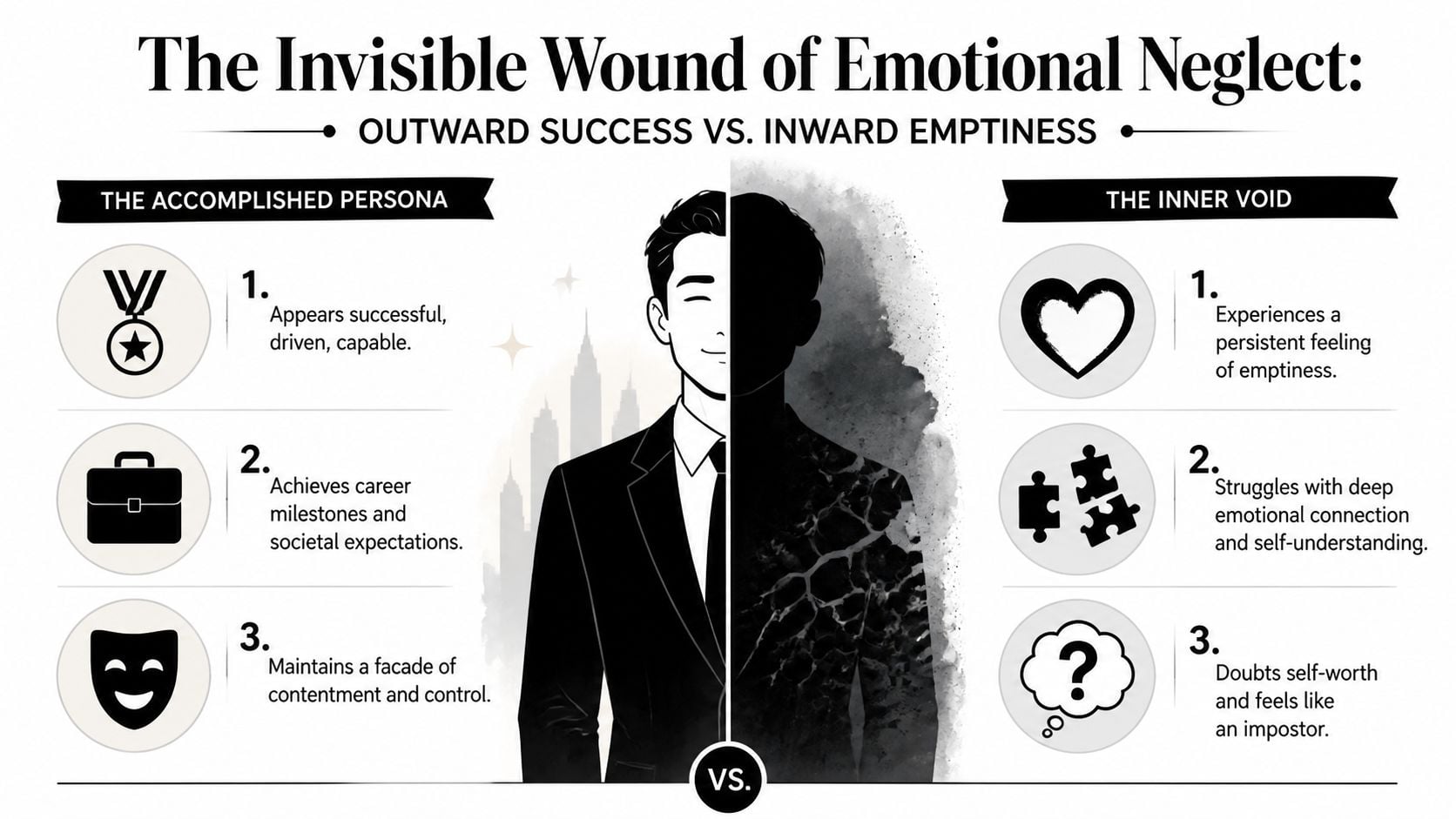
I’ve sat with a lot of people who say some version of the same sentence: “Nothing terrible happened, so why do I feel this empty?” They’re often competent, productive, thoughtful, and exhausted by a pain they can’t quite justify.
That confusion has a name. And once you can name it, you can start working with it instead of arguing with yourself about whether it’s real.
The Invisible Wound of Emotional Neglect
Emotional neglect is hard to spot because it usually isn’t about what happened to you. It’s about what didn’t happen.
Your parent may have provided food, school, rides, rules, and opportunities. The family may have looked stable from the outside. You may even describe your childhood as “fine.” But if the adults around you regularly failed to notice, welcome, make sense of, or respond to your emotional world, something essential was missing.
That missing piece leaves a very particular kind of wound. Not dramatic. Not always easy to explain. But real.
What emotional neglect is, and what it isn’t
I often explain it this way. Emotional abuse is like poisoning a plant. Emotional neglect is like failing to water it.
Both harm growth. But one leaves clearer evidence. The other leaves you wondering whether the plant was just weak to begin with.
That’s why adults who grew up with emotional neglect often minimize it. They say:
- “My parents loved me.” They may have.
- “They worked hard for us.” That can be true.
- “I wasn’t hit or screamed at.” Also true.
None of that cancels the absence of emotional attunement.
Here’s the clean distinction:
| Characteristic | Emotional Neglect (A Sin of Omission) | Emotional Abuse (A Sin of Commission) |
|---|---|---|
| Core dynamic | Emotional needs are missed, dismissed, or left unsupported | Emotions are attacked, shamed, manipulated, or punished |
| What the child learns | “My feelings don’t matter much” | “My feelings are dangerous or bad” |
| Typical evidence | Often subtle, diffuse, hard to point to | More concrete incidents or patterns |
| Adult effect | Emptiness, numbness, self-disconnection, low needs | Fear, shame, hypervigilance, self-attack |
Many people have both. But neglect deserves its own language because the healing task is different. You’re not only recovering from injury. You’re learning skills and inner experiences you were never properly given.
Why this matters more than most people realize
Neglect is not rare. In the United States, neglect was the most common form of child maltreatment in 2023, with 377,742 victims, accounting for 72% of all cases, according to American SPCC child maltreatment statistics.
That number covers the broader neglect category, not just emotional neglect. But it tells you something important. The failure to meet a child’s needs often hides in plain sight.
Practical rule: If your pain is hard to prove, that doesn’t make it less real. It usually means the injury was relational, cumulative, and normalized.
This gets even trickier in high-achieving families. Success can hide neglect well. Good schools, structured schedules, polished manners, and high standards can create the appearance of health while emotional life goes mostly unaddressed.
A lot of adults from these homes don’t think, “I was neglected.” They think, “Why can’t I relax?” or “Why do I feel fake when people get close?” or “Why do I perform so well and still feel disconnected?”
If that’s you, you’re not broken. You may be describing the long afterlife of unmet emotional needs.
If the phrase fits, it often connects with a broader pattern of emotional disconnect in everyday life that people have been carrying for years without language for it.
Recognizing the Echoes in Your Life
Emotional neglect becomes visible when you line up childhood adaptation with adult behavior. Then the pattern starts to make sense.

A major review estimated the global self-reported prevalence of child emotional neglect at 18.4%, based on 16 samples with 59,655 participants, as reported in this meta-analysis on child maltreatment prevalence. That matters because many adults still think their experience is too vague or too uncommon to count.
Then and now
Here are some of the most common pairings I see.
-
As a child, you learned not to bring distress to adults. Maybe no one helped you make sense of fear, grief, embarrassment, or disappointment.
As an adult, you become “easy,” self-contained, and oddly uncomfortable when you need support. -
As a child, your inner world didn’t get much response. You had to carry feelings alone.
As an adult, you know how to function, but not always how to identify what you feel. -
As a child, praise may have centered on performance. Achievement got attention. Emotion got less.
As an adult, you feel valuable when you’re useful, productive, or impressive, and lost when you’re being human. -
As a child, vulnerability may have been met with fixing, minimizing, or silence.
As an adult, closeness can feel both wanted and threatening. -
As a child, you adapted by needing less.
As an adult, you may call yourself independent when what’s really happening is counter-dependence.
A familiar client story
I’ll call her Sarah.
Sarah was sharp, reliable, high-performing, and respected at work. No obvious crisis. Good income, good reputation, solid habits. But in private, she kept circling the same question: “Why does my life look fine while I feel flat inside?”
Her childhood didn’t include the kind of stories people usually think “count” as trauma. Her parents were responsible. They valued education. They kept things moving. But they didn’t do much with emotion. If she was upset, she got advice. If she was hurt, she got perspective. If she was scared, she got reassurance without real attunement.
So she became efficient.
She learned how to solve, perform, anticipate, and stay composed. She did not learn how to notice herself in a deep way.
The adult symptom is often the childhood solution that outlived its usefulness.
That’s why emotional neglect can feel so confusing. The traits that helped you survive in one environment can make you feel lonely in another.
Signs people miss because they don’t look dramatic
In high-functioning adults, emotional neglect often sounds ordinary:
- “I don’t know what I need.” Not indecision. Disconnection.
- “I hate burdening people.” Not always kindness. Sometimes an old adaptation.
- “I’m not emotional.” Sometimes true temperament. Sometimes learned shut-down.
- “I’m fine on my own.” Sometimes strength. Sometimes protection.
- “I should be grateful.” Often a way to silence your own reality.
If you’re seeing yourself here, don’t rush to diagnose every trait. Context matters. Temperament matters. Family culture matters. But if these patterns carry a specific emptiness, strain, or chronic self-erasure, emotional neglect is worth taking seriously.
How the Past Shows Up Today
You may look calm, capable, and well-adjusted from the outside, yet still feel strangely absent from your own life when emotion enters the room. That gap is one of the clearest adult signatures of emotional neglect, especially in families that looked stable, responsible, and successful.

Research has linked childhood emotional neglect with higher depression severity in adulthood, including findings that it explained a meaningful share of depression score differences in one study on childhood emotional neglect and depressive symptoms. That kind of finding does not reduce your life to a statistic. It clarifies that an experience can be quiet, common, and still have lasting psychological effects.
What I want people to understand is this: emotional neglect often shows up less as a memory and more as a pattern. You do not always think, “I was neglected.” You think, “Why do I shut down when someone asks what I feel?” “Why do I get tired after basic closeness?” “Why do I function well and still feel off?”
Your body often knows before your mind does
Emotional regulation starts in relationship. A child gets upset, and a regulated adult notices, names, and helps organize the experience. Repeated enough times, the child begins to do that internally.
If that process was inconsistent or missing, the adult nervous system often compensates in ways that look deceptively ordinary. Some people disconnect from feeling until hours later. Some stay productive while carrying constant muscle tension, shallow breathing, gut discomfort, headaches, or a flat, heavy fatigue they cannot explain. Others get flooded fast, then go blank.
Common phrases sound like this:
- “I don’t know what I’m feeling until it’s already passed.”
- “I can explain the situation, but I can’t locate my reaction.”
- “I’m fine, but my jaw is tight all day.”
- “I shut down in hard conversations, then replay them all night.”
These are not random quirks. They often reflect an underdeveloped link between sensation, emotion, and meaning.
A practical starting point is to interrupt the speed of that pattern. Once or twice a day, pause for sixty seconds and ask three concrete questions: What is happening in my body? What emotion might fit this sensation? What does this feeling seem to want from me, comfort, space, protection, rest, contact, or expression? The goal is accuracy, not drama.
Relationships start to revolve around safety strategies
Adults who grew up without enough emotional attunement often become highly skilled at staying useful. They solve problems. They anticipate needs. They keep the peace. They offer competence instead of contact because competence got a better response early on.
That creates predictable strain in intimate relationships. You may want closeness and still tense up when someone gets emotionally near. You may pick partners who are hard to reach because the distance feels familiar. You may become the organized, reliable one and then feel unseen, resentful, or alone.
I see this often in high-achieving adults. Their life works on paper. Their inner life does not feel like home.
That pattern can overlap with what many people describe as learned helplessness in close relationships and self-trust. Repeated emotional nonresponse can train a person to expect very little from reaching out, then call that expectation independence.
One relational repair step helps more than people expect. In low-stakes moments, practice stating a present-tense inner truth without overexplaining it. “I’m more tired than I realized.” “I need a minute to find words.” “Part of me wants closeness and part of me is bracing.” That kind of language builds tolerance for being known while staying grounded.
Your self-concept can form around what was missing
Emotional neglect becomes especially hard to identify in “good” families. There may be no obvious villain. There may be love, provision, education, structure, and decent intentions. What is missing is harder to photograph. Your inner world was not met with enough curiosity, reflection, or room.
People often turn that absence into a character judgment.
They decide they are too sensitive, too distant, too needy, too cold, too much work, or defective at intimacy. In practice, I usually find something more specific. The person was not taught how to recognize an internal state, stay with it, and bring it into relationship without shame.
Consider a familiar adult pattern. Someone performs well at work, handles real responsibility, and rarely asks for help. Their partner asks, “What’s going on with you lately?” They say “nothing” because they cannot identify it in the moment. Two hours later, it comes out as scrolling, irritability, overworking, snacking, withdrawal, or sleep that does not restore them.
The feeling was there. Access to it was not.
That distinction matters because it creates room for agency. If the problem were a character flaw, shame would make sense. If the problem is an old adaptation, the work is different. Build body awareness. Practice naming states before they become behaviors. Let trustworthy people respond to something real and small. Repetition changes this.
The past often lives in the present through automatic responses that once made sense. Once you can see the pattern clearly, you can start responding to yourself in a new way.
Your Path to Reconnection
You may have a competent adult life and still feel strangely unreachable to yourself.
That is common in emotional neglect, especially in families that looked stable from the outside. There may have been food, school, routines, achievement, and very little obvious chaos. What was missing was harder to see. Your inner experience did not get enough attention, help, or room. Reconnection starts when you stop arguing with that reality and begin practicing different responses.

Structured tools can help with that shift. The Childhood Trauma Questionnaire, including its emotional neglect subscale, is widely used to organize reflection and give shape to experiences people often minimize. Use it as a prompt for honesty, not as a verdict on whether your pain qualifies.
Make the invisible specific
People affected by emotional neglect often lose time debating whether anything “bad enough” happened. That debate keeps them stuck.
The more useful question is: what was absent, and what did that absence train me to do?
Start with four brief prompts:
- What happened when I was upset as a child?
- Which feelings were welcomed, and which were brushed aside?
- What did I learn to hide to keep things calm or acceptable?
- What feels hard to ask for in close relationships now?
Write one or two sentences for each. Short is better. You are looking for patterns, not a polished story.
Start with sensation, not explanation
Many high-functioning adults try to solve emotional neglect through insight alone. In the office, they can explain everything. In a hard moment with a partner, child, or friend, they go blank, get sharp, overwork, or leave the room.
That pattern makes sense. If no one helped you notice and tolerate your inner world early on, your body often registers strain before your mind can name it.
Use that fact.
Here are three practices I give clients because they are simple enough to repeat when real life is happening:
-
Feet on floor check-in
Put both feet on the ground. Press down gently for ten seconds. Notice whether you feel steady, braced, heavy, restless, collapsed, or numb. -
Chest and stomach scan
Place one hand on your chest and one on your stomach. Breathe normally. Ask, “What is here right now?” If emotion words do not come, use body words first: tight, warm, hollow, buzzing, flat, shaky. -
Orient to the room
Look around slowly. Name five objects. Notice light, color, distance, and sound. This helps when turning inward feels foggy or too intense.
I usually tell people to drop the question, “What is wrong with me?” Ask, “What is happening in me right now?” That small change reduces shame and increases usable information.
Build language that leads to action
Insight helps. So does precision.
Try this sentence structure in real time:
- I feel…
- It makes sense because…
- What I need next is…
For example: “I feel shut down. It makes sense because that conversation felt exposing. What I need next is five minutes alone and then I can come back.”
This is how emotional clarity becomes relational clarity. You are no longer asking another person to guess your state, and you are no longer forcing yourself to perform calm when you are not calm.
If this feels awkward, that is normal. New emotional language often feels clumsy before it feels natural. A practical support is this emotion regulation checklist you can use day to day, especially if you tend to confuse functioning with being okay.
Practice reconnection in relationships, not only alone
Private reflection matters, but emotional neglect is also a relational injury. Some repair has to happen with another person.
Start small. Tell a trustworthy person one true thing before it becomes a crisis. Say you are disappointed instead of saying “I’m fine.” Ask for ten minutes of company, a slower conversation, or a pause before problem-solving. Notice who gets curious, who gets impatient, and who makes your inner world feel like an inconvenience.
That information matters.
Many people who grew up in “good” families carry a hidden rule: do not have needs that disrupt the system. Healing often requires breaking that rule in measured ways. Not through dramatic confrontation. Through repeated, grounded honesty.
What helps, and what sets people back
A few approaches consistently help:
- Short, repeated check-ins: two minutes done daily works better than rare self-reflection marathons
- More specific feeling words: irritated, exposed, lonely, ashamed, relieved
- Body-based settling: grounding before analysis
- Small relational risks: letting safe people see a little more of what is true
- Grief: making room for the sadness and anger that come with recognizing what was missing
A few approaches tend to slow progress:
- Explaining instead of feeling: some people can describe their childhood for an hour and still not know what they feel today
- Forcing big emotional release: intensity is not the same as repair
- Waiting until you can do it perfectly: skill grows through repetition
- Using shame as motivation: shame may produce compliance, but it does not build connection
Repair usually looks ordinary from the outside. You notice tension sooner. You ask for help earlier. You recover faster after conflict. You feel more present in your own life.
That is real change.
If you’re starting to recognize how deep emotional neglect runs in your story, working with a licensed therapist can shorten the road considerably. Online platforms like Talkspace can match you with a licensed therapist usually within 24 hours, work in all 50 states, accept most major insurance, and let you message your therapist between sessions when something comes up that you don’t want to forget. I mention them by name because they’re the platform I’d point a student or coaching client to today — the path from “I think I need help” to “I’m in a session” is short enough to actually walk.
When to Seek a Guide for Your Journey
Self-help can take you far. Sometimes it should not take you alone.
If emotional neglect has shaped your life in deep ways, support can help you move faster and with less confusion. That’s especially true if you become overwhelmed when you turn inward, keep repeating painful relationship patterns, or understand the issue intellectually but still can’t change it in practice.
Signs it’s time to get help
Consider working with a therapist or skilled guide if:
- Your emotions feel either unreachable or unmanageable. You’re numb most of the time, or you swing quickly into shutdown, panic, rage, or collapse.
- Relationships keep hitting the same wall. You withdraw, overfunction, attach to unavailable people, or feel chronically unseen.
- Your body carries the stress. Sleep, appetite, tension, irritability, and exhaustion become part of the pattern.
- Parenting activates old pain. Your child’s needs, tears, dependence, or anger trigger reactions you don’t fully understand.
Effective support for emotional neglect usually includes attachment work, emotional literacy, nervous system awareness, grief, and practice with new relational experiences. It should help you build skills, not just retell history.
Healing also protects the next generation
This matters for your children too.
Research on intergenerational patterns found that a father’s own adverse childhood experiences predicted emotional neglect in his children, with each paternal ACE associated with a 0.343-point increase in a child’s emotional neglect score, according to this study on intergenerational transmission of emotional neglect.
That doesn’t mean fate is fixed. It means patterns transfer unless someone interrupts them.
Healing is not only personal relief. It’s a change in what your children experience when they come to you with fear, sadness, excitement, shame, and need.
If you’re a parent who recognizes the pattern, don’t wait until you feel fully healed to begin acting differently. Start with repair. Start with naming feelings out loud. Start with staying present for emotion instead of rushing to solve it.
A child does not need a perfect parent. A child needs a parent who can increasingly notice, respond, and reconnect.
Conclusion and Your Next Step
If you’ve spent years feeling empty, hard on yourself, oddly disconnected, or emotionally underfed despite a life that looks functional, you’re not imagining it. Emotional neglect is real precisely because it is subtle. It leaves you with absence, not always with evidence.
The good news is that what was missed can still be built.
You can learn to notice your body instead of overriding it. You can develop emotional vocabulary instead of defaulting to “fine.” You can stop measuring your worth only by output. You can become more reachable to yourself, and therefore more reachable to the people you love.
That work takes patience. It also creates a kind of relief that productivity alone never gives.
You do not need to prove your pain to start caring for it. You only need to tell the truth about what has been missing.
I write about the patterns most families never get language for, and what to do once you finally see them. My next pieces dig into the difference between self-care and self-reparenting, how high-achieving parents accidentally train emotional shutdown, and the repair conversations that help kids feel safe. If you want the next one in your inbox, join David Pexa.
A note on affiliates: This article includes affiliate links to platforms I’ve vetted and would recommend to my own clients and students. If you start with a recommended service through a link here, I may earn a small commission — at no extra cost to you. I only mention what I’d actually point you to in person. The recommendation comes first; the relationship is disclosed second.
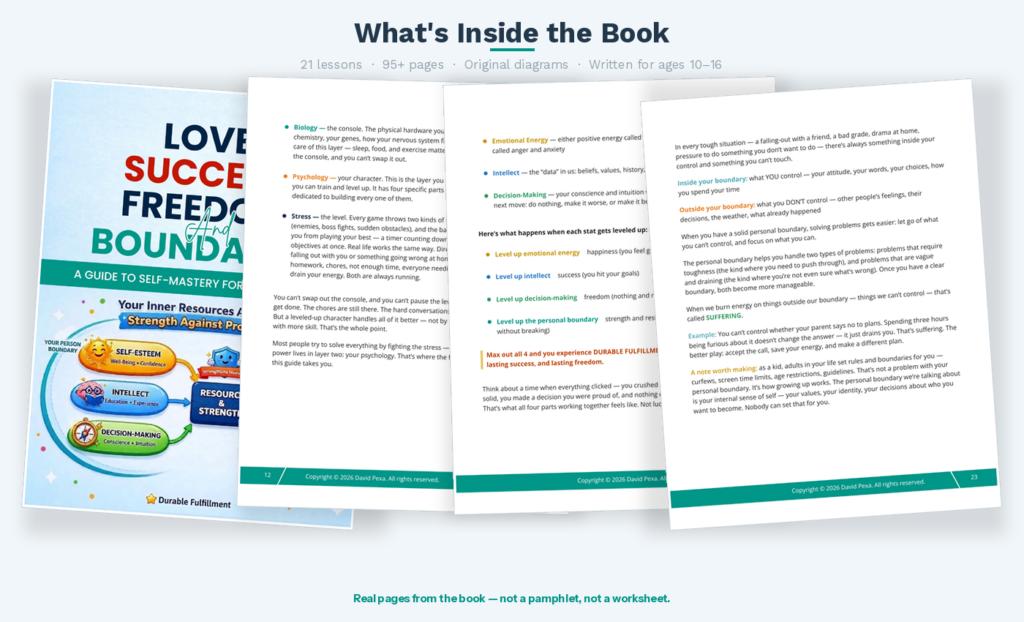
If this resonates, the full framework lives in Love, Success, Freedom and Boundaries.
A practical playbook for raising emotionally resilient kids — and breaking the patterns you didn’t choose to inherit.
Get the ebook →