



I’ve sat with parents who lower their voice when they say it, like saying it too clearly will make it true. “He used to try. Now he just shrugs.” The fear under that sentence is always the same. You’re not just worried about one bad week. You’re wondering if your child is disappearing right in front of you.
If that’s where your head is, your concern makes sense.
When a child stops raising their hand, stops starting homework, stops texting friends back, or stops arguing for themselves, parents often reach for the wrong explanation first. Laziness. Defiance. Screens. Attitude. Sometimes those are part of the picture. But often there’s something more important underneath it. A learned pattern of powerlessness.
That pattern has a name. Learned helplessness.
And once you can see it, a lot of confusing family behavior starts making sense. The good news is that this is not a fixed identity. It’s not who your child is. It’s a response. Responses can be changed. If you’ve already been doing the hard work of trying to understand what’s underneath the behavior, you’re closer than you think. This is the same deeper shift I talk about when I write about overcoming limiting beliefs.
That Feeling When They Just Give Up
You probably know the moment I mean.
Your child hits one snag and folds fast. A math assignment gets hard and they say, “I can’t do this,” before they’ve really started. A friend doesn’t text back and suddenly they “knew nobody liked them anyway.” You suggest one small next step and they act like you’ve asked them to move a mountain.
What makes this so painful is that you can often see ability still sitting there. That’s what drives parents crazy. You know your kid can think. You know they can adapt. You’ve watched them solve harder problems before. So when they stop trying, it doesn’t feel logical. It feels frightening.
What parents usually feel, but rarely say out loud
A lot of parents carry some version of this internal loop:
- Fear: If they give up this easily now, what happens when life gets harder?
- Frustration: Why won’t they do the things that would help?
- Self-doubt: Am I pushing too hard, or not hard enough?
- Grief: I miss the version of them who seemed more alive
The behavior looks like quitting. The experience underneath often feels like futility.
That’s an important distinction. A child in learned helplessness doesn’t always think, “I refuse.” More often the message is, “It won’t matter.”
When you understand that, your response changes. You stop treating every shutdown like a discipline problem or a motivation problem. You start asking a better question. Where did they learn that effort and outcome aren’t connected anymore?
That question creates hope, because learned helplessness is learned. Which means it can be unlearned.
The Invisible Cage They Can’t See
The original research still matters because it captured the core mechanism cleanly. In 1967, Martin Seligman and Steven Maier found that dogs exposed to inescapable shocks later often didn’t try to escape even when escape was available. In that experiment, 67% of the helpless group passively endured the shocks, while the control group learned to escape quickly, showing that the passivity was a learned response to perceived lack of control, not an absence of ability or instinct, as summarized in this overview of learned helplessness.

That’s the piece families need to hear. Learned helplessness is not stupidity. It is not lack of character. It is not proof that someone secretly wants to fail. It happens when the brain starts encoding a brutal lesson: my actions don’t change what happens.
What that looks like in a family
Kids don’t need a lab to learn this. Family life gives plenty of opportunities.
A child studies and still feels lost. They try to explain themselves and get interrupted. They take social risks and get rejected. They ask for help and feel misunderstood. Or they live in a home where the emotional weather changes fast, so they can’t predict what leads to safety, praise, or conflict. After enough repetitions, some children stop experimenting. They conserve energy. They go passive.
Three patterns usually show up.
Motivation starts to drop first
The first thing parents notice is often reduced effort. The child delays, avoids, or gives up early. They may say “whatever,” but underneath that word is often protection. If trying has started to feel useless, not trying feels safer.
This is why lectures about effort often flop. They assume the child still believes effort pays off.
Thinking gets narrower
Learned helplessness also affects how someone reads a situation. They stop noticing exits. They miss options. Even when a solution is close, they can’t feel it as real.
You see this at home when a child gets stuck on one interpretation. “I failed this quiz, so I’m bad at school.” “They didn’t invite me, so nobody wants me around.” “You’re asking me again, so I already messed it up.”
Practical rule: Don’t confuse “they can’t see a way through” with “there is no way through.”
Emotion goes flat or brittle
Some kids get teary. Some get angry. Some go strangely blank.
That emotional blunting matters. In the research tradition that followed the original work, helplessness was linked with a cluster of motivational, cognitive, and emotional problems that overlap heavily with depression. So when a child seems numb, checked out, or impossible to activate, I take that seriously. Not because it means catastrophe. Because it means the system may be conserving itself.
A useful family reframe is this: your child may not be trapped by the problem itself. They may be trapped by the belief that nothing they do can change it.
How Learned Helplessness Shows Up at Home
One reason learned helplessness gets missed is that it doesn’t always look dramatic. Sometimes it looks like a smart teenager saying “I don’t care.” Sometimes it looks like a younger child clinging to you at the birthday party door. Sometimes it looks like a parent who has stopped making moves in their own life.

The teenager who stopped trying in one subject
A teen struggles in chemistry. At first they ask questions. Then they stop. They leave problems blank, not because they know nothing, but because getting it wrong feels like proof of something bigger. When a parent says, “Just try a few,” the teen hears, “Go collect more evidence that you’re incapable.”
Notice the shift. The subject is no longer just chemistry. It has turned into identity.
The child who gives up socially
A younger child gets left out a few times. Maybe not bullied outright. Just enough awkward moments, enough missed invitations, enough failed attempts to join in. Now they say they don’t want to go, don’t want to ask, don’t want to try.
Parents sometimes interpret this as preference. “Maybe they’re just shy.” Sometimes that’s partly true. But sometimes the child has started predicting pain and futility, and avoidance is how they manage both.
The parent who feels stuck too
This pattern isn’t only in kids. A parent who has been dismissed at work for a long time may stop speaking up. They may delay applications, stop negotiating, or convince themselves that every workplace will be the same. Then that discouraged posture leaks into family life. Less energy. Less clarity. Shorter fuse.
Children notice this more than adults think. Family systems transmit beliefs about agency all the time.
The important distinction most families miss
Not all helplessness starts with a clear external event. Learned helplessness can emerge without trauma. It can originate from depression-driven low self-efficacy, where a child interprets situations negatively even when the evidence is mixed, which changes the intervention path because you’re not only addressing past powerlessness but also distorted expectations in the present, as described in this explanation of learned helplessness and depression-linked passivity.
That distinction matters at home. If a child has been trapped by bullying, chaos, or repeated failure, you address the environment and rebuild safety. If depression is driving the helplessness, you also need to work directly with the child’s explanatory style, their self-efficacy, and often their mood symptoms.
A simple way to sort the pattern is to ask:
| Situation | More likely external-powerlessness pattern | More likely depression-linked pattern |
|---|---|---|
| Trigger | Specific events or settings | Diffuse negativity across situations |
| Belief | “Nothing works there” | “Nothing I do works anywhere” |
| Intervention focus | Safety, context change, support | Attribution retraining, mood support, structure |
This isn’t a diagnosis tool. It’s a practical lens. It helps you stop arguing with the behavior and start locating the engine under it.
The Hidden Logic of Giving Up
In 1978, the theory was updated in a way that helps families enormously. The new model asked a smarter question. Why do some people get discouraged by one setback and recover, while others turn one bad experience into a whole way of seeing themselves and life?
The answer was attributional style. In plain English, that means how a person explains bad events.
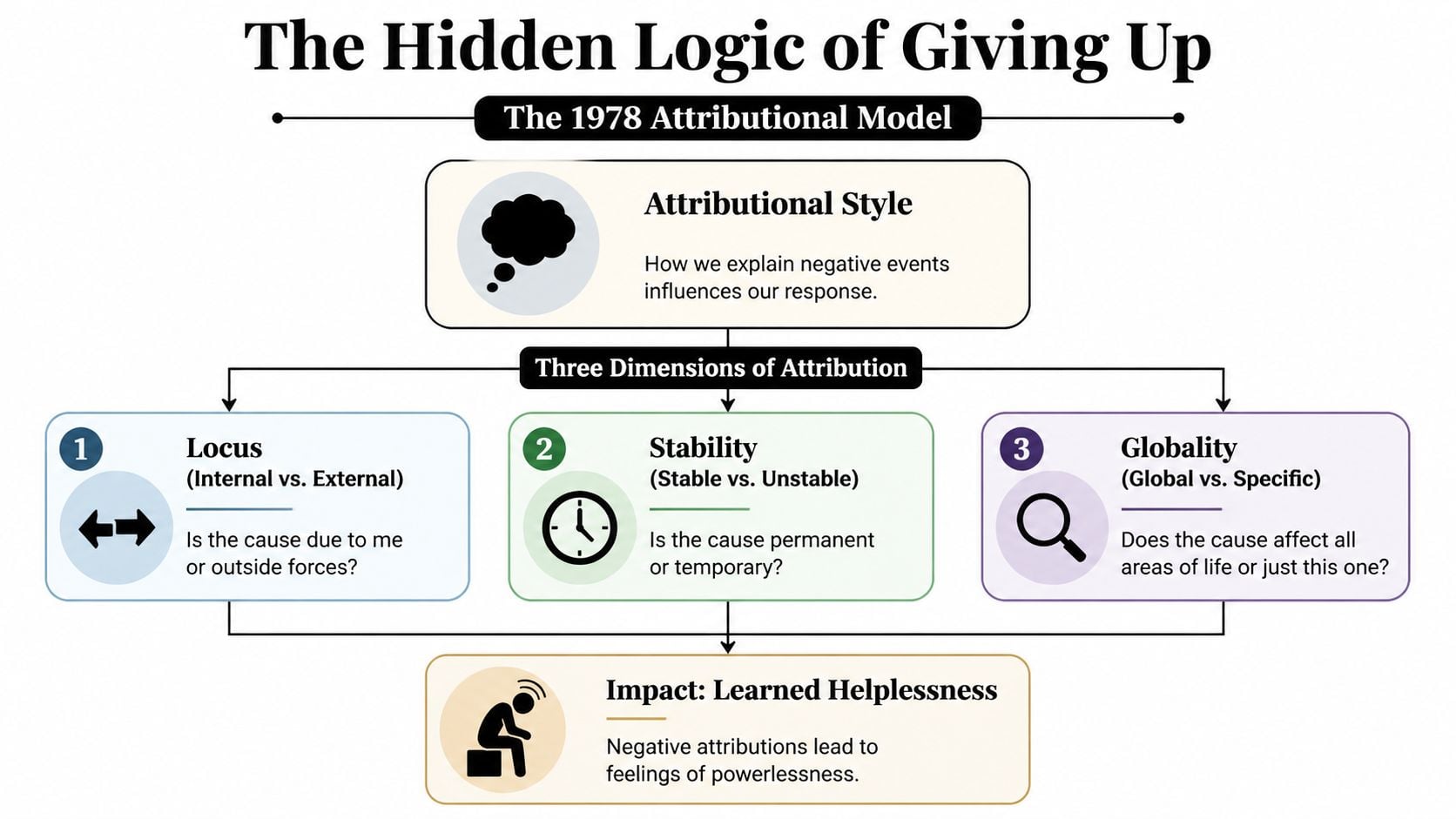
The reformulation showed that when people explain failure as stable and global, helplessness tends to last longer and spread wider. In studies, people with that explanatory style generalized passivity to new, unrelated tasks in 60 to 70% of cases, which helps explain why one defeat can spill into many parts of life, according to this research review on the attributional model.
The three explanations that matter most
A child doesn’t need to know this language for it to run their behavior. But you should know it.
Internal or external
This is about where the blame lands.
Internal sounds like this: “I failed because I’m stupid.”
External sounds like this: “That test was confusing, and I didn’t study the right way.”
Internal attributions can become corrosive fast when they’re also rigid. Not every internal explanation is bad. Sometimes personal responsibility is healthy. The problem is when the child makes themselves the entire cause of every painful outcome.
Stable or unstable
This is about time. Is the problem permanent, or can it change?
Stable sounds like: “I’m always going to be like this.”
Unstable sounds like: “I had a rough week,” or “I haven’t learned this yet.”
Stable explanations make effort feel irrational. Why work if the cause is fixed?
Global or specific
This is about scope. Does the child think the problem belongs to one area, or all areas?
Global sounds like: “I mess everything up.”
Specific sounds like: “I’m struggling with this friend group,” or “writing essays is hard for me right now.”
Global explanations are where helplessness really expands. This is the child who goes from one social bruise to “nobody likes me,” or from one hard class to “school just isn’t for me.”
A setback becomes dangerous when the child turns it into a verdict about self, permanence, and everything.
How this sounds in the kitchen, car, and hallway
Parents usually hear the model before they understand it.
- Internal: “It’s my fault.”
- Stable: “This is never going to get better.”
- Global: “I’m bad at everything.”
That trio is the hidden logic of giving up.
When I hear that pattern, I don’t argue first. I slow down and get precise. “Which part feels hard?” “Since when?” “Only in math, or in other classes too?” “Was there any moment this week it felt a little different?” Precision starts breaking the spell. The brain in helplessness talks in absolutes. Recovery usually starts with specifics.
That’s also why mindset advice can fail when it’s too generic. Telling a child to “be positive” skips the actual structure of the thought. If you want a useful companion framework, growth vs fixed mindset emerges as practical. Not as a slogan, but as a way to challenge permanence and overgeneralization.
What does not work
A few common parent responses accidentally deepen helplessness:
- Over-reassuring: “You’re amazing, you’ll be fine.” Kind, but often too disconnected from the child’s lived evidence.
- Over-explaining: Long speeches usually bounce off a shut down nervous system.
- Taking over: Finishing the task for them may reduce immediate distress while confirming they can’t do it.
- Debating feelings: If they say “There’s no point,” and you respond with logic alone, you’ll miss the learned expectation underneath.
What helps is a tighter move. Name the pattern. Shrink the scope. Build one experience of effective action.
Watching your child stop reaching for things wears on the people who love them. If you’re feeling worn down, isolated, or unsure how to be steady when they aren’t, your own support matters too. Online platforms like Talkspace can match you with a licensed therapist usually within 24 hours, work in all 50 states, accept most major insurance, and let you message between sessions when a hard moment hits. I mention them by name because they’re where I’d point a parent or coaching client today — the path from “I think I need help” to “I’m in a session” is short enough to actually walk.
Four Ways to Rebuild Agency Starting Today
The most encouraging part of this conversation is that helplessness is not just psychological. It’s behavioral and neurobiological, which means change can happen through repeated lived experiences, not just insight. Research has linked learned helplessness with hyperactivation in the dorsal raphe nucleus, a threat-related brain response associated with passive coping. Work that builds learned controllability helps activate the ventromedial prefrontal cortex, which supports regulation and a renewed sense of efficacy. In that research line, four-week protocols designed around controllable action normalized DRN activity and improved self-efficacy, as reviewed in this neuroscience paper on learned controllability.

That sounds technical, but the family translation is simple. The brain changes when a person repeatedly experiences, “I did something, and it mattered.”
Start with thoughts, but don’t stop there
If your child says, “There’s no point,” don’t answer with a pep talk. Try a short attribution check.
Ask:
- “What are you telling yourself this means?”
- “Is that about this one situation, or about you as a person?”
- “What’s one other explanation that could also be true?”
You’re not trying to win an argument. You’re helping them loosen stable, global conclusions.
If you want more structure for this kind of thinking work, my article on cognitive behavioral therapy techniques can help you turn this into a repeatable conversation instead of a one-off rescue attempt.
Use the body to interrupt shutdown
A helpless child often looks “unmotivated,” but sometimes the body is already in a freeze-leaning state. Talking won’t reach them well there.
Try this sequence:
- Name the body first: “What’s happening in your chest, stomach, face, or hands right now?”
- Shrink the action: “Don’t finish the assignment. Just sit up and open the page.”
- Add orientation: Ask them to look around the room and name a few neutral objects.
- Complete one physical action: Stand up, drink water, move to the table, write the date
This sounds small because it is. Small is the point. You’re helping the nervous system move from collapse to participation.
Sometimes the first win is not solving the problem. It’s getting the body out of surrender.
Design success on purpose
Parents often wait for confidence before asking for action. Usually it works the other way around. Action, especially successful action, is what starts rebuilding confidence.
So don’t assign “try harder.” Design a task with a high chance of completion.
For example:
| Situation | Unhelpful ask | Better agency-building task |
|---|---|---|
| Homework shutdown | “Finish the whole worksheet” | “Do the first problem with me nearby, then stop and assess” |
| Social withdrawal | “Just go talk to them” | “Text one friend one simple question” |
| Room chaos | “Clean all of this” | “Put clothes in one basket for three minutes” |
This is scaffolding, not coddling. The difference is whether the task gives the child a real experience of influence.
Change your parenting position
When a child is stuck, parents often swing between two roles. Drill sergeant or rescuer. Neither builds agency well.
A better role is scaffold.
That means you provide structure without stealing authorship. You might sit nearby, break the task down, ask better questions, and regulate your own tone. But the child still does the doing.
Here’s what that sounds like in practice:
-
Instead of fixing: “Let me do it.”
Try: “Show me where you get stuck first.” -
Instead of pushing: “You have to do this now.”
Try: “What’s the smallest step that still counts as starting?” -
Instead of praising traits: “You’re so smart.”
Try: “You stayed with that longer than you wanted to, and it changed something.”
Notice what’s happening there. You’re tying effort to effect. That’s the opposite of helplessness training.
The Goal Isn’t Fixing It’s Connecting
Most parents come into this problem wanting the behavior to stop. That’s understandable. You want your child to do the work, answer the text, get out of bed, take the risk, care again.
But if you only chase compliance, you can miss the deeper repair.
The task is to help your child trust two things again. First, that their actions can matter. Second, that they don’t have to face that rebuilding alone. That’s why the best response to learned helplessness isn’t a perfect script. It’s a relationship stance. Calm enough to hold their fear. Clear enough not to join their fatalism. Practical enough to keep giving them experiences of agency.
A child who feels powerless doesn’t just need more pressure. They need evidence. Evidence that one step can lead somewhere. Evidence that struggle doesn’t define identity. Evidence that home is a place where hard things get broken down, not turned into character judgments.
If you start working this way, the changes are often subtle before they’re obvious. A little less shutdown. A little more initiation. A little less “why bother.” Those moments matter. They’re not small. They’re the beginning of restored authorship.
And if you’re the one in the family who’s feeling stuck too, this applies to you as much as to your child.
A note on affiliates: This article includes affiliate links to platforms I’ve vetted and would recommend to my own clients and students. If you start with a recommended service through a link here, I may earn a small commission — at no extra cost to you. I only mention what I’d actually point you to in person. The recommendation comes first; the relationship is disclosed second.
If this resonates, the full framework lives in Love, Success, Freedom and Boundaries.
A practical playbook for raising emotionally resilient kids — and breaking the patterns you didn’t choose to inherit.
Get the ebook →