


Summary: Your Child’s Anger Isn’t the Problem. Here’s What Is.. A framework for understanding what’s really going on — and what to do about it.
Child anger is one of the most misunderstood signals in family life. Here’s what it actually means — and what to do about it.
Your daughter slams her door so hard the frame shakes. Your son throws his controller across the room. A six-year-old screams at you in the grocery store, face red, fists balled, over something you can’t even identify.
And your first instinct—the one that fires before you can think—is to stop the anger.
That instinct makes sense. Anger is loud. It disrupts. It scares you, even when you know it shouldn’t. So you address the volume: the yelling, the slamming, the hitting. You set a consequence. You try to calm them down. Sometimes both at once, which works about as well as pressing the gas and the brake at the same time.
But here’s what most of us were never taught: anger is almost never the first thing that happened inside your child. It’s the last thing. The loudest thing. The only signal their system knows how to broadcast at full volume.
And if you only ever respond to the broadcast, you will keep having the same fight on different days, in different rooms, for years. Until one day the fights stop—not because your child learned to regulate, but because they stopped bringing their inner world to you at all.
That’s the real cost. Not the broken controller. Not the slammed door. The silence that comes after a child decides you can’t handle what they actually feel.
What Your Child’s Anger Is Really Telling You
Think of anger the way you’d think of a car’s check engine light. The light isn’t the problem. Something underneath the hood triggered it. You could put tape over the dashboard and the light disappears. The engine still fails.
Your child’s anger works the same way. The outburst is the dashboard signal. The engine problem is something earlier, quieter, and harder to name: embarrassment, rejection, confusion, fear, or the particular kind of overwhelm that comes from having too many feelings and not enough language to sort them.
A child who screams “I hate you!” after being told they can’t go to a friend’s house is almost certainly not experiencing hatred. What’s closer to the truth is something like: I feel powerless and nobody asked what I wanted and I don’t know how to say that so I’ll say the loudest thing I can find.
That’s not an excuse for the behavior. It’s information about what’s driving it. And that distinction—between the signal and what’s underneath it—is the difference between a parent who manages moments and a parent who changes patterns.
Why Children Get Angry Instead of Talking
You have a larger vocabulary for internal experience. When something lands badly at work, you might say “I feel dismissed” or “I’m overwhelmed and need a minute.” Your child—especially between ages 5 and 14—often doesn’t have access to that precision yet. Their emotional vocabulary is still forming.
So their nervous system does what it’s designed to do: it selects the highest-energy available response. Anger is fast, physical, and unmistakable. It gets a reaction. And from your child’s perspective, getting a reaction—even a negative one—is better than being invisible with a feeling they can’t name.
Dr. Dan Siegel’s work on the developing brain describes how the prefrontal cortex—the part responsible for impulse regulation, emotional labeling, and perspective-taking—doesn’t fully mature until the mid-twenties. Your child is literally working with incomplete hardware for the task we’re asking them to perform.
That doesn’t mean you accept destructive behavior. It means you stop expecting a child to regulate an emotion they haven’t yet been taught to identify.
The three feelings anger most often covers
Not every outburst hides the same thing. But in families, three patterns show up more than others:
Shame. A child who feels stupid, clumsy, or “wrong” almost never says “I feel ashamed.” They get angry. They blame the teacher, the sibling, the game, or you. The anger creates distance from a feeling they can’t tolerate. And here’s what makes this one dangerous: if we punish the anger without ever naming the shame underneath it, the shame stays. It just learns to hide better. And a child who learns to hide shame doesn’t grow out of it. They build a personality around it.
Fear. Social fear—rejection, exclusion, not belonging. Academic fear—failing, being seen as incapable. Family fear—conflict between parents, unpredictability at home. Fear in children rarely looks like fear. It looks like defiance, irritability, or explosive reactions to minor triggers. The minor trigger is just the last weight on a system that was already at capacity. We see the explosion. We miss the tremor that preceded it.
Powerlessness. Children control very little of their own lives. Where they go, what they eat, when they sleep, who they spend time with—most of it is decided for them. Usually this is fine. But when a child is already stressed, even small losses of control can feel unbearable. The anger is an attempt to reclaim some sense of agency. The method is destructive. The need behind it is completely human.
Practical rule: When your child explodes, try asking yourself one question before you respond: Is this anger—or is this shame, fear, or powerlessness wearing anger’s clothes?
Common Anger Management Mistakes Parents Make
Most of us default to one of two approaches with an angry child. Both are understandable. Neither is complete.
We suppress it. Consequences, time-outs, removal of privileges. The message: This behavior is not acceptable. Stop. And the behavior might stop—today. But the engine problem underneath is still running. Worse, the child learns that certain feelings are not welcome in this house. Which means they’ll either bury those feelings (and lose access to important internal signals) or escalate them (because suppressed signals eventually find a louder frequency). Neither outcome is what we wanted.
We validate without direction. “I see you’re angry. It’s okay to be angry.” This is better. It creates emotional safety. But it often stops there. The child still doesn’t know what to do with the anger, what’s underneath it, or how to make sense of what just happened inside them. Validation without a framework is warmth without a map. It’s comforting. It’s not enough.
The missing piece is what I call translation—helping a child move from I’m angry to I’m angry because I felt embarrassed and I didn’t know what to do with that.
That isn’t a skill children develop on their own. It’s a skill they learn from someone who can do it first.
How Your Own Anger Affects Your Child
Here’s the part that changes everything—and the part we almost never talk about.
When your child’s anger triggers your own frustration, impatience, or fear, two nervous systems are escalating at the same time. You’re trying to steady someone else while your own ground is shaking. That’s like trying to hold a compass steady during an earthquake.
Most of us were never taught to read our own anger any better than our children read theirs. You might intellectually know that your child’s tantrum isn’t a personal attack. But your body responds as if it is—tight jaw, rising heat, the urge to either control or walk away.
If you act from that state, you get the parenting version of a reactive decision: you lecture, you escalate consequences, you say “It’s not a big deal,” or you shut down. All of which confirm—for a child who was already struggling—that their inner world is too much for the people around them.
That confirmation is the thing that calcifies. Not the tantrum. Not even the punishment. The moment a child concludes: What I feel is a problem for the people I need most.
Practical rule: Your child’s emotional clarity will never consistently exceed yours. If you want them to learn to read what’s underneath their anger, the practice starts with you reading what’s underneath your own.
What Happens When You Understand the Pattern
Imagine a different version of the same Tuesday night.
Your child storms in. The anger is the same. But instead of reacting to the volume, you recognize it as the dashboard light—not the engine. You notice your own body tightening, and you name that to yourself before you speak. You give the moment ten seconds of space instead of ten seconds of correction.
You don’t need to know the exact right thing to say. You just need to be looking at the right layer.
That shift—from reacting to the anger to reading what’s underneath it—changes the trajectory of the conversation. And over time, it changes the trajectory of the relationship. A child who learns that someone can see past the surface of their worst moments is a child who keeps bringing their inner world to you. At twelve. At fifteen. At the ages when it matters most and when most parents have already lost the signal.
That’s what’s actually at stake. Not tonight’s tantrum. Whether your child still trusts you with what they feel when the feelings get harder and the stakes get higher.
Where to Go From Here
This article gave you the lens: anger as signal, not as problem. But seeing the pattern is the first step, not the last one. The harder skill—the one that actually shifts outcomes—is learning to translate what your child’s behavior communicates, in real time, under pressure, with a developing brain on the other side of the conversation.
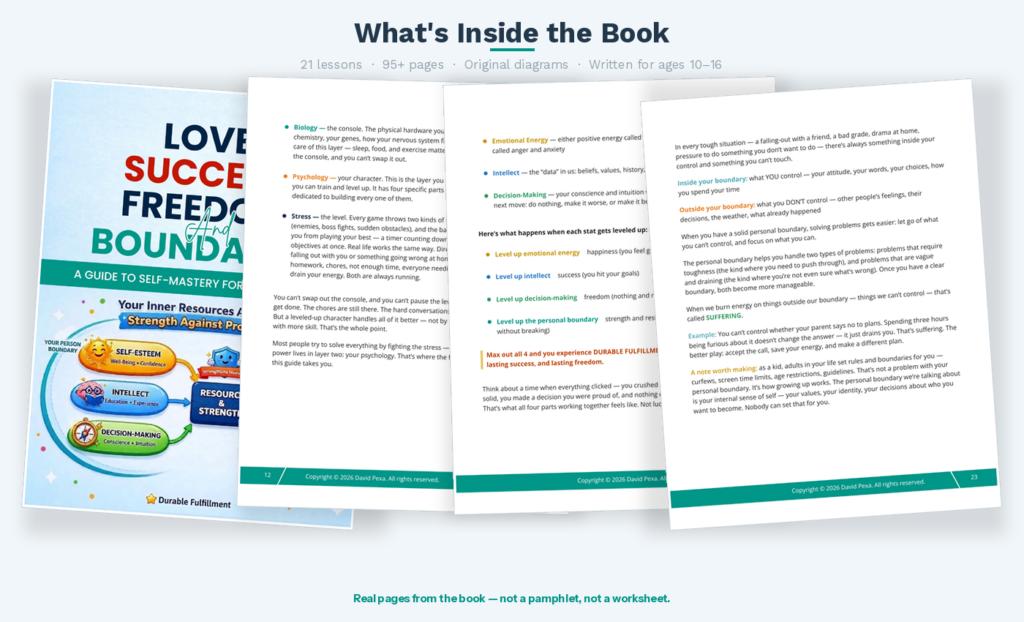
That’s what Love, Success, Freedom and Boundaries builds. It’s a framework for helping young people understand their own psychology—so they stop being at the mercy of patterns they can’t see and start building from a foundation of clarity.
If what you read here changed how you see your child’s anger, the book gives you the complete framework for what to do with that understanding.
Enter your email and get the first chapter sent to your inbox.
Frequently Asked Questions
Why is my child so angry all the time?
Chronic anger in children is almost never about anger itself. It’s usually a secondary emotion covering something more vulnerable — fear, shame, feeling unseen, or a sense of powerlessness. The anger is the alarm, not the fire.
Should I let my child express anger?
Yes, but with structure. The emotion is always valid; the behavior needs boundaries. A child needs to know it’s okay to feel furious and it’s not okay to throw things. Suppressing the emotion teaches them to hide, not to cope.
When should I be concerned about my child’s anger?
If the anger is escalating in frequency or intensity, if it’s accompanied by withdrawal from activities they used to enjoy, or if it’s affecting their ability to function at school or with peers, it’s worth seeking professional support.
Keep Reading
- Behavioral Strengths of a Child: What Your Child’s Worst Behavior Is Really Telling You
- Manipulative Child Behavior Symptoms: What You’re Really Seeing
- Two Different Kids: When Your Child Is Fine at School and Falling Apart at Home
If you process emotions through writing — journaling, drafting hard conversations, putting words to what you’re feeling — the tool I use to draft most of my words is Wispr Flow. It transcribes your voice into clean, edited text in real time, so the friction between thinking it and writing it basically disappears.
Conclusion
Understanding is the first step, but it’s what you do with that understanding that changes things. The ideas in this article aren’t meant to sit in your head — they’re meant to shift how you see your situation and give you something concrete to act on. Start with the one thing that felt most relevant, apply it this week, and notice what changes.
A note on affiliates: This article includes affiliate links to platforms I’ve vetted and would recommend to my own clients and students. If you start with a recommended service through a link here, I may earn a small commission — at no extra cost to you. I only mention what I’d actually point you to in person. The recommendation comes first; the relationship is disclosed second.
If this resonates, the full framework lives in Love, Success, Freedom and Boundaries.
A practical playbook for raising emotionally resilient kids — and breaking the patterns you didn’t choose to inherit.
