



Summary: Self Esteem vs Confidence: Key Differences & How to Build — understanding the signal beneath the surface and what you can actually do about it.
Self-esteem and confidence get used interchangeably, but they’re not the same thing. One is about how you see yourself. The other is about what you believe you can do. The distinction changes everything.
You finish a big project. The client is happy. Your manager praises your work. You can explain your process clearly, defend your decisions, and solve real problems under pressure.
Then someone asks you to lead the next meeting, pitch the next idea, or step into a bigger role, and your stomach drops.
That gap confuses a lot of smart people. You may have real ability and still feel shaky inside. You may trust yourself in one room and doubt your worth the moment you leave it. That’s why self esteem vs confidence matters so much. These two terms get used like they mean the same thing, but they don’t.
When people blur them together, they often try to fix the wrong problem. They chase more achievement when what they need is a healthier relationship with themselves. Or they focus only on healing old emotional wounds when what they really need is more reps, more skill, and more proof.
Why High Achievers Can Still Feel Like Impostors
A lawyer I once worked with had a pattern that looked impressive from the outside. She delivered strong work, handled difficult conversations well, and people came to her for answers. In meetings, she sounded capable. After meetings, she replayed every sentence in her head and assumed she had looked foolish.
That’s the high achiever’s trap. You can be competent in public and still feel fragile in private.

Success doesn’t automatically create self-worth
Many people assume achievement should fix self-doubt. It often doesn’t. Achievement can build confidence in a specific area, but it doesn’t automatically repair the deeper belief that you are enough without performing.
That’s why someone can feel strong while doing the work and still feel like an impostor afterward. Their confidence may be real, but their self-esteem may still be shaky.
A lot of this starts with internal beliefs that were never fully examined. If you notice a pattern of overworking, overexplaining, or needing constant proof that you belong, it can help to look at the beliefs running underneath that behavior. A practical place to start is this guide on overcoming limiting beliefs.
You’re not unusual if this is happening
Low self-esteem is far more common than widely assumed. Roughly 85% of people worldwide experience low self-esteem, and that same pattern is linked to serious outcomes including increased suicide risk and reduced academic achievement, according to this Psychology Today summary.
That number matters because it reframes the problem. If you struggle with self-doubt, you’re not broken. You’re dealing with a widespread human issue that shows up even in people who perform well.
Practical rule: If your results are solid but your inner voice still says “not enough,” you’re probably not dealing with a skill problem alone.
The impostor feeling usually comes from a split
Here’s the split in simple terms:
- Part of you knows you can do the task.
- Another part of you believes your value is always on trial.
That creates a painful cycle. You perform well, but the win doesn’t land. You get evidence, but the evidence doesn’t sink in. You keep raising the bar, hoping the next milestone will finally make you feel secure.
For some people, that turns into perfectionism. For others, it becomes procrastination, hiding, people-pleasing, or burnout. Different behaviors, same root confusion.
The cleanest way through this is to separate the two ideas. One is about your worth. The other is about your ability. Once you see that clearly, the work gets much more precise.
Defining Your Inherent Worth vs Your Perceived Ability
If you remember only one distinction, remember this:
Self-esteem is how you feel about who you are. Confidence is how you feel about what you can do.
Those are connected, but they aren’t interchangeable.
Self-esteem is your internal weather
Think of self-esteem as your inner climate. It’s the background feeling you carry about yourself when nothing special is happening. It answers questions like:
- Am I okay as I am?
- Do I respect myself?
- Do I believe I have value even when I’m struggling?
Self-esteem isn’t tied to one task. It’s broader. It affects how you handle rejection, criticism, conflict, mistakes, and comparison.
Someone with healthier self-esteem can fail at something and still think, “That hurt, but it doesn’t erase me.”
Confidence is your task forecast
Confidence is narrower. It’s your belief that you can handle a specific challenge.
You might be confident giving a presentation, negotiating a contract, cooking dinner for friends, or learning a software tool. You might be unconfident in dating, public speaking, or leading a team for the first time.
Confidence asks:
- Can I do this?
- Can I learn this?
- Can I figure this out under pressure?
That’s why confidence can rise quickly with repetition and evidence. It responds to skill, preparation, and experience.
Self-esteem says, “I have worth.” Confidence says, “I can handle this.”
A simple analogy that sticks
Use this house analogy.
| Concept | Best way to think about it | What it affects |
|---|---|---|
| Self-esteem | The foundation of the house | Stability, security, resilience |
| Confidence | The lights in specific rooms | Performance in particular situations |
If the foundation is weak, the whole house feels unstable even when one room looks great.
If the lights are out in one room, it doesn’t mean the whole house is bad. It may only mean you need wiring, tools, and practice in that area.
Where readers usually get confused
People often say, “I need more confidence,” when what they mean is one of two different things.
- They fear a task. That’s usually a confidence issue.
- They feel inadequate. That’s usually a self-esteem issue.
That difference changes the intervention.
If you lack confidence before a presentation, rehearsal helps. Better slides help. Speaking reps help.
If you deliver a great presentation and still go home feeling ashamed of yourself, that’s not fixed by more slide practice alone. That calls for deeper inner work.
Both can be true at once
A person can have:
- high confidence and low self-esteem
- high self-esteem and low confidence
- low levels of both
- healthy levels of both
That’s why the phrase self esteem vs confidence is useful, but incomplete. A key challenge is learning how they interact. You want to know which one is weak, which one is strong, and how each is affecting the other.
A Detailed Comparison of Self Esteem and Confidence
The cleanest way to understand self esteem vs confidence is to compare them side by side across a few key dimensions.
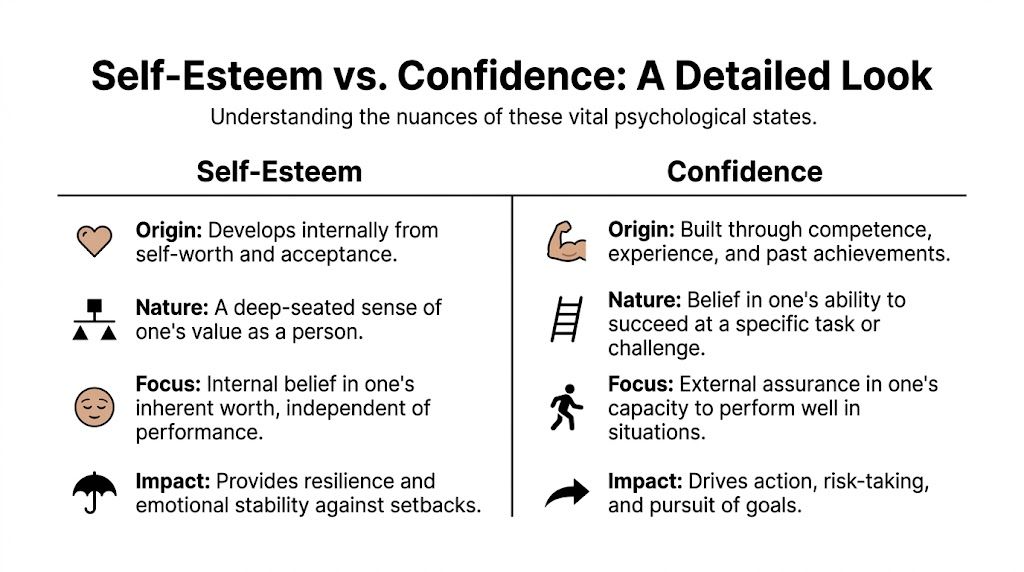
Side by side differences
| Dimension | Self-esteem | Confidence |
|---|---|---|
| Core question | “Am I worthy?” | “Can I do this?” |
| Primary focus | Being | Doing |
| Typical source | Self-concept, self-acceptance, personal meaning | Practice, competence, preparation, evidence |
| How it feels | Grounded or shaky at the level of identity | Assured or hesitant in a specific situation |
| Best response when low | Self-compassion, boundary work, values alignment, inner dialogue work | Reps, skill-building, feedback, preparation |
At this point, many people finally relax. They stop trying to use one tool for two different jobs.
They come from different systems
Research on brain activity supports the idea that these are distinct experiences. Brain imaging research shows that self-esteem is associated with the medial prefrontal cortex, a region linked to self-referential processing, while self-confidence recruits reward pathways such as the ventral striatum, which helps compute likely success based on past experience, as described in this review of self-esteem vs self-confidence.
In plain English, your brain doesn’t treat “What am I worth?” and “Can I perform well?” as the same question.
That matters because it explains why a person can feel highly capable and still feel insecure. Different systems are involved.
One is more global, one is more specific
Self-esteem is more like a lens. It colors a wide range of life experiences. It can shape how you interpret praise, criticism, belonging, and rejection.
Confidence is usually more local. You may trust yourself at work and doubt yourself in relationships. You may feel strong in the gym and unsure in creative work. Confidence moves around based on context.
This is also why confidence can be easier to test. You can ask, “Did I practice? Did I improve? Can I do the skill under pressure?” That’s much easier to observe than “How do I value myself as a person?”
They require different forms of measurement
Psychology often uses broader tools for self-esteem and more task-related tools for confidence. You’ll sometimes see the Rosenberg Self-Esteem Scale used to assess global self-regard, and the General Self-Efficacy Scale used to assess confidence-related beliefs.
You don’t need formal testing to use the idea. You can ask yourself two direct questions:
- When I fail, do I still treat myself as someone worthy of respect?
- When I face a challenge, do I believe I can learn, adapt, or perform?
Those answers often reveal the gap quickly.
For a related distinction that helps a lot of people, this piece on ego vs confidence is useful. Ego tries to protect image. Confidence trusts ability. Self-esteem sits underneath both.
Healthy confidence says, “I can learn.” Healthy self-esteem says, “I’m still okay while learning.”
A coaching shortcut
If you’re trying to self-diagnose, listen to your language.
- “I’m terrible at this” may point to low confidence.
- “I’m terrible” points to self-esteem.
- “I need more practice” is confidence language.
- “I need to prove I matter” is self-esteem language.
That one-word shift can tell you a lot.
How Esteem and Confidence Create a Feedback Loop
The most useful way to think about this is as a loop, not a debate. Self-esteem and confidence affect each other all the time.
When self-esteem is steadier, people usually take more healthy risks. They speak up, try things, recover from mistakes, and stay in the game long enough to build confidence. When confidence grows, they collect proof that they can handle life. That evidence can reinforce self-respect.
When self-esteem is low, the opposite often happens. People avoid the very actions that would create confidence. Then the lack of action becomes fresh “evidence” that something is wrong with them.

The positive loop
Think about someone learning the violin. At first, they sound rough. If they have enough self-esteem, they can tolerate that discomfort without turning it into self-attack. They keep practicing. Their confidence grows because the skill grows. As they improve, they trust themselves more. Their identity shifts from “I’m awkward and behind” to “I’m someone who can learn.”
That is the flywheel.
The negative loop
Now flip it. A capable employee gets asked to present. He assumes one imperfect moment will expose him. He avoids the opportunity or overprepares from fear. If the presentation goes well, he dismisses it as luck. If one part goes poorly, he uses that as proof that he shouldn’t have tried.
Nothing in that loop gives confidence a fair chance to form.
What the research suggests
Longitudinal research shows that high self-esteem prospectively predicts better academic achievement (β = .08), lower depression (β = −.16), lower anxiety (β = −.08), and stronger relationships, while people with low self-esteem tend to underestimate their performance even without feedback, according to this meta-analytic review in PMC.
That underestimation matters more than it first appears. If you consistently rate yourself below reality, you’ll hesitate to act. And if you hesitate to act, confidence has very little raw material to build from.
Sometimes the problem isn’t poor performance. It’s poor self-appraisal.
A common client pattern
One client came in saying, “I need confidence.” What he had was partial confidence. He could do his work well, but he couldn’t absorb his own wins. Every success felt temporary. Every mistake felt personal.
We worked on two tracks at once. On the confidence side, he practiced smaller visible leadership behaviors, like speaking first in meetings and making cleaner decisions with less apology. On the self-esteem side, he tracked the harsh story that said he had to earn the right to exist comfortably around other people.
Once that story softened, his behavior changed faster. He took more action with less drama. More action created more evidence. More evidence reduced hesitation.
That’s the interaction often overlooked. Confidence grows through doing. Self-esteem affects whether you let yourself keep doing when the doing is messy.
An Action Plan for Building Unshakeable Confidence
Confidence is built best through evidence. Positive thinking can help you start, but evidence is what makes confidence stick.
I like using Preparation, Practice, and Proof. It’s simple, and it works because each part gives your brain something concrete to trust.
Preparation
Before you ask yourself to feel confident, ask whether you’ve prepared in a way that deserves confidence.
Preparation might include:
- Skill breakdown by turning one big goal into smaller parts you can train
- Environmental support like using Notion, Trello, or a paper planner to keep tasks visible
- Recovery basics such as sleep, food, and margin, because a tired brain often labels depletion as insecurity
If public speaking scares you, don’t set “be confident” as the goal. Set “outline the talk, rehearse it aloud, and record one run-through.” Preparation lowers vagueness, and vagueness feeds fear.
Practice
Confidence comes from contact with reality. You have to do the thing in some form.
Try a ladder approach:
- Start private.
- Move to low-stakes exposure.
- Add pressure gradually.
If you want more confidence leading, start by speaking earlier in smaller meetings. If you want confidence writing online, publish short posts before long essays. If you want confidence with conflict, rehearse one clear sentence before the actual conversation.
Coach’s note: Don’t wait for confidence to act. Use action to create confidence.
Proof
Your brain forgets wins faster than it remembers embarrassment. That’s why many capable people still feel uncertain. They never build a record of proof.
Create a simple proof log with three columns:
| Situation | What I did | What this proves |
|---|---|---|
| Hard conversation | Stayed calm and clear | I can handle tension |
| Presentation | Spoke with structure | I can communicate under pressure |
| New software task | Learned by testing | I can adapt |
Tools can be beneficial. A notes app works. A spreadsheet works. A voice memo works. The format matters less than consistency.
If you want guided structure, David Pexa’s confidence coaching page outlines one approach focused on practical belief-building. Other useful supports include Toastmasters for speaking reps, journaling apps for reflection, and habit trackers that make progress visible.
What to stop doing
A lot of people unknowingly undermine confidence by demanding certainty before action.
Drop these habits:
- Over-comparing your beginning to someone else’s middle
- Overgeneralizing one bad result into a global identity statement
- Overwaiting for a feeling that usually arrives after the rep, not before it
Confidence isn’t magic. It’s memory plus repetition plus honest evidence.
A Coaching Guide to Nurturing Healthy Self-Esteem
Confidence grows from action. Self-esteem grows from relationship. Specifically, your relationship with yourself.
That means the work is less about proving and more about how you respond when proving fails, slows down, or stops. I use Compassion, Connection, and Contribution because they pull attention away from constant self-evaluation and back toward a steadier center.
Compassion
People with low self-esteem often speak to themselves in ways they’d never use with a friend. The first shift is not fake praise. It’s reducing unnecessary hostility.
Try a brief self-compassion pause when you mess up:
- Name what happened plainly.
- Name what you feel without exaggeration.
- Offer one sane, respectful sentence back to yourself.
For example: “I’m disappointed. I wanted to do better. But one rough moment doesn’t make me worthless.”
That kind of response doesn’t lower standards. It lowers shame, which is different.
Treating yourself with respect during failure is one of the clearest signs that self-esteem is healing.
Connection
Self-esteem often drops when your whole identity gets tied to performance, approval, or comparison. Connection rebuilds a wider sense of self.
Journal on questions like these:
- What do I value when nobody is watching?
- Which relationships make me feel more honest, not more performative?
- Where am I abandoning myself to be accepted?
Boundaries matter here. So does choosing people who allow your full humanity, not just your usefulness. Self-esteem becomes more stable when your worth is not constantly negotiated through pleasing, impressing, or shape-shifting.
Contribution
Healthy self-esteem isn’t just inward. It strengthens when you live in a way that feels aligned and meaningful.
Contribution can look small and ordinary:
- keeping a promise to yourself
- helping someone without needing applause
- acting from values even when it’s inconvenient
- finishing a task because integrity matters to you
This is different from achievement-chasing. Achievement says, “Maybe this win will make me enough.” Contribution says, “I’m acting from who I want to be.”
A useful contrast with confidence work
When confidence is low, ask, “What skill or experience do I need?”
When self-esteem is low, ask, “How am I treating myself, and what kind of life relationship am I rehearsing?”
Those are different questions, and they should lead to different practices. Reps help confidence. Self-respect, values, and compassion help self-esteem.
Creating Your Integrated Growth Plan
If you want practical traction, use a simple two-by-two view of yourself. Research suggests that self-esteem is relatively stable over time, with test-retest values of r = 0.8-0.9 over 6 months, while self-confidence is more volatile at r = 0.5-0.7. The same line of work also notes that a high esteem and high confidence profile is associated with a 40% productivity edge, while low esteem can suppress trial attempts and stall growth, as discussed in this PMC article on self-esteem level and stability.
That makes the grid useful because it shows why some changes feel quick and others take longer.
The four common profiles
| Self-esteem | Confidence | Common pattern | Best focus |
|---|---|---|---|
| Low | Low | You hesitate, self-criticize, and avoid challenge | Start with small confidence reps and basic self-compassion |
| Low | High | You perform well but never feel secure | Prioritize esteem work so wins can actually land |
| High | Low | You value yourself but doubt a specific skill | Build competence through practice and feedback |
| High | High | You trust your worth and your ability | Protect the system and keep stretching carefully |
How to use the grid this week
Don’t overcomplicate this. Pick one action for confidence and one action for self-esteem.
For confidence, choose a visible rep:
- speak once early in the next meeting
- practice the skill for a set block of time
- ask for feedback on one specific area
For self-esteem, choose a relational rep:
- challenge one harsh thought in writing
- set one boundary without overexplaining
- reconnect with one value you’ve been ignoring
A short resource list
Keep your support simple and practical:
- Books: choose one on self-compassion or self-efficacy and study it slowly
- Podcasts: use one thoughtful mindset show during walks or commute time
- Apps: Notes, Notion, Day One, or any journal app that helps you track patterns
- Communities: coaching, therapy, peer groups, or skill-based groups where progress is visible
The goal isn’t to become endlessly self-focused. The goal is to become grounded enough that you can act, learn, connect, and recover without turning every hard moment into a verdict on your worth.
Frequently Asked Questions
Are self-esteem and confidence the same thing?
No. Self-esteem is how you value yourself as a person. Confidence is how much you trust your abilities. You can have high self-esteem (I’m worthy) and low confidence in a specific area (I’m terrible at public speaking), or vice versa.
Which is more important: self-esteem or confidence?
Self-esteem is foundational. Without it, confidence becomes fragile — dependent on external validation and performance. With solid self-esteem, confidence failures don’t shatter you because your sense of worth isn’t tied to your competence.
Can you have high confidence but low self-esteem?
Yes, and it’s more common than people think. Many high performers are deeply confident in their skills but fundamentally unsure of their worth as people. They achieve constantly but never feel enough.
Keep Reading
- Self Esteem vs Self Confidence: What’s the Difference?
- Self Esteem vs Self Confidence A Guide to Personal Growth
- Mastering the Antonym to Confidence: 8 Key Steps
Conclusion
Understanding is the first step, but it’s what you do with that understanding that changes things. The ideas in this article aren’t meant to sit in your head — they’re meant to shift how you see your situation and give you something concrete to act on. Start with the one thing that felt most relevant, apply it this week, and notice what changes.
If this resonated, go deeper. My book Love, Success, Freedom and Boundaries gives you twelve frameworks for seeing the patterns that shape your life — and changing the ones that aren’t working.
If this resonates, the full framework lives in Love, Success, Freedom and Boundaries.
A practical playbook for raising emotionally resilient kids — and breaking the patterns you didn’t choose to inherit.
