



Summary: A practical guide to take risks for personal growth a practical guide. What actually works, what doesn’t, and where to start.
I spent most of my twenties avoiding risk — staying in safe jobs, safe relationships, safe routines. It felt responsible. It was actually just slow suffocation. The first real risk I took was moving to Japan with no plan and no safety net. Everything meaningful in my life traces back to that decision. Risk isn’t recklessness. It’s the price of becoming someone new.
Learning to take risks for personal growth isn’t about being reckless. It’s about making smart, calculated moves that force you to stretch your abilities. The real skill lies in telling the difference between a foolish gamble and a well-designed experiment. It’s about reframing that knot in your stomach as a sign of opportunity, not a warning to retreat.
This is how you intentionally step outside your comfort zone and build genuine, unshakable confidence.
Why Your Brain Is Actually Wired for Smart Risks
It sounds backward, but your brain is built to grow through challenge and risk. We’re conditioned to see risk as a straight path to danger, loss, or failure. But that internal push to seek out new challenges isn’t some self-destructive tendency—it’s a fundamental part of how we evolve.
When you decide to take on something new, your brain releases dopamine, a powerful neurotransmitter tied to motivation and reward. This isn’t just about a fleeting feeling of accomplishment; it’s a biological thumbs-up, encouraging you to keep exploring, learning, and adapting. Your brain literally rewards you for stepping into the unknown, because it knows that’s where the real growth is hiding.
That feeling of discomfort you get right before taking a risk? That’s just your brain flagging a growth opportunity. The goal isn’t to kill that feeling—it’s to learn how to move forward with it.
Once you get this, you can start turning all that uncertainty in your life into a real advantage.
The Mindset: Growth Experiments vs. Reckless Gambles
The first, most critical step is learning to distinguish between a destructive gamble and a calculated, positive risk. A gamble is a blind leap of faith, usually driven by emotion and with little thought given to the potential fallout. A calculated risk, on the other hand, is a thoughtful experiment.
A smart risk always has these ingredients:
- A Clear “Why”: You know exactly what you’re hoping to achieve, whether it’s landing a new role, learning a skill, or just building your confidence.
- An Honest Look at the Downside: You’ve thought through the worst-case scenario and you have a plan—or at least the confidence—to handle it if it happens.
- A Focus on Learning: The main prize is the lesson, no matter what the immediate outcome is.
Think of yourself as a scientist running an experiment in the lab of your own life. The goal isn’t just to get the “right” result, but to gather data. You ask for that promotion and get a firm “no.” Instead of a failure, you’ve just received invaluable data about where you need to develop or what the company is truly looking for. That’s a win.
This mental shift is everything. It changes the internal question from “What if I fail?” to “What will I learn?” Suddenly, taking risks becomes a sustainable practice for growth, not something to be feared.
Your Brain’s Natural Appetite for Risk
Interestingly, our willingness to take risks isn’t static; it evolves throughout our lives. For many, it peaks during late adolescence and early adulthood. A cross-national study of 5,227 people in 11 countries found that risk-taking often follows an inverted-U pattern, hitting its highest point in our late teens.
For anyone focused on personal growth, this is a powerful insight. If you’re in your peak risk-taking years—generally between 18-25—you have a unique chance to lean into your brain’s natural wiring. You can dig into the full study on risk-taking across cultures and ages over at pmc.ncbi.nlm.nih.gov.
But this doesn’t mean the window closes after 25. It just shows that the fundamental wiring is already in place. As an adult, the key is to consciously reactivate that same exploratory instinct. The risks just look different. Instead of youthful dares, you’re launching a side hustle, having a difficult conversation, or speaking up in a high-stakes meeting.
The underlying psychology is identical.
By understanding that your brain is quite literally designed for these kinds of challenges, you can stop fighting your own biology. You can start working with it to identify and act on the right opportunities, turning the vague concept of “personal growth” into a series of real, manageable steps.
Find Your Growth Zone: A Practical Framework for Smart Risks
Knowing when to push yourself isn’t about blind courage. It’s about self-awareness. Taking a smart risk for personal growth is the difference between a workout that builds muscle and one that leaves you with an injury, setting you back for weeks. The goal is to find that productive tension.
We’re aiming for your personal “growth zone”—that sweet spot where you feel challenged but not completely overwhelmed. A really effective way I’ve found to pinpoint this is by using the Four Zones of Personal Growth framework. Once you know where you stand, you can make intelligent, deliberate moves toward growth instead of just hoping for it.
Every time you consciously choose a challenge, you’re actually rewiring your brain. You’re building up the neural pathways for resilience and confidence, creating a powerful feedback loop that makes the next risk a little easier to take.
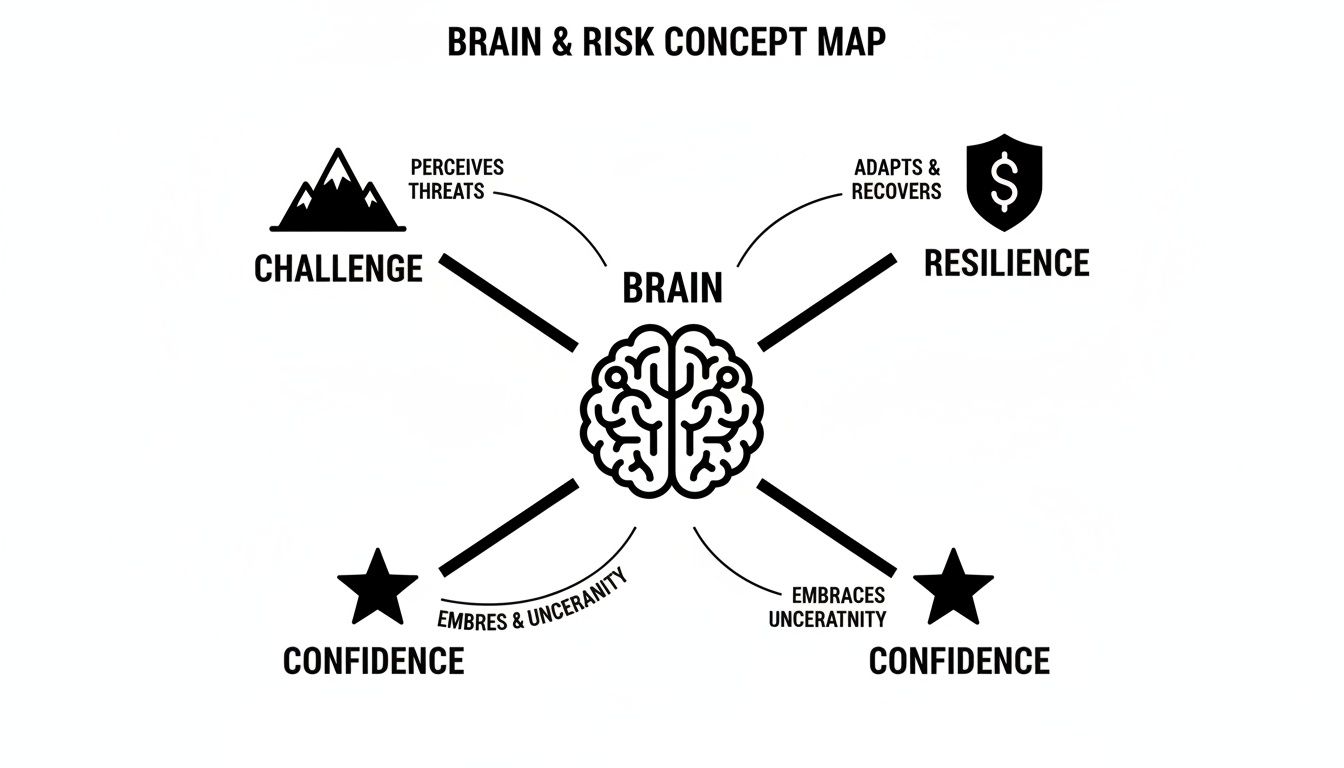
This isn’t just a nice idea; it’s how our brains are built to adapt and become stronger.
Where Are You Right Now?
First, you need an honest look in the mirror. Are your daily habits and actions pushing you forward, or are you just spinning your wheels? Let’s break down the four zones with some real-world examples.
- The Comfort Zone: This is your home base. It’s where you feel competent, safe, and totally in control—performing job tasks you’ve mastered, sticking to your favorite coffee shop, or chatting with your closest friends. It feels good, but there’s no growth here.
- The Stagnation Zone: Think of this as the dark side of the comfort zone. This is where comfort sours into boredom and apathy. You’re not just comfortable; you’re actively avoiding anything new, and you can feel your skills and passion starting to fade.
Hanging out in these two zones feels safe, but there’s a hidden cost. You miss out on the energy and self-respect that only come from tackling something new and difficult. The point isn’t to abandon your comfort zone forever, but to learn how to take strategic trips outside of it.
A smart risk isn’t about diving headfirst into chaos. It’s about taking one deliberate step out of your comfort zone and into the learning zone. That’s it. That’s the whole game.
This brings us to the two zones where the action really happens.
The Learning Zone vs. The Panic Zone
The real magic happens when you stretch yourself. But there’s a razor-thin line between a productive stretch and a painful snap.
The Learning Zone is where you want to be. You’re trying something that requires your full attention. You might feel a bit of that nervous flutter, but you’re also engaged and driven. This is you learning a new piece of software for a project, taking on a task just a little above your current pay grade, or finally having that tough conversation you’ve been putting off.
Then there’s the Panic Zone. This is what happens when you leap way too far, way too fast. The challenge is so immense that your brain just shuts down learning and switches to survival mode. You feel intense fear, anxiety, and the overwhelming urge to run away. Think of an introvert being forced to give a keynote with zero prep time, or a brand-new coder being told to single-handedly lead a massive, complex project.
The entire strategy for taking smart risks boils down to this: learn to live in the Learning Zone.
This isn’t just a theory; it’s backed by solid research. A fascinating study of 962 adolescents across nine countries confirmed that this kind of positive risk-taking is a distinct behavior essential for healthy development. The study found that between 50-70% of teens see these calculated risks as both safe and beneficial. This tells us that a smart-risk mindset is a globally recognized part of growing up. You can dig into the full study on how cultures measure positive risk-taking at pubmed.ncbi.nlm.nih.gov.
The Four Zones of Personal Growth
To put this into practice, use the table below to map out where your current activities fall. This simple exercise can be incredibly revealing and help you pinpoint exactly what your next growth move should be.
| Zone | Feeling & Mindset | Actions & Behaviors | Growth Potential |
|---|---|---|---|
| Comfort | Safe, easy, automatic, low engagement. | Routine tasks, known conversations, predictable activities. | Low |
| Learning | Engaged, challenged, focused, slightly anxious but motivated. | Asking for feedback, trying a new skill, speaking up in a meeting. | High |
| Panic | Overwhelmed, fearful, stressed, “fight or flight.” | Taking on a goal far beyond your current abilities without support. | Negative |
| Stagnation | Bored, apathetic, disengaged, “stuck.” | Actively avoiding all newness, sticking to the same routine for years. | Regressive |
Once you’ve mapped out your day-to-day, your mission is simple: identify one small action that can nudge you from the Comfort Zone into the Learning Zone.
If you’re normally quiet in meetings, your risk could be to share just one idea. If you’re a confident writer, maybe you offer to review a colleague’s important presentation. It’s not about being fearless; it’s about being a smart navigator of your own growth.
How to Design Your First Growth Experiment
Okay, enough with the theory. It’s easy to read about risk, but the real magic happens when you actually do something. It’s time to get your hands dirty.
This isn’t about taking some massive, terrifying leap of faith. Instead, I want you to think like a scientist. We’re going to design a small, controlled experiment. When you frame a risk as an experiment, you completely change the game. It’s no longer a pass/fail test of your worth; it’s just a mission to gather some data.
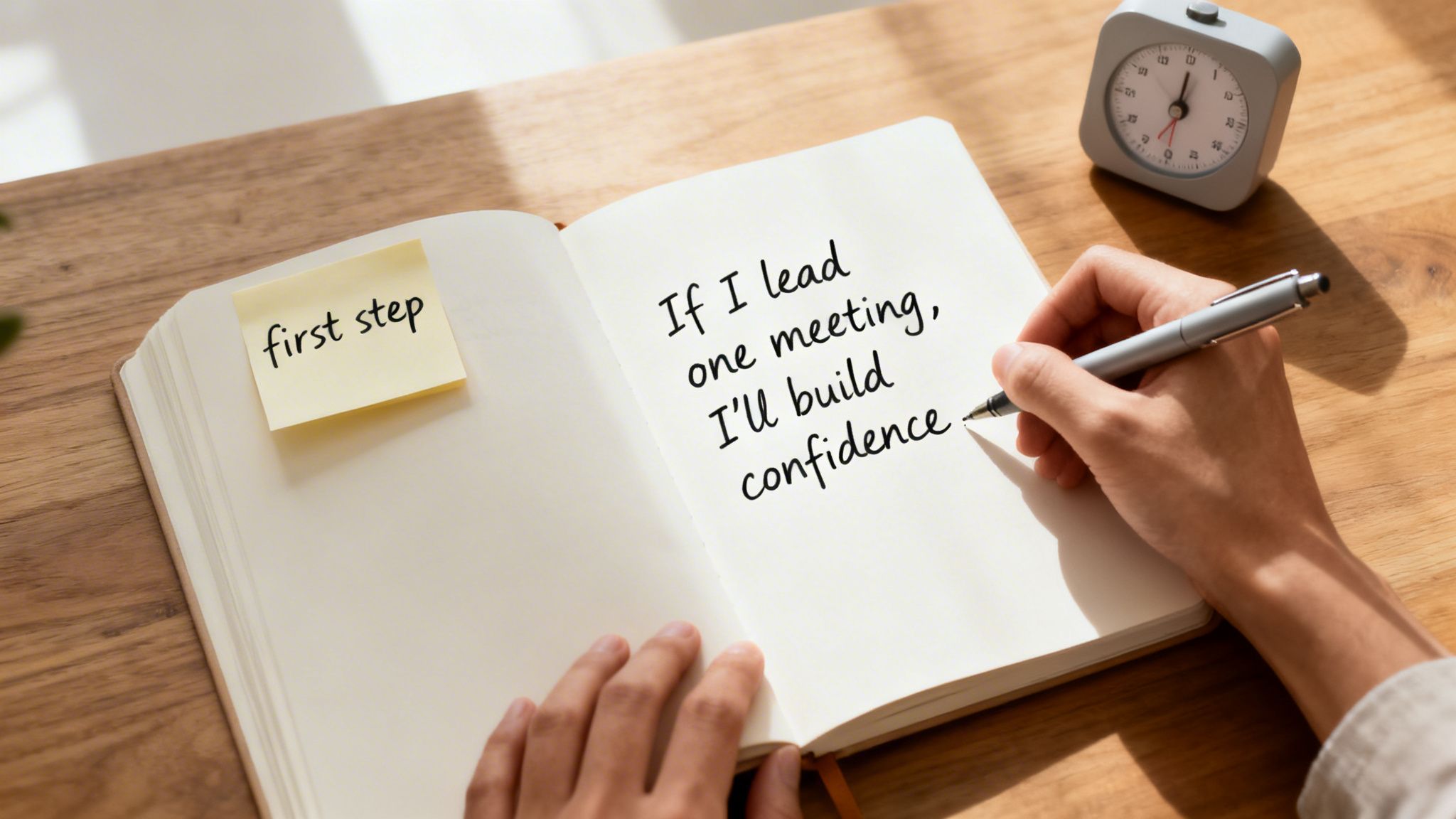
The goal here is simply to learn and adjust. That’s it. This mindset shift immediately lowers the stakes, making it much easier to build a habit of taking smart risks for your personal growth.
Start with a Clear Hypothesis
Every good experiment I’ve ever run, whether in business or my own life, started with a clear “if-then” statement. This is your hypothesis. It connects a very specific action you’ll take to the outcome you’re hoping for.
A vague goal like, “I’m going to be more confident,” is useless. It’s not actionable. You need to get specific.
Let’s look at a few practical examples:
- For your career: “If I volunteer to lead one project meeting this month, then I will build the confidence to speak up more frequently in team settings.”
- For your social life: “If I go to one new meetup group alone, then I will feel more comfortable initiating conversations with strangers.”
- For a new skill: “If I publish one article on a personal blog, then I will overcome my fear of sharing my writing publicly.”
See the pattern? Each one boils down a scary goal into a single, concrete task. It’s much less intimidating.
Define Your Smallest Viable Risk
With your hypothesis in hand, your next job is to find the absolute smallest action you can take to test it. I call this the Smallest Viable Risk (SVR). It’s the first step that’s so tiny, so manageable, that you almost can’t say no to it.
Let’s say your goal is to get better at networking.
- The Panic Zone: Marching into a huge industry conference and vowing to meet 20 influential people. (Hello, anxiety!)
- The Learning Zone: Going to a small, local meetup and aiming for two meaningful conversations. (Better, but still a hurdle.)
- The Smallest Viable Risk: Sending a connection request on LinkedIn to one person you admire with a personalized, two-sentence message. (You could do that right now.)
The SVR is designed to get you moving without setting off all the internal alarms. That first bit of momentum is everything.
Your first experiment isn’t about transforming your life overnight. It’s about proving to yourself that you can take a single step forward, gather information, and survive. This small win provides the fuel for the next, slightly bigger risk.
Map Your Experiment with a Simple Template
To make this feel even more concrete, I strongly recommend mapping out your experiment. This isn’t some complex project plan—it’s a five-minute exercise that gives you incredible psychological clarity and a sense of control. This kind of framework is a cornerstone of any good personal growth plan because it keeps you on track.
Just grab a notebook and jot this down:
| Component | Question to Answer | Your Example |
|---|---|---|
| Objective | What is the one thing I want to learn or achieve? | “To feel more confident sharing my ideas at work.” |
| Hypothesis | If I do [Small Action], then [Desired Outcome] will happen. | “If I share one unsolicited idea in our team’s Slack channel this week, I’ll feel less anxious about contributing.” |
| Success Metric | How will I know if it worked? What does “success” look like? | “Success is simply posting the idea. The team’s reaction is secondary data.” |
| Worst-Case Scenario | What is the realistic worst thing that could happen? | “My idea is ignored, or a colleague points out a flaw.” |
| Bounce-Back Plan | If the worst happens, how will I recover and what will I learn? | “I’ll remind myself the goal was to act, not be perfect. I’ll analyze the feedback (or lack thereof) to refine my next idea.” |
Filling this out defangs the fear. By actually writing down the worst-case scenario and how you’ll handle it, you take away its power. You’re no longer staring into a black hole of “what if”; you’re preparing for a completely survivable outcome.
This practical approach is how to take risks for personal growth in a way that actually works. You stop worrying and start doing. This simple shift is what drives real, lasting change, turning every small risk into a powerful step forward.
Building a Psychological Safety Net to Overcome Fear
Let’s be honest: fear is the number one reason we stay stuck. It’s that primal, nagging voice in your head that screams at you to play it safe and retreat to your comfort zone. But here’s the secret: the goal isn’t to get rid of fear. That’s impossible. The real goal is to learn how to act in spite of it.
This is where a psychological safety net comes in. Think of it as a collection of mindsets and practical moves that lower the emotional stakes of taking a risk. It gives you the confidence to step into the unknown because you already have a plan to handle whatever happens. With a solid net in place, every outcome—good or bad—is just another lesson learned.

Deconstruct Your Fears with Fear-Setting
One of the most effective tools I’ve found for managing fear is an exercise called “fear-setting.” Instead of letting vague worries paralyze you, this technique forces you to drag them into the light and define them with total clarity. It’s amazing how much smaller the monsters under the bed look once you actually turn the lights on.
Grab a pen and paper and map this out. First, get specific about the absolute worst-case scenario. If the risk you’re considering blows up in your face, what does that actually look like? Be brutally honest.
Next, brainstorm all the little things you could do to prevent those worst-case outcomes from even happening. What actions could you take right now to lower the odds of failure?
Finally, write down exactly how you would recover if the worst did happen. This is your “repair” plan. Who would you call for help? What’s the very first step you would take to get back on track? This simple process shifts your mind from a state of paralyzing fear to one of concrete, actionable planning.
Always Have an Exit Strategy
Another crucial piece of your safety net is building reversibility into your risks. Before you jump in, always ask yourself, “If this goes sideways, how can I back out?” A decision you can undo is a decision you can make with much less pressure.
For instance, instead of quitting your job cold to start a business (a highly irreversible move), why not launch it as a side hustle? If it doesn’t take off, your main income source is still secure. Rather than moving to a new city on a whim, maybe try a month-long trip to work from there and see how you like it.
The most effective way to build courage is to make your risks as low-stakes as possible. When you know you have an escape hatch, you’re far more likely to take the leap.
This isn’t about being flaky; it’s about being strategic. By designing an exit ramp from the start, you give yourself the freedom to experiment without putting everything on the line. Many of these mental reframing strategies are actually rooted in proven therapeutic approaches. If you’re curious to learn more, you can read about these powerful cognitive behavioral therapy techniques on our blog.
Practice Self-Compassion After Every Attempt
Your psychological safety net is worthless if you just use it to beat yourself up every time an experiment doesn’t work out. Real, lasting resilience is built by treating yourself with kindness, especially when you stumble.
Self-compassion isn’t about letting yourself off the hook. It’s about recognizing that growth is a messy, uncomfortable process, and the occasional failure is a feature, not a bug.
Here’s a practical way to do it:
- Acknowledge the feeling. Don’t push disappointment away. Just say to yourself, “This is tough, and it’s okay that I feel let down.”
- Reframe the outcome as data. Remember, the goal wasn’t perfection; it was learning. Ask yourself, “What did this experience teach me that I can use for my next attempt?”
- Talk to yourself like you would a friend. If your best friend took this same risk and it flopped, you wouldn’t criticize them. You’d offer encouragement. Give yourself that same grace.
When you weave together fear-setting, reversible decisions, and genuine self-compassion, you build an incredible foundation for a life of continuous growth. Fear stops being a stop sign and becomes a compass, pointing you exactly where you need to go next.
Turn Risk-Taking Into a Lifelong Habit
Taking a single risk is just an event. Becoming a person who consistently seeks out smart risks? That’s a total transformation. This isn’t about one-off gambles, but about building a long-term strategy to make growth your default setting.
It’s a common misconception that this means making huge, life-altering decisions every week. The real work is much quieter. It’s about rewiring your brain through small, consistent actions that stretch your comfort zone, building a foundation for the bigger, more rewarding challenges you want to take on.
You Can Actually Train Yourself to Be Bolder
Believe it or not, your personality isn’t set in stone. Your willingness to take risks is closely tied to two specific traits you can actively develop: openness to experience and extraversion.
Don’t just take my word for it. Longitudinal data tracking 44,076 individuals over a decade found something fascinating. While risk tolerance generally drops as we age, people who actively became more open or extraverted actually increased their risk-taking. You can dive into the research from the Max Planck Institute here: mpg.de.
So, what does this mean for you? It proves you can create a positive feedback loop. By intentionally practicing behaviors that foster openness—like exploring new hobbies, talking to new people, or just trying a different route to work—you’re building the courage for much bigger leaps.
True personal growth isn’t about one heroic leap. It’s the sum of a hundred small, consistent steps into the unknown, each one building on the last.
When you focus on these underlying traits, you stop forcing yourself to take risks. Instead, you’re becoming the kind of person who naturally sees opportunity where others see uncertainty.
Weekly Habits for Rewiring Your Brain
Building a growth-oriented mindset is a hands-on job. The goal is to sprinkle tiny doses of “productive discomfort” into your weekly routine—small challenges that nudge you out of your regular patterns without sending you into a panic.
Here are a few simple habits you can start this week:
- Try one new thing locally. Ditch your usual coffee shop for the one on the next block. Take a different path for your daily walk. Finally try that restaurant you’ve always been curious about. The point is to break your routine and get your brain used to novelty.
- Engage with an opposing viewpoint. Deliberately listen to a podcast or read an article from someone you disagree with. You’re not trying to change your mind; you’re practicing intellectual humility and strengthening your ability to hold different ideas at once.
- Do one small task inefficiently. This sounds strange, but it works. Instead of Googling how to fix a simple problem, give yourself ten minutes to figure it out on your own. This builds your problem-solving muscles and your tolerance for not knowing the answer right away.
Each of these small acts teaches your brain that stepping into the unknown is safe and often rewarding. This is a core practice for anyone looking to develop a growth vs. fixed mindset, where challenges become opportunities to learn, not tests to be failed.
The Powerful Feedback Loop of Growth
This strategy is so effective because it creates a powerful upward spiral. When you take a small, calculated risk—like finally signing up for that workout class—and it goes well, your brain gives you a little hit of dopamine. That reward feels good and builds a tiny bit of confidence.
Suddenly, the next risk feels a little less scary. With that newfound confidence, maybe you decide to introduce yourself to someone at the gym. When that goes well, you get another small confidence boost.
This is the feedback loop in action:
- Small Risk: You take a tiny, manageable step into something new.
- Successful Outcome: The risk pays off, even in a small way (you learned something, you met someone, you had fun).
- Confidence Boost: Your brain rewards this behavior, making you feel more capable.
- Increased Courage: This feeling provides the fuel to take on a slightly bigger risk the next time.
This gradual process is how you sustainably scale your ability to take on bigger and better challenges. You slowly shift from someone who fears the unknown to someone who is energized by it, one small experiment at a time.
Common Questions About Taking Risks for Personal Growth
Even with the best playbook in hand, stepping outside your comfort zone is bound to bring up some second-guessing. That’s not just normal; it’s a sign you’re on the right track.
Let’s walk through some of the most common mental roadblocks I see people run into. Getting clear on these now will give you the confidence to handle the uncertainty when it shows up.
What if I Take a Risk and Fail Publicly?
This is the big one. The fear of falling flat on your face in front of colleagues, friends, or your industry can feel absolutely paralyzing. The trick isn’t to avoid failure, but to change your relationship with it.
Think of it this way: the point of a growth experiment isn’t a perfect outcome; it’s to collect information. Say you volunteer to lead a project meeting and it feels clunky or you get flustered. You didn’t fail. You just gathered some incredibly valuable data on where to focus next—maybe you need to brush up on your public speaking, or perhaps you need to prepare your key points more thoroughly beforehand.
That sting of public failure feels so permanent in the moment, but it’s almost always a temporary data point. Trust me, most people are far too wrapped up in their own challenges to keep a scorecard of your stumbles. The lesson you walk away with, however, is yours for life.
If the thought still terrifies you, just lower the stakes. Test out a new idea with one trusted teammate before you pitch it to the whole department. This gives you a safe space to work out the kinks and build real confidence before you step onto a bigger stage.
How Can I Tell if a Risk Is Smart or Just Reckless?
Drawing the line between a calculated growth opportunity and a foolish gamble is critical. A smart risk is an educated guess designed for learning. A reckless one is more of a blind jump, often fueled by ego or a “what the heck” impulse.
Before you leap, run the idea through a quick mental filter. A smart risk usually checks these boxes:
- A clear potential upside: You can specifically name what you hope to gain, like learning a new software, building a relationship with a mentor, or proving your leadership skills. A reckless risk often has a vague goal, like just “shaking things up.”
- An honest look at the downside: You’ve thought through the realistic worst-case scenario and have a general idea of how you’d recover from it. Reckless risks tend to ignore this part completely.
- The primary goal is learning: With a smart risk, you win even if you “lose.” You don’t get the promotion, but you learn exactly what the hiring manager is looking for. A reckless risk that doesn’t work out just feels like a total waste.
If you can tick these boxes, you’re not being reckless; you’re being strategic.
I Feel Selfish for Prioritizing My Own Growth What Should I Do?
This feeling comes up far more often than you’d think, especially for people who are used to putting others first. The moment you start setting boundaries or dedicating time, energy, or money to yourself, that “selfish” alarm can start ringing.
First off, recognize that feeling is often a direct signal that you are finally setting healthy boundaries. When you begin saying “no” to things that drain you so you can say “yes” to opportunities that grow you, it can feel foreign and uncomfortable at first.
The most powerful thing you can do here is to reframe your thinking. Investing in your own skills, confidence, and well-being isn’t selfish; it’s a prerequisite for being a better partner, parent, employee, and leader. When your cup is full, you have more to give.
It also helps to communicate your “why” to others. A simple, “I’m taking this weekend course to get better at financial modeling, which will help us make smarter team decisions,” connects your personal growth directly to a shared benefit.
Keep Going
Frequently Asked Questions
What kind of risks lead to personal growth?
The risks that stretch your identity, not just your comfort. Signing up for a course is comfortable risk. Having a conversation where you might be rejected is identity risk. Growth lives in the second category.
How do I get better at taking risks?
Shrink the risk until it’s tolerable, take it, notice you survived, then expand slightly. Risk tolerance builds through exposure, not through convincing yourself to be brave. Small risks compound.
What if the risk doesn’t pay off?
Then you’ve learned something you couldn’t have learned any other way. The growth was never in the outcome — it was in your willingness to act despite uncertainty. That willingness is the capability that transfers to everything.
Keep Reading
- How to Create a Personal Growth Plan That Actually Works
- Your Ultimate Personal Growth Thesaurus: 10 Core Concepts for 2026
- Your Guide to Personal Growth Counseling in 2026
Conclusion
Understanding is the first step, but it’s what you do with that understanding that changes things. The ideas in this article aren’t meant to sit in your head — they’re meant to shift how you see your situation and give you something concrete to act on. Start with the one thing that felt most relevant, apply it this week, and notice what changes.
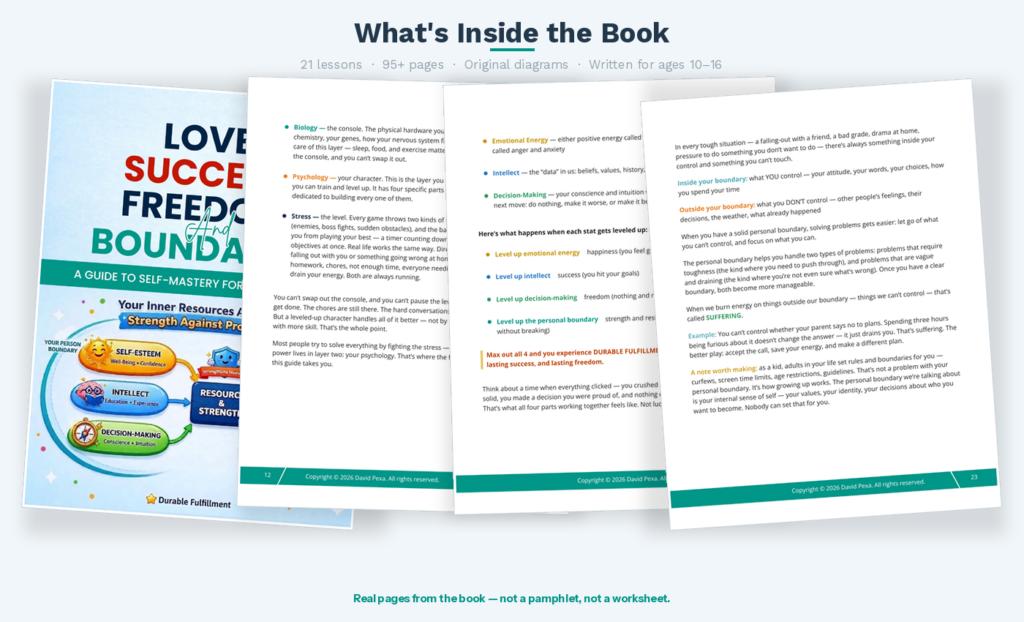
If this resonated, go deeper. My book Love, Success, Freedom and Boundaries gives you twelve frameworks for seeing the patterns that shape your life — and changing the ones that aren’t working.
A note on affiliates: This article includes affiliate links to platforms I’ve vetted and would recommend to my own clients and students. If you start with a recommended service through a link here, I may earn a small commission — at no extra cost to you. I only mention what I’d actually point you to in person. The recommendation comes first; the relationship is disclosed second.
If this resonates, the full framework lives in Love, Success, Freedom and Boundaries.
A practical playbook for raising emotionally resilient kids — and breaking the patterns you didn’t choose to inherit.
Get the ebook →