



Summary: A Guide to Improve Personality Development — a practical breakdown of what matters, what doesn’t, and what to do next.
Personality isn’t fixed — that’s one of the most liberating things I’ve learned. You can deliberately develop traits you admire in others without losing what makes you, you.
If you’re looking to genuinely improve your personality, it’s not about becoming someone else entirely. It’s about taking the person you already are and refining the rough edges. This requires a real commitment to understanding yourself, building better habits, and practicing how you show up in the world.
The whole process is an active journey, one that involves taking a hard look at your strengths, identifying where you want to grow, and then making small, measurable actions happen every single day.
Your Path to Personal Growth Starts Here

So, let’s get started. Think of this guide as your personal blueprint for authentic growth. Forget the vague, feel-good advice you’ve heard before. This is a practical, step-by-step program designed to help you become a more confident, articulate, and resilient version of yourself.
This isn’t about a complete personality transplant. It’s more like upgrading your internal operating system. By focusing on a few core areas, you can make a massive difference in how you handle challenges, connect with people, and navigate your career.
Why Invest in Yourself Now
Putting time into your personal development is more than just a nice idea—it’s a smart, strategic move. The numbers back this up: the global personal development market was valued at USD 45.32 billion in 2023 and is projected to hit USD 70.55 billion by 2031.
Why the boom? People are looking for ways to build resilience in a fast-changing world, and companies know that employees with strong interpersonal skills are invaluable. You can dig into the data by checking out the full market report on the personal development industry.
The most powerful investment you can make is in yourself. It’s the one asset that no one can take away from you and which will pay dividends for the rest of your life.
To make this journey stick, we’re going to focus on four key areas. Think of these as the foundational pillars for any lasting change. They’ll give you the tools for both professional success and a more fulfilling personal life.
The Four Pillars of Personality Development
This table lays out the roadmap for our journey. Each pillar builds on the last, creating a powerful compounding effect that will accelerate your growth.
| Pillar | Focus Area | Key Outcome |
|---|---|---|
| Self-Awareness | Understanding your values, strengths, and weaknesses. | Clarity on personal and professional goals. |
| Communication Skills | Articulating ideas clearly and listening actively. | Stronger relationships and professional influence. |
| Emotional Regulation | Managing emotions and responding thoughtfully. | Increased resilience and better decision-making. |
| Growth Mindset | Embracing challenges and continuous learning. | Sustained long-term personal and career growth. |
By methodically working through these areas, you’ll turn that fuzzy desire to “be better” into a concrete plan with real, measurable results. Let’s start laying the foundation for this rewarding work.
Create Your Personal Development Baseline
Before you can improve your personality, you have to know where you stand. It’s a simple truth, but one we often overlook. You can’t chart a course to a new destination without knowing your starting point, right? This first phase is all about moving beyond a vague desire to “be better” and getting brutally honest about who you are right now.
Think of it as creating a map of your own personality. It helps you measure what actually matters so you can manage your growth in a real, tangible way. Instead of just wishing for more confidence, you’ll pinpoint the exact situations that make you second-guess yourself. This kind of clarity is the bedrock of any meaningful change.

The image above nails the fundamental flow: self-awareness leads to better communication, which fuels your overall growth. Everything starts with that honest internal look before you can expect to see changes in your external world.
A Fresh Spin on the Wheel of Life
A classic tool for this kind of self-assessment is the “Wheel of Life,” but we’re going to adapt it specifically for personality traits. Forget broad categories like “career” or “finances” for a moment. Instead, we’ll focus on the attributes you want to build.
First, draw a circle and divide it into 6-8 pie slices. Each slice gets a label for a trait you want to work on.
- Confidence: Your genuine belief in what you can do.
- Communication: How well you get your point across and truly listen.
- Discipline: Your ability to show up and do the work, even when you don’t feel like it.
- Resilience: How you handle getting knocked down and get back up.
- Emotional Regulation: Your skill in managing feelings without letting them run the show.
- Empathy: The capacity to step into someone else’s shoes and understand their perspective.
Now, rate your current satisfaction in each area on a scale of 1 (needs a lot of work) to 10 (a core strength). This is just for you, so be tough but fair. A “1” means this area is a real struggle, while a “10” means you feel you’ve mastered it.
This simple exercise gives you an instant snapshot of your strengths and, more importantly, your most urgent opportunities for growth. The areas with the lowest scores are exactly where you should start focusing your energy.
Uncover Your “Why” with Targeted Journaling
If the Wheel of Life shows you what to work on, journaling helps you understand why. This is where you dig into the real motivations and triggers hiding behind your behaviors. Generic prompts won’t cut it here. You need diagnostic questions that force you to look deeper.
The goal of this self-assessment is not judgment, but clarity. By asking tougher questions, you uncover the specific patterns you need to address, turning a vague wish for improvement into a targeted plan of action.
Try answering one of these questions each day for a week. Don’t edit or censor your thoughts—just let them flow onto the page.
Actionable Journaling Prompts
- In which specific situations do I feel least confident, and what are the triggers? (e.g., when presenting to senior leaders, during salary negotiations).
- What is my gut reaction when I get critical feedback, even if it’s meant to be helpful? (e.g., defensiveness, shame, curiosity).
- When I fail, is my first thought about what I can learn, or do I immediately criticize myself?
- Think of a recent argument. Was my main goal to win the point or to actually find a solution?
- What’s a promise I made to myself that I broke, and what was the real reason?
Answering these questions gives you the raw data you need for your personal growth journey. You’ll start noticing patterns in your thinking and reactions that were invisible before. This newfound self-awareness is the critical first step. If you want a more detailed framework for this, our guide on how to create a personal growth plan can help you structure the entire process.
Build Foundational Habits for Daily Improvement

Real, lasting change doesn’t happen overnight. It’s not about grand, dramatic gestures. It’s forged in the small, consistent actions you take every single day. If you’re serious about your personality development, you have to build a bedrock of habits that support your growth on autopilot. It’s the compounding effect of these daily routines that creates unstoppable momentum.
Think of it like watering a plant. You can’t just drench it once and expect it to thrive. It needs consistent, daily attention. Your personality is no different—it needs daily nurturing across your cognitive, physical, and emotional worlds to really flourish.
Fuel Your Mind with Cognitive Habits
Your mind is a muscle. If you don’t use it, you lose it. Stagnant thinking leads to a stagnant personality, but cultivating curiosity and intentional learning can turn your brain into an idea-generating machine. You don’t need another degree; you just need to commit to small, daily mental workouts.
A simple but powerful practice I swear by is the “10-page rule.” The commitment is tiny: read just ten pages of a non-fiction book every day. It’s so achievable it’s hard to make excuses, yet it adds up to roughly 12-15 books a year. This habit alone will expose you to a flood of new ideas, vocabulary, and perspectives, directly feeding your ability to hold more engaging conversations.
Another great mental habit is the “daily question” practice. Each morning, just come up with one question you want to answer that day. It could be work-related, like “How does our top competitor market their flagship product?” or something completely random, like “What’s one historical event I know absolutely nothing about?” This simple act trains your brain to be actively curious and observant of the world around you.
Connect Your Body and Mind for Greater Confidence
Your physical state has a massive and immediate impact on your mental state. You can’t project a dynamic, confident personality if you feel tired, sluggish, and unhealthy. Regular exercise and mindful nutrition are not just about physical health—they are fundamental tools for personality development.
Exercise, for example, is a proven confidence factory. When you push through a tough workout, you’re doing more than building muscle; you’re building self-trust. You’re proving to yourself, over and over, that you can do hard things. Research consistently shows that even 20-30 minutes of moderate activity can slash anxiety and elevate your mood for hours afterward.
What you eat also directly affects your energy and mental clarity. A diet heavy in processed foods and sugar often leads to brain fog and energy crashes, making it nearly impossible to be sharp and present. Focusing on whole foods, on the other hand, provides the stable energy you need to show up as your best self, whether you’re in a boardroom or on a first date.
The connection is undeniable: when you feel physically strong and energized, you project an aura of confidence and capability. Taking care of your body is a non-negotiable part of building a powerful personality.
If you’re starting from scratch, our guide on how to build healthy habits is a great resource for making these changes stick. The secret is always to start small and just keep showing up.
Integrate Emotional Processing with Daily Rituals
Emotional intelligence is a cornerstone of a mature, resilient personality. This means creating a dedicated time to actually process your feelings, celebrate small wins, and learn from challenges. A simple five-minute journaling exercise can be a game-changer here.
Every evening, just take five minutes to jot down answers to these prompts:
- One thing I’m grateful for today: This simple act immediately shifts your focus toward positivity.
- One challenge I faced and how I handled it: This builds self-reflection and problem-solving skills.
- One thing I could have done better: This encourages a growth mindset without spiraling into self-criticism.
This isn’t about writing a novel; it’s a quick, honest check-in with yourself. Over time, this practice builds incredible self-awareness and stops emotional baggage from piling up.
To make these new routines stick, try a technique called “habit stacking.” You simply link a new habit to one you already do without thinking.
For example:
- After I pour my morning coffee, I will do a two-minute breathing exercise.
- While my lunch is in the microwave, I will read my ten pages.
- After I brush my teeth at night, I will write in my five-minute journal.
By anchoring new behaviors to existing ones, you remove the friction of starting something new. These small, stacked habits are the bricks that will build a stronger, more authentic you.
Master Communication and Build Real Confidence
The way you express your ideas is every bit as important as the ideas themselves. It’s a hard truth, but it’s true. In the same vein, real confidence has nothing to do with being the loudest person in the room. It’s a quiet, internal belief in your own ability. To really move the needle on your personal development, you have to get a handle on both communication and self-assurance—they’re two sides of the same coin.
This isn’t about memorizing cheesy lines or adopting a “fake it ’til you make it” mantra. Instead, we’re going to focus on practical, repeatable drills you can do in low-stakes situations. Think of it as building muscle memory. You practice now so you can show up and deliver when the pressure is actually on.
Sharpen Your Communication with Proven Frameworks
Ever feel like your thoughts are a tangled mess, and your words come out the same way? You’re not alone. The secret to clear communication is having a few mental models ready to go, helping you organize your thoughts on the fly.
One of the best I’ve ever used is the PREP method. It’s a simple, four-part structure that helps you sound clear, concise, and persuasive, whether you’re in a big meeting or just chatting with a colleague.
The PREP Method in Action
- P – Point: Lead with your main point. Get straight to it.
- R – Reason: Back it up with why you believe that.
- E – Example: Give a concrete example or piece of evidence.
- P – Point: Circle back and restate your main point to drive it home.
Let’s say your manager asks for your take on a new software tool. A rambling, unsure answer doesn’t inspire confidence. But with PREP:
(Point) “I think we should absolutely move forward with this software.”
(Reason) “My main reason is that it automates a manual reporting process that eats up about five hours of our team’s time every single week.”
(Example) “Just last week, for instance, Sarah spent her entire Tuesday morning exporting and formatting those reports. This tool handles all of that in about three minutes with one click.”
(Point) “That’s why I’m convinced adopting it is the right call for our productivity.”
See the difference? It’s structured, compelling, and shows you’ve actually thought it through.
Another huge piece of the puzzle is active listening. Most of us don’t listen to understand; we listen to reply. The “Playback Technique” is a powerful habit to break that cycle. After someone makes a point, just paraphrase what you heard back to them.
You can kick it off with simple phrases like, “So, if I’m hearing you right, the main issue is…” or “Just to make sure I’m on the same page, you’re suggesting…” This tiny shift does two incredible things: it forces you to actually listen, and it makes the other person feel genuinely heard. It’s a cornerstone of building stronger relationships. For a much deeper look at this, you might find our guide on the art of conversation useful.
Build Authentic Confidence Through Competence
Confidence isn’t some magical trait you’re born with. It’s a byproduct of competence. It’s that feeling you get when you know you can handle something because you’ve done it before. The most reliable way to build this is through what I call “Competence Stacking.”
The idea is simple: you deliberately master a series of small, manageable skills. Each win, no matter how tiny, becomes another “stack” in your foundation of self-trust, creating real momentum.
Let’s say public speaking terrifies you. Don’t sign up for a TED Talk.
- Start Small: Your first stack is just asking one question in the next team meeting. That’s it.
- Stack the Next Skill: After doing that a few times, your next goal is to share one thought you prepared ahead of time.
- Continue Stacking: From there, maybe you lead a small, informal 5-minute update with a few colleagues you trust.
Each step is a small victory that proves to your brain, “I can do this.” Over time, these stacked competencies build a rock-solid foundation of genuine confidence that no one can take away from you.
Finally, never underestimate your physical presence. Your body language doesn’t just reflect how you feel; it can actually change how you feel. Before a big meeting or a tough conversation, find a private spot (like a bathroom stall or an empty office) and try a “power pose” for just two minutes. Stand with your feet apart, hands on your hips, chest out, and chin up. Research shows this simple act can boost feelings of confidence and lower anxiety, giving you a small but crucial edge.
Weave Modern Tools into Your Growth Plan
Your journey to a better you doesn’t have to be a pen-and-paper-only affair. In fact, the device in your pocket can be one of your most powerful allies for personality development. The trick is to be intentional, turning what’s often a source of distraction into a focused tool for growth.
This isn’t just a fleeting trend. The whole self-improvement world has been moving online for years. It’s a fundamental shift in how we access ways to grow. Just look at the numbers: by 2025, roughly 67% of the personal development market had already migrated to online channels. The self-help app industry alone is on track to become a USD 10 billion powerhouse by 2027. You can dive deeper into this massive shift by checking out these personal development industry statistics.
Choose Your Tools Wisely
With a seemingly endless app store, it’s incredibly easy to get overwhelmed and download a dozen apps you’ll never use. This is what I call “app overload.” The secret is to stop collecting tools and start selecting them with surgical precision, based directly on the growth areas you pinpointed in your self-assessment.
Don’t just grab an app because it’s popular. Ask yourself: what specific problem does this solve for me? A great way to approach this is to think about tools in categories based on their function. This helps you build a balanced digital toolkit where each app has a specific job.
Core Tool Categories
- Mindfulness & Emotional Regulation: These are your go-to apps for building resilience and keeping stress in check.
- Habit & Goal Tracking: These platforms bring much-needed structure and accountability to your daily routines.
- Micro-learning & Skill Building: Think of these as delivering bite-sized lessons to expand your knowledge on the go.
- AI-Powered Coaching: A newer category, these apps offer personalized feedback and guidance, almost like a coach in your pocket.
When you see tools through this lens, it becomes clear how different apps serve unique purposes. You wouldn’t use a hammer to saw a piece of wood, right? In the same way, you shouldn’t expect a meditation app to manage a complex project for you.
Building Your Personal Digital Ecosystem
Let’s make this real. Imagine your self-assessment showed you need to work on emotional regulation and building more discipline. Instead of just randomly downloading things, you’d build a targeted digital support system.
For emotional regulation, you might pick an app like Headspace or Calm. These platforms are purpose-built to teach you mindfulness through guided meditations. Just committing to a 10-minute session each morning can genuinely build your ability to respond to stress thoughtfully instead of just reacting. This directly tackles that “emotional regulation” goal.
For discipline, you could try a goal-tracker like Habitica or Streaks. Habitica is clever—it “gamifies” your to-do list, turning daily tasks into a role-playing game. You literally level up your character by completing your habits. This can make the often-dull process of building discipline feel more like a game you actually want to win.
The goal isn’t to find the one ‘perfect’ app. It’s to create a small, curated suite of tools where each one has a clear and specific job in your personal development plan.
For instance, a simple but powerful daily digital routine might look something like this:
| Time | Action | Tool Used | Personality Trait Targeted |
|---|---|---|---|
| 7:00 AM | 10-minute guided meditation | Headspace | Emotional Regulation |
| 12:30 PM | 15-minute leadership lesson | LinkedIn Learning | Communication & Influence |
| 9:00 PM | Check off daily habits | Habitica | Discipline & Consistency |
This kind of structured approach cuts through the digital clutter and ensures your screen time is actively helping you grow. It’s no surprise that the use of AI-powered coaching apps skyrocketed by 300% between 2023 and now; people are hungry for this kind of personalized, tech-driven guidance. By thoughtfully picking your tools, you can build a powerful, modern system for accelerated growth.
Got Questions About Your Personality Journey?
Diving into personality development is exciting, but it often kicks up a lot of questions. That’s completely normal. You might be wondering how long it all takes, what methods actually work, or even where on earth to begin. This section is here to give you some straight, no-nonsense answers to clear up the confusion and help you move forward with confidence.
Think of it as a frank conversation about the nuts and bolts of personal growth. We’ll cut through the fluff and get right to what you can realistically expect.
How Long Does It Realistically Take to See Changes in My Personality?
There’s no magic switch, but you can feel internal shifts happening faster than you might think. With consistent daily effort, you’ll likely notice a boost in self-awareness within 30 to 60 days. This is the phase where your mindset starts to change—you might catch yourself pausing before reacting or finally recognizing an old, unhelpful pattern as it emerges.
The changes other people can see, however, usually take a bit longer. Expect friends, family, or colleagues to start commenting on things like your improved communication or newfound confidence somewhere around the 3 to 6-month mark. The key here is consistency.
The real goal is progress, not instant perfection. Lasting change is a marathon, not a sprint. Instead of watching the calendar, get in the habit of tracking your small, daily wins. They’re the real proof that you’re on the right track.
Ask yourself things like this:
- Did I speak up in that meeting this week when I normally would’ve stayed quiet?
- Did I manage to use the “Playback Technique” to help a coworker feel understood?
- Did I handle that bit of criticism a lot more constructively than I would have a month ago?
These little victories are the building blocks of a genuinely transformed personality. They show you the process is working, and that compounding effect is what leads to major, long-term change.
Can I Improve My Personality on My Own, or Do I Need a Coach?
You can absolutely make huge strides on your own. A well-structured program like this one is designed to be your self-coaching manual. In fact, leading your own development is a powerful way to build discipline, self-reliance, and a deep understanding of your own inner workings.
If you’re going it alone, success hinges on three things:
- Honest Self-Assessment: Use the tools we’ve discussed to get a clear, unbiased look at your starting point. No sugarcoating.
- Unwavering Commitment: Dedicate yourself to the daily habits and exercises. This is non-negotiable.
- Meticulous Tracking: Keep a journal to monitor your progress, celebrate wins, and pinpoint exactly where you’re getting stuck.
That said, a coach can be a powerful accelerator. A good one provides accountability, offers an objective perspective on the blind spots you can’t see yourself, and pushes you past the limits you’ve unconsciously set for yourself.
A hybrid approach often works best. Try going solo for three to six months and see what you can accomplish. If you hit a wall, get stuck on a specific challenge, or just want to speed things up, then investing in a coach can deliver a serious return on your efforts.
What Is the Most Important First Step to Take?
Without a doubt, the single most critical first step is radical self-honesty through a structured self-assessment. You can’t build a new house on a shaky foundation. Trying to change without this initial clarity is like trying to find your way through a new city without a map—you’ll just wander around and end up frustrated.
Before you dive into new habits or download a bunch of apps, take one full week to just observe yourself. No judgment. This is your personal diagnostic phase.
Use the journaling prompts from earlier in this guide, but go deeper. Ask yourself some tough questions and write down the raw, unfiltered answers.
Examples of Self-Observation Questions
- What specific compliments do I always brush off, and what does that say about my self-worth?
- What’s a piece of feedback I’ve heard from multiple people over the years?
- In what situations do I feel most drained of energy, and who is usually with me?
This process transforms a fuzzy goal like “I want to be more confident” into a concrete, actionable starting point like, “I need to build the confidence to accept praise gracefully instead of dismissing it.” That’s a real, tangible goal you can actually work on. And that’s where true transformation begins.
If this resonated, go deeper. My book Love, Success, Freedom and Boundaries gives you twelve frameworks for seeing the patterns that shape your life — and changing the ones that aren’t working.
Frequently Asked Questions
Can you actually change your personality?
You can’t change your core temperament, but you can develop skills that expand how you show up. An introvert won’t become an extrovert, but they can become an introvert who communicates powerfully and leads effectively.
What’s the fastest way to develop personality?
Put yourself in situations that stretch you. Personality develops through friction, not comfort. Join a group where you’re the least experienced. Have conversations that challenge your perspective. Comfort zones are where personality stagnates.
Does personality change with age?
Research shows personality shifts throughout life — people generally become more agreeable, conscientious, and emotionally stable with age. But the rate and direction of change are heavily influenced by the challenges you choose to face.
Keep Reading
- 7 Personal growth and development courses You Should Know
- Online Courses for Personal Development to Boost Your Growth
- 12 Powerful Quotes About Personal Growth and Development to Inspire You in 2026
If you find yourself wanting to put words to what’s happening with your kid — drafting a hard conversation, journaling what you noticed, writing the script you wish you had — the tool I use to draft most of my words is Wispr Flow. It transcribes your voice into clean, edited text in real time, so the friction between thinking it and writing it basically disappears.
If this resonated, go deeper. My book Love, Success, Freedom and Boundaries gives you twelve frameworks for seeing the patterns that shape your life — and changing the ones that aren’t working.
Frequently Asked Questions
Can you actually change your personality?
You can’t change your core temperament, but you can develop skills that expand how you show up. An introvert won’t become an extrovert, but they can become an introvert who communicates powerfully and leads effectively.
What’s the fastest way to develop personality?
Put yourself in situations that stretch you. Personality develops through friction, not comfort. Join a group where you’re the least experienced. Have conversations that challenge your perspective. Comfort zones are where personality stagnates.
Does personality change with age?
Research shows personality shifts throughout life — people generally become more agreeable, conscientious, and emotionally stable with age. But the rate and direction of change are heavily influenced by the challenges you choose to face.
Keep Reading
- 7 Personal growth and development courses You Should Know
- Online Courses for Personal Development to Boost Your Growth
- 12 Powerful Quotes About Personal Growth and Development to Inspire You in 2026
If you find yourself wanting to put words to what’s happening with your kid — drafting a hard conversation, journaling what you noticed, writing the script you wish you had — the tool I use to draft most of my words is Wispr Flow. It transcribes your voice into clean, edited text in real time, so the friction between thinking it and writing it basically disappears.
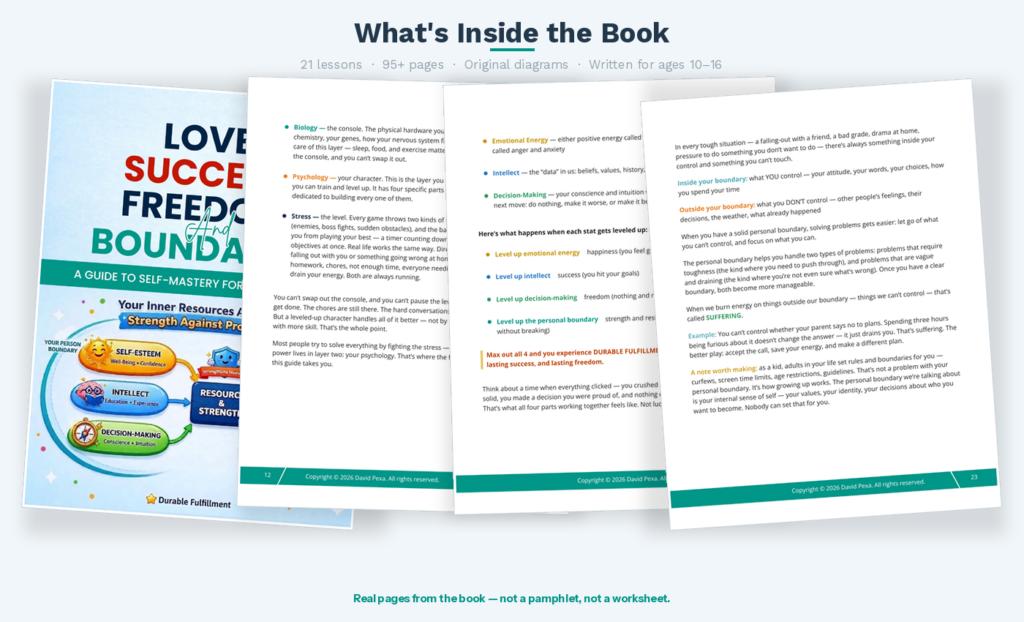
If this resonated, go deeper. My book Love, Success, Freedom and Boundaries gives you twelve frameworks for seeing the patterns that shape your life — and changing the ones that aren’t working.
Frequently Asked Questions
Can you actually change your personality?
You can’t change your core temperament, but you can develop skills that expand how you show up. An introvert won’t become an extrovert, but they can become an introvert who communicates powerfully and leads effectively.
What’s the fastest way to develop personality?
Put yourself in situations that stretch you. Personality develops through friction, not comfort. Join a group where you’re the least experienced. Have conversations that challenge your perspective. Comfort zones are where personality stagnates.
Does personality change with age?
Research shows personality shifts throughout life — people generally become more agreeable, conscientious, and emotionally stable with age. But the rate and direction of change are heavily influenced by the challenges you choose to face.
Keep Reading
- 7 Personal growth and development courses You Should Know
- Online Courses for Personal Development to Boost Your Growth
- 12 Powerful Quotes About Personal Growth and Development to Inspire You in 2026
If you find yourself wanting to put words to what’s happening with your kid — drafting a hard conversation, journaling what you noticed, writing the script you wish you had — the tool I use to draft most of my words is Wispr Flow. It transcribes your voice into clean, edited text in real time, so the friction between thinking it and writing it basically disappears.
Conclusion
Understanding is the first step, but it’s what you do with that understanding that changes things. The ideas in this article aren’t meant to sit in your head — they’re meant to shift how you see your situation and give you something concrete to act on. Start with the one thing that felt most relevant, apply it this week, and notice what changes.
A note on affiliates: This article includes affiliate links to platforms I’ve vetted and would recommend to my own clients and students. If you start with a recommended service through a link here, I may earn a small commission — at no extra cost to you. I only mention what I’d actually point you to in person. The recommendation comes first; the relationship is disclosed second.
If this resonates, the full framework lives in Love, Success, Freedom and Boundaries.
A practical playbook for raising emotionally resilient kids — and breaking the patterns you didn’t choose to inherit.
