


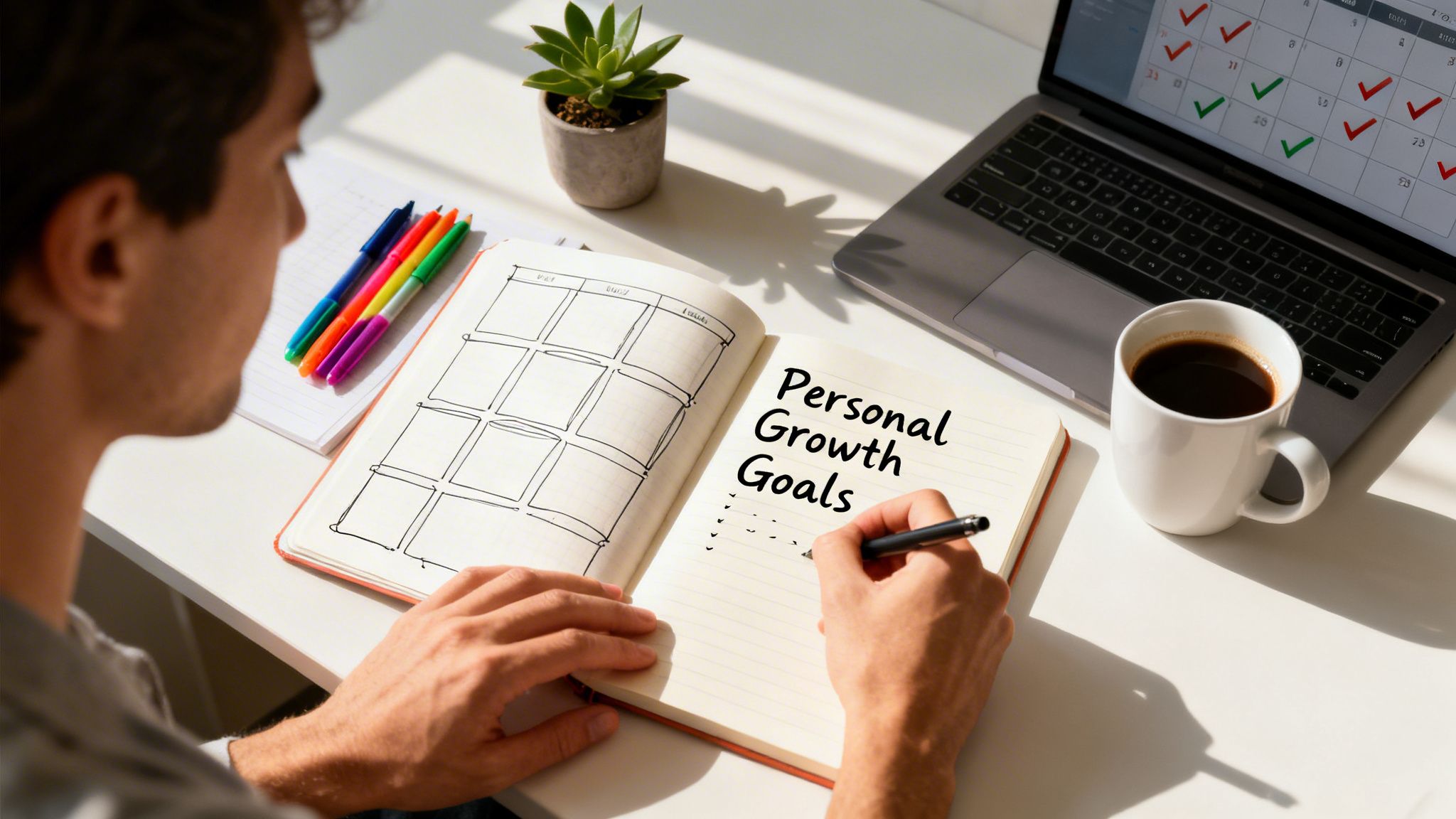
At its core, a personal growth goal is simply an objective you set to become better—whether that’s improving a skill, shifting your mindset, or enhancing your quality of life. It’s the practice of turning a vague wish, like “I want to be healthier,” into a concrete, actionable plan, like exercising three times a week or learning to cook five new healthy meals.
This approach gives your ambitions a backbone, creating a clear roadmap to becoming a more capable and fulfilled version of yourself.
Why Personal Growth Goals Are Your Ultimate Life Upgrade

It’s incredibly easy to get swept up in the day-to-day grind and lose sight of what you truly want. Setting personal growth goals is the antidote to that drift. It’s a conscious decision to grab the steering wheel of your life, giving you the clarity to make better choices and focus your energy where it counts.
Think of it this way: if you don’t have a destination, you’ll end up wherever the road takes you. But with a clear goal, you can actually chart a course. You can anticipate the bumps, celebrate the milestones, and know you’re heading in the right direction. This isn’t about adding more pressure; it’s about making your efforts work for you.
The Shift Toward Intentional Living
If you feel a pull toward self-improvement, you’re in good company. We’re seeing a massive cultural shift toward living more intentionally, and the numbers back it up.
The global personal development market hit an incredible USD 40.1 billion in 2022. It’s on track to reach a projected USD 80.4 billion by 2032, driven by people just like you looking to manage stress and get ahead in their careers. This proves that investing in yourself is no longer some niche hobby—it’s a mainstream priority.
The real power of goals isn’t about restriction. It’s about liberation. They give you permission to focus on what truly matters to you and ignore the noise of what you think you should be doing.

From Ambition to Tangible Achievement
The magic happens when you translate a fuzzy ambition into a concrete plan. “I want to be more confident” is a great starting point, but it’s not a goal. A goal sounds like, “I will deliver one presentation per quarter at work.” See the difference? One is a wish; the other is a target you can actually hit.
This process does more than just help you achieve things; it builds resilience. Every small win is another piece of evidence that you can do hard things. When you inevitably face a setback, you’ll have a history of success to lean on, reminding you to get back up and try again.
To help you get started, it’s useful to think about which areas of your life you want to focus on. Most personal growth goals fall into a few key domains.
Key Areas for Personal Growth Goals
Here’s a quick breakdown of the primary areas where people often set goals. Think of this as a menu of possibilities for your own journey.
| Growth Domain | Focus Area | Example Goal |
|---|---|---|
| Career & Skills | Professional Development | “Complete a project management certification by December.” |
| Health & Wellness | Physical & Mental Vitality | “Meditate for 10 minutes every morning for 30 days straight.” |
| Mindset & EQ | Emotional Intelligence | “Identify one emotional trigger each week and journal about it.” |
| Relationships | Social Connections | “Schedule a one-on-one catch-up with a close friend every two weeks.” |
| Finances | Financial Literacy | “Create a monthly budget and stick to it for three consecutive months.” |
These are just starting points, of course. The goal is to build a life that feels authentic to you, step by step.
Ultimately, these goals become the building blocks for a life you design yourself. For a deeper look at the philosophy behind this, our guide on the definition of self-improvement is a great place to start.
Choosing Your Goal Setting Framework
Okay, you’ve done the soul-searching and know what you want to improve. Now comes the critical part: turning those big ideas into a real plan. This is often where things fall apart. A fuzzy goal like “be healthier” is a recipe for failure because it lacks a clear finish line.
To give your goals a fighting chance, you need a system. Let’s skip the dense academic theories and focus on two incredibly effective frameworks I use with my clients: the classic SMART method and a more flexible version of Objectives and Key Results (OKRs). They approach goal-setting from different angles, and one will likely click better with your personality and the specific goal you’re chasing.
The SMART Framework for Precision and Clarity
There’s a reason SMART goals have been around forever—they just work. This method is all about taking a vague wish and sharpening it into a tactical, well-defined target. It forces you to get crystal clear on what success actually looks like, which is a massive advantage for tracking your progress.
A goal isn’t truly “smart” unless it checks all these boxes:
- Specific: What exactly do you want to do? Get down to the nitty-gritty.
- Measurable: How will you know you’re making progress? You need a number or a metric.
- Achievable: Is this goal actually possible for you right now? Be honest about your time and resources.
- Relevant: Does this even matter? It has to connect to your bigger vision for your life.
- Time-bound: What’s the deadline? This creates a healthy sense of urgency.
Let’s take a common goal: “I want to read more.” It’s a nice sentiment, but it has no teeth.
Watch what happens when we run it through the SMART filter:
“To improve my leadership skills, I will read one book on emotional intelligence or leadership each month for the next 12 months.“
See the difference? It’s no longer a wish. It’s a project. You know exactly what to do, how often to do it, and why you’re doing it. This is perfect for goals that depend on consistent, step-by-step action.
http://
The OKR-Lite Approach for Ambitious Growth
SMART goals are great for specific targets, but what about those bigger, more exploratory ambitions? Sometimes you know the general direction you want to head in, but the final destination isn’t a single, neat checkbox. That’s where a simplified OKR system comes in handy.
Borrowed from the tech industry, the OKR model pairs an ambitious Objective (O) with a few measurable Key Results (KRs). Your Objective is the inspiring, qualitative mission—the “what.” Your Key Results are the quantitative proof points that show you’re making real headway—the “how.”
The Objective is the mountain you want to climb. The Key Results are the base camps you need to reach along the way. Hitting them proves you’re on the right path.
Let’s try this with another popular growth goal: “I want to be a better communicator.” It’s a fantastic goal, but how do you measure it?
Here’s how you could frame it with OKRs:
- Objective: Become a more confident and effective public speaker.
- Key Result 1: Complete an online public speaking course by the end of Q2.
- Key Result 2: Volunteer to lead 3 team meetings by the end of Q3, collecting feedback after each.
- Key Result 3: Write and deliver a 5-minute presentation at a local Toastmasters club.
This approach gives you a clear mission but leaves room for how you get there. You’re not just ticking a box; you’re building a new skill set over time. It’s perfect for those bigger, multifaceted goals. If you want to dive deeper into this, our complete guide on how to set realistic goals has even more strategies.
Which Framework Should You Choose?
Honestly, there’s no “best” one. The right tool depends on the job at hand.
My rule of thumb?
Go with SMART when:
- Your goal is very specific and tactical (e.g., “save $5,000”).
- You love having a clear, structured plan and checking things off a list.
- You’re trying to build a new, quantifiable habit like working out 3 times a week.
Lean toward OKR-Lite when:
- Your goal is more about a direction or a theme (e.g., “become more creative”).
- The path forward isn’t totally clear and involves multiple projects or experiments.
- You’re focused on developing a complex skill over a longer period.
You can also combine them. You could set a big, aspirational OKR for the year, then create smaller SMART goals each quarter to help you hit your Key Results. The goal here is to pick a system that makes your ambitions feel real and, most importantly, achievable.
Alright, you’ve got your frameworks. Now comes the part where the rubber really meets the road: building your actual plan. This is often where people stall out, staring at a giant list of ambitions without a clue how to start. A good plan isn’t just a wish list; it’s a living, breathing roadmap that turns “one day” into what you’re doing this week.
Let’s start with something I call a “brain dump.” It’s exactly what it sounds like. Grab a notebook or open a fresh document and just let everything pour out. Every single thing you want to do, change, or get better at. Don’t edit, don’t second-guess, and definitely don’t judge. Get it all down on paper. Your list might have everything from “run a 10k” and “learn to code” to “be a more patient listener” or “finally organize the garage.” The goal is just to get it out of your head so you can see what you’re working with.
Prioritize What Truly Matters
Looking at that raw list, you’re probably feeling a mix of excitement and total overwhelm. That’s normal. The secret to making real progress is realizing you can’t do everything at once. You have to get ruthless about what matters most right now.
A fantastic tool for this is the Eisenhower Matrix. It forces you to sort everything by urgency and importance. Here’s how it breaks down:
- Urgent and Important: These are the fires you have to put out. They’re your non-negotiable, top priorities that align with your core goals.
- Important, Not Urgent: This quadrant is where real growth lives. These are the game-changing activities—like learning a new skill or building a business—that you have to proactively schedule, or they’ll never happen.
- Urgent, Not Important: Think of these as distractions, often disguised as other people’s priorities. Your job is to delegate, minimize, or just say no.
- Not Urgent, Not Important: These are the time-wasters. Be honest with yourself and eliminate them.
Run your brain-dump list through this filter. It’s an incredibly clarifying exercise that separates the genuine priorities from the noise. Your energy needs to be focused squarely on the two “Important” quadrants.
This personal drive for improvement is part of a massive global shift. The self-improvement market was valued at a staggering USD 45.72 billion in 2024 and is on track to hit nearly USD 84 billion by 2034. It’s clear that building resilience and leadership skills is no longer a niche hobby. With flexible e-learning platforms making skills accessible to everyone, often using AI to create personalized learning paths, there’s never been a better time to invest in yourself. You can dig into these market trends to see the powerful forces behind this movement.
Break It Down into Quarterly Milestones
A huge, year-long goal can be completely paralyzing. “Become a skilled public speaker” sounds great, but it’s so big it’s hard to even start. “Sign up for a Toastmasters meeting” on the other hand? You could do that today. The key is to break your big goals down into 90-day milestones.
A quarter is the perfect sweet spot for a personal development sprint. It’s long enough to make real, tangible progress, but short enough that you feel a constant sense of urgency. For each of your top-priority goals, ask yourself this one simple question: What can I realistically accomplish in the next 90 days to get me closer to my end goal?
A year is for planning, but a quarter is for execution. When you work in 90-day cycles, you create a natural rhythm of intense focus followed by reflection and recalibration. It’s how you build unstoppable momentum.
Let’s see what this looks like with a practical example.
Annual Goal: Launch a successful side-hustle as a freelance writer.
Quarter 1 (Q1) Milestones:
- Finish a specific online course on freelance writing basics.
- Build a starter portfolio with three solid sample articles.
- Land one paying client. That’s it. Even a small project counts.
See how that works? A scary, ambiguous dream suddenly becomes a clear, three-step project for the next three months. It gives you a checklist you can actually work from. You’re not just dreaming anymore—you’re building. Follow this process, and you’ll have a powerful first draft of your personal growth plan ready to go.
From Grand Plans to Daily Action
You’ve done the hard work of defining your goals. Now for the real challenge: making them happen. A beautifully designed growth plan is useless if it just sits in a notebook. The magic isn’t in some rare burst of inspiration; it’s in the small, consistent things you do every single day.
It really boils down to a three-part process: you brainstorm all the possibilities, you ruthlessly prioritize what actually matters, and then you map out how you’ll execute.
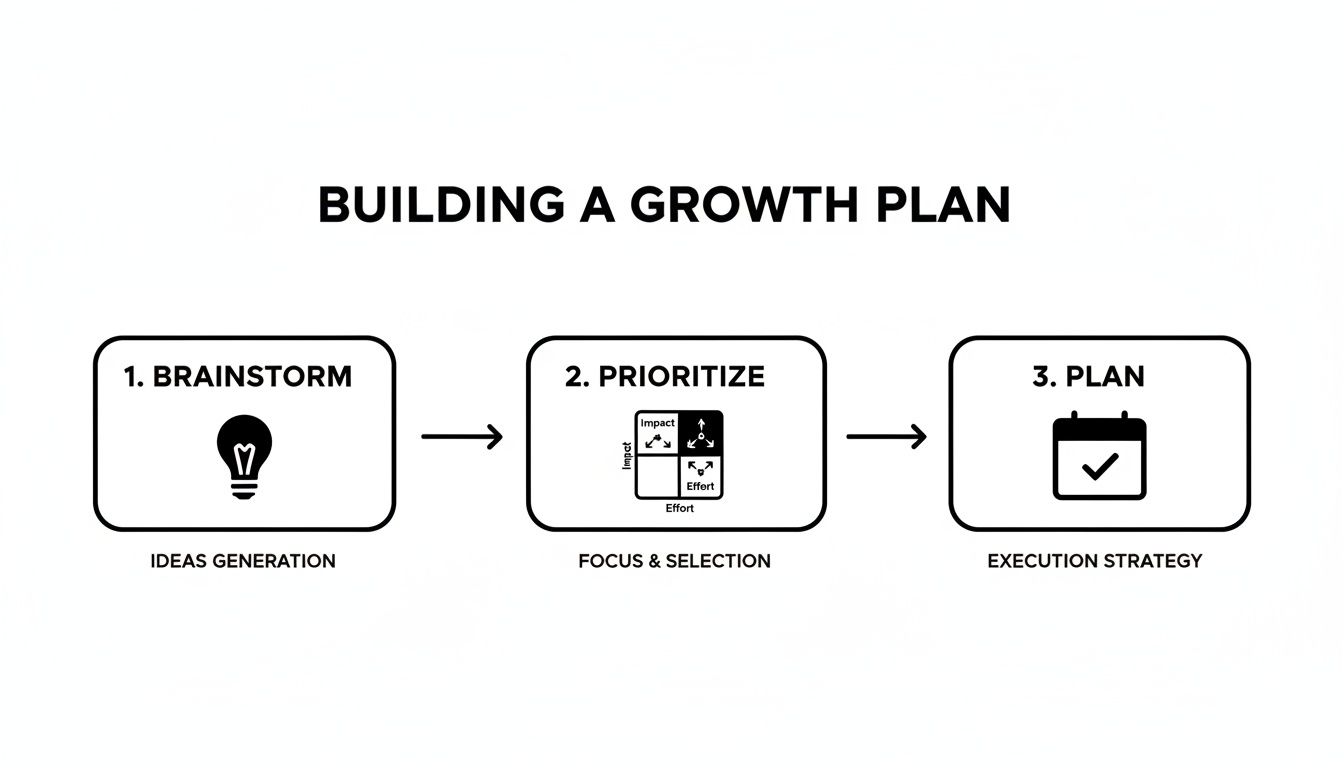
Think of it as a funnel. You start wide with all your big ideas and then narrow them down until you’re left with focused, daily actions that push you forward.
The Simple Power of Habit Stacking
I’ve found one of the best ways to build a new habit is to piggyback it onto an old one. It’s a technique called habit stacking, and it’s incredibly effective because it removes the “when” and “where” from the equation. You’re not trying to find extra time; you’re just linking a new action to something you already do on autopilot.
The framework is straightforward: “After I [existing habit], I will [new habit].”
For example, instead of a vague goal like “read more,” get specific:
- “After I pour my morning coffee, I will meditate for five minutes.”
- “After I brush my teeth at night, I will write one sentence in my journal.”
- “After I get into bed, I will read one page from my book.”
The old habit acts as a trigger, automating the new one. It’s a simple shift, but it’s how goals get woven into the fabric of your daily life. If you want to dive deeper, we have a complete guide on how to build healthy habits that breaks this down even further.
Set Yourself Up for Success
Your environment quietly dictates your behavior, for better or worse. If your goal is to cut back on sugar but your kitchen counter is covered in cookies, you’re fighting an unnecessary battle against your own willpower. The trick is to make the right choice the easy choice.
Here are a few ways I engineer my own environment:
- Make it Obvious: If you want to work out before work, lay your gym clothes out the night before. You can’t miss them.
- Make it Difficult: Want to stop mindlessly scrolling on your phone in bed? Leave it charging in the living room overnight.
- Make it Visible: If you’re trying to drink more water, keep a full water bottle on your desk at all times. It serves as a constant, visual nudge.
Create a Simple Tracking System
What gets measured gets managed. A simple checklist is all you need to see your progress and stay motivated. It’s not about perfection; it’s about building awareness and celebrating consistency.
Here is a basic template you can adapt. Just list the habits you’re building and check them off each day.
Simple Habit Tracking Template
| Habit | Mon | Tue | Wed | Thu | Fri | Sat | Sun | Weekly Goal Met? |
|---|---|---|---|---|---|---|---|---|
| Meditate 5 mins | ✅ | ✅ | ✅ | ✅ | ✅ | Yes | ||
| Read 1 page | ✅ | ✅ | ✅ | ✅ | ✅ | No | ||
| No phone after 9 PM | ✅ | ✅ | ✅ | ✅ | ✅ | No | ||
| Morning walk | ✅ | ✅ | ✅ | ✅ | ✅ | ✅ | ✅ | Yes |
At the end of the week, you get a clear, honest snapshot of how you did. Seeing a row of checkmarks is a powerful motivator, and seeing gaps shows you exactly where you need to refocus your efforts.

Find an Accountability Partner
Going it alone is tough. Sharing your goals with someone—a friend, a colleague, a mentor—is one of the most powerful things you can do to stay on track. This isn’t about finding someone to judge you; it’s about having a person who provides support, encouragement, and a bit of healthy pressure.
It’s no surprise that personal coaching is a massive industry, making up 41% of the market in 2024. People are actively seeking this kind of structured support because it works.
An accountability partner simply asks, “Did you do what you said you would do?” It’s a simple question that makes a world of difference.
A weekly check-in can be a quick five-minute text exchange. These regular touchpoints help you celebrate the small wins, troubleshoot problems before they get out of hand, and, most importantly, remind you that you’re not on this journey by yourself.

Overcoming Obstacles on Your Growth Journey

Let’s be real: even the most carefully crafted plans will hit a snag. Life has a funny way of throwing curveballs. Motivation evaporates, unexpected challenges pop up, and some days, you just don’t have it in you. The first step is to stop seeing these moments as failures. They’re not.
Think of every roadblock as a piece of data. It’s not a reflection of your character; it’s a signal that something in your system needs a tune-up. When you hit a wall, you’ve just found a valuable opportunity to learn and adjust. So, let’s look at some of the most common hurdles I’ve seen and how to clear them.
Decoding Procrastination
Procrastination isn’t a sign of laziness; it’s almost always an emotional response. It’s your brain’s self-protection mechanism kicking in when a task feels overwhelming, scary, or just plain confusing. So when you find yourself putting something off, it’s time to play detective.
What’s the real reason you’re avoiding that task?
-
Is the goal too big? A massive goal like “learn to code” can feel so intimidating that you don’t even know where to start. Your brain just shuts down. The fix: Break it down into a laughably small first step. Instead of “learn to code,” try “watch one 5-minute tutorial on HTML.” The goal is just to break the inertia.
-
Is the path unclear? If you don’t know the very next action to take, it’s easy to do nothing at all. The fix: Take 10 minutes to sketch out a mini-plan. Don’t worry about mapping out the entire project, just the next 3 to 4 steps. Clarity creates momentum.

Navigating the Fear of Failure
The fear of looking foolish or not being good enough is a powerful brake on progress. That little voice in your head says, “If you don’t try, you can’t possibly fail.” This keeps you safe in your comfort zone, but your comfort zone is where growth goes to die.
The goal is not to eliminate fear. The goal is to learn to act while afraid. Resilience isn’t the absence of struggle; it’s the ability to move forward through it.
The trick is to change your relationship with failure. It isn’t a verdict on your worth; it’s just an outcome. It’s information.
Here’s a practical way to reframe it:
- Name the “Worst-Case Scenario.” Seriously, what’s the absolute worst that could happen if you stumble? When you actually write it down, you’ll often find the monster in your head is much scarier than the one on paper.
- Focus on Reps, Not Results. Shift your goal from “achieve the perfect outcome” to “put in the work.” Celebrate the act of showing up, regardless of the immediate result. This builds the habit of action.
- Keep an “Evidence Log.” Remind yourself of other tough things you’ve done. You have a long history of overcoming challenges, even if they seem small now. That’s your proof.
Preventing Burnout and Staying Energized
Burnout is what happens when your ambition writes checks your energy levels can’t cash. We get so fired up about our goals that we push too hard, ignore our body’s warning signs, and eventually run the tank dry. Ambitious goals demand energy, and that energy is not an infinite resource.
You have to start treating rest as a crucial part of your strategy, not a reward for when you’re already running on fumes.
- Schedule Your Recovery. Actually block off time in your calendar for things that recharge you. This isn’t “if I have time” stuff; it’s a non-negotiable appointment with yourself.
- Embrace Sprints and Rests. You can’t sprint a marathon. Work in focused bursts of high-intensity effort, then pull back for a period of lower-intensity work or genuine rest. It’s the rhythm of progress.
- Celebrate the Small Wins. Acknowledging progress, no matter how tiny, is like a shot of motivational espresso. Stuck with a new habit for 3 days? That’s a win. High-five yourself. It matters.

A Few Common Questions About Personal Growth Goals
Even with the best frameworks in hand, a few practical questions almost always pop up when you start getting serious about personal growth. It’s completely normal. Let’s clear up some of the most common ones I hear so you can move forward with total confidence.
How Many Personal Growth Goals Should I Actually Set at Once?
This is the big one. It’s so tempting to get fired up and try to reinvent your entire life overnight, but I’ve seen that approach backfire more times than I can count. Trying to juggle too many big objectives is the fastest way to feel overwhelmed and give up.
As a starting point, stick to one to three major goals at a time. That’s it. This gives you enough mental bandwidth to make real, sustainable progress on each one. For example, you might have one goal for your career, one for your health, and one for a skill you want to learn. Once those new habits are locked in and running on autopilot, you can think about adding something new.
Think of it this way: You can’t learn to play the guitar, speak Spanish, and master chess all in the same month. Lasting change comes from focused, sustained effort, not scattered intensity.
What’s the Real Difference Between a Personal Goal and a Resolution?
The line can feel a bit fuzzy, but the difference is everything. A resolution is usually just a wish without a plan. Think about the classic, “I’m going to get in shape this year.” It sounds great on January 1st, but it has no substance, no roadmap for how it will actually happen.
A true personal growth goal, on the other hand, is a resolution with a system attached. It’s a project. You use a framework like SMART to define it, break it down into smaller steps, and build daily habits to support it. It turns a vague hope into something tangible you can work on every single day.
How Often Should I Be Reviewing My Goals?
Setting goals and then promptly forgetting about them is an incredibly common mistake. To keep your momentum and stay on course, you need a regular review cadence. I’ve found a two-part system works best for just about everyone.
- The Weekly Check-in: Set aside just 15-20 minutes every Sunday. Look back at your week. Did you do what you said you would do? What worked? Where did you get stuck? This quick pulse check lets you make small adjustments before you drift too far off track.
- The Quarterly Deep-Dive: Every 90 days, block out an hour or two for a more serious review. Are these goals still the right ones for you? Have your priorities changed? This is your chance to celebrate wins, learn from what didn’t work, and map out your focus for the next quarter.
At David Pexa, we focus on giving you the practical strategies and clear guidance needed to turn your ambition into real achievement. We do the research for you, connecting you with the best tools and frameworks for your personal growth. Explore our guides and start building a life you design yourself at https://davidpexa.com.
