



Investing in yourself is one of the most reliable decisions you can make, but choosing the right path can be overwhelming. The market is filled with countless personal growth and development courses, each promising life-altering results. How do you cut through the noise to find a program that delivers real, lasting change for your specific goals, whether it’s building mental resilience, mastering productivity, or improving your communication skills?
This guide is designed to provide that clarity. We’ve done the research for you, creating a curated roundup of the most effective and evidence-based programs available today. Forget scrolling through endless Reddit threads or relying on ambiguous marketing claims. Here, you’ll find an in-depth analysis of top-tier courses, from university-backed psychological frameworks to time-tested professional development workshops.
Our goal is to help you make a well-informed decision, not just give you a list. For each program covered, we provide a detailed breakdown, including:
- Core learning outcomes and the skills you’ll actually acquire.
- The ideal student profile, helping you see if a course is a good fit.
- Essential details like cost, format, and the time commitment required.
- Direct links and screenshots to give you a clear look at the platform.
This article moves beyond surface-level reviews to offer a practical decision-making tool. Whether you’re seeking to build healthier habits, become a more effective leader, or simply learn how your own mind works, you’ll find a structured path forward. Let’s explore the programs that can help you build a more intentional and capable version of yourself.
1. Yale University – The Science of Well-Being (Coursera)
For those who want a structured, research-backed introduction to happiness and habit formation, Yale University’s The Science of Well-Being is an excellent starting point. Taught by Professor Laurie Santos, this course demystifies the psychology behind what truly makes us happy, separating common misconceptions from evidence-based practices. It stands out by translating complex academic research into simple, actionable steps anyone can apply.
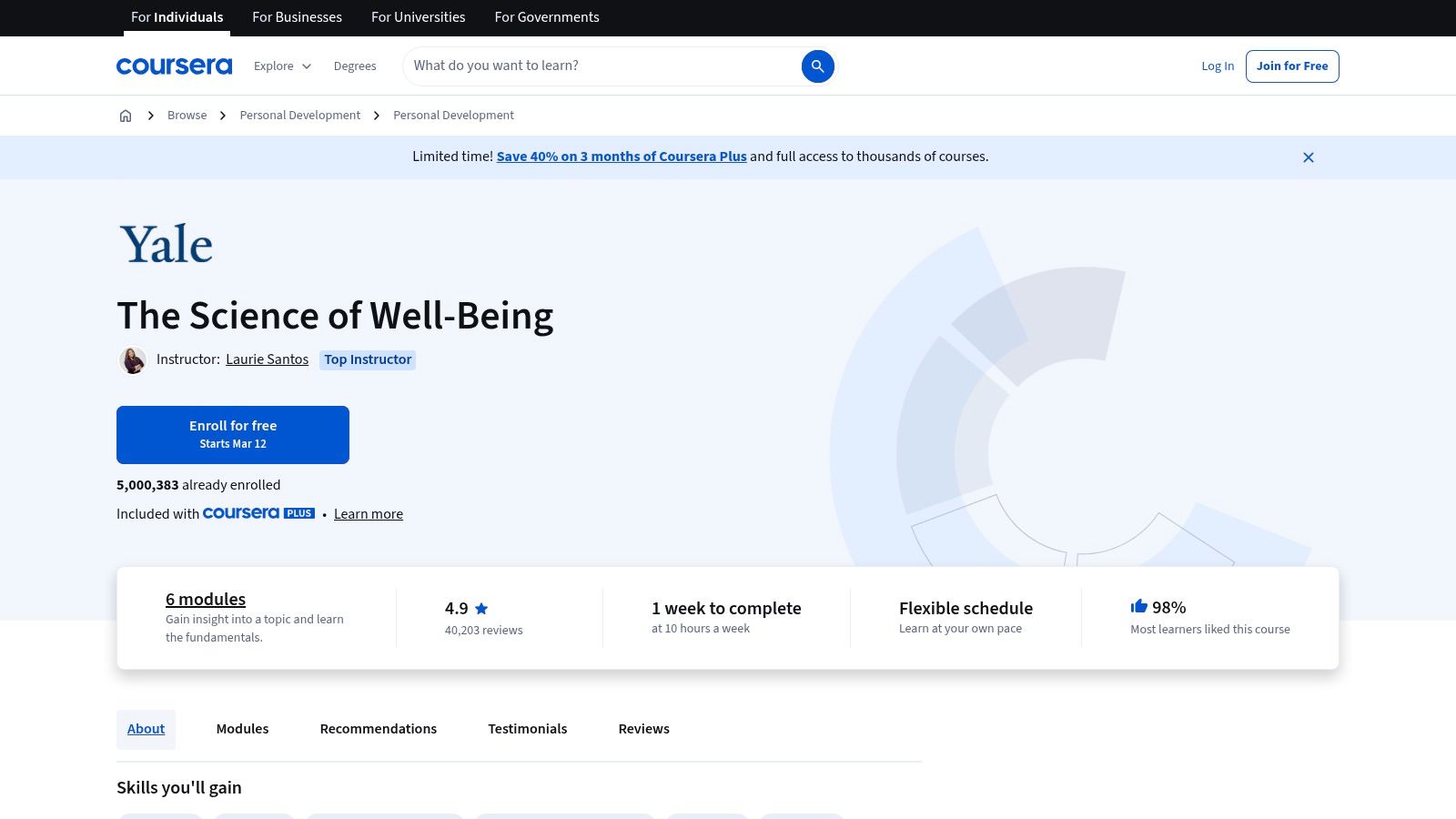
The course is structured around short, digestible video modules and weekly “rewirement” challenges. These challenges are the core of the experience, requiring you to actively implement practices like savoring, gratitude, and social connection into your daily routine. This focus on practical application ensures you don’t just learn the theory but actually begin to build better habits.
Key Features & Structure
- Format: On-demand video lectures, readings, quizzes, and weekly practical challenges.
- Time Commitment: Approximately 19 hours total. The flexible pacing allows you to complete it over several weeks.
- Cost: Access to audit the course (viewing all materials) is free. A paid option is available to earn a shareable certificate, typically through a Coursera Plus subscription or by purchasing the course individually. Financial aid is also available.
- Learning Outcomes: You’ll learn to identify and correct your own cognitive biases about happiness, implement specific strategies to improve well-being, and track your progress using a happiness score.
Who Is This Course Best For?
This is one of the best personal growth and development courses for beginners or anyone feeling skeptical about self-help. It grounds its advice in peer-reviewed science, making it a credible first step. If you’re building a foundation for self-improvement and want to learn how to create a personal growth plan, the rewirement activities provide a perfect framework to start. The huge community of over five million learners also provides a sense of shared experience and motivation.
Key Insight: The course’s central premise is that knowing is not enough; you must actively do. The “rewirements” force this action, making it more effective than passively consuming content.
Pros and Cons
| Pros | Cons |
|---|---|
| Evidence-Based: Every strategy is supported by scientific research, adding credibility. | Introductory Level: Experienced learners may find the content foundational. |
| Action-Oriented: The “rewirements” are practical and designed for immediate implementation. | Confusing Pricing: Coursera’s subscription vs. individual purchase model can be unclear. |
| High Social Proof: Its massive enrollment and positive reviews demonstrate its effectiveness and appeal. | Requires Self-Discipline: The flexible schedule means you must hold yourself accountable. |
Website: The Science of Well-Being on Coursera

2. Learning How to Learn (Coursera) – Dr. Barbara Oakley & Dr. Terrence Sejnowski
For anyone looking to become a more effective learner, Learning How to Learn is a foundational course that unlocks the mechanics of your own brain. Taught by Dr. Barbara Oakley and Dr. Terrence Sejnowski, this program provides a high-leverage toolkit of mental models for acquiring new skills, defeating procrastination, and improving memory. It excels by making complex neuroscience accessible, offering practical techniques that can be applied immediately to any subject, from learning a new language to mastering a technical skill.
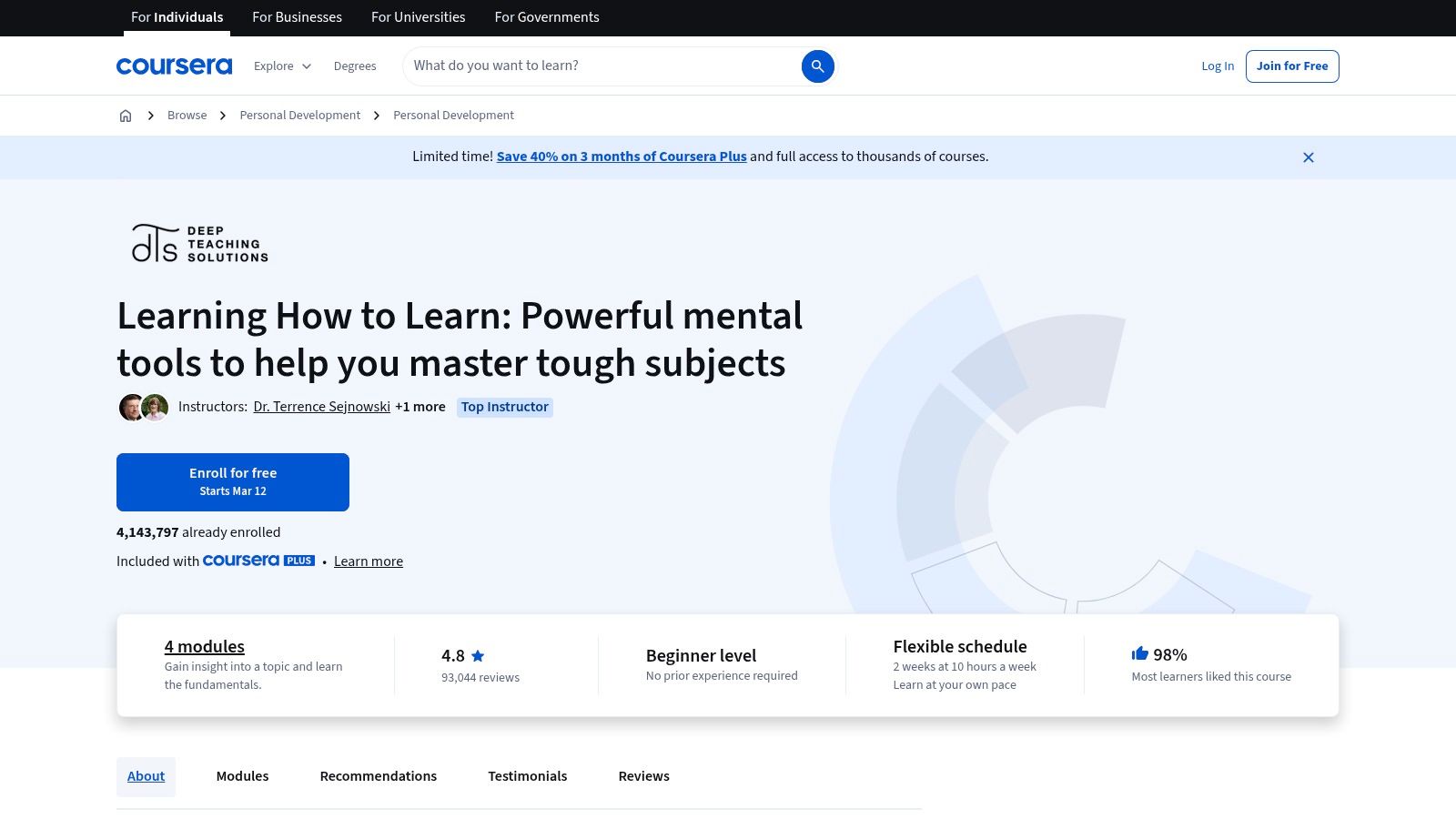
The course is famous for its simple yet powerful concepts, like the “Focused vs. Diffuse” modes of thinking and the “Pomodoro Technique.” Through short, engaging videos and light-hearted animations, it explains how to “chunk” information into manageable pieces, use recall to strengthen neural pathways, and build long-term knowledge. Its structure is designed for busy people, making it easy to absorb critical ideas without a huge time investment.
Key Features & Structure
- Format: On-demand video lectures, short readings, quizzes, and optional peer-reviewed assignments.
- Time Commitment: Approximately 15 hours total. Its modular design allows you to complete it in small increments over a few weeks.
- Cost: The course can be audited for free, granting access to all video content. A paid certificate is available through a Coursera Plus subscription or by purchasing the course, which also unlocks graded assignments. Financial aid is available.
- Learning Outcomes: You’ll understand the key differences between focused and diffuse thinking, learn practical techniques to stop procrastinating, and build a framework for mastering any new subject more efficiently.
Who Is This Course Best For?
This is one of the most versatile personal growth and development courses available, ideal for students, professionals, and lifelong learners alike. If your goal is to improve your capacity to absorb and retain information, this course offers an incredible return on investment. Its focus on “meta-learning” (the skill of learning itself) provides a permanent upgrade to your cognitive toolkit, making every future learning endeavor easier and more effective. A companion course, Mindshift, is also available for those who want to go deeper.
Key Insight: The course’s most powerful idea is that your brain has two distinct operating modes. Intentionally switching between focused attention and relaxed, diffuse thinking is the secret to solving hard problems and fostering creativity.
Pros and Cons
| Pros | Cons |
|---|---|
| High Applicability: The skills learned are universal and can be applied to any professional or academic field. | Meta-Learning Focus: It teaches you how to learn, not a specific subject, which may not suit everyone. |
| Immediate Quick Wins: You can apply techniques like the Pomodoro method after the first few videos. | Variable Pricing Display: Coursera’s cost can be confusing depending on your region and subscription status. |
| Massive Social Proof: With millions of learners and stellar ratings, its value and effectiveness are well-established. | Beginner-Friendly: The content is foundational, so experts in cognitive science may not find it new. |
Website: Learning How to Learn on Coursera

3. Search Inside Yourself (SIY Global)
For leaders and professionals aiming to integrate mindfulness and emotional intelligence into their work, Search Inside Yourself (SIY Global) offers a deeply experiential program. Born at Google, this curriculum combines neuroscience, mindfulness practices, and emotional intelligence (EQ) training to help participants improve focus, manage stress, and cultivate a more empathetic leadership style. It stands out by moving beyond theory and focusing on live, cohort-based learning that drives genuine behavior change.
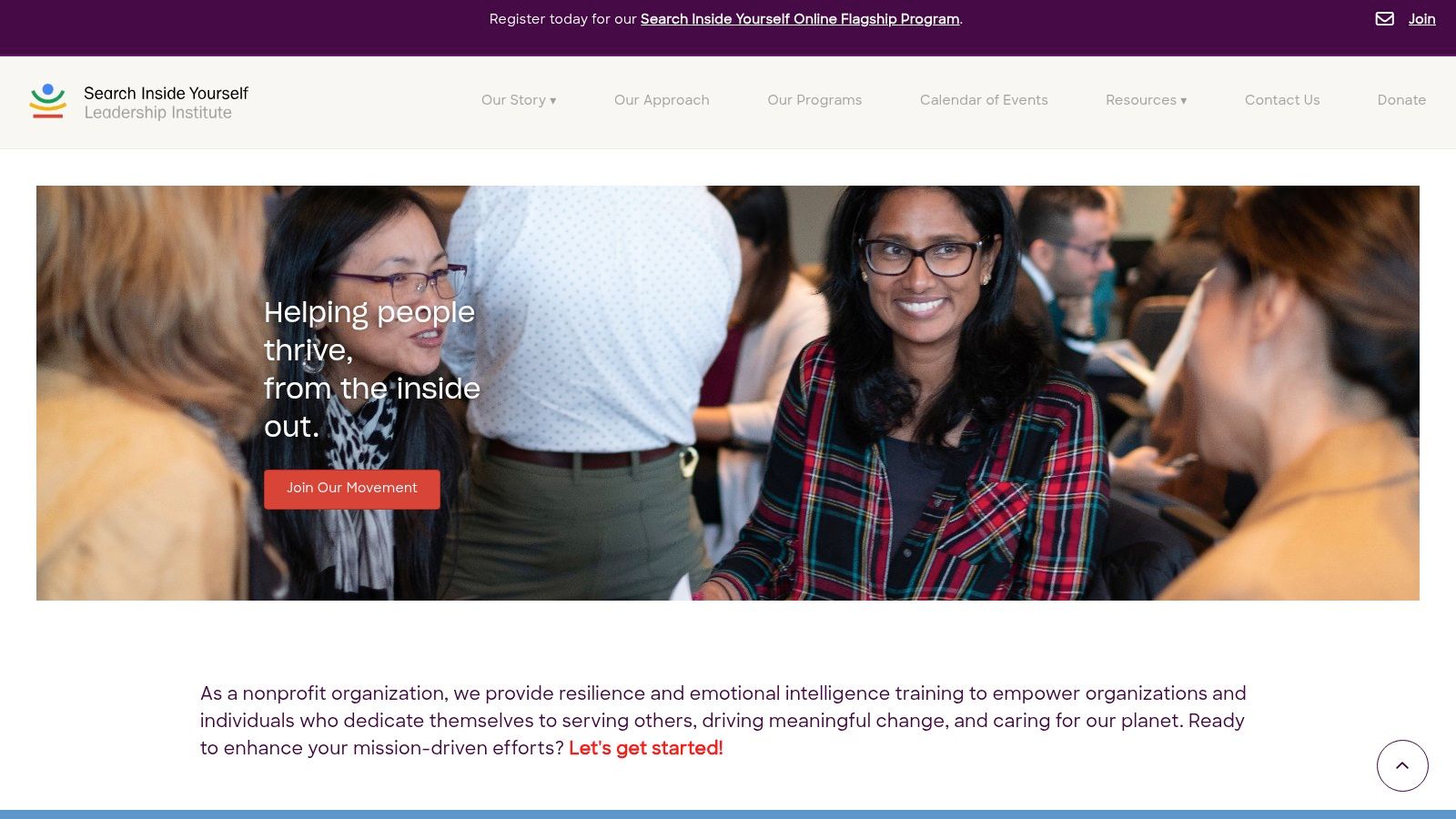
The program is not a self-paced video course but a live, interactive experience led by certified SIY teachers. Participants engage in guided mindfulness exercises, peer-to-peer discussions, and practical skill-building sessions. A key component is the community practice period and capstone project, which ensures the skills learned are actively applied and integrated into daily professional and personal life, preventing the common “forgetting curve” associated with one-off workshops.
Key Features & Structure
- Format: Live, multi-session programs delivered either online or in-person. It includes experiential learning, coaching-style facilitation, and a post-program practice period.
- Time Commitment: Typically consists of multiple live sessions spread over days or weeks, plus a commitment to daily practice and a final capstone project.
- Cost: Pricing is event-specific and not always listed publicly until registration for a cohort opens. Scholarships are often available for individuals from mission-driven organizations.
- Learning Outcomes: You’ll develop enhanced self-awareness, learn to manage emotional triggers effectively, build skills for empathetic communication, and cultivate resilience to navigate workplace challenges.
Who Is This Course Best For?
This is one of the top personal growth and development courses for managers, leaders, and teams who want to build a culture of psychological safety and high performance. It’s also ideal for individuals who thrive in a structured, community-driven environment and prefer live interaction over solitary, on-demand learning. If you are looking for a program with a strong corporate pedigree and a focus on measurable EQ improvements, SIY is an excellent choice.
Key Insight: The program’s strength lies in its cohort-based, live format. The shared experience and accountability with peers and teachers make it much more likely that new habits will stick long after the course ends.
Pros and Cons
| Pros | Cons |
|---|---|
| Experiential Learning: Focuses on practice and interaction, not just passive listening. | Significant Time Commitment: Requires attendance at multiple live sessions plus dedicated practice time. |
| Strong Pedigree: Developed at Google and used by major global companies, adding to its credibility. | Variable Pricing: Cost is not always transparent and can be a significant investment. |
| Community-Driven: The cohort model provides accountability, support, and valuable networking. | Not On-Demand: The fixed schedule lacks the flexibility of self-paced courses. |
Website: Search Inside Yourself Leadership Institute

4. FranklinCovey – The 7 Habits of Highly Effective People (On‑Demand & workshops)
For those seeking a proven, principle-centered framework for personal and professional effectiveness, FranklinCovey’s programs based on The 7 Habits of Highly Effective People are a gold standard. While the book has been a staple for decades, FranklinCovey has adapted this timeless content into modern, engaging formats. This isn’t just a book summary; it’s an immersive system for integrating core habits related to leadership, productivity, and interpersonal skills into your life.

The platform stands out by offering multiple learning pathways to suit different needs and budgets, from self-paced online courses to live workshops. This flexibility allows individuals to access enterprise-grade training that has been trusted by Fortune 500 companies for years. The content focuses on moving from dependence to independence and finally to interdependence, providing a clear roadmap for growth.
Key Features & Structure
- Format: Multiple options are available, including self-paced On-Demand courses, live-online workshops, and multi-day in-person events. The On-Demand membership provides access to over 80 courses.
- Time Commitment: The flagship “7 Habits” On-Demand course takes approximately 10-12 hours. Live workshops are typically 2-3 days. The self-paced membership is an annual subscription.
- Cost: Public workshops are premium-priced, often several thousand dollars (a better value if sponsored by an employer). The All Access Pass On-Demand membership offers more affordable year-long access to the entire content library for a few hundred dollars.
- Learning Outcomes: You’ll learn to master a habit-based system for personal leadership, prioritize tasks using the Time Management Matrix, and apply principles for effective communication and collaboration.
Who Is This Course Best For?
This is one of the best personal growth and development courses for professionals, managers, or anyone looking to build a strong foundation of personal effectiveness that translates directly to their career. If you thrive on structured, time-tested systems and want to develop leadership qualities, this is a superb choice. It’s also ideal for those interested in a deep dive into how to build healthy habits that compound over time, as the entire framework is built on this premise.
Key Insight: The power of the 7 Habits lies in its integrated, sequential nature. Each habit builds on the last, creating a powerful system for character development rather than just offering isolated “hacks.”
Pros and Cons
| Pros | Cons |
|---|---|
| Time-Tested Content: The framework is proven and widely respected in corporate environments. | Premium Pricing: Live workshops are a significant financial investment for individuals. |
| Multiple Formats: Offers flexibility with self-paced, live-online, and in-person options. | Requires Self-Discipline: The On-Demand membership model requires strong personal accountability. |
| Strong Brand Recognition: A certificate from FranklinCovey carries weight on a resume. | Corporate Focus: Some examples may feel more oriented toward a corporate setting. |
Website: FranklinCovey On-Demand Courses & Workshops

5. Dale Carnegie Course – Effective Communications & Human Relations
For those seeking to master the art of interpersonal dynamics and leadership, the Dale Carnegie Course offers a time-tested, highly interactive experience. Rather than passive video lectures, this program focuses on building tangible skills in a live environment. It’s designed to boost confidence, refine communication, manage stress, and cultivate a powerful leadership presence, all grounded in the enduring principles from Carnegie’s famous book, How to Win Friends and Influence People.

The course’s strength lies in its cohort-based model, available both in-person and live online. Participants engage in extensive role-playing, receive direct coaching, and present regularly in a supportive setting. This constant practice helps internalize concepts, turning theory into applied skill. The focus is on speaking up effectively, building trust with others, and influencing outcomes in both professional and personal scenarios.
Key Features & Structure
- Format: Live, instructor-led sessions (in-person or online) with a cohort of peers. Heavily reliant on participation, role-plays, and direct feedback.
- Time Commitment: Typically runs for several weeks, with one session per week lasting 3-4 hours. The total commitment is often around 32 hours.
- Cost: This is a premium investment. Pricing varies significantly by region and franchise, often ranging from $1,500 to over $2,500. Corporate sponsorships are common.
- Learning Outcomes: You’ll learn to communicate with clarity and confidence, handle difficult conversations, build stronger relationships, manage stress, and inspire action in others. It’s a foundational course in the art of conversation and influence.
Who Is This Course Best For?
This is one of the best personal growth and development courses for professionals, emerging leaders, or anyone whose success depends on their ability to connect with and influence people. If you find public speaking intimidating or struggle to articulate your ideas under pressure, the hands-on practice provides a direct path to improvement. It’s less about abstract theory and more about building real-world “people skills” that have an immediate impact.
Key Insight: The true value is in the live practice. Being required to stand up and speak in front of a group each week, with expert coaching, builds confidence in a way that self-paced online courses cannot replicate.
Pros and Cons
| Pros | Cons |
|---|---|
| Tangible Skill-Building: Focuses on practical application for immediate use in professional life. | Premium Cost: The price point makes it a significant financial commitment. |
| Live Coaching & Feedback: Direct, personalized guidance from trained facilitators is a core component. | Facilitator Dependent: The quality of the experience can vary based on the local facilitator’s skill. |
| Strong Brand & History: A globally recognized program with a long track record of success. | Time-Intensive: Requires a fixed weekly schedule over several weeks, offering less flexibility. |
Website: Dale Carnegie Course

6. Positive Intelligence (PQ Program)
For those looking to build mental resilience through a daily, app-guided routine, the Positive Intelligence (PQ) Program offers a structured mental fitness regimen. Created by Shirzad Chamine, this program is designed to weaken your inner critics (“Saboteurs”) and strengthen your wiser, more creative self (“Sage”). It stands out by gamifying mindset work, turning abstract concepts into concrete, two-minute exercises called “PQ Reps” that you can do anytime, anywhere.
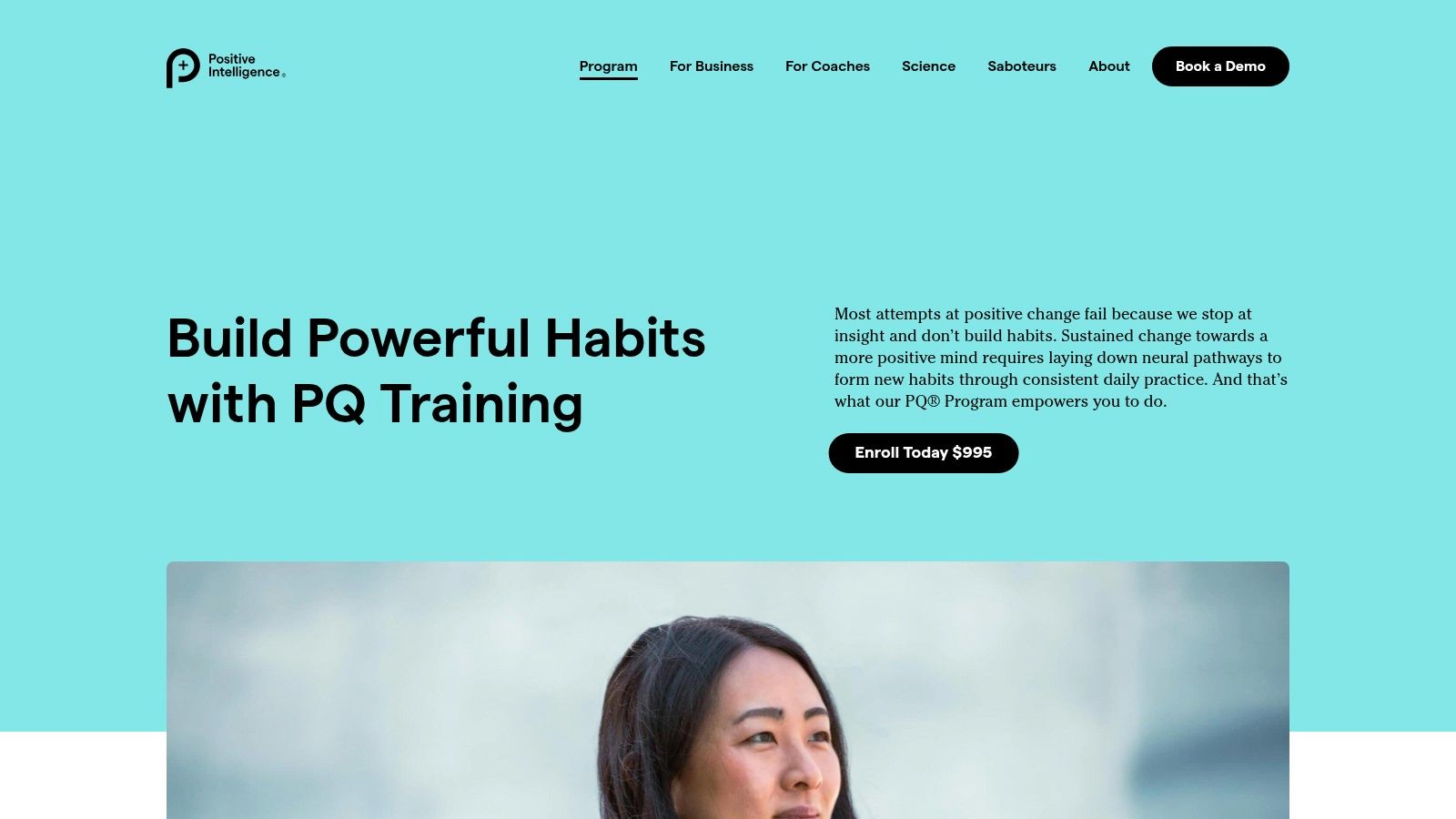
The program unfolds over six to seven weeks, combining weekly video modules with daily app-based practices and a supportive community “pod.” This combination of learning, doing, and sharing creates a powerful system for habit formation. Instead of just learning theory, you actively practice intercepting negative thought patterns and activating different regions of your brain associated with calm and creativity.
Key Features & Structure
- Format: A hybrid of weekly video lessons, daily app-guided exercises (PQ Reps), an audiobook, and small group accountability pods.
- Time Commitment: A 1-hour weekly video plus 15 minutes of daily practice via the app for 6-7 weeks. Continued mastery tracks are available.
- Cost: Pricing often varies depending on the coach or channel you sign up through, but the foundational program typically has a set fee. There are different tiers for individuals, teams, and those pursuing a coaching certification.
- Learning Outcomes: You’ll learn to identify your top Saboteurs, build the three core mental muscles of Self-Command, and apply five Sage powers to handle challenges with a clear, positive mindset.
Who Is This Course Best For?
This is one of the best personal growth and development courses for busy professionals, leaders, and teams who need a practical, low-friction way to improve performance and well-being. The clear framework (Saboteurs, Sage, PQ Reps) is easy to understand and apply in a corporate setting. If you respond well to app-based nudges and want a system that builds habits through small, consistent actions, this program is an excellent fit.
Key Insight: The power of the PQ Program lies in its micro-interventions. By practicing “PQ Reps” for just a few minutes a day, you build the neural pathways needed to shift from a reactive, stressed state to a calm, resourceful one on demand.
Pros and Cons
| Pros | Cons |
|---|---|
| Strong Habit-Formation Loop: The app provides daily nudges and tracks progress, making it easy to stay engaged. | Requires Daily Engagement: The program’s effectiveness is directly tied to consistent daily practice; skipping days weakens results. |
| Scalable Framework: The concepts are simple enough to be used by individuals or deployed across entire organizations. | Variable Pricing: The cost and promotional offers can differ significantly depending on the cohort and sign-up channel. |
| Practical Application: Focuses on tangible exercises (“PQ Reps”) rather than just passive learning. | Framework Can Seem Simplistic: The “Saboteur” and “Sage” language might feel too basic for those with a deep psychology background. |
Website: Positive Intelligence Program

7. Mindfulness-Based Stress Reduction (MBSR) – 8-Week Live Online (UMass/US Providers)
For those seeking a profound, medically respected approach to managing stress and cultivating presence, the Mindfulness-Based Stress Reduction (MBSR) program is a gold standard. Developed by Jon Kabat-Zinn at the University of Massachusetts Medical School in 1979, MBSR is not a quick-fix course but a deep, experiential training. It stands out by offering a structured, evidence-informed protocol taught by qualified instructors, often within reputable health systems, making it a clinically recognized pathway for well-being.
This 8-week program is built around formal meditation practices (like the body scan and sitting meditation), mindful movement (gentle yoga), and integrating mindfulness into daily life. Unlike passive learning, MBSR requires active participation in weekly live sessions, a full-day silent retreat, and structured daily home practice. This combination of instruction, practice, and group dialogue creates a powerful container for genuine personal change.
Key Features & Structure
- Format: 8 weekly 2.5-hour live sessions, a full-day silent retreat, and structured daily home practice (approx. 45 minutes/day). Delivered live online or in hybrid formats.
- Time Commitment: Extremely intensive. Requires approximately 27-30 hours of class time over 8 weeks, plus significant daily practice.
- Cost: Varies significantly by provider, typically ranging from $400 to $750. Some health insurance plans may offer partial reimbursement. Always check with the specific center (e.g., UMass, Brown, UCSD) for pricing, dates, and policies.
- Learning Outcomes: You’ll develop skills to manage stress, reduce anxiety, handle difficult emotions, and cultivate a non-judgmental awareness of your present-moment experience.
Who Is This Course Best For?
This is one of the most effective personal growth and development courses for individuals committed to a deep, disciplined practice for managing chronic stress, anxiety, or pain. It is ideal for those who value scientific credibility and a structured group environment. If you’ve dabbled in meditation apps and now want a more immersive and guided experience with a strong community and expert instruction, MBSR is the definitive next step.
Key Insight: MBSR’s power lies in its structure and intensity. The combination of weekly sessions, a day-long retreat, and mandatory daily home practice creates a powerful habit-forming loop that is difficult to replicate with self-study.
Pros and Cons
| Pros | Cons |
|---|---|
| Deep, Experiential Training: Goes far beyond theory, providing immersive practice and group support. | Time-Intensive: The commitment of nearly an hour per day plus weekly classes is substantial. |
| Medical-Center Pedigree: Backed by decades of research and widely used in clinical settings. | Variable Cost & Access: Pricing, schedules, and refund policies differ across many providers. |
| Proven Effectiveness: Providers cite strong evidence for its positive impact on stress, anxiety, and chronic pain. | Requires High Self-Discipline: Success is dependent on consistent completion of the daily home practice. |
Website: MBSR Program at UMass Memorial Health

Personal Growth Courses — 7-Course Comparison
| Program | Implementation complexity 🔄 | Time & resource ⚡ | Expected outcomes ⭐📊 | Ideal use cases 💡 | Key advantages ⭐ | Main limitations / tradeoffs 💡 |
|---|---|---|---|---|---|---|
| Yale University – The Science of Well‑Being (Coursera) | Low — self‑paced modules + weekly challenges | Low–Medium — hours/week; optional certificate fee | ⭐ Evidence‑based habit gains; short‑term well‑being uplift | Intro learners seeking practical happiness strategies | Research‑backed, pragmatic, highly accessible | Introductory depth; Coursera pricing/options can confuse |
| Learning How to Learn (Coursera) – Oakley & Sejnowski | Low — short videos and practical assignments | Low — short modules; free audit or paid cert | ⭐⭐ Improved learning efficiency, memory, reduced procrastination | Students & professionals wanting meta‑learning tools | Highly applicable; quick, actionable techniques | Not a deep subject‑matter course; platform pricing varies |
| Search Inside Yourself (SIY Global) | Medium–High — live, cohort‑based experiential program | Medium–High — multi‑session live attendance; cohort fees | ⭐⭐ Improved EQ, focus, resilience; behavior change with practice | Leaders and teams seeking applied mindfulness + EQ | Cohort interaction, coaching, corporate pedigree | Price often opaque; requires sustained attendance/practice |
| FranklinCovey – The 7 Habits (On‑Demand & workshops) | Medium — structured curriculum across formats | Medium — workshop fees or subscription for library | ⭐⭐ Improved leadership, prioritization, execution | Organizations and individuals wanting proven habit system | Time‑tested framework; enterprise‑ready; multiple delivery modes | Premium public workshops; self‑discipline needed for on‑demand |
| Dale Carnegie Course – Effective Communications & Human Relations | Medium — cohort, role‑plays, coaching | Medium–High — live sessions; franchise pricing varies | ⭐⭐ Tangible gains in communication, confidence, influence | Presenters, managers, people-focused roles | Interactive practice, long‑standing reputation | Cost varies by franchise; facilitator quality can differ |
| Positive Intelligence (PQ Program) | Low–Medium — app + weekly content and micro‑practices | Low daily time; cohort or licensing cost for teams | ⭐ Reduced negative self‑talk; improved mental fitness with adherence | Leaders, coaches, teams aiming for daily habit change | Scalable app nudges; clear, shareable framework | Effectiveness depends on daily engagement; adherence required |
| Mindfulness‑Based Stress Reduction (MBSR) – 8‑Week | High — structured 8‑week curriculum + retreat | High — ~27–30 hours + daily practice; instructor fees | ⭐⭐⭐ Strong evidence for stress/anxiety reduction; deep experiential change | Individuals seeking clinical‑grade mindfulness training | Robust research lineage; taught by qualified instructors | Time‑intensive; scheduling and cost vary by provider |
Final Thoughts
You have now explored a detailed map of some of the most effective personal growth and development courses available today. We’ve moved beyond surface-level descriptions to dissect the core mechanics of each program, from Yale’s evidence-based happiness strategies to the practical communication frameworks of the Dale Carnegie Course. The goal was to provide you with the clarity needed to move from interest to intentional action.
The common thread connecting these distinct programs is their foundation in actionable frameworks rather than just abstract inspiration. Whether it’s the cognitive reframing techniques in the Positive Intelligence program or the neuroscience-backed study habits from Learning How to Learn, each course offers a system for tangible change. True development isn’t about a single moment of insight; it’s about integrating new behaviors and mindsets into your daily operating system.
Your Path Forward: From Information to Integration
The most significant takeaway is that the “best” course is entirely dependent on your immediate goals and preferred learning style. Your next step isn’t just to pick one, but to diagnose your primary area for growth with honesty.
Before you make a decision, revisit the core purpose of each program we reviewed:
- For building foundational happiness and habits: The Science of Well-Being offers a low-risk, research-backed starting point.
- For mastering the learning process itself: Learning How to Learn is an essential primer for any student or lifelong learner.
- For cultivating workplace mindfulness and emotional intelligence: Search Inside Yourself provides a secular, corporate-friendly approach.
- For creating a life of principle-centered effectiveness: The 7 Habits remains a powerful guide for holistic personal and professional management.
- For improving interpersonal skills and influence: The Dale Carnegie Course delivers time-tested methods for communication and leadership.
- For quieting your inner critic and mental “Saboteurs”: The PQ Program offers a focused, app-based system for mental fitness.
- For deep, evidence-based stress reduction: MBSR provides an intensive, live-format training in classical mindfulness.
Key Insight: Choosing a course is an act of self-awareness. It requires you to pinpoint the specific friction in your life you want to resolve. Are you struggling with focus, relationships, stress, or a general sense of purpose? Let the answer guide your investment.
Making Your Choice Actionable
Once you’ve selected a program, commit to its structure. The true value of these personal growth and development courses comes from consistent engagement, not passive consumption. Block out the time in your calendar as you would for any other important commitment. Engage with the community, complete the exercises, and actively look for opportunities to apply the lessons in your professional and personal life.
Remember that personal growth is not a one-time fix but a continuous practice of curiosity and application. The course you choose is not the destination; it is the vehicle that helps you begin the journey with a reliable map and a full tank of gas. The real work, and the real reward, begins when you take what you’ve learned and put it into practice, one day at a time. Your commitment to this process is the ultimate investment in your future self.
If you’re looking for guidance on building a purpose-driven career or brand that aligns with your personal growth, check out David Pexa. His work focuses on helping individuals and businesses create authentic, impactful presences. Explore his resources at David Pexa.
