



The first step to overcoming limiting beliefs is realizing that the stories you tell yourself aren’t facts. That little voice whispering, “I’m not good enough” or “I’ll probably fail anyway”—it’s just a well-rehearsed script, not a reflection of reality. The real work is in finding those scripts, challenging them, and rewriting a new narrative that actually serves you.
Why Your Mindset Is Your Biggest Asset

Ever found yourself passing on a great career move, staying silent in a meeting when you had a brilliant idea, or shelving a passion project? The real barrier often isn’t a lack of talent or drive. It’s that quiet, persistent inner voice insisting you can’t or shouldn’t.
That’s the sound of a limiting belief in action. It’s one of the most powerful, yet invisible, forces shaping your life.
These beliefs are the subconscious rules you operate by, the unseen scripts that guide your decisions and define the edges of your comfort zone. They don’t just appear out of nowhere; they’re built up over years, piece by piece.
The Origins of Your Inner Critic
Most limiting beliefs take root in our younger, more formative years. A single offhand comment from a teacher, a string of frustrations in one subject, or the weight of family expectations can plant a seed of self-doubt.
These experiences become the “evidence” we use to build narratives like, “I’m just not a creative person,” or “I’ve always been terrible with money.”
Societal pressures pile on, too. We’re constantly bombarded with messages about what success, intelligence, or happiness is supposed to look like. This can lead to beliefs like, “I’m too old to switch careers,” or “I need to hit X milestone before I can be considered successful.” These external benchmarks become the harsh measuring sticks we use against ourselves.
“It’s not so easy to do but when you consciously decide to choose love over perfection, you give yourself enough grace to powerfully handle any emotion, challenge, or circumstance that threatens to keep you locked in the infinite loop of ‘not good enough.'”
That infinite loop of “not good enough” is precisely what keeps you stuck. It’s why you might look at someone else’s success and think, “They just have something I don’t.” But more often than not, the real difference is the story they tell themselves. Overcoming these beliefs isn’t about pretending you have no flaws; it’s about refusing to let those flaws define you.
Shifting from a Fixed to a Growth Mindset
Dismantling these mental roadblocks starts with consciously adopting what’s known as a growth mindset. This isn’t just a feel-good idea; it’s the fundamental shift required for real, lasting change. It’s the core belief that your abilities and intelligence aren’t set in stone—they can be developed through dedication and hard work.
Here’s how that small shift changes absolutely everything:
- A fixed mindset says: “I failed, so I’m a failure.” It treats any setback as a final verdict on your worth.
- A growth mindset says: “I failed, so what can I learn from this? I’ll try a different way next time.” It treats setbacks as crucial feedback.
When you start seeing challenges as stepping stones instead of dead ends, you reclaim your power. You can dive deeper into this powerful concept by exploring the differences between a growth vs. fixed mindset and seeing how it applies in the real world. This guide will give you the framework to start putting this into practice, moving from just understanding the idea to actually living it.
How to Uncover Your Hidden Beliefs
You can’t change what you don’t acknowledge. The tricky thing about limiting beliefs is that they rarely announce themselves. Instead, they operate just below the surface, like invisible puppet strings pulling your emotional strings and guiding your actions.
The first step isn’t to judge or fix anything. It’s simply to bring them into the light. We need to learn how to see these beliefs for what they are: not fundamental truths, but automatic mental habits your brain has formed over time. And like any habit, they can be understood and reshaped with a bit of intentional practice.
Pay Attention to Your Emotional Triggers
Your emotions are powerful messengers. That sudden spike of anxiety before a presentation? The heavy feeling of dread when you look at a blank page? The immediate, almost physical urge to procrastinate on a big project?
These aren’t random. They are flares, signaling that an underlying belief has just been activated.
Think of these feelings as a trail of breadcrumbs leading back to a core assumption you hold about yourself or the world. The next time you feel a disproportionately strong negative emotion, just pause. Ask yourself one simple question: “What thought just went through my mind?”
Don’t filter the answer. It might be a fleeting, nasty little phrase like:
- “They’re all going to think I’m an idiot.”
- “I have no idea what I’m doing.”
- “I’m going to fail at this, just like last time.”
These flashes of self-talk are the visible tips of much deeper icebergs. Catching them in the moment is the first practical step toward mapping out the hidden architecture of your mindset. It’s how you shift from being a passive participant in your emotional life to an active, curious observer.
Your strongest negative emotions often guard your most entrenched limiting beliefs. Instead of pushing them away, get curious. They are pointing directly at the work that needs to be done.
Use Journaling for Deeper Discovery
Once you start catching these trigger thoughts in the wild, journaling is one of the best ways to explore where they actually come from. It gives you a private, judgment-free space to follow a thought without interruption. The goal isn’t to write a masterpiece; it’s to think clearly on paper.
Set aside just five or ten minutes when you feel stuck, anxious, or self-critical. Use these prompts to get to the root of your thinking.
Journaling Prompts to Unearth Your Beliefs:
- What is the story I tell myself about my potential? Is there a hero in this story? A victim? Where did I first learn this narrative?
- When I feel like an imposter, what is the specific fear? Am I afraid of being “found out”? What do I believe will happen if I am?
- If I were to chase [your goal], what’s the worst-case scenario I keep imagining? What belief about myself makes this outcome feel so inevitable?
- Complete this sentence 10 times: “To succeed, I must be…” Take a hard look at your answers. Are these your rules, or did you borrow them from someone else?
Don’t underestimate the power of this exercise. Shifting these beliefs has a real, measurable impact. Take students, for example. Research has shown that when students shift from a fixed mindset (“I’m just not good at this”) to a growth mindset, their results can skyrocket. In fact, one study found they achieved 40% higher results in their grades. You can learn more about how this works by exploring these findings on overcoming limiting beliefs.
Listen for Absolute Language in Your Thoughts
Finally, train your ear to perk up whenever you hear absolute language in your own self-talk. Words like “always,” “never,” “everyone,” and “impossible” are massive red flags. This kind of all-or-nothing vocabulary is the native tongue of a rigid, limiting belief.
It leaves no room for nuance, learning, or growth.
Notice the huge difference between these two ways of thinking:
-
Limiting: “I always mess up important presentations.”
-
Realistic: “I’ve felt nervous during some past presentations, but I’ve also delivered some that went well.”
-
Limiting: “I’ll never be as successful as they are.”
-
Realistic: “Their career path is different from mine. I can define what success looks like for me.”
When you catch yourself using these words, you’ve likely just stumbled upon a core limiting belief. The simple act of noticing it interrupts the automatic pattern. It creates a small gap—just enough space to start questioning if it’s actually true. And that’s exactly where we’re headed next.
Putting Your Beliefs on Trial
Once you’ve managed to catch a limiting belief and drag it out into the open, the real work begins. It’s time to put that belief on the stand and question its authority over your life.
This means acting like a detective for your own mind, cross-examining the stories you’ve accepted as fact for years. This isn’t about being harsh with yourself. It’s about getting rigorously honest and curious. So many of these beliefs are built on flimsy evidence, outdated experiences, or someone else’s opinion.
By systematically questioning them, you can start to dismantle their power from the inside out.
The process often starts with a trigger—a situation that brings up a strong emotional reaction. By capturing that moment in a journal, you bring the underlying belief into conscious awareness, where you can finally challenge it.
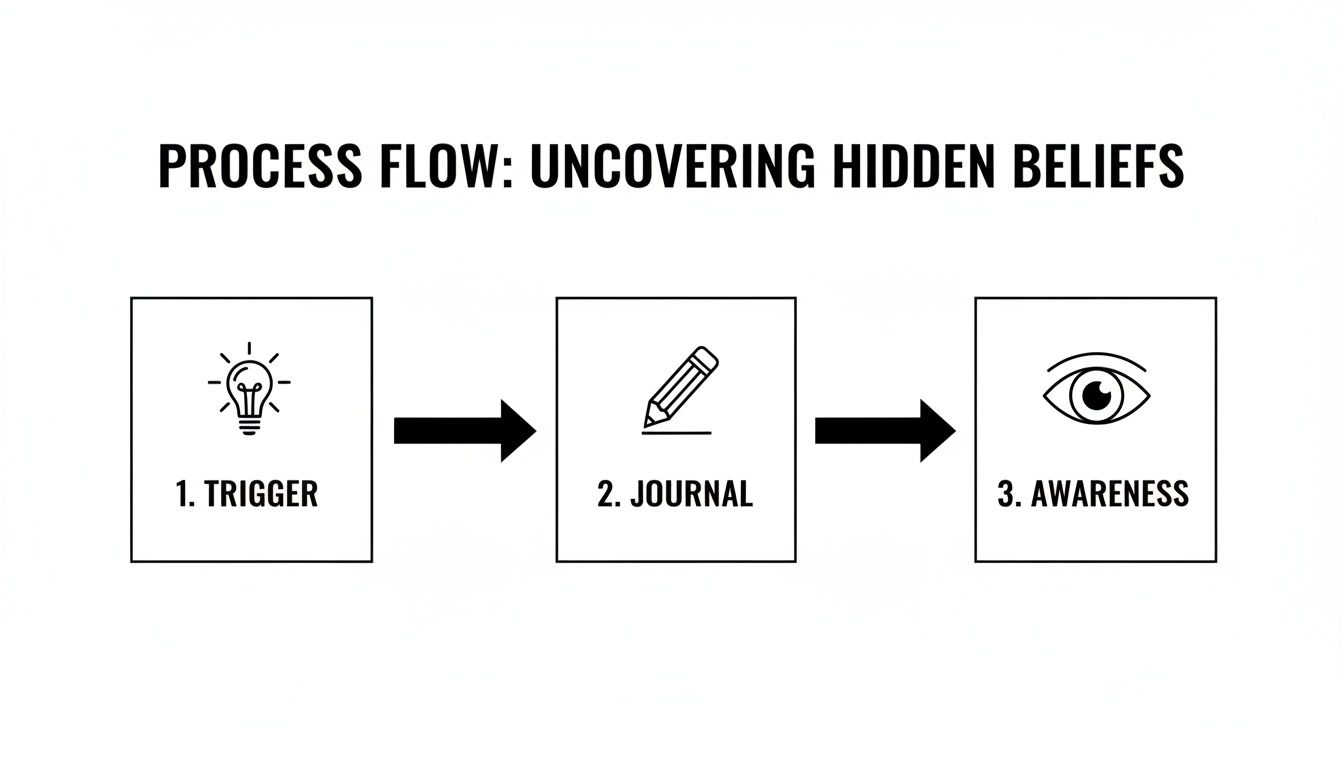
This simple flow—from trigger to journaling to awareness—is the key that unlocks your ability to question everything.
The Cross-Examination Questions
To begin your interrogation, you need a set of powerful, open-ended questions. These are designed to poke holes in the absolute certainty of a limiting belief, creating space for new possibilities.
Think of it as applying a simplified form of cognitive-behavioral therapy to your own thought patterns. The goal is to separate feelings from facts. If you want to go deeper, you can explore some common cognitive behavioral therapy techniques and see how professionals apply them.
Grab a journal and write down your unfiltered answers to these questions:
- Where is the hard, objective evidence that this belief is 100% true, all the time? (Feelings don’t count here. We’re looking for undeniable facts.)
- Is it possible there’s another way to look at this situation? Could someone else view these same facts and reach a completely different conclusion?
- What has holding onto this belief cost me? Think about missed opportunities, relationships, or personal peace. Get specific.
- What would I tell a close friend if they came to me with this exact same belief? (We often show more compassion and reason to others than we do to ourselves.)
These questions force a logical examination rather than an emotional one. They shift you from feeling the belief to analyzing it.
The Belief Deconstruction Framework
To make this process more systematic, I use a framework that I call the “Belief Deconstruction Framework.” It’s a simple table that walks you through the process of challenging a belief and finding a more empowering alternative.
| Limiting Belief | Evidence Supporting This Belief | Evidence Contradicting This Belief | Alternative, Empowering Belief |
|---|---|---|---|
| “I’m too old to change careers.” | Most people in the new field are younger than me. I haven’t been in an entry-level job in 15 years. | Colonel Sanders started KFC in his 60s. Vera Wang started her fashion brand at 40. My years of experience give me maturity and a strong work ethic that younger candidates lack. | “My age and experience are valuable assets that give me a unique advantage in this new career.” |
| “I’m not good with money.” | I made some bad financial decisions in my 20s. I find budgeting confusing and overwhelming. | I’ve successfully paid my bills on time for years. I’ve read books on personal finance. I’ve started saving a small amount each month. | “I am capable of learning and becoming more confident in managing my finances.” |
By laying it all out like this, you can clearly see how one-sided your limiting belief really is. The evidence against it is often far more compelling than the evidence for it.
A Real-World Example in Action
Let’s really break down a common and powerful limiting belief: “I’m too old to change careers.”
Many people feel this, especially when they see younger colleagues seemingly advancing faster. It feels true, heavy, and final. But let’s put it on trial using the questions from before.
Cross-Examination of “I’m Too Old”
-
Where is the evidence?
- Initial Thought: “Well, everyone in the industry I want to enter is in their 20s. I haven’t been in an entry-level position in 15 years.”
- Counter-Evidence: Is that really 100% true? A quick search reveals countless stories of successful career changers in their 40s, 50s, and even 60s. Your experience, wisdom, and professionalism are assets, not liabilities.
-
Is there another perspective?
- Initial Thought: “Hiring managers will see my age as a negative.”
- Alternative Perspective: An experienced manager might see maturity, a proven track record of responsibility, and a strong work ethic. They might see someone who is making an intentional, dedicated choice, not just looking for any job.
-
What has this belief cost me?
- Honest Answer: “It has kept me stuck in a job I don’t enjoy for years. It’s cost me a sense of purpose, daily excitement, and the chance to learn new things. I’ve felt stagnant and resentful.”
By holding onto this belief, you are not just staying in a job; you are sacrificing your potential for fulfillment and growth based on an unexamined assumption.
Answering these questions honestly reveals the belief for what it is—a story, not a life sentence. It may have felt true, but under scrutiny, its foundation crumbles. This critical self-inquiry doesn’t magically erase the feeling overnight, but it does plant a powerful seed of doubt. It creates the critical opening you need to start writing a new, more empowering narrative for yourself.
Crafting a New and Empowering Narrative

After putting your old beliefs on trial, you’ve created a crucial opening. The old story has been weakened, but that void needs to be filled. This is where the real work begins—consciously choosing and crafting a new, empowering narrative to live by.
This isn’t about just papering over self-doubt with generic positive affirmations. Let’s be honest, standing in front of a mirror shouting “I am a fantastic public speaker” when you’re terrified just feels like a lie. Your brain knows it’s not true… yet.
The key is to build a belief that is both inspiring and, most importantly, believable. We’re aiming for what I call a “bridge belief.” It’s a statement that honors where you are right now while pointing you toward where you want to go. Think of it as a steady, confident step forward, not a blind leap of faith.
From Affirmations to Bridge Beliefs
A powerful bridge belief focuses on the process, not just a distant, seemingly impossible outcome. It ditches the rigid, all-or-nothing language of your old limiting belief and swaps in words that open the door to growth, learning, and momentum.
Take the classic limiting belief, “I’m a terrible public speaker.”
- Hollow Affirmation: “I am a world-class, confident public speaker.” (Your mind probably scoffs at this.)
- Bridge Belief: “I am becoming a more confident and effective speaker with every opportunity I take.” (This feels authentic, right? It feels possible.)
The second version has so much more power because it’s actually true. Every attempt you make, whether it goes perfectly or not, is a building block. This reframes every meeting or presentation as a training ground instead of some final judgment on your worth.
Here are a few more examples of how to make this shift:
-
Instead of: “I am wealthy.”
-
Try: “I am building the skills and habits to manage my money effectively and create financial freedom.”
-
Instead of: “I’m a natural leader.”
-
Try: “I am learning to lead with empathy and am capable of inspiring my team.”
Your new belief shouldn’t feel like a lie. It should feel like a promise you are actively working to keep. It’s a statement of intent, grounded in the reality of your effort.
Embodying Your New Narrative with Visualization
Once you’ve written down your new belief, you need to make it feel real in your body, not just in your head. Visualization is an incredible tool for this because it lets your brain “rehearse” a new reality. Neuroscientists have shown that vividly imagining an action can fire up the same parts of the brain as actually doing it.
Find five quiet minutes. Close your eyes and vividly imagine a specific scenario where you are living out this new belief. Don’t just see it—feel it.
Let’s stick with the public speaking example.
- Picture the setting: See the room, the faces looking at you, and yourself standing at the front, looking composed.
- Engage your senses: What are you wearing? Can you feel the solid floor under your feet? What does the quiet hum of the room sound like?
- Focus on the feeling: Imagine the words flowing clearly and calmly. Feel the confidence in your posture, the resonance in your voice. Picture the audience members nodding along, engaged by what you’re saying.
- Envision success: See yourself wrapping up your talk and feeling that wave of pride and accomplishment wash over you.
This mental rehearsal does more than just build a little confidence. It creates a new blueprint for success in your mind, making it far easier to follow when you find yourself in the real situation.
Gathering Real-World Proof Through Behavioral Experiments
Now for the most critical piece of the puzzle: gathering undeniable, real-world proof that your new narrative is true. This is where behavioral experiments come into play. These are small, deliberately low-stakes actions designed specifically to test your new belief and collect evidence that supports it.
Your old belief didn’t just appear out of nowhere; it was built on years of perceived “proof.” To replace it, you have to be just as systematic in building a case file for your new belief.
The trick is to design an experiment so small it’s almost impossible to fail. The goal isn’t a massive victory; it’s simply to collect one tiny piece of new data that punches a hole in the old story.
Designing Your Behavioral Experiment:
| Old Belief | New “Bridge” Belief | Behavioral Experiment |
|---|---|---|
| “I’m not creative enough to contribute ideas.” | “I am capable of offering valuable perspectives.” | Action: In the next team meeting, share one small suggestion or ask one thoughtful question. |
| “I’ll never be able to network effectively.” | “I am learning to connect with new people in professional settings.” | Action: At the next event, set a goal to have a five-minute conversation with just one new person. |
| “I’m too disorganized to manage a big project.” | “I am building better organizational systems.” | Action: This week, use a tool like Trello or Asana to break down one big task into three smaller, manageable steps. |
Each time you complete one of these tiny experiments, you’re actively rewriting your story. You are no longer just thinking a new thought; you are living it. This collection of small wins is what truly cements your new belief, transforming it from a hopeful idea into your new reality.
Building Habits for a Resilient Mindset
Getting past a limiting belief isn’t a one-and-done deal. It’s really the start of a lifelong practice. Lasting change doesn’t come from a single breakthrough moment, but from the small, consistent things you do every single day. This is how you build a mental framework that doesn’t just adopt new beliefs but makes them your automatic way of thinking.
Think of it like tending a garden. You can’t just throw some seeds on the ground and expect a masterpiece. You have to water them, make sure they get sun, and pull the weeds. Your new, more empowering beliefs need that same kind of steady care to really take root and grow.
Curate Your Environment Intentionally
Your mind is a sponge, constantly soaking up information from your surroundings. That input is either going to reinforce your old limitations or support your new growth. The good news is, you have a ton of control over this. Actively shaping your environment is one of the most powerful moves you can make to protect your new mindset.
It really comes down to being deliberate about what you let in.
- Audit Your Media Diet: Unfollow the social media accounts that leave you feeling inadequate or stuck in comparison mode. Fill that space with voices that inspire you, teach you something, and line up with the person you’re working to become.
- Choose Your Mentors: Find podcasts and books by people who have navigated the same kinds of challenges you’re facing. Their stories offer both practical tactics and, just as importantly, powerful proof that this kind of change is absolutely possible.
- Evaluate Your Inner Circle: Spend your time with people who challenge you to grow, not those who seem invested in keeping you stuck as your old self. Your conversations should leave you feeling energized and encouraged.
Create Daily Mindset Rituals
To really make a new belief a core part of who you are, you have to weave it into the fabric of your daily life. These little rituals don’t need to be complicated or time-consuming, but their cumulative effect is huge. They’re like daily check-ins that reinforce your commitment to a new way of thinking.
Just start with one or two that feel doable and go from there. If you want to go deeper, our guide on how to build healthy habits lays out a full framework for making these new practices stick for good.
Here are a few simple but potent rituals you can try:
- The Mindset Minute: Before you do anything else in the morning, spend just 60 seconds with your new bridge belief. Close your eyes, say it to yourself, and picture one small thing you can do today that aligns with it. This sets a powerful intention before the day’s chaos kicks in.
- The Win Log: At the end of the day, jot down one piece of evidence—no matter how small—that proves your new belief is true. Did you speak up in that meeting? Handle a tough conversation with calm? This simple act trains your brain to start looking for proof of your progress.
- Gratitude Practice: Before bed, list three specific things you’re grateful for. Gratitude is a powerful antidote to scarcity-based beliefs. It shifts your focus from what you lack to what you have, effectively starving the old stories.
When an old belief resurfaces, don’t treat it as a failure. See it for what it is: an echo from an old operating system. Acknowledge it without judgment, thank it for trying to protect you, and gently redirect your focus back to your new, chosen narrative.
Handling Setbacks with Self-Compassion
Look, there will be days when those old, familiar limiting beliefs creep back in. A stressful deadline, a critical comment, or even just a simple mistake can trigger that old voice in your head. This is not a sign that you’ve failed. It’s a completely normal part of the process.
The real goal isn’t to silence these thoughts forever, but to change how you relate to them. Instead of getting sucked back into the old drama, you learn to observe the thought with a bit of compassionate distance. When that old belief shows up, treat it as a chance to practice.
Acknowledge it—”Ah, there’s that ‘I’m not good enough’ story again”—remind yourself of your new belief, and then consciously choose to do something that aligns with the new you. Every single time you do this, you weaken the old neural pathway and strengthen the new one. This is how resilience is built, not by avoiding the tough stuff, but by using it as practice for becoming the person you want to be.
Answering Your Questions About Mindset Shifts
As you dive into this work, it’s completely normal for questions and a little bit of doubt to creep in. In fact, that’s a sign you’re engaging with the process. Let’s tackle some of the most common hurdles people run into so you can move forward with confidence.
How Can I Tell If a Belief Is Actually Limiting Me?
Here’s a simple gut check: ask yourself, “Does this thought expand my world or shrink it?”
A belief is probably holding you back if it consistently sparks negative emotions like fear, anxiety, or self-doubt. If it stops you from going after a goal, trying something new, or even just feeling good about what you’ve already achieved, it’s worth a closer look. These beliefs often show up as hard-and-fast rules we’ve set for ourselves—things like “I can’t afford to fail” or “I’m just not a creative person.” They feel like facts, but they’re really just opinions that have run their course.
What if the Old Belief Still Feels True?
This is the part where everyone gets stuck, so don’t worry—you’re not alone. Our beliefs carve deep neural pathways in our brains over years, and dismantling them logically doesn’t instantly erase the feeling. That emotional echo can hang around for a while.
The trick is to prioritize consistent action over immediate feeling. Keep acting as if your new, more empowering belief is true, even when it feels a little fake. Start with small, low-risk behaviors. Every time you act in this new way, you’re gathering fresh evidence for your brain, slowly building a new pathway until the new belief starts to feel more natural.
Acknowledge the old feeling, but don’t let it drive. You can feel the doubt and still do the thing. That’s how you build real, undeniable proof that the old story no longer has power over you.
Can I Get Rid of a Limiting Belief for Good?
It’s more realistic and far more effective to think of this as turning down the volume on that belief rather than trying to delete it completely. Imagine a critical radio station has been playing in the background of your mind for years. Your goal isn’t to destroy the radio, but to learn how to turn the dial down so low you barely hear it.
That old voice might still pop up, especially when you’re stressed or tired. The work is in getting so good at spotting it that you can simply say, “Ah, there’s that old thought again,” and then consciously choose to act from your new perspective. It loses its grip on you because you stop treating it like the absolute truth.
How Long Does It Actually Take to Change a Limiting Belief?
Honestly, there’s no set schedule. The timeline really depends on how long you’ve held the belief and how consistently you work on rewiring it.
- Superficial beliefs, like “I’m terrible at public speaking,” might start to shift within a few weeks of focused effort.
- Deep core beliefs about your worth or identity—the big ones like “I’m not good enough” or “I’m unlovable”—can take months, or even years, of steady work.
The best approach is to stop watching the clock and start focusing on the process. Celebrate the small victories. Every time you catch yourself in an old thought pattern or choose a different action, you’re making progress. This isn’t a sprint; it’s a marathon built on small, consistent steps.
At David Pexa, we focus on practical, evidence-based strategies to help you build a stronger mindset and create habits that stick. If you’re ready to keep going with clear guidance and proven tools, you can explore more resources on our website.
