



Online personal development courses are simply structured, digital programs that guide you in sharpening your skills, upgrading your mindset, and improving your life. They offer a flexible and accessible way to invest in yourself, covering everything from productivity and habit-building to communication and emotional intelligence. Think of them as your modern toolkit for strategic self-improvement.
Why Personal Development Courses Are Your Modern Toolkit for Success

Think of your personal and professional abilities as your mind’s operating system. Just like the software on your phone, it needs regular updates to run smoothly, stay secure, and handle new challenges. Online courses for personal development are those critical updates—the upgrades that build resilience, adaptability, and purpose in a fast-moving world.
These courses give you a clear roadmap, guiding you from feeling stuck to feeling empowered. In recent years, self-improvement has shifted from a passive hobby into a strategic investment in both your career and your life.
The Surge in Self-Improvement
This shift became undeniable during the early pandemic lockdowns. People everywhere were looking for ways to level up their lives from home, causing a massive explosion in online learning. Enrollment in personal development courses alone surged by an incredible 408%.
Platforms like Udemy and Thinkific are still buzzing with programs on everything from mindset mastery to habit-building hacks. This wasn’t just a fleeting trend. It reflects a deep-seated desire for growth, with a staggering 95% of learners reporting tangible benefits like more confidence and a greater sense of accomplishment. The impact can be life-changing—studies have shown that 30% of unemployed learners even found jobs after finishing a course.
Self-improvement is no longer just about fixing weaknesses. It’s about strategically building strengths, sharpening your focus, and designing a life that aligns with your core values and professional ambitions.
This proactive approach all comes down to a simple but powerful psychological concept: your mindset. Cultivating the right one is the first step toward unlocking your potential. If you’re ready to build that foundation, you can learn more about the difference between a growth vs. a fixed mindset in our detailed guide.
Tangible Returns on Your Investment
Jumping into an online course for personal development gives you real-world returns that go far beyond a certificate. It’s about building practical skills that directly improve your daily effectiveness and shape your long-term success.
These benefits often show up as:
- Enhanced Productivity: You learn to finally manage your time, beat procrastination, and focus on what truly matters. The result is a more accomplished and less stressful workday.
- Improved Confidence: Mastering a new skill, whether it’s public speaking or negotiation, naturally boosts your self-assurance in both professional and personal situations.
- Greater Resilience: Developing emotional intelligence and stress management techniques helps you navigate challenges with a calmer, more centered approach.
- Clearer Purpose: You gain clarity on your goals and values, which allows you to make intentional decisions that lead to a more fulfilling life.
Ultimately, investing in yourself through structured learning is one of the most powerful moves you can make. It’s a commitment to continuous improvement that pays dividends in your career, relationships, and overall well-being.
The 4 Pillars of Personal Development: Which Path Is Right for You?
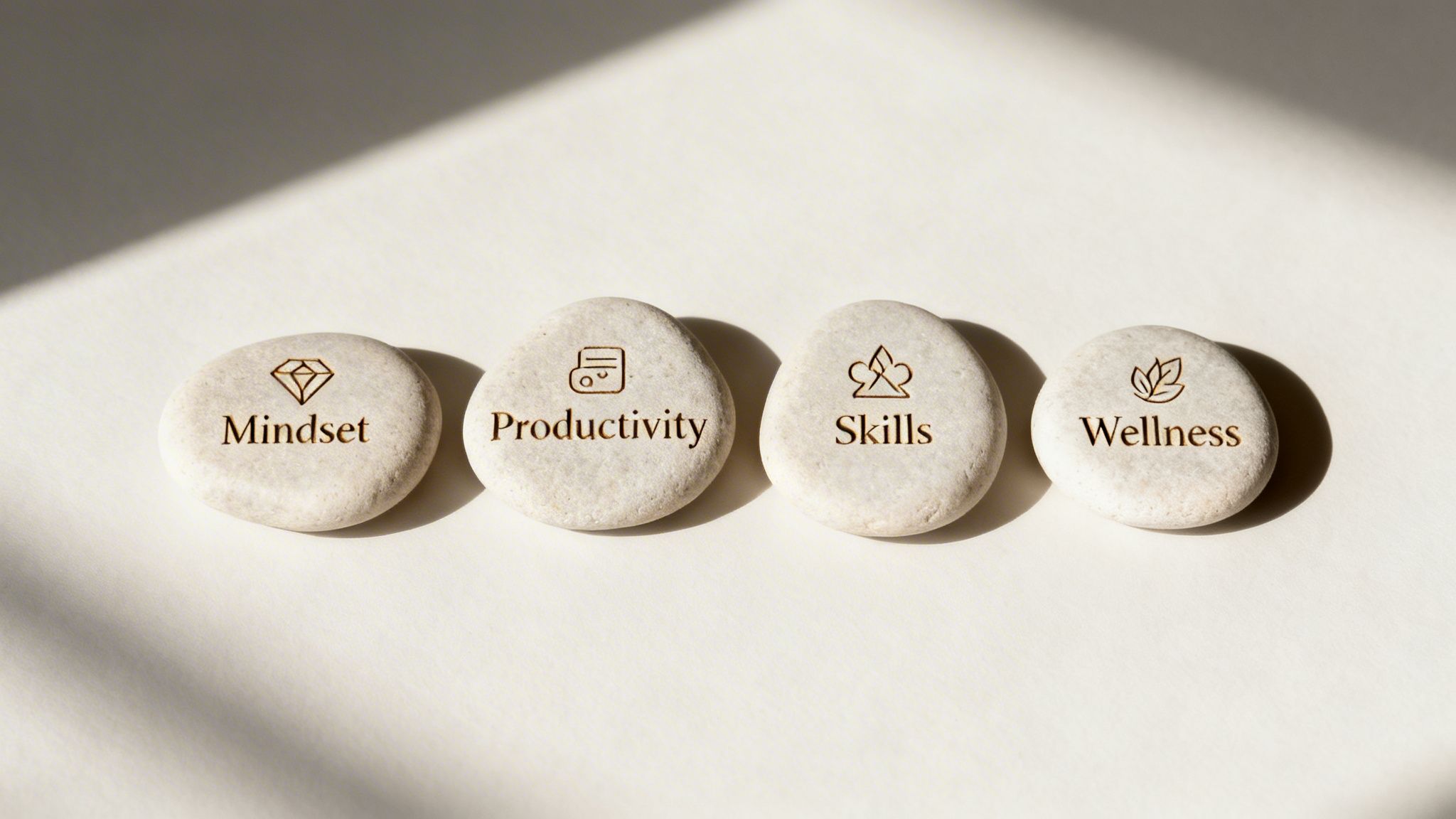
The world of personal development is huge, and trying to dive in without a clear direction can feel like drinking from a firehose. The key is to narrow your focus. From what I’ve seen, all meaningful growth can be sorted into four main categories.
By figuring out which of these pillars speaks to where you are right now, you can choose online courses for personal development that will give you the most bang for your buck, both in time and energy.
Let’s break down these four pillars to help you find your starting point.
Finding Your Fit: A Guide to Personal Development Course Categories
This table gives you a quick overview of the four main areas of personal growth. Use it as a compass to point you toward the category that best fits what you’re trying to achieve today.
| Course Category | Who It’s For | Common Goals Addressed |
|---|---|---|
| Mindset & Emotional Intelligence | Those feeling stuck, battling self-doubt, or reacting emotionally to stress. | Building confidence, overcoming limiting beliefs, managing emotions, developing resilience. |
| Productivity & Habit Formation | Anyone feeling overwhelmed, disorganized, or struggling with procrastination. | Time management, goal setting, building good habits, creating effective systems. |
| Skills & Career Growth | Professionals looking to advance, increase their influence, or pivot their career. | Leadership, public speaking, negotiation, learning technical skills, financial literacy. |
| Health & Wellness | People feeling burned out, stressed, or wanting more energy and balance in life. | Stress management, mindfulness, nutrition, fitness, building sustainable healthy routines. |
Once you’ve pinpointed a category, you can dig deeper into what each one offers. Let’s take a closer look.
H3: 1. Mindset and Emotional Intelligence
This is where it all begins—the inner work that underpins any lasting change. Courses in this area are all about rewiring the way you think, learning to navigate your emotions, and building true mental grit. You’ll learn to move from a “fixed” to a “growth” mindset, handle stress with intention, and cultivate a powerful sense of self-awareness.
This is your starting point if:
- You constantly struggle with negative self-talk, imposter syndrome, or a paralyzing fear of failure.
- You find that your emotions run the show, causing you to react in ways you later regret.
- You’re ready to build unshakable confidence and a genuinely optimistic outlook on life.
Don’t underestimate this work. High emotional intelligence (EQ) is one of the biggest predictors of career success and personal fulfillment. These courses give you the internal toolkit to handle whatever life throws at you with strength and grace.

H3: 2. Productivity and Habit Formation
With a solid mindset, the next step is turning your intentions into tangible results. This category is about getting things done—but not by working harder. It’s about working smarter. You’ll learn how to manage your time, organize your life, and build routines that support your goals.
These courses provide practical, real-world systems for setting goals you’ll actually hit and managing your to-do list so it doesn’t manage you. You’ll finally learn how to beat procrastination and build positive habits that stick.
A core concept in productivity is that willpower is a finite resource. Relying on it is a losing battle. The most successful people don’t have more willpower; they have better systems and habits that make consistency feel effortless.
If you feel like you’re spinning your wheels, constantly overwhelmed, or just plain frustrated with your lack of progress, this is the category for you.
H3: 3. Skills and Career Growth
This pillar is about acquiring specific, marketable abilities that directly move your career forward. Think of these as the “hard” and “soft” skills that open doors, from public speaking and leadership to negotiation and financial management.
Investing in these skills pays real dividends. Studies have shown that companies prioritizing employee training see a 17% increase in productivity and a 21% boost in profitability. Taking a course to sharpen a specific skill is a direct investment in your professional value.
You should explore this category if you are:
- Gunning for a promotion and need to cultivate your leadership presence.
- Wanting to become more persuasive and influential in your current role.
- Thinking about starting a side hustle or making a complete career change.
These online courses for personal development give you the functional tools you need to level up professionally.
![Communication & Social Skills [13-in-1]: 263 Techniques & Insights to Improve Your Interactions. Master Small Talk, Body Language, & Public Speaking for Greater Confidence](https://m.media-amazon.com/images/I/61-XwT3CFCL._SY342_.jpg)
H3: 4. Health and Wellness
Ultimately, none of the other pillars can hold up without a strong foundation of well-being. This category is all about fueling your engine. It covers everything from practical stress management and mindfulness to nutrition and physical fitness.
In these courses, you’ll learn how to create genuine work-life balance, use techniques like meditation to manage stress, and build a healthy lifestyle that gives you the energy to pursue your goals. With burnout on the rise, taking care of your wellness isn’t a luxury—it’s a non-negotiable strategy for long-term success.

How to Choose the Right Online Course for Your Goals
With so many personal development courses out there, picking one can feel like a shot in the dark. It’s easy to get swayed by slick marketing promises, but the real challenge is finding a program that actually delivers on them. Think of it less like shopping and more like hiring a specialist—you need someone with the right expertise to help you hit your specific targets.
To make a smart choice, you need a simple framework. This means looking past the sales page and evaluating a few key factors that signal a course’s true value. By knowing what to look for, you can invest your time and money with confidence.
Define Your Personal Growth ROI
Before you even start browsing, you need to get crystal clear on what a good “return on investment” means for you. And I’m not just talking about money. Your Personal Growth ROI is the total value you get back from the time, energy, and cash you sink into a course.
What’s the end goal? Are you trying to build the confidence to speak up in meetings? Lower your daily stress? Or maybe you need to master a new skill to climb the career ladder. Nailing down your desired outcome is always step one.
The perfect course is one that builds a direct bridge from where you are today to where you want to be. The clearer your destination, the easier it is to spot a program with a high Personal Growth ROI.
Once you know what you want to achieve, you can start looking at the courses that can actually get you there. This brings us to the nitty-gritty of vetting your options.
Your Course Vetting Checklist
Use this checklist to systematically break down any online course for personal development. If you find yourself nodding “yes” to most of these questions, you’ve likely found a winner.
-
Is the Instructor Credible and Experienced?
Look for teachers who have actually done the thing they’re teaching, not just studied it. Do they have a verifiable track record? Genuine testimonials from past students? A professional background that proves they know their stuff? A true expert who has walked the path is invaluable. -
Does the Learning Style Match Yours?
People learn differently, and courses are built differently. Do you learn best by getting your hands dirty with projects, or do you prefer to absorb information through video lectures? Pay attention to the format:- Project-Based: Perfect for learning practical skills where you learn by doing.
- Lecture-Based: Great for building a solid foundation in theoretical concepts.
- Interactive/Cohort-Based: The best choice if you thrive on live sessions, group accountability, and real-time feedback.
Choosing a format that fits how your brain works will make a huge difference in whether you stick with it. For a deeper dive, check out our online course platform comparison, which explores how different platforms cater to these learning styles.
-
Is the Time Commitment Realistic for You?
Be brutally honest with yourself here. A 30-hour intensive looks impressive, but it’s worthless if you can only realistically carve out two hours a week. Look for programs with flexible pacing or a weekly structure that slots neatly into your life. Remember, consistency is more important than intensity. -
Does It Offer Community and Support?
Growth is tough, and going it alone makes it even tougher. Does the course have an active community forum, live Q&As with the instructor, or peer accountability groups? This support network is what gets you through the moments you feel stuck. A good community turns a lonely journey into a shared mission.
Suggested Learning Paths for Your Top Personal Growth Goals
Knowing you want to improve is the easy part. The hard part? Figuring out where to even begin. The sheer volume of choices can be paralyzing.
To help you cut through the noise and get moving, I’ve mapped out three proven learning paths. Think of them as curated playlists of online courses for personal development. Each course builds on the last, giving you real momentum toward a specific, meaningful goal.
Following a structured path is far more effective than just picking courses at random. It’s a clear roadmap that takes you from where you are now to where you want to be.
The Productivity Architect Path
This path is for you if you feel like you’re constantly drowning in to-do lists, hijacked by notifications, and stuck putting out fires all day. The goal here isn’t just to be “busy,” but to become truly effective—the architect of your own time and attention.
- Start with Time Management: First things first, you need to know where your time is actually going. A good introductory course will give you a practical system, like time blocking or the Pomodoro Technique, to help you reclaim your schedule and focus on what really matters.
- Layer on Habit Formation: Real productivity isn’t about sheer willpower; it’s about building smart, automatic systems. The next course should dive into the science of habit creation. You’ll learn how to build routines for deep work, dismantle procrastination triggers, and make consistency feel almost effortless.
- Finish with Advanced Systems: Once you’ve got a handle on your time and habits, it’s time to connect them. Look for advanced courses on building a “second brain” or creating a personalized productivity system that links your daily actions to your biggest, long-term goals.
Following this sequence helps you shift from a frantic, reactive worker into a calm, focused architect of your life.

The Confident Communicator Path
This track is designed for anyone who wants to sharpen their influence, get their ideas across clearly, and feel more confident speaking up. Whether you’re eyeing a leadership role or just want to feel heard in meetings, this path will help you connect and persuade.
Your Learning Sequence:
- Step 1: Public Speaking Fundamentals: Start by tackling the fear. A solid fundamentals course will teach you the essentials of structure, delivery, and body language. Many courses on platforms like Coursera even offer peer-review assignments, giving you a safe place to practice.
- Step 2: Storytelling for Influence: Facts and data are fine, but stories are what stick. The next step is learning to weave compelling narratives into your presentations, pitches, and even day-to-day conversations. This is how you make your message memorable.
- Step 3: Advanced Negotiation or Leadership Communication: With a strong foundation in place, you can start to specialize. A negotiation course teaches you how to create win-win scenarios, while a leadership communication course focuses on motivating a team and giving feedback that helps people grow.
By following this progression, you’re not just building skills—you’re developing a genuine presence that earns trust and inspires people to act.

The Mindset Master Path
This is arguably the most important path of all. It’s for anyone wrestling with self-doubt, stress, or a persistent negative outlook. The goal is to build mental resilience, foster a healthier inner voice, and develop the emotional strength to handle whatever life throws your way.
Building a resilient mindset is like strengthening your psychological immune system. It doesn’t stop challenges from showing up, but it equips you to handle them with more strength and clarity, so you bounce back faster.
Your Learning Sequence:
- Mindfulness and Meditation: Begin by learning to quiet the internal chatter. A good mindfulness course teaches you to observe your thoughts without getting tangled up in them. This simple practice is a powerful way to reduce stress and feel more present.
- Positive Psychology and Resilience: Next, you can move from awareness to action. Courses rooted in positive psychology give you evidence-based tools for cultivating optimism, practicing gratitude, and reframing setbacks as opportunities to learn and grow.
- Emotional Intelligence (EQ): The final piece is understanding and managing your own emotions while also recognizing them in others. A high EQ is a cornerstone of great relationships, both at work and at home.
This path helps you build the strong inner foundation that all other growth depends on. For a more detailed guide on putting these ideas into practice, check out our article on how to create a personal growth plan.
This quick decision tree can also help you narrow down your options based on what’s most important to you, whether it’s getting a certificate, finding a course that fits your learning style, or working within a tight schedule.
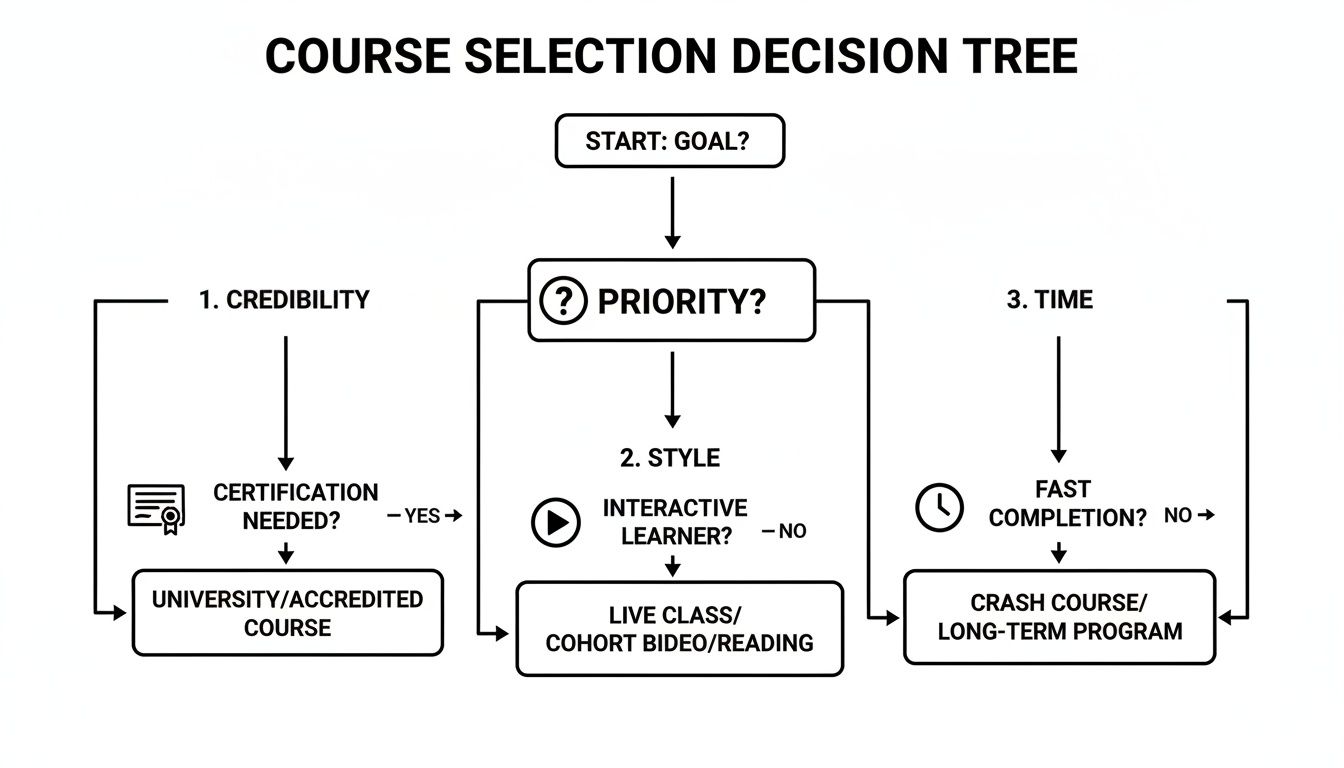
Ultimately, there is no single “best” course. The right choice is the one that aligns with your personal goals and priorities.
We’re seeing this desire for targeted growth reflected everywhere. For instance, Skillshare saw a 65% increase in demand for mindfulness content as people sought ways to manage burnout. During that same period, its members watched over 380,000 minutes of classes on starting a side hustle. As you can see in this professional development report, online courses for personal development are no longer a niche interest; they’re essential tools for building the life and career you want.

Integrating Course Lessons for Real World Change

Watching the final video of a course feels fantastic, but that little dopamine hit is just the starting gun. The real work—and the real reward—begins after you close the laptop. Knowledge is great, but knowledge without action is just trivia. Lasting change only happens when you start integrating those new skills and mindsets into your actual life.
Think of it like learning to cook from a recipe book. You can read about techniques all day, but you won’t become a better cook until you actually get in the kitchen and start chopping onions. The goal is to close the gap between learning and living, making sure your investment in online courses for personal development genuinely pays off.
From Theory to Practice with the 1-3-5 Method
To keep that hard-earned knowledge from evaporating, you need a simple system. I’ve found one of the most effective frameworks is the 1-3-5 Weekly Plan. It’s brilliant because it forces you to make steady, manageable progress without that all-too-common feeling of being overwhelmed.
Here’s the breakdown for each week:
- 1 Hour of Learning: Block out just one focused hour to go through your course. This makes learning feel sustainable, not like another chore you have to cram into a busy schedule.
- 3 Key Takeaways: Right after your learning session, jot down the three most important concepts or techniques. This simple act forces you to distill the information down to its most valuable, actionable parts.
- 5 Action Items: For each of your takeaways, create at least one or two small, specific actions you can take that week. Aim for a total of five action items. Instead of a vague goal like “be more productive,” your action item should be concrete, like “use the pomodoro technique for my next big report.”
This method turns abstract ideas into a tangible weekly to-do list. It’s how you make growth intentional instead of accidental.
The greatest barrier to personal growth isn’t a lack of information—it’s a lack of application. Consistent, small actions will always outperform infrequent, grand gestures.
Building Your Accountability Engine
Even with the perfect plan, motivation has a tendency to fizzle out. Let’s be honest, willpower is a finite resource. That’s where building an external support system—what I call an accountability engine—comes in. It’s what keeps you going when your own drive is running on empty.
Creating accountability doesn’t need to be some grand, complicated affair. The core idea is simply to make your commitment visible to others, which makes it much harder to back out.
Proven Accountability Tactics:
- Find a Study Partner: Pair up with a friend or colleague who’s also working on self-improvement. Schedule a quick weekly check-in to talk about progress, share insights, and troubleshoot roadblocks together.
- Use Habit-Tracking Apps: Tools like Habitica or Streaks gamify your progress, while a simple shared Google Sheet can provide clear visual tracking. Watching a streak grow is a surprisingly powerful motivator.
- Join a Community: Many courses have built-in forums or Slack channels. Don’t just lurk—actively participate. Post your goals, ask questions, and celebrate your wins. That sense of shared purpose can be a game-changer.
When you combine a clear action plan like the 1-3-5 method with a solid accountability system, you create a powerful feedback loop for growth. You stop being a passive consumer of content and become an active participant in your own transformation, one small, deliberate step at a time.
Frequently Asked Questions About Personal Development Courses
Jumping into the world of online personal development courses is exciting, but it’s totally normal to have a few last-minute questions. Before you commit your time and money, let’s clear up some of the most common hesitations so you can move forward with confidence.
How Can I Stay Motivated Through an Entire Course?
We’ve all been there. You sign up for a course, fired up and ready to learn, but a few weeks in, that initial excitement fades. The secret isn’t about having superhuman willpower; it’s about building a smart system to keep you on track.
First, stop looking at the mountain. A 10-hour course can feel overwhelming, so don’t even think about it. Your only goal is to watch the next 15-minute video. That’s it. This approach gives you a constant stream of small, satisfying wins that build momentum.
Next, treat your learning time like an important meeting. Block it out on your calendar—make it a non-negotiable appointment with yourself. When it’s scheduled, it’s real.
The most powerful trick? Tell someone. Share your goal with a friend, post about it in the course’s community forum, or find an accountability partner. It’s amazing how much harder it is to quit when someone else is watching.
Are Free Personal Development Courses Actually Worth It?
That’s a great question, and the honest answer is: sometimes. Free courses are a fantastic, no-risk way to explore a new topic or learn a very specific skill. Think of them as a sampler platter—perfect for figuring out what you actually enjoy.
The trade-off is that free courses usually don’t offer the depth, structure, or support of a paid program. You likely won’t get access to the instructor for questions, a community to learn with, or a certificate that holds any weight.
Here’s a simple way to think about it:
- Free courses are like checking out a book from the library. The information is valuable, but you’re on your own to figure it all out.
- Paid courses are like hiring a personal trainer. You get a structured plan, expert guidance, and a support system all designed to make sure you get the result you want.
If you’re just exploring, start with free options. But if you’re serious about mastering a subject and want a clear path to follow, a paid course is almost always the better investment.
Can I Get My Employer to Pay for My Course?
Yes, and you absolutely should try! More and more companies have budgets set aside for employee training because they know it pays off. When employees learn new skills, the entire organization benefits from increased productivity and better performance.
The key is to frame your request around the company’s return on investment, not just your personal gain.
How to Pitch Your Manager:
- Choose a Relevant Course: Find a course that directly connects to your role or the company’s bigger goals. For example, if you’re moving into a leadership position, a course on effective communication is a perfect fit.
- Highlight the ROI: Be specific. Explain exactly how the skills you learn will benefit the team. Will you make your workflow more efficient? Will you improve client presentations? Will you be able to help solve a problem that’s been nagging the department?
- Present a Clear Plan: Draft a simple, one-page proposal. Outline the course details, the cost, the time needed, and—most importantly—the concrete business outcomes you’ll be able to deliver after completing it.
When you show your manager that your development is a direct investment in the company’s success, you make it very easy for them to say “yes.”
Your First Step Toward a More Empowered You
So, we’ve covered a lot of ground. You now know that online courses for personal development are a fantastic way to take charge of your own growth. The knowledge is all out there, the paths have been mapped out, and all that’s left is for you to take that first step.
Think of it like standing at a trailhead. You see several paths leading up the mountain, and it’s tempting to think you have to climb them all at once. But you don’t. Your only job right now is to pick the single trail that matters most to you today.
From Reading to Doing
Here’s where most people get stuck. They get excited, try to overhaul their entire life overnight, and burn out in a week. The real secret is building momentum, not chasing a massive, sudden transformation. Think of this moment not as the finish line, but as your personal launchpad.
Take another look at the course categories we walked through:
- Mindset & Emotional Intelligence: For building a stronger, more resilient inner world.
- Productivity & Habit Formation: To get a handle on your time and start making real progress.
- Skills & Career Growth: For getting that promotion or making a professional pivot.
- Health & Wellness: To manage stress and stop feeling so drained all the time.
Which one of these speaks to the most immediate friction in your life? Choosing just one turns that vague feeling of “I should be better” into a concrete mission. If you’re constantly feeling overwhelmed, for example, your first step is simply to find and enroll in a solid time management course. That’s it. Nothing else matters for now.
Real change isn’t born from grand announcements. It’s built in the quiet, consistent choices you make every single day. The person you want to become is assembled one small action at a time.
You’ve got the map and the compass. Now, it’s your turn to step up and take the helm. I hope this guide has given you the clarity to move forward. Commit to yourself, trust the process, and take that first step with the confidence that you’re heading in the right direction.
At David Pexa, my focus is on providing practical strategies and honest guides to help you build mental clarity, better habits, and sustainable growth. For more in-depth resources to start your journey with confidence, head over to https://davidpexa.com.
