



We often talk about courage in terms of heroic, life-or-death situations. But what about the other kind of courage? The quieter, often harder kind you need not on a battlefield, but in a boardroom, a family dinner, or a difficult conversation.
This is moral courage, or courage moral. It’s not about being fearless. Instead, it’s about feeling the fear—of being judged, losing your job, or straining a relationship—and choosing to act on your values anyway. Think of it as a ‘moral muscle’; the more you exercise it, the stronger it gets.
What Is Moral Courage, Really?

Let’s be real—the term “moral courage” can sound a bit lofty, like something reserved for history books. But it’s not. It’s a profoundly human quality that shows up in the small, unseen moments of our daily lives. It’s that internal nudge to speak up when you see something that isn’t right, even when you’re the only one willing to do so.
It’s crucial to distinguish this from physical courage. Facing down a physical threat is one thing, but moral courage is about facing down social risks. The potential for ridicule, professional backlash, or getting pushed to the margins of a group—that’s the terrain of moral courage. It’s the manager who takes the heat to protect their team or the junior employee who points out an ethical flaw in a major project.
The Bedrock of Integrity
At its heart, moral courage is what makes integrity possible. Without it, our values are just nice ideas we hold. It’s the bridge between knowing what’s right and doing what’s right, especially when it’s inconvenient or costly. This is where it really matters:
- In Your Career: It’s the backbone for pushing back on unethical requests, advocating for a colleague who’s been treated unfairly, and building a culture where people feel safe enough to tell the truth.
- In Your Personal Life: It gives you the strength to set firm boundaries, have the tough conversations that lead to healthier relationships, and live a life that genuinely reflects who you are.
- In Society: It’s the spark for all meaningful change. Every movement for justice or equality started with individuals choosing to stand up against the status quo, one brave act at a time.
Moral courage is doing the right thing in the face of adversity and opposition, and doing it whether people notice it or not.
Choosing to act with principle isn’t about guaranteeing a win. Sometimes, the point is simply to plant your flag and stand by it, creating a clear marker of what’s right for yourself and for others. This requires a deep sense of self-awareness and the willingness to confront the internal narratives that hold us back. To go deeper on that, our guide on overcoming limiting beliefs is a great place to start.
When you cultivate moral courage, you’re doing more than just building character. You are laying the foundation for authentic leadership and a life you can be proud of.
Why Moral Courage Is Your Professional Superpower

Let’s be honest: in the modern workplace, moral courage isn’t some lofty, abstract virtue. It’s one of the most practical and powerful tools you can have in your career toolkit. It’s the very thing that separates good managers from truly authentic leaders and builds a reputation that outlasts any job title.
Think of it as your personal check-and-balance system. It’s the inner voice that pushes you to question a flawed strategy, even when everyone else is nodding along. It’s what gives you the strength to defend a teammate from unfair criticism or to say “no” to a request that compromises your team’s ethical standards. These acts are the antidote to the quiet poison of groupthink, where bad ideas get a free pass simply because no one is brave enough to speak up.
Drive Innovation and Build Unbreakable Trust
Innovation rarely comes from conformity. It’s born from the courage to challenge the status quo. When you create a space where it’s safe to offer a dissenting opinion, you unlock perspectives that would otherwise stay hidden. A single person with the courage to ask, “What if we’re looking at this all wrong?” can be the difference between a failed project and a breakthrough success.
This quality is also deeply attractive. People are drawn to leaders and colleagues who stand for something real. When you consistently choose the principled path over the easy one, you forge a deep, resilient trust that money can’t buy. This isn’t just a feeling; it delivers tangible results:
- Stronger Team Cohesion: When your team knows you have their back, you cultivate fierce loyalty and genuine psychological safety.
- Improved Collaboration: Openness becomes the default. Colleagues won’t hesitate to bring you the real problems, leading to faster and better solutions.
- Enhanced Reputation: You become known as someone who is reliable and principled, attracting better opportunities and stronger partnerships.
When you consistently act with moral conviction, you eliminate the mental strain of cognitive dissonance—the exhausting internal conflict between your values and your actions. This frees up mental energy, boosting your confidence and overall well-being.
The Bedrock of Authentic Leadership
At the end of the day, moral courage is the foundation of authentic leadership. It has nothing to do with a fancy title or a corner office; it’s about inspiring people through your character and actions. It’s about being the person who does the right thing when no one is watching.
Put it this way: technical skills might get you in the door, but it’s your moral courage that will define your career. It’s the one quality that signals you’re guided by a steady internal compass, making you a stable, trustworthy force in any organization. Every time you choose principle over expediency, you aren’t just making a decision—you’re building your legacy.
The Psychology of Principled Action
Ever wonder what makes one person stand up and speak out while another stays silent? It’s not some heroic gene they were born with. The engine behind moral courage is actually a set of psychological drivers that anyone can learn to tap into. It’s less about a single moment of bravery and more about a mindset you build over time.
It all starts with empathy—the ability to genuinely feel what someone else is going through. When you can see a tough situation through another person’s eyes, their struggle stops being an abstract problem. It becomes real and personal, making it much harder to simply look away.
That emotional connection then gets processed by your moral sensitivity. Think of this as your internal radar for ethical dilemmas. It’s what helps you spot the subtle microaggression in a casual remark or recognize the hidden harm in a standard business practice. The more you tune this radar, the more you’ll notice moments where your principles are needed.
From Empathy to Responsibility
Seeing the issue and feeling for the people involved are the first steps. But true moral courage kicks in with the final ingredient: a deep sense of personal responsibility. This is the internal switch that flips from “Someone should do something” to “I need to do something.” It’s the moment you stop being a bystander and become an actor.
A huge part of this is seeing the world through the lens of a shared humanity—the profound belief that we’re all in this together. When you stop seeing others as “them” and start seeing them as “us,” those group lines blur. Suddenly, acting to protect someone else feels as natural as protecting yourself.
This isn’t just a feel-good idea; it’s backed by history. During the Holocaust, an estimated 500,000 to 1 million non-Jews risked their lives and the lives of their families to rescue Jews. When researchers studied what drove them, they found it wasn’t a desire for rewards. It was powerful internal forces like empathy and an overwhelming sense of social responsibility. They saw others as part of their human family, which made the choice to help a deeply personal imperative. You can explore more about these findings on the nature of moral courage.
Cultivating the Psychological Drivers
The good news is that these psychological muscles aren’t fixed. You can absolutely strengthen them with intentional practice by rewiring your automatic thoughts and emotional responses.
Here are a few ways to get started:
- Practice Perspective-Taking: Make a real effort to see a situation from someone else’s viewpoint, especially someone you disagree with. What might they be afraid of? What are their hopes? What pressures are they under?
- Clarify Your Values: Take a few minutes to write down the principles you refuse to compromise on. When your “why” is crystal clear, the “how” becomes much easier to figure out.
- Start Small: Look for low-stakes opportunities to act on your values, whether it’s speaking up in a meeting or correcting a small injustice. These small wins build the confidence you’ll need for bigger challenges.
By nurturing these psychological foundations, you move from just reacting to the world to actively shaping it based on your principles. This work is fundamental to building personal resilience, and many mental frameworks can help. For more on this, check out our guide on practical Cognitive Behavioral Therapy techniques for reframing your thinking.
Real-World Examples of Moral Courage in Action
Theory is one thing, but stories are what stick with us. To truly grasp what moral courage looks like, we need to see it in the wild—those moments when real people chose to stand by their principles, often at a steep personal cost. These aren’t just famous events from history books; they are powerful case studies in what it means to act with integrity.
Take Rosa Parks’ quiet defiance on a Montgomery, Alabama bus. On December 1, 1955, her refusal to give up her seat wasn’t a random, tired impulse. It was a deliberate act of moral conviction against a deeply entrenched system of injustice. That single decision helped ignite the Montgomery Bus Boycott, a massive protest where over 40,000 African American citizens refused to use the city’s transit system for 381 days. The bus company’s finances were crippled. Her courage was the spark that led directly to a landmark Supreme Court decision outlawing segregation on public buses. You can explore more about how individual acts of defiance have changed history.
Collective Courage Under Pressure
But moral courage doesn’t always belong to a single person. Sometimes, it’s a shared resolve—a group of people standing together against incredible odds. We all witnessed a stunning example of this with frontline medical workers during the COVID-19 pandemic.
Day in and day out, doctors, nurses, and support staff walked into hospitals facing immense physical risk and crushing emotional strain. They worked impossible hours with scarce resources, many isolating themselves from their own families to keep them safe. Their choice to simply show up was a sustained, collective act of moral courage, guided by a shared professional ethic and a fundamental duty of care. They held the line, showing how a common moral purpose can fortify a group under the most extreme pressure.
Moral courage isn’t defined by the scale of the action but by the gap between the risk and the conviction. It’s the decision to act on your values when it would be far easier—and safer—to stay silent or step aside.
This same principle plays out in our own professional lives, even on a smaller scale. Think of the accountant who flags unethical financial practices, knowing it could put their job on the line. Or the manager who publicly admits a high-profile project is failing, taking full responsibility instead of pointing fingers. Each scenario demands placing integrity above the instinct for self-preservation.
Moral Courage in Action
Let’s break down these powerful examples side-by-side. The table below highlights the context, the specific act of courage, and the lasting impact each had.
| Figure/Group | Context of the Moral Challenge | The Act of Courage | The Impact |
|---|---|---|---|
| Rosa Parks | Segregation and racial injustice were legally enforced and socially accepted. | Refusing to surrender her seat to a white passenger, a direct challenge to the law. | Sparked the Montgomery Bus Boycott, leading to a Supreme Court ruling that desegregated public buses. |
| Frontline Workers | A global pandemic with high personal health risks and immense systemic pressure. | Consistently providing patient care despite physical danger and emotional exhaustion. | Saved countless lives and upheld the ethical foundations of the medical profession during a crisis. |
What these stories prove is that moral courage is a genuine force for change. Whether it’s one person on a bus or an entire profession on the front lines, standing firm on your principles can create ripples that transform not just our workplaces, but our entire society.
How to Build Your Moral Courage Muscle
It’s one thing to understand what moral courage is, but it’s another thing entirely to build it. Think of it like a muscle. You don’t develop physical strength by just thinking about the gym; you have to show up, be consistent, and do the work. The same is true for principled action. It’s a skill you strengthen through intentional practice, not with a single heroic act, but through small, steady steps over time.
This is your personal training plan for that moral muscle. We’re going to move past the theory and get right into a toolkit of practical strategies you can start using today. Let’s get to work on building the strength to stand by your values, especially when it’s hard.
Start with Self-Reflection
You can’t stand up for your values if you’re not crystal clear on what they are. When the pressure is on, vague ideas like “honesty” or “fairness” just won’t cut it. You need to know, in no uncertain terms, what those principles mean to you and where you draw the line.
Take some time with these reflection prompts to get that clarity:
- The Non-Negotiable List: What are three to five core values you simply will not compromise on, no matter the social or professional fallout?
- The Line in the Sand: Think back to a time you wish you’d spoken up but didn’t. What specific value was on the line? Knowing what you know now, what would you do differently?
- The Role Model Test: Who do you admire for their integrity? Pinpoint the specific actions they took and the principles that must have been guiding them.
Getting this clear in your own mind is the foundation for everything else. When an ethical dilemma pops up, you won’t be left scrambling to figure out what you stand for—you’ll already know.
Practice with Low-Stakes Scenarios
You wouldn’t walk into a gym for the first time and try to bench press 300 pounds. The same logic applies here. To build up your courage moral, start with small, low-risk situations where you can practice speaking and acting on your principles.
This could be as simple as politely disagreeing with an idea in a low-stakes meeting, correcting a piece of misinformation you hear in a casual chat, or owning up to a small mistake instead of hoping no one notices. Each time you do this, you reinforce the habit of aligning your actions with your values. You’re building a track record with yourself, proving that you can, in fact, do this.
A single act of principled defiance can often be the spark that ignites a much larger movement.
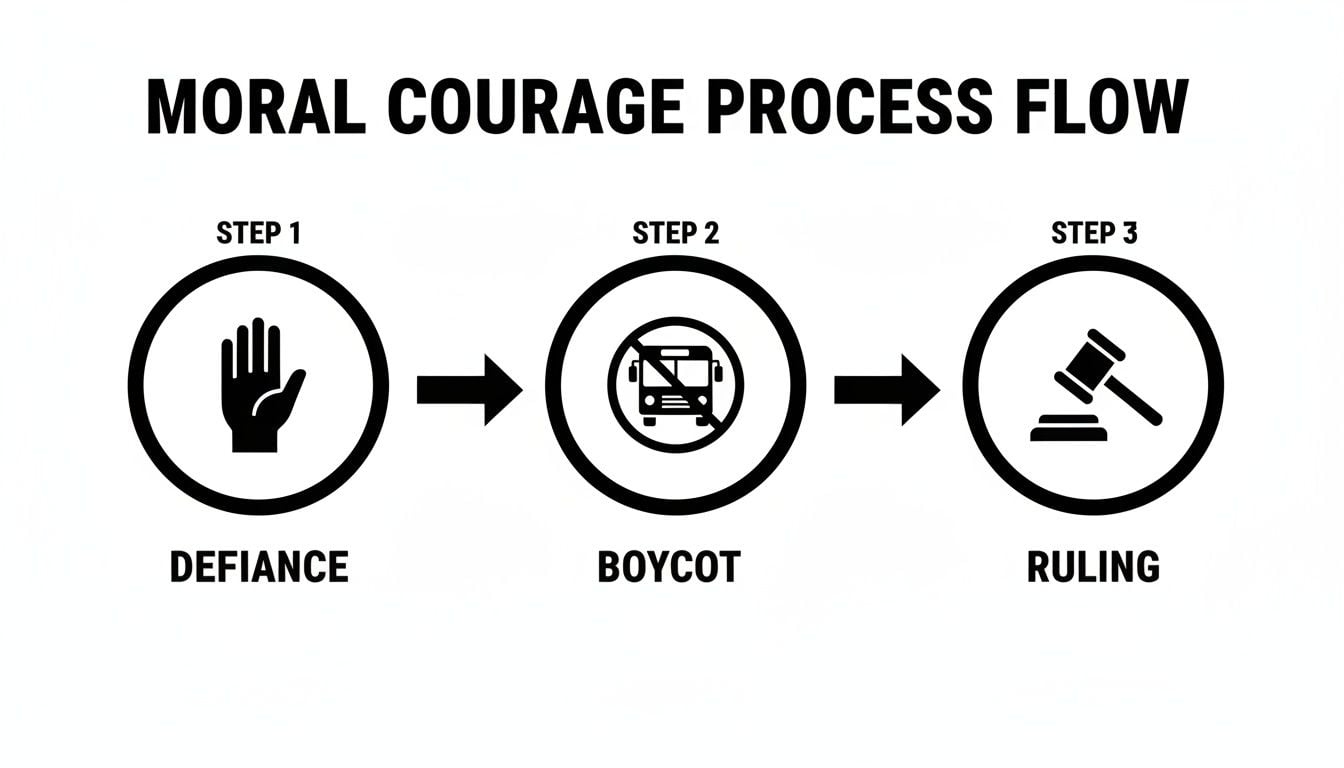
This process shows how one person’s stand can create a ripple effect, inspiring collective action and, in the end, leading to real, systemic change.
Master Difficult Conversations with Simple Scripts
Often, the biggest thing holding us back isn’t a lack of conviction; it’s simply not knowing what to say. The fear of fumbling our words or being put on the spot can be paralyzing. Having a few simple, pre-planned phrases in your back pocket can make all the difference.
Here are a few scripts you can adapt and make your own:
- “I need a moment to think about this request. On the surface, it seems to conflict with our team’s commitment to [value].”
- “I see it a bit differently. From my perspective, the ethical path forward is to…”
- “Could we pause for a second? I want to make sure this decision truly aligns with the company’s stated values.”
Moral courage isn’t just a nice-to-have virtue; it’s a measurable skill with real-world impact. A study of 250 nurses found a strong link between their moral courage scores and their ability to provide safe patient care. This proves that principled bravery isn’t just an abstract idea—it directly improves performance and is a skill that can be trained.
By starting small and preparing yourself for those tough conversations, you’re actively taking risks for your personal growth. If you’re looking to dig deeper into this, you might find our guide on how to take risks for personal growth helpful. Building your moral courage muscle isn’t just about you; it’s about transforming yourself from a passive bystander into an active force for creating a more ethical world.
Frequently Asked Questions About Moral Courage
Once you start thinking about moral courage, it’s only natural for the “what-ifs” to pop up. Theory is one thing, but applying it in a messy, real-world situation is another beast entirely. This is where most people get stuck.
Let’s walk through some of the most common questions that come up when you’re trying to bridge that gap from knowing what’s right to actually doing it.
What Is the Difference Between Moral and Physical Courage?
This is a fantastic question, and the distinction is crucial. Most of us think of courage as a physical act—a firefighter rushing into a burning building or a soldier on the battlefield. That’s physical courage, and it’s about facing bodily harm.
Moral courage, on the other hand, is about facing social and emotional risks for the sake of your principles. It’s the willingness to stand alone, risk your reputation, or face ridicule for what you believe is right. It’s the quiet bravery of speaking an unpopular truth in a meeting, not the roar of battle.
What if I Miss an Opportunity to Act?
First off, welcome to the club. Everyone misses opportunities to act. The goal isn’t perfection; it’s progress. Beating yourself up over a missed chance doesn’t help you or anyone else. What matters is what you do next.
Instead of letting guilt fester, treat it as feedback. Ask yourself, what really stopped me? Was I afraid of looking foolish? Was I unclear on my own values in that moment? Did the words just not come? Pinpointing the barrier is the first step to dismantling it. Forgive yourself, learn the lesson, and get ready for the next opportunity.
Moral courage is doing the right thing in the face of adversity and opposition, and doing it whether people notice it or not.
How Can I Encourage Moral Courage in My Team or Family?
You can’t just tell people to be brave. You have to build an environment where they feel safe enough to try. This concept is often called psychological safety—the shared belief that it’s okay to take a stand, ask a tough question, or admit a mistake without fear of punishment.
Here are a few ways to cultivate that kind of culture:
- Model It Yourself: The most powerful thing you can do is lead by example. Own your mistakes openly. Voice a respectful, principled disagreement, even when it’s uncomfortable. Your actions give others permission to do the same.
- Reward the Attempt: When someone raises a difficult point or challenges the status quo, thank them. Acknowledge their courage, especially if their idea creates more work or goes against your own.
- Practice Together: Run through hypothetical ethical problems as a group. Discussing tough choices in a low-stakes setting is like a workout for your team’s collective moral muscle.
When you create this foundation, you make it easier for everyone to act on their values. The result is a stronger, more honest, and more resilient group.
At David Pexa, we offer practical, evidence-based coaching to help you develop the habits for a more principled and effective life. To continue your journey, you can explore our resources.
