


Extreme attention-seeking behavior is one of the most misunderstood things in child development. The child isn’t being ‘needy’ — they’re telling you something important about what they’re not getting.
Your child isn’t seeking attention. They’re seeking connection they don’t know how to ask for.
If you’re searching “extreme attention-seeking behavior in child,” you’re probably exhausted. The constant interrupting. The meltdowns that seem to come out of nowhere. The feeling that no matter how much you give, it’s never enough.
And underneath the exhaustion, there’s a question you’re afraid to ask out loud: Why isn’t my love enough?
Here’s what I want you to know: your love IS enough. But something is getting lost in translation between what you’re giving and what your child is able to receive. And once you understand why, everything about this behavior starts to make sense.
Why This Matters More Than You Think
Most advice on extreme attention-seeking behavior in children treats it as a discipline issue. “Ignore the behavior.” “Don’t reward it with attention.” “Be consistent with consequences.”
And if you’ve tried that, you already know the result: the behavior gets worse. Or it shifts into something new — something louder, more disruptive, harder to ignore.
That’s not a coincidence. It’s a clue.
When we treat attention-seeking as manipulation, we respond with control. But the child isn’t trying to manipulate you — they’re trying to solve a problem they don’t have words for. And the problem is almost never what it looks like on the surface.
Think of it this way: imagine you’re drowning, and every time you wave your arms, someone on shore tells you to stop making a scene. You wouldn’t wave less. You’d wave harder.
That’s what extreme attention-seeking behavior is. It’s not a performance. It’s a signal that something essential is missing — and your child is doing the only thing they know how to do about it.
What’s Actually Driving the Behavior
When a child’s attention-seeking reaches extreme levels, it’s almost always pointing to one of three underlying needs that aren’t being met — not because you’re failing, but because these needs are often invisible.
The need to feel seen — not just watched.
There’s a critical difference between monitoring a child and actually seeing them. We can be in the same room, supervising homework, making dinner, managing the logistics of family life — and our child can still feel invisible. Because being seen isn’t about proximity. It’s about the experience of having someone reflect back to you that who you are matters. A child who feels watched but not seen will escalate their behavior until someone finally looks — really looks — at what’s going on inside them.
The need for predictable connection.
Children build their sense of safety on patterns. When connection with a parent is unpredictable — warm and present one day, distracted or stressed the next — a child’s nervous system starts working overtime to secure that connection. The attention-seeking isn’t greed for attention. It’s anxiety about whether the connection will be there when they need it. Think of it like checking your phone when you’re waiting for an important message. You don’t check because you’re needy. You check because the uncertainty is intolerable.
The need to matter in the family system.
Every child needs to know they have a role — that they contribute something irreplaceable to the family. When a child can’t find a positive way to matter, they’ll find a negative one. Being the “difficult” child is still a way of being significant. It’s a lousy strategy, but it works — and for a child who feels invisible or replaceable, a lousy strategy is better than no strategy at all.
How to Respond Differently
Understanding what drives the behavior is important. But you need to know what to actually do — starting today. Here are four shifts that address the root, not just the surface.
This is the most counterintuitive and most powerful shift you can make. Instead of waiting for the behavior to start (and then reacting to it), create predictable moments of undivided connection. Ten minutes in the morning. Five minutes when they get home from school. Not multitasking. Not half-listening. Full presence, even if brief.
What happens is remarkable: when a child knows the connection is coming, they stop working so hard to create it. The attention-seeking drops — not because you’ve ignored it away, but because the need underneath it is being met.
2. Name what you see, not what you want to correct.
When your child is in the middle of extreme behavior, the instinct is to label it: “You’re being dramatic.” “Stop showing off.” “Why do you always have to be the center of attention?”
Every one of those labels tells the child the same thing: who you are right now is a problem.
Instead, try naming what’s underneath: “It looks like you really need me right now.” “I can see something’s bothering you — I want to hear about it.” “You seem like you’re having a hard time, and I’m here.”
This doesn’t reward the behavior. It bypasses the behavior entirely and speaks directly to the child beneath it. That child — the one who’s drowning — finally feels like someone sees them waving.
3. Create roles where they matter.
If your child needs to feel significant, give them real significance. Not manufactured praise — children see through that instantly. Real responsibility that the family actually depends on.
“You’re in charge of the playlist for our weekend drives.” “I need your help figuring out what to cook this week — you’re good at this.” “Your sister looks up to you. Would you read her that bedtime story tonight?”
Each of these says: you belong here, and you matter because of who you are — not because of how loud you can be.
4. Repair the moments when you got it wrong.
We all lose patience with extreme attention-seeking. We all snap. We all have moments where we react to the behavior instead of responding to the child.
What matters isn’t whether you get it wrong — it’s what you do next. Going back and saying, “I was frustrated earlier, and I think I missed what you were actually trying to tell me. Can we try again?” — that teaches your child something no amount of perfect parenting ever could: that relationships can survive mistakes. That rupture doesn’t mean rejection.
What Changes When You See It This Way
When you stop treating extreme attention-seeking as a behavior problem and start seeing it as a communication problem, something shifts — in you first, then in your child.
You stop bracing for the next outburst and start getting curious about it. Your child stops escalating because they no longer need to. The energy that was going into the battle starts flowing into the relationship.
This doesn’t happen overnight. And it doesn’t mean you accept every behavior without limits. Boundaries still matter. But boundaries work when they come from understanding, not from exasperation. A child who feels seen will respect a boundary. A child who feels invisible will fight one.
The parents who find their way through this aren’t the ones who figured out the perfect consequence. They’re the ones who figured out the real question their child was asking — and answered it.
For the therapy option specifically, the access friction has dropped a lot in the last few years. Online platforms like Talkspace can match you with a licensed therapist usually within 24 hours, work in all 50 states, accept most major insurance, and let you message your therapist between sessions when something comes up that you don’t want to forget. I mention them by name because they’re the platform I’d point a student or coaching client to today — the path from “I think I need help” to “I’m in a session” is short enough to actually walk.
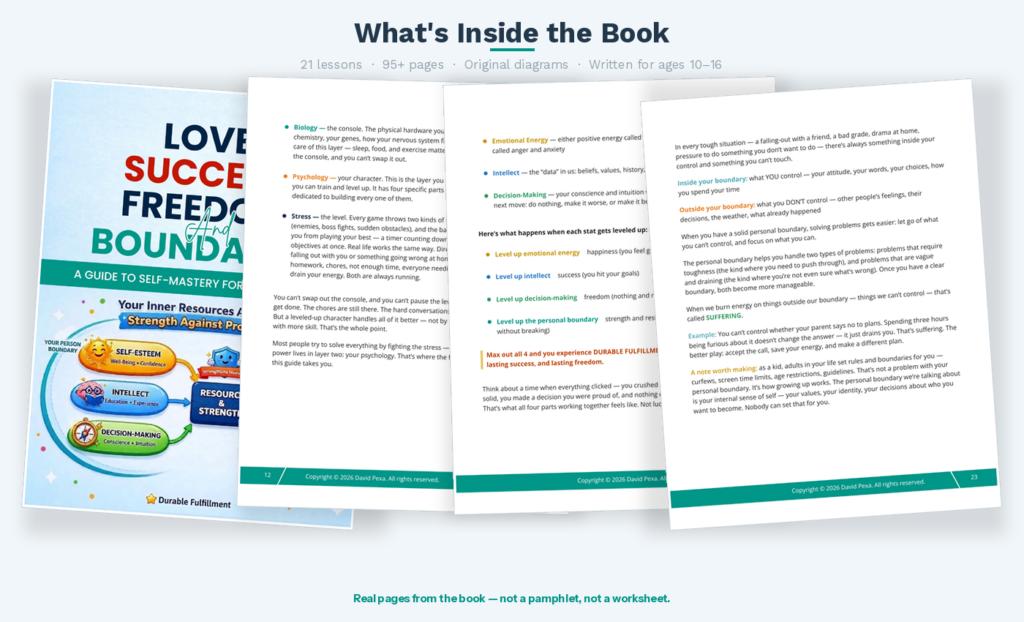
For parents who want the deeper framework — the one that makes work like this stick instead of feeling like you’re firefighting forever — my book Love, Success, Freedom and Boundaries is the structured version of what I teach my own students. Written for tweens and teens, but most parents tell me they pick up more from it than the kid does.
Going Deeper
If this article changed the way you see your child — if you read it and thought, “That’s what’s been happening” — then you’re ready for more.
Love, Success, Freedom and Boundaries is a book I wrote for young people and the parents raising them. It gives families a framework for understanding each other at a deeper level — the kind of understanding that turns extreme behavior into real connection.
A note on affiliates: This article includes affiliate links to platforms I’ve vetted and would recommend to my own clients and students. If you start with a recommended service through a link here, I may earn a small commission — at no extra cost to you. I only mention what I’d actually point you to in person. The recommendation comes first; the relationship is disclosed second.
If this resonates, the full framework lives in Love, Success, Freedom and Boundaries.
A practical playbook for raising emotionally resilient kids — and breaking the patterns you didn’t choose to inherit.
