


Summary: Two Different Kids: When Your Child Is Fine at School and Falling Apart at Home. A framework for understanding what’s really going on — and what to do about it.
If you’re wondering how to discipline a child who acts completely differently at home than at school, you’re not alone. The behavior rarely looks the same in every kid — even in the same house.
The teacher smiles at you during the parent conference. “He’s doing great. Participates in class. Gets along with the other kids. No behavioral concerns at all.”
You nod and smile back, because what are you supposed to say? That three hours ago this same child screamed at you for asking him to put his shoes on? That last night he threw his dinner plate? That most evenings feel like defusing a bomb while everyone in your house holds their breath?
You drive home wondering if you’re crazy. Or if you’re the problem. Because if he’s fine everywhere else, the variable must be you.
And here’s what keeps you up at night: if you’re the reason they’re falling apart, then you don’t know how to stop it. Every attempt to help feels like guessing. Every evening feels like bracing for impact. And the longer this goes on without understanding what’s actually happening, the more your child learns that home is a place where they’re a problem instead of a person. That’s the pattern that hardens if no one names it.
It’s not you. And he’s not fine. What you’re seeing is one of the most misunderstood patterns — and before you can learn how to discipline a child like this — and once you understand it, everything about your household starts to make sense.
Why the Discrepancy Exists
Your child is performing at school. Not performing like faking — performing like managing. They’re expending significant cognitive and emotional energy to hold themselves together in a structured environment with clear expectations and social consequences for losing control.
By the time they get home, that energy is gone.
Think of it like a battery. Your child wakes up at 80%. School draws it down to 15% — managing social dynamics, suppressing impulses, following rules, navigating friendships, handling academic pressure. When they walk through your front door, they’re running on fumes. And your home is the one environment where the performance doesn’t have to continue.
This isn’t a choice they’re making to be terrible to you. It’s a nervous system that has been in regulation mode all day and has finally reached the one place where it feels safe enough to stop regulating.
The explosion after school? That’s not defiance. That’s decompression. And the fact that it happens with you — not with teachers, not with coaches, not with friends’ parents — is actually a sign of attachment, not disrespect.
I know that’s a hard reframe when you’re in the middle of it. But it’s the accurate one.
How to Discipline a Child: What Most People Get Wrong
When parents describe this to friends, family, or even professionals, they typically hear one of three things:
“He just needs firmer boundaries at home.” This assumes the behavior is a discipline problem — that your child chooses to behave at school and chooses not to at home. It misreads the entire mechanism. Your child isn’t choosing. They’re depleted. Adding stricter consequences to a depleted nervous system doesn’t create compliance. It creates escalation.
“She’s manipulating you.” This is the most damaging interpretation. It implies strategic intent in a child whose prefrontal cortex — the brain region responsible for strategic planning — isn’t fully developed. A ten-year-old who melts down at home isn’t running a psychological operation. They’re a child who has reached the end of their capacity.
“It’s just a phase.” Maybe. But “phase” has become a way of saying “I don’t understand this, and I’m hoping it resolves itself.” Some patterns do resolve. This one usually doesn’t — it shifts. The child who explodes at eight becomes the teenager who withdraws at fourteen. The question of how to discipline a child changes shape; the underlying depletion pattern stays the same.
Reading the Signal
Here’s what I’d want to know if you were sitting across from me: what happens in the first thirty minutes after your child gets home?
That transition window — from school to home, from performance mode to home mode — is where the most important data lives. What you observe there tells you more about your child’s internal state than anything a report card or teacher conference ever will.
Does your child need silence? Don’t fill it with questions. They may need twenty minutes of absolutely zero demands before their system resets enough to engage.
Does your child need movement? Some kids decompress through physical activity — not organized sports, just motion. Running around the yard, bouncing a ball, lying upside down on the couch. Their body is discharging the regulatory tension from the day.
Does your child need conflict? This sounds counterintuitive, but some children pick a fight within minutes of arriving home because the argument itself is a discharge mechanism. They’re not mad about the snack or the homework or the screen time rule. They’re offloading, and you’re the safest target.
Once you can identify which decompression pattern your child uses, you can stop reacting to the surface behavior and start responding to the actual need.
The Framework That Changes the Afternoon
Here’s what I teach parents dealing with this pattern:
Protect the transition. The first thirty minutes after school is not the time for questions about homework, requests to clean rooms, or discussions about what happened today. It’s recovery time. Treat it like a decompression chamber. Your child has been underwater all day. They need time to surface.
Lower the demand load. On the worst days, reduce your expectations to the bare minimum. This isn’t permissiveness. It’s triage. If your child’s nervous system is running on empty, stacking demands creates a cascading failure. Feed them. Give them space. Save the important conversations for after dinner, when the battery has had time to recharge.
Separate the behavior from the message. When your child screams at you for asking them to set the table, the behavior says: disrespect. The message says: I have nothing left to give and your request, however small, feels like one more thing being taken from me. The behavior needs a boundary. The message needs to be heard. Both can happen — but only if you’re reading the message underneath.
Talk to the school. Not to report problems, but to share data. Teachers are seeing one version of your child; you’re seeing another. When both adults are looking at the full picture, they can collaborate on reducing the regulatory load during the school day — fewer transitions, quieter lunch spaces, permission to take a break when the system starts heating up.
What You Can Do This Week
You don’t need to figure out how to discipline a child overnight. But you can start reading the signal instead of reacting to the surface.
Track the transition. For three days, write down exactly what happens in the first 30 minutes after your child gets home. Not your interpretation — just the facts: Walked in. Dropped bag. Went to room. Came out 20 minutes later. Asked for a snack. Started talking about recess. You’ll start seeing a decompression pattern you’ve been interrupting without realizing it.
Notice your body’s anticipation. Before your child even walks through the door, check: are your shoulders up? Is your jaw tight? Is there a knot in your stomach? That’s your nervous system expecting the explosion. And your child reads that tension the moment they see you. If you can name it — I’m bracing — and consciously soften before they arrive, you change the first signal they receive.
Give them one decompression gift. Tomorrow, try this: when they walk in, don’t ask a single question. Offer a snack. Be in the room. Say nothing about school, homework, or behavior. See what happens in the next hour. Most parents who try this are stunned by how much their child voluntarily shares once the pressure to perform is removed.
What This Means for Your Family
The two-different-kids pattern isn’t a mystery once you have the framework. It’s one of the most common and most readable behavioral signals in children — and it tells you something important: your child is working harder than anyone realizes to hold themselves together, and they need the adults in their life to see the cost of that effort.
You’re not the problem. You’re the person they trust enough to fall apart with. The work isn’t making them behave better at home. It’s understanding why they need to decompress, and understanding how to discipline a child by seeing the behavior for what it really is and building a home environment that supports the recovery instead of accidentally adding to the load.
Start Here
The child who falls apart at home isn’t broken. They’re communicating something they can’t say with words yet. And you — the person they trust enough to fall apart with — are the one who can learn to read it.
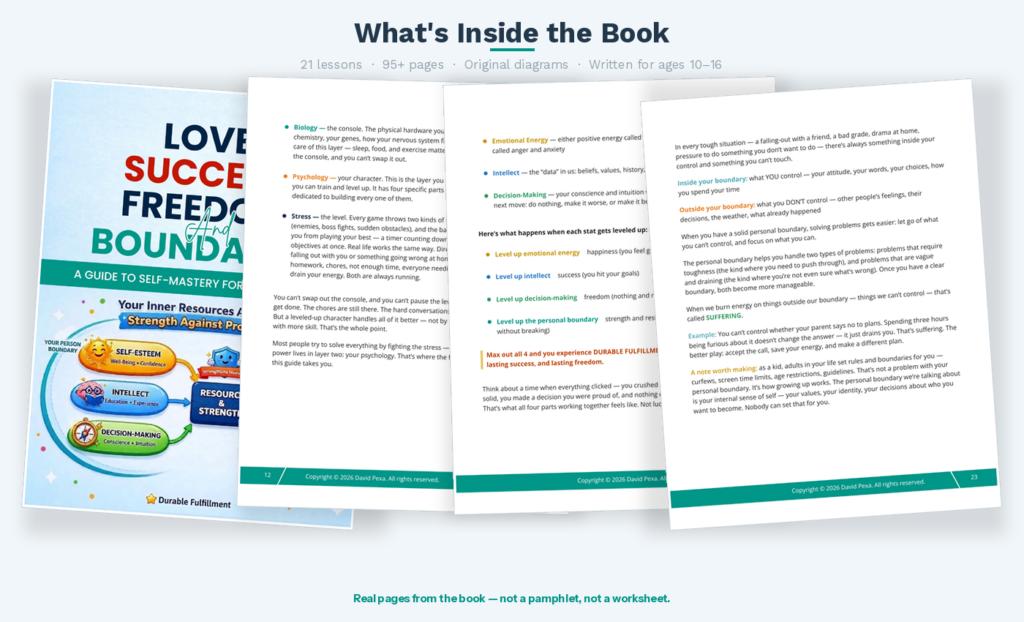
Love, Success, Freedom and Boundaries is the framework that teaches you how. It’s the same lens I use with every family I work with — and it starts with understanding that child behavior problems are always a message.
Understand what your child is actually telling you → Get Chapter 1 free — enter your email and it arrives in minutes.
Or if you’re ready for the full picture: Get the complete framework — $39
You’re not the problem. You’re the one paying close enough attention to see that something needs to change. That’s not a weakness. That’s the starting point.
Frequently Asked Questions
Why does my child behave differently at school vs. home?
Home is where a child feels safest. If they’re holding it together at school, they’re spending enormous emotional energy maintaining that composure. Home is where they finally let go. It’s actually a sign of trust, not disrespect.
Are behavior problems a sign of bad parenting?
No. Behavior problems are a sign that something in the child’s world isn’t working — and that could be anything from a sensory issue to a social dynamic to a developmental stage. The behavior is information, not an indictment.
What’s the best approach to behavior problems?
Get curious before you get corrective. Ask what the behavior is trying to communicate before deciding how to change it. Most interventions fail because they address the symptom without understanding the cause.
Keep Reading
- Manipulative Child Behavior Symptoms: What You’re Really Seeing
- Behavioral Strengths of a Child: What Your Child’s Worst Behavior Is Really Telling You
- Your Child’s Anger Isn’t the Problem. Here’s What Is.
If you find yourself wanting to put words to what’s happening with your kid — drafting a hard conversation, journaling what you noticed, writing the script you wish you had — the tool I use to draft most of my words is Wispr Flow. It transcribes your voice into clean, edited text in real time, so the friction between thinking it and writing it basically disappears.
Conclusion
Understanding is the first step, but it’s what you do with that understanding that changes things. The ideas in this article aren’t meant to sit in your head — they’re meant to shift how you see your situation and give you something concrete to act on. Start with the one thing that felt most relevant, apply it this week, and notice what changes.
A note on affiliates: This article includes affiliate links to platforms I’ve vetted and would recommend to my own clients and students. If you start with a recommended service through a link here, I may earn a small commission — at no extra cost to you. I only mention what I’d actually point you to in person. The recommendation comes first; the relationship is disclosed second.
If this resonates, the full framework lives in Love, Success, Freedom and Boundaries.
A practical playbook for raising emotionally resilient kids — and breaking the patterns you didn’t choose to inherit.
