


A strong-willed child is exhausting to raise — and they’re also the ones who tend to become the most resilient adults. The challenge isn’t breaking the will. It’s learning to work with it.
If you’re raising a strong willed child, you already know this feeling.
You’ve tried explaining it. To your partner, to your mother, to the friend whose kids seem to navigate everything effortlessly.
You describe what’s happening at home — the shutdown after school, the explosions over nothing, the way your child’s eyes go flat when you ask a simple question — and the person across from you tilts their head and says some version of the same thing: “That sounds pretty normal.”
And you nod. Because what else do you do? You can’t prove that the thing you’re seeing is real. You can’t point to a test result or a diagnosis or a single dramatic incident. What you have is a pattern — something accumulating over months, maybe years — and a gut feeling that won’t stop pulling at you.
You know your child. And you know something is off. But the loneliest place in the world is knowing something no one else can see.
Why the People Around You Minimize It
Before I get to what you should do, I want you to understand why you’re alone in this. It’s not because the people around you don’t care. It’s because they literally can’t see what you see.
Your child performs. That’s the piece everyone misses. Most struggling children have an extraordinary ability to hold it together in public and fall apart in private. At school they’re fine — maybe quiet, maybe not thriving, but manageable. At a friend’s house they’re charming. At family dinners they’re polite enough.
Then they walk through your front door and the mask comes off.
This isn’t acting. It’s actually a sign of trust, though it doesn’t feel like it when your child just threw a shoe at the wall. Your home is the one place where they feel safe enough to stop managing the performance. Which means you — the person who loves them most — get the version no one else believes exists.
So when your sister says “He seemed fine at Thanksgiving,” she’s telling you the truth of what she saw. It just has nothing to do with the truth of what you live.
The Professional Validation Problem
Here’s where it gets worse. You finally work up the courage to take your child to a therapist, a counselor, a pediatrician. You describe what you’ve been observing. The professional spends 45 minutes with your child, maybe runs a questionnaire, and tells you one of two things: “They seem fine” or “Let’s watch and wait.”
You leave feeling like you either imagined the whole thing or you’re so broken as a parent that your presence is the variable making your child fall apart.
Neither is true.
What happened is this: a professional evaluated your child in a controlled setting where the child performed — because that’s what they do. The professional saw the public version. You live with the private one. And most clinical tools are calibrated for the public version. They catch the kids who struggle everywhere. They miss the kids who struggle only where they feel safe.
This is not a failure of the professionals. It’s a limitation of the setting. Your child’s behavior at home is data — important data — and it’s the data that’s hardest to capture in a 45-minute appointment.
What Your Gut Is Actually Telling You
Let me validate something for you that should have been validated a long time ago: your instinct is almost certainly correct.
Parents — especially the high-functioning, self-questioning kind who read articles like this — have a remarkably accurate sense of when something is off with their child. Research consistently shows that parental concern about developmental and behavioral issues predicts real issues with high accuracy. The problem isn’t that parents are alarmist. The problem is that the systems around them are built to reassure rather than investigate.
When you say “something is off,” here’s what I hear: you’ve noticed a pattern in your strong willed child that doesn’t match the developmental trajectory you expected, and the gap between what you observe and what everyone else reports is creating a dissonance that won’t resolve.
That’s not anxiety. That’s observation. And observation is the first step toward understanding what’s actually happening.
The Cost of Staying Silent
When no one validates what you see, something predictable happens. You stop talking about it. You perform normalcy — the same way your child does, just in a different direction. At the school pickup you smile. At the dinner party you laugh about how “teenagers are teenagers.” Inside, you’re carrying a weight that gets heavier every week because it has no outlet.
This isolation does real damage. Not just to you — to your ability to help your child. When you stop trusting your own perception, you lose the most sensitive instrument you have for reading your child’s behavior. You start second-guessing the signals. You start overriding your instinct with other people’s reassurance. And the pattern you noticed — the one that was trying to tell you something — gets buried under everyone else’s comfort.
And here’s the part that should keep you up at night: while you’re performing normalcy, your child is watching you do it. They see you laugh it off. They see you nod along when someone says “it’s just a phase.” And what they learn is: even the person who knows me best won’t say what’s true out loud. That teaches them something devastating — that what they’re experiencing isn’t real enough to name. That they should perform normalcy too. And they will. For years. Until the cost of performing catches up with them in ways that are much harder to reverse.
Your child needs you to trust what you see. Even when no one else sees it. Because the window where early understanding changes the trajectory doesn’t stay open forever.
What I’d Tell You If You Were Sitting Across From Me
Three things.
First: you’re not overreacting. The discrepancy between what you observe at home and what others see in public is itself a meaningful behavioral signal. It tells me your child is expending significant energy managing their external presentation. That’s not fine. That’s exhausting, and it eventually breaks down.
Second: stop waiting for external validation to act. You don’t need a diagnosis to respond to what you’re observing. You don’t need a professional to confirm what you already know. A diagnosis can be useful for specific interventions, but the pattern you’re seeing — the withdrawal, the explosions, the flatness — is already telling you what your child needs. They need to be understood. And that starts with someone taking the behavioral data seriously. You already have the data. You just need the framework to read it.
Third: find one person who sees your strong willed child the way you do. Not someone who reassures you. Someone who takes it seriously. This might be a partner who stops dismissing, a friend who asks the right questions, or a professional who listens to your observations as intelligence rather than anxiety. You cannot do this alone, and you shouldn’t have to.
A Strong Willed Child: The Loneliest Problem in the Room
Nobody told you parenting would be this lonely. The books don’t cover it. The Instagram accounts definitely don’t cover it. Everyone shows you the breakthrough moment — never the eighteen months of invisible struggle that preceded it.
But here’s what I know from working with families: the parents who feel most alone are usually the ones paying the closest attention. Your isolation isn’t a sign that you’re wrong. It’s a sign that you’re seeing something other people find too uncomfortable to sit with.
Carrying a child the world doesn’t quite see is lonely work — and the chronic isolation can erode your own ground. Online platforms like Talkspace can match you with a licensed therapist usually within 24 hours, work in all 50 states, accept most major insurance, and let you message your therapist between sessions when something happens that you don’t want to forget. They’re where I’d point a parent or coaching client today — the path from “I think I need help” to “I’m in a session” is short enough to actually walk.
What You Can Do This Week
You don’t need anyone’s permission to start paying closer attention. Here are three things you can do tonight.
Start a pattern log. For one week, track your strong willed child — write down the moments that trigger your gut response — the flat eyes, the shutdown, the explosion that seemed disproportionate. Don’t interpret. Just record: what happened, when, and what you noticed in your body when you saw it. After seven days, you’ll have something concrete where before you only had a feeling. That changes everything — for you and for anyone you eventually bring into the conversation.
Notice the gap between public and private. Pay attention to the difference between how your child presents at school, at friends’ houses, in public — and how they are at home with you. That gap is data. A child who is “fine everywhere else” isn’t fine — they’re managing their presentation, and they’re choosing to stop managing it with you because you’re safe. That’s not a problem. That’s trust. But it’s trust that’s asking you to see what no one else will.
Stop asking “what’s wrong” and start describing what you see. Instead of “What happened?” try: “I noticed your shoulders got tight when you walked in. Something felt heavy today.” You’re not diagnosing. You’re translating their body language back to them — giving them words for what their system is doing. Most strong willed children can’t tell you what’s wrong because they genuinely don’t have the framework. You’re building that framework, one observation at a time.
These aren’t fixes. They’re the beginning of seeing clearly. And once you see clearly, the next step becomes obvious — not because someone told you what to do, but because you finally have the information you need.
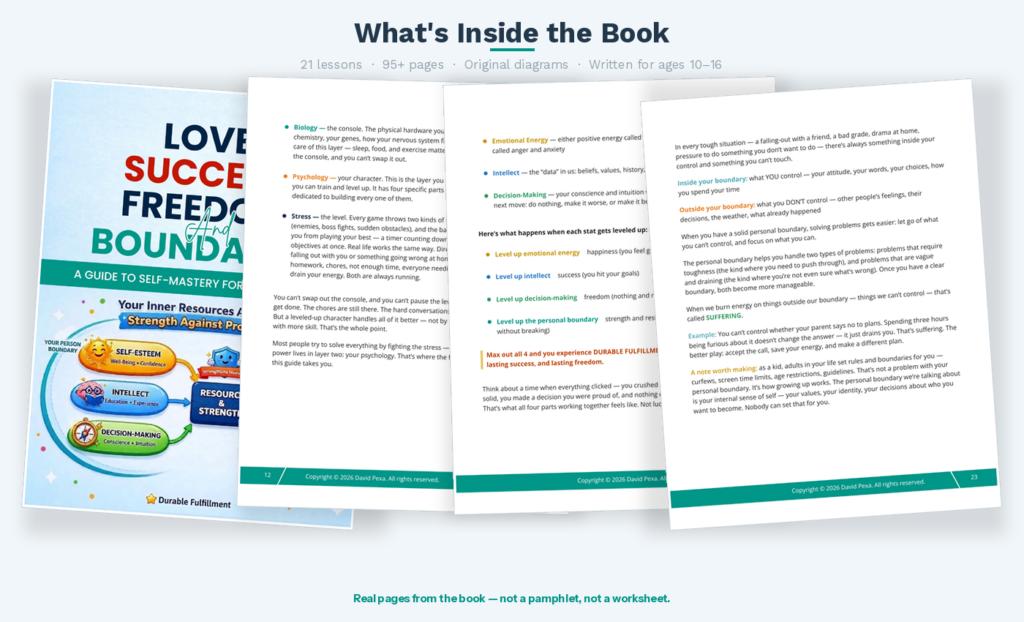
If you’re the parent who sees what no one else sees — and you’re done waiting for someone to validate it — Love, Success, Freedom and Boundaries is the framework that turns that observation into understanding. It’s the system I use with every family I work with.
Stop waiting for permission to trust what you see → Get Chapter 1 free — enter your email and it arrives in minutes.
Or if you’re ready for the full picture: Get the complete framework — $39
You’re not overreacting. You’re not imagining it. And you don’t have to carry this alone.
I write about the tools, habits, and mindset shifts that actually move the needle. Join the newsletter.
A note on affiliates: This article includes affiliate links to platforms I’ve vetted and would recommend to my own clients and students. If you start with a recommended service through a link here, I may earn a small commission — at no extra cost to you. I only mention what I’d actually point you to in person. The recommendation comes first; the relationship is disclosed second.
If this resonates, the full framework lives in Love, Success, Freedom and Boundaries.
A practical playbook for raising emotionally resilient kids — and breaking the patterns you didn’t choose to inherit.
