



Summary: Master Narrative Therapy Techniques for Growth — a practical breakdown of what matters, what doesn’t, and what to do next.
Narrative therapy changed how I work with people. The core idea — that the problem is the problem, not the person — sounds simple, but it’s one of the most powerful reframes I’ve ever encountered.
You open your laptop to do one focused hour of work, and a familiar story starts talking.
“You always leave things too late.”
“You’re not disciplined enough.”
“You’re the kind of person who freezes when it matters.”
Individuals often struggle not just with the problem itself. They struggle with the identity built around it. Procrastination becomes “I’m lazy.” Social anxiety becomes “I’m awkward.” A rough season at work becomes “I’m not leadership material.”
That identity-level conclusion is where people get stuck.
Narrative therapy techniques offer a different move. Instead of treating the problem as your essence, they treat it as something that has entered your life, influenced your choices, and shaped your self-talk, but is not the sum of who you are. That sounds simple. In practice, it is one of the most relieving and usable mindset shifts I know.
Used well, these techniques are not fluffy journaling prompts. They are structured ways to reduce self-blame, notice overlooked evidence, and build a more accurate story about your abilities, values, and direction. They can support personal development, career growth, habit change, and emotional resilience. They can also expose where self-help has real limits.
Your Story Is Not Your Identity
You can be capable at work, reliable with other people, and still carry a private story that keeps cutting you down.
I see this in high-functioning adults all the time. They are meeting deadlines, solving problems, and supporting a team, yet the inner narrative says, “I’m behind everyone else,” “I always mess up important moments,” or “I’m not the kind of person who can lead.” After a while, the story stops feeling like a thought and starts feeling like a fact.
That is the point where self-reflection turns useful.
When a problem becomes a self-definition
One of the strongest ideas in narrative therapy is simple: the person is not the problem. The problem is the problem.
That line matters because people often confuse repeated experience with permanent identity. If you have struggled with avoidance, you may start calling yourself lazy. If conflict drains you, you may decide you are weak. If you have made a few costly mistakes, you may start introducing yourself to yourself as careless.
Those labels feel honest. Usually they are just incomplete.
A better question is, “What has been influencing me, and how has it been shaping my behavior?” That wording creates room to examine patterns instead of handing down a verdict on your character. In practice, that can lower shame enough for real change to begin.
This matters outside therapy too. People trying to build confidence, improve performance, or change habits often stay stuck because they are still arguing with an identity conclusion. Work on overcoming limiting beliefs helps here, but narrative work adds something important. It helps you identify the story structure around the belief, where it came from, what keeps reinforcing it, and which parts no longer fit your life.
Examples:
- I am a person who values contribution, and even when The Delayer shows up, I can begin before I feel ready.
- I am a thoughtful connector. Even when Social Fear visits, I can ask genuine questions and stay present.
- I care about craftsmanship, and I do not need Perfectionism to bully me into doing good work.
This works because it does three things at once. It names what matters to you, admits the problem still appears, and anchors the new story in something you have already done.
Build the story in four moves
Use one recent situation, not your whole life.
| Step | What to write | Example |
|---|---|---|
| 1. Name the old story | The identity claim you usually make | “I am bad at speaking up” |
| 2. Add contradictory evidence | One specific moment that does not fit | “I shared an idea in Tuesday’s meeting” |
| 3. Interpret the moment | The skill and value inside that action | “I prepared one clear sentence because I care about contributing useful thinking” |
| 4. Write the new story | A grounded identity phrase | “I am a careful contributor who can speak with clarity” |
That is the process. Short. Concrete. Repeatable.
If you want it to hold up in a stressful moment, read the new identity phrase and ask two questions. “Would I believe this on a hard day?” and “Could I act from this story in the next 24 hours?” If the answer is no, shrink it until the answer becomes yes.
A case example in plain language
Sarah described herself as “socially awkward.” To her, it sounded like a fact.
Once she separated herself from the problem, the pattern became easier to examine. Social anxiety tightened her body before group settings, pushed her to say something impressive, and made her scan for rejection. Then we looked at the exceptions. She asked strong one-to-one questions. She checked on new coworkers. She listened closely, and people opened up to her faster than they did with louder colleagues.
The old identity was “awkward person.” The revised identity was “thoughtful connector.”
That phrase worked because it matched lived evidence. It also gave her a direction for practice. She did not need to become the boldest person in the room. She needed to act like a thoughtful connector in settings where that strength already existed.
Questions that help you write a stronger story
Use these prompts after you record a unique outcome:
- What does this moment suggest about what matters to me?
- What ability did I use here?
- Under what conditions was that ability easier to access?
- Who has seen this quality in me before?
- What is a fairer identity statement based on this evidence?
- What action would a person with that identity take next?
For self-application, the last question matters most. A new story that never reaches behavior stays theoretical.
Use regulation before reflection if you are flooded
Re-authoring does not work well when your nervous system is fully activated. If shame, panic, or anger is running the room, regulate first and write second. A simple emotion regulation checklist for high-stress moments can help you settle enough to think clearly.
This is a key trade-off when doing this work on your own. Self-reflection is powerful, but it gets distorted when you are exhausted, triggered, or trying to rewrite the story in the middle of a spiral.
Gather outside reflection early
A preferred story gets stronger when another person can recognize it accurately.
You do not need a therapy group for this. Ask a trusted friend, mentor, coach, partner, or colleague a focused question: “When have you seen me act in line with this description of myself?” Good witnesses help you stay honest. They can confirm the strength, challenge exaggeration, and give language you would not have found alone.
As noted earlier, research on narrative therapy suggests the approach can support meaningful change. In practice, one reason it helps is simple. People stop treating a problem-saturated story as the only available truth.
Daring Greatly: How the Courage to Be Vulnerable Transforms the Way We Live, Love, Parent, and Lead
$9.99

Keep the new narrative narrow enough to use this week
Do not write a life manifesto on day one. Write a working story for one domain:
Sponsored

- Work identity
- Relationship identity
- Creative identity
- Health identity
A good re-authored story should feel slightly stretching and clearly true. If it feels fake, make it smaller. If it feels flat, return to the value underneath it.
The goal is not to invent a better personality. The goal is to describe yourself with more accuracy, then act from that description often enough that it becomes familiar.
Making Your New Story Stick
Monday morning, you handle a hard conversation better than your old script predicts. By Thursday, one stressful email pulls you back into “I’m behind, I always fumble this, nothing has changed.”
That snapback is common. Old narratives stay active because they have history, emotion, and repetition behind them. A preferred story lasts when you build a practice around it.
Reinforcement turns insight into identity
A single breakthrough rarely changes behavior on its own. What changes behavior is repeated contact with evidence that supports the new description of who you are.
In narrative practice, therapists sometimes call this thickening the story. In plain terms, you collect enough concrete moments that the new story stops feeling like a nice idea and starts feeling like the more accurate account.
This matters even more for self-application. Without a way to record what happened, people remember the emotional setback and forget the small acts that contradict the old story.
Make the evidence easy to capture
Use the tool you will still use on a tired day.
I usually suggest a very small system first. A notes app, a paper card in your bag, a pinned voice memo folder, or one document called “evidence” is enough. The point is speed. If recording the moment takes too much effort, you will skip it, and the old narrative will keep more proof than the new one.
A practical setup looks like this:
- Capture in real time: Record a short voice note or one-sentence entry right after a meaningful moment.
- Name the pattern: Add a tag such as “calm under pressure,” “clear boundary,” or “followed through.”
- Review once a week: Scan for repeated actions, not just standout wins.
- Turn patterns into language: Rewrite your preferred story using what happened this week.
Use a weekly review that asks better questions
Do not review your week like a prosecutor building a case against you. Review it like an editor looking for the true plot.
Ask:
- Where did I act against the old story, even briefly?
- What helped that happen?
- What nearly pulled me back into the old role?
- Which description fits the facts better now?
- What is one situation next week where I want to practice this story on purpose?
That last question matters. A new narrative gets traction when it enters your calendar, not just your journal.
Let other people reflect the story back accurately
Private reflection helps. Social reflection makes the story harder to dismiss.
Choose one or two people who can be specific. A good witness does not hype you up or tear you down. They notice what you did, what values showed up, and what changed in your responses. That outside reflection is useful in both personal and professional settings. A colleague might notice that you speak with more clarity in meetings. A partner might notice that you repair conflict faster. A mentor might hear less apology and more ownership in your decisions.
Useful prompts include:
- What did you notice me do differently?
- When did I seem most like the person I say I want to be?
- What strengths were visible there?
- What would help me repeat that next week?
Tie the story to cues, routines, and regulation
Narratives stick faster when they are attached to ordinary behavior.
Pick one cue. After your last meeting each day, write one line of evidence. After a workout, record a voice memo about discipline or follow-through. Before a difficult conversation, review a short emotion regulation checklist so your body is not deciding the story for you.
There is a trade-off here. If you build an elaborate system, it may feel satisfying for three days and then collapse. If you build a system that is slightly too simple, you may wish it were cleaner, but you will keep using it. Consistency wins.
What helps the new story hold
A preferred story becomes more stable when you:
- Log partial successes: Repairs, pauses, and second attempts count.
- Use exact language: Write what you did, not what you hoped to do.
- Keep the story current: Update it from lived evidence, not aspiration alone.
- Practice in one domain first: Work, relationships, health, or creativity. Breadth can come later.
- Expect setbacks: A hard day does not erase a developing pattern.
One strong test is this: can you describe your new story in a sentence, point to three recent examples, and name the next situation where you will practice it again? If not, the story is still too vague.
Key takeaway: A preferred story holds when you collect evidence for it, speak it aloud, and connect it to repeated action in daily life.
For the therapy option specifically, the access friction has dropped a lot in the last few years. Online platforms like Talkspace can match you with a licensed therapist usually within 24 hours, work in all 50 states, accept most major insurance, and let you message your therapist between sessions when something comes up that you don’t want to forget. I mention them by name because they’re the platform I’d point a student or coaching client to today — the path from “I think I need help” to “I’m in a session” is short enough to actually walk.
Boundaries for Self-Application and When to Call a Professional
You finish a journaling session hoping for clarity and end up more certain that the worst story about you is true. That is the line to watch.
Self-directed narrative work helps when it increases perspective, flexibility, and choice. It stops helping when it becomes a smarter way to rehearse shame, fear, or hopelessness. I see this often with capable, reflective people. They can name patterns with precision, but they still interpret every detail through the same harsh frame.

Where self-guided work usually fits
Use narrative techniques on your own when the issue is meaningful but still contained. You can function, recover after reflection, and test new interpretations in daily life.
That often includes:
- A recurring work identity story, such as “I am always behind” or “I am not leadership material”
- Mild perfectionism that creates hesitation, overchecking, or avoidance
- Fear of visibility, judgment, or speaking up
- Shame around habits, consistency, or self-discipline
- Career, purpose, or confidence questions during a transition
For these problems, structured writing, voice notes, and deliberate questioning can create real traction. The goal is not insight for its own sake. The goal is better decisions, cleaner language, and more freedom in how you respond.
Where self-guided work starts to break down
The main limitation is not technical accuracy. It is lack of corrective feedback.
If your current story already filters out evidence, solo work can make that story sound more convincing. You may become highly skilled at explaining why you are stuck while missing the places where the story is incomplete. That is one reason researchers who study psychotherapy outcomes generally find guided treatment more effective than self-help for more complex problems. If you want a broad comparison of structured self-help versus therapist-guided work, a practical overview of cognitive behavioral therapy techniques can help clarify what changes when support is added.
Narrative work also has a pacing issue. Once the material touches trauma, panic, dissociation, severe depression, or chronic self-attack, reflection alone is often not enough. You need containment, sequence, and someone who can notice when the exercise has shifted from meaning-making into destabilization.
Signs you should stop self-directing and get support
Professional help is the better choice if any of the following are true:
- You get flooded fast: After writing or reflecting, you feel panicked, numb, disoriented, or unable to settle.
- The story involves trauma: Abuse, violence, coercion, dissociation, or intrusive traumatic memories are present.
- Every exercise becomes self-indictment: You keep using the process to build a case against yourself.
- You cannot find exceptions: The problem story feels total, fixed, and beyond question.
- Daily functioning is slipping: Sleep, work, appetite, relationships, hygiene, or safety are getting harder to maintain.
- You are stuck in repetition: You keep circling the same conclusions without any increase in clarity or choice.
One or two hard sessions do not automatically mean you should stop. A consistent pattern matters more. If narrative exercises leave you less stable, less functional, or more self-punitive across several attempts, treat that as useful information, not a failure.
What a professional adds
A trained therapist or skilled coach does more than ask thoughtful questions. They track pacing, challenge hidden assumptions, and help separate productive discomfort from overwhelm. They can also hear the parts you skip. That matters because problem stories often hide in tone, absolutes, and small language habits such as “always,” “never,” or “that proves it.”
There is also a practical trade-off here. Self-application gives you privacy, speed, and low cost. Professional support gives you feedback, structure, and safety. For habit-level identity work, doing it yourself may be enough. For trauma, severe symptoms, or repeated collapse after reflection, outside help is the smarter tool.
A simple rule to use
Use self-guided narrative work for clarity, identity questions, and behavior patterns you can observe without becoming overwhelmed.
Get professional support when the story carries trauma, severe symptoms, major impairment, or a level of emotional intensity that you cannot regulate on your own.
Tip: If your reflection consistently reduces your capacity to work, connect, sleep, or care for yourself, pause the exercise and contact a qualified mental health professional.
Narrative therapy respects your authorship. It does not require you to work alone.
Frequently Asked Questions About Narrative Therapy
Is narrative therapy just positive thinking
No. Positive thinking often tries to replace a negative thought with a better-sounding one. Narrative therapy techniques look at how a problem story formed, how it has influenced your life, where it is incomplete, and what evidence supports a more accurate story.
The standard is not “Does this sound uplifting?” The standard is “Is this fuller and more truthful?”
How long does it take to feel a shift on your own
Some people feel immediate relief from externalizing the problem because self-blame drops quickly. A deeper shift usually takes repetition.
The first signs are often subtle. You catch the problem voice earlier. You describe yourself with more precision. You notice exceptions instead of treating them as flukes. The larger identity change comes from repeated evidence.
Can I use this with a friend or partner
Lightly, yes. Clinically, no.
You can ask reflective questions, help someone notice a problem pattern, or mirror strengths you see. But once the issue touches trauma, severe depression, panic, dissociation, or major relational volatility, you are no longer in coaching territory. At that point, support should come from a qualified professional.
What is the difference between narrative therapy and CBT
CBT often focuses on identifying and changing patterns of thinking and behavior. Narrative therapy focuses more on identity, meaning, language, and the stories organizing a person’s life.
In practice, many people benefit from both. Someone might use CBT tools to test a fear-based thought and narrative tools to examine the identity story that keeps regenerating it.
Can I use narrative therapy techniques for career growth
Yes. They are especially useful when a work problem has turned into an identity statement.
Common examples include “I am not leadership material,” “I am bad at visibility,” or “I always burn out because that is who I am.” Externalization, unique outcomes, and re-authoring can help you separate a career pattern from your core identity and build a more workable professional story.
Should I use this by myself for trauma or PTSD
Not as a primary approach.
Narrative methods can be powerful in trauma treatment, but trauma work needs pacing, containment, and professional judgment. If recalling or writing about your story overwhelms you, increases panic, or destabilizes your life, work with a qualified therapist rather than trying to force the process alone.
Keep Reading
Conclusion
Understanding is the first step, but it’s what you do with that understanding that changes things. The ideas in this article aren’t meant to sit in your head — they’re meant to shift how you see your situation and give you something concrete to act on. Start with the one thing that felt most relevant, apply it this week, and notice what changes.
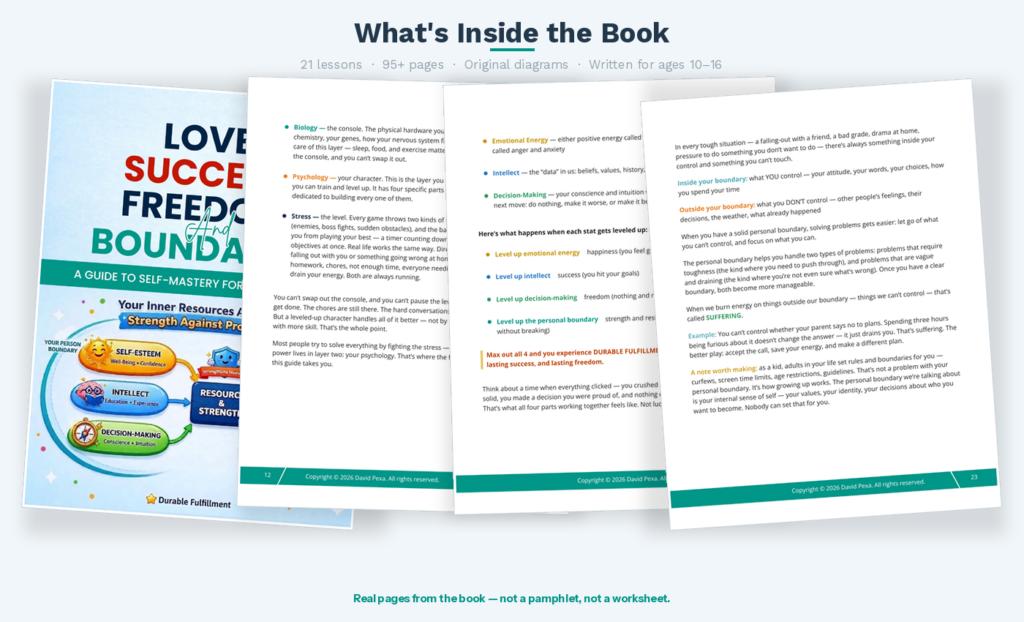
If this resonated, go deeper. My book Love, Success, Freedom and Boundaries gives you twelve frameworks for seeing the patterns that shape your life — and changing the ones that aren’t working.
Sponsored
A note on affiliates: This article includes affiliate links to platforms I’ve vetted and would recommend to my own clients and students. If you start with a recommended service through a link here, I may earn a small commission — at no extra cost to you. I only mention what I’d actually point you to in person. The recommendation comes first; the relationship is disclosed second.
If this resonates, the full framework lives in Love, Success, Freedom and Boundaries.
A practical playbook for raising emotionally resilient kids — and breaking the patterns you didn’t choose to inherit.
