



Summary: Self Esteem vs Self Confidence: What’s the Difference? — understanding the signal beneath the surface and what you can actually do about it.
Self-esteem and self-confidence sound interchangeable, but confusing them leads people to work on the wrong thing. I’ve seen clients spend years building skills while ignoring the deeper question of whether they believe they’re worth investing in.
You might be doing well on paper and still feel shaky in private.
You hit deadlines. People trust your judgment. You can lead a meeting, solve problems, and deliver under pressure. Yet one small mistake can ruin your whole evening. Praise feels temporary. Success gives relief, not peace.
That usually means you are not dealing with one issue. You are dealing with two. Self-esteem and self-confidence overlap, but they are not the same thing. If you mix them together, you can spend years trying to fix the wrong problem.
A lot of smart, capable people do exactly that. They work on skills when the deeper wound is self-worth. Or they try to “love themselves” when what they really need is practical proof that they can handle a challenge.
The good news is that self esteem vs self confidence becomes much easier to work with once you separate them. Then you can build each one on purpose.
The Confidence Trap Why Success Can Feel Hollow
A common modern profile looks like this.
A project manager gives clean presentations, handles client pressure well, and knows how to recover when things go wrong. Other people describe her as capable. She describes herself as “one mistake away from being exposed.”
She is confident in what she can do. She is not settled in who she is.
That gap creates a strange kind of suffering. From the outside, she looks strong. Inside, her value still depends on performance. If the meeting goes well, she feels okay. If the meeting goes badly, she does not just question the presentation. She questions herself.
When ability and worth get fused
When ability and worth get fused. Many readers become confused here. They assume, “If I feel bad about myself, I must need more confidence.” Sometimes that is true. Often it is not.
You can be highly confident in a narrow area and still have low self-esteem overall. In fact, that combination often pushes people into overwork. They keep producing because producing is the only time they feel temporarily safe.
A useful clue is your inner reaction after success:
- If confidence is the issue: Success makes you think, “I can do this.”
- If self-esteem is the issue: Success makes you think, “I hope this proves I’m enough.”
- If both are healthy: Success feels satisfying, but it does not decide your worth.
Why this is so common
This struggle is not rare. UK research found that only 42% of men feel confident in their job abilities, while 85% of women reported not believing they are attractive. The same research also noted 700,000 searches for “Imposter Syndrome” in a 12-month period (Gee Hair’s summary of the UK survey data).
Those numbers matter because they show how many people live with a split identity. They function well, yet doubt themselves profoundly.
If your achievements keep rising but your inner security does not, the missing piece is usually not more hustle. It is a cleaner distinction between competence and worth.
That distinction changes everything. Once you see it clearly, you stop asking one trait to do the job of the other.
Defining the Core Concepts Self Esteem and Self Confidence
Self-esteem is your sense of personal worth. It reflects whether you believe you are acceptable, valuable, and deserving of respect, even on days when you perform poorly.
Self-confidence is your belief in your ability to handle a specific task or situation. It answers whether you trust yourself to do something, learn something, or recover when a challenge appears.

What self-esteem really means
Self-esteem sits at the identity level. It shapes the tone of your inner relationship with yourself.
It shows up in questions like:
- Do I feel acceptable as a person?
- Can I respect myself when I fall short?
- Do I believe I matter even when I am not achieving?
Healthy self-esteem does not mean constant self-approval or inflated self-image. It means your mistakes stay in the category of behavior. They do not become proof that you are defective.
For example, someone with solid self-esteem might say, “I handled that badly. I need to repair it.” The correction is honest, but it does not turn into self-rejection.
What self-confidence really means
Self-confidence is narrower. It operates more like a skill meter than a worth meter.
It shows up in questions like:
- Can I give this presentation?
- Can I learn this software?
- Can I handle this hard conversation?
- Can I recover if this goes off track?
Confidence usually grows through practice, preparation, feedback, and repetition. That is why it can vary so much across life domains. A person may feel highly confident leading a team meeting and uncertain on a first date. A new manager may trust their technical ability and still doubt their ability to set boundaries.
That variation is normal. Confidence is often situational.
The simplest distinction to remember
Use this shortcut:
| Concept | Guiding Question |
|---|---|
| Self-esteem | How do I relate to myself as a person? |
| Self-confidence | How capable do I feel in this situation? |
One more distinction helps.
- Self-esteem says: “I have worth.”
- Self-confidence says: “I can handle this.”
These traits work together, but they are built in different ways. Self-esteem grows through self-acceptance, belief repair, and a steadier internal standard. Self-confidence grows through evidence, reps, and skill development.
Where people confuse them
A lot of professionals try to solve a worth problem with performance. That approach can produce promotions, praise, and polished competence, but it often leaves the original insecurity untouched.
A surgeon may trust their hands in the operating room and still feel unlovable at home. A founder may make bold decisions at work and privately believe their value depends on staying impressive. A student may feel okay as a person and still freeze during exams because the issue is not worth. It is task-specific confidence.
The distinction between self-esteem and self-confidence is practical, not just semantic. If you build the wrong trait, you can work hard and still feel stuck.
Build self-esteem when the wound is about worth. Build self-confidence when the gap is about skill, readiness, or experience. Build both separately when you want lasting change.
The Psychological Divide A Detailed Comparison
A useful way to see the difference is to picture two professionals after the same strong performance. Both deliver a solid presentation. Both get positive feedback. One leaves feeling steady and satisfied. The other leaves scanning for flaws, replaying one awkward sentence, and wondering whether being impressive is the only reason they matter.
That gap is the psychological divide.
Self-esteem operates across your whole sense of self. Self-confidence operates in a role, task, or situation. Because of that, they are built differently, they break down differently, and they need different repair strategies.
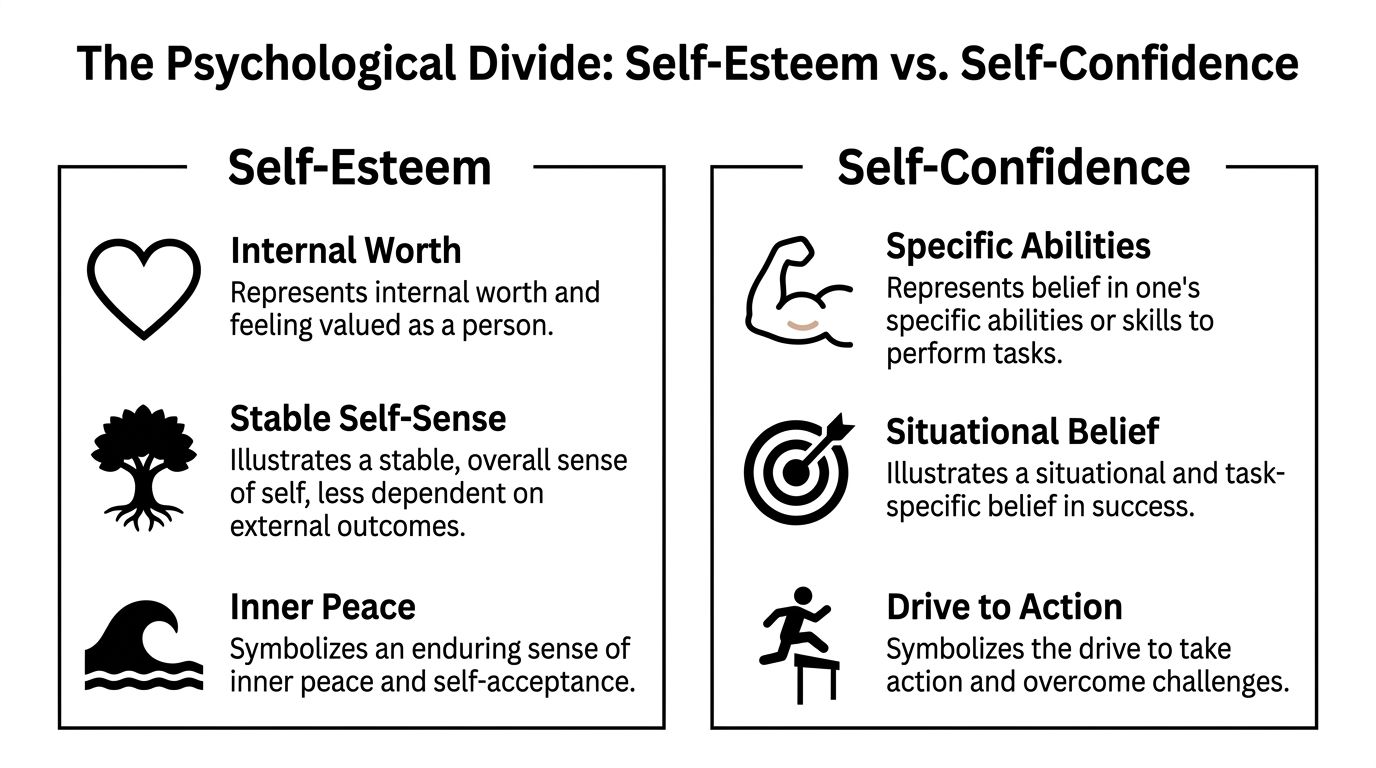
Side by side in plain language
The comparison becomes clearer when you place them next to each other.
| Attribute | Self-Esteem | Self-Confidence |
|---|---|---|
| Scope | Overall sense of worth and self-respect | Belief in your ability in a specific area |
| Typical question | “What do I believe about myself?” | “Can I handle this task?” |
| Primary source | Self-acceptance, attachment history, identity, inner dialogue | Practice, preparation, feedback, repetition |
| Speed of change | Usually slower | Often faster |
| Response to setbacks | A weak base can trigger shame or harsh self-criticism | A setback can reduce belief in that skill or situation |
| Best way to strengthen it | Belief repair, values work, self-acceptance, healthier self-talk | Skill-building, rehearsal, exposure, better preparation |
| What low levels often look like | Feeling inadequate even when doing well | Hesitating, avoiding, or underperforming in specific situations |
A simple analogy helps here. Self-esteem works like the foundation of a house. Self-confidence works like the tools you use inside it. You can own excellent tools and still live on shaky ground. You can also have a solid foundation and still need practice with a new tool.
Why this difference shows up so strongly in emotional health
One of the clearest illustrations comes from a PLOS ONE study on self-esteem, performance estimates, and mental health. Researchers found that participants with lower self-esteem did not necessarily perform worse, but they showed a much heavier burden of depression and trait anxiety (PLOS ONE study on self-esteem, performance estimates, and mental health).
That matters because many professionals assume, “If I feel bad about myself, I must not be as capable as other people.” The research points to a different possibility. You may be functioning well while carrying an unnecessarily harsh internal verdict.
In coaching, this is common. A client can lead teams, solve problems, and hit targets, yet still interpret ordinary mistakes as proof of personal inadequacy. Their performance system is working. Their self-worth system is under strain.
Different roots, different repair plans
Self-confidence usually grows from evidence.
You prepare for a difficult meeting. You do it a few times. You learn what works. Your nervous system starts to register, “I can handle this.” That is targeted confidence.
Self-esteem develops through a broader and more personal process. It is shaped by early relationships, repeated messages about worth, the standards you use to judge yourself, and whether you believe love and respect must be earned through performance.
This is why success can feel strangely hollow. Achievement can improve confidence in what you do without changing how you feel about who you are.
A promotion may quiet self-doubt for a week. It does not automatically heal the belief, “I am only acceptable when I excel.”
They also move at different speeds
Confidence often changes quickly because it is linked to recent evidence. A good client call can raise it. A rough interview can lower it. It behaves a lot like situational trust.
Self-esteem usually shifts more slowly. It acts more like a long-running emotional pattern. If that pattern is weak, praise may land for a moment and then slide off, while criticism sticks for hours.
This is one reason the “high confidence, low self-esteem” paradox confuses people. From the outside, someone can look bold, polished, and decisive. On the inside, they may still be bargaining for worth through performance.
That pattern can also be mistaken for healthy confidence when it is defensive self-protection. If you want to separate grounded self-trust from image management, David Pexa’s article on ego vs confidence offers a useful distinction.
The mechanisms are different too
At a psychological level, self-esteem is more about how you evaluate your value as a person. Self-confidence is more about what you expect from yourself in action.
That sounds abstract, so make it concrete.
- A lawyer with low confidence may say, “I do not trust myself in court yet.”
- A lawyer with low self-esteem may say, “If I perform poorly, it proves something is wrong with me.”
- A lawyer with high confidence and low self-esteem may say, “I know I can win this case, but if I stop winning, I do not know who I am.”
Each sentence points to a different coaching target. The first person needs skill reps and exposure. The second needs worth repair. The third needs both, but in the right order.
A practical summary
Keep this distinction close:
- Self-esteem is how securely you value yourself.
- Self-confidence is how strongly you trust yourself to perform.
When you separate those two, your growth work gets far more precise. You stop using achievement as a substitute for self-acceptance, and you stop trying to solve a skill gap with reassurance alone.
Which Profile Fits You A Quick Self-Assessment
A fast way to understand yourself is to place your current pattern on a simple grid.
Think of self-esteem as the vertical axis and self-confidence as the horizontal axis. You can be high or low in each. That creates four common profiles.
The four profiles at a glance
| Profile | Self-Esteem | Self-Confidence | Common pattern |
|---|---|---|---|
| Secure Achiever | High | High | Grounded and capable |
| Humble Learner | High | Low | Worthy, but still developing skill belief |
| Anxious Achiever | Low | High | Capable, but internally unsteady |
| Self-Doubter | Low | Low | Struggles with both worth and capability |
The Secure Achiever
This person feels basically solid inside and also trusts their ability in key areas.
You might:
- Recover well: A bad result disappoints you, but it does not define you.
- Take healthy risks: You trust yourself enough to try, learn, and adjust.
- Accept praise without shrinking: You do not need to fight compliments or over-explain them.
- Stay teachable: Strong self-worth does not make you defensive.
This is not perfection. It is psychological steadiness.
The Humble Learner
This person usually likes and respects themselves, but does not yet feel capable in a specific area.
You might:
- Feel okay being a beginner: You do not assume inexperience means inadequacy.
- Say “I’m learning” without shame: Newness feels uncomfortable, not humiliating.
- Admire others without collapsing: Other people’s skill does not erase your value.
- Need reps, not healing: Your main growth task is competence-building.
This profile is often healthier than it feels. Many people mistake it for weakness when it is normal skill development.
The Anxious Achiever
This is the most misunderstood profile. Outwardly strong. Inwardly fragile.
You might:
- Perform well under pressure: People rely on you because you are effective.
- Feel driven by fear: Your effort comes from proving, not just creating.
- Struggle to enjoy wins: Relief arrives faster than pride.
- Take feedback personally: Even useful notes can feel like evidence of not being enough.
- Overidentify with output: Your value rises and falls with metrics, praise, and results.
This profile often looks successful. It also gets exhausted.
The Self-Doubter
This person questions both their worth and their ability.
You might:
- Avoid challenges early: It feels safer not to try than to confirm your fears.
- Downplay strengths: Even clear wins do not register for long.
- Compare constantly: Other people seem more capable and more deserving.
- Need support on two levels: Skill-building alone will not be enough.
If this is you, the key is not self-criticism. It is sequencing. You need gentle work on self-worth and structured practice that creates believable evidence of capability.
Your profile is not your identity. It is a starting point.
How to identify your main issue
Ask yourself two separate questions:
- If I fail, do I mainly doubt my ability or my worth?
- If I succeed, does it make me feel capable, valuable, or both?
Your answers usually reveal the gap.
If your struggle is mostly about skill, focus on confidence.
If your struggle is mostly about shame, focus on self-esteem.
If you see yourself in the Anxious Achiever pattern, you need a split strategy. One for performance. One for self-worth.
A Coaching Framework for Building Unshakeable Self-Esteem
A professional can walk out of a praised presentation, smile at the compliments, and still hear one private thought on the way home: If they knew me, they would be less impressed.
That is the self-esteem problem.
Self-esteem is your internal verdict about your worth. It shapes how you interpret mistakes, praise, conflict, and even quiet moments when nobody is evaluating you. If confidence is about trusting your ability in a specific area, self-esteem is about whether you believe you are worthy even when your performance is mixed.
That is why achievement alone does not fix it. You can stack wins and still feel emotionally underfunded. The work has to reach identity.

Step one, identify the belief under the feeling
Low self-esteem rarely announces itself in formal language. It shows up as fast, harsh interpretation.
You miss a deadline and think, “I’m useless.”
You feel awkward at dinner and think, “No one really wants me here.”
You get corrected and think, “I’m a disappointment.”
Those thoughts feel true because they arrive quickly. Speed is not proof.
Treat the moment like a coach reviewing game footage. Pause the replay and separate the event from the conclusion. Ask:
- What happened?
- What meaning did I attach to it?
- What belief about myself does that meaning reveal?
For structured support with this process, a guide to overcoming limiting beliefs can help you spot and reframe the internal scripts that keep self-worth tied to old assumptions.
Step two, separate behavior from identity
This is one of the most important shifts in self-esteem work.
A behavior is something you did. An identity statement is something you claim to be. Low self-esteem fuses the two. One awkward conversation becomes “I am socially bad.” One mistake at work becomes “I am incompetent.” One rejection becomes “I am not enough.”
Healthy self-esteem creates space between those layers.
Instead of saying, “I failed, so I am a failure,” use language that is both honest and precise: “I handled that poorly,” or “I was unprepared for that situation.”
That may sound small, but it changes the entire emotional impact. Precision reduces shame. Shame spreads. Precision contains.
A simple journal structure helps:
- What happened
- What did my inner critic add
- What is the fairest interpretation
The goal is not praise. The goal is accuracy with dignity.
Step three, practice self-compassion as a skill
Many high performers treat self-criticism like a productivity tool. They assume harshness keeps standards high.
In practice, it often does the opposite. It turns every mistake into a threat to identity, which makes learning slower and recovery harder.
Self-compassion works like good physical rehab after an injury. It does not pretend nothing hurts. It creates the conditions for repair. You acknowledge the pain, reduce unnecessary strain, and respond in a way that helps you regain strength.
Use this short script after a hard moment:
- Name the pain: “This hurts.”
- Normalize the struggle: “Mistakes are part of being human.”
- Offer support: “What would help me respond well now?”
The answer might be a break, a clearer boundary, a sincere apology, more preparation, or a calmer tone with yourself.
If your inner voice offers respect only after success, it is training you to earn basic kindness.

Step four, build self-respect through values
Self-esteem becomes steadier when your life reflects what matters to you.
Here is the simplest way to understand it. Your mind watches your behavior and forms conclusions. If you keep abandoning your own values, your mind stops trusting you. If you act in line with your values, even in small ways, your self-respect starts to grow.
Pick three values that matter to you. Not values that sound impressive. Values you want your life to show. Examples include honesty, courage, steadiness, creativity, service, faith, learning, or presence.
Each evening, ask:
- Where did I live this value today?
- Where did I drift from it?
- What is one repair I can make tomorrow?
This matters for the “high confidence, low self-esteem” professional. That person often performs well in public but feels disconnected in private because image has replaced alignment. Values bring you back to solid ground.
Step five, stop outsourcing your worth
Praise feels good. Approval has a place. Neither can carry your identity safely.
If your self-worth rises and falls with compliments, metrics, appearance, or comparison, you are handing strangers, managers, and algorithms too much authority over your inner life. That arrangement creates emotional volatility. A good week lifts you. A quiet week shakes you.
Try this exercise. Make two columns:
| Borrowed worth | Owned worth |
|---|---|
| Praise, status, metrics, appearance, comparison wins | Integrity, effort, honesty, compassion, repair, consistency |
Read the second column each morning for a week. Then ask yourself one question: Which list has the stronger foundation when life gets messy?
That question usually answers itself.
Step six, create evidence that you matter to you
Self-esteem strengthens through repeated acts of self-respect. Words help, but behavior teaches faster.
Keep one small promise to yourself each day. Leave a conversation where disrespect is becoming normal. Rest before your body has to force the issue. Tell the truth where you usually perform. Follow through on one task that reflects your standards.
These actions may look ordinary from the outside. Internally, they send a powerful message: I am someone I do not abandon.
That is how self-esteem becomes more stable. Not through image management. Through a growing history of treating yourself like your worth is real, especially on days when you do not feel impressive.
A Practical Guide to Increasing Targeted Self-Confidence
Confidence grows best when it becomes specific.
Do not aim for “more confidence” in general. Aim for confidence in one domain. Speaking up in meetings. Selling your work. Starting conversations. Learning software. Handling conflict. Running farther. Recording videos.
That precision changes everything.

Confidence responds to evidence
Verified data notes that self-confidence can shift quickly after a single success or failure, while self-esteem is more stable over time. The same source describes confidence through Bandura’s framework and notes that mastery experiences can support stronger task persistence, with high-confidence groups showing 25-35% better task persistence and outcomes in simulations (summary citing Bandura-based self-efficacy research).
The practical lesson is straightforward. Confidence likes proof.
Use the four sources of self-efficacy
Bandura’s framework is still one of the clearest ways to build confidence in real life.
Mastery experiences
This forms the strongest source for many individuals. You do the thing in manageable steps until your brain has evidence.
If speaking in meetings terrifies you, your ladder might look like this:
- Write one point before the meeting
- Say one sentence early
- Ask one clarifying question
- Offer one recommendation
- Lead one small section later
The mistake is trying to jump from silence to charisma. Confidence usually grows through graduated exposure, not dramatic reinvention.

Vicarious learning
Seeing someone similar to you succeed makes a task feel more possible. Examples include mentors, peers, YouTube tutorials, workshops, and deliberate observation. Watch how a calm manager handles pushback. Study how a skilled podcaster pauses. Notice how a friend enters a room with warmth instead of force.
Do not copy personalities. Copy mechanics.
Ask:
- How did they prepare?
- What pattern did they repeat?
- What made the task look manageable?
Verbal persuasion
Good coaching and useful feedback matter.
This does not mean empty praise. “You’re amazing” rarely builds durable confidence. Specific persuasion works better.
Examples:
- “Your opening was strong. Slow down at the midpoint.”
- “You already know the material. Practice the delivery.”
- “You handled that objection well. Keep the same structure next time.”
Use this on yourself too. Replace vague self-talk with skill-based language.
Instead of “I’m terrible at this,” say, “I am early in this skill, and I need more reps.”
Managing emotional states
Many people label arousal as incapacity.
Your hands shake before a talk, so you conclude you are not confident. Not necessarily. Sometimes your body is activated because the situation matters.
Try a reframe:
- “This energy means I care.”
- “I can feel anxious and still perform.”
- “Activation is not danger.”
Then regulate physically. Slow exhale breathing, a brief walk, note cards, rehearsal, and sleep all support better execution.
Confidence is not the absence of nerves. It is the decision to act with enough preparation despite them.
Track confidence like a coach, not a critic
A simple tracking page can help:
| Skill area | Today’s action | What worked | Next rep |
|---|---|---|---|
| Meeting confidence | Spoke once in first 10 minutes | Notes helped | Prepare one stronger example |
| Fitness confidence | Completed workout | Started small | Add one set |
| Social confidence | Texted first | Simpler than expected | Initiate one plan this week |
Confidence strengthens when your brain sees progression clearly.
Avoid the biggest confidence mistake
Do not use comparison as your primary measure.
If you compare your chapter three to someone else’s chapter twenty, confidence collapses. Better questions are:
- Was I clearer today than last week?
- Did I stay in the task longer?
- Did I recover faster?
- Did I take one step I used to avoid?
Confidence grows through self-reference. Not fantasy standards.

The High Confidence Low Esteem Paradox Case Study and Solutions
Daniel walks into a leadership meeting ready. He knows the numbers, answers questions clearly, and earns trust because he is good at his job. From the outside, he looks solid.
Then one project slips. A senior executive presses him on a missed detail. Daniel goes home and replays the exchange for hours, ending with a much larger conclusion than the situation deserves: “Maybe I do not belong here.”
That reaction reveals a pattern many capable professionals miss. His performance system is strong. His worth system is shaky.
Why success can still feel empty
Self-confidence and self-esteem can grow at different speeds. A person can become highly confident in visible skills, such as presenting, managing, selling, or leading, while still carrying a private belief that their value depends on continued success.
That creates a treadmill effect. Achievement brings relief, not peace. Praise feels good for a moment, then turns into pressure. Rest starts to feel risky because slowing down seems tied to losing value.
In coaching, this profile often shows up in people who are respected by others and harsh with themselves.
How to recognize the high-confidence, low-self-esteem pattern
A useful way to understand this paradox is to picture two separate accounts.
One account tracks capability. “Can I do this task well?”
The other tracks worth. “Am I still okay if I struggle, disappoint someone, or need recovery?”
Daniel’s capability account is full. His worth account is unstable.
You may relate to this pattern if several of these feel familiar:
- You perform well in important settings but collapse internally after small mistakes.
- Feedback feels bigger than feedback. It feels like a verdict on who you are.
- You keep raising the bar because achievement briefly quiets self-doubt.
- You struggle to enjoy success because your mind immediately asks how to maintain it.
- You appear calm and certain while privately feeling fragile, ashamed, or replaceable.
This pattern also helps explain why people sometimes confuse insecurity with confidence. A polished, forceful style can hide fear of being exposed. That is part of the distinction covered in this guide on confidence vs arrogance.
Why building more confidence does not fix the underlying problem
Daniel does not need another layer of competence alone. More skill can make him more effective, but it will not repair the belief underneath: “I matter when I perform.”
That belief works like a house built on temporary scaffolding. The structure may look impressive, but every setback shakes it. As long as identity is attached to output, confidence becomes a maintenance job.
The goal is not to reduce ambition. The goal is to stop asking achievement to do the job of self-worth.
A two-lane solution
The cleanest coaching approach is to separate the work into two lanes.
Lane one is performance.
Keep improving real skills. Prepare for meetings. Practice difficult conversations. Review mistakes. Build confidence through evidence.
Lane two is worth.
Build a stable relationship with yourself that does not rise and fall with outcomes. Self-esteem repair happens here.
Many professionals combine these lanes and get stuck. They turn healing into another performance project. That usually backfires. If you only feel worthy on the days you complete your growth routine perfectly, the old pattern is still running.
Practical solutions for the anxious achiever
Use these interventions like a coach would. Pick one or two and repeat them until they become familiar.
1. Separate event from identity
After a hard day, write two short sentences:
- “What happened?”
- “What story am I telling about myself because it happened?”
Example:
- “I answered one question poorly.”
- “I am telling myself I am incompetent.”
That gap matters. The first sentence is a work problem. The second is an identity attack.
2. Build a failure recovery script
Prepare language for the moments when your mind spirals.
Try:
- “This was a miss, not a definition.”
- “I can improve the skill without attacking the self.”
- “A hard moment does not cancel my intrinsic value.”
Prepared language helps because people under stress rarely become wise on command.
3. Create non-performance evidence of worth
Schedule activities that do not reward output. Time with your partner, being present with your kids, making music badly, walking without tracking it, helping someone who cannot advance your career. These experiences teach your nervous system a deeper lesson: you still matter when nothing is being measured.
4. Let praise end where it belongs
Many high performers turn praise into a contract. “They were impressed, so now I must never slip.” Practice a simpler response: “Thank you.” Let appreciation be information, not a burden.
5. Notice defensive overcontrol
Perfectionism, certainty, and the need to manage every variable often act as protection. They are attempts to avoid shame, not signs of true security. Once you see that, you can address the fear directly instead of polishing the armor.
The coaching shift that changes everything
Daniel improves faster when he stops using work to answer the question, “Am I enough?”
Work can measure output. It cannot measure human worth.
That shift sounds simple, but it changes how setbacks are processed. A missed goal becomes feedback. A difficult quarter becomes strain to recover from. A sharp question in a meeting becomes one moment, not proof of inadequacy.
High confidence with low self-esteem is common among professionals because the workplace rewards capability in public and leaves worth unexamined in private. The way out is targeted, not generic. Keep building skill where skill is needed. Build a fundamental sense of worth where worth has been made conditional.
The anxious achiever does not need less drive. They need a self-worth system that still holds on ordinary days, imperfect days, and disappointing days.
Recommended Resources for Your Growth Journey
The right resource depends on the gap you are trying to close. Self-esteem and self-confidence grow through different kinds of work, so your reading, exercises, and support system should match the underlying issue.
A simple rule helps here. Use healing tools for worth. Use training tools for skill.
For rebuilding self-esteem
Kristin Neff’s work on self-compassion is a strong place to begin. As noted earlier, research has linked self-compassion and self-esteem closely, which makes sense in practice. If your inner voice turns every mistake into a verdict on who you are, self-compassion helps interrupt that pattern. It teaches you to respond to struggle the way a wise coach would, with honesty, steadiness, and respect.

CBT journaling tools help when your self-esteem falls through harsh interpretations. A missed deadline becomes “I always fail.” A tense conversation becomes “Something is wrong with me.” Writing these thoughts down and testing them slows the jump from event to identity.
ACT-based exercises help when you understand your inner critic but still obey it. ACT works like learning to drive with noise in the car. The noise may still be there, but it no longer gets to hold the steering wheel. That makes it easier to act from values instead of shame.
For building self-confidence
Skill-specific courses are usually the fastest option when confidence is low because competence is still developing. If you freeze during presentations, a public speaking workshop gives you structure, repetition, and feedback. General motivation cannot replace that.
Deliberate practice tools make progress visible. A habit tracker, rehearsal log, or notes app can show how many reps you have done, what improved, and where you still wobble. Confidence grows faster when your brain can point to evidence.
Mentors, coaches, and feedback loops help when the guidance is concrete. Look for people who can tell you what to practice, what to stop, and what “better” looks like in observable terms.
For the high-confidence, low-esteem profile
This group needs a two-track plan. One track supports performance. The other repairs worth.
That might include:
- A therapist or counselor for shame, conditional approval, or old identity wounds
- A coach for execution, habit design, and professional performance
- A reflective practice such as journaling, meditation, or voice notes to separate results from self-evaluation
This combination matters because the problem is mixed. You may be fully capable at work and still collapse internally after one mistake. In that case, more training improves output, but it does not answer the deeper fear underneath it.
If you prefer one hub for practical self-improvement topics, David Pexa publishes mindset guides, comparisons, and coaching-oriented resources that can help you keep both inner work and daily habits in view.
If this article helped you spot your real gap, whether it is self-worth, capability, or both, explore more practical frameworks at David Pexa. You’ll find personal development guidance designed to make complex mindset work easier to apply in real life.
Frequently Asked Questions
Do self-esteem and self-confidence develop at the same time?
Usually not. Self-esteem forms earlier, shaped by how you were treated as a child — whether you felt valued for who you were. Self-confidence develops through experience and mastery. You can accelerate one without affecting the other.
Which should I work on first?
Start with self-esteem. Without a foundation of self-worth, confidence gains feel hollow. You’ll achieve things but still feel empty. Self-esteem gives meaning to what your confidence builds.
Can therapy help with both?
Yes, but through different mechanisms. Therapy builds self-esteem by helping you see and challenge the beliefs you formed about yourself. Confidence often builds as a byproduct — as you understand yourself better, you trust yourself more.
Keep Reading
- Self Esteem vs Confidence: Key Differences & How to Build
- Self Esteem vs Self Confidence A Guide to Personal Growth
- Mastering the Antonym to Confidence: 8 Key Steps
Conclusion
Understanding is the first step, but it’s what you do with that understanding that changes things. The ideas in this article aren’t meant to sit in your head — they’re meant to shift how you see your situation and give you something concrete to act on. Start with the one thing that felt most relevant, apply it this week, and notice what changes.
If this resonated, go deeper. My book Love, Success, Freedom and Boundaries gives you twelve frameworks for seeing the patterns that shape your life — and changing the ones that aren’t working.
If this resonates, the full framework lives in Love, Success, Freedom and Boundaries.
A practical playbook for raising emotionally resilient kids — and breaking the patterns you didn’t choose to inherit.
