



To get to the heart of what it means to be emotionally unavailable is to see it for what it truly is: a persistent pattern of emotional distance that keeps genuine connection at arm’s length. This isn’t just about someone being shy or “bad with feelings.” It’s a deep-seated defense mechanism that effectively blocks the vulnerability and empathy necessary for real intimacy.
The Hidden Wall of Emotional Unavailability
Have you ever felt like you were talking to a brick wall in a relationship, no matter how hard you tried to connect? That feeling is the very essence of emotional unavailability.
It’s helpful to picture someone who has built an emotional fortress around their heart. The walls are high, the moat is deep, and the drawbridge is almost always up. They might let you wander around the courtyard for a while, but getting inside the castle—where their true, authentic self lives—feels impossible.
This isn’t usually a conscious or malicious choice. More often than not, it’s a protective strategy learned from past experiences. People build these walls to shield themselves from the sting of potential pain, rejection, or feeling utterly overwhelmed. The devastating irony is that the same walls that keep the pain out also keep love and connection from getting in.
The Fortress of Unavailability
So, what is this “emotional fortress” actually built from? It’s constructed from specific behaviors that consistently shut down deep connection. Think of it as a fundamental inability to sustain vulnerability, offer a steady emotional presence, or talk openly about feelings.
Researchers define emotional availability by the capacity for this kind of healthy connection, marked by empathy and reliability—the very things the fortress is designed to block.
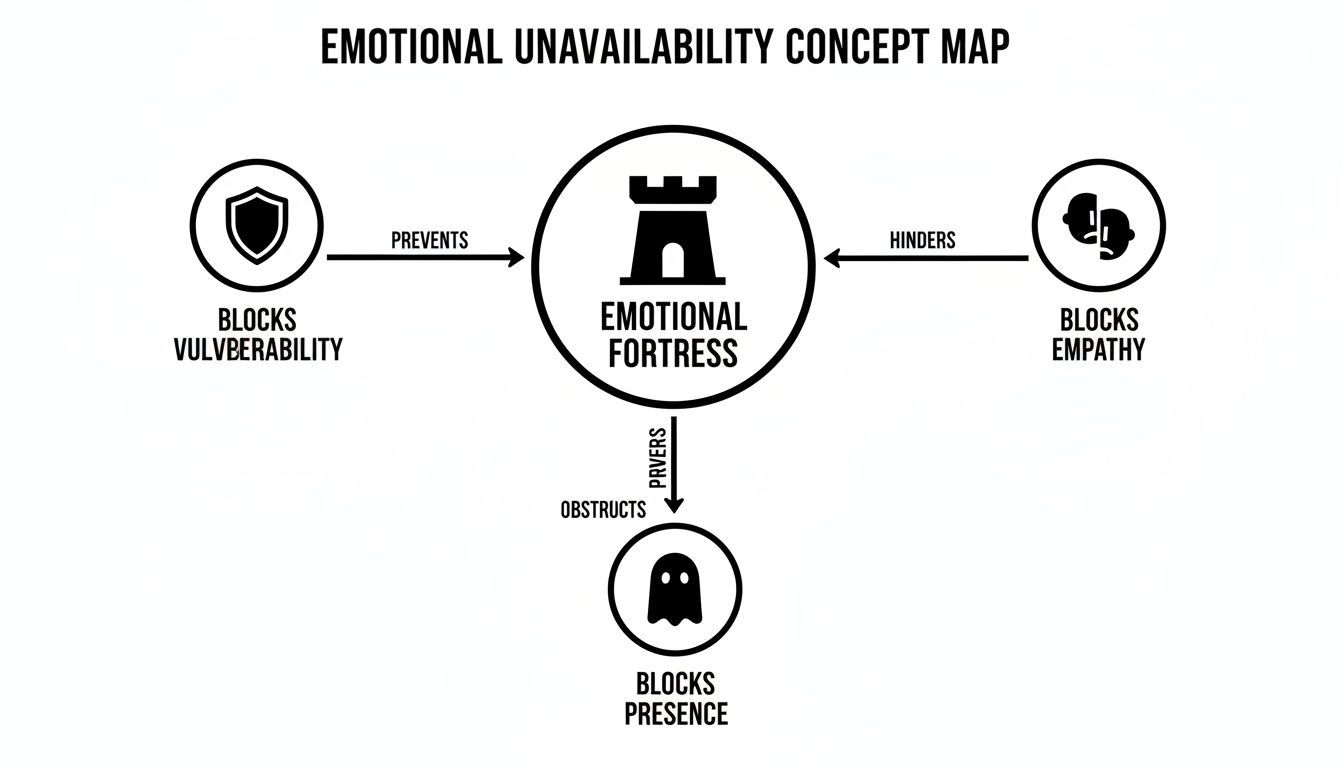
As this image shows, the core purpose of this fortress is to obstruct vulnerability, empathy, and presence, which are the three pillars of true intimacy. Without them, a genuine bond can’t take root.
The core issue with emotional unavailability is that it creates a one-sided relationship. One person is left carrying the emotional weight, constantly knocking on a door that rarely opens, leading to feelings of loneliness and invalidation.
To get a clearer picture of this dynamic, it helps to see these behaviors side-by-side. The table below contrasts the key differences between someone who is emotionally available and someone who is not.
Emotional Availability vs Unavailability At a Glance
| Characteristic | Emotionally Available | Emotionally Unavailable |
|---|---|---|
| Vulnerability | Open to sharing feelings and fears; sees vulnerability as a strength. | Avoids deep emotional topics; deflects with humor or anger. |
| Consistency | Reliable and consistent in their affection and communication. | Inconsistent; runs hot and cold, creating confusion and anxiety. |
| Empathy | Listens actively and tries to understand their partner’s perspective. | Dismissive of others’ feelings; struggles to offer comfort. |
| Future Plans | Comfortable discussing the future and making long-term commitments. | Vague about the future; avoids labels and definitive plans. |
| Conflict | Addresses disagreements directly and seeks resolution. | Avoids conflict, shuts down, or “ghosts” when things get tough. |
This table provides a quick reference, but remember, these behaviors exist on a spectrum. Understanding the contrast is the first step toward recognizing these patterns in yourself or others.
For a deeper dive into identifying and naming specific feelings, you might find it helpful to explore this comprehensive emotions chart.
Key Signs of an Emotionally Distant Partner

It’s one thing to hear the term “emotionally unavailable,” but it’s another thing entirely to feel it in your relationship day after day. Knowing what to look for is the first step to understanding what’s really going on.
The signs usually show up in two main ways: through their actions (or lack thereof) that keep you at arm’s length, and in the way they handle emotions—both yours and their own. This isn’t about a bad mood or an off day; it’s a consistent pattern of behavior that prevents real intimacy from ever taking root.
Behavioral Red Flags
Actions really do speak louder than words, and this is where you’ll find the clearest signs of emotional distance. These are the specific things someone does, often without even realizing it, to maintain a safe buffer and sidestep the vulnerability they fear.
One of the most telling signs is inconsistent communication. One minute they’re all in, flooding you with texts and attention. The next, they pull away, leaving you on read for days. This hot-and-cold cycle is incredibly destabilizing and leaves you constantly questioning where you stand.
A few other key behaviors to watch for:
- Avoiding Future Talk: Any conversation about the future—like defining the relationship, moving in, or just planning a vacation months from now—gets shut down. They’ll change the subject, give a vague non-answer, or simply refuse to engage, preferring to keep the connection stuck in the present moment.
- Using Distractions as a Shield: They might seem like a total workaholic or be completely consumed by a hobby. While passion is great, they weaponize these commitments to avoid genuine, emotionally present time with you. The “busyness” becomes a convenient excuse.
- Actions Don’t Match Words: This one is crucial. They’ll say things like, “You mean the world to me,” or “I’m so serious about us,” but their behavior tells a completely different story. The follow-through just isn’t there.
A core truth in any healthy connection is that consistent actions build trust, not just beautiful words. When a partner’s behavior consistently contradicts what they say, it is a clear indicator of what it means to be emotionally unavailable.
Emotional and Conversational Cues
Beyond what they do, how a person talks about and reacts to feelings is incredibly revealing. An emotionally distant partner often seems deeply uncomfortable, and sometimes even dismissive, when emotions enter the picture.
Think about what happens when you get emotional. If you cry, do they freeze up, get awkward, or immediately jump into “fix-it” mode instead of just offering a hug? If you’re upset, do they become defensive or shut down the conversation entirely? They struggle to hold space for your feelings because they can’t handle their own.
You’ll see this discomfort with their own inner world, too. Look for these patterns:
- Intellectualizing Feelings: Instead of saying, “That hurt me,” they’ll say something like, “That was an illogical thing to say.” They analyze emotions from a safe, detached distance rather than actually feeling them.
- Using Criticism as Deflection: When you try to start a real, vulnerable conversation, they might suddenly find fault with you. By turning the tables and putting you on the defensive, they effectively sabotage any attempt at getting closer.
Understanding the Roots of Emotional Distance
So, why do some people keep everyone at arm’s length, building walls that feel impossible to climb? To really get what it means to be emotionally unavailable, we have to look back. It’s almost never about a single, conscious choice to be distant. Instead, it’s about deep-seated patterns that were programmed long ago.
These origins aren’t malicious. They’re old, outdated protective strategies.
Think of your childhood as the time when your “relational operating system” was first installed. This system runs quietly in the background of your adult life, dictating how you connect with others. If a child grows up with caregivers who are unreliable, dismissive, or just plain absent when feelings come up, they learn a hard lesson: reaching out for connection is risky and often leads to more pain.
The Influence of Early Attachment
This is the core idea behind attachment theory, which shows how our very first bonds create the blueprint for all future relationships. A child who learns their emotional needs are a liability might develop what’s known as an avoidant attachment style. They simply adapt by shutting down their own feelings and making independence their primary goal.
As adults, intimacy feels threatening—like they’ll lose themselves or get hurt all over again. The subconscious script running in their head is, “If I don’t need anyone, no one can disappoint me.” This isn’t a cold rejection of love, but a deeply ingrained survival instinct kicking in.
For someone with this background, emotional closeness can feel completely overwhelming, like a foreign language they were never taught. They learned to get by on their own, and that old programming is incredibly hard to rewrite, even when a part of them genuinely craves connection.

Trauma and Betrayal
But it’s not just our earliest years that can build this fortress. Major life events can install or reinforce emotional distance later on. A gut-wrenching breakup, the sting of infidelity, or any profound betrayal can teach a person that vulnerability is a one-way ticket to heartbreak.
The pain can be so intense that they vow, consciously or not, to never let anyone get that close again.
This sets up a brutal internal conflict: the natural desire for companionship clashes with the terror of history repeating itself. This constant battle is a huge part of what it means to be emotionally unavailable. Other factors can also feed this pattern:
- A deep-seated fear of being controlled: For some, getting close feels like a trap that will suffocate them or strip away their autonomy.
- Mental health struggles: Conditions like depression or anxiety can completely drain a person’s emotional battery, leaving nothing in the tank for a partner.
- Societal conditioning: This is a big one. Men, in particular, have historically been taught to bottle up their feelings and see emotional expression as a form of weakness.
Seeing these roots helps build compassion. It moves us away from blaming someone for being “closed off” and toward understanding the protective job this behavior once had. With this insight, you can start to see a path forward. Therapeutic work can be incredibly helpful here, and you can learn more about practical cognitive behavioral therapy techniques that directly address these underlying thought patterns.
http://
How Unavailability Shows Up Across Genders
Let’s start by dismantling a common and really damaging myth: that emotional unavailability is a “man’s problem.” This stereotype isn’t just unfair to men; it also gives women a pass on their own distancing behaviors. The reality is that emotional unavailability is a human defense mechanism, not a gendered trait. It can show up in anyone.
Of course, societal pressures do shape how people express this emotional distance. Men, for generations, have been taught to equate vulnerability with weakness. As a result, their unavailability can be more obvious—they might dodge commitment, shut down completely during arguments, or use cold logic to sidestep emotional conversations.
The core struggle with emotional unavailability is not exclusive to any gender. It’s a universal protective mechanism that blocks intimacy, whether it’s through overt avoidance or more subtle forms of emotional guarding within a committed relationship.
When we shift our thinking from blame to awareness, we can start to see these patterns for what they are—in others, and just as importantly, in ourselves.
Unavailability Beyond the Stereotypes
Women, on the other hand, are often socialized to be the relationship builders and emotional caretakers. This can make their version of unavailability much harder to spot, and frankly, more confusing for their partners. An emotionally unavailable woman might be the first to want marriage, a family, and a shared home, yet keep her actual heart under lock and key.
The difference is in the delivery. For instance, some emotionally unavailable women might eagerly commit to the structure of a relationship because society has framed it as a key life goal. But in the day-to-day reality of the partnership, their emotional distance creates the same deep sense of friction and loneliness. Many therapists report that a significant portion of their work involves helping emotionally available men navigate relationships with unavailable female partners. You can explore more about these gendered expressions and how they affect modern relationships on Talkspace.com.
This creates a painful paradox. The relationship looks perfect from the outside, but on the inside, there’s no real emotional connection. It’s a crucial distinction:
- Men’s Unavailability: Often looks like a fear of commitment, inconsistency, and emotional stonewalling.
- Women’s Unavailability: Can appear as committing to the relationship “checklist” while remaining emotionally detached, overly critical, or incapable of handling a partner’s vulnerability.
Ultimately, the only way forward is to let go of these outdated stereotypes. It’s what allows all of us to take an honest look at our own patterns and finally start building the genuine connections we all deserve.
How to Cope in a Relationship with an Unavailable Partner
Loving someone who keeps you at arm’s length can be a uniquely lonely experience. It’s easy to feel powerless, and your first instinct might be to try and “fix” them—to find the magic key that unlocks their heart. But if you’ve tried that, you know it usually just ends in frustration.
The most meaningful change you can make starts with you. It’s about shifting your energy away from changing them and toward what you can actually control: how you communicate, how you protect your own well-being, and what you’re willing to accept.
Communicate Your Needs with “I” Statements
Your first, most powerful tool is your own voice. The goal is to express what you’re feeling and what you need without making your partner feel attacked, which almost always causes them to retreat further.
Instead of pointing a finger with “you” statements (“You never open up to me”), try framing things from your perspective using “I” statements. It’s the difference between an accusation and an observation. When you talk about your own experience, you’re just stating your truth—and that’s much harder for someone to argue with.
This small shift can completely change the tone of a conversation. You’re no longer launching an attack; you’re extending an invitation for them to understand you better.
Think of it like this: you’re providing a roadmap to your heart. Instead of making them guess what you need and getting frustrated when they guess wrong, you’re showing them the way.
Here are a few practical examples of how to turn a common complaint into a constructive request. This isn’t about manipulation; it’s about clarity.
Constructive Communication Scripts
| Instead of Saying This (Blaming) | Try Saying This (Expressing Needs) |
|---|---|
| “You never want to talk about us.” | “I feel disconnected when we avoid talking about our feelings, and I would love to feel closer to you.” |
| “You’re always on your phone.” | “I feel a bit lonely when we’re together but distracted. Could we set aside some time just for us?” |
| “Why are you so cold all the time?” | “When I share something I’m excited about and don’t get much of a response, it makes me feel like I’m alone in my joy.” |
| “You don’t care about my feelings.” | “I feel hurt and misunderstood when I’m upset and the conversation shuts down. I really need your support in those moments.” |
By expressing a need instead of a criticism, you give your partner a clear, actionable way to help you feel more connected.
Set and Enforce Your Boundaries
Clearly communicating your needs is just one side of the coin. The other is deciding what you will and won’t tolerate in the relationship. That’s where boundaries come in.
Boundaries are not punishments; they are the rules you set to protect your own emotional and mental health. They are for you, not to control them.
Start by getting really clear on your non-negotiables. What behaviors consistently leave you feeling drained, disrespected, or invisible? Maybe it’s being stonewalled for days after an argument, enduring constant criticism, or their complete refusal to ever discuss the future of your relationship.
Knowing your limits is the easy part. Enforcing them is where the real work begins. You have to decide ahead of time what you will do when a core boundary is crossed. This might mean taking some space for yourself to regroup, or it could lead to the tough realization that this relationship, in its current form, isn’t meeting your fundamental needs for connection and respect. Protecting your emotional safety has to be your top priority.

Can Someone Become More Emotionally Available?

Let’s get straight to the big question: Is it possible for an emotionally unavailable person to change? The honest answer is yes. But it’s crucial to understand that this isn’t about a quick personality fix. It’s a challenging, long-term journey of unlearning old protective habits and slowly building new emotional muscles.
Lasting change comes down to one thing: the person’s own desire to do the work. No amount of pleading, ultimatums, or pressure from a partner can force someone to open their heart. The motivation has to spark from within—a personal realization that their emotional walls are no longer serving them and a genuine wish for something more.

Starting the Journey to Availability
For anyone who recognizes these patterns in themselves and feels ready for a change, the path forward is built on self-awareness, often with professional guidance and a whole lot of practice. It’s like carefully dismantling a fortress brick by brick, not blowing it up all at once. The process is gradual and requires enormous patience and self-compassion.
A good first step is simply to start mapping out your own inner world. This means paying closer attention to your reactions and what triggers them.
- Journal to spot your patterns. Try writing down your feelings and reactions without judging them. When do you feel the urge to shut down? What topics make you want to retreat into your shell? Getting it on paper can reveal a lot.
- Practice small acts of vulnerability. This doesn’t mean you have to immediately share your deepest secrets. It can be as simple as telling a trusted friend you’re feeling a bit frustrated or sharing a small win from your day. Then, just notice the discomfort and sit with it for a moment.
- Find professional support. Honestly, this is often the most important step. A good therapist, especially one trained in methods like Cognitive Behavioral Therapy (CBT) or attachment-based therapy, gives you a safe space and proven tools to get to the root of the issue.
Think of building emotional availability like learning a new language. At first, it feels clunky and unnatural. You have to consciously think about every single word. But with consistent practice, it starts to flow and eventually becomes a natural, intuitive part of how you connect with others.
A Realistic Timeline for Change
You have to be realistic about the timeline here. Rewiring a lifetime of emotional habits can easily take months, if not years, of dedicated effort. There will be setbacks. There will be days you want to retreat behind those familiar old walls. That’s all part of the process.
If you’re looking for a more structured way to get a handle on your own emotional landscape, a tool like an emotion regulation checklist can offer some really valuable insights.
Ultimately, becoming more emotionally available is a profound act of self-growth. It’s a journey from a life of self-protection to one of genuine connection—and it’s a path anyone can choose to walk if they’re ready.
A Few Common Questions About Emotional Unavailability
When you’re trying to get your head around emotional unavailability, a few questions tend to pop up over and over. Let’s tackle some of the most common ones to clear up any confusion and give you some real-world clarity.
Is Being an Introvert the Same as Being Emotionally Unavailable?
It’s easy to see why people mix these two up, but they’re fundamentally different things. The short answer is no.
Introversion is simply a personality trait. It’s about how you recharge your batteries—introverts gain energy from spending time alone. An introvert can be perfectly capable of forming deep, secure, and loving relationships. They just might need some quiet time afterward to feel like themselves again.
Emotional unavailability, on the other hand, is a defense mechanism. It’s a pattern of avoiding emotional closeness, and you’ll find it in both introverts and extroverts. It’s driven by a fear of connection, not a need for solo time.
An introvert might feel drained after a deep, vulnerable conversation and need an evening to themselves to recharge. But during that conversation, they were fully there. An emotionally unavailable person, by contrast, might try to avoid the conversation entirely to keep you at arm’s length.
Can I Make an Emotionally Unavailable Person Change?
This is a tough one, but the honest answer is no—you can’t make anyone change. Real, lasting change has to come from their own decision and hard work. Trying to “fix” someone else is a recipe for exhaustion and heartbreak.
Your real power is in what you do. You can:
- Communicate your own needs clearly, using “I” statements to explain how their behavior affects you.
- Set firm boundaries around what you will and won’t accept in a relationship to protect your own heart.
- Decide for yourself what a healthy partnership looks like and whether this one is meeting your needs.
Sometimes, seeing the consequences of their actions—like you pulling back to protect yourself—can be a catalyst for them to look inward. But ultimately, the choice to change is theirs, and theirs alone.
How Do I Know if I Am the Emotionally Unavailable One?
It takes a lot of courage to even ask this question, so if you’re here, that’s a huge first step. Getting honest with yourself is key.
Take a moment and really think: How do you react when a partner wants to get closer or talk about feelings? Do you feel a surge of panic or an immediate urge to pull away? Do you find yourself ending relationships just as they start getting real?
Another big sign is if you tend to intellectualize emotions—treating them like problems to be solved rather than experiences to be felt. If you see vulnerability as a weakness or just “messy,” it could be a clue that you’re keeping your own heart under lock and key. Exploring these patterns, either on your own or with a therapist, is the only way to build true self-awareness and start making a change.
