


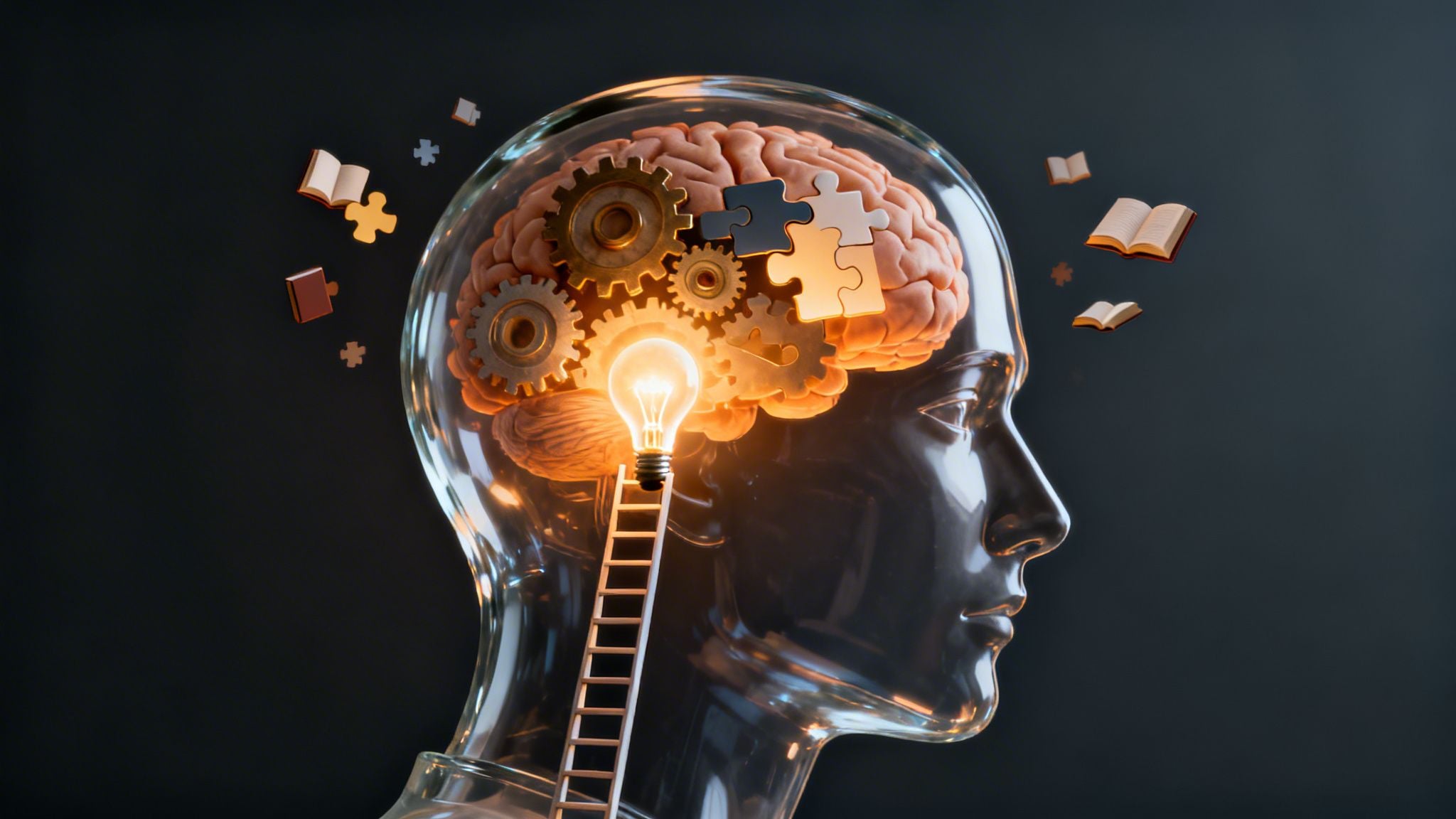
Ever wonder why you do the things you do? Psychology is the key to unlocking that mystery. It's far more than a dusty academic subject—it's a practical user manual for your own mind, explaining the hidden forces behind your thoughts, feelings, and actions.
By learning the basics of your own mental "operating system," you can move from being a passenger to becoming the architect of your own life.
A Practical Guide to Building Your Mental User Manual
Forget the dense textbooks and confusing jargon. This guide is all about giving you evidence-based psychological tools you can start using today. The mission is simple: connect the science of the mind directly to your goals, whether that’s boosting your productivity, building better habits, or simply finding more clarity.
Think of it like this: your brain is the most powerful tool you'll ever own. But most of us were never taught how to use it effectively. We just react. This guide is about changing that—giving you the insights to work with your brain, not against it, to create the outcomes you want.
From Mind to Action to Success
The journey from understanding to achievement follows a clear path. It begins with looking inward to understand your mind, using that knowledge to shape your actions, and then directing those actions to build real-world success.
This is how practical psychology works. It’s a direct line from insight to impact.
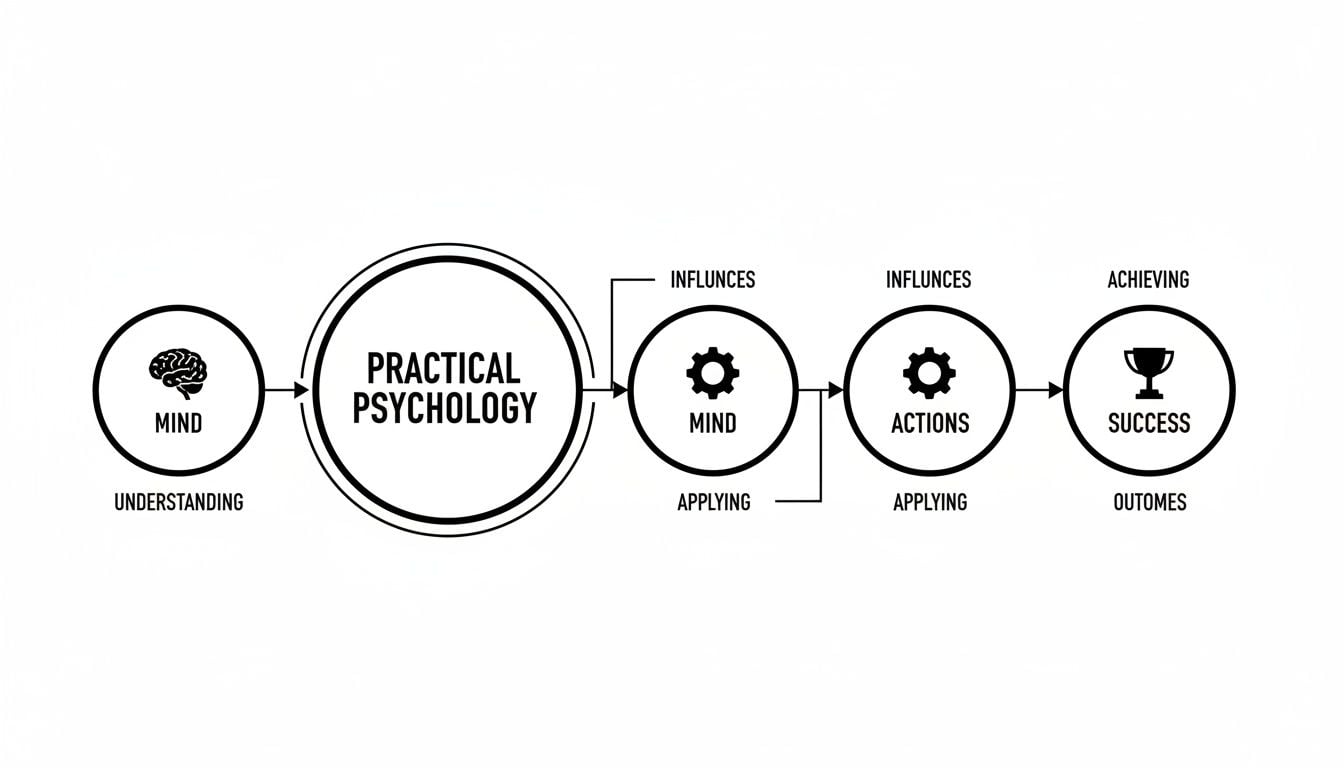
As the flowchart shows, understanding psychology is the foundational first step. It’s the solid ground you build everything else on. You don't need a Ph.D. to get the benefits; you just need to grasp a few core ideas and learn how to put them to work.
The greatest discovery of my generation is that a human being can alter his life by altering his attitudes. – William James
This quote from William James, a pioneer of modern psychology, is more relevant than ever. Your mindset and your understanding of yourself are the most powerful levers for creating lasting change.
To make these concepts tangible, let’s quickly look at how different areas of psychology connect to everyday life.
Core Psychological Concepts and Their Real-World Impact
This table summarizes the foundational pillars of psychology we'll be exploring and shows how they directly apply to personal and professional development.
| Psychological Area | Core Focus | Application in Daily Life |
|---|---|---|
| Cognition | How you think, process information, and perceive. | Overcoming procrastination, improving focus, and making better decisions. |
| Emotion | The nature and purpose of feelings. | Managing stress, building resilience, and improving emotional intelligence. |
| Motivation | The internal and external drivers of your actions. | Setting effective goals, staying consistent with habits, and finding long-term drive. |
| Behavior Change | The science of how habits are formed and broken. | Quitting bad habits, adopting healthy routines, and achieving personal growth. |
Seeing these connections is the first step toward using psychology as a tool for intentional living.
What You Will Learn in This Guide
To give you a clear roadmap, this guide will walk you through a few key areas, building your knowledge from the ground up so that every new idea connects to the last.
Here’s a quick look at what’s ahead:
- Core Psychological Concepts: We’ll demystify the big ideas—like cognition, emotion, and motivation—that explain what makes you tick.
- Practical Applications: You'll discover how to apply these concepts to master your habits, sharpen your focus, and enhance your overall well-being.
- Common Misconceptions: We’ll bust some of the biggest myths about psychology that hold people back from using it effectively.
- Actionable Frameworks: You’ll get simple coaching models and real-world case examples that bring these principles to life.
- Curated Resources: I’ll share my go-to list of the best books, courses, and tools to help you continue learning.
This is your user manual for the mind—a practical, evidence-based journey designed to help you upgrade how you think, feel, and live. Let's begin.
Exploring the Major Schools of Psychological Thought
To really get a grip on psychology, you have to go back to its roots. The field wasn't born overnight; it grew out of a series of powerful, often competing, ideas known as "schools of thought." Each one gives us a different lens to look at human behavior, and understanding them is the foundation for everything that followed.
Think of these schools like different operating systems. Each one runs on a different logic to solve problems, but they're all trying to get the machine—in this case, the human mind—to work. These frameworks offer distinct ways of explaining why we do what we do.
Let's walk through the big ones.
The Mind as a Deep Archive: Psychoanalysis
One of the very first formal theories came from Sigmund Freud. His big idea, psychoanalysis, proposed that what we do consciously is actually driven by powerful, hidden forces.
He saw the mind as an iceberg. The tiny tip you see above the water is your conscious awareness. But beneath the surface lies the massive, unseen part: your unconscious mind. This is where we store buried memories, deep-seated desires, and childhood experiences that still quietly run the show.
From this perspective, our psychological struggles are often caused by unresolved conflicts simmering in the unconscious. The goal of psychoanalytic therapy—the original "talk therapy"—was to bring these hidden feelings to light so they could finally be understood and dealt with. While many of Freud’s ideas have since been debated and revised, his core insight—that our past deeply influences our present—is still a cornerstone of modern therapy.
Programming Human Behavior: Behaviorism
The early 20th century saw a dramatic shift in focus. A new school called behaviorism, led by figures like John B. Watson and B.F. Skinner, argued that if you can't see it and measure it, you can't study it scientifically. They treated the mind as a "black box," unknowable and irrelevant, and focused only on observable behavior.
The central belief here is that all behavior is learned from our environment. It's almost like programming.
Classical Conditioning: This is learning by association. If you hear a specific notification sound every time your boss messages you, you might start feeling a little anxious just from hearing that sound, even on a weekend. The sound has become associated with the feeling of being on-call.
Operant Conditioning: This is learning through consequences—rewards and punishments. A child who gets praise (a reward) for cleaning their room is more likely to do it again. This simple principle is the engine behind many of our habit-building strategies today.
Behaviorism gave us incredibly practical tools that are still widely used, from clinical therapy and animal training to corporate incentive plans.
The Drive for Personal Growth: Humanistic Psychology
By the mid-20th century, some felt psychology had become too pessimistic (psychoanalysis) or too robotic (behaviorism). A "third force" emerged to counter this: Humanistic psychology. Champions like Abraham Maslow and Carl Rogers put the focus back on the individual's potential and inherent goodness.
This approach celebrates our unique experiences, free will, and the innate drive to become our best selves—what Maslow called "self-actualization." It’s less concerned with diagnosing what’s wrong and more focused on creating the conditions for growth.
Humanistic psychology is built on the belief that individuals are not just products of their past or their environment but are active agents in their own lives, striving for meaning and fulfillment.
This was a profound shift. It steered psychology toward well-being and personal development, laying the groundwork for modern positive psychology and the entire field of coaching.
Understanding Your Mental Operating System: Cognitive Psychology
The "cognitive revolution" of the 1950s and 60s brought the mind roaring back into the picture. Cognitive psychology draws a powerful analogy between the human mind and a computer, focusing on how we process information. It dives deep into our mental software, exploring processes like:
- Memory (how we store and retrieve information)
- Perception (how we make sense of the world)
- Problem-solving and decision-making
- Language
This school wants to understand the "code" that drives our behavior. For example, a cognitive psychologist might investigate how mental shortcuts, or cognitive biases, can lead to poor financial choices. This thinking is the bedrock of highly effective therapies like Cognitive Behavioral Therapy (CBT), which helps people change destructive thought patterns.
Understanding these incredibly complex mental processes is also why psychology relies so heavily on statistics. In fact, psychology may require a deeper level of statistical literacy than even a field like physics. Why? Because the phenomena it studies—our thoughts, feelings, and choices—are so complex and variable. Rigorous analysis is the only way to find meaningful patterns in the noise. You can learn more about the importance of statistics in psychology and see how it helps researchers make sense of it all.
Decoding Cognition, Emotion, and Motivation

To really bring psychology off the page and into your life, we need to focus on three pillars that run the show every single day: cognition, emotion, and motivation. Think of them as the internal engines that shape your moment-to-moment experience.
Getting a practical handle on psychology really boils down to understanding how these three forces interact. They're like the operating system, the user feedback, and the power supply for your mind. Once you learn to read their signals and work with them, you gain a massive amount of influence over where you're headed.
Let's dig into each one.
Cognition: Your Mental Operating System
First up is cognition, which is just the technical word for all your mental processes. If your brain were a computer, cognition would be its operating system, running the software that lets you navigate the world. It’s how you absorb information, make sense of it, file it away, and pull it back out when you need it.
This "OS" is constantly humming in the background, managing a host of complex tasks:
- Perception: How you translate the sights, sounds, and sensations from your environment into a coherent reality.
- Memory: The way you encode experiences, store knowledge, and retrieve it later.
- Problem-Solving: Your ability to analyze a situation and figure out a path forward.
- Decision-Making: The mental calculus you perform when choosing one option over another.
But here's the catch: just like any computer OS, our cognitive processes are prone to bugs. In psychology, we call these cognitive biases—basically, predictable glitches in our thinking that lead us away from rational judgment. For instance, confirmation bias makes us cherry-pick information that supports what we already believe, while conveniently ignoring anything that doesn't.
These mental shortcuts often lead us astray without us even realizing it. A huge part of applying psychology is learning to spot these patterns in your own head.
Your mind is a powerful tool, but it comes with factory settings that aren't always optimal. The goal of understanding cognition is to learn how to access the control panel and adjust those settings for better performance.
By simply getting into the habit of questioning your own assumptions and actively looking for different points of view, you can start to debug your thinking and make much clearer decisions.
Emotion: The Data Signals from Your Inner World
Next, we have emotion. For centuries, emotions were seen as messy, irrational impulses that needed to be controlled or suppressed. Modern psychology throws that idea out the window. Emotions aren't the enemy; they're data.
Think of your emotions as the dashboard lights in your car. A blinking oil light isn't a "bad" thing—it’s critical information telling you the engine needs your attention. In the same way, feelings like anxiety, sadness, or anger aren't problems to be stamped out. They are messengers.
Anxiety might be a signal about a potential future threat that you need to prepare for. Sadness often points to a loss that needs to be acknowledged and processed. Even anger can be useful, highlighting a personal boundary that’s been crossed.
The goal isn't to eliminate these feelings but to build emotional intelligence—the skill of recognizing, understanding, and managing them. When you can accurately interpret your emotional data, you can respond thoughtfully instead of just reacting. If you want a deeper dive into this, check out our guide on how to handle mixed emotions.
Motivation: The Engine of Your Actions
Finally, let's talk about motivation. This is the "why" behind every single thing you do. It's the force that gets you out of bed, pushes you to pursue a goal, and drives you to act, whether you're grabbing a glass of water or building a career.
We can generally split motivation into two camps:
- Intrinsic Motivation: This is the drive that comes from within. You do something because the act itself is rewarding, interesting, or just plain fun. Think of learning an instrument just for the sheer joy of it.
- Extrinsic Motivation: This drive is all about the external payoffs. You’re motivated by earning a reward or avoiding a punishment, like working extra hours for a bonus or studying to pass an exam.
While both have their place, countless studies show that intrinsic motivation is the key to sustainable, long-term success. It’s a much deeper well to draw from. People who are intrinsically motivated are more creative, stick with challenges longer, and report much higher levels of satisfaction.
This is why "just try harder" is often terrible advice. Willpower is a finite resource that runs out. A much smarter approach is to connect your goals to your genuine interests and values. When you tap into that intrinsic drive, you're not just pushing a boulder uphill—you're letting the hill work for you.
How to Build Better Habits with Psychology

Knowing some psychology is one thing, but actually using it to change what you do every day? That's a completely different game. This is where we move past the theory and get our hands dirty. Instead of just wishing for better habits, we can apply core psychological principles to build them systematically.
The secret isn’t some massive, dramatic life overhaul that fizzles out in a week. It’s about making small, smart changes that stick.
Most of our daily actions aren't conscious choices. They’re automated routines that our brain runs on autopilot to save mental energy. Think about driving a car—you don't actively deliberate every single turn and button press. This automation is brilliant, but it's also what locks us into patterns we desperately want to break.
The trick is to work with this system, not fight it. Once you understand the basic structure of a habit, you can take it apart piece by piece and rebuild it into something better.
The Four-Step Habit Loop
Every single habit you have, good or bad, follows a simple, four-stage cycle in your brain. Once you see this pattern, you’ll start noticing it everywhere. Recognizing these four steps is the first move toward taking back control.
The loop looks like this:
- Cue: This is the trigger. It’s the little nudge that tells your brain to kickstart a certain behavior. It could be a specific time of day, a place you're in, a feeling, or something you just finished doing.
- Craving: This is the powerful motivation that drives the habit. You don’t actually crave the action itself; you crave the feeling or state of mind it delivers.
- Response: This is the habit you actually perform—the thought or the action.
- Reward: This is the satisfying feeling at the end that solves the craving. It's what teaches your brain, "Hey, that was good. Let's remember this loop for next time."
If any one of these four stages is weak, the habit won't form. If you get rid of the cue, kill the craving, make the action difficult, or if the reward just isn't satisfying, the whole loop falls apart. This is exactly where we can step in and make intentional changes.
A habit is a behavior that has been repeated enough times to become automatic. The ultimate purpose of habits is to solve the problems of life with as little energy and effort as possible. – James Clear, author of Atomic Habits
This insight gives us a clear playbook. To build good habits, we have to make the cue obvious, the craving attractive, the response easy, and the reward satisfying. To break bad habits, we just flip these rules on their head. If you want a deeper dive, you can explore our other guides on learning how to build healthy habits.
Practical Strategies for Building Habits
Knowing the habit loop is a great start, but you need real-world strategies to put it to work. Two of the most effective and easy-to-use techniques are habit stacking and temptation bundling.
Habit Stacking
This is my personal favorite because it’s so simple. You just link a new habit you want to form with a solid, existing habit you already do without thinking. Your old habit becomes the cue for the new one.
The formula is just: "After [current habit], I will [new habit]."
- For a morning routine: "After my coffee maker starts brewing (current habit), I will meditate for one minute (new habit)."
- For an evening routine: "After I brush my teeth at night (current habit), I will lay out my workout clothes for the morning (new habit)."
This works beautifully because you're using the momentum of a behavior that's already wired into your brain. No need to rely on fickle motivation or a sticky note.
Temptation Bundling
This strategy is genius because it makes a habit you're avoiding feel more attractive. You pair an action you want to do with an action you need to do. It’s a way of giving yourself an immediate reward.
The formula is: "I will only [do the thing I want to do] when I [do the thing I need to do]."
- For getting to the gym: "I will only listen to my favorite true-crime podcast (the want) while I'm on the treadmill (the need)."
- For tackling chores: "I will only watch the next episode of my favorite Netflix show (the want) while I'm folding laundry (the need)."
This tactic directly hacks the craving part of the habit loop, connecting a difficult task to something you already look forward to.
As you start using these frameworks, it's also a good idea to become a smarter consumer of information. In a world flooded with "life hacks" and advice, statistical literacy is more important than ever. It helps you tell the difference between genuine psychological insight and a claim that just sounds good. As the writer Andrew Lang once quipped, "He uses statistics like a drunk uses a lamppost—more for support than for illumination." Learning to spot the difference will make you a much better judge of what actually works.
Common Misconceptions About Psychology Debunked
Before we can really dig into how psychology can improve your life, we need to clear the air. There's a lot of misinformation out there, and these myths can send you chasing ineffective fads or just leave you confused about what psychology actually is.
Let's bust a few of the most common ones. Getting these straight will help you spot good information from bad, so you can focus on what genuinely works.
Myth 1: Psychology Is Just Common Sense
This is probably the most stubborn myth of them all. It's the idea that psychology just puts fancy labels on things we already know through intuition. But the truth is, our "common sense" is often flat-out wrong, or at least full of contradictions.
Take anger, for example. Common sense might suggest that punching a pillow to "let it all out" is a healthy release. But what does the science say? Research on catharsis actually shows this can have the opposite effect, reinforcing aggression instead of soothing it. Psychology relies on rigorous methods, like controlled experiments and statistical analysis, to move past guesswork and figure out what’s really going on.
Myth 2: Pop Psychology Is Real Science
We're all swimming in a sea of "psychology" tips from social media, magazines, and self-proclaimed gurus. While some of it might be harmless, a huge chunk of pop psychology is built on flimsy anecdotes, oversimplifications, or ideas with zero scientific backing.
A key part of understanding psychology is learning to distinguish between ideas that are scientifically validated and those that merely sound good. Real psychological insights are built on evidence, not just compelling stories.
This is why a healthy dose of skepticism is your best friend. The popular notion that we only use 10% of our brains is a classic example—a complete myth that just won't die. Real psychological knowledge is built from peer-reviewed studies and verifiable data, not viral posts.
Myth 3: You Need a Mental Illness to Benefit from Psychology
This one is a huge misunderstanding. Many people think psychology is only for those with a diagnosed mental health condition. That view misses the forest for the trees. Psychology is the study of the entire human mind—our strengths and our struggles alike.
It's true that the clinical side is vital. In the United States, over 20% of adults live with a mental illness, and about 4% experience serious mental illnesses that significantly impact their lives. You can get a better sense of the broader scope of psychology in society by looking at the data.
But that's only one piece of the puzzle. The principles of psychology can help literally anyone improve their focus, build better habits, manage daily stress, or become a better communicator. Thinking psychology is only for therapy is like thinking exercise is only for professional athletes. It’s a toolkit for optimizing your life, no matter where you're starting from.
Your Next Steps in Applying Psychology
So, where do you go from here? We've covered the core theories, peeked inside the workings of your mind, and explored real strategies for changing your behavior. But knowledge is only half the battle. The real magic happens when you start applying it.
Think of it this way: understanding psychology is a superpower for navigating your life and work. This guide isn't the finish line—it's your starting block for a lifetime of self-discovery and intentional growth. The goal now is to put these ideas into practice, making a conscious commitment to observe your own patterns, test these strategies, and see what works for you.
Build Your Personal Learning Library
To keep your momentum going, it helps to learn directly from the experts who have spent their lives in this field. The right books don’t just give you more information; they offer deeper, more nuanced ways of thinking.
Here are a couple of foundational reads I always recommend to anyone serious about this work:
- Thinking, Fast and Slow by Daniel Kahneman: This book is an absolute masterclass on cognitive biases and the two systems that drive our thinking. It will fundamentally change the way you see your own decisions.
- Atomic Habits by James Clear: If you're looking for a practical, no-fluff guide to building good habits, this is it. Clear does an amazing job of translating complex behavioral psychology into simple, actionable steps you can start using today.
Reading is a fantastic starting point, but don't stop there.
Explore Reputable Online Resources
Beyond books, the internet is overflowing with information. The trick is to find sources that are both credible and easy to digest. I suggest looking for podcasts and websites run by credentialed psychologists or respected science journalists.
These platforms are great at breaking down complex research into short, useful insights that help you stay up-to-date. A good psychology podcast can turn a boring commute into a productive learning session. For example, many therapeutic frameworks have surprisingly practical uses in daily life. You can discover powerful Cognitive Behavioral Therapy techniques to help manage stress or reframe the negative thoughts that hold you back.
Understanding psychology isn’t an academic exercise; it’s a practical skill for improving your everyday experience. The goal is to move from knowing the concepts to living them.
Ultimately, the way forward is through curiosity and consistent action. Start small. Pick one idea from this guide—maybe habit stacking, or catching and questioning a cognitive bias—and commit to trying it for just one week.
See what happens. Observe the results, learn from the experience, and then build on that small win. You have the map; now it's time to take the first step.
Your Questions About Psychology, Answered
As you start to explore psychology, you'll naturally have questions about how it all works in the real world. That's a good thing. Moving from theory to practice is where the real magic happens.
Let's clear up some of the most common questions that come up.
What's the Difference Between a Psychologist and a Coach?
This is probably the most frequent question I get, and it's a critical one to understand. Think of it this way: a psychologist is like a doctor for the mind. They are licensed professionals trained to diagnose and treat mental health conditions such as clinical depression, anxiety disorders, or PTSD. Their work often involves exploring your past to heal present-day struggles.
A coach, on the other hand, is more like a personal trainer for your life. They work with people who are already mentally healthy to help them close the gap between where they are and where they want to be. The focus is on the future—setting goals, optimizing performance, and building better habits. While coaches use psychological principles, they don't treat clinical issues.
How Can I Use Psychology to Improve My Focus?
Instead of relying on sheer willpower, you can use a few simple ideas from psychology to strategically sharpen your focus.
- Design Your Environment: This is straight out of behaviorism. Make your desired action (focus) easy and your distractions hard. Turn off your phone notifications, clear your desk, and close unnecessary tabs. You're engineering your space for success.
- Shrink the Task: Our brains get overwhelmed when faced with a massive project. This is a cognitive load issue. Break that huge task down into tiny, manageable steps. Your brain will see a small, easy-to-complete action instead of a mountain to climb.
- Work in Bursts: Your brain isn't designed for hours of non-stop concentration. The Pomodoro Technique is famous for a reason—it works with your brain's natural rhythms. Try working in focused sprints of 25 minutes, followed by a 5-minute break to recharge.
It’s less about trying harder and more about working smarter.
Where Can I Find Reliable Psychological Information?
In a world full of "pop psychology" and wellness influencers, being careful about where you get your information is vital.
True psychological understanding comes from evidence, not just popular opinion. Be cautious of trends that lack scientific backing and instead seek out information grounded in research.
Your best bet is to stick to sources with a strong academic or scientific foundation. Look for books written by authors with a Ph.D. in psychology, research from academic institutions, and articles in peer-reviewed journals (you can find many on Google Scholar).
Organizations like the American Psychological Association (APA) are gold mines for reliable, evidence-based content that you can trust.
At David Pexa, we provide clear, evidence-informed strategies to help you apply psychology to your daily life. Explore our guides and resources to build better habits, improve your mindset, and achieve your personal growth goals at https://davidpexa.com.
