


When you’re looking for ways to reduce anxiety naturally, it helps to have a plan that covers both the flare-ups and the day-to-day grind. The most effective path isn’t about finding a single magic bullet, but rather weaving together quick calming techniques with solid, consistent lifestyle habits. This guide is your blueprint for doing just that—building real mental resilience and getting back to a place of calm.
Your Blueprint for Lasting Calm
Feeling anxious doesn’t have to be your default setting. I’ve designed this guide to move beyond vague advice and give you real-world strategies that actually work. We’ll start with immediate techniques to ground you when anxiety spikes, then build a strong foundation through simple, repeatable daily routines.
Think of this as your personal roadmap to a clearer, calmer mind.
Building a Comprehensive Toolkit
This plan is structured to give you the right tool for the right situation. You won’t just learn what to do, but I’ll show you how and when to apply each technique for the best results.
Here’s what we’ll cover:
- Immediate Relief: Specific grounding and breathing exercises for those acute moments of panic or intense worry. These are your first-aid skills for when you feel completely overwhelmed.
- Daily Resilience: How to weave small, consistent habits around movement, nutrition, and sleep into your life to fortify your mind against everyday stressors.
- Cognitive Reframing: We’ll dive into practical cognitive behavioral therapy techniques you can use to challenge and reframe anxious thoughts before they spiral out of control.
- Informed Choices: You’ll get a balanced look at evidence-backed supplements and clear guidance on when it’s time to bring in professional support.
From Theory to Practical Application
Just knowing what to do isn’t enough; consistent action is what creates real change. This blueprint is all about being practical, helping you turn these concepts into tangible daily practices. For example, instead of just telling you to “get more sleep,” we’ll walk through a specific wind-down routine that signals to your body it’s time for deep rest.
Likewise, we won’t just say “exercise more.” I’ll provide a sample weekly schedule that you can easily adapt to fit your own life. The goal here is to give you a sustainable system, not a quick, temporary fix.
To give you a quick overview, here’s a summary of the core strategies we’ll be building on.
At-a-Glance Guide to Natural Anxiety Relief
This table breaks down the core strategies covered in this guide, giving you an immediate action plan to start with.
| Strategy Area | Key Action | When to Use |
|---|---|---|
| Breathing & Grounding | Box Breathing: Inhale for 4, hold for 4, exhale for 4, hold for 4. | During a panic attack or when you feel overwhelmed. |
| Lifestyle Habits | 15-Minute Daily Walk: Gentle, consistent movement. | Daily, preferably in the morning to get sunlight. |
| Cognitive Techniques | Thought Record: Write down anxious thoughts and challenge them. | When you notice a pattern of negative self-talk or worry. |
| Nutrition & Supplements | Magnesium Glycinate: Consider before bed for relaxation. | In the evening as part of your wind-down routine. |
| Professional Support | Therapy Consultation: Reach out to a qualified therapist. | When anxiety significantly impacts daily life or self-help isn’t enough. |
Think of these as the building blocks. We’ll explore each one in much greater detail throughout the guide.
The most powerful approach to managing anxiety isn’t about finding a single, perfect solution. It’s about layering small, intentional habits that compound over time to create a strong foundation of mental well-being.
I’ve broken down this whole process into manageable parts so you can build momentum without feeling overwhelmed. Each section builds on the last, creating a complete framework for taking control of your mental health journey.
Immediate Relief for When Anxiety Strikes

We all know that feeling. The sudden surge of anxiety that hits you out of nowhere—your heart pounds, your chest tightens, and your thoughts start to spiral. In those moments, you don’t need a long-term plan; you need first aid for your mind.
This section is your go-to toolkit for that exact situation. These aren’t just theories; they are practical, in-the-moment skills designed to pull you back from the edge and calm your body’s alarm system.
Think of these techniques as a reflex. The more you practice them when you’re feeling okay, the more instinctively you’ll be able to use them when you’re actually overwhelmed.
Master Your Breath to Master Your Mind
The absolute fastest way to hijack your nervous system for the better is through your breath. When anxiety takes hold, your breathing becomes shallow and quick, which just screams “danger!” to your brain. By deliberately slowing your breath down, you send a powerful counter-signal: “I am safe.” This is what kicks your parasympathetic nervous system—your body’s natural “rest and digest” mode—into gear.
One of the most effective and discreet methods I’ve come across is the 4-7-8 breathing technique. You can do it anywhere without anyone noticing.
- Get set: Sit up straight or lie down comfortably. Touch the tip of your tongue to the ridge of tissue right behind your upper front teeth. Keep it there for the whole exercise.
- Empty your lungs: Exhale completely through your mouth. It helps to make a little “whoosh” sound.
- Inhale: Now, close your mouth and breathe in quietly through your nose for a count of four.
- Hold: Hold that breath for a count of seven. This is the important part.
- Exhale: Finally, exhale fully through your mouth, making that same whoosh sound, for a slow count of eight.
That’s one full cycle. Do it three or four times in a row. Don’t be surprised if you feel a bit lightheaded at first—that’s totally normal. The long exhale is the real magic here; it slows your heart rate and tells your body the crisis is over.
Ground Yourself in the Present Moment
Anxiety lives in the future, worrying about what might happen, or in the past, ruminating on what did happen. Grounding techniques are designed to yank your attention back to the here and now, where things are usually okay.
The 5-4-3-2-1 method is a classic for a reason: it works. It forces your brain to stop spinning by engaging all five of your senses. No matter where you are, just pause and quietly find:
- 5 things you can see: Look around you. Don’t just glance—really notice five specific things. The pattern on the rug, a scuff mark on your shoe, the way light hits a water glass.
- 4 things you can feel: Bring your awareness to your body. The pressure of the chair against your back, the texture of your shirt sleeve, the cool metal of your watch on your wrist, the feeling of your feet flat on the floor.
- 3 things you can hear: Listen. What sounds are in the background? The hum of the computer, distant traffic, a bird outside the window.
- 2 things you can smell: Take a gentle sniff. The faint aroma of coffee, the scent of soap on your hands, or maybe just the neutral smell of the room.
- 1 thing you can taste: What is the taste in your mouth right now? You could take a sip of water or just notice the lingering flavor from your last meal.
By systematically going through your senses, you interrupt the anxious thought loop. You’re giving your brain a concrete job to do, which makes it nearly impossible to simultaneously entertain those abstract worries.
Change Your Environment to Change Your Mind
Sometimes the most powerful thing you can do is just move. Changing your physical space, even slightly, can be a surprisingly effective circuit breaker for anxiety.
Feeling cornered at your desk? Get up and walk to the window. Better yet, step outside for five minutes. A quick change of scenery floods your brain with new sensory information and forces a mental reset.
There’s real science to this. A Stanford study found that a 90-minute walk in nature actually reduced activity in the part of the brain linked to negative self-talk. You don’t need the full 90 minutes to feel a benefit, but as Heart.org highlights, it proves how powerfully our surroundings affect our mental state.
By getting up and moving, you physically break the connection between the place you are and the anxiety you’re feeling. It’s a simple action that can create an immediate shift.
Building a Resilient Foundation with Daily Habits

While the grounding techniques we’ve covered are your first line of defense when anxiety spikes, lasting calm is built day by day, through small, consistent actions. Think of your mental well-being like a house—the stronger the foundation, the better it weathers life’s storms.
The three pillars of this foundation are movement, nutrition, and sleep. When you intentionally focus on each one, you create a powerful upward spiral. Positive habits begin to reinforce one another, building a natural buffer against daily stressors. This isn’t about a radical life overhaul, but about making small, sustainable shifts that really add up.
Move Your Body to Soothe Your Mind
Physical activity is one of the most powerful, non-pharmaceutical tools we have for managing anxiety. When you get moving, your body releases endorphins—those amazing natural mood elevators. It also helps burn off the excess cortisol that can leave you feeling wired and on edge.
The real secret here is consistency, not intensity. You don’t need to train for a marathon to feel the difference. In fact, I’ve found that gentle, mindful movement is often just as effective, if not more so.
A few ideas to get you started:
- Brisk Walking: A simple 20-30 minute walk can work wonders, especially if you can get outside. The rhythmic motion is meditative, and a little natural light helps regulate your internal clock.
- Yoga or Tai Chi: These practices are brilliant because they combine physical postures with breathing exercises and meditation, directly targeting the body’s stress response.
- Gardening: Getting your hands in the dirt is profoundly grounding. A 2022 NIH-funded study found that while 46% of participants reported anxiety, those who gardened regularly scored much lower on anxiety scales. The research also highlights that just 120 minutes in nature each week can significantly boost well-being. You can read more about the calming effects of gardening from the study here.
Try to aim for about 30 minutes of moderate activity most days of the week. The best exercise is the one you’ll actually do, so find something you genuinely enjoy.
Fuel Your Brain for Calm and Clarity
The gut-brain connection is not just a buzzword; it’s a powerful reality. What you eat directly impacts your mood, your energy, and your ability to handle stress. An anxiety-friendly diet isn’t about restriction—it’s about crowding out the junk by adding in more of the good stuff.
Certain nutrients are absolute superstars when it comes to supporting a healthy nervous system.
Your diet is a powerful lever for managing anxiety. By prioritizing whole foods and key nutrients, you’re not just feeding your body—you’re providing your brain with the essential building blocks for resilience and calm.
Here are the key players to focus on:
- Magnesium: I often call this “nature’s relaxant” because it helps regulate neurotransmitters that promote calm. You can find it in leafy greens like spinach, nuts and seeds, and even a little dark chocolate.
- Omega-3 Fatty Acids: These healthy fats are crucial for brain health. They’ve been shown to reduce inflammation and ease anxiety symptoms. Load up on fatty fish like salmon, or plant-based sources like walnuts and flaxseeds.
- B Vitamins: This group is vital for energy and neurotransmitter function. Deficiencies, especially in B12 and B6, are often linked to higher anxiety. You’ll find them in lean meats, eggs, legumes, and fortified whole grains.
By focusing on these nutrient-dense foods, you’re creating a stable internal environment that makes you far less susceptible to the physical turmoil of anxiety.
Prioritize Restorative Sleep
Sleep is when your mind and body do their most important repair work. When you’re chronically sleep-deprived, cortisol levels spike, emotional regulation goes out the window, and you become incredibly vulnerable to anxiety. But it’s not just about the number of hours; it’s about the quality of those hours.
Creating a solid “wind-down” routine is one of the best things you can do. This ritual signals to your body that it’s time to shift gears from the stress of the day into a state of rest.
Your evening ritual could look something like this:
- Dim the Lights: About an hour before you want to sleep, lower the lights. This simple cue tells your brain to start producing melatonin, the sleep hormone.
- Disconnect from Screens: The blue light from our phones and tablets is a known melatonin-suppressor. Put them away at least 30-60 minutes before your head hits the pillow.
- Do Something Calming: Try reading a physical book, listening to mellow music or a podcast, doing some gentle stretching, or taking a warm bath with Epsom salts.
- Stick to a Schedule: Try to go to bed and wake up around the same time every day, even on weekends. This helps regulate your body’s internal clock, making it easier to fall asleep and wake up naturally.
Building these habits takes time, but the payoff is immense. For more practical advice on making these changes stick for good, you might find our article on how to build healthy habits really helpful.
Finding Calm in the Natural World
One of the most powerful and accessible tools for easing anxiety is waiting right outside your door. Spending time in nature isn’t just a nice way to pass an afternoon; it’s a legitimate, science-backed intervention that can directly impact your body’s stress response.
This isn’t about needing to summit a mountain or disappear into the wilderness for a week. It’s about intentionally weaving the natural world into the fabric of your daily life, even in small ways.
The science here is pretty clear. Exposure to green spaces helps dial down cortisol, which is your body’s main stress hormone. When cortisol is high, you’re stuck in that exhausting “fight-or-flight” mode. A short walk in a park can be enough to start shifting your nervous system back into a more relaxed, restorative state.
You Don’t Need Hours, Just Consistency
The biggest barrier for most people is time. The thought of adding one more thing to the to-do list can feel overwhelming. But here’s the good news: you don’t need a huge time commitment to reap the rewards.
A fascinating 2020 study from Cornell University found that students who spent just 10 to 50 minutes in nature saw significant improvements. Their mood lifted, their focus sharpened, and key stress markers like blood pressure actually went down.
This tells us that even a quick dose of nature during a hectic day can have a real, measurable impact. Think of it less like a one-time event and more like a daily vitamin for your mental health.
How to Find Your Green Space (Even in a Concrete Jungle)
Living in a city doesn’t disqualify you from these benefits. You just have to get a little more creative about what “nature” looks like.
Here are a few ideas to get you started:
- Scout your local parks. Even a tiny city park with a handful of trees and a bench is a perfect spot for a ten-minute reset.
- Find a community garden. These are amazing places to connect not only with plants but with other people, too.
- Walk the tree-lined streets. Be intentional about your route. Instead of the main road, pick the quiet side street with the big oak trees. Really look at them.
- Seek out water. If you’re anywhere near a river, lake, or coastline, make it a destination. There’s something uniquely calming about open water.
The trick is to find the easiest and most convenient option for you. The lower the barrier to entry, the more likely you are to make it a consistent habit.
Your mind will answer most questions if you learn to relax and wait for the answer. By stepping into a natural setting, you create the quiet space your mind needs to process, calm down, and find clarity.
Turn Your Walk into a Mindful Practice
To really squeeze the most benefit out of your time outside, you can layer a simple mindfulness practice on top of it. This elevates a simple walk into something much more therapeutic, pulling your attention out of the anxious spiral in your head and grounding you in the present.
It’s about engaging your senses, one by one.
An Easy Outdoor Mindfulness Exercise
Next time you’re outside, just pause and try this:
- What do you hear? Close your eyes for a second. Try to separate the different sounds—the rustle of leaves, a bird chirping, the distant hum of traffic. Just notice them without judgment.
- What do you feel? Focus on the physical sensations. The feeling of the sun or the breeze on your skin. The solid ground beneath your feet. If you’re standing by a tree, touch the bark and notice its texture.
- What do you see? Instead of just glancing around, pick one thing and really look at it. A single leaf, a patch of moss, the way the clouds are moving. Notice the details, colors, and patterns you’d normally overlook.
This simple act of paying attention yanks your brain out of its default worry mode. You’re breaking the cycle of anxious rumination by giving your mind something tangible and immediate to focus on.
While the research points to a sweet spot of about 120 minutes per week spent in nature, don’t get hung up on the number. Every single ten-minute walk counts, and each one makes a difference.
Exploring Supplements and Professional Support
Lifestyle changes are the bedrock of managing anxiety, but sometimes you need a little extra reinforcement. This is where a few carefully chosen supplements can lend a hand. It’s also where recognizing the right time to call in a professional becomes an act of self-care.
Let’s walk through these options so you can feel confident in the choices you make for your mental health. We’ll look at some evidence-backed supplements and outline the clear signs that it’s time to get a professional in your corner.
When to Consider Natural Supplements
First things first, a crucial disclaimer: supplements are not a substitute for professional medical advice. You should always talk to your doctor before adding anything new to your routine. They can make sure it’s safe for you and won’t interfere with any medications you’re taking.
With that out of the way, some natural compounds have shown real promise in helping the body handle stress.
-
Magnesium: I often call this “nature’s relaxant.” Magnesium is a key player in regulating the neurotransmitters that keep us calm, and being deficient can make you feel on edge. Magnesium glycinate is usually a good bet because it’s easy for the body to absorb and tends to be gentle on the stomach.
-
L-theanine: This is an amino acid found in green tea, known for promoting a feeling of relaxation without making you sleepy. It can quiet a racing mind, which makes it a solid choice for daytime use when you need to be calm but still sharp.
-
Ashwagandha: This ancient herb is an adaptogen, which is a fancy way of saying it helps your body adapt to and manage stress more effectively. Studies suggest it can help lower cortisol levels, taking some of the physical strain of chronic stress off your system.
Think of supplements as helpers, not heroes. They can support your nervous system and build resilience, but they work best when combined with the foundational habits of good sleep, nutrition, and movement.
Here’s a quick overview of some common supplements people turn to for anxiety support.
A Closer Look at Supplements for Anxiety Support
This table compares a few popular natural supplements, explaining how they are thought to work and what you need to keep in mind.
| Supplement | How It Works | Key Research Finding | Important Considerations |
|---|---|---|---|
| Magnesium | Regulates neurotransmitters like GABA, which has a calming effect on the nervous system. | Studies link magnesium deficiency to increased anxiety symptoms. | Choose highly absorbable forms like glycinate or citrate. Can have a laxative effect at high doses. |
| L-theanine | Increases alpha brain waves, associated with a state of “wakeful relaxation.” | A 2019 study showed it reduced stress-related symptoms in participants. | Generally well-tolerated. Often found in green tea or as a standalone supplement. |
| Ashwagandha | An adaptogenic herb that helps modulate the body’s stress response, particularly by reducing cortisol levels. | A 60-day study found participants taking ashwagandha had significantly reduced cortisol levels. | Can interact with thyroid or immune-suppressant medications. Best to cycle its use. |
| Chamomile | Contains compounds (like apigenin) that bind to the same brain receptors as anti-anxiety drugs. | Long-term use of chamomile extract has been shown to moderately reduce generalized anxiety disorder (GAD) symptoms. | May cause allergic reactions in people sensitive to the ragweed family. Available as tea or capsules. |
Remember, this is just a starting point. Your own research and a conversation with a healthcare provider are the most important steps before you start taking anything.
Understanding When You Need More Support
Natural strategies are incredibly powerful, but they aren’t a cure-all. If anxiety is starting to seriously get in the way of your life, that’s a sign that it’s time to look for more support.
It might be time to seek help if you notice:
- Anxiety is making it hard to go to work, maintain your relationships, or enjoy things you used to love.
- You’re leaning on unhealthy coping habits, like drinking too much or avoiding social situations entirely.
- The physical symptoms—stomach issues, constant headaches, deep fatigue—just won’t go away.
- You feel trapped in a worry cycle that you can’t break on your own, no matter what you try.
Simple, accessible activities can make a big difference. This infographic is a great reminder of how just getting outside can help.
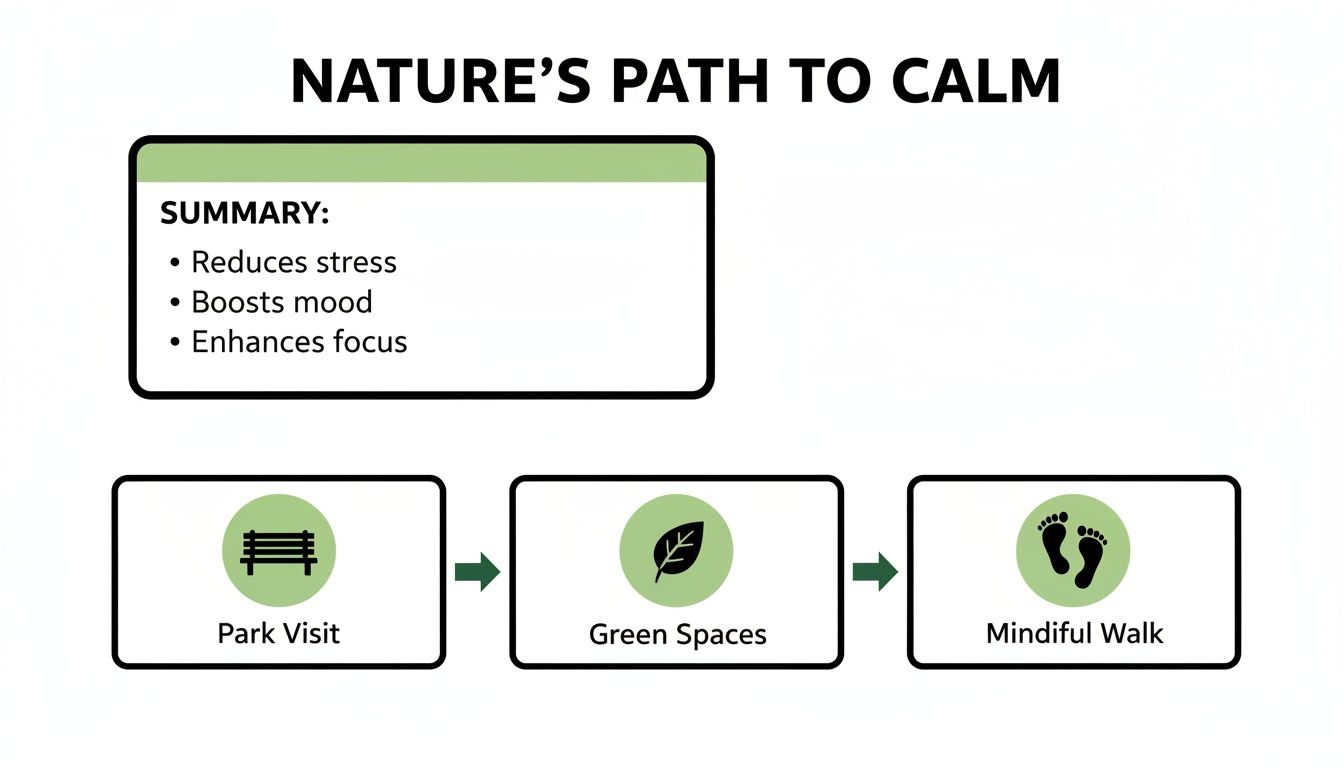
As you can see, small acts like a walk in the park aren’t just pleasant—they’re potent tools for managing stress.
Taking the Step to Seek Professional Help
Reaching out to a therapist or counselor isn’t a sign of failure; it’s a proactive, courageous move toward taking back your life. A professional can offer a safe, confidential space to unpack the roots of your anxiety and give you proven strategies, like Cognitive Behavioral Therapy (CBT), to manage it effectively.
Finding the right fit is everything. Look for someone who specializes in anxiety and whose approach feels right to you. Many therapists offer a free initial chat, which is the perfect, no-pressure way to see if you click. If you’re curious about what that process entails, resources on personal growth counseling can offer a clearer picture of the journey.
Deciding to get support is a true investment in your long-term well-being. It doesn’t replace the natural strategies you’re using—it builds on them, creating a solid, comprehensive plan for finding lasting calm. You don’t have to do this alone.
Got Questions About Natural Anxiety Relief? Let’s Talk.
As you start putting these ideas into practice, you’re bound to have some questions pop up. That’s a great sign—it means you’re engaged and thinking critically about what works for you. Let’s tackle some of the most common ones I hear.
How Long Does This Stuff Actually Take to Work?
This is the big one, isn’t it? The honest answer is: it depends. The timeline for feeling better is different for everyone and hinges on which tools you’re using.
Some techniques, like 4-7-8 breathing or the 5-4-3-2-1 grounding exercise, can offer a sense of calm almost instantly. Think of them as your emergency brake for when anxiety is spiraling. They can pull you out of an acute moment of panic within just a few minutes, though the relief is temporary.
Bigger, foundational changes are more of a slow burn. When you start building consistent routines around movement, nutrition, and sleep, you’re playing the long game. You’ll probably begin to feel a noticeable shift in your overall mood and resilience after a few solid weeks. The key here is consistency. These daily deposits into your well-being bank account really add up over time.
You don’t just cross a finish line with anxiety. The “quick win” techniques are for the moment, while the daily habits are what build lasting mental strength. You really do need both.
Can I Do This Stuff Alongside My Therapy?
Absolutely. In fact, most therapists would be thrilled. Natural, self-care strategies and professional therapy are a fantastic combination.
Think of it this way: your therapist helps you untangle the deeper “why” behind your anxiety, while these daily practices help you manage the “how” of your symptoms day-to-day. A therapist might encourage you to get more exercise or practice mindfulness precisely because it strengthens the work you’re doing in your sessions. For example, using a simple grounding technique right before a session can help you arrive more present and ready to dig in.
The one golden rule is to keep everyone on your team in the loop. Always talk to your doctor and therapist about any new supplements you’re considering or big lifestyle shifts you’re making. This ensures your entire support system is working together safely and effectively.
If I Could Only Do One Thing, What’s the Most Effective?
Everyone is searching for that single magic bullet, but the reality is that what works is deeply personal. One person’s go-to technique might not do much for someone else. That said, if we look at what has the broadest impact and the most evidence behind it, two things consistently stand out.
- Consistent Physical Activity: Moving your body is non-negotiable for anxiety. It directly counteracts the physical stress response by burning off excess cortisol and releasing endorphins—your body’s own natural mood lifters. You don’t need to run a marathon; a brisk daily walk can be incredibly powerful.
- Mastering a Breathing Technique: This is like having a remote control for your nervous system. Learning a simple, controlled breathing exercise gives you a direct way to signal to your body that it’s safe, manually shifting you out of that “fight-or-flight” state.
If you’re feeling overwhelmed and just need a place to start, focus on those two. Make daily movement a non-negotiable part of your day and find a simple breathing exercise you can practice until it’s second nature. That’s your strongest foundation.
Wait, Isn’t a Little Anxiety Actually Normal?
Yes, it is. Anxiety is a basic human emotion wired into our DNA for survival. It’s the internal alarm that fires up to keep you alert and safe from potential threats. Feeling a knot in your stomach before a job interview, a big exam, or a tough conversation is perfectly normal.
The trouble starts when that alarm system gets stuck in the “on” position. When anxiety becomes a constant, buzzing backdrop to your life and gets in the way of your work, relationships, or just enjoying things, it has shifted from a helpful emotion to a problem that needs addressing. The goal isn’t to eliminate anxiety completely—that’s impossible. The goal is to get the alarm system working correctly again, so you feel in control.
At David Pexa, we’re all about giving you the practical tools and a clear roadmap for building a calmer, more focused life. To dive deeper and find more curated resources for your journey, feel free to explore our other guides and recommendations at https://davidpexa.com.
