


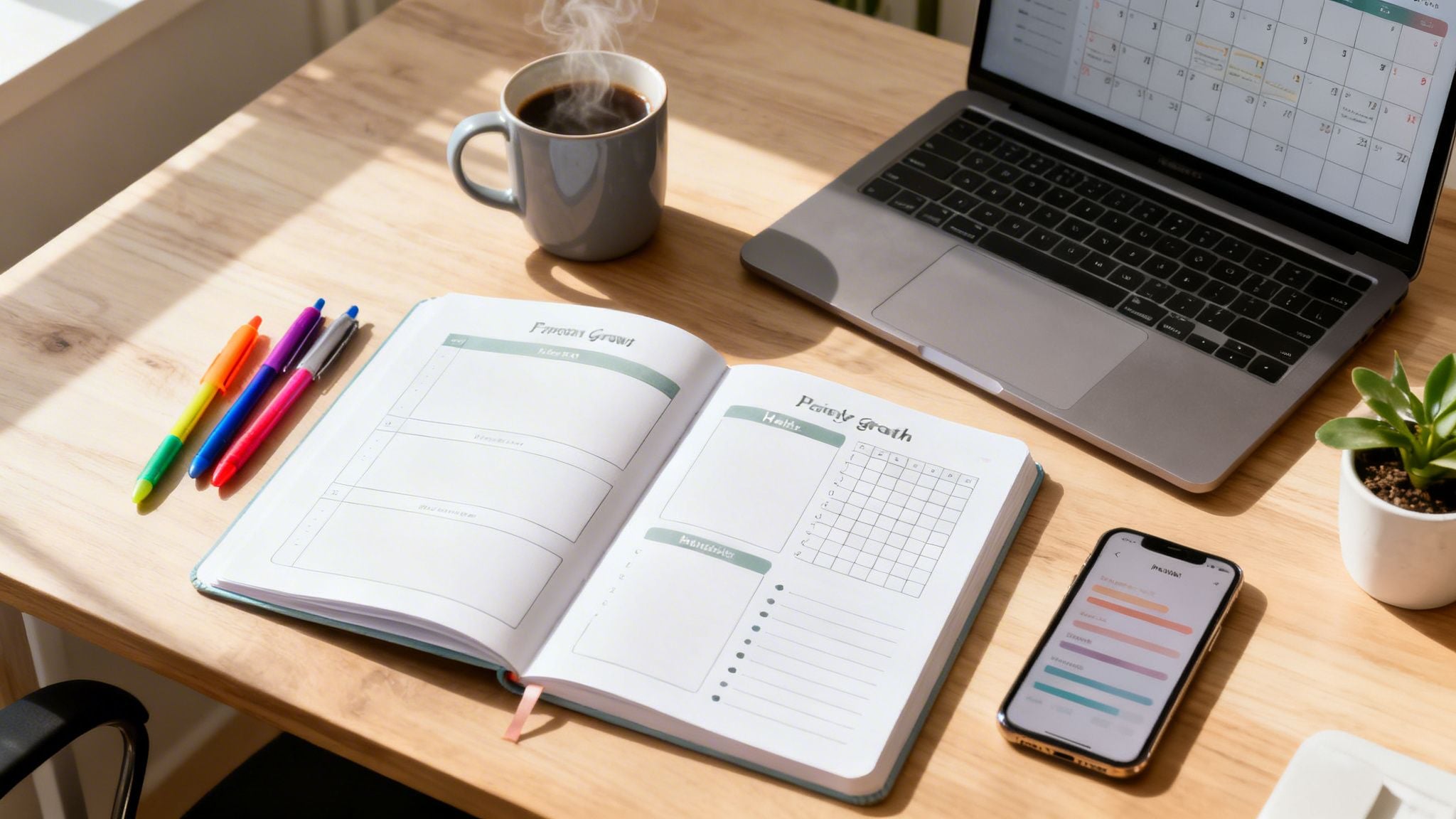
A personal growth journal is a powerful tool for anyone looking to bring more intention and clarity into their life. It provides a structured space to set goals, track progress, and reflect on your journey, turning abstract ambitions into concrete, actionable steps. This guide will walk you through the top 8 personal growth journals available on Amazon, each selected for its unique strengths. We'll explore both structured planners for goal-oriented individuals and freeform notebooks for creative minds, helping you find the perfect fit to start your self-improvement journey.
The Rise of Intentional Self-Improvement
The growing popularity of these journals is no accident. It’s part of a much larger shift toward proactive self-betterment, and the numbers back it up. People are actively investing in tools that bring structure to their personal development.
A recent report from Precedence Research valued the global personal development market at a staggering USD 53.24 billion in 2025. It’s expected to shoot up to USD 90.86 billion by 2035. With North America making up over 35% of that market, it’s clear that people are serious about their growth.

At its core, a journal creates a feedback loop for yourself. You set goals, track your progress, and build habits—all in one place. It works as a command center for your life, turning fuzzy ideas into something you can actually work on.
A personal growth journal is where your ambitions stop being vague daydreams and start becoming a concrete, actionable plan for your life.
Starting this practice gives you a solid framework for both self-discovery and real-world achievement. It’s a first step toward building a more deliberate and meaningful life. If you're ready to go deeper, our guide on how to create a personal growth plan is the perfect next read.
Why a Journal Is a Powerful Tool for Self-Improvement
Before we get into specific tools, let's talk about why a personal growth journal is such a secret weapon for driven people. It’s so much more than just a place to jot down thoughts. Think of it as a dedicated, private space for the kind of self-reflection that actually leads to real-world clarity and action. This one habit can completely change how you navigate your life.
When you journal consistently, it’s like creating a mental filter for your brain. Getting your thoughts out of your head and onto the page allows you to look at them from a distance. It's an incredibly effective way to get a handle on your emotions, helping you untangle feelings of stress or anxiety instead of letting them spin on an endless loop.
I like to think of it as having a conversation with your most honest self. It’s a safe place to break down a tough day at the office, map out a tricky career move, or even just celebrate a small win without any judgment. This simple act turns those fuzzy, abstract worries into concrete problems you can actually start solving.
From Mental Clutter to Focused Action
We all know the feeling of decision fatigue. It's a massive performance drain, especially for busy professionals. A journal is one of the best ways to fight back. It gives you a structured place to process information and figure out what really matters. Instead of carrying the mental weight of a dozen pending choices, you can lay them all out and free up that valuable brainpower.
This isn’t just a nice idea; the numbers back it up. The self-improvement market, where journaling is a cornerstone, is seeing massive growth. It jumped from USD 59.22 billion in 2024 to an expected USD 64.61 billion in 2025 and is on track to hit USD 90.94 billion by 2029. You can dig into more of this data in the full self-improvement market report.
So, what does this newfound clarity actually look like in practice?
- Deeper Self-Awareness: You start to see your own patterns—your triggers, your motivations, your blind spots. This is always the first step toward making a real change.
- Better Goal Achievement: Writing down your goals and tracking your progress creates a powerful feedback loop. It's a simple way to keep yourself accountable and motivated.
- Less Stress and Anxiety: The act of writing about stressful events can actually reduce their emotional hold on you, building your resilience over the long haul.
For an entrepreneur, this might look like tracking weekly progress toward a product launch. For a manager, it could mean dissecting a project setback to pull out valuable lessons for the next one.
A personal growth journal isn't a passive diary of what happened. It is an active workshop where you design what happens next.
At the end of the day, the real power of a journal is how it turns reflection into intention. It closes the gap between who you are right now and the person you're working to become, one entry at a time. It gives you the structure you need to move through a complicated world with more focus and purpose.
Our Top 4 Journals for Structured Goal Setting

If you treat your personal growth like a project that needs clear milestones and management, a simple blank notebook just won't cut it. You need a system. This is where structured journals come in, providing a framework to turn your ambitions into concrete daily actions.
We’ve picked four of the best journals available on Amazon designed for accountability and methodical progress. Let's dig into their philosophy, layout, and who they’re best for so you can find the right fit for your goals.
1. The High Performance Habit Journal
Think of this less as a diary and more as a daily command center. The High Performance Habit Journal is built from the ground up for the goal-oriented professional, keeping you laser-focused on the activities that actually drive results.
It’s all about building the routines that support long-term success. Each day has prompts for your morning mindset, top priorities, and an end-of-day reflection where you score yourself on key habits like clarity and energy.
- Pros: The comprehensive daily, weekly, and monthly reviews create a powerful feedback loop. The scoring system gives you a hard, quantitative look at how you're sticking to your habits. Its professional tone is perfect for entrepreneurs and career-focused individuals.
- Cons: The structure is very prescriptive, which can feel restrictive if you prefer more free-form reflection. Be ready to commit; filling it out properly takes a dedicated 15-20 minutes each day.
2. BestSelf Co. SELF Journal
A huge favorite in the productivity space, the BestSelf Co. SELF Journal operates on a unique 13-week system. The whole idea is that you can accomplish something significant in a 90-day sprint, and this journal gives you the roadmap to do it.
The layout splits your goals into daily, weekly, and monthly views. Every day starts with gratitude, identifies your main target, and includes a schedule from 6 AM to 9 PM. It’s designed to ruthlessly prioritize your time and energy.
This journal is designed to close the gap between your big-picture goals and what you actually do every single day. It creates a direct line from your vision to your daily schedule.
For anyone struggling to make their goals more tangible, this structured method can be a game-changer. You can learn more about how to set realistic goals in our dedicated guide.
- Pros: The 13-week framework is brilliant for tackling specific projects with a deadline. It’s an integrated planner, goal-setter, and journal all in one. The build quality is fantastic, with thick paper that doesn't bleed.
- Cons: Because it only covers 13 weeks, you’ll need a new one every quarter, which adds up. The identical daily format can start to feel a bit monotonous by the end of the 90 days.
3. Panda Planner
The Panda Planner brings a scientific approach to the table, incorporating principles from positive psychology to boost both happiness and productivity. It was originally created to help its user regain control after a period of illness, and that focus on well-being shines through.
It’s divided into monthly, weekly, and daily sections. The daily pages are the core of the system, with space for gratitude, focus, habits, priorities, and a schedule. The end-of-day review, where you list wins and areas for improvement, is a key feature for building momentum.
- Pros: The heavy focus on gratitude and "wins" genuinely helps improve your mindset. The multi-level planning keeps your daily tasks aligned with your bigger vision. It’s undated, so you can start anytime without wasting pages.
- Cons: It's one of the bulkier planners, making it less portable. Having to flip between the separate monthly, weekly, and daily sections can feel a little clunky during a busy day.
4. Full Focus Planner
From Michael Hyatt, the Full Focus Planner is a premium system for high-achievers who want to crush their goals without burning out. Like the SELF Journal, it runs on a 90-day cycle and is all about disciplined planning.
Its standout features are the "Ideal Week" template and the "Weekly Preview" ritual, which is a comprehensive process for reviewing the past week and strategically planning the next one. Daily pages push you to identify your "Daily Big 3" priorities, which helps avoid a scattered, overwhelming to-do list.
- Pros: The goal-setting system is incredibly thorough, guiding you from annual goals down to daily tasks. It puts a strong emphasis on work-life balance, with prompts for rest and rejuvenation. The build quality is top-notch.
- Cons: This is one of the more expensive planners on the market. There's also a steep learning curve; you really need to watch the introductory videos to get the most out of the system.
Our Top 4 Journals for Creative and Freeform Reflection
Sometimes, the most powerful journaling happens without any rules. If you're someone who feels boxed in by daily prompts and rigid templates, a simple, high-quality notebook can be your best tool for personal growth. It becomes a blank canvas where you can let your thoughts wander, sketch out ideas, or just get it all out on paper.
I've tested dozens of notebooks over the years, and a few stand out for their quality, design, and pure flexibility. These are my top picks from Amazon for anyone who wants a journal that simply gets out of the way and lets you think.
5. Morning Pages Journal
Julia Cameron’s "Morning Pages" practice is a game-changer for clearing your head. The idea is simple: wake up and immediately write three longhand pages of whatever is on your mind. The Morning Pages Journal is the official companion for this ritual, and it’s beautifully uncomplicated.
This isn't a planner or a habit tracker. It's a dedicated space to dump your mental clutter before your inner critic wakes up. By writing without a filter, you start to uncover insights and ideas that are usually buried under the day-to-day noise. It’s a tool for unblocking yourself.
- Pros: Designed specifically for the proven "Morning Pages" method, it includes inspiring quotes from The Artist's Way to motivate you. It's an excellent tool for overcoming creative blocks and gaining mental clarity.
- Cons: It's designed for one specific purpose, so it's not a multi-purpose journal for tracking habits or planning goals. The blank pages can feel daunting if you're not committed to the stream-of-consciousness method.
6. Leuchtturm1917 Medium A5 Dotted Hardcover Notebook
There's a reason why the Leuchtturm1917 is the unofficial king of the bullet journal world. Its dot-grid layout is the perfect middle ground between a blank page and a lined one, giving you freedom with just enough structure to keep things neat. It’s my go-to for building a completely custom system.
The details are what make this journal special. The paper is a solid 80 g/sqm weight that handles most pens well. But the real magic is in the numbered pages and the blank table of contents at the front—it's a lifesaver for organizing your entries and finding what you need later.
This journal doesn't tell you how to think; it gives you a high-quality, organized space to think. Its genius is in its thoughtful, minimalist features that support your system, whatever it may be.
I've used Leuchtturm1917s to create habit trackers, mood logs, and goal-setting pages, all while leaving plenty of room for free-form reflection. It’s for anyone who wants to build their ideal journal from scratch.
- Pros: The dot grid, numbered pages, and table of contents offer ultimate flexibility for custom layouts. It has a durable hardcover and comes in a huge range of colors.
- Cons: With 251 numbered pages, it’s a bit thick for those needing something ultra-portable. While the paper is great, very wet fountain pen inks might cause some minor ghosting.
7. Moleskine Classic Notebook
The Moleskine Classic Notebook is an icon. There's a certain feeling you get when you open a Moleskine—it's a simple, elegant invitation to write. Available in ruled, plain, squared, or dotted versions, it’s the definition of a blank slate.
What I love about the Moleskine is its durability and timeless design. The oilcloth-bound cover, rounded corners, and elastic closure mean you can toss it in a bag without a second thought. The 70 g/sqm acid-free paper has a classic ivory hue that’s easy on the eyes.
This is the notebook for the purist who wants absolutely no distractions. Its minimalism forces the focus back on what matters: your own thoughts.
- Pros: It provides a timeless, no-fuss writing experience. It’s incredibly durable and portable, making it a great everyday carry. The wide availability of different sizes and page styles is a huge plus.
- Cons: The 70 g/sqm paper is on the thinner side, so fountain pens or heavy markers will likely cause ghosting or bleed-through. It lacks conveniences like page numbers or an index.
8. Rhodia Webnotebook
If paper quality is your top priority, look no further. The Rhodia Webnotebook—or "Webbie," as fans call it—is famous for one thing: its incredible paper. It’s packed with premium 90 g/sqm Clairefontaine brushed vellum paper that is unbelievably smooth.
For fountain pen users, this is the holy grail. Ink glides across the page with zero feathering or bleed-through, making the writing experience itself a joy. The dot grid offers a subtle guide, and the soft leatherette cover feels fantastic.
- Pros: It offers a luxurious writing experience, especially for fountain pen users. The world-class 90 g/sqm Clairefontaine paper is second to none. The overall build quality feels high-end and durable.
- Cons: This level of quality comes at a higher price point. The distinct ivory color of the paper might not be for everyone, especially if you prefer pure white pages.
How to Make Journaling a Consistent Daily Habit

Finding a personal growth journal you love is a great start, but let's be honest—the real magic happens when you actually use it. Consistently. The secret isn't about finding more willpower; it’s about weaving the practice so smoothly into your daily rhythm that it stops feeling like a chore.
Our goal is to shift journaling from a "should do" to a "want to do" ritual. This is where most people get stuck, but with a couple of smart strategies, you can build a habit that becomes a genuine highlight of your day.
Piggyback on Your Existing Routines
One of the most powerful tricks I've learned is something called habit stacking. Instead of trying to carve out new time from a busy schedule, you simply link journaling to something you already do automatically. This existing habit becomes the trigger for your new one.
Think about it: do you start every morning with a cup of coffee? Perfect. That's your cue. The new habit becomes, "When I pour my morning coffee, I'll open my journal and write for five minutes."
Here are a few other simple ways to stack this habit:
- Morning: While your tea is steeping, jot down your top 3 priorities for the day.
- Commute: If you take the train or bus, use that built-in downtime for a quick digital entry.
- Evening: Right after brushing your teeth, take three minutes to write down one thing that went well.
This simple technique is a big reason journaling is exploding in popularity. It's a key part of a larger self-improvement movement, with market analysis from Technavio projecting the personal development industry to grow by USD 613.2 million between 2024 and 2029. You can explore the full market analysis on Technavio to see why it works.
Start Small and Make It Effortless
The single biggest mistake people make is aiming too high. If you tell yourself you have to write for 30 minutes every day, you’re setting yourself up to fail. Instead, start with a goal that feels ridiculously easy.
Your only goal at the beginning is to show up. A consistent five-minute practice is infinitely more powerful than a sporadic one-hour session.
Make it almost impossible not to do it. Keep your journal and a pen right on your nightstand, next to the coffee maker, or on your work desk. The less effort it takes to get started, the more likely you'll do it. For more on this, our guide on how to build healthy habits is a fantastic resource.
When you lower the barrier, you completely change the dynamic. Journaling goes from being a daunting task to a simple, rewarding pause in your day.
Conclusion: Your Next Chapter Starts Now
We've explored why a personal growth journal is a transformative tool and reviewed the 8 best options you can find on Amazon today. Whether you gravitate towards a structured planner like the Full Focus Planner or a flexible notebook like the Leuchtturm1917, the most important step is simply to begin.
A journal is more than just paper; it is a commitment to yourself. It's a dedicated space to process your thoughts, celebrate your progress, and intentionally design the life you want to live. By making journaling a small, consistent part of your daily routine, you create a powerful feedback loop for self-awareness and achievement. The right journal is waiting for you. It's time to pick one up and start writing your next chapter.
Frequently Asked Questions (FAQs)
How long should I journal for each day?
Consistency is more important than duration. Start with just 5-10 minutes a day. A short, consistent practice is far more effective than long, sporadic sessions. This makes the habit easier to build and stick with over the long term.
What if I don't know what to write about?
The blank page can be intimidating. If you feel stuck, use simple prompts to get started. For example: "What is one thing I'm grateful for today?", "What was a challenge I faced and how did I handle it?", or "What is one small step I can take toward a big goal tomorrow?"
Is a physical journal better than a digital one?
This depends entirely on your personal preference. A physical journal offers a tactile, screen-free experience that can enhance focus and memory. A digital app offers convenience, searchability, and portability. Choose the format that you are most likely to use consistently.
How soon will I see results from journaling?
You may notice some benefits, like increased mental clarity, almost immediately. The act of writing your thoughts down can provide instant relief. Deeper changes, such as improved self-awareness and habit formation, develop over weeks and months of consistent practice. Trust the process and be patient with yourself.
At David Pexa, we're all about giving you the strategies and tools to build a more intentional life. For more curated guides and actionable advice, you can explore our resources at https://davidpexa.com.
