



Personal growth counseling is less about fixing what’s broken and more about building what’s next. Think of it as a dedicated partnership focused on closing the gap between feeling ‘just fine’ and feeling truly alive and fulfilled. It’s a proactive choice to consciously design your own development instead of just letting life happen to you.
The whole point is to sharpen your self-awareness and map out a clear, actionable plan for the future you want to create.
Upgrading Your Life’s Operating System
I like to think of personal growth counseling as hiring a personal trainer, but for your mind and your ambitions. You don’t go to a trainer only when you’re injured; you go to build strength, boost your performance, and hit new goals. It’s the same idea here. This isn’t just for moments of crisis. It’s for anyone who feels like they’ve hit a plateau and is ready to intentionally upgrade their life’s “operating system.”
This is a forward-looking process for people who are doing okay but sense there’s a whole other level they could be on. It’s a space to get clear on your aspirations, tear down the walls of your self-imposed limits, and build the mental habits you need for long-term success and happiness. The core idea is simple: you’re the architect of your own growth, and the counselor is the expert consultant who helps you draw up the blueprints.
Who Is This For
Personal growth counseling really resonates with people who are driven by progress, not just by pain. You might be a perfect fit if any of these sound familiar:
- Ambitious Professionals: You’re doing well at work, but something feels missing. Maybe you want to level up your leadership skills, sharpen your emotional intelligence, or find more meaning in what you do.
- Habit Builders: You know exactly what you should be doing—eating healthier, being more productive, improving your relationships—but you just can’t seem to make it stick.
- Individuals at a Crossroads: You’re facing a big life change, like a promotion, a new venture, or a personal milestone, and you want to walk through it with purpose and a clear head.
- Those Feeling ‘Stuck’: There isn’t a glaring “problem,” but you feel stagnant. The inspiration is gone, and you have a nagging feeling that you’re capable of so much more.
The goal of personal growth work isn’t to erase your past but to ensure it no longer dictates your future. It’s about taking the raw material of your life experiences and learning how to build something stronger and more aligned with your values.
This proactive approach is built on one foundational truth: all meaningful change starts with self-awareness. Once you truly understand your own patterns, beliefs, and what drives you, you can start making deliberate choices that lead to better places. This is where ideas like cultivating a growth mindset become absolutely critical. It’s about making the shift from being a passenger in your own life to grabbing the steering wheel, fully equipped to handle whatever road lies ahead.
How Personal Growth Counseling Differs from Therapy and Coaching
It’s easy to get confused by the terms personal growth counseling, therapy, and coaching. They all aim to improve your life, right? Yes, but they do so in fundamentally different ways. The best way to understand the distinction is to think about it like maintaining a car for a long road trip.
Traditional therapy is like bringing in a master mechanic. If your car has a serious engine problem—maybe from a past crash or just years of neglect—you need an expert to diagnose what’s wrong under the hood. A therapist does something similar for your mind, helping you heal from past trauma, manage clinical anxiety or depression, and repair deep-seated issues so you can get back on the road safely. Their focus is on treating and healing.
Life coaching, on the other hand, is your GPS navigator. You plug in a destination—a promotion, a new business, a fitness goal—and the coach helps you map out the most efficient route. They’re all about action, strategy, and holding you accountable for getting from Point A to Point B. The past isn’t the focus; the destination is everything.
The Role of Personal Growth Counseling
So where does personal growth counseling fit into this picture? Think of it as an advanced driving school. Your car is running fine—no major engine trouble—but you know you could be a better, more confident driver.
A personal growth counselor is that expert instructor who teaches you to understand your vehicle’s full potential. They help you learn how to handle sharp turns, navigate tricky weather, and become more intuitive behind the wheel. It’s a holistic approach that connects your car’s inner workings (your self-awareness) with your on-the-road skills (your actions), preparing you to thrive on any journey you choose.
This flowchart offers a simple way to visualize which path might be right for you, depending on whether you’re navigating a crisis or proactively seeking to grow.
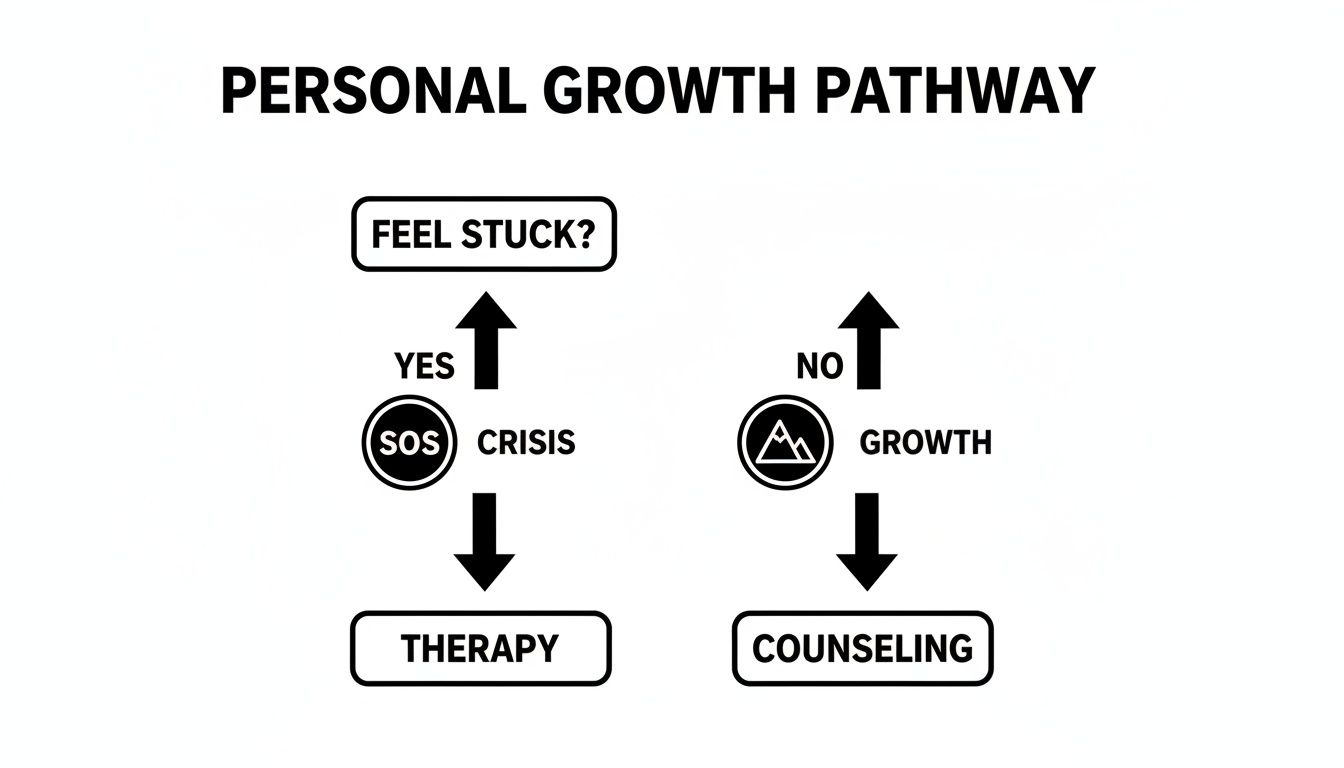
As you can see, therapy is critical when you’re in distress. But when you’re stable and ready to build on that foundation, personal growth counseling is where the real work of self-actualization begins.
Counseling vs. Therapy vs. Coaching At a Glance
To make these distinctions even clearer, let’s put them side-by-side. Each practice serves a unique purpose and is suited for different needs. Seeing them compared directly can help you pinpoint exactly what kind of support you’re looking for.
This table breaks down the core differences.
| Dimension | Personal Growth Counseling | Traditional Therapy | Life Coaching |
|---|---|---|---|
| Primary Focus | Cultivating self-awareness and building skills to thrive. It connects insights from the past with your aspirations for the future. | Healing from past trauma, treating diagnosed mental health conditions, and resolving psychological distress. | Achieving specific, future-oriented goals. The emphasis is on action, accountability, and measurable results. |
| Typical Client | Someone who feels stuck, wants to improve their habits, or is seeking deeper self-understanding and fulfillment. | An individual managing anxiety, depression, trauma, or other clinical conditions that impact their daily life. | A person with a clear, defined goal (like a career change) who needs a strategic partner to stay on track. |
| Key Question | “How can I understand myself better to create a more meaningful life?” | “Why am I feeling this way, and how can I heal from what happened in my past?” | “What is my goal, and what exact steps will get me there?” |
| Professional Role | A guide and collaborator who provides tools and frameworks for self-directed personal evolution. | A licensed clinician who diagnoses and treats mental and emotional health conditions. | A motivator and strategist who helps you create and execute a concrete action plan. |
Choosing the right path comes down to what you need right now. Therapy is for healing, coaching is for achieving, and personal growth counseling is for the deep, rewarding work of becoming a more capable and self-aware version of yourself.
Core Techniques Used to Unlock Your Potential
Personal growth counseling isn’t just a series of encouraging chats; it’s a structured process that relies on proven, evidence-informed techniques. Think of these as practical tools your counselor uses to help you become the architect of your own change—different lenses for examining and rebuilding your inner world.

Instead of sticking rigidly to one method, a good counselor will often blend several approaches to fit what you actually need. This ensures the work is a personalized strategy for your development, not a one-size-fits-all script. Let’s look at three powerful frameworks that are central to this work.
Rewiring Your Thoughts with Cognitive Behavioral Therapy
Cognitive Behavioral Therapy, or CBT, is a real cornerstone in this field. The core idea is simple but incredibly powerful: your thoughts, feelings, and behaviors are all linked. If you can change your thought patterns, you can directly influence how you feel and what you do.
Let’s say you consistently put off a major project at work. The behavior is procrastination, and the feeling is likely anxiety. CBT helps you dig down to find the automatic negative thought driving it all, which might be something like, “If I start this, I’m going to fail, and everyone will see I’m not good enough.”
A counselor using CBT would guide you to challenge and reframe that belief. This isn’t just about “thinking positive.” It’s about systematically examining the evidence for and against your negative thoughts, learning to treat them like hypotheses instead of facts. You learn to replace a self-limiting thought with a more balanced and realistic one, like, “This project is tough, but I have the skills to make progress one step at a time.”
By practicing this mental shift over and over, you literally start to build new neural pathways. The anxiety begins to fade, making it much easier to take action. For anyone wanting to go deeper, there’s a wide range of powerful Cognitive Behavioral Therapy techniques that can be applied to almost any area of life.
Rewriting Your Story with Narrative Therapy
We all live by stories—the narratives we tell ourselves about who we are, where we’ve come from, and what we’re capable of. Narrative Therapy is all about helping you become the author of your own life story, rather than just a character in a script someone else wrote for you.
This approach understands that our problems often come from “problem-saturated” stories that define us in negative ways. Someone might have a dominant story of being “the anxious one” or “the person who never finishes things.” Over time, these labels can start to feel like unchangeable truths.
A narrative therapist helps you “externalize” the problem. Instead of saying, “I am an anxious person,” you would start to explore “how anxiety is impacting your life.” It’s a small shift in language, but it’s huge. It separates you from the problem, turning it into something you can observe and challenge.
Narrative Therapy is about finding the alternative stories that have been overshadowed or ignored—stories of your resilience, strength, and competence. It gives you the power to choose which narrative you want to live by, effectively rewriting your future.
You and your counselor would work to uncover moments when “anxiety” didn’t win, or times when you successfully saw a difficult task through. By highlighting these exceptions, you begin to build a new, more empowering narrative for yourself.
Building on Your Strengths
While some approaches focus on fixing what’s wrong, a strengths-based approach does the exact opposite: it identifies what’s already working and helps you do more of it. This method is built on the belief that every person has inherent strengths and resources they can draw on to overcome challenges.
It’s a refreshingly positive and motivating way to work. Instead of dwelling on your weaknesses, your sessions will focus on discovering and amplifying your innate talents, skills, and past wins.
Key elements of a strengths-based approach include:
- Identifying Core Talents: What are you naturally good at? Where do you feel most energized and effective in your life?
- Recalling Past Successes: Exploring times you successfully navigated a tough situation, no matter how small it seemed.
- Applying Strengths to Goals: Strategizing how you can intentionally use your core talents to achieve what you want right now.
For instance, if you’re a naturally organized person struggling with a chaotic home life, a counselor would help you figure out how to apply that organizational strength to create better systems and routines at home. By leveraging what you already do well, success starts to feel much more accessible and sustainable.
Key Signs You’re Ready for Personal Growth Counseling
Knowing when to reach out for support is a powerful first step. A common misconception is that you need to hit rock bottom to see a counselor, but personal growth counseling is the exact opposite. It’s for people who are already doing well and are asking, “What’s next? How can I reach a higher level?”
This proactive approach is catching on. More and more, people are realizing that investing in their mental and emotional toolkit is just as important as any other form of professional development. The signs you’re ready are often less like a blaring alarm and more like a quiet, persistent whisper telling you that you’re capable of more.
You’re Successful But Feel Unfulfilled
On paper, everything looks great. You’ve checked all the boxes—good job, stable life, achievements unlocked. But underneath it all, there’s a nagging sense of emptiness or a feeling that something crucial is missing. Sound familiar?
This is a classic signal that your external success has drifted away from what you internally value. It’s like you’re operating from an old script you wrote years ago, and it’s time for a rewrite. Personal growth counseling gives you the space to figure out what a meaningful, fulfilling life looks like for you now, not the person you were five or ten years ago.
You Keep Repeating the Same Unhelpful Patterns
Do you ever feel like you’re stuck in a loop? Maybe it’s the same New Year’s resolution that fizzles out by February, a recurring communication breakdown in your relationships, or a constant battle with procrastination. When you see the same patterns show up again and again, it’s a sure sign that there are deeper beliefs or habits running the show.
These cycles are more than just frustrating; they can lead to analysis paralysis, where you get so stuck in your head thinking about what to do that you end up doing nothing at all. A counselor can help you get to the bottom of these patterns using proven tools from approaches like CBT to finally break the cycle. For more on this, check out our guide on how to overcome analysis paralysis.
You’re not starting from scratch; you’re starting from experience. Counseling helps you decode that experience to make intentional choices, turning past frustrations into fuel for future growth.
You’re Navigating a Major Life Transition
Big life changes are tough, even the good ones. Getting a promotion, starting a family, or moving to a new city can throw you for a loop, and it’s smart to want a guide to help you find your footing.
Think about moments like these:
- Getting a huge promotion that suddenly demands a whole new level of leadership.
- Launching your own business and facing the mental rollercoaster that comes with it.
- Becoming an empty-nester and trying to figure out who you are beyond being a parent.
- Moving to a new city and wanting to build a social circle from the ground up.
A counselor in these situations is like a strategic thought partner. They help you build the inner strength and clarity to not just get through the change, but to actually thrive in it. This idea of guided self-improvement is a big reason the personal development market was recently valued at USD 50.42 billion and continues to expand. People are seeing the incredible ROI of investing in themselves. You can read the full report on the growth of the personal development market from Precedence Research.
Finding the Right Counselor for Your Journey
Finding the right professional isn’t just about checking a box—it’s about finding a partner. The single most important factor in how much you get out of counseling is the connection you build with the person across from you. You’re looking for someone who not only gets your vision but also has the right tools to help you bring it to life. A little research upfront pays off big time.
And you’ve got options. With a growing focus on proactive mental wellness, the field has exploded. In the U.S., the counseling industry is a $35.7 billion market, and jobs for mental health counselors are expected to jump by 18% through 2032. That’s great news for you, because it means more choices to find someone who’s a perfect fit. You can learn more about the expanding counseling industry from IBISWorld.
First Things First: Credentials and Specialties
Before you get into personalities and approaches, you need to know you’re working with a qualified professional. Licensing is non-negotiable; it’s your assurance that they’ve met strict educational and supervised experience standards set by their state.
Look for credentials like these:
- LPC (Licensed Professional Counselor)
- LMFT (Licensed Marriage and Family Therapist)
- LCSW (Licensed Clinical Social Worker)
- PhD or PsyD in Psychology
Once you’ve confirmed they’re licensed, dig into their specialty. Does their work focus on career development, building confidence, or mastering emotional intelligence? A quick look at their website or professional profile should tell you if their expertise lines up with your goals.
Questions to Ask During a Consultation Call
Most counselors offer a free, short consultation. This isn’t a therapy session—it’s a two-way interview. It’s your opportunity to get a feel for their style and see if you click. A good counselor will expect and welcome your questions.
Have a few thoughtful questions ready to go. You want to understand not just what they do, but how they do it.
Here are some powerful questions to ask:
- For someone with goals like mine, what does your approach to personal growth counseling look like?
- What specific methods, like CBT or strengths-based work, do you find yourself using most often?
- How do we work together to set goals and actually track progress?
- What should I expect in our first couple of sessions?
- What’s your philosophy on the relationship between a client and a counselor?
Ultimately, your goal during this call is to answer one core question: “Do I feel seen, heard, and understood by this person?” A strong ‘yes’ is the clearest sign you’ve found a great potential match.
Trusting Your Gut and Making the Choice
After the call, give yourself a moment to process. Did their answers make sense to you? Did you feel comfortable and respected? The right counselor should feel like a supportive, knowledgeable guide—not someone who just nods along or, on the flip side, tells you what to do.
Remember, this is a partnership. You need someone who can both challenge you to step outside your comfort zone and create a safe space for you to be vulnerable. Pay attention to your intuition. If the conversation left you feeling energized, with a sense of hope and clarity, that’s a fantastic sign you’re on the right track.
What to Expect and How to Maximize Your Results
Stepping into personal growth counseling for the first time can feel a bit like starting a new fitness program. You’re excited about the possibilities, but you might be wondering what the actual “workouts” will look like. It’s a collaborative journey, intentionally structured to build momentum right from your very first conversation. The whole process is designed to be transparent, goal-oriented, and focused on making a real-world difference in your life.

Your first few sessions are all about discovery. You can expect to talk about your background, the challenges you’re facing right now, and what a more fulfilling life would genuinely look like for you. The main goal here is getting crystal clear—moving from that vague feeling of being “stuck” to defining sharp, inspiring objectives. This foundational work is what makes every future session count.
From there, each meeting builds on the last. These aren’t just casual chats; they follow a productive rhythm meant to keep you moving forward.
The Structure of a Typical Session
Most sessions follow a simple, three-part flow that ensures you’re making steady headway. This structure keeps the work focused and action-oriented, helping you turn insights from your conversations into tangible changes week after week.
A typical session usually breaks down like this:
- Check-In and Progress Review: You’ll kick things off by talking about what happened since your last meeting. What went well? What new challenges popped up? This review is crucial for connecting the dots between your sessions and your day-to-day reality.
- Focus on a Core Topic: This is the heart of the session. Here, you’ll dive deep into a specific goal or pattern you want to work on. You might role-play a difficult conversation, explore a limiting belief, or brainstorm strategies for handling an upcoming situation.
- Define Your Next Steps: You’ll always end with a clear, actionable takeaway. This might be a specific task to complete, a new mindset to practice, or simply something to observe in your own behavior before you meet again.
This reliable structure ensures you leave each session with more than just ideas—you leave with a plan.
How to Maximize Your Investment
Here’s a secret that many people miss: the most profound growth doesn’t actually happen during the 50-minute session. It happens in all the hours and days in between. Think of your counselor as a guide, but remember, you’re the one walking the path. To get the most out of the experience, you have to be an active participant.
The real magic of personal growth counseling is in applying what you learn. The sessions provide the map and the tools, but your willingness to use them on your daily journey is what creates lasting change.
To make every dollar and every minute count, you have to treat the time between sessions as your personal practice field.
Tips for Getting the Best Results:
- Prep Before You Go: Take just 10 minutes before each session to reflect. What was a win this week? What was a struggle? Coming in with a few thoughts helps you hit the ground running.
- Jot Down “Aha” Moments: Keep a notebook handy. When an important insight strikes you during or after a session, write it down. This simple act helps it stick.
- Apply Just One Thing: Don’t overwhelm yourself by trying to change everything at once. Pick one single insight or strategy from your session and focus on applying it during the week ahead.
The rise of online counseling has made it easier than ever to do this consistent work. The market is booming, projected to grow from USD 2.75 billion to USD 4.42 billion by 2029, as busy people seek more convenient ways to build mental clarity and upgrade their habits. You can learn more about the surge in online counseling on Research and Markets. This incredible accessibility means you can weave your growth work right into your life, which is the best way to maximize your results.
Common Questions About Personal Growth Counseling
It’s completely normal to have a few practical questions before diving into personal growth counseling. Getting a handle on the details—like how long it takes, what it costs, and what to expect—helps you walk into the process feeling prepared and confident about investing in yourself.
Let’s clear up some of the most common questions people have.
How Long Until I See Results From Counseling?
Think of this process less like a race with a finish line and more like tending to a garden. You’ll likely spot small, encouraging sprouts—a shift in your thinking, a moment of clarity—within the first few sessions, often around the 4-6 week mark. These early wins are a great sign that the seeds you’re planting are taking root.
For the bigger, more lasting changes, like fundamentally reshaping your career path or building unshakeable confidence, you’ll need to give it more time. Deeper growth unfolds over several months of steady work, usually somewhere in the 3-6 month range, and sometimes longer. Your counselor will help you map out milestones so you can track your progress and celebrate how far you’ve come.
Is Personal Growth Counseling Covered by Insurance?
This one is a classic “it depends.” Whether insurance covers it all comes down to if the service is considered a medical necessity.
- When It Might Be Covered: If you’re working with a licensed mental health professional (like an LPC or LCSW) who can link your growth goals to a diagnosable condition, such as mild anxiety or an adjustment disorder, your plan might kick in.
- When It’s Often Not Covered: If the focus is purely on self-improvement, learning new skills, or hitting performance goals without any underlying diagnosis, insurance usually views it as an elective service and won’t cover the cost.
Your best bet is to call your insurance provider directly to confirm what your benefits include. It’s also worth asking a potential counselor if they can provide a “superbill,” which you can submit to your insurance for possible out-of-network reimbursement.
Do I Need a Specific Problem to Start Counseling?
Not at all. In fact, this is one of the key things that sets personal growth counseling apart. You don’t have to be in crisis or feeling broken to get started. This approach is built for people who are already doing well but have a drive to do better.
The only “problem” you’re solving is the gap between where you are today and the person you know you can become. It’s about proactively closing that gap.
It’s all about making the leap from good to great. You’re building on the strengths you already have to reach a new level of fulfillment, performance, or purpose.
What Is the Difference Between a Counselor and a Coach?
Both counselors and coaches can be incredibly helpful, but they come from different worlds in terms of training, oversight, and scope. A licensed counselor holds an advanced degree, has logged thousands of hours of supervised clinical practice, and answers to a state licensing board. That rigorous background equips them to help you understand and work with the deep-seated psychological patterns that drive your behavior.
Coaching, on the other hand, is an unregulated field that tends to focus on future-oriented goals and holding you accountable. Personal growth counseling often blends the best of both worlds. It combines the psychological depth of counseling with the forward-moving, practical strategies of coaching, giving you a powerful and well-rounded path to development.
At David Pexa, we believe that structured guidance is the key to unlocking your potential. Our resources are designed to provide the clarity and actionable strategies you need to build a more intentional life. Explore our guides and start your journey today at https://davidpexa.com.
