


Picking the right online course platform is one of those make-or-break decisions that will shape your business for years. It’s not just about tech; it’s a strategic move that directly affects how you make money, how your students learn, and how much you can grow. The best platform for you really hinges on your business model. For example, all-in-one platforms like Kajabi are built for serious entrepreneurs, while creator-focused tools like Teachable are great for beginners, and something like Thinkific is perfect for creators who want more control and flexibility. This guide will break down the top contenders to help you match your vision with the right technology.
Why Your Platform Choice Defines Your Success

Choosing a platform isn’t just a box to check on your to-do list—it’s the very foundation of your digital education business. Get it right, and you’ll accelerate your growth. Get it wrong, and you’re looking at frustrating workarounds and a painful, expensive migration down the line. It’s crucial to understand that every platform is designed with a specific type of creator in mind.
Your decision touches everything. It’s the first impression a new student has of your brand and the last click they make when they buy. This single choice powers your marketing funnels, your community, and how you get paid.
Understanding the Core Platform Philosophies
Most course platforms fall into one of three buckets, each with a completely different philosophy. Your business goals will point you to the right one.
- All-in-One Solutions: Think of these as your entire business in a box. Platforms like Kajabi bundle course hosting with a website builder, email marketing, sales funnels, and community tools. They’re designed for creators who want to simplify their tech stack and run everything from one place.
- Dedicated Course Platforms: Tools like Teachable and Thinkific are laser-focused on delivering an amazing learning experience. They pack a punch with robust course creation tools, quizzes, and certificates. While they have some marketing features, their real power comes from deep customization options and seamless integrations with other best-in-class software.
- Marketplaces: Platforms like Udemy and Skillshare offer one massive advantage: a built-in audience of millions. The trade-off is significant. You give up control over your branding, pricing, and student data, and the platform takes a hefty cut of your revenue.
This table gives you a quick snapshot of how they stack up.
| Category | Best For | Key Strength | Main Trade-Off | Example Platforms |
|---|---|---|---|---|
| All-in-One | Solopreneurs & serious marketers | Integrated marketing & sales tools | Higher cost, less design flexibility | Kajabi, Podia |
| Dedicated | Educators & creators needing control | Customization & learning features | Requires integrating other marketing tools | Teachable, Thinkific |
| Marketplace | Beginners testing course ideas | Built-in audience & no upfront cost | Low profit margins, no brand control | Udemy, Skillshare |
Your platform isn’t just a place to upload videos; it’s your business partner. The choice you make defines your ability to scale, engage students, and ultimately, build a profitable and sustainable education business.
At the end of the day, this decision is about managing your business’s energy and focus. As you’ll see throughout this guide, getting your operational systems right is just as vital as the content you create. You can learn more about how to apply this thinking by exploring energy management solutions for personal and professional growth.
The Core Criteria for Evaluating Course Platforms

To make the right choice, you have to look past the shiny feature lists. A truly meaningful online course platform comparison digs deeper, focusing on the five pillars that actually support a thriving online education business.
This isn’t just about finding a place to host your videos; it’s about partnering with a platform that aligns with your long-term vision. We’ll examine each of these pillars through a practical lens, helping you see how they apply to your business today and where you plan to take it tomorrow.
Monetization Models and Flexibility
Let’s be blunt: how you get paid matters. A platform’s payment options can either open up new revenue opportunities or box you in. Don’t just settle for one-time payments; the real power is in the flexibility to design offers that fit your business model.
Can you easily set up recurring revenue? That’s one of the biggest questions to ask. Here are the must-have features that directly impact your bottom line:
- Subscriptions and Memberships: These are the bedrock of predictable income, perfect for ongoing content or community access.
- Payment Plans: Offering installments can dramatically increase conversions on higher-priced courses by making them more accessible.
- Course Bundles: The ability to package several courses together at a special price is a proven way to boost your average order value.
- Affiliate Programs: A built-in affiliate system lets you build an army of promoters, giving you a powerful, commission-based sales force.
Also, check for support for multiple payment gateways and currencies. Removing that friction for international students is a simple way to expand your market and scale your revenue.
Student Engagement Features
A course is only as good as the results it gets for students. When students finish your course and succeed, you get glowing testimonials, fewer refund requests, and a loyal following that buys from you again and again. Engagement tools aren’t just a nice-to-have; they’re essential.
The difference between a static video library and a dynamic learning environment lies in engagement. Features that foster interaction and measure progress are what turn passive viewers into successful students.
Look for tools like interactive quizzes, graded assignments, and professional certificates that give students a sense of accomplishment. A built-in community is another game-changer. It allows students to connect, ask questions, and support each other, creating a rich learning ecosystem that keeps them coming back. And to manage all this effectively, make sure you have the right setup; our guide on the best laptops for productivity can help you get geared up.
Marketing and Sales Tools
Your masterpiece of a course won’t sell itself. A platform with strong, built-in marketing and sales tools can save you a ton of time and money by cutting down on the need for other software. This is where all-in-one platforms really shine, giving you the tools to attract leads and turn them into customers.
Does the platform give you what you need to sell?
- Landing Page Builders: You need to be able to create high-converting sales pages without hiring a developer.
- Email Marketing Automation: Sending targeted emails based on student actions (like enrolling or completing a lesson) is crucial for nurturing relationships.
- Sales Funnel Creation: Look for tools that let you build a clear path that guides potential students from initial interest to final purchase.
When these features are integrated, your platform stops being a simple content host and becomes the engine driving your business forward.
Integrations and Scalability
Let’s face it: no single platform is perfect at everything. That’s precisely why a strong integration ecosystem is non-negotiable. Your course platform has to play nice with the other essential tools in your stack, whether it’s your email marketing provider, your CRM, or your analytics software.
Think about the future, too. As your business grows, you’ll have more students, more courses, and more complex needs. You need a platform that can scale with you, not one you’ll outgrow in a year. Planning for that growth now will save you the massive headache of a platform migration down the road.
An In-Depth Online Course Platform Comparison
Alright, let’s get into the heart of it. We’re moving past the flashy feature lists to really dig into what separates the big players: Teachable, Kajabi, Thinkific, and Podia. Each of these platforms was built with a specific kind of creator in mind, and understanding those core philosophies is the key to picking the right one for your business.
We’ll look at how they stack up in the real world. You’ll see how a platform that’s perfect for a new solo coach might actually hold back an established educator. My goal here is to give you a clear, honest view of where each one truly excels.
H3: Teachable: Your Straight Shot to Course Creation
Teachable has long been the go-to for first-timers, and for good reason. Its superpower is its simplicity. The entire platform is designed to get your course idea out of your head and onto the market with as little technical headache as possible, making it a fantastic launching pad.
The course builder is incredibly straightforward, letting you pull in content directly from places like Dropbox and Google Drive. They’ve also woven in some AI tools that can help you map out a course outline and draft lesson content, which is a huge help when you’re just starting. It’s built for creators who want to test an idea quickly without getting lost in a sea of settings.
The trade-off? Design flexibility isn’t its strong suit. You can tweak colors and add your logo, but you’re mostly working within their established templates.
Key Differentiator: Teachable is all about speed to market and ease of use. It’s the best pick if your main goal is to create and sell a course without a steep learning curve or needing complex marketing tools.
It comes with all the essential payment tools right out of the box, like payment plans, subscriptions, and a simple affiliate marketing program. Setting these up is a breeze, so even new creators can start using smart sales tactics from day one.
H3: Kajabi: The All-in-One Business Engine
Kajabi doesn’t just see itself as a course platform; it’s a command center for your entire online business. This one is built for serious entrepreneurs who are tired of duct-taping different tools together and want to manage everything—website, blog, email marketing, funnels—from one spot.
Its most impressive feature is its marketing automation. Kajabi’s “Funnels” (which used to be called Pipelines) let you build out entire marketing campaigns with a few clicks. Imagine creating a sequence that offers a freebie, follows up with a series of emails, and then guides people right to your checkout page, all automatically.
This integrated approach means you can ditch separate tools for email marketing or landing pages, which can really simplify your workflow and even cut down on monthly software bills.
Key Differentiator: Kajabi’s strength is its seamless integration of high-powered marketing and sales tools with course delivery. It’s for creators who are ready to build sophisticated funnels and scale their business from a single platform.
That power comes with a higher price tag, of course. It’s an investment that makes the most sense when you have a clear growth strategy and are ready to use its advanced marketing features to their full potential.
H3: Thinkific: The Customization Powerhouse
Thinkific is for the builders and the educators who crave total control over the learning experience. Where others go for simplicity or integrated marketing, Thinkific doubles down on flexibility, and its biggest ace in the hole is the extensive Thinkific App Store.
This marketplace lets you plug in all sorts of third-party tools to add very specific functions—think advanced quizzes, gamification elements, or live chat support. It’s a “best-of-breed” strategy, allowing you to assemble the perfect tech stack for your unique needs instead of being limited to what an all-in-one platform offers.
The course builder itself is also incredibly capable. It handles a huge variety of content, including assignments, surveys, and live lessons run through Zoom, making it a top choice for creating truly deep, interactive learning programs.
Key Differentiator: Thinkific’s open architecture and App Store make it the most adaptable platform out there. It’s built for creators who want to craft a totally unique student environment and integrate their favorite specialized tools.
This level of control means you might face a bit more of a learning curve compared to Teachable. But for anyone who needs to dial in the student experience just right, it’s absolutely worth the effort.
H3: Podia: The Digital Product Generalist
Podia is the perfect home for creators selling more than just courses. If your business includes a mix of digital downloads, webinars, coaching sessions, and a community, Podia gives you one simple, beautiful storefront to sell it all.
The platform’s whole vibe is about making things easy and affordable. It helps you create and sell a bunch of different products without a million confusing options. The user interface is clean, modern, and designed to get your digital shop up and running in no time.
Podia also packs in its own email marketing and community features, offering a light all-in-one experience without the price or complexity of Kajabi. Its community tool is especially solid, letting you create private membership areas with different access levels for your biggest fans.
Now, let’s take a quick look at how these platforms compare at a glance.
Feature and Pricing Snapshot of Top Course Platforms
Choosing a platform often comes down to the nitty-gritty details of features and cost. This table breaks down the essentials for each of our top contenders to give you a quick reference point as you weigh your options.
| Platform | Best For | Starting Price (Monthly) | Transaction Fees (on entry plan) | Key Feature Highlight |
|---|---|---|---|---|
| Teachable | First-time creators prioritizing simplicity and speed to market. | $39 | 5% | Exceptionally user-friendly course builder and AI content assistance. |
| Kajabi | Established entrepreneurs wanting an all-in-one business and marketing hub. | $149 | 0% | Powerful, built-in marketing funnels and email automation. |
| Thinkific | Educators who need deep customization and control over the learning experience. | $49 | 0% | Extensive App Store for integrating third-party tools and features. |
| Podia | Creators selling a mix of digital products (courses, downloads, webinars). | $39 | 8% | Unified storefront for multiple product types with built-in community. |
This snapshot should help clarify the immediate trade-offs between price, fees, and standout capabilities, guiding you toward the platform that best fits your current business needs and budget.
The trend toward self-paced online courses is undeniable. By 2025, this format captured 42% of the market with a staggering 0.76 billion enrollees, far surpassing other models. This flexibility is a perfect match for motivated learners needing access to coaching and skill-building on their own schedule. It helps explain the massive success of platforms like Teachable, where 35 million creators have earned over $500 million. You can find more e-learning statistics to see just how big this market has become.
Matching the Right Platform to Your Creator Type
Let’s get one thing straight: there’s no single “best” online course platform. The best one is the one that fits your business, your goals, and your specific way of working. What empowers a seasoned marketer with a team could easily overwhelm a first-time coach just getting started. A successful comparison isn’t about picking a winner; it’s about matching your unique creator style to the right set of tools.
In this section, we’ll break down our recommendations for four common types of creators. We’ll look at why certain platforms are built from the ground up to solve the specific problems you’re facing, so you can make a choice that feels right for where you are now and where you want to go.
This simple decision tree can help you filter your options based on what’s most important to you at this moment.
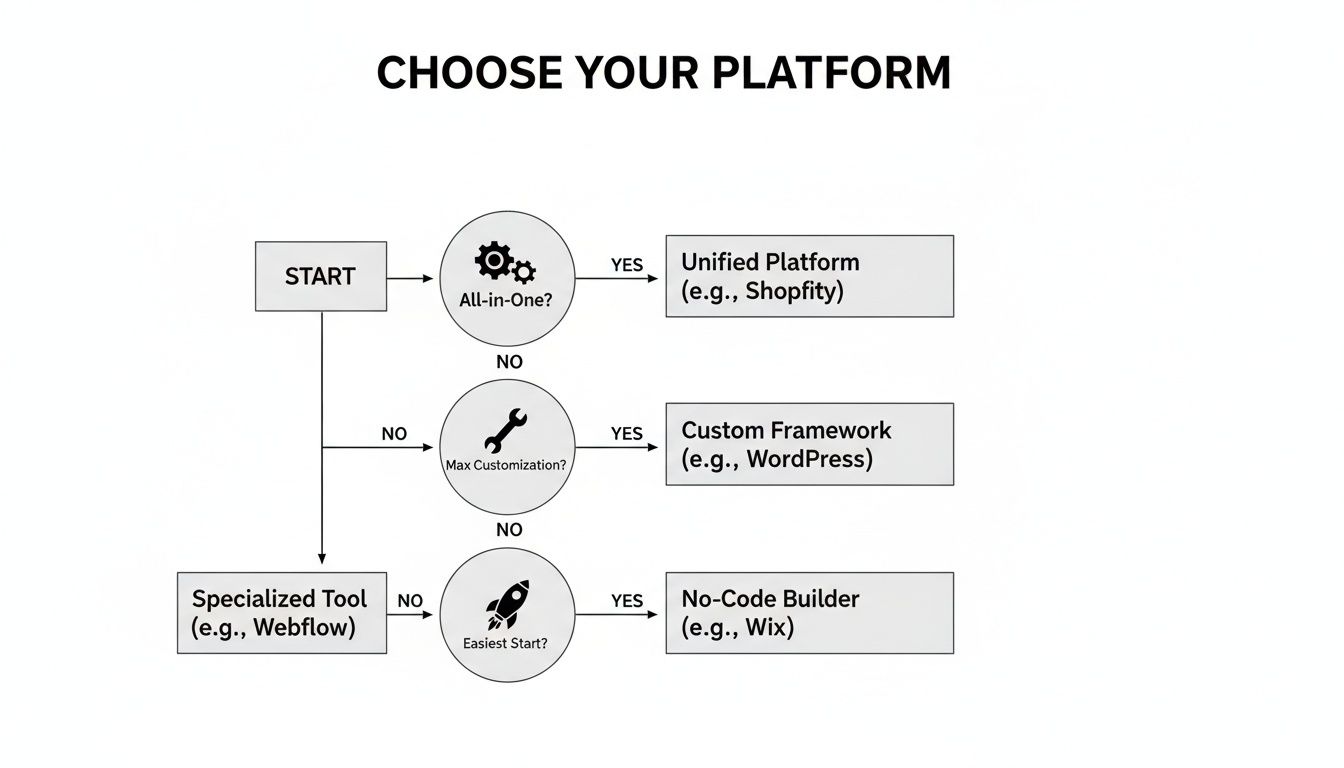
As you can see, your starting point is everything. Are you trying to simplify your tech stack? Do you need total creative freedom? Or do you just need to get your course launched fast? Answering that question is the first step.
The All-In-One Solopreneur
If you’re a coach, consultant, or small business owner who dreams of running everything from one central dashboard, this is you. Your biggest bottleneck isn’t a lack of expertise—it’s juggling time and technology. You need a platform that can handle your courses, marketing, sales funnels, and community without forcing you to patch together a dozen different apps.
For this creator, Kajabi is the undisputed champion. It’s built to be a true business-in-a-box, integrating email marketing, landing pages, a website builder, and even a podcast host. This isn’t just about convenience; it gives you a unified view of your entire customer journey, from the first blog post they read to the final course they purchase.
By bringing everything under one roof, an all-in-one platform like Kajabi frees up your mental energy to focus on what you do best: creating great content and serving your students. You trade some creative flexibility for a massive boost in operational efficiency.
Sure, the monthly investment is higher, but you’re eliminating separate subscriptions for your email provider, funnel builder, and website hosting. For the solopreneur ready to scale, that kind of efficiency is a game-changer.
The Educator Focused on Learning Outcomes
You’re an academic, a corporate trainer, or a deep subject matter expert. For you, it’s all about the student’s experience and making sure they actually learn. You’re thinking less about marketing funnels and more about delivering impactful, engaging educational content with things like advanced quizzes, graded assignments, and official certifications.
This is where Thinkific really shines. The entire platform is architected around creating a rich, interactive learning environment. While it supports all the standard content types you’d expect, its secret weapon is the Thinkific App Store. This lets you bolt on specialized tools for gamification, live chat, or sophisticated assessment tools, allowing you to build a truly unique and effective learning journey.
This focus on educational tools means you can design a learning experience that truly reflects your teaching philosophy and meets the specific needs of your audience. It’s ideal for anyone delivering high-stakes training or certification programs.
The Community Builder and Membership Maven
Your business isn’t built on a one-time course sale; it’s built on recurring revenue and fostering a thriving community. You’re selling ongoing access to an experience, and your biggest challenge is keeping members engaged month after month.
A platform with deeply integrated community features isn’t just a nice-to-have—it’s essential. This is where a tool like Podia becomes a fantastic fit. It provides a clean, unified space where your courses, digital products, and private membership community all live together. The entire interface is designed for interaction, making it simple for members to connect with you and, more importantly, with each other.
The potential here is enormous. The enterprise e-learning market is booming, with projections showing 93% of businesses will adopt it for training, leading to a 42% revenue uplift per employee. While giants like LinkedIn Learning own the corporate space, platforms like Teachable show what’s possible for independent creators, with its 35 million users generating over $500 million. These numbers prove the massive opportunity for creators who build a loyal audience. You can discover more insights about the expanding learning platform market to see these trends in action.
The Digital Product Generalist
You’re a multi-passionate creator. You don’t just sell courses—you have ebooks, templates, coaching calls, webinars, and a whole suite of digital downloads. Your biggest headache is finding a single platform that can sell this diverse product line without looking cluttered or being a nightmare to manage on the back end.
Once again, Podia stands out as a top choice. It was designed from day one to be a simple, elegant storefront for every kind of digital product. You can easily bundle a course with an ebook, sell a standalone webinar ticket, and list your coaching services, all from one clean dashboard. Its core strength is its simplicity, helping you get your entire product catalog online and ready to sell in no time.
How to Test and Launch Your Course Successfully

You’ve done the hard work of comparing platforms and you’ve finally picked a winner. That’s a huge milestone, but now the real work begins. Getting from a decision to a live, money-making course takes a smart, step-by-step plan. This roadmap is all about moving from theory to action, giving you the clarity to set up your school and launch with confidence.
First things first: that free trial. Almost every platform dangles one, but most people waste it. Don’t just click around and admire the dashboard. You need to treat this trial period as a serious stress test for the features that will make or break your business and your students’ experience.
How to Get the Most Out of Your Free Trial
Your mission during the trial is to mimic exactly what you’ll be doing when you go live. Instead of building one half-baked lesson, create an entire mini-course. This forces you to actually use the platform’s workflow from A to Z, uncovering any annoying quirks or deal-breakers before you’ve spent a dime.
Here’s where to focus your energy:
- Content Upload & Organization: Try uploading everything you plan to use—videos, PDFs, audio files, you name it. How fast does it process? Is it a pain to organize? Build a few modules and lessons to get a real feel for the course builder’s flow.
- The Student’s Point of View: Create a test student account and log in. Go through your own mini-course. Take a quiz. Check your progress. Is it a smooth, intuitive experience, or is it clunky and confusing?
- The All-Important Checkout: Connect a test payment processor and buy your own course. This is where the money is made, and any friction at all in the checkout process will kill your sales.
By putting these specific functions through their paces, you’ll get practical knowledge that no feature list can ever give you. It’s the only way to know for sure if a platform’s workflow actually fits how you like to work.
A free trial isn’t for window shopping; it’s a dress rehearsal for your business. Use it to build, sell, and support a mock version of your course to ensure the platform can handle the demands of a real launch.
Your Pre-Launch Technical Checklist
Once you’ve validated your choice, it’s time to lay the technical groundwork for your school. This is your pre-flight checklist. Ticking these boxes systematically will save you from the frantic, last-minute scramble that plagues so many course creators.
- Brand Your School: Get your logo uploaded, set your brand colors, and pick your fonts. A professional, consistent look builds immediate trust.
- Connect Your Custom Domain: Ditch the generic platform URL (like
yourschool.teachable.com) and set up your own (likecourses.yourbrand.com). This is non-negotiable for looking like a serious business. - Set Up Your Payment Gateway: Connect your Stripe or PayPal account. Make absolutely sure it’s fully verified and ready to take payments in the currencies you need.
- Integrate Your Email Service: Hook up your email marketing tool, whether it’s ConvertKit or Mailchimp. You need to make sure every new student automatically lands on the right email list so you can stay in touch. For more on creating focused work environments, check out our guide on how to eliminate distractions.
Designing a Phased Launch Strategy
A great launch isn’t a one-day event. It’s a carefully planned sequence of events designed to build buzz and gather crucial feedback. The global online education market hit an incredible USD 347.45 billion in 2025, and self-paced learning made up 42.75% of that. The demand is massive, and a phased launch helps you capture it without getting overwhelmed. You can learn more about the booming online education market and its rapid growth.
Instead of flipping a switch and hoping for the best, try this three-phase approach:
- Phase 1: The Beta Launch: Offer your course to a small, hand-picked group at a steep discount. Their job is to find bugs, give you honest feedback on your content, and provide you with those all-important first testimonials.
- Phase 2: The Early Bird Launch: Now, open enrollment to your email list with a special, time-sensitive discount. This rewards your most dedicated followers and creates a powerful sense of urgency.
- Phase 3: The Public Launch: Finally, open the doors to the general public at the full price. By this stage, you’ll have testimonials, a polished course, and a tech setup that you know works perfectly.
Got Questions? Let’s Get Them Answered
Diving into the world of online course platforms can feel like a maze. Even after you’ve compared all the features and pricing tables, some nagging questions often remain. This section is here to clear up those final uncertainties.
Think of this as a final Q&A session before you commit. We’ll tackle the common “what ifs” and “how does this work” questions that pop up for creators just like you. Let’s get you the clarity you need to move forward with confidence.
Can I Switch Platforms Later If I Change My Mind?
The short answer is yes, but it’s a serious undertaking. Migrating your courses and students isn’t a simple click-and-drag operation; it’s a full-blown project that demands careful planning.
Most platforms will let you export your core content—videos, PDFs, and your student email list. The real work comes when you have to manually rebuild everything on the new platform. Your course curriculum, sales pages, quizzes, and community forums all have to be painstakingly reconstructed. This is exactly why getting it right the first time is so important.
Choosing a platform is like laying the foundation for a house. You can move later, but it’s a massive, disruptive effort. Taking the time now to pick a platform that can grow with you will save you a world of headaches down the road.
If you suspect your needs might evolve, make robust data export options a non-negotiable feature in your initial search. That one detail can make a future migration far less painful.
Do I Still Need a Website with an All-in-One Platform?
Not necessarily, and frankly, that’s their biggest appeal. A true all-in-one platform like Kajabi is designed to be your entire online business headquarters, making a separate website redundant.
They give you the tools to build your public-facing website, blog, and sales funnels right alongside your private course area. For creators looking to simplify their tech stack, this is a game-changer. It means one less login, one less monthly bill, and perfect data flow between your marketing and your products. You get to spend more time creating and less time wrestling with tech.
How Are These Platforms Different from Udemy?
The difference comes down to one core concept: control versus exposure.
When you use a platform like Thinkific or Teachable, you’re building your own branded academy on your own piece of digital real estate. You call all the shots:
- Your Brand: From your custom domain to the colors in the student dashboard, it’s all you.
- Your Pricing: You set the price, you create the payment plans, and you run sales whenever you want.
- Your Student Data: The student list is yours. You can email them directly and build a real relationship.
A marketplace like Udemy, on the other hand, is like a giant digital bookstore. You give up that autonomy in exchange for a shot at its massive, built-in audience. They do a lot of the marketing for you, but they also dictate pricing rules, take a hefty slice of your revenue (up to 63% in some scenarios), and place a wall between you and your students. A dedicated platform means you’re building a real business you actually own.
How Important Are Built-in Community Features?
They’re quickly moving from a “nice-to-have” feature to an absolute must-have for long-term success. A community transforms your course from a static library of content into a living, breathing learning ecosystem.
This has a direct and measurable impact on your bottom line. When students can connect with each other, ask questions, and get support, they’re far more likely to stick around and finish the course. This engagement leads to better student outcomes, which generates incredible testimonials and slashes refund requests. For many top-tier creators, the community is the very thing that justifies premium pricing and creates loyal, repeat buyers.
Ready to build a business that aligns with your vision for personal and professional growth? At David Pexa, we provide the clear guidance and practical strategies you need to make confident choices. Explore our in-depth resources and curated recommendations to elevate how you think, feel, and live. Find your path to success at https://davidpexa.com.
