


That swell of pride at a graduation ceremony, tinged with the unmistakable sadness of an ending? That’s the very heart of mixed emotions. This experience of feeling two seemingly opposite things at once—joy and sorrow, excitement and fear—isn’t a sign of confusion. It’s a fundamental part of being human.
When Happiness and Sadness Collide

Have you ever felt a sudden pang of loss during a moment of pure celebration? Or a flicker of hope in the midst of deep frustration? If you have, it simply means you’re experiencing the rich, complex texture of a meaningful life. These emotional combinations aren’t a bug in our system; they’re a feature.
Think of a parent dropping their child off for the first day of school. There’s immense pride and excitement for this new chapter, but it’s often paired with a quiet grief for the toddler years that are now officially in the past. Or consider the feeling of starting a dream job—the thrill of the opportunity is real, but so is the anxiety of leaving the comfort and familiarity of your old role.
These aren’t rare occurrences. They are cornerstone human experiences.
The Truth About Emotional Overlap
From a young age, we’re often taught to put our feelings into neat little boxes: happy or sad, angry or afraid. But real life is messy and rarely fits into such tidy categories. Most significant life events involve both gains and losses, so it’s only natural that they trigger a blend of positive and negative emotions.
This emotional overlap is far more common than most people realize. In fact, research shows that mixed emotions occur in about 36% of our emotional episodes. This finding challenges the old assumption that our inner world is dominated by singular feelings. For more than a third of the time we feel something deeply, it’s a combination of the “good” and the “bad.”
Embracing this emotional complexity isn’t a sign of being conflicted. It’s a hallmark of a rich, deeply felt life and proof that you’re fully engaged with the nuances of your own story.
Moving From Conflict to Clarity
The real breakthrough comes when we stop seeing these feelings as being in conflict with each other. Instead of thinking, “I’m excited about this, but I’m also sad,” try reframing it with a simple yet powerful word: “and.”
“I’m excited about this new chapter, and I’m sad to leave the old one behind.”
This small shift in language validates both feelings, allowing them to exist together without one canceling the other out. Recognizing and accepting your mixed emotions is the first, most crucial step toward genuine self-awareness.
When you give yourself permission to feel both the joy and the sorrow, you get a much clearer, more honest picture of what a situation truly means to you. This understanding doesn’t just help you; it deepens your relationships by empowering you to show up more authentically for others. By learning to sit with these feelings, you can turn them from a source of confusion into a powerful compass for personal growth.
The Psychology Behind Your Complex Feelings
Ever felt happy and sad at the very same time? If so, you’re not broken—you’re human. Far from being a sign of confusion, the ability to hold seemingly contradictory feelings is actually one of your mind’s most sophisticated tools for navigating a complex world.
I like to think of it like a rich musical chord. A single note, like pure happiness, is simple. But when you add another note, like a touch of sadness, you don’t get noise. You get a chord—something with far more depth and emotional resonance. That’s exactly what mixed emotions are: a blend of distinct feelings that tells a much fuller story.
This internal experience isn’t random. It’s a direct and honest psychological response to life’s biggest moments, which almost never fit into neat little boxes of “good” or “bad.”
Common Triggers for Mixed Feelings
Certain life events are practically guaranteed to stir up mixed feelings because they involve major transitions. These are the moments where we’re simultaneously closing one chapter and starting another, making it nearly impossible to feel just one way.
Think about these common scenarios:
- Landing a major promotion. Of course, you feel the pride and excitement of being recognized for your hard work. But right alongside that joy, you might feel a pang of anxiety about the new pressures or a genuine sadness about leaving your old team behind.
- A child or loved one moving away. You can be bursting with happiness for their new adventure and bright future. That happiness doesn’t cancel out the deep ache of knowing they won’t be around the corner anymore. The two feelings coexist.
- Making a positive life change. You might feel incredibly proud of starting a new fitness routine and energized by the progress. At the same time, you can also miss old comforts or feel frustrated that the change isn’t happening faster.
In each of these situations, the positive and negative feelings aren’t fighting each other. They’re two sides of the same emotional coin, reflecting the complete truth of an experience. If you want to dig deeper into these core concepts, exploring the essentials of understanding psychology is a great place to start.
At its core, the experience of mixed emotions is an adaptive mechanism. It allows us to process the full reality of a situation without being forced into an overly simplistic, black-or-white judgment. It’s your mind’s way of holding complexity.
The Purpose of Emotional Duality
So, what’s the point of feeling happy and sad at once? This capacity serves a critical purpose: it helps us move through life with more wisdom and resilience. Instead of forcing ourselves into a corner—”this is great” or “this is awful”—mixed emotions allow us to embrace a much more accurate perspective: “This is wonderful, and it’s also really hard.”
This is a hallmark of emotional maturity. It shows you can hold multiple truths at once, which is absolutely crucial for making sound decisions and building empathetic relationships. A leader who feels both optimism for a new direction and genuine concern for their team’s workload is going to navigate that change far more effectively than one who only sees the upside.
A polar scientist I once read about perfectly described this. He felt a profound sense of excitement before his 15th trip to Antarctica, a place he truly loved. But that joy was woven together with the deep sadness of leaving his family for months. The thrill of adventure and the sorrow of goodbye weren’t a contradiction; they were the complete, honest truth of his experience.
This psychological dance actually prepares us for what’s next. That hint of anxiety mixed with excitement pushes us to plan more carefully. The touch of sadness that accompanies a happy milestone helps us honor what we’re leaving behind, allowing us to move forward without pretending the past didn’t matter. Ultimately, your mixed emotions aren’t a problem to be solved—they’re a guide to be understood.
How Your Brain Processes Mixed Emotions
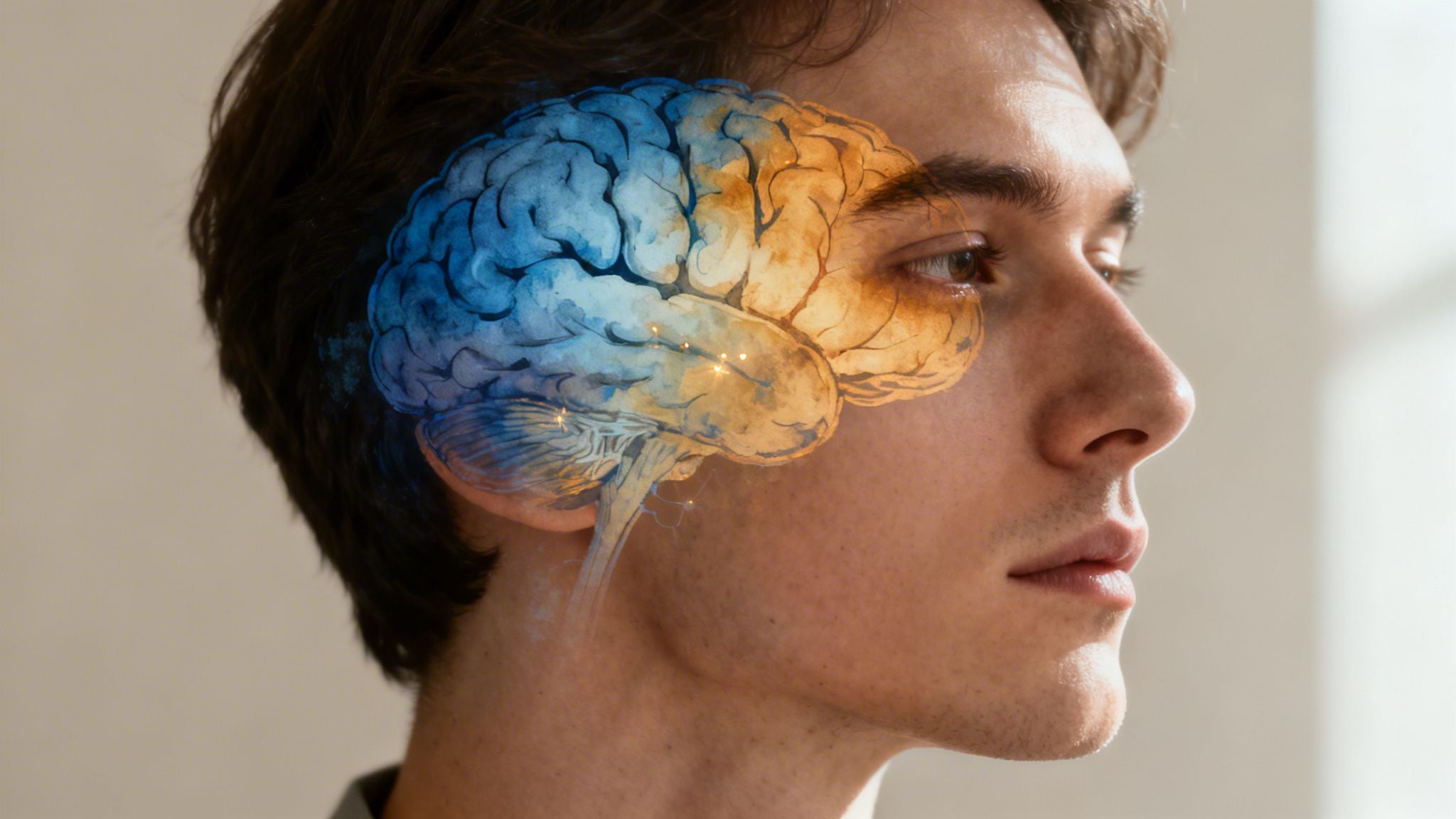
While we can talk about the psychology of mixed emotions, what’s actually happening inside our heads when we feel them? For a long time, scientists wondered if the brain was just flipping back and forth between “happy” and “sad” signals at lightning speed.
That was the common assumption—that you’re just ping-ponging between two separate feelings. But modern neuroscience shows us a much more fascinating reality. Feeling two things at once isn’t a glitch; it’s a completely distinct and sophisticated state of mind.
Think of it like a painter’s palette. Your brain isn’t just dabbing some yellow paint on the canvas, wiping the brush, and then dabbing some blue. It’s actively blending the two colors to create a whole new shade of green—one that has hints of both yellow and blue, but is ultimately its own unique color.
The Brain’s Unique Emotional Signature
And it turns out, this isn’t just a nice metaphor. Neuroscience actually backs it up. A recent 2026 study from the University of Southern California used fMRI scans to see what was happening in real-time as people watched an emotionally complex animated film designed to bring up these exact feelings.
The results were incredibly clear. Experiencing mixed emotions creates a unique, sustained neural signature in the brain. Instead of seeing the brain flicker between positive and negative activity, researchers saw key areas working together to create a blended state. Specifically, they noted coordinated activity in the amygdala (your brain’s emotion-processing hub) and the nucleus accumbens (a core part of your reward system).
As lead researcher Anthony Vaccaro put it, “You’re not ping-ponging between negative and positive. It’s a very unique, mixed emotion over a long period.” You can read more about the study’s findings on mixed emotions and their neurological basis.
This research validates what you’ve always felt. That bittersweet ache is not just “in your head”—it’s a measurable, tangible event happening in your brain.
Understanding this takes “conflicting feelings” out of the realm of confusion and shows them for what they are: a defined neurological event. It allows you to see your emotional depth not as a bug, but as a biological feature.
What This Means For You
So, what does all this brain science mean for you in the real world? It gives you a rock-solid, evidence-based reason to trust what you’re feeling, even when it seems contradictory on the surface.
The next time you face a moment that brings both joy and sorrow, remember this:
- You’re not confused or broken. Your brain is working exactly as it should, skillfully processing the full picture of a meaningful life event.
- Your feelings are completely valid. Science shows that the blend of emotions you’re experiencing is a real, singular state, not a chaotic back-and-forth.
- You have the capacity to hold this complexity. Your brain is literally built for it. The discomfort you might feel is just part of the process of making sense of life’s biggest moments.
This biological reality moves mixed emotions from an abstract idea into the concrete world of neuroscience. It confirms that the bittersweet pride of watching a child graduate or the excitement-tinged fear of a new beginning are fundamental to how our brilliant minds interpret the world. Your capacity for mixed feelings is a testament to the remarkable complexity of being human.
Real-World Scenarios That Trigger Mixed Emotions
The science behind mixed emotions is fascinating, but where it really starts to make sense is in our own lives. These feelings aren’t just abstract psychological concepts; they’re tangled up in the very fabric of our biggest moments. Once you see them play out in familiar stories, you can start to recognize the same patterns in your own experience.
Life’s major milestones are rarely just one thing. They’re almost always defined by what we’re gaining and what we’re letting go of. That inherent tension is exactly why they stir up such a potent cocktail of emotions. It isn’t a sign of confusion—it’s the honest, complete truth of the moment.
Let’s explore a few situations where this emotional complexity shows up.
Landing That Big Promotion
Picture this: you get the call. The promotion you’ve been hustling for, the one that kept you late at the office for months, is finally yours. The first wave is pure elation. A surge of pride, a thrill for the new title and bigger paycheck, and a deep sense of validation for all that hard work. You did it.
But then, as the champagne settles, other feelings start to surface. A knot of anxiety might tighten in your stomach when you think about the new responsibilities and the pressure to deliver. You might feel a pang of sadness at the thought of leaving your old team, the inside jokes, and the easy camaraderie you built. Maybe even a flicker of fear—am I really ready for this?
These feelings aren’t fighting each other. They’re painting a complete picture of the transition:
- Positive: Pride, excitement, validation, joy
- Negative: Anxiety, fear, sadness, pressure
The real conflict here is between the thrill of moving forward and the fear of the unknown. Both are completely valid, and acknowledging them is what allows you to step into that new role with your eyes wide open, ready for the challenges just as much as the rewards.
Becoming a New Parent
Bringing a child into the world is often described as life’s most profound experience. The love you feel for your newborn can be staggering, an absolute and overwhelming force. It’s a sense of purpose and connection so intense it can bring you to tears. Pure joy.
Yet, right alongside that incredible love, many new parents feel a quiet sense of loss. They grieve for the freedom and spontaneity they once had—the ability to sleep in, go out at a moment’s notice, or just focus on their own needs. This is often paired with bone-deep exhaustion and a constant, humming worry about this immense new responsibility.
This blend of overwhelming love and a quiet grief for a past self is one of the most classic examples of mixed emotions. Acknowledging the sadness doesn’t diminish the love; it simply honors the magnitude of the life change.
This scenario perfectly captures the tension between embracing a new, profound identity and letting go of the old one. By understanding the emotional value of what you’re feeling—both the joy and the grief—you can navigate this massive life change with more grace.
Moving to a New City
Relocating for a fantastic job or a fresh start is undeniably exciting. There’s a powerful sense of adventure, a rush of optimism for the future, and an eagerness to explore a new place and build a new life. The possibilities feel endless.
At the exact same time, leaving is an act of loss. You’re saying goodbye to friends who feel like family, to your favorite coffee shop, to a support system you may have spent years building. This can trigger a deep sense of loneliness, sadness, and even a bit of fear about having to start all over again. The excitement for what’s ahead doesn’t cancel out the ache of leaving things behind.
This common experience sets up a clear emotional dynamic:
- The Pull Forward: Excitement, adventure, hope
- The Tug Backward: Sadness, nostalgia, loneliness
To make this even clearer, let’s map out how these feelings appear in a few common situations.
Mapping Your Mixed Emotions in Common Situations
This table breaks down common life events, identifying the conflicting positive and negative emotions they often trigger, helping you recognize and name your own feelings.
| Situation | Common Positive Emotions | Common Negative Emotions | The Core Conflict |
|---|---|---|---|
| Graduating from School | Pride, relief, excitement, freedom | Sadness, nostalgia, anxiety, fear of the unknown | Celebrating an achievement while mourning the end of an era and facing an uncertain future. |
| Starting a New Relationship | Joy, excitement, hope, connection | Fear of vulnerability, anxiety about getting hurt, loss of independence | The thrill of new intimacy versus the fear of potential pain and the loss of singlehood. |
| Finishing a Major Project | Accomplishment, pride, relief | Emptiness, sadness (“post-project blues”), exhaustion | The satisfaction of completion paired with a sense of loss of purpose or identity. |
| Watching a Child Leave Home | Pride in their independence, excitement for their future | Sadness, loneliness (“empty nest”), worry | Joy for your child’s growth clashing with the personal loss of their daily presence. |
Recognizing these patterns isn’t about solving a problem; it’s about validation. Seeing that your complex feelings are a shared human experience is the first step. It reminds us that feeling multiple things at once isn’t a sign of being broken—it’s a sign that we are living fully.
Knowing the theory behind mixed emotions is one thing. Knowing what to do when you’re feeling pulled in two directions at once? That’s something else entirely.
True growth happens when we can move from understanding to action. This isn’t about making the uncomfortable feelings disappear. It’s about learning to hold them—to sit with two seemingly opposite truths and find your way forward through the complexity.
Here’s a practical, step-by-step approach to do just that.
Step 1: Acknowledge Both Feelings Without Judging
First things first: just let the feelings be there. Don’t fight them. Our immediate instinct is often to pick a side, labeling one emotion “good” and the other “bad.” This just creates an internal war you can’t win.
Instead, get curious. If you’re thrilled about a promotion but also terrified of the new responsibility, just notice both. You can even say it out loud or to yourself: “I feel excited, and I feel scared.” By simply acknowledging both are present, you stop the internal tug-of-war and create space to actually understand what’s going on.
Step 2: Explore the “Why” Behind Each Emotion
Once you’ve given both feelings a seat at the table, it’s time to listen. Every emotion is a messenger, carrying information about your deepest needs, values, and fears.
Ask yourself what each feeling is trying to tell you.
- Why am I excited? Maybe this new chapter aligns with a core value, like growth, or offers a chance for adventure.
- Why am I sad/scared? Perhaps you’re mourning the loss of comfort and familiarity, or you fear losing connections you’ve worked hard to build.
Journaling is a fantastic tool here. You don’t need to write a novel; just a few lines can bring incredible clarity. Try these prompts to get started:
- “The joy I’m feeling is connected to…”
- “The anxiety I’m feeling is trying to protect me from…”
- “What does this situation really mean to me and my future?”
Step 3: Practice Sitting With the Discomfort
Let’s be honest—holding two conflicting feelings is uncomfortable. Our brains are wired for certainty and will push for a quick, clean resolution. Your job is to gently resist that urge.
This skill is called affect tolerance, and it’s like a muscle. The more you consciously practice sitting with the tension of a “both/and” reality, the stronger your emotional resilience gets. This isn’t just a nice-to-have skill; it becomes more critical as we get older. Research shows that our experience of mixed emotions can nearly double between the ages of 30 and 70, making this an essential tool for navigating a rich, complex life.
Step 4: Embrace the “And” Mindset
This step is a small language shift with a massive impact. Whenever you describe your feelings, swap the word “but” for “and.”
Notice the difference:
“I’m excited for this new chapter, but I’m scared.” This phrasing immediately puts your feelings in opposition. It implies one has to cancel the other out.
“I’m excited for this new chapter, and I’m scared.” This simple change validates both. They can coexist. Both are true.
Adopting an “And Mindset” fundamentally changes your internal conversation from one of conflict to one of integration. It’s a powerful acknowledgment that life is rarely black or white.
The infographic below shows how this process works in a few common, messy, and totally normal life transitions.
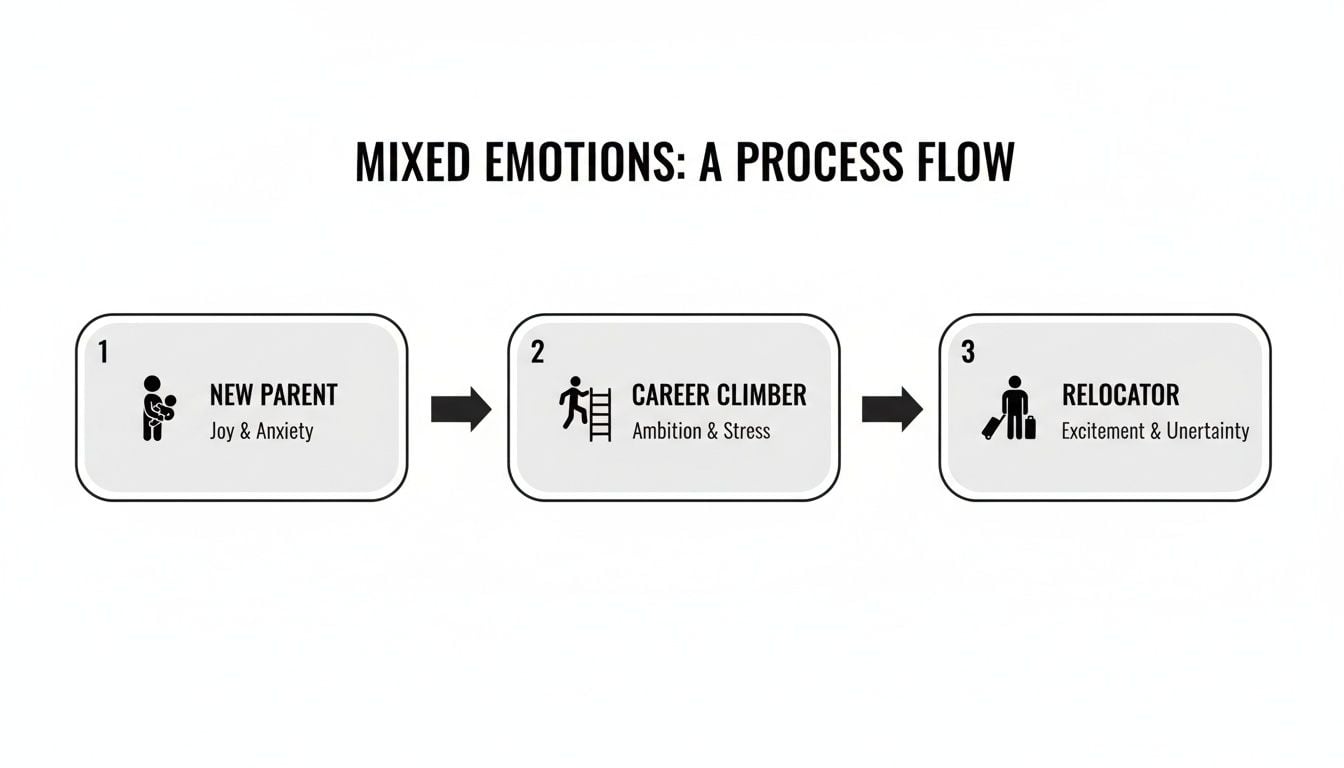
Whether you’re becoming a parent, climbing the career ladder, or moving to a new city, the path forward involves embracing both the good and the hard stuff at the same time.
Step 5: Take Action That Aligns With Your Values
After you’ve acknowledged, explored, and sat with your feelings, you’re in a much better position to act. The goal isn’t to make a decision that magically erases one of the emotions. It’s about making a choice that honors your core values, even if it feels a little scary.
Go back to what you uncovered in Step 2. What truly matters to you in this situation? Growth? Security? Connection? Adventure?
By understanding the messages from all your emotions, you can make a choice that honors the whole picture. You might take that new job (valuing growth and opportunity) while also making a plan to stay in touch with your old colleagues (honoring connection). You don’t have to pick one. You can, and often must, do both.
This five-step framework gives you a reliable map for the confusing territory of your own heart. If you want to get better at naming what you’re feeling in the first place, our comprehensive emotions chart is an amazing resource. With practice, you can learn to turn emotional complexity from a source of stress into your greatest source of wisdom.
Frequently Asked Questions About Mixed Emotions
As you start paying closer attention to your inner world, some common questions are bound to come up. Let’s walk through a few of the most frequent ones I hear from clients. This should help clear up any lingering confusion and give you the confidence to work with your complex feelings, not against them.
Is It Unhealthy to Experience Mixed Emotions Often?
Absolutely not. In fact, it’s quite the opposite. Regularly experiencing mixed emotions is often a sign of emotional maturity. It shows you have the capacity to see the gray areas in life, rather than seeing everything in black and white.
This only becomes a problem if you feel chronically paralyzed or overwhelmed by the competing feelings. The whole point of the strategies in this guide is to help you move through that discomfort, understand the messages your emotions are sending, and find a clear path forward.
Are Mixed Emotions the Same as Indecisiveness?
That’s a great question, and they are definitely related, but not the same thing. Mixed emotions are the feelings themselves—that swirl of excitement and terror you get when thinking about a big career change, for example. Indecisiveness is the inability to make a choice, which is often a direct result of not properly acknowledging or processing those mixed emotions.
By using a framework to sit with both feelings, you can break through the indecision. Recognizing the fear doesn’t mean you turn down the opportunity. It means you make a more informed decision, ready to manage the challenges while also embracing the rewards.
The goal isn’t to eliminate one feeling to make a decision easier. It’s to understand both so you can make a choice that honors your complete emotional reality.
How Can I Explain My Mixed Feelings to Others?
One of the simplest yet most powerful tools is swapping the word “but” for “and.”
When you say, “I’m excited about this move, but I’m sad to leave my friends,” the “but” invalidates the first feeling. It sets them up in opposition.
Try this instead: “I’m so excited about this move, and I’m also really sad to be leaving my friends.” This phrasing beautifully communicates that both feelings are true and co-exist. It helps others see you’re not just confused; you’re navigating a rich, multi-layered experience. This invites empathy instead of a rush to problem-solve for you.
Could My Mixed Emotions Be a Sign of Bipolar Disorder?
While both involve complex emotional states, they are fundamentally different things. Mixed emotions are a near-universal human experience, typically tied to a specific situation where it makes sense to feel conflicting ways at the same time.
Bipolar disorder, however, is a clinical diagnosis involving distinct and pervasive mood episodes (like mania and depression). These episodes are far more severe, last much longer, and can happen without any clear trigger. The clinical term ‘mixed features’ describes a serious condition where symptoms of both mania and depression occur simultaneously.
If you feel your moods are extreme, hard to control, and are disrupting your ability to function, it’s always best to consult a mental health professional for a proper diagnosis and support.
At David Pexa, I provide structured, evidence-informed guidance to help you master your mindset and build a more intentional life. Discover actionable frameworks and curated tools to turn complexity into clarity by visiting https://davidpexa.com.
