



Learning how to take notes from a book effectively boils down to one powerful shift: moving from a passive highlighter to an active, purpose-driven reader. It’s all about having a goal before you even start, wrestling with the text by asking questions, and then structuring your notes so you can actually understand and use them—not just copy them down.
Why Your Current Note-Taking Method Doesn’t Work
Ever finish a fantastic book, buzzing with ideas, only to have its key lessons vanish from your mind a week later? You’re definitely not alone. The common habit of just highlighting sentences or scribbling down a few quotes is a perfect recipe for forgotten wisdom. It feels productive at the moment, but it fails to build any real, lasting knowledge.
The problem isn’t that you’re not trying; it’s the lack of intention and structure. When you dive into a book without a clear goal, your brain has no idea what information to grab onto. Highlighting becomes a substitute for actual thinking, letting you mark up a page without ever truly processing what it means.

The Cycle of Passive Learning
This cycle is incredibly common and, frankly, frustrating. It probably looks familiar:
- Read and Highlight: You underline interesting sentences and dog-ear pages, feeling like you’re capturing all the good stuff.
- Forget and Repeat: A few weeks go by, and the specifics get fuzzy. You might remember the book’s general topic, but you’d struggle to recall the powerful insights you highlighted.
- The Illusion of Knowledge: You feel like you learned something because you finished the book, but that knowledge isn’t there for you when you actually need it.
This guide is about breaking that cycle. Truly learning from a book isn’t about collecting quotes. It’s about building a bridge between the author’s ideas and your own life and understanding. That requires a system that forces you to engage, to question, and to synthesize.
“Passive reading gives you information. Active note-taking builds knowledge. The difference is whether the ideas stay on the page or become part of how you think and act.”
This is exactly why so many notes end up in a “digital graveyard”—a forgotten folder full of clippings and highlights that are never seen again. To make knowledge stick, you need a workflow that turns passive consumption into active creation.
We’re going to walk through a framework that bridges that gap between just reading words and actually applying powerful ideas. A critical first step is clearing your head before you even start. To really nail this, check out my guide on how to eliminate distractions.
This whole system kicks off before you even open the book, with a few strategies to prime your mind for what’s coming. I’ll show you how to set a clear purpose, engage directly with the text, and build a personal knowledge base that genuinely fuels your growth. It’s time to stop collecting information and start building wisdom.
Prime Your Mind Before You Open the Book
Let’s be honest, great note-taking doesn’t start when you crack open a book. It starts before you even read the first sentence. The most effective readers I know all have a pre-reading ritual. This isn’t some mystical process; it’s about building a mental framework so the right information has something to stick to.
Without this prep work, you’re just a passive passenger on the author’s train of thought. But with a clear goal, you become an active investigator, hunting for specific answers and insights you can use right away.
Define Your Why
First things first: get brutally honest about why you’re reading this particular book. Your purpose is the filter for everything that follows—it dictates what you pay attention to and, ultimately, what ends up in your notes.
Are you trying to solve a specific business problem? Learn a new skill for a promotion? Or are you just trying to understand a new way of thinking to improve your life?
For example, when I picked up Deep Work by Cal Newport, my “why” wasn’t vague. It was laser-focused: “I need two or three practical strategies to kill daily distractions and get more focused coding time.” This meant I wasn’t just casually reading about focus; I was actively scanning for rules and systems I could implement the next day.
Perform a Book Reconnaissance
Once you know your mission, do a quick “reconnaissance” of the book. Think of it like looking at a city map before you start wandering the streets. You’re not trying to see everything, just getting the lay of the land.
This whole process should only take about five minutes. Here’s what to look for:
- Table of Contents: This is the author’s entire argument laid out for you. Scan the chapter titles to understand the logical flow.
- Introduction and Conclusion: Always read these first. The intro is the author’s promise to you, and the conclusion is their summary of what they delivered.
- Key Diagrams or Bolded Terms: Flip through the book and look for anything that stands out—visuals, callout boxes, or bolded text. These are the signposts pointing to the most important concepts.
A quick five-minute flyover like this primes your brain. It creates mental “hooks” so that when you encounter a new idea during your deep read, it has a place to land.
Formulate Specific Questions
Now for the most critical step: turn your “why” into a handful of direct questions. This is what truly shifts you from passive reading to an active, engaged state. Instead of waiting for the author to feed you information, you show up demanding answers. This is a game-changer for focus and, as a side benefit, it’s one of the best ways to learn how to increase mental stamina when tackling dense material.
Let’s say you’re reading Atomic Habits to finally stick to a workout routine. Your questions might look something like this:
- What’s the best way to start a new habit when my motivation is at zero?
- How do I set up my environment to make skipping a workout harder than actually doing it?
- What’s a practical system for tracking progress that won’t make me feel discouraged?
Armed with questions like these, your reading is no longer a passive activity. It has a direction. Every note you take will be a direct answer to one of your questions, making them instantly relevant, focused, and ready for action.
Finding the Right Note Taking System for You
Alright, let’s get tactical. You’ve primed your mind and you’re ready to dig in, but how do you actually capture insights in a way that’s useful later on? This is where a structured system comes in. It’s what separates casual readers from serious learners who build a real, lasting body of knowledge. Without a system, your notes just become a messy collection of quotes instead of a powerful personal library.
The goal isn’t just to write stuff down. It’s to build a framework that forces you to process what you’re reading, connect the dots, and really make the ideas your own. Here’s a practical breakdown of two powerful frameworks that I’ve seen work wonders, each serving a different but equally important purpose.
This little decision tree below maps out the crucial pre-reading steps. They really are the foundation for any solid note-taking session.
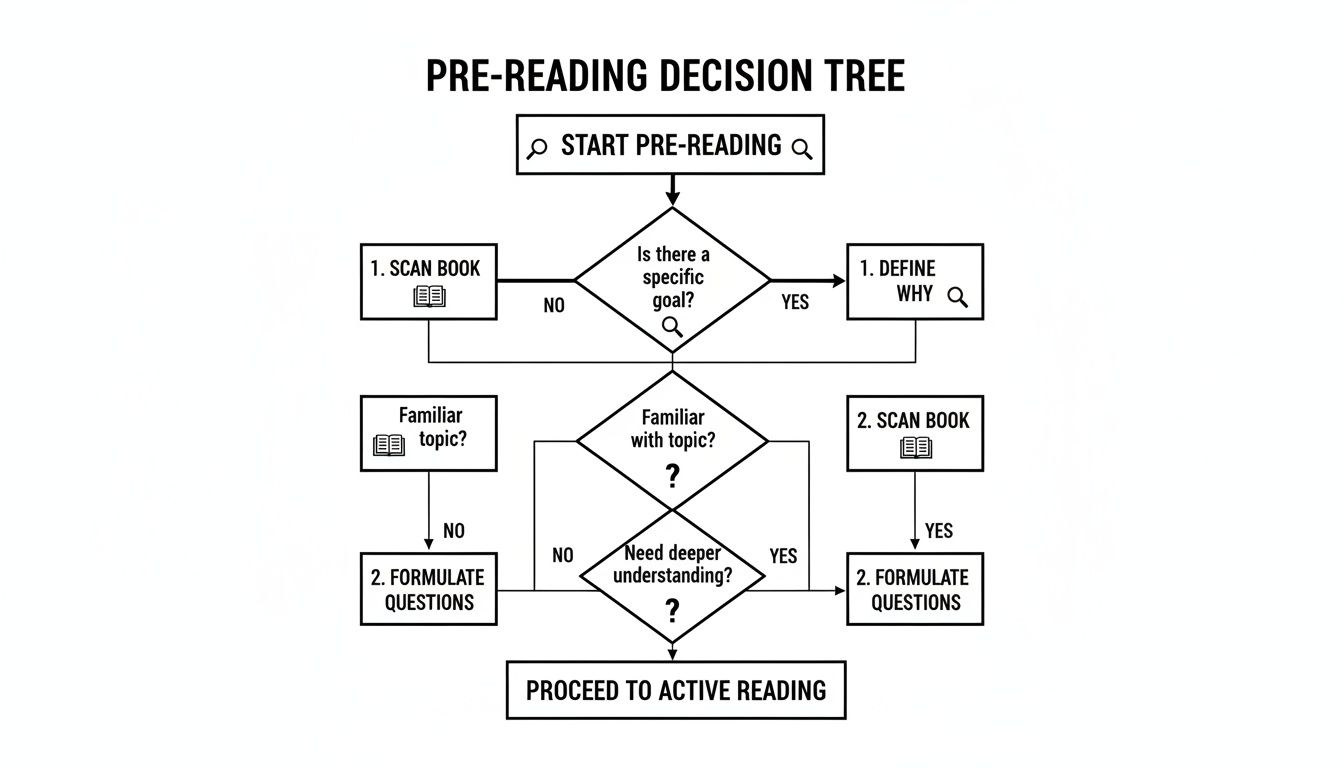
As you can see, defining your purpose, scanning the book’s layout, and cooking up some targeted questions aren’t just random acts. They build on each other, giving you a clear roadmap before you even read the first page.
Master the Cornell Note Taking System
The Cornell Note-Taking System is a classic for a good reason: it’s simple, it’s effective, and it forces you to actually think about what you’re reading. Developed back in the 1950s, this method is a powerhouse for retention because it makes you summarize and question the material. The data backs this up—research shows that students using structured methods like Cornell retain 7.5% more information than those just scribbling randomly. A separate study found a staggering 89% of students believe better note-taking could seriously boost their grades.
For anyone looking to get more out of their reading, this system turns a book into a tool for real growth. You can dive deeper into these note-taking statistics and their impact if you’re curious.
Here’s how it works. You just divide your page into three sections:
- Main Notes Area (Right Column): This is the big part of the page. As you read, this is where you capture your detailed notes—key points, examples, and anything that stands out.
- Cues Column (Left Column): After you’re done reading for the session, go back to your main notes. Pull out the big ideas, keywords, or even questions and jot them in this narrow left-hand column. This becomes your quick-reference study guide.
- Summary Section (Bottom): This is the final step. In the space at the bottom of the page, write a one or two-sentence summary of everything on that page. It’s a powerful final check that forces you to synthesize the information.
Real-World Example: Atomic Habits
Let’s say you’re reading the chapter on making habits obvious.
- Main Notes: You might write, “James Clear talks about creating visual cues for good habits. He calls it ‘environment design.’ Example: Put running shoes by the door so you see them when you get home.”
- Cues: In the left column, you’d pull out keywords like “Environment Design” and “Visual Cues,” and maybe add a question like “How can I redesign my workspace for focus?”
- Summary: Down at the bottom, you’d wrap it all up: “To build a new habit, change your physical environment to make the cue for it impossible to miss.”
See how that works? It transforms note-taking from a passive chore of just copying words into an active learning process. You’re deconstructing the author’s ideas and then putting them back together in a way that makes sense to you.
Build a Second Brain with the Zettelkasten Method
While the Cornell method is fantastic for absorbing and summarizing a single book, the Zettelkasten method is built for something different: connecting ideas across multiple sources over a lifetime. It’s less about summarizing one book and more about building a sprawling web of interconnected knowledge—what many call a “second brain.”
This system was famously used by sociologist Niklas Luhmann, who managed to publish more than 70 books and 400 scholarly articles with his. The whole thing hinges on creating individual, atomic notes.
Each note you create should contain just one core idea. This constraint forces you to be crystal clear and makes the idea much easier to link up with other concepts down the line.
The workflow is pretty straightforward:
- Capture Fleeting Notes: As you’re reading, just jot down ideas, thoughts, and quotes on whatever you have handy—a notebook, an app, a scrap of paper. These are quick, temporary thoughts.
- Create Permanent Notes: Later, maybe at the end of the day or week, you’ll review those fleeting notes. For each idea that’s truly valuable, you create a permanent “Zettel” (which is just German for “slip of paper”). The key is to write the idea in your own words, cite the source, and give it a unique ID so you can find it later.
- Link Your Notes: This is where the magic happens. You have to ask yourself, “How does this new idea connect to things I already know?” Then, you physically or digitally create links between your new note and existing notes in your system.
For instance, a note from Atomic Habits about “habit stacking” could link to a note you have from Deep Work about “scheduling routines,” which might also link to a psychology article you read about “cognitive triggers.”
Over time, you’re not just collecting information anymore. You’re building a rich, interconnected network of your own insights that will spark new ideas and deepen your understanding far beyond what any single book could ever offer. This is how you stop just reading books and start turning them into a lifelong intellectual asset.
Comparison of Note-Taking Systems
Choosing between Cornell and Zettelkasten really comes down to your primary goal. Are you trying to master the content of one book for a specific purpose, or are you building a long-term knowledge base? This table breaks down the key differences to help you decide.
| Feature | Cornell Note-Taking System | Zettelkasten Method |
|---|---|---|
| Primary Goal | Comprehension and retention of a single source (e.g., a book, a lecture). | Connecting ideas across multiple sources over time to generate new insights. |
| Structure | Highly structured, page-based layout with predefined sections. | Networked and non-linear; a web of individual, interconnected “atomic” notes. |
| Best For | Students, preparing for exams, summarizing chapters, quick review. | Researchers, writers, lifelong learners, creative thinkers, building a “second brain.” |
| Process | Read, take notes, create cues, summarize. A linear, sequential process per page. | Capture fleeting ideas, process into permanent notes, link to existing knowledge. A continuous cycle. |
| Key Strength | Forces active recall and summarization, making it excellent for memory. | Fosters serendipity and discovery by revealing unexpected connections between different ideas. |
| Time Horizon | Short-to-medium term. Designed for mastering material for a specific outcome. | Long-term. A lifelong project that grows in value as more notes are added and linked. |
Ultimately, neither system is “better”—they’re just different tools for different jobs. You might even find yourself using the Cornell method to process a dense, technical book and then transferring the most crucial, atomic ideas from your Cornell summary into your Zettelkasten to connect with your broader knowledge base. The best approach is the one that fits your immediate needs and helps you turn reading into real understanding.
The Best of Both Worlds: Blending Analog and Digital Notes
Forget the endless debate over physical notebooks versus digital apps. You don’t have to choose. In my experience, the most effective note-taking systems aren’t one or the other—they’re a thoughtful combination of both.
This hybrid approach gives you the brain-boosting benefits of writing by hand while tapping into the incredible organizational power of modern technology.
There’s something almost magical about the friction of pen on paper. It forces you to slow down, to actually process what you’re reading instead of just transcribing it. This physical connection deepens your understanding and makes ideas stick in a way that typing just can’t replicate. Once you’ve captured those initial sparks on paper, you can move them into a digital system to organize, search, and connect them for the long term.
This isn’t just a feeling; there’s data to back it up. Hybrid note-taking has been shown to result in 12% higher comprehension scores. It’s the perfect marriage of tactile learning and technological efficiency, turning what could be passive reading into a powerful engine for growth. You can dive deeper into these reading and note-taking trends and see their impact here.
The “Capture and Digitize” Workflow
The core idea here is a simple, two-part workflow: capture your immediate thoughts on paper as you read, then digitize the refined insights for later use. It’s a one-two punch that gives you the best of both worlds without creating a bunch of busywork.
Here’s a practical way to structure it:
- Analog Capture: Keep a notebook handy while you read. Use a framework like the Cornell Method to scribble down messy thoughts, quick summaries, and raw ideas as they come to you. This is your thinking space.
- Digital Synthesis: Later, maybe at the end of your reading session or once a week, transfer the cleaned-up summaries and key ideas from your notebook into a digital tool like Notion, Obsidian, or Evernote.
This isn’t just redundant copying. The act of transferring your notes is a powerful form of active recall. It forces you to revisit and re-process the material, which dramatically improves how well you remember it down the line.
How the Hybrid Method Works in Practice
Let’s make this concrete. Say you’re reading The Lean Startup because you want to find some solid strategies for a new project at work. Your end goal is to get actionable ideas into your team’s project management tool, like Asana or Trello.
Here’s how that would look, step-by-step:
-
While Reading (The Analog Part): You’ve got your Moleskine notebook open, using the Cornell method. In the main section, you jot down key concepts like the “Build-Measure-Learn feedback loop” and Minimum Viable Products (MVPs). You might pull a direct quote that resonates or scribble a note to yourself about how an idea applies to your specific project.
-
After Reading (The Digital Transfer): Later that evening, you open your laptop and review the cues and summaries in your notebook. You create a new page in your Notion workspace and title it “Lean Startup Insights.”
-
Synthesize and Tag: Here’s the key—don’t just re-type your notes word-for-word. Synthesize them. You might create a few bullet points that break down the Build-Measure-Learn cycle in your own words. You could define what an MVP means for your project, not just in theory. Then, you add relevant tags like
#product-development,#experimentation, and#project-managementto make it easy to find later. -
Create Action Items: From these polished digital notes, you create specific, actionable tasks in your team’s Asana board. For example: “Draft a one-page MVP proposal for the new feature” or “Schedule a team meeting to map out our first Build-Measure-Learn cycle.”
The beauty of this workflow is that it closes the loop between learning and doing. The notebook is for thinking; the digital tool is for organizing, connecting, and taking action.
By following this process, you’ve done more than just take notes. You’ve built a direct bridge from the author’s ideas to real-world results. The handwritten notes helped you truly understand the concepts. The digital notes made those concepts searchable, shareable, and actionable. That’s how you stop being a passive reader and start using books as a core driver of your personal and professional growth.
Making Your Knowledge Stick with Spaced Repetition
Let’s be honest. Taking meticulous notes from a book feels great in the moment, but it’s only half the job. The real trick is stopping all that hard-won knowledge from vanishing into thin air a week later. This is the exact point where most note-taking systems break down—we treat it like a one-and-done capture exercise instead of a long-term retention game.
Our brains are literally designed to forget. It’s not a personal flaw; it’s a feature. Scientists call it the Ebbinghaus forgetting curve. Without actively reviewing new information, you can kiss goodbye to 50% of it within a day and a staggering 70% within a week. Those beautiful notes you took? They’re practically useless if they just sit in a notebook collecting dust.

This is where a powerful technique called spaced repetition changes everything. Instead of cramming a review session once and hoping for the best, you strategically revisit your notes at gradually increasing intervals. This simple habit sends a strong signal to your brain: “Hey, this stuff is important!” It actively interrupts the forgetting process and moves knowledge from your shaky short-term memory into your long-term vault.
A Simple Spaced Repetition Schedule
You don’t need some complex algorithm to make this work. A basic manual schedule is more than enough to dramatically improve how much you remember from the books you read.
Give this simple rhythm a try for reviewing your notes on a particular book:
- Review 1: Within 24 hours of finishing the book (or a major section).
- Review 2: 7 days later.
- Review 3: 30 days later.
- Review 4: 90 days later.
Each review doesn’t have to be an ordeal. A quick five or ten-minute scan of your summaries, key questions, or main takeaways is usually all it takes to fire up those neural pathways and lock the concepts in place.
When you systematically review your notes at specific intervals, your long-term retention can skyrocket to as high as 90%. This turns note-taking from a temporary task into a permanent upgrade for your thinking.
This strategy is especially powerful for personal growth books, where the real goal is to internalize new mindsets and behaviors. In fact, applying spaced repetition is a core piece of how to build healthy habits that actually last.
Practical Ways to Implement Your Review
Building this review habit into your life can be surprisingly easy. The key is to find a system you’ll actually stick with, whether it’s on paper or on a screen.
A fantastic method is to turn the core ideas from your notes into digital flashcards. While we know that the act of taking notes can improve your attention by 25%, transforming those notes into reviewable assets is what makes the knowledge endure. With the digital note-taking market expanding rapidly, tools like Anki or Quizlet can even automate the spaced repetition schedule for you.
If you prefer a more low-tech vibe, just plug these review sessions directly into your calendar. The moment you finish a book, create recurring events like “Review Atomic Habits Notes” for the 1, 7, 30, and 90-day marks. It’s a small bit of organization that prevents your insights from getting lost in a forgotten notebook.
Ultimately, this systematic review process transforms your notes from a static archive into a living library of knowledge you can actually draw from. It’s the final step that ensures the time you invest in reading pays off for years to come.
From Notes to Real-World Results
You’ve done the hard work. You read the book, wrestled with the ideas, and filled your notebook with highlights and connections. That’s a huge accomplishment, but it’s not the end of the road. The real magic happens when you close the gap between knowing something and doing something with it.
Information that just sits in a notebook is shelf-ware. The whole point of this process is to turn those carefully curated insights into actual, tangible upgrades in your work, health, or relationships. Let’s make sure that happens.
Create an “Action Items Only” Summary
Once you finish a non-fiction book, create one final, super-focused summary. This isn’t about recapping the author’s main points; it’s about pulling out the marching orders for you. Think of it as your personal execution plan.
The only question this one-pager should answer is: “What am I going to do differently now?”
Be ruthless here. Only include things you can actually act on.
- New Habits: What’s one small, specific routine you can start? After reading Essentialism, maybe it’s: “Every morning, I will identify my one top priority and block out the first 90 minutes to work on it. No exceptions.”
- Small Experiments: Not everything has to be a lifelong commitment. Frame some ideas as a trial run. For instance, after reading Atomic Habits, you might write: “For the next two weeks, I’m going to try the ‘two-minute rule’ on cleaning the kitchen after dinner.”
- Mindset Shifts: Sometimes the biggest change is internal. What’s a core mental model you want to adopt? It could be a simple mantra you repeat to yourself, like, “Progress, not perfection,” to overcome a creative block.
The goal isn’t to boil the entire book down. It’s to build a short, simple, and almost intimidatingly clear to-do list that will give you the biggest bang for your buck.
The 30-Day Sprint
Ideas without deadlines are just dreams. They get relegated to a “someday” pile that never gets touched. To beat this, I always create a simple 30-day plan centered on just one or two key actions from my summary.
Why only one or two? Because trying to overhaul your entire life at once is a classic recipe for burnout and failure. Focusing on a single, high-impact change for a month is how you build real, lasting momentum.
Your plan doesn’t need to be complicated. A daily calendar reminder or a sticky note on your monitor works perfectly.
Let’s say you just read a book on personal finance and your main takeaway is to get a handle on your spending. Your 30-day sprint is straightforward: “For the next 30 days, I will spend five minutes every evening logging my expenses in my budgeting app.” That’s it.
This focused approach makes the change feel manageable, giving the new behavior enough time to stick. At the end of the 30 days, you can check in. Did it work? Do you want to keep it going? Then, you can pick a new insight and start the next sprint. This is how you systematically turn a library full of notes into a life of continuous, meaningful improvement.
Answering Your Top Questions About Book Notes
Even with the best system in place, you’re bound to run into a few snags as you build your note-taking habit. That’s perfectly normal. Let’s walk through some of the most common questions I get and find a practical solution for each.
How Can I Take Notes from Audiobooks?
This is a big one. Since you can’t just grab a highlighter, you need a different way to flag important ideas without completely breaking your listening rhythm.
Most audiobook apps, like Audible, have a built-in “clip” or “bookmark” feature. Get comfortable with it. Every time you hear something that makes you pause and think, hit that button. It’s the digital equivalent of folding down the corner of a page. After your listening session—maybe at the end of the day or during a commute—revisit those clips and jot down the core concept in your own words.
Pro Tip: If your app is bare-bones and lacks a clipping feature, your phone’s voice recorder is your new best friend. Just pause the book and record a quick voice memo to yourself explaining the idea. It’s much faster and safer than fumbling with a keyboard, especially if you’re driving or exercising.
What Should I Do with a Really Dense Book?
We’ve all been there—staring at a dense, academic, or technical book that feels like an impenetrable wall of text. The secret isn’t to try harder; it’s to be more strategic.
First, forget about capturing everything. It’s a losing battle. Instead, go back to the pre-reading work we covered earlier. Before you even read the first chapter, decide on the one or two specific questions you need this book to answer. Frame your entire reading session around this. You become a detective hunting for clues, not a student trying to memorize a textbook. This laser-focused approach allows you to pull out the most valuable insights while ignoring the rest, at least for now.
Which Digital Tools Are Best for a Beginner?
It’s easy to get distracted by fancy new apps, but when you’re starting out, the best tool is the one that feels the most invisible. Your goal is to build the habit of taking notes, not to become an expert in complex software.
Here are a few solid options to get you started:
- Keep it Simple: The default notes app on your phone (like Apple Notes or Google Keep) is more than enough. They’re free, easy, and sync everywhere.
- Add Some Structure: When you feel ready for a bit more organization, Evernote is a great step up. You can sort notes into different notebooks and use tags to find things easily.
- Think Long-Term: If you love the idea of building a connected “second brain,” you might start with Notion. It has a steeper learning curve, but you can ignore the advanced features at first and just use it for basic pages and lists.
My best advice? Pick one and commit to it for at least a month. Master the process first. You can always upgrade your tools later.
At David Pexa, my goal is to give you practical, no-fluff strategies for building better systems in your life. To find more guides on upgrading how you think, feel, and live, check out the resources at https://davidpexa.com.
