



Taking great notes from a book isn’t about passively highlighting every other sentence. It’s about actively wrestling with the ideas on the page. The trick is to know your goal before you start reading, then pick a note-taking strategy that forces you to summarize, question, and connect concepts in your own words.
Why Most Note-Taking Fails and How to Fix It
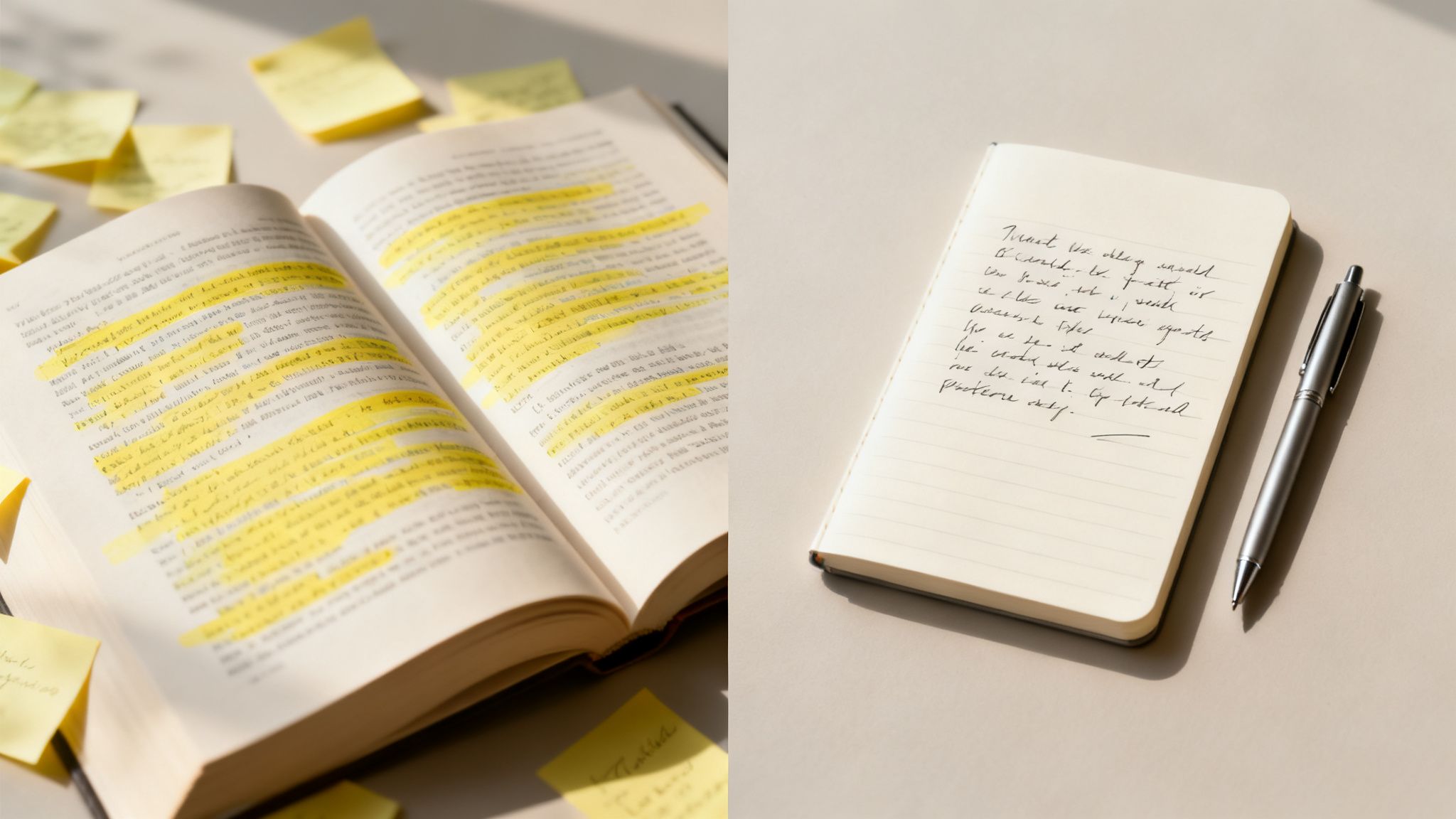
Ever finish an amazing book, only to find its key lessons have completely evaporated a few weeks later? It’s a frustratingly common experience. This happens because most of us were taught to take notes passively—highlighting long passages or copying quotes word-for-word. These methods create the illusion of learning but don’t actually build real, lasting understanding.
True learning is an active process. Think of it as the difference between being a court stenographer, who just transcribes every word, and being a detective, who actively looks for clues, connects the dots, and forms their own theories. Shifting to that detective mindset is what turns reading into a genuine tool for growth.
The Problem With Passive Highlighting
Dragging a bright yellow marker across a sentence feels productive, doesn’t it? But it often tricks our brains into thinking we’ve learned something when we’ve merely identified it. The real work of processing, summarizing, and questioning the material gets skipped entirely. You end up with a book full of someone else’s ideas but very little personal connection or memory of what they meant.
Imagine you’re deep into a complex business book, only to realize the core concepts from chapter one are already foggy. This is why active methods are so powerful. A well-known 2014 study found that students taking notes by hand outperformed those on laptops by 11% on conceptual questions. Why? Because handwriting is slower, forcing you to synthesize and summarize ideas instead of just typing them verbatim. For a deeper dive, you can explore more research on note-taking innovations.
Match Your Method to Your Mission
The real secret to effective notes is aligning your technique with your purpose. Before you even open to page one, stop and ask yourself: “What do I really want to get out of this book?” Your answer changes everything.
- Learning a new skill? Your notes should be a collection of actionable steps, checklists, and frameworks you can put into practice immediately.
- Trying to understand a complex topic? You’ll want to map out the main arguments, connect different ideas, and maybe even jot down questions that challenge the author.
- Just enjoying a great story? For fiction, you could track character arcs, recurring themes, or simply collect powerful quotes that hit you on an emotional level.
The goal isn’t to create a perfect, exhaustive summary of the book. It’s to build a personalized resource that serves your specific needs and helps you remember what matters most to you.
This upfront intentionality is the foundation for turning raw information into knowledge that actually sticks.
Choosing Your Note Taking Method Based On Your Goal
Not sure which approach to take? This table breaks down the best strategies for common reading goals, helping you get started quickly.
| Reading Goal | Recommended Method | Best For |
|---|---|---|
| Deep Comprehension | Cornell Method, Zettelkasten | Academic texts, dense non-fiction, complex theories |
| Practical Application | Action-Based Notes | Self-help, business, skill-building books |
| Quick Review & Retention | One-Page Summary | Remembering key ideas from any non-fiction book |
| Creative Inspiration | Mind Mapping, Quote Collection | Fiction, philosophy, biographies, idea generation |
| Academic Study | Outline Method | Textbooks, research papers, structured learning |
Choosing the right tool for the job makes all the difference. When your method matches your mission, you’re no longer just a reader; you’re actively building a library of useful, memorable knowledge.
Preparing to Read With Intention
The best notes you’ll ever take from a book start before you even crack the spine. Most of us just dive right in, hoping the good stuff will jump out. But a much smarter way to read is to treat it like an active quest for knowledge, and every quest needs a map. This little pre-reading ritual primes your brain, turning passive consumption into a focused hunt for specific ideas.
Think of it this way: you wouldn’t set off on a road trip without knowing where you’re going. Reading without a clear “why” is just as aimless. So before you start, take five minutes to nail down your purpose. Are you trying to solve a specific problem? Master a new skill? Or maybe you just want to understand a new author’s perspective?
Jot that goal down on a sticky note or at the top of a fresh page. This simple act creates a powerful filter, helping you instantly zero in on the chapters and concepts that actually matter to you.
How to Interview a Book Before You Read It
Once you know your mission, it’s time to get the lay of the land. Don’t just start on page one and hope for the best. Instead, give the book a quick “interview” to understand its core arguments and structure. This reconnaissance work gives you a mental framework to hang your notes on later.
This shouldn’t take more than 10-15 minutes, but the payoff is huge. You’ll have a solid grasp of the author’s entire thesis before you get bogged down in the details.
Here’s a quick and dirty way to scan the book:
- Title and Subtitle: They’re the book’s core promise. What is it offering you?
- Table of Contents: This is the author’s roadmap. Follow the breadcrumbs and see how the ideas connect from one chapter to the next.
- Introduction and Conclusion: Authors almost always spell out their entire argument right here. Read these first.
- Chapter Headings and Summaries: Skim through these to get a feel for the key topics covered in each section.
After this quick scan, you should have a surprisingly clear, high-level view of the book’s purpose, main arguments, and overall flow. This context is the secret sauce for taking smarter, more connected notes.
Formulate Your Key Questions
With a clear goal and a mental map of the book, the final pre-reading step is to turn that goal into a handful of key questions. You’re no longer just a passive reader; you’re now an active investigator looking for specific answers.
Let’s say you’re reading a book on productivity. Your questions might look something like this:
- What’s the single most effective technique here for beating procrastination?
- How can I bake these ideas into my weekly planning routine?
- What common productivity myths does the author call out?
These questions become your compass. As you read, you’ll feel a little jolt of recognition every time you find a potential answer—a clear signal that this is something worth capturing. This process is so much easier when your environment is set up for focus. For some solid advice on that, check out our guide on how to eliminate distractions and build a better reading space.
Set Up Your Note Taking System
Last but not least, get your tools ready. Whether you’re a pen-and-paper person or a digital native, have your system set up before you start reading. Don’t let the friction of finding a pen or opening a new doc derail your momentum.
- For Analog Notes: Grab a dedicated notebook or a stack of index cards. Create a title page with the book’s name, author, and the goal you defined earlier.
- For Digital Notes: Open your favorite app—Notion, Evernote, or Obsidian—and create a new note. Use a simple template with fields for the title, author, your reading goal, and your key questions.
This small bit of prep removes any barrier to capturing insight. When you’re all set up, you’re ready to engage deeply from the very first page, ensuring none of the book’s wisdom slips through the cracks.
How to Actually Take Notes While You Read
Alright, you’ve set your intention and you’re ready to dive in. Now for the fun part: capturing the ideas from the page. The key here is to move beyond just copying text. We’re aiming for active engagement—questioning the material, connecting it to what you already know, and making it truly yours.
Let’s explore a few proven methods. There’s no single “best” way; it’s all about matching the technique to your brain and your goals.
It’s so easy to highlight half a wellness book on your Kindle, only to realize a month later you can’t remember a single actionable step. This isn’t just you—it’s a well-documented challenge. A massive Paperlike analysis of 38 studies revealed that digital distractions can tank the focus of 50% of laptop note-takers. They often slip into mindless transcription instead of actually thinking about the material.
Even though we’ve been digital since the 1970s, writing by hand consistently wins for comprehension. Tablet users with a stylus are finally catching up, matching the 25-35% comprehension advantage that pen and paper have always held over keyboards. It’s no surprise that despite the convenience of e-readers, U.S. print sales still hit 767.36 million units in 2023. A big reason? 62% of 16-24-year-olds prefer the hands-on experience of a physical book. You can see all the data in the full analysis of note-taking statistics.
The process below is the foundation for any good note-taking system. It’s about being intentional from the very start.
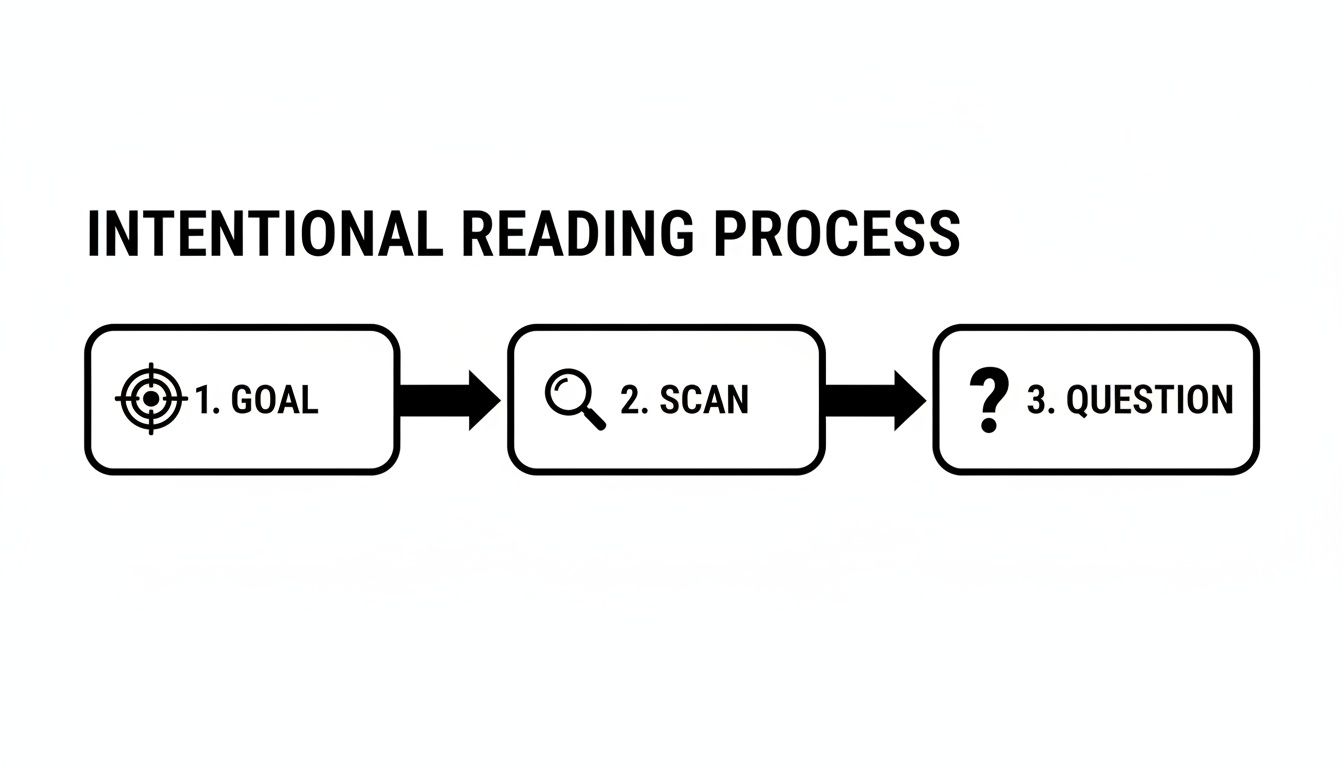
This workflow shows that great notes don’t start on page one. They start with a clear goal, a quick scan of the book’s structure, and a set of questions you want answered.
Digital vs Analog Note Taking A Practical Comparison
Choosing between a digital app and a physical notebook can feel like a huge decision, but it doesn’t have to be. Both have their strengths, and the best system is often a hybrid that plays to the advantages of each. Here’s a quick breakdown to help you decide where to start.
| Aspect | Digital Notes (e.g., Notion, Obsidian) | Analog Notes (e.g., Notebook, Index Cards) |
|---|---|---|
| Pros | – Infinitely searchable – Easy to link between ideas – Accessible on all devices – Simple to edit and reorganize |
– Fewer distractions – Better for memory retention (kinesthetic link) – Great for visual thinking (mind maps, sketches) – Doesn’t require batteries |
| Cons | – Can be distracting (notifications, internet) – Easy to fall into “copy-paste” mode – Can feel impersonal or sterile |
– Not searchable – Harder to organize and edit – Limited space per page/card – Susceptible to physical damage (spills, loss) |
| Best Tools | – Notion for all-in-one databases – Obsidian for creating a linked “second brain” – Evernote for web clipping and general notes |
– Leuchtturm1917 or Moleskine notebooks – Oxford-style index cards – A quality pen (Pilot G2, Lamy Safari) |
Ultimately, the choice comes down to your personal workflow. Do you value searchability and integration above all else, or does the tactile, focused experience of pen on paper help you think more clearly? Don’t be afraid to experiment.
The Cornell Method For Structured Learning
Developed at Cornell University, this classic method is a godsend for anyone trying to pull clear, structured insights from a dense non-fiction book. It carves up your page into three specific zones, giving you a system for capturing notes, creating study prompts, and summarizing what you’ve learned.
Here’s how you can put it to work with a book:
- Main Notes (The Big Column on the Right): As you read, this is where you’ll capture the meat of the content. Think key ideas, surprising facts, or powerful quotes. The trick is to use your own words—don’t just transcribe.
- Cues (The Skinny Column on the Left): Once you’re done with a reading session, go back over your notes. In this left margin, pull out keywords or questions that correspond to your notes. These are your triggers.
- Summary (The Section at the Bottom): Before you close the book, force yourself to write a one or two-sentence summary of the entire page. This simple act of synthesis is where the real learning happens.
The magic of the Cornell Method is that it bakes review right into the process. Just cover the main notes column and try to explain the concepts using only the prompts in your cue column. This is called active recall, and it’s a powerful way to build lasting memory. It’s a fantastic exercise to increase your mental stamina for focused work.
Mind Mapping For Visual And Creative Thinkers
If you’re the kind of person who thinks in connections rather than straight lines, mind mapping will feel like coming home. It’s perfect for visual thinkers and for books with sprawling, interconnected themes. You’re essentially creating a diagram of the book’s ideas, mirroring how your brain naturally links concepts.
Imagine you’re taking notes on Atomic Habits by James Clear:
- Start in the Middle: Write “Atomic Habits” in the center of a blank page and draw a circle around it. This is your anchor.
- Create Main Branches: From the center, draw a thick branch for each of the Four Laws of Behavior Change: “Make it Obvious,” “Make it Attractive,” “Make it Easy,” and “Make it Satisfying.”
- Add the Details: Sprouting from each main branch, add smaller branches for the specific tactics, stories, or key concepts. For example, off of “Make it Obvious,” you could add sub-branches for “Habit Stacking” or “Environment Design.”
The best part about mind mapping is its complete freedom. You can use different colors, add little sketches, and draw dotted lines between related ideas on opposite sides of the page. It gives you a bird’s-eye view of the entire book in one glance.
This isn’t about capturing every single detail. It’s about understanding the architecture of the book’s argument and sparking new connections in your own mind.
Progressive Summarization For Digital Note-Takers
Reading on a Kindle or using apps like Notion or Obsidian? You need to know about Progressive Summarization. Developed by productivity expert Tiago Forte, it’s a brilliant, layered approach to distilling digital information without getting overwhelmed.
Instead of trying to summarize everything in one go, you refine your notes over multiple “passes.”
- Layer 1: The Initial Highlights. As you read, simply highlight the passages that jump out at you. This is your raw material, captured with minimal effort.
- Layer 2: Bold the Best Bits. Later, when you’ve imported these highlights into your note-taking app, read through them again. This time, bold the most powerful sentences within your highlights.
- Layer 3: Highlight the Core. On your next review, scan just the bolded parts and highlight the absolute essential phrases or ideas. You’re getting closer to the essence.
- Layer 4: Write the Executive Summary. Finally, at the very top of your note, write a few sentences in your own words that summarize the key takeaways, using your highlighted gems as a guide.
Each layer makes your notes more potent and easier to review. This system is perfect for building a personal knowledge base that you can actually search, reference, and use for years to come.
From Raw Notes to Lasting Knowledge
Closing the book cover isn’t the finish line. It’s actually where the real work begins. This is the moment you take that messy collection of highlights, scribbles, and margin notes and forge it into something useful—knowledge that actually sticks.
If you skip this step, even the most profound insights you’ve gathered will evaporate. Think of this process as building a bridge from just reading something to truly knowing it. Here are a few powerful ways to make sure that bridge gets built.
Craft a One-Page Summary
Imagine you have to explain the entire book to a friend, but you’re limited to a single sheet of paper. This constraint forces you to be ruthless. You have to cut through the noise and zero in on what truly matters. Your one-page summary is the ultimate cheat sheet for the book’s core message.
This isn’t about cramming in details; it’s about synthesis.
- Nail the Big Idea: What’s the one central argument the author is making? Start there.
- Outline the Pillars: What are the three to five key concepts that hold up that big idea? These are usually the book’s main sections or chapters.
- Capture Your “Aha!” Moments: Jot down a few powerful quotes, surprising stats, or personal insights that really hit home.
The goal here is simple: create a document you can glance at months or even years from now and get a complete mental refresh in under five minutes.
Pull Out an Action List
Information is pointless if it doesn’t lead to action. For any non-fiction book—especially in areas like self-improvement, business, or learning a new skill—your notes should spit out a clear to-do list. Go back through your notes with a single, laser-focused question: “What can I actually do with this?”
Isolate every specific strategy, tip, or framework the author shared. Then, rewrite them as direct commands for your future self. For example, a raw note from a productivity book might be, “author suggests time blocking.” On your action list, that becomes: “Schedule a 30-minute time-blocking session every Sunday evening.“
This small shift from a passive idea to an active task is what sparks real change. Creating this list is a fantastic first step if you’re exploring how to build healthy habits that last.
Test Yourself With the Feynman Technique
This final exercise is the ultimate acid test for your comprehension. Named after the brilliant physicist Richard Feynman, the technique is beautifully simple: explain the book’s main ideas as if you were teaching them to a kid. That means using simple language, relatable analogies, and concrete examples—no jargon allowed.
When you try this, you’ll immediately find where your understanding is shaky. You might stumble over a concept or find yourself reaching for the author’s exact words. That’s a red flag. It’s your cue to dive back into the book or your notes and solidify that weak spot.
This process forces you to go beyond just recognizing an idea and truly internalize it. If you can’t explain it simply, you don’t understand it well enough.
It’s easy to feel productive after finishing a book like ‘Atomic Habits,’ but without smart notes, you’re just pouring water into a leaky bucket. A 2021 U.S. survey found that while 68% of 18-29-year-olds prefer print books, other studies show we only retain 20-30% of the core ideas without active note-taking. The Feynman Technique, developed back in the 1940s, is a powerful fix. Some people in productivity forums report up to 50% better long-term recall just by applying this simple method of explaining concepts and plugging the gaps. You can discover more reading statistics and trends to see the bigger picture.
By weaving these three strategies—summarizing, creating action lists, and testing your understanding—into your post-reading routine, you build a system. You ensure the wisdom you work so hard to gain doesn’t just stay on the page, but becomes a real part of how you think and act.
Building Your System for Long-Term Recall
Let’s be honest: taking great notes is only half the battle. A brilliant summary locked away in a forgotten notebook is no more useful than a book you never opened. The real magic happens when you build a system to make that knowledge accessible for the long haul. This is how you stop just reading books and start turning them into a compounding asset for your life.
Our brains are designed to forget. It’s not a bug, it’s a feature—it stops us from getting bogged down by useless information. The problem is, your brain can’t always tell the difference between the plot of a random movie and a business framework that could transform your career. To fight this natural “forgetting curve,” you have to be deliberate about how you review and organize what you learn.
Implement a Spaced Repetition Schedule
One of the most effective ways to signal to your brain, “Hey, this is important!” is to revisit information at increasing intervals. This technique, called spaced repetition, is a game-changer for memory. It interrupts the forgetting process right when it’s about to kick in, solidifying those neural pathways.
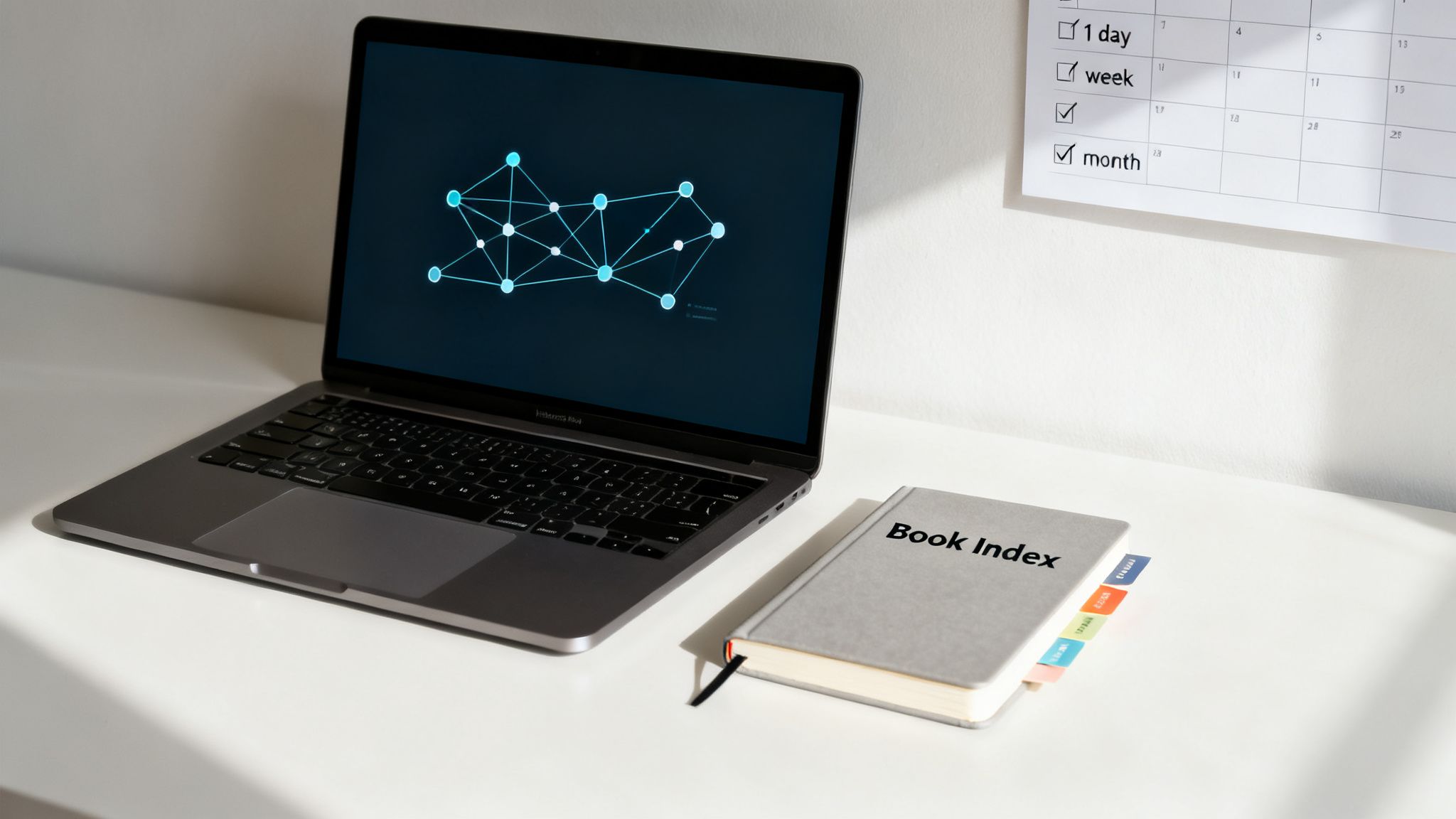
You don’t need complicated software to make this work. A simple calendar-based schedule is incredibly powerful. For every book you finish and summarize, block out time for these three quick review sessions:
- 1 Day Later: Take just two minutes to scan your one-page summary. This first review is critical because the memory is still fresh but extremely fragile.
- 1 Week Later: Do another quick review. This reinforces the ideas just as they’re starting to fade, pushing them deeper into your long-term memory.
- 1 Month Later: One last check-in. By this point, the core concepts should be pretty solid, and this final review helps lock them in for good.
It’s a tiny investment of time, but it dramatically increases the odds that you’ll actually remember—and use—what you read.
Connect Your Notes in a Personal Knowledge Management System
A truly powerful system doesn’t just store notes; it connects them. When you start linking ideas across different books and articles, you uncover insights you’d never spot otherwise. This is the heart of a Personal Knowledge Management (PKM) system, what some people call a “second brain.”
Tools like Obsidian and Notion are built for this. They let you create links between notes, creating a web of your own thinking. Imagine you read a book on decision-making and note a specific mental model. Six months later, a productivity book mentions that same model. By linking the new note back to the original one, you start building a richer, more nuanced understanding of the concept.
This process turns your notes from a static archive into a dynamic, living system. Over time, you build a personalized wiki of your own best thinking, where the value of the whole network is far greater than the sum of its individual parts.
Your PKM becomes an active partner in your work. When you’re tackling a new project, you can search your “second brain” and instantly surface connections you would have completely forgotten.
Build a Master Book Index
As you keep reading, your library of summaries will grow. To keep it all manageable, you need a central dashboard: a master Book Index. This could be a simple spreadsheet or a dedicated page in your PKM tool. Think of it as your personal card catalog for everything you’ve learned from books.
I recommend tracking a few key data points for each book:
| Category | Description | Example |
|---|---|---|
| Title & Author | The basics, for easy reference. | The Power of Habit by Charles Duhigg |
| Date Finished | Helps you track your reading pace. | January 15, 2024 |
| My Rating | A quick 1-5 star personal take. | ★★★★★ |
| Core Idea | The book’s central thesis in one sentence. | Habits are a loop of cue, routine, and reward that can be re-engineered. |
| Link to Notes | A direct link to your one-page summary. | [Link to Notion Page] |
This index is your command center. It lets you scan your reading history at a glance, find specific notes without digging through folders, and spot patterns in your learning journey. It’s the final piece that ensures the wisdom you gain from books remains a tool you can pull out and use anytime you need it.
Your Questions, Answered
Let’s tackle some of the most common questions that pop up when you’re trying to build a solid note-taking habit with books. Getting these things right can make all the difference.
Am I Taking Too Many Notes? How Much Is Enough?
It’s a classic trap: you end up highlighting half the book, and your notes become a dense, unreadable transcript. That’s not the goal. You’re trying to capture the core ideas, not rewrite the author’s work.
A good rule of thumb I’ve found incredibly effective is to aim for just one to three key takeaways per chapter. Seriously, that’s it. This forces you to stop and really think, “What’s the absolute most important point here?” instead of just passively copying text.
It’s all about quality over quantity. This simple constraint pushes you from being a collector of information to a synthesizer of ideas—which is where the real learning happens.
Should I Use a Notebook or a Digital App?
Honestly, there’s no single right answer here. The best method is the one you’ll actually stick with, and that comes down to your own style and what you’re trying to achieve.
There’s something powerful about writing by hand in a physical notebook. It slows you down, forces you to summarize, and has been shown to boost memory and understanding. Plus, it’s a great way to escape digital distractions.
On the other hand, digital tools like Notion or Obsidian are incredible for organizing, searching, and connecting thoughts across dozens of books. A hybrid approach often works best. I often jot down messy, initial thoughts in a notebook while reading, then transfer the refined, core insights into my digital system later for easy access.
What About Taking Notes on Fiction?
Taking notes on a novel feels different because your goal isn’t to extract a list of “how-to” steps. It’s about deepening your connection to the story and appreciating the craft.
Instead of looking for takeaways, you could track things like:
- How a character develops or changes over time
- Recurring symbols or themes
- Key plot twists and foreshadowing
Try mapping out a simple timeline of major events. Jot down quotes that hit you hard or passages with beautiful prose. You can even adapt the Cornell Method for this—use the main section for plot points and the side column for your own thoughts, questions, and reflections on the author’s style. It’s a fantastic way to engage with the story on a much richer level.
At David Pexa, we provide clear, actionable strategies to upgrade how you think, feel, and live. Explore our guides and curated recommendations to build better habits and achieve long-term growth by visiting https://davidpexa.com.
