



Setting realistic goals isn’t about dreaming smaller; it’s about building a smarter bridge between your vision and your daily reality. It’s about connecting what you want to a deeper purpose, defining it with crystal clarity, and then breaking it down into small, consistent habits. This framework is designed to pull you out of the world of vague dreams and into a sustainable, actionable plan.
Why Most Ambitious Goals Are Doomed From The Start

We’ve all been there. That initial rush of excitement when you set a big, audacious goal is intoxicating. But that familiar feeling of frustration when the motivation fizzles out by February? That’s not a personal failure or a lack of ambition. It’s the predictable outcome of a flawed approach—one that values grand declarations over practical, day-to-day planning.
This guide will give you a clear, repeatable framework for setting goals that actually stick. We’re going to shift the focus from wishful thinking to building a structured, actionable system that works for you.
To see what this shift looks like in practice, here’s a quick comparison of how we often think about goals versus how we should be thinking about them.
The Shift from Vague Ambition to Realistic Action
| Common Vague Goal | The Realistic Reframe | Why It Works |
|---|---|---|
| “I want to get in shape.” | “I will go to the gym 3 times a week (M/W/F) for 45 minutes and walk for 20 minutes on off-days.” | It’s specific, measurable, and fits into a real-world schedule. “Getting in shape” is an outcome; this is the process to get there. |
| “I need to grow my business.” | “I will increase qualified leads by 15% this quarter by publishing 2 blog posts and sending 1 newsletter per week.” | This breaks a huge, intimidating goal into concrete, controllable actions with a clear timeline and metric for success. |
| “I’m going to learn to code.” | “I will complete one module of my Python course every week and build a small project by the end of the month.” | It turns a massive learning curve into manageable weekly milestones, preventing overwhelm and building momentum. |
This table gets to the heart of the matter. It’s not about lowering your standards; it’s about creating a plan that gives your ambition a fighting chance.
The Realism Gap
The chasm between our aspirations and our actions is what I call the “realism gap.” It’s that space where great intentions collide head-on with the friction of daily life. We set ourselves up for failure with all-or-nothing thinking: “I must go to the gym five times this week,” or “I have to finish this entire project by Friday.”
That kind of rigid language is a trap. Life is messy and unpredictable. Unexpected meetings pop up, energy levels dip, and priorities can shift in an instant. When our plan doesn’t account for this reality, a single misstep feels like a total failure, which makes it incredibly easy to just give up entirely.
A goal without a realistic plan is just a wish. The key isn’t to lower your ambition but to build a smarter, more flexible path to get there.
The Power of Planning and Accountability
Think about all the ambitious New Year’s resolutions that are abandoned by spring. It’s a staggering 80%, and it’s almost always due to a lack of specific planning. But what if you just wrote your goals down? Research from Dominican University found that simple act boosts your chance of success to 42%.
It gets even better. That success rate skyrockets to a massive 70% when you share your progress with a supportive friend or coach. You can dive deeper into the powerful statistics behind goal setting to see just how much of a difference this makes.
This tells us a crucial truth: success is less about raw willpower and much more about solid strategy. A well-defined plan anticipates obstacles and builds in accountability from the start. It’s also deeply tied to your mindset. Learning the difference between a growth vs. fixed mindset can fundamentally change how you approach challenges. By moving from vague desires to concrete steps, you create a system that truly supports your ambition, making sustained progress not just possible, but probable.
Connect Your Goals to a Deeper Personal Why

Before you even think about setting a goal, you have to hit the pause button. Ask yourself one simple question: Why? A goal without a powerful, personal “why” behind it is just a nice idea. It’s a wish that will crumble the first time you hit a real challenge.
Think of your “why” as the anchor that holds you steady when the inevitable storms of doubt or frustration roll in. We’ve all set goals based on what we think we should be doing—”I need to be more productive” or “I have to earn more money.” These sound good, but they’re hollow. They lack a real connection to what gets you out of bed in the morning.
Realistic goals are more than just achievable; they’re deeply relevant to the life you actually want to live.
Discovering Your Core Drivers
So, how do you find that anchor? It starts with some honest self-reflection. This isn’t a five-minute exercise; it’s the foundational work for everything that follows. Grab a pen and paper and really dig into these questions:
- What truly matters to me? Think about your core values. Is it freedom? Security? Creativity? Helping others?
- What kind of impact do I want to make? This could be on your family, your clients, your industry, or your community.
- If I look ahead five years to my ideal life, what does that actually look like? Get specific. What are you doing every day? How do you feel?
- What past accomplishments made me feel genuinely proud and fulfilled? The “why” behind those moments is a huge clue.
Answering these shifts your perspective entirely. Suddenly, a vague goal like “earn more money” becomes something much more compelling, like “build financial security so I can give my family more opportunities and experiences.” Now that is a goal you’ll fight for. If you’re struggling to pinpoint your drivers, exploring personal growth counseling strategies can be a powerful way to gain clarity.
A goal is far more likely to stick when it’s an authentic reflection of your values, not just an attempt to meet someone else’s expectations.
Draft a Personal Mission Statement
Once you’ve got a handle on what truly drives you, try to boil it down into a simple, guiding statement. Forget the corporate jargon; this is a personal compass you can use to check if you’re heading in the right direction.
I once worked with a client whose initial goal was simply to “get a promotion.” After we dug into his ‘why,’ he discovered that what he actually craved was the chance to mentor junior colleagues and tackle complex, meaningful problems.
He reframed his mission into a powerful statement: “To use my expertise to guide and empower my team, creating innovative solutions that make a real difference.”
That one sentence changed everything for him. It became the filter for every decision and every goal he set. This is what it means to set goals that are truly realistic—they aren’t just logical on paper; they’re woven into the very fabric of who you are.
Turning Your Big Vision into a Real-World Plan with SMART Goals
So, you’ve found your “why”—that core reason driving your ambition. That’s the hard part. Now, we need to bring that big, beautiful vision down to earth and give it a solid foundation. This is where we get tactical.
The most time-tested tool for this job is the SMART framework. It’s a simple but incredibly effective way to translate a vague dream into something you can actually work on. The acronym breaks down into Specific, Measurable, Achievable, Relevant, and Time-bound.
Think of it as a filter. It forces you to get crystal clear on what you’re trying to do. For instance, the fuzzy idea of “I want to start a side business” becomes something concrete: “I will launch an Etsy shop selling custom digital planners and generate my first $500 in revenue within 90 days.” See the difference? One is a wish; the other is a plan with a finish line.
The data backs this up, too. People who use structured goal-setting like this see their achievement rates jump by as much as 65%. It’s not magic; it’s just clarity. Companies that adopt this see productivity climb by 50%, and individuals find they can advance their careers 45% faster. If you’re curious, there are some fascinating statistics on structured goal-setting that really show the impact.
The Two Most Important Letters: A and R
Every part of the SMART framework plays a role, but when it comes to keeping things realistic, Achievable and Relevant are your true north stars. This is where your ambition has an honest conversation with your current reality.
Relevant is simple—it has to tie directly back to that “why” you already figured out. If the goal doesn’t light a fire in you or move you closer to your big-picture vision, it’s just a distraction.
Achievable is where you do a reality check. It’s time for an honest self-audit, asking some tough but crucial questions:
- Do I actually have the skills to pull this off, or is there a learning curve I need to account for?
- Looking at my calendar, how much time can I realistically dedicate to this each week without completely burning out?
- What resources—money, tools, support—does this goal depend on?
Being honest here isn’t about being negative; it’s about being strategic. A goal is achievable if it stretches you just enough without snapping you in half. For example, if you’re already pulling a 50-hour work week, vowing to hit the gym seven days a week is probably a recipe for failure. A much smarter, more achievable goal would be to aim for three workouts a week. You’re still making huge progress, but you’re not setting yourself up to quit.
Setting an achievable goal isn’t thinking small. It’s respecting where you are right now so you can build real momentum toward where you want to go.
The Simple Act That Makes It Real: Write It Down
There’s one final step in this process that feels almost too simple to be effective, but it’s non-negotiable: write your goals down.
The moment you put pen to paper (or fingers to keyboard), something shifts. The idea leaves the chaotic realm of your mind and becomes a tangible commitment in the real world. A “wish” officially becomes a “plan.”
Let’s walk through a quick example of how this transformation happens.
Vague Idea: “I want to be a better public speaker.”
SMART Goal:
- Specific: I will improve my presentation skills so I can confidently deliver a 15-minute talk without reading from my notes.
- Measurable: I will join a local Toastmasters club and deliver one prepared speech each month.
- Achievable: I will block out two hours every week on my calendar specifically for writing and practicing my speeches.
- Relevant: Being a better speaker will help me lead team meetings more effectively and position me for a promotion.
- Time-bound: I will achieve this level of confidence within the next six months.
Just like that, you’ve moved from a passive desire to an active pursuit. The goal is no longer a fuzzy cloud; it’s a clear, manageable project with a deadline. And that makes all the difference.
Building Momentum with Milestones and Micro-Habits
Having a solid SMART goal is a great start, but it’s just that—a start. Where most people trip up isn’t in setting the goal itself, but in figuring out what to do on a random Tuesday afternoon to actually make it happen. Big, ambitious goals can be paralyzing. That feeling of being overwhelmed is the number one killer of momentum, and it’s what leads straight to procrastination.
The trick is to stop staring at the entire mountain you have to climb and focus on taking the very next step.
You do this by translating your big-picture goal into two much smaller, more manageable pieces: milestones and micro-habits. Think of milestones as the major checkpoints on your map. Micro-habits are the tiny, almost effortless daily actions that get you from one checkpoint to the next. This simple shift in focus—from the intimidating final outcome to the doable daily process—is what separates those who succeed from those who just dream.
Reverse-Engineer Your Success with Milestone Mapping
The best way I’ve found to figure out your milestones is to work backward. It’s a technique called reverse-engineering, and it forces you to think through the entire process logically, from finish to start.
Begin with your final, time-bound goal. Then, ask yourself, “What absolutely has to be done right before I can achieve this?”
Take the answer to that question and ask it again. “Okay, and what needs to happen right before that?” Keep going until you’ve worked your way all the way back to what you need to do today.
Let’s walk through a real-world example. Say your goal is to launch a professional portfolio website in three months to land more freelance work.
- Final Goal (Month 3): Launch a fully functional, 5-page portfolio website.
- Milestone 3 (Month 2): Have all the website content—text, images, and case studies—written, edited, and ready to go.
- Milestone 2 (Month 1): Choose a platform (like WordPress or Squarespace), mock up a design, and build the basic site structure.
- Milestone 1 (This Week): Research five competitor websites and outline the five core pages for your own site.
See what happened? “Build a website” just went from a vague, stressful idea to a clear, step-by-step project. The overwhelm is gone, replaced by a simple first task you can start on right now.
From Milestones to Micro-Habits
Once you have your milestones mapped out, the final step is to break them down into daily or weekly micro-habits. These are the tiny, repeatable actions that make progress feel automatic. A good micro-habit is so small it seems almost too easy to skip, even on a day when you have zero motivation.
Let’s stick with the website example:
- Milestone 1 Task: Outline the five essential pages.
- Micro-Habit: Spend just 15 minutes each morning this week sketching out ideas for one single page.
Or, let’s take a classic goal: writing a book.
- Goal: Finish a 60,000-word manuscript in six months.
- Milestone: Complete one 5,000-word chapter each month.
- Micro-Habit: Write 250 words every weekday. That’s it.
This tiny, consistent effort is what compounds into huge results over time. This approach of breaking things down is a core principle in many behavioral change models. If you’re curious about the psychology behind how our thoughts influence our actions, you can dig deeper into some of the powerful frameworks used in Cognitive Behavioral Therapy techniques.
The secret to achieving massive goals isn’t massive action. It’s consistent, ridiculously small actions that build a powerful rhythm of progress.
This visual captures that simple but effective flow from a big idea to a concrete plan.
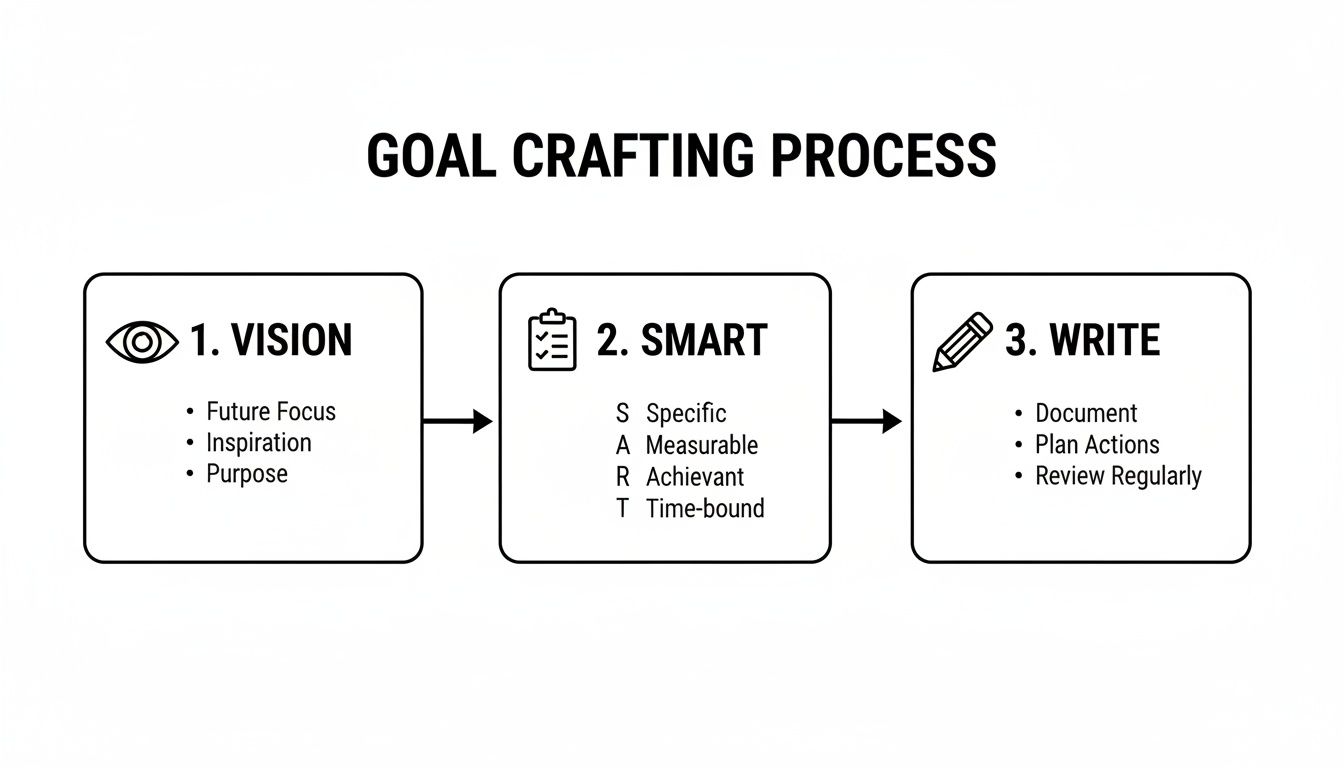
As the diagram shows, you start with a clear vision, sharpen it with the SMART framework, and then make it real by writing it down. Each step layers on more clarity, turning a fuzzy dream into something you can actually work on today.
Staying on Track and Knowing When to Adjust
Alright, you’ve set a solid, realistic goal. That’s a huge win, but it’s just the starting line. The plan you’ve laid out is your best guess right now, based on what you know today. But life rarely sticks to the script.
Think of your plan less like a set of commandments carved in stone and more like a GPS route. If you hit an unexpected roadblock or a street closure, you don’t just turn around and go home, right? You find a detour. Tracking your progress is how you spot those roadblocks early, giving you time to reroute without getting completely stuck.
Find Your Review Rhythm
The secret to staying on course isn’t obsessing over your progress every single hour. It’s about creating a simple, consistent check-in routine that you can actually stick with. For most people, a weekly review hits the sweet spot.
This doesn’t need to be some formal, high-pressure board meeting with yourself. Just block out 20-30 minutes every Friday afternoon or Sunday evening. Grab a coffee, open your notes, and ask yourself three straightforward questions:
- What worked this week? Give yourself credit for the wins, even the small ones.
- Where did I get stuck? Pinpoint the friction points without judging yourself.
- What’s one thing I can change for next week? Turn that insight into a small, actionable adjustment.
This simple habit transforms goal pursuit from a pass/fail exam into a dynamic learning process. You’re building the muscle for resilience and getting better at spotting trouble before it completely kills your momentum.
Your ability to adapt is a superpower. The objective isn’t to flawlessly execute a plan that’s no longer working. It’s to intelligently evolve your strategy as you learn and gather real-world feedback.
The Art of Pivoting vs. Persevering
Here’s where experience really comes into play. How do you know if you’re just hitting a tough patch that requires more grit, or if your entire approach is wrong? It all comes down to understanding the why behind the struggle.
Perseverance is for when you’re facing expected friction. Let’s say your goal is to wake up at 5 a.m. to write. Feeling groggy and uninspired for the first week or two is totally normal. That’s the time to push through and let the habit solidify.
A pivot, on the other hand, is necessary when new information fundamentally changes the game. Maybe after a few weeks, you realize your brain is on fire with ideas at 9 p.m., not 5 a.m. Stubbornly sticking to that early morning schedule would be fighting your own biology. The smart move is to pivot your strategy—change how you’ll get the writing done, not abandon the goal itself.
Learning to tell the difference between these two scenarios is what separates people who achieve their goals from those who just make plans.
Answering Your Questions About Realistic Goals
Even with the best framework in hand, putting it all into practice is where the real questions start to surface. It’s totally normal for this process to feel a bit clunky at first. Let’s walk through some of the most common sticking points I see people encounter.
Think of this as a quick-reference guide to troubleshoot those real-world moments when you’re not quite sure what to do next.
How Do I Find the Sweet Spot Between Too Hard and Too Easy?
This is the million-dollar question, isn’t it? Nailing that perfect balance between a goal that stretches you and one that’s actually achievable is a bit of an art.
A great rule of thumb to start with is what I call the “70% rule.” You should feel about 70% sure you can pull it off. That leaves enough room for a challenge that will keep you engaged, but it’s not so terrifying that you just want to put it off.
Your own progress will be your best guide. If you’re blowing past your milestones without breaking a sweat, that’s your cue to aim a little higher. On the flip side, if you’re constantly missing the mark and feeling completely swamped, don’t take it as a sign of failure. It’s just feedback telling you to break the goal down into even smaller, more manageable pieces. The point isn’t to set easy goals—it’s to set smart ones that keep pulling you forward.
What’s the Best Way to Handle a Setback or Lost Motivation?
First things first: motivation dips and things go wrong. It happens to everyone, on every important journey. It’s not a character flaw; it’s just part of the game.
When you feel your drive fading, the very first thing you should do is go back to your “why.” Seriously. Pull out that personal mission statement you wrote down and read it. Reminding yourself of the deep-seated reason you started this whole thing can be an incredibly powerful shot of adrenaline.
Next, look at the setback like a scientist. What actually happened? What can you learn from it? This simple shift in perspective turns a frustrating roadblock into a lesson. Finally, hit the reset button by focusing on the smallest possible action you can take right now. Don’t worry about the finish line—just win the next five minutes. That tiny victory is often all you need to start rebuilding momentum.
Setbacks aren’t stop signs. They’re just opportunities to learn, tweak your approach, and prove to yourself how committed you really are.
How Often Should I Be Reviewing My Goals?
The right rhythm for reviewing your goals really comes down to their timeline. The most important thing isn’t how often you do it, but that you do it consistently.
- For short-term goals (like a 90-day project), a weekly check-in is perfect. It gives you a chance to see how you’re tracking against your milestones and adjust your plan for the week ahead before you get too far off course.
- For long-term goals (like a big annual objective), a monthly and quarterly review schedule is usually best. Use the monthly check-in for progress on milestones, and use the quarterly review to take a step back and ask, “Is this goal still the right one for me?”
Whatever cadence you land on, book these reviews in your calendar like you would any other critical meeting. If it’s not on the schedule, it’s not real.
At David Pexa, we believe that personal growth comes from having the right mindset combined with practical, actionable strategies. Our guides are designed to give you the clarity and tools you need to build a life that’s both ambitious and fulfilling.
Explore more resources and curated product recommendations to support your journey at https://davidpexa.com.
