



If you feel like you’re constantly wading through mental fog—overwhelmed, scattered, and just plain stuck—you’re not imagining things. Achieving real mental clarity in a world buzzing with notifications and endless demands isn’t just difficult; it can feel downright impossible.
This isn’t just about being a little forgetful. It’s that frustrating inability to concentrate, the indecisiveness that stalls your day, and the short attention span that kills your productivity.
Why Your Brain Feels So Crowded
Let’s be clear: this isn’t a personal failure. It’s a completely normal reaction to an environment designed to fracture our attention. The constant pull in a million different directions takes a serious toll.
The numbers don’t lie. Stress now affects a staggering 64% of people globally, and over a billion individuals are living with some form of mental health condition. This isn’t just a “feeling”—it’s a documented crisis that directly impacts our ability to think. For a deeper dive, the full report on global mind health from Ipsos paints a stark picture.
From Mental Clutter to Sharp Focus
The great news? You can train your brain to cut through the noise. It’s not about finding some magical “off” switch for your thoughts, but about building a reliable system that fosters a clear, focused mind.
This is the journey we’re about to take—from a scattered, reactive state to one of deliberate, calm focus.
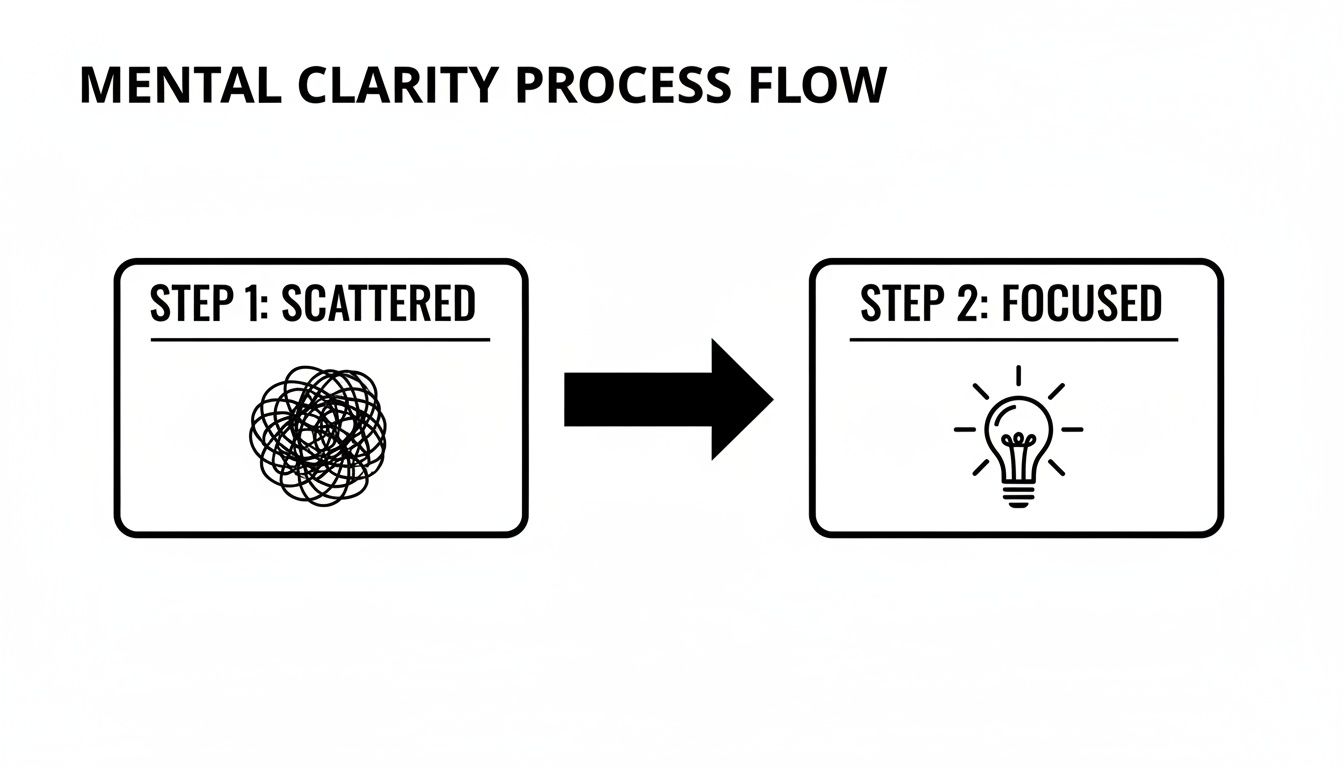
This transition doesn’t happen by accident. It requires a bit of intentional effort, but the payoff is immense.
The Four Pillars of a Clear Mind
Instead of throwing random productivity hacks at the wall and hoping something sticks, we’re going to use a structured approach. It’s built on four core pillars that work together to create a powerful flywheel effect—where improving one area naturally boosts all the others. The best energy management solutions use the same logic: build a strong foundation first, and everything else gets easier.
To give you a clear sense of where we’re headed, here is a quick overview of our game plan.
Your Roadmap to Reclaiming Mental Clarity
| Pillar | Core Focus | Key Outcome |
|---|---|---|
| Foundational Daily Routines | Nailing your sleep, nutrition, and movement. | A brain that’s biologically primed for peak performance. |
| Intentional Focus Strategies | Using tactics like time-blocking to shield your attention. | Proactive control over your time and cognitive energy. |
| Active Cognitive Training | Strengthening your focus muscle with mindfulness and deliberate practice. | A stronger, more resilient ability to concentrate on demand. |
| Environmental Optimization | Shaping your physical and digital worlds to support, not sabotage, your focus. | An environment where clarity is the default, not the exception. |
Think of these pillars as the blueprint for building a life where you’re in the driver’s seat of your own attention. You’ll stop just reacting to brain fog and start proactively creating the conditions that prevent it from ever setting in.
Build Your Foundation with Unskippable Daily Routines

It’s tempting to jump straight to fancy productivity hacks, but they won’t do you much good if your underlying biology is out of whack. It’s like trying to run sophisticated software on a computer with a dying battery. Real, lasting mental clarity doesn’t start with an app; it starts with the non-negotiable routines that fuel your brain every single day.
Think of these not as “healthy habits” but as essential maintenance for your cognitive hardware. Getting your sleep, nutrition, and movement right is single-handedly the most powerful thing you can do to clear the fog from the ground up.
And the stakes are higher than just feeling good. Research has shown that up to 45% of dementia cases and 21% of major depression might be linked to modifiable lifestyle factors like diet, sleep, and exercise. What we do every day is one of our most powerful tools for long-term brain health. The Milken Institute has published some great insights on why this is a global imperative.
Master Your Sleep for a Sharper Mind
Sleep is your brain’s dedicated cleaning crew. While you’re in deep sleep, your glymphatic system gets to work, flushing out metabolic waste that builds up during the day. This is the “gunk” that directly contributes to brain fog. Skimping on quality sleep is like letting the trash pile up in your mind.
To really nail this, you need to think beyond just the number of hours. The key is sleep hygiene—creating a consistent, predictable environment that signals to your brain it’s time to power down for the night.
Here’s a simple wind-down routine you can start tonight:
- 90 Minutes Before Bed: Dim the lights. Seriously. Lowering ambient light, especially from overhead sources, cues your brain to start producing melatonin, the hormone that makes you sleepy.
- 60 Minutes Before Bed: All screens off. The blue light from your phone, tablet, and TV actively disrupts melatonin. Instead, pick up a physical book, listen to a calming podcast, or do some light stretching.
- 30 Minutes Before Bed: Do something to quiet your mind. This could be journaling to get racing thoughts out of your head, a short meditation, or a warm bath. The goal is to de-stimulate, not wind yourself up.
Key Takeaway: A consistent wind-down routine isn’t about being rigid; it’s about giving your brain clear, reliable cues. That predictability reduces the mental effort needed to fall asleep, paving the way for deeper, more restorative rest.
Fuel Your Brain with Clarity-Boosting Nutrition
The food you eat quite literally becomes the fuel your brain uses to create neurotransmitters, build cell membranes, and generate energy. A diet filled with processed foods, sugar, and unhealthy fats creates inflammation, a known driver of brain fog and cognitive decline.
On the flip side, a diet rich in certain nutrients can actively protect your brain and sharpen its function. It’s the difference between putting high-octane fuel in your car versus cheap, dirty gasoline.
Try to consciously incorporate these brain-boosting food groups:
- Omega-3 Fatty Acids: Found in fatty fish like salmon and mackerel, plus walnuts and flaxseeds. These fats are the literal building blocks for brain and nerve cells, making them essential for learning and memory.
- Flavonoids: These are powerful antioxidants you’ll find in berries, dark chocolate, and leafy greens. They help protect brain cells from damage and improve blood flow, which directly enhances cognitive function.
- Complex Carbohydrates: Foods like oats, quinoa, and sweet potatoes give your brain a steady supply of glucose, its main energy source. Unlike sugary snacks that cause a spike and crash, these release energy slowly for sustained focus.
Start with one easy swap. Tomorrow morning, trade your sugary cereal for a bowl of oatmeal topped with berries and walnuts. Just that one small change delivers a powerful combination of all three of these brain-boosting groups.
Reset Your Focus with Strategic Movement
Movement is one of the fastest ways to hit the reset button on your brain. You don’t need a grueling workout; even short bursts of activity can have an immediate, noticeable impact on your mental state.
When you get moving, your body pumps more blood to the brain, delivering a fresh shot of oxygen and nutrients. It also triggers the release of some very helpful neurochemicals.
The Neurochemical Cocktail of Exercise
| Neurochemical | Primary Benefit for Mental Clarity |
|---|---|
| Endorphins | Reduces stress and improves mood, clearing emotional clutter. |
| Dopamine | Enhances motivation, focus, and concentration. |
| Norepinephrine | Boosts alertness and attention. |
| BDNF | Supports the growth of new neurons and protects existing ones. |
You don’t need to block out an hour at the gym to get these benefits. A brisk 10-15 minute walk during a lunch break can be more than enough to shake off that midday grogginess. I’ve found that if I’m stuck on a tricky problem, getting up and doing a quick set of jumping jacks or push-ups often gives me the mental shift I need to see a solution.
The real trick is to weave movement throughout your day, not just save it for one big session. These three pillars—sleep, nutrition, and movement—are all interconnected. Better sleep gives you the energy to move, and regular movement improves your sleep. Good food fuels both. By getting this foundation solid, you create a powerful upward spiral for lasting mental clarity.
Master Your Focus with Intentional Work Habits

Now that we’ve covered the biological foundations, let’s get into behavior. The modern workday is an open invitation for distraction—a constant barrage of pings, emails, and “quick questions” that shatter our concentration. Relying on willpower alone to stay focused is a losing battle. You need a system to protect your most valuable asset: your attention.
This is where you stop reacting to your day and start intentionally designing it. By adopting a few structured work habits, you build defensive walls around your focus. This allows you to slip into a state of “flow” that’s absolutely essential for high-quality thinking and true mental clarity.
Deep Work vs. Shallow Work: Know the Difference
First things first: not all work is created equal. Your cognitive energy is a finite resource, and spending it on the wrong tasks is the fastest way to feel busy but completely unproductive at the end of the day. All your work really boils down to two categories.
- Deep Work: These are the big-ticket items—the cognitively demanding tasks that require your full, uninterrupted concentration. Think writing a strategic report, coding a complex feature, or mapping out a major project. This is where real progress is made.
- Shallow Work: This is all the logistical, low-value stuff that doesn’t need intense brainpower. We’re talking about answering routine emails, scheduling meetings, or organizing files. It’s necessary, sure, but it’s also the biggest culprit in derailing your focus.
The problem? Shallow work is easy. It feels productive and often masquerades as urgent. This sneaky combination makes it dangerously appealing, and it can easily push your deep work to the forgotten corners of your day. To boost your mental clarity, you have to flip this script.
Structure Your Day with Time Blocking
Time blocking is a powerful way to reclaim your schedule. Instead of working from a reactive to-do list, you proactively assign every single minute of your workday to a specific task. You’re not just planning what to do; you’re deciding exactly when you’re going to do it.
Picture a project manager’s calendar. It’s not a chaotic jumble of meetings and reminders; it’s a neatly organized grid. A block from 9:00 to 11:00 AM is dedicated to “Draft Q3 Project Proposal.” From 11:00 to 11:30 AM, there’s a slot for “Respond to Team Emails.” Every task has a home, which prevents the mental whiplash of context-switching.
By giving every task a specific time and place on your calendar, you eliminate the mental energy wasted on deciding what to do next. This structured approach is a game-changer for anyone struggling with analysis paralysis, as it forces you to make decisions ahead of time. You can learn more about how to overcome analysis paralysis in our detailed guide.
Use the Pomodoro Technique for Intense Bursts of Focus
While time blocking provides the overarching structure for your day, the Pomodoro Technique helps you execute within those blocks. It’s a beautifully simple yet incredibly effective system for maintaining high concentration on one thing at a time.
Here’s the breakdown:
- Choose one task. Seriously, just one.
- Set a timer for 25 minutes.
- Work on that task without any interruptions. No checking email, no glancing at your phone. If a distracting thought pops up, jot it down on a notepad and get right back to it.
- When the timer goes off, take a 5-minute break. Stand up, stretch, get some water—do something completely unrelated to your work.
- After four “pomodoros,” take a longer break of 15-30 minutes.
The 25-minute work sprint feels manageable, which is a great psychological trick to overcome procrastination. The forced breaks also prevent burnout and help reset your focus, ensuring you come back to your task feeling refreshed.
Tame Your Digital Environment
Even the most perfect system will crumble if your environment is engineered for distraction. Your phone and computer are incredible tools, but their default settings are designed to steal your attention. You have to actively curate your digital space so it serves your goals, not the goals of app developers.
Practical Digital Minimalism Tips
| Tactic | Why It Works | How to Implement It |
|---|---|---|
| Turn Off Non-Essential Notifications | It eliminates the constant external pings and pop-ups that pull you out of deep work. | Dive into your phone and computer settings. Disable notifications for everything but the absolute essentials (like calls or calendar alerts). |
| Schedule “Distraction Windows” | It corrals all your shallow work into specific times, preventing it from bleeding into your focus blocks. | Designate two or three 30-minute slots per day just for checking email and social media. Outside those windows, keep those tabs closed. |
| Use Focus Apps | It’s like fighting fire with fire—using technology to create an environment where focus is the default. | Check out apps like Freedom or Forest that can temporarily block distracting websites and apps during your work sessions. |
By putting these intentional habits into practice, you’re not just managing your time—you’re managing your mental energy. You’re building a fortress around your focus, creating the space you need to think clearly, solve complex problems, and finally produce your best work.
Sharpen Your Mind with Cognitive Training Practices
While nailing down your daily routines is a huge part of the puzzle, you can also train your brain directly, just like you’d train a muscle in the gym. Think of these cognitive practices less as quick fixes and more as targeted workouts that actively reshape your brain’s structure and function over time.
This is where you move from passively hoping for focus to actively building a more resilient, agile mind.
Strengthen Your Attention with Mindfulness Meditation
Mindfulness gets a bad rap. It’s not about emptying your mind or achieving some zen-like state of nothingness. At its core, it’s the simple practice of paying attention to the present moment, on purpose, without getting tangled up in judgment.
This seemingly simple act has a profound impact on your brain, especially the prefrontal cortex. This is your command center—the part of your brain running the show for focus, planning, and decision-making.
When you sit down to meditate, you’re just repeatedly guiding your wandering attention back to a single point, like your breath. Every time you catch your mind drifting and gently bring it back, you’ve just done one mental “rep.” This is how you strengthen your ability to regulate your attention. That skill pays off all day long, making it easier to tune out distractions and stay locked in on what matters.
Ready to give it a shot? Here’s a simple 5-minute exercise you can do right now.
- Find a comfortable seat. Sit upright but don’t be rigid. Keep your feet flat on the floor.
- Close your eyes and take a few deep, settling breaths.
- Bring your focus to your breath. Just notice the sensation of air moving in and out. You don’t need to change anything; just observe.
- Your mind will wander. That’s what minds do. When you notice you’re lost in thought, gently—and without frustration—guide your attention back to your breath.
- Repeat this process of noticing and returning for five minutes.
That’s it. The real magic isn’t in achieving perfect, unbroken focus. It’s in the quiet, persistent act of returning, again and again.
Build Metacognition with Deliberate Practice for Your Thinking
Beyond just paying attention, you can also train the quality of your thoughts through deliberate practice. This is all about actively working on your thinking skills with clear goals and a way to get feedback. One of the most powerful tools for this is journaling—not as a diary of your day, but as a structured cognitive workout.
This kind of practice builds metacognition, which is the crucial skill of thinking about your own thinking. It helps you spot flawed logic, uncover the assumptions you didn’t know you had, and tackle problems with a clearer, more structured approach. Understanding your own thought patterns is a cornerstone of many therapeutic approaches, and you can learn more about related cognitive behavioral therapy techniques to see just how powerful this kind of self-awareness can be.
Expert Insight: Metacognition is what separates novice thinkers from experts. It’s the ability to step outside your immediate thoughts, look at them objectively, and ask, “Is this the most effective way to be thinking about this?”
Try these journaling prompts to put structured problem-solving into practice:
- What is the actual problem I am trying to solve, stripped of all emotion and assumptions? (This forces you to get crystal clear.)
- What are three completely different ways I could approach this? (This breaks you out of mental ruts.)
- What information am I missing that would make this decision easier? (This highlights your knowledge gaps.)
Seriously, spending just 10 minutes with these prompts can untangle a mental knot you’ve been wrestling with for hours.
Keep Your Mind Agile by Learning New Skills
Your brain absolutely thrives on novelty and challenge. One of the best things you can do for your cognitive health is to learn a new, complex skill. This directly boosts neuroplasticity—your brain’s ability to forge and reorganize connections. Think of it as building new highways and side roads in your mental map.
When you learn something genuinely difficult, like a musical instrument, a new language, or how to code, you’re not just picking up a new hobby. You’re forcing different parts of your brain to fire together in new ways, which enhances your overall cognitive function and builds what scientists call “cognitive reserve.”
This reserve is like a mental savings account. A brain with more rich, dense connections is far more resilient to age-related decline and better equipped to handle stress. The key is to pick something that consistently challenges you and requires sustained effort. The struggle isn’t a sign of failure; it’s precisely where the growth is happening.
Shape Your Environment to Sharpen Your Mind

It’s a simple truth we often overlook: our outer world shapes our inner world. A chaotic, cluttered environment almost always leads to chaotic, cluttered thoughts. Trying to find focus in a distracting space is an exhausting, uphill battle.
The good news? You can stop fighting and start designing. By intentionally shaping your environment, you can make mental clarity the path of least resistance. This isn’t about sterile minimalism, but about deliberately removing the friction that constantly drains your cognitive energy.
Craft a Workspace That Invites Focus
Your immediate physical space has a massive, subconscious influence on your ability to concentrate. A messy desk, poor lighting, and constant background chatter are silent killers of productivity, slowly draining your mental reserves.
Start with the most obvious culprit: your desk. A clear physical space really does promote a clear mental space. Keep only the absolute essentials within arm’s reach—your laptop, a notebook, a pen. Everything else needs a designated home, preferably out of sight.
From there, a few small tweaks can make a world of difference:
- Let there be light. If you can, set up your desk near a window. Natural light is a proven mood and energy booster. If not, a good desk lamp that mimics daylight can seriously reduce eye strain and fatigue.
- Control the noise. Noise-canceling headphones are a lifesaver in a busy office or a noisy home. For something less intense, a white noise machine or even a simple app can mask distractions and signal to your brain that it’s time to work.
- Get organized. Simple tools like desk organizers and cable ties can tame the visual chaos that fragments your attention. It’s a small upfront effort for a huge daily payoff.
Curate Your Social Circles
The people we spend time with have a direct line to our mental state. Some interactions leave you feeling energized and sharp; others leave you feeling like you’ve just run a mental marathon. Protecting your focus means being just as intentional with your social life as you are with your workspace.
This is all about setting healthy boundaries. It’s not about cutting people out, but about consciously managing the time and energy you devote to draining interactions.
For instance, if you have a friend who tends to dwell on the negative, maybe you opt for shorter, more focused catch-ups instead of long, unstructured calls. It’s simply about recognizing which relationships tax your mental energy and adjusting how you engage.
My Two Cents: Your mental energy is a finite resource. Treat it like one. When you consciously curate your social inputs, you save your best thinking for the people and projects that actually matter.
Tame Financial Stress to Free Up Brainpower
There are few things as distracting as money worries. That constant, low-grade anxiety about bills, debt, and savings eats up a huge amount of your cognitive bandwidth, leaving you with less mental space for creativity and problem-solving.
This isn’t just a personal feeling; it has a global economic impact. Depression and anxiety disorders cost the global economy an estimated $1 trillion in lost productivity every year. In fact, the World Economic Forum highlighted that reducing these kinds of stressors could boost global GDP by up to 12%. You can discover more insights about the economy and brain health in their full report.
You don’t need to be a Wall Street wizard to quiet this noise. The key is building simple, automated systems that do the worrying for you.
Simple Systems for Financial Peace of Mind
| System | How It Boosts Clarity | My Advice |
|---|---|---|
| Automate Savings | It eliminates the daily “should I save?” decision and the guilt that comes with it. | Set up an automatic transfer from your checking to your savings account the day you get paid. Set it and forget it. |
| Use a Budgeting App | Gives you a clear, real-time snapshot of your finances, replacing anxiety with actual data. | Try linking your accounts to an app like Mint or YNAB. The app does the heavy lifting of categorizing your spending. |
| Schedule “Money Dates” | Prevents financial to-dos from popping into your head at random times and stressing you out. | Block off 30 minutes every other week to pay bills and review your budget. Contain the task, contain the stress. |
By taking control of your physical, social, and financial environments, you stop leaking precious mental energy and start building an ecosystem where clarity can finally take root.
Common Questions About Improving Mental Clarity
As you start putting these ideas into practice, you’re bound to run into questions and a few hurdles. That’s perfectly normal. Knowing what to expect and how to handle the common sticking points is often the difference between giving up in frustration and making real, lasting progress. Let’s tackle some of the most frequent questions I hear.
How Long Does It Realistically Take to See Improvements in Mental Clarity?
This is the big one, and the honest answer is: it depends, but you can think about it in phases. While you might feel a little calmer after a single five-minute meditation, the deep, lasting changes don’t happen overnight.
In the first 1-2 weeks, you’ll likely notice the physical stuff first. More energy, less of that morning grogginess—especially if you’re really dialing in your sleep and nutrition. These are the foundational wins. They provide the raw fuel your brain needs, making everything else feel a little bit easier. Don’t look for a miracle here, but pay close attention to your baseline energy.
After about 1-2 months of consistent effort with focus techniques like time-blocking and the cognitive exercises we’ve talked about, most people report that the “brain fog” really starts to lift. You’ll probably find that making decisions feels less draining and you can hold your focus for longer without hitting a wall. This is where your new behaviors start to pay off in a big way.
Real, sustainable clarity is built over 3-6 months. This is the point where these actions stop feeling like a checklist of chores and become second nature—just part of how you operate.
The Key to Progress: Remember this: consistency will always beat intensity. A 10-minute walk every single day is far more powerful for your mind than a heroic two-hour gym session you only do once a month.
I Feel Overwhelmed. Where Is the Best Place to Start?
Feeling overwhelmed by a long list of new habits is completely understandable. In fact, it’s the fastest way to get stuck in “analysis paralysis” and do nothing at all.
So, let’s make it simple. Ignore everything else for now and start with the single most important habit from our “Foundation” pillar: sleep.
Seriously. Without enough quality rest, every other effort you make is like trying to build a house on sand. Your brain simply cannot function at its peak when it’s running on fumes. Your first step is incredibly straightforward and doesn’t require any fancy gear.
Here’s your starting plan for the next week:
- Pick a wake-up time and stick to it. Every day. Yes, even on weekends. This is the fastest way to regulate your body’s internal clock (your circadian rhythm).
- Create a 30-minute, screen-free wind-down routine. Put your phone away an hour before bed. Read a real book, do some light stretching, or just listen to some calm music.
Once you’ve got that down and it feels normal, then you can stack on another small habit, like a 10-minute walk first thing in the morning. The secret is to build momentum with one small, achievable win at a time. This makes the whole process feel empowering, not daunting.
Are There Any Supplements That Genuinely Help with Mental Clarity?
The supplement aisle can feel like the Wild West, full of bold claims and questionable products. Let’s be crystal clear about one thing: supplements should never be a substitute for the foundational habits. You can’t out-supplement a poor lifestyle.
However, once your foundation is solid, a few specific compounds do have promising research behind them for supporting cognitive function. Think of them as potential helpers, not magic pills.
Here are a few that are actually backed by science:
- Omega-3 Fatty Acids (EPA/DHA): This is the good stuff in fish oil. Omega-3s are critical building blocks for your brain and have been repeatedly linked to better memory and overall cognitive health.
- Creatine: Most people think of it for building muscle, but your brain is a massive energy hog, and creatine is crucial for brain energy metabolism. Studies show it can support short-term memory and reasoning.
- L-Theanine: This is an amino acid found in green tea that’s famous for promoting a feeling of “calm alertness” without making you drowsy. It’s often paired with caffeine to take the edge off the jitters and sharpen focus.
- Adaptogens: Certain herbs like Rhodiola Rosea can help your body better manage its response to stress. By blunting the effects of cortisol, they can reduce mental fatigue and help you stay concentrated under pressure.
I can’t stress this enough: talk to your doctor or a qualified healthcare professional before you start taking any new supplement. They can help you figure out what’s right for your specific needs and make sure it won’t interact with anything else. Self-prescribing is a bad idea.
What If I Try These Strategies and Still Feel No Improvement?
It’s incredibly frustrating to put in the work and feel like you’re still stuck in a fog. If that’s you, it’s time to get a bit more systematic.
First, do a quick self-audit. For the next two weeks, honestly track how well you’re sticking to the new habits. Are you being as consistent as you think you are? Sometimes we give ourselves a little more credit than we’ve earned. The data won’t lie.
If your tracking shows that you are being consistent and the brain fog isn’t lifting—especially if it’s paired with low mood, a total lack of motivation, or high anxiety—that’s a clear signal to bring in a professional. This guide is here to educate and support you, but it is not a substitute for medical advice.
Please, make an appointment with your doctor or a mental health professional. They can help rule out underlying issues that often show up as brain fog, like depression, anxiety disorders, nutritional deficiencies (low iron or Vitamin B12 are common culprits), thyroid problems, or other medical concerns. Taking that step is a sign of strength, and it’s the most proactive thing you can do for your long-term well-being.
At David Pexa, we believe that building a clearer, more focused mind is one of the most powerful investments you can make in yourself. We provide practical guides and curated recommendations to help you navigate your personal growth journey with confidence. Explore more strategies and tools at https://davidpexa.com.
