



The whole growth vs fixed mindset discussion boils down to one powerful question: Do you believe your abilities are set in stone, or can they be developed? A fixed mindset assumes your talents are innate—you’ve either got it or you don’t. A growth mindset, on the other hand, is built on the idea that you can cultivate skills through effort and practice.
This single belief acts as a filter for everything you experience, shaping how you react to challenges, what you do with feedback, and ultimately, where you end up in life.
Defining The Core Concepts

The idea of “mindset” was brought into the mainstream by Stanford psychologist Carol Dweck. Her research uncovered the powerful, often unconscious, beliefs we all hold about our own intelligence and abilities. Getting a handle on these beliefs is a massive step forward for anyone serious about their development, which is a core theme in our guide on the meaning of personal growth.
Someone with a fixed mindset believes that core qualities like talent, intelligence, or even personality are static traits. They think you’re either born a great artist or you’re not. This creates a constant, nagging pressure to prove yourself, because every failure feels like a final verdict on who you are.
The growth mindset turns that entire notion on its head. It’s the belief that your basic abilities are just a starting point. Through dedication, hard work, and learning, you can develop and grow. This perspective doesn’t deny that people start with different aptitudes, but it emphasizes that everyone can change and improve with experience. Challenges aren’t threats; they’re opportunities.
A Real-World Scenario
Let’s look at two colleagues, Alex and Ben. Both are asked to lead a tough project that’s well outside their comfort zones.
- Alex (Fixed Mindset): The pressure is on. He feels he has to nail it right away to prove he’s competent. He’s hesitant to ask for help because, in his mind, that’s admitting weakness. When a problem inevitably pops up, he gets defensive, blames outside factors, and secretly worries this just proves he wasn’t the right person for the job.
- Ben (Growth Mindset): Ben sees this project as a fantastic chance to learn something new. He’s upfront about what he doesn’t know and actively seeks out advice from more experienced team members. When that same problem arises, he treats it like a puzzle. His first thought is, “Okay, what can we learn from this?”
This little story shows exactly where the two mindsets diverge in the real world. Alex is playing for validation. Ben is playing for development.
At a Glance Growth Mindset vs Fixed Mindset
To really see the difference side-by-side, it helps to break down how each mindset shapes our core beliefs and reactions.
Here’s a quick summary of the key differences.
| Characteristic | Growth Mindset (Belief in Development) | Fixed Mindset (Belief in Static Traits) |
|---|---|---|
| Abilities | Can be developed through effort and learning. | Are innate and unchangeable traits. |
| Challenges | Embraces them as opportunities to learn and grow. | Avoids them to prevent potential failure. |
| Effort | Sees it as the path to mastery and improvement. | Views it as a sign of low natural ability. |
| Feedback | Welcomes it as useful information for development. | Takes it personally and becomes defensive. |
| Success of Others | Finds inspiration and lessons in their achievements. | Feels threatened and envious. |
As you can see, the mindset you bring to the table changes everything—from how you see your own abilities to how you react when a colleague succeeds. It’s a foundational element of how we operate.
The Psychology Behind How Your Mindset Develops

We aren’t born with a fixed or growth mindset. It’s something that gets built, piece by piece, starting from our earliest years. The foundational research in this field shows that the feedback we get as kids is what really shapes the beliefs we hold about our own abilities. These experiences essentially write the mental code that dictates how we handle success and failure for the rest of our lives.
The fork in the road between a growth vs fixed mindset often appears with the kind of praise we hear. What seems like a simple, encouraging comment can actually have a huge impact on how we see ourselves.
For instance, think about a child who aces a test and is always told, “You’re so smart!” That’s what we call person-praise, and while well-intentioned, it subtly teaches them to value innate talent above everything else. Success gets tied to a static trait they feel pressured to constantly prove.
Now, picture another child who gets praised for their hard work: “You studied so well for that test, and your effort really paid off.” This is process-praise. It sends a completely different message—that results are a product of dedication and strategy. This slight change in wording is often what lays the foundation for a growth mindset.
The Power of Early Messages
The messages we internalize in our formative years become the inner voice that guides us as adults. A fixed mindset often takes root in environments where mistakes are treated like failures instead of what they really are: opportunities to learn.
Let’s break down the long-term effects of these two feedback styles:
- Praising Intelligence (“You’re a natural!”): This can create a fear of any challenge that might expose them as not being a “natural” after all. Effort starts to look like a sign of weakness—proof that you weren’t smart enough in the first place.
- Praising Effort (“I love how you kept trying!”): This fosters grit and resilience. It sends the clear signal that struggle is a normal, even productive, part of learning. That belief makes it much easier to dive into difficult tasks later on.
Grasping this is so important because it proves our mindsets aren’t set in stone. They were learned, which means they can be unlearned or reshaped with a bit of conscious work.
“The view you adopt for yourself profoundly affects the way you lead your life. It can determine whether you become the person you want to be and whether you accomplish the things you value.”
— Carol S. Dweck, Mindset: The New Psychology of Success
The Neuroscience of a Growth Mindset
It’s not just psychology, either. The entire concept of a growth mindset is backed by solid neuroscience. Our brains aren’t rigid, unchanging organs; they have an incredible capacity known as neuroplasticity. This is the brain’s ability to rewire itself by forming new neural connections all throughout our lives.
Every single time you practice a new skill, wrestle with a tough problem, or just challenge your old ways of thinking, you are physically changing your brain. It’s like cutting a new path in a dense forest. It’s tough going at first, but every time you walk it, the path gets wider and easier to navigate.
This biological reality is the proof behind the growth mindset. When you put in the work, your brain responds by strengthening the neural pathways for that task. Making a mistake actually triggers brain activity aimed at correction and learning—but only if you believe you can improve.
Studies have shown that people with a growth mindset have more intense brain activity when they make an error compared to those with a fixed mindset. Their brains are fired up, actively processing the mistake and figuring out how to fix it. The fixed mindset brain, on the other hand, tends to check out, which closes the door on a valuable chance to learn. The science confirms it: hard work and perseverance literally build a stronger, more capable brain.
How Mindset Shapes Your Professional Life
The whole growth vs. fixed mindset debate isn’t just theory—it comes to life in the workplace every single day. Your career path isn’t just about what you know; it’s profoundly shaped by how you react to challenges, what you do with feedback, and even how you see your colleagues succeed. Think of your mindset as the operating system for your professional growth. It dictates how you process every experience and, ultimately, whether you turn that experience into expertise.
Someone with a fixed mindset tends to treat their job like a performance. Every task, every project, is a test of their natural-born talent. This can lead to them spending a ton of energy trying to look smart and capable, sometimes even more than they spend on actually getting smarter and more capable.
On the other hand, a colleague with a growth mindset views their role as a learning journey. They get that competence isn’t something you’re born with—it’s built brick by brick through hard work, smart strategies, and learning from others. From this perspective, everyday work stops being a test and starts becoming an opportunity.
Receiving Critical Feedback
One of the clearest moments you’ll see a mindset in action is when someone gets constructive criticism. This single interaction can be the fork in the road for professional development.
- Fixed Mindset Response: Feedback often lands as a personal attack on their intelligence or talent. You might see them get defensive, start making excuses, or just flat-out dismiss the critique to protect their ego. The thought bubble above their head might read, “If I were really good at this, they wouldn’t be telling me this.”
- Growth Mindset Response: This person actively seeks out feedback because they see it as pure gold—valuable data they can use to get better. They don’t tie the critique to their self-worth. Instead, they ask clarifying questions to figure out exactly how to apply the advice. Their internal monologue sounds more like, “This is great information. It’s going to help me improve.”
This one difference—seeing feedback as a threat versus a tool—is everything. It determines whether a person stalls out or continues to grow.
Facing Project Setbacks
Let’s be real: no career is a straight line up. Projects fail, deadlines get missed, and things go wrong. How a person handles those bumps in the road is a direct reflection of what they believe about ability and effort.
Imagine a big project misses its deadline. The professional with a fixed mindset might see this as a total failure, a final verdict. They might start blaming outside factors or just feel completely demoralized, thinking, “I’m just not cut out for project management,” and then shy away from similar roles in the future.
But the growth-minded professional? They treat that same setback like a diagnostic tool. They’re immediately asking, “Okay, what part of our process broke down? What can we learn from this so it doesn’t happen again?” They don’t see failure as a personal indictment, but as a non-negotiable part of the learning curve.
Key Differentiator: The fixed mindset asks, “Who’s to blame?” The growth mindset asks, “What can be learned?” Shifting from judgment to curiosity is what separates stagnation from progress.
The Impact on Workplace Culture and Performance
This isn’t just an individual thing; it has a massive ripple effect on team dynamics and the entire company. In a competitive job market, employees with a growth mindset consistently outperform their peers. Research from a human performance consultancy found that companies with a fixed culture can see turnover spike by up to 25%.
On the flip side, environments that champion growth see a huge boost in commitment, with employees being 40% more likely to stick around for the long haul.
The chart below lays it out pretty clearly. A culture built on a growth mindset leads directly to better business outcomes, including more innovation and higher retention.
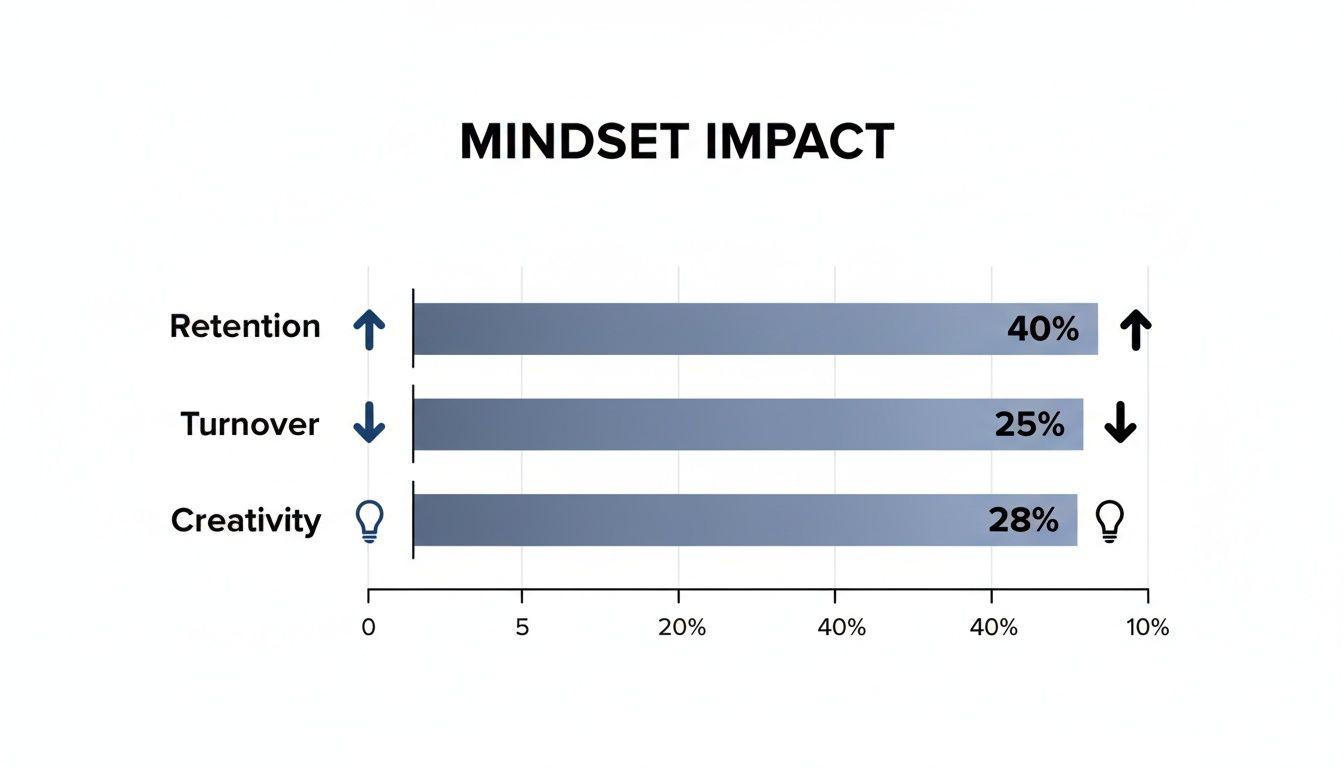
These numbers prove that a growth mindset isn’t some fluffy “soft skill.” It’s a measurable driver of success. A 2020 study of professionals in Korea revealed that teams with a shared growth mindset were far more willing to tackle challenges and learned from mistakes three times more effectively. The result? A 28% jump in their collective creativity scores.
Collaborating with Successful Colleagues
Finally, think about how people react when a coworker hits a home run. This is a huge tell, revealing whether someone is operating from a mindset of scarcity or abundance.
- Fixed Mindset View: When a peer succeeds, it can feel like a threat. It triggers jealousy or feelings of inadequacy, as if there’s only a limited amount of success to go around. This can quickly lead to toxic, uncooperative behavior.
- Growth Mindset View: A successful colleague isn’t a threat; they’re an inspiration and a resource. Someone with a growth mindset is the first to say, “That was amazing! How did you do that?” They truly believe they can achieve similar results if they learn from others and put in the work.
If you’re looking to continue your own development, it can be incredibly helpful to hear from others who have walked this path. You can find some fantastic insights in some of the best personal growth podcasts out there.
Ultimately, your choice between a growth vs. fixed mindset at work comes down to a simple question: are you there to prove your worth, or to improve it?
The Impact of Mindset on Team Performance and Innovation

The difference between a growth vs fixed mindset isn’t just an individual trait; it scales up to define an entire organization. A company’s collective mindset is the invisible architecture of its culture, determining whether the environment champions creative risks or quietly punishes anyone who strays from proven methods.
In a culture dominated by a fixed mindset, the main objective is often to avoid mistakes at all costs. Errors are treated as proof of incompetence, which cultivates a low-grade fear. Employees quickly learn to hesitate before proposing bold ideas or experimenting with new approaches, making the organization rigid and slow to adapt.
On the other hand, a culture built around a growth mindset establishes psychological safety. When people believe their abilities can be developed, they start to see challenges not as threats, but as necessary steps in the innovation process. This belief makes it safe to fail, learn, and try again—the very engine of progress.
A Tale of Two Company Cultures
Let’s make this tangible. Imagine two fictional tech companies, “Innovate Inc.” and “Stasis Corp,” both tasked with creating a new software product. Their dominant mindsets will send them down two completely different paths.
Stasis Corp: The Fixed Mindset Environment
At Stasis Corp, the culture is all about perfectionism and individual genius. Project leads are expected to have all the answers from day one, and any major setback is met with a hunt for who to blame.
- Initial Brainstorming: Ideas are carefully filtered to minimize any chance of failure. Team members hold back unconventional concepts, fearing they’ll look foolish or unprepared.
- Hitting a Roadblock: A major bug appears late in development, and panic sets in. The team’s focus immediately shifts from solving the problem to deflecting responsibility, creating a toxic cycle of finger-pointing.
- The Outcome: The final product is a safe, incremental update that already feels behind the market. Team morale is in the gutter, and the most creative employees are quietly polishing their resumes.
Innovate Inc: The Growth Mindset Environment
Innovate Inc runs on a different operating system—one of learning and experimentation. The leadership openly celebrates “intelligent failures,” treating mistakes as valuable data points.
- Initial Brainstorming: The team is encouraged to think big, and no idea is shot down early. The room is collaborative and energetic, completely focused on what’s possible.
- Hitting a Roadblock: The same major bug surfaces. The project lead calls a “lessons learned” meeting where the team deconstructs the failure without blame. They don’t see the bug as a disaster, but as a critical insight that will make their process better.
- The Outcome: The team pivots, using what they learned to create a genuinely groundbreaking product. They feel energized and more connected, having navigated a tough challenge together.
The core difference lies in how each company defines failure. For Stasis Corp, failure is a final verdict. For Innovate Inc, it’s just data.
The Data-Driven Case for a Growth Mindset Culture
This isn’t just a hypothetical story; the numbers back it up. We see a direct, statistically significant link between a growth mindset and innovative behavior at work.
The table below gives a data-driven look at how a company’s dominant mindset culture can affect key business metrics.
Organizational Outcomes by Dominant Mindset
| Business Metric | Growth Mindset Culture Impact | Fixed Mindset Culture Impact |
|---|---|---|
| Employee Engagement | 34% higher likelihood of strong ownership and commitment. | Lower engagement; employees often feel like cogs in a machine. |
| Innovation & Risk-Taking | 49% more likely to say the company fosters innovation. | Fear of failure stifles creativity; preference for “safe” projects. |
| Collaboration & Trust | 47% more likely to report high levels of trust in their colleagues. | Silos and internal competition are common; trust is low. |
| Employee Retention | 31% more likely to report long-term commitment to the company. | Higher turnover, especially among top performers seeking growth. |
The data paints a clear picture: a growth-oriented culture isn’t just a “nice-to-have.” It directly fuels the metrics that drive long-term success.
A landmark study, for instance, found that employees who believe their abilities can be developed show a strong positive correlation with innovative behavior. The research revealed that growth-minded individuals are 41% more likely to engage in the creative problem-solving and necessary risk-taking that lead to breakthroughs. You can dig into the full study on the connection between mindset and workplace innovation on the NIH’s PMC platform.
Organizations that cultivate a growth mindset don’t just see better morale; they see a tangible impact on their bottom line. They become more agile, resilient, and better at solving complex problems. This adaptability is a massive competitive advantage, allowing them to consistently outperform competitors stuck in a culture that prioritizes appearing perfect over the messy reality of genuine progress. The business case is clear: investing in a growth mindset is investing in sustainable innovation.
Actionable Strategies to Cultivate a Growth Mindset
Knowing the difference between a growth vs fixed mindset is one thing, but real change happens when you put that knowledge to work. Cultivating a growth mindset isn’t a passive exercise; it’s an active process of rewiring how you think. It takes conscious effort and repeatable strategies to challenge your default thought patterns and forge new mental habits.
This isn’t just about self-help, either. It’s a core strategy driving real business success. A recent analysis found that 80% of companies are now actively building growth mindset cultures, seeing it as a direct path to profit. This isn’t just talk—64% of them report real gains in productivity, which translates to a 15-20% bump in output per employee. You can dig deeper into how companies are leveraging mindset shifts for bottom-line results on The Equity Accelerator.
The best part? These powerful shifts are available to anyone. You don’t need a corporate training budget, just a commitment to a few key practices.
Identify Your Fixed Mindset Triggers
Think of yourself as a detective of your own mind. The first step is to learn the sound of your fixed mindset’s voice—it’s that critical inner monologue that pipes up when you run into a challenge, face criticism, or suffer a setback. Recognizing this voice is the game-changer.
This inner critic usually appears in specific situations. Maybe it’s when you’re trying to learn new software, or perhaps it’s after a manager gives you some blunt feedback. Start paying close attention to those moments when you feel defensive, discouraged, or just want to throw in the towel.
Once you spot a trigger, try personifying that fixed-mindset voice. Give it a name, like “The Judge” or “Captain Comfort Zone.” This simple trick creates just enough psychological space to observe its narrative instead of blindly believing it. That separation is your first real move toward choosing a different response.
Reframe Your Internal Dialogue
Once you can hear that fixed-mindset voice, you can start talking back to it. This means consciously reframing your self-talk to be more aligned with growth principles. One of the simplest and most powerful ways to do this is by adding one little word to your limiting statements: “yet.”
This tiny linguistic tweak can completely change your perspective.
- Instead of thinking, “I don’t get this,” try, “I don’t get this… yet.”
- Instead of, “I’m not good at public speaking,” shift to, “I’m not good at public speaking… yet.”
- Instead of, “This isn’t working,” reframe it as, “This isn’t working… yet.”
The word “yet” turns a dead end into an open road. It acknowledges where you are right now without locking you in, framing the situation as part of a learning curve instead of a final judgment on your abilities.
Seek Challenges and Embrace Imperfection
A fixed mindset runs from failure and clings to safety. To build a growth mindset, you have to do the exact opposite: purposefully step outside your comfort zone. This isn’t about being reckless; it’s about picking tasks that stretch you just beyond your current abilities.
Key Insight: A growth mindset thrives on challenge because it equates effort with progress. When you actively choose difficult tasks, you are sending a powerful signal to your brain that learning, not just performance, is the goal.
This whole process involves redefining your relationship with failure. Stop seeing mistakes as proof of incompetence and start seeing them as data. Every error is a valuable piece of information telling you what doesn’t work, which gets you one step closer to figuring out what does. If navigating this on your own feels daunting, the frameworks offered through personal growth counseling can provide structured support.
Create a Feedback-Rich Environment
While a fixed mindset flinches at criticism, a growth mindset craves it. Constructive feedback is pure fuel for improvement, offering an outside perspective that can shine a light on blind spots you’d never see otherwise. Make it a habit to ask for input from colleagues, mentors, or managers you trust.
To get the most useful advice, be specific when you ask.
- Be Direct: Don’t just ask, “How did I do?” Instead, try, “What’s one thing I could have done to make that presentation more impactful?”
- Focus on the Future: Ask, “For my next project like this, what advice would you give me to improve the outcome?”
- Listen to Understand: When you get the feedback, just listen. Resist the urge to explain or defend yourself. Thank the person for their time and give yourself a moment to process it later.
By actively seeking and gracefully accepting feedback, you put your learning curve on hyperdrive and reinforce the belief that your abilities can always grow. You’re building your own personal culture of continuous improvement, one conversation at a time.
Common Questions About Growth and Fixed Mindsets
Even after you get the hang of the growth vs fixed mindset framework, real-world questions pop up all the time. The shift toward a growth-oriented view isn’t a straight line; it’s full of nuances, and it’s perfectly normal to hit a wall or wonder if you’re getting it right. This section tackles some of the most common questions I hear, offering some clarity for those tricky situations.
Getting into these gray areas is important. Building a growth mindset is really about creating new mental habits and raising your own awareness, which almost always sparks new questions along the way.
Can You Have a Mix of Both Mindsets?
Of course. In fact, most of us do. It’s incredibly rare for someone to operate from a purely growth or purely fixed mindset in every single aspect of their life. This is a crucial detail that often gets glossed over.
Think about it: you might have a solid growth mindset about your career, always ready to tackle a new challenge or learn from feedback at the office. But when it comes to, say, artistic talent, you might have a fixed belief that you “just weren’t born creative.”
The goal isn’t to achieve some perfect, unshakable growth mindset. It’s about building the self-awareness to notice where and when your fixed-mindset triggers pop up. Once you can pinpoint those specific contexts, you can start making a conscious choice to respond in a more productive, growth-oriented way when it counts.
The real work is in noticing the fixed mindset voice when it shows up and understanding that you have a choice in how you respond. It’s about progress, not perfection.
Is a Growth Mindset Just About Praising Effort?
This is probably one of the biggest myths out there, and the answer is a hard no. While appreciating effort is part of the equation, the concept is far more sophisticated than just giving out gold stars for trying hard. Praising effort blindly, without any connection to results or strategy, can actually do more harm than good.
A genuine growth mindset is about valuing the entire learning process. That includes things like:
- Smart Strategies: Applauding the specific approaches someone used to crack a problem.
- Tackling Challenges: Acknowledging the guts it takes to step outside a comfort zone.
- Using Feedback: Valuing someone’s ability to take criticism on board and actually apply it.
- Grit and Progress: Celebrating not just the persistence, but the actual progress made because of it.
The focus should always be on productive effort—the kind that leads to learning, new strategies, and eventually, better results. It’s about drawing a clear line between hard work and successful outcomes, not just cheering on the struggle itself. Praising effort that’s going nowhere isn’t helpful; guiding that effort toward a better approach is.
How Long Does It Take to Develop a Growth Mindset?
There’s no finish line here. Developing a growth mindset is an ongoing practice, not a destination you arrive at. It’s less like flipping a switch and more like building muscle at the gym or becoming fluent in a new language. It takes consistent, intentional work over time.
That said, you can feel the benefits right away. The very first time you catch a fixed-mindset thought and reframe it, or consciously decide to take on a challenge you’d normally avoid, you’re building momentum. Those small wins are powerful.
But making the growth mindset your automatic, go-to response—especially when you’re stressed or under pressure—is a lifelong practice. You’re essentially rewiring old habits of thought. Like any habit, it gets stronger and more second-nature the more you do it. The journey never really ends, but with every step, it gets easier and more deeply ingrained in who you are.
At David Pexa, we provide structured guidance and evidence-informed strategies to help you navigate your personal development journey with clarity and confidence. Explore our resources to build a stronger mindset and achieve your goals. Learn more at https://davidpexa.com.
