


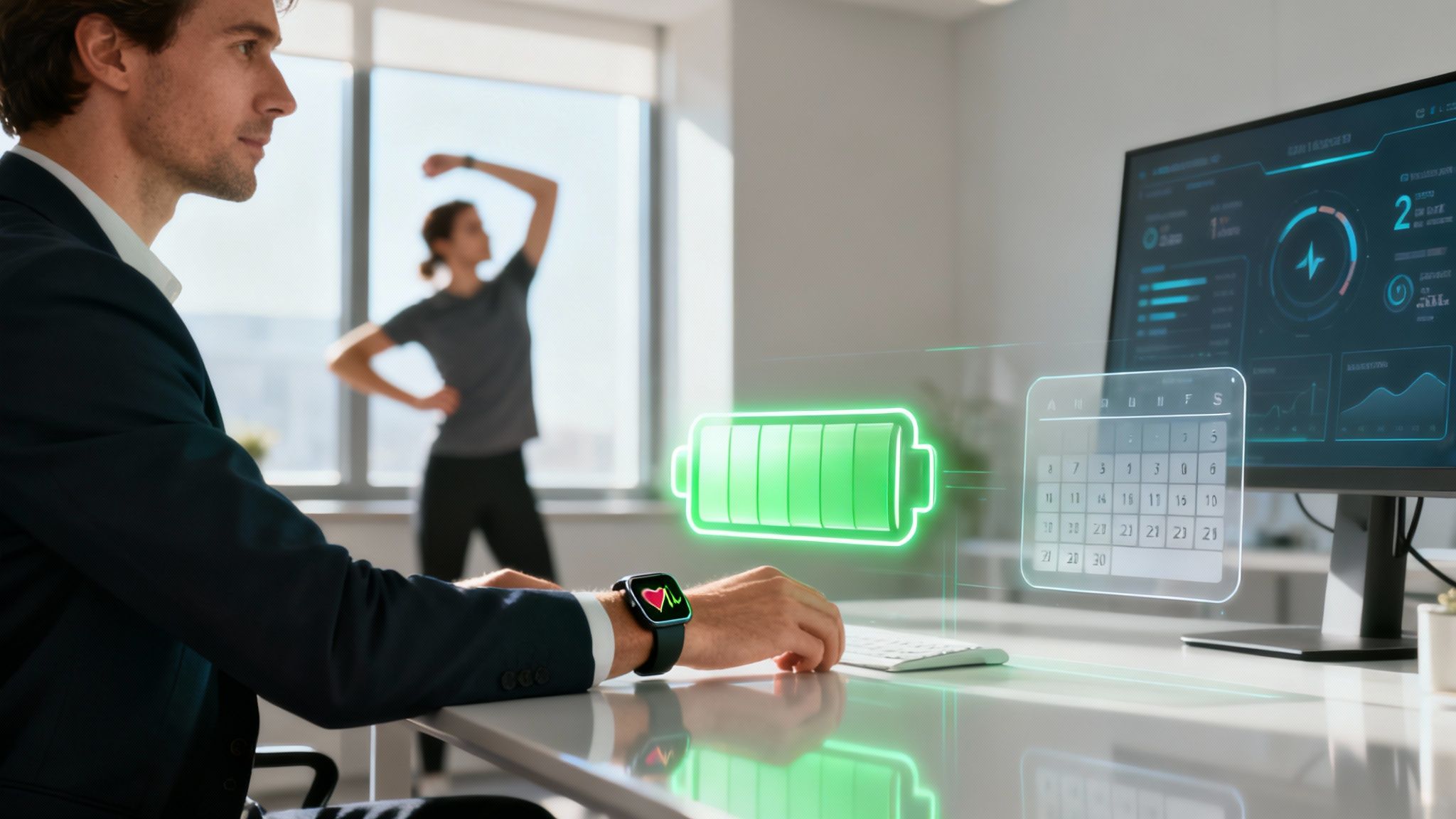
Ever feel like you’re just running on fumes? You’re not alone. The problem often isn’t a lack of time, but a lack of energy. Personal energy management solutions are the specific strategies and tools you use to take back control of your physical, mental, and emotional fuel. It’s a shift from just clock-watching to managing the quality of your focus and effort throughout the day.
Think of it this way: your energy is a finite budget. You can either spend it randomly and end up drained, or you can invest it wisely in things that matter, ending your day feeling accomplished, not exhausted.
What Are Personal Energy Management Solutions
The term “energy management” might bring to mind a power company optimizing the electrical grid. The concept is surprisingly similar, but the resource is you. You’re essentially becoming the CEO of your own well-being and performance, making strategic decisions to cut waste and maximize your output.
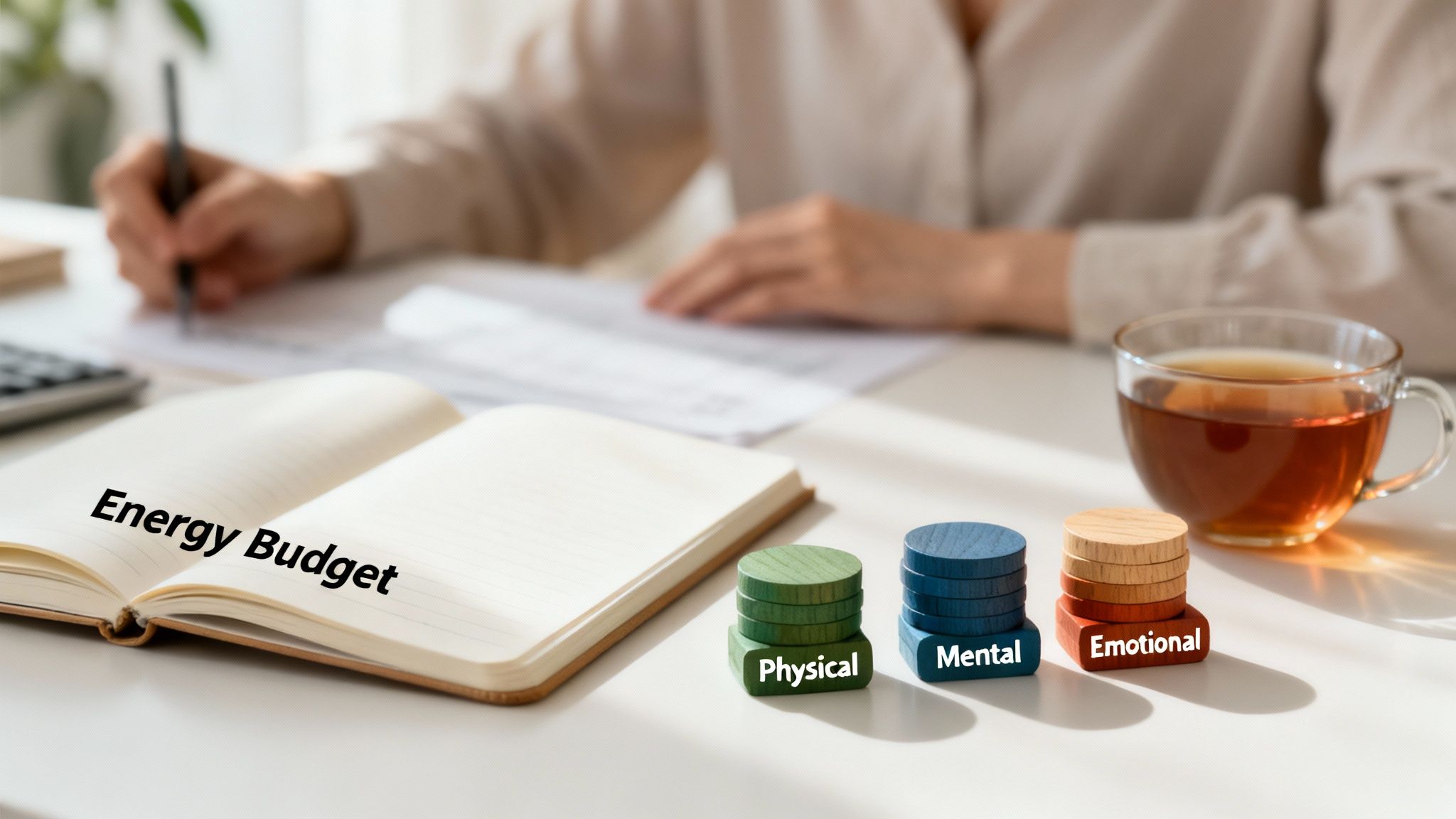
Let’s stick with the financial budget analogy. Each morning, you start with a certain amount in your “energy account.” Every meeting you attend, every complex problem you solve, and every stressful interaction is a withdrawal. A day without a plan is like tapping your card without checking the balance—you’re almost guaranteed to overdraw. But when you manage your energy strategically, you invest in high-return activities and still have something left in the tank.
The Three Pillars of Your Energy Budget
To truly master your energy, you have to look at the whole picture. Your energy isn’t just one thing; it’s a blend of different resources that all affect each other. If one pillar crumbles, the others quickly follow.
- Physical Energy: This is your base. It’s all about sleep, nutrition, and movement. Without a solid physical foundation, everything else feels ten times harder.
- Mental Energy: This is your focus, your problem-solving power, and your ability to make sharp decisions. It’s the currency you spend on deep work, learning a new skill, or mapping out a big project.
- Emotional Energy: Think of this as your resilience, your patience, and your capacity for positive social interaction. It gets drained by conflict and worry but refilled by meaningful connections and a sense of purpose.
The real goal isn’t just to stop wasting energy, but to build systems that actively replenish it. This isn’t about working less; it’s about working smarter. Once you understand your own rhythms—when you feel most creative, focused, or patient—you can start aligning your most critical tasks with your natural peaks.
This strategic allocation of personal resources is a cornerstone of effective self-improvement. It transforms abstract goals into achievable daily actions, directly linking how you feel with what you accomplish.
Why This Is a Learnable Skill, Not an Innate Trait
Here’s the best part: managing your energy isn’t some gift you’re born with. It’s a skill, just like learning to budget your money or manage your calendar. You can get better at it with practice.
This guide will go way beyond the generic advice you’ve heard a thousand times. We’re going to explore specific, actionable energy management solutions, from simple behavioral shifts to powerful software, that put you firmly in the driver’s seat. Understanding the personal growth meaning behind this practice is the first step. You’ll learn how to stop fighting a daily battle with exhaustion and start building a sustainable system that fuels your ambitions without burning you out.
The Two Core Approaches to Managing Your Energy
When you get serious about managing your energy, you’ll find yourself on one of two paths—or, ideally, a combination of both. Think of it like getting your finances in order. You could focus on your spending habits and budget discipline (the behavioral approach), or you could get a sophisticated app to track every penny (the technical approach). Both are powerful energy management solutions, but they come at the problem from different angles.
The first path is all about what’s going on inside: the habits, routines, and mindsets you cultivate. The second relies on external tools—technology that can measure, track, and give you a clear picture of where your energy is actually going. Let’s break down what each one looks like in practice.
Behavioral Solutions: Upgrading Your Internal Operating System
Behavioral solutions are the fundamental habits you build to protect and renew your energy. This isn’t about willpower or pushing harder; it’s about working with your body’s natural rhythms, not fighting against them. You learn to structure your day around your biological peaks and valleys, making sure you tackle your toughest work when you have the most fuel in the tank.
And these aren’t just fuzzy suggestions like “take more breaks.” We’re talking about specific, proven frameworks you can start using today.
- Working with Ultradian Rhythms: This means working in focused bursts of about 90 minutes, followed by a real break. Our brains aren’t designed for endless, hours-long slogs. This method respects that natural limit and prevents the mental fatigue that kills productivity.
- Practicing Strategic Rest: Rest isn’t just the absence of work; it’s an active process. A five-minute walk, a quick meditation, or some simple stretching does far more to reset your brain than scrolling through your phone, which often just drains you further.
- Reframing Your Mindset: This is a game-changer. You start treating rest as a non-negotiable, productive part of your workday. Breaks aren’t a sign of weakness; they’re the essential maintenance that fuels high-quality output.
The real power of these habits is that they don’t cost a thing and their benefits compound over time. They are the bedrock of any effective energy management strategy.
Technical Solutions: Your Personal Analytics Dashboard
While good habits are the foundation, technology gives you a data-driven edge. Technical solutions are the tools and software that act like a dashboard for your personal energy, showing you what’s really going on under the hood. It’s a concept borrowed directly from the corporate world.
Companies use complex Energy Management Systems (EMS) to monitor power grids and streamline operations. That market is massive—valued at $56 billion in 2025 and on track to hit $219.3 billion by 2034. Why? Because smart technology helps them predict and manage energy use with incredible precision. You can learn more about these AI-enabled efficiency solutions and see how the same principles apply to us.
Personal tech solutions do for you what an EMS does for a corporation: they give you the visibility needed to make smarter decisions. After all, you can’t fix a problem you can’t see.
Here’s what this looks like for an individual:
- Bio-feedback Wearables: A smart ring or watch that tracks sleep quality, heart rate variability (HRV), and activity gives you objective data on how recovered you really are.
- Productivity and Project Software: Tools like Asana or Trello aren’t just for tasks. You can use them to map out your “energy budget” for the week, assigning your most draining work to the days you know you’ll be at your sharpest.
These tools don’t create good habits, but they absolutely supercharge them. They give you the hard data you need to see what’s working, what isn’t, and where to adjust.
Behavioral vs. Technical Energy Management Solutions
So, where should you start? This table breaks down the two approaches to help you decide which path—or combination of paths—is the right fit for you right now.
| Approach | Core Concept | Examples | Best For |
|---|---|---|---|
| Behavioral | Building sustainable habits and internal systems to manage energy. | Time blocking, 90-minute focus sprints, active recovery breaks, mindset reframing. | Creating a foundational, low-cost system that improves your baseline energy levels. |
| Technical | Using external tools to measure, track, and optimize energy patterns. | Sleep trackers, HRV monitors, focus apps, project management software. | Gaining objective data to identify hidden energy drains and fine-tune your habits. |
Ultimately, the most resilient systems combine both. You start by building the right habits (behavioral), then use data (technical) to refine those habits for even better results.
How to Choose the Right Energy Management Approach for You
Picking the right way to manage your energy can feel like standing at a crossroads. You’ve got all these options—from simple habits to slick new tech—and it’s easy to get analysis paralysis.
The trick is to start with a diagnosis. Where is your energy really going? Once you can pinpoint the main source of the drain, you can pick a strategy that directly tackles your biggest problem.
This all starts with a bit of self-awareness. Are you wrestling with mental fog, struggling to lock in on deep work? Or is it a physical exhaustion that hangs on you, even after a full night’s sleep? Maybe it’s more emotional, where constant stress just leaves you feeling tapped out. Figuring out your main challenge is the first, most crucial step.
What’s Your Primary Energy Drain?
Before you can fix the leak, you have to find it. Most energy drains fall into one of three buckets. Let’s walk through them so you can see which one sounds most like you.
- Cognitive Drain (Mental Fog): This feels like your brain is constantly running on low battery. You can’t seem to focus, get sidetracked by everything, and the idea of creative or strategic thinking feels impossible. Your to-do list looks like a mountain, and even small tasks take forever.
- Somatic Drain (Physical Exhaustion): This is that deep, bone-tired feeling that a good night’s sleep just doesn’t seem to touch. You might feel sluggish all morning, chug caffeine to survive the afternoon, and have zero physical drive for a workout or a hobby after your workday ends.
- Affective Drain (Emotional Fatigue): This usually shows up as low resilience or a short fuse. You find yourself getting knocked off balance by minor setbacks, it’s hard to be positive with your team, and your motivation is tanking because of persistent stress or a feeling of being unfulfilled.
Once you’ve identified which of these is your primary struggle, you’ll know exactly where to aim your efforts.
This decision path helps you see whether you should focus on internal habits first or jump straight to external tools to build out your energy management system.
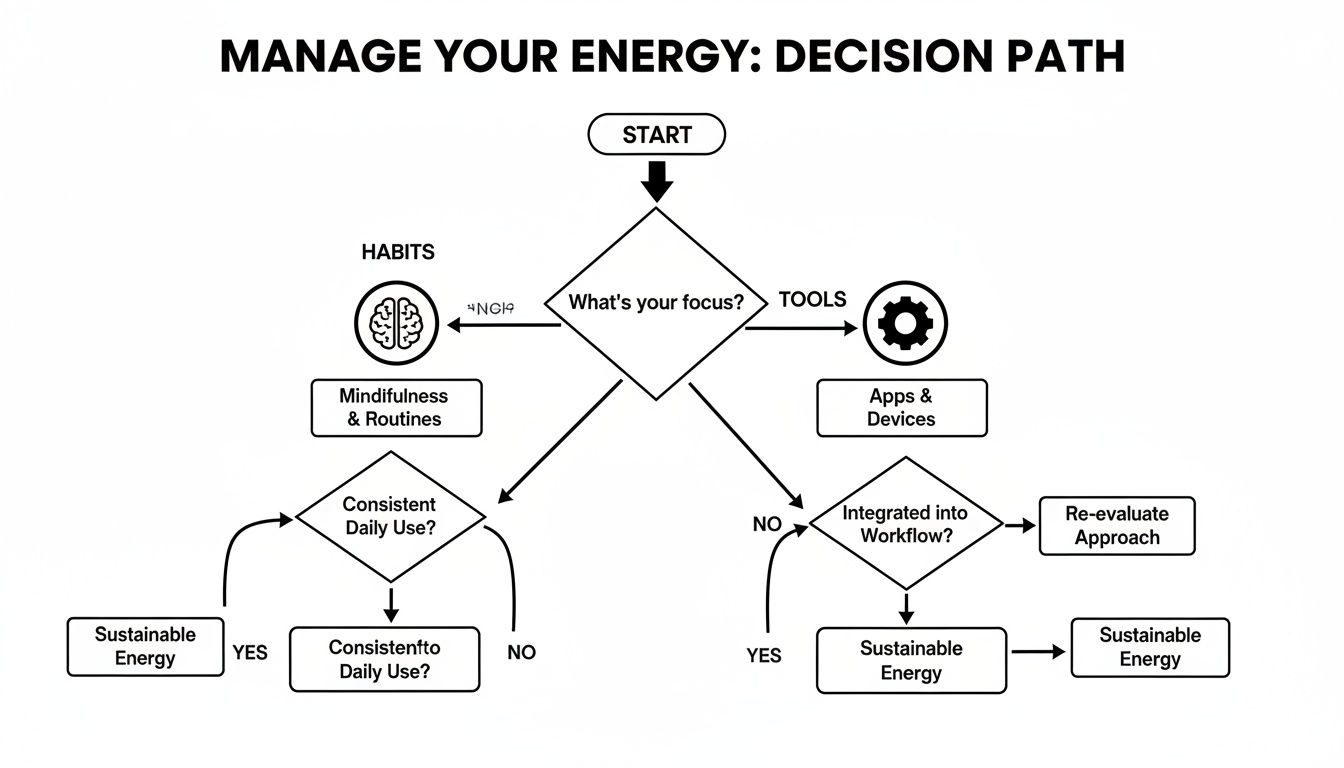
As the flowchart shows, there’s no single “right” place to start. Both habits and tools are valid entry points, so you can choose the path that makes the most sense for you right now.
Matching the Solution to Your Needs
Okay, let’s get practical. Based on your self-diagnosis, here are some targeted recommendations designed to give you the biggest bang for your buck. This isn’t a one-size-fits-all prescription; it’s about finding the right tool for the job.
If You’re Experiencing Cognitive Drain (Mental Fog):
Your goal here is to kill distractions and rebuild your ability to do deep, focused work. The best way to do that is to combine a structured habit with tech that backs it up.
- Habit to Build: Start using the Pomodoro Technique or block out 90-minute “focus blocks.” This trains your brain to work in intense, dedicated sprints followed by a real break.
- Tool to Use: Pair that habit with a focus app like Freedom. It will block distracting websites and notifications for you, creating a fortress of solitude where you can actually get things done.
If You’re Experiencing Somatic Drain (Physical Exhaustion):
The mission here is all about recovery and physical renewal. This is where objective data becomes your best friend, because it can show you patterns you’d never notice on your own.
- Habit to Build: Weave in “micro-breaks” for movement every hour. A quick five-minute walk or a few stretches can do wonders for your blood flow and fight off that afternoon slump.
- Tool to Use: A wearable that tracks sleep, like an Oura Ring or Whoop strap, gives you priceless data on your sleep quality and recovery. It helps you finally connect what you do during the day to how you feel physically.
This data-driven approach is already a huge deal in the corporate world. As energy costs become a silent productivity killer, the global market for Energy Management Systems (EMS) is on track to explode from $69.05 billion in 2025 to $225.13 billion by 2034. This isn’t just about factory floors anymore; it’s about smart, cloud-based dashboards for everything from corporate headquarters to home offices. You can read the full research on the energy management systems market to see how deep this trend runs.
If You’re Experiencing Affective Drain (Emotional Fatigue):
Here, the goal is to build emotional resilience and give your mind some room to breathe. That usually requires a mix of mindfulness and structured reflection.
By proactively identifying your specific type of energy drain, you transform a vague feeling of being ‘tired’ into a solvable problem with a clear action plan.
- Habit to Build: Try a simple two-minute journaling practice at the end of your workday. Just jotting down one win and one challenge helps you process the day and stops stress from bleeding into your personal time.
- Tool to Use: Use a guided meditation app like Calm or Headspace for just 10 minutes a day. It’s a surprisingly effective way to regulate your nervous system and get better at handling whatever the day throws at you.
By using this “if you feel X, then try Y” framework, you can stop guessing and start putting a system in place that actually works for you.
How to Implement Your Personal Energy Management System
Knowing you need to manage your energy and actually doing it are two very different things. The gap between them can feel like a chasm, filled with complicated apps and intimidating new habits. The good news? Building a system that works for you doesn’t have to be overwhelming.
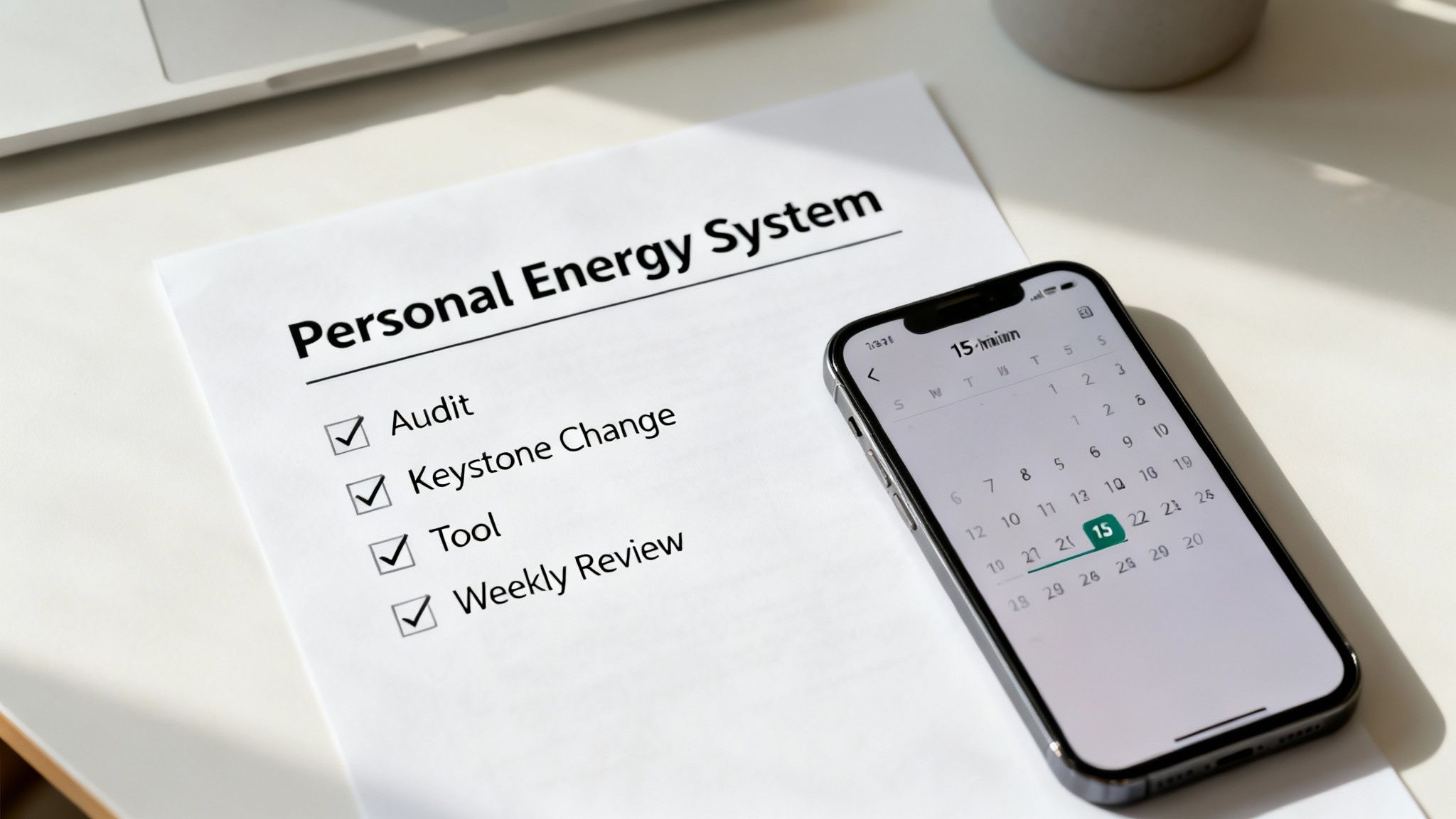
By breaking it down into a clear, four-step blueprint, you can put your strategy into action methodically. This isn’t about a massive, short-lived overhaul. It’s about making small, sustainable changes that stick. Let’s walk through the exact process for building effective, personal energy management solutions.
Step 1: Conduct a Personal Energy Audit
Before you can manage your energy, you have to know where it’s actually going. Think of it like a business tracking its expenses to find waste—you’re doing the same thing, but with your focus and vitality. This first step is all about becoming a detective of your own daily rhythms.
For one full week, keep a simple log. Jot down your energy levels on a scale of 1 to 10 at different points throughout the day: when you wake up, mid-morning, after lunch, late afternoon. Crucially, also note what you were doing during your highest and lowest points.
The goal isn’t self-judgment; it’s pattern recognition. You might discover your focus is laser-sharp at 10 AM, making it the perfect time for deep work. Or maybe you’ll realize that a certain type of meeting consistently leaves you drained. This data is the bedrock of your entire system.
You can’t fix a problem you can’t see. An honest audit turns vague feelings of fatigue into actionable data points, giving you a real baseline to work from.
Step 2: Define Your Keystone Change
With your audit done, you’ll probably have a list of things you could change. Resist the urge to tackle them all at once. That’s a recipe for burnout. Instead, you’re going to pick one keystone change—a single, high-impact habit that creates a positive ripple effect across everything else.
The term comes from the central stone in an arch; it’s the one piece that holds the entire structure together. For your energy, this might be something surprisingly small but powerful.
- Example 1: If your audit showed you’re wiped out by 3 PM, your keystone change might be taking a mandatory 15-minute walk after lunch. No exceptions.
- Example 2: If you noticed your mornings are a chaotic scramble, your change could be laying out your clothes and packing your bag the night before.
Choose the one change that feels both achievable and promises the biggest return on your effort. Focusing on a single habit dramatically boosts your chances of making it stick.
Step 3: Integrate Your Support Tools
Now it’s time to back up your new habit with the right tool. Technology is your ally here, but only when it supports a clearly defined behavior. A tool without a purpose is just a distraction.
Let’s say your keystone habit is protecting your deep work time every morning. Your support tool could be a focus app like Freedom that blocks distracting websites. If your goal is to improve your sleep, a wearable that tracks sleep quality can provide the feedback you need to stay motivated.
The principle is simple: one habit, one tool. This keeps you from getting bogged down in a dozen new apps and workflows. You’re creating a simple, powerful loop where the behavior and the technology reinforce each other.
Step 4: Schedule a Weekly Review
A system is only as good as its maintenance. The final, critical step is to schedule a non-negotiable, 15-minute review at the end of each week. This is your chance to look back, see what worked, and make small course corrections.
During this quick check-in, ask yourself three simple questions:
- Did I stick to my keystone change this week?
- What went well?
- What got in the way, and what can I adjust for next week?
This short debrief is what makes your system adaptable and resilient. It lets you learn from setbacks and refine your approach over time, ensuring your energy management solutions evolve as your goals and challenges do. This constant, gentle iteration is the secret to building a system that delivers high performance for the long haul.
Real-World Examples of Energy Management in Action
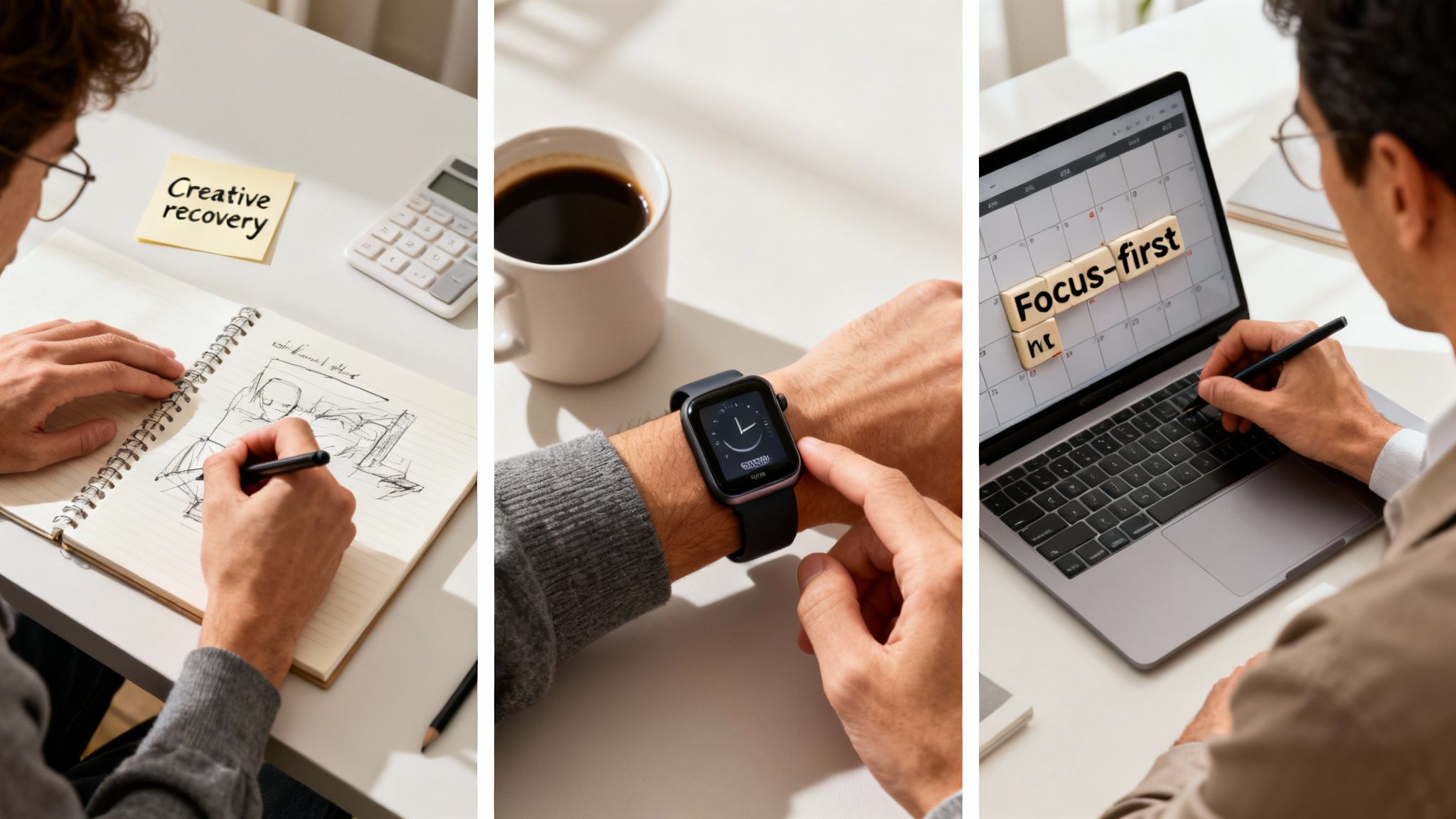
Theory is great, but seeing how energy management solutions actually work for real people is what truly matters. These aren’t just abstract ideas for corporate efficiency experts; they’re practical, life-changing systems for ambitious professionals who feel like they’re running on fumes.
Let’s look at three people who were dealing with the all-too-common enemies of high performance: burnout, exhaustion, and fatigue. Each of them found a specific way to reclaim their focus and well-being, proving that a thoughtful approach to energy really works.
Profile 1: The Freelance Creative Who Beat Burnout
Meet Alex, a freelance graphic designer. His passion had become his prison. With no clear line between work and life, he was constantly wrestling with creative burnout. Project deadlines started to feel more like threats than opportunities, and his energy levels were all over the place, which meant his work quality was, too.
The real culprit? Context switching. Alex would jump from designing a logo to answering client emails, then switch to invoicing, only to dive back into another creative project. Every single one of those shifts was a massive mental energy drain, leaving him scattered and unproductive by lunch.
The Solution Implemented:
Alex didn’t need more willpower; he needed a better system. He adopted a behavioral strategy called task batching, completely redesigning his workday around the type of brainpower each task required.
- Creative Block (9 AM – 12 PM): This became his sacred, no-fly zone for interruptions. All notifications went off, and he focused entirely on design.
- Administrative Block (1 PM – 2:30 PM): He corralled all his emails, calls, and invoicing into one focused power session.
- Creative Recovery (4 PM – 5 PM): Instead of forcing himself to push through the afternoon slump, he scheduled an hour to recharge by sketching for fun or just getting outside.
The Measurable Result:
Within a single month, Alex cut his average project completion time by an impressive 20%. Even better, he felt the constant knot of work-related anxiety loosen its grip. By creating structure, he ironically found more creative freedom.
Profile 2: The Founder Who Traded Hustle for Health
Next up is Maya, a classic startup founder. She was running on caffeine and the belief that more hours automatically meant more success. Her 12-hour days were becoming less and less productive, her sleep was a mess, and she felt perpetually exhausted.
Her energy drain was purely physical. Without quality rest, she was starting every single day with her tank half-empty. Her body was stuck in a high-stress state, making clear-headed, strategic thinking feel next to impossible.
The Solution Implemented:
Maya decided to stop guessing and start measuring. She went for a technical solution, investing in a sleep-tracking wearable and committing to a morning routine that was completely non-negotiable.
- Data-Driven Sleep: The wearable provided hard data on her sleep cycles and heart rate variability (HRV). Seeing the poor numbers in black and white was the wake-up call she needed.
- Protected Morning Routine: She blocked off the first 60 minutes of her day for herself. No screens. Instead, she got 15 minutes of sunlight and did some light exercise.
The Measurable Result:
After just six weeks, her deep sleep duration had increased by an average of 45 minutes per night. She felt dramatically more focused during the day and found she was getting more done in a sharp eight-hour day than she ever did in a grueling twelve.
Profile 3: The Team Lead Who Ended Meeting Fatigue
Finally, let’s look at Ben, a team leader at a fast-growing tech company. His calendar was a nightmare—a solid wall of back-to-back video calls. He was constantly drained by “Zoom fatigue” and had zero time left for the deep, strategic thinking his job actually required.
The Solution Implemented:
Ben knew the problem wasn’t just his; it was the team’s entire way of working. He rolled out a new communication framework built on asynchronous tools and what he called “focus-first” calendar blocks.
- Asynchronous-First Communication: For simple status updates and non-urgent questions, the team switched from scheduling meetings to using project management software and shared docs.
- Focus-First Calendar Blocks: He mandated that everyone on the team, himself included, block out two hours of “no-meeting” time every single day for uninterrupted work.
This shift from reactive communication to intentional collaboration is a powerful energy management solution. It empowers individuals to protect their most valuable resource: focused attention.
The Measurable Result:
The team slashed its total number of internal meetings by over 40%. Ben got back nearly eight hours a week for actual strategic work, and morale shot up as everyone finally felt like they were in control of their own schedules. For those looking to go even deeper on building this kind of focus, a guided personal growth retreat can provide the immersive environment needed to master these skills.
Your Next Steps to Sustainable High Performance
Let’s be clear: mastering your personal energy isn’t just another box to check on your to-do list. It’s the very system that powers everything else you do. The big takeaway is simple but powerful: genuine high performance is about working smarter, not just grinding harder.
When you start treating your energy like the precious, finite resource it is, you unlock a way of living that is more focused, productive, and balanced.
Think of energy management solutions as the bridge between your biggest goals and your personal well-being. They give you a real structure for channeling your efforts where they count most, ensuring you bring your A-game to your most important work without burning out. This is the ultimate tool for getting where you want to go.
Commit to Your First Action
Going from knowing this stuff to actually doing it starts with one small, intentional step. Don’t just read about it. Put it into play. Your immediate next step is to nail down the foundational practice we covered earlier.
Conduct your personal energy audit this week. This isn’t some huge, time-consuming project. It’s a simple act of observation that will give you the clarity you need to make real changes.
By just paying attention to your energy peaks and valleys, you turn those vague feelings of being drained into a clear, actionable map for your week. Taking this first step is the most important move you can make.
Finally, remember that this isn’t a one-and-done fix. It’s an ongoing process of tuning and refining. For a steady stream of inspiration on this path, listening to some of the best personal growth podcasts can offer fresh ideas and keep you motivated.
You now have the framework to break the burnout cycle for good. Start your audit, pick one small change to focus on, and begin building a system that fuels your success for the long haul. The power to create a more energized and fulfilling professional life is right here in your hands.
Frequently Asked Questions
When you first start thinking about managing your energy, a few questions always seem to pop up. It’s totally normal to wonder how long this stuff takes, which tools are actually worth it, and what happens when you inevitably have an off day. Getting straight answers to these questions is the best way to build the confidence to stick with it.
This section gets right to the point, answering the most common questions with practical advice to help you build a system for high performance that actually lasts.
How Quickly Can I Expect To See Results?
While building a full-fledged energy management system is a long game, you don’t have to wait ages to feel the benefits. The secret is consistency, not intensity. Most people feel small but meaningful improvements within the first one to two weeks of making just one key change.
For instance, committing to a simple 10-minute walk after lunch can almost immediately kill that afternoon slump. The really big wins—like unshakable focus and a deeper well of resilience—come later, as these new habits become automatic. Those early victories are what keep you motivated for the long haul.
Should I Start with New Habits or New Tech?
This is a classic chicken-or-egg question, but you don’t have to choose. The best systems use both. Think of habits and technology as partners, not competitors. That said, if you’re starting from scratch, locking in one foundational behavioral habit is almost always the best first move.
Here’s why: a habit is your reason, and a tool is your method. A fancy sleep tracker won’t do you any good if you don’t have the self-discipline to get to bed at a decent hour.
First, pinpoint a simple behavior to change—like putting your phone away an hour before bed. Then, bring in a tool, like a sleep-tracking app, to measure your progress and show you it’s working. This creates a powerful cycle where your habit gives you the structure and the tech gives you the proof.
What if I Fall Off Track with My New System?
Let’s be clear: setbacks are going to happen. It’s not a possibility; it’s a certainty. A chaotic week at work, a vacation, or just plain old stress can throw you off your game. The goal here is progress, not perfection. The quickest way to give up entirely is to treat a small slip-up like a catastrophic failure.
Instead, have a simple reset plan ready to go.
- Acknowledge, Don’t Judge: So you skipped a few days. Don’t beat yourself up. Just notice it and move on.
- Go Back to One Thing: Don’t try to restart everything at once. Just get back to that one small, core habit that you started with.
- Review and Learn: During your next weekly review, ask yourself why you fell off. What can you tweak to make it easier to stick with things next week?
Falling off track isn’t failure—it’s feedback. It shows you where the weak spots are in your system, giving you the perfect chance to make it even stronger.
At David Pexa, we provide clear, actionable guidance to help you build systems for sustainable growth. Explore our curated resources and expert advice to master your energy and achieve your goals without burnout at davidpexa.com.
